Month: May 2024

  • IELTS Reading Practice Test – Exercise 271

    READING PASSAGE 1

    You should spend about 20 minutes on Questions 1-13, which are based on Reading Passage 1 below.

    The animal that regrows its head

    In a windowless lab at the University of Galway in Ireland, there’s a fish tank containing an extraordinary creature. Perched on blue cocktail sticks like lollipops, rows of seashells are coated in a strange “living hair”, buffeted by gently flowing seawater. This colony of tiny marine animals – known as “snail fur” – was harvested in Irish rockpools off the backs of hermit crabs, and is related to jellyfish, corals and sea anemones.

    Each no bigger than a baby’s eyelash, they are called Hydractinia, and up close resemble a tree, each with a foot, a trunk and a tentacled head used for catching tasty passing detritus. They also have a superpower: when grazing fish frequently bite off those tentacle heads, they re-sprout to their former hirsute glory within a week.

    The following picture depicts how Hydractinia can grow back a new head

    It’s this talent that has captured the attention of Uri Frank and colleagues at Galway’s Regenerative Medicine Institute. Along with a growing number of researchers, he claims that the tissue regeneration seen in creatures like Hydractinia could be an ancient power possessed by most animals, including humans – it’s just dormant. So, how does this “snail fur” regrow itself? And could it hold the key to tissue regeneration in human beings too?

    Many animals can regenerate body parts, from starfish to salamanders. But primitive snail fur is unusual, not least because its abilities are so extreme.

    Marshalling stem cells

    The key to Hydractinia’s regenerative talent is the fact that it retains its embryonic stem cells for life. This means that any wound healing process doesn’t just produce a scab and a scar but a whole new body part as it would in an embryo, even a head.

    At a gathering of developmental biologists earlier this year, Frank showed a video of the creature’s head-budding process in action, embryonic stem cells that had been genetically altered to glow green rushing to the neck end of a headless Hydractinia. Attendees were agog. As one tweeted: “Uri Frank shows timelapse movie of Hydractinia stem cells physically moving across to head (wound site) – Wow!”

    Since recording that video the Galway team have been working to understand how Hydractinia rebuilds its severed body and hope to publish their findings shortly in a scientific journal. While they’re keeping schtum about the details, the paper will focus on how the creature marshalls its stem cells to regrow its head – for example, how stem cells know the head’s missing – and where exactly the embryonic stem cells come from.

    Studying Hydractinia has also led Frank and colleagues to ask a bigger question: why can only a few animals regenerate while most can’t? A salamander can regrow a lost tail but closely related frogs can’t regrow a lost limb. And if a tiny marine creature can regrow its own head, why can’t humans even regrow their adult teeth? After all, says Frank, it’s not as if human and Hydractinia stem cell systems are so very different.

    Ancient ancestor

    Key stem cell processes are ancient and common to many animal species. For instance, the complex “Wnt” signalling system, which controls stem cells in developing embryos and, when uncontrolled, causes cancer, is very similar in all animals, including Hydractinia and people. It’s one of a handful of complex stem cell systems, each involving hundreds of elements, which have remained the same since Hydractinia branched off the evolutionary tree that eventually led to us around 600 million years ago.

    Over the past decade or so, researchers have started to believe that stem cells first evolved in a creature even more ancient than Hydractinia, whose soft body has long since dissolved in ancient seabeds. In this as-yet-unknown creature, the power of regeneration may have first evolved, says Frank, endowing all later animals with a basic toolkit for regrowing lost body parts – one which mainly lies dormant in present-day life.

    “It’s maybe not such a crazy idea. Stem cell systems are enormously complex and 600 million years may not be long enough to reinvent another system from scratch. So it’s more likely to believe that our stem cell system and Hydractinia’s stem cell system were actually inherited from a common ancestor,” says Frank. “And if you think about it, Hydractinia can grow a new head and, although we cannot as adults, we can do that as embryos when we make our own head. So it is possible that this ability to do so is switched off in human adults and in Hydractinia it’s not.”

    This theory ties in with a study published last year in the journal Nature, about two varieties of an ancient form of flatworm, the planarian. This worm has been studied for over a century because of its amazing regenerative powers. Slice them up into tiny pieces and some planarian worms can regrow their bodies from even the tiniest tailpiece. Others need most of their body intact to regrow a head. Until now, that is.

    Researchers at the Max Planck Institute tested the idea that all planarian flatworms have the same regenerative superpowers but that in some it’s switched off early in development. They were right. With a relatively simple tweak to the stem cell system of a developing embryo they turned a creature that in nature couldn’t regrow a head out of a tiny tailpiece, into one that could.

    In Galway, Frank hopes his research will help to explain the apparently miraculous results from planarian experiments and unravel other mysteries, too. Why, for instance, do planarians easily grow new tails when Hydractinia struggles to regrow its foot? One idea is that body symmetry – front/back or left-right as in planarians and humans but not snail fur – may dictate where stem cells in the body can migrate to.

    In theory, it’s possible that humans may harbour the same dormant regenerative superpowers as snail fur and flatworms, however far they seem from humans. At the most basic cellular level there are striking similarities. Studying them could teach us how to regrow damaged or lost body parts too. “While there’s no market for regrowing human heads,” says Frank, “wouldn’t it be great if we could repair spinal cords, damaged hearts, damaged kidneys, hands and any other organs we might lose?”

    The flatworm studies imply this might not be quite as unthinkable as once thought. The Victorian father of regenerative science, Thomas Hunt Morgan carried out flatworm experiments showed their amazing powers to regrow a whole body from a stump in 1901. But he abandoned the study, writing: “We will never understand the phenomena of development and regeneration.”

    Clearly, there are many mysteries of regeneration still to be revealed, yet now it seems that a tiny creature living in a fish tank in Galway and its ilk could help us unlock the bizarre process of regrowing body parts sooner than we thought.

    Questions 1-5

    Do the following statements agree with the information in the IELTS reading text?

    In boxes 1-5 on your answer sheet, write

    TRUE                          if the statement agrees with the information

    FALSE                        if the statement contradicts the information

    NOT GIVEN                if there is no information on this

    1. “Snail fur” is related to jellyfish, corals and sea anemones.            TRUE           FALSE           NOT GIVEN         

    2. Judging by the picture, Hydractinia can regrow its head in a day.            TRUE           FALSE           NOT GIVEN         

    3. Uri Frank thinks that even humans can possess regenerating powers.            TRUE           FALSE           NOT GIVEN         

    4. Snail fur is similar to salamnders and starfish.            TRUE           FALSE           NOT GIVEN         

    5. Healing in Hydractinia produces new body part.            TRUE           FALSE           NOT GIVEN         

    Questions 6-9

    Choose the correct letter, A, B, C or D.

    Write the correct letter in boxes 6on your answer sheet.

    6. Which of the following DIDN’T happen at a gathering of developmental biologists?

    1.  Uri Frank showed a video of Hydractinia regenerating its head.
    2.  Some stem sells of the creature were glowing green.
    3.  Attendants were astonished by the show.
    4.  Research conference afterwards took place.

    7. The Galway team will focus on what in their future paper?

    1.  How Hydractinia manages to regrow its head.
    2.  How stem cells know that the head is missing.
    3.  Where the stem cells come from.
    4.  All of the above.

    8. According to Frank Uri and his team

    1.  human and Hydractinia stem cells are similar.
    2.  most organisms can regenerate themselves.
    3.  frogs can regrow lost limbs.
    4.  salamander and frogs are not closely related.

    Questions 9-13

    Complete the sentences below.

    Write ONLY ONE WORD from the passage for each answer.

    Write your answers in boxes 9-13 on your answer sheet.

    9. “Wnt” signalling system can cause  if uncontrolled.

    10. Human and Hydractinia stem cells might actually be from a common  .

    11. The thing that dictates where stem cells in the body can migrate tomight be body .

    12. Humans might possibly harbour the same  regenerative superpowers as snail fur and flatworms.

    13.Thomas Hunt Morgan said that we will never understand the  of development and regeneration.
  • IELTS Reading Practice Test – Exercise 270

    READING PASSAGE 3

    You should spend about 20 minutes on Questions 26-40, which are based on Reading Passage 3 below.

    Toddlers Bond With Robot

    (A) Will the robot revolution begin in nursery school? Researchers introduced a state-of-the-art social robot into a classroom of 18- to 24-month-olds for five months as a way of studying human-robot interactions. The children not only came to accept the robot, but treated it as they would a human buddy – hugging it and helping it – a new study says. “The results imply that current robot technology is surprisingly close to achieving autonomous bonding and socialization with human toddlers,” said Fumihide Tanaka, a researcher at the University of California, San Diego


    (B) The development of robots that interact socially with people has been difficult to achieve, experts say, partly because such interactions are hard to study. “To my knowledge, this is the first long-term study of this sort,” said Ronald Arkin, a roboticist at the Georgia Institute of Technology, who was not involved with the study. “It is groundbreaking and helps to forward human-robot interaction studies significantly,” he said.


    (C) The most successful robots so far have been storytellers, but they have only been able to hold human interest for a limited time. For the new study, researchers introduced a toddler-size humanoid robot into a classroom at a UCSD childhood education center. Initially the researchers wanted to use a 22-inch-tall model, but later they decided to use another robot of the QRIO series, the 23-inch-tall (58-centimeter-tall) machine was originally developed by Sony. Children of toddler age were chosen because they have no preconceived notions of robots, said Tanaka, the lead researcher, who also works for Sony. The researchers sent instructions about every two minutes to the robot to do things like giggle, dance, sit down, or walk in a certain direction. The 45 sessions were videotaped, and interactions between toddlers and the robot were later analyzed.


    (D) The results showed that the quality of those interactions improved steadily over 27 sessions. The tots began to increasingly interact with the robot and treat it more like a peer than an object during the first 11 sessions. The level of social activity increased dramatically when researchers added a new behavior to QRIO’s repertoire: If a child touched the humanoid on its head, it would make a giggling noise. The interactions deteriorated quickly over the next 15 sessions, when the robot was reprogrammed to behave in a more limited, predictable manner. Finally, the human-robot relations improved in the last three sessions, after the robot had been reprogrammed to display its full range of behaviors. “Initially the children treated the robot very differently than the way they treated each other,” Tanaka said. “But by the end they treated the robot as a peer rather than a toy.”


    (E) Early in the study some children cried when QRIO fell. But a month into the study, the toddlers helped QRIO stand up by pushing its back or pulling its hands. “The most important aspect of interaction was touch”, Tanaka said. “At first the toddlers would touch the robot on its face, but later on they would touch only on its hands and arms, like they would with other humans”. Another robotlike toy named Robby, which resembled QRIO but did not move, was used as a control toy in the study. While hugging of QRIO increased, hugging of Robby decreased throughout the study. Furthermore, when QRIO laid down on the floor as its batteries ran down, a toddler would put a blanket over his silver-colored “friend” and say “night-night.”


    (F) “Our work suggests that touch integrated on the time-scale of a few minutes is a surprisingly effective index of social connectedness,” Tanaka says. “Something akin to this index may be used by the human brain to evaluate its own sense of social well-being.” He adds that social robots like QRIO could greatly enrich classrooms and assist teachers in early learning programs. Hiroshi Ishiguro – robotics expert at Osaka University in Japan – says, “I think this study has clearly reported the possibilities of small, almost autonomous humanoid robots for toddlers. Nowadays robots can perform a variety of functions that were thought to be incident to people only – in short time we’ll have electronic baby-sitters and peer-robots in every kindergarten,” said Ishiguro, who was not involved with the study but has collaborated with its authors on other projects.


    (G) Now this study has taken a new direction – the researchers are now developing autonomous robots for the toddler classroom. “I cannot avoid underlining how great potential it could have in educational settings assisting teachers and enriching the classroom environment,” Tanaka said. However, some scientists don’t share his opinion.


    (H) Arkin, the Georgia Tech roboticist, said he was not surprised by the affection showed by the toddlers toward the robot. “Humans have a tremendous propensity to bond with artifacts with any or all sort, whether it be a car, a doll, or a robot,” he said. But he also cautioned that researchers don’t yet understand the consequences of increased human-robot interaction. “Just studying how robots and humans work together can give us insight into whether this is a good thing or a bad thing for society,” Akrin said. “What are the consequences of introducing a robot artifact into a cadre of children? How will that enhance, or potentially interfere with, their social development? It might make life easier for the teacher, but we really don’t understand the long-term impact of having a robot as a childhood friend, do we?”

    Questions 26-32

    Reading Passage 3 has eight paragraphs, A-H.

    Which paragraph contains the following information?

    Write the correct letter, A-H, in boxes 26-32 on your answer sheet. You may use any letter more than once.

    26. Changes in toddler-robot interactions quality. 

    27. Comparison of two different robots. 

    28. The fact that previous robots could maintain people’s interest only for a short time. 

    29. The importance of touch. 

    30. The new direction of the study. 

    31. Technical parameters of the introduced robot. 

    32. The significance and novelty of the conducted study. 

    Questions 33-37

    Connect each of the statements below with the name of scientist who expressed it. Answer AB, or C to questions 33-37.

    AFumihide Tanaka
    BRonald Arkin
    CHiroshi Ishiguro

    33. Robots will perform duties of baby-sitters in the nearest future. 

    34. By the end of the study children treated the robot as a living creature rather than a toy. 

    35. The long-term impact of having a robot as a childhood friend can be negative. 

    36. The conducted study is the first major study of this sort. 

    37. Robots can be used in classrooms and assist teachers. 

    Questions 38-40

    Choose the correct letter, A, B, C or D.

    Write the correct letter in boxes 38-40 on your answer sheet.

    1. For the study, researchers introduced a toddler-size humanoid robot that was
      1.  58-inch-tall
      2.  22-inch-tall
      3.  23-inch-tall
      4.  45-inch-tall
    2. The researchers sent instructions to the robot to perform different actions EXCEPT
      1.  laugh
      2.  dance
      3.  sit down
      4.  crawl
    3. The toddlers began to increasingly interact with the robot during
      1.  the first 11 sessions
      2.  the next 15 sessions
      3.  the first 27 sessions
      4.  the last 15 sessions
  • IELTS Reading Practice Test – Exercise 269

    READING PASSAGE 2

    You should spend about 20 minutes on Questions 14-25, which are based on Reading Passage 2 below.

    Sponging dolphins

      (A) In 1984, researchers spotted dolphins doing something unusual in Shark Bay, Western Australia. When the animals got hungry, they ripped a marine basket sponge from the sea floor and fitted it over their beaks like a person would fit a glove over a hand. The scientists suspected that as the dolphins foraged for fish, the sponges protected their beaks, or rostra, from the rocks and broken chunks of coral that litter the sea floor, making this behavior the first example of tool use in this species.


    (B) The researchers surmised that a long time ago one ingenious Shark Bay dolphin figured out that by prodding the sediments with a sponge attached to her beak, she could stir up these swim bladder-less fish without being hurt. Eventually, such technique became popular among other dolphins. But why do dolphins go to all of this trouble when they could simply snag a fish from the open sea? The answer is that the bottom-dwelling fish are a lot more nutritious. Some species also don’t have swim bladders, gas chambers that help other fish control their buoyancy as they travel up and down the water column. In the Bahamas, where dolphins are also known to forage for bottom-dwelling fish, dolphins hunt partly by echolocating these bladders, which give off a strong acoustic signal. That helps the cetaceans find prey even when it’s buried in sea sand. But bottom-dwelling fish, such as barred sandperch, which are favored by some Shark Bay dolphins, don’t have swim bladders and so are harder to find with echolocation. The sea floor is not nearly as soft here as it is in the Bahamas, so if dolphins want to probe for these fish, they risk injuring their rostra.


    (C) Not every dolphin in Shark Bay hunts with sponges. “It’s primarily done by females,” says Janet Mann, a behavioral ecologist. She believes the female dolphins invented the method because of the “selective pressures they face while raising a calf as long as they do,” about 4 to 5 years. “These clever dolphins have figured out a way to target fish that other dolphins cannot,” she says, adding that even the local fishermen do not catch, or even know about, this particular species. Mann’s previous research has shown that dolphin mothers pass the sponging method to their daughters and some of their sons, rare evidence of a cultural tradition in an animal other than humans. The team has documented three generations of sponging dolphins.


    (D) The foraging technique came to light a few decades ago – very recently in evolutionary terms – when a local fisherman spotted what looked like a strange tumour on a dolphin’s nose. Researchers eventually worked out that the ‘tumour’ was a conically shaped sponge and it became apparent that the dolphins would spend considerable time searching for one the right shape to fit their nose. The sponge is used to scatter the sand gently on the sea floor and disturb buried fish. When a fish is spotted, the dolphin drops the sponge and gives chase. “It has been thought that behaviours which are exclusively learnt from one parent are not very stable. With our model we could now show that sponging can be a stable behaviour,” said Dr Anna Kopps, a biologist at the University of New South Wales.


    (E) By modelling the emergence of “sponger” dolphins in a computer simulation, the team of researchers could see different scenarios in which the skill could have spread among the dolphin population over the years. They then compared the results of these simulations with field data on the genetic relationship between the spongers, to estimate the role of mothers teaching their offspring in transmitting the skill. They found that if the likelihood of a sponger’s offspring learning the ability was less than certain, the dolphins that did pick up the technique needed to gain a survival advantage from the skill, in order for the ability to pass on to the next generation. The model also allowed them to attempt to calculate the date that the behaviour was likely to have originated.”The results suggested that sponging was innovated at least 120 to 180 years ago – it is only a best estimate,” said Dr Kopps. Scientists discovered that although dolphins tried to teach the hunting technique to all their young, it was mainly female offspring that grasped the concept. Why male offspring rarely acquire the same skill remains unclear, though the team put forward one possible explanation: male bottlenose dolphins tend to form close bonds with other males, and such alliances aren’t suited to seabed foraging, since it is a time-consuming, solitary activity.


    (F) The US scientists say discovering a new tool is a direct sign of intelligence. “There’s a strong link between animals with larger brains and tool users. Bottlenose dolphins have a brain second in size only to humans.” said Janet Mann, a marine biologist who led the research. “Dolphins are already good at catching fish so they don’t need tools, but they’ve discovered this sponge makes their job easier. Working out how to use tools in a creative way like that is a hallmark of intelligence.” Mann admits we still do not understand dolphins well. “It’s hard to get inside their heads because their brains are constructed differently and it’s very hard to analyse their language, but they do seem very intelligent,” she said.


    (G) Dolphins are also often seen engaging in playful behaviour and creating tools to use for entertainment. They have been observed to blow bubbles which they form into rings to play with. After creating the bubble ring, a dolphin will use its nose and body to maintain the shape of the bubble and keep it from floating to the surface. The study provides a “better understanding of the why and how of sponging” by the Shark Bay dolphins, says Louis Herman, a cognitive psychologist. The work “adds to previously documented” examples of “innovation by this highly intelligent species.” Patterson’s and Mann’s results also “reinforce a pattern” often seen in other tool-using animals, says Simon Reader, a behavioral biologist. “Tool use appears to be almost a last option, taken when other options fail or are unavailable,” he says, noting that woodpecker finches in the Galápagos Islands “turn to tool use only in arid areas,” wielding cactus spines to extract grubs from tree branches. Using tools takes time and energy, Reader says, and animals tend to rely on them only when there’s a guaranteed payoff, such as turning up a fatty fish that most other dolphins (and fishermen) know nothing about.

    Questions 14-20

    Reading Passage 2 has seven paragraphs, A-G.

    Which paragraph contains the following information?

    Write the correct letter, A-G, in boxes 14-20 on your answer sheet.

    14. Hallmark of intelligence 

    15. Fisrt example of dolphins using tools 

    16. Tool for entertainment 

    17. The reason why dolphins go through trouble of getting fish from the bottom of the ocean 

    18. The evidence of tradition in dolphins 

    19. The estimated time of sponging innovation 

    20. The observation of a local fisherman 

    Questions 21-25

    Choose the correct letter, A, B, C or D.

    Write the correct letter in boxes 21-25 on your answer sheet.

    21. Dolphins use sponges for hunting fish because:

    1.  they like it.
    2.  it helps them get fish from the bottom of the ocean.
    3.  it makes hunting easier.
    4.  it helps them to get more fish during the hunt.

    22. All the following statements about dolphins are true, EXCEPT:

    1.  Females discovered the method of hunting with sponges.
    2.  The sponging method is passed by female dolphins to their daughters.
    3.  Male dolphins never use the sponging technique.
    4.  Three generations of sponging dolphins have been documented.

    23. Biologist Dr. Anna says that

    1.  sponging is very dangerous for dolphins.
    2.  dolphins do not inherit sponging method from their parents.
    3.  she has benn studying dolphins for a few decades now.
    4.  sponging can be a stable behaviour.

    24. With the computer simulation that modeled sponging, researchers

    1.  managed to find out approximately when sponging was originated.
    2.  were able to predict the behaviour of dolphins.
    3.  found out the true reason of sponging.
    4.  discovered a new way treating dolphins

    25. Accroding to Janet Mann

    1.  bottlenose dolphins have brain as big as humans have.
    2.  we can understand dolphins well now.
    3.  dolphins are very intellegent.
    4.  all of the above.
  • IELTS Reading Practice Test – Exercise 268

    READING PASSAGE 1

    You should spend about 20 minutes on Questions 1-13, which are based on Reading Passage 1 below.

    Phi Phi Island Resort

    The “Phi Phi Island Resort” is located in Phi Phi Leh island in Thailand, between the large island of Phuket and the west Strait of Malacca coast of the mainland. Phi Phi consists of six small islands 46km south of Phuket. Fine sandy beaches give way to soaring limestone cliffs to form spectacular scenery. Add crystal clear water, a refreshing lack of roads, plus a laid-back lifestyle, and it’s easy to see why Phi Phi is one of southern Thailand’s most popular destinations.

    The islands are administratively part of Krabi province. Ko Phi Phi is the largest island of the group, and is the most populated island of the group, although the beaches of the second largest island, Ko Phi Phi Leh are visited by many people as well. The rest of the islands in the group, including Bida Nok, Bida Noi, and Bamboo Island are not much more than large limestone rocks jutting out of the sea. The Islands are reachable by speedboats or Long-tail boats most often from Krabi Town or from various piers in Phuket Province.

    The islands came to worldwide prominence when Ko Phi Phi was used as a location for the 2000 British-American film The Beach. This attracted criticism, with claims that the film company had damaged the island’s environment, since the producers bulldozed beach areas and planted palm trees to make it resemble description in the book, an accusation the film’s makers contest. An increase in tourism was attributed to the film’s release, which resulted in increases in waste on the Islands, and more developments in and around the Phi Phi Don Village.

    Unlike its larger brother Ko Phi Phi, Phi Phi Leh is a virgin island – it is almost untouched by human civilization. Surrounded by sheer limestone walls dotted with caves and passages the island’s shallow blue-green lagoons and coral gardens are a snorkeler’s paradise. The island also has two magnificent beaches, Loh Samah and Maya Bay.

    The climate on Phi Phi Leh island is influenced by tropical monsoon winds. There are two seasons: the rainy season from May till December and the hot season from January till April. Average temperature ranges between 17–37 degrees Celsius. Average rainfall per year is about 2,231 millimetres, wettest in July and driest in February.

    The “Phi Phi Island Resort” is an eco-friendly hotel that aims at providing excellent service without hurting the local environment. This dreamy lodging in Thailand is as environmentally friendly as it gets. The building itself is built with natural materials, such as local stone and wood. Moreover, all utilities (such as cutlery, hygiene items, towels, kitchen utensils) are made of bio-degradable materials.

    The pool is created in the local stone quarry, so that the harmony of local landscape was not infringed. Since the water in the pool is replete with natural salts and minerals, there is no need in further disinfection with chlorinated compounds and the pool is absolutely chemical-free.

    The hotel provides soaps, gels and creams, which are all natural and organic. Waste is recycled to the garden via a bio-cycle septic system, and “Phi Phi Island Resort” uses hydro-electricity from a Pelton wheel and solar power.

    The restaurant values locally sourced products. That’s why only locally grown vegetables and fruits along with natural sea products are served. The resort ensures that fishing and croppage don’t contravene the local equilibrium of the island.

    Diving and snorkeling at Phi Phi Leh Island are excellent. Many dive companies offer all-inclusive trips only in this location. And other little secluded islands are accessible from “Phi Phi Island Resort” by long-tail boats. Visitors can take advantage of the free bike rentals, free shuttle service in an electric vehicle and even green spa, with all organic products.

    On the other hand, this beautiful resort combines the seclusion much sought after in Thailand with refinement of a 4.5 star resort. Privacy is certain on 70 tranquil acres of swaying coconut palms, fragrant gardens, and a half-mile of sparkling shore overlooking the crystal Andaman Sea. Spacious and secluded bungalows conform comfortably to the natural surroundings, welcoming stunning coastal vistas and cool sea breezes. Stylish furnishings, gracious hospitality and a private 800 metres stretch of pristine white sand beach lapped by the turquoise waters of the Andaman Sea create an idyllic setting for a green and calm holiday.

    Questions 1-8

    Do the following statements agree with the information in the IELTS reading text?

    In boxes 1-8 on your answer sheet, write

    TRUE if the statement agrees with the information

    FALSE if the statement contradicts the information

    NOT GIVEN if there is no information on this

    1. Phi Phi is located 46km south of Phuket.            TRUE           FALSE           NOT GIVEN         

    2. Ko Phi Phi is the largest, though not the most populated island of the group.            TRUE           FALSE           NOT GIVEN         

    3. Islands gained their popularity after Ko Phi Phi was used for a famous film.            TRUE           FALSE           NOT GIVEN         

    4. The increase in tourism had a negative effect on the Ko Phi Phi island.            TRUE           FALSE           NOT GIVEN         

    5. Unlike its larger brother Phi Phi Leh, Ko Phi Phi is a virgin island.            TRUE           FALSE           NOT GIVEN         

    6. There are two seasons on the Phi Phi Leh island: rainy and hot.            TRUE           FALSE           NOT GIVEN         

    7. July is the hottest month on the Phi Phi Leh.            TRUE           FALSE           NOT GIVEN         

    8. The “Phi Phi Island Resort” is very environmentally friendly.            TRUE           FALSE           NOT GIVEN         

    Questions 9-13

    Complete the sentences below.

    Write NO MORE THAN TWO WORDS from the passage for each answer.

    Write your answers in boxes 9-13 on your answer sheet.

    9. Due to the fact that the pool is rich in natural salts and minerals, there is no need to use  for further disinfection.

    10. The “Phi Phi Island Resort” uses a bio-cycle  to recycle waste.

    11. The restaurant serves only natural  products.

    12. Visitors can take free bike rentals, free shuttle service and even  .

    13. Phi Phi Island Resort has a refinement of a 4.5  .

  • IELTS Reading Practice Test – Exercise 267

    READING PASSAGE 3

    You should spend about 20 minutes on Questions 28-40, which are based on Reading Passage 3 below.

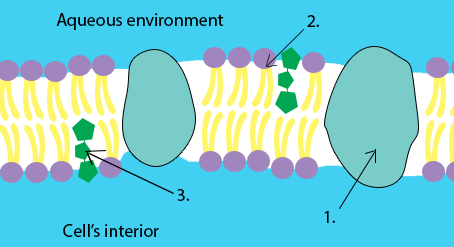
    Structure and function of cell membranes

    (A) Human body is made up of millions of cells – little building blocks of life. Each cell contains many functional subunits (organelles) that enable its proper functioning and is protected from the external environment by a cell membrane. While structure and function of organelles are extensively covered in various biology courses, the importance of study of cell membranes is often underrated. This article is dedicated to provide a short introduction into the basic functions and anatomy of a cell membrane.

    (B) Cell membranes protect and organize cells. Most importantly they serve as barriers, discriminating the cell’s interior from the outer milieu. Because cells always exist in aqueous environment their membranes should be structured in such way so they do not solve in water. This function is ideally carried by special chemical molecules – phospholipids. These molecules are constructed from two parts: tails made up of 2 molecules of fat that ‘avoid’ water and heads that have an affinity for water. For this specific behaviour the phospholipid’s tails are called hydrophobic (‘hydro’ means water and ‘phobia’ means fear) and heads are called hydrophilic (‘philos’ means love). When phospholipids are added to water, they self-assemble into double-layered structures, shielding their hydrophobic portions from water and exposing their hydrophilic portions to the environment. This phospholipid bilayer may resemble a sandwich, where phospholipid heads are bread rolls and tails are the sandwich filling.

    (C) In addition to lipids, membranes are loaded with proteins. They usually go through the lipid bilayer and are exposed to both aqueous environment and cell’s interior. In fact, proteins account for roughly half the mass of most cellular membranes. They make the membrane semi-permeable, which means that some molecules can diffuse across the lipid bilayer but others cannot. Small hydrophobic molecules and gases like oxygen and carbon dioxide cross membranes rapidly. Small molecules, such as water and ethanol, can also pass through membranes, but they do so more slowly. On the other hand, cell membranes restrict diffusion of highly charged molecules, such as ions, and large molecules, such as sugars and amino acids. The passage of these molecules relies on specific transport proteins embedded in the membrane.

    (D) Membrane transport proteins are specific and selective for the molecules they move, and they often use energy to enhance passage. Also, these proteins transport some nutrients against the concentration gradient, which requires additional energy. The ability to maintain concentration gradients and sometimes move materials against them is vital to cell health and maintenance. Thanks to membrane barriers and transport proteins, the cell can accumulate nutrients in higher concentrations than exist in the environment and, conversely, dispose of waste products.

    (E) Other membrane-embedded proteins have communication-related jobs. Large molecules from the extracellular environment, such as hormones or immune mediators, bind to the receptor proteins on the cell membrane. Such binding causes a conformational change in the protein that transmits a signal to intracellular messenger molecules. Like transport proteins, receptor proteins are specific and selective for the molecules they bind.

    (F) Another important type of membrane’s components are cholesterol molecules, which account for about 20 percent of the lipids in animal cell plasma membranes. However, cholesterol is not present in bacterial membranes or mitochondrial membranes. The cholesterol molecules are embedded in place of phospholipid molecules and help to regulate the stiffness of membranes. To function properly, the cell membrane should be in fluid state. Cholesterol reduces membrane fluidity at moderate temperatures by reducing the moving of phospholipids. But at low temperatures, it hinders solidification by disrupting the regular packing of phospholipids.

    Questions 28-30

    Label the diagram below.
    Write NO MORE THAN ONE WORD from the passage for each answer. Do not write the articles.

    Which elements of cell membrane correspond to the numbers in the diagram?

    IELTS Reading text - cell

    Questions 31-35

    Reading Passage 3 has six paragraphs, A-F.

    Which paragraph contains the following information?

    Write the correct letter, A–F, in boxes 31–35 on your answer sheet.

    31. Specific proteins transport nutrients from the external environment against the concentration gradient. 

    32. The barrier function of cell membranes is supported by a bilayer of phospholipids. 

    33. The level of membrane fluidity is regulated by cholesterol molecules. 

    34. The importance of cell membranes are often underestimated. 

    35. Proteins make the membrane semi-permeable. 

    Questions 36–40

    Complete the summary below.

    Choose ONLY ONE WORD from the passage for each answer.
    Write your answers in boxes 36–40 on your answer sheet.

    Cell membranes protect cells and organize their activities. The first main function of cell membrane – barrier function – is carried by phospholipids. These molecules don’t solve in water and, thus, are ideal for cells that always exist in 36.  environment.

    In addition to lipids, membranes are loaded with 37.  that make the membrane 38.  , which means that some molecules can diffuse across the lipid bilayer but others cannot. One of the most important types of membrane proteins are 39.  proteins and receptor proteins.

    The last type of membrane elements are cholesterol molecules, which are embedded in place of 40.  molecules and help to regulate the stiffness of membranes.

  • IELTS Reading Practice Test – Exercise 266

    READING PASSAGE 2

    You should spend about 20 minutes on Questions 15-27, which are based on Reading Passage 2 below.

    How I was floored by a tick

    When Allan Little began to feel ill, he knew almost immediately what it was – Lyme Disease. But getting a medical diagnosis, and treatment, took a lot longer. I’d been going for years to the same little town in New England and Lyme Disease is everywhere there. You can’t walk more than a few hundred metres in the countryside without coming across a public health notice warning you not to get bitten by a deer tick.

    So the intense headache, the aching limbs, the burning joints, the ferocious fever and night sweats that hit me in a matter of hours, a few days after I’d got back to London, were all consistent with what I’d read about the condition. I went to a London GP, who wasn’t convinced. She took a blood sample and advised me to go home, rest, and take paracetamol. The next day, the blood test came back. It was negative for Lyme. My condition grew worse. I could hardly stand up. I called another doctor, who came to my house. He was also sceptical. He took another blood test. This too came back negative. But he gave me a prescription for powerful painkillers which made me feel well enough to get on a train to Edinburgh, my home town.Within three hours of arriving at Waverley Station I was an in-patient in the Infectious Diseases Department of the city’s Western General Hospital: diagnosis, Acute Lyme Disease. By now I had found the tick bite and the distinctive livid red rash, about six inches in diameter. (To be fair to those London GPs, I hadn’t noticed it when I’d consulted them.)

    “It’s attacked your liver,” the Edinburgh Consultant said. “You have three distinct kinds of liver inflammation”. I made a lame sick-bed joke: “You’re sure that’s not like Lager-and-Lime Disease then?” She laughed politely and reassured me that that would look quite different. Why then had both blood tests come back negative? Dr Roger Evans of Raigmore Hospital in Inverness is one of the UK’s leading Lyme Disease researchers. “In early Lyme Disease,” he told me, “the test is not reliable because no antibodies have been produced. In the first few weeks of infection, you could test negative, but still have Lyme Disease.”

    This is a problem for GPs, especially in urban centres where Lyme Disease is unfamiliar. Lyme is not a viral infection. It’s bacterial. GPs will not prescribe antibiotics if they think you’re showing symptoms of a viral infection – and it does look and feel like a bad case of flu, or chronic fatigue syndrome, neither of which can, or should, be treated with antibiotics. “In the early weeks of infection, when the blood test is not reliable,” says Evans, “the GP needs to assess the patient clinically, looking for other symptoms that identify Lyme Disease.” In other words, symptoms that distinguish it from flu.

    If you have been bitten:

    • Remove the tick as soon as possible – the safest way is to use a pair of fine-tipped tweezers, or a tick removal tool
    • Grasp the tick as close to the skin as possible, pull upwards slowly and firmly, as mouthparts left in the skin can cause a local infection
    • Once removed, apply antiseptic to the bite area, or wash with soap and water and keep an eye on it for several weeks for any changes
    • Contact your GP if you begin to feel unwell and remember to tell them you were bitten by a tick or have recently spent time outdoors

    Catching it early is vital. Angela Howard fell ill with Lyme Disease in the 1990s. She had never heard of it. Her doctor, she says, told her to go home and see whether her symptoms persisted. It was only when a visiting American friend saw the distinctive rash – concentric red rings around the place where the tick bite had occurred that she realised she might have Lyme Disease. She says her doctor was still reluctant to diagnose Lyme. “Doctors say you can only get this abroad – that it comes from overseas. But I hadn’t been abroad. I’d been picnicking in Wiltshire.” She was not treated early and her symptoms have persisted for years.

    There is an accumulation of anecdotal evidence that Lyme Disease often goes undiagnosed. One problem is that no-one knows how prevalent it now is. It is not a notifiable disease in the National Health Service – doctors are not required to inform a central database when they diagnose it. So there is no reliable evidence of how widespread it is, or where in the country you are most likely to get it. Roger Evans at Raigmore Hospital wants to remedy that.

    “We’re using Scotland as a pilot study,” he said. “We’re trying to create maps of areas where there’s a risk of tick exposure. We’re using satellite data from the European Space Agency to create an app that will give information, but which will also be interactive, so that users can put in information about where they’ve been bitten and whether the Lyme Disease rash has appeared.” Why has Lyme, which 30 years ago seemed largely limited to a small area of New England – Lyme is the town in Connecticut where it was first identified – now so prevalent across the continental USA and in Europe? One theory is climate change: that small gradations in climate can create new habitats for micro-organisms, or keep them alive and active for longer.

    I was struck, at the time of my own treatment, that awareness was far greater in Scotland than in England and Wales. And awareness of the condition is vital to catching it early. For when you catch it early, treatment is easy and in most cases successful. It floors you though. It took me four or five months to get my strength and stamina back. It is a debilitating and dangerous illness and there is no doubt that it is getting more common. You can get it in the Scottish Highlands, in Devon and Cornwall, in Richmond Park in London and probably in your own back garden – anywhere where there are small furry animals on whose skins a deer tick can live. If you get it, you can get treatment. But take it from me: it really helps if you know what it is you’ve got.

    Questions 15-22

    Do the following statements agree with the information given in Reading Passage 1?

    In boxes 15-22 on your answer sheet, write

    TRUE                          if the statement agrees with the information

    FALSE                        if the statement contradicts the information

    NOT GIVEN                if there is no information on this

    15. Alan had no doubt about his illness from the beginning.                TRUE               FALSE               NOT GIVEN          

    16. Both blood tests were negative for Lyme Disease.                TRUE               FALSE               NOT GIVEN          

    17. Alan didn’t become a Waverley Station patient for more than 3 hours.                TRUE               FALSE               NOT GIVEN          

    18. Blood tests were inaccurate because they were taken unprofessionaly.                TRUE               FALSE               NOT GIVEN          

    19. Lyme Disease is very unfamiliar in the UK.                TRUE               FALSE               NOT GIVEN          

    20. When bitten, you should remove the tick, preferably with a tool.                TRUE               FALSE               NOT GIVEN             

    21. After you remove the tick and apply antiseptic, you should take paracetamol.                  TRUE                 FALSE                 NOT GIVEN               

    22. It is advise to contact a doctor, if you feel ill after removing the tick.                TRUE               FALSE               NOT GIVEN          

    Questions 23-27

    Complete the sentences below.

    Write NO MORE THAN TWO WORDS from the passage for each answer.

    Write your answers in boxes 23-27 on your answer sheet.

    23. Angela’s friend recognized the Lyme Disease as soon as she saw the  rash.

    24. One problem is, it’s unknown how  Lyme Disease is nowadays.

    25. Roger Evans says that they try to create maps of Scotland where there’s a risk of  .

    26. The one possible reason for Lyme Diseaes to move all over the world is  .

    27. You can catch the disease even in your own back  .

  • IELTS Reading Practice Test – Exercise 265

    READING PASSAGE 1

    You should spend about 20 minutes on Questions 1-13, which are based on Reading Passage 1 below.

    We French do love to demonstrate

    (A) Josiane Bertrand has a small family business – a neighbourhood charcuterie selling sausage, poached pigs’ trotters, pate and jellied pig snouts. Her ham, she says, is the best in Paris and her queue of customers is long. Despite the ceaseless rain outside – among all its other woes, France is now flooding – it’s a convivial crowd waiting to be served, and the animated conversation is all about strikes.

    (B) If the opinion pages of Le Monde are to be believed, the charcuterie queue is a pretty accurate reflection of the mood of the country. Split, roughly half and half, between those for the Work Bill and those against. Philippe’s 28. He’s landed what most French would regard as a dream job. He’s a fonctionnaire working in local government. A fonctionnaire is an employee of the French state in almost any form of public administration and service. It’s a job for life – with solid pay and conditions, fixed working hours, a good pension, generous holidays. So, what many young French people aspire to is not to change the world – explore, create, set-up alone – but, with self-employment difficult and taxes punitive, they dream of becoming steadily employed bureaucrats.

    (C) Philippe knows he’s lucky. And he’s against any change. “I’m happy,” he says. “I know exactly where I am and where I’ll be in 40 years’ time, with a good pension.” Eleonore, who has four children, two of them dancing around the shop as they wait, is in her early 40s. As a secondary school teacher she has also got a job for life and generous state benefits. But, unlike Philippe, she’s all for change. “It can’t go on like this. For every person like me, there are 20 or more with no hope at all,” she says.

    (D) A quarter of all French people under 25, many of them well-qualified, have no work. A large number of those are from immigrant families, making their chances of employment even slimmer. These are the kind of people who voted Francois Hollande into the presidency in 2012, with his pledge to end the country’s employment troubles.

    (E) Now he’s made a new promise, putting his own political career on the line – he’s not running for re-election next spring unless he cuts unemployment. A bold move for a president with an approval rating of only 14% in a country riven by industrial disputes. Along with his prime minister, Manuel Valls, and Pierre Gattaz – known as the “boss of bosses”, president of Medef, the largest federation of employers in France – Hollande stands against the combined power of the country’s two biggest unions.

    (F) The proposed Work Bill runs to over 500 pages. It aims to simplify and liberalise the French Work Code which, at 3,689 pages, is a vast labyrinth beset with perils for employers. The unions won’t even consider negotiations until the bill is removed from parliament. The president and his allies refuse to change a word of it. “It’s a good law, good for France,” says Hollande. The result? Total stalemate. An ongoing siege. Just after one o’clock on the glassed-in terrace of a popular restaurant on the Boulevard Montparnasse, and everything begins to go quiet. The traffic disappears from the street. Cordons of riot police move in, three columns deep, flanked by armoured vans. There’s a whirr of helicopters overhead.

    (G) In the distance, a gathering roar and blare – the protesters. The noise becomes deafening. The riot police take up positions. Frederique, the waiter, temporarily locks the doors – and those having lunch find themselves exhibits in a kind of transparent, gastronomic showcase along with various grilled fish, bottles of wine and assorted desserts. Looking in from the outside, hundreds of protesters passing down the boulevard, some marching, others ambling, a few dancing to music booming from the accompanying floats. Looking out from the inside, the lunchers. The lunchers comment on the demonstrators, the demonstrators wave cheerily at the lunchers. There’s general resigned, amused talk amid the eating – “Here we go again,” and “Where will this round end?” And self-deprecating comments such as, “We French do love to demonstrate…”

    (H) Then it all subsides, passes on, the noise, the marchers, the red balloons and pounding music, leaving a trailing wake of litter. Frederique unlocks the doors. The conversation leaves the political, returns to the personal. Similar reforms have already been implemented in Italy and Spain. Germany did so long ago – its unemployment, at 5%, is less than half that of France, which according to some commentators here now stands alone as the last bastion of 20th Century-style socialism in Europe.

    Questions 1-8

    Reading Passage 1 has eight paragraphs, A-H.

    Which paragraph contains what information? Choose the headings and write the correct letter, A-H, in boxes 1-8 on your answer sheet.

    1. A bold promise 

    2. Similar reforms in other countries 

    3. A refusal to change the law 

    4. Unemployment rate statistics 

    5. The dream of young French people 

    6. Different opinions 

    7. Best ham in all Paris 

    8. The demonstration itself 

    Questions 9-13

    Do the following statements agree with the information given in Reading Passage 1?

    In boxes 9-13 on your answer sheet, write

    TRUE if the statement agrees with the information

    FALSE if the statement contradicts the information

    NOT GIVEN if there is no information on this

    9. Most french would say that Philippe has a very good job.            TRUE           FALSE           NOT GIVEN         

    10. Eleonore and Philippe have same views on the situation.            TRUE           FALSE           NOT GIVEN         

    11. 25% of all people in France have no job.            TRUE           FALSE           NOT GIVEN         

    12. Francois Hollande might not run for re-election next year.            TRUE           FALSE           NOT GIVEN         

    13. The French Work Code is concidered simplier than the proposed Work Bill.            TRUE           FALSE           NOT GIVEN         

    14. The unemployment rate in Spain is less than in Italy.            TRUE           FALSE           NOT GIVEN         

  • IELTS Reading Practice Test – Exercise 264

    READING PASSAGE 3

    You should spend about 20 minutes on Questions 26-40, which are based on Reading Passage 3 below.

    Cognitive dissonance

    (A) Charles Darwin said, “This not the strongest of the species that survive, nor the most intelligent, but the one most responsive to change.” So you’ve sold your home, quit your job, shunned your colleagues, abandoned your friends and family. The end of the world is nigh, and you ‘know for a fact’ that you are one of the chosen few who will be swept up from the ‘great flood’ approaching on 21st December at midnight to be flown to safety on a far off planet. And then midnight on 21st December comes around and there is no flood. No end of the world. No flying saucer to the rescue. What do you do? Admit you were wrong? Acknowledge that you gave up position, money, friends – for nothing? Tell yourself and others you have been a schmuck? Not on your life.

    (B) Social psychologist Leon Festinger infiltrated a flying saucer doomsday cult in the late 1950s. The members of this cult had given up everything on the premise that the world was about to self destruct and that they, because of their faith, would be the sole survivors. In the lead up to the fateful day, the cult shunned publicity and shied away from journalists. Festinger posed as a cultist and was present when the space ship failed to show up. He was curious about what would happen. How would the disappointed cultists react to the failure of their prophecy? Would they be embarrassed and humiliated? What actually happened amazed him.

    (C) Now, after the non-event, the cultists suddenly wanted publicity. They wanted media attention and coverage. Why? So they could explain how their faith and obedience had helped save the planet from the flood. The aliens had spared planet earth for their sake – and now their new role was to spread the word and make us all listen. This fascinated Festinger. He observed that the real driving force behind the cultists’ apparently inexplicable response was the need, not to face the awkward and uncomfortable truth and ‘change their minds’, but rather to ‘make minds comfortable’ – to smooth over the unacceptable inconsistencies.

    (D) Festinger coined the term ‘cognitive dissonance’ to describe the uncomfortable tension we feel when we experience conflicting thoughts or beliefs (cognitions), or engage in behavior that is apparently opposed to our stated beliefs. What is particularly interesting is the lengths to which people will go to reduce the inner tension without accepting that they might, in fact, be wrong. They will accept almost any form of relief, other than admitting being at fault, or mistaken. Festinger quickly realized that our intolerance for ‘cognitive dissonance’ could explain many mysteries of human behavior.

    (E) In a fascinating experiment Festinger and his colleagues paid some subjects twenty dollars to tell a specific lie, while they paid another group of subjects only one dollar to do the same. Those who were paid just one dollar were far more likely to claim, after the event, that they had actually believed in the lie they were told to tell. Why? Well, because it’s just so much harder to justify having done something that conflicts with your own sense of being ‘an honest person’ for a mere pittance. If you get more money, you can tell yourself: ‘Yeah, I lied, but I got well paid! It was justified.’ But for one dollar? That’s not a good enough reason to lie, so what you were saying must have been true in the first place, right?

    (F) Emotional factors influence how we vote for our politicians much more than our careful and logical appraisal of their policies, according to Drew Westen, a professor of psychiatry and psychology. This may come as little surprise to you, but what about when we learn that our favored politician may be dishonest? Do we take the trouble to really find out what they are supposed to have done, and so possibly have to change our opinions (and our vote), or do we experience that nasty cognitive dissonance and so seek to keep our minds comfortable at the possible cost of truth?

    (G) Cognitive dissonance is essentially a matter of commitment to the choices one has made, and the ongoing need to satisfactorily justify that commitment, even in the face of convincing but conflicting evidence. This is why it can take a long time to leave a cult or an abusive relationship – or even to stop smoking. Life’s commitments, whether to a job, a social cause, or a romantic partner, require heavy emotional investment, and so carry significant emotional risks. If people didn’t keep to their commitments, they would experience uncomfortable emotional tension. In a way, it makes sense that our brains should be hard-wired for monitoring and justifying our choices and actions – so as to avoid too much truth breaking in at once and overwhelming us.

    (H) I guess we can’t really develop unless we start to get a grip and have some personal honesty about what really motivates us. This is part of genuine maturity. If I know I am being lazy, and can admit it to myself, that at least is a first step to correcting it. If, however, I tell myself it’s more sensible to wait before vacuuming, then I can go around with a comfortable self-concept of ‘being sensible’ while my filthy carpets and laziness remain unchanged. Cognitive dissonance can actually help me mature, if I can bring myself, first, to notice it (making it conscious) and second, to be more open to the message it brings me, in spite of the discomfort. As dissonance increases, providing I do not run away into self-justification, I can get a clearer and clearer sense of what has changed, and what I need to do about it.
    And then I can remember what Darwin had to say about who will survive…

    Questions 26-33

    Reading Passage 3 has eight paragraphs, A–H. Choose the most suitable headings for these paragraphs from the list of ten headings below. Write the appropriate number i-x in the text boxes 26-33. There are more paragraph headings than paragraphs, so you will not use them all.

    List of headings:

    i. Leon Festinger: On being stood up by the aliens
    ii. Dishonest politicians? Never!
    iii. Mind manipulation: the true reason of strange behaviour
    iv. You can’t handle the truth!
    v. The catastrophe of 21st December
    vi. Grow up – make cognitive dissonance work for you
    vii. How many dollars would you take to tell a lie?
    viii. Revealing mysteries: Darwin was right.
    ix. Cognitive dissonance: who are you kidding?
    x. The high cost of commitment exposes us to cognitive dissonance

    26. Passage A 

    27. Passage B 

    28. Passage C 

    29. Passage D 

    30. Passage E 

    31. Passage F 

    32. Passage G 

    33. Passage H 

    Questions 34-40

    Choose the correct letter, A, B, C or D.

    Write the correct letter in boxes 34-40 on your answer sheet.

    34. After the space ship didn’t show up on the fateful day, the members of flying saucer doomsday cult

    1.  didn’t want to admit the uncomfortable truth and still believed that the world would self destruct.
    2.  were embarrassed and humiliated because of their failure.
    3.  wanted media attention to say that they saved the planet.

    35. The main reason why people fight cognitive dissonance is

    1.  a desire to reduce the inner tension.
    2.  people’s unwillingness to accept their mistakes.
    3.  wish to avoid the awkward feeling of lying for not a good reason.

    36 During the experiment, people who were telling lies were more likely to claim that they believed in the lie if

    1.  they were paid less.
    2.  they were paid more.
    3.  they felt uncomfortable because of lying

    37. Commitment to the choices someone has made, and the ongoing need to justify that commitment, despite the conflicting evidence can be explained by the fact that

    1.  it causes uncomfortable emotional tension.
    2.  commitments require heavy emotional investment.
    3.  our brain always justifies our choices.

    38. The big part of genuine maturity is the ability of

    1.  sensible reasoning.
    2.  disregarding cognitive dissonance.
    3.  being honest with yourself.

    39. According to the text, which of the situations below is NOT an example of cognitive dissonance?

    1.  A man learns that his favored politician is dishonest, but continues to vote for him.
    2.  A woman doesn’t want to do vacuuming, but convinces herself that otherwise her carpet will remain filthy and finally does it.
    3.  A woman has been dating with her boyfriend for five years. Everyone tells her that it’s an abusive relationship because he often beats and humiliates her, but she doesn’t want to leave her romantic partner.

    40. Charles Darwin quote from the beginning of the text implies that

    1.  cognitive dissonance helps us to change and therefore makes us more enduring species
    2.  people often accept almost any form of relief, rather than admitting being at fault, to survive.
    3.  fighting the discomfort caused by cognitive dissonance is a survival mechanism developed during the evolution.
  • IELTS Reading Practice Test – Exercise 263

    READING PASSAGE 2

    You should spend about 20 minutes on Questions 14-25, which are based on Reading Passage 2 below.

    Making sense of scent

      With every whiff you take as you walk by a bakery, a cloud of chemicals comes swirling up your nose. Identifying the smell as freshly baked bread is a complicated process. But, compared to the other senses, the sense of smell is often underappreciated.

      In a survey of 7,000 young people around the world, about half of those between the age of 16 and 30 said that they would rather lose their sense of smell than give up access to technology like laptops or cell phones.

      We’re not that acutely aware of our use of olfaction in daily living. In fact, mammals have about a thousand genes that code for odor reception. And even though humans have far fewer active odor receptor genes, 5 percent of our DNA is devoted to olfaction, a fact that emphasizes how important our sense of smell is.

     Smell begins at the back of nose, where millions of sensory neurons lie in a strip of tissue called the olfactory epithelium. Molecules of odorants pass through the superior nasal concha of the nasal passages and come down on the epithelium. The tips of the epithelium cells contain proteins called receptors that bind odor molecules. The receptors are like locks and the keys to open these locks are the odor molecules that float past, explains Leslie Vosshall, a scientist who studies olfaction.

      People have about 450 different types of olfactory receptors. (For comparison, dogs have about two times as many.) Each receptor can be activated by many different odor molecules, and each odor molecule can activate several different types of receptors. However, the forces that bind receptors and odor molecules can vary greatly in strength, so that some interactions are better “fits” than others.

      The complexity of receptors and their interactions with odor molecules are what allow us to detect a wide variety of smells. And what we think of as a single smell is actually a combination of many odor molecules acting on a variety of receptors, creating an intricate neural code that we can identify as the scent of a rose or freshly-cut grass.

     This neural code begins with the nose’s sensory neurons. Once an odor molecule binds to a receptor, it initiates an electrical signal that travels from the sensory neurons to the olfactory bulb, a structure at the base of the forebrain that relays the signal to other brain areas for additional processing.

      One of these areas is the piriform cortex, a collection of neurons located just behind the olfactory bulb that works to identify the smell. Smell information also goes to the thalamus, a structure that serves as a relay station for all of the sensory information coming into the brain. The thalamus transmits some of this smell information to the orbitofrontal cortex, where it can then be integrated with taste information. What we often attribute to the sense of taste is actually the result of this sensory integration.

      “The olfactory system is critical when we’re appreciating the foods and beverages we consume,” says Monell Chemical Senses Center scientist Charles Wysocki. This coupling of smell and taste explains why foods seem lackluster with a head cold.

      You’ve probably experienced that a scent can also conjure up emotions and even specific memories, like when a whiff of cologne at a department store reminds you of your favorite uncle who wears the same scent. This happens because the thalamus sends smell information to the hippocampus and amygdala, key brain regions involved in learning and memory.

      Although scientists used to think that the human nose could identify about 10,000 different smells, Vosshall and her colleagues have recently shown that people can identify far more scents. Starting with 128 different odor molecules, they made random mixtures of 10, 20, and 30 odor molecules, so many that the smell produced was unrecognizable to participants. The researchers then presented people with three vials, two of which contained identical mixtures while the third contained a different concoction, and asked them to pick out the smell that didn’t belong.

      Predictably, the more overlap there was between two types of mixtures, the harder they were to tell apart. After calculating how many of the mixtures the majority of people could tell apart, the researchers were able to predict how people would fare if presented with every possible mixture that could be created from the 128 different odor molecules. They used this data to estimate that the average person can detect at least one trillion different smells, a far cry from the previous estimate of 10,000.

      This number is probably an underestimation of the true number of smells we can detect, said Vosshall, because there are far more than 128 different types of odor molecules in the world. And our olfaction is quite powerful comparing to other mammals. For example, marine animals can detect only water-soluble odorants.

      No longer should humans be considered poor smellers. “It’s time to give our sense of smell the recognition it deserves,” said Vosshall.

    Questions 14-19

    Do the following statements agree with the information given in Reading Passage 1?

    In boxes 14-19 on your answer sheet, write

    TRUE if the statement agrees with the information

    FALSE if the statement contradicts the information

    NOT GIVEN if there is no information on this

    14. In general, olfaction and sense of taste are considered equally important.                TRUE               FALSE               NOT GIVEN          

    15. About 7,000 young people around the world would prefer losing their sense of smell than access to laptops.                TRUE               FALSE               NOT GIVEN          

    16. Odor reception is an integral function of all mammals.                TRUE               FALSE               NOT GIVEN          

    17. Superior nasal concha is compared to a lock and odor molecules are like keys that are used to open it.                TRUE               FALSE               NOT GIVEN          

    18. Cats have two times as many olfactory receptors as humans.                TRUE               FALSE               NOT GIVEN          

    19. We are able to detect a lot of different scents because of a variety of odor receptors, which translate impact of molecules into a neural code.                TRUE               FALSE               NOT GIVEN          

    Questions 20-25

    Complete the sentences below.

    Write NO MORE THAN TWO WORDS from the passage for each answer.

    Write your answers in boxes 20-25 on your answer sheet.

    20. The part of our brain responsible for identifying the smell is called  .

    21. The  is a region in our brain that serves as a transition station for all sensory information that we receive.

    22. Sense of smell is closely related to  .

    23.  and  are involved in arousing memories caused by specific smells.

    24. The experiment proved that the average person can discriminate between at least  smells.

    25. Sea mammals can smell only odorants that are  in water.

  • IELTS Reading Practice Test – Exercise 262

    READING PASSAGE 1

    You should spend about 20 minutes on Questions 1-12, which are based on Reading Passage 1 below.

    Harsh marks ‘put pupils off languages’

    (A) Harsh and inconsistent marking is putting pupils in England off studying languages beyond age 14, a report says. The dawn of more rigorous GCSEs will further reduce interest in languages, research by the British Council and Education Development Trust suggests. It says a focus on maths and sciences, as well as a perception languages are a hard option, is also de-motivating pupils and teachers.

    (B) Exams watchdog Ofqual said last year’s languages results were “very stable”. From September 2016, new GCSE and A-level modern language syllabuses will be taught in England, and new exams will be taken in the summer of 2018. The Language Trends Survey, in its 14th year of charting the state of language learning in England’s schools, suggests these changes – particularly at A-level – will deter pupils from studying languages. It says: “The exam system is seen as one of the principal barriers to the successful development of language teaching. “The comparative difficulty of exams in languages in relation to other subjects, and widely reported harsh and inconsistent marking, are deeply de-motivating for both pupils and teachers.”

    (C) The report says the EBacc, where pupils have to study English, a language, maths, science and history or geography to GCSE, “appears to be having very little impact on the numbers of pupils taking languages post-16”. Uptake after GCSE is found to be a particular concern, with some state schools suggesting the small numbers of students opting to take languages at A-level means the subject is becoming “financially unviable”.

    (D) The proportion of the total cohort sitting a GCSE in a language dropped by one percentage point (to 48%) between 2014 and 2015, ending the rise in entries seen from 2012 onward, when the EBacc was brought in. Entries for each of the three main languages fell this year compared with 2014, French is down 6%, German is down 10% and Spanish is down 3%. Overall entries for languages at A-level are at 94% of their 2002 level, and they declined by 3% between 2014 and 2015 – French uptake declined by 1% and German by 2.5% while Spanish uptake rose by almost 15%.

    (E) The report does note some positive developments, particularly at primary level, saying just over half of England’s primary schools now have access to specialist expertise in the teaching of languages. But primary schools report finding it hard to fit languages into the curriculum time available and to recruit suitably qualified teaching staff. Teresa Tinsley, co-author of the report, said: “Languages are already one of the harder GCSEs, and teachers fear that with the new exams it will be even tougher for pupils to get a good grade. “Combine this with the expectation that a wider range of pupils will be sitting the exam and it is not surprising that teachers feel embattled. “Improving their morale and confidence in the exam system is crucial if languages are to thrive in our schools.”

    (F) A spokesman for the exam regulator, Ofqual, said: “We are committed to ensuring that all GCSEs, AS- and A-levels, including those in modern foreign languages, are sufficiently valid, produce fair and reliable results and have a positive impact on teaching and learning. “Last year’s results in modern foreign languages were very stable, with only small changes in the proportions achieving each grade compared to the previous year. “We have looked into concerns that it is harder for students to achieve the highest grades in A level languages. “We found this is because of the way the exams are designed, rather than the nature of the subject content. “We are keeping this under review and will be further publishing information shortly.”

    (G) Referring to the new modern foreign language A-levels and GCSEs being taught from this September, the spokesman added: “Before we accredit a qualification, we check the exams will be designed to allow good differentiation – including that the best students will be able to achieve the highest grades – and whether they are properly based on the new subject content.”

    (H) Mark Herbert, head of schools programmes at the British Council, said: “The country’s current shortage of language skills is estimated to be costing the economy tens of billions in missed trade and business opportunities every year. “Parents, schools and businesses can all play their part in encouraging our young people to study languages at school and to ensure that language learning is given back the respect and prominence that it deserves.” Tony McAleavy, director of research and development at the Education Development Trust, said: “The reduction in pupils opting for GCSE and A-level languages is concerning, particularly coupled with teachers’ lack of faith in the exam system. “Solutions are required to give languages a firmer place in the curriculum, to make languages more compelling for pupils who find the examination process a barrier and to boost teacher morale.”

    Questions 1-8

    Reading Passage 1 has eight paragraphs, A-H.

    Choose the most suitable paragraph headings from the list of headings and write the correct letter, A-H, in boxes 1-8 on your answer sheet.

    1. Data about studying 

    2. Stable results 

    3. Heavy economic losses 

    4. Fairness of the exams 

    5. A hard option 

    6. A-level changings 

    7. The most important thing for languages to be able to prosper 

    8. Weak influence on pupils 

    Questions 9-13

    Classify the events with the following dates.

    A. 2018

    B. 2016

    C. 2014-2015

    D. None of the above

    In boxes 9-13 on your answer sheet, write either A, B, C or D.

    9. A Drop of GCSE to 48% 

    10. New syllabus system arrives in England 

    11. The start of new exams 

    12. The rise in entries 

    13. The decline of French by 1 percent