Author: IELTS BRIDGE

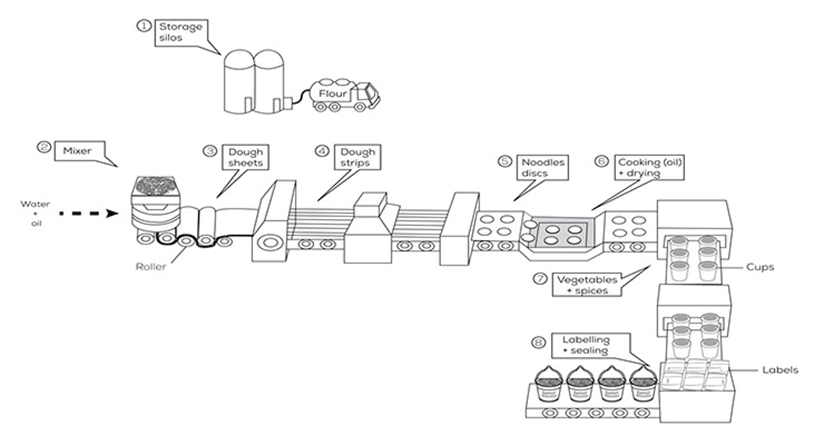
  • The diagram below shows how instant noodles are manufactured. IELTS Cambridge 15 – Test 3 (Task 1)

    The illustration captures the detailed process of manufacturing instant noodles. To sum up, this sequential procedure involves eight distinct stages, starting with storing flour in silos and concluding with carefully labeling and sealing cups.

    The initial phase requires pumping flour from a truck into tower silos for temporary storage, followed by blending it with oil and water in a mixing machine. The ultimate step involves rolling the blended mixture to create dough sheets, subsequently using a machine to separate them into strips.

    Continuing, the process shapes these dough strips into disc-shaped noodles, subjects them to oil cooking, and allows them to dry. After drying, the noodle discs are combined with a variety of spices and vegetables before being meticulously placed into packaging cups.

    The entire procedure concludes with systematically labeling and sealing these cups, ensuring the production of high-quality instant noodles. This comprehensive process showcases the precision and care involved at each stage of instant noodle production.

  • Some people say that advertising is extremely successful at persuading us to buy things. Other people think that advertising is so common that we no longer pay attention to it. IELTS Cambridge 15 – Test 3 (Task 2)

    Question – Some people say that advertising is extremely successful at persuading us to buy things. Other people think that advertising is so common that we no longer pay attention to it. Discuss both these views and give your own opinion.Give reasons for your answer and include any relevant examples from your own knowledge or experience. Write atleast 250 words.

    In today\’s dynamic marketplace, opinions about the effectiveness of advertising diverge. While some argue it significantly influences consumer decisions, others view it as commonplace, losing its ability to capture attention. In this perspective, I assert that advertising remains a compelling force, especially with the surge in its prevalence on social media, driving demand for various goods.

    To thrive in this competitive landscape, industries employ a diverse array of marketing techniques. From enticing packaging designs and coupons to steep discounts and other offers, businesses strive to attract clients and boost sales. Leveraging cutting-edge technological innovations, such as email newsletters and online promotions, companies not only reach their target audience but also witness significant growth in clientele.

    A recent survey by the Times of India highlights a noteworthy increase in online sales over the last five years, underlining a distinct shift in advertising methods. Even with continuous changes to advertising strategies, the art of persuasion remains a pivotal function, influencing consumer choices.

    On the positive side, most people are now conscious of advertising traps, leading to a shift in behavior. Online advertising, with its pop-ups, banners, spam, and auto-playing videos, seldom captures the attention of potential customers. Users have developed an automatic response of quickly closing pop-up windows, skipping YouTube ads, and navigating past in-page ads. Even less obvious marketing strategies, like those on social media platforms such as Instagram, prove challenging for advertisers but are recognized by users due to their sheer frequency.

    In conclusion, massive advertising campaigns have undeniably succeeded in creating consumer demand. The evidence lies in our inclination to consistently purchase and accumulate a variety of goods. However, it\’s essential to acknowledge that, regardless of the platform, consumers tend to selectively ignore certain advertisements in their media channels. As the advertising landscape continues to evolve, understanding these nuances becomes crucial for effective brand communication.
  • The chart below shows what Anthropology graduates from one university did after finishing their undergraduate degree course. The table shows the salaries of the anthropologists in work after five years. IELTS Cambridge 15 – Test 4 (Task 1)

    After completing their undergraduate degrees in Anthropology, a pie chart depicts the employment situation of graduates from a specific university, while a table illustrates the salaries of three different types of employment for Anthropologists after five years.

    The largest proportion of Anthropology graduates chose to pursue postgraduate study and part-time employment, contrasting with those who opted for part-time employment exclusively. After five years, the percentages of anthropologists in the government sector with the highest salary range and those working as independent consultants were identical, while the highest percentage was observed among those in the government sector with the lowest salary range.

    The pie chart indicates that 52% of anthropology graduates worked full-time, with lower percentages for those unemployed or working part-time at 12% and 15%, respectively. Only 5% of Anthropology graduates chose part-time jobs while pursuing postgraduate studies, with the same numbers for those opting for full-time postgraduate study and the unidentified group, both at 8%.

    In reference to the table, graduates of anthropology programs earning between $25,000 and $499,999 had the lowest percentage of individuals employed as independent contractors and in the government after five years—just 5%, or half as much as those in private enterprises. However, the percentages of people with the highest salaries in the table—40%, 50%, and 30%—who work as independent consultants, in the public sector, and in private businesses were significantly higher.

  • In some cultures, children are often told that they can achieve anything if they try hard enough. IELTS Cambridge 15 – Test 4 (Task 2)

    Question – In some cultures, children are often told that they can achieve anything if they try hard enough. What are the advantages and disadvantages of giving children this message? Write atleast 250 words.

    In numerous cultures, children are frequently instilled with the belief that they can achieve anything through persistent effort. This philosophy has both advantages and disadvantages, shaping the perspectives and behaviors of young individuals.

    On the positive side, fostering a belief in the limitless potential of hard work can cultivate a strong work ethic and resilience in children. When children are encouraged to pursue their goals with determination, they develop a sense of perseverance that can be instrumental in overcoming obstacles and setbacks. This mindset fosters self-confidence and instills in them the notion that challenges are surmountable with dedication and tenacity.

    However, there are potential drawbacks to this approach. Unrealistic expectations may lead to stress and anxiety in children who feel pressured to meet exceedingly high standards. The constant emphasis on individual effort might undermine the recognition of external factors influencing success, such as systemic inequalities or varying opportunities. Moreover, a singular focus on personal effort may neglect the importance of collaboration, teamwork, and adaptability in navigating the complexities of the real world.

    In conclusion, encouraging children to believe in their ability to achieve anything through hard work has merits in fostering resilience and a strong work ethic. Nevertheless, it is crucial to balance this message by acknowledging external factors and promoting a holistic approach that includes collaboration and adaptability. Striking this balance ensures that children develop not only a robust work ethic but also a realistic understanding of the multifaceted nature of success.

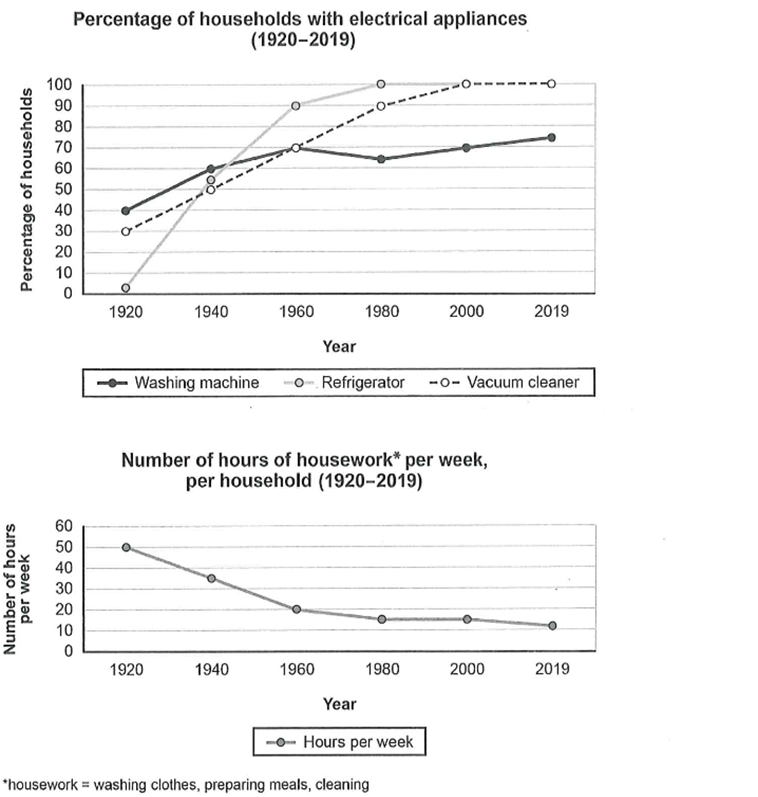
  • The charts below show the changes in ownership of electrical appliances and amount of time spent doing housework and households in one country between 1920 and 2019. IELTS Cambridge 16 – Test 1 (Task 1)

    The process diagram illustrates the recycling of plastic bottles, comprising a total of nine steps. It begins with individuals discarding bottles in the trash and progresses through factory processes utilizing specialized machinery, concluding with the production of items from recycled plastic before restarting the cycle.

    Commencing with the initial three steps, involving collecting and sorting plastic, plastic bottles are initially discarded into garbage bins. Garbage trucks then collect these bins, and the plastic bottles reach a recycling center where manual sorting distinguishes recyclable from non-recyclable bottles.

    The subsequent steps focus on processing recyclable plastic, starting with compressing the recyclable material. Creating recyclable plastic becomes the primary objective in the following stages, where compressed blocks are fed into a grinder, crushed, and placed in a washing tank. Afterward, the plastic undergoes a pellet-forming process through a machine.

    In the remaining stages, the plastic pellets are heated to form raw material suitable for plastic product manufacturing, stacked on pallets for storage. Following this, finished products are created from the raw material. Some completed goods may end up discarded in trash cans, subsequently re-entering the recycling process.

  • In some countries more and more people are becoming interested in finding out about the history of the house or building they live in. IELTS Cambridge 16 – Test 1 (Task 2)

    Question – In some countries more and more people are becoming interested in finding out bout the history of the house or building they live in. What are the reasons for this? How can people research this? Give reasons for your answer and include any relevant examples from your own experience or knowledge. Write atleast 250 words.

    It is not uncommon to observe that a growing proportion of individuals in some nations are interested in learning about the background of the home they live in. This has two primary causes, and there are two avenues via which individuals can learn more.

    The curiosity itself is the first postulated explanation for this trend. More specifically, a lot of people get proud to live in an ancestral home that was constructed by their ancestors. They feel they are in a better social standing as a result. Superstitious myths and beliefs are the second likely explanation for this interest. To put it another way, a lot of people think it\’s bad to live in a home where unexplained deaths have happened. In a similar vein, some people think certain old houses contain hidden treasures.

    To help people in obtaining this information, the first dependable source is from elders or from their own old generations. This way is more convincing for most of such people who are keen to know about the history of their own house. Another reliable way of acquiring this information is from the official records such as the data from the local self- government or local record rooms. It is also seen people searching the history on the internet.

    To conclude, extreme curiosity and traditional beliefs make people search the history of the place they live and the date can be obtained from either the elders or from the official records.

  • How sugar is produced from sugarcane. IELTS Cambridge 16 – Test 2 (Task 1)

    \"\"

    Question – The diagram below shows the manufacturing process for making sugar from sugar cane. Summarise the information by selecting and reporting the main features, and make comparisons where relevant. Write atleast 150 words .

    The diagram illustrates the step-by-step manufacturing process for producing sugar from sugar cane. Initially, workers manually cut mature sugar cane and transport it to the processing facility. The second phase includes crushing the harvested sugar cane to extract juice, a crucial step in sugar production.

    After extracting juice, the subsequent stage focuses on purifying and clarifying. The juice undergoes heating and treatment with lime to eliminate impurities, resulting in a clarified liquid. This liquid then undergoes further processing through multiple filtration stages to ensure the removal of any residual solids.

    The final steps involve concentrating and crystallizing the purified liquid. Boiling the clarified juice reduces its water content, forming a concentrated syrup. Gradually, the syrup undergoes crystallization, producing sugar crystals. The end product is refined sugar ready for packaging and distribution.

    In summary, the sugar manufacturing process involves harvesting and crushing sugar cane, extracting juice, purifying and clarifying the liquid, and finally concentrating and crystallizing it to produce refined sugar. The diagram offers a comprehensive overview of the sequential stages in creating sugar from sugar cane.

  • In their advertising, businesses nowadays usually emphasize that their products are new in some way. IELTS Cambridge 16- Test 2 (Task 2)

    Question – In their advertising, businesses nowadays usually emphasize that their products are new in some way. Why is this? Do you think it is a positive or negative development? Write atleast 250 words.

    Effectively introducing a product across diverse platforms requires a thoughtful and strategic approach to advertising. Companies are continually refining their product presentation strategies, aiming to leave a lasting impression on consumers and drive their preference towards these upgraded and user-friendly items. However, this evolving phenomenon carries a dual nature with both advantages and disadvantages.

    Initiating the advertising journey with the introduction of the same product featuring new aspects brings about numerous benefits for companies, with increased profits being a prominent advantage. Advertisements act as powerful incentives, motivating individuals to opt for products boasting novel features, thereby amplifying the likelihood of a purchase. Conversely, the repetition of the same products can lead to feelings of weariness and dissatisfaction among consumers, elevating the chances of reselling items that were once considered controversial and challenging to market.

    On the flip side, the emphasis on these advertisements may present drawbacks, potentially causing irritation and contributing to negative sentiments. Companies frequently reintroduce items with a negative reputation, but audiences may become fatigued with these repetitive ads, rendering the relaunch of unpopular products ineffective. Moreover, such actions may result in consumer dissatisfaction, potentially affecting the overall perception of other products offered by the same company, as individuals lose interest in the brand.

    In conclusion, the re-launching of products with new features brings about both advantages and disadvantages, influencing consumers\’ interest in the products and their decisions to make a purchase or explore alternatives. Navigating these dynamics requires a continued focus on strategic advertising, striking a delicate balance between the benefits of novelty and the potential drawbacks to sustain consumer engagement and foster brand loyalty.

  • Site of an Airport Now and after Redevelopment. IELTS Cambridge 16 – Test 3 (Task 1)

    \"\"

    Question Site of an Airport Now and after Redevelopment. The plans below show the site of an airport now and how it will look after redevelopment next year.Summarise the information by selecting and reporting the main features and make comparisons where relevant. Write atleast 150 words.

  • Many manufactured food and drink products contain high levels of sugar, which causes many health problems. Sugary products should be made more expensive to encourage people to consume less sugar. IELTS Cambridge 16- Test 3 (Task 2)

    Question- Many manufactured food and drink products contain high levels of sugar, which causes many health problems. Sugary products should be made more expensive to encourage people to consume less sugar. Give reasons for your answer and include any relevant examples from your own knowledge and experiences.

    The excessive consumption of sugar in processed foods and beverages is contributing to a rise in diabetes, obesity, and cardiovascular diseases, posing a significant health concern. While some propose a sugar tax as a deterrent, I argue for its inclusion as one aspect of a broader strategy to promote healthier eating habits. This article explores the need for a comprehensive approach to tackle sugar-related health issues, highlighting the significance of public awareness, industry cooperation, and improved access to nutritious food.

    Overindulging in sugary processed foods and drinks has led to a surge in health problems, from diabetes to cardiovascular diseases. Recognizing the need for intervention, some suggest increasing the cost of high-sugar products to discourage consumption. While acknowledging the potential benefits of this approach, I argue for its integration into a multidimensional plan to effectively combat these health issues.

    A crucial element of any comprehensive plan is raising public awareness. Government campaigns targeting all demographics can encourage healthy eating habits, empowering individuals to make informed dietary choices. Collaboration with food manufacturers is equally vital to ensure a reduction in sugar content and the development of healthier alternatives. By implementing these tactics, individuals can make healthier food choices, contributing to a sustainable shift in dietary habits.

    To address disparities in access to nutritious foods, particularly in low-income communities, it is essential to tackle inequalities. Governments can collaborate with local farmers and small-scale food producers to support the production and distribution of fresh, healthful foods. This approach aims to create a more equitable landscape where everyone has access to nutrient-dense options, fostering healthier communities.