Author: theieltsbridge

  • You have just read an article in a national newspaper

    Question – You have just read an article in a national newspaper which claims that town centres in your country all look very similar to each other. You don’t fully agree with this opinion.
    Write a letter to the editor of the newspaper. In your letter,say which points in the article you agree with , explain ways in which your town centre is different from most other town centres , offer to give a guided tour of your town to the writer of the article. Write at least 150 words.

    Dear Sir or Madam,

    I have recently come across an article, published in your popular daily newspaper, which tried to shed some light on the looks of our town centres in our country. I am writing to thank you for the article, and express my opinion on that. 

    No doubt, it was rather well-written, and I do agree with most of the points that were presented in the article. For example, I agree with the author when he says that the areas of most of the town centres have expanded over the years. I also agree with the fact that the number of parking spaces in and around the city centres has become relatively low.

    However, I do not agree with the author when he claims that city centres in our country, pretty much, look the same. For instance, my city centre looks different since it has managed to preserve many of its old buildings, unlike many other city centres. But, if the author of the article does not believe what I am saying here about my city centre, I would be more than happy to give him a guided tour so that he can witness this fact and get some more insight about it.

    Yours faithfully,

    Morris Buchanon
  • Plastic bags, plastic bottles and plastic packaging are

    Question – Plastic bags, plastic bottles and plastic packaging are bad for the environment.What damage does plastic do to the environment?What can be done by governments and individuals to solve this problem?
    Give reasons for your answer and include any relevant examples from your own knowledge or experience.Write at least 250 words. 

    Plastic bags, plastic bottles, and plastic packaging have become ubiquitous in our daily lives, but their convenience comes at a significant cost to the environment. The environmental damage caused by these plastics is multifaceted, ranging from wildlife harm to pollution of land and water. To address this pressing issue, both governments and individuals must take proactive measures.

    Plastics, particularly bags and packaging, contribute to environmental degradation in various ways. The non-biodegradable nature of plastic means that discarded items persist in the environment for centuries. Marine life often falls victim to plastic pollution as plastic waste contaminates oceans and water bodies. Aquatic ecosystems suffer, and the repercussions extend to human populations as plastic particles enter the food chain through fish and other marine organisms. Moreover, plastic packaging and bottles contribute to overflowing landfills, further diminishing the quality of soil and water resources.

    Governments play a pivotal role in mitigating the impact of plastic on the environment. Enforcing strict regulations on plastic production, encouraging sustainable alternatives, and investing in recycling infrastructure are key steps. Additionally, public awareness campaigns can educate citizens about the environmental consequences of plastic use. On an individual level, reducing plastic consumption is crucial. Individuals can opt for reusable bags, containers, and bottles, minimizing their reliance on single-use plastics. Furthermore, supporting businesses that prioritize eco-friendly packaging and products sends a powerful message to industries.

    In conclusion, the adverse effects of plastic on the environment demand urgent attention and concerted efforts. Governments must implement stringent policies and invest in sustainable practices, while individuals can contribute by making informed choices in their daily lives. By collectively adopting eco-friendly alternatives and minimizing plastic use, we can pave the way towards a cleaner, healthier, and more sustainable planet.

  • Mrs Barrett, an English-speaking woman who lives in your town

    Question – Mrs Barrett, an English-speaking woman who lives in your town, has advertised for someone to help her in her home for a few hours a day next summer.

    Write a letter to Mrs Barrett. In your letter,

    • suggest how you could help her in her home
    • say why you would like to do this work
    • explain when you will and will not be available

    Write at least 150 words.

    Dear Sir or Madam

    I, Sandaruwani Sumanapala, have lived in South Alta for a number of years. Actually, since you advertised in the newspaper last weekend, I would like to let you know that I am willing to assist you with some household chores.

    I would love to work as a volunteer to be a strong contributor for the elderly widow lady like you, even though I am fully occupied with my academic studies. I am also a fantastic kitchen assistant with delicious recipes that allow us to prepare delicious meals based on your preferences.

    In accordance with my summer schedule, I will not be joining you for any evening lectures on weekdays after 2:00 pm. Unfortunately, I will be occupied with driving practical classes every weekend during the summer, so I might find it challenging to relax on the weekends.

    Yours

    Faithfully

    Sandaruwani

    Sumanapala

  • Improvements in health, education and trade are essential

    Question –Improvements in health, education and trade are essential for the development of poorer nations. However, the governments of richer nations should take more responsibility for helping the poorer nations in such areas. To what extent do you agree or disagree with this opinion? You should use your own ideas, knowledge and experience and support your arguments with examples and relevant evidence. You should write at least 250 words.

    The advancement of health, education, and trade is universally acknowledged as pivotal for the progress of impoverished nations. However, the question of responsibility, specifically whether richer nations should play a more substantial role in aiding the development of poorer nations in these areas, remains a subject of considerable debate. In my opinion, I firmly agree that wealthier governments bear a significant responsibility in supporting and facilitating the progress of their less affluent counterparts.

    Primarily, it is imperative to recognize that the well-being of nations is interconnected in the globalized world we inhabit today. The governments of wealthier nations possess the financial resources, technical expertise, and infrastructural capabilities to catalyze meaningful change in health, education, and trade sectors. For instance, financial assistance in establishing healthcare infrastructure, educational institutions, and facilitating fair trade agreements can significantly uplift the socio-economic conditions of struggling nations.

    Moreover, wealthier nations, by aiding their less prosperous counterparts, contribute to the creation of a more stable and secure global environment. Addressing health issues, enhancing education, and promoting fair trade reduce the likelihood of social unrest, conflicts, and mass migrations, which can have repercussions that transcend national borders. Therefore, supporting the development of poorer nations is not just a matter of altruism but a strategic investment in fostering global stability.

    In conclusion, the responsibility of wealthier nations in aiding the development of poorer nations in health, education, and trade is undeniable. Global challenges require global solutions, and richer governments should actively engage in fostering sustainable development to create a more equitable and prosperous world for all.

  • The graph below shows the unemployment rates in the US

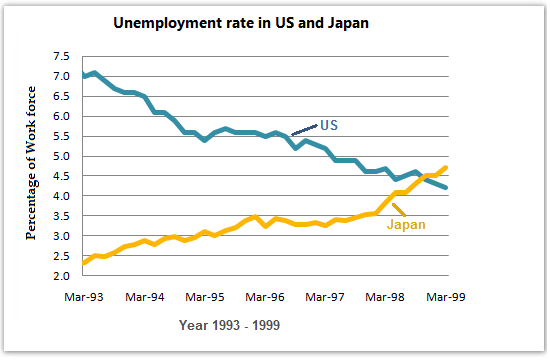
    Question – The graph below shows the unemployment rates in the US and Japan between March 1993 and March 1999.
    Write a report for a university lecturer describing the information shown below. You should write at least 150 words.
    Unemployment in the US and Japan - 1993 & 1999
  • In many countries, children are engaged in some kind of paid work. 

    Question –In many countries, children are engaged in some kind of paid work. Some people regard this as completely wrong, while others consider it as valuable work experience, important for learning and taking responsibility. What are your opinions on this?
    You should use your own ideas, knowledge and experience and support your arguments with examples and relevant evidence. You should write at least 250 words.

    In numerous countries, the issue of children engaging in paid work has sparked a debate, with differing opinions on its ethical and educational implications. Some vehemently oppose the idea, arguing that it is wholly inappropriate for children to work for financial gain. On the other hand, there is a contingent that views it as a valuable experience, instrumental in fostering essential life skills and a sense of responsibility.

    From a critical standpoint, the idea of children working for wages may seem objectionable. Childhood is traditionally perceived as a period of innocence, where youngsters are shielded from the pressures and responsibilities of adulthood. Engaging in paid work at an early age might jeopardize this innocence, exposing them to the harsh realities of the adult world prematurely. Moreover, there are concerns about exploitation and potential harm to the physical and mental well-being of children involved in certain types of labor.

    A balanced perspective recognizes that not all types of work are detrimental to a child’s well-being. Engaging in age-appropriate, supervised tasks, such as part-time jobs or internships, can offer a safe and controlled environment for learning. For instance, part-time roles in community service or family businesses can provide constructive experiences that contribute positively to a child’s growth.

    In conclusion, the debate surrounding children engaging in paid work is complex and multifaceted. While there are legitimate concerns about the potential negative impacts, a nuanced approach acknowledges that certain work experiences can be valuable for a child’s development. Striking a balance between protecting childhood innocence and providing constructive learning opportunities is crucial for fostering responsible, well-rounded individuals in society.

  • The charts below show the levels of participation in education

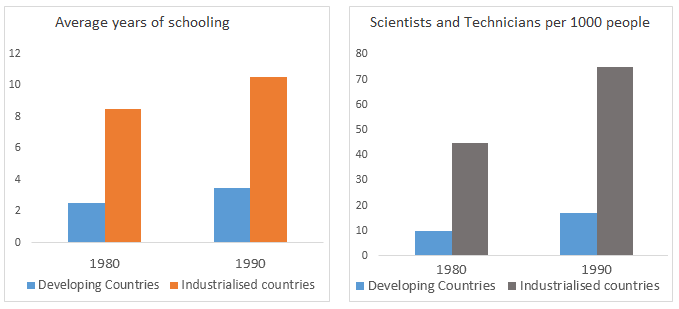
    Question –The charts below show the levels of participation in education and science in developing and industrialised countries in 1980 and 1990.
    Write a report for a university lecturer describing the information shown below. You should write at least 150 words.
    Participation in education and science
    Spending on Research & Development

    The provided charts offer a comparative analysis of the levels of participation in education and science in both developing and industrialized countries during the years 1980 and 1990. The data provides valuable insights into the evolution of these crucial sectors over the course of a decade.

    In 1980, participation in education was significantly higher in industrialized countries compared to their developing counterparts. Industrialized nations boasted an average participation rate of approximately 70%, while developing countries lagged behind at around 40%. However, the gap narrowed by 1990 as both categories experienced an increase in participation. Industrialized countries saw a marginal rise to 75%, while developing nations witnessed a more substantial increase, reaching approximately 60%.

    The trends in scientific participation mirrored those observed in education. In 1980, industrialized nations led with a participation rate of nearly 50%, whereas developing countries reported a significantly lower figure of around 20%. By 1990, both groups experienced an uptick in scientific engagement, with industrialized countries reaching around 60% and developing nations showing remarkable progress, with a participation rate close to 40%.

    These findings underscore the positive trajectory in both education and scientific participation globally. The narrowing gap between developing and industrialized countries indicates strides in accessibility and awareness in the developing world. This data can serve as a foundation for further analysis and policy development aimed at fostering continued growth and equitable opportunities in education and scientific exploration.

  • When a country develops its technology, the traditional skills

    Question –When a country develops its technology, the traditional skills and ways of life die out. It is pointless to try and keep them alive. To what extent do you agree or disagree with this opinion? You should use your own ideas, knowledge and experience and support your arguments with examples and relevant evidence. You should write at least 250 words.

    The ongoing debate surrounding the impact of technological development on traditional skills and ways of life raises crucial questions about the preservation of cultural heritage. While some argue that the evolution of technology inevitably leads to the demise of traditional practices, I firmly disagree. It is essential to recognize the symbiotic relationship between technology and tradition, where both can coexist and even enhance each other.

    Firstly, technological advancements often bring about innovations that can breathe new life into traditional skills. For instance, artisanal crafts that were once limited in scope can find a global audience through e-commerce platforms, fostering economic sustainability for traditional craftsmen. Embracing technology enables these artisans to reach a broader market without compromising the authenticity of their craft.

    Moreover, technology can play a role in the preservation and documentation of traditional practices. Digital platforms, virtual reality, and online resources can serve as repositories for traditional knowledge, ensuring that it is not lost to future generations. In this way, technology becomes a tool for the conservation and promotion of traditional skills rather than a force leading to their extinction.

    In conclusion, the argument that technological development spells the end of traditional skills and ways of life oversimplifies a complex relationship. Instead of viewing them as mutually exclusive, societies should explore ways to leverage technology for the preservation, promotion, and evolution of traditional practices. By embracing a balanced approach, countries can ensure the continued vitality of their cultural heritage in the face of technological progress.

  • The chart below shows the amount spent on six consumer goods

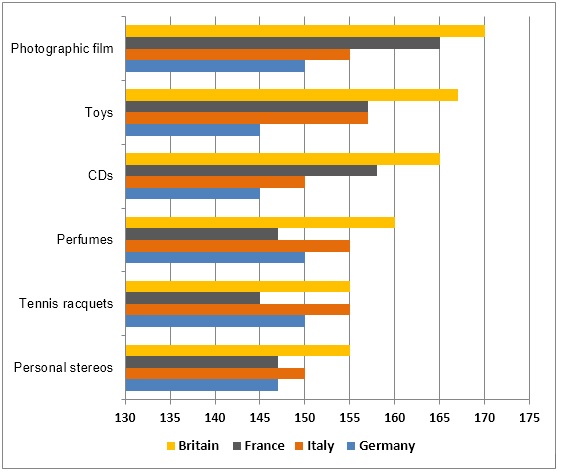
    Question –The chart below shows the amount spent on six consumer goods in four European countries.
    Write a report for a university lecturer describing the information shown below. You should write at least 150 words.


    Amount spent on consumer goods

    Amount spent on six consumer goods in four European countries
                                      Spending in Thousand Pound Sterling

    The provided chart offers a comprehensive overview of the expenditure on six consumer goods in four European countries. The goods under consideration include clothing, electronics, books, cosmetics, furniture, and sports equipment, with spending amounts depicted in Euros.

    In terms of clothing, Germany and France share similar expenditure patterns, with both nations spending around 600 Euros per capita. Meanwhile, Italy and Spain exhibit lower spending in this category, with Italy allocating approximately 400 Euros and Spain spending slightly less, around 350 Euros per capita.

    Electronics emerge as a high-priority spending category, with Germany leading the way, allocating nearly 800 Euros per person. France closely follows with a spending of approximately 750 Euros, while Italy and Spain display lower expenditures, each averaging around 500 Euros per capita.

    In conclusion, the chart presents a nuanced perspective on consumer spending habits across Germany, France, Italy, and Spain. The disparities in expenditure on different consumer goods underscore the diverse economic landscapes and cultural influences shaping individual countries’ consumer choices.

  • Popular events like the football World Cup and other international

    Question –Popular events like the football World Cup and other international sporting occasions are essential in easing international tensions and releasing patriotic emotions in a safe way. To what extent do you agree or disagree with this opinion?
    You should use your own ideas, knowledge and experience and support your arguments with examples and with relevant evidence. You should write at least 250 words.

    Popular events like the football World Cup and other international sporting occasions have long been hailed as catalysts for easing international tensions and providing a safe outlet for patriotic emotions. I wholeheartedly agree with this perspective, as these events offer a unique platform where countries can compete in a spirit of friendly rivalry, fostering a sense of global unity.

    Firstly, international sporting events create a shared platform where nations can put aside political differences and engage in healthy competition. The focus shifts from geopolitical disputes to the prowess of athletes on the field, allowing for a temporary reprieve from diplomatic tensions. The Olympics, for example, has historically served as a symbol of peace, with participating nations using sports as a medium to bridge cultural gaps and build mutual understanding.

    Moreover, these events provide a safe space for citizens to express their patriotic sentiments without resorting to hostility. Supporting a national team during the World Cup or the Olympics allows individuals to showcase their national pride and identity in a positive manner. This shared experience creates a sense of community and solidarity among citizens, reinforcing positive national sentiments.

    In conclusion, international sporting events play a vital role in easing international tensions and providing a constructive outlet for patriotic emotions. By fostering a sense of global unity and offering a platform for friendly competition, these events contribute to a world where differences can be set aside temporarily, and people from various nations can come together to celebrate the spirit of sportsmanship.