Author: theieltsbridge

  • IELTS Reading Practice Test – Exercise 468

    ABSENTEEISM IN NURSING: A LONGITUDINAL STUDY

    Absence from work is a costly and disruptive problem for any organisation. The cost of absenteeism in Australia has been put at 1.8 million hours per day or $1400 million annually. The study reported here was conducted in the Prince William Hospital in Brisbane, Australia, where, prior to this time, few active steps had been taken to measure, understand or manage the occurrence of absenteeism.

    Nursing Absenteeism
    A prevalent attitude amongst many nurses in the group selected for study was that there was no reward or recognition for not utilising the paid sick leave entitlement allowed them in their employment conditions. Therefore, they believed they may as well take the days off — sick or otherwise. Similar attitudes have been noted by James (1989), who noted that sick leave is seen by many workers as a right, like annual holiday leave.

    Miller and Norton (1986), in their survey of 865 nursing personnel, found that 73 per cent felt they should be rewarded for not taking sick leave, because some employees always used their sick leave. Further, 67 per cent of nurses felt that administration was not sympathetic to the problems shift work causes to employees’ personal and social lives. Only 53 per cent of the respondents felt that every effort was made to schedule staff fairly.

    In another longitudinal study of nurses working in two Canadian hospitals, Hackett, Bycio and Guion (1989) examined the reasons why nurses took absence from work. The most frequent reason stated for absence was minor illness to self. Other causes, in decreasing order of frequency, were illness in family, family social function, work to do at home and bereavement.

    Method
    In an attempt to reduce the level of absenteeism amongst the 250 Registered and Enrolled Nurses in the present study, the Prince William management introduced three different, yet potentially complementary, strategies over 18 months.

    Strategy 1: Non-financial (material) incentives
    Within the established wage and salary system it was not possible to use hospital funds to support this strategy. However, it was possible to secure incentives from local businesses, including free passes to entertainment parks, theatres, restaurants, etc. At the end of each roster period, the ward with the lowest absence rate would win the prize.

    Strategy 2: Flexible fair roistering
    Where possible staff were given the opportunity to determine their working schedule within the limits of clinical needs.

    Strategy 3: Individual absenteeism and counselling
    Each month, managers would analyse the pattern of absence of staff with excessive sick leave (greater than ten days per year for full time employees). Characteristic patterns of potential ‘voluntary absenteeism’ such as absence before and after days off, excessive weekend and night duty absence and multiple single days off were communicated to all ward nurses and then, as necessary, followed up by action.

    Results
    Absence rates for the six months prior to the incentive scheme ranged from 3.69 percent to 4.32 percent. In the following six months they ranged between 2.87 percent and 3.96 percent. This represents a 20 percent improvement. However, analysing the absence rates on a year-to-year basis, the overall absence rate was 3.60 per cent in the first year and 3.43 per cent in the following year. This represents a 5 per cent decrease from the first to the second year of the study. A significant decrease in absence over the two-year period could not be demonstrated.

    Discussion
    The non-financial incentive scheme did appear to assist in controlling absenteeism in the short term. As the scheme progressed it became harder to secure prizes and this contributed to the program’s losing momentum and finally ceasing. There were mixed results across wards as well. For example, in wards with staff members who had long-term genuine illness, there was little chance of winning, and to some extent the staff on those wards were disempowered. Our experience would suggest that the long-term effects of incentive awards on absenteeism are questionable.

    Over the time of the study, staff were given a larger degree of control in their rosters. This led to significant improvements in communication between managers and staff. A similar effect was found from the implementation of the third strategy. Many of the nurses had not realised the impact their behaviour was having on the organisation and their colleagues but there were also staff members who felt that talking to them about their absenteeism was ‘picking’ on them and this usually had a negative effect on management-employee relationships.

    Conclusion
    Although there has been some decrease in absence rates, no single strategy or combination of strategies has had a significant impact on absenteeism per se. Notwithstanding the disappointing results, it is our contention that the strategies were not in vain. A shared ownership of absenteeism and a collaborative approach to problem solving has facilitated improved cooperation and communication between management and staff. It is our belief that this improvement alone, while not tangibly measurable, has increased the ability of management to manage the effects of absenteeism more effectively since this study.

    Questions 1-7
    Do the following statements agree with the information given in Reading Passage I? In boxes 1-7 on your answer sheet write

    YES                         if the statement agrees with the information
    NO                           if the statement contradicts the information
    NOT GIVEN        if there is no information on this in the passage

    1 The Prince William Hospital has been trying to reduce absenteeism amongst nurses for many years.
    2 Nurses in the Prince William Hospital study believed that there were benefits in taking as little sick leave as possible.
    3 Just over half the nurses in the 1986 study believed that management understood the effects that shift work had on them.
    4 The Canadian study found that ‘illness in the family’ was a greater cause of absenteeism than ‘work to do at home’.
    5 In relation to management attitude to absenteeism the study at the Prince William Hospital found similar results to the two 1989 studies.
    6 The study at the Prince William Hospital aimed to find out the causes of absenteeism amongst 250 nurses.
    7 The study at the Prince William Hospital involved changes in management practices.

    Questions 8-13
    Complete the notes below. Choose ONE OR TWO WORDS from the passage for each answer.
    Write your answers in boxes 8-13 on your answer sheet.

    In the first strategy, wards with the lowest absenteeism in different periods would win prizes donated by (8)………………………. In the second strategy, staff were given more control over their (9)……………………….
    In the third strategy, nurses who appeared to be taking (10)……………………….. sick leave or (11)…………………… were identified and counselled. Initially, there was a (12)………………………..per cent decrease in absenteeism. The first strategy was considered ineffective and stopped. The second and third strategies generally resulted in better (13)……………………. among staff.

    The Motor Car

    A There are now over 700 million motor vehicles in the world – and the number is rising by more than 40 million each year. The average distance driven by car users is growing too – from 8 km a day per person in western Europe in 1965 to 25 km a day in 1995. This dependence on motor vehicles has given rise to major problems, including environmental pollution, depletion of oil resources, traffic congestion and safety.

    B While emissions from new cars are far less harmful than they used to be, city streets and motorways are becoming more crowded than ever, often with older trucks, buses and taxis, which emit excessive levels of smoke and fumes. This concentration of vehicles makes air quality in urban areas unpleasant and sometimes dangerous to breathe. Even Moscow has joined the list of capitals afflicted by congestion and traffic fumes. In Mexico City, vehicle pollution is a major health hazard.

    C Until a hundred years ago, most journeys were in the 20 km range, the distance conveniently accessible by horse. Heavy freight could only be carried by water or rail. The invention of the motor vehicle brought personal mobility to the masses and made rapid freight delivery possible over a much wider area. Today about 90 per cent of inland freight in the United Kingdom is carried by road. Clearly the world cannot revert to the horse-drawn wagon. Can it avoid being locked into congested and polluting ways of transporting people and goods?

    D In Europe most cities are still designed for the old modes of transport. Adaptation to the motor car has involved adding ring roads, one-way systems and parking lots. In the United States, more land is assigned to car use than to housing. Urban sprawl means that life without a car is next to impossible. Mass use of motor vehicles has also killed or injured millions of people. Other social effects have been blamed on the car such as alienation and aggressive human behaviour.

    E A 1993 study by the European Federation for Transport and Environment found that car transport is seven times as costly as rail travel in terms of the external social costs it entails such as congestion, accidents, pollution, loss of cropland and natural habitats, depletion of oil resources, and so on. Yet cars easily surpass trains or buses as a flexible and conveniept mode of personal transport. It is unrealistic to expect people to give up private cars in favour of mass transit.

    F Technical solutions can reduce the pollution problem and increase the fuel efficiency of engines. But fuel consumption and exhaust emissions depend on which cars are preferred by customers and how they are driven. Many people buy larger cars than they need for daily purposes or waste fuel by driving aggressively. Besides, global car use is increasing at a faster rate than the improvement in emissions and fuel efficiency which technology is now making possible.

    G One solution that has been put forward is the long-term solution of designing cities and neighbourhoods so that car journeys are not necessary – all essential services being located within walking distance or easily accessible by public transport. Not only would this save energy and cut carbon dioxide emissions, it would also enhance the quality of community life, putting the emphasis aa people instead of cars. Good local government is already bringing this about in some places. But few democratic communities are blessed with the vision – and the capital – to make such profound changes in modern lifestyles.

    H A more likely scenario seems to be a combination of mass transit systems for travel into and around cities, with small ‘low emission’ cars for urban use and larger hybrid or lean burn cars for use elsewhere. Electronically tolled highways might be used to ensure that drivers pay charges geared to actual road use. Better integration of transport systems is also highly desirable – and made more feasible by modern computers. But these are solutions for countries which can afford them. In most developing countries, old cars and old technologies continue to predominate.

    Questions 14-19
    Reading Passage 2 has eight paragraphs (A-H). Which paragraphs concentrate on the following information? Write the appropriate letters (A-H) in boxes 14-19 on your answer sheet.

    14 a comparison of past and present transportation methods
    15 how driving habits contribute to road problems
    16 the relative merits of cars and public transport
    17 the writer’s own prediction of future solutions
    18 the increasing use of motor vehicles
    19 the impact of the car on city development

    Questions 20-26
    Do the following statements agree with the information given in Reading Passage 2? In boxes 20-26 on your answer sheet write

    YES                          if the statement agrees with the information
    NO                            if the statement contradicts the information
    NOT GIVEN         if there is no information on this in the passage

    20 Vehicle pollution is worse in European cities than anywhere else.
    21 Transport by horse would be a useful alternative to motor vehicles.
    22 Nowadays freight is not carried by water in the United Kingdom.
    23 Most European cities were not designed for motor vehicles.
    24 Technology alone cannot solve the problem of vehicle pollution.
    25 People’s choice of car and attitude to driving is a factor in the pollution problem.
    26 Redesigning cities would be a short-term solution.

    The Keyless Society

    A Students who want to enter the University of Montreal’s Athletic Complex need more than just a conventional ID card – their identities must be authenticated by an electronic hand scanner. In some California housing estates, a key alone is insufficient to get someone in the door; his or her voiceprint must also be verified. And soon, customers at some Japanese banks will have to present their faces for scanning before they can enter the building and withdraw their money.

    B All of these are applications of biometrics, a little-known but fast-growing technology that involves the use of physical or biological characteristics to identify individuals. In use for more than a decade at some high- security government institutions in the United States and Canada, biometrics are now rapidly popping up in the everyday world. Already, more than 10,000 facilities, from prisons to day-care centres, monitor people’s fingerprints or other physical parts to ensure that they are who they claim to be. Some 60 biometric companies around the world pulled in at least $22 million last year and that grand total is expected to mushroom to at least $50 million by 1999.

    C Biometric security systems operate by storing a digitised record of some unique human feature. When an authorised user wishes to enter or use the facility, the system scans the person’s corresponding characteristics and attempts to match them against those on record. Systems using fingerprints, hands, voices, irises, retinas and faces are already on the market. Others using typing patterns and even body odours are in various stages of development.

    D Fingerprint scanners are currently the most widely deployed type of biometric application, thanks to their growing use over the last 20 years by law-enforcement agencies. Sixteen American states now use biometric fingerprint verification systems to check that people claiming welfare payments are genuine. In June, politicians in Toronto voted to do the same, with a pilot project beginning next year.

    E To date, the most widely used commercial biometric system is the handkey, a type of hand scanner which reads the unique shape, size and irregularities of people’s hands. Originally developed for nuclear power plants the handkey received its big break when it was used to control access to the plarftf, the handkey received its big break when it was used to control access to the Olympic Village in Atlanta by more than 65,000 athletes, trainers and support staff. Now there are scores of other applications.

    F Around the world, the market is growing rapidly. Malaysia, for example, is preparing to equip all of its airports with biometric face scanners to match passengers with luggage. And Japan’s largest maker of cash dispensers is developing new machines that incorporate iris scanners. The first commercial biometric, a hand reader used by an American firm to monitor employee attendance, was introduced in 1974. But only in the past few years has the technology improved enough for the prices to drop sufficiently to make them commercially viable. ‘When we started four years ago, I had to explain to everyone what a biometric is,’ says one marketing expert. ‘Now, there’s much more awareness out there.’

    G Not surprisingly, biometrics raise thorny questions about privacy and the potential for abuse. Some worry that governments and industry will be tempted to use the technology to monitor individual behaviour. ‘If someone used your fingerprints to match your health-insurance records with a credit-card record showing you regularly bought lots of cigarettes and fatty foods,’ says one policy analyst, ‘you would see your insurance payments go through the roof.’ In Toronto, critics of the welfare fingerprint plan complained that it would stigmatise recipients by forcing them to submit to a procedure widely identified with criminals.

    H Nonetheless, support for biometrics is growing in Toronto as it is in many other communities. In an increasingly crowded and complicated world, biometrics may well be a technology whose time has come.

    Questions 27-33
    Reading Passage 3 has eight paragraphs (A-H). Choose the most suitable headings for paragraphs B-H from the list of headings below. Write the appropriate numbers (i—x) in boxes 27-33 on your answer sheet.
    NB There are more headings than paragraphs, so you will not use all of them.

    List of headings
    i. Common objections
    ii. Who’s planning what
    iii. This type sells best in shops
    iv. The figures say it all
    v. Early trials
    vi. They can’t get in without these
    vii. How does it work?
    viii. Fighting fraud
    ix. Systems to avoid
    x. Accepting the inevitable

    27 Paragraph B
    28 Paragraph C
    29 Paragraph D
    30 Paragraph E
    31 Paragraph F
    32 Paragraph G
    33 Paragraph H

    Questions 34-40
    Look at the following groups of people (Questions 34-40) and the list of biometric systems (A-F) below. Match the groups of people to the biometric system associated with them in Reading Passage 3. Write the appropriate letters A-F in boxes 34-40 on your answer sheet. NB You may use any biometric system more than once.

    34 sports students
    35 Olympic athletes
    36 airline passengers
    37 welfare claimants
    38 business employees
    39 home owners
    40 bank customers

    List of Biometric Systems
    A fingerprint scanner
    B hand scanner
    C body odour
    D voiceprint
    E face scanner
    F typing pattern
  • IELTS Reading Practice Test – Exercise 467

    IMPLEMENTING THE CYCLE OF SUCCESS: A CASE STUDY

    Within Australia, Australian Hotels Inc (AHI) operates nine hotels and employs over 2000 permanent full-time staff, 300 permanent part-time employees and 100 casual staff. One of its latest ventures, the Sydney Airport hotel (SAH), opened in March 1995. The hotel is the closest to Sydney Airport and is designed to provide the best available accommodation, food and beverage and meeting facilities in Sydney’s southern suburbs. Similar to many international hotel chains, however, AHI has experienced difficulties in Australia in providing long-term profits for hotel owners, as a result of the country’s high labour-cost structure. In order to develop an economically viable hotel organisation model, AHI decided to implement some new policies and practices at SAH.

    The first of the initiatives was an organisational structure with only three levels of management – compared to the traditional seven. Partly as a result of this change, there are 25 per cent fewer management positions, enabling a significant saving. This change also has other implications. Communication, both up and down the organisation, has greatly improved. Decision-making has been forced down in many cases to front-line employees. As a result, guest requests are usually met without reference to a supervisor, improving both customer and employee satisfaction.

    The hotel also recognised that it would need a different approach to selecting employees who would fit in with its new policies. In its advertisements, the hotel stated a preference for people with some ‘service’ experience in order to minimise traditional work practices being introduced into the hotel. Over 7000 applicants filled in application forms for the 120 jobs initially offered at SAH. The balance of the positions at the hotel (30 management and 40 shift leader positions) were predominantly filled by transfers from other AHI properties.

    A series of tests and interviews were conducted with potential employees, which eventually left 280 applicants competing for the 120 advertised positions. After the final interview, potential recruits were divided into three categories. Category A was for applicants exhibiting strong leadership qualities, Category C was for applicants perceived to be followers, and Category B was for applicants with both leader and follower qualities. Department heads and shift leaders then composed prospective teams using a combination of people from all three categories. Once suitable teams were formed, offers of employment were made to team members.

    Another major initiative by SAH was to adopt a totally multi-skilled workforce. Although there may be some limitations with highly technical jobs such as cooking or maintenance, wherever possible, employees at SAH are able to work in a wide variety of positions. A multi-skilled workforce provides far greater management flexibility during peak and quiet times to transfer employees to needed positions. For example, when office staff are away on holidays during quiet period of the year, employees in either food or beverage or housekeeping departments can temporarily fill in.

    The most crucial way, however, of improving the labour cost structure at SAH was to find better, more productive ways of providing customer service. SAH management concluded this would first require a process of ‘benchmarking’. The prime objective of the benchmarking process was to compare a range of service delivery processes across a range of criteria using teams made up of employees from different departments within the hotel which interacted with each other. This process resulted in performance measures that greatly enhanced SAH’s ability to improve productivity and quality.

    The front office team discovered through this project that a high proportion of AHI Club member reservations were incomplete. As a result, the service provided to these guests was below the standard promised to them as part of their membership agreement. Reducing the number of incomplete reservations greatly improved guest perceptions of service.

    In addition, a program modelled on an earlier project called ‘Take Charge’ was implemented. Essentially, Take Charge provides an effective feedback loop from both customers and employees. Customer comments, both positive and negative, are recorded by staff. These are collated regularly to identify opportunities for improvement. Just as importantly, employees are requested to note down their own suggestions for improvement. (AHI has set an expectation that employees will submit at least three suggestions for every one they receive from a customer.)

    Employee feedback is reviewed daily and suggestions are implemented within 48 hours, if possible, or a valid reason is given for non-implementation. If suggestions require analysis or data collection, the Take Charge team has 30 days in which to address the issue and come up with recommendations.

    Although quantitative evidence of AHI’s initiatives at SAH are limited at present, anecdotal evidence clearly suggests that these practices are working. Indeed AHI is progressively rolling out these initiatives in other hotels in Australia, whilst numerous overseas visitors have come to see how the program works.

    Questions 1—5
    Choose the appropriate letters A—D and write them in boxes 1-5 on your answer sheet.

    1 The high costs of running AHIs hotels are related to their
    A management
    B size
    C staff
    D policies

    2 SAH’s new organisational structure requires
    A 75% of the old management positions
    B 25% of the old management positions
    C 25% more management positions
    D 5% fewer management positions

    3 The SAH’s approach to organisational structure required changing practices in
    A industrial relations
    B firing staff
    C hiring staff
    D marketing

    4 The total number of jobs advertised at the SAH was …
    A 70
    B 120
    C 170
    D 280

    5 Categories A, B and C were used to select…
    A front office staff
    B new teams
    C department heads
    D new managers

    Questions 6-13
    Complete the following summary of the last four paragraphs of Reading Passage 1 using ONE OR TWO words from the passage.

    What they did at SAH
    Teams of employees were selected from different hotel departments to participate in a (6)……………………….. exercise. The information collected was used to compare (7)……………………… processes which, in turn, led to the development of (8)………………………… that would be used to increase the hotel’s capacity to improve (9)……………………… as well as quality. Also, an older program known as (10)…………………… was introduced at SAH. In this program, (11)……………………….. is sought from customers and staff. Wherever possible (12)…………………….. suggestions are implemented within 48 hours. Other suggestions are investigated for their feasibility for a period of up to (13)…………………………

    READING PASSAGE 2

    The discovery that language can be a barrier to communication is quickly made by all who travel, study, govern or sell. Whether the activity is tourism, research, government, policing, business, or data dissemination, the lack of a common language can severely impede progress or can halt it altogether. ‘Common language’ here usually means a foreign language, but the same point applies in principle to any encounter with unfamiliar dialects or styles within a single language. ‘They don’t talk the same language’ has a major metaphorical meaning alongside its literal one.

    Although communication problems of this kind must happen thousands of times each day, very few become public knowledge. Publicity comes only when a failure to communicate has major consequences, such as strikes, lost orders, legal problems, or fatal accidents — even, at times, war. One reported instance of communication failure took place in 1970, when several Americans ate a species of poisonous mushroom. No remedy was known, and two of the people died within days. A radio report of the case was heard by a chemist who knew of a treatment that had been successfully used in 1959 and published in 1963. Why had the American doctors not heard of it seven years later? Presumably because the report of the treatment had been published only in journals written in European languages other than English.

    Several comparable cases have been reported. But isolated examples do not give an impression of the size of the problem — something that can come only from studies of the use or avoidance of foreign-language materials and contacts in different communicative situations. In the English-speaking scientific world, for example, surveys of books and documents consulted in libraries and other information agencies have shown that very little foreign-language material is ever consulted. Library requests in the field of science and technology showed that only 13 per cent were for foreign language periodicals. Studies of the sources cited in publications lead to a similar conclusion: the use of foreign- language sources is often found to be as low as 10 per cent.

    The language barrier presents itself in stark form to firms who wish to market their products in other countries. British industry, in particular, has in recent decades often been criticized for its linguistic insularity — for its assumption that foreign buyers will be happy to communicate in English, and that awareness of other languages is not therefore a priority. In the 1960s, over two-thirds of British firms dealing with non-English-speaking customers were using English for outgoing correspondence; many had their sales literature only in English; and as many as 40 per cent employed no-one able to communicate in the customers’ languages. A similar problem was identified in other English-speaking countries, notably the USA, Australia and New Zealand. And non-English-speaking countries were by no means exempt-although the widespread use of English as an alternative language made them less open to the charge of insularity.

    The criticism and publicity given to this problem since the 1960s seems to have greatly improved the situation. Industrial training schemes have promoted an increase in linguistic and cultural awareness. Many firms now have their own translation services; to take just one example in Britain, Rowntree Mackintosh now publish their documents in six languages (English, French, German, Dutch, Italian and Xhosa). Some firms run part-time language courses in the languages of the countries with which they are most involved; some produce their own technical glossaries, to ensure consistency when material is being translated. It is now much more readily appreciated that marketing efforts can be delayed, damaged, or disrupted by a failure to take account of the linguistic needs of the customer.

    The changes in awareness have been most marked in English-speaking countries, where the realisation has gradually dawned that by no means everyone in the world knows English well enough to negotiate in it. This is especially a problem when English is not an official language of public administration, as in most parts of the Far East, Russia, Eastern Europe, the Arab world, Latin America and French speaking Africa. Even in cases where foreign customers can speak English quite well, it is often forgotten that they may not be able to understand it to the required level — bearing in mind the regional and social variation which permeates speech and which can cause major problems of listening comprehension. In securing understanding, how ‘we’ speak to ‘them’ is just as important, it appears, as how ‘they’ speak to ‘us’.

    Questions 14-17
    Complete each of the following statements (Questions 14-17) with words taken from Reading Passage 2.
    Write NO MORE THAN THREE WORDS for each answer.

    14 Language problems may come to the attention of the public when they have………………………..such as fatal accidents or social problems.
    15 Evidence of the extent of the language barrier has been gained from……………………….of materials used by scientists such as books and periodicals.
    16 An example of British linguistic insularity is the use of English for materials such as………………….
    17 An example of a part of the world where people may have difficulty in negotiating English is………….

    Questions 18-20
    Choose the appropriate letters A—D and write them in boxes 18-20 on your answer sheet.

    18 According to the passage, ‘They don’t talk the same language’ (paragraph 1), can refer to problems in …
    A understanding metaphor
    B learning foreign languages
    C understanding dialect or style
    D dealing with technological change

    19 The case of the poisonous mushrooms (paragraph 2) suggests that American doctors …
    A should pay more attention to radio reports
    B only read medical articles if they are in English
    C are sometimes unwilling to try foreign treatments
    D do not always communicate effectively with their patients

    20 According to the writer, the linguistic insularity of British businesses …
    A later spread to other countries
    B had a negative effect on their business
    C is not as bad now as it used to be in the past
    D made non-English-speaking companies turn to other markets

    Questions 21-24
    List the FOUR main ways in which British companies have tried to solve the problems of the language barrier since the 1960s. Write NO MORE THAN THREE WORDS for each answer.

    21……………………………….
    22………………………………
    23…………………………………
    24………………………………..

    Questions 25 and 26
    Choose the appropriate letters A-D and write them in boxes 25 and 26 on your answer sheet.

    25 According to the writer, English-speaking people need to be aware that…
    A some foreigners have never met an English-speaking person
    B many foreigners have no desire to learn English
    C foreign languages may pose a greater problem in the future
    D English-speaking foreigners may have difficulty understanding English

    26 A suitable title for this passage would be
    A Overcoming the language barrier
    B How to survive an English-speaking world
    C Global understanding – the key to personal progress
    D The need for a common language

    What is a Port City?

    A A port must be distinguished from a harbour. They are two very different things. Most ports have poor harbours, and many fine harbours see few ships. Harbour is a physical concept, a shelter for ships; port is an economic concept, a centre of land-sea exchange which requires good access to a hinterland even more than a sea-linked foreland. It is landward access, which is productive of goods for export and which demands imports, that is critical. Poor harbours can be improved with breakwaters and dredging if there is a demand for a port. Madras and Colombo are examples of harbours expensively improved by enlarging, dredging and building breakwaters.

    B Port cities become industrial, financial and service centres and political capitals because of their water connections and the urban concentration which arises there and later draws to it railways, highways and air routes. Water transport means cheap access, the chief basis of all port cities. Many of the world’s biggest cities, for example, London, New York, Shanghai, Istanbul, Buenos Aires, Tokyo, Jakarta, Calcutta, Philadelphia and San Francisco began as ports – that is, with land-sea exchange as their major function – but they have since grown disproportionately in other respects so that their port functions are no longer dominant. They remain different kinds of places from non-port cities and their port functions account for that difference.

    C Port functions, more than anything else, make a city cosmopolitan. A port city is open to the world. In it races, cultures, and ideas, as well as goods from a variety of places, jostle, mix and enrich each other and the life of the city. The smell of the sea and the harbour, the sound of boat whistles or the moving tides are symbols of their multiple links with a wide world, samples of which are present in microcosm within their own urban areas.

    D Sea ports have been transformed by the advent of powered vessels, whose size and draught have increased. Many formerly important ports have become economically and physically less accessible as a result. By-passed by most of their former enriching flow of exchange, they have become cultural and economic backwaters or have acquired the character of museums of the past. Examples of these are Charleston, Salem, Bristol, Plymouth, Surat, Galle, Melaka, Soochow, and a long list of earlier prominent port cities in Southeast Asia, Africa and Latin America.

    E Much domestic port trade has not been recorded. What evidence we have that domestic trade was greater at all periods than external trade. Shanghai, for example, did most of its trade with other Chinese ports and inland cities. Calcutta traded mainly with other parts of India and so on. Most of any city’s population is engaged in providing goods and services for the city itself. Trade outside the city is its basic function. But each basic worker requires food, housing, clothing and other such services. Estimates of the ratio of basic to service workers range from 1A to 1:8.

    F No city can be simply a port but must be involved in a variety of other activities. The port function of the city draws to it raw materials and distributes them in many other forms. Ports take advantage of the need for breaking up the bulk material where water and land transport meet and where loading and unloading costs can be minimised by refining raw materials or turning them into finished goods. The major examples here are oil refining and ore refining, which are commonly located at ports. It is not easy to draw a line around what is and is not a port function. All ports handle, unload, sort, alter, process, repack, and reship most of what they receive. A city may still be regarded as a port city when it becomes involved in a great range of functions not immediately involved with ships or docks.

    G Cities which began as ports retain the chief commercial and administrative centre of the city close to the waterfront. The centre of New York is in lower Manhattan between two river mouths, the City of London is on the Thames, Shanghai along the Bund. This proximity to water is also true of Boston, Philadelphia, Bombay, Calcutta, Madras, Singapore, Bangkok, Hong Kong and Yokohama, where the commercial, financial, and administrative centres are still grouped around their harbours even though each city has expanded into a metropolis. Even a casual visitor cannot mistake them as anything but port cities.

    Questions 27-30
    Reading passage 3 has seven paragraphs A-G. From the list of headings below choose the most suitable headings for paragraphs B-E. Write the appropriate numbers (i-viii) in boxes 27-30 on your answer sheet.
    NB There are more headings than paragraphs, so you will not use them all.

    List of Headings
    i. A truly international environment
    ii. Once a port city, always a port city
    iii. Good ports make huge profits
    iv. How the port changes a city’s infrastructure
    v. Reasons’ for the decline of ports
    vi. Relative significance of trade and service industry
    vii. Ports and harbours
    viii. The demands of the oil industry

    27 Paragraph B
    28 Paragraph C
    29 Paragraph D
    30 Paragraph E

    Questions 31-34
    Look at the following descriptions of some port cities mentioned in the passage. Match the pairs of cities (A-H) listed below with the descriptions. Write the appropriate letters A-H in boxes 31-34. NB There are more pairs of port cities than descriptions so you will not use them all.

    31 required considerable harbor development
    32 began as ports but other facilities later dominated
    33 lost their prominence when large ships could not be accommodated
    34 maintain their business centres near the port waterfront

    A Bombay and Buenos Aires
    B Hong Kong and Salem
    C Istanbul and Jakarta
    D Madras and Colombo
    E New York and Bristol
    F Plymouth and Melaka
    G Singapore and Yokohama
    H Surat and London

    Question 35-40
    Do the following statements agree with the information given in Reading Passage 3?
    In boxes 35-40 on your answer sheet write

    YES                           if the statement agrees with the information
    NO                             if the statement contradicts the information
    NOT GIVEN          if there is no information on this in the passage

    35 Cities cease to be port cities when other functions dominate.
    36 In the past, many port cities did more trade within their own country than with overseas ports.
    37 Most people in a port city are engaged in international trade and finance.
    38 Ports attract many subsidiary and independent industries.
    39 Ports have to establish a common language of trade.
    40 Ports often have river connections.

  • IELTS Reading Practice Test – Exercise 466

    Airports on Water

    River deltas are difficult places for map makers. The river builds them up, the sea wears them down; their outlines are always changing. The changes in China’s Pearl River delta, however, are more dramatic than these natural fluctuations. An island six kilometres long and with a total area of 1248 hectares is being created there. And the civil engineers are as interested in performance as in speed and size. This is a bit of the delta that they want to endure.

    The new island of Chek Lap Kok, the site of Hong Kong’s new airport, is 83% complete. The giant dumper trucks rumbling across it will have finished their job by the middle of this year and the airport itself will be built at a similarly breakneck pace.

    As Chek Lap Kok rises, however, another new Asian island is sinking back into the sea. This is a 520-hectare island built in Osaka Bay, Japan, that serves as the platform for the new Kansai airport. Chek Lap Kok was built in a different way, and thus hopes to avoid the same sinking fate.

    The usual way to reclaim land is to pile sand rock on to the seabed. When the seabed oozes with mud, this is rather like placing a textbook on a wet sponge: the weight squeezes the water out, causing both water and sponge to settle lower. The settlement is rarely even: different parts sink at different rates. So buildings, pipes, roads and so on tend to buckle and crack. You can engineer around these problems, or you can engineer them out. Kansai took the first approach; Chek Lap Kok is taking the second.

    The differences are both political and geological. Kansai was supposed to be built just one kilometre offshore, where the seabed is quite solid. Fishermen protested, and the site was shifted a further five kilometres. That put it in deeper water (around 20 metres) and above a seabed that consisted of 20 metres of soft alluvial silt and mud deposits. Worse, below it was a not-very- firm glacial deposit hundreds of metres thick.

    The Kansai builders recognised that settlement was inevitable. Sand was driven into the seabed to strengthen it before the landfill was piled on top, in an attempt to slow the process; but this has not been as effective as had been hoped. To cope with settlement, Kansai’s giant terminal is supported on 900 pillars. Each of them can be individually jacked up, allowing wedges to be added underneath. That is meant to keep the building level. But it could be a tricky task.

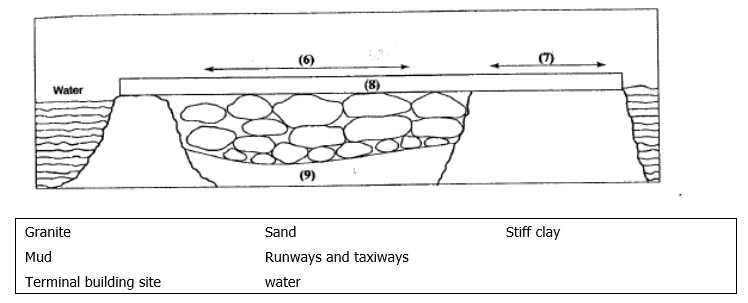
    Conditions are different at Chek Lap Kok. There was some land there to begin with, the original little island of Chek Lap Kok and a smaller outcrop called Lam Chau. Between them, these two outcrops of hard, weathered granite make up a quarter of the new island’s surface area. Unfortunately, between the islands there was a layer of soft mud, 27 metres thick in places.

    According to Frans Uiterwijk, a Dutchman who is the project’s reclamation director, it would have been possible to leave this mud below the reclaimed land, and to deal with the resulting settlement by the Kansai method. But the consortium that won the contract for the island opted opted for a more aggressive approach It scrambled the world’s largest lot of dredgers, which sucked up 150m cubic metres of clay mud and dumped it in deeper waters. At the same time sand was dredged from the waters and piled on top of the layer of stiff clay that the massive dredging had laid bare.

    Nor was the sand the only thing used. The original granite island which had hills up to 120 metres high was drilled and blasted into boulders no bigger than two metres in diameter. This provided 70m cubic metres of granite to add to the island’s foundations. Because the heap of boulders does not fill the space perfectly, this represents the equivalent of 105m cubic metres of landfill. Most of the rock will become the foundations for the airport’s runways and its taxiways. The sand dredged from the waters will also be used to provide a two-metre capping layer over the granite platform. This makes it easier for utilities to dig trenches – granite is unyielding stuff. Most of the terminal buildings will be placed above the site of the existing island. Only a limited amount of pile-driving is needed to support building foundations above softer areas.

    The completed island will be six to seven metres above sea level. In all, 350m cubic metres of material will have been moved. And much of it, like the overloads, has to be moved several times before reaching its final resting place. For example, there has to be a motorway capable of carrying 150-tonne dump-trucks; and there has to be a raised area for the 15,000 construction workers. These are temporary; they will be removed when the airport is finished.

    The airport, though, is here to stay. To protect it, the new coastline is being bolstered with a formidable twelve kilometres of sea defences. The brunt of a typhoon will be deflected by the neighbouring island of Lantau; the sea walls should guard against the rest. Gentler but more persistent bad weather – the downpours of the summer monsoon – is also being taken into account. A mat-like material called geotextile is being laid across the island to separate the rock and sand layers. That will stop sand particles from being washed into the rock voids, and so causing further settlement. This island is being built never to be sunk.

    Questions 1-5
    Classify the following statements as applying to

    A Chek Lap Kok airport only
    B Kansai airport only
    C Both airports

    1 having an area of over 1000 hectares
    2 built in a river delta
    3 built in the open sea
    4 built by reclaiming land
    5 built using conventional methods of reclamation

    Questions 6-9
    Complete the labels on Diagram below. Choose your answers from the box below the diagram and write them in boxes 6-9 on your answer sheet.

    Questions 10-13

    Complete the summary below. Choose your answers from the options given below. NB there are more words than spares so you will not use them all.

    Example: When the new Chek Lap Kok airport has been completed the raised area and the………..will be removed.

    Answer: motorway

    The island will be partially protected from storms by (10)……………….and also by (11)…………….. Further settlement caused by (12)……………..will be prevented by the use of (13)……………..

    Options

    Construction workers                  Sea walls                 Rocky and sand                    Motorway

    Geotextile                                    Coastline                 Typhoons                              Rock voids

    Rainfall                                         Lantau Island          Dump-trucks

    Changing Our Understanding of Health

    A The concept of health holds different meanings for different people and groups. These meanings of health have also changed over time. This change is no more evident than in Western society today, when notions of health and health promotion are being challenged and expanded in new ways.

    B For much of recent Western history, health has been viewed in the physical sense only. That is, good health has been connected to the smooth mechanical operation of the body, while ill health has been attributed to a breakdown in this machine. Health in this sense has been defined as the absence of disease or illness and is seen in medical terms. According to this view, creating health for people means providing medical care to treat or prevent disease and illness. During this period, there was an emphasis on providing clean water, improved sanitation and housing.

    C In the late 1940s the World Health Organisation challenged this physically and medically oriented view of health. They stated that ‘health is a complete state of physical, mental and social well-being and is not merely the absence of disease’ (WHO, 1946). Health and the person were seen more holistically (mind/body/spirit) and not just in physical terms.

    D The 1970s was a time of focusing on the prevention of disease and illness by emphasizing the importance of the lifestyle and behaviour of the individual. Specific behaviours which were seen to increase risk of disease, such as smoking, lack of fitness and unhealthy eating habits, were targeted. Creating health meant providing not only medical health care, but health promotion programs and policies which would help people maintain healthy behaviours and lifestyles. While this individualistic healthy lifestyles approach to health worked for some (the wealthy members of society), people experiencing poverty, unemployment, underemployment or little control over the conditions of their daily lives benefited little from this approach.

    This was largely because both the healthy lifestyles approach and the medical approach to health largely ignored the social and environmental conditions affecting the health of people.

    E During the 1980s and 1990s there has been a growing swing away from lifestyle risks as the root cause of poor health. While lifestyle factors still remain important, health is being viewed also in terms of the social, economic environmental contexts in which people live. This broad approach to health is called the socio-ecological view of health. The broad socio-ecological view of health was endorsed at the first International Conference of Health Promotion held in 1986, Ottawa, Canada, where people from 38 countries agreed and declared that:

    The fundamental conditions and resources for health are peace, shelter, education, food, a viable income, a stable eco-system, sustainable resources, social justice and equity. Improvement in health requires a secure foundation in these basic requirements. (WHO, 1986)

    It is clear from this statement that the creation of health is about much more than encouraging healthy individual behaviours and lifestyles and providing appropriate medical care. Therefore, the creation of health must include addressing issues such as poverty, pollution, urbanisation, natural resource depletion, social alienation and poor working conditions. The social, economic and environmental contexts which contribute to the creation of health do not operate separately or independently of each other. Rather, they are interacting and interdependent, and it is the complex interrelationships between them which determine the conditions that promote health. A broad socio-ecological view of health suggests that the promotion of health must include a strong social, economic and environmental focus.

    F At the Ottawa Conference in 1986, a charter was developed which outlined new directions for health promotion based on the socio-ecological view of health. This charter, known as the Ottawa Charter for Health Promotion, remains as the backbone of health action today. In exploring the scope of health promotion it states that:

    Good health is a major resource for social, economic and personal development and an important dimension of quality of life. Political, economic, social, cultural, environmental, behavioural and biological factors can all favour health or be harmful to it. (WHO, 1986)

    The Ottawa Charter brings practical meaning and action to this broad notion of health promotion. It presents fundamental strategies and approaches in achieving health for all. The overall philosophy of health promotion which guides these fundamental strategies and approaches is one of ‘enabling people to increase control over and to improve their health’ (WHO, 1986).

    Questions 14-18
    Reading passage 2 has six paragraphs A-F. Choose the most suitable headings for paragraphs B-F from the list of headings below. Write the appropriate numbers (i-ix) in boxed 14-18 on your answer sheet.
    NB There are more headings than paragraphs so you will not use them all.

    List of Headings
    i. Ottawa International Conference on Health Promotion
    ii. Holistic approach to health
    iii. The primary importance of environmental factors
    iv. Healthy lifestyles approach to health
    v. Changes in concepts of health in Western society
    vi. Prevention of diseases and illness
    vii. Ottawa Charter for Health Promotion
    viii. Definition of health in medical terms
    ix. Socio-ecological view of health

    14 Paragraph B
    15 Paragraph C
    16 Paragraph D
    17 Paragraph E
    18 Paragraph F

    Questions 19-22
    Using NO MORE THAN THREE WORDS from the passage answer the following questions.

    19 In which year did the World Health Organisation define health in terms of mental, physical and social well-being?
    20 Which members of society benefited most from the healthy lifestyles approach to health?
    21 Name the three broad areas which relate to people’s health, according to the socio-ecological view of health.
    22 During which decade were lifestyle risks seen as the major contributors to poor health?

    Questions 23-27
    Do the following statements agree with the information in Reading Passage 2?

    YES                            if the statement agrees with the information
    NO                              if the statement contradicts the information
    NOT GIVEN           if there is no information on this in the passage

    23 Doctors have been instrumental in improving living standards in Western society.
    24 The approach to health during the 1970s included the introduction of health awareness programs.
    25 The socio-ecological view of health recognises that lifestyle habits and the provision of adequate health care are critical factors governing health.
    26 The principles of the Ottawa Charter are considered to be out of date in the 1990s.
    27 In recent years a number of additional countries have subscribed to the Ottawa Charter.

    Children’s Thinking

    One of the most eminent of psychologists, Clark Hull, claimed that the essence of reasoning lies in the putting together of two ‘behaviour segments’ in some novel way, never actually performed before, so as to reach a goal.

    Two followers of Clark Hull, Howard and Tracey Kendler, devised a test for children that was explicitly based on Clark Hull’s principles. The children were given the task of learning to operate a machine so as to get a toy. In order to succeed they had to go through a two-stage sequence. The children were trained on each stage separately. The stages consisted merely of pressing the correct one of two buttons to get a marble; and of inserting the marble into a small hole to release the toy.

    The Kendlers found that the children could learn the separate bits readily enough. Given the task of getting a marble by pressing the button they could get the marble; given the task of getting a toy when a marble was handed to them, they could use the marble. (All they had to do was put it in a hole.) But they did not for the most part ‘integrate’, to use the Kendlers’ terminology. They did not press the button to get the marble and then proceed without further help to use the marble to get the toy. So the Kendlers concluded that they were incapable of deductive reasoning.

    The mystery at first appears to deepen when we learn, from another psychologist, Michael Cole, and his colleagues, that adults in an African culture apparently cannot do the Kendlers’ task either. But it lessens, on the other hand, when we learn that a task was devised which was strictly analogous to the Kendlers’ one but much easier for the African males to handle.

    Instead of the button-pressing machine, Cole used a locked box and two differently coloured match-boxes, one of which contained a key that would open the box. Notice that there are still two behaviour segments – ‘open the right match-box to get the key’ and ‘use the key to open the box’ – so the task seems formally to be the same. But psychologically it is quite different. Now the subject is dealing not with a strange machine but with familiar meaningful objects; and it is clear to him what he is meant to do. It then turns out that the difficulty of ‘integration’ is greatly reduced.

    Recent work by Simon Hewson is of great interest here for it shows that, for young children, too, the difficulty lies not in the inferential processes which the task demands, but in certain perplexing features of the apparatus and the procedure. When these are changed in ways which do not at all affect the inferential nature of the problem, then five-year-old children solve the problem as well as college students did in the Kendlers’ own experiments.

    Hewson made two crucial changes. First, he replaced the button-pressing mechanism in the side panels by drawers in these panels which the child could open and shut. This took away the mystery from the first stage of training. Then he helped the child to understand that there was no ‘magic’ about the specific marble which, during the second stage of training, the experimenter handed to him so that he could pop it in the hole and get the reward.

    A child understands nothing, after all, about how a marble put into a hole can open a little door. How is he to know that any other marble of similar size will do just as well? Yet he must assume that if he is to solve the problem. Hewson made the functional equivalence of different marbles clear by playing a ‘swapping game’ with the children.

    The two modifications together produced a jump in success rates from 30% to 90% for five year olds and from 35% to 72.5% for four year olds. For three year olds, for reasons that are still in need of clarification, no improvement – rather a slight drop in performance – resulted from the change.

    We may conclude then, that children experience very real difficulty when faced with the Kendler apparatus, but this difficulty cannot be taken as proof that they are incapable of deductive reasoning.

    Questions 28-35
    Classify the following descriptions as referring to

    CH Clark Hull
    HTK Howard and Tracey Kendler
    MC Michael Cole and colleagues
    SH Simon Hewson

    Write the appropriate letters in boxes 28-35 on your answer sheet. NB You may use any answer more than once.

    28………….is cited as famous in the field of psychology.
    29…………demonstrated that the two stage experiment involving button pressing and inserting a marble into a hole poses problems for certain adults as well as children.
    30………..devised an experiment that investigated deductive reasoning without the use of any marbles.
    31………..appears to have proved that a change in the apparatus dramatically improves the performance of children of certain ages.
    32………..used a machine to measure inductive reasoning that replaced button pressing with drawer opening.
    33………..experimented with things that the subjects might have been expected to encounter in everyday life, rather than with a machine.
    34………..compared the performance of five year olds with college students using the same apparatus with both sets of subjects.
    35………..is cited as having demonstrated that earlier experiments into children’s ability to reason deductively may have led to the wrong conclusions.

    Questions 36-40
    Do the following statements agree with the information given in Reading Passage 3? In boxes 36 40 on your answer sheet write

    YES                           if the statement agrees with the information
    NO                             if the statement contradicts the information
    NOT GIVEN          if there is no informal ion on this in the passage

    36 Howard and Tracey Kendler studied under Clark Hull.
    37 The Kendlers trained their subjects separately in the two stages of their experiment, but not in how to integrate the two actions.
    38 Michael Cole and his colleagues demonstrated that adult performance on inductive reasoning tasks depends on features of the apparatus and procedure.
    39 All Hewson’s experiments used marbles of the same size.
    40 Hewson’s modifications resulted in a higher success rate for children of all ages.

  • IELTS Reading Practice Test – Exercise 465

    SECTION 1

    Questions 1- 4
    Read the information on The Medicine in the passage below.
    Do the following statements agree with the information in the passage? In boxes 1- 4 on your answer sheet write.

    YES                            if the statement agrees with the information
    NO                              if the statement contradicts the information
    NOT GIVEN           if there is no information about this in the passage

    Example
    You must shake the bottle before you take the medicine.       YES

    The Medicine
    • This medicine must be taken as directed.
    • Before using, shake the bottle.
    • Dose: 50ml to be taken twice daily after the midday and evening meals.

    Instructions
    • Do not take this medicine on an empty stomach or immediately before lying down.
    • If any of the following occur, discontinue taking the medicine and contact your doctor: dizziness, vomiting, blurred vision.
    • This medicine is not available without a prescription and is not suitable for children under 5 years.
    • Once you have begun to take this medicine you must continue to take it until the bottle is empty, unless advised otherwise by your doctor.
    • Only one course of this medicine should be taken in a period of six months.
    • Expiry date: 16 February 2004.

    1. You should lie down after you have taken the medicine.
    2. You must stop taking the medicine if your eyesight is affected.
    3. You must stop taking the medicine when you feel better.
    4. This medicine is suitable for a person of any age.

    Questions 5-9
    Look at the notice below.
    Using NO MORE THAN THREE WORDS AND/OR A NUMBER answer the following questions.

    Write your answers in boxes 5-9 on your answer sheet.

    Example
    What has been found in some Fancy Foods products?        pieces of metal

    5. Where can you find the batch number on the jars?
    6. How much will you receive for an opened jar of contaminated Chicken Curry?
    7. If you have eaten Chicken Curry from a jar with one of the batch numbers listed, whom should you contact?
    8. What information do they ask you to provide about the jar of Chicken Curry you ate?
    9. What is the maximum reward Fancy Foods is offering for information about who contaminated their product?

    IMPORTANT NOTICE: PRODUCT RETURN

    Fancy Foods wishes to inform the public that pieces of metal have been found in some jars of Fancy Foods Chicken Curry (Spicy). The batches of the Jars involved have numbers from J6617 to J6624.The batch number is printed on the bottom of each jar.

    If you have any jars with these batch numbers, please return them (preferably unopened) to the supermarket where you purchased them. You can also return them to the factory (Fancy Foods Retailers, Blacktown). Fancy Foods will pay $10 for each jar returned unopened and $5 for each jar already opened.

    No payment will be made for empty jars, which do not need to be returned. However, the company’s Retailing Manager will be interested to hear from people who have consumed chicken curry from any of the above batch numbers. In particular, it will be helpful if they can give information about the place of purchase of the product.

    Jars of Fancy Foods Chicken Curry (Coconut) and Fancy Foods Chicken Curry (Mango) have not been affected and do not need to be returned.

    REWARD
    Fancy Foods will pay a reward of $ 10,000 to $50,000 for information which leads to the conviction of any person found guilty of placing metal pieces in its products. If you have such information, please contact the Customer Relations Manager, Fancy Foods Retailers, Blacktown.

    Questions 10-13
    Look at the extract from a brochure on the following page.
    From the list of headings below, choose the most suitable headings for Sections C-F.
    Write the appropriate numbers i-viii in boxes 10-13 on your answer sheet.

    Example 
    Section A vii
    10. Section C
    11. Section D
    12. Section E
    13. Section F

    List of Headings
    i Payment options
    ii Save money by not paying interest
    iii Choosing your style of furniture
    iv Free advice on furnishing your home
    V Location of stores
    vi Applying for a card
    vii Ordering furniture from home
    viii A wide range of furniture

    Fabulous Furniture

    Section A
    Have you ever wanted to buy a small bedside table? Or a dinner table for 20 people? If you want it, we’ve got it! Fabulous Furniture has Australia’s widest choice of furniture.

    Section B
    If you visit a Fabulous Furniture store, you can have your furniture – right now – using our Fabulous Furniture Credit Card. When you see something you really want, you can have it straight away, and pay later.

    Section C
    Unlike most cards, the Fabulous Furniture Credit Card offers a full 60-day interest-free period on every Fabulous purchase – no matter when you make your purchase. This leaves you with more money to spend on other things.

    Section D
    • You may choose to pay the full amount within 60 days. In this case, you pay no interest.
    • You may spread your payments over a longer period. In this case, interest will be charged after the initial 60-day interest-free period.

    Section E
    Application is absolutely free! Nor are there any annual fees or administration fees. Just fill in the application form and bring it to your nearest Fabulous Furniture store. Your application will be processed promptly and you can begin making purchases immediately after your application is approved.

    Section F
    We have stores in every major city, so you’re never far away from a Fabulous Furniture store. For our addresses, just check in your local telephone directory.

    SECTION 2

    Questions 14-17
    Read the notice on the following page about Student Clubs and Societies.
    The notice has four main paragraphs A-D. Choose the most suitable heading for each paragraph from the list of headings below.
    Write the appropriate numbers i-x in boxes 14-17 on your answer sheet.

    List of Headings
    i English Society
    ii Education Club
    iii Film Appreciation Society
    iv Drama Society
    v Music Club
    vi Games Society
    vii Women’s Club
    viii Debating Club
    ix United Nations Student Club
    x Technical Students’ Club

    14. Paragraph A
    15. Paragraph B
    16. Paragraph C
    17. Paragraph D

    Questions 18 and 19
    Using NO MORE THAN THREE WORDS, answer the following questions.
    Write your answers in boxes 18 and 19 on your answer sheet.

    18. How do you let the CAS President know you are interested in joining a club?
    19. How often is the CAS Ball held?

    STUDENT CLUBS AND SOCIETIES

    Desperate to find friends with common interests?
    Urgently in need of student contacts around college?
    Looking for different cultural and religious experiences?
    Wanting some good discussion?
    Don’t look any further!
    JOIN A CLUB OR SOCIETY AND HAVE FUN!

    A. This club was first started by a group of friends who enjoyed going to the cinema. When our trips became more frequent we realised that there must be others who also shared our love of movies. This club is for those people. Membership gives wide access to other activities like basketball and football as well as barbeques and other social functions. We don’t just enjoy movies.

    B. The association has many opportunities to debate and we are a non-political unbiased international organisation which aims to promote international awareness on campus. We establish links and access to the organisation’s agencies and other internationalist organisations and their resources. Our plans this year include discussion groups, guest speakers and to build a model of the UN General Assembly.

    C. Whether for fun or debating experience, we discuss everything from personal experience, future society or feminism. This year we plan an internal competition, weekly debates and beginners’ lessons as well as chances to compete nationally. Whether it be to improve your verbal or social skills the society provides both!

    D. Want to be a movie star? Then go somewhere else! On the other hand, want to work really hard for great rewards? Then come and join the club where the interesting theatre is created. We usually put on three productions each year. So if you like to write, paint, act, direct or do anything in the theatre, come and put your name down with us.

    If you are interested in joining any of these clubs, you can leave a message for the President at the CAS Office in the Student Union Building. And don’t forget the CAS Ball is an annual event! This year it’s being held on 22 December!

    It is possible for some students in Higher Education in Britain to borrow money through a government scheme. These loans are called ‘student loans’ and are described in the passage.

    Questions 20-27

    Read the passage and answer the questions 20-27 below.

    In boxes 20-27 on your answer sheet write-

    YES                                if the answer to the question is ‘yes’
    NO                                  if the answer to the questions is ‘no’
    NOT GIVEN              if the information is not given in the passage

    20. I’m taking a month’s cookery course at a local college. It’s a private catering college. I’m going a couple of evenings a week, after work. I get a diploma at the end of it. Can I get some help with a student loan?

    21. I’m starting a foundation course in September. It’s full time and after a year I hope to get on to a degree course. The fees for the actual course are being paid for by my Local Authority. Am I eligible for a student loan?

    22. I finish my first degree in July. I’ve got a place on a Postgraduate Certificate in Education course to start in September. Will the Local Authority pay the tuition fees for this course?

    23. Now all her children are grown up my mother says she’d like to finish the studies she was forced to give up earlier in life. She’s 48 now and her course is full-time for a year. Is she too old to get a student loan?

    24. I’ve already been given a small scholarship to cover some of my tuition fees. Can I still get a student loan?

    25. I’m actually staying with my aunt while I’m at college. Will the Student Loans Company want to know how much she earns?

    26. I owed the bank rather a lot of money a few years ago. It’s all paid back now but they won’t lend me any more. Will this disqualify me from getting a student loan?

    27. I took a course a couple of years ago, got a student loan, but had to withdraw half-way through. I’ve kept up all my payments on my loan. Am I eligible for a second loan?

    STUDENT LOANS

    The Government has been funding a loans scheme for students in Higher Education since September 1990.

    These loans are available as a ‘top up’ to the standard grant. Although the loan is intended to supplement the grant for living costs, eligibility for a student loan is not restricted to those who receive a maintenance grant. The decision whether or not to take the loan is yours.

    Eligibility
    You are eligible for a student loan if you are a UK resident and are attending a full-time Higher Education course, below postgraduate level, or a Postgraduate Certificate in Education course, provided you start your course before your 50th birthday. Full-time courses last at least one academic year and include sandwich courses which combine time at college with time spent in a workplace.

    Eligible courses are offered by colleges, universities, the Scottish grant-aided colleges and other publicly funded institutions providing Higher Education courses.
    In general, eligible courses include first-degree courses or their equivalents and any other courses for which your Local Authority will pay your tuition fees.

    Your financial circumstances
    Students who want loans are not ‘means tested’ or ‘credit vetted’ – all those eligible will obtain a loan. This means that:
    • The amount of your maintenance grant or tuition fees does not matter.
    • Other income, if any, is not taken into account.
    • Any previous student loans are not taken into account.
    • The income of your parents, spouse, partner or other relatives is not taken into account.
    • Your previous financial record is not a consideration.

    When to apply for a loan
    If you would like more information on how to apply for a student loan in readiness for your entry to Higher Education in Autumn 2003, then you should contact The Student Loans Company from June 2003 onwards. Once in Higher Education, you can apply for a loan at any time in the academic year.

    SECTION 3

    FIRST IMPRESSIONS COUNT

    A Traditionally uniforms were — and for some industries still are — manufactured to protect the worker. When they were first designed, it is also likely that all uniforms made symbolic sense – those for the military, for example, were originally intended to impress and even terrify the enemy; other uniforms denoted a hierarchy – chefs wore white because they worked with flour, but the main chef wore a black hat to show he supervised.

    B The last 30 years, however, have seen an increasing emphasis on their role in projecting the image of an organisation and in uniting the workforce into a homogeneous unit — particularly in ‘customer facing” industries, and especially in financial services and retailing. From uniforms and workwear has emerged ‘corporate clothing’. “The people you employ are your ambassadors,” says Peter Griffin, managing director of a major retailer in the UK. “What they say, how they look, and how they behave is terribly important.” The result is a new way of looking at corporate workwear. From being a simple means of identifying who is a member of staff, the uniform is emerging as a new channel of marketing communication.

    C Truly effective marketing through visual cues such as uniforms is a subtle art, however. Wittingly or unwittingly, how we look sends all sorts of powerful subliminal messages to other people. Dark colours give an aura of authority while lighter pastel shades suggest approachability. Certain dress style creates a sense of conservatism, others a sense of openness to new ideas. Neatness can suggest efficiency but, if it is overdone, it can spill over and indicate an obsession with power. “If the company is selling quality, then it must have quality uniforms. If it is selling style, its uniforms must be stylish. If it wants to appear innovative, everybody can’t look exactly the same. Subliminally we see all these things,” says Lynn Elvy, a director of image consultants House of Colour.

    D But translating corporate philosophies into the right mix of colour, style, degree of branding and uniformity can be a fraught process. And it is not always successful. According to Company Clothing magazine, there are 1000 companies supplying the workwear and corporate clothing market. Of these, 22 account for 85% of total sales – £380 million in 1994.

    E A successful uniform needs to balance two key sets of needs. On the one hand, no uniform will work if staff feel uncomfortable or ugly. Giving the wearers a choice has become a key element in the way corporate clothing is introduced and managed. On the other, it is pointless if the look doesn’t express the business’s marketing strategy. The greatest challenge in this respect is time. When it comes to human perceptions, first impressions count. Customers will size up the way staff look in just a few seconds, and that few seconds will colour their attitudes from then on. Those few seconds can be so important that big companies are prepared to invest years, and millions of pounds, getting them right.

    F In addition, some uniform companies also offer rental services. “There will be an increasing specialisation in the marketplace,” predicts Mr Blyth, Customer Services Manager of a large UK bank. The past two or three years have seen consolidation. Increasingly, the big suppliers are becoming ‘managing agents’, which means they offer a total service to put together the whole complex operation of a company’s corporate clothing package – which includes reliable sourcing, managing the inventory, budget control and distribution to either central locations or to each staff member individually. Huge investments have been made in new systems, information technology and amassing quality assurance accreditations.

    G Corporate clothing does have potentials for further growth. Some banks have yet to introduce a full corporate look; police forces are researching a completely new look for the 21st century. And many employees now welcome a company wardrobe. A recent survey of staff found that 90 per cent welcomed having clothing which reflected the corporate identity.

    Questions 28-33
    The passage First Impressions Count has seven paragraphs A—G. Which paragraphs discuss the following points?
    Write the appropriate letters A-G in boxes 28-33 on your answer sheet.

    Example
    the number of companies supplying the corporate clothing market       D

    28 different types of purchasing agreement
    29 the original purposes of uniforms
    30 the popularity rating of staff uniforms
    31 involving employees in the selection of a uniform
    32 the changing significance of company uniforms
    33 perceptions of different types of dress

    Questions 34-40
    Do the following statements agree with the views of the writer of the passage? In boxes 34-40 on your answer sheet write

    YES                            if the statement agrees with the writer’s views
    NO                              if the statement contradicts the writer’s views
    NOT GIVEN           if it is impossible to say what the writer thinks about this

    34 Uniforms were more carefully made in the past than they are today.
    35 Uniforms make employees feel part of a team.
    36 Using uniforms as a marketing tool requires great care.
    37 Being too smart could have a negative impact on customers.
    38 Most businesses that supply company clothing are successful.
    39 Uniforms are best selected by marketing consultants.
    40 Clothing companies are planning to offer financial services in the future.

  • IELTS Reading Practice Test – Exercise 464

    Section 1

    Questions 1 – 8

    Look at the five advertisements, A-E.
    Write the correct letter, A-E , in boxes 1-8 on your answer sheet.

    A International Language Centre
    B Global Language Learning Centre
    C Tafe International
    D Club Francais
    E University of Canberra

    Which advertisement mentions
    1. up-to-date teaching systems?
    2. that the institution has been established for a significant time?
    3. examination classes?
    4. that arrangements can be made for activities outside class?
    5. the availability of courses for school students?
    6. language teaching for special purposes?

    Which TWO advertisement mentions
    7. a wide variety of language choices?
    8. evening classes?

    Questions 9-13
    Read the notice about road works below. In boxes 9-13 on your answer sheet write:

    TRUE                        if the statement is true
    FALSE                      if the statement is false
    NOT GIVEN           if the information is not given in the notice

    9. The road will be closed for two days and not re-opened until Monday.
    10. The road will be open as far as Little Street.
    11. Work on the road will continue each weekend for the next month.
    12. Temporary traffic lights will operate at intersections with Main Street.
    13. There will be bus services to the university throughout the weekend.

    MAIN STREET, GATTON RE-DEVELOPMENT

    ROAD WIDENING TO AFFECT WEEKEND TRAFFIC AND BUS SERVICES TO THE UNIVERSITY CAMPUS

    The next stage in the re-development of the roads in the town of Gatton will mean that Main Street will be closed between Little and Denning Streets from 6am on Saturday, 12 August to 6pm on Sunday, 13 August. The intersections of these streets with Main Street will not be affected.

    We expect that the work will be completed at this time without further disruption to traffic.

    Motorists should note that Main Street will be closed over the weekend during the hours indicated.

    No university bus services will operate through the area between Little and Denning Streets. However, alternative services will operate on bus routes 566 and 45 between Gatton Road, the town centre and the university.

    The Transport and Roads Department apologises for any inconvenience caused while improvements are in progress.

    Section 2

    Questions 14-19
    Read the enrolment details for Ashwood College on the following page and look at the statements below.
    In boxes 14-19 on your answer sheet write.

    TRUE                         if the statement is true
    FALSE                       if the statement is false
    NOT GIVEN            if the information is not given in the passage

    Example 
    Overseas students may enroll for a course at the college from their home country            TRUE

    14. Overseas students must pay a deposit when they apply for a course at the college.
    15. Outstanding fees are payable by the end of the first week of the course.
    16. Classes are organised according to ability level.
    17. There is a break between each lesson.
    18. Students may change courses at any time during the term.
    19. Any student is permitted to take a week’s holiday during a 12-week course.

    Questions 20-26

    Read the information on the Language Institute on the following page.

    Complete the summary of information below:

    Choose NO MORE THAN THREE WORDS AND/OR NUMBERS from the passage for each answer.
    Write your answers in boxes 20-26 on your answer sheet.

    Example
    Overseas students who study at ….. may choose to spend more of their free time.        Totara Language Institute

    SUMMARY
    with local students by applying for a room in the ……20…… Places are available here even for students enrolled on the minimum length course of ……21…….Class sizes for each course range from ……22……students and all the class teachers are well qualified; many of them teach on graduate programmes in areas such as applied linguistics. As a member of the Language Institute, you will automatically be able to join the ……23…… . Hamilton can offer students a wide range of social activities. The city itself lies on either side of the ……24…… which results in some very ……25…… views and enjoyable walks in the gardens. The Institute employs an activities coordinator who can help you organise your free time and you may also wish to make use of this service for planning your ……26…… when you leave New Zealand. Remember that a student permit is not valid when you have finished your studies.

    THE TOTARA LANGUAGE INSTITUTE NEW ZEALAND

    Study English in a national university with students from many countries.
    • 4-week blocks
    • 5 hours’ tuition each day
    • Examination preparation
    • University entry (with appropriate academic and English requirements)
    Choice of accommodation for all students – homestays with local families or in Halls of Residence with New Zealand students.

    The Totara Language Institute is part of the University of Waikato in the city of Hamilton, in New Zealand’s North Island. Intensive English classes are taught in four-week blocks throughout the year and students may enrol for as many blocks as they wish. Classes are for 5 hours each day, Monday to Friday, and include preparation for several international English language examinations. All the courses are taught by highly qualified teachers, many of whom also teach on Language Institute graduate programmes in second language teaching and applied linguistics. Classes are small, usually from 10-12 students with a maximum number of 15, and normally contain a mix of students from a wide range of countries. Students who study English at the Language Institute become international members of the Waikato Students’ Union. The option is available to move on to university study if students meet the English language and academic entry levels for their choice of programme. The Language Institute provides student support, welfare and activities services. Students are met at Auckland airport on arrival and accommodation is provided with local families or in University Halls of Residence with New Zealand students.

    Hamilton, one of New Zealand’s fastest growing cities, is ideally located for a wide range of leisure and cultural activities. The Waikato river, the longest river in New Zealand, flows through the centre of the city, providing a picturesque and park-like setting of riverside walks and gardens. The Waikato region is a diverse agricultural area, rich in historic sites, arts and crafts, hot springs, native forests, mountains and rivers. Within easy reach is an unspoilt coastline; the wild and rugged west coast beaches famous for surfing, and the more peaceful east coast resorts are only a short drive from Hamilton. Further afield the mountains of the central North Island, 3 hours’ drive away, provide superb ski facilities in winter and hiking country in summer.

    The Language Institute activities coordinator can assist students to arrange any sport and leisure activities. Assistance is also available for ongoing travel arrangements for students. Students on a visitor visa or work permit may study for a maximum of 3 months. Courses of longer duration require a student permit which is issued for the length of study only.

    Section 3

    Questions 27- 40
    Read the passage below and answer the questions from 27-40.

    Question 27
    From the list below choose the most suitable title for the whole of the Reading Passage. Write the
    appropriate letter A-D in box 27 on your answer sheet.

    A Pollution control in coal mining
    B The greenhouse effect
    C The coal industry and the environment
    D Sustainable population growth

    Questions 28-31
    The Reading Passage has four sections A-D.

    Choose the most suitable heading for each section from the list of headings below.
    Write the appropriate numbers i-viii in boxes 28-31 on your answer sheet.

    List of Headings
    i Global warming
    ii The dangers of the coal industry
    iii Superclean coal
    iv Environment protection measures
    v Coal as an energy source
    vi Coal and the enhanced greenhouse effect
    vii Research and development
    viii Mining site drainage

    28 Section A
    29 Section B
    30 Section C
    31 Section D

    A Coal is expected to continue to account for almost 27 per cent of the world’s energy needs. However, with growins international awareness of pressures on the environment and the need to achieve sustainable development of energy resources, the way in which the resource is extracted, transported and used is critical.

    A wide range of pollution control devices and practices is in place at most modern mines and significant resources are spent on rehabilitating mined land. In addition, major research and development programmes are being devoted to lifting efficiencies and reducing emissions of greenhouse gases during coal consumption. Such measures are helping coal to maintain its status as a major supplier of the world’s energy needs.

    B The coal industry has been targeted by its critics as a significant contributor to the greenhouse effect. However, the greenhouse effect is a natural phenomenon involving the increase in global surface temperature due to the presence of greenhouse gases – water vapour, carbon dioxide, tropospheric ozone, methane and nitrous oxide – in the atmosphere. Without the greenhouse effect, the earth’s average surface temperature would be 33-35 degrees C lower, or -15 degrees C. Life on earth, as we know it today, would not be possible.

    There is concern that this natural phenomenon is being altered by a greater build-up of gases from human activity, perhaps giving rise to additional warming and changes in the earth’s climate. This additional build-up and its forecast outcome has been called the enhanced greenhouse effect. Considerable uncertainty exists, however, about the enhanced greenhouse effect, particularly in relation to the extent and timing of any future increases in global temperature.

    Greenhouse gases arise from a wide range of sources and their increasing concentration is largely related to the compound effects of increased population, improved living standards and changes in lifestyle. From a current base of 5 billion, the United Nations predicts that the global population may stabilise in the twenty-first century between 8 and 14 billion, with more than 90 per cent of the projected increase taking place in the world’s developing nations. The associated activities to support that growth, particularly to produce the required energy and food, will cause further increases in greenhouse gas emissions. The challenge, therefore, is to attain a sustainable balance between population, economic growth and the environment.

    The major greenhouse gas emissions from human activities are carbon dioxide (CO2), methane and nitrous oxide. Chlorofluorocarbons (CFCs) are the only major contributor to the greenhouse effect that does not occur naturally, coming from such sources as refrigeration, plastics and manufacture. Coal’s total contribution to greenhouse gas emissions is thought to be about 18 per cent, with about half of this coming from electricity generation.

    C The world-wide coal industry allocates extensive resources to researching and developing new technologies and ways of capturing greenhouse gases. Efficiencies are likely to be improved dramatically, and hence CO2 emissions reduced, through combustion and gasification techniques which are now at pilot and demonstration stages.

    Clean coal is another avenue for improving fuel conversion efficiency. Investigations are under way into superclean coal (3-5 per cent ash) and ultraclean coal (less than 1 per cent ash). Superclean coal has the potential to enhance the combustion efficiency of conventional pulverised fuel power plants. Ultraclean coal will enable coal to be used in advanced power systems such as coal-fired gas turbines which, when operated in combined cycle, have the potential to achieve much greater efficiencies.

    D Defendants of mining point out that, environmentally, coal mining has two important factors in its favour. It makes only temporary use of the land and produces no toxic chemical wastes. By carefully pre-planning projects, implementing pollution control measures, monitoring the effects of mining and rehabilitating mined areas, the coal industry minimises the impact on the neighbouring community, the immediate environment and long-term land capability.

    Dust levels are controlled by spraying roads and stockpiles, and water pollution is controlled by carefully separating clean water runoff from runoff which contains sediments or salt from mine workings. The latter is treated and re-used for dust suppression. Noise is controlled by modifying equipment and by using insulation and sound enclosures around machinery.

    Since mining activities represent only a temporary use of the land, extensive rehabilitation measures are adopted to ensure that land capability after mining meets agreed and appropriate standards which, in some cases, are superior to the land’s pre-mining condition. Where the mining is underground, the surface area can be simultaneously used for forests, cattle grazing and crop raising, or even reservoirs and urban development, with little or no disruption to the existing land use. In all cases, mining is subject to stringent controls and approvals processes.

    In open-cut operations, however, the land is used exclusively for mining but land rehabilitation measures generally progress with the mine’s development. As core samples are extracted to assess the quality and quantity of coal at a site, they are also analysed to assess the ability of the soil or subsoil material to support vegetation. Topsoils are stripped and stockpiled prior to mining for subsequent dispersal over rehabilitated areas. As mining ceases in one section of the open-cut, the disturbed area is reshaped. Drainage within and off the site is carefully designed to make the new land surface as stable as the local environment allows: often dams are built to protect the area from soil erosion and to serve as permanent sources of water. Based on the soil requirements, the land is suitably fertilised and revegetated.

    Questions 32-36
    Choose the appropriate letters A-D and write them in boxes 32-36 on your answer sheet.

    32 The global increase in greenhouse gases has been attributed to
    A industrial pollution in developing countries.
    B coal mining and electricity generation.
    C reduced rainfall in many parts of the world.
    D trends in population and lifestyle.

    33 The proportion of all greenhouse gases created by coal is approximately
    A 14 per cent.
    B 18 per cent.
    C 27 per cent.
    D 90 per cent.

    34 Current research aims to increase the energy-producing efficiency of coal by
    A burning it at a lower temperature.
    B developing new gasification techniques.
    C extracting CO2 from it.
    D recycling greenhouse gases.

    35 Compared with ordinary coal, new, ‘clean’ coals may generate power
    A more cleanly and more efficiently.
    B more cleanly but less efficiently.
    C more cleanly but at higher cost.
    D more cleanly but much more slowly.

    36 To control dust at mine sites, mining companies often use
    A chemicals which may be toxic.
    B topsoil taken from the site before mining.
    C fresh water from nearby dams.
    D runoff water containing sediments.

    Questions 37-40
    Do the following statements reflect the opinions of the writer in the Reading Passage?
    In boxes 37—40 on your answer sheet write:

    YES                               if the statement reflects the opinion of the writer
    NO                                 if the statement contradicts the writer
    NOT GIVEN              if it is impossible to say what the writer thinks about this

    37. The coal industry should be abandoned in favour of alternative energy sources because of the environmental damage it causes.
    38. The greatest threats to the environment are the gases produced by industries which support the high standard of living of a growing world population.
    39. World population in the twenty-first century will probably exceed 8 billion.
    40. CFC emissions have been substantially reduced in recent years.

  • IELTS Reading Practice Test – Exercise 463

    Section 1

    Questions 1 – 8

    Look at the five advertisements, A-E.
    Write the correct letter, A-E , in boxes 1-8 on your answer sheet.

    A International Language Centre
    B Global Language Learning Centre
    C Tafe International
    D Club Francais
    E University of Canberra

    Which advertisement mentions
    1. up-to-date teaching systems?
    2. that the institution has been established for a significant time?
    3. examination classes?
    4. that arrangements can be made for activities outside class?
    5. the availability of courses for school students?
    6. language teaching for special purposes?

    Which TWO advertisement mentions
    7. a wide variety of language choices?
    8. evening classes?

    Questions 9-13
    Read the notice about road works below. In boxes 9-13 on your answer sheet write:

    TRUE                        if the statement is true
    FALSE                      if the statement is false
    NOT GIVEN           if the information is not given in the notice

    9. The road will be closed for two days and not re-opened until Monday.
    10. The road will be open as far as Little Street.
    11. Work on the road will continue each weekend for the next month.
    12. Temporary traffic lights will operate at intersections with Main Street.
    13. There will be bus services to the university throughout the weekend.

    MAIN STREET, GATTON RE-DEVELOPMENT

    ROAD WIDENING TO AFFECT WEEKEND TRAFFIC AND BUS SERVICES TO THE UNIVERSITY CAMPUS

    The next stage in the re-development of the roads in the town of Gatton will mean that Main Street will be closed between Little and Denning Streets from 6am on Saturday, 12 August to 6pm on Sunday, 13 August. The intersections of these streets with Main Street will not be affected.

    We expect that the work will be completed at this time without further disruption to traffic.

    Motorists should note that Main Street will be closed over the weekend during the hours indicated.

    No university bus services will operate through the area between Little and Denning Streets. However, alternative services will operate on bus routes 566 and 45 between Gatton Road, the town centre and the university.

    The Transport and Roads Department apologises for any inconvenience caused while improvements are in progress.

    Section 2

    Questions 14-19
    Read the enrolment details for Ashwood College on the following page and look at the statements below.
    In boxes 14-19 on your answer sheet write.

    TRUE                         if the statement is true
    FALSE                       if the statement is false
    NOT GIVEN            if the information is not given in the passage

    Example 
    Overseas students may enroll for a course at the college from their home country            TRUE

    14. Overseas students must pay a deposit when they apply for a course at the college.
    15. Outstanding fees are payable by the end of the first week of the course.
    16. Classes are organised according to ability level.
    17. There is a break between each lesson.
    18. Students may change courses at any time during the term.
    19. Any student is permitted to take a week’s holiday during a 12-week course.

    Questions 20-26

    Read the information on the Language Institute on the following page.

    Complete the summary of information below:

    Choose NO MORE THAN THREE WORDS AND/OR NUMBERS from the passage for each answer.
    Write your answers in boxes 20-26 on your answer sheet.

    Example
    Overseas students who study at ….. may choose to spend more of their free time.        Totara Language Institute

    SUMMARY
    with local students by applying for a room in the ……20…… Places are available here even for students enrolled on the minimum length course of ……21…….Class sizes for each course range from ……22……students and all the class teachers are well qualified; many of them teach on graduate programmes in areas such as applied linguistics. As a member of the Language Institute, you will automatically be able to join the ……23…… . Hamilton can offer students a wide range of social activities. The city itself lies on either side of the ……24…… which results in some very ……25…… views and enjoyable walks in the gardens. The Institute employs an activities coordinator who can help you organise your free time and you may also wish to make use of this service for planning your ……26…… when you leave New Zealand. Remember that a student permit is not valid when you have finished your studies.

    THE TOTARA LANGUAGE INSTITUTE NEW ZEALAND

    Study English in a national university with students from many countries.
    • 4-week blocks
    • 5 hours’ tuition each day
    • Examination preparation
    • University entry (with appropriate academic and English requirements)
    Choice of accommodation for all students – homestays with local families or in Halls of Residence with New Zealand students.

    The Totara Language Institute is part of the University of Waikato in the city of Hamilton, in New Zealand’s North Island. Intensive English classes are taught in four-week blocks throughout the year and students may enrol for as many blocks as they wish. Classes are for 5 hours each day, Monday to Friday, and include preparation for several international English language examinations. All the courses are taught by highly qualified teachers, many of whom also teach on Language Institute graduate programmes in second language teaching and applied linguistics. Classes are small, usually from 10-12 students with a maximum number of 15, and normally contain a mix of students from a wide range of countries. Students who study English at the Language Institute become international members of the Waikato Students’ Union. The option is available to move on to university study if students meet the English language and academic entry levels for their choice of programme. The Language Institute provides student support, welfare and activities services. Students are met at Auckland airport on arrival and accommodation is provided with local families or in University Halls of Residence with New Zealand students.

    Hamilton, one of New Zealand’s fastest growing cities, is ideally located for a wide range of leisure and cultural activities. The Waikato river, the longest river in New Zealand, flows through the centre of the city, providing a picturesque and park-like setting of riverside walks and gardens. The Waikato region is a diverse agricultural area, rich in historic sites, arts and crafts, hot springs, native forests, mountains and rivers. Within easy reach is an unspoilt coastline; the wild and rugged west coast beaches famous for surfing, and the more peaceful east coast resorts are only a short drive from Hamilton. Further afield the mountains of the central North Island, 3 hours’ drive away, provide superb ski facilities in winter and hiking country in summer.

    The Language Institute activities coordinator can assist students to arrange any sport and leisure activities. Assistance is also available for ongoing travel arrangements for students. Students on a visitor visa or work permit may study for a maximum of 3 months. Courses of longer duration require a student permit which is issued for the length of study only.

    Section 3

    Questions 27- 40
    Read the passage below and answer the questions from 27-40.

    Question 27
    From the list below choose the most suitable title for the whole of the Reading Passage. Write the
    appropriate letter A-D in box 27 on your answer sheet.

    A Pollution control in coal mining
    B The greenhouse effect
    C The coal industry and the environment
    D Sustainable population growth

    Questions 28-31
    The Reading Passage has four sections A-D.

    Choose the most suitable heading for each section from the list of headings below.
    Write the appropriate numbers i-viii in boxes 28-31 on your answer sheet.

    List of Headings
    i Global warming
    ii The dangers of the coal industry
    iii Superclean coal
    iv Environment protection measures
    v Coal as an energy source
    vi Coal and the enhanced greenhouse effect
    vii Research and development
    viii Mining site drainage

    28 Section A
    29 Section B
    30 Section C
    31 Section D

    A Coal is expected to continue to account for almost 27 per cent of the world’s energy needs. However, with growins international awareness of pressures on the environment and the need to achieve sustainable development of energy resources, the way in which the resource is extracted, transported and used is critical.

    A wide range of pollution control devices and practices is in place at most modern mines and significant resources are spent on rehabilitating mined land. In addition, major research and development programmes are being devoted to lifting efficiencies and reducing emissions of greenhouse gases during coal consumption. Such measures are helping coal to maintain its status as a major supplier of the world’s energy needs.

    B The coal industry has been targeted by its critics as a significant contributor to the greenhouse effect. However, the greenhouse effect is a natural phenomenon involving the increase in global surface temperature due to the presence of greenhouse gases – water vapour, carbon dioxide, tropospheric ozone, methane and nitrous oxide – in the atmosphere. Without the greenhouse effect, the earth’s average surface temperature would be 33-35 degrees C lower, or -15 degrees C. Life on earth, as we know it today, would not be possible.

    There is concern that this natural phenomenon is being altered by a greater build-up of gases from human activity, perhaps giving rise to additional warming and changes in the earth’s climate. This additional build-up and its forecast outcome has been called the enhanced greenhouse effect. Considerable uncertainty exists, however, about the enhanced greenhouse effect, particularly in relation to the extent and timing of any future increases in global temperature.

    Greenhouse gases arise from a wide range of sources and their increasing concentration is largely related to the compound effects of increased population, improved living standards and changes in lifestyle. From a current base of 5 billion, the United Nations predicts that the global population may stabilise in the twenty-first century between 8 and 14 billion, with more than 90 per cent of the projected increase taking place in the world’s developing nations. The associated activities to support that growth, particularly to produce the required energy and food, will cause further increases in greenhouse gas emissions. The challenge, therefore, is to attain a sustainable balance between population, economic growth and the environment.

    The major greenhouse gas emissions from human activities are carbon dioxide (CO2), methane and nitrous oxide. Chlorofluorocarbons (CFCs) are the only major contributor to the greenhouse effect that does not occur naturally, coming from such sources as refrigeration, plastics and manufacture. Coal’s total contribution to greenhouse gas emissions is thought to be about 18 per cent, with about half of this coming from electricity generation.

    C The world-wide coal industry allocates extensive resources to researching and developing new technologies and ways of capturing greenhouse gases. Efficiencies are likely to be improved dramatically, and hence CO2 emissions reduced, through combustion and gasification techniques which are now at pilot and demonstration stages.

    Clean coal is another avenue for improving fuel conversion efficiency. Investigations are under way into superclean coal (3-5 per cent ash) and ultraclean coal (less than 1 per cent ash). Superclean coal has the potential to enhance the combustion efficiency of conventional pulverised fuel power plants. Ultraclean coal will enable coal to be used in advanced power systems such as coal-fired gas turbines which, when operated in combined cycle, have the potential to achieve much greater efficiencies.

    D Defendants of mining point out that, environmentally, coal mining has two important factors in its favour. It makes only temporary use of the land and produces no toxic chemical wastes. By carefully pre-planning projects, implementing pollution control measures, monitoring the effects of mining and rehabilitating mined areas, the coal industry minimises the impact on the neighbouring community, the immediate environment and long-term land capability.

    Dust levels are controlled by spraying roads and stockpiles, and water pollution is controlled by carefully separating clean water runoff from runoff which contains sediments or salt from mine workings. The latter is treated and re-used for dust suppression. Noise is controlled by modifying equipment and by using insulation and sound enclosures around machinery.

    Since mining activities represent only a temporary use of the land, extensive rehabilitation measures are adopted to ensure that land capability after mining meets agreed and appropriate standards which, in some cases, are superior to the land’s pre-mining condition. Where the mining is underground, the surface area can be simultaneously used for forests, cattle grazing and crop raising, or even reservoirs and urban development, with little or no disruption to the existing land use. In all cases, mining is subject to stringent controls and approvals processes.

    In open-cut operations, however, the land is used exclusively for mining but land rehabilitation measures generally progress with the mine’s development. As core samples are extracted to assess the quality and quantity of coal at a site, they are also analysed to assess the ability of the soil or subsoil material to support vegetation. Topsoils are stripped and stockpiled prior to mining for subsequent dispersal over rehabilitated areas. As mining ceases in one section of the open-cut, the disturbed area is reshaped. Drainage within and off the site is carefully designed to make the new land surface as stable as the local environment allows: often dams are built to protect the area from soil erosion and to serve as permanent sources of water. Based on the soil requirements, the land is suitably fertilised and revegetated.

    Questions 32-36
    Choose the appropriate letters A-D and write them in boxes 32-36 on your answer sheet.

    32 The global increase in greenhouse gases has been attributed to
    A industrial pollution in developing countries.
    B coal mining and electricity generation.
    C reduced rainfall in many parts of the world.
    D trends in population and lifestyle.

    33 The proportion of all greenhouse gases created by coal is approximately
    A 14 per cent.
    B 18 per cent.
    C 27 per cent.
    D 90 per cent.

    34 Current research aims to increase the energy-producing efficiency of coal by
    A burning it at a lower temperature.
    B developing new gasification techniques.
    C extracting CO2 from it.
    D recycling greenhouse gases.

    35 Compared with ordinary coal, new, ‘clean’ coals may generate power
    A more cleanly and more efficiently.
    B more cleanly but less efficiently.
    C more cleanly but at higher cost.
    D more cleanly but much more slowly.

    36 To control dust at mine sites, mining companies often use
    A chemicals which may be toxic.
    B topsoil taken from the site before mining.
    C fresh water from nearby dams.
    D runoff water containing sediments.

    Questions 37-40
    Do the following statements reflect the opinions of the writer in the Reading Passage?
    In boxes 37—40 on your answer sheet write:

    YES                               if the statement reflects the opinion of the writer
    NO                                 if the statement contradicts the writer
    NOT GIVEN              if it is impossible to say what the writer thinks about this

    37. The coal industry should be abandoned in favour of alternative energy sources because of the environmental damage it causes.
    38. The greatest threats to the environment are the gases produced by industries which support the high standard of living of a growing world population.
    39. World population in the twenty-first century will probably exceed 8 billion.
    40. CFC emissions have been substantially reduced in recent years.

  • IELTS Reading Practice Test – Exercise 462

    Reading Passage One

    Part One
    A Air pollution is increasingly becoming the focus of government and citizen concern around the globe. From Mexico City and New York, to Singapore and Tokyo, new solutions to this old problem are being proposed, Mailed and implemented with ever increasing speed. It is feared that unless pollution reduction measures are able to keep pace with the continued pressures of urban growth, air quality in many of the world’s major cities will deteriorate beyond reason.

    B Action is being taken along several fronts: through new legislation, improved enforcement and innovative technology. In Los Angeles, state regulations are forcing manufacturers to try to sell ever cleaner cars: their first of the cleanest, titled “Zero Emission Vehicles’, hove to be available soon, since they are intended to make up 2 per cent of sales in 1997. Local authorities in London are campaigning to be allowed to enforce anti-pollution laws themselves; at present only the police have the power to do so, but they tend to be busy elsewhere. In Singapore, renting out toad space to users is the way of the future.

    C When Britain’s Royal Automobile Club monitored the exhausts of 60,000 vehicles, it found that 12 per cent of them produced more than half the total pollution. Older cars were the worst offenders; though a sizeable number of quite new cars were also identified as gross polluters, they were simply badly tuned. California has developed a scheme to get these gross polluters off the streets: they offer a flat $700 for any old, run-down vehicle driven in by its owner. The aim is to remove the heaviest-polluting, most decrepit vehicles from the roads.

    D As part of a European Union environmental programme, a London council is resting an infra-red spectrometer from the University of Denver in Colorado. It gauges the pollution from a passing vehicle – more useful than the annual stationary rest that is the British standard today – by bouncing a beam through the exhaust and measuring what gets blocked. The councils next step may be to link the system to a computerised video camera able to read number plates automatically.

    E The effort to clean up cars may do little to cut pollution if nothing is done about the tendency to drive them more. Los Angeles has some of the world’s cleanest cars – far better than those of Europe – but the total number of miles those cars drive continues to grow. One solution is car-pooling, an arrangement in which a number of people who share the same destination share the use of one car. However, the average number of people in a car on the freeway in Los Angeles, which is 1.0, has been falling steadily. Increasing it would be an effective way of reducing emissions as well as easing congestion. The trouble is, Los Angeleians seem to like being alone in their cars.

    F Singapore has for a while had a scheme that forces drivers to buy a badge if they wish to visit a certain part of the city. Electronic innovations make possible increasing sophistication: rates can vary according to road conditions, time of day and so on. Singapore is advancing in this direction, with a city-wide network of transmitters to collect information and charge drivers as they pass certain points. Such road-pricing, however, can be controversial. When the local government in Cambridge, England, considered introducing Singaporean techniques, it faced vocal and ultimately successful opposition.

    Part Two
    The scope of the problem facing the world’s cities is immense. In 1992, the United Nations Environmental Programme and the World Health Organisation (WHO) concluded that all of a sample of twenty megacities – places likely to have more than ten million inhabitants in the year 2000 – already exceeded the level the WHO deems healthy in at least one major pollutant. Two-thirds of them exceeded the guidelines for two, seven for three or more.

    Of the six pollutants monitored by the WHO – carbon dioxide, nitrogen dioxide, ozone, sulphur dioxide, lead and particulate matter – it is this last category that is attracting the most attention from health researchers. PM10, a sub-category of particulate matter measuring ten-millionths of a metre across, has been implicated in thousands of deaths a year in Britain alone. Research being conducted in two counties of Southern California is reaching similarly disturbing conclusions concerning this little- understood pollutant.

    A world-wide rise in allergies, particularly asthma, over the past four decades is now said to be linked with increased air pollution. The lungs and brains of children who grow up in polluted air offer further evidence of its destructive power the old and ill, however, are the most vulnerable to the acute effects of heavily polluted stagnant air. It can actually hasten death, as it did in December 1991 when a cloud of exhaust fumes lingered over the city of London for over a week.

    The United Nations has estimated that in the year 2000 there will be twenty-four mega-cities and a further eighty-five cities of more than three million people. The pressure on public officials, corporations and urban citizens to reverse established trends in air pollution is likely to grow in proportion with the growth of cities themselves. Progress is being made. The question, though, remains the same: ‘Will change happen quickly enough?

    Questions 1-5
    Look at the following solutions (Questions 1-5) and locations. Match each solution with one location. Write the appropriate locations in boxes 1-5 on your answer sheet. NB You may use any location more than once.

    SOLUTIONS
    1 Manufacturers must sell cleaner cars.
    2 Authorities want to have power to enforce anti-pollution laws.
    3 Drivers will be charged according to the roads they use.
    4 Moving vehicles will be monitored for their exhaust emissions.
    5 Commuters are encouraged to share their vehicles with others.

    Locations
    Singapore
    Tokyo
    London
    New York
    Mexico City
    Cambridge
    Los Angeles

    Questions 6-10
    Do the following statements reflect the claims of the writer in Reading Passage 1? In boxes 6-10 on your answer sheet write

    YES                           if the statement reflects the claims of the writer
    NO                             if the statement contradicts the claims of the writer
    NOT GIVEN          if it is impossible to say what the writer thinks about this

    6 According to British research, a mere twelve per cent of vehicles tested produced over fifty per cent of total pollution produced by the sample group.
    7 It is currently possible to measure the pollution coming from individual vehicles whilst they are moving.
    8 Residents of Los Angeles are now tending to reduce the yearly distances they travel by car.
    9 Car-pooling has steadily become more popular in Los Angeles in recent years.
    10 Charging drivers for entering certain parts of the city has been successfully done in Cambridge, England.

    Questions 11-13
    Choose the appropriate letters A—D and write them in boxes 11-13 on your answer sheet.

    11 How many pollutants currently exceed WHO guidelines in all megacities studied?
    A one
    B two
    C three
    D seven

    12 Which pollutant is currently the subject of urgent research?
    A nitrogen dioxide
    B ozone
    C lead
    D particulate matter

    13 Which of the following groups of people are the most severely affected by intense air pollution?
    A allergy sufferers
    B children
    C the old and ill
    D asthma sufferers

    Votes for Women

    The suffragette movement, which campaigned for votes for women in the early twentieth century, is most commonly associated with the Pankhurst family and militant acts of varying degrees of violence. The Museum of London has drawn on its archive collection to convey a fresh picture with its exhibition.

    The name is a reference to the colour scheme that the Women’s Social and Political Union (WSPU) created to give the movement a uniform, nationwide image. By doing so, it became one of the first groups to project a corporate identity, and it is this advanced marketing strategy, along with the other organisational and commercial achievements of the WSPU, to which the exhibition is devoted.

    Formed in 1903 by the political campaigner Mrs. Emmeline Pankhurst and her daughters Christabel and Sylvia, the WSPU began an educated campaign to put women’s suffrage on the political agenda. New Zealand, Australia and parts of the United States had already enfranchised women, and growing numbers of their British counterparts wanted the same opportunity.

    With their slogan ‘Deeds not words’, and the introduction of the colour scheme, the WSPU soon brought the movement the cohesion and focus it had previously lacked.

    Membership grew rapidly as women deserted the many other, less directed, groups and joined it. By 1906 the WSPU headquarters, called the Women’s Press Shop, had been established in Charing Cross Road and in spite of limited communications (no radio or television, and minimal use of the telephone) the message had spread around the country, with members and branch officers stretching to as far away as Scotland.

    The newspapers produced by the WSPU, first Votes for Women and later The Suffragette, played a vital role in this communication. Both were sold throughout the country and proved an invaluable way of informing members of meetings, marches, fund-raising events and the latest news and views on the movement.

    Equally importantly for a rising political group, the newspaper returned a profit. This was partly because advertising space was bought in the paper by large department stores such as Selfridges, and jewellers such as Mappin & Webb. These two, together with other like- minded commercial enterprises sympathetic to the cause, had quickly identified a direct way to reach a huge market of women, many with money to spend.

    The creation of the colour scheme provided another money-making opportunity which the WSPU was quick to exploit. The group began to sell playing cards, board games, Christmas and greeting cards, and countless other goods, all in the purple, white and green colours. In 1906 such merchandising of a corporate identity was a new marketing concept.

    But the paper and merchandising activities alone did not provide sufficient funds for the WSPU to meet organisational costs, so numerous other fund-raising activities combined to fill the coffers of the ‘war chest’. The most notable of these was the Woman’s Exhibition, which took place in 1909 in a Knightsbridge ice-skating rink, and in 10 days raised the equivalent of £250,000 today.

    The Museum of London’s exhibition is largely visual, with a huge number of items on show. Against a quiet background hum of street sounds, copies of The Suffragette, campaign banners and photographs are all on display, together with one of Mrs. Pankhurst’s shoes and a number of purple, white and green trinkets.

    Photographs depict vivid scenes of a suffragette’s life: WSPU members on a self- proclaimed ‘monster’ march, wearing their official uniforms of a white frock decorated with purple, white and green accessories; women selling The Suffragette at street corners, or chalking up pavements with details of a forthcoming meeting.

    Windows display postcards and greeting cards designed by women artists for the movement, and the quality of the artwork indicates the wealth of resources the WSPU could call on from its talented members.

    Visitors can watch a short film made up of old newsreels and cinema material which clearly reveals the political mood of the day towards the suffragettes. The programme begins with a short film devised by the ‘antis’ – those opposed to women having the vote -depicting a suffragette as a fierce harridan bullying her poor, abused husband.
    Original newsreel footage shows the suffragette Emily Wilding Davison throwing herself under King George V’s horse at a famous race.

    Although the exhibition officially charts the years 1906 to 1914, graphic display boards outlining the bills of enfranchisement of 1918 and 1928, which gave the adult female populace of Britain the vote, show what was achieved. It demonstrates how advanced the suffragettes were in their thinking, in the marketing of their campaign, and in their work as shrewd and skillful image-builders. It also conveys a sense of the energy and ability the suffragettes brought to their fight for freedom and equality. And it illustrates the intelligence employed by women who were at that time deemed by several politicians to have ‘brains too small to know how to vote’.

    Questions 14 and 15
    Choose the appropriate letters A-D and write them in boxes 14 and 15 on your answer sheet.

    14 What is the main aspect of the suffragette movement’s work to which the exhibition at the Museum of London is devoted?
    A the role of the Pankhurst family in the suffrage movement
    B the violence of the movement’s political campaign
    C the success of the movement’s corporate image
    D the movement’s co-operation with suffrage groups overseas

    15 Why was the WSPU more successful than other suffrage groups?
    A Its leaders were much better educated
    B It received funding from movements abroad.
    C It had access to new technology
    D It had a clear purpose and direction

    Question 16
    Choose TWO letters A-E and write them in box 16 on your answer sheet.

    In which TWO of the following years were laws passed allowing British women to vote?
    A 1906
    B 1909
    C 1914
    D 1918
    E 1928

    Questions 17-19
    Complete the notes below. Choose NO MORE THAN THREE WORDS from Reading Passage 2 for each answer.
    Write your answers in boxes 17-19 on your answer sheet.

    Three ways in which the WSPU raised money:
    • the newspapers: mainly through selling (17)…………………
    • merchandising activities: selling a large variety of goods produced in their (18)……………….
    • additional fund-raising activities: for example, (19)…………………….

    Questions 20-26
    Do the following statements reflect the situation as described by the writer in Reading Passage 2? In boxes 20-26 on your answer sheet write

    YES                              if the statement reflects the situation as described by the writer
    NO                                if the statement contradicts the writer
    NOT GIVEN             if it is impossible to know what the situation is from the passage

    20 In 1903 women in Australia were still not allowed to vote.
    21 The main organs of communication for the WSPU were its two newspapers.
    22 The work of the WSPU was mainly confined to London and the south.
    23 The WSPU’s newspapers were mainly devoted to society news and gossip.
    24 The Woman’s Exhibition in 1909 met with great opposition from Parliament.
    25 The Museum of London exhibition includes some of the goods sold by the movement.
    26 The opponents of the suffragettes made films opposing the movement.

    Question 27
    Choose the appropriate letter A-D and write it in box 27 on your answer sheet.

    The writer of the article finds the exhibition to be
    A misleading
    B exceptional
    C disappointing
    D informative

    Measuring Organisational Performance

    There is clear-cut evidence that, for a period of at least one year, supervision which increases the direct pressure for productivity can achieve significant increases in production. However, such short-term increases are obtained only at a substantial and serious cost to the organisation.

    To what extent can a manager make an impressive earnings record over a short period of one to three years by exploiting the company’s investment in the human organisation in his plant or division? To what extent will the quality of his organisation suffer if he does so? The following is a description of an important study conducted by the Institute for Social Research designed to answer these questions.

    The study covered 500 clerical employees in four parallel divisions. Each division was organised in exactly the same way, used the same technology, did exactly the same kind of work, and had employees of comparable aptitudes.

    Productivity in all four of the divisions depended on the number of clerks involved. The work entailed the processing of accounts and generating of invoices. Although the volume of work was considerable, the nature of the business was such that it could only be processed as it came along. Consequently, the only way in which productivity could be increased was to change the size of the workgroup.

    The four divisions were assigned to two experimental programmes on a random basis. Each programme was assigned at random a division that had been historically high in productivity and a division that had been below average in productivity. No attempt was made to place a division in the programme that would best fit its habitual methods of supervision used by the manager, assistant managers, supervisors and assistant supervisors.

    The experiment at the clerical level lasted for one year. Beforehand, several months were devoted to planning, and there was also a training period of approximately six months. Productivity was measured continuously and computed weekly throughout the year. The attitudes of employees and supervisory staff towards their work were measured just before and after the period.

    Turning now to the heart of the study, in two divisions an attempt was made to change the supervision so that the decision levels were pushed down and detailed supervision of the workers reduced. More general supervision of the clerks and their supervisors was introduced. In addition, the managers, assistant managers, supervisors and assistant supervisors of these two divisions were trained in group methods of leadership, which they endeavoured to use as much as their sill would permit during the experimental year.

    For easy reference, the experimental changes in these two divisions will be labelled the ‘participative programme!

    In the other two divisions, by contrast, the programme called for modifying the supervision so as to increase the closeness of supervision and move the decision levels upwards. This will be labelled the ‘hierarchically controlled programme’. These changes were accomplished by a further extension of the scientific management approach. For example, one of the major changes made was to have the jobs timed and to have standard times computed. This showed that these divisions were overstaffed by about 30%. The general manager then ordered the managers of these two divisions to cut staff by 25%. This was done by transfers without replacing the persons who left; no one was to be dismissed.

    Results of the Experiment

    Changes in productivity
    Figure 1 shows the changes in salary costs per unit of work, which reflect the change in productivity that occurred in the divisions. As will be observed, the hierarchically controlled programmes increased productivity by about 25%. This was a result of the direct orders from the general manager to reduce staff by that amount. Direct pressure produced a substantial increase in production.

    A significant increase in productivity of 20% was also achieved in the participative programme, but this was not as great an increase as in the hierarchically controlled programme. To bring about this improvement, the clerks themselves participated in the decision to reduce the size of the work group. (They were aware of course that productivity increases were sought by management in conducting these experiments.) Obviously, deciding to reduce the size of a work group by eliminating some of its members is probably one of the most difficult decisions for a work group to make. Yet the clerks made it. In fact, one division in the participative programme increased its productivity by about the same amount as each of the two divisions in the hierarchically controlled programme. The other participative division, which historically had been the poorest of all the divisions, did not do so well and increased productivity by only 15%.

    Changes in attitude
    Although both programmes had similar effects on productivity, they had significantly different results in other respects. The productivity increases in the hierarchically controlled programme were accompanied by shifts in an adverse direction in such factors as loyalty, attitudes, interest, and involvement in the work. But just the opposite was true in the participative programme.

    For example, Figure 2 shows that when more general supervision and increased participation were provided, the employees’ feeling of responsibility to see that the work got done increased. Again, when the supervisor was away, they kept on working. In the hierarchically controlled programme, however, the feeling of responsibility decreased, and when the supervisor was absent, work tended to stop.

    As Figure 3 shows, the employees in the participative programme at the end of the year felt that their manager and assistant manager were ‘closer to them’ than at the beginning of the year. The opposite was true in the hierarchical programme. Moreover, as Figure 4 shows, employees in the participative programme felt that their supervisors were more likely to ‘pull’ for them, or for the company and them, and not be solely interested in the company, while in the hierarchically controlled programme, the opposite trend occurred.

    Questions 28-30
    Choose the appropriate letters A-D and write them in boxes 28-30 on your answer sheet.

    28 The experiment was designed to
    A establish whether increased productivity should be sought at any cost
    B show that four divisions could use the same technology
    C perfect a system for processing accounts
    D exploit the human organisation of a company in order to increase profits

    29 The four divisions
    A each employed a staff of 500 clerks
    B each had equal levels of productivity
    C had identical patterns of organization
    D were randomly chosen for the experiment

    30 Before the experiment
    A the four divisions were carefully selected to suit a specific programme
    B each division was told to reduce its level of productivity
    C the staff involved spent a number of months preparing for the study
    D the employees were questioned about their feelings towards the study

    Questions 31-36
    Complete the summary below. Choose ONE word from Reading Passage 3 for each answer. Write your answers in boxes 31-36 on your answer sheet.

    This experiment involved an organisation comprising four divisions, which were divided into two programmes: the
    hierarchically controlled programme and the participative programme. For a period of one year a different method
    of (31)……………………. was used in each programme. Throughout this time (32)…………………………. was calculated on a weekly basis. During the course of the experiment the following changes were made in an attempt to improve performance.

    In the participative programme:
    • supervision of all workers was (33)……………………..
    • supervisory staff were given training in (34)…………………….
    In the hierarchically controlled programme:
    • supervision of all workers was increased.
    • work groups were found to be (35)…………………. by 30%.
    • the work force was (36)………………………… by 25%.

    Questions 37-40
    Look at Figures 1, 2, 3 and 4 in Reading Passage 3. Choose the most appropriate label, A—I, for each Figure from the box below. Write your answers in boxes 37-40 on your answer sheet.

    37 Figure 1…………..
    38 Figure 2…………
    39 Figure 3…………
    40 Figure 4………….

    A Employees’ interest in the company
    B Cost increases for the company
    C Changes in productivity
    D Employees’ feelings of responsibility towards completion of work
    E Changes in productivity when supervisor was absent
    F Employees’ opinion as to extent of personal support from management
    G Employees feel closer to their supervisors
    H Employees’ feelings towards increased supervision
    I Supervisors’ opinion as to closeness of work group

  • IELTS Reading Practice Test – Exercise 461

    THE DEPARTMENT OF ETHNOGRAPHY

    The Department of Ethnography was created as a separate deportment within the British Museum in 1946, offer 140 years of gradual development from the original Department of Antiquities. If is concerned with the people of Africa, the Americas, Asia, the Pacific and parts of Europe. While this includes complex kingdoms, as in Africa, and ancient empires, such as those of the Americas, the primary focus of attention in the twentieth century has been on small-scale societies. Through its collections, the Department’s specific interest is to document how objects are created and used, and to understand their importance and significance to those who produce them. Such objects can include both the extraordinary and the mundane, the beautiful and the banal.

    The collections of the Department of Ethnography include approximately 300,000 artefacts, of which about half are the product of the present century. The Department has a vital role to play in providing information on non-Western cultures to visitors and scholars. To this end, the collecting emphasis has often been less on individual objects than on groups of material which allow the display of a broad range of a society’s cultural expressions.

    Much of the more recent collecting was carried out in the field, sometimes by Museum staff working on general anthropological projects in collaboration with a wide variety of national governments and other institutions. The material collected includes great technical series – for instance, of textiles from Bolivia, Guatemala, Indonesia and areas of West Africa – or of artefact types such as boats. The latter include working examples of coracles from India, reed boars from Lake Titicaca in the Andes, kayaks from the Arctic, and dug-out canoes from several countries. The field assemblages, such as those from the Sudan, Madagascar and Yemen, include a whole range of material culture representative of one people. This might cover the necessities of life of an African herdsman or on Arabian farmer, ritual objects, or even on occasion airport art. Again, a series of acquisitions might represent a decade’s fieldwork documenting social experience as expressed in the varieties of clothing and jewellery styles, tents and camel trappings from various Middle Eastern countries, or in the developing preferences in personal adornment and dress from Papua New Guinea. Particularly interesting are a series of collections which continue to document the evolution of ceremony and of material forms for which the Department already possesses early (if nor the earliest) collections formed after the first contact with Europeans.

    The importance of these acquisitions extends beyond the objects themselves. They come from the Museum with documentation of the social context, ideally including photographic records. Such acquisitions have multiple purposes. Most significantly they document for future change. Most people think of the cultures represented in the collection in terms of the absence of advanced technology. In fact, traditional practices draw on a continuing wealth of technological ingenuity. Limited resources and ecological constraints are often overcome by personal skills that would be regarded as exceptional in the West. Of growing interest is the way in which much of what we might see as disposable is, elsewhere, recycled and reused.

    With the Independence of much of Asia and Africa after 1945, it was assumed that economic progress would rapidly lead to the disappearance or assimilation of many small-scale societies. Therefore, it was felt that the Museum should acquire materials representing people whose art or material culture, ritual or political structures were on the point of irrevocable change. This attitude altered with the realisation that marginal communities can survive and adapt in spite of partial integration into a notoriously fickle world economy. Since the seventeenth century, with the advent of trading companies exporting manufactured textiles to North America and Asia, the importation of cheap goods has often contributed to the destruction of local skills and indigenous markets. On the one hand modern imported goods may be used in an everyday setting, while on the other hand other traditional objects may still be required for ritually significant events. Within this context trade and exchange attitudes are inverted. What are utilitarian objects to a Westerner may be prized objects in other cultures – when transformed by local ingenuity – principally for aesthetic value. In the some way, the West imports goods from other peoples and in certain circumstances categorizes them as ‘art’.

    Collections act as an ever-expanding database, nor merely for scholars and anthropologists, bur for people involved in a whole range of educational and artistic purposes. These include schools and universities as well as colleges of art and design. The provision of information about non-Western aesthetics and techniques, not just for designers and artists but for all visitors, is a growing responsibility for a Department whose own context is an increasingly multicultural European society.

    Questions 1-6
    Do the following statements agree with the information given in Reading Passage 1? In boxes 1-6 on your answer sheet write

    TRUE                        if the statement is true according to the passage
    FALSE                      if the statement is false according to the passage
    NOT GIVEN           if the information is not given in the passage

    1 The twentieth-century collections come mainly from mainstream societies such as the US and Europe.
    2 The Department of Ethnography focuses mainly on modern societies.
    3 The Department concentrates on collecting single unrelated objects of great value.
    4 The textile collection of the Department of Ethnography is the largest in the world.
    5 Traditional societies are highly inventive in terms of technology.
    6 Many small-scale societies have survived and adapted in spite of predictions to the contrary.

    Questions 7-12
    Some of the exhibits at the Department of Ethnography are listed below (Questions 7-12). The writer gives these exhibits as examples of different collection types. Match each exhibit with the collection type with which it is associated in Reading Passage 1. Write the appropriate letters in boxes 7-12 on your answer sheet.
    NB You may use any collection type more than once.

    Example: Boats (Answer) AT
    7 Bolivian textiles
    8 Indian coracles
    9 airport art
    10 Arctic kayaks
    11 necessities of life of an Arabian farmer
    12 tents from the Middle East

    Collection Types
    AT Artefact Types
    EC Evolution of Ceremony
    FA Field Assemblages
    SE Social Experiences
    TS Technical Series

    Secrets of the Forest

    A In 1942 Allan R Holmberg, a doctoral student in anthropology from Yale University, USA, ventured deep into the jungle of Bolivian Amazonia and searched out an isolated band of Siriono Indians. The Siriono, Holmberg later wrote, led a “strikingly backward” existence. Their villages were little more than clusters of thatched huts. Life itself was a perpetual and punishing search for food: some families grew manioc and other starchy crops in small garden plots cleared from the forest, while other members of the tribe scoured the country for small game and promising fish holes. When local resources became depleted, the tribe moved on. As for technology, Holmberg noted, the Siriono “may be classified among the most handicapped people of the world”. Other than bows, arrows and crude digging sticks, the only tools the Siriono seemed to possess were “two machetes worn to the size of pocket- knives”.

    B Although the lives of the Siriono have changed in the intervening decades, the image of them as Stone Age relics has endured. Indeed, in many respects the Siriono epitomize the popular conception of life in Amazonia. To casual observers, as well as to influential natural scientists and regional planners, the luxuriant forests of Amazonia seem ageless, unconquerable, a habitat totally hostile to human civilization. The apparent simplicity of Indian ways of life has been judged an evolutionary adaptation to forest ecology, living proof that Amazonia could not – and cannot – sustain a more complex society. Archaeological traces of far more elaborate cultures have been dismissed as the ruins of invaders from outside the region, abandoned to decay in the uncompromising tropical environment.

    C The popular conception of Amazonia and its native residents would be enormously consequential if it were true. But the human history of Amazonia in the past 11,000 years betrays that view as myth. Evidence gathered in recent years from anthropology and archaeology indicates that the region has supported a series of indigenous cultures for eleven thousand years; an extensive network of complex societies – some with populations perhaps as large as 100,000 – thrived there for more than 1,000 years before the arrival of Europeans. (Indeed, some contemporary tribes, including the Siriono, still live among the earthworks of earlier cultures.) Far from being evolutionarily retarded, prehistoric Amazonian people developed technologies and cultures that were advanced for their time. If the lives of Indians today seem “primitive”, the appearance is not the result of some environmental adaptation or ecological barrier; rather it is a comparatively recent adaptation to centuries of economic and political pressure. Investigators who argue otherwise have unwittingly projected the present onto the past.

    D The evidence for a revised view of Amazonia will take many people by surprise. Ecologists have assumed that tropical ecosystems were shaped entirely by natural forces and they have focused their research on habitats they believe have escaped human influence. But as the University of Florida ecologist, Peter Feinsinger, has noted, an approach that leaves people out of the equation is no longer tenable. The archaeological evidence shows that the natural history of Amazonia is to a surprising extent tied to the activities of its prehistoric inhabitants.

    E The realization comes none too soon. In June 1992 political and environmental leaders from across the world met in Rio de Janeiro to discuss how developing countries can advance their economies without destroying their natural resources. The challenge is especially difficult in Amazonia. Because the tropical forest has been depicted as ecologically unfit for large-scale human occupation, some environmentalists have opposed development of any kind.

    Ironically, one major casualty of that extreme position has been the environment itself. While policy makers struggle to define and implement appropriate legislation, development of the most destructive kind has continued apace over vast areas.

    F The other major casualty of the “naturalism” of environmental scientists has been the indigenous Amazonians, whose habits of hunting, fishing, and slash-and-burn cultivation often have been represented as harmful to the habitat. In the clash between environmentalists and developers, the Indians, whose presence is in fact crucial to the survival of the forest, have suffered the most. The new understanding of the pre-history of Amazonia, however, points toward a middle ground. Archaeology makes clear that with judicious management selected parts of the region could support more people than anyone thought before. The long- buried past, it seems, offers hope for the future.

    Questions 13-15
    Reading Passage 2 has six sections A-F. Choose the most suitable headings for sections A, B and D from the list of headings below. Write the appropriate numbers i-vii in boxes 13-15 on your answer sheet.

    List of headings

    i Amazonia as unable to sustain complex societies
    ii The role of recent technology in ecological research in Amazonia
    iii The hostility of the indigenous population to North American influences
    iv Recent evidence
    v Early research among the Indian Amazons
    vi The influence of prehistoric inhabitants on Amazonian natural history
    vii The great difficulty of changing local attitudes and practices

    Example: Section C iv
    13 Section A
    14 Section B
    15 Section D

    Questions 16-21
    Do the following statements agree with the views of the writer in Reading Passage 2? In boxes 16—21 on your answer sheet write

    YES                        if the statement agrees with the views of the writer
    NO                         if the statement contradicts the views of the writer
    NOT GIVEN        if it is impossible to say what the writer thinks about this

    16 The reason for the simplicity of the Indian way of life is that Amazonia has always been unable to support a more complex society.
    17 There is a crucial popular misconception about the human history of Amazonia.
    18 There are lessons to be learned from similar ecosystems in other parts of the world.
    19 Most ecologists were aware that the areas of Amazonia they were working in had been shaped by human settlement.
    20 The indigenous Amazonian Indians are necessary to the well-being of the forest.
    21 It would be possible for certain parts of Amazonia to support a higher population.

    Questions 22-25

    22 In 1942 the US anthropology student concluded that the Siriono
    A were unusually aggressive and cruel
    B had had their way of life destroyed by invaders
    C were an extremely primitive society
    D had only recently made permanent settlements

    23 The author believes recent discoveries of the remains of complex societies in Amazonia
    A are evidence of early indigenous communities
    B are the remains of settlements by invaders
    C are the ruins of communities established since the European invasions
    D show the region has only relatively recently been covered by forest

    24 The assumption that the tropical ecosystem of Amazonia has been created solely by natural forces
    A has often been questioned by ecologists in the past
    B has been shown to be incorrect by recent research
    C was made by Peter Feinsinger and other ecologists
    D has led to some fruitful discoveriesx

    25 The application of our new insights into the Amazonian past would
    A warn us against allowing any development at all
    B cause further suffering to the Indian communities
    C change present policies on development in the region
    D reduce the amount of hunting, fishing, and ‘slash-and-burn’

    HIGHS and LOWS

    Hormone levels – and hence our moods -may be affected by the weather. Gloomy weather can cause depression, but sunshine appears to raise the spirits. In Britain, for example, the dull weather of winter drastically cuts down the amount of sunlight that is experienced which strongly affects some people. They become so depressed and lacking in energy that their work and social life are affected. This condition has been given the name SAD (Seasonal Affective Disorder). Sufferers can fight back by making the most of any sunlight in winter and by spending a few hours each day under special, full-spectrum lamps. These provide more ultraviolet and blue-green light than ordinary fluorescent and tungsten lights. Some Russian scientists claim that children learn better after being exposed to ultraviolet light. In warm countries, hours of work are often arranged so that workers can take a break, or even a siesta, during the hottest part of the day. Scientists are working to discover the links between the weather and human beings’ moods and performance.

    It is generally believed that tempers grow shorter in hot, muggy weather. There is no doubt that crimes against the person rise in the summer, when the weather is hotter and fall in the winter when the weather is colder. Research in the United States has shown a relationship between temperature and street riots. The frequency of riots rises dramatically as the weather gets warmer, hitting a peak around 27-30°C. But is this effect really due to a mood change caused by the heat? Some scientists argue that trouble starts more often in hot weather merely because there are more people in the street when the weather is good.

    Psychologists have also studied how being cold affects performance. Researchers compared divers working in icy cold water at 5°C with others in water at 20°C (about swimming pool temperature). The colder water made the divers worse at simple arithmetic and other mental tasks. But significantly, their performance was impaired as soon as they were put into the cold water – before their bodies had time to cool down. This suggests that the low temperature did not slow down mental functioning directly, but the feeling of cold distracted the divers from their tasks.

    Psychologists have conducted studies showing that people become less sceptical and more optimistic when the weather is sunny. However, this apparently does not just depend on the temperature. An American psychologist studied customers in a temperature-controlled restaurant. They gave bigger tips when the sun was shining and smaller tips when it wasn’t, even though the temperature in the restaurant was the same. A link between weather and mood is made believable by the evidence for a connection between behaviour and the length of the daylight hours. This in turn might involve the level of a hormone called melatonin, produced in the pineal gland in the brain.

    The amount of melatonin falls with greater exposure to daylight. Research shows that melatonin plays an important part in the seasonal behaviour of certain animals. For example, food consumption of stags increases during the winter, reaching a peak in February/ March. It falls again to a low point in May, then rises to a peak in September, before dropping to another minimum in November. These changes seem to be triggered by varying melatonin levels.

    In the laboratory, hamsters put on more weight when the nights are getting shorter and their melatonin levels are falling. On the other hand, if they are given injections of melatonin, they will stop eating altogether. It seems that time cues provided by the changing lengths of day and night trigger changes in animals’ behaviour – changes that are needed to cope with the cycle of the seasons. People’s moods too, have been shown to react to the length of the daylight hours. Sceptics might say that longer exposure to sunshine puts people in a better mood because they associate it with the happy feelings of holidays and freedom from responsibility. However, the belief that rain and murky weather make people more unhappy is borne out by a study in Belgium, which showed that a telephone counselling service gets more telephone calls from people with suicidal feelings when it rains.

    When there is a thunderstorm brewing, some people complain of the air being ‘heavy’ and of feeling irritable, moody and on edge. They may be reacting to the fact that the air can become slightly positively charged when large thunderclouds are generating the intense electrical fields that cause lightning flashes. The positive charge increases the levels of serotonin (a chemical involved in sending signals in the nervous system). High levels of serotonin in certain areas of the nervous system make people more active and reactive and, possibly, more aggressive. When certain winds are blowing, such as the Mistral in southern France and the Fohn in southern Germany, mood can be affected – and the number of traffic accidents rises. It may be significant that the concentration of positively charged particles is greater than normal in these winds. In the United Kingdom, 400,000 ionizers are sold every year. These small machines raise the number of negative ions in the air in a room. Many people claim they feel better in negatively charged air.

    Questions 26-28
    Choose the appropriate letters A—D and write them in boxes 26—28 on your answer sheet.

    26 Why did the divers perform less well in colder conditions?
    A They were less able to concentrate
    B Their body temperature fell too quickly
    C Their mental functions were immediately affected by the cold
    D They were used to swimming pool conditions

    27 The number of daylight hours
    A affects the performance of workers in restaurants
    B influences animal feeding habits
    C makes animals like hamsters more active
    D prepares humans for having greater leisure time

    28 Human irritability may be influenced by
    A how nervous and aggressive people are
    B reaction to certain weather phenomena
    C the number of ions being generated by machines
    D the attitude of people to thunderstorms

    Questions 29-34
    Do the following statements agree with the information in Reading Passage 3? In boxes 29-34 on your answer sheet write

    TRUE                        if the statement is true according to the passage
    FALSE                      if the statement is false according to the passage
    NOT GIVEN           if the information is not given in the passage

    29 Seasonal Affective Disorder is disrupting children’s education in Russia.
    30 Serotonin is an essential cause of human aggression.
    31 Scientific evidence links ‘happy associations with weather’ to human mood.
    32 A link between depression and the time of year has been established.
    33 Melatonin levels increase at certain times of the year.
    34 Positively charged ions can influence eating habits.

    Questions 35-37
    According to the text which THREE of the following conditions have been scientifically proved to have a psychological effect on humans? Choose THREE letters A—G and write them in boxes 35—37 on your answer sheet.

    A lack of negative ions
    B rainy weather
    C food consumption
    D high serotonin levels
    E sunny weather
    F freedom from worry
    G lack of counselling facilities

    Questions 38-40
    Complete each of the following statements with the best ending from the box below. Write the appropriate letters A-G in boxes 38—40 on your answer sheet.

    38 It has been established that social tension increases significantly in the United States during
    39 Research has shown that a hamster’s bodyweight increases according to its exposure to
    40 Animals cope with changing weather and food availability because they are influenced by

    A daylight                   B hot weather                  C melatonin                 D moderate temperatures

    E poor coordination    F time cues                      G impaired performance

  • IELTS Reading Practice Test – Exercise 460

    THE DEPARTMENT OF ETHNOGRAPHY

    The Department of Ethnography was created as a separate deportment within the British Museum in 1946, offer 140 years of gradual development from the original Department of Antiquities. If is concerned with the people of Africa, the Americas, Asia, the Pacific and parts of Europe. While this includes complex kingdoms, as in Africa, and ancient empires, such as those of the Americas, the primary focus of attention in the twentieth century has been on small-scale societies. Through its collections, the Department’s specific interest is to document how objects are created and used, and to understand their importance and significance to those who produce them. Such objects can include both the extraordinary and the mundane, the beautiful and the banal.

    The collections of the Department of Ethnography include approximately 300,000 artefacts, of which about half are the product of the present century. The Department has a vital role to play in providing information on non-Western cultures to visitors and scholars. To this end, the collecting emphasis has often been less on individual objects than on groups of material which allow the display of a broad range of a society’s cultural expressions.

    Much of the more recent collecting was carried out in the field, sometimes by Museum staff working on general anthropological projects in collaboration with a wide variety of national governments and other institutions. The material collected includes great technical series – for instance, of textiles from Bolivia, Guatemala, Indonesia and areas of West Africa – or of artefact types such as boats. The latter include working examples of coracles from India, reed boars from Lake Titicaca in the Andes, kayaks from the Arctic, and dug-out canoes from several countries. The field assemblages, such as those from the Sudan, Madagascar and Yemen, include a whole range of material culture representative of one people. This might cover the necessities of life of an African herdsman or on Arabian farmer, ritual objects, or even on occasion airport art. Again, a series of acquisitions might represent a decade’s fieldwork documenting social experience as expressed in the varieties of clothing and jewellery styles, tents and camel trappings from various Middle Eastern countries, or in the developing preferences in personal adornment and dress from Papua New Guinea. Particularly interesting are a series of collections which continue to document the evolution of ceremony and of material forms for which the Department already possesses early (if nor the earliest) collections formed after the first contact with Europeans.

    The importance of these acquisitions extends beyond the objects themselves. They come from the Museum with documentation of the social context, ideally including photographic records. Such acquisitions have multiple purposes. Most significantly they document for future change. Most people think of the cultures represented in the collection in terms of the absence of advanced technology. In fact, traditional practices draw on a continuing wealth of technological ingenuity. Limited resources and ecological constraints are often overcome by personal skills that would be regarded as exceptional in the West. Of growing interest is the way in which much of what we might see as disposable is, elsewhere, recycled and reused.

    With the Independence of much of Asia and Africa after 1945, it was assumed that economic progress would rapidly lead to the disappearance or assimilation of many small-scale societies. Therefore, it was felt that the Museum should acquire materials representing people whose art or material culture, ritual or political structures were on the point of irrevocable change. This attitude altered with the realisation that marginal communities can survive and adapt in spite of partial integration into a notoriously fickle world economy. Since the seventeenth century, with the advent of trading companies exporting manufactured textiles to North America and Asia, the importation of cheap goods has often contributed to the destruction of local skills and indigenous markets. On the one hand modern imported goods may be used in an everyday setting, while on the other hand other traditional objects may still be required for ritually significant events. Within this context trade and exchange attitudes are inverted. What are utilitarian objects to a Westerner may be prized objects in other cultures – when transformed by local ingenuity – principally for aesthetic value. In the some way, the West imports goods from other peoples and in certain circumstances categorizes them as ‘art’.

    Collections act as an ever-expanding database, nor merely for scholars and anthropologists, bur for people involved in a whole range of educational and artistic purposes. These include schools and universities as well as colleges of art and design. The provision of information about non-Western aesthetics and techniques, not just for designers and artists but for all visitors, is a growing responsibility for a Department whose own context is an increasingly multicultural European society.

    Questions 1-6
    Do the following statements agree with the information given in Reading Passage 1? In boxes 1-6 on your answer sheet write

    TRUE                        if the statement is true according to the passage
    FALSE                      if the statement is false according to the passage
    NOT GIVEN           if the information is not given in the passage

    1 The twentieth-century collections come mainly from mainstream societies such as the US and Europe.
    2 The Department of Ethnography focuses mainly on modern societies.
    3 The Department concentrates on collecting single unrelated objects of great value.
    4 The textile collection of the Department of Ethnography is the largest in the world.
    5 Traditional societies are highly inventive in terms of technology.
    6 Many small-scale societies have survived and adapted in spite of predictions to the contrary.

    Questions 7-12
    Some of the exhibits at the Department of Ethnography are listed below (Questions 7-12). The writer gives these exhibits as examples of different collection types. Match each exhibit with the collection type with which it is associated in Reading Passage 1. Write the appropriate letters in boxes 7-12 on your answer sheet.
    NB You may use any collection type more than once.

    Example: Boats (Answer) AT
    7 Bolivian textiles
    8 Indian coracles
    9 airport art
    10 Arctic kayaks
    11 necessities of life of an Arabian farmer
    12 tents from the Middle East

    Collection Types
    AT Artefact Types
    EC Evolution of Ceremony
    FA Field Assemblages
    SE Social Experiences
    TS Technical Series

    Secrets of the Forest

    A In 1942 Allan R Holmberg, a doctoral student in anthropology from Yale University, USA, ventured deep into the jungle of Bolivian Amazonia and searched out an isolated band of Siriono Indians. The Siriono, Holmberg later wrote, led a “strikingly backward” existence. Their villages were little more than clusters of thatched huts. Life itself was a perpetual and punishing search for food: some families grew manioc and other starchy crops in small garden plots cleared from the forest, while other members of the tribe scoured the country for small game and promising fish holes. When local resources became depleted, the tribe moved on. As for technology, Holmberg noted, the Siriono “may be classified among the most handicapped people of the world”. Other than bows, arrows and crude digging sticks, the only tools the Siriono seemed to possess were “two machetes worn to the size of pocket- knives”.

    B Although the lives of the Siriono have changed in the intervening decades, the image of them as Stone Age relics has endured. Indeed, in many respects the Siriono epitomize the popular conception of life in Amazonia. To casual observers, as well as to influential natural scientists and regional planners, the luxuriant forests of Amazonia seem ageless, unconquerable, a habitat totally hostile to human civilization. The apparent simplicity of Indian ways of life has been judged an evolutionary adaptation to forest ecology, living proof that Amazonia could not – and cannot – sustain a more complex society. Archaeological traces of far more elaborate cultures have been dismissed as the ruins of invaders from outside the region, abandoned to decay in the uncompromising tropical environment.

    C The popular conception of Amazonia and its native residents would be enormously consequential if it were true. But the human history of Amazonia in the past 11,000 years betrays that view as myth. Evidence gathered in recent years from anthropology and archaeology indicates that the region has supported a series of indigenous cultures for eleven thousand years; an extensive network of complex societies – some with populations perhaps as large as 100,000 – thrived there for more than 1,000 years before the arrival of Europeans. (Indeed, some contemporary tribes, including the Siriono, still live among the earthworks of earlier cultures.) Far from being evolutionarily retarded, prehistoric Amazonian people developed technologies and cultures that were advanced for their time. If the lives of Indians today seem “primitive”, the appearance is not the result of some environmental adaptation or ecological barrier; rather it is a comparatively recent adaptation to centuries of economic and political pressure. Investigators who argue otherwise have unwittingly projected the present onto the past.

    D The evidence for a revised view of Amazonia will take many people by surprise. Ecologists have assumed that tropical ecosystems were shaped entirely by natural forces and they have focused their research on habitats they believe have escaped human influence. But as the University of Florida ecologist, Peter Feinsinger, has noted, an approach that leaves people out of the equation is no longer tenable. The archaeological evidence shows that the natural history of Amazonia is to a surprising extent tied to the activities of its prehistoric inhabitants.

    E The realization comes none too soon. In June 1992 political and environmental leaders from across the world met in Rio de Janeiro to discuss how developing countries can advance their economies without destroying their natural resources. The challenge is especially difficult in Amazonia. Because the tropical forest has been depicted as ecologically unfit for large-scale human occupation, some environmentalists have opposed development of any kind.

    Ironically, one major casualty of that extreme position has been the environment itself. While policy makers struggle to define and implement appropriate legislation, development of the most destructive kind has continued apace over vast areas.

    F The other major casualty of the “naturalism” of environmental scientists has been the indigenous Amazonians, whose habits of hunting, fishing, and slash-and-burn cultivation often have been represented as harmful to the habitat. In the clash between environmentalists and developers, the Indians, whose presence is in fact crucial to the survival of the forest, have suffered the most. The new understanding of the pre-history of Amazonia, however, points toward a middle ground. Archaeology makes clear that with judicious management selected parts of the region could support more people than anyone thought before. The long- buried past, it seems, offers hope for the future.

    Questions 13-15
    Reading Passage 2 has six sections A-F. Choose the most suitable headings for sections A, B and D from the list of headings below. Write the appropriate numbers i-vii in boxes 13-15 on your answer sheet.

    List of headings

    i Amazonia as unable to sustain complex societies
    ii The role of recent technology in ecological research in Amazonia
    iii The hostility of the indigenous population to North American influences
    iv Recent evidence
    v Early research among the Indian Amazons
    vi The influence of prehistoric inhabitants on Amazonian natural history
    vii The great difficulty of changing local attitudes and practices

    Example: Section C iv
    13 Section A
    14 Section B
    15 Section D

    Questions 16-21
    Do the following statements agree with the views of the writer in Reading Passage 2? In boxes 16—21 on your answer sheet write

    YES                        if the statement agrees with the views of the writer
    NO                         if the statement contradicts the views of the writer
    NOT GIVEN        if it is impossible to say what the writer thinks about this

    16 The reason for the simplicity of the Indian way of life is that Amazonia has always been unable to support a more complex society.
    17 There is a crucial popular misconception about the human history of Amazonia.
    18 There are lessons to be learned from similar ecosystems in other parts of the world.
    19 Most ecologists were aware that the areas of Amazonia they were working in had been shaped by human settlement.
    20 The indigenous Amazonian Indians are necessary to the well-being of the forest.
    21 It would be possible for certain parts of Amazonia to support a higher population.

    Questions 22-25

    22 In 1942 the US anthropology student concluded that the Siriono
    A were unusually aggressive and cruel
    B had had their way of life destroyed by invaders
    C were an extremely primitive society
    D had only recently made permanent settlements

    23 The author believes recent discoveries of the remains of complex societies in Amazonia
    A are evidence of early indigenous communities
    B are the remains of settlements by invaders
    C are the ruins of communities established since the European invasions
    D show the region has only relatively recently been covered by forest

    24 The assumption that the tropical ecosystem of Amazonia has been created solely by natural forces
    A has often been questioned by ecologists in the past
    B has been shown to be incorrect by recent research
    C was made by Peter Feinsinger and other ecologists
    D has led to some fruitful discoveriesx

    25 The application of our new insights into the Amazonian past would
    A warn us against allowing any development at all
    B cause further suffering to the Indian communities
    C change present policies on development in the region
    D reduce the amount of hunting, fishing, and ‘slash-and-burn’

    HIGHS and LOWS

    Hormone levels – and hence our moods -may be affected by the weather. Gloomy weather can cause depression, but sunshine appears to raise the spirits. In Britain, for example, the dull weather of winter drastically cuts down the amount of sunlight that is experienced which strongly affects some people. They become so depressed and lacking in energy that their work and social life are affected. This condition has been given the name SAD (Seasonal Affective Disorder). Sufferers can fight back by making the most of any sunlight in winter and by spending a few hours each day under special, full-spectrum lamps. These provide more ultraviolet and blue-green light than ordinary fluorescent and tungsten lights. Some Russian scientists claim that children learn better after being exposed to ultraviolet light. In warm countries, hours of work are often arranged so that workers can take a break, or even a siesta, during the hottest part of the day. Scientists are working to discover the links between the weather and human beings’ moods and performance.

    It is generally believed that tempers grow shorter in hot, muggy weather. There is no doubt that crimes against the person rise in the summer, when the weather is hotter and fall in the winter when the weather is colder. Research in the United States has shown a relationship between temperature and street riots. The frequency of riots rises dramatically as the weather gets warmer, hitting a peak around 27-30°C. But is this effect really due to a mood change caused by the heat? Some scientists argue that trouble starts more often in hot weather merely because there are more people in the street when the weather is good.

    Psychologists have also studied how being cold affects performance. Researchers compared divers working in icy cold water at 5°C with others in water at 20°C (about swimming pool temperature). The colder water made the divers worse at simple arithmetic and other mental tasks. But significantly, their performance was impaired as soon as they were put into the cold water – before their bodies had time to cool down. This suggests that the low temperature did not slow down mental functioning directly, but the feeling of cold distracted the divers from their tasks.

    Psychologists have conducted studies showing that people become less sceptical and more optimistic when the weather is sunny. However, this apparently does not just depend on the temperature. An American psychologist studied customers in a temperature-controlled restaurant. They gave bigger tips when the sun was shining and smaller tips when it wasn’t, even though the temperature in the restaurant was the same. A link between weather and mood is made believable by the evidence for a connection between behaviour and the length of the daylight hours. This in turn might involve the level of a hormone called melatonin, produced in the pineal gland in the brain.

    The amount of melatonin falls with greater exposure to daylight. Research shows that melatonin plays an important part in the seasonal behaviour of certain animals. For example, food consumption of stags increases during the winter, reaching a peak in February/ March. It falls again to a low point in May, then rises to a peak in September, before dropping to another minimum in November. These changes seem to be triggered by varying melatonin levels.

    In the laboratory, hamsters put on more weight when the nights are getting shorter and their melatonin levels are falling. On the other hand, if they are given injections of melatonin, they will stop eating altogether. It seems that time cues provided by the changing lengths of day and night trigger changes in animals’ behaviour – changes that are needed to cope with the cycle of the seasons. People’s moods too, have been shown to react to the length of the daylight hours. Sceptics might say that longer exposure to sunshine puts people in a better mood because they associate it with the happy feelings of holidays and freedom from responsibility. However, the belief that rain and murky weather make people more unhappy is borne out by a study in Belgium, which showed that a telephone counselling service gets more telephone calls from people with suicidal feelings when it rains.

    When there is a thunderstorm brewing, some people complain of the air being ‘heavy’ and of feeling irritable, moody and on edge. They may be reacting to the fact that the air can become slightly positively charged when large thunderclouds are generating the intense electrical fields that cause lightning flashes. The positive charge increases the levels of serotonin (a chemical involved in sending signals in the nervous system). High levels of serotonin in certain areas of the nervous system make people more active and reactive and, possibly, more aggressive. When certain winds are blowing, such as the Mistral in southern France and the Fohn in southern Germany, mood can be affected – and the number of traffic accidents rises. It may be significant that the concentration of positively charged particles is greater than normal in these winds. In the United Kingdom, 400,000 ionizers are sold every year. These small machines raise the number of negative ions in the air in a room. Many people claim they feel better in negatively charged air.

    Questions 26-28
    Choose the appropriate letters A—D and write them in boxes 26—28 on your answer sheet.

    26 Why did the divers perform less well in colder conditions?
    A They were less able to concentrate
    B Their body temperature fell too quickly
    C Their mental functions were immediately affected by the cold
    D They were used to swimming pool conditions

    27 The number of daylight hours
    A affects the performance of workers in restaurants
    B influences animal feeding habits
    C makes animals like hamsters more active
    D prepares humans for having greater leisure time

    28 Human irritability may be influenced by
    A how nervous and aggressive people are
    B reaction to certain weather phenomena
    C the number of ions being generated by machines
    D the attitude of people to thunderstorms

    Questions 29-34
    Do the following statements agree with the information in Reading Passage 3? In boxes 29-34 on your answer sheet write

    TRUE                        if the statement is true according to the passage
    FALSE                      if the statement is false according to the passage
    NOT GIVEN           if the information is not given in the passage

    29 Seasonal Affective Disorder is disrupting children’s education in Russia.
    30 Serotonin is an essential cause of human aggression.
    31 Scientific evidence links ‘happy associations with weather’ to human mood.
    32 A link between depression and the time of year has been established.
    33 Melatonin levels increase at certain times of the year.
    34 Positively charged ions can influence eating habits.

    Questions 35-37
    According to the text which THREE of the following conditions have been scientifically proved to have a psychological effect on humans? Choose THREE letters A—G and write them in boxes 35—37 on your answer sheet.

    A lack of negative ions
    B rainy weather
    C food consumption
    D high serotonin levels
    E sunny weather
    F freedom from worry
    G lack of counselling facilities

    Questions 38-40
    Complete each of the following statements with the best ending from the box below. Write the appropriate letters A-G in boxes 38—40 on your answer sheet.

    38 It has been established that social tension increases significantly in the United States during
    39 Research has shown that a hamster’s bodyweight increases according to its exposure to
    40 Animals cope with changing weather and food availability because they are influenced by

    A daylight                   B hot weather                  C melatonin                 D moderate temperatures

    E poor coordination    F time cues                      G impaired performance

  • IELTS Reading Practice Test – Exercise 459

    A Remarkable Beetle

    Some of the most remarkable beetles are the dung beetles, which spend almost their whole lives eating and breeding in dung’.

    More than 4,000 species of these remarkable creatures have evolved and adapted to the world’s different climates and the dung of its many animals. Australia’s native dung beetles are scrub and woodland dwellers, specialising in coarse marsupial droppings and avoiding the soft cattle dung in which bush flies and buffalo flies breed.

    In the early 1960s George Bornemissza, then a scientist at the Australian Government’s premier research organisation, the Commonwealth Scientific and Industrial Research Organisation (CSIRO), suggested that dung beetles should be introduced to Australia to control dung-breeding flies. Between 1968 and 1982, the CSIRO imported insects from about 50 different species of dung beetle, from Asia, Europe and Africa, aiming to match them to different climatic zones in Australia. Of the 26 species that are known to have become successfully integrated into the local environment, only one, an African species released in northern Australia, has reached its natural boundary.

    Introducing dung beetles into a pasture is a simple process: approximately 1,500 beetles are released, a handful at a time, into fresh cow pats in the cow pasture. The beetles immediately disappear beneath the pats digging and tunnelling and, if they successfully adapt to their new environment, soon become a permanent, self-sustaining part of the local ecology. In time they multiply and within three or four years the benefits to the pasture are obvious.

    Dung beetles work from the inside of the pat so they are sheltered from predators such as birds and foxes. Most species burrow into the soil and bury dung in tunnels directly underneath the pats, which are hollowed out from within. Some large species originating from France excavate tunnels to a depth of approximately 30 cm below the dung pat. These beetles make sausage-shaped brood chambers along the tunnels. The shallowest tunnels belong to a much smaller Spanish species that buries dung in chambers that hang like fruit from the branches of a pear tree. South African beetles dig narrow tunnels of approximately 20 cm below the surface of the pat. Some surface-dwelling beetles, including a South African species, cut perfectly-shaped balls from the pat, which are rolled away and attached to the bases of plants.

    For maximum dung burial in spring, summer and autumn, farmers require a variety of species with overlapping periods of activity. In the cooler environments of the state of Victoria, the large French species (2.5 cms long) is matched with smaller (half this size), temperate-climate Spanish species. The former are slow to recover from the winter cold and produce only one or two generations of offspring from late spring until autumn. The latter, which multiply rapidly in early spring, produce two to five generations annually. The South African ball-rolling species, being a subtropical beetle, prefers the climate of northern and coastal New South Wales where it commonly works with the South African tunnelling species. In warmer climates, many species are active for longer periods of the year.

    Dung beetles were initially introduced in the late 1960s with a view to controlling buffalo flies by removing the dung within a day or two and so preventing flies from breeding. However, other benefits have become evident. Once the beetle larvae have finished pupation, the residue is a first-rate source of fertiliser. The tunnels abandoned by the beetles provide excellent aeration and water channels for root systems. In addition, when the new generation of beetles has left the nest the abandoned burrows are an attractive habitat for soil-enriching earthworms. The digested dung in these burrows is an excellent food supply for the earthworms, which decompose it further to provide essential soil nutrients. If it were not for the dung beetle, chemical fertiliser and dung would be washed by rain into streams and rivers before it could be absorbed into the hard earth, polluting water courses and causing blooms of blue-green algae. Without the beetles to dispose of the dung, cow pats would litter pastures making grass inedible to cattle and depriving the soil of sunlight. Australia’s 30 million cattle each produce 10-12 cow pats a day. This amounts to 1.7 billion tonnes a year, enough to smother about 110,000 sq km of pasture, half the area of Victoria.

    Dung beetles have become an integral part of the successful management of dairy farms in Australia over the past few decades. A number of species are available from the CSIRO or through a small number of private breeders, most of whom were entomologists with the CSIRO’s dung beetle unit who have taken their specialised knowledge of the insect and opened small businesses in direct competition with their former employer.

    Questions 1-5
    Do the following statements reflect the claims of the writer in Reading Passage 1? In boxes 1-5 on your answer sheet write

    YES                             if the statement reflects the claims of the writer
    NO                               if the statement contradicts the claims of the writer
    NOT GIVEN            if it is impossible to say what the writer thinks about this

    1 Bush flies are easier to control than buffalo flies.
    2 Four thousand species of dung beetle were initially brought to Australia by the CSIRO.
    3 Dung beetles were brought to Australia by the CSIRO over a fourteen-year period.
    4 At least twenty-six of the introduced species have become established in Australia.
    5 The dung beetles cause an immediate improvement to the quality of a cow pasture.

    Questions 6-8
    Label the tunnels on the diagram below. Choose your labels from the box given with the diagram

    Section B
    No activity affects more of the earth’s surface than farming. It shapes a third of the planet’s land area, not counting Antarctica, and the proportion is rising. World food output per head has risen by 4 per cent between the 1970s and 1980s mainly as a result of increases in yields from land already in cultivation, but also because more land has been brought under the plough. Higher yields have been achieved by increased irrigation, better crop breeding, and a doubling in the use of pesticides and chemical fertilisers in the 1970s and 1980s.

    Section C
    All these activities may have damaging environmental impacts. For example, land clearing for agriculture is the largest single cause of deforestation; chemical fertilisers and pesticides may contaminate water supplies; more intensive farming and the abandonment of fallow periods tend to exacerbate soil erosion; and the spread of mono-Culture and use of high-yielding varieties of crops have been accompanied by the disappearance of old varieties of food plants which might have provided some insurance against pests or diseases in future. Soil erosion threatens the productivity of land in both rich and poor countries. The United States, where the most careful measurements have been done, discovered in 1982 that about one-fifth of its farmland as losing topsoil at a rate likely to diminish the soil’s productivity. The country subsequently embarked upon a program to convert 11 per cent of its cropped land to meadow or forest. Topsoil in India and China is vanishing much faster than in America.

    Section D
    Government policies have frequently compounded the environmental damage that farming can cause. In the rich countries, subsidies for growing crops and price supports for farm output drive up the price of land. The annual value of these subsidies is immense: about $250 billion, or more than all World Bank lending in the 1980s.To increase the output of crops per acre, a farmer’s easiest option is to use more of the most readily available inputs: fertilisers and pesticides. Fertiliser use doubled in Denmark in the period 1960-1985 and increased in The Netherlands by 150 per cent. The quantity of pesticides applied has risen too; by 69 per cent in 1975-1984 in Denmark, for example, with a rise of 115 per cent in the frequency of application in the three years from 1981.

    In the late 1980s and early 1990s some efforts were made to reduce farm subsidies. The most dramatic example was that of New Zealand, which scrapped most farm support in 1984. A study of the environmental effects, conducted in 1993, found that the end of fertiliser subsidies had been followed by a fall in fertiliser use (a fall compounded by the decline in world commodity prices, which cut farm incomes). The removal of subsidies also stopped land-clearing and over-stocking, which in the past had been the principal causes of erosion. Farms began to diversify. The one kind of subsidy whose removal appeared to have been bad for the environment was the subsidy to manage soil erosion.

    In less enlightened countries, and in the European Union, the trend has been to reduce rather than eliminate subsidies, and to introduce new payments to encourage farmers to treat their land in environmentally friendlier ways, or to leave it follow. It may sound strange but such payments need to be higher than the existing incentives for farmers to grow food crops. Farmers, however, dislike being paid to do nothing. In several countries they have become interested in the possibility of using fuel produced from crop residues either as a replacement for petrol (as ethanol) or as fuel for power stations (as biomass). Such fuels produce far less carbon dioxide than coal or oil, and absorb carbon dioxide as they grow. They are therefore less likely to contribute to the greenhouse effect. But they die rarely competitive with fossil fuels unless subsidised – and growing them does no less environmental harm than other crops.

    Section E
    In poor countries, governments aggravate other sorts of damage. Subsidies for pesticides and artificial fertilisers encourage farmers to use greater quantities than are needed to get the highest economic crop yield. A study by the International Rice Research Institute Of pesticide use by farmers in South East Asia found that, with pest-resistant varieties of rice, even moderate applications of pesticide frequently cost farmers more than they saved. Such waste puts farmers on a chemical treadmill: bugs and weeds become resistant to poisons, so next year’s poisons must be more lethal. One cost is to human health, every year some 10,000 people die from pesticide poisoning, almost all of them in the developing countries, and another 400,000 become seriously ill. As for artificial fertilisers, their use world-wide increased by 40 per cent per unit of farmed land between the mid 1970s and late 1980s, mostly in the developing countries. Overuse of fertilisers may cause farmers to stop rotating crops or leaving their land fallow. That, In turn, may make soil erosion worse.

    Section F
    A result of the Uruguay Round of world trade negotiations is likely to be a reduction of 36 per cent in the average levels of farm subsidies paid by the rich countries in 1986-1990. Some of the world’s food production will move from Western Europe to regions where subsidies are lower or non-existent, such as the former communist countries and parts of the developing world. Some environmentalists worry about this outcome.

    It will undoubtedly mean more pressure to convert natural habitat into farmland. But it will also have many desirable environmental effects. The intensity of farming in the rich world should decline, and the use of chemical inputs will diminish. Crops are more likely to be grown up in the environments to which they are naturally suited. And more farmers in poor countries will have the money and the incentive to manage their land in ways that are sustainable in the long run. That is important. To feed an increasingly hungry world, farmers need every incentive to use their soil and water effectively and efficiently.

    Questions 14-18
    Reading Passage 2 has six sections A-F. Choose the most suitable headings for sections A-D and F from the list of headings below. Write the appropriate numbers i-ix in boxes 14-18 on your answer sheet.

    List of Headings
    i The probable effects of the new international trade agreement
    ii The environmental impact of modern farming
    iii Farming and soil erosion
    iv The effects of government policy in rich countries
    v Governments and management of the environment
    vi The effects of government policy in poor countries
    vii Farming and food output
    viii The effects of government policy on food output
    ix The new prospects for world trade

    14 Paragraph A
    15 Paragraph B
    16 Paragraph C
    17 Paragraph D
    18 Paragraph F

    Questions 19-22
    Complete the table below using the information in sections B and C of Reading Passage 2. Choose your answers A-G from the box below the table and write them in boxes 19-22 on your answer sheet.

    Agricultural practiceEnvironment damage that may result
    (19)……………………..deforestation
    (20)……………………degraded water supply
    More intensive farming(21)……………………
    Expansion of monoculture(22)…………………..
    A abandonment of fallow periodB disappearance of old plant varietiesC increased use of chemical inputs
    D increased irrigationE insurance against pets and diseasesF soil erosion
    G clearing land for cultivation

    Questions 23-27
    Choose the appropriate letters A-D and write them in boxes 23-27 on your answer sheet.

    23 Research completed in 1982 found that in the United States soil erosion
    A reduced the productivity of farmland by 20 per cent.
    B was almost as severe as in India and China.
    C was causing significant damage to 20 per cent of farmland.
    D could be reduced by converting cultivated land to meadow or forest.

    24 By the mid-1980s, farmers in Denmark
    A used 50 per cent less fertiliser than Dutch farmers.
    B used twice as much fertiliser as they had in 1960.
    C applied fertiliser much more frequently than in 1960.
    D more than doubled the amount of pesticide they used in just 3 years.

    25 Which one of the following increased in New Zealand after 1984?
    A farm incomes
    B use of fertilizer
    C over-stocking
    D farm diversification

    26 The writer refers to some rich countries as being ‘less enlightened’ than New Zealand because
    A they disapprove of paying farmers for not cultivating the land.
    B their new fuel crops are as harmful as the ones they have replaced.
    C their policies do not recognise the long-term benefit of ending subsidies.
    D they have not encouraged their farmers to follow environmentally friendly practices.

    27 The writer believes that the Uruguay Round agreements on trade will
    A encourage more sustainable farming practices in the long term.
    B do more harm than good to the international environment.
    C increase pressure to cultivate land in the rich countries.
    D be more beneficial to rich than to poor countries.

    Question 28
    From the list below choose the most suitable title for Reading Passage 2. Write the appropriate letter A-E in box 28 on your answer sheet.

    A Environmental management
    B Increasing the world’s food supply
    C Soil erosion
    D Fertilisers and pesticides – the way forward
    E Farm subsidies

    The Concept Of Role Theory

    Role set
    Any individual in any situation occupies a role in relation to other people. The particular individual with whom one is concerned in the analysis of any situation is usually given the name of focal person. He has the focal role and can be regarded as sitting in the middle of a group of people, with whom he interacts in some way in that situation. This group of people is called his role set. For instance, in the family situation, an individual’s role set might be shown as in Figure 6. The role set should include all those with whom the individual has more than trivial interactions.

    Role definition
    The definition of any individual’s role in any situation will be a combination of the role expectations that the members of the role set have of the focal role. These expectations are often occupationally denned, sometimes even legally so. The role definitions of lawyers and doctors are fairly clearly defined both in legal and in cultural terms. The role definitions of, say, a film star or bank manager, are also fairly clearly defined in cultural terms, too clearly perhaps.

    Individuals often find it hard to escape from the role that cultural traditions have defined for them. Not only with doctors or lawyers is the required role behaviour so constrained that if you are in that role for long it eventually becomes part of you, part of your personality. Hence, there is some likelihood that all accountants will be alike or that all blondes are similar – they are forced that way by the expectations of their role.

    It is often important that you make it clear what your particular role is at a given time. The means of doing this are called, rather obviously, role signs. The simplest of role signs is a uniform. The number of stripes on your arm or pips on your shoulder is a very precise role definition which allows you to do certain very prescribed things in certain situations. Imagine yourself questioning a stranger on a dark street at midnight without wearing the role signs of a policeman!

    In social circumstances, dress has often been used as a role sign to indicate the nature and degree of formality of any gathering and occasionally the social status of people present. The current trend towards blurring these role signs in dress is probably democratic, but it also makes some people very insecure. Without role signs, who is to know who has what role?

    Place is another role sign. Managers often behave very differently outside the office and in it, even to the same person. They use a change of location to indicate a change in role from, say, boss to friend. Indeed, if you wish to change your roles you must find some outward sign that you are doing so or you won’t be permitted to change – the subordinate will continue to hear you as his boss no matter how hard you try to be his friend. In very significant cases of role change, e.g. from a soldier in the ranks to officer, from bachelor to married man, the change of role has to have a very obvious sign, hence rituals. It is interesting to observe, for instance, some decline in the emphasis given to marriage rituals. This could be taken as an indication that there is no longer such a big change in role from single to married person, and therefore no need for a public change in sign.

    In organisations, office signs and furniture are often used as role signs. These and other perquisites of status are often frowned upon, but they may serve a purpose as a kind of uniform in a democratic society; roles without signs often lead to confused or differing expectations of the role of the focal person.

    Role ambiguity
    Role ambiguity results when there is some uncertainty in the minds, either of the focal person or of the members of his role set, as to precisely what his role is at any given time. One of the crucial expectations that shape the role definition is that of the individual, the focal person himself. If his occupation of the role is unclear, or if it differs from that of the others in the role set, there will be a degree of role ambiguity. Is this bad? Not necessarily, for the ability to shape one’s own role is one of the freedoms that many people desire, but the ambiguity may lead to role stress which will be discussed later on. The virtue of job descriptions is that they lessen this role ambiguity. Unfortunately, job descriptions are seldom complete role definitions, except at the lower end of the scale. At middle and higher management levels, they are often a list of formal jobs and duties that say little about the more subtle and informal expectations of the role. The result is therefore to give the individual an uncomfortable feeling that there are things left unsaid, i. e. to heighten the sense of role ambiguity.

    Looking at role ambiguity from the other side, from the point of view of the members of the role set, lack of clarity in the role of the focal person can cause insecurity, lack of confidence, irritation and even anger among members of his role set. One list of the roles of a manager identified the following: executive, planner, policy maker, expert, controller of rewards and punishments, counsellor, friend, teacher. If it is not clear, through role signs of one sort or another, which role is currently the operational one, the other party may not react in the appropriate way — we may, in fact, hear quite another message if the focal person speaks to us, for example, as a teacher and we hear her as an executive.

    Questions 29-35
    Do the following statements reflect the views of the writer in Reading Passage 3? In boxes 29-35 on your answer sheet write

    YES                           if the statement reflects the views of the writer
    NO                             if the statement contradicts the views of the writer
    NOT GIVEN          if it is impossible to know what the writer thinks about this

    29 It would be a good idea to specify the role definitions of soldiers more clearly.
    30 Accountants may be similar to one another because they have the same type of job.
    31 It is probably a good idea to keep dress as a role sign even nowadays.
    32 The decline in emphasis on marriage rituals should be reversed.
    33 Today furniture operates as a role sign in the same way as dress has always done.
    34 It is a good idea to remove role ambiguity.
    35 Job descriptions eliminate role ambiguity for managers.

    Questions 36-39
    Choose ONE OR TWO WORDS from Reading Passage 3 for each answer.
    Write your answers in boxes 36-39 on your answer sheet.

    36 A new headmaster of a school who enlarges his office and puts in expensive carpeting is using the office as a……………………….
    37 The graduation ceremony in many universities is an important……………….
    38 The wig which judges wear in UK courts is a………………….
    39 The parents of students in a school are part of the headmaster’s………………………

    Question 40
    Choose the appropriate letter A-D and write it in box 40 on your answer sheet.

    This text is taken from
    A a guide for new managers in a company.
    B a textbook analysis of behaviour in organisations.
    C a critical study of the importance of role signs in modern society.
    D a newspaper article about role changes.