Author: theieltsbridge

  • IELTS Reading Practice Test – Exercise 438

    Let’s Go Bats

    A Bats have a problem: how to find their way around in the dark. They hunt at night, and cannot use light to help them find prey and avoid obstacles. You might say that this is a problem of their own making, one that they could avoid simply by changing their habits and hunting by day. But the daytime economy is already heavily exploited by other creatures such as birds. Given that there is a living to be made at night, and given that alternative daytime trades are thoroughly occupied, natural selection has favoured bats that make a go of the night-hunting trade. It is probable that the nocturnal trades go way back in the ancestry of all mammals. In the time when the dinosaurs dominated the daytime economy, our mammalian ancestors probably only managed to survive at all because they found ways of scraping a living at night. Only after the mysterious mass extinction of the dinosaurs about 65 million years ago were our ancestors able to emerge into the daylight in any substantial numbers.

    B Bats have an engineering problem: how to find their way and find their prey in the absence of light. Bats are not the only creatures to face this difficulty today. Obviously the night-flying insects that they prey on must find their way about somehow. Deep-sea fish and whales have little or no light by day or by night. Fish and dolphins that live in extremely muddy water cannot see because, although there is light, it is obstructed and scattered by the dirt in the water. Plenty of other modern animals make their living in conditions where seeing is difficult or impossible.

    C Given the questions of how to manoeuvre in the dark, what solutions might an engineer consider? The first one that might occur to him is to manufacture light, to use a lantern or a searchlight. Fireflies and some fish (usually with the help of bacteria) have the power to manufacture their own light, but the process seems to consume a large amount of energy. Fireflies use their light for attracting mates. This doesn’t require a prohibitive amount of energy: a male’s tiny pinprick of light can be seen by a female from some distance on a dark night, since her eyes are exposed directly to the light source itself. However using light to find one’s own way around requires vastly more energy, since the eyes have to detect the tiny fraction of the light that bounces off each part of the scene.

    The light source must therefore be immensely brighter if it is to be used as a headlight to illuminate the path, than if it is to be used as a signal to others. In any event, whether or not the reason is the energy expense, it seems to be the case that, with the possible exception of some weird deep-sea fish, no animal apart from man uses manufactured light to find its way about.

    D What else might the engineer think of? Well, blind humans sometimes seem to have an uncanny sense of obstacles in their path. It has been given the name ‘facial vision’, because blind people have reported that it feels a bit like the sense of touch, on the face. One report tells of a totally blind boy who could ride his tricycle at good speed round the block near his home, using facial vision. Experiments showed that, in fact, facial vision is nothing to do with touch or the front of the face, although the sensation may be referred to the front of the face, like the referred pain in a phantom limb. The sensation of facial vision, it turns out, really goes in through the ears. Blind people, without even being aware of the fact, are actually using echoes of their own footsteps and of other sounds, to sense the presence of obstacles. Before this was discovered, engineers had already built instruments to exploit the principle, for example to measure the depth of the sea under a ship. After this technique had been invented, it was only a matter of time before weapons designers adapted it for the detection of submarines. Both sides in the Second World War relied heavily on these devices, under such codenames as Asdic (British) and Sonar (American), as well as Radar (American) or RDF (British), which uses radio echoes rather than sound echoes.

    E The Sonar and Radar pioneers didn’t know it then, but all the world now knows that bats, or rather natural selection working on bats, had perfected the system tens of millions of years earlier, and their radar achieves feats of detection and navigation that would strike an engineer dumb with admiration. It is technically incorrect to talk about bat ‘radar’, since they do not use radio waves. It is sonar but the underlying mathematical theories of radar and sonar are very similar and much of our scientific understanding of the details of what bats are doing has come from applying radar theory to them. The American zoologist Donald Griffin, who was largely responsible for the discovery of sonar in bats, coined the term ‘echolocation’ to cover both sonar and radar, whether used by animals or by human instruments.

    Questions 1-5
    Reading Passage 1 has five paragraphs, A-E. Which paragraph contains the following information?
    Write the correct letter. A-E, in boxes 1-5 on your answer sheet. NB You may use any letter more than once.

    1. Examples of wildlife other than bats which do not rely on vision to navigate by
    2. How early mammals avoided dying out
    3. Why bats hunt in the dark
    4. How a particular discovery has helped our understanding of bats
    5. Early military uses of echolocation

    Questions 6-9
    Complete the summary below. Choose ONE WORD ONLY from the passage for each answer.

    Facial Vision
    Blind people report that so-called ‘facial vision’ is comparable to the sensation of touch on the face. In fact, the sensation is more similar to the way in which pain from a (6)……………………arm or leg might be felt. The ability actually comes from perceiving (7)………..…………..through the ears. However, even before this was understood, the principle had been applied in the design of instruments which calculated the (8)……….…………..of the seabed. This was followed by a wartime application in devices for finding (9)………………

    Questions 10-13
    Complete the sentences below. Choose NO MORE THAN TWO WORDS from the passage for each answer.

    10 Long before the invention of radar,…………… had resulted in a sophisticated radar-like system in bats.
    11 Radar is an inaccurate term when referring to bats because………………are not used in their navigation system.
    12 Radar and sonar are based on similar…………………….
    13 The word ‘echolocation’ was first used by someone working as a………………….

    Making Every Drop Count

    A The history of human civilisation is entwined with the history of the ways we have learned to manipulate water resources. As towns gradually expanded, water was brought from increasingly remote sources, leading to sophisticated engineering efforts such as dams and aqueducts. At the height of the Roman Empire, nine major systems, with an innovative layout of pipes and well-built sewers, supplied the occupants of Rome with as much water per person as is provided in many parts of the industrial world today.

    B During the industrial revolution and population explosion of the 19th and 20th centuries, the demand for water rose dramatically. Unprecedented construction of tens of thousands of monumental engineering projects designed to control floods, protect clean water supplies, and provide water for irrigation and hydropower brought great benefits to hundreds of millions of people. Food production has kept pace with soaring populations mainly because of the expansion of artificial irrigation systems that make possible the growth of 40 % of the world’s food. Nearly one fifth of all the electricity generated worldwide is produced by turbines spun by the power of falling water.

    C Yet there is a dark side to this picture: despite our progress, half of the world’s population still suffers, with water services inferior to those available to the ancient Greeks and Romans. As the United Nations report on access to water reiterated in November 2001, more than one billion people lack access to clean drinking water; some two and a half billion do not have adequate sanitation services. Preventable water-related diseases kill an estimated 10,000 to 20,000 children every day, and the latest evidence suggests that we are falling behind in efforts to solve these problems.

    D The consequences of our water policies extend beyond jeopardising human health. Tens of millions of people have been forced to move from their homes – often with little warning or compensation – to make way for the reservoirs behind dams. More than 20 % of all freshwater fish species are now threatened or endangered because dams and water withdrawals have destroyed the free-flowing river ecosystems where they thrive. Certain irrigation practices degrade soil quality and reduce agricultural productivity. Groundwater aquifers are being pumped down faster than they are naturally replenished in parts of India, China, the USA and elsewhere. And disputes over shared water resources have led to violence and continue to raise local, national and even international tensions.

    E At the outset of the new millennium, however, the way resource planners think about water is beginning to change. The focus is slowly shifting back to the provision of basic human and environmental needs as top priority – ensuring ‘some for all,’ instead of ‘more for some’. Some water experts are now demanding that existing infrastructure be used in smarter ways rather than building new facilities, which is increasingly considered the option of last, not first, resort. This shift in philosophy has not been universally accepted, and it comes with strong opposition from some established water organisations. Nevertheless, it may be the only way to address successfully the pressing problems of providing everyone with clean water to drink, adequate water to grow food and a life free from preventable water-related illness.

    F Fortunately – and unexpectedly – the demand for water is not rising as rapidly as some predicted. As a result, the pressure to build new water infrastructures has diminished over the past two decades. Although population, industrial output and economic productivity have continued to soar in developed nations, the rate at which people withdraw water from aquifers, rivers and lakes has slowed. And in a few parts of the world, demand has actually fallen.

    G What explains this remarkable turn of events? Two factors: people have figured out how to use water more efficiently, and communities are rethinking their priorities for water use. Throughout the first three-quarters of the 20th century, the quantity of freshwater consumed per person doubled on average; in the USA, water withdrawals increased tenfold while the population quadrupled. But since 1980, the amount of water consumed per person has actually decreased, thanks to a range of new technologies that help to conserve water in homes and industry. In 1965, for instance, Japan used approximately 13 million gallons of water to produce $1 million of commercial output; by 1989 this had dropped to 3.5 million gallons (even accounting for inflation) – almost a quadrupling of water productivity. In the USA, water withdrawals have fallen by more than 20 % from their peak in 1980.

    H On the other hand, dams, aqueducts and other kinds of infrastructure will still have to be built, particularly in developing countries where basic human needs have not been met. But such projects must be built to higher specifications and with more accountability to local people and their environment than in the past. And even in regions where new projects seem warranted, we must find ways to meet demands with fewer resources, respecting ecological criteria and to a smaller budget.

    Questions 14-20
    Reading Passage 2 has seven paragraphs, A-H. Choose the correct heading for paragraphs A and C-H from the list of headings below. Write the correct number, i-xi, in boxes 14-20 on your answer sheet.

    List of Headings

    i Scientists’ call for revision of policy
    ii An explanation for reduced water use
    iii How a global challenge was met
    iv Irrigation systems fall into disuse
    v Environmental effects
    vi The financial cost of recent technological improvements
    vii The relevance to health
    viii Addressing the concern over increasing populations
    ix A surprising downward trend in demand for water
    x The need to raise standards
    xi A description of ancient water supplies

    14 Paragraph A
    15 Paragraph C
    16 Paragraph D
    17 Paragraph E
    18 Paragraph F
    19 Paragraph G
    20 Paragraph H

    Questions 21-26
    Do the following statements agree with information given in Reading Passage 2. In boxes 21-26 on your answer sheet, write

    YES                                 if the statement agrees with the claims of the writer
    NO                                   if the statement contradicts the claims of the writer
    NOT GIVEN                if it is impossible to say what the writer thinks about this

    21 Water use per person is higher in the industrial world than it was in Ancient Rome.
    22 Feeding increasing populations is possible due primarily to improved irrigation systems.
    23 Modern water systems imitate those of the ancient Greeks and Romans.
    24 Industrial growth is increasing the overall demand for water.
    25 Modern technologies have led to reduction in the domestic water consumption.
    26 In the future, governments should maintain ownership of water infrastructures.

    EDUCATING PSYCHE

    Educating Psyche by Bernie Neville is a book which looks at radical new approaches to learning, describing the effects of emotion, imagination and the unconscious on learning. One theory discussed in the book is that proposed by George Lozanov, which focuses on the power of suggestion.

    Lozanov’s instructional technique is based on the evidence that the connections made in the brain through unconscious processing (which he calls non-specific mental reactivity) are more durable than those made through conscious processing. Besides the laboratory evidence for this, we know from our experience that we often remember what we have perceived peripherally, long after we have forgotten what we set out to learn. If we think of a book we studied months or years ago, we will find it easier to recall peripheral details – the colour, the binding, the typeface, the table at the library where we sat while studying it – than the content on which we were concentrating. If we think of a lecture we listened to with great concentration, we will recall the lecturer’s appearance and mannerisms, our place in the auditorium, the failure of the air-conditioning, much more easily than the ideas we went to learn. Even if these peripheral details are a bit elusive, they come back readily in hypnosis or when we relive the event imaginatively, as in psychodrama. The details of the content of the lecture, on the other hand, seem to have gone forever.

    This phenomenon can be partly attributed to the common counterproductive approach to study (making extreme efforts to memorise, tensing muscles, inducing fatigue), but it also simply reflects the way the brain functions. Lozanov therefore made indirect instruction (suggestion) central to his teaching system. In suggestopedia, as he called his method, consciousness is shifted away from the curriculum to focus on something peripheral. The curriculum then becomes peripheral and is dealt with by the reserve capacity of the brain.

    The suggestopedic approach to foreign language learning provides a good illustration. In its most recent variant (1980), it consists of the reading of vocabulary and text while the class is listening to music. The first session is in two parts. In the first part, the music is classical (Mozart, Beethoven, Brahms) and the teacher reads the text slowly and solemnly, with attention to the dynamics of the music. The students follow the text in their books. This is followed by several minutes of silence. In the second part, they listen to baroque music (Bach, Corelli, Handel) while the teacher reads the text in a normal speaking voice. During this time they have their books closed. During the whole of this session, their attention is passive; they listen to the music but make no attempt to learn the material.

    Beforehand, the students have been carefully prepared for the language learning experience. Through meeting with the staff and satisfied students they develop the expectation that learning will be easy and pleasant and that they will successfully learn several hundred words of the foreign language during the class. In a preliminary talk, the teacher introduces them to the material to be covered, but does not ‘teach’ it. Likewise, the students are instructed not to try to learn it during this introduction.

    Some hours after the two-part session, there is a follow-up class at which the students are stimulated to recall the material presented. Once again the approach is indirect. The students do not focus their attention on trying to remember the vocabulary, but focus on using the language to communicate (e.g. through games or improvised dramatisations). Such methods are not unusual in language teaching. What is distinctive in the suggestopedic method is that they are devoted entirely to assist recall. The ‘learning’ of the material is assumed to be automatic and effortless, accomplished while listening to music. The teacher’s task is to assist the students to apply what they have learned paraconsciously, and in doing so to make it easily accessible to consciousness. Another difference from conventional teaching is the evidence that students can regularly learn 1000 new words of a foreign language during a suggestopedic session, as well as grammar and idiom.

    Lozanov experimented with teaching by direct suggestion during sleep, hypnosis and trance states, but found such procedures unnecessary. Hypnosis, yoga, Silva mind-control, religious ceremonies and faith healing are all associated with successful suggestion, but none of their techniques seem to be essential to it. Such rituals may be seen as placebos. Lozanov acknowledges that the ritual surrounding suggestion in his own system is also a placebo, but maintains that without such a placebo people are unable or afraid to tap the reserve capacity of their brains. Like any placebo, it must be dispensed with authority to be effective. Just as a doctor calls on the full power of autocratic suggestion by insisting that the patient take precisely this white capsule precisely three times a day before meals, Lozanov is categoric in insisting that the suggestopedic session be conducted exactly in the manner designated, by trained and accredited suggestopedic teachers.

    While suggestopedia has gained some notoriety through success in the teaching of modern languages, few teachers are able to emulate the spectacular results of Lozanov and his associates. We can, perhaps, attribute mediocre results to an inadequate placebo effect. The students have not developed the appropriate mind set. They are often not motivated to learn through this method. They do not have enough ‘faith’. They do not see it as ‘real teaching’, especially as it does not seem to involve the ‘work’ they have learned to believe is essential to learning.

    Questions 27-30
    Choose the correct letter A, B, C or D. Write the correct letter in boxes 27-30 on your answer sheet.

    27 The book Educating Psyche is mainly concerned with
    A the power of suggestion in learning
    B a particular technique for leaning based on emotions
    C the effects of emotion on the imagination and the unconscious
    D ways of learning which are not traditional

    28 Lozanov’s theory claims that, when we try to remember things,
    A unimportant details are the easiest to recall
    B concentrating hard produces the best results
    C the most significant facts are most easily recalled
    D peripheral vision is not important

    29 In this passage, the author uses the examples of a book and a lecture to illustrate that
    A both these are important for developing concentration
    B his theory about methods of learning is valid
    C reading is a better technique for learning than listening
    D we can remember things more easily under hypnosis

    30 Lozanov claims that teachers should train students to
    A memorise details of the curriculum
    B develop their own sets of indirect instructions
    C think about something other than the curriculum content
    D avoid overloading the capacity of the brain

    Questions 31-36
    Do the following statement agree with the information given in Reading Passage 3? In boxes 31-36 on your answer sheet, write:

    TRUE                         if the statement agrees with the information
    FALSE                       if the statement contradicts the information
    NOT GIVEN           if there is no information on this

    31 In the example of suggestopedic teaching in the fourth paragraph, the only variable that changes is the music.
    32 Prior to the suggestopedia class, students are made aware that the language experience will be demanding.
    33 In the follow-up class, the teaching activities are similar to those used in conventional classes.
    34 As an indirect benefit, students notice improvements in their memory.
    35 Teachers say they prefer suggestopedia to traditional approaches to language teaching.
    36 Students in a suggestopedia class retain more new vocabulary than those in ordinary classes.

    Questions 37-40
    Complete the summary using the list of words, A-K, below. Write the correct letter A-K in boxes 37-40 on your answer sheet.

    Sugestopedia uses a less direct method of suggestion than other techniques such as hypnosis. However, Lozanov admits that a certain amount of (37)……………… is necessary in order to convince students, even if this is just a (38)……………………. Furthermore, if the method is to succeed, teachers must follow a set procedure. Although Lozanov’s method has become quite (39)………………., the result of most other teachers using this method have been (40)……………………

    A spectacular              B teaching                 C lesson                 D authoritarian                E unpopular

    F ritual                       G unspectacular          H placebo              I involved                        J appropriate

    K well known
  • IELTS Reading Practice Test – Exercise 437

    Section 1

    Consumer advice on buying shoes

    If you have a problem with shoes you’ve recently bought follow this four-step plan.

    Step 1
    Go back to the shop with proof of purchase. If you return faulty shoes at once, you have a right to insist on a refund. It is also likely that you will get one if you change your mind about the shoes and take them back immediately. But if you delay or you’ve had some use out of the shoes, the shop may not give you all your money back. It depends on the state of the shoes and how long you’ve had them.

    If you are offered a credit note, you don’t have to accept it. If you accept it you will usually not be able to exchange it for cash later on. So, you may be left with an unwanted credit note, if you cannot find any other shoes you want from the shop.

    The shop may want to send the shoes back to head office for inspection. This is fair and could help to sort things out But don’t be put off by the shop which claims that it’s the manufacturer’s responsibility. This isn’t true. Its the shop’s legal duty to put things right.

    Step 2
    If you don’t seem to be getting anywhere, you can get help. Free advice is available from a Citizens Advice Bureau (get the address from your telephone book), or from a local Trading Standards Department. Again, consult the telephone directory under County, Regional or Borough Council. All these departments have people who can advise you about faulty goods and what to do with them.

    Step 3
    Most shops are covered by the Footwear Code of Practice. If the shop you are dealing with is covered, you can ask for the shoes to be sent to the Footwear Testing Centre for an independent opinion. The shop has to agree with whatever the resulting report says. There is a charge of £21. You pay £7 and the shop pays the rest (including postage).

    Step 4
    As a last resort you can take your case to court. This is not as difficult as it sounds. The small claims procedure for amounts up to £ 1000 (£750 in Scotland) is a cheap,easy and informal way of taking legal action.

    The relevant forms are available from your nearest County Court or, in Scotland, the Sheriff Court. You can get advice and leaflets from the Citizens Advice Bureau. Alternatively, some bookshops sell advice packs which contain the relevant forms.

    Questions 1-8
    Do the following statements agree with the information given in the text. In boxes 1-8 on your answer sheet, write

    TRUE                       if the statement agrees with the information
    FALSE                     if the statement contradicts the information
    NOT GIVEN          if there is no information on this in the passage

    1. If you return unwanted shoes straightaway, with a receipt, the shop will probably give you a refund.
    2. You are advised to accept a credit note if you are offered one.
    3. The factory is responsible for replacing unwanted shoes.
    4. You can ask any shoe shop to send shoes to the Footwear Testing Centre.
    5. Shops prefer to give a credit note rather than change shoes.
    6. The customer contributes to the cost of having faulty shoes tested.
    7. The procedure for making a legal claim is easier in Scotland.
    8. Legal advice and forms can be bought from certain shops.

    Read the text below and answer Questions 9-14

    LOST CARDS

    If you discover that your credit card, cheque book, debit card or cash card’s missing, telephone the credit card company or bank as soon as possible. Follow this up with a letter. If you suspect theft tell the police as well.

    In most circumstances, provided you act quickly, you will not have to pay any bills which a thief runs up on your account. Most home insurance policies will also cover you against even this limited risk.

    Because plastic money’s now so common, central registration schemes such as Credit Card Shield and Card Protection System exist to help customers whose cards are lost or stolen. Under the schemes you file details of all your cards- including cash cards and account cards issued by hops-with a central registry, for a small annual fee. Then, if any or all of your cards are stolen, you need to make only one phone call to the registry, which is open around the clock 365 days a year. As soon as you have called, your responsibility for any bills run up by the thief ends and the scheme’s staff make sure that all the companies whose cards you had are notified

    What you stand to lose on a stolen card
    CREDIT CARD You will not have to pay more than £50 of the bills a thief runs up with your card. If you report the loss before the card’s used, you will not have to pay anything.

    CHEQUES AND GUARANTEE CARD Unless you have been careless- by signing blank cheques, you will not have to pay for any forged cheques a thief uses. The bank or shop that accepts them will have to bear the loss.

    DEBIT CARD (Switch or Visa Delta) The banks operate a system similar to that for credit cards, in that you are liable for bills up to £50. If your cash card is stolen legally, you can be made to pay back any sums a thief withdraws using your card, but only up to the time you report the loss and up to £50, unless the bank can prove gross negligence, such as writing your personal identification number on your card.

    • Never keep your card and a note of your personal number (which does not appear on the card) together.
    • Memorise your personal number if possible. If you must make a note of it disguise it as something else-a telephone number, say.
    • The same rules and precautions apply to a credit card used as a cash card.

    Questions 9-14
    Choose the correct letter, A. B, C or D. Write the correct letter in boxes 9-14 on your answer sheet.

    9. What should you do first if you lose a credit card?
    A. contact your insurance company
    B. write a letter
    C. contact the police
    D. make a phone call

    10. Credit Card Shield is
    A.an insurance company which deals with card theft.
    B. a system for registering people’s card details.
    C. an emergency telephone answering service.
    D. an agency for finding lost or stolen cards

    11. When contacted, the Card Protection System company will
    A. inform the police about the loss of the card.
    B. get in touch with the relevant credit card companies.
    C. ensure that lost cards are replaced.
    D. give details about the loss of the card to shops.

    12. You are fully covered by both banks and shops if you lose
    A. a cheque that is signed but not otherwise completed.
    B. a blank unsigned cheque.
    C. a Switch card.
    D. a credit card.

    13. If you have written your personal number on a stolen card, you may have to
    A. join a different credit card protection scheme.
    B. pay up to £50 for any loss incurred.
    C. pay for anything the thief buys on it.
    D. change your account to a different bank.

    14. What happens if your cash card is stolen?
    A. You arrange for the card to be returned.
    B. The bank stops you withdrawing money.
    C. You may have to pay up to £50 of any stolen money.
    D. You cannot use a cash card in future.

    Questions 15-27
    Read the text and answer Questions 15-21.

    Recycling at work handy hints to employers

    It is estimated that avoidable waste costs UK businesses up to 4.5°/o of their annual revenue. Reducing waste in the workplace is about being efficient. By becoming more efficient, businesses not only increase profits but they also save natural resources.

    On the island of Jersey, for example, the amount of waste produced each year has doubled since 1980. In 2004 it topped 100,000 tonnes and 60% is generated by local businesses. A lot of waste for a small island!

    Setting up a company scheme

    Waste audit
    Before starting a recycling scheme, perform an audit. This will make you aware of how much waste you are producing in the company.

    Company policy
    Consider switching your office waste contractor to one that provides are cycling service. Buy recycled paper. Although this is sometimes more expensive, costs can be reduced by lowering consumption and using duplex printers.

    Get everyone involved
    • Raise awareness internally within the company, perhaps by putting up educational posters.
    • Allocate a person to be the point of contact for anyone with queries.

    There are also a couple of ways to increase motivation:
    • Hold internal competitions between different departments. For example, see which can reduce their waste the most within a specific time period.
    • Send out regular newsletters reporting on all waste improvements. Staff will then see the impact their actions are having.

    WHAT TO RECYCLE AND HOW

    Paper
    According to a recent survey 65% of waste produced is paper waste. Waste paper will inevitably be produced in
    the workplace but it is not necessary to discard it. It can serve a variety of purposes before it is recycled such as writing notes. Envelopes too can be re-used for internal mail.

    Plastic cups
    Rather than supplying disposable plastic cups in your workplace get ceramic mugs that can be re-used. Not only do they make your tea taste better but they can reduce your office waste by up to 1%!

    Electrical equipment
    Rather than giving up on any old electrical equipment and just throwing it away why not try upgrading it? This reduces waste as well as avoiding the need to manufacture a new machine -a process which creates a large amount of waste. You could also consider donating your old computers to charities when it comes to replacing them.

    Questions 15-21
    Answer the questions below. Choose NO MORE THAN TWO WORDS from the text for each answer. Write your answers in boxes 15-21 on your answer sheet.

    15. What does the writer think should be carried out in a company before it starts recycling?
    16. What machines can help to cut the stationery budget?
    17. What can be displayed in the workplace to publicise the recycling scheme?
    18. What can be distributed to motivate staff to recycle more?
    19. What can unwanted paper be used for in the office?
    20. What can be bought to cut down on the waste produced by staff refreshments?
    21. Where can unwanted PCs be sent?

    Read the text below and answer Questions 22-27

    To start, take a tip from consultants who coach executives on how to handle media interviews. They say you can deliver the message you want to an employer, regardless of the question you’re asked.

    Unlike some politicians, who take no notice of press questions and immediately introduce a different topic in response, job candidates must answer employers queries, says John Barford of the interview training firm Genesis. However, you can quickly make the transition from your answer to the important points you want to convey about your qualifications, he says.

    He advises candidates at job interviews to apply the formula Q= A + 1: Q is the question; A is the answer; + is the bridge to the message you want to deliver; and 1 is the point you want to make.

    Diligent preparation is also necessary to effectively answer any interview question, say senior executives. They give a number of useful tips:

    • Learn as much as you can beforehand. Ask company employees questions prior to job interviews to gain as much insight as you can if the company is publicly owned, find out how viable it is by reading shareholder reports. You can then tailor what you say to the company’s issues.

    • Be prepared for questions that require you to show how you handled difficult challenges. These questions require stories in response, but as it’s unlikely that you’ll have one that fits every situation, try to recall some from your past experience that show how you coped with a range of issues.

    • Count on being asked about a past mistake or blemish on your career record, and don t try to dodge the issue.
    Ms Murphy, president of the Murphy Group, a media interview training firm, says that it’s important to steer clear of lies at all costs. Just answer the question and move on.

    • When discussing a mistake, focus on the positive outcomes. You learn as much by dropping the ball as you do by catching it says senior executive Mr Friedmann. When he was being interviewed for his current job, he mentioned he had been involved in many successful turnarounds and one that failed. ‘And I said how I’d benefited in many ways from going through that experience,’ he says.

    Questions 22-27
    Complete the sentences below.
    Choose NO MORE THAN TWO WORDS from the text for each answer. Write your answers in boxes 22-27 on your answer sheet.

    22. The writer warns candidates not to imitate the way that ________ ignore questions in interviews.
    23. Interviewees are recommended to follow a certain ________ to allow them to communicate their main points.
    24. Senior executives advise candidates to request information from ________ before an interview.
    25. A candidate can also learn about a business by studying its ________.
    26. The head of an interview training firm advises people to avoid telling ________.
    27. In his job interview, one executive explained how he had ________ considerably from a previous failure.

    Section 3

    TALKING POINT

    Learning a second language fuels children’s intelligence and makes their job prospects brighter. But the fact is, in New Zealand, as in many other English-speaking countries, speakers of two or more languages are in the minority. Eighty-four per cent of New Zealanders are monolingual (speakers of only one language). This leaves a small number who claim to speak two or more languages-a small percentage of whom were born in New Zealand.

    No matter how proud people are of their cultural roots, to speak anything other than English is a marker of difference here. That’s why eight-year-old Tiffany Dvorak no longer wishes to speak her mother tongue German, and eight-year-old Ani Powell is embarrassed when people comment on the fact that she is able to speak Maori*. As Joanne Powell, Ani mother, points out: In Europe, it’s not unusual for kids to be bilingual. But, if you speak another language to your children in New Zealand, there are some people who think that you are not helping them to become a member of society.

    But in fact, the general agreement among experts is that learning a second language is good for children. Experts believe that bilinguals – people who speak two languages have a clear learning advantage over their monolingual schoolmates. This depends on how much of each language they can speak, not on which language is used, so it doesn’t matter whether they are learning Maori or German or Chinese or any other language.

    Cathie Elder, a professor of Language Teaching and Learning at Auckland University, says: ‘A lot of studies have shown that children who speak more than one language sometimes learn one language more slowly, but in the end they do as well as their monolingual schoolmates, and often better, in other subjects. The view is that there is an improvement in general intelligence from the effort of learning another language.’

    Dr Brigitte Halford, a professor of linguistics at Freiburg University in Germany, agrees. Bilinguals tend to use language better as a whole, she says. They also display greater creativity and problem-solving ability, and they learn further languages more easily. So with all of the benefits, why do we not show more enthusiasm for learning other languages? Parents and teachers involved in bilingual education say pressure from friends at school, general attitudes to other languages in English-speaking countries, and problems in the school system are to blame.

    In New Zealand, immigrants face the possibility of culture being lost along with the language their children no longer wish to speak. Tiffany’s mother, Susanne Dvorak, has experienced this. When she and husband Dieter left Germany six years ago to start up a new life in New Zealand, they thought it would be the perfect opportunity to raise their two-year-old as a bilingual. After all, bilingual Turkish families in Germany were normal and Susanne had read all the books she could find on the subject.

    The idea was to have as a German language environment and for Tiffany to learn English at nursery school. But when Tiffany went to nursery school she stopped talking completely. She was quiet for about two or three months. Then, when she took up talking again, it was only in English. Concerned for her language development, Dieter started speaking English to his daughter while Susanne continued in German.

    Today, when Susanne speaks to her daughter in German, she still answers in English.‘Or sometimes she speaks half and half. I checked with her teacher and she very seldom mixes up German and English at school. She speaks English like a New Zealander. It’s her German that’s behind,’ says Susanne.

    Professor Halford, also a mother of two bilingual children, says, ‘It’s normal for kids to refuse to speak their home language at the stage when they start to socialise with other kids in kindergarten or school’. But, she says, this depends a lot on the attitudes of the societies in question. In monolingual societies, like New Zealand, ‘kids want to be like all the others and sometimes use bilingualism as one of the battlefields for finding their own identity in contrast to that of their parents.’

    She supports Susanne’s approach of not pressuring her daughter. ‘Never force the child to use a specific language, just keep using it yourself. The child will accept that. There is often a time when children or teenagers will need to establish their own identity as different from their schoolmates and they may use their other language to do so.’

    Cathie Elder thinks immigrant parents should only speak English to their children if they are able to use English well themselves. ‘What parents should do is provide rich language experiences for their children in whatever language they speak well. They may feel like outsiders and want to speak the local language, but it is more important for the child’s language development to provide a lot of language experience in any language.’

    There can be differences between children in attitudes to learning languages. Susanne Dvorak’s two-year-old son, Danyon, is already showing signs of speaking German and English equally well. While her ‘ideal’ scenario hasn’t happened with Tiffany, she is aware that her daughter has a certain bilingual ability which, although mainly passive at this stage, may develop later on.

    Joanne Powell feels the same way about her daughter, Ani. ‘At the moment she may not want to speak Maori but that’s okay because she’ll pick it up again in her own time. It’s more important that she has the ability to understand who she is. By learning another language she can open the door to another culture.’

    Donna Chan, 25, a marketing specialist for IBM, arrived here with her parents from Hong Kong when she was four. She also remembers refusing to speak Chinese when she started primary school. But now she appreciates she had the chance to be bilingual. ‘It’s quite beneficial speaking another language in my job. Last year, my company sent me to a trade fair in Hong Kong because I could speak Chinese. Being bilingual definitely opens doors,’ she says

    Questions 28-31
    Do the following statements agree with the information given in the text? In boxes 28—31 on your answer sheet, write

    TRUE                      if the statement agrees with the information
    FALSE                    if the statement contradicts the information
    NOT GIVEN         if there is no information on this in the passage

    28. Most people who speak a second language in New Zealand were born in another country.
    29. Most New Zealanders believe it is good lo teach children a second language.
    30. Chinese is the most common foreign language in New Zealand.
    31. Some languages develop your intelligence more than others.

    Questions 32-38
    Look at the following statements (Questions 32-38) and the list of people below. Match each statement with the correct person, A-E. Write the correct letter, A-E, in boxes 32-38 on your answer sheet.
    NB: You may use any letter more than once.

    A. Cathie Elder
    B. Brigitte Halford
    C. Susanne Dvorak
    D. Joanne Powell
    E. Donna Chan

    32. Children learning two languages may learn one language faster.
    33. It has been unexpectedly difficult to raise a bilingual child in New Zealand.
    34. Her daughter sometimes speaks a mixture of two languages.
    35. Children’s attitudes to language depend on general social attitudes.
    36. It is not important which language parents speak with their children.
    37. Learning a second language provides opportunities to learn another culture
    38. Speaking a second language provides work opportunities.

    Question 39
    Choose TWO letters, A-F. Write the correct letters in box 39 on your answer sheet.
    Which TWO people stopped speaking one language as a child?

    A. Donna Chan
    B. Susanne Dvorak
    C. Tiffany Dvorak
    D. Cathie Elder
    E. Brigitte Halford
    F. Joanne Powell

    Question 40
    Choose TWO letters, A-F. Write the correct letters in box 40 on your answer sheet.
    Which TWO people think that their children’s language may develop as they get older?

    A. Donna Chan
    B. Susanne Dvorak
    C. Tiffany Dvorak
    D. Cathie Elder
    E. Brigitte Halford
    F. Joanne Powell

  • IELTS Reading Practice Test – Exercise 436

    Land of the Rising Sun

    A Japan has a significantly better record in terms of average mathematical attainment than England and Wales. Large sample international comparisons of pupils’ attainments since the 1960s have established that not only did Japanese pupils at age 13 have better scores of average attainment, but there was also a larger proportion of ‘low’ attainers in England, where, incidentally, the variation in attainment scores was much greater. The percentage of Gross National Product spent on education is reasonably similar in the two countries, so how is this higher and more consistent attainment in maths achieved?

    B Lower secondary schools in Japan cover three school years, from the seventh grade (age 13) to the ninth grade (age 15). Virtually all pupils at this stage attend state schools: only 3 per cent are in the private sector. Schools are usually modern in design, set well back from the road and spacious inside. Classrooms are large and pupils sit at single desks in rows. Lessons last for a standardised 50 minutes and are always followed by a 10-minute break, which gives the pupils a chance to let off steam. Teachers begin with a formal address and mutual bowing, and then concentrate on whole-class teaching.

    Classes are large – usually about 40 – and are unstreamed. Pupils stay in the same class for all lessons throughout the school and develop considerable class identity and loyalty. Pupils attend the school in their own neighbourhood, which in theory removes ranking by school. In practice in Tokyo, because of the relative concentration of schools, there is some competition to get into the ‘better’ school in a particular area.

    C Traditional ways of teaching form the basis of the lesson and the remarkably quiet classes take their own notes of the points made and the examples demonstrated. Everyone has their own copy of the textbook supplied by the central education authority, Monbusho, as part of the concept of free compulsory education up to the age of 15. These textbooks are, on the whole, small, presumably inexpensive to produce, but well set out and logically developed. (One teacher was particularly keen to introduce colour and pictures into maths textbooks: he felt this would make them more accessible to pupils brought up in a cartoon culture.) Besides approving textbooks, Monbusho also decides the highly centralised national curriculum and how it is to be delivered.

    D Lessons all follow the same pattern. At the beginning, the pupils put solutions to the homework on the board, then the teachers comment, correct or elaborate as necessary. Pupils mark their own homework: this is an important principle in Japanese schooling as it enables pupils to see where and why they made a mistake, so that these can be avoided in future. No one minds mistakes or ignorance as long as you are prepared to learn from them.

    After the homework has been discussed, the teacher explains the topic of the lesson, slowly and with a lot of repetition and elaboration. Examples are demonstrated on the board; questions from the textbook are worked through first with the class, and then the class is set questions from the textbook to do individually. Only rarely are supplementary worksheets distributed in a maths class. The impression is that the logical nature of the textbooks and their comprehensive coverage of different types of examples, combined with the relative homogeneity of the class, renders work sheets unnecessary. At this point, the teacher would circulate and make sure that all the pupils were coping well.

    E It is remarkable that large, mixed-ability classes could be kept together for maths throughout all their compulsory schooling from 6 to 15. Teachers say that they give individual help at the end of a lesson or after school, setting extra work if necessary. In observed lessons, any strugglers would be assisted by the teacher or quietly seek help from their neighbour. Carefully fostered class identity makes pupils keen to help each other – anyway, it is in their interests since the class progresses together.

    This scarcely seems adequate help to enable slow learners to keep up. However, the Japanese attitude towards education runs along the lines of ‘if you work hard enough, you can do almost anything’. Parents are kept closely informed of their children’s progress and will play a part in helping their children to keep up with class, sending them to ‘Juku’ (private evening tuition) if extra help is needed and encouraging them to work harder. It seems to work, at least for 95 per cent of the school population.

    F So what are the major contributing factors in the success of maths teaching?

    Clearly, attitudes are important. Education is valued greatly in Japanese culture; maths is recognised as an important compulsory subject throughout schooling; and the emphasis is on hard work coupled with a focus on accuracy. Other relevant points relate to the supportive attitude of a class towards slower pupils, the lack of competition within a class, and the positive emphasis on learning for oneself and improving one’s own standard. And the view of repetitively boring lessons and learning the facts by heart, which is sometimes quoted in relation to Japanese classes, may be unfair and unjustified. No poor maths lessons were observed. They were mainly good and one or two were inspirational.

    Questions 1-5
    Reading Passage 1 has six sections, A—F. Choose the correct heading for sections B—F from the list of headings below.

    List of Headings

    i The influence of Monbusho
    ii Helping less successful students
    iii The success of compulsory education
    iv Research findings concerning achievements in maths
    v The typical format of a maths lesson
    vi Comparative expenditure on maths education
    vii Background to middle-years education in Japan
    viii The key to Japanese successes in maths education
    ix The role of homework correction

    Example Answer:        Section A                      iv

    1 Section
    B 2 Section
    C 3 Section
    D 4 Section
    E 5 Section F

    Questions 6-9
    DO the following statements agree with the claims of the writer in Reading Passage 1?

    YES                      if the statement agrees with the claims of the writer
    NO                        if the statement contradicts the claims of the writer
    NOT GIVEN     if it is impossible to say what the writer thinks about this

    6 There is a wider range of achievement amongst English pupils studying maths than amongst their Japanese counterparts.
    7 The percentage of Gross National Product spent on education generally reflects the level of attainment in mathematics.
    8 Private schools in Japan are more modern and spacious than state-run lower secondary schools.
    9 Teachers mark homework in Japanese schools.

    Questions 10-13
    Choose the correct letter, A, B, C or D. Write the correct letter in boxes 10-13 on your answer sheet.

    10 Maths textbooks in Japanese schools are
    A cheap for pupils to buy.
    B well organised and adapted to the needs of the pupils.
    C written to be used in conjunction with TV programmes.
    D not very popular with many Japanese teachers.

    11 When a new maths topic is introduced,
    A students answer questions on the board.
    B students rely entirely on the textbook.
    C it is carefully and patiently explained to the students.
    D it is usual for students to use extra worksheets.

    12 How do schools deal with students who experience difficulties?
    A They are given appropriate supplementary tuition.
    B They are encouraged to copy from other pupils.
    C They are forced to explain their slow progress.
    D They are placed in a mixed-ability class.

    13 Why do Japanese students tend to achieve relatively high rates of success in maths?
    A It is a compulsory subject in Japan.
    B They are used to working without help from others.
    C Much effort is made and correct answers are emphasised.
    D There is a strong emphasis on repetitive learning

    Biological Control of Pests

    The continuous and reckless use of synthetic chemicals for the control of pests which pose a threat to agricultural crops and human health is proving to be counter-productive. Apart from engendering widespread ecological disorders, pesticides have contributed to the emergence of a new breed of chemical-resistant, highly lethal superbugs.

    According to a recent study by the Food and Agriculture Organisation (FAO), more than 300 species of agricultural pests have developed resistance to a wide range of potent chemicals. Not to be left behind are the disease-spreading pests, about 100 species of which have become immune to a variety of insecticides now in use.

    One glaring disadvantage of pesticides’ application is that, while destroying harmful pests, they also wipe out many useful non-targeted organisms, which keep the growth of the pest population in check. This results in what agroecologists call the ‘treadmill syndrome’. Because of their tremendous breeding potential and genetic diversity, many pests are known to withstand synthetic chemicals and bear offspring with a built-in resistance to pesticides.

    The havoc that the ‘treadmill syndrome’ can bring about is well illustrated by what happened to cotton farmers in Central America. In the early 1940s, basking in the glory of chemical- based intensive agriculture, the farmers avidly took to pesticides as a sure measure to boost crop yield. The insecticide was applied eight times a year in the mid-1940s, rising to 28 in a season in the mid-1950s, following the sudden proliferation of three new varieties of chemical- resistant pests.

    By the mid-1960s, the situation took an alarming turn with the outbreak of four more new pests, necessitating pesticide spraying to such an extent that 50% of the financial outlay on cotton production was accounted for by pesticides. In the early 1970s, the spraying frequently reached 70 times a season as the farmers were pushed to the wall by the invasion of genetically stronger insect species.

    Most of the pesticides in the market today remain inadequately tested for properties that cause cancer and mutations as well as for other adverse effects on health, says a study by United States environmental agencies. The United States National Resource Defense Council has found that DDT was the most popular of a long list of dangerous chemicals in use.

    In the face of the escalating perils from indiscriminate applications of pesticides, a more effective and ecologically sound strategy of biological control, involving the selective use of natural enemies of the pest population, is fast gaining popularity – though, as yet, it is a new field with limited potential. The advantage of biological control in contrast to other methods is that it provides a relatively low-cost, perpetual control system with a minimum of detrimental side-effects. When handled by experts, bio-control is safe, non-polluting and self-dispersing.

    The Commonwealth Institute of Biological Control (CIBC) in Bangalore, with its global network of research laboratories and field stations, is one of the most active, non-commercial research agencies engaged in pest control by setting natural predators against parasites. CIBC also serves as a clearing-house for the export and import of biological agents for pest control world-wide.

    CIBC successfully used a seed-feeding weevil, native to Mexico, to control the obnoxious parthenium weed, known to exert devious influence on agriculture and human health in both India and Australia. Similarly the Hyderabad-based Regional Research Laboratory (RRL), supported by CIBC, is now trying out an Argentinian weevil for the eradication of water hyacinth, another dangerous weed, which has become a nuisance in many parts of the world. According to Mrs Kaiser Jamil of RRL, ‘The Argentinian weevil does not attack any other plant and a pair of adult bugs could destroy the weed in 4-5 days.’ CIBC is also perfecting the technique for breeding parasites that prey on ‘disapene scale’ insects – notorious defoliants of fruit trees in the US and India.

    How effectively biological control can be pressed into service is proved by the following examples. In the late 1960s, when Sri Lanka’s flourishing coconut groves were plagued by leaf-mining hispides, a larval parasite imported from Singapore brought the pest under control. A natural predator indigenous to India, Neodumetia sangawani, was found useful in controlling the Rhodes grass-scale insect that was devouring forage grass in many parts of the US. By using Neochetina bruci, a beetle native to Brazil, scientists at Kerala Agricultural University freed a 12- kilometre- long canal from the clutches of the weed Salvinia molesta, popularly called ‘African Payal’ in Kerala. About 30,000 hectares of rice fields in Kerala are infested by this weed.

    Questions 14-17
    Choose the correct letter, A, B, C, or D. Write the correct letter in boxes 14-17 on your answer sheet.

    14 The use of pesticides has contributed to
    A a change in the way ecologies are classified by agroecologists.
    B an imbalance in many ecologies around the world.
    C the prevention of ecological disasters in some parts of the world.
    D an increase in the range of ecologies which can be usefully farmed.

    15 The Food and Agriculture Organisation has counted more than 300 agricultural pests which
    A are no longer responding to most pesticides in use
    B can be easily controlled through the use of pesticides.
    C continue to spread disease in a wide range of crops.
    D may be used as part of bio-control’s replacement of pesticides.

    16 Cotton farmers in Central America began to use pesticides
    A because of an intensive government advertising campaign.
    B in response to the appearance of new varieties of pest.
    C as a result of changes in the seasons and the climate.
    D to ensure more cotton was harvested from each crop.

    17 By the mid-1960s, cotton farmers in Central America found that pesticides
    A were wiping out 50% of the pests plaguing the crops.
    B were destroying 50% of the crops they were meant to protect.
    C were causing a 50% increase in the number of new pests reported.
    D were costing 50% of the total amount they spent on their crops.

    Questions 18-21
    Do the following statements agree with the claims of the writer in Reading Passage 2?
    In boxes 18-21 on your answer sheet, write

    YES                         if the statement agrees with the claims of the writer
    NO                           if the statement contradicts the claims of the writer
    NOT GIVEN        if it is impossible to say what the writer thinks about this

    18 Disease-spreading pests respond more quickly to pesticides than agricultural pests do.
    19 A number of pests are now born with an innate immunity to some pesticides.
    20 Biological control entails using synthetic chemicals to try and change the genetic make-up of the pests’ offspring.
    21 Bio-control is free from danger under certain circumstances.

    Questions 22-26
    Complete each sentence with the correct ending, A—I, below.

    22 Disapene scale insects feed on
    23 Neodumetia sangawani ate
    24 Leaf-mining hispides blighted
    25 An Argentinian weevil may be successful in wiping out
    26 Salvinia molesta plagues

    A forage grass              B rice fields              C coconut trees                 D fruit trees

    E water hyacinth          F parthenium weed          G Brazilian beetles

    H grass-scale insects      I larval parasites

    Collecting Ant Specimens

    Collecting ants can be as simple as picking up stray ones and placing them in a glass jar, or as complicated as completing an exhaustive survey of all species present in an area and estimating their relative abundances. The exact method used will depend on the final purpose of the collections. For taxonomy, or classification, long series, from a single nest, which contain all castes (workers, including majors and minors, and, if present, queens and males) are desirable, to allow the determination of variation within species. For ecological studies, the most important factor is collecting identifiable samples of as many of the different species present as possible. Unfortunately, these methods are not always compatible. The taxonomist sometimes overlooks whole species in favour of those groups currently under study, while the ecologist often collects only a limited number of specimens of each species, thus reducing their value for taxonomic investigations.

    To collect as wide a range of species as possible, several methods must be used. These include hand collecting, using baits to attract the ants, ground litter sampling, and the use of pitfall traps. Hand collecting consists of searching for ants everywhere they are likely to occur. This includes on the ground, under rocks, logs or other objects on the ground, in rotten wood on the ground or on trees, in vegetation, on tree trunks and under bark. When possible, collections should be made from nests or foraging columns and at least 20 to 25 individuals collected. This will ensure that all individuals are of the same species, and so increase their value for detailed studies. Since some species are largely nocturnal, collecting should not be confined to daytime. Specimens are collected using an aspirator (often called a pooter), forceps, a fine, moistened paint brush, or fingers, if the ants are known not to sting. Individual insects are placed in plastic or glass tubes (1.5-3-0 ml capacity for small ants, 5-8 ml for larger ants) containing 75% to 95% ethanol. Plastic tubes with secure tops are better than glass because they are lighter, and do not break as easily if mishandled.

    Baits can be used to attract and concentrate foragers. This often increases the number of individuals collected and attracts species that are otherwise elusive. Sugars and meats or oils will attract different species and a range should be utilised. These baits can be placed either on the ground or on the trunks of trees or large shrubs. When placed on the ground, baits should be situated on small paper cards or other flat, light-coloured surfaces, or in test-tubes or vials. This makes it easier to spot ants and to capture them before they can escape into the surrounding leaf litter.

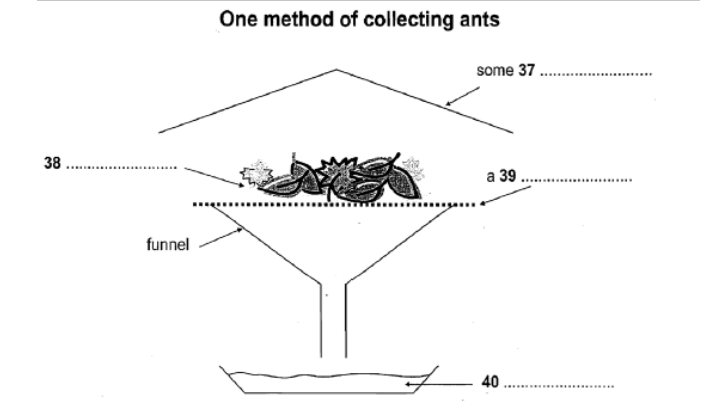
    Many ants are small and forage primarily in the layer of leaves and other debris on the ground. Collecting these species by hand can be difficult. One of the most successful ways to collect them is to gather the leaf litter in which they are foraging and extract the ants from it. This is most commonly done by placing leaf litter on a screen over a large funnel, often under some heat. As the leaf litter dries from above, ants (and other animals) move downward and eventually fall out the bottom and are collected in alcohol placed below the funnel. This method works especially well in rain forests and marshy areas. A method of improving the catch when using a funnel is to sift the leaf litter through a coarse screen before placing it above the funnel. This will concentrate the litter and remove larger leaves and twigs. It will also allow more litter to be sampled when using a limited number of funnels.

    The pitfall trap is another commonly used tool for collecting ants. A pitfall trap can be any small container placed in the ground with the top level with the surrounding surface and filled with a preservative. Ants are collected when they fall into the trap while foraging. The diameter of the traps can vary from about 18 mm to 10 cm and the number used can vary from a few to several hundred. The size of the traps used is influenced largely by personal preference (although larger sizes are generally better), while the number will be determined by the study being undertaken. The preservative used is usually ethylene glycol or propylene glycol, as alcohol will evaporate quickly and the traps will dry out. One advantage of pitfall traps is that they can be used to collect over a period of time with minimal maintenance and intervention. One disadvantage is that some species are not collected as they either avoid the traps or do not commonly encounter them while foraging.

    Questions 27-30
    Do the following statements agree with the information given in Reading Passage 3?
    In boxes 27-30 on your answer sheet, write

    TRUE                     if the statement agrees with the information
    FALSE                   if the statement contradicts the information
    NOT GIVEN       if there is no information on this

    27 Taxonomic research involves comparing members of one group of ants.
    28 New species of ant are frequently identified by taxonomists.
    29 Range is the key criterion for ecological collections.
    30 A single collection of ants can generally be used for both taxonomic and ecological purposes.

    Questions 31-36
    Classify the following statements as referring to
    A hand collecting
    B using bait
    C sampling ground litter
    D using a pitfall trap

    Write the correct letter, A, B, C or D, in boxes 31-36 on your answer sheet.

    31 It is preferable to take specimens from groups of ants.
    32 It is particularly effective for wet habitats.
    33 It is a good method for species which are hard to find.
    34 Little time and effort is required.
    35 Separate containers are used for individual specimens.
    36 Non-alcoholic preservative should be used.

    Questions 37-40
    Label the diagram below. Choose NO MORE THAN TWO WORDS from the passage for each answer.

  • IELTS Reading Practice Test – Exercise 435

    Striking Back at Lightning with Lasers

    Seldom is the weather more dramatic than when thunderstorms strike. Their electrical fury inflicts death or serious injury on around 500 people each year in the United States alone. As the clouds roll in, a leisurely round of golf can become a terrifying dice with death – out in the open, a lone golfer may be a lightning bolt’s most inviting target. And there is damage to property too. Lightning damage costs American power companies more than $100 million a year.

    But researchers in the United States and Japan are planning to hit back. Already in laboratory trials they have tested strategies for neutralising the power of thunderstorms, and this winter they will brave real storms, equipped with an armoury of lasers that they will be pointing towards the heavens to discharge thunderclouds before lightning can strike.

    The idea of forcing storm clouds to discharge their lightning on command is not new. In the early 1960s, researchers tried firing rockets trailing wires into thunderclouds to set up an easy discharge path for the huge electric charges that these clouds generate. The technique survives to this day at a test site in Florida run by the University of Florida, with support from the Electrical Power Research Institute (EPRI), based in California. EPRI, which is funded by power companies, is looking at ways to protect the United States’ power grid from lightning strikes. ‘We can cause the lightning to strike where we want it to using rockets,’ says Ralph Bernstein, manager of lightning projects at EPRI. The rocket site is providing precise measurements of lightning voltages and allowing engineers to check how electrical equipment bears up.

    Bad behaviour
    But while rockets are fine for research, they cannot provide the protection from lightning strikes that everyone is looking for. The rockets cost around $1,200 each, can only be fired at a limited frequency and their failure rate is about 40 per cent. And even when they do trigger lightning, things still do not always go according to plan. ‘Lightning is not perfectly well behaved,’ says Bernstein. ‘Occasionally, it will take a branch and go someplace it wasn’t supposed to go.’

    And anyway, who would want to fire streams of rockets in a populated area? ‘What goes up must come down,’ points out Jean-Claude Diels of the University of New Mexico. Diels is leading a project, which is backed by EPRI, to try to use lasers to discharge lightning safely – and safety is a basic requirement since no one wants to put themselves or their expensive equipment at risk. With around $500,000 invested so far, a promising system is just emerging from the laboratory.

    The idea began some 20 years ago, when high-powered lasers were revealing their ability to extract electrons out of atoms and create ions. If a laser could generate a line of ionisation in the air all the way up to a storm cloud, this conducting path could be used to guide lightning to Earth, before the electric field becomes strong enough to break down the air in an uncontrollable surge. To stop the laser itself being struck, it would not be pointed straight at the clouds. Instead it would be directed at a mirror, and from there into the sky. The mirror would be protected by placing lightning conductors close by. Ideally, the cloud-zapper (gun) would be cheap enough to be installed around all key power installations, and portable enough to be taken to international sporting events to beam up at brewing storm clouds.

    A stumbling block
    However, there is still a big stumbling block. The laser is no nifty portable: it’s a monster that takes up a whole room. Diels is trying to cut down the size and says that a laser around the size of a small table is in the offing. He plans to test this more manageable system on live thunderclouds next summer.

    Bernstein says that Diels’s system is attracting lots of interest from the power companies. But they have not yet come up with the $5 million that EPRI says will be needed to develop a commercial system, by making the lasers yet smaller and cheaper. ‘I cannot say I have money yet, but I’m working on it,’ says Bernstein. He reckons that the forthcoming field tests will be the turning point – and he’s hoping for good news. Bernstein predicts ‘an avalanche of interest and support’ if all goes well. He expects to see cloud-zappers eventually costing $50,000 to $100,000 each.

    Other scientists could also benefit. With a lightning ‘switch’ at their fingertips, materials scientists could find out what happens when mighty currents meet matter. Diels also hopes to see the birth of ‘interactive meteorology’ – not just forecasting the weather but controlling it. ‘If we could discharge clouds, we might affect the weather,’ he says.

    And perhaps, says Diels, we’ll be able to confront some other meteorological menaces. ‘We think we could prevent hail by inducing lightning,’ he says. Thunder, the shock wave that comes from a lightning flash, is thought to be the trigger for the torrential rain that is typical of storms. A laser thunder factory could shake the moisture out of clouds, perhaps preventing the formation of the giant hailstones that threaten crops. With luck, as the storm clouds gather this winter, laser-toting researchers could, for the first time, strike back.

    Questions 1-3
    Choose the correct letter, A, B, C or D. Write the correct letter in boxes 1-3 on your answer sheet.

    1 The main topic discussed in the text is
    A the damage caused to US golf courses and golf players by lightning strikes.
    B the effect of lightning on power supplies in the US and in Japan.
    C a variety of methods used in trying to control lightning strikes.
    D a laser technique used in trying to control lightning strikes.

    2 According to the text, every year lightning
    A does considerable damage to buildings during thunderstorms.
    B kills or injures mainly golfers in the United States.
    C kills or injures around 500 people throughout the world.
    D damages more than 100 American power companies.

    3 Researchers at the University of Florida and at the University of New Mexico
    A receive funds from the same source
    B are using the same techniques
    C are employed by commercial companies
    D are in opposition to each other

    Questions 4-6
    Complete the sentences below. Write NO MORE THAN TWO WORDS.

    4 EPRI receives financial support from………………
    5 The advantage of the technique being developed by Diels is that it can be used ……………..
    6 The main difficulty associated with using the laser equipment is related to its……………..

    Questions 7-10
    Complete the summary using the list of words, A-I, below.
    Write the correct letter, A-I, in boxes 7-10 on your answer sheet.

    In this method, a laser is used to create a line of ionisation by removing electrons from (7) ………………. This laser is then directed at (8) ………………….. in order to control electrical charges, a method which is less dangerous than using (9) ………………….. As a protection for the lasers, the beams are aimed firstly at (10) …………………..

    A cloud-zappers                     B atoms                     C storm clouds

    D mirrors                                E technique                F ions

    G rockets                                H conductors             I thunder

    Questions 11-13
    Do the following statements agree with the information given in Reading Passage 1?
    In boxes 11-13 on your answer sheet write:

    YES                            if the statement agrees with the claims of the writer
    NO                              if the statement contradicts the claims of the writer
    NOT GIVEN           if it is impossible to say what the writer thinks about this

    11 Power companies have given Diels enough money to develop his laser.
    12 Obtaining money to improve the lasers will depend on tests in real storms.
    13 Weather forecasters are intensely interested in Diels’s system.

    The Nature of Genius

    There has always been an interest in geniuses and prodigies. The word ‘genius’, from the Latin gens (= family) and the term ‘genius’, meaning ‘begetter’, comes from the early Roman cult of a divinity as the head of the family. In its earliest form, genius was concerned with the ability of the head of the family, the paterfamilias, to perpetuate himself. Gradually, genius came to represent a person’s characteristics and thence an individual’s highest attributes derived from his ‘genius’ or guiding spirit. Today, people still look to stars or genes, astrology or genetics, in the hope of finding the source of exceptional abilities or personal characteristics.

    The concept of genius and of gifts has become part of our folk culture, and attitudes are ambivalent towards them. We envy the gifted and mistrust them. In the mythology of giftedness, it is popularly believed that if people are talented in one area, they must be defective in another, that intellectuals are impractical, that prodigies burn too brightly too soon and burn out, that gifted people are eccentric, that they are physical weaklings, that there’s a thin line between genius and madness, that genius runs in families, that the gifted are so clever they don’t need special help, that giftedness is the same as having a high IQ, that some races are more intelligent or musical or mathematical than others, that genius goes unrecognised and unrewarded, that adversity makes men wise or that people with gifts have a responsibility to use them. Language has been enriched with such terms as ‘highbrow’, ‘egghead’, ‘blue-stocking’, ‘wiseacre’, ‘know-all’, ‘boffin’ and, for many, ‘intellectual’ is a term of denigration.

    The nineteenth century saw considerable interest in the nature of genius, and produced not a few studies of famous prodigies. Perhaps for us today, two of the most significant aspects of most of these studies of genius are the frequency with which early encouragement and teaching by parents and tutors had beneficial effects on the intellectual, artistic or musical development of the children but caused great difficulties of adjustment later in their lives, and the frequency with which abilities went unrecognised by teachers and schools. However, the difficulty with the evidence produced by these studies, fascinating as they are in collecting together anecdotes and apparent similarities and exceptions, is that they are not what we would today call norm-referenced. In other words, when, for instance, information is collated about early illnesses, methods of upbringing, schooling, etc., we must also take into account information from other historical sources about how common or exceptional these were at the time. For instance, infant mortality was high and life expectancy much shorter than today, home tutoring was common in the families of the nobility and wealthy, bullying and corporal punishment were common at the best independent schools and, for the most part, the cases studied were members of the privileged classes. It was only with the growth of paediatrics and psychology in the twentieth century that studies could be carried out on a more objective, if still not always very scientific, basis.

    Geniuses, however they are defined, are but the peaks which stand out through the mist of history and are visible to the particular observer from his or her particular vantage point. Change the observers and the vantage points, clear away some of the mist, and a different lot of peaks appear. Genius is a term we apply to those whom we recognise for their outstanding achievements and who stand near the end of the continuum of human abilities which reaches back through the mundane and mediocre to the incapable. There is still much truth in Dr. Samuel Johnson’s observation, ‘The true genius is a mind of large general powers, accidentally determined to some particular direction’. We may disagree with the ‘general’, for we doubt if all musicians of genius could have become scientists of genius or vice versa, but there is no doubting the accidental determination which nurtured or triggered their gifts into those channels into which they have poured their powers so successfully. Along the continuum of abilities are hundreds of thousands of gifted men and women, boys and girls.

    What we appreciate, enjoy or marvel at in the works of genius or the achievements of prodigies are the manifestations of skills or abilities which are similar to, but so much superior to, our own. But that their minds are not different from our own is demonstrated by the fact that the hard-won discoveries of scientists like Kepler or Einstein become the commonplace knowledge of schoolchildren and the once outrageous shapes and colours of an artist like Paul Klee so soon appear on the fabrics we wear. This does not minimise the supremacy of their achievements, which outstrip our own as the sub-four-minute milers outstrip our jogging.

    To think of geniuses and the gifted as having uniquely different brains is only reasonable if we accept that each human brain is uniquely different. The purpose of instruction is to make us even more different from one another, and in the process of being educated we can learn from the achievements of those more gifted than ourselves. But before we try to emulate geniuses or encourage our children to do so we should note that some of the things we learn from them may prove unpalatable. We may envy their achievements and fame, but we should also recognise the price they may have paid in terms of perseverance, single-mindedness, dedication, restrictions on their personal lives, the demands upon their energies and time, and how often they had to display great courage to preserve their integrity or to make their way to the top.

    Genius and giftedness are relative descriptive terms of no real substance. We may, at best, give them some precision by defining them and placing them in a context but, whatever we do, we should never delude ourselves into believing that gifted children or geniuses are different from the rest of humanity, save in the degree to which they have developed the performance of their abilities.

    Questions 14-18
    Choose FIVE letters, A—K. Write the correct letters in boxes 14-18 on your answer sheet.
    NB Your answers maybe given in any order.
    Below are listed some popular beliefs about genius and giftedness.

    Which FIVE of these beliefs are reported by the writer of the text?

    A Truly gifted people are talented in all areas.
    B The talents of geniuses are soon exhausted.
    C Gifted people should use their gifts.
    D A genius appears once in every generation.
    E Genius can be easily destroyed by discouragement.
    F Genius is inherited.
    G Gifted people are very hard to live with.
    H People never appreciate true genius.
    I Geniuses are natural leaders.
    J Gifted people develop their greatness through difficulties.
    K Genius will always reveal itself.

    Questions 19-26
    Do the following statements agree with the information given in Reading Passage 2? In boxes 19-26 on your answer sheet, write:

    TRUE                                  if the statement agrees with the information
    FALSE                                if the statement contradicts the information
    NOT GIVEN                     if there is no information on this

    19 Nineteenth-century studies of the nature of genius failed to take into account the uniqueness of the person’s upbringing.
    20 Nineteenth-century studies of genius lacked both objectivity and a proper scientific approach.
    21 A true genius has general powers capable of excellence in any area
    22 The skills of ordinary individuals are in essence the same as the skills of prodigies.
    23 The ease with which truly great ideas are accepted and taken for granted fails to lessen their significance.
    24 Giftedness and genius deserve proper scientific research into their true nature so that all talent may be retained for the human race.
    25 Geniuses often pay a high price to achieve greatness.
    26 To be a genius is worth the high personal cost.

    How Does the Biological Clock Tick?

    A Our life span is restricted. Everyone accepts this as ‘biologically’ obvious. ‘Nothing lives forever!’ However, in this statement we think of artificially produced, technical objects, products which are subjected to natural wear and tear during use. This leads to the result that at some time or other the object stops working and is unusable (‘death’ in the biological sense). But are the wear and tear and loss of function of technical objects and the death of living organisms really similar or comparable?

    B Our ‘dead’ products are ‘static’, closed systems. It is always the basic material which constitutes the object and which, in the natural course of things, is worn down and becomes ‘older*. Ageing in this case must occur according to the laws of physical chemistry and of thermodynamics. Although the same law holds for a living organism, the result of this law is not inexorable in the same way. At least as long as a biological system has the ability to renew itself it could actually become older without ageing; an organism is an open, dynamic system through which new material continuously flows. Destruction of old material and formation of new material are thus in permanent dynamic equilibrium. The material of which the organism is formed changes continuously. Thus our bodies continuously exchange old substance for new, just like a spring which more or less maintains its form and movement, but in which the water molecules are always different.

    C Thus ageing and death should not be seen as inevitable, particularly as the organism possesses many mechanisms for repair. It is not, in principle, necessary for a biological system to age and die. Nevertheless, a restricted life span, ageing, and then death are basic characteristics of life. The reason for this is easy to recognise: in nature, the existent organisms either adapt or are regularly replaced by new types. Because of changes in the genetic material (mutations) these have new characteristics and in the course of their individual lives they are tested for optimal or better adaptation to the environmental conditions. Immortality would disturb this system – it needs room for new and better life. This is the basic problem of evolution.

    D Every organism has a life span which is highly characteristic. There are striking differences in life span between different species, but within one species the parameter is relatively constant. For example, the average duration of human life has hardly changed in thousands of years. Although more and more people attain an advanced age as a result of developments in medical care and better nutrition, the characteristic upper limit for most remains 80 years. A further argument against the simple wear and tear theory is the observation that the time within which organisms age lies between a few days (even a few hours for unicellular organisms) and several thousand years, as with mammoth trees.

    E If a life span is a genetically determined biological characteristic, it is logically necessary to propose the existence of an internal clock, which in some way measures and controls the ageing process and which finally determines death as the last step in a fixed programme. Like the life span, the metabolic rate has for different organisms a fixed mathematical relationship to the body mass. In comparison to the life span this relationship is ‘inverted’: the larger the organism the lower its metabolic rate. Again this relationship is valid not only for birds, but also, similarly on average within the systematic unit, for all other organisms (plants, animals, unicellular organisms).

    F Animals which behave ‘frugally’ with energy become particularly old, for example, crocodiles and tortoises. Parrots and birds of prey are often held chained up. Thus they are not able to ‘experience life’ and so they attain a high life span in captivity. Animals which save energy by hibernation or lethargy (e.g. bats or hedgehogs) live much longer than those which are always active. The metabolic rate of mice can be reduced by a very low consumption of food (hunger diet). They then may live twice as long as their well fed comrades. Women become distinctly (about 10 per cent) older than men. If you examine the metabolic rates of the two sexes you establish that the higher male metabolic rate roughly accounts for the lower male life span. That means that they live life ‘energetically’ – more intensively, but not for as long.

    G It follows from the above that sparing use of energy reserves should tend to extend life. Extreme high performance sports may lead to optimal cardiovascular performance, but they quite certainly do not prolong life. Relaxation lowers metabolic rate, as does adequate sleep and in general an equable and balanced personality. Each of us can develop his or her own ‘energy saving programme’ with a little self-observation, critical self-control and, above all, logical consistency. Experience will show that to live in this way not only increases the life span but is also very healthy. This final aspect should not be forgotten.

    Questions 27-32
    Reading Passage 3 has seven paragraphs, A—G. Choose the correct heading for paragraphs B—G from the list of headings below. Write the correct number, i—x, in boxes 27-32 on your answer sheet.

    List of Headings

    i The biological clock
    ii Why dying is beneficial
    iii The ageing process of men and women
    iv Prolonging your life
    v Limitations of life span
    vi Modes of development of different species
    vii A stable life span despite improvements
    viii Energy consumption
    ix Fundamental differences in ageing of objects and organisms
    x Repair of genetic material

    Example: Paragraph A                v

    27 Paragraph B
    28 Paragraph C
    29 Paragraph D
    30 Paragraph E
    31 Paragraph F
    32 Paragraph G

    Questions 33-36
    Complete the notes below. Choose NO MORE THAN TWO WORDS from the passage for each answer.

    • Objects age in accordance with principles of (33) ………………….. and of (34) ……………………………..
    • Through mutations, organisms can (35) …………………. better to the environment
    • (36) ………………… would pose a serious problem for the theory of evolution

    Questions 37-40
    Do the following statements agree with the views of the writer in Reading Passage 3?
    In boxes 37-40 on your answer sheet, write:

    YES                           if the statement agrees with the views of the writer
    NO                             if the statement contradicts the views of the writer
    NOT GIVEN          if it is impossible to say what the writer thinks about this

    37 The wear and tear theory applies to both artificial objects and biological systems.
    38 In principle, it is possible for a biological system to become older without ageing.
    39 Within seven years, about 90 per cent of a human body is replaced as new.
    40 Conserving energy may help to extend a human’s life.

  • IELTS Reading Practice Test – Exercise 434

    Sheet Glass Manufacture: the Float Process

    Glass, which has been made since the time of the Mesopotamians and Egyptians, is little more than a mixture of sand, soda ash and lime. When heated to about 1500 degrees Celsius (°C) this becomes a molten mass that hardens when slowly cooled. The first successful method for making clear, flat glass involved spinning. This method was very effective as the glass had not touched any surfaces between being soft and becoming hard, so it stayed perfectly unblemished, with a ‘fire finish’. However, the process took a long time and was labour intensive.

    Nevertheless, demand for flat glass was very high and glassmakers across the world were looking for a method of making it continuously. The first continuous ribbon process involved squeezing molten glass through two hot rollers, similar to an old mangle. This allowed glass of virtually any thickness to be made non-stop, but the rollers would leave both sides of the glass marked, and these would then need to be ground and polished. This part of the process rubbed away around 20 per cent of the glass, and the machines were very expensive.

    The float process for making flat glass was invented by Alistair Pilkington. This process allows the manufacture of clear, tinted and coated glass for buildings, and clear and tinted glass for vehicles. Pilkington had been experimenting with improving the melting process, and in 1952 he had the idea of using a bed of molten metal to form the flat glass, eliminating altogether the need for rollers within the float bath. The metal had to melt at a temperature less than the hardening point of glass (about 600°C), but could net boil at a temperature below the temperature of the molten glass (about 1500°C). The best metal for the job was tin.

    The rest of the concept relied on gravity, which guaranteed that the surface of the molten metal was perfectly flat and horizontal. Consequently, when pouring molten glass onto the molten tin, the underside of the glass would also be perfectly flat. If the glass were kept hot enough, it would flow over the molten tin until the top surface was also flat, horizontal and perfectly parallel to the bottom surface. Once the glass cooled to 604°C or less it was too hard to mark and could be transported out of the cooling zone by rollers. The glass settled to a thickness of six millimetres because of surface tension interactions between the glass and the tin. By fortunate coincidence, 60 per cent of the flat glass market at that time was for six- millimetre glass.

    Pilkington built a pilot plant in 1953 and by 1955 he had convinced his company to build a full-scale plant. However, it took 14 months of non-stop production, costing the company £100,000 a month, before the plant produced any usable glass. Furthermore, once they succeeded in making marketable flat glass, the machine was turned off for a service to prepare it for years of continuous production. When it started up again it took another four months to get the process right again. They finally succeeded in 1959 and there are now float plants all over the world, with each able to produce around 1000 tons of glass every day, non-stop for around 15 years.

    Float plants today make glass of near optical quality. Several processes – melting, refining, homogenising – take place simultaneously in the 2000 tonnes of molten glass in the furnace. They occur in separate zones in a complex glass flow driven by high temperatures. It adds up to a continuous melting process, lasting as long as 50 hours, that delivers glass smoothly and continuously to the float bath, and from there to a coating zone and finally a heat treatment zone, where stresses formed during cooling are relieved.

    The principle of float glass is unchanged since the 1950s. However, the product has changed dramatically, from a single thickness of 6.8 mm to a range from sub-millimetre to 25 mm, from a ribbon frequently marred by inclusions and bubbles to almost optical perfection. To ensure the highest quality, inspection takes place at every stage. Occasionally, a bubble is not removed during refining, a sand grain refuses to melt, a tremor in the tin puts ripples into the glass ribbon. Automated on-line inspection does two things. Firstly, it reveals process faults upstream that can be corrected. Inspection technology allows more than 100 million measurements a second to be made across the ribbon, locating flaws the unaided eye would be unable to see. Secondly, it enables computers downstream to steer cutters around flaws.

    Float glass is sold by the square metre, and at the final stage computers translate customer requirements into patterns of cuts designed to minimise waste.

    Questions 1-8
    Complete the table and diagram below. Choose NO MORE THAN TWO WORDS from the passage for each answer.
    Write your answers in boxes 1-8 on your answer sheet.

    Questions 9-13
    Do the following statements agree with the information given in Reading Passage 1? In boxes 9-13 on your answer sheet, write:

    TRUE                          if the statement agrees with the information
    FALSE                        if the statement contradicts the information
    NOT GIVEN             if there is no information on this

    9 The metal used in the float process had to have specific properties.
    10 Pilkington invested some of his own money in his float plant.
    11 Pilkington’s first full-scale plant was an instant commercial success.
    12 The process invented by Pilkington has now been improved.
    13 Computers are better than humans at detecting faults in glass.

    The Little Ice Age

    A This book will provide a detailed examination of the Little Ice Age and other climatic shifts, but, before I embark on that, let me provide a historical context. We tend to think of climate – as opposed to weather – as something unchanging, yet humanity has been at the mercy of climate change for its entire existence, with at least eight glacial episodes in the past 730,000 years. Our ancestors adapted to the universal but irregular global warming since the end of the last great Ice Age, around 10,000 years ago, with dazzling opportunism. They developed strategies for surviving harsh drought cycles, decades of heavy rainfall or unaccustomed cold; adopted agriculture and stock-raising, which revolutionised human life; and founded the world’s first pre-industrial civilisations in Egypt, Mesopotamia and the Americas. But the price of sudden climate change, in famine, disease and suffering, was often high.

    B The Little Ice Age lasted from roughly 1300 until the middle of the nineteenth century. Only two centuries ago, Europe experienced a cycle of bitterly cold winters; mountain glaciers in the Swiss Alps were the lowest in recorded memory, and pack ice surrounded Iceland for much of the year. The climatic events of the Little Ice Age did more than help shape the modern world. They are the deeply important context for the current unprecedented global warming. The Little Ice Age was far from a deep freeze, however; rather an irregular seesaw of rapid climatic shifts, few lasting more than a quarter-century, driven by complex and still little understood interactions between the atmosphere and the ocean. The seesaw brought cycles of intensely cold winters and easterly winds, then switched abruptly to years of heavy spring and early summer rains, mild winters, and frequent Atlantic storms, or to periods of droughts, light northeasterly winds, and summer heat waves.

    C Reconstructing the climate changes of the past is extremely difficult, because systematic weather observations began only a few centuries ago, in Europe and North America. Records from India and tropical Africa are even more recent.

    For the time before records began, we have only ‘proxy records’ reconstructed largely from tree rings and ice cores, supplemented by a few incomplete written accounts. We now have hundreds of tree-ring records from throughout the northern hemisphere, and many from south of the equator, too, amplified with a growing body of temperature data from ice cores drilled in Antarctica, Greenland, the Peruvian Andes, and other locations. We are close to a knowledge of annual summer and winter temperature variations over much of the northern hemisphere going back 600 years.

    D This book is a narrative history of climatic shifts during the past ten centuries, and some of the ways in which people in Europe adapted to them. Part One describes the Medieval Warm Period, roughly 900 to 1200. During these three centuries, Norse voyagers from Northern Europe explored northern seas, settled Greenland, and visited North America. It was not a time of uniform warmth, for then, as always since the Great Ice Age, there were constant shifts in rainfall and temperature. Mean European temperatures were about the same as today, perhaps slightly cooler.

    E It is known that the Little Ice Age cooling began in Greenland and the Arctic in about 1200. As the Arctic ice pack spread southward, Norse voyages to the west were rerouted into the open Atlantic, then ended altogether. Storminess increased in the North Atlantic and North Sea. Colder, much wetter weather descended on Europe between 1315 and 1319, when thousands perished in a continent-wide famine. By 1400, the weather had become decidedly more unpredictable and stormier, with sudden shifts and lower temperatures that culminated in the cold decades of the late sixteenth century. Fish were a vital commodity in growing towns and cities, where food supplies were a constant concern. Dried cod and herring were already the staples of the European fish trade, but changes in water temperatures forced fishing fleets to work further offshore. The Basques, Dutch, and English developed the first offshore fishing boats adapted to a colder and stormier Atlantic. A gradual agricultural revolution in northern Europe stemmed from concerns over food supplies at a time of rising populations. The revolution involved intensive commercial farming and the growing of animal fodder on land not previously used for crops. The increased productivity from farmland made some countries self-sufficient in grain and livestock and offered effective protection against famine.

    F Global temperatures began to rise slowly after 1850, with the beginning of the Modern Warm Period. There was a vast migration from Europe by land-hungry farmers and others, to which the famine caused by the Irish potato blight contributed, to North America, Australia, New Zealand, and southern Africa. Millions of hectares of forest and woodland fell before the newcomers’ axes between 1850 and 1890, as intensive European farming methods expanded across the world. The unprecedented land clearance released vast quantities of carbon dioxide into the atmosphere, triggering for the first time humanly caused global warming. Temperatures climbed more rapidly in the twentieth century as the use of fossil fuels proliferated and greenhouse gas levels continued to soar. The rise has been even steeper since the early 1980s. The Little Ice Age has given way to a new climatic regime, marked by prolonged and steady warming. At the same time, extreme weather events like Category 5 hurricanes are becoming more frequent.

    Questions 14-17
    Reading Passage 2 has six paragraphs, A—F. Choose the correct heading for paragraphs B and D—F from the list of headings below. Write the correct number, i—ix, in boxes 14-17 on your answer sheet.

    List of Headings

    i Predicting climatic changes
    ii The relevance of the Little Ice Age today
    iii How cities contribute to climate change
    iv Human impact on the climate
    v How past climatic conditions can be determined
    vi A growing need for weather records
    vii A study covering a thousand years
    viii People have always responded to climate change
    ix Enough food at last

    Example Answer           Paragraph A                viii
    14. Paragraph B
    Example Answer           Paragraph C                 v
    15 Paragraph D
    16 Paragraph E
    17 Paragraph F

    Questions 18-22
    Complete the summary using the list of words, A—I, below. Write the correct letter, A—I, in boxes 18-22 on your answer sheet.

    Weather during the Little Ice Age
    Documentation of past weather condition is limited: our main sources of knowledge of conditions in the distant past are (18)………………. and (19)………………… . We can deduce that the Little Ice Age was a time of (20)…………… , rather than of consistent freezing. Within it there were some periods of very cold winters, others of (21)…………. and heavy rain, and yet others that saw (22)…………. with no rain at all.

    A climatic shifts                    B ice cores                      C tree rings

    D glaciers                             E interactions                  F weather observations

    G heat waves                       H storms                         I written accounts

    Questions 23-26
    Classify the following events as occurring during the

    A Medieval Warm Period
    B Little Ice Age
    C Modem Warm Period

    Write the correct letter, A, B or C, in boxes 23-26 on your answer sheet.

    23 Many Europeans started farming abroad.
    24 The cutting down of trees began to affect the climate.
    25 Europeans discovered other lands.
    26 Changes took place in fishing patterns.

    The meaning and power of smell

    A A survey conducted by Anthony Synott at Montreal’s Concordia University asked participants to comment on how important smell was to them in their lives. It became apparent that smell can evoke strong emotional responses. A scent associated with a good experience can bring a rush of joy, while a foul odour or one associated with a bad memory may make us grimace with disgust. Respondents to the survey noted that many of their olfactory likes and dislikes were based on emotional associations. Such associations can be powerful enough so that odours that we would generally label unpleasant become agreeable, and those that we would generally consider fragrant become disagreeable for particular individuals. The perception of smell, therefore, consists not only of the sensation of the odours themselves, but of the experiences and emotions associated with them.

    B Odours are also essential cues in social bonding. One respondent to the survey believed that there is no true emotional bonding without touching and smelling a loved one. In fact, infants recognise the odours of their mothers soon after birth and adults can often identify their children or spouses by scent. In one well-known test, women and men were able to distinguish by smell alone clothing worn by their marriage partners from similar clothing worn by other people. Most of the subjects would probably never have given much thought to odour as a cue for identifying family members before being involved in the test, but as the experiment revealed, even when not consciously considered, smells register.

    C In spite of its importance to our emotional and sensory lives, smell is probably the most undervalued sense in many cultures. The reason often given for the low regard in which smell is held is that, in comparison with its importance among animals, the human sense of smell is feeble and undeveloped. While it is true that the olfactory powers of humans are nothing like as fine as those possessed by certain animals, they are still remarkably acute. Our noses are able to recognise thousands of smells, and to perceive odours which are present only in extremely small quantities.

    D Smell, however, is a highly elusive phenomenon. Odours, unlike colours, for instance, cannot be named in many languages because the specific vocabulary simply doesn’t exist. ‘It smells like . . .,’ we have to say when describing an odour, struggling to express our olfactory experience. Nor can odours be recorded: there is no effective way to either capture or store them over time. In the realm of olfaction, we must make do with descriptions and recollections. This has implications for olfactory research.

    E Most of the research on smell undertaken to date has been of a physical scientific nature. Significant advances have been made in the understanding of the biological and chemical nature of olfaction, but many fundamental questions have yet to be answered. Researchers have still to decide whether smell is one sense or two – one responding to odours proper and the other registering odourless chemicals in the air. Other unanswered questions are whether the nose is the only part of the body affected by odours, and how smells can be measured objectively given the nonphysical components. Questions like these mean that interest in the psychology of smell is inevitably set to play an increasingly important role for researchers.

    F However, smell is not simply a biological and psychological phenomenon. Smell is cultural, hence it is a social and historical phenomenon. Odours are invested with cultural values: smells that are considered to be offensive in some cultures may be perfectly acceptable in others. Therefore, our sense of smell is a means of, and model for, interacting with the world. Different smells can provide us with intimate and emotionally charged experiences and the value that we attach to these experiences is interiorised by the members of society in a deeply personal way. Importantly, our commonly held feelings about smells can help distinguish us from other cultures. The study of the cultural history of smell is, therefore, in a very real sense, an investigation into the essence of human culture.

    Questions 27-32
    Reading Passage 3 has six paragraphs, A—F. Choose the correct heading for each paragraph from the list of headings below.

    Write the correct number, i—viii, in boxes 27-32 on your answer sheet.

    List of Headings

    i The difficulties of talking about smells
    ii The role of smell in personal relationships
    iii Future studies into smell
    iv The relationship between the brain and the nose
    v The interpretation of smells as a factor in defining groups
    vi Why our sense of smell is not appreciated
    vii Smell is our superior sense
    viii The relationship between smell and feelings

    27 Paragraph A
    28 Paragraph B
    29 Paragraph C
    30 Paragraph D
    31 Paragraph E
    32 Paragraph F

    Questions 33-36
    Choose the correct letter, A, B, C or D. Write the correct letter in boxes 33-36 on your answer sheet.

    33 According to the introduction, we become aware of the importance of smell when
    A we discover a new smell
    B we experience a powerful smell
    C our ability to smell is damaged
    D we are surrounded by odours

    34 The experiment described in paragraph B
    A shows how we make use of smell without realising it
    B demonstrates that family members have a similar smell
    C proves that a sense of smell is learnt
    D compares the sense of smell in males and females

    35 What is the writer doing in paragraph C?
    A supporting other research
    B making a proposal
    C rejecting a common belief
    D describing limitations

    36 What does the writer suggest about the study of smell in the atmosphere in paragraph E?
    A The measurement of smell is becoming more accurate
    B Researchers believe smell is a purely physical reaction
    C Most smells are inoffensive
    D Smell is yet to be defined

    Questions 37-40
    Complete the sentences below. Choose ONE WORD ONLY from the passage for each answer.

    37 Tests have shown that odours can help people recognise the………………..belonging to their husbands and wives.
    38 Certain linguistic groups may have difficulty describing smell because they lack the appropriate……………
    39 The sense of smell may involve response to…………………which do not smell, in addition to obvious odours.
    40 Odours regarded as unpleasant in certain……………………….are not regarded as unpleasant in others.

  • IELTS Reading Practice Test – Exercise 433

    A CHRONICLE OF TIMEKEEPING

    A According to archaeological evidence, at least 5,000 years ago, and long before the advent of the Roman Empire, the Babylonians began to measure time, introducing calendars to co-ordinate communal activities, to plan the shipment of goods and, in particular, to regulate planting and harvesting. They based their calendars on three natural cycles: the solar day, marked by the successive periods of light and darkness as the earth rotates on its axis; the lunar month, following the phases of the moon as it orbits the earth; and the solar year, defined by the changing seasons that accompany our planet’s revolution around the sun.

    B Before the invention of artificial light, the moon had greater social impact. And, for those living near the equator in particular, its waxing and waning was more conspicuous than the passing of the seasons. Hence, the calendars that were developed at the lower latitudes were influenced more by the lunar cycle than by the solar year. In more northern climes, however, where seasonal agriculture was practised, the solar year became more crucial. As the Roman Empire expanded northward, it organised its activity chart for the most part around the solar year.

    C Centuries before the Roman Empire, the Egyptians had formulated a municipal calendar having 12 months of 30 days, with five days added to approximate the solar year. Each period of ten days was marked by the appearance of special groups of stars called decans. At the rise of the star Sirius just before sunrise, which occurred around the all-important annual flooding of the Nile, 12 decans could be seen spanning the heavens. The cosmic significance the Egyptians placed in the 12 decans led them to develop a system in which each interval of darkness (and later, each interval of daylight) was divided into a dozen equal parts. These periods became known as temporal hours because their duration varied according to the changing length of days and nights with the passing of the seasons. Summer hours were long, winter ones short; only at the spring and autumn equinoxes were the hours of daylight and darkness equal. Temporal hours, which were first adopted by the Greeks and then the Romans, who disseminated them through Europe, remained in use for more than 2,500 years.

    D In order to track temporal hours during the day, inventors created sundials, which indicate time by the length or direction of the sun’s shadow. The sundial’s counterpart, the water clock, was designed to measure temporal hours at night. One of the first water clocks was a basin with a small hole near the bottom through which the water dripped out. The falling water level denoted the passing hour as it dipped below hour lines inscribed on the inner surface. Although these devices performed satisfactorily around the Mediterranean, they could not always be depended on in the cloudy and often freezing weather of northern Europe.

    E The advent of the mechanical clock meant that although it could be adjusted to maintain temporal hours, it was naturally suited to keeping equal ones. With these, however, arose the question of when to begin counting, and so, in the early 14th century, a number of systems evolved. The schemes that divided the day into 24 equal parts varied according to the start of the count: Italian hours began at sunset, Babylonian hours at sunrise, astronomical hours at midday and ‘great clock’ hours, used for some large public clocks in Germany, at midnight. Eventually these were superseded by ‘small clock’, or French, hours, which split the day into two 12-hour periods commencing at midnight.

    F The earliest recorded weight-driven mechanical clock was built in 1283 in Bedfordshire in England. The revolutionary aspect of this new timekeeper was neither the descending weight that provided its motive force nor the gear wheels (which had been around for at least 1,300 years) that transferred the power; it was the part called the escapement. In the early 1400s came the invention of the coiled spring or fusee which maintained constant force to the gear wheels of the timekeeper despite the changing tension of its mainspring. By the 16th century, a pendulum clock had been devised, but the pendulum swung in a large arc and thus was not very efficient.

    G To address this, a variation on the original escapement was invented in 1670, in England. It was called the anchor escapement, which was a lever-based device shaped like a ship’s anchor. The motion of a pendulum rocks this device so that it catches and then releases each tooth of the escape wheel, in turn allowing it to turn a precise amount. Unlike the original form used in early pendulum clocks, the anchor escapement permitted the pendulum to travel in a very small arc. Moreover, this invention allowed the use of a long pendulum which could beat once a second and thus led to the development of a new floor standing case design, which became known as the grandfather clock.

    H Today, highly accurate timekeeping instruments set the beat for most electronic devices. Nearly all computers contain a quartz-crystal clock to regulate their operation. Moreover, not only do time signals beamed down from Global Positioning System satellites calibrate the functions of precision navigation equipment, they do so as well for mobile phones, instant stock-trading systems and nationwide power-distribution grids. So integral have these time-based technologies become to day-to-day existence that our dependency on them is recognised only when they fail to work.

    Questions 1-4
    Reading Passage 1 has eight paragraphs, A-H. Which paragraph contains the following information? Write the correct letter, A-H, in boxes 1- 4 on your answer sheet.

    1 a description of an early timekeeping invention affected by cold temperatures
    2 an explanation of the importance of geography in the development of the calendar in farming communities
    3 a description of the origins of the pendulum clock
    4 details of the simultaneous efforts of different societies to calculate time using uniform hours

    Questions 5-8
    Look at the following events (Questions 5-8) and the list of nationalities below. Match each event with the correct nationality, A-F. Write the correct letter, A-F, in boxes 5-8 on your answer sheet.

    5 They devised a civil calendar in which the months were equal in length.
    6 They divided the day into two equal halves.
    7 They developed a new cabinet shape for a type of timekeeper.
    8 They created a calendar to organise public events and work schedules.

    A Babylonians
    B Egyptians
    C Greeks
    D English
    E Germans
    F French

    Questions 9-13
    Label the diagram below. Write NO MORE THAN TWO WORDS from the passage.

    AIR TRAFFIC CONTROL IN THE USA

    A An accident that occurred in the skies over the Grand Canyon in 1956 resulted in the establishment of the Federal Aviation Administration (FAA) to regulate and oversee the operation of aircraft in the skies over the United States, which were becoming quite congested. The resulting structure of air traffic control has greatly increased the safety of flight in the United States, and similar air traffic control procedures are also in place over much of the rest of the world.

    B Rudimentary air traffic control (АТС) existed well before the Grand Canyon disaster. As early as the 1920s, the earliest air traffic controllers manually guided aircraft in the vicinity of the airports, using lights and flags, while beacons and flashing lights were placed along cross-country routes to establish the earliest airways. However, this purely visual system was useless in bad weather, and, by the 1930s, radio communication was coming into use for АТС. The first region to have something approximating today’s АТС was New York City, with other major metropolitan areas following soon after.

    C In the 1940s, АТС centres could and did take advantage of the newly developed radar and improved radio communication brought about by the Second World War, but the system remained rudimentary. It was only after the creation of the FAA that full-scale regulation of America’s airspace took place, and this was fortuitous, for the advent of the jet engine suddenly resulted in a large number of very fast planes, reducing pilots’ margin of error and practically demanding some set of rules to keep everyone well separated and operating safely in the air.

    D Many people think that АТС consists of a row of controllers sitting in front of their radar screens at the nation’s airports, telling arriving and departing traffic what to do. This is a very incomplete part of the picture. The FAA realised that the airspace over the United States would at any time have many different kinds of planes, flying for many different purposes, in a variety of weather conditions, and the same kind of structure was needed to accommodate all of them.

    E To meet this challenge, the following elements were put into effect. First, АТС extends over virtually the entire United States. In general, from 365m above the ground and higher, the entire country is blanketed by controlled airspace. In certain areas, mainly near airports, controlled airspace extends down to 215m above the ground, and, in the immediate vicinity of an airport, all the way down to the surface. Controlled airspace is that airspace in which FAA regulations apply. Elsewhere, in uncontrolled airspace, pilots are bound by fewer regulations. In this way, the recreational pilot who simply wishes to go flying for a while without all the restrictions imposed by the FAA has only to stay in uncontrolled airspace, below 365m, while the pilot who does want the protection afforded by АТС can easily enter the controlled airspace.

    F The FAA then recognised two types of operating environments. In good meteorological conditions, flying would be permitted under Visual Flight Rules (VFR), which suggests a strong reliance on visual cues to maintain an acceptable level of safety. Poor visibility necessitated a set of Instrumental Flight Rules (IFR), under which the pilot relied on altitude and navigational information provided by the plane’s instrument panel to fly safely. On a clear day, a pilot in controlled airspace can choose a VFR or IFR flight plan, and the FAA regulations were devised in a way which accommodates both VFR and IFR operations in the same airspace. However, a pilot can only choose to fly IFR if they possess an instrument rating which is above and beyond the basic pilot’s license that must also be held.

    G Controlled airspace is divided into several different types, designated by letters of the alphabet. Uncontrolled airspace is designated Class F, while controlled airspace below 5,490m above sea level and not in the vicinity of an airport is Class E. All airspace above 5,490m is designated Class A. The reason for the division of Class E and Class A airspace stems from the type of planes operating in them. Generally, Class E airspace is where one finds general aviation aircraft (few of which can climb above 5,490m anyway), and commercial turboprop aircraft. Above 5,490m is the realm of the heavy jets, since jet engines operate more efficiently at higher altitudes. The difference between Class E and A airspace is that in Class A, all operations are IFR, and pilots must be instrument-rated, that is, skilled and licensed in aircraft instrumentation. This is because АТС control of the entire space is essential. Three other types of airspace, Classes D, С and B, govern the vicinity of airports. These correspond roughly to small municipal, medium-sized metropolitan and major metropolitan airports respectively, and encompass an increasingly rigorous set of regulations. For example, all a VFR pilot has to do to enter Class С airspace is establish two-way radio contact with АТС. No explicit permission from АТС to enter is needed, although the pilot must continue to obey all regulations governing VFR flight. To enter Class В airspace, such as on approach to a major metropolitan airport, an explicit АТС clearance is required. The private pilot who cruises without permission into this airspace risks losing their license.

    Questions 14-19
    Reading passage 2 has seven paragraphs A-G. Choose the correct heading for paragraphs A and C-G from the list below. Write the correct number i-x in boxes 14-19 on your answer sheet.

    List of Headings

    i Disobeying FAA Regulations
    ii Aviation disaster prompts action
    iii Two coincidental developments
    iv Setting Altitude Zones
    v An oversimplified view
    vi Controlling pilots’ licence
    vii Defining airspace categories
    viii Setting rules to weather conditions
    ix Taking of Safety
    x First step towards ATC

    Example – Paragraph B                 x
    14 Paragraph A
    15 Paragraph C
    16 Paragraph D
    17 Paragraph E
    18 Paragraph F
    19 Paragraph G

    Questions 20-26
    Do the following statements agree with the given information of the reading passage? In boxes 20-26 on your answer sheet, write:

    TRUE                          if the statement agrees with the information
    FALSE                        if the statement contradicts the information
    NOT GIVEN             if there is no information on this

    20 The FAA was created as a result of the introduction of the jet engine.
    21 Air traffic control started after the Grand Canyon crash in 1956.
    22 Beacons and flashing lights are still used by the ATC today.
    23 Some improvements were made in radio communication during World War II.
    24 Class F airspace is airspace which is below 365m and not near airports.
    25 All aircraft in class E airspace must use IFR.
    26 A pilot entering class C airspace is flying over an average-sized city.

    TELEPATHY

    Since the 1970s, parapsychologists at leading universities and research institutes around the world have risked the derision of sceptical colleagues by putting the various claims for telepathy to the test in dozens of rigorous scientific studies. The results and their implications are dividing even the researchers who uncovered them.

    Some researchers say the results constitute compelling evidence that telepathy is genuine. Other parapsychologists believe the field is on the brink of collapse, having tried to produce definitive scientific proof and failed. Sceptics and advocates alike do concur on one issue, however: that the most impressive evidence so far has come from the so-called ‘ganzfeld’ experiments, a German term that means ‘whole field’. Reports of telepathic experiences had by people during meditation led parapsychologists to suspect that telepathy might involve ‘signals’ passing between people that were so faint that they were usually swamped by normal brain activity. In this case, such signals might be more easily detected by those experiencing meditation-like tranquility in a relaxing ‘whole field’ of light, sound and warmth.

    The ganzfeld experiment tries to recreate these conditions with participants sitting in soft reclining chairs in a sealed room, listening to relaxing sounds while their eyes are covered with special filters letting in only soft pink light. In early ganzfeld experiments, the telepathy test involved identification of a picture chosen from a random selection of four taken from a large image bank. The idea was that a person acting as a ‘sender’ would attempt to beam the image over to the ‘receiver’ relaxing in the sealed room. Once the session was over, this person was asked to identify which of the four images had been used. Random guessing would give a hit-rate of 25 per cent; if telepathy is real, however, the hit-rate would be higher. In 1982, the results from the first ganzfeld studies were analysed by one of its pioneers, the American parapsychologist Charles Honorton. They pointed to typical hit-rates of better than 30 per cent – a small effect, but one which statistical tests suggested could not be put down to chance.

    The implication was that the ganzfeld method had revealed real evidence for telepathy. But there was a crucial flaw in this argument – one routinely overlooked in more conventional areas of science. Just because chance had been ruled out as an explanation did not prove telepathy must exist; there were many other ways of getting positive results. These ranged from ‘sensory leakage’ – where clues about the pictures accidentally reach the receiver – to outright fraud. In response, the researchers issued a review of all the ganzfeld studies done up to 1985 to show that 80 per cent had found statistically significant evidence. However, they also agreed that there were still too many problems in the experiments which could lead to positive results, and they drew up a list demanding new standards for future research.

    After this, many researchers switched to autoganzfeld tests – an automated variant of the technique which used computers to perform many of the key tasks such as the random selection of images. By minimising human involvement, the idea was to minimise the risk of flawed results. In 1987, results from hundreds of autoganzfeld tests were studied by Honorton in a ‘meta-analysis’, a statistical technique for finding the overall results from a set of studies. Though less compelling than before, the outcome was still impressive.

    Yet some parapsychologists remain disturbed by the lack of consistency between individual ganzfeld studies. Defenders of telepathy point out that demanding impressive evidence from every study ignores one basic statistical fact: it takes large samples to detect small effects. If, as current results suggest, telepathy produces hit-rates only marginally above the 25 per cent expected by chance, it’s unlikely to be detected by a typical ganzfeld study involving around 40 people: the group is just not big enough. Only when many studies are combined in a meta-analysis will the faint signal of telepathy really become apparent. And that is what researchers do seem to be finding.

    What they are certainly not finding, however, is any change in attitude of mainstream scientists: most still totally reject the very idea of telepathy. The problem stems at least in part from the lack of any plausible mechanism for telepathy.

    Various theories have been put forward, many focusing on esoteric ideas from theoretical physics. They include ‘quantum entanglement’, in which events affecting one group of atoms instantly affect another group, no matter how far apart they may be. While physicists have demonstrated entanglement with specially prepared atoms, no-one knows if it also exists between atoms making up human minds. Answering such questions would transform parapsychology. This has prompted some researchers to argue that the future lies not in collecting more evidence for telepathy, but in probing possible mechanisms. Some work has begun already, with researchers trying to identify people who are particularly successful in autoganzfeld trials. Early results show that creative and artistic people do much better than average: in one study at the University of Edinburgh, musicians achieved a hit-rate of 56 per cent. Perhaps more tests like these will eventually give the researchers the evidence they are seeking and strengthen the case for the existence of telepathy.

    Questions 27-30
    Complete each sentence with the correct ending, A —G, below. Write the correct letter, A—G, in boxes 27-30 on your answer sheet.

    27 Researchers with differing attitudes towards telepathy agree on
    28 Reports of experiences during meditation indicated
    29 Attitudes to parapsychology would alter drastically with
    30 Recent autoganzfeld trials suggest that success rates will improve with

    A the discovery of a mechanism for telepathy.
    B the need to create a suitable environment for telepathy.
    C their claims of a high success rate.
    D a solution to the problem posed by random guessing.
    E the significance of the ganzfeld experiments.
    F a more careful selection of subjects.
    G a need to keep altering conditions.

    Questions 31-40
    Complete the table below. Choose NO MORE THAN THREE WORDS from the passage for each answer.
    Write your answers in boxes 31-40 on your answer sheet.

    TELEPATHY EXPERIMENTS
    Name/ DateDescriptionResultFlas
    Ganzfeld studies 1982involved a person acting as a (31)……………….who picked out one (32)……………. from a random selection of four and a (33)………………. who then tried to identify ithit rates were higher than with random guessingpositive results could be produced by factors such as (34)…………. or (35)…………..
    Autoganzfeld studies 1987(36)…………….were used for key tasks to limit the amount of (37)…………. in carrying out the teststhe results were then subjected to a (38)………….the (39)………….. between different test results were put down to the fact that sample groups were not (40)…………. (as with most ganzfled studies)
  • IELTS Reading Practice Test – Exercise 432

    Section 1
    Read the text below and answer Questions 1-7.

    The Young Person’s Railcard

    A Young Person’s Railcard gives young people the opportunity to purchase discounted rail tickets across Britain. Just imagine where it could take you – to festivals, to see distant friends or to London for a weekend break.

    Who can apply?
    Absolutely anybody between 16 and 25 can apply. You will need to provide proof that you are under 26 years of age. For this, only your birth certificate, driving licence, passport or medical card will be acceptable. Alternatively, if you are a mature student over this age but in full-time education, you can also apply. In order to prove your eligibility, you will need to get your headteacher, tutor, or head of department to sign the application form as well as one of your photos, the latter also needing to be officially stamped. ‘Full-time education’ is defined as over 15 hours per week for at least 20 weeks a year.

    Then go along to any major railway station, rail-appointed travel agent or authorised student travel office with your completed application form from this leaflet, together with £28, two passport-sized photos and proof of eligibility.

    Using your railcard
    You can use it at any time – weekends, Bank Holidays or during the week. But if you travel before 10 am Monday to Friday (except during July and August) minimum fares will apply. For full details of these, please ask at your local station or contact a rail-appointed travel agent.

    Conditions
    In cases where a railcard does not bear the user’s signature, it will be treated as invalid. Neither your railcard nor any tickets bought with it may be used by anybody else. Unless there are no purchase facilities available at the station where you began your journey, you will be required to pay the full fare if you are unable to produce a valid ticket for inspection during a journey.

    Reduced rate tickets are not available for first-class travel or for Eurostar links to France and Belgium. Passengers will be charged the full rate if they want to use these services.

    Questions 1-7
    Complete the sentences below. Choose NO MORE THAN THREE WORDS from the text for each answer.
    Write your answers in boxes 1-7 on your answer sheet.

    1. Railcard applicants over 25 need to be involved in ………….
    2. For mature, full-time students, one of the photographs submitted must be signed and ……………
    3. At certain times of the year, there are no for………….. railcard holders at any time of day.
    4. If your railcard doesn’t have your……………… it will be impossible to use it for travel.
    5. The benefits of a railcard are not transferable to ……………
    6. If you have no ticket but boarded a train at a station without any…… you will still be eligible for a discounted ticket.
    7. If railcard holders wish to use the Eurostar network they must pay the ……………….

    Read the text below and answer Questions 8-14.

    TRAIN TRAVEL INFORMATION

    We offer several distinct options for you to choose the ticket that suits you best.
    TICKET TYPE DISCOUNT* NOTES
    standard returns 20% return within 60 days of outward trip
    same day returns 25% ticket cannot be altered or refunded
    children 40% children between 4 and 11
    students 25% student card Trust be shown
    senior citizens 25% seniors card must be shown
    groups (10-25 people) 15% discount on each section of the trip
    globe-trotter tickets according to ticket Railpass, Tourist Card, Econopass
    * Only one discount may apply to each fare.

    CHANGES AND REFUNDS
    Tickets may be refunded not later than 5 minutes before the departure of the train for a charge of 15% of the ticket price, or the journey may be changed to another day for a charge of 10% of the ticket price. (Not applicable to same day returns.)

    CHANGES FOR SAME DAY TRAVEL
    You may change your ticket once without charge for a journey on the same day as the original ticket.

    INFORMATION OF INTEREST TO TRAVELLERS
    • When you buy your ticket it is up to you to check that the dates and times of the journey on it are exactly as you requested.
    • Ticket control and access to each train platform will be open until 2 minutes before departure of the train.
    • Each traveller may take one suitcase and one item of hand Luggage. You may also check in 15kgs. of luggage not later than 30 minutes before departure, at no extra charge.
    • If you would like to charter a train, or make reservations for over 25 passengers travelling together, call the Sales Department.

    OUR TIMETABLE IS GUARANTEED
    If the arrival of your train at your destination is delayed by more than 5 minutes according to the timetable, we will refund the full price of your ticket if the delay is caused by our company

    Questions 8-14
    Complete the summary below. Choose NO MORE THAN THREE WORDS from the text for each answer.
    Write your answers in boxes 8-14 on your answer sheet.

    An elderly person who is also studying full-time receives a concession of 8………. Large groups people who want to reserve seats should get in touch with the 9……..If travellers cancel their trip, they will usually receive back the ticket price less 10………… or they may change the date of their trip by paying 11……… of the original value. These concessions do not apply in the case of 12………… It is the passenger’s responsibility to make sure the 13……. and ……….. are correct.

    Travellers should ensure they are ready to board the train with a: least 14………. to spare. They may take a suitcase with them in the carriage as well as hand luggage. A traveller may check in 15 kilos maximum weight of luggage but his must be done at least 30 minutes before the train leaves.

    SECTION 2
    Read the text below and answer Questions 15-20.

    Professional Credentials:
    Advice for Immigrants

    As an immigrant to North America, you will need to ensure that employers and organisations such as colleges and universities properly recognise your international credentials. These may be trade certificates, but also educational qualifications such as degrees or diplomas, that you have completed or partially-completed.

    It is common for hiring personnel to have little or no training in evaluating an academic background earned outside of North America. But at the same time, employers see formal education as very important when hiring. Education is a hiring requirement for 60% of employment opportunities, but 40% of human resources staff say that if they do not know a lot about the value of documents attained elsewhere, they will not recognise them.

    Research has shown that sometimes immigrants start with a lower salary level than people who have completed their training in North America. You may want to apply for employment opportunities with companies whose staff understands your situation or, more importantly, who know where to send you to get your North American qualifications. If you need to complete your training in North America, apprenticeships leading to skilled trades are in high demand. Apprenticeship training is a hands-on program where about 10% is in a classroom setting at community colleges, and 90% of the training is at-the-job. The training involves working for an employer and earning income during the training period. Sometimes there is a limit of 5 years for training. You may be able to use this training toward college or university credits or education. There is a good potential for long-term job security after completion of apprenticeship training.

    If you earned your papers outside of North America, you will need to get them translated if you want to work or study. It is important for you that your education is assessed by an accredited assessment service when you are applying for jobs, and particularly if the job posting has an education requirement. As well, it is recommended that you include a copy of the report with your cover letter. It is suggested that you provide this information early and do not wait until the time you actually meet with the employer. Getting job interviews is more than 50% of the whole process of securing employment; and with an evaluation report, you want to make sure that employers are screening you ‘in rather than ‘out’.

    Establishing yourself in North America is a difficult process, but companies do consider integrating immigrants into the workforce important to the workplace mosaic. Employers are making significant progress in improving diversity at work

    Questions 15-20
    Complete the sentences below. Choose NO MORE THAN TWO WORDS from the text for each answer.
    Write your answers in boxes 15-20 on your answer sheet.

    15. New arrivals to North America need to make sure that their academic qualifications or their…………… are accepted.
    16. A significant number of companies view…..…. as a major requirement.
    17. People educated in North America may initially be offered a higher………. than immigrants.
    18 ………… courses often provide more job stability.
    19. Most of the effort to find work is spent trying to obtain………
    20. As more newcomers enter the workforce………… increases.

    Read the text below and answer Questions 21-27.

    How to Prepare for a Presentation

    The first time your boss suggests that you formally present something to your department or a client, your reaction may be to panic. But remember that being asked to present is a compliment. Someone believes that you have valuable information to share with the group, and wants to listen to your ideas.

    You need to decide exactly what you will say during the allotted time. Condense your topic into one sentence. What do you want your audience to remember or learn from your talk? This is your big Idea’. Remember that you are dealing with the short attention spans of individuals who tend to have many things on their minds.

    Think of three main points you want to make to support your overall topic. Develop a story to demonstrate each of those concepts. This could be something that happened to you or someone you know, or something you read in a newspaper or magazine.

    We have all heard the saying A picture Is worth a thousand words. Think about how your presentation can be more interesting to watch. Props are a wonderful way to make your talk come alive. You could do something as simple as holding up a toy phone receiver when talking about customer service or putting on a hat to signal a different part of your talk.

    Think of a dynamic and unusual way to start your presentation. This might involve telling anecdotes that relate to your topic. Never begin with, ‘Thank you for inviting me here to talk with you today: You will put your audience to sleep right away. Start off enthusiastically so they will listen with curiosity and interest. After your energetic introduction, identify yourself briefly and thank the audience for taking the time to listen to you.

    Plan your ending, and finish in a memorable way. Your listen-s remember best what they hear at the beginning and end of a speech, so conclude with a game in which they can participate, or tell a humorous story and your audience will leave laughing.

    Don’t try to memorise your talk or read it word-for-word. It will sound stilted and boring. Instead, practise your dynamic Introduction and conclusion until you can deliver them effortlessly. If you do this you’ll feel a burst of confidence that will help you sail through the whole of the speech.

    Questions 21-27
    Complete the sentences below. Choose ONE WORD ONLY from the text for each answer.
    Write your answers in boxes 21-27 on your answer sheet.

    How to Prepare for a Presentation
    • You should regard an invitation to speak as a 21…………
    • Express your main idea in a 22……
    • Try using a……… 23 to support the major points you are making.
    • Add visual excitement to your talk by using 24………..
    • Express appreciation to your listeners for their 25………….
    • A 26……….. will get the audience to interact.
    • It is important to prepare well as this will increase your 27………….

    Section 3
    Read the text below and answer Questions 28-40.

    The Birdmen

    Will people finally be able to fly long distances without a plane?
    John Andres investigates

    People have dreamt of flying since written history began. In the 1400s, Leonardo da Vinci drew detailed plans for human flying machines. You might have thought the invention of mechanised flight would have put an end to such ideas. Far from it. For many enthusiasts, the ultimate flight fantasy is the jet pack, a small piece of equipment on your back which enables you to climb vertically into the air and fly forwards, backwards and turn. Eric Scott was a stuntman in Hollywood for about a decade and has strapped jet packs to his back more than 600 times and propelled himself hundreds of metres into the air. Now he works for an energy-drink company that pays him to travel around the world with his jet pack. As Scott says: ‘I get to do what I love and wherever I go I advertise Go Fast drinks. Existing packs work for little more than 30 seconds, but people are working on designs which let you fly around for 20 minutes. That would be amazing,’ says Scott.

    Paramotoring is another way of getting into the air. It combines the sort of parachute used in paragliding with a small engine and propeller and is now becoming popular. Chris Clarke has been flying a paramotor for five years. ‘Getting about is roughly comparable with driving a petrol-powered car in terms of expense. The trouble is that paramotoring is ill-suited to commuting because of the impossibility of taking off in strong winds,’ says Clarke.

    Another keen paramotorist recently experienced a close call when in the air. ‘I started to get a warm feeling in my back,’ says Patrick Vandenbulcke. ‘I thought I was just sweating. But then I started to feel burning and I realized I had to get to the ground fast. Aker an inspection of the engine later, I noticed that the exhaust pipe had moved during the flight and the harness had started melting.’ This hasn’t put Vandenbulcke off, however, and he is enthusiastic about persuading others to take up paramotoring. However he warns: ‘Although it seems cheaper to try to teach yourself, you will regret it later as you won’t have a good technique.’ A training course will cost over £1,000, while the equipment costs a few thousand pounds. You may pick up cheaper equipment secondhand, however. There was one pre-used kit advertised on a website, with a bit of damage to the cage and tips of the propellers due to a rough landing. ‘Scared myself to death,’ the seller reported, ‘hence the reason for this sale.’

    Fun though it is, paramotoring is not in the same league as the acrobatics demonstrated by Yves Rossy. He has always enjoyed being a daredevil showman. He once parachuted from a plane above Lake Geneva and, intentionally skimming the top of a fountain as he landed, he descended to the lake where he grabbed some water ski equipment and started waterskiing while the crowd watched open-mouthed.

    Rossy, who has been labelled ‘the Birdman, was born in 1959 in Switzerland. After flying planes for the air force from the ages of 20 to 28, he went on to do a job as a pilot with a commercial airline from 1988 to 2000. ‘The cockpit of a plane is the most beautiful office in the world,’ he says, ‘but I didn’t have any contact with the air around me. It was a bit like being in a box or a submarine under water.’ From then on, he therefore concentrated on becoming the first jet-powered flying man.

    In May 2008, he stepped out of an aircraft at about 3000 metres. Within seconds he was soaring and diving at over 290 kph, at one point reaching 300 kph, about 104 kph faster than the typical falling skydiver. His speed was monitored by a plane flying alongside. Rossy started his flight with a free fall, then he powered four jet turbines to keep him in the air before releasing a parachute which enabled him to float to the ground. The jet turbines are attached to special wings which he can unfold. The wings were manufactured by a German firm called JCT Composites. Initially he had approached a company called Jet-Ki: which specialised in miniature planes, but the wings they made for him weren’t rigid enough to support the weight of the engines. Rossy says he has become ‘the first person to maintain a stable horizontal flight, thanks to aerodynamic carbon foldable wings.’ Without these special wings, it is doubtful he would have managed to do this.

    Rossy’s ambitions include flying down the Grand Canyon. To do this, he will have to fit his wings with bigger, more powerful jets. The engines he currently uses already provide enough thrust to allow him to climb through the air, but then he needs the power to stay there. In terms of the physical strength involved, Rossy insists it’s no more difficult than riding a motorbike. ‘But even the slightest change in position can cause problems. I have to focus hard on relaxing in the air, because if you put tension in your body, you start to swing round.’ If he makes it, other fliers will want to know whether they too will some day be able to soar. The answer is yes, possibly, but it is unlikely to be more than an expensive hobby.

    Questions 28-30
    Choose the correct letter, A, B, C or D. Write the correct letter in boxes 28-30 on your answer sheet.

    28 What information is given about Vandenbulcke in paragraph 3?
    A He narrowly avoided a dangerous situation.
    B He did not understand the equipment he was using.
    C He did not react fast enough to the situation.
    D He was fortunate to get the help he needed.

    29 When the writer refers to some second-hand paramotoing equipment which was for sale, he is emphasising that
    A paramotoring equipment is in short supply
    B paramotoring equipment needs to be carefully tested.
    C paramotoring is a very expensive hobby.
    D paramotoring can be a dangerous pastime.

    30 The description of what happened at Lake Geneva is given to suggest that Rossy
    A frequently changes his plans.
    B likes to do what appears impossible.
    C is an excellent overall sportsman.
    D knows the area very thoroughly.

    Questions 31-35
    Complete the summary below. Choose ONE WORD AND/OR A NUMBER from the text for each answer.
    Write your answers in boxes 31-35 on your answer sheet.

    Yves Rossy

    Yves Rossy was born in 1959. He worked as both a military and 31…….. pilot before focusing on his ambition of becoming a jet-powered flying man. First he asked a firm which made 32……….. planes to construct some 33…………. for him, but these proved unsuitable. The second company he approached was able to help him, however. On a flight in May 2008, he managed to achieve a top speed of 34………. easily exceeding the speed achieved by the average 35………… He lad engines to keep him in the air and then used a parachute when it was time to come down.

    Questions 36-40
    Look at the following statements (Questions 36-40) and the list of people below.
    Match each statement with the correct person, A, B, C or D.
    Write the correct letter, A, B, C or D, in boxes 36-40 on your answer sheet.

    36 He acknowledges the role of his equipment in enabling him to set a flying record.
    37 He explains how he uses his flying expertise to promote a product.
    38 He explains what led him to experiment with different ways of flying.
    39 He describes a mistake some beginners might make.
    40 He mentions circumstances which prevent you from leaving the ground.

    People
    A Eric Scott
    B Chris Clarke
    C Patrick Vandenbulcke
    D Yves Rossy

  • IELTS Reading Practice Test – Exercise 431

    SECTION 1

    Read the text below and answer Questions 1-6

    A
    HELP- snack bar serving person

    – Bright, friendly, experience not essential
    – Energy and enthusiasm an absolute must
    – Sat & Sun only
    – Call or drop in at Kingway Centre, Melbourne/ Royston
    – Tel: 01763 24272 and ask for the manager
    B
    Granta Hotel

    – Requires part time silver service waiter/ waitress
    – only applicants with experience and good references need apply
    – excellent wages, meals on duty
    – Tel: 01223 51468 (office hours)
    C
    WANTED from January till July a nanny/carer for Toby, 2 years
    – formal qualifications not as important as a sensible, warm and imaginative approach
    – Hours: 8.50 – 5.00 Mon-Fri
    – car driver essential, non-smoker
    -references required
    – for further details phone: 01480 88056 after 6 pm
    D
    Cleaner required for 12 floor modern office block in the Station road area St. Ives

    – 2 hours per day, Mondays to Fridays
    – to finish work before the office opens

    Wages: $80 per week
    Tel: 01223 93292
    E
    Mature, experienced administrator/ secretary for soft furnishing company, working within hotel industry

    Hours: 1 pm – 5 pm, Mon-Fri
    Phone: Mr. S Quinn 01353 71251
    F
    FULL – TIME COOK for a new and exciting cafe venture
    – good conditions
    – pay and hours can be negotiated

    Apply Red Cafe (01863) 72052
    G
    50 – SEATER REATAURANT TO LET
    – ideal for very experienced person looking to start up on their own
    – located on busy A10 road
    – reply Box No. P762, New Market Newspaper Ltd., 51 Cambridge Road, New Market, CB8 3BN

    Questions 1-6
    Look at the seven job advertisements, A-G, and read the descriptions of people below.
    Which is the most suitable job for each person?

    1. a person with two small children who wants a few hours a week of unskilled work in the early mornings
    2. a person with no experience or qualifications who is looking for a short term full¬time job, Monday to Friday3. a lively student with no experience, who cannot work on weekdays
    4. a person with more than 20 years’ experience in catering who would like to run a business
    5. a catering college graduate who is now looking for his first full-time job
    6. a person with many years’ experience working in hotels who is now looking for well- paid part-time employment in a hotel

    Read the text below and answer Questions 7-14.

    INTERCITY Sleeper between London and Scotland

    Most tickets may be used for travel by Sleeper, subject to availability, and a reservation in a two- berth cabin can be made for £25, except in the case of Solo and Special tickets, which include Sleeper reservations in the fare. The price includes early morning tea or coffee and biscuits. A continental or hot breakfast can be ordered if you wish.
    Choose from a range of tickets to suit your journey.

    A – SuperApex
    Only available for travel after 9am. Book at least 2 weeks ahead and travel between Edinburgh or Glasgow and London for the unbeatable price of £59 return. This ticket is non-refundable unless the service is cancelled.

    B – Apex
    Areal bargain fare. Only £69 return between Edinburgh or Glasgow and London. Great value Sleeper travel available by booking at least a week before outward travel. Ticket refundable on payment of a 25% administrative charge.

    C – SuperSaver
    Available right up to the day of travel and valid any day except these peak days: all Fridays, also 18-30 December, 31 March and 28 May. Departures between midnight and 2am count as previous day’s departures. London to Glasgow or Edinburgh £82.

    D – Saver
    This flexible ticket is valid every day and can be bought on the day of travel. Your ticket allows standard class travel on any train between 10am and midnight. No seat reservations available. London to Glasgow or Edinburgh £95.

    E – Solo
    Treat yourself and enjoy exclusive use of a Standard cabin. Solo is an inclusive return travel ticket with Sleeper reservations for one or both directions. Outward and return reservations should be made at the time of booking. The journey must include a Saturday night away. £140-£160 London to Edinburgh/Glasgow return.

    F – Special
    Special is an inclusive return travel package for two people including sleeper reservations for one or both directions. It can mean savings for both of you. Outward and return reservations should be made at the time of booking. From £120.

    G – Standard
    Not the cheapest option but available up to the time of travel and valid for all trains and at all times. You are advised to turn up early for travel on a Friday.

    Questions 7-14
    Look at the seven types of train ticket, A-G, on page 107.

    For which type of train ticket are the following statements true? Write the correct letter, A-G, in boxes 7-14 on your answer sheet.
    NB You may use any letter more than once.

    7. There are advantages if you book a journey with a friend.
    8. You cannot use this on a Friday.
    9. This can be used without restriction.
    10. This can only be booked up to 7 days before departure.
    11. It’s the cheapest ticket available but there is a restriction on departure time.
    12. If you decide not to travel after you have bought the ticket, you cannot get your money back.
    13. This is not available if you’re travelling out on a Monday and back the next day.
    14. You cannot use this ticket for departures between midnight and 10am.

    Read the text below and answer Questions 15-21

    Formal Dress Code For Company Employees

    At Transit European, the company’s objective in establishing a formal dress code is to enable our employees to project the professional image that is in keeping with the needs of our clients and customers who seek our guidance, input, and professional services. Because our industry requires the appearance of trusted business professionals and we serve clients at our site on a daily basis, a more formal dress code is necessary for our employees.

    Formal Dress Code Guidelines
    In a formal business environment, the standard of dressing for men and women is a suit. Alternatively a jacket may be worn with appropriate accessories. Torn, dirty, or frayed clothing is unacceptable. Clothing should be pressed and never wrinkled. No dress code can cover all contingencies so employees must exert a certain amount of judgement in their choice of clothing to wear to work. If you experience uncertainty, please ask your supervisor for advice.

    Shoes and Footwear
    Conservative walking shoes, dress shoes, loafers, boots, flats, dress heels, and backless shoes are acceptable for work. Not wearing stockings or socks is inappropriate. Tennis shoes and any shoe with an open toe are not acceptable in the office.

    Accessories and Jewellery
    The wearing of ties, scarves, belts, and jewellery is encouraged, provided they are tasteful. Items which are flashy should be avoided.

    Makeup, Perfume, and Cologne
    A professional appearance is encouraged and excessive makeup is unprofessional. Remember that some employees may have allergic reactions to the chemicals in perfumes and makeup, so wear these substances in moderation.

    Hats and Head Covering
    Hats are not appropriate in the office. Head covers that are required for reasons of faith or to honour cultural tradition are permitted.

    Dress Down Days
    Certain days can be declared dress down days, generally Fridays. On these days, business casual clothing is allowed. Clothing that has our company logo is strongly encouraged. Sports team, university, and fashion brand names on clothing are generally acceptable. However, you may wish to keep a jacket in your office in case a client unexpectedly appears.

    Violation of Dress Code
    If clothing fails to meet these standards, as determined by the employee’s supervisor, the employee will be asked not to wear the inappropriate item to work again. If the problem persists, the employee will receive a verbal warning and may be sent home to change clothes.

    Question 15-21
    Complete the notes below.
    Choose NO MORE THAN TWO WORDS from the text for each answer.

    Write your answers in boxes 15-21 on your answer sheet.

    NOTES ON COMPANY DRESS CODE

    Aim of formal dress code: to present a (15)……………….to clients
    Acceptable types of formal clothing: jacket or suit
    State of clothes: they must be (16)……………………….and in good condition
    Footwear: tennis shoes and open toe shoes are not allowed
    Accessories: ties, scarves, belts and jewellery may be worn
    -these must be (17)………………and not brightly coloured
    Make up: avoid wearing too much make up and perfume.
    -these sometimes cause (18)………………………
    Hats: hats should not be worn
    -head covers in line with religious reasons or (19)…………………..are allowed
    Dressing down: casual clothing is allowed on some Fridays
    -clothing with the (20)………………………..on it is recommended
    Breaking the dress code: if advice is repeatedly ignored, a (21)………………………..is given

    JLP RETAIL: STAFF BENEFITS

    Whatever your role, your pay range will be extremely competitive and reviewed in the light of your progress. In addition to your salary, you will enjoy an array of excellent benefits from the moment you join the company.

    Paid holiday
    The holiday entitlement is four weeks per year, rising to five weeks after three years (or in the case of IT graduate trainees, after promotion to programmer or trainee analyst). There are further long-service increases for most staff after ten or fifteen years. Managers, including graduate trainees, receive five weeks’ holiday from the outset.

    Pension scheme
    We offer a non-contributory final salary pension scheme, payable from the age of 60, to most staff who have completed the qualifying period of five years.

    Life assurance
    Our life assurance scheme pays a sum equivalent to three times your annual salary to your nominated beneficiary.

    Discounts
    After three months’ service, all staff are entitled to a 12% discount on most purchases from the company’s stores. This rises to 25% after one year’s service.

    Subsidised dining room
    In most sites, we provide a dining room where you can enjoy excellent food at very reasonable prices.

    Holiday and leisure facilities
    The business owns a number of residential clubs which offer subsidised holiday accommodation for staff with at least three years’ service.

    Sports clubs
    We support an extensive range of sports activities including football, netball, golf, skiing, sailing, squash, riding and gliding.

    Ticket subsidies
    Ticket subsidies of 50% of the cost of plays or concerts are available. Staff may also take advantage of corporate membership to bodies such as the Science Museum.

    Education subsidies
    We give generous financial support to staff who wish to acquire leisure skills or continue their education, e.g. through the Open University or evening classes.

    Extended leave
    Staff who complete 25 years’ service can enjoy paid sabbatical leave of up to six months.

    Health services
    We have an occupational health service staffed by full-time doctors and health advisers.

    Financial help, benefits and discounted deals
    In cases of particular hardship, we will help staff with a loan. We have also negotiated a range of benefits for staff such as discounted private healthcare and a car purchase scheme, along with a number of one-off deals with hotels and amusement parks.

    Questions 22-27 Complete the sentences below.
    Choose NO MORE THAN TWO WORDS AND/OR A NUMBER from the text for each answer. Write your answers in boxes 22-27 on your answer sheet.

    22. Pay increases depend on the that each member of staff makes.
    23. Employees must work a minimum of to be eligible for a pension.
    24. Staff may take a holiday at one of the provided by the company.
    25. The company pay half the seat price for and plays.
    26. The company gives financial assistance for both educational courses and as part of staff development.
    27. Employees may be entitled to a if they find themselves in difficult circumstances.

    Section 3

    A On the afternoon of 30th August 1989, fire broke out at Uppark, a large eighteenth- century house in Sussex. For a year builders had been replacing the lead on the roof, and by a stroke of irony, were due to finish the next day, on August 31st. Within fifteen minutes of the alarm being sounded, the fire brigade had arrived on the scene, though nothing was to survive of the priceless collection on the first floor apart from an oil painting of a dog which the firemen swept up as they finally retreated from the blaze. But due to the courage and swift action of the previous owners, the Meade-Featherstonhaugh family, and the staff, stewards and visitors to the house, who formed human chains to pass the precious pieces of porcelain, furniture and paintings out on to the lawn, 95 per cent of the contents from the ground floor and the basement were saved. As the fire continued to rage, the National Trust’s conservators were being mobilised, and that evening local stationers were especially opened to provide the bulk supplies of blotting paper so desperately needed in the salvage operation.

    B The following morning, Uppark stood open to the sky. A sludge of wet charcoal covered the ground floor and basement, and in every room charred and fallen timbers lay amongst the smoke. It was a scene of utter devastation.

    C After the initial sense of shock, the days which followed the fire were filled with discoveries. Helped by volunteers, the National Trust’s archaeologists and conservators swung into action, first of all marking the site out into a grid and then salvaging everything down to the last door handle. The position of each fragment was recorded, and all the debris was stored in countless dustbins before being shifted and categorised.

    D There was great excitement as remnants of the lantern from the Staircase Hall were pulled out from the debris of two fallen floors, and also three weeks later when the Red Room carpet, thought to have been totally lost, was found wrapped around the remains of a piano. There was a lucky reprieve for the State Bed too. Staff who had left the scene at 3am on the night of the fire had thought its loss was inevitable, but when they returned the next morning it had escaped largely undamaged. Firemen, directed by the National Trust’s conservators from outside the Tapestry Room window, dismantled the silk-hung bed and passed it out piece by piece. Twenty minutes later the ceiling fell in.

    E The scale of the task to repair Uppark was unprecedented in the National Trust. The immediate question was whether it should be done at all. A decision had to be whatever had not been damaged by the fire was exposed to the elements. Within a month, after consulting many experts and with the agreement of the National Trust’s Executive Committee, the restoration programme began. It was undertaken for three main reasons. After the fire it had become apparent just how much remained of the structure with its splendidly decorated interiors; to have pulled the house down, as one commentator suggested, would have been vandalism. Also the property was covered by insurance, so the repairs would not call upon the National Trust’s own funds. Lastly, much had been saved of the fine collection acquired especially for Uppark from 1747 by Sir Matthew Featherstonhaugh and his son Harry. These objects belonged nowhere else, and complete restoration of the house would allow them to be seen and enjoyed again in their original setting.

    F The search for craftsmen and women capable of doing the intricate restoration work was nation-wide. Once the quality and skill of the individual or company had been ascertained, they had to pass an economic test, as everyjob was competitively tendered. This has had enormous benefits because not only have a number of highly skilled people come to the fore – woodcarvers for example, following in the footsteps of Grinling Gibbons – but many of them, for example plasterers, have relearnt the skills of the seventeenth and eighteenth centuries which can now be of use to other country house owners when the need arises.

    G In june 1994 the building programme was completed, on time and on budget. The total cost of the work to repair the house and its contents came to be nearly £20 million, largely met from insurance. In addition, it made economic sense for the National Trust to invest time and money in upgrading water and heating systems, installing modern environmental controls, and updating fire and security equipment.

    H The final stages of restoration and the massive programme of reinstallation took eight months. The family and the room stewards were visibly moved when returning to their old haunts, perhaps the best testament that the spirit of Uppark had not died. But the debate will no doubt continue as to whether or not it was right to repair the house after the fire. The National Trust has done its best to remain true to Uppark; it is for others to judge the success of the project.

    Note: The National Trust is a charitable organisation in Britain set up over a hundred years ago to preserve the national heritage.

    Question 28-33
    The text below has eight paragraphs A-H.

    Which paragraphs contain the following information?

    Write the appropriate letters, A-H, in boxes 28-33 on your answer sheet.

    28 the procedure for sorting through the remains of the fire
    29 how Uppark looked after the fire
    30 improvements made to the rebuilt Uppark
    31 the selection of people to carry out the repair work
    32 why the National Trust chose to rebuild Uppark
    33 how people reacted to the rebuilt Uppark

    Questions 34-37
    Answer the questions below.
    Choose NO MORE THAN THREE WORDS from the text for each answer.

    Write your answers in boxes 34-37 on your answer sheet.

    34 On what date in 1989 should the original repairs to the roof have been completed?
    35 By what method were things rescued immediately from the burning house?
    36 After the fire, what did the conservators require large quantities of immediately?
    37 Into what did the conservation put material recovered from the fire?

    Question 38-40
    Choose the correct letter, A,B,C or D
    Write the correct letter in boxes 38-40 on your answer sheet.

    38 The fire destroyed
    A all the contents of the ground floor.
    B most of the contents of the basement.
    C the roof of the house.
    D all the contents of the first floor.

    39 One of the reasons the National Trust decided to rebuild Uppark was that
    A the Meade-Featherstonhaugh family wanted them to.
    B the building as it stood was unsound.
    C they wouldn’t have to pay for the repairs.
    D nothing on this scale had been tried before.

    40 Some of the craftsmen and women employed in the restoration of Uppark have benefited because
    A they were very well paid for doing intricate work.
    B their businesses have become more competitive.
    C they were able to work with Grinling Gibbons
    D they acquired skills they did not have previously.Show Answers

  • IELTS Reading Practice Test – Exercise 430

    The Life and Work of Marie Curie

    Marie Curie is probably the most famous woman scientist who has ever lived. Born Maria Sklodowska in Poland in 1867, she is famous for her work on radioactivity, and was twice a winner of the Nobel Prize. With her husband, Pierre Curie, and Henri Becquerel, she was awarded the 1903 Nobel Prize for Physics, and was then sole winner of the 1911 Nobel Prize for Chemistry. She was the first woman to win a Nobel Prize.

    From childhood, Marie was remarkable for her prodigious memory, and at the age of 16 won a gold medal on completion of her secondary education. Because her father lost his savings through bad investment, she then had to take work as a teacher. From her earnings she was able to finance her sister Bronia’s medical studies in Paris, on the understanding that Bronia would, in turn, later help her to get an education.

    In 1891 this promise was fulfilled and Marie went to Paris and began to study at the Sorbonne (the University of Paris). She often worked far into the night and lived on little more than bread and butter and tea. She came first in the examination in the physical sciences in 1893, and in 1894 was placed second in the examination in mathematical sciences. It was not until the spring of that year that she was introduced to Pierre Curie.

    Their marriage in 1895 marked the start of a partnership that was soon to achieve results of world significance. Following Henri Becquerel’s discovery in 1896 of a new phenomenon, which Marie later called ‘radioactivity’, Marie Curie decided to find out if the radioactivity discovered in uranium was to be found in other elements. She discovered that this was true for thorium.

    Turning her attention to minerals, she found her interest drawn to pitchblende, a mineral whose radioactivity, superior to that of pure uranium, could be explained only by the presence in the ore of small quantities of an unknown substance of very high activity. Pierre Curie joined her in the work that she had undertaken to resolve this problem, and that led to the discovery of the new elements, polonium and radium. While Pierre Curie devoted himself chiefly to the physical study of the new radiations, Marie Curie struggled to obtain pure radium in the metallic state. This was achieved with the help of the chemist André-Louis Debierne, one of Pierre Curie’s pupils. Based on the results of this research, Marie Curie received her Doctorate of Science, and in 1903 Marie and Pierre shared with Becquerel the Nobel Prize for Physics for the discovery of radioactivity.

    The births of Marie’s two daughters, Irène and Eve, in 1897 and 1904 failed to interrupt her scientific work. She was appointed lecturer in physics at the École Normale Supérieure for girls in Sèvres, France (1900), and introduced a method of teaching based on experimental demonstrations. In December 1904 she was appointed chief assistant in the laboratory directed by Pierre Curie.

    The sudden death of her husband in 1906 was a bitter blow to Marie Curie, but was also a turning point in her career: henceforth she was to devote all her energy to completing alone the scientific work that they had undertaken. On May 13, 1906, she was appointed to the professorship that had been left vacant on her husband’s death, becoming the first woman to teach at the Sorbonne. In 1911 she was awarded the Nobel Prize for Chemistry for the isolation of a pure form of radium.

    During World War I, Marie Curie, with the help of her daughter Irène, devoted herself to the development of the use of X-radiography, including the mobile units which came to be known as ‘Little Curies’, used for the treatment of wounded soldiers. In 1918 the Radium Institute, whose staff Irène had joined, began to operate in earnest, and became a centre for nuclear physics and chemistry. Marie Curie, now at the highest point of her fame and, from 1922, a member of the Academy of Medicine, researched the chemistry of radioactive substances and their medical applications.

    In 1921, accompanied by her two daughters, Marie Curie made a triumphant journey to the United States to raise funds for research on radium. Women there presented her with a gram of radium for her campaign. Marie also gave lectures in Belgium, Brazil, Spain and Czechoslovakia and, in addition, had the satisfaction of seeing the development of the Curie Foundation in Paris, and the inauguration in 1932 in Warsaw of the Radium Institute, where her sister Bronia became director.

    One of Marie Curie’s outstanding achievements was to have understood the need to accumulate intense radioactive sources, not only to treat illness but also to maintain an abundant supply for research. The existence in Paris at the Radium Institute of a stock of 1.5 grams of radium made a decisive contribution to the success of the experiments undertaken in the years around 1930. This work prepared the way for the discovery of the neutron by Sir James Chadwick and, above all, for the discovery in 1934 by Irène and Frédéric Joliot-Curie of artificial radioactivity. A few months after this discovery, Marie Curie died as a result of leukaemia caused by exposure to radiation. She had often carried test tubes containing radioactive isotopes in her pocket, remarking on the pretty blue-green light they gave off.

    Her contribution to physics had been immense, not only in her own work, the importance of which had been demonstrated by her two Nobel Prizes, but because of her influence on subsequent generations of nuclear physicists and chemists.

    Questions 1-6
    Do the following statements agree with the information given in Reading Passage 1? In boxes 1-6 on your answer sheet write

    TRUE                             if the statement agrees with the information
    FALSE                           if the statement contradicts the information
    NOT GIVEN                if there is no information on this

    1. Marie Curie’s husband was a joint winner of both Marla‘s Nobel Prizes.
    2. Marie became interested in science when she was a child.
    3. Marie was able to attend the Sorbonne because of her sister’s financial contribution.
    4. Marie stopped doing research for several years when her children were born.
    5. Marie took over the teaching position her husband had held.
    6. Marie‘s sister Bronia studied the medical uses of radioactivity.

    Questions 7-13
    Complete the notes below. Choose ONE WORD from the passage for each answer.

    Marie Curie’s research on radioactivity

    When uranium was discovered to be radioactive. Marie Curie found that the element called (7)………………….. had the same property. Marie and Pierre Curie‘s research into the radioactivity of the mineral known as (8)……………….……………..led to the discovery of two new elements. In 1911, Marie Curie received recognition for her work on the element (9)………………………… Marie and Irene Curie developed X-radiography which was used as a medical technique for (10)……………………. Marie Curie saw the importance of collecting radioactive material both for research and for cases of (11)…………………… The radioactive material stocked in Paris contributed to the discoveries in the 1930s of the (12)…………….……… and of what was known as artificial radioactivity. During her research. Marie Curio was exposed to radiation and as a result she suffered from (13)…………………

    Young Children’s Sense of Identity

    A A sense of self develops in young children by degrees. The process can usefully be thought of in terms of the gradual emergence of two somewhat separate features: the self as a subject, and the self as an object. William James introduced the distinction in 1892, and contemporaries of his, such as Charles Cooley, added to the developing debate. Ever since then psychologists have continued building on the theory.

    B According to James, a child’s first step on the road to self-understanding can be seen as the recognition that he or she exists. This is an aspect of the self that he labelled ‘self-as-subject’, and he gave it various elements. These included an awareness of one’s own agency (i.e. one’s power to act), and an awareness of one’s distinctiveness from other people. These features gradually emerge as infants explore their world and interact with caregivers. Cooley (1902) suggested that a sense of the self-as-subject was primarily concerned with being able to exercise power. He proposed that the earliest examples of this are an infant’s attempts to control physical objects, such as toys or his or her own limbs. This is followed by attempts to affect the behaviour of other people. For example, infants learn that when they cry or smile someone responds to them.

    C Another powerful source of information for infants about the effects they can have on the world around them is provided when others mimic them. Many parents spend a lot of time, particularly in the early months, copying their infant’s vocalizations and expressions. In addition, young children enjoy looking in mirrors, where the movements they can see are dependent upon their own movements. This is not to say that infants recognize the reflection as their own image (a later development). However, Lewis and Brooks-Gunn (1979) suggest that infants’ developing understanding that the movements they see in the mirror are contingent on their own, leads to a growing awareness that they are distinct from other people. This is because they, and only they, can change the reflection in the mirror.

    D This understanding that children gain of themselves as active agents continues to develop in their attempts to co-operate with others in play. Dunn (1988) points out that it is in such day-to-day relationships and interactions that the child’s understanding of his- or herself emerges. Empirical investigations of the self-as- subject in young children are, however, rather scarce because of difficulties of communication: even if young infants can reflect on their experience, they certainly cannot express this aspect of the self directly.

    E Once children have acquired a certain level of self-awareness, they begin to place themselves in a whole series of categories, which together play such an important part in defining them uniquely as ‘themselves’. This second step in the development of a full sense of self is what James called the ‘self-as-object’. This has been seen by many to be the aspect of the self which is most influenced by social elements, since it is made up of social roles (such as student, brother, colleague) and characteristics which derive their meaning from comparison or interaction with other people (such as trustworthiness, shyness, sporting ability).

    F Cooley and other researchers suggested a close connection between a person’s own understanding of their identity and other people’s understanding of it. Cooley believed that people build up their sense of identity from the reactions of others to them, and from the view they believe others have of them. He called the self- as-object the ‘looking-glass self’, since people come to see themselves as they are reflected in others. Mead (1934) went even further, and saw the self and the social world as inextricably bound together: ‘The self is essentially a social structure, and it arises in social experience … it is impossible to conceive of a self arising outside of social experience.’

    G Lewis and Brooks-Gunn argued that an important developmental milestone is reached when children become able to recognize themselves visually without the support of seeing contingent movement. This recognition occurs around their second birthday. In one experiment, Lewis and Brooks-Gunn (1979) dabbed some red powder on the noses of children who were playing in front of a mirror, and then observed how often they touched their noses. The psychologists reasoned that if the children knew what they usually looked like, they would be surprised by the unusual red mark and would start touching it. On the other hand, they found that children of 15 to 18 months are generally not able to recognize themselves unless other cues such as movement are present.

    H Finally, perhaps the most graphic expressions of self-awareness in general can be seen in the displays of rage which are most common from 18 months to 3 years of age. In a longitudinal study of groups of three or four children, Bronson (1975) found that the intensity of the frustration and anger in their disagreements increased sharply between the ages of 1 and 2 years. Often, the children’s disagreements involved a struggle over a toy that none of them had played with before or after the tug-of-war: the children seemed to be disputing ownership rather than wanting to play with it. Although it may be less marked in other societies, the link between the sense of ‘self’ and of ‘ownership’ is a notable feature of childhood in Western societies.

    Questions 14-19
    Reading Passage 2 has eight paragraphs, A-H. Which paragraph contains the following information?
    Write the correct letter A-H, in boxes 14-19 on your answer sheet. NB You may use any letter more than once.

    14. An account of the method used by researchers in a particular study
    15. The role of imitation in developing a sense of identity
    16. The age at which children can usually identify a static image of themselves
    17. A reason for the limitations of scientific research into ‘self-as subject.
    18. Reference to a possible link between culture and a particular form of behavior
    19. Examples of the wide range of features that contribute to the sense of ‘self-as-object’.

    Questions 20-23
    Look at the following findings (Questions 20-23) and the list of researchers below.
    Match each finding with the correct researcher or researchers, A-E.

    20. A sense of identity can never be formed without relationships with other people.
    21. A child’s awareness of self is related to a sense of mastery over things and people.
    22. At a certain age, children’s sense of identity leads to aggressive behavior.
    23. Observing their own reflection contributes to children‘s self awareness.

    List of Researchers
    A James
    B Cooley
    C Lewis and Brooks-Gunn
    D Mead
    E Bronson

    Questions 24-26
    Complete the summary below Choose ONE WORD ONLY from the passage for each answer.

    How children acquire a sense of identity

    First, children come to realize that they can have an effect on the world around them, for example by handling objects. or causing the image to move when they face a (24)……………………….. This aspect of self-awareness is difficult to research directly, because of (25)………………………. problems. Secondly. children start to become aware of how they are viewed by others. One important stage in this process is the visual recognition of themselves which usually occurs when they reach the age of two. In Western societies at least, the development of self awareness is often linked to a sense of (26)…………………………… , and can lead to disputes.

    The Development of Museums

    A The conviction that historical relics provide infallible testimony about the past is rooted in the nineteenth and early twentieth centuries, when science was regarded as objective and value free. As one writer observes: ‘Although it is now evident that artefacts are as easily altered as chronicles, public faith in their veracity endures: a tangible relic seems ipso facto real.’ Such conviction was, until recently, reflected in museum displays. Museums used to look – and some still do – much like storage rooms of objects packed together in showcases: good for scholars who wanted to study the subtle differences in design, but not for the ordinary visitor, to whom it all looked alike. Similarly, the information accompanying the objects often made little sense to the lay visitor. The content and format of explanations dated back to a time when the museum was the exclusive domain of the scientific researcher.

    B Recently, however, attitudes towards history and the way it should be presented have altered. The key word in heritage display is now ‘experience’, the more exciting the better and, if possible, involving all the senses. Good examples of this approach in the UK are the Jorvik Centre in York; the National Museum of Photography, Film and Television in Bradford; and the Imperial War Museum in London. In the US the trend emerged much earlier: Williamsburg has been a prototype for many heritage developments in other parts of the world. No one can predict where the process will end. On so-called heritage sites the re-enactment of historical events is increasingly popular, and computers will soon provide virtual reality experiences, which will present visitors with a vivid image of the period of their choice, in which they themselves can act as if part of the historical environment. Such developments have been criticised as an intolerable vulgarisation, but the success of many historical theme parks and similar locations suggests that the majority of the public does not share this opinion.

    C In a related development, the sharp distinction between museum and heritage sites on the one hand, and theme parks on the other, is gradually evaporating. They already borrow ideas and concepts from one another. For example, museums have adopted story lines for exhibitions, sites have accepted ‘theming’ as a relevant tool, and theme parks are moving towards more authenticity and research-based presentations. In zoos, animals are no longer kept in cages, but in great spaces, either in the open air or in enormous greenhouses, such as the jungle and desert environments in Burgers’ Zoo in Holland. This particular trend is regarded as one of the major developments in the presentation of natural history in the twentieth century.

    D Theme parks are undergoing other changes, too, as they try to present more serious social and cultural issues, and move away from fantasy. This development is a response to market forces and, although museums and heritage sites have a special, rather distinct, role to fulfil, they are also operating in a very competitive environment, where visitors make choices on how and where to spend their free time. Heritage and museum experts do not have to invent stories and recreate historical environments to attract their visitors: their assets are already in place. However, exhibits must be both based on artefacts and facts as we know them, and attractively presented. Those who are professionally engaged in the art of interpreting history are thus in a difficult position, as they must steer a narrow course between the demands of ‘evidence’ and ‘attractiveness’, especially given the increasing need in the heritage industry for income-generating activities.

    E It could be claimed that in order to make everything in heritage more ‘real’, historical accuracy must be increasingly altered. For example, Pithecanthropus erectus is depicted in an Indonesian museum with Malay facial features, because this corresponds to public perceptions. Similarly, in the Museum of Natural History in Washington, Neanderthal man is shown making a dominant gesture to his wife. Such presentations tell us more about contemporary perceptions of the world than about our ancestors. There is one compensation, however, for the professionals who make these interpretations: if they did not provide the interpretation, visitors would do it for themselves, based on their own ideas, misconceptions and prejudices. And no matter how exciting the result, it would contain a lot more bias than the presentations provided by experts.

    F Human bias is inevitable, but another source of bias in the representation of history has to do with the transitory nature of the materials themselves. The simple fact is that not everything from history survives the historical process. Castles, palaces and cathedrals have a longer lifespan than the dwellings of ordinary people. The same applies to the furnishings and other contents of the premises. In a town like Leyden in Holland, which in the seventeenth century was occupied by approximately the same number of inhabitants as today, people lived within the walled town, an area more than five times smaller than modern Leyden. In most of the houses several families lived together in circumstances beyond our imagination. Yet in museums, fine period rooms give only an image of the lifestyle of the upper class of that era. No wonder that people who stroll around exhibitions are filled with nostalgia; the evidence in museums indicates that life was so much better in the past. This notion is induced by the bias in its representation in museums and heritage centres.

    Questions 27-30
    Reading passage 3 has six paragraphs A-F. Choose the correct heading for paragraph B-E from the list of headings below.

    List of Headings
    i Commercial pressures on people in charge
    ii Mixed views on current changes to museums
    iii Interpreting the facts to meet visitor expectations
    iv The international dimension
    v Collections of factual evidence
    vi Fewer differences between public attractions
    vii Current reviews and suggestions

    Example: Paragraph A             v
    27. Paragraph B
    28. Paragraph C
    29. Paragraph D
    30. Paragraph E

    Questions 31-36
    Choose the correct letter A, B, C or D. Write the correct letter in boxes 31-36 on your answer sheet.

    31. Compared with today’s museums those of the past
    A did not present history in a detailed way
    B were not primarily intended for the public
    C were more clearly organized
    D preserved items with greater care

    32. According to the writer, current trends in the heritage industry
    A emphasize personal involvement
    B have their origins in York and London
    C rely on computer images
    D reflect minority tastes

    33. The writer says that museums heritage sites and theme parks
    A often work in close partnership
    B try to preserve separate identities
    C have similar exhibits
    D are less easy to distinguish than before

    34. The writer says that in preparing exhibits for museums, experts
    A should pursue a single objective
    B have to do a certain amount of language translation
    C should be free from commercial constraints
    D have to balance conflicting priorities

    35. In paragraph E, the writer suggests that some museum exhibits
    A fail to match visitor expectations
    B are based on the false assumptions of professionals
    C reveal more about present beliefs than about the past
    D allow visitors to make more use of their imagination

    36. The passage ends by noting that our view of history is biased because
    A we fail to use our imagination
    B only very durable objects remain from the past
    C we tend to ignore things that displease us
    D museum exhibits focus too much on the local area

    Questions 37-40
    Do the following statements agree with the information given in Reading Passage 3′?
    In boxes 37-40 on your answer sheet, write

    TRUE                           if the statement agrees with the information
    FALSE                         if the statement contradicts the information
    NOT GIVEN              if there is no information on this

    37. Consumers prefer theme parks which avoid serious issues.
    38. More people visit museums than theme parks.
    39. The boundaries of Leyden have changed little since the seventeenth century.
    40. Museums can give a false impression of how life used to be.

  • IELTS Reading Practice Test – Exercise 429

    ATTITUDES TO LANGUAGE

    It is not easy to be systematic and objective about language study. Popular linguistic debate regularly deteriorates into invective and polemic. Language belongs to everyone, so most people feel they have a right to hold an opinion about it. And when opinions differ, emotions can run high. Arguments can start as easily over minor points of usage as over major policies of linguistic education.

    Language, moreover, is a very public behaviour, so it is easy for different usages to be noted and criticised. No part of society or social behaviour is exempt: linguistic factors influence how we judge personality, intelligence, social status, educational standards, job aptitude, and many other areas of identity and social survival. As a result, it is easy to hurt, and to be hurt, when language use is unfeelingly attacked.

    In its most general sense, prescriptivism is the view that one variety of language has an inherently higher value than others, and that this ought to be imposed on the whole of the speech community. The view is propounded especially in relation to grammar and vocabulary, and frequently with reference to pronunciation. The variety which is favoured, in this account, is usually a version of the ‘standard’ written language, especially as encountered in literature, or in the formal spoken language which most closely reflects this style. Adherents to this variety are said to speak or write ‘correctly’; deviations from it are said to be ‘incorrect!

    All the main languages have been studied prescriptively, especially in the 18th century approach to the writing of grammars and dictionaries. The aims of these early grammarians were threefold: (a) they wanted to codify the principles of their languages, to show that there was a system beneath the apparent chaos of usage, (b) they wanted a means of settling disputes over usage, and (c) they wanted to point out what they felt to be common errors, in order to ‘improve’ the language. The authoritarian nature of the approach is best characterised by its reliance on ‘rules’ of grammar. Some usages are ‘prescribed,’ to be learnt and followed accurately; others are ‘proscribed,’ to be avoided. In this early period, there were no half-measures: usage was either right or wrong, and it was the task of the grammarian not simply to record alternatives, but to pronounce judgement upon them.

    These attitudes are still with us, and they motivate a widespread concern that linguistic standards should be maintained. Nevertheless, there is an alternative point of view that is concerned less with standards than with the facts of linguistic usage. This approach is summarised in the statement that it is the task of the grammarian to describe, not prescribe to record the facts of linguistic diversity, and not to attempt the impossible tasks of evaluating language variation or halting language change. In the second half of the 18th century, we already find advocates of this view, such as Joseph Priestley, whose Rudiments of English Grammar (1761) insists that ‘the custom of speaking is the original and only just standard of any language! Linguistic issues, it is argued, cannot be solved by logic and legislation. And this view has become the tenet of the modern linguistic approach to grammatical analysis.

    In our own time, the opposition between ‘descriptivists’ and ‘prescriptivists’ has often become extreme, with both sides painting unreal pictures of the other. Descriptive grammarians have been presented as people who do not care about standards, because of the way they see all forms of usage as equally valid. Prescriptive grammarians have been presented as blind adherents to a historical tradition. The opposition has even been presented in quasi-political terms – of radical liberalism vs elitist conservatism.

    Questions 1-8
    Do the following statements agree with the claims of the writer in Reading Passage 1?
    In boxes 1-8 in your answer sheet, write:

    YES                                if the statement agrees with the claims of the writer
    NO                                  if the statement contradicts the claims of the writer
    NOT GIVEN               if it is impossible to say what the writer thinks about this

    1 There are understandable reasons why arguments occur about language.
    2 People feel more strongly about language education than about small differences in language usage.
    3 Our assessment of a person’s intelligence is affected by the way he or she uses language.
    4 Prescriptive grammar books cost a lot of money to buy in the 18th century.
    5 Prescriptivism still exists today.
    6 According to descriptivists it is pointless to try to stop language change.
    7 Descriptivism only appeared after the 18th century.
    8 Both descriptivists and prescriptivists have been misrepresented.

    Questions 9-12
    Complete the summary using the list of words, A-l, below.

    The language debate

    According to (9) …………. there is only one correct form of language. Linguists who take this approach to language place great importance on grammatical (10) ……………………. Conversely, the view of (11) ………….., such as Joseph Priestley, is that grammar should be based on (12) ………………….

    A descriptivists                     
    B
     language expert                   
    C
     popular speech                           
    D
     formal language
    E evaluation                         
    F
     rules                                         
    G
     modern linguists                       
    H
     prescriptivists
    I change

    Question 13
    Choose the correct letter A. B, C or D.

    What is the writer’s purpose in Reading Passage?

    A to argue in favour of a particular approach to writing dictionaries and grammar books
    B to present a historical account of differing views of language
    C to describe the differences between spoken and written language
    D to show how a certain view of language has been discredited

    TIDAL POWER

    A Operating on the same principle as wind turbines, the power in sea turbines comes from tidal currents which turn blades similar to ships’ propellers, but, unlike wind, the tides are predictable and the power input is constant. The technology raises the prospect of Britain becoming self-sufficient in renewable energy and drastically reducing its carbon dioxide emissions. If tide, wind and wave power are all developed, Britain would be able to close gas, coal and nuclear power plants and export renewable power to other parts of Europe. Unlike wind power, which Britain originally developed and then abandoned for 20 years allowing the Dutch to make it a major industry, undersea turbines could become a big export earner to island nations such as Japan and New Zealand.

    B Tidal sites have already been identified that will produce one sixth or more of the UK’s power – and at prices competitive with modern gas turbines and undercutting those of the already ailing nuclear industry. One site alone, the Pentland Firth, between Orkney and mainland Scotland, could produce 10% of the country’s electricity with banks of turbines under the sea, and another at Alderney in the Channel Islands three times the 1,200 megawatts of Britain’s largest and newest nuclear plant, Sizewell B, in Suffolk. Other sites identified include the Bristol Channel and the west coast of Scotland, particularly the channel between Campbeltown and Northern Ireland.

    C Work on designs for the new turbine blades and sites are well advanced at the University of Southampton’s sustainable energy research group. The first station is expected to be installed off Lynmouth in Devon shortly to test the technology in a venture jointly funded by the department of Trade and Industry and the European Union. AbuBakr Bahaj, in charge of the Southampton research, said: The prospects for energy from tidal currents are far better than from wind because the flows of water are predictable and constant. The technology for dealing with the hostile saline environment under the sea has been developed in the North Sea oil industry and much is already known about turbine blade design, because of wind power and ship propellers. There are a few technical difficulties, but I believe in the next five to ten years we will be installing commercial marine turbine farms.’ Southampton has been awarded £215,000 over three years to develop the turbines and is working with Marine Current Turbines, a subsidiary of IT power, on the Lynmouth project. EU research has now identified 106 potential sites for tidal power, 80% round the coasts of Britain. The best sites are between islands or around heavily indented coasts where there are strong tidal currents.

    D A marine turbine blade needs to be only one third of the size of a wind generator to produce three times as much power. The blades will be about 20 metres in diameter, so around 30 metres of water is required. Unlike wind power, there are unlikely to be environmental objections. Fish and other creatures are thought unlikely to be at risk from the relatively slow-turning blades. Each turbine will be mounted on a tower which will connect to the national power supply grid via underwater cables. The towers will stick out of the water and be lit, to warn shipping, and also be designed to be lifted out of the water for maintenance and to clean seaweed from the blades.

    E Dr Bahaj has done most work on the Alderney site, where there are powerful currents. The single undersea turbine farm would produce far more power than needed for the Channel Islands and most would be fed into the French Grid and be re-imported into Britain via the cable under the Channel.

    F One technical difficulty is cavitation, where low pressure behind a turning blade causes air bubbles. These can cause vibration and damage the blades of the turbines. Dr Bahaj said: ‘We have to test a number of blade types to avoid this happening or at least make sure it does not damage the turbines or reduce performance. Another slight concern is submerged debris floating into the blades. So far we do not know how much of a problem it might be. We will have to make the turbines robust because the sea is a hostile environment, but all the signs that we can do it are good.’

    Questions 14-17
    Reading Passage 2 has six paragraphs, A-F. Which paragraph contains the following information?
    NB You may use any letter more than once.

    14 the location of the first test site
    15 a way of bringing the power produced on one site back into Britain
    16 a reference to a previous attempt by Britain to find an alternative source of energy
    17 mention of the possibility of applying technology from another industry

    Questions 18-22
    Choose FIVE Letters A-J

    Which FIVE of the following claims about tidal power are made by the writer?

    A It is a more reliable source of energy than wind power.
    B It would replace all other forms of energy in Britain.
    C Its introduction has come as a result of public pressure.
    D It would cut down on air pollution.
    E It could contribute to the closure of many existing power stations ln Britain.
    F It could be a means of increasing national income.
    G It could face a lot of resistance from other fuel industries.
    H It could be sold more cheaply than any other type of fuel.
    I It could compensate for the shortage of inland sites for energy production.
    J It is best produced in the vicinity of coastlines with particular features.

    Questions 23-26
    Label the diagram below. Choose NO MORE THAN TWO WORDS from the passage for each answer.

    An Undersea Turbine

    INFORMATION THEORY – THE BID IDEA

    A In April 2002 an event took place which demonstrated one of the many applications of information theory. The space probe, Voyager I, launched in 1977, had sent back spectacular images of Jupiter and Saturn and then soared out of the Solar System on a one-way mission to the stars. After 25 years of exposure to the freezing temperatures of deep space, the probe was beginning to show its age. Sensors and circuits were on the brink of failing and NASA experts realised that they had to do something or lose contact with their probe forever. The solution was to get a message to Voyager I to instruct it to use spares to change the failing parts. With the probe 12 billion kilometres from Earth, this was not an easy task. By means of a radio dish belonging to NASA’s Deep Space Network, the message was sent out into the depths of space. Even travelling at the speed of light, it took over 11 hours to reach its target, far beyond the orbit of Pluto. Yet, incredibly, the little probe managed to hear the faint call from its home planet, and successfully made the switchover.

    B It was the longest-distance repair job in history, and a triumph for the NASA engineers. But it also highlighted the astonishing power of the techniques developed by American communications engineer Claude Shannon, who had died just a year earlier. Born in 1916 in Petoskey, Michigan, Shannon showed an early talent for maths and for building gadgets, and made breakthroughs in the foundations of computer technology when still a student. While at Bell Laboratories, Shannon developed information theory, but shunned the resulting acclaim. In the 1940s, he single-handedly created an entire science of communication which has since inveigled its way into a host of applications, from DVDs to satellite communications to bar codes – any area, in short, where data has to be conveyed rapidly yet accurately.

    C This all seems light years away from the down-to-earth uses Shannon originally had for his work, which began when he was a 22-year-old graduate engineering student at the prestigious Massachusetts Institute of Technology in 1939. He set out with an apparently simple aim: to pin down the precise meaning of the concept of ‘information’. The most basic form of information, Shannon argued, is whether something is true or false – which can be captured in the binary unit, or ‘bit’, of the form 1 or 0. Having identified this fundamental unit, Shannon set about defining otherwise vague ideas about information and how to transmit it from place to place. In the process he discovered something surprising: it is always possible to guarantee information will get through random interference – ‘noise’ – intact.

    D Noise usually means unwanted sounds which interfere with genuine information. Information theory generalises this idea via theorems that capture the effects of noise with mathematical precision. In particular, Shannon showed that noise sets a limit on the rate at which information can pass along communication channels while remaining error-free. This rate depends on the relative strengths of the signal and noise travelling down the communication channel, and on its capacity (its ‘bandwidth’). The resulting limit, given in units of bits per second, is the absolute maximum rate of error-free communication given signal strength and noise level. The trick, Shannon showed, is to find ways of packaging up – ‘coding’ – information to cope with the ravages of noise, while staying within the information-carrying capacity – ‘bandwidth’ – of the communication system being used.

    E Over the years scientists have devised many such coding methods, and they have proved crucial in many technological feats. The Voyager spacecraft transmitted data using codes which added one extra bit for every single bit of information; the result was an error rate of just one bit in 10,000 – and stunningly clear pictures of the planets. Other codes have become part of everyday life – such as the Universal Product Code, or bar code, which uses a simple error-detecting system that ensures supermarket check-out lasers can read the price even on, say, a crumpled bag of crisps. As recently as 1993, engineers made a major breakthrough by discovering so-called turbo codes – which come very close to Shannon’s ultimate limit for the maximum rate that data can be transmitted reliably, and now play a key role in the mobile videophone revolution.

    F Shannon also laid the foundations of more efficient ways of storing information, by stripping out superfluous (‘redundant’) bits from data which contributed little real information. As mobile phone text messages like ‘I CN C U’ show, it is often possible to leave out a lot of data without losing much meaning. As with error correction, however, there’s a limit beyond which messages become too ambiguous. Shannon showed how to calculate this limit, opening the way to the design of compression methods that cram maximum information into the minimum space.

    Questions 27-32
    Reading Passage 3 has six paragraphs, A-F. Which paragraph contains the following information?

    27 an explanation of the factors affecting the transmission of information
    28 an example of how unnecessary information can be omitted
    29 a reference to Shannon`s attitude to fame
    30 details of a machine capable of interpreting incomplete information
    31 a detailed account of an incident involving information theory
    32 a reference to what Shannon initially intended to achieve in his research

    Questions 33-37
    Complete the notes below. Choose NO MORE THAN TWO WORDS from the passage for each answer

    The Voyager l Space Probe

    The probe transmitted pictures of both (33) ……………….,and ……………. , then left the (34) ……………. The freezing temperatures were found to have a negative effect on parts of the space probe. Scientists feared that both the (35)……………….. and ………………… were about to stop working. The only hope was to tell the probe to replace them with (36)…………………….. – but distance made communication with the probe difficult. A (37)………………….. was used to transmit the message at the speed of light. The message was picked up by the probe and the switchover took place.

    Questions 38-40
    Do the following statements agree with the information given in Reading Passage 3? In boxes 38-40 on your answer sheet write

    TRUE                      if the statement agrees with the information
    FALSE                    if the statement contradicts the information
    NOT GIVEN         if there is no information on this

    38. The concept of describing something as true or false was the starting point for Shannon in his attempts to send messages over distances.
    39. The amount of information that can be sent in a given time period is determined with reference to the signal strength and noise level.
    40. Products have now been developed which can convey more information than Shannon had anticipated as possible.