Month: February 2024

  • The charts below show the main reasons for study among

    Question – The charts below show the main reasons for study among students of different age groups and the amount of support they received from employers.
    Summarise the information by selecting and reporting the main features, and make comparisons where relevant.Write at least 150 words.


    Reasons for study according to age of student
    Employer support, by age group
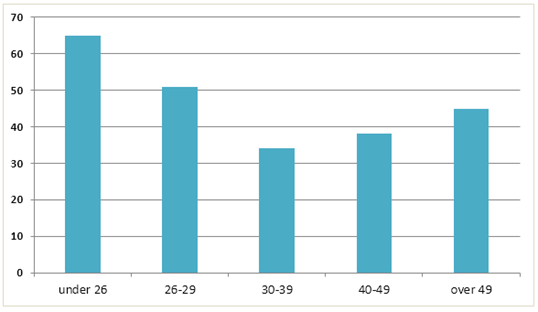
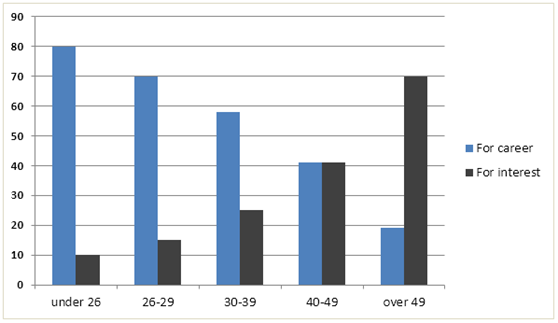
    The illustrations explain why students of various ages study, as well as the assistance that their employers provided.

    In general, young people pursue education primarily for professional purposes, whereas adults do so out of personal interest. Additionally, employers provided more support to younger workers in regards to their education.

    People under 40 primarily study for their careers, while those over 49 primarily study for their interests, as shown by the first bar graph. Remarkably, there is an equal proportion of individuals in the 40–49 age range who study for their careers and those who study for personal interests. In order to advance their careers, 80% of students under 26 continue their education. Rather than for professional reasons, seven out of ten students over 49 enroll because of their interests.

    Over 60% of students under 26 received financial aid and paid time off from their employers to further their education, as evidenced by the second bar graph. As the learners’ ages increased, this percentage of support decreased, with 32% of the 30-39 age group receiving support from their employers. Following that, employer support for workers’ education rose and eventually reached 45% for those over 49.
  • Universities should accept equal numbers of male and

    Question –Universities should accept equal numbers of male and female students in every subject.To what extent do you agree or disagree?
    Give reasons for your answer and include any relevant examples from your own knowledge or experience.Write at least 250 words. 

    The demand for gender equality in all aspects has become a contentious topic, reflecting the ongoing discourse and arguments surrounding this issue. In a modern community, both men and women can perform similar tasks, and maintaining an equal representation of each gender in all institution courses is crucial. I strongly agree with this stance, and I will delve into the details in the following paragraph.

    Firstly, educational institutions should prioritize a platform where students can enroll without facing discrimination, ensuring equal opportunities for both male and female members. For instance, Australia has implemented a policy requiring universities to enroll an equal number of students regardless of gender, driven by the nation’s need for a substantial labor force to boost its economic standing. Consequently, higher education institutions should actively admit an equal number of students in each subject, fostering gender equality.

    Secondly, single-sex education has various drawbacks. When boys and girls are unable to interact with the opposite sex, it can lead to a lack of confidence when handling tasks simultaneously in shared spaces. For example, Canadian universities offer all students the same courses, resulting in better outcomes compared to institutions in other countries that limit specific subjects based on gender. Historically, women faced limited study options, impacting their lives significantly. Therefore, universities should actively cultivate diverse student bodies, challenging restrictive educational regulations, such as instances where Afghani women are not allowed to enroll in medical courses until marriage.

    In summary, it is imperative that educational institutions actively break down barriers. Enrollment in all courses at higher education institutions must occur without gender considerations, providing both genders the freedom to choose how they pursue their education.

  • The graph below shows the proportion of the population

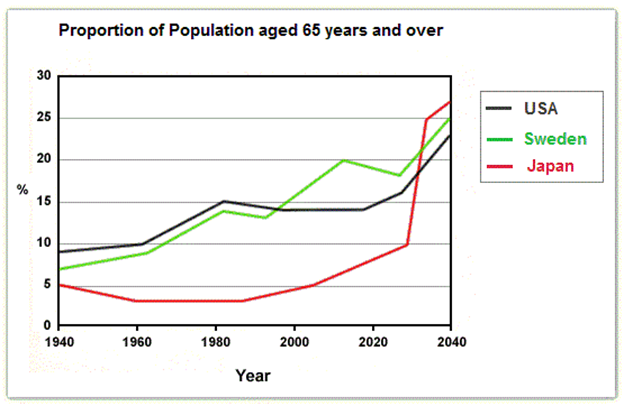
    Question –The graph below shows the proportion of the population aged 65 and over between 1940 and 2040 in three different countries.
    Summarise the information by selecting and reporting the main feature and make comparisons where relevant.Write at least 150 words.

    The percentage of people 65 years of age or older in three different countries between 1940 and 2040 is depicted in the line graph.

    Overall, it is evident that while the percentage of the population in Japan declines from 1940 to 1980 before a sharp increase in the number of elderly people occurs there, the percentage of people aged 65 and over increases in the USA and Sweden from 1940 to 2040 with only minor dips in between.

    When compared to Sweden (approximately 7%), the United States (just under 10%) had a higher percentage of elderly residents in 1940; Japan (only 5%) came in second. The percentage of elderly people in the USA increased between 1940 and 1980 before slightly declining after that. But it’s expected that this number will eventually rise, reaching 2040. The percentage of older people in Sweden increased from 1940 to 2040, with two gradual declines from 1980 to 1990 and from 2010 to 2025. This result follows a similar pattern.

    Regarding Japan, it can be observed that prior to an upward trend, the percentage of the population that was older was slightly lower between 1940 and 1990. It is anticipated that starting in 2030, the number will rise sharply and peak in 2040. The United States will have the fewest elderly citizens among the three countries, while Japan will have the greatest.


  • Some people prefer to spend their lives doing the same things

    Question – Some people prefer to spend their lives doing the same things and avoiding change. Others, however, think that change is always a good thing.Discuss both these views and give your own opinion.
    Give reasons for your answer and include any relevant examples from your own knowledge or experience.Write at least 250 words.

    The needs of the environment are influencing mass changes. Back then, the majority of people chose to live their entire lives doing the same things, with very few people choosing otherwise. Currently, there are fewer members of the former group. Everyone wants to see change, but especially young people, who anticipate positive and enjoyable changes.

    First of all, only the younger generation now fully embraces change in the majority of situations. They welcome change and believe it will add significance to their lives. Second, when things change, we are presented with fresh chances to advance. For example, starting a new work may provide obstacles that force an individual to change, learn new things, or broaden their skill set. Thirdly, a shift may signify a break from the past and an outdated schedule that has grown monotonous and cliche. Lastly, having new experiences can improve our physical and emotional well-being in addition to adding excitement and interest to our lives. We discover that experiences can make us more valuable and experienced.

    Conversely, individuals of the older generation frequently resist change out of a desire to avoid becoming materialistic. They contend that we ought to focus exclusively on one issue and the traditional way of life. They mostly stay away from significant changes and stay safe, missing out on a lot of opportunities that the changes could have presented. They would rather stick to their routine and avoid stepping outside of their comfort zone. Their situation seems satisfactory to them. They might not enjoy surprises or lack the confidence to take on new challenges, or they might believe that structure comes from routine. They thought that the best course of action was to remain safe and to remain in the current situation.

    Briefly stated, each side appears to have advantages of its own. I did, however, also convince them that in order to keep up with the fast-paced nature of modern life, change is both inevitable and essential. The world continues to spin and change, even though some people manage to maintain a semblance of stability through routine.

  • The charts below give information about USA marriage

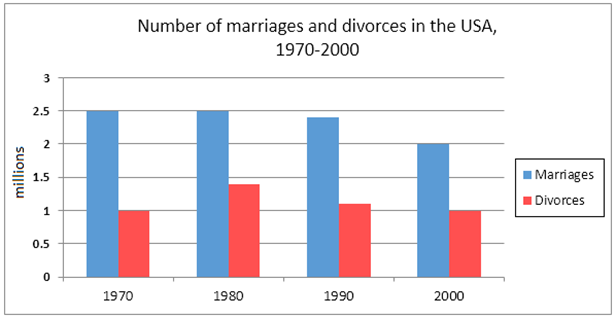
    Question –The charts below give information about USA marriage and divorce rates between 1970 and 2000, and the marital status of adult Americans in two of the years.
    Summarise the information by selecting and reporting the main features, and make comparisons where relevant.Write at least 150 words.

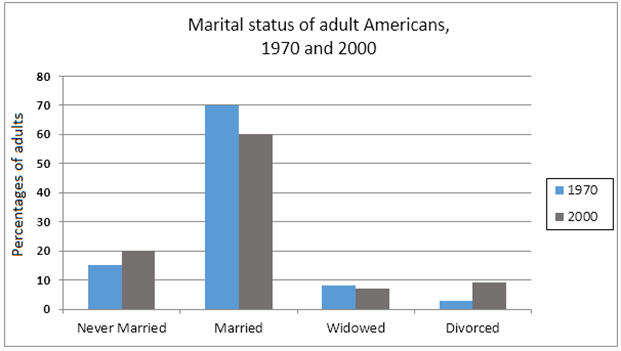
    The first chart shows the evolution of the US marriage and divorce rates over a thirty-year span beginning in 1970. In the second chart, the percentage of American adults in each of the two years—1970 and 2000—who were married varies.

    In general, the number of marriages in the US was clearly declining. Despite the fact that the majority of adult Americans were married in both of the years that data were available, the number of single people in 2000 was significantly higher.

    In 1970–1980, there were 2.5 million marriages registered in America; by 2000, that figure had dwindled to 2 million. By comparison, in 1970 there were about a million divorces filed; ten years later, that number rose to nearly 1.5 million. Since then, there have been fewer divorces, and in 2000, there were exactly 1 million divorces, or 50% fewer marriages than there were marriages.

    In 1970, the proportion of married adults in America was 70%; by 2000, it was only about 60%. In a similar vein, the percentage of widows slightly decreased. The numbers for singles and divorced individuals increased slightly, by about 8% in each case.

  • Some people believe that visitors to other countries

    Question –Some people believe that visitors to other countries should follow local customs and behaviour. Others disagree and think that the host country should welcome cultural differences.
    Discuss both these views and give your own opinion.Give reasons for your answer and include any relevant examples from your own knowledge or experience.Write atleast 250 words

    This paper aims to address contrasting perspectives on the interaction between visitors and host nations. While some individuals advocate for embracing diverse cultures brought by visitors, others emphasize the importance of visitors adhering to the laws and traditions of the host nation.

    The proponents of cultural respect not only believe in honoring visitors for their cultural heritage but also assert the benefits of introducing new cultures into a community. In other words, tourists possess the potential to impart knowledge and contribute to a broader public understanding of various global lifestyles. To thrive in the tourism sector and attract more visitors, these groups argue that individuals and governments must actively adapt and remain open to other cultures. Competing nations vying for tourists during the holiday season, those failing to respect the customs of others risk falling behind.

    On the flip side, there are concerns among some about the impact of visitors introducing unfamiliar cultures and behaviors on local customs and traditional cultures. There is a fear that such introductions may pose a serious threat to these traditions, leading to a potential forgetting of native customs. For example, the development of new foods and the replacement of traditional clothing with modern fashion might occur. Hence, they insist that visitors act in accordance with the permissions of the host nation, such as the prohibition of alcohol consumption or specific attire requirements in some Islamic countries.

    In essence, travelers seek to actively experience and learn about local customs when exploring new places. Therefore, host nations can actively create opportunities for tourists to enjoy their freedom while also motivating them to abide by local laws and customs by outlining and demonstrating their advantages. If the right tactics are actively taken into account, there’s no denying that tourists would actively want to behave just like locals.

  • The diagrams below show the life cycle of the silkworm

    Question –The diagrams below show the life cycle of the silkworm and the stages in the production of silk cloth. Summarise the information by selecting and reporting the main features, and make comparisons where relevant. Write at least 150 words.

    The illustrations show different stages in the process of creating silk cloth as well as the life cycle of the silkworm.

    There are four main stages in the silkworm life cycle, starting with eggs and ending with the cocoon. Similar to this, there are four primary steps in the creation of silk fabric, which start with boiling in water and conclude with dying.

    Bees deposit eggs on mulberry leaves, which is where the silkworm life cycle begins. It transforms into silkworm larva on mulberry leaves after this point in the cycle. After that, it takes four to six weeks to develop into silk thread. Following the final major stage of its life cycle, it changes into cocoons, which are needed to produce silk fabric.

    Selected cocoons are boiled in water to produce silk fabrics. The second step, known as unwinding, produces threads that range in diameter from 300 to 900 mm. At some point, it is twisted, which helps create waves. At last, the wave can be dyed any color to be used in the final silk clothing production.

  • Successful sports professionals can earn a great deal more money

    Question –Successful sports professionals can earn a great deal more money than people in other important professions. Some people think this is fully justified while others think it is unfair. Discuss both these views and give your own opinion. Give reasons for your answer and include any relevant examples from your own knowledge or experience. Write at least 250 words.

    The substantial earnings of successful sports professionals have long been a subject of debate, with opinions divided on whether such lucrative remuneration is justified or unfair in comparison to individuals in other essential professions. Both perspectives hold merit, reflecting the complex dynamics of societal values and economic structures.

    On one hand, proponents argue that the high earnings of successful sports professionals are fully justified. Athletes often endure rigorous training regimens, face intense competition, and carry the weight of representing their nations or teams. Their careers are physically demanding, with limited peak years, and the associated risks of injuries are significant. The immense popularity of sports generates substantial revenue through sponsorships, broadcasting rights, and merchandise sales, justifying the athletes’ financial rewards. This argument asserts that the economic principles of supply and demand play a role in determining the earnings of sports professionals.

    Conversely, the opposing view contends that the income disparity is unfair, especially when compared to the wages of individuals in other crucial professions, such as healthcare, education, and public service. Teachers, doctors, and emergency responders, for instance, contribute significantly to societal well-being and often work under challenging conditions. Critics argue that the disproportionate earnings in favor of sports professionals reflect skewed societal priorities, where entertainment is valued more than fundamental services that contribute to the betterment of society.

    In my opinion, while the earnings of successful sports professionals may seem disproportionately high, they are justified within the context of the entertainment industry’s economic dynamics. The revenue generated by sports contributes significantly to the economy, and athletes’ earning potential is often tied to the industry’s financial success.

    However, it is crucial for societies to ensure fair compensation across all professions, acknowledging the invaluable contributions of individuals in essential roles that contribute to the overall welfare of the community. Striking a balance between recognizing entertainment value and essential services is essential for a more equitable and sustainable society.

  • The table below gives information about changes in modes of travel

    Question-The table below gives information about changes in modes of travel in England between 1985 and 2000. Summarise the information by selecting and reporting the main features, and make comparisons where relevant. Write at least 150 words.

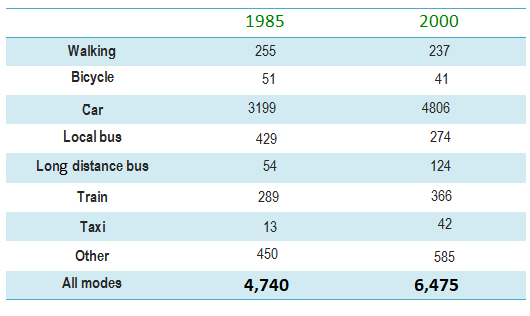
    Average distance in miles travelled per person per year, by mode of travel

    The table provides a snapshot of changes in modes of travel in England over the fifteen-year period from 1985 to 2000. A concise analysis of the main features unveils notable shifts in transportation preferences during this timeframe.

    In 1985, the majority of journeys were undertaken using cars, constituting a substantial 64% of all trips. Bicycles and walking accounted for 11% and 24%, respectively. However, by the year 2000, a discernible change occurred, with the percentage of car travel increasing to 73%, underscoring a growing reliance on automobiles. Meanwhile, the popularity of bicycles experienced a considerable decline, dropping to a mere 7%. Walking also saw a slight reduction, falling to 20% of all journeys.

    Comparisons between 1985 and 2000 reveal a clear trend towards increased car usage, indicating a shift away from more sustainable and active modes of transportation. The drop in bicycle usage is particularly significant, suggesting a decreasing emphasis on eco-friendly and health-conscious travel options. Despite efforts to promote walking as a sustainable means of transportation, its percentage also decreased slightly over the fifteen-year period.

    In conclusion, the table provides a comprehensive overview of the changes in modes of travel in England between 1985 and 2000. The data highlights a pronounced shift towards increased reliance on cars, accompanied by a decline in the popularity of bicycles and a marginal reduction in walking. These trends reflect evolving transportation preferences and their implications for sustainability and public health.

  • Today, the high sales of popular consumer goods reflect the power

    Question-Today, the high sales of popular consumer goods reflect the power of advertising and not the real needs of the society in which they are sold. To what extent do you agree or disagree? Give reasons for your answer and include any relevant examples from your own knowledge or experience. Write at least 250 words.

    Title: The Influence of Advertising on Consumer Choices

    The assertion that the high sales of popular consumer goods primarily reflect the power of advertising rather than addressing the real needs of society is a contentious issue that warrants a nuanced examination. While advertising undeniably plays a significant role in shaping consumer preferences, the extent to which it dictates purchases and deviates from genuine societal needs is a complex interplay of various factors.

    On one hand, advertising is a powerful tool that creates awareness, establishes brand identity, and influences consumer behavior. Companies invest substantial resources in marketing campaigns to enhance the appeal of their products. This, in turn, can lead to increased sales, creating a correlation between advertising efforts and consumer choices. Critics argue that this dynamic often results in the consumption of goods driven more by perceived desires than genuine societal needs, fostering a culture of materialism.

    Conversely, consumer choices are influenced by a multitude of factors beyond advertising, such as cultural norms, social trends, and economic conditions. While advertising can create desire, it does not operate in isolation from broader societal influences. The success of a product in the market is not solely determined by advertising; rather, it reflects a combination of factors, including the product’s utility, quality, and relevance to evolving societal needs.

    In my view, the relationship between advertising and consumer choices is complex and multifaceted. While advertising undoubtedly wields significant influence, it is not the sole determinant of high sales. The real needs of society, including convenience, functionality, and innovation, also play a crucial role in shaping consumer behavior. Striking a balance between promoting products and addressing genuine societal needs is imperative to ensure ethical business practices and responsible consumption in an ever-evolving market landscape.