Month: April 2024

  • IELTS Reading Practice Test – Exercise 65

    Space

    Section A
    The world has changed dramatically since Thomas Malthus’s work An Essay on the Principle of Population, first published in 1798, argued that by the mid 1800s the unrestricted expansion of the human population would outgrow the agricultural land available to supply humanity with food. Over 150 years have passed since this theoretical milestone, but mankind, admittedly somewhat more cramped, is still expanding and will continue to do so.

    Section B
    The impact of unfettered population growth is clear for all to see. Urbanization is now a more evident worldwide phenomenon than previously as even greater numbers of people drift from rural areas to vast cities all over the world like Tokyo, Mexico City and Mumbai (26.4 million, 18.4 million and 18.1 million inhabitants in 2000 respectively) in their quest for a better life. These mega-cities, i.e. conurbations with an estimated population of more than 10 million people, are springing up in every continent. Now teeming with humanity, they are hungry for one increasingly valuable resource: land.

    While developments in agricultural technology ensure humanity may be able, by and large, to feed the people flocking to these great metropolises, the expansion of the human race is fuelling an unprecedented appetite for real estate. Space, whether it be for personal or public use, corporate or national, human or flora/fauna, is now at a premium as we move into a new century. Not only is more land required for accommodation, but also for a wide range of infrastructure facilities. Transport systems including roads within and between cities need to be constructed or upgraded to create motorways; green fields are turned into airports; virgin forest is stripped to provide food and firewood. In poorer regions, this newly exposed land becomes desert, completing the cycle of destruction.

    Section C
    Hitherto, the most common practice for the utilization of expensive space for living and working has been to build upwards; hence, the demand for ever higher buildings, both apartment and commercial, in major cities like New York, Shanghai and Singapore all vying with each other for the tallest buildings. There has also been a tradition for building underground, not just for transport systems, but for the storage of waste, depositories for books etc. as in London, where The British Library housing millions of books has been built largely underground. Recent years have seen more novel construction developments around the world. In the past, in many countries, Holland and the UK included, marshes and flood plains have been reclaimed from the sea. Like the city of Venice in Italy, housing complexes and even airports have now been constructed off-shore to amazing effect. In Japan, Kansai International Airport has been built off-shore on a man-made island at vast expense and in Dubai a very imaginative and expensive housing complex in the shape of a palm tree is being built just off the coast on land created by a construction company. However, these and other developments are at risk from rising sea levels as a consequence of global warming.

    Section D
    But where will the human race go when planet earth is full? There have been many theories put forward about the human population moving to outer space. Marshall Savage (1992, 1994), for example, has projected that the human population will reach five quintillion throughout the solar system by the year 3000, with the majority living in the asteroid belt. Arthur C Clarke, a fervent supporter of Savage, now argues that by the year 2057 there will be humans on the Moon, Mars, Europa, Ganymede, Titan and in orbit around Venus, Neptune and Pluto. Feeman Dyson (1999) favours the Kuiper belt as the future home of humanity, suggesting this could happen within a few centuries.

    Section E
    Habitation in outer space in huge stations is no longer just a dream, but a reality. A permanent international space station now orbits the earth. The first commercial tourist recently went into outer space with more trips planned for the near future. This is only a beginning, but the development of space hotels is not far-off. There is no knowing where mankind may end up. But the ideas about off-world habitation are not fanciful and I am sure I am not alone in fantasizing about summer holidays spent watching the moons rising in some far-flung planet or on a floating hotel somewhere on the Andromeda nebula.

    Questions 1-4
    Reading passage 1 has five sections A-E. Choose the correct heading for sections B-E from the list of headings below. Write the correct number, i-viii, in boxes 1-4 on your answer sheet.

    List of Headings
    i How the problem of land scarcity has been overcome in the past
    ii Various predictions about future solutions to a lack of space
    iii The effects of population growth on land availability
    iv The importance of the new British Library
    v An expanding population
    vi A description of a mega-city
    vii A firm belief that human habitation of outer space will occur
    viii The importance of having an international space station

    Example: Section A            Answer: v
    1 Section B
    2 Section C
    3 Section D
    4 Section E

    Questions 5-8
    Complete the sentences below. Choose NO MORE THAN TWO WORDS from the passage for each answer.

    5 The movement of rural people to cities is a………………………
    6 Land is now a very……………………………, as a result of the growing demand for space.
    7 The feeding of the human race will perhaps be guaranteed by changes in………………..
    8 Besides the demands of accommodation, land is needed for various…………………..

    Questions 9-13
    Do the following statements agree with the claims of the writer in Reading Passage 1? In boxes 9-13 on your answer sheet write

    YES                            if the statement reflects the claims of the writer
    NO                              if the statement contradicts the claims of the writer
    NOT GIVEN           if it is impossible to say what the writer thinks about this

    9 The destruction of land for food and firewood is linked to desertification.
    10 Shortage of space has also led to underground building construction.
    11 The building of the airport in Japan cost much more than that of the housing complex in Dubai.
    12 Arthur C Clarke was the only person to predict that mankind will inhabit other parts of the solar system.
    13 The concept of the habitation of outer space by mankind is unimaginable.

    The History of Salt

    1 Salt is so simple and plentiful that we almost take it for granted. In chemical terms, salt is the combination of a sodium ion with a chloride ion, making it one of the most basic molecules on earth. It is also one of the most plentiful: it has been estimated that salt deposits under the state of Kansas alone could supply the entire world’s needs for the next 250,000 years.

    2 But salt is also an essential element. Without it, life itself would be impossible since the human body requires the mineral in order to function properly. The concentration of sodium ions in the blood is directly related to the regulation of safe body fluid levels. And while we are all familiar with its many uses in cooking, we may not be aware that this element is used in some 14,000 commercial applications. From manufacturing pulp and paper to setting dyes in textiles and fabric, from producing soaps and detergents to making our roads safe in winter, salt plays an essential part in our daily lives.

    3 Salt has a long and influential role in world history. From the dawn of civilization, it has been a key factor in economic, religious, social and political development. In every corner of the world, it has been the subject of superstition, folklore, and warfare, and has even been used as currency.

    4 As a precious and portable commodity, salt has long been a cornerstone of economies throughout history. In fact, researcher M.R. Bloch conjectured that civilization began along the edges of the desert because of the natural surface deposits of salt found there. Bloch also believed that the first war – likely fought near the ancient city of Essalt on the Jordan River – could have been fought over the city’s precious supplies of the mineral.

    5 In 2200 BC, the Chinese emperor Hsia Yu levied one of the first known taxes. He taxed salt. In Tibet, Marco Polo noted that tiny cakes of salt were pressed with images of the Grand Khan to be used as coins and to this day among the nomads of Ethiopia’s Danakil Plains it is still used as money. Greek slave traders often bartered it for slaves, giving rise to the expression that someone was “not worth his salt.” Roman legionnaires were paid in salt – a salarium, the Latin origin of the word “salary.”

    6 Merchants in 12th-century Timbuktu – the gateway to the Sahara Desert and the seat of scholars – valued this mineral as highly as books and gold. In France, Charles of Anjou levied the “gabelle,” a salt tax, in 1259 to finance his conquest of the Kingdom of Naples. Outrage over the gabelle fueled the French Revolution. Though the revolutionaries eliminated the tax shortly after Louis XVI, the Republic of France re-established the gabelle in the early 19th Century; only in 1946 was it removed from the books.

    7 The Erie Canal, an engineering marvel that connected the Great Lakes to New York’s Hudson River in 1825, was called “the ditch that salt built.” Salt tax revenues paid for half the cost of construction of the canal. The British monarchy supported itself with high salt taxes, leading to a bustling black market for the white crystal. In 1785, the earl of Dundonald wrote that every year in England, 10,000 people were arrested for salt smuggling. And protesting against British rule in 1930, Mahatma Gandhi led a 200-mile march to the Arabian Ocean to collect untaxed salt for India’s poor.

    8 In religion and culture, salt long held an important place with Greek worshippers consecrating it in their rituals. Further, in Buddhist tradition, salt repels evil spirits, which is why it is customary to throw it over your shoulder before entering your house after a funeral: it scares off any evil spirits that may be clinging to your back. Shinto religion also uses it to purify an area. Before sumo wrestlers enter the ring for a match – which is in reality an elaborate Shinto rite – a handful is thrown into the center to drive off malevolent spirits.

    9 In the Southwest of the United States, the Pueblo worship the Salt Mother. Other native tribes had significant restrictions on who was permitted to eat salt. Hopi legend holds that the angry Warrior Twins punished mankind by placing valuable salt deposits far from civilization, requiring hard work and bravery to harvest the precious mineral. In 1933, the Dalai Lama was buried sitting up in a bed of salt. Today, a gift of salt endures in India as a potent symbol of good luck and a reference to Mahatma Gandhi’s liberation of India.

    10 The effects of salt deficiency are highlighted in times of war, when human bodies and national economies are strained to their limits. Thousands of Napoleon’s troops died during the French retreat from Moscow due to inadequate wound healing and lowered resistance to disease – the results of salt deficiency.

    Questions 14-16
    Choose THREE letters A-H. NB Your answers may be given in any order.

    Which THREE statements are true of salt?
    A A number of cities take their name from the word salt
    B Salt contributed to the French Revolution
    C The uses of salt are countless
    D Salt has been produced in China for less than 2000 years
    E There are many commercial applications for salt
    F Salt deposits in the state of Kansas are vast
    G Salt has few industrial uses nowadays
    H Slaves used salt as a currency

    Questions 17-21
    Complete the summary. Choose NO MORE THAN TWO WORDS from the passage for each answer.

    Salt is such an (17)……………………….that people would not be able to live without it. As well as its uses in cooking, this basic mineral has thousands of business (18)………………………..ranging from making paper to the manufacture of soap. Being a prized and (19)………………………….., it has played a major part in the economies of many countries. As such, salt has not only led to war, but has also been used to raise (20)………………………by governments in many parts of the world. There are also many instances of its place in religion and culture, being used as a means to get rid of evil (21)………………….

    Questions 22-27
    Do the following statements agree with the information in Reading Passage 2?
    In boxes 22-27 on your answer sheet write

    TRUE                      if the statement agrees with the information
    FALSE                    if the statement contradicts the information
    NOT GIVEN         if there is no information about the statement

    22 It has been suggested that salt was responsible for the first war.
    23 The first tax on salt was imposed by a Chinese emperor.
    24 Salt is no longer used as a form of currency.
    25 Most of the money for the construction of the Erie Canal came from salt taxes.
    26 Hopi legend believes that salt deposits were placed far away from civilization to penalize mankind.
    27 A lack of salt is connected with the deaths of many of Napoleon’s soldiers during the French retreat from Moscow.

    Volunteering: enriching others and helping oneself

    A Volunteering, some might mistakenly think, embraces a plethora of people from all walks of life as well as activities, but data from the other side of the world suggest otherwise. A 2001 survey on who participated in volunteering by the Office for National Statistics (ONS) in the United Kingdom (UK) revealed that people in higher income households are more likely than others to volunteer. In England and Wales, 57 per cent of adults with gross annual household incomes of £75,000 or more, have volunteered formally (such as raising or handling money for a charity or being a member of a committee) in the 12 months prior to the survey date. They were almost twice as likely to have done so than those living in households with an annual income under £10,000.

    B As well as having high household incomes, volunteers also tend to have higher academic qualifications, be in higher socio-economic groups and be in employment. Among people with a degree or postgraduate qualification, 79 per cent had volunteered informally and 57 per cent had volunteered formally in the previous 12 months. For people with no qualifications the corresponding proportions were 52 per cent and 23 per cent. But voluntary work is certainly not the exclusive preserve of the rich, nor should it be. Does the answer not lie perhaps in the fact that the rich tend to have money to allow them the time to become involved in voluntary work compared to less well-off people?

    C A breakdown in the year 2000 of the range of volunteering activities taken from The Australian Bureau of Statistics gives an idea of the scale of activities in which people are typically involved. Eleven sectors are given ranging from Community and Welfare, which accounted for just over a quarter of the total hours volunteered in Australia, to Law/justice/politics with 1.2 percent at the other end of the scale. Other fields included sport/recreation, religious activities and education, following at 21.2 per cent, 16.9 and 14.3 per cent respectively. Foreign/international volunteer work accounted for 2.4 per cent of the total hours. The data here also seem to point to a cohort of volunteers with expertise and experience.

    D The knock-on effect of volunteering on the lives of individuals can be profound. Voluntary work helps foster independence and imparts the ability to deal with different situations, often simultaneously, thus teaching people how to work their way through different systems. It therefore brings people into touch with the real world; and, hence, equips them for the future.

    E Initially, young adults in their late teens might not seem to have the expertise or knowledge to impart to others that say a teacher or agriculturalist or nurse would have, but they do have many skills that can help others. And in the absence of any particular talent, their energy and enthusiasm can be harnessed for the benefit of their fellow human beings, and ultimately themselves. From all this, the gain to any community no matter how many volunteers are involved is immeasurable.

    F Employers will generally look favourably on people who have shown an ability to work as part of a team. It demonstrates a willingness to learn and an independent spirit, which would be desirable qualities in any employee. So to satisfy employers’ demands for experience when applying for work, volunteering can act as a means of gaining experience that might otherwise elude would-be workers and can ultimately lead to paid employment in the desired field.

    G But what are the prerequisites for becoming a volunteer? One might immediately think of attributes like kindness, selflessness, strength of character, ability to deal with others, determination, adaptability and flexibility and a capacity to comprehend the ways of other people. While offering oneself selflessly, working as a volunteer makes further demands on the individual. It requires a strength of will, a sense of moral responsibility for one’s fellow human beings, and an ability to fit into the ethos of an organization or community. But it also requires something which in no way detracts from the valuable work done by volunteers and which may seem at first glance both contradictory and surprising: self-interest.

    H Organizations involved in any voluntary work have to be realistic about this. If someone, whatever the age, is going to volunteer and devote their time without money, they do need to receive something from it for themselves. People who are unemployed can use volunteer work as a stepping-stone to employment or as a means of finding out whether they really like the field they plan to enter or as a way to help them find themselves.

    I It is tempting to use some form of community work as an alternative to national service or as punishment for petty criminals by making the latter for example clean up parks, wash away graffiti, work with victims of their own or of other people. This may be acceptable, but it does not constitute volunteer work, two cardinal rules of which are the willingness to volunteer without coercion and working unpaid.

    Questions 28-33
    Reading Passage 3 has nine paragraphs A-I. Which paragraph contains the following information?
    Write the correct letter, A-l, in boxes 28-33 on your answer sheet.

    28 a description of what does not satisfy the criteria for volunteer work
    29 the impact of voluntary work on the development of individuals
    30 the requirement for both selflessness and self-interest in volunteers
    31 various areas in which people volunteer
    32 the benefit of voluntary work for the young
    33 a mistaken view of volunteering

    Questions 34-37
    Choose the correct letters A, B, C or D.

    34 The ONS survey was done to find out
    A why people undertook volunteering
    B how many people participated in volunteering
    C how many rich people did volunteer work
    D which people were involved in volunteering

    35 The ONS survey found that people with university qualifications were
    A as likely to volunteer as those with no qualifications
    B more likely to volunteer than those with no qualifications
    C less likely to volunteer than those with no qualifications
    D the only group likely to do formal volunteer work

    36 It is suggested that rich people volunteer as a result of having
    A clearer goals
    B fewer children
    C more spare time
    D greater guilt

    37 Volunteer work benefits people by teaching them how to
    A function in systems
    B communicate clearly
    C deal with failure
    D overcome shyness

    Questions 38-40
    Complete each sentence with the correct ending, A-F below.

    38 One of the requirements of being a volunteer is being able to
    39 Volunteering can be used as a way for the unemployed to
    40 Employers in general tend to

    A consider workers with volunteer work experience an asset.
    B gain a very well paid job.
    C gain access to a job in a field of interest.
    D benefit most from volunteer work.
    E understand how people behave.
    F want much younger workers.

  • IELTS Reading Practice Test – Exercise 64

    The Brain and Intelligence

    Human intelligence is an elusive quality. We all think we know it when we see it but try to pin down that quality to a firm, testable definition and suddenly, even for the most experienced researchers, the concept disappears. But now a team of British and German scientists believe they have firmly nailed down at least part of the notion of intelligence. They claim to have found a location for intelligence, whatever it is, in the brain.

    For many years researchers have believed that intelligence is a quality which is spread throughout the whole human brain. Traditional psychologists such as Benjamin Martin believe that this accounts for incidences where physical damage to the brain need not affect intelligence at all. By using advanced scanning equipment, however, researchers led by John Duncan of the Cognition and Brain Sciences Unit in Cambridge now think that it is much more localised and at the front of the brain in particular.

    Duncan and his team have attempted to link intelligence to the activity of nerve cells in the brain by giving subjects a series of problem solving tests. These tests are of the standard sort used to test and measure intelligence. They resemble puzzles where sequences of numbers or letters have to be rearranged or continued, or patterns of shapes have to be inverted. While subjects are carrying out these intelligence tasks, their heads are scanned to see where electrical activity and blood flow in the brain are concentrated. It turns out that activity was concentrated in the frontal cortex and so, Duncan and his team presume, intelligence is situated there too.

    This new idea has not been met with universal acceptance, however. The usual definition of “intelligence” was set by Charles Spearman 100 years ago. This was the quality that allows some people to be very good at a whole variety of things – music, mathematics, practical problem solving and so on – while others are not. He called this quality general intelligence or the “g” factor for short. It was a contentious idea even at the time but still no-one has come up with a better definition. Nonetheless, because the notion of intelligence is imprecisely defined, the idea that there is a fixed location for intelligence has to be questioned.

    The questioning comes in an article in the prestigious journal Science, the same edition as Duncan’s own article. Yale psychologist Robert Sternberg points out that many people who are clearly intelligent, such as leading politicians and lawyers, do very badly in intelligence tests. Conversely, one might argue, there are plenty of academics who are good at intelligence tests but who cannot even tie their own shoe laces! Sternberg implies that the idea that being a successful politician or lawyer does not require intelligence, flies in the face of reason. Rather more likely is the idea that so-called intelligence tests can have little to do with many practical manifestations of intelligence. The skills of verbal and mathematical analysis measured by these tests can tell us very little about the skills of social interaction and people handling which are equally essential for success and are, therefore, equally valid qualities of intelligence.

    Sternberg makes a further criticism of the conclusions drawn by Duncan’s team. The mental-atlas approach really does not tell us anything about intelligence. The fact that we know a computer’s “intelligence” is produced by a computer chip and that we can say where this chip is, does not tell us anything about the computer’s intelligence or ability. We could easily move the location of the chip and this would not change the computer’s “intelligence”. As Benjamin Martin points out, this may be what happens in reality when following physical damage to one area of the brain, knowledge and ability appear able to relocate.

    Questions 1-8
    Classify the following statements as referring to

    A John Duncan
    B Charles Spearman
    C Benjamin Martin
    D Robert Sternberg
    E The writer of the article

    Example: Physical damage to the brain need not affect intelligence.               Answer C
    1 Intelligence can be located throughout the brain.
    2 Intelligence makes you good at many different things.
    3 Intelligence tests examine limited skills.
    4 Intelligence is located at the front of the brain.
    5 It is difficult to describe what intelligence is.
    6 Intelligence tests can be bad at measuring the intellect of professionals.
    7 Intelligence and other abilities can reposition following injury to the brain.
    8 Intelligence is a characteristic required by those doing well in legal and political professions

    Questions 9-13
    Using information contained in the text, complete the following sentences using NO MORE THAN THREE WORDS for each answer.

    9 Spearman’s suggested that intelligence was the ability to be good at…………………………..
    10 The idea that all politicians and lawyers are unintelligent is……………………….
    11 Spearman’s ideas about intelligence are not…………………………
    12 Sternberg suggests that in addition to academic ability, intelligence includes…………………..
    13 Sternberg also believes that intelligence is not affected by where…………………………..

    A New Menace from an Old Enemy

    Malaria is the world’s second most common disease causing over 500 million infections and one million deaths every year. Worryingly it is one of those diseases which is beginning to increase as it develops resistance to treatments. Even in the UK, where malaria has been effectively eradicated, more than 2,000 people are infected as they return from trips abroad and the numbers are rising.

    It seems as though malaria has been in existence for millions of years and a similar disease may have infected dinosaurs. Malaria-type fevers are recorded among the ancient Greeks by writers such as Herodotus who also records the first prophylactic measures: fishermen sleeping under their own nets. Treatments up until the nineteenth century were as varied as they were ineffective. Live spiders in butter, purging and bleeding, and sleeping with a copy of the Iliad under the patient’s head are all recorded. The use of the first genuinely effective remedy, an infusion from the bark of the cinchona tree, was recorded in 1636 but it was only in 1820 that quinine, the active ingredient from the cinchona bark was extracted and modern prevention became possible. For a long time the treatment was regarded with suspicion since it was associated with the Jesuits. Oliver Cromwell, the Protestant English leader who executed King Charles I, died of malaria as a result of his doctors refusing to administer a Catholic remedy! Despite the presence of quinine, malaria was still a major cause of illness and death throughout the nineteenth century. Hundreds of thousands were dying in southern Europe even at the beginning of the last century. Malaria was eradicated from Rome only in the 1930s when Mussolini drained the Pontine marshes.

    Despite the fact that malaria has been around for so long, surprisingly little is known about how to cure or prevent it. Mosquitoes, who are the carriers of the disease, are attracted to heat, moisture, lactic acid and carbon dioxide but how they sort through this cocktail to repeatedly select one individual for attention over another is not understood. It is known that the malaria parasite, or plasmodium falciparum to give it its Latin name, has a life cycle which must pass through the anopheles mosquito and human hosts in order to live. It can only have attained its present form after mankind mastered agriculture and lived in groups for this to happen. With two such different hosts, the life cycle of the parasite is remarkable.

    There is the sporozoite stage which lives in the mosquito. When a human is bitten by an infected anopheles mosquito the parasite is passed to the human through the mosquito’s saliva. As few as six such parasites may be enough to pass on the infection provided the human’s immune system fails to kill the parasites before they reach the liver. There they transform into merozoites and multiply hugely to, perhaps, about 60,000 after 10 days and then spread throughout the bloodstream. Within minutes of this occurring, they attack the red blood cells to feed on the iron-rich haemoglobin which is inside. This is when the patient begins to feel ill. Within hours they can eat as much as 125 grams of haemoglobin which causes anaemia, lethargy, vulnerability to infection, and oxygen deficiency to areas such as the brain. Oxygen is carried to all organs by haemoglobin in the blood. The lack of oxygen leads to the cells blocking capillaries in the brain and the effects are very much like that of a stroke with one important difference: the damage is reversible and patients can come out of a malarial coma with no brain damage. Merozoites now change into gametocytes which can be male or female and it is this phase, with random mixing of genes that results, that can lead to malaria developing resistance to treatments. These resistant gametocytes, can be passed back to the mosquito if the patient is bitten, and they turn into zygotes. These zygotes divide and produce sporozoites and the cycle can begin again.

    The fight against malaria often seems to focus on the work of medical researchers who try to produce solutions such as vaccines. But funding is low because, it is said, malaria is a third world condition and scarcely troubles the rich, industrialised countries. It is true that malaria is, at root, a disease of poverty. The richer countries have managed to eradicate malaria by extending agriculture and so having proper drainage so mosquitoes cannot breed, and by living in solid houses with glass windows so the mosquitoes cannot bite the human host. Campaigns in Hunan province in China, making use of pesticide impregnated netting around beds reduced infection rates from over 1 million per year to around 65,000. But the search for medical cures goes on. Some 15 years ago there were high hopes for DNA based vaccines which worked well in trials on mice. Some still believe that this is where the answer lies and shortly too. Other researchers are not so confident and expect a wait of at least another 15 years before any significant development.

    Questions 14-21
    Do the following statements agree with the information in Reading Passage 2? In boxes 14 – 21 on your answer sheet write

    YES                           if the statement agrees with the information
    NO                             if the statement contradicts the information
    NOT GIVEN         if there is no information on this in the passage.

    14 Malaria started among the ancient Greeks.
    15 Malaria has been eradicated in the wealthier parts of the world.
    16 Mosquitoes are discerning in their choice of victims.
    17 Treatments in the nineteenth century were ineffective
    18 Iron is a form of nourishment for malarial merizoites.
    19 A severe attack of malaria can be similar to a stroke.
    20 Research into malaria is not considered a priority by the West.
    21 Technological solutions are likely to be more effective than low-tech solutions.

    Mary Wollstonecraft

    A In 1789 began the celebrated French Revolution, an event which shook the old certainties of European states and European monarchies to the core. It also raised debate on the desired structure of the state throughout whole populations to an unprecedented degree. In October the following year, Edmund Burke brought out his Reflections on the Revolution in France which sold 35,000 copies within weeks, then a huge number. It reinforced all the fears and prejudices of the traditional aristocracy. Immediately, more progressive authors began writing their responses including the celebrated Thomas Paine whose ‘The Rights of Man’ sold an amazing two million copies.

    B But Paine’s was not the first response. Less than a month after Burke’s book was published there appeared the anonymous A Vindication of the Rights of Men. It sold so well that a second edition appeared only three weeks after the first. However, in this edition the author was named as Mary Wollstonecraft. The involvement of women in politics was almost unknown at the time and there was outrage. Horace Walpole called her “a hyena in petticoats”.

    C If she was intimidated by the outcry, it did not show. Only two years later, at the beginning of 1792, she produced another book with an even more inflammatory title: A Vindication of the Rights of Women. This has been a handbook for feminists ever since. Women tended to like her strong opinions while men were, not surprisingly, infuriated. What is surprising is that so many of the men who attacked this piece are usually thought of as politically advanced. Even William Godwin, for example, supported the idea that men and women were different and complementary and this required a political arrangement where men led and women followed. Wollstonecraft attacked this notion and demanded independence and equality for women.

    D This rebellious streak led her in quite a different direction from most of her contemporaries. As bloodshed in Paris reached its peak during 1792 and 1793, and most British fled from France, Wollstonecraft moved to Paris to live. She stayed while most of her French friends were killed. Quite why is not clear since she clearly preferred the society of the bourgeois intellectuals who were dying to the street revolutionaries who were killing them. Perhaps it was only after this experience that she appreciated some of the practical pitfalls of unchecked liberty.

    E The reality of revolution seemed to change her in a number of other ways. A feature of her Vindication was to urge both men and women to subjugate passion to reason. Before her experience in France she had remained single and, single-mindedly, celibate despite the temptation offered by the painter Fuseli. But whilst in France she threw herself into a passionate affair with the American adventurer Gilbert Imlay. She even followed Imlay to Scandinavia in search of stolen silver treasure; a triumph of passion over reason if ever there was one! How ironic that she should suffer this fate in the middle of, what she hoped would be, the foundation of a better, more rational, society.

    F She never entirely lost her principles, however, and clung to the belief that a better world based on equality and reason was attainable. Eventually she returned to Britain and, after a failed suicide bid, she married the very William Godwin who had so criticised her before. She died in childbirth not long after and pronounced herself “content to be wretched” but refused to be a nothing and discounted.

    G Mary Wollstonecraft’s life was revolutionary in many ways, even for her time. She may have been inconsistent and contradictory but this cannot diminish the effect she had on the political thoughts of her contemporaries. We cannot ignore too, the degree to which she has influenced later thought, even down to the present day. Her son-in-law, Percy Shelley, was a fervent admirer who immortalised her in verse in The Revolt of Islam. De Beauvoir’s The Second Sex and Greer’s The Female Eunuch both owe their origins to Wollstonecraft’s pioneering writing. The notions of equality we take for granted today first appeared in her work.

    Questions 28-33
    Reading Passage 3 has seven paragraphs A – C. Choose the most suitable headings for paragraphs A – G from the list of headings below.

    Paragraph headings
    i A tragic ending
    ii A revolutionary life
    iii Being different
    iv Contradictory behavior
    v The work of Thomas Paine
    vi Reactions to revolution
    vii A life in perspective
    viii The first reaction to Burke
    ix Asserting the rights of women

    Example: Paragraph A                    Answer vi
    28 Paragraph B
    29 Paragraph C
    30 Paragraph D
    31 Paragraph E
    32 Paragraph F
    33 Paragraph G

    Questions 34-40
    Choose the appropriate answers A – D and write them in boxes 34 – 40 on your answer sheet.

    34 The revolution in France
    A frightened everybody
    B prejudiced the aristocracy
    C concerned everybody
    D challenged the established order

    35 Wollstonecraft’s A Vindication of the Rights of Men
    A was an immediate best seller
    B sold only slowly at first
    C hardly sold at all
    D was only read by women

    36 The response to A Vindication of the Rights of Men
    A intimidated Mary
    B made Mary flee to France
    C attracted William Godwin
    D made Mary write another book.

    37 Men objected to the book because
    A it was written by a woman
    B it challenged established ideas about men and women
    C she published before them
    D the writer was a female politician

    38 Mary’s personal life
    A always matched her published beliefs
    B sometimes contradicted her published beliefs
    C never contradicted her published beliefs
    D never matched her published beliefs.

    39 In refusing to be discounted she meant
    A women should be taught literacy and numeracy
    B the role of women should not be reduced
    C she was not to be overlooked for being a woman
    D she was happy as she was

    40 Mary Wollstonecraft’s writing
    A was constant and contemporary
    B inspired modern feminist writers
    C took equality for granted
    D was ignored

  • IELTS Reading Practice Test – Exercise 63

    Britain Set For Heat Wave In 2050

    A As you sit in your home or office and look at the rain running relentlessly down the window pane, you will almost certainly be thinking, “This is more like February, when will summer arrive?” This summer seems to have been colder and wetter than ever. So here is some good news. The Meteorological Office computer has analysed weather patterns over the last 100 years and suggests that the weather will get both drier and warmer – but in fifty year’s time.

    B Regardless of the effects of global warming it seems as though we can expect the average temperature in the UK to increase by 1.5°C. In parts of the UK we can also expect rainfall to decrease. Probably this will be most apparent in the south and east of Britain where rainfall is already the lowest in the UK. It looks as though parts of the UK may be prone to drought by the middle of the next century. This has already been noticed in the English wine making industry. John Gore Bullingham, who makes the award winning Carter Castle sparkling wine, has noticed that his grapes ripen two or three weeks earlier than they did when he started the vineyard in 1955.

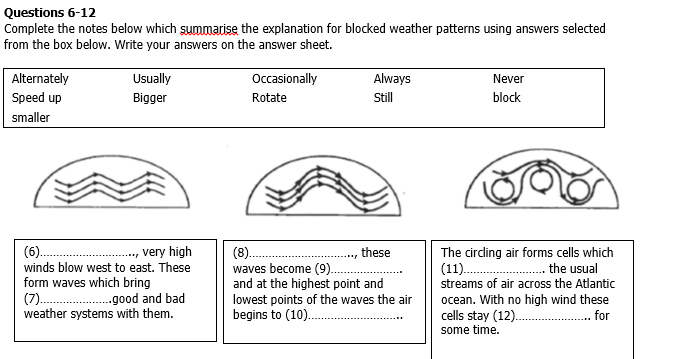
    C All of this seems hard to believe. At present we are in the middle of a cold, grey and distinctly sodden July. It seems as though summer will never arrive. How does this observation fit with Met Office predictions of a warmer, drier Britain? The Met Office’s chief weather forecaster Claire Miles explains, “At present the weather over the whole of North America, the North Atlantic and Europe has become temporarily blocked. Those areas which have good weather, such as Southern Europe and the Balkans, can expect to keep it and develop heat waves. Those areas which have bad weather, such as the UK and Northern France, will keep the rain and unseasonable cold.”

    D We seem to have kept it for some time already. In the last two weeks of June and first two weeks of July the UK has had an average daily temperature of 12.9oC. Although it is hard to believe, this is only 1.7°C lower than normal for the time of year. But what makes it seem so cold is that in the same period there has been only three hours of sunshine a day; less than half the average for the period. This, combined with northerly winds, makes it seem much colder. It may get a little warmer towards the end of the month but not much.

    E Blocked weather does not have to be bad for the UK. The glorious summer of 1976 was caused by the same phenomenon. In that case the weather patterns came to a standstill with hot rather than cold weather over the UK. Even now, parts of Europe are suffering their highest temperatures for a generation. In Athens last week the temperature rose to 48.5oC, a temperature record for Europe. The settled and warm weather which would normally come to Britain on prevailing westerly winds is now stuck over the North Atlantic, sandwiched between unusually cold and wet weather in Northern Europe and the East coast of North America.

    F “Basically,” says Miss Miles, “you’ve got low pressure centred on the UK and the eastern US and two huge high pressure areas centred on the Atlantic and the Balkans. Normally high altitude winds would blow west to east and bring the weather with them. They form waves so in somewhere like the UK we usually get alternate high and low pressure systems passing over us. These bring, successively, warm and sunny, then colder and wetter weather and there is a pretty fixed boundary between the two. But this year the waves have been more pronounced. The waves become so big they turn into cells with the winds within them going round in circles. The normal west to east winds stop and the weather remains static for some time. It could stay like this for the whole summer.”

    Questions 1-5
    Reading Passage 1 has six paragraphs A – F. Choose the most suitable headings for paragraphs A – F from the list of headings below. Write the appropriate number i – viii in boxes 1 – 5 on your answer sheet. The first one has been done for you as an example. There are more headings than paragraphs, so you will not use them all

    Paragraph Headings
    i The process of blocked patterns
    ii Better weather in Britain soon
    iii The highs and lows of weather
    iv Record UK temperatures
    v The weather now and in the future
    vi The weather now
    vii Met office forecasts
    viii Weather blocking in the past

    1 Paragraph B
    2 Paragraph C
    3 Paragraph D
    4 Paragraph E
    5 Paragraph F

    Questions 13 and 14
    Complete the following paragraph based on information in Reading Passage 1 using NO MORE THAN THREE WORDS from the Reading Passage for each answer. Write the answers in boxes 13 – 14 on your answer sheet.

    The weather in Britain is expected to change in the next fifty years. The temperatures will rise and in some areas the amount of rain will certainly (13)…………………………….Indeed it has been forecast that some regions of England will be (14)……………………….. by 2050.

    The Biggest Australian Budget Ever

    The Australian government is set to announce some of the biggest ever spending increases in education, welfare, the foreign office and defence at lunchtime tomorrow. After a decade of strong industrial growth, record low unemployment and a booming economy, the government feels confident enough to reinvest some of the funds it has been hoarding since it came to power four years ago.

    In accordance with the priorities which were stated when the Liberal party was elected, a very sizeable portion of this bounty will go to education and to schools in particular. Approximately A$1 billion is expected to go on educational building through the Neighbourhood Renewal Scheme. School buildings have suffered shameful neglect for over half a century. The population has grown and education has changed in that time but no new school buildings have been erected for 10 years. But this change should increase expenditure per child from some A$350 to over A$700. A further A$400 million will go on increasing teachers’ pay. There is national shortage of teachers, especially in areas such as science, mathematics and religion. The target to increase teachers in training to 5,600 last year was missed by a huge margin; only 2,533 actually enrolled. Increases both in basic pay and in incentive schemes, such as rewards for conspicuous achievement and cash payments for trainee teachers, will be made.

    In contrast to last year, expenditure on health will rise by less than one per cent and the changes here will be in research funding. The most notable change is in funding to the Adelaide Epidemiology Centre which is nearing its goal of marketing a vaccination against AIDS. The Department of Health will inject A$5.8 million for the large-scale, double-blind trials it requires. This compares with A$575,000 invested by the government in this programme last year. A government spokesman explains that, “health will be taking a back seat this year because of the huge increases announced in this area over the previous two years.”

    In other areas significant changes are also occurring. In the Department of Pensions and Welfare, state old age pensions, frozen at A$204 per month for the last three years are set to rise to A$255 per month. Unemployment benefit, likewise frozen for three years, is also set to rise but not until next year. Thereafter, rises of 10.5% over each of the remaining three years of this Parliament are scheduled. This is not as generous as it may seem, however, as certain categories of expenditure will be phased out. The Work Now Scheme to encourage single mothers back into the labour market will go, as will the infamous YTCs. The Youth Training Councils received a bad press over the Manning scandal which led to the resignation of the Minister, but there is evidence that these schemes placed in work only those people who would have found work anyway. More importantly, the period over which unemployment benefit is paid has been cut from a year to eight months and this might remove 20% of all claimants.

    In Defence and the Foreign Office, there are increases in the funding of the Voice of Australia radio service. The A$128 million may seem a small investment but it checks the reduction in funds from A$2 billion to A$698 million over the last decade which threatened to end the service entirely. A$500 million is being made available for two new warships and a further A$250 million for an extension to the Rapid Reaction Force now seen as so much more important given recent political and civil unrest in Indonesia, Malaysia, Papua New Guinea and Fiji.

    Questions 15-21
    For questions 15-21 match the statistical changes stated in the text with a numerical expression. Write your answers in boxes 15 – 21 on your answer sheet. There are more expressions than answers needed, so you will not use them all.

    doubletwelvefoldone in fiveone in ten
    less than halfabout a thirdabout one in six6%
    tenfold25%10.5%12%

    15 The decrease in financial support for the Voice of Australia over the previous 10 years…………………..
    16 The shortfall in the numbers who entered teacher training…………………..
    17 The long term increase in unemployment benefit……………………..
    18 The reduction in the numbers eligible for unemployment benefit…………………
    19 The increase in funding for AIDS research ……………….
    20 The increase in state pensions…………………
    21 The increase in per capita expenditure on schools………………..

    Questions 22-26
    Do the following statements agree with the information given in Reading Passage 27 In boxes 22 – 26 on your answer sheet write

    YES                            if the statement agrees with the information
    NO                              if the statement contradicts the information
    NOT GIVEN           if there is no information on this in the passage.

    22 The Australian government has been increasing expenditure for four years.
    23 School buildings have been neglected for 10 years.
    24 The Work Now Scheme was unsuccessful.
    25 The state pension did not increase for three years.
    26 The government has decided to release some of its reserves to improve the lives of its citizens.

    A Man Of Principle Of Needless Martyr?

    Sir Thomas More was the most brilliant Englishman of his age in an age, the early Renaissance, which is thought to be particularly brilliant. He scaled the heights in law, in philosophy and literature, and attained high political rank as Chancellor. But the most challenging thing about this man is nothing that he achieved in life but the nature of his death. The facts are well known. He was executed by King Henry VIII in 1534 for refusing to accept Henry as head of the church in England. What is unclear is why he chose to refuse, and to die in this way.

    Clouding the issue are the political and religious arguments which were at the root of his refusal and his death. It will be remembered that King Henry VIII was, for most of his life, an ardent Catholic who was awarded the title of Defender of the Faith for his resistance to the Protestant reformation. But his desperation for a male heir led Henry to divorce his first wife, Catherine of Aragon, in favour of the younger Ann Boleyn who offered the promise of a son. High politics among the crowned heads of Europe meant that this could only be achieved by a break with Rome and the acceptance of Protestantism in England. In a time when religion was taken very seriously by whole populations there was bound to be resistance.

    Traditional Catholic writers, such as Friar Anthony Foley, have cast “More as a martyr who stood up for the cause of Catholicism and perished for the true religion. “More was a beacon of light in those dark times,” says Friar Foley, “whose actions have shown the path of righteousness for true believers even down to the present day.” This interpretation was convenient for the Catholic church, then as now, and resulted in More being made a saint. It ignores, however, the fact that More took every step to stop his ideas being made a political issue. Whatever reason he had it was not support of the Catholic church. It also does not explain why More chose to take a stand, and effectively commit suicide, on this issue. Even under the teachings of the Catholic church he could have sworn the necessary oath to Henry because he was under duress. The church in his day did not expect or require him to refuse. More’s personal beliefs were his own but refusal to take the oath is what condemned him.

    A more recent biography, by Paul Hardy, views More as a medieval man and not the renaissance man he is often seen as. As such, Hardy argues, he would have been deeply conservative. The changes which Henry was embracing, with the acceptance of Protestantism, would have been highly offensive. “As a lawyer and Chancellor, More had spent his life defending the status quo and now, at the stroke of a pen, it was turned round,” he writes. This rather ignores the deliberate modernity which imbued every other aspect of More’s life from legal reform to the rewriting of school textbooks.

    Other writers, such as the psychotherapist Bill Blake, see More’s demise as an example of depressive illness. Melancholy was widely known at the time but not seen as an illness. It is not implausible that under the strain of work and the profile of his position as Chancellor, he succumbed to depression and, desperate and indecisive, let death sweep over him. But contemporary reports are at odds with this. He made every effort to comfort and cheer up his own relatives and never appeared lost or undecided.

    Since More himself left no explanation we will probably never really know what his motivation was. However, Hardy’s observations are very true in some respects in that More lived in a very different world and one that is hard for us to understand. Life could be very cheap 500 years ago especially if one held high political office or intellectual views at odds with the establishment. There is no better way of appreciating this than to consider the fate of the poets in the Oxford Book of Sixteenth Century Verse. Two thirds of these poets died violent deaths, almost all at the hands of an executioner. With the possibility of death ever present it seems to have been regarded then with something less than the dread it evokes today. Perhaps this is what happened with More. After a lifetime of good fortune, considerable luxury and achievement, the wheel of fortune had turned, and he accepted his fate with good grace in the hope of an even better life in the hereafter.

    Questions 27-34
    Classify the following statement as referring to

    Writers

    A Foley
    B Hardy
    C Blake
    D The writer of the article
    E Contemporary writers

    Example: More took a religious stand against Protestantism.               Answer A

    Write the appropriate letters in boxes 27 – 33 on your answer sheet. You may use any answer more than once

    27 More was suffering from depression when he died.
    28 More was a traditionalist in his views.
    29 More could have taken the oath and remained a Catholic.
    30 More had a positive attitude to life and helped others.
    31 More was defending the true faith.
    32 More resigned himself to the fact that his good luck had changed.
    33 More had a lifestyle which is difficult for modern man to comprehend.
    34 More showed he was a modern man in his restructuring of the law and education.

    Questions 35 – 40
    For questions 35 – 40, choose the best answers. A, B, C or D, according to the information in the text. Write your answers on the answer sheet.

    35 Henry VIII executed More because
    A Henry VIII wanted a son
    B More believed in Protestantism
    C More was a Chancellor
    D More refused to take an oath

    36 More’s death is a mystery because
    A he chose to be executed
    B he left no written explanation
    C the facts of his death are not known
    D it is bound up in religious controversy

    37 Which of the following was More NOT expert in?
    A literature
    B religion
    C philosophy
    D law

    38 The writer disbelieves traditional views of More’s death because
    A More committed suicide
    B More didn’t follow Catholic teaching in refusing the oath
    C theories of depression are more persuasive
    D little is really understood of the time More lived in

    39 According to the writer, the life of an intellectual 500 years ago could be dangerous
    A because the standard of living was cheap
    B because they held high political office
    C if they held dissident views
    D if they suffered from depression

    40 Henry VIII broke from Rome because
    A he believed Protestantism was the true faith
    B Rome refused him a divorce
    C he wanted to ensure the succession
    D he wanted to marry Ann Boleyn

  • IELTS Reading Practice Test – Exercise 62

    A Spark, A Flint; How Fire Leapt To Life

    The control of fire was the first and perhaps greatest of humanity’s steps towards a life-enhancing technology. To early man, fire was a divine gift randomly delivered in the form of lightning, forest fire or burning lava.

    Unable to make flame for themselves, the earliest people probably stored fire by keeping slow burning logs alight or by carrying charcoal in pots. How and where man learnt how to produce flame at will is unknown. It was probably a secondary invention, accidentally made during tool-making operations with wood or stone. Studies of primitive societies suggest that the earliest method of making fire was through friction. European peasants would insert a wooden drill in a round hole and rotate it briskly between their palms this process could be speeded up by wrapping a cord around the drill and pulling on each end.

    The Ancient Greeks used lenses or concave mirrors to concentrate the sun’s rays and burning glasses were also used by Mexican Aztecs and the Chinese.

    Percussion methods of fire-lighting date back to Paleolithic times, when some Stone Age tool-makers discovered that chipping flints produced sparks. The technique became more efficient after the discovery of iron, about 5000 vears ago In Arctic North America, the Eskimos produced a slow-burning spark by striking quartz against iron pyrites, a compound that contains sulphur. The Chinese lit their fires by striking porcelain with bamboo. In Europe, the combination of steel, flint and tinder remained the main method of fire-lighting until the mid 19th century.

    Fire-lighting was revolutionised by the discovery of phosphorus, isolated in 1669 by a German alchemist trying to transmute silver into gold. Impressed by the element’s combustibility, several 17th century chemists used it to manufacture fire-lighting devices, but the results were dangerously inflammable. With phosphorus costing the equivalent of several hundred pounds per ounce, the first matches were expensive.

    The quest for a practical match really began after 1781 when a group of French chemists came up with the Phosphoric Candle or Ethereal Match, a sealed glass tube containing a twist of paper tipped with phosphorus. When the tube was broken, air rushed in, causing the phosphorus to self- combust. An even more hazardous device, popular in America, was the Instantaneous Light Box — a bottle filled with sulphuric acid into which splints treated with chemicals were dipped.

    The first matches resembling those used today were made in 1827 by John Walker, an English pharmacist who borrowed the formula from a military rocket-maker called Congreve. Costing a shilling a box, Congreves were splints coated with sulphur and tipped with potassium chlorate. To light them, the user drew them quickly through folded glass paper.

    Walker never patented his invention, and three years later it was copied by a Samuel Jones, who marketed his product as Lucifers. About the same time, a French chemistry student called Charles Sauria produced the first “strike-anywhere” match by substituting white phosphorus for the potassium chlorate in the Walker formula. However, since white phosphorus is a deadly poison, from 1845 match-makers exposed to its fumes succumbed to necrosis, a disease that eats away jaw-bones. It wasn’t until 1906 that the substance was eventually banned.

    That was 62 years after a Swedish chemist called Pasch had discovered non-toxic red or amorphous phosphorus, a development exploited commercially by Pasch’s compatriot J E Lundstrom in 1885. Lundstrom’s safety matches were safe because the red phosphorus was non-toxic; it was painted on to the striking surface instead of the match tip, which contained potassium chlorate with a relatively high ignition temperature of 182 degrees centigrade.

    America lagged behind Europe in match technology and safety standards. It wasn’t until 1900 that the Diamond Match Company bought a French patent for safety matches — but the formula did not work properly in the different climatic conditions prevailing in America and it was another 11 years before scientists finally adapted the French patent for the US.

    The Americans, however, can claim several “firsts” in match technology and marketing. In 1892 the Diamond Match Company pioneered book matches. The innovation didn’t catch on until after 1896, when a brewery had the novel idea of advertising its product in match books. Today book matches are the most widely used type in the US, with 90 percent handed out free by hotels, restaurants and others.

    Other American innovations include an anti-afterglow solution to prevent the match from smoldering after it has been blown out; and the waterproof match, which lights after eight hours in water.

    Questions 1-8
    Complete the summary below. Choose your answers from the box given below and write them in boxes 1-8 on your answer sheet. NB There are more words than spaces so you will not use them all you may use any of the words more than once.

    EARLY FIRE-LIGHTING METHODS
    They tried to (1)…………………….burning logs or charcoal (2)…………………… that they could create fire themselves. It is suspected that the first man-made flames were produced by (3)…………………The very first fire-lighting methods involved the creation of (4)……………………by, for example, rapidly (5)……………………. a wooden stick in a round hole. The use of (6)………………………… or persistent chipping was also widespread in Europe and among other peoples such as the Chinese and (7)…………………….. European practice of this method continued until the 1850s (8)…………………….the discovery of phosphorus some years earlier.

    Mexicansrandomrotatingdespite
    preserverealisingsunlightlacking
    heavenlypercussionchancefriction
    unawarewithoutmakeheating
    eskimossurpriseduntilsmoke

    Questions 9-15

    Look at the following notes that have been made about the matches described in Reading passage. Decide which type of match (A-H) corresponds with each description and write your answers in the boxes 9-15.

    Notes

    9. made using a les poisonous type of phosphorus

    10. identical to a previous type of match

    11. caused a deadly illness

    12. first to look like modern matches

    13. first matches used for advertising

    14. relied on an airtight glass container

    15. made with the help of an army design

    Type of matches

    A the Ethereal Match

    B the instantaneous lightbox

    C congreves

    D lucifers

    E the first strike anywhere match

    F Lundstrom’s safety match

    G book matches

    H waterproof matches

    Zoo Conservation Programmes

    One of London Zoo’s recent advertisements caused me some irritation, so patently did it distort reality. Headlined “Without zoos you might as well tell these animals to get stuffed”, it was bordered with illustrations of several endangered species and went on to extol the myth that without zoos like London Zoo these animals “will almost certainly disappear forever”. With the zoo world’s rather mediocre record on conservation, one might be forgiven for being slightly sceptical about such an advertisement.

    Zoos were originally created as places of entertainment, and their suggested involvement with conservation didn’t seriously arise until about 30 years ago, when the Zoological Society of London held the first formal international meeting on the subject. Eight years later, a series of world conferences took place, entitled “The Breeding of Endangered Species”, and from this point onwards conservation became the zoo community’s buzzword. This commitment has now been clearly defined in The World Zoo Conservation Strategy (WZGS, September 1993), which although an important and welcome document does seem to be based on an unrealistic optimism about the nature of the zoo industry.

    The WZCS estimates that there are about 10,000 zoos in the world, of which around 1,000 represent a core of quality collections capable of participating in co-ordinated conservation programmes. This is probably the document’s first failing, as I believe that 10,000 is a serious underestimate of the total number of places masquerading as zoological establishments. Of course it is difficult to get accurate data but, to put the issue into perspective, I have found that, in a year of working in Eastern Europe, I discover fresh zoos on almost a weekly basis.

    The second flaw in the reasoning of the WZCS document is the naive faith it places in its 1,000 core zoos. One would assume that the calibre of these institutions would have been carefully examined, but it appears that the criterion for inclusion on this select list might merely be that the zoo is a member of a zoo federation or association. This might be a good starting point, working on the premise that members must meet certain standards, but again the facts don’t support the theory. The greatly respected American Association of Zoological Parks and Aquariums (AAZPA) has had extremely dubious members, and in the UK the Federation of Zoological Gardens of Great Britain and Ireland has occasionally had members that have been roundly censured in the national press. These include Robin Hill Adventure Park on the Isle of Wight, which many considered the most notorious collection of animals in the country. This establishment, which for years was protected by the Isle’s local council (which viewed it as a tourist amenity), was finally closed down following a damning report by a veterinary inspector appointed under the terms of the Zoo Licensing Act 1981. As it was always a collection of dubious repute, one is obliged to reflect upon the standards that the Zoo Federation sets when granting membership. The situation is even worse in developing countries where little money is available for redevelopment and it is hard to see a way of incorporating collections into the overall scheme of the WZCS.

    Even assuming that the WZCS’s 1,000 core zoos are all of a high standard complete with scientific staff and research facilities, trained and dedicated keepers, accommodation that permits normal or natural behaviour, and a policy of co-operating fully with one another what might be the potential for conservation? Colin Tudge, author of Last Animals at the Zoo (Oxford University Press, 1992), argues that “if the world”s zoos worked together in co-operative breeding programmes, then even without further expansion they could save around 2,000 species of endangered land vertebrates’. This seems an extremely optimistic proposition from a man who must be aware of the failings and weaknesses of the zoo industry the man who, when a member of the council of London Zoo, had to persuade the zoo to devote more of its activities to conservation. Moreover, where are the facts to support such optimism?

    Today approximately 16 species might be said to have been “saved” by captive breeding programmes, although a number of these can hardly be looked upon as resounding successes. Beyond that, about a further 20 species are being seriously considered for zoo conservation programmes. Given that the international conference at London Zoo was held 30 years ago, this is pretty slow progress, and a long way off Tudge’s target of 2,000.

    Questions 16-22

    Do the following statements agree with the views of the writer in Reading Passage 2? In boxes 16-22 write

    YES                       if the statement agrees with the writer
    NO                         if the statement contradicts the writer
    NOT GIVEN      if it is impossible to say what the writer thinks about this

    16 London Zoo’s advertisements are dishonest.
    17 Zoos made an insignificant contribution to conservation up until 30 years ago.
    18 The WZCS document is not known in Eastern Europe.
    19 Zoos in the WZCS select list were carefully inspected.
    20 No one knew how the animals were being treated at Robin Hill Adventure Park.
    21 Colin Tudge was dissatisfied with the treatment of animals at London Zoo.
    22 The number of successful zoo conservation programmes is unsatisfactory.

    Questions 23-25
    Choose the appropriate letters A-D and write them in boxes 23-25 on your answer sheet.

    23 What were the objectives of the WZCS document?
    A to improve the calibre of zoos world-wide
    B to identify zoos suitable for conservation practice
    C to provide funds for zoos in underdeveloped countries
    D to list the endangered species of the world

    24 Why does the writer refer to Robin Hill Adventure Park?
    A to support the Isle of Wight local council
    B to criticise the 1981 Zoo Licensing Act
    C to illustrate a weakness in the WZCS document
    D to exemplify the standards in AAZPA zoos

    25 What word best describes the writer’s response to Colin Tudges’ prediction on captive breeding programmes?
    A disbelieving
    B impartial
    C prejudiced
    D accepting

    Questions 26-28
    The writer mentions a number of factors which lead him to doubt the value of the WZCS document.
    Which THREE of the following factors are mentioned?
    Write your answers (A-F) in boxes 26-28 on your answer sheet.

    List of Factors
    A the number of unregistered zoos in the world
    B the lack of money in developing countries
    C the actions of the Isle of Wight local council
    D the failure of the WZCS to examine the standards of the “core zoos”
    E the unrealistic aim of the WZCS in view of the number of species “saved” to date
    F the policies of WZCS zoo managers

    Architecture – Reaching For The Sky

    Architecture is the art and science of designing buildings and structures. A building reflects the scientific and technological achievements of the age as well as the ideas and aspirations of the designer and client. The appearance of individual buildings, however, is often controversial.

    The use of an architectural style cannot be said to start or finish on a specific date. Neither is it possible to say exactly what characterises a particular movement. But the origins of what is now generally known as modern architecture can be traced back to the social and technological changes of the 18th and 19th centuries.

    Instead of using timber, stone and traditional building techniques, architects began to explore ways of creating buildings by using the latest technology and materials such as steel, glass and concrete strengthened steel bars, known as reinforced concrete. Technological advances also helped bring about the decline of rural industries and an increase in urban populations as people moved to the towns to work in the new factories. Such rapid and uncontrolled growth helped to turn parts of cities into slums.

    By the 1920s architects throughout Europe were reacting against the conditions created by industrialisation. A new style of architecture emerged to reflect more idealistic notions for the future. It was made possible by new materials and construction techniques and was known as Modernism.

    By the 1930s many buildings emerging from this movement were designed in the International Style. This was largely characterised by the bold use of new materials and simple, geometric forms, often with white walls supported by stilt¬like pillars. These were stripped of unnecessary decoration that would detract from their primary purpose — to be used or lived in.

    Walter Gropius, Charles Jeanneret (better known as Le Corbusier) and Ludwig Mies van der Rohe were among the most influential of the many architects who contributed to the development of Modernism in the first half of the century. But the economic depression of the 1930s and the second world war (1939-45) prevented their ideas from being widely realised until the economic conditions improved and war-torn cities had to be rebuilt. By the 1950s, the International Style had developed into a universal approach to building, which standardised the appearance of new buildings in cities across the world.

    Unfortunately, this Modernist interest in geometric simplicity and function became exploited for profit. The rediscovery of quick-and-easy-to-handle reinforced concrete and an improved ability to prefabricate building sections meant that builders could meet the budgets of commissioning authorities and handle a renewed demand for development quickly and cheaply. But this led to many badly designed buildings, which discredited the original aims of Modernism.

    Influenced by Le Corbusier’s ideas on town planning, every large British city built multi-storey housing estates in the 1960s. Mass- produced, low-cost high-rises seemed to offer a solution to the problem of housing a growing inner-city population. But far from meeting human needs, the new estates often proved to be windswept deserts lacking essential social facilities and services. Many of these buildings were poorly designed and constructed and have since been demolished.

    By the 1970s, a new respect for the place of buildings within the existing townscape arose. Preserving historic buildings or keeping only their facades (or fronts) grew common.

    Architects also began to make more use of building styles and materials that were traditional to the area. The architectural style usually referred to as High Tech was also emerging. It celebrated scientific and engineering achievements by openly parading the sophisticated techniques used in construction. Such buildings are commonly made of metal and glass; examples are Stansted airport and the Lloyd’s building in London.

    Disillusionment at the failure of many of the poor imitations of Modernist architecture led to interest in various styles and ideas from the past and present. By the 1980s the coexistence of different styles of architecture in the same building became known as Post Modern. Other architects looked back to the classical tradition. The trend in architecture now favours smaller scale building design that reflects a growing public awareness of environmental issues such as energy efficiency. Like the Modernists, people today recognise that a well designed environment improves the quality of life but is not necessarily achieved by adopting one well defined style of architecture.

    Twentieth century architecture will mainly be remembered for its tall buildings. They have been made possible by the development of light steel frames and safe passenger lifts. They originated in the US over a century ago to help meet the demand for more economical use of land. As construction techniques improved, the skyscraper became a reality.

    Questions 29-35
    Complete the table below using information from Reading Passage 3. Write NO MORE THAN THREE WORDS for each answer. Write your answers in boxes 29-35 on your answer sheet.

    PeriodStyle of PeriodBuilding MaterialsCharacteristics
    Before 18th centuryexample: traditional(29)…………………..
    1920sintroduction of (30)………………..steel, glass and concreteexploration of latest technology
    1930s – 1950s(31)…………………….geometric forms
    1960sdecline of Modernismpre-fabricated sections(32)……………………
    1970send of Modernist eratraditional materials(33)…………………of historic buildings
    1970sbeginning of (34)………………erametal and glasssophisticated techniques paraded
    1980sPost-Modernism(35)………………………

    Questions 36-40
    Reading Passage 3 describes a number of cause and effect relationships. Match each Cause (36-40) in List A, with its Effect (A-H) in List B. Write your answers (A-H) in boxes 36 40 on your answer sheet.
    NB There are more effects in List B than you will need, so you will not use all of them. You may use any effect more than once if you wish.

    List A CausesList B Effects
    36. A rapid movement of people from rural areas to cities is triggered by technological advance
    37. Buildings become simple and functional
    38. An economic depression and the second world war hit Europe
    39. Multi-storey housing estates are built according to contemporary ideas on town planning
    40. Less land must be used for building
    A The quality of life is improved
    B Architecture reflects the age
    C A number of these have been knocked down
    D Light steel frames and lifts are developed
    E Historical buildings are preserved
    F All decoration is removed
    G Parts of cities become slums
    H Modernist ideas cannot be put into practice until the second half of the 20th century

  • IELTS Reading Practice Test – Exercise 61

    Sharks – Face Extinction

    Professor Robert Law, bead of Marine Biological Ltd, which monitors the ocean environment, and a leading governmental advisor on marine pollution, is claiming today that sharks are in danger of extinction. Professor Law’s main point is that worldwide the number of sharks of most species is dropping rapidly. Exact figures about these elusive creatures are hard to come by, but the general consensus is that certain kinds of shark population have decreased by up to 75% in the last 30 years.

    The great white and tiger sharks have seen the greatest drop in numbers, down by as much as 90% from 20 years ago. Smaller sharks are also under threat – the populations of makos, hammerheads, even common dogfish are being decimated. Estimates suggest that British dogfish numbers have halved in the last decade alone.

    And this decline is worldwide. The big sharks congregate mainly in the warmer waters of the Pacific and Caribbean, but cold water areas such as the Atlantic and the North Sea have their own species and these too are in danger. The reasons for the decline in numbers are not hard to see. One huge reason is the continued demand for shark fins in South-East Asia, where they are used to make soup and as ingredients in medicines. Most sharks that are killed commercially in the West are processed for the oil that comes from their livers. Sharks are also victims of fear, since they are routinely killed by fishermen when they are landed with other catches.

    “Sharks have no protection.” writes Professor Law. “They are not outside the law – most countries have laws protecting the species which are most under threat – but the problem is that people are so frightened of them that the laws are not enforced. There are perhaps five marine biologists in Europe actively involved in attempts to save shark species, although there is greater awareness in America and Australia. Sharks have an image problem. Nobody associates them with needing to be saved simply because they are such fearsome predators.”

    But the market demand for shark products has always been high. The real reason why shark stocks have plummeted is the same as the reason why other fish species are in decline. Modern fishing technology – the use of sonar and deep-netting in particular – has made the shark’s natural defences useless.

    Charles Starkling, author of Jaws: the Myth of the Sea, agrees. “The equipment the shark has to defend itself is perfect in the right environment. Against other sharks, humans, fish, all the normal dangers, the shark is virtually invincible.” But Starkling adds that no animal, no matter how large and dangerous on its own, can fight against steel nets. “The nets that are put out to protect swimmers don’t just keep sharks away. They kill them. A shark which is caught in a net dies, because sharks can’t stop swimming. Without a swim bladder, the shark drowns as soon as it stops moving.” Starkling says it is common practice for sharks to have their fins cut off by fishermen and then to be dropped back in the ocean alive. They die by drowning.

    And the ecology of sharks makes them especially vulnerable. Sharks are top-of-the-chain predators, feeding on virtually anything else in the water, and consequently they are quite rare. For every million herring in the Atlantic, there will be one mako. Sharks are solitary and territorial, with unimaginably vast areas. The larger sharks also reproduce slowly, giving birth to live young one at a time.

    Most people are afraid of sharks, but without good reason. You are many thousands of times more likely to be run over or die from smoking – even death by lightning or drowning in your bath are more likely – than to be attacked by a shark, and even then most shark attack victims survive. Recent research suggests that most sharks kill by mistake after taking an exploratory bite – humans are not sharks’ chosen food. But time is running out for these ancient predators of the deeps. When their populations have gone below a certain level, no amount of legislation will protect them. Professor Law points out that most sharks cannot be kept in zoos, like tigers, and that once they are gone they will be gone forever. He counsels that sharks urgently need protection by law if they are to continue to grace the seas.

    Questions 1-8
    Complete the summary below. Choose your answers from the box below the summary and write them in boxes 1 – 8 on the answer sheet. There are more words than spaces, so you will not use all the given words.

    Sharks Face Extinction
    All over the world, shark populations are in dramatic (1)………………………. In warm and cold waters, many shark species have been reduced to a (2)……………………….. of their former size. This has come about largely as a result of the demand for shark products in the medical and catering industries, but sharks are also left biologically (3)…………………………., since they lack swim bladders and can drown if they are (4)…………………………… And the shark’s reputation means it does not enjoy the (5)……………………………… of other endangered species; conservation laws are often (6)……………………….. All these factors are compounded by recent (7)……………………….. in the techniques of fishing. Sharks are comparatively rare, because of their status as (8)……………………….., and reproduce slowly. This makes them even more exposed to the dangers of overfishing. With stocks already very low, the time for full legal protection has come.

    improvementsprotectiondeclinefollowed
    fishvulnerablechangetechnology
    ignoredsectionattackerslaws
    movementtrappedopenpart
    predatorsmadefraction

    Questions 9-15
    Do the following statements agree with the information given in Reading Passage 1? In boxes 9 -15 on your answer sheet write

    YES                              if the statement agrees with the information
    NO                                if the statement contradicts the information
    NOT GIVEN             if there is no information on this in the passage.

    9 We know precisely how much shark populations have declined.
    10 The biggest reason for the decline of sharks is the demand for shark fins.
    11 People are afraid to implement regulations safeguarding sharks.
    12 The shark is able to protect itself in all circumstances.
    13 Sharks live in groups.
    14 Shark attacks are a statistically improbable cause of death for humans.
    15 Sharks will become extinct in the near future.

    Water Power

    Some of the ways in which Britain gets its energy are often dangerous and dirty. They are also unsustainable. Water power from the tides and the waves is one way to reduce pollution and create energy safely and cleanly.

    More than 70% of the earth’s surface is water. It is impossible to know exactly how much energy could be produced from this, although as an example 4-metre high waves in storms could produce up to 700 kilowatts per metre. While it is not practical to use stormy seas as a resource, even relatively calm seas and tidal rivers can be exploited for their energy potential.

    Nowadays, machinery can be used to convert the power of moving water into electricity. In the past, a less efficient method was to use the power of the water directly in, for example, mills, where the falling water drove a wheel which simply drove the mill to convert corn to flour. Another alternative is to create a hydraulic ram, which sends water up a pipe to a higher level using only the power of the water itself.

    Hydro-electricity is the most common use of water power in Britain, although even then it only accounts for 2% of all the electricity generated in Britain. A huge body of water, the reservoir, is held back by a dam so the water is fed through pipes at great speed, to a turbine which generates electricity. There are major advantages to this system. First, it is a clean source of power which uses only natural renewable resources. It is safe, too, if it is well-constructed, although there have been disasters when dams have burst. It is also possible to control how much power is generated. The major disadvantage, especially in Britain, which is comparatively small and overpopulated, is that hydro-electric power uses lots of land, which has to be flooded to make reservoirs. It also has very high start-up costs.

    However, small-scale hydro-electric projects have fewer disadvantages than the huge schemes such as the Hoover Dam in the USA. They are cheaper to build and less potentially dangerous. This kind of smaller project uses turbines, which work on a similar principle to old-fashioned waterwheels, but are smaller and more efficient.

    With impulse turbines, water is forced through pipes at speed. It hits specially-designed sections of a wheel, which spin. The kinetic energy thus produced is transferred to the engine. There are various kinds of impulse turbines, including the Pelton Turbine, which is a single or double width of cup-shaped devices on a narrow wheel, and the Cross-Flow Turbine, which consists of thin paddles on a long shaft, and which is suitable for wider areas.

    There are also reaction turbines such as the Francis Turbine, which looks rather like a ship’s propeller. They consist of a series of blades mounted inside the pipe which is carrying the water under great pressure. These blades are turned by the flow of water across them.

    Small water turbines are only ever about 80% efficient, as some efficiency is inevitably lost in the transfer of energy. But this should not prevent us exploiting the power of water further. The small-scale systems described here are cheap and clean, and, once set-up costs have been met, will provide power for years to come without much maintenance and at no permanent cost to the environment.

    Questions 16-21
    Label the diagrams below. Choose NO MORE THAN THREE WORDS from Reading Passage 2 for each answer. Write your answers in boxes 16-21 on your answer sheet.

    Questions 22-25
    Complete each of the following statements with words taken from Reading Passage 2. Write NO MORE THAN THREE WORDS for each answer.

    Write your answers in boxes 22 – 25 on your answer sheet.

    22 Using water power to move machinery is………………………………………….than using it to generate electricity.
    23 About 20% of energy………………………………….with smaller water turbines.
    24 All water turbines rely on water being………………………………..at great speed.
    25 The main expense of hydro-electric projects lies in………………………….

    The Art Of History

    1 The earliest stage of writing is called pre-writing or proto-literary, and depends on direct representation of objects, rather than representing them with letters or other symbols. Evidence for this stage, in the form of rock and cave paintings, dates back to about 15,000 years ago, although the exact dates are debatable. This kind of proto-literate cave painting has been found in Europe, with the best known examples m South-Western France, but also in Africa and on parts of the American continent. These petrographs (pictures on rock) show typical scenes of the period, and include representations of people, animals and activities. Most are astonishingly beautiful, with a vibrancy and immediacy that we still recognise today. They are painted with pigments made from natural materials including crushed stones and minerals, animal products such as blood, ashes, plant materials of all kinds, and they produce a wide range of colours and hues.

    2 Why did ancient people put such effort into making them? Various theories have been put forward, but the most compelling include the idea that the pictures were records of heroic deeds or important events, that they were part of magical ceremonies, or that they were a form of primitive calendar, recording the changes in the seasons as they happened. These, then, are all explanations as to why man started to write.

    3 A related theory suggests that the need for writing arose thereafter from the transactions and bartering that went on. In parts of what is now Iraq and Iran, small pieces of fired earth – pottery – have been found which appear to have been used as tokens to represent bartered objects, much as we use tokens in a casino, or money, today. Eventually, when the tokens themselves became too numerous to handle easily, representations of the tokens were inscribed on day tablets.

    4 An early form of writing is the use of pictograms, which are pictures used to communicate. Pictograms have been found from almost every part of the world and every era of development, and are still in use in primitive communities nowadays. They represent objects, ideas or concepts more or less directly. They tend to be simple in the sense that they are not a complex or full picture, although they are impressively difficult to interpret to an outsider unfamiliar with their iconography, which lends to be localised, and to differ widely form society to society. They were never intended to be a detailed testimony which could be interpreted by outsiders, but to serve instead as aide-memoires to the author, rather as we might keep a diary in a personal shorthand. However, some modem pictograms are more or less universally recognised, such as the signs which indicate men’s and women’s toilets, or road signs, which tend to be very similar throughout the world.

    5 The first pictograms that we know of are Sumerian in origin, and date to about 8000 BC. They show how images used to represent concrete objects could be expanded to include abstractions by adding symbols together, or using associated symbols. One Sumerian pictogram, for example, indicates ‘death’ by combining the symbols for ‘man’ and winter’; another shows ‘power’ with the symbol for a man with the hands enlarged.

    6 By about 5,000 years ago, Sumerian pictograms had spread to other areas, and the Sumerians had made a major advance towards modern writing with the development of the rebus principle, which meant that symbols could be used to indicate sounds. This was done try using a particular symbol not only for the thing it originally represented, but also for anything which was pronounced in a similar way. So the pictogram for na (meaning ‘animal’) could also be used to mean ‘old’ (which was also pronounced na). The specific meaning of the pictogram (whether na meant ‘old’ or animal j could only be decided through its context.

    7 It is a short step from this to the development of syllabic writing using pictograms, and this next development took about another half a century. Now the Sumerians would add pictograms to each other, so that each, representing an individual sound – or syllable – formed part of a larger word. Thus pictograms representing the syllables he, na and mi (‘mother’, ‘old’, my’) could be put together to form henami or ‘grandmother’.

    Questions 26-32
    Reading Passage 3 has seven paragraphs 1 – 7. Choose the most suitable headings for paragraphs 1 – 7 from the list of headings below. Write the appropriate letters A – H in boxes 26 – 32 on your answer sheet. There are more headings than paragraphs, so you will not use them all.

    Paragraph Headings
    A Magic and Heroes
    B Doing Business
    C Early Developments
    D Sounds and Symbols
    E Images on Stone
    F Stories and Seasons
    G A Personal Record
    H From Visual to Sound

    26 Paragraph 1
    27 Paragraph 2
    28 Paragraph 3
    29 Paragraph 4
    30 Paragraph 5
    31 Paragraph 6
    32 Paragraph 7

    Questions 33-37
    Complete the following notes on Reading Passage 3 using ONE or TWO WORDS from the Reading Passage for each answer. Write your answers in boxes 33 – 37 on your answer sheet.

    Notes on the Development of Writing

    First stage of writing – pre-writing or proto-literacy – very old – 15,000 years. Evidence: cave and rock paintings. Famous example – (33)…………………………. Reasons for development of writing: primitive ceremonies, recording events, seasons, used on pottery to represent (34)………………………… Next stage: simple pictograms – pictures used to represent articles and (35)…………………………… Very simple drawings (but very difficult to understand). Then – 8000 BC – combined (36)……………………………..to create new concepts (eg. man + winter = death). After this – started using same pictogram for different words with same (37)…………………………Very important step.

    Questions 38 – 40
    Choose the appropriate letters A – D and write them in boxes 38 – 40 on your answer sheet.

    38 The earliest stages of writing
    A were discovered 15,000 years ago and are found all over the world.
    B are pictures which show the natural life of the time.
    C are called petrographs and were painted with natural materials.
    D could not describe concepts.

    39 The earliest pictograms
    A represent complex objects and are difficult to understand.
    B represent comparatively simple objects and are easy to understand.
    C are a record of events for outsiders.
    D are fairly simple but may not be easy to interpret.

    40 About 5.000 years ago
    A Sumerians were developing sounds.
    B Sumerians were writing in a modern style.
    C pictograms were used over a wide area.
    D pictogram symbols could only have one meaning.

  • IELTS Reading Practice Test – Exercise 60

    National Parks And Climate Change

    A National parks nature reserves, protected areas and sites of special scientific interest (SSSIs) are an important part of the natural landscape in most countries. Their habitat and terrains vary massively from tundra and glacier parks in the north to wetlands in Europe, steppes in central and Eastern Europe, and prairie grasslands and deserts in other areas virtually all kinds of landscape are protected somewhere. And these protected areas are important for the variety of plant and animal life they harbour: caribou, bears, wolves, rare types of fish and birds.

    B But these areas are under threat from a recent peril – global climate change. No amount of legislation in any one country can protect against a worldwide problem. What exactly are the problems caused by climate change? David Woodward, head of the British Council for Nature Conservation, spoke to Science Now’ about some of these areas, and his first point highlighted the enormous variation in nature reserves

    C “Each park or reserve is an ecosystem,” he says, “and the larger reserves, such as those in Canada, may have several types of ecological subsystems within it. There are reserves which are half the size of Western Europe, so it doesn’t make sense to talk about them as if they were all the same or as if the microclimates within them were uniform,” Woodward outlines some of the dangers posed by climatic change to parks in the northern Americas, for example.

    D “If climatic change is severe, and in particular if the change is happening as quickly as it is at the moment, then the boundaries of the park no longer make much sense. A park that was designated as a protected area 90 years ago may suffer such change in its climate that the nature of it changes too. It will no longer contain the animal and plant life that it did. So the area which once protected, say. A species of reindeer or a type of scenery, will have changed. In effect, you lose the thing you were trying to protect.” This effect has already been seen in Canada, where parks which once contained glaciers have seen the glaciers melted by global warming.

    E Jennie Lindstrom, Chief Executive Officer of H2O, the charity which campaigns on an international level on behalf of mainland Europe’s protected wetland and wilderness areas, is even more pessimistic. In a letter to Science Now, she has asserted that up to 70% of such areas are already experiencing such “significant change. In climate ’ that the distribution patterns of flora and fauna are changing, and that all areas will eventually be affected. She estimates that the most profound change is occurring in the northernmost parks in areas such as Finland, Greenland, Iceland and northern Russia but adds that “there is no place which will not suffer the effects of global warming What we are seeing is a massive change in the environment – and that means the extinction of whole species, as well as visual and structural changes which means that areas like the Camargue may literally look totally different in 50 or 60 years’ time.”

    F The problems are manifold. First, it is difficult or impossible to predict which areas are most in need of help – that is, which areas are in most danger. Predicting climate change is even more unreliable than predicting the weather. Secondly, there is a sense that governments in most areas are apathetic towards a problem which may not manifest itself until long after that government’s term of office has come to an end in poor areas, of course, nature conservation is low on the list of priorities compared to, say employment or health. Third, and perhaps most important, even in areas where there is both the political will and the financial muscle to do something about the problem, it is hard to know just what to do. Maria Colehill of Forestlife, an American conservation body, thinks that in the case of climate change, the most we can realistically do is monitor the situation and allow for the changes that we cannot prevent, while lobbying governments internationally to make the changes to the pollution laws, for example, that will enable us to deal with the causes of the problem. “I am despondent.” she admits. “I have no doubt that a lot of the work we are doing on behalf of the North American lynx, for example, will be wasted The animal itself can live in virtually any environment where there are few humans, but of course its numbers are small. If climate change affects the other animal life in the areas where it now lives, if the food chain changes, then the lynx will be affected too. Less food for the lynx means fewer lynxes, or lynxes with nowhere to go.”

    G Certainly, climate change is not going to go away overnight. It is estimated that fossil fuels burnt in the 1950s will still be affecting our climate in another 30 years, so the charges will continue for some time after that If we want to protect the remnants of our wild landscapes for future generations, the impetus for change must come from the governments of the world.

    Questions 1-7
    Do the following statements agree with the information given in Reading Passage 1? In boxes 1 – 7 on your answer sheet write

    TRUE                        if the statement agrees with the information
    FALSE                      if the statement contradicts the information
    NOT GIVEN           if there is no information on this in the passage

    1 Every country has protected areas or national parks.
    2 Countries can protect their parks by changing their laws.
    3 A protected area or park can contain many different ecosystems.
    4 David Woodward thinks that Canadian parks will all be different in 90 years.
    5 Canada, more than any other country, has felt the effects of global warming.
    6 H2O works to protect wetlands everywhere.
    7 Some parts of the world will feel the results of global warming more than others.

    Questions 8-13
    Complete the summary below. Choose your answers from the box below the summary and write them in boxes 8 -13 on the answer sheet. There are more words than spaces, so you will not use all the given words.

    There are (8)……………………in attempting to stop the effects of (9)……………………… One is the problem of predicting change. Another is a lack of (10) …………………….. to change the situation; most governments’ interest in the problem is limited because the problem will not become very serious (11)…………………………Finally, there is the problem of what action we should actually take. One solution is both to keep an eye on the situation as it develops, and to push for changes (12)………………………. Even if we do this, the problem is not going to (13)……………………., since it takes a considerable time for global warming to happen.

    governmental willingnesslots of waysglobal warming
    internationallyfor many yearslocally
    go away overnightmany problemsafter all

    Questions 14 and 15
    Reading Passage 1 has seven paragraphs A – G. Which paragraphs state the following information? Write the appropriate letters A -G in boxes 14 and 15 on your answer sheet.

    14 All areas of the world are likely to be affected by global climate changes………….
    15 Remedies for global warming will not reverse these trends immediately…………….

    The Truth About Art

    Modem art has had something of a bad press recently – or, to be more precise, it has always had a bad press in certain newspapers and amongst certain sectors of the public. In the public mind, it seems, art (that is, graphic art — pictures – and spatial art – sculpture) is divided into two broad categories. The first is “classic” art, by which is meant representational painting, drawing and sculpture; the second is “modem” art, also known as “abstract” or “non-representational”. British popular taste runs decidedly in favour of the former, if one believes a recent survey conducted by Sir Bruce McGowen, owner of the Tarn Gallery and Workshops in Suffolk, and one of Britain’s most influential artistic commentators. He found that the “man (or woman) in the street” has a distrust of cubism, abstracts, sculptures made of hicks and all types of so-called “found” art, He likes Turner and Constable, the great representatives of British watercolour and oil painting respectively, or the French Impressionists, and his taste for statues is limited to the realistic figures of the great and good that litter the British landscape – Robin Hood in Nottingham and Oliver Cromwell outside the Houses of Parliament, This everyman does not believe in primary colours, abstraction and geometry in nature – the most common comment is that such-and-such a painting is “something a child could have done”

    Maurice Coates, director of the Buckinghamshire Galleries in Windsor, which specialises in modem painting, agrees. “Look around you at what ‘art’ is available every day,” he says. “Our great museums and galleries specialise in work which is designed to appeal to the lowest common denominator. It may be representational, it may be ‘realistic’ in one sense, but a lot of it wouldn’t make it into the great European galleries. Britain has had maybe two or three major world painters in the last 1000 years, so we make up the space with a lot of second-rate material.”

    Coates believes that our ignorance of what “modem art” is has been caused by this lack of exposure to truly great art. He compares the experience of the average British city-dweller with that of a citizen of Italy, France or Spain.

    “Of course, we don’t appreciate any kind of art in the same way because of the paucity of good art in Britain. We don ’t have galleries of the quality of those in Madrid, Paris, Versailles, Florence, New York or even some places in Russia. We distrust good art – by which I mean both modern and traditional artistic forms – because we don’t have enough of it to learn about it. In other countries, people are surrounded by it from birth. Indeed they lake it as a birthright, and are proud of it. The British tend to be suspicious of it. It’s not valued here.”

    Not all agree. Jane Forrester, who runs the Hampshire Art House, believes that while the British do not have the same history of artistic experience as many European countries, their senses are as finely attuned to art as anyone else’s.

    “Look at what sells – in the great art auction houses, in greetings cards, in posters. Look at what’s going on in local amateur art classes up and down the country. Of course, the British are not the same as other countries, but that’s true of all nationalities. The French artistic experience and outlook is not the same as the Italian. In Britain, we have artistic influences from all over the world. There’s the Irish, Welsh, and Scottish influences, as well as Caribbean, African and European, We also have strong links with the Far East, in particular the Indian subcontinent. All these influences come to bear in creating a British artistic outlook. There’s this tendency to say that British people only want garish pictures of clowns crying or ships sailing into battle, and that anything new or different is misunderstood. That’s not my experience at all. The British public is poorly educated in art, but that’s not the same as being uninterested in it.”

    Forrester points to Britain’s long tradition of visionary artists such as William Blake, the London engraver and poet who died in 1827. Artists like Blake tended to be one-offs rather than members of a school, and their work is diverse and often word- based so it is difficult to export.

    Perhaps, as ever, the truth is somewhere in between these two opinions. It is true that visits to traditional galleries like the National and the National Portrait Gallery outnumber attendance at more modern shows, but this is the case in every country except Spain, perhaps because of the influence of the two most famous non-traditional Spanish painters of the 20th century, Picasso and Dali. However, what is also true is that Britain has produced a long line of individual artists with unique, almost unclassifiable styles such as Blake, Samuel Palmer and Henry Moore.

    Questions 16-24
    Classify the following statements as referring to

    A Sir Bruce McGowen
    B Maurice Coates
    C Jane Forrester
    D None of the above

    Write the appropriate letters A – D in boxes 16 – 24 on your answer sheet.

    16 British people don’t appreciate art because they don’t see enough art around them all the time.
    17 British museums aim to appeal to popular tastes in art.
    18 The average Englishman likes the works of Turner and Constable.
    19 Britain, like every other country, has its own view of what art is.
    20 In Britain, interest in art is mainly limited to traditional forms such as representational painting.
    21 Art in France and Italy has been affected by other cultures.
    22 Galleries in other countries are of better quality than those in Britain.
    23 People are not raised to appreciate art.
    24 The British have a limited knowledge of art.

    Questions 25 – 27
    For questions 25 – 27, choose the best answers, A, B, C or D, according to the information in the text. Write your answers in boxes 25 – 27 on your answer sheet.

    25 Many British artists
    A are engravers or poets
    B are great but liked only in Britain
    C do not belong to a school or general trend
    D are influenced by Picasso and Dali

    26 “Classic” art can be described as
    A sentimental, realistic paintings with geometric shapes
    B realistic paintings with primary colours
    C abstract modern paintings and sculptures
    D realistic, representational pictures and sculptures

    27 In Spain people probably enjoy modern art because
    A their artists have a classifiable style
    B the most renowned modern artists are Spanish
    C they attend many modern exhibitions
    D they have different opinions on art

    Australian Aborigines Demand Return Of Remains

    As a former British colony, Australia has close cultural and historical links with the United Kingdom, due to the British and Irish settlers who arrived in droves in the 19th and 20th centuries. One aspect of this contact is the role of Britain, and British archeologists and collectors, in taking Aboriginal bones, relics and artifacts from Australia to museums and collections in the UK. Now leaders of the indigenous people of Australia, the Aborigines, are demanding that any aboriginal remains in the UK are returned to Australia.

    In 19th century Britain, there was a mania for collecting all kinds of objects from other countries. These were sent home, where they were kept in museums such as the British Museum and the Natural History Museum. Museums in the UK have a huge number of such objects – objects which, say protesters, were basically stolen during Britain’s long colonial history, with little or no regard for the feelings or rights of the people to whom the objects originally belonged.

    Now the Australian Prime Minister is supporting Aboriginal calls for the objects and remains to be returned to their original home. A spokesman for the Aboriginal Council of New South Wales, Stevie McCoy, said: “The bones do not belong abroad. They belong here. This is about beliefs, and a traditional Aboriginal belief is that our ancestors can only find peace if their remains are buried in the homeland.”

    There are certainly lots of Aboriginal remains in the UK, although their exact locations are not entirely clear. What is known is that, between them, the British Museum and the Natural History Museum have some 2000-2500 artifacts composed of human remains, although the museums point out that only about 500 of these are of Aboriginal origin. Dr William Cowell Bell, for the London Museum Association, adds that “A lot of the objects are not human remains in their original form, but are made out of human remains. These include decorated skulls and bones from which charms and amulets have been created.” A smaller number of similar artifacts are known to be held in collections in Oxford and Cambridge.

    There is some sensitivity to Aboriginal demands in the archeological world. Lady Amanda Spurway, life president of the Glover Museum in London, says that the museum has had its small collection of Aboriginal remains packed ready for return for a decade, and is only waiting for information about where they must go.

    The National College of Surgeons says it will return the remains of any individual who can be named (although it is obviously difficult to put names to them after such a long time). This growing sensitivity to the hitherto ignored rights of indigenous peoples around the world has caused some relics to be restored to their original country, particularly in Scotland, where a group of Aboriginal remains has already been returned. Edinburgh University has returned skulls and bones to Tasmania and New Zealand.

    One problem, according to legal expert Ewan Mather, is that the law allowing museums to decide what to do with these objects is more relaxed in Scotland. English museums, on the other hand, are not allowed (either by law or by the groups of trustees who run them) to just hand back remains of their own accord. However, British supporters of the Aborigines claim that such restrictive laws are inhumane in the modern world, and that it would be a simple enough matter to change them in order to allow the items to be returned.

    A further objection to handing back relics is because of their scientific value claim some museum directors. Dr Bell believes that the size of the collection in the Natural History Museum in Lincoln made it a very valuable resource in the analysis of the way of life of Aborigines, and could be used to study the origin and development of the people. Breaking up the collection might mean that such knowledge could tie lost forever.

    Aboriginal groups, however, respond by pointing out that the scientific importance of the remains has to be seen against a backdrop of human rights. “I doubt whether the British government would allow several thousand bones of British soldiers to be used for ‘scientific purposes’ in any other country,” said Stevie McCoy, with a hint of irony. “Would the families allow it? I think there would be a public outcry, no matter how- old the remains were. This practice [of taking bones and human remains] went on from the first moment the white man came to Australia right up to the early part of the 20th century. It is a scandal.”

    The British government, meanwhile, has announced that it will set up a working party to discuss the possibility of changes to the law. This might allow’ museums to negotiate on their own with Aboriginal and other groups around the world.

    Questions 28-30
    Choose the two best answers according to the text, and write the letters A-E in boxes 28 – 30 on your answer sheet

    28 The Aboriginal demand that bones be returned to Australia is based on which TWO ideas?
    A The rightful place for the remains is Australia
    B Britain had no right to take the remains.
    C The remains have religious significance for Aborigines
    D Some remains have already been returned
    E They believe the remains must be returned to their ancestors to find peace

    29 Which TWO factors might cause problems when it comes to returning the remains?
    A Scottish and English law does not allow museums to return objects
    B It is not clear what will happen to the remains once they have been returned
    C The remains are scientifically important and need to be studied
    D Not all the Australian artifacts are human remains
    E Some museums do not have the right to return objects to their countries of origin

    30 Which TWO points may help to speed up the process of returning the remains?
    A The British government is going to discuss the return of Aboriginal items
    B Some items have already been returned to their countries of origin
    C There is already some sympathy to the Aborigines’ claims in the world of archeology
    D Not all the Australian artifacts are human remains
    E The remains have religious significance for Aborigines

    Questions 31-36
    Classify the following opinions as referring to
    A The National College of Surgeons
    B Stevie McCoy
    C Dr William Cowell Bell
    D Lady Amanda Spurway
    E Ewan Mather
    F None of the above

    Write the appropriate letter A – F in boxes 31-36 on your answer sheet
    31 No country would allow the bones of its citizens to be used for scientific purposes in another country
    32 The Glover Museum is ready to return its Aboriginal bones
    33 Australian remains are a useful resource for scientific study.
    34 It would be a problem to accurately identify the human remains.
    35 Most Aboriginal remains in Britain have been made into artifacts.
    36 Discrepancies in the laws of different countries can hinder the return of relics.

    Questions 37 – 40
    Complete the following paragraph based on information in Reading Passage 3 using ONE or TWO WORDS from the Reading Passage for each answer. Write your answers in boxes 37 – 40 on your answer sheet.

    Aborigines believe that the remains should be returned for a number of reasons. First is the fact that the relics were taken during the period when Australia was a (37)……………………….The Aborigine belief that their ancestors can only (38)……………………….if their bones are returned is a further factor. Thirdly, the restitution of the remains is an issue of human rights. However, objectors who oppose the return of the artifacts point out that not only is there a (39)………………………..problem, but also that the remains constitute an important (40)…………………….. in studying the lifestyle of the Aborigines.

  • IELTS Reading Practice Test – Exercise 59

    THE ROCKET – FROM EAST TO WEST

    A The concept of the rocket, or rather the mechanism behind the idea of propelling an object into the air, has been around for well over two thousand years. However, it wasn’t until the discovery of the reaction principle, which was the key to space travel and so represents one of the great milestones in the history of scientific thought that rocket technology was able to develop. Not only did it solve a problem that had intrigued man for ages, but, more importantly, it literally opened the door to exploration of the universe.

    B An intellectual breakthrough, brilliant though it may be, does not automatically ensure that the transition is made from theory to practice. Despite the fact that rockets had been used sporadically for several hundred years, they remained a relatively minor artefact of civilisation until the twentieth century. Prodigious efforts, accelerated during two world wars, were required before the technology of primitive rocketry could be translated into the reality of sophisticated astronauts. It is strange that the rocket was generally ignored by writers of fiction to transport their heroes to mysterious realms beyond the Earth, even though it had been commonly used in fireworks displays in China since the thirteenth century. The reason is that nobody associated the reaction principle with the idea of travelling through space to a neighbouring world.

    C A simple analogy can help us to understand how a rocket operates. It is much like a machine gun mounted on the rear of a boat. In reaction to the backward discharge of bullets, the gun, and hence the boat, move forwards. A rocket motor’s ‘bullets’ are minute, high-speed particles produced by burning propellants in a suitable chamber. The reaction to the ejection of these small particles causes the rocket to move forwards. There is evidence that the reaction principle was applied practically well before the rocket was invented. In his Noctes Atticae or Greek Nights, Aulus Gellius describes ‘the pigeon of Archytas’, an invention dating back to about 360 BC. Cylindrical in shape, made of wood, and hanging from string, it was moved to and fro by steam blowing out from small exhaust ports at either end. The reaction to the discharging steam provided the bird with motive power.

    D The invention of rockets is linked inextricably with the invention of ‘black powder’. Most historians of technology credit the Chinese with its discovery. They base their belief on studies of Chinese writings or on the notebooks of early Europeans who settled in or made long visits to China to study its history and civilisation. It is probable that, some time in the tenth century, black powder was first compounded from its basic ingredients of saltpetre, charcoal and sulphur. But this does not mean that it was immediately used to propel rockets. By the thirteenth century, powder-propelled fire arrows had become rather common. The Chinese relied on this type of technological development to produce incendiary projectiles of many sorts, explosive grenades and possibly cannons to repel their enemies. One such weapon was the ‘basket of fire’ or, as directly translated from Chinese, the ‘arrows like flying leopards’. The 0.7 metre-long arrows, each with a long tube of gunpowder attached near the point of each arrow, could be fired from a long, octagonal-shaped basket at the same time and had a range of 400 paces. Another weapon was the ‘arrow as a flying sabre’, which could be fired from crossbows. The rocket, placed in a similar position to other rocket-propelled arrows, was designed to increase the range. A small iron weight was attached to the 1.5m bamboo shaft, just below the feathers, to increase the arrow’s stability by moving the centre of gravity to a position below the rocket. At a similar time, the Arabs had developed the ‘egg which moves and burns’. This ‘egg’ was apparently full of gunpowder and stabilised by a 1.5m tail. It was fired using two rockets attached to either side of this tail.

    E It was not until the eighteenth century that Europe became seriously interested in the possibilities of using the rocket itself as a weapon of war and not just to propel other weapons. Prior to this, rockets were used only in pyrotechnic displays. The incentive for the more aggressive use of rockets came not from within the European continent but from far-away India, whose leaders had built up a corps of rocketeers and used rockets successfully against the British in the late eighteenth century. The Indian rockets used against the British were described by a British Captain serving in India as ‘an iron envelope about 200 millimetres long and 40 millimetres in diameter with sharp points at the top and a 3m-long bamboo guiding stick’. In the early nineteenth century the British began to experiment with incendiary barrage rockets. The British rocket differed from the Indian version in that it was completely encased in a stout, iron cylinder, terminating in a conical head, measuring one metre in diameter and having a stick almost five metres long and constructed in such a way that it could be firmly attached to the body of the rocket. The Americans developed a rocket, complete with its own launcher, to use against the Mexicans in the mid-nineteenth century. A long cylindrical tube was propped up by two sticks and fastened to the top of the launcher, thereby allowing the rockets to be inserted and lit from the other end. However, the results were sometimes not that impressive as the behaviour of the rockets in flight was less than predictable.

    F Since then, there have been huge developments in rocket technology, often with devastating results in the forum of war. Nevertheless, the modern day space programs owe their success to the humble beginnings of those in previous centuries who developed the foundations of the reaction principle. Who knows what it will be like in the future?

    Questions 1-4
    Choose the most suitable headings for paragraphs B-E from the list of headings below.
    Write the appropriate numbers (i-ix) in boxes 1-4 on your answer sheet.

    List of Headings
    i How the reaction principle works
    ii The impact of the reaction principle
    iii Writers’ theories of the reaction principle
    iv Undeveloped for centuries
    v The first rockets
    vi The first use of steam
    vii Rockets for military use
    viii Developments of fire
    ix What’s next?

    1 Paragraph B
    2 Paragraph C
    3 Paragraph D
    4 Paragraph E

    Question 5 and 6
    Choose the appropriate letters A-D and write them in boxes 5 and 6 on your answer sheet.

    5 The greatest outcome of the discovery of the reaction principle was that
    A rockets could be propelled into the air
    B space travel became a reality
    C a major problem had been solved
    D bigger rockets were able to be built

    6 According to the text, the greatest progress in rocket technology was made
    A from the tenth to the thirteenth centuries
    B from the seventeenth to the nineteenth centuries
    C from the early nineteenth to the late nineteenth century
    D from the late nineteenth century to the present day

    Questions 7-10
    From the information in the text, indicate who FIRST invented or used the items in the list below.

    Write the appropriate letters A-E in boxes 7-10 on your answer sheet.
    NB You may use any letter more than once.

    7 black powder ……………….. .
    8 rocket-propelled arrows for fighting ……………….. .
    9 rockets as war weapons ……………….. .
    10 the rocket launcher ……………….. .

    FIRST invented or used by
    A the Chinese
    B the Indians
    C the British
    D the Arabs
    E the Americans

    Questions 11-14

    Look at the drawings of different projectiles below, A-H, and the names of types of projectiles given in the Reading Passage 1, Questions 11-14.
    Write the appropriate letters A-H in boxes 11-14 on your answer sheet.

    11 The Chinese ‘basket of fire’ …………………
    12 The Arab ‘egg which moves and burns’ …………………
    13 The Indian rocket …………………
    14 The British barrage rocket …………………

    The Risks of Cigarette Smoke

    Discovered in the early 1800s and named ‘nicotianine’, the oily essence now called nicotine is the main active ingredient of tobacco. Nicotine, however, is only a small component of cigarette smoke, which contains more than 4,700 chemical compounds, including 43 cancer-causing substances. In recent times, scientific research has been providing evidence that years of cigarette smoking vastly increases the risk of developing fatal medical conditions.

    In addition to being responsible for more than 85 per cent of lung cancers, smoking is associated with cancers of, amongst others, the mouth, stomach and kidneys, and is thought to cause about 14 per cent of leukemia and cervical cancers. In 1990, smoking caused more than 84,000 deaths, mainly resulting from such problems as pneumonia, bronchitis and influenza. Smoking, it is believed, is responsible for 30 per cent of all deaths from cancer and clearly represents the most important preventable cause of cancer in countries like the United States today.

    Passive smoking, the breathing in of the side-stream smoke from the burning of tobacco between puffs or of the smoke exhaled by a smoker, also causes a serious health risk. A report published in 1992 by the US Environmental Protection Agency (EPA) emphasized the health dangers, especially from side-stream smoke. This type of smoke contains more smaller particles and is therefore more likely to be deposited deep in the lungs. On the basis of this report, the EPA has classified environmental tobacco smoke in the highest risk category for causing cancer.

    As an illustration of the health risks, in the case of a married couple where one partner is a smoker and one a non-smoker, the latter is believed to have a 30 per cent higher risk of death from heart disease because of passive smoking. The risk of lung cancer also increases over the years of exposure and the figure jumps to 80 per cent if the spouse has been smoking four packs a day for 20 years. It has been calculated that 17 per cent of cases of lung cancer can be attributed to high levels of exposure to second-hand tobacco smoke during childhood and adolescence.

    A more recent study by researchers at the University of California at San Francisco (UCSF) has shown that second-hand cigarette smoke does more harm to non-smokers than to smokers. Leaving aside the philosophical question of whether anyone should have to breathe someone else’s cigarette smoke, the report suggests that the smoke experienced by many people in their daily lives is enough to produce substantial adverse effects on a person’s heart and lungs.

    The report, published in the Journal of the American Medical Association (AMA), was based on the researchers’ own earlier research but also includes a review of studies over the past few years. The American Medical Association represents about half of all US doctors and is a strong opponent of smoking. The study suggests that people who smoke cigarettes are continually damaging their cardiovascular system, which adapts in order to compensate for the effects of smoking. It further states that people who do not smoke do not have the benefit of their system adapting to the smoke inhalation. Consequently, the effects of passive smoking are far greater on non-smokers than on smokers.

    This report emphasizes that cancer is not caused by a single element in cigarette smoke; harmful effects to health are caused by many components. Carbon monoxide, for example, competes with oxygen in red blood cells and interferes with the blood’s ability to deliver life-giving oxygen to the heart. Nicotine and other toxins in cigarette smoke activate small blood cells called platelets, which increases the likelihood of blood clots, thereby affecting blood circulation throughout the body.

    The researchers criticize the practice of some scientific consultants who work with the tobacco industry for assuming that cigarette smoke has the same impact on smokers as it does on non-smokers. They argue that those scientists are underestimating the damage done by passive smoking and, in support of their recent findings, cite some previous research which points to passive smoking as the cause for between 30,000 and 60,000 deaths from heart attacks each year in the United States. This means that passive smoking is the third most preventable cause of death after active smoking and alcohol-related diseases.

    The study argues that the type of action needed against passive smoking should be similar to that being taken against illegal drugs and AIDS (SIDA). The UCSF researchers maintain that the simplest and most cost-effective action is to establish smoke-free work places, schools and public places.

    Questions 15-17
    Choose the appropriate letters A-D and write them in boxes 15-17 on your answer sheet.

    15 According to information in the text, leukaemia and pneumonia
    A are responsible for 84,000 deaths each year
    B are strongly linked to cigarette smoking
    C are strongly linked to lung cancer
    D result in 30 per cent of deaths per year

    16 According to information in the text, intake of carbon monoxide
    A inhibits the flow of oxygen to the heart
    B increases absorption of other smoke particles
    C inhibits red blood cell formation
    D promotes nicotine absorption

    17 According to information in the text, intake of nicotine encourages
    A blood circulation through the body
    B activity of other toxins in the blood
    C formation of blood clots
    D an increase of platelets in the blood

    Questions 18-21
    Do the following statements reflect the claims of the writer in Reading Passage 2.

    YES                             if the statement reflects the claims of the writer
    NO                               if the statement contradicts the claims of the writer
    NOT GIVEN            if it is impossible to say what the writer thinks about this

    18 Thirty per cent of deaths in the United States are caused by smoking-related diseases.
    19 If one partner in a marriage smokes, the other is likely to take up smoking.
    20 Teenagers whose parents smoke are at risk of getting lung cancer at some time during their lives.
    21 Opponents of smoking financed the UCSF study.

    Questions 22-24
    Choose ONE phrase from the list of phrases A-J below to complete each of the following sentences
    22 Passive smoking ……………….. .
    23 Compared with a non-smoker, a smoker ……………….. .
    24 The American Medical Association ……………….. .

    A includes reviews of studies in its reports.
    B argues for stronger action against smoking in public places.
    C is one of the two most preventable causes of death.
    D is more likely to be at risk from passive smoking diseases.
    E is more harmful to non-smokers than to smokers.
    F is less likely to be at risk of contracting lung cancer.
    G is more likely to be at risk of contracting various cancers.
    H opposes smoking and publishes research on the subject.
    I is just as harmful to smokers as it is to non-smokers.
    J reduces the quantity of blood flowing around the body.

    Questions 25-28
    Classify the following statements as being

    A a finding of the UCSF study
    B an opinion of the UCSF study
    C a finding of the EPA report
    D an assumption of consultants to the tobacco industry

    25 Smokers’ cardiovascular systems adapt to the intake of environmental smoke.
    26 There is a philosophical question as to whether people should have to inhale others’ smoke.
    27 Smoke-free public places offer the best solution.
    28 The intake of side-stream smoke is more harmful than smoke exhaled by a smoker.

    THE SCIENTIFIC METHOD

    A ‘Hypotheses,’ said Medawar in 1964, ‘are imaginative and inspirational in character’; they are ‘adventures of the mind’. He was arguing in favour of the position taken by Karl Popper in The Logic of Scientific Discovery (1972, 3rd edition) that the nature of scientific method is hypothetico-deductive and not, as is generally believed, inductive.

    B It is essential that you, as an intending researcher, understand the difference between these two interpretations of the research process so that you do not become discouraged or begin to suffer from a feeling of ‘cheating’ or not going about it the right way.

    C The myth of scientific method is that it is inductive: that the formulation of scientific theory starts with the basic, raw evidence of the senses – simple, unbiased, unprejudiced observation. Out of these sensory data – commonly referred to as ‘facts’ — generalisations will form. The myth is that from a disorderly array of factual information an orderly, relevant theory will somehow emerge. However, the starting point of induction is an impossible one.

    D There is no such thing as an unbiased observation. Every act of observation we make is a function of what we have seen or otherwise experienced in the past. All scientific work of an experimental or exploratory nature starts with some expectation about the outcome. This expectation is a hypothesis. Hypotheses provide the initiative and incentive for the inquiry and influence the method. It is in the light of an expectation that some observations are held to be relevant and some irrelevant, that one methodology is chosen and others discarded, that some experiments are conducted and others are not. Where is, your naive, pure and objective researcher now?

    E Hypotheses arise by guesswork, or by inspiration, but having been formulated they can and must be tested rigorously, using the appropriate methodology. If the predictions you make as a result of deducing certain consequences from your hypothesis are not shown to be correct then you discard or modify your hypothesis. If the predictions turn out to be correct then your hypothesis has been supported and may be retained until such time as some further test shows it not to be correct. Once you have arrived at your hypothesis, which is a product of your imagination, you then proceed to a strictly logical and rigorous process, based upon deductive argument — hence the term ‘hypothetico-deductive’.

    F So don’t worry if you have some idea of what your results will tell you before you even begin to collect data; there are no scientists in existence who really wait until they have all the evidence in front of them before they try to work out what it might possibly mean. The closest we ever get to this situation is when something happens by accident; but even then the researcher has to formulate a hypothesis to be tested before being sure that, for example, a mould might prove to be a successful antidote to bacterial infection.

    G The myth of scientific method is not only that it is inductive (which we have seen is incorrect) but also that the hypothetico-deductive method proceeds in a step-by-step, inevitable fashion. The hypothetico-deductive method describes the logical approach to much research work, but it does not describe the psychological behaviour that brings it about. This is much more holistic — involving guesses, reworkings, corrections, blind alleys and above all inspiration, in the deductive as well as the hypothetic component -than is immediately apparent from reading the final thesis or published papers. These have been, quite properly, organised into a more serial, logical order so that the worth of the output may be evaluated independently of the behavioural processes by which it was obtained. It is the difference, for example between the academic papers with which Crick and Watson demonstrated the structure of the DNA molecule and the fascinating book The Double Helix in which Watson (1968) described how they did it. From this point of view, ‘scientific method’ may more usefully be thought of as a way of writing up research rather than as a way of carrying it out.

    Questions 29-30
    Reading Passage 3 has seven paragraphs A-G.
    Choose the most suitable headings for paragraphs C-G from the list of headings below.
    Write the appropriate numbers i-x in boxes 29-33 on your answer sheet.

    List of Headings
    i The Crick and Watson approach to research
    ii Antidotes to bacterial infection
    iii The testing of hypotheses
    iv Explaining the inductive method
    v Anticipating results before data is collected
    vi How research is done and how it is reported
    vii The role of hypotheses in scientific research
    viii Deducing the consequences of hypotheses
    ix Karl Popper’s claim that the scientific method is hypothetico-deductive
    x The unbiased researcher

    29 Paragraph C
    30 Paragraph D
    31 Paragraph E
    32 Paragraph F
    33 Paragraph G

    Questions 34 and 35
    In which TWO paragraphs in Reading Passage 3 does the writer give advice directly to the reader?

    Write the TWO appropriate letters (A-G) in boxes 34 and 35 on your answer sheet.

    34 …………………
    35 ………………

    Questions 36-39
    Do the following statements reflect the opinions of the writer in Reading Passage 3.
    In boxes 36-39 on your answer sheet write

    YES                            if the statement reflects the claims of the writer
    NO                              if the statement contradicts the claims of the writer
    NOT GIVEN           if it is impossible to say what the writer thinks about this

    36 Popper says that the scientific method is hypothetico-deductive ……………….. .
    37 If a prediction based on a hypothesis is fulfilled, then the hypothesis is confirmed as true ……………….. .
    38 Many people carry out research in a mistaken way ……………….. .
    39 The ‘scientific method’ is more a way of describing research than a way of doing it ……………….. .

    Question 40
    Choose the appropriate letter A-D and write it in box 40 on your answer sheet.

    Which of the following statements best describes the writer’s main purpose in Reading Passage 3?

    A to advise Ph.D students not to cheat while carrying out research
    B to encourage Ph.D students to work by guesswork and inspiration
    C to explain to Ph.D students the logic which the scientific research paper follows
    D to help Ph.D students by explaining different conceptions of the research process

  • IELTS Reading Practice Test – Exercise 58

    Passage 1

    The people of ancient Egypt emerged as one of the first Western civilisations. Sustained by the River Nile and protected by vast deserts, the Egyptians lived in comparative security, prosperity and peace for thousands of years. When such conditions exist, the civilisation and its arts usually flourish. To this day, many of the Egyptian artistic creations display the wealth, splendour and talent of this great civilisation.

    Ancient Egypt has been called a land of temples and tombs. For centuries people have been filled with wonder at the ingenuity of the Egyptians, whose impressive works have withstood the ravages of time so well. Had it not been for the long-lasting nature of their monuments and carved inscriptions in the form of hieroglyphics’, much evidence of their activities would have vanished from all historical records. In about 3000 BC, Upper and Lower Egypt were united under the first pharaoh, and generally from that time until the invasion by Alexander the Great in 332 BC, Egypt prospered as a nation of skilful craftsmen and artists.

    The Egyptians were an industrious, highly civilised and deeply religious people, who obediently accepted the supreme authority of their pharaohs. The people were content to serve and work for the state in return for a secure livelihood. They considered this earthly life to be a segment in a great cycle, at the end of which everything would be returned to its original form. The richer and more important the person, the more careful and elaborate would be his or her burial, and the stronger and safer the tomb in which they would be buried.

    The burial of the dead in the ground was not considered sufficiently safe for kings, queens and court officials, so sunken, sealed tombs were ingeniously constructed to protect personal treasures, food and instructions for the safe conduct of the soul after death. The design of these tombs developed into the stepped pyramid, and finally into the square pyramid that we know today.

    There are about 80 ancient pyramids in Egypt. The Great Pyramid at Giza, which King Cheops built as his tomb 5000 years ago, holds most interest. It stands with two other pyramids on a slight rise overlooking the River Nile. At the centre of the pyramid is the King’s Chamber and leading down from there is a long narrow area known as the Grand Gallery. The pyramid covers 13 acres and contains 2,300,000 blocks of limestone, each weighing an average of 1.5 tons. Its pyramidal form has a perfectly square base with sides of 756 feet and a height of 481 feet. Situated directly below the King’s Chamber is the Queen’s Chamber and there are two air channels leading upwards from the centre of the pyramid to the outside.

    Originally the exterior was covered in highly polished limestone slabs, all of which have been stolen over the years. It is estimated that a total of 100,000 men laboured for 20 years to build this gigantic structure, and although architecturally unimportant in design, it has aroused the curiosity of millions of people because of the uncanny accuracy of its measurements and proportions. It reveals the remarkable ingenuity and the great organising ability of the ancient Egyptians.

    Near these pyramids stands the Great Sphinx, the origin and purpose of which constitutes one of the world’s most famous puzzles. Shaped from an outcrop of stone in the form of a humanheaded lion, the face is possibly a portrait of King Khafra, the son of Cheops, who was buried in the second largest pyramid. The Sphinx is one of the biggest statues ever made.

    The Egyptian people showed reverence towards natural objects such as the lotus flower, the scarab beetle, the falcon, the lion, the sun and the River Nile. All these subjects and many more were used symbolically and conventionally as motifs in low-relief carving and painting. It was the custom of the Egyptians to depict the various parts of the human figure, usually in the most characteristic positions. The head was shown in profile except for the eye, which was represented from the front, the shoulders and a portion of the arms were portrayed from the front, while the hips and legs were side views. Wall decoration showed little or no attempt to indicate depth or perspective, except by placing distant objects above near things. It was essentially two-dimensional, and relative size indicated the status of the person, so the pharaoh was the largest figure in the composition.

    Egyptian art is characterised by a passion for permanence, a desire to impress by size, and a determination to make each item serve its function without much regard for the whole. It is obvious that art among these people reached a very high level and the strong influence of Egyptian art can be seen in the work of nearby civilisations.

    The fortunate discovery and subsequent deciphering in 1822 of the Rosetta Stone, which showed the same laws inscribed both in Egyptian hieroglyphics and the Egyptian demotic, or popular version of their language, as well as the Greek language, eventually gave the key to the meaning of Egyptian inscriptions, and therefore the significance of much Egyptian art.

    Questions 1-3

    You should spend about 20 minutes on questions 1-13, which are based on Reading Passage 1.
    Complete the sentences below. Choose NO MORE THAN THREE WORDS from the passage for each answer.

    1 Security and peace are two ……………….. that are necessary for a civilisation to be successful.
    2 Ancient Egyptians worked as both ……………….. .
    3 Ordinary Egyptians expected to receive ……………….. for their hard work.

    Questions 8-12

    Do the following statements agree with the information given in the Reading Passage 1. In boxes 8-12 on your answer sheet, write

    TRUE                        if the statement agrees with the information
    FALSE                      if the statement contradicts the information
    NOT GIVEN          if there is no information on this

    8 The surface of the Great Pyramid is covered in polished limestone slabs.
    9 King Khafra died before King Cheops.
    10 Egyptian carvings were often based on things found in nature.
    11 Important characters in Egyptian carvings were bigger than less important characters.
    12 Egyptian art was greatly influenced by the art of neighbouring cultures.

    Question 13
    Choose the correct letter A, B, C or D. Write the correct letter in box 13 on your answer sheet.

    The writer’s aim in this passage is to

    A describe the construction methods of the pyramids.
    B explain the beliefs of the ancient Egyptians.
    C offer an interpretation of Egyptian art and sculpture.
    D provide an overview of early Egyptian society.

    Sticking Power

    A If Kellar Autumn, an expert in Biomechanics at Clark College in Portland, Oregon, has his way, the first footprints on Mars won’t be human. They’ll belong to a gecko. Gecko toes have legendary sticking power – and the Clark College scientist would like to see the next generation of Martian robots walking about on gecko-style feet. A gecko can whiz up the smoothest wall and hang from the ceiling by one foot, with no fear of falling.

    B Autumn is one of a long line of researchers who have puzzled over the gecko’s gravity-defying footwork. Earlier this year, he and his colleagues discovered that the gecko’s toes don’t just stick, they bond to the surface beneath them. Engineers are already trying to copy the gecko’s technique – but reptilian feet are not the only ones they are interested in.

    C Some of the most persistent ‘hanging’ creatures are insects. They can defy not just gravity, but gusts of wind, raindrops and a predator’s attempt to prize them loose. Recent discoveries about how they achieve this could lead to the development of quick-release adhesives and miniature grippers, ideal for manipulating microscopic components or holding tiny bits of tissue together during surgery. ‘There are lots of ways to make two surfaces stick together, but there are very few which provide precise and reversible attachment,’ says Stas Gorb, a biologist in Tübingen, Germany, working on the problem.

    D Geckos and insects have both perfected ways of doing this, and engineers and scientists would dearly love to know how. Friction certainly plays a part in assisting horizontal movement, but when the animal is running up a slope, climbing vertically or travelling upside down, it needs a more powerful adhesive. Just what that adhesive is has been hotly debated for years. Some people suggested that insects had micro-suckers. Some reckoned they relied on electrostatic forces. Others thought that intermolecular forces between pad and leaf might provide a firm foothold.

    E Most of the evidence suggests that insects rely on ‘wet adhesion’, hanging on with the help of a thin film of fluid on the bottom of the pad. Insects often leave tiny trails of oily footprints. Some clearly secrete a fluid onto the ‘soles’ of their feet. And they tend to lose their footing when they have their feet cleaned or dried.

    F This year, Walter Federle, an entomologist at the University of Würzburg, showed experimentally that an insect’s sticking power depends on a thin film of liquid under its feet. He placed an ant on a polished turntable inside the rotor of a centrifuge, and switched it on. At slow speeds, the ant carried on walking unperturbed. But as the scientist slowly increased the speed, the pulling forces grew stronger and the ant stopped dead, legs spread out and all six feet planted firmly on the ground. At higher speeds still, the ant’s feet began to slide. ‘This can only be explained by the presence of a liquid,’ says Federle. ‘If the ant relied on some form of dry adhesion, its feet would pop abruptly off the surface once the pull got too strong.’

    G But the liquid isn’t the whole story. What engineers really find exciting about insect feet is the way they make almost perfect contact with the surface beneath. ‘Sticking to a perfectly smooth surface is no big deal,’ says Gorb. But in nature, even the smoothest-looking surfaces have microscopic lumps and bumps. For a footpad to make good contact, it must follow the contours of the landscape beneath it. Flies, beetles and earwigs have solved the problem with hairy footpads, with hairs that bend like the bristles of a toothbrush to accommodate the troughs below.

    H Gorb has tested dozens of species with this sort of pad to see which had the best stick. Flies resist a pull of three or four times their body weight – perfectly adequate for crossing the ceiling. But beetles can do better and the champion is a small, blue beetle with oversized yellow feet, found in the south-eastern parts of the US.

    I Tom Eisner, a chemical ecologist at Cornell University in New York, has been fascinated by this beetle for years. Almost 30 years ago, he suggested that the beetle clung on tight to avoid being picked off by predators – ants in particular. When Eisner measured the beetle’s sticking power earlier this year, he found that it can withstand pulling forces of around 80 times its own weight for about two minutes and an astonishing 200 times its own weight for shorter periods. ‘The ants give up because the beetle holds on longer than they can be bothered to attack it,’ he says.

    J Whatever liquid insects rely on, the gecko seems able to manage without it. No one knows quite why the gecko needs so much sticking power. ‘It seems overbuilt for the job,’ says Autumn. But whatever the gecko’s needs are, its skills are in demand by humans. Autumn and his colleagues in Oregon have already helped to create a robot that walks like a gecko. Mecho-Gecko, a robot built by iRobot of Massachusetts, walks like a lizard – rolling its toes down and peeling them up again. At the moment, though, it has to make do with balls of glue to give it stick. The next step is to try to reproduce the hairs on a gecko’s toes and create a robot with the full set of gecko skills. Then we could build robots with feet that stick without glue, clean themselves and work just as well underwater as in the vacuum of space, or crawling over the dusty landscape of Mars.

    Questions 14-18

    You should spend about 20 minutes on questions 14-26, which are based on Reading Passage 2.
    Look at the following statements (Questions 14-18) and the list of scientists below.
    Match each statement with the correct scientist A, B, C or D.
    Write the correct letter A, B, C or D in boxes 14-18 on your answer sheet.

    List of Scientists
    A Kellar Autumn
    B Stas Gorb
    C Walter Federte
    D Tom Eisher

    14 Some insects use their ability to stick to surfaces as a way of defending themselves.
    15 What makes sticky insect feet special is the fact that they can also detach themselves easily from a surface.
    16 Gecko feet seem to be stickier than they need to be.
    17 A robot with gecko-style feet would be ideal for exploring other planets.
    18 Evidence shows that in order to stick, insect feet have to be wet.

    Questions 19-22

    Reading Passage 2 has ten paragraphs A-J.
    Which paragraph contains the following information?
    Write the correct letter A-J in boxes 19-22 on your answer sheet.

    19 some of the practical things a gecko-style adhesive could be used for
    20 a description of a test involving an insect in motion
    21 three different theories scientists have had about how insect feet stick
    22 examples of remarkable gecko movements

    Questions 23-26

    Complete each sentence with the correct ending A-G below.
    Write the correct letter A-G in boxes 23-26 on your answer sheet.

    A stick to surfaces in and out of water.
    B curl up and down.
    C are washed and dried.
    D resist a pull of three times their body weight.
    E start to slip across the surface.
    F leave yellow footprints.
    G have hairy footpads.

    23 Insect feet lose their sticking power when they
    24 If you put ants on a rapidly rotating object, their feet
    25 Beetles can stick to uneven surfaces because they
    26 The toes on robots like Mecho-Gecko

    TRY IT AND SEE

    A In the scientific pecking order, social scientists are usually looked down on by their peers in the natural sciences. Natural scientists do experiments to test their theories or, if they cannot, they try to look for natural phenomena that can act in lieu of experiments. Social scientists, it is widely thought, do not subject their own hypotheses to any such rigorous treatment. Worse, they peddle their untested hypotheses to governments and try to get them turned into policies.

    B Governments require sellers of new medicines to demonstrate their safety and effectiveness. The accepted gold standard of evidence is a randomised control trial, in which a new drug is compared with the best existing therapy (or with a placebo, if no treatment is available). Patients are assigned to one arm or the other of such a study at random, ensuring that the only difference between the two groups is the new treatment. The best studies also ensure that neither patient nor physician knows which patient is allocated to which therapy. Drug trials must also include enough patients to make it unlikely that chance alone may determine the result.

    C But few education programmes or social initiatives are evaluated in carefully conducted studies prior to their introduction. A case in point is the ‘whole-language’ approach to reading, which swept much of the English-speaking world in the 1970s and 1980s. The whole-language theory holds that children learn to read best by absorbing contextual clues from texts, not by breaking individual words into their component parts and reassembling them (a method known as phonics). Unfortunately, the educational theorists who pushed the whole-language notion so successfully did not wait for evidence from controlled randomised trials before advancing their claims. Had they done so, they might have concluded, as did an analysis of 52 randomised studies carried out by the US National Reading Panel in 2000, that effective reading instruction requires phonics.

    D To avoid the widespread adoption of misguided ideas, the sensible thing is to experiment first and make policy later. This is the idea behind a trial of restorative justice which is taking place in the English courts. The experiment will include criminals who plead guilty to robbery. Those who agree to participate will be assigned randomly either to sentencing as normal or to participation in a conference in which the offender comes face-to-face with his victim and discusses how he may make emotional and material restitution. The purpose of the trial is to assess whether such restorative justice limits re-offending. If it does, it might be adopted more widely.

    E The idea of experimental evidence is not quite as new to the social sciences as sneering natural scientists might believe. In fact, randomised trials and systematic reviews of evidence were introduced into the social sciences long before they became common in medicine. An apparent example of random allocation is a study carried out in 1927 of how to persuade people to vote in elections. And randomised trials in social work were begun in the 1930s and 1940s. But enthusiasm later waned. This loss of interest can be attributed, at least in part, to the fact that early experiments produced little evidence of positive outcomes. Others suggest that much of the opposition to experimental evaluation stems from a common philosophical malaise among social scientists, who doubt the validity of the natural sciences, and therefore reject the potential of knowledge derived from controlled experiments. A more pragmatic factor limiting the growth of evidence-based education and social services may be limitations on the funds available for research.

    F Nevertheless, some 11,000 experimental studies are known in the social sciences (compared with over 250,000 in the medical literature). Randomised trials have been used to evaluate the effectiveness of driver-education programmes, job training schemes, classroom size, psychological counselling for post-traumatic stress disorder and increased investment in public housing. And where they are carried out, they seem to have a healthy dampening effect on otherwise rosy interpretations of the observations.

    G The problem for policymakers is often not too few data, but what to make of multiple and conflicting studies. This is where a body called the Campbell Collaboration comes into its own. This independent non-profit organisation is designed to evaluate existing studies, in a process known as a systematic review. This means attempting to identify every relevant trial of a given question (including studies that have never been published), choosing the best ones using clearly defined criteria for quality, and combining the results in a statistically valid way. An equivalent body, the Cochrane Collaboration, has produced more than 1,004 such reviews in medical fields. The hope is that rigorous review standards will allow Campbell, like Cochrane, to become a trusted and authoritative source of information.

    Questions 27-32
    Reading Passage 3 has seven paragraphs A-G.
    Choose the correct heading for paragraphs B-G from the list of headings below.
    Write the correct number i-x in boxes 27-32 on your answer sheet.

    List of Headings
    i Why some early social science methods lost popularity
    ii The cost implications of research
    iii Looking ahead to an unbiased assessment of research
    iv A range of social issues that have been usefully studied
    v An example of a poor decision that was made too quickly
    vi What happens when the figures are wrong
    vii One area of research that is rigorously carried out
    viii The changing nature of medical trials
    ix An investigative study that may lead to a new system
    x Why some scientists’ theories are considered second-rate

    Example Paragraph A                Answer: x

    27 Paragraph B
    28 Paragraph C
    29 Paragraph D
    30 Paragraph E
    31 Paragraph F
    32 Paragraph G

    Questions 33-36
    Complete the summary below. Choose NO MORE THAN TWO WORDS from the passage for each answer.

    Fighting Crime

    Some criminals in England are agreeing to take part in a trial designed to help reduce their chances of (33)……………….. . The idea is that while one group of randomly selected criminals undergoes the usual (34)……………….. , the other group will discuss the possibility of making some repayment for the crime by meeting the (35) ……………….. . It is yet to be seen whether this system, known as (36) ……………….. , will work.

    Questions 37-40

    Classify the following characteristics as relating to

    A Social Science
    B Medical Science
    C Both Social Science and Medical Science
    D Neither Social Science nor Medical Science

    Write the correct letter A, B, C or D in boxes 37-40 on your answer sheet.

    37 a tendency for negative results in early trials
    38 the desire to submit results for independent assessment
    39 the prioritisation of research areas to meet government needs
    40 the widespread use of studies that investigate the quality of new products

  • IELTS Reading Practice Test – Exercise 57

    ADAM’S WINE

    A Water is the giver and, at the same time, the taker of life. It covers most of the surface of the planet we live on and features large in the development of the human race. On present predictions, it is an element that is set to assume even greater significance.

    B Throughout history, water has had a huge impact on our lives. Humankind has always had a rather ambiguous relationship with water, on the one hand receiving enormous benefit from it, not just as a drinking source, but as a provider of food and a means whereby to travel and to trade. But forced to live close to water in order to survive and to develop, the relationship has not always been peaceful or beneficial. In fact, it has been quite the contrary. What has essentially been a necessity for survival has turned out in many instances to have a very destructive and life-threatening side.

    C Through the ages, great floods alternated with long periods of drought have assaulted people and their environment, hampering their fragile fight for survival. The dramatic changes to the environment that are now a feature of our daily news are not exactly new: fields that were once lush and fertile are now barren; lakes and rivers that were once teeming with life are now long gone; savannah has been turned to desert. What perhaps is new is our naive wonder when faced with the forces of nature.

    D Today, we are more aware of climatic changes around the world. Floods in far-flung places are instant hews for the whole world. Perhaps these events make us feel better as we face the destruction of our own property by floods and other natural disasters.

    E In 2002, many parts of Europe suffered severe flood damage running into billions of euros. Properties across the continent collapsed into the sea as waves pounded the coastline wreaking havoc with sea defences. But it was not just the seas. Rivers swollen by heavy rains and by the effects of deforestation carried large volumes of water that wrecked many communities.

    F Building stronger and more sophisticated river defences against flooding is the expensive short-term answer. There are simpler ways. Planting trees in highland areas, not just in Europe but in places like the Himalayas, to protect people living in low-lying regions like the Ganges Delta, is a cheaper and more attractive solution. Progress is already being made in convincing countries that the emission of carbon dioxide and other greenhouse gases is causing considerable damage to the environment. But more effort is needed in this direction.

    G And the future? If we are to believe the forecasts, it is predicted that two-thirds of the world population will be without fresh water by 2025. But for a growing number of regions of the world the future is already with us. While some areas are devastated by flooding, scarcity of water in many other places is causing conflict. The state of Texas in the United States of America is suffering a shortage of water with the Rio Grande failing to reach the Gulf of Mexico for the first time in 50 years in the spring of 2002, pitting region against region as they vie for water sources. With many parts of the globe running dry through drought and increased water consumption, there is now talk of water being the new oil.

    H Other doom-laden estimates suggest that, while tropical areas will become drier and uninhabitable, coastal regions and some low-lying islands will in all probability be submerged by the sea as the polar ice caps melt. Popular exotic destinations now visited by countless tourists will become no-go areas. Today’s holiday hotspots of southern Europe and elsewhere will literally become hotspots – too hot to live in or visit. With the current erratic behaviour of the weather, it is difficult not to subscribe to such despair.

    I Some might say that this despondency is ill-founded, but we have had ample proof that there is something not quite right with the climate. Many parts of the world have experienced devastating flooding. As the seasons revolve, the focus of the destruction moves from one continent to another. The impact on the environment is alarming and the cost to life depressing. It is a picture to which we will need to become accustomed.

    Questions 1-8
    Reading Passage 1 has eight paragraphs labelled A-I.
    Choose the most suitable headings for paragraphs B-I from the list of headings below.

    List of Headings
    i Environmental change has always been with us
    ii The scarcity of water
    iii Rivers and seas cause damage
    iv Should we be despondent? Or realistic?
    v Disasters caused by the climate make us feel better
    vi Water, the provider of food
    vii What is water?
    viii How to solve flooding
    ix Far-flung flooding
    x Humans’ relationship with water
    xi The destructive force of water in former times
    xii Flooding in the future
    xiii A pessimistic view of the future

    1 Paragraph B
    2 Paragraph C
    3 Paragraph D
    4 Paragraph E
    5 Paragraph F
    6 Paragraph G
    7 Paragraph H
    8 Paragraph I

    Questions 9-15
    Choose the appropriate letters A-D and write them in boxes 9-15 on your answer sheet.

    9 The writer believes that water
    A is gradually becoming of greater importance
    B will have little impact on our lives in future
    C is something we will need more than anything else
    D will have even greater importance in our lives in the future

    10 Humankind’s relationship with water has been
    A two-sided
    B one-sided
    C purely one of great benefit
    D fairly frightening

    11 The writer suggests that
    A we are in awe of the news we read and see on TV every day.
    B change to the environment leaves us speechless.
    C we should not be in awe of the news we read and see on TV every day.
    D our surprise at the environmental change brought about by nature is something new.

    12 According to the text, planting trees
    A has to be co-ordinated internationally.
    B is more expensive than building sea and river defences.
    C is a less expensive answer to flooding than building river defences.
    D is not an answer to the problem of flooding in all regions.

    13 By 2025, it is projected that
    A at least half the world population will have fresh water.
    B the majority of the world population will have fresh water.
    C one-third of the world population will have fresh water.
    D fresh water will only be available to half of the world population.

    14 According to the text, in the future low-lying islands
    A will still be habitable
    B will not be under water
    C are likely to be under water
    D will probably not be under water

    15 According to the writer,
    A people do not need to get used to environmental damage.
    B people will need to get used to climate changes that cause environmental damage.
    C people are now more used to environmental damage than they have been in the past.
    D the general despondency about environmental changes is ill-founded.

    Reading Passage 2

    Is it any wonder that there are teacher shortages? Daily, the press carries reports of schools going on four-day weeks simply because they cannot recruit enough teachers. But why? There is no straightforward answer. For a start, fewer students are entering teacher-training courses when they leave school. But can you blame young people after the barracking faced by the teaching profession in the UK over the last decade? The attack, relentless in the extreme, has been on several fronts. Government inspectors, by accident or design, have been feeding the media a constant stream of negative information about the teaching establishments in this country. Teachers also come in for a lot of flak from politicians. And the government wonders why there are problems in schools.

    The government’s obvious contempt for the teaching profession was recently revealed by one of the most powerful people in government when she referred to schools as ‘bog standard comprehensives’. Hardly the sort of comment to inspire parents or careers advisers seeking to direct young people’s future. Would you want to spend your working life in a dead-end profession? The government doesn’t seem to want you to either.

    On the administrative side, most teachers are weighed down by an increasing flow of bureaucracy. Cynicism would have me believe that this stops teachers from fomenting dissent as they are worn out by useless administrative exercises. Most teachers must then also be cynics!

    Teacher bashing has, unfortunately, spread to youngsters in schools as the recent catalogue of physical attacks on teachers will testify. If grown-ups have no respect for the teaching profession, young people can hardly be expected to think any differently. The circle is then squared when, as well as experienced, competent teachers being driven out of the profession by the increased pressure and stress; fewer students are applying for teacher-training courses.

    Increased salaries are certainly welcome, but they are not the complete answer to a sector in crisis. Addressing the standing of the profession in the eyes of the public is crucial to encourage experienced teachers to remain in the classroom and to make it an attractive career option for potential teachers once again.

    It might also be a good idea for the relevant ministers to go on a fact-finding mission and find out from teachers in schools, rather than relying overmuch on advisers, as to what changes could be brought about to improve the quality of the education service. Initiatives in the educational’ field surprisingly come from either politicians who know little about classroom practice or educational theorists who know even less, but are more dangerous because they work in the rarefied air of universities largely ignorant of classroom practice.

    Making sure that nobody without recent classroom experience is employed as a teacher-trainer at any tertiary institution would further enhance the teaching profession. If someone does not have practical experience in the classroom, they cannot in all seriousness propound theories about it. Instead of being given sabbaticals to write books or papers, lecturers in teacher-training establishments should be made to spend a year at the blackboard or, these days, the whiteboard. This would give them practical insights into current classroom practice. Student teachers could then be given the chance to come and watch the specialists in the classroom: a much more worthwhile experience than the latter sitting thinking up ideas far removed from the classroom. Then we would have fewer initiatives like the recent government proposal to teach thinking in school. Prima facie, this is a laudable recommendation. But, as any practising teacher will tell you, this is done in every class. Perhaps someone needs to point out to the academic who thought up the scheme that the wheel has been around for some time.

    In the educational field, there is surprisingly constant tension between the educational theorists and government officials on the one hand, who would like to see teachers marching in unison to some greater Utopian abstraction and, on the other, practising teachers. Any experienced classroom practitioner knows that the series of initiatives on teaching and learning that successive governments have tried to foist on schools and colleges do not work.

    Questions 16-22
    Complete the summary below of the first four paragraphs of Reading Passage 2.
    Choose ONE WORD ONLY from the passage for each answer.
    Write your answers in boxes 16-22 on your answer sheet.

    Is it surprising that there is a (16) ……………….. of teachers? Schools do not have enough teachers, but what are the reasons for this? To begin with, fewer students are going into (17) ……………….. after finishing school. But this is not young people’s fault. The (18) ……………….. of teaching has been under constant attack over the last ten years. The government’s lack of respect for the profession is (19) ……………….. Moreover, administratively, the flow of bureaucracy is (20) ……………….. Even pupils in schools have no respect for those who teach them, as a (21) ……………….. series of assaults on teachers shows. The growing strain and stress means that, as well as fewer applications for teacher-training courses, teachers who have experience and are (22) ……………….. are also being driven out.

    Questions 23-29
    Do the following statements agree with the information given in Reading Passage 2?
    In boxes 23-29 on your answer sheet, write

    YES                          if the statement agrees with the claims of the writer
    NO                           if the statement contradicts the claims of the writer
    NOT GIVEN        if it is impossible to say what the writer thinks about this

    23 More students are entering teacher-training courses.
    24 The government is right to be surprised that there are problems in schools.
    25 Teachers are too weighed down by administrative duties to stir up trouble.
    26 All teachers are cynics.
    27 Politicians are not as dangerous as educational theorists, who know even less than the former about educational theory.
    28 Any experienced classroom practitioner knows that the initiatives on teaching and learning that governments have tried to impose on schools do not work.
    29 The government’s attitude with regard to teachers is of great interest to the general public.

    Question 30
    Choose the appropriate letter A-D and write it in box 30 on your answer sheet.

    30 Which one of the following is the most suitable title for the passage?
    A Politicians and teachers
    B A profession undervalued
    C Recruitment difficulties in the teaching profession
    D Teacher-training needs improvement

    Three Pieces Plus…

    In one corner of the room is a mass of tangled rope suspended from the ceiling with some sections dangling to the floor; the first of three encountered pieces of work that have a resounding impact on the viewing public.

    It stops one in one’s tracks: how dare it be there – this mess of nothing! It is like arranged chaos: that is, the confused mixture of varying sizes of rope, dipped in latex, looks as though it might collapse in a heap on the floor at any moment. At the same time, it is held up and in place by a series of fine wires and hooks, giving it a strange sense of … order.

    A deliberate challenge to the forces of gravity. It is a shambles. It makes one laugh. It is play. It is drawing in the air! Maybe it can move or dance about! Yet, it is hardly there, like something imagined.

    The materials are cheap and disposable. Impermanent, like … the people looking at it. But it is very definitely present! It has a presence. You can see that people want to walk into it and become a part of it – but alas! The gallery guard is hovering nearby.

    To the left of this piece, running along the wall, in two rows on top of each other, is a long series of lid-less boxes. They are mounted at average nose height and are made of fibreglass which gives them a shiny, almost moist, appearance. They are the colour of murky water, absorbing the gallery light with an opacity similar to that of mucus or tree gum.

    They look as though they might be soft and malleable to touch, with their irregular edges and non-conforming sides. This gives the overall impression that they could fall in on themselves or slide down the wall. The structure is puzzlingly familiar, similar to things in the world, and yet it is not like anything in particular.

    In the adjacent corner is the third piece, consisting of a collection of nine cylindrical open-ended objects, slit part way from end to end. They give the appearance of being randomly placed – some lying, some leaning on the wall or on each other-all seeming somehow to be related. Like the boxes, they are a multiple of each other. Made of fibreglass with a shiny surface they look almost like abandoned pods that had once been alive. The associations seem to jump around in one’s head, running between sensations of delight and pleasure, violence and discomfort.

    One has to bend down to be with them more. Driven by the desire to physically interact, one is almost forced to stoop further so that one can touch, or indeed taste, this intriguing surface; but no, the guard is there.

    The visual language apparent in these artworks is unfamiliar, as is the artist, Eva Hesse. Her work is as exciting as it is disturbing. For many, Hesse’s sculpture refers essentially to the body. This, perhaps, does not seem surprising when it is in relation to the body that women are generally assessed. Hesse died of a brain tumour in 1970 at the age of 34. It must be an inescapable inevitability, therefore, that her work was read in the context of its time where it has, until recently, been largely abandoned.

    Given the influence of feminism on our cultural consciousness since that period, it seems paramount that we avoid, or at the very least attempt to avoid, those dramatic facts about her life and family history. We may then be freed from a limited and narrow translation of her art.

    Hesse’s work is much more ambiguous and funny than some rather literal readings would have us believe. Perhaps it is precisely because her use of metaphor in her work is so subtle that it escapes the one-line definitions we so love to employ.

    We are now, more than ever, hungry for the cult of ‘personality’. While Hesse and others before and since can more than fill that demand, we seem in danger of focusing on the life of the artist and not on the life of the art.

    When looking at Hesse’s sculpture, drawings and paintings, the most interesting and challenging aspects lie just there – within the work. And this must be the starting point for any interpretation, not her complex life or untimely death.

    Questions 31-36
    Do the following statements agree with the information given in Reading Passage 3?
    In boxes 31-36 on your answer sheet, write

    YES                         if the statement agrees with the claims of the writer
    NO                          if the statement contradicts the claims of the writer
    NOT GIVEN       if it is impossible to say what the writer thinks about this

    31 The first piece of Hesse’s art has little effect on visitors to the gallery.
    32 The order inherent in the first piece of Hesse’s art is essential to the understanding of her work.
    33 The second piece of art by Hesse is inferior in several significant ways to the first.
    34 The second piece by Hesse has several design faults that attract the public.
    35 The third piece of work arouses different emotions.
    36 Of the three pieces of Hesse’s work described, the first is the writer’s favourite.

    Question 37-40
    Choose the appropriate letter A-D and write it in box 30 on your answer sheet.

    37 According to the writer, Eva Hesse
    A is not a well-known artist
    B is very familiar, as is her work
    C is not a good artist
    D is strongly attracted by visual language

    38 The writer concludes that
    A Hesse’s work is timeless
    B the understanding of Hesse’s work has until recently been interpreted only in the context of its time
    C Hesse’s work is a product of her time and is not relevant to the modern world
    D Hesse’s work is easy to read

    39 The writer thinks that it is ……………… to define Hesse’s work.
    A not difficult
    B essential
    C not important
    D not easy

    40 In the present climate,
    A we may lose sight of Hesse’s art and focus on her life.
    B personality is very important.
    C art cults are in vogue.
    D we may lose sight of Hesse’s life and focus on her art.

  • IELTS Reading Practice Test – Exercise 56

    Networking

    Networking as a concept has acquired what is in all truth an unjustified air of modernity. It is considered in the corporate world as an essential tool for the modern businessperson, as they trot round the globe drumming up business for themselves or a corporation. The concept is worn like a badge of distinction, and not just in the business world.

    People can be divided basically into those who keep knowledge and their personal contacts to themselves, and those who are prepared to share what they know and indeed their friends with others. A person who is insecure, for example someone who finds it difficult to share information with others and who is unable to bring people, including friends, together does not make a good networker. The classic networker is someone who is strong enough within themselves to connect different people including close friends with each other. For example, a businessman or an academic may meet someone who is likely to be a valuable contact in the future, but at the moment that person may benefit from meeting another associate or friend.

    It takes quite a secure person to bring these people together and allow a relationship to develop independently of himself. From the non-networker’s point of view such a development may be intolerable, especially if it is happening outside their control. The unfortunate thing here is that the initiator of the contact, if he did but know it, would be the one to benefit most. And why?

    Because all things being equal, people move within circles and that person has the potential of being sucked into ever growing spheres of new contacts. It is said that, if you know eight people, you are in touch with everyone in the world. It does not take much common sense to realize the potential for any kind of venture as one is able to draw on the experience of more and more people.

    Unfortunately, making new contacts, business or otherwise, while it brings success, does cause problems. It enlarges the individual’s world. This is in truth not altogether a bad thing, but it puts more pressure on the networker through his having to maintain an ever larger circle of people. The most convenient way out is, perhaps, to cull old contacts, but this would be anathema to our networker as it would defeat the whole purpose of networking. Another problem is the reaction of friends and associates. Spreading oneself thinly gives one less time for others who were perhaps closer to one in the past. In the workplace, this can cause tension with jealous colleagues, and even with superiors who might be tempted to rein in a more successful inferior. Jealousy and envy can prove to be very detrimental if one is faced with a very insecure manager, as this person may seek to stifle someone’s career or even block it completely.

    The answer here is to let one’s superiors share in the glory; to throw them a few crumbs of comfort. It is called leadership from the bottom. In the present business climate, companies and enterprises need to co-operate with each other in order to expand. As globalization grows apace, companies need to be able to span not just countries but continents. Whilst people may rail against this development it is for the moment here to stay. Without co-operation and contacts, specialist companies will not survive for long. Computer components, for example, need to be compatible with the various machines on the market and to achieve this, firms need to work in conjunction with others. No business or institution can afford to be an island in today’s environment. In the not very distant past, it was possible for companies to go it alone, but it is now more difficult to do so.

    The same applies in the academic world, where ideas have been jealously guarded. The opening-up of universities and colleges to the outside world in recent years has been of enormous benefit to industry and educational institutions. The stereotypical academic is one who moves in a rarefied atmosphere living a life of sometimes splendid isolation, a prisoner of their own genius. This sort of person does not fit easily into the mould of the modern networker. Yet even this insular world is changing. The ivory towers are being left ever more frequently as educational experts forge links with other bodies; sometimes to stunning effect as in Silicon Valley in America and around Cambridge in England, which now has one of the most concentrated clusters of high tech companies in Europe.

    It is the networkers, the wheeler-dealers, the movers and shakers, call them what you will, that carry the world along. The world of the Neanderthals was shaken between 35,000 and 40,000 BC; they were superseded by Homo Sapiens with the very ‘networking’ skills that separate us from other animals: understanding, thought abstraction and culture, which are inextricably linked to planning survival and productivity in humans. It is said the meek will inherit the earth. But will they?

    Questions 1-5

    Do the following statements agree with the information given in Reading Passage 1?

    In boxes 11-13 on your answer sheet, write

    YES                          if the statement agrees with the writer’s claims
    NO                            if the statement contradicts the writer’s claims
    NOT GIVEN         if there is impossible to say what the writer thinks about this

    1 Networking is not a modern idea.
    2 Networking is worn like a badge exclusively in the business world.
    3 People fall into two basic categories.
    4 A person who shares knowledge and friends makes a better networker than one who does not.
    5 The classic networker is physically strong and generally in good health.

    Questions 6-10

    Using NO MORE THAN THREE WORDS from the passage, complete the sentences below.

    6 Making new acquaintances …………………………………. but also has its disadvantages.
    7 At work, problems can be caused if the manager is …………………………………. .
    8 A manager can suppress, or even totally …………………………………. the career of an employee.
    9 In business today, working together is necessary in order for …………………………………. to grow.
    10 Businesses that specialize will not last for long without …………………………………. .

    Questions 11-15

    Using NO MORE THAN THREE WORDS from the passage, complete the sentences below.

    11 In which sphere of life have ideas been protected jealously? ………………………………….
    12 Which type of individual does not easily become a modern networker? ………………………………….
    13 Where is one of the greatest concentrations of high tech companies in Europe? ………………………………….
    14 Who replaced the Neanderthals? ………………………………….
    15 What, as well as understanding and thought abstraction, sets us apart from other animals? ………………………………….

    A SILENT FORCE

    A There is a legend that St Augustine in the fourth century AD was the first individual to be seen reading silently rather than aloud, or semi-aloud, as had been the practice hitherto. Reading has come a long way since Augustine’s day. There was a time when it was a menial job of scribes and priests, not the mark of civilization it became in Europe during the Renaissance when it was seen as one of the attributes of the civilized individual.

    B Modern nations are now seriously affected by their levels of literacy. While the Western world has seen a noticeable decline in these areas, other less developed countries have advanced and, in some cases, overtaken the West. India, for example, now has a large pool of educated workers. So European countries can no longer rest on their laurels as they have done for far too long; otherwise, they are in danger of falling even further behind economically.

    C It is difficult in the modern world to do anything other than a basic job without being able to read. Reading as a skill is the key to an educated workforce, which in turn is the bedrock of economic advancement, particularly in the present technological age. Studies have shown that by increasing the literacy and numeracy skills of primary school children in the UK, the benefit to the economy generally is in billions of pounds. The skill of reading is now no more just an intellectual or leisure activity, but rather a fully-fledged economic force.

    D Part of the problem with reading is that it is a skill which is not appreciated in most developed societies. This is an attitude that has condemned large swathes of the population in most Western nations to illiteracy. It might surprise people in countries outside the West to learn that in the United Kingdom, and indeed in some other European countries, the literacy rate has fallen to below that of so-called less developed countries.

    E There are also forces conspiring against reading in our modern society. It is not seen as cool among a younger generation more at home with computer screens or a Walkman. The solitude of reading is not very appealing. Students at school, college or university who read a lot are called bookworms. The term indicates the contempt in which reading and learning are held in certain circles or subcultures. It is a criticism, like all such attacks, driven by the insecurity of those who are not literate or are semi-literate. Criticism is also a means, like all bullying, of keeping peers in place so that they do not step out of line. Peer pressure among young people is so powerful that it often kills any attempts to change attitudes to habits like reading.

    F But the negative connotations apart, is modern Western society standing Canute-like against an uncontrollable spiral of decline? I think not.

    G How should people be encouraged to read more? It can easily be done by increasing basic reading skills at an early age and encouraging young people to borrow books from schools. Some schools have classroom libraries as well as school libraries. It is no good waiting until pupils are in their secondary school to encourage an interest in books; it needs to be pushed at an early age. Reading comics, magazines and low brow publications like Mills and Boon is frowned upon. But surely what people, whether they be adults or children, read is of little import. What is significant is the fact that they are reading. Someone who reads a comic today may have the courage to pick up a more substantial tome later on.

    H But perhaps the best idea would be to stop the negative attitudes to reading from forming in the first place. Taking children to local libraries brings them into contact with an environment where they can become relaxed among books. If primary school children were also taken in groups into bookshops, this might also entice them to want their own books. A local bookshop, like some local libraries, could perhaps arrange book readings for children which, being away from the classroom, would make the reading activity more of an adventure. On a more general note, most countries have writers of national importance. By increasing the standing of national writers in the eyes of the public, through local and national writing competitions, people would be drawn more to the printed word. Catch them young and, perhaps, they just might then all become bookworms.

    Questions 16-22

    Reading Passage 2 has eight paragraphs labelled A-H.
    Choose the most suitable heading for each paragraph from the list of headings below.
    Write the appropriate numbers (i-xii) in boxes 16-22 on your answer sheet.

    List of Headings
    i Reading not taken for granted
    ii Taking children to libraries
    iii Reading: the mark of civilization
    iv Reading in St Augustine’s day
    v A large pool of educated workers in India
    vi Literacy rates in developed countries have declined because of people’s attitude
    vii Persuading people to read
    viii Literacy influences the economies of countries in today’s world
    xi Reading benefits the economy by billions of pounds
    x The attitude to reading amongst the young
    xi Reading becomes an economic force
    xii The writer’s attitude to the decline in reading

    16 Paragraph A
    17 Paragraph B
    18 Paragraph C
    19 Paragraph D
    20 Paragraph E
    21 Paragraph F
    22 Paragraph G

    Questions 23-27

    Do the following statements agree with the information given in Reading Passage 2?

    In boxes 23-27 on your answer sheet, write

    YES                             if the statement agrees with the writer’s claims
    NO                              if the statement contradicts the writer’s claims
    NOT GIVEN            if there is impossible to say what the writer thinks about this

    23 European countries have been satisfied with past achievements for too long and have allowed other countries to overtake them in certain areas.
    24 Reading is an economic force.
    25 The literacy rate in less developed nations is considerably higher than in all European countries.
    26 If you encourage children to read when they are young the negative attitude to reading that grows in some subcultures will be eliminated.
    27 People should be discouraged from reading comics and magazines.

    Variations on a theme: the sonnet form in English poetry

    A The form of lyric poetry known as ‘the sonnet’, or ‘little song’, was introduced into the English poetic corpus by Sir Thomas Wyatt the Elder and his contemporary Henry Howard, Earl of Surrey, during the first half of the sixteenth century. It originated, however, in Italy three centuries earlier, with the earliest examples known being those of Giacomo da Lentini, ‘The Notary’ in the Sicilian court of the Emperor Frederick II, dating from the third decade of the thirteenth century. The Sicilian sonneteers are relatively obscure, but the form was taken up by the two most famous poets of the Italian Renaissance, Dante and Petrarch, and indeed the latter is regarded as the master of the form.

    B The Petrarchan sonnet form, the first to be introduced into English poetry, is a complex poetic structure. It comprises fourteen lines written in a rhyming metrical pattern of iambic pentameter, that is to say each line is ten syllables long, divided into five ‘feet’ or pairs of syllables (hence ‘pentameter’), with a stress pattern where the first syllable of each foot is unstressed and the second stressed (an iambic foot). This can be seen if we look at the first line of one of Wordsworth’s sonnets, ‘After- Thought’: ‘I thought of thee my partner and my guide’. If we break down this line into its constituent syllabic parts, we can see the five feet and the stress pattern (in this example each stressed syllable is underlined), thus: ‘I thought/ of thee/ my part/ner and/ my guide’.

    C The rhyme scheme for the Petrarchan sonnet is equally as rigid. The poem is generally divided into two parts, the octave (8 lines) and the sestet (6 lines), which is demonstrated through rhyme rather than an actual space between each section. The octave is usually rhymed abbaabba with the first, fourth, fifth and eighth lines rhyming with each other, and the second, third, sixth and seventh also rhyming. The sestet is more varied: it can follow the patterns cdecde, cdccdc,or cdedce. Perhaps the best interpretation of this division in the Petrarchan sonnet is by Charles Gayley, who wrote: ‘The octave bears the burden; a doubt, a problem, a reflection, a query, an historical statement, a cry of indignation or desire, a vision of the ideal. The sestet eases the load, resolves the problem or doubt, answers the query or doubt, solaces the yearning, realizes the vision’. Thus, we can see that the rhyme scheme demonstrates a twofold division in the poem, providing a structure for development of themes and ideas.

    D Early on, however, English poets began to vary and experiment with this structure. The first major development was made by Henry Howard, Earl of Surrey, altogether an indifferent poet, but was taken up and perfected by William Shakespeare, and is named after him. The Shakespearean sonnet also has fourteen lines in iambic pentameter, but rather than the division into octave and sestet, the poem is divided into four parts: three quatrains and a final rhyming couplet. Each quatrain has its own internal rhyme scheme, thus a typical Shakespearean sonnet would rhyme abab cdcd efef gg. Such a structure naturally allows greater flexibility for the author and it would be hard, if not impossible, to enumerate the different ways in which it has been employed, by Shakespeare and others. For example, an idea might be introduced in the first quatrain, complicated in the second, further complicated in the third, and resolved in the final couplet – indeed, the couplet is almost always used as a resolution to the poem, though often in a surprising way.

    E These, then, are the two standard forms of the sonnet in English poetry, but it should be recognized that poets rarely follow rules precisely and a number of other sonnet types have been developed, playing with the structural elements. Edmund Spenser, for example, more famous for his verse epic ‘The Faerie Queene’, invented a variation on the Shakespearean form by interlocking the rhyme schemes between the quatrains, thus: abab bcbc cdcd ee, while in the twentieth century Rupert Brooke reversed his sonnet, beginning with the couplet. John Milton, the seventeenth-century poet, was unsatisfied with the fourteen-line format and wrote a number of ‘Caudate’ sonnets, or sonnets with the regular fourteen lines (on the Petrarchan model) with a ‘coda’ or ‘tail’ of a further six lines. A similar notion informs George Meredith’s sonnet sequence ‘Modern Love’, where most sonnets in the cycle have sixteen lines.

    F Perhaps the most radical of innovators, however, has been Gerard Manley Hopkins, who developed what he called the ‘Curtal’ sonnet. This form varies the length of the poem, reducing it in effect to eleven and a half lines, the rhyme scheme and the number of feet per line. Modulating the Petrarchan form, instead of two quatrains in the octave, he has two tercets rhyming abc abc, and in place of the sestet he has four and a half lines, with a rhyme scheme dcbdc. As if this is not enough, the tercets are no longer in iambic pentameter, but have six stresses instead of five, as does the final quatrain, with the exception of the last line, which has three. Many critics, however, are sceptical as to whether such a major variation can indeed be classified as a sonnet, but as verse forms and structures become freer, and poets less satisfied with convention, it is likely that even more experimental forms will out.

    Questions 28-32

    Reading Passage 3 has eight paragraphs labelled A-H.
    Choose the most suitable heading for each paragraph from the list of headings below.
    Write the appropriate numbers (i-xiii) in boxes 28-32 on your answer sheet.

    List of Headings
    i Octave develops sestet
    ii The Faerie Queene and Modern Love
    iii The origins of the sonnet
    iv The Shakespearean sonnet form
    v The structure of the Petrarchan sonnet form
    vi A real sonnet?
    vii Rhyme scheme provides structure developing themes and ideas
    viii Dissatisfaction with format
    xi The Sicilian sonneteers
    x Howard v. Shakespeare
    xi Wordsworth’s sonnet form
    xii Future breaks with convention
    xiii The sonnet form: variations and additions

    Example      Paragraph A          iii

    28 Paragraph B
    29 Paragraph C
    30 Paragraph D
    31 Paragraph E
    32 Paragraph F

    Questions 33-37

    Using NO MORE THAN THREE WORDS from the passage, complete the sentences below.

    33 Sir Thomas Wyatt the Elder and Henry Howard were …………………………………. .
    34 It was in the third decade of the thirteenth century that the …………………………………. was introduced.
    35 Among poets of the Italian Renaissance …………………………………. was considered to be the better sonneteer.
    36 The Petrarchan sonnet form consists of …………………………………. .
    37 In comparison with the octave, the rhyming scheme of the sestet is …………………………………. varied.

    Questions 38-40
    Choose the correct letters A-D and write them in boxes 38-40 on your answer sheet.

    38 According to Charles Gayley,
    A the octave is longer than the sestet.
    B the octave develops themes and ideas.
    C the sestet provides answers and solutions.
    D the sestet demonstrates a twofold division.

    39 The Shakespearean sonnet is
    A an indifferent development.
    B more developed than the Petrarchan sonnet.
    C more flexible than the Petrarchan sonnet.
    D enumerated in different ways.

    40 According to the passage, whose sonnet types are similar?
    A Spenser and Brooke
    B Brooke and Milton
    C Hopkins and Spenser
    D Milton and Meredith