Month: April 2024

  • IELTS Reading Practice Test – Exercise 35

    The Life and Work of Marie Curie

    Marie Curie is probably the most famous woman scientist who has ever lived. Born Maria Sklodowska in Poland in 1867, she is famous for her work on radioactivity, and was twice a winner of the Nobel Prize. With her husband, Pierre Curie, and Henri Becquerel, she was awarded the 1903 Nobel Prize for Physics, and was then sole winner of the 1911 Nobel Prize for Chemistry. She was the first woman to win a Nobel Prize.

    From childhood, Marie was remarkable for her prodigious memory, and at the age of 16 won a gold medal on completion of her secondary education. Because her father lost his savings through bad investment, she then had to take work as a teacher. From her earnings she was able to finance her sister Bronia’s medical studies in Paris, on the understanding that Bronia would, in turn, later help her to get an education.

    In 1891 this promise was fulfilled and Marie went to Paris and began to study at the Sorbonne (the University of Paris). She often worked far into the night and lived on little more than bread and butter and tea. She came first in the examination in the physical sciences in 1893, and in 1894 was placed second in the examination in mathematical sciences. It was not until the spring of that year that she was introduced to Pierre Curie.

    Their marriage in 1895 marked the start of a partnership that was soon to achieve results of world significance. Following Henri Becquerel’s discovery in 1896 of a new phenomenon, which Marie later called ‘radioactivity’, Marie Curie decided to find out if the radioactivity discovered in uranium was to be found in other elements. She discovered that this was true for thorium.

    Turning her attention to minerals, she found her interest drawn to pitchblende, a mineral whose radioactivity, superior to that of pure uranium, could be explained only by the presence in the ore of small quantities of an unknown substance of very high activity. Pierre Curie joined her in the work that she had undertaken to resolve this problem, and that led to the discovery of the new elements, polonium and radium. While Pierre Curie devoted himself chiefly to the physical study of the new radiations, Marie Curie struggled to obtain pure radium in the metallic state. This was achieved with the help of the chemist André-Louis Debierne, one of Pierre Curie’s pupils. Based on the results of this research, Marie Curie received her Doctorate of Science, and in 1903 Marie and Pierre shared with Becquerel the Nobel Prize for Physics for the discovery of radioactivity.

    The births of Marie’s two daughters, Irène and Eve, in 1897 and 1904 failed to interrupt her scientific work. She was appointed lecturer in physics at the École Normale Supérieure for girls in Sèvres, France (1900), and introduced a method of teaching based on experimental demonstrations. In December 1904 she was appointed chief assistant in the laboratory directed by Pierre Curie.

    The sudden death of her husband in 1906 was a bitter blow to Marie Curie, but was also a turning point in her career: henceforth she was to devote all her energy to completing alone the scientific work that they had undertaken. On May 13, 1906, she was appointed to the professorship that had been left vacant on her husband’s death, becoming the first woman to teach at the Sorbonne. In 1911 she was awarded the Nobel Prize for Chemistry for the isolation of a pure form of radium.

    During World War I, Marie Curie, with the help of her daughter Irène, devoted herself to the development of the use of X-radiography, including the mobile units which came to be known as ‘Little Curies’, used for the treatment of wounded soldiers. In 1918 the Radium Institute, whose staff Irène had joined, began to operate in earnest, and became a centre for nuclear physics and chemistry. Marie Curie, now at the highest point of her fame and, from 1922, a member of the Academy of Medicine, researched the chemistry of radioactive substances and their medical applications.

    In 1921, accompanied by her two daughters, Marie Curie made a triumphant journey to the United States to raise funds for research on radium. Women there presented her with a gram of radium for her campaign. Marie also gave lectures in Belgium, Brazil, Spain and Czechoslovakia and, in addition, had the satisfaction of seeing the development of the Curie Foundation in Paris, and the inauguration in 1932 in Warsaw of the Radium Institute, where her sister Bronia became director.

    One of Marie Curie’s outstanding achievements was to have understood the need to accumulate intense radioactive sources, not only to treat illness but also to maintain an abundant supply for research. The existence in Paris at the Radium Institute of a stock of 1.5 grams of radium made a decisive contribution to the success of the experiments undertaken in the years around 1930. This work prepared the way for the discovery of the neutron by Sir James Chadwick and, above all, for the discovery in 1934 by Irène and Frédéric Joliot-Curie of artificial radioactivity. A few months after this discovery, Marie Curie died as a result of leukaemia caused by exposure to radiation. She had often carried test tubes containing radioactive isotopes in her pocket, remarking on the pretty blue-green light they gave off.

    Her contribution to physics had been immense, not only in her own work, the importance of which had been demonstrated by her two Nobel Prizes, but because of her influence on subsequent generations of nuclear physicists and chemists.

    Questions 1-6
    Do the following statements agree with the information given in Reading Passage 1? In boxes 1-6 on your answer sheet write

    TRUE                             if the statement agrees with the information
    FALSE                           if the statement contradicts the information
    NOT GIVEN                if there is no information on this

    1. Marie Curie’s husband was a joint winner of both Marla‘s Nobel Prizes.
    2. Marie became interested in science when she was a child.
    3. Marie was able to attend the Sorbonne because of her sister’s financial contribution.
    4. Marie stopped doing research for several years when her children were born.
    5. Marie took over the teaching position her husband had held.
    6. Marie‘s sister Bronia studied the medical uses of radioactivity.

    Questions 7-13
    Complete the notes below. Choose ONE WORD from the passage for each answer.

    Marie Curie’s research on radioactivity

    When uranium was discovered to be radioactive. Marie Curie found that the element called (7)………………….. had the same property. Marie and Pierre Curie‘s research into the radioactivity of the mineral known as (8)……………….……………..led to the discovery of two new elements. In 1911, Marie Curie received recognition for her work on the element (9)………………………… Marie and Irene Curie developed X-radiography which was used as a medical technique for (10)……………………. Marie Curie saw the importance of collecting radioactive material both for research and for cases of (11)…………………… The radioactive material stocked in Paris contributed to the discoveries in the 1930s of the (12)…………….……… and of what was known as artificial radioactivity. During her research. Marie Curio was exposed to radiation and as a result she suffered from (13)…………………

    Young Children’s Sense of Identity

    A A sense of self develops in young children by degrees. The process can usefully be thought of in terms of the gradual emergence of two somewhat separate features: the self as a subject, and the self as an object. William James introduced the distinction in 1892, and contemporaries of his, such as Charles Cooley, added to the developing debate. Ever since then psychologists have continued building on the theory.

    B According to James, a child’s first step on the road to self-understanding can be seen as the recognition that he or she exists. This is an aspect of the self that he labelled ‘self-as-subject’, and he gave it various elements. These included an awareness of one’s own agency (i.e. one’s power to act), and an awareness of one’s distinctiveness from other people. These features gradually emerge as infants explore their world and interact with caregivers. Cooley (1902) suggested that a sense of the self-as-subject was primarily concerned with being able to exercise power. He proposed that the earliest examples of this are an infant’s attempts to control physical objects, such as toys or his or her own limbs. This is followed by attempts to affect the behaviour of other people. For example, infants learn that when they cry or smile someone responds to them.

    C Another powerful source of information for infants about the effects they can have on the world around them is provided when others mimic them. Many parents spend a lot of time, particularly in the early months, copying their infant’s vocalizations and expressions. In addition, young children enjoy looking in mirrors, where the movements they can see are dependent upon their own movements. This is not to say that infants recognize the reflection as their own image (a later development). However, Lewis and Brooks-Gunn (1979) suggest that infants’ developing understanding that the movements they see in the mirror are contingent on their own, leads to a growing awareness that they are distinct from other people. This is because they, and only they, can change the reflection in the mirror.

    D This understanding that children gain of themselves as active agents continues to develop in their attempts to co-operate with others in play. Dunn (1988) points out that it is in such day-to-day relationships and interactions that the child’s understanding of his- or herself emerges. Empirical investigations of the self-as- subject in young children are, however, rather scarce because of difficulties of communication: even if young infants can reflect on their experience, they certainly cannot express this aspect of the self directly.

    E Once children have acquired a certain level of self-awareness, they begin to place themselves in a whole series of categories, which together play such an important part in defining them uniquely as ‘themselves’. This second step in the development of a full sense of self is what James called the ‘self-as-object’. This has been seen by many to be the aspect of the self which is most influenced by social elements, since it is made up of social roles (such as student, brother, colleague) and characteristics which derive their meaning from comparison or interaction with other people (such as trustworthiness, shyness, sporting ability).

    F Cooley and other researchers suggested a close connection between a person’s own understanding of their identity and other people’s understanding of it. Cooley believed that people build up their sense of identity from the reactions of others to them, and from the view they believe others have of them. He called the self- as-object the ‘looking-glass self’, since people come to see themselves as they are reflected in others. Mead (1934) went even further, and saw the self and the social world as inextricably bound together: ‘The self is essentially a social structure, and it arises in social experience … it is impossible to conceive of a self arising outside of social experience.’

    G Lewis and Brooks-Gunn argued that an important developmental milestone is reached when children become able to recognize themselves visually without the support of seeing contingent movement. This recognition occurs around their second birthday. In one experiment, Lewis and Brooks-Gunn (1979) dabbed some red powder on the noses of children who were playing in front of a mirror, and then observed how often they touched their noses. The psychologists reasoned that if the children knew what they usually looked like, they would be surprised by the unusual red mark and would start touching it. On the other hand, they found that children of 15 to 18 months are generally not able to recognize themselves unless other cues such as movement are present.

    H Finally, perhaps the most graphic expressions of self-awareness in general can be seen in the displays of rage which are most common from 18 months to 3 years of age. In a longitudinal study of groups of three or four children, Bronson (1975) found that the intensity of the frustration and anger in their disagreements increased sharply between the ages of 1 and 2 years. Often, the children’s disagreements involved a struggle over a toy that none of them had played with before or after the tug-of-war: the children seemed to be disputing ownership rather than wanting to play with it. Although it may be less marked in other societies, the link between the sense of ‘self’ and of ‘ownership’ is a notable feature of childhood in Western societies.

    Questions 14-19
    Reading Passage 2 has eight paragraphs, A-H. Which paragraph contains the following information?
    Write the correct letter A-H, in boxes 14-19 on your answer sheet. NB You may use any letter more than once.

    14. An account of the method used by researchers in a particular study
    15. The role of imitation in developing a sense of identity
    16. The age at which children can usually identify a static image of themselves
    17. A reason for the limitations of scientific research into ‘self-as subject.
    18. Reference to a possible link between culture and a particular form of behavior
    19. Examples of the wide range of features that contribute to the sense of ‘self-as-object’.

    Questions 20-23
    Look at the following findings (Questions 20-23) and the list of researchers below.
    Match each finding with the correct researcher or researchers, A-E.

    20. A sense of identity can never be formed without relationships with other people.
    21. A child’s awareness of self is related to a sense of mastery over things and people.
    22. At a certain age, children’s sense of identity leads to aggressive behavior.
    23. Observing their own reflection contributes to children‘s self awareness.

    List of Researchers
    A James
    B Cooley
    C Lewis and Brooks-Gunn
    D Mead
    E Bronson

    Questions 24-26
    Complete the summary below Choose ONE WORD ONLY from the passage for each answer.

    How children acquire a sense of identity

    First, children come to realize that they can have an effect on the world around them, for example by handling objects. or causing the image to move when they face a (24)……………………….. This aspect of self-awareness is difficult to research directly, because of (25)………………………. problems. Secondly. children start to become aware of how they are viewed by others. One important stage in this process is the visual recognition of themselves which usually occurs when they reach the age of two. In Western societies at least, the development of self awareness is often linked to a sense of (26)…………………………… , and can lead to disputes.

    The Development of Museums

    A The conviction that historical relics provide infallible testimony about the past is rooted in the nineteenth and early twentieth centuries, when science was regarded as objective and value free. As one writer observes: ‘Although it is now evident that artefacts are as easily altered as chronicles, public faith in their veracity endures: a tangible relic seems ipso facto real.’ Such conviction was, until recently, reflected in museum displays. Museums used to look – and some still do – much like storage rooms of objects packed together in showcases: good for scholars who wanted to study the subtle differences in design, but not for the ordinary visitor, to whom it all looked alike. Similarly, the information accompanying the objects often made little sense to the lay visitor. The content and format of explanations dated back to a time when the museum was the exclusive domain of the scientific researcher.

    B Recently, however, attitudes towards history and the way it should be presented have altered. The key word in heritage display is now ‘experience’, the more exciting the better and, if possible, involving all the senses. Good examples of this approach in the UK are the Jorvik Centre in York; the National Museum of Photography, Film and Television in Bradford; and the Imperial War Museum in London. In the US the trend emerged much earlier: Williamsburg has been a prototype for many heritage developments in other parts of the world. No one can predict where the process will end. On so-called heritage sites the re-enactment of historical events is increasingly popular, and computers will soon provide virtual reality experiences, which will present visitors with a vivid image of the period of their choice, in which they themselves can act as if part of the historical environment. Such developments have been criticised as an intolerable vulgarisation, but the success of many historical theme parks and similar locations suggests that the majority of the public does not share this opinion.

    C In a related development, the sharp distinction between museum and heritage sites on the one hand, and theme parks on the other, is gradually evaporating. They already borrow ideas and concepts from one another. For example, museums have adopted story lines for exhibitions, sites have accepted ‘theming’ as a relevant tool, and theme parks are moving towards more authenticity and research-based presentations. In zoos, animals are no longer kept in cages, but in great spaces, either in the open air or in enormous greenhouses, such as the jungle and desert environments in Burgers’ Zoo in Holland. This particular trend is regarded as one of the major developments in the presentation of natural history in the twentieth century.

    D Theme parks are undergoing other changes, too, as they try to present more serious social and cultural issues, and move away from fantasy. This development is a response to market forces and, although museums and heritage sites have a special, rather distinct, role to fulfil, they are also operating in a very competitive environment, where visitors make choices on how and where to spend their free time. Heritage and museum experts do not have to invent stories and recreate historical environments to attract their visitors: their assets are already in place. However, exhibits must be both based on artefacts and facts as we know them, and attractively presented. Those who are professionally engaged in the art of interpreting history are thus in a difficult position, as they must steer a narrow course between the demands of ‘evidence’ and ‘attractiveness’, especially given the increasing need in the heritage industry for income-generating activities.

    E It could be claimed that in order to make everything in heritage more ‘real’, historical accuracy must be increasingly altered. For example, Pithecanthropus erectus is depicted in an Indonesian museum with Malay facial features, because this corresponds to public perceptions. Similarly, in the Museum of Natural History in Washington, Neanderthal man is shown making a dominant gesture to his wife. Such presentations tell us more about contemporary perceptions of the world than about our ancestors. There is one compensation, however, for the professionals who make these interpretations: if they did not provide the interpretation, visitors would do it for themselves, based on their own ideas, misconceptions and prejudices. And no matter how exciting the result, it would contain a lot more bias than the presentations provided by experts.

    F Human bias is inevitable, but another source of bias in the representation of history has to do with the transitory nature of the materials themselves. The simple fact is that not everything from history survives the historical process. Castles, palaces and cathedrals have a longer lifespan than the dwellings of ordinary people. The same applies to the furnishings and other contents of the premises. In a town like Leyden in Holland, which in the seventeenth century was occupied by approximately the same number of inhabitants as today, people lived within the walled town, an area more than five times smaller than modern Leyden. In most of the houses several families lived together in circumstances beyond our imagination. Yet in museums, fine period rooms give only an image of the lifestyle of the upper class of that era. No wonder that people who stroll around exhibitions are filled with nostalgia; the evidence in museums indicates that life was so much better in the past. This notion is induced by the bias in its representation in museums and heritage centres.

    Questions 27-30
    Reading passage 3 has six paragraphs A-F. Choose the correct heading for paragraph B-E from the list of headings below.

    List of Headings
    i Commercial pressures on people in charge
    ii Mixed views on current changes to museums
    iii Interpreting the facts to meet visitor expectations
    iv The international dimension
    v Collections of factual evidence
    vi Fewer differences between public attractions
    vii Current reviews and suggestions

    Example: Paragraph A             v
    27. Paragraph B
    28. Paragraph C
    29. Paragraph D
    30. Paragraph E

    Questions 31-36
    Choose the correct letter A, B, C or D. Write the correct letter in boxes 31-36 on your answer sheet.

    31. Compared with today’s museums those of the past
    A did not present history in a detailed way
    B were not primarily intended for the public
    C were more clearly organized
    D preserved items with greater care

    32. According to the writer, current trends in the heritage industry
    A emphasize personal involvement
    B have their origins in York and London
    C rely on computer images
    D reflect minority tastes

    33. The writer says that museums heritage sites and theme parks
    A often work in close partnership
    B try to preserve separate identities
    C have similar exhibits
    D are less easy to distinguish than before

    34. The writer says that in preparing exhibits for museums, experts
    A should pursue a single objective
    B have to do a certain amount of language translation
    C should be free from commercial constraints
    D have to balance conflicting priorities

    35. In paragraph E, the writer suggests that some museum exhibits
    A fail to match visitor expectations
    B are based on the false assumptions of professionals
    C reveal more about present beliefs than about the past
    D allow visitors to make more use of their imagination

    36. The passage ends by noting that our view of history is biased because
    A we fail to use our imagination
    B only very durable objects remain from the past
    C we tend to ignore things that displease us
    D museum exhibits focus too much on the local area

    Questions 37-40
    Do the following statements agree with the information given in Reading Passage 3′?
    In boxes 37-40 on your answer sheet, write

    TRUE                           if the statement agrees with the information
    FALSE                         if the statement contradicts the information
    NOT GIVEN              if there is no information on this

    37. Consumers prefer theme parks which avoid serious issues.
    38. More people visit museums than theme parks.
    39. The boundaries of Leyden have changed little since the seventeenth century.
    40. Museums can give a false impression of how life used to be.
  • IELTS Reading Practice Test – Exercise 34

    IMPLEMENTING THE CYCLE OF SUCCESS: A CASE STUDY

    Within Australia, Australian Hotels Inc (AHI) operates nine hotels and employs over 2000 permanent full-time staff, 300 permanent part-time employees and 100 casual staff. One of its latest ventures, the Sydney Airport hotel (SAH), opened in March 1995. The hotel is the closest to Sydney Airport and is designed to provide the best available accommodation, food and beverage and meeting facilities in Sydney’s southern suburbs. Similar to many international hotel chains, however, AHI has experienced difficulties in Australia in providing long-term profits for hotel owners, as a result of the country’s high labour-cost structure. In order to develop an economically viable hotel organisation model, AHI decided to implement some new policies and practices at SAH.

    The first of the initiatives was an organisational structure with only three levels of management – compared to the traditional seven. Partly as a result of this change, there are 25 per cent fewer management positions, enabling a significant saving. This change also has other implications. Communication, both up and down the organisation, has greatly improved. Decision-making has been forced down in many cases to front-line employees. As a result, guest requests are usually met without reference to a supervisor, improving both customer and employee satisfaction.

    The hotel also recognised that it would need a different approach to selecting employees who would fit in with its new policies. In its advertisements, the hotel stated a preference for people with some ‘service’ experience in order to minimise traditional work practices being introduced into the hotel. Over 7000 applicants filled in application forms for the 120 jobs initially offered at SAH. The balance of the positions at the hotel (30 management and 40 shift leader positions) were predominantly filled by transfers from other AHI properties.

    A series of tests and interviews were conducted with potential employees, which eventually left 280 applicants competing for the 120 advertised positions. After the final interview, potential recruits were divided into three categories. Category A was for applicants exhibiting strong leadership qualities, Category C was for applicants perceived to be followers, and Category B was for applicants with both leader and follower qualities. Department heads and shift leaders then composed prospective teams using a combination of people from all three categories. Once suitable teams were formed, offers of employment were made to team members.

    Another major initiative by SAH was to adopt a totally multi-skilled workforce. Although there may be some limitations with highly technical jobs such as cooking or maintenance, wherever possible, employees at SAH are able to work in a wide variety of positions. A multi-skilled workforce provides far greater management flexibility during peak and quiet times to transfer employees to needed positions. For example, when office staff are away on holidays during quiet period of the year, employees in either food or beverage or housekeeping departments can temporarily fill in.

    The most crucial way, however, of improving the labour cost structure at SAH was to find better, more productive ways of providing customer service. SAH management concluded this would first require a process of ‘benchmarking’. The prime objective of the benchmarking process was to compare a range of service delivery processes across a range of criteria using teams made up of employees from different departments within the hotel which interacted with each other. This process resulted in performance measures that greatly enhanced SAH’s ability to improve productivity and quality.

    The front office team discovered through this project that a high proportion of AHI Club member reservations were incomplete. As a result, the service provided to these guests was below the standard promised to them as part of their membership agreement. Reducing the number of incomplete reservations greatly improved guest perceptions of service.

    In addition, a program modelled on an earlier project called ‘Take Charge’ was implemented. Essentially, Take Charge provides an effective feedback loop from both customers and employees. Customer comments, both positive and negative, are recorded by staff. These are collated regularly to identify opportunities for improvement. Just as importantly, employees are requested to note down their own suggestions for improvement. (AHI has set an expectation that employees will submit at least three suggestions for every one they receive from a customer.)

    Employee feedback is reviewed daily and suggestions are implemented within 48 hours, if possible, or a valid reason is given for non-implementation. If suggestions require analysis or data collection, the Take Charge team has 30 days in which to address the issue and come up with recommendations.

    Although quantitative evidence of AHI’s initiatives at SAH are limited at present, anecdotal evidence clearly suggests that these practices are working. Indeed AHI is progressively rolling out these initiatives in other hotels in Australia, whilst numerous overseas visitors have come to see how the program works.

    Questions 1—5
    Choose the appropriate letters A—D and write them in boxes 1-5 on your answer sheet.

    1 The high costs of running AHIs hotels are related to their
    A management
    B size
    C staff
    D policies

    2 SAH’s new organisational structure requires
    A 75% of the old management positions
    B 25% of the old management positions
    C 25% more management positions
    D 5% fewer management positions

    3 The SAH’s approach to organisational structure required changing practices in
    A industrial relations
    B firing staff
    C hiring staff
    D marketing

    4 The total number of jobs advertised at the SAH was …
    A 70
    B 120
    C 170
    D 280

    5 Categories A, B and C were used to select…
    A front office staff
    B new teams
    C department heads
    D new managers

    Questions 6-13
    Complete the following summary of the last four paragraphs of Reading Passage 1 using ONE OR TWO words from the passage.

    What they did at SAH
    Teams of employees were selected from different hotel departments to participate in a (6)……………………….. exercise. The information collected was used to compare (7)……………………… processes which, in turn, led to the development of (8)………………………… that would be used to increase the hotel’s capacity to improve (9)……………………… as well as quality. Also, an older program known as (10)…………………… was introduced at SAH. In this program, (11)……………………….. is sought from customers and staff. Wherever possible (12)…………………….. suggestions are implemented within 48 hours. Other suggestions are investigated for their feasibility for a period of up to (13)…………………………

    READING PASSAGE 2

    The discovery that language can be a barrier to communication is quickly made by all who travel, study, govern or sell. Whether the activity is tourism, research, government, policing, business, or data dissemination, the lack of a common language can severely impede progress or can halt it altogether. ‘Common language’ here usually means a foreign language, but the same point applies in principle to any encounter with unfamiliar dialects or styles within a single language. ‘They don’t talk the same language’ has a major metaphorical meaning alongside its literal one.

    Although communication problems of this kind must happen thousands of times each day, very few become public knowledge. Publicity comes only when a failure to communicate has major consequences, such as strikes, lost orders, legal problems, or fatal accidents — even, at times, war. One reported instance of communication failure took place in 1970, when several Americans ate a species of poisonous mushroom. No remedy was known, and two of the people died within days. A radio report of the case was heard by a chemist who knew of a treatment that had been successfully used in 1959 and published in 1963. Why had the American doctors not heard of it seven years later? Presumably because the report of the treatment had been published only in journals written in European languages other than English.

    Several comparable cases have been reported. But isolated examples do not give an impression of the size of the problem — something that can come only from studies of the use or avoidance of foreign-language materials and contacts in different communicative situations. In the English-speaking scientific world, for example, surveys of books and documents consulted in libraries and other information agencies have shown that very little foreign-language material is ever consulted. Library requests in the field of science and technology showed that only 13 per cent were for foreign language periodicals. Studies of the sources cited in publications lead to a similar conclusion: the use of foreign- language sources is often found to be as low as 10 per cent.

    The language barrier presents itself in stark form to firms who wish to market their products in other countries. British industry, in particular, has in recent decades often been criticized for its linguistic insularity — for its assumption that foreign buyers will be happy to communicate in English, and that awareness of other languages is not therefore a priority. In the 1960s, over two-thirds of British firms dealing with non-English-speaking customers were using English for outgoing correspondence; many had their sales literature only in English; and as many as 40 per cent employed no-one able to communicate in the customers’ languages. A similar problem was identified in other English-speaking countries, notably the USA, Australia and New Zealand. And non-English-speaking countries were by no means exempt-although the widespread use of English as an alternative language made them less open to the charge of insularity.

    The criticism and publicity given to this problem since the 1960s seems to have greatly improved the situation. Industrial training schemes have promoted an increase in linguistic and cultural awareness. Many firms now have their own translation services; to take just one example in Britain, Rowntree Mackintosh now publish their documents in six languages (English, French, German, Dutch, Italian and Xhosa). Some firms run part-time language courses in the languages of the countries with which they are most involved; some produce their own technical glossaries, to ensure consistency when material is being translated. It is now much more readily appreciated that marketing efforts can be delayed, damaged, or disrupted by a failure to take account of the linguistic needs of the customer.

    The changes in awareness have been most marked in English-speaking countries, where the realisation has gradually dawned that by no means everyone in the world knows English well enough to negotiate in it. This is especially a problem when English is not an official language of public administration, as in most parts of the Far East, Russia, Eastern Europe, the Arab world, Latin America and French speaking Africa. Even in cases where foreign customers can speak English quite well, it is often forgotten that they may not be able to understand it to the required level — bearing in mind the regional and social variation which permeates speech and which can cause major problems of listening comprehension. In securing understanding, how ‘we’ speak to ‘them’ is just as important, it appears, as how ‘they’ speak to ‘us’.

    Questions 14-17
    Complete each of the following statements (Questions 14-17) with words taken from Reading Passage 2.
    Write NO MORE THAN THREE WORDS for each answer.

    14 Language problems may come to the attention of the public when they have………………………..such as fatal accidents or social problems.
    15 Evidence of the extent of the language barrier has been gained from……………………….of materials used by scientists such as books and periodicals.
    16 An example of British linguistic insularity is the use of English for materials such as………………….
    17 An example of a part of the world where people may have difficulty in negotiating English is………….

    Questions 18-20
    Choose the appropriate letters A—D and write them in boxes 18-20 on your answer sheet.

    18 According to the passage, ‘They don’t talk the same language’ (paragraph 1), can refer to problems in …
    A understanding metaphor
    B learning foreign languages
    C understanding dialect or style
    D dealing with technological change

    19 The case of the poisonous mushrooms (paragraph 2) suggests that American doctors …
    A should pay more attention to radio reports
    B only read medical articles if they are in English
    C are sometimes unwilling to try foreign treatments
    D do not always communicate effectively with their patients

    20 According to the writer, the linguistic insularity of British businesses …
    A later spread to other countries
    B had a negative effect on their business
    C is not as bad now as it used to be in the past
    D made non-English-speaking companies turn to other markets

    Questions 21-24
    List the FOUR main ways in which British companies have tried to solve the problems of the language barrier since the 1960s. Write NO MORE THAN THREE WORDS for each answer.

    21……………………………….
    22………………………………
    23…………………………………
    24………………………………..

    Questions 25 and 26
    Choose the appropriate letters A-D and write them in boxes 25 and 26 on your answer sheet.

    25 According to the writer, English-speaking people need to be aware that…
    A some foreigners have never met an English-speaking person
    B many foreigners have no desire to learn English
    C foreign languages may pose a greater problem in the future
    D English-speaking foreigners may have difficulty understanding English

    26 A suitable title for this passage would be
    A Overcoming the language barrier
    B How to survive an English-speaking world
    C Global understanding – the key to personal progress
    D The need for a common language

    What is a Port City?

    A A port must be distinguished from a harbour. They are two very different things. Most ports have poor harbours, and many fine harbours see few ships. Harbour is a physical concept, a shelter for ships; port is an economic concept, a centre of land-sea exchange which requires good access to a hinterland even more than a sea-linked foreland. It is landward access, which is productive of goods for export and which demands imports, that is critical. Poor harbours can be improved with breakwaters and dredging if there is a demand for a port. Madras and Colombo are examples of harbours expensively improved by enlarging, dredging and building breakwaters.

    B Port cities become industrial, financial and service centres and political capitals because of their water connections and the urban concentration which arises there and later draws to it railways, highways and air routes. Water transport means cheap access, the chief basis of all port cities. Many of the world’s biggest cities, for example, London, New York, Shanghai, Istanbul, Buenos Aires, Tokyo, Jakarta, Calcutta, Philadelphia and San Francisco began as ports – that is, with land-sea exchange as their major function – but they have since grown disproportionately in other respects so that their port functions are no longer dominant. They remain different kinds of places from non-port cities and their port functions account for that difference.

    C Port functions, more than anything else, make a city cosmopolitan. A port city is open to the world. In it races, cultures, and ideas, as well as goods from a variety of places, jostle, mix and enrich each other and the life of the city. The smell of the sea and the harbour, the sound of boat whistles or the moving tides are symbols of their multiple links with a wide world, samples of which are present in microcosm within their own urban areas.

    D Sea ports have been transformed by the advent of powered vessels, whose size and draught have increased. Many formerly important ports have become economically and physically less accessible as a result. By-passed by most of their former enriching flow of exchange, they have become cultural and economic backwaters or have acquired the character of museums of the past. Examples of these are Charleston, Salem, Bristol, Plymouth, Surat, Galle, Melaka, Soochow, and a long list of earlier prominent port cities in Southeast Asia, Africa and Latin America.

    E Much domestic port trade has not been recorded. What evidence we have that domestic trade was greater at all periods than external trade. Shanghai, for example, did most of its trade with other Chinese ports and inland cities. Calcutta traded mainly with other parts of India and so on. Most of any city’s population is engaged in providing goods and services for the city itself. Trade outside the city is its basic function. But each basic worker requires food, housing, clothing and other such services. Estimates of the ratio of basic to service workers range from 1A to 1:8.

    F No city can be simply a port but must be involved in a variety of other activities. The port function of the city draws to it raw materials and distributes them in many other forms. Ports take advantage of the need for breaking up the bulk material where water and land transport meet and where loading and unloading costs can be minimised by refining raw materials or turning them into finished goods. The major examples here are oil refining and ore refining, which are commonly located at ports. It is not easy to draw a line around what is and is not a port function. All ports handle, unload, sort, alter, process, repack, and reship most of what they receive. A city may still be regarded as a port city when it becomes involved in a great range of functions not immediately involved with ships or docks.

    G Cities which began as ports retain the chief commercial and administrative centre of the city close to the waterfront. The centre of New York is in lower Manhattan between two river mouths, the City of London is on the Thames, Shanghai along the Bund. This proximity to water is also true of Boston, Philadelphia, Bombay, Calcutta, Madras, Singapore, Bangkok, Hong Kong and Yokohama, where the commercial, financial, and administrative centres are still grouped around their harbours even though each city has expanded into a metropolis. Even a casual visitor cannot mistake them as anything but port cities.

    Questions 27-30
    Reading passage 3 has seven paragraphs A-G. From the list of headings below choose the most suitable headings for paragraphs B-E. Write the appropriate numbers (i-viii) in boxes 27-30 on your answer sheet.
    NB There are more headings than paragraphs, so you will not use them all.

    List of Headings
    i. A truly international environment
    ii. Once a port city, always a port city
    iii. Good ports make huge profits
    iv. How the port changes a city’s infrastructure
    v. Reasons’ for the decline of ports
    vi. Relative significance of trade and service industry
    vii. Ports and harbours
    viii. The demands of the oil industry

    27 Paragraph B
    28 Paragraph C
    29 Paragraph D
    30 Paragraph E

    Questions 31-34
    Look at the following descriptions of some port cities mentioned in the passage. Match the pairs of cities (A-H) listed below with the descriptions. Write the appropriate letters A-H in boxes 31-34. NB There are more pairs of port cities than descriptions so you will not use them all.

    31 required considerable harbor development
    32 began as ports but other facilities later dominated
    33 lost their prominence when large ships could not be accommodated
    34 maintain their business centres near the port waterfront

    A Bombay and Buenos Aires
    B Hong Kong and Salem
    C Istanbul and Jakarta
    D Madras and Colombo
    E New York and Bristol
    F Plymouth and Melaka
    G Singapore and Yokohama
    H Surat and London

    Question 35-40
    Do the following statements agree with the information given in Reading Passage 3?
    In boxes 35-40 on your answer sheet write

    YES                           if the statement agrees with the information
    NO                             if the statement contradicts the information
    NOT GIVEN          if there is no information on this in the passage

    35 Cities cease to be port cities when other functions dominate.
    36 In the past, many port cities did more trade within their own country than with overseas ports.
    37 Most people in a port city are engaged in international trade and finance.
    38 Ports attract many subsidiary and independent industries.
    39 Ports have to establish a common language of trade.
    40 Ports often have river connections.

  • IELTS Reading Practice Test – Exercise 33

    Airports on Water

    River deltas are difficult places for map makers. The river builds them up, the sea wears them down; their outlines are always changing. The changes in China’s Pearl River delta, however, are more dramatic than these natural fluctuations. An island six kilometres long and with a total area of 1248 hectares is being created there. And the civil engineers are as interested in performance as in speed and size. This is a bit of the delta that they want to endure.

    The new island of Chek Lap Kok, the site of Hong Kong’s new airport, is 83% complete. The giant dumper trucks rumbling across it will have finished their job by the middle of this year and the airport itself will be built at a similarly breakneck pace.

    As Chek Lap Kok rises, however, another new Asian island is sinking back into the sea. This is a 520-hectare island built in Osaka Bay, Japan, that serves as the platform for the new Kansai airport. Chek Lap Kok was built in a different way, and thus hopes to avoid the same sinking fate.

    The usual way to reclaim land is to pile sand rock on to the seabed. When the seabed oozes with mud, this is rather like placing a textbook on a wet sponge: the weight squeezes the water out, causing both water and sponge to settle lower. The settlement is rarely even: different parts sink at different rates. So buildings, pipes, roads and so on tend to buckle and crack. You can engineer around these problems, or you can engineer them out. Kansai took the first approach; Chek Lap Kok is taking the second.

    The differences are both political and geological. Kansai was supposed to be built just one kilometre offshore, where the seabed is quite solid. Fishermen protested, and the site was shifted a further five kilometres. That put it in deeper water (around 20 metres) and above a seabed that consisted of 20 metres of soft alluvial silt and mud deposits. Worse, below it was a not-very- firm glacial deposit hundreds of metres thick.

    The Kansai builders recognised that settlement was inevitable. Sand was driven into the seabed to strengthen it before the landfill was piled on top, in an attempt to slow the process; but this has not been as effective as had been hoped. To cope with settlement, Kansai’s giant terminal is supported on 900 pillars. Each of them can be individually jacked up, allowing wedges to be added underneath. That is meant to keep the building level. But it could be a tricky task.

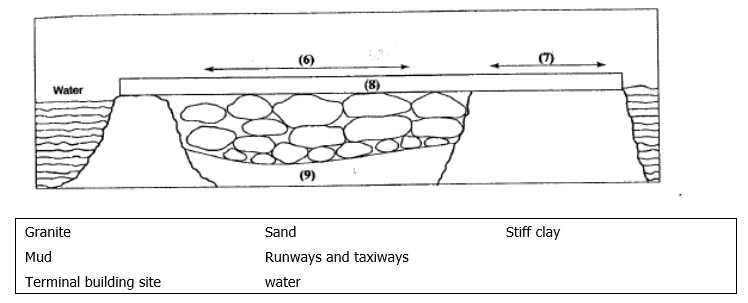
    Conditions are different at Chek Lap Kok. There was some land there to begin with, the original little island of Chek Lap Kok and a smaller outcrop called Lam Chau. Between them, these two outcrops of hard, weathered granite make up a quarter of the new island’s surface area. Unfortunately, between the islands there was a layer of soft mud, 27 metres thick in places.

    According to Frans Uiterwijk, a Dutchman who is the project’s reclamation director, it would have been possible to leave this mud below the reclaimed land, and to deal with the resulting settlement by the Kansai method. But the consortium that won the contract for the island opted opted for a more aggressive approach It scrambled the world’s largest lot of dredgers, which sucked up 150m cubic metres of clay mud and dumped it in deeper waters. At the same time sand was dredged from the waters and piled on top of the layer of stiff clay that the massive dredging had laid bare.

    Nor was the sand the only thing used. The original granite island which had hills up to 120 metres high was drilled and blasted into boulders no bigger than two metres in diameter. This provided 70m cubic metres of granite to add to the island’s foundations. Because the heap of boulders does not fill the space perfectly, this represents the equivalent of 105m cubic metres of landfill. Most of the rock will become the foundations for the airport’s runways and its taxiways. The sand dredged from the waters will also be used to provide a two-metre capping layer over the granite platform. This makes it easier for utilities to dig trenches – granite is unyielding stuff. Most of the terminal buildings will be placed above the site of the existing island. Only a limited amount of pile-driving is needed to support building foundations above softer areas.

    The completed island will be six to seven metres above sea level. In all, 350m cubic metres of material will have been moved. And much of it, like the overloads, has to be moved several times before reaching its final resting place. For example, there has to be a motorway capable of carrying 150-tonne dump-trucks; and there has to be a raised area for the 15,000 construction workers. These are temporary; they will be removed when the airport is finished.

    The airport, though, is here to stay. To protect it, the new coastline is being bolstered with a formidable twelve kilometres of sea defences. The brunt of a typhoon will be deflected by the neighbouring island of Lantau; the sea walls should guard against the rest. Gentler but more persistent bad weather – the downpours of the summer monsoon – is also being taken into account. A mat-like material called geotextile is being laid across the island to separate the rock and sand layers. That will stop sand particles from being washed into the rock voids, and so causing further settlement. This island is being built never to be sunk.

    Questions 1-5
    Classify the following statements as applying to

    A Chek Lap Kok airport only
    B Kansai airport only
    C Both airports

    1 having an area of over 1000 hectares
    2 built in a river delta
    3 built in the open sea
    4 built by reclaiming land
    5 built using conventional methods of reclamation

    Questions 6-9
    Complete the labels on Diagram below. Choose your answers from the box below the diagram and write them in boxes 6-9 on your answer sheet.

    Questions 10-13

    Complete the summary below. Choose your answers from the options given below. NB there are more words than spares so you will not use them all.

    Example: When the new Chek Lap Kok airport has been completed the raised area and the………..will be removed.

    Answer: motorway

    The island will be partially protected from storms by (10)……………….and also by (11)…………….. Further settlement caused by (12)……………..will be prevented by the use of (13)……………..

    Options

    Construction workers                  Sea walls                 Rocky and sand                    Motorway

    Geotextile                                    Coastline                 Typhoons                              Rock voids

    Rainfall                                         Lantau Island          Dump-trucks

    Changing Our Understanding of Health

    A The concept of health holds different meanings for different people and groups. These meanings of health have also changed over time. This change is no more evident than in Western society today, when notions of health and health promotion are being challenged and expanded in new ways.

    B For much of recent Western history, health has been viewed in the physical sense only. That is, good health has been connected to the smooth mechanical operation of the body, while ill health has been attributed to a breakdown in this machine. Health in this sense has been defined as the absence of disease or illness and is seen in medical terms. According to this view, creating health for people means providing medical care to treat or prevent disease and illness. During this period, there was an emphasis on providing clean water, improved sanitation and housing.

    C In the late 1940s the World Health Organisation challenged this physically and medically oriented view of health. They stated that ‘health is a complete state of physical, mental and social well-being and is not merely the absence of disease’ (WHO, 1946). Health and the person were seen more holistically (mind/body/spirit) and not just in physical terms.

    D The 1970s was a time of focusing on the prevention of disease and illness by emphasizing the importance of the lifestyle and behaviour of the individual. Specific behaviours which were seen to increase risk of disease, such as smoking, lack of fitness and unhealthy eating habits, were targeted. Creating health meant providing not only medical health care, but health promotion programs and policies which would help people maintain healthy behaviours and lifestyles. While this individualistic healthy lifestyles approach to health worked for some (the wealthy members of society), people experiencing poverty, unemployment, underemployment or little control over the conditions of their daily lives benefited little from this approach.

    This was largely because both the healthy lifestyles approach and the medical approach to health largely ignored the social and environmental conditions affecting the health of people.

    E During the 1980s and 1990s there has been a growing swing away from lifestyle risks as the root cause of poor health. While lifestyle factors still remain important, health is being viewed also in terms of the social, economic environmental contexts in which people live. This broad approach to health is called the socio-ecological view of health. The broad socio-ecological view of health was endorsed at the first International Conference of Health Promotion held in 1986, Ottawa, Canada, where people from 38 countries agreed and declared that:

    The fundamental conditions and resources for health are peace, shelter, education, food, a viable income, a stable eco-system, sustainable resources, social justice and equity. Improvement in health requires a secure foundation in these basic requirements. (WHO, 1986)

    It is clear from this statement that the creation of health is about much more than encouraging healthy individual behaviours and lifestyles and providing appropriate medical care. Therefore, the creation of health must include addressing issues such as poverty, pollution, urbanisation, natural resource depletion, social alienation and poor working conditions. The social, economic and environmental contexts which contribute to the creation of health do not operate separately or independently of each other. Rather, they are interacting and interdependent, and it is the complex interrelationships between them which determine the conditions that promote health. A broad socio-ecological view of health suggests that the promotion of health must include a strong social, economic and environmental focus.

    F At the Ottawa Conference in 1986, a charter was developed which outlined new directions for health promotion based on the socio-ecological view of health. This charter, known as the Ottawa Charter for Health Promotion, remains as the backbone of health action today. In exploring the scope of health promotion it states that:

    Good health is a major resource for social, economic and personal development and an important dimension of quality of life. Political, economic, social, cultural, environmental, behavioural and biological factors can all favour health or be harmful to it. (WHO, 1986)

    The Ottawa Charter brings practical meaning and action to this broad notion of health promotion. It presents fundamental strategies and approaches in achieving health for all. The overall philosophy of health promotion which guides these fundamental strategies and approaches is one of ‘enabling people to increase control over and to improve their health’ (WHO, 1986).

    Questions 14-18
    Reading passage 2 has six paragraphs A-F. Choose the most suitable headings for paragraphs B-F from the list of headings below. Write the appropriate numbers (i-ix) in boxed 14-18 on your answer sheet.
    NB There are more headings than paragraphs so you will not use them all.

    List of Headings
    i. Ottawa International Conference on Health Promotion
    ii. Holistic approach to health
    iii. The primary importance of environmental factors
    iv. Healthy lifestyles approach to health
    v. Changes in concepts of health in Western society
    vi. Prevention of diseases and illness
    vii. Ottawa Charter for Health Promotion
    viii. Definition of health in medical terms
    ix. Socio-ecological view of health

    14 Paragraph B
    15 Paragraph C
    16 Paragraph D
    17 Paragraph E
    18 Paragraph F

    Questions 19-22
    Using NO MORE THAN THREE WORDS from the passage answer the following questions.

    19 In which year did the World Health Organisation define health in terms of mental, physical and social well-being?
    20 Which members of society benefited most from the healthy lifestyles approach to health?
    21 Name the three broad areas which relate to people’s health, according to the socio-ecological view of health.
    22 During which decade were lifestyle risks seen as the major contributors to poor health?

    Questions 23-27
    Do the following statements agree with the information in Reading Passage 2?

    YES                            if the statement agrees with the information
    NO                              if the statement contradicts the information
    NOT GIVEN           if there is no information on this in the passage

    23 Doctors have been instrumental in improving living standards in Western society.
    24 The approach to health during the 1970s included the introduction of health awareness programs.
    25 The socio-ecological view of health recognises that lifestyle habits and the provision of adequate health care are critical factors governing health.
    26 The principles of the Ottawa Charter are considered to be out of date in the 1990s.
    27 In recent years a number of additional countries have subscribed to the Ottawa Charter.

    Children’s Thinking

    One of the most eminent of psychologists, Clark Hull, claimed that the essence of reasoning lies in the putting together of two ‘behaviour segments’ in some novel way, never actually performed before, so as to reach a goal.

    Two followers of Clark Hull, Howard and Tracey Kendler, devised a test for children that was explicitly based on Clark Hull’s principles. The children were given the task of learning to operate a machine so as to get a toy. In order to succeed they had to go through a two-stage sequence. The children were trained on each stage separately. The stages consisted merely of pressing the correct one of two buttons to get a marble; and of inserting the marble into a small hole to release the toy.

    The Kendlers found that the children could learn the separate bits readily enough. Given the task of getting a marble by pressing the button they could get the marble; given the task of getting a toy when a marble was handed to them, they could use the marble. (All they had to do was put it in a hole.) But they did not for the most part ‘integrate’, to use the Kendlers’ terminology. They did not press the button to get the marble and then proceed without further help to use the marble to get the toy. So the Kendlers concluded that they were incapable of deductive reasoning.

    The mystery at first appears to deepen when we learn, from another psychologist, Michael Cole, and his colleagues, that adults in an African culture apparently cannot do the Kendlers’ task either. But it lessens, on the other hand, when we learn that a task was devised which was strictly analogous to the Kendlers’ one but much easier for the African males to handle.

    Instead of the button-pressing machine, Cole used a locked box and two differently coloured match-boxes, one of which contained a key that would open the box. Notice that there are still two behaviour segments – ‘open the right match-box to get the key’ and ‘use the key to open the box’ – so the task seems formally to be the same. But psychologically it is quite different. Now the subject is dealing not with a strange machine but with familiar meaningful objects; and it is clear to him what he is meant to do. It then turns out that the difficulty of ‘integration’ is greatly reduced.

    Recent work by Simon Hewson is of great interest here for it shows that, for young children, too, the difficulty lies not in the inferential processes which the task demands, but in certain perplexing features of the apparatus and the procedure. When these are changed in ways which do not at all affect the inferential nature of the problem, then five-year-old children solve the problem as well as college students did in the Kendlers’ own experiments.

    Hewson made two crucial changes. First, he replaced the button-pressing mechanism in the side panels by drawers in these panels which the child could open and shut. This took away the mystery from the first stage of training. Then he helped the child to understand that there was no ‘magic’ about the specific marble which, during the second stage of training, the experimenter handed to him so that he could pop it in the hole and get the reward.

    A child understands nothing, after all, about how a marble put into a hole can open a little door. How is he to know that any other marble of similar size will do just as well? Yet he must assume that if he is to solve the problem. Hewson made the functional equivalence of different marbles clear by playing a ‘swapping game’ with the children.

    The two modifications together produced a jump in success rates from 30% to 90% for five year olds and from 35% to 72.5% for four year olds. For three year olds, for reasons that are still in need of clarification, no improvement – rather a slight drop in performance – resulted from the change.

    We may conclude then, that children experience very real difficulty when faced with the Kendler apparatus, but this difficulty cannot be taken as proof that they are incapable of deductive reasoning.

    Questions 28-35
    Classify the following descriptions as referring to

    CH Clark Hull
    HTK Howard and Tracey Kendler
    MC Michael Cole and colleagues
    SH Simon Hewson

    Write the appropriate letters in boxes 28-35 on your answer sheet. NB You may use any answer more than once.

    28………….is cited as famous in the field of psychology.
    29…………demonstrated that the two stage experiment involving button pressing and inserting a marble into a hole poses problems for certain adults as well as children.
    30………..devised an experiment that investigated deductive reasoning without the use of any marbles.
    31………..appears to have proved that a change in the apparatus dramatically improves the performance of children of certain ages.
    32………..used a machine to measure inductive reasoning that replaced button pressing with drawer opening.
    33………..experimented with things that the subjects might have been expected to encounter in everyday life, rather than with a machine.
    34………..compared the performance of five year olds with college students using the same apparatus with both sets of subjects.
    35………..is cited as having demonstrated that earlier experiments into children’s ability to reason deductively may have led to the wrong conclusions.

    Questions 36-40
    Do the following statements agree with the information given in Reading Passage 3? In boxes 36 40 on your answer sheet write

    YES                           if the statement agrees with the information
    NO                             if the statement contradicts the information
    NOT GIVEN          if there is no informal ion on this in the passage

    36 Howard and Tracey Kendler studied under Clark Hull.
    37 The Kendlers trained their subjects separately in the two stages of their experiment, but not in how to integrate the two actions.
    38 Michael Cole and his colleagues demonstrated that adult performance on inductive reasoning tasks depends on features of the apparatus and procedure.
    39 All Hewson’s experiments used marbles of the same size.
    40 Hewson’s modifications resulted in a higher success rate for children of all ages.

  • IELTS Reading Practice Test – Exercise 32

    Right and left-handedness in humans

    Why do humans, virtually alone among all animal species, display a distinct left or right-handedness? Not even our closest relatives among the apes possess such decided lateral asymmetry, as psychologists call it. Yet about 90 per cent of every human population that has ever lived appears to have been right-handed. Professor Bryan Turner at Deakin University has studied the research literature on left-handedness and found that handedness goes with sidedness. So nine out of ten people are right-handed and eight are right-footed. He noted that this distinctive asymmetry in the human population is itself systematic. “Humans think in categories: black and white, up and down, left and right. It’s a system of signs that enables us to categorise phenomena that are essentially ambiguous.’

    Research has shown that there is a genetic or inherited element to handedness. But while left-handedness tends to run in families, neither left nor right handers will automatically produce off-spring with the same handedness; in fact about 6 per cent of children with two right-handed parents will be left-handed. However, among two left-handed parents, perhaps 40 per cent of the children will also be left-handed. With one right and one left-handed parent, 15 to 20 per cent of the offspring will be left- handed. Even among identical twins who have exactly the same genes, one in six pairs will differ in their handedness.

    What then makes people left-handed if it is not simply genetic? Other factors must be at work and researchers have turned to the brain for clues. In the 1860s the French surgeon and anthropologist, Dr Paul Broca, made the remarkable finding that patients who had lost their powers of speech as a result of a stroke (a blood clot in the brain) had paralysis of the right half of their body. He noted that since the left hemisphere of the brain controls the right half of the body, and vice versa, the brain damage must have been in the brain’s left hemisphere. Psychologists now believe that among right-handed people, probably 95 per cent have their language centre in the left hemisphere, while 5 per cent have right-side language. Left-handers, however, do not show the reverse pattern but instead a majority also have their language in the left hemisphere. Some 30 per cent have right hemisphere language.

    Dr Brinkman, a brain researcher at the Australian National University in Canberra, has suggested that evolution of speech went with right-handed preference. According to Brinkman, as the brain evolved, one side became specialised for fine control of movement (necessary for producing speech) and along with this evolution came right- hand preference. According to Brinkman, most left-handers have left hemisphere dominance but also some capacity in the right hemisphere. She has observed that if a left-handed person is brain-damaged in the left hemisphere, the recovery of speech is quite often better and this is explained by the fact that left-handers have a more bilateral speech function.

    In her studies of macaque monkeys, Brinkman has noticed that primates (monkeys) seem to learn a hand preference from their mother in the first year of life but this could be one hand or the other. In humans, however, the specialisation in (unction of the two hemispheres results in anatomical differences: areas that are involved with the production of speech are usually larger on the left side than on the right. Since monkeys have not acquired the art of speech, one would not expect to see such a variation but Brinkman claims to have discovered a trend in monkeys towards the asymmetry that is evident in the human brain.

    Two American researchers, Geschwind and Galaburda, studied the brains of human embryos and discovered that the left-right asymmetry exists before birth. But as the brain develops, a number of things can affect it. Every brain is initially female in its organisation and it only becomes a male brain when the male foetus begins to secrete hormones. Geschwind and Galaburda knew that different parts of the brain mature at different rates; the right hemisphere develops first, then the left. Moreover, a girl’s brain develops somewhat faster than that of a boy. So, if something happens to the brain’s development during pregnancy, it is more likely to be affected in a male and the hemisphere more likely to be involved is the left. The brain may become less lateralised and this in turn could result in left-handedness and the development of certain superior skills that have their origins in the left hemisphere such as logic, rationality and abstraction. It should be no surprise then that among mathematicians and architects, left-handers tend to be more common and there are more left-handed males than females.

    The results of this research may be some consolation to left-handers who have for centuries lived in a world designed to suit right-handed people. However, what is alarming, according to Mr. Charles Moore, a writer and journalist, is the way the word “right” reinforces its own virtue. Subliminally he says, language tells people to think that anything on the right can be trusted while anything on the left is dangerous or even sinister. We speak of left-handed compliments and according to Moore, “it is no coincidence that left-handed children, forced to use their right hand, often develop a stammer as they are robbed of their freedom of speech”. However, as more research is undertaken on the causes of left-handedness, attitudes towards left-handed people are gradually changing for the better. Indeed when the champion tennis player Ivan Lendl was asked what the single thing was that he would choose in order to improve his game, he said he would like to become a left-hander.

    Questions 1-7

    Use the information in the text to match the people (listed A-E) with the opinions (listed 1-7) below. Write the appropriate letter (A-E) in boxes 1-7 on your answer sheet. Some people match more than one opinion.

    A Dr Broca
    B Dr Brinkman
    C Geschwind and Galaburda
    D Charles Moore
    E Professor Turner

    1 Human beings started to show a preference for right-handedness when they first developed language.
    2 Society is prejudiced against left-handed people.
    3 Boys are more likely to be left-handed.
    4 After a stroke, left-handed people recover their speech more quickly than right-handed people.
    5 People who suffer strokes on the left side of the brain usually lose their power of speech.
    6 The two sides of the brain develop different functions before birth.
    7 Asymmetry is a common feature of the human body.

    Questions 8-10
    Using the information in the passage, complete the table below. Write your answers in boxes 8-10 on your answer sheet.

    Questions 11 and 12
    Choose the appropriate letters A-D and write them in boxes 11 and 12 on your answer sheet.

    11 A study of monkeys has shown that
    A monkeys are not usually right-handed
    B monkeys display a capacity for speech
    C monkey brains are smaller than human brains
    D monkey brains are asymmetric

    12 According to the writer, left-handed people
    A will often develop a stammer
    B have undergone hardship for years
    C are untrustworthy
    D are good tennis players

    Cambridge IELTS Test 1 to 17

    MIGRATORY BEEKEEPING

    Of the 2,000 commercial beekeepers in the United States about half migrate This pays off in two ways moving north in the summer and south in the winter lets bees work a longer blooming season, making more honey — and money — for their keepers. Second, beekeepers can carry their hives to farmers who need bees to pollinate their crops. Every spring a migratory beekeeper in California may move up to 160 million bees to flowering fields in Minnesota and every winter his family may haul the hives back to California, where farmers will rent the bees to pollinate almond and cherry trees.

    Migratory beekeeping is nothing new. The ancient Egyptians moved clay hives, probably on rafts, down the Nile to follow the bloom and nectar flow as it moved toward Cairo. In the 1880s North American beekeepers experimented with the same idea, moving bees on barges along the Mississippi and on waterways in Florida, but their lighter, wooden hives kept falling into the water. Other keepers tried the railroad and horse- drawn wagons, but that didn’t prove practical. Not until the 1920s when cars and trucks became affordable and roads improved, did migratory beekeeping begin to catch on.

    For the Californian beekeeper, the pollination season begins in February. At this time, the beehives are in particular demand by farmers who have almond groves; they need two hives an acre. For the three-week long bloom, beekeepers can hire out their hives for $32 each. It’s a bonanza for the bees too. Most people consider almond honey too bitter to eat so the bees get to keep it for themselves.

    By early March it is time to move the bees. It can take up to seven nights to pack the 4,000 or so hives that a beekeeper may own. These are not moved in the middle of the day because too many of the bees would end up homeless. But at night, the hives are stacked onto wooden pallets, back-to-back in sets of four, and lifted onto a truck. It is not necessary to wear gloves or a beekeeper’s veil because the hives are not being opened and the bees should remain relatively quiet. Just in case some are still lively, bees can be pacified with a few puffs of smoke blown into each hive’s narrow entrance.

    In their new location, the beekeeper will pay the farmer to allow his bees to feed in such places as orange groves. The honey produced here is fragrant and sweet and can be sold by the beekeepers. To encourage the bees to produce as much honey as possible during this period, the beekeepers open the hives and stack extra boxes called supers on top. These temporary hive extensions contain frames of empty comb for the bees to fill with honey. In the brood chamber below, the bees will stash honey to eat later. To prevent the queen from crawling up to the top and laying eggs, a screen can be inserted between the brood chamber and the supers. Three weeks later the honey can be gathered.

    Foul smelling chemicals are often used to irritate the bees and drive them down into the hive’s bottom boxes, leaving the honey- filled supers more or less bee free. These can then be pulled off the hive. They are heavy with honey and may weigh up to 90 pounds each. The supers are taken to a warehouse. In the extracting room, the frames are tilted out and lowered into an “uncapper” where rotating blades shave away the wax that covers each cell. The uncapped frames are put in a carousel that sits on the bottom of a large stainless steel drum. The carousel is filled to capacity with 72 frames. A switch is flipped and the frames begin to whirl at 300 revolutions per minute; centrifugal force throws the honey out of the combs. Finally the honey is poured into barrels for shipment.

    After this, approximately a quarter of the hives weakened by disease, mites, or an ageing or dead queen, will have to be replaced. To create new colonies, a healthy double hive, teeming with bees, can be separated into two boxes. One half will hold the queen and a young, already mated queen can be put in the other half, to make two hives from one. By the time the flowers bloom, the new queens will be laying eggs, filling each hive with young worker bees. The beekeeper’s family will then migrate with them to their summer location.

    Questions 13-19

    The steps below outline the movements of the migratory beekeepers as described in the passage. Compete the steps. Choose your answers from the options given below.

    Beekeeper Movements

    1. In March, beekeepers (13)………………..for migration at night when the hives are (14)……………and the bees are generally tranquil. A little (15)……………can ensure that this is the case.

    2. They transport their hives to orange groves where farmers (16)……………beekeepers for placing them on their land. Here the bees make honey.

    3. After three weeks, the supers can be taken to a warehouse where (17)……………are used to remove the wax and extract the honey from the (18)……………….

    4. After the honey collection, the old hives are rejected. Good double hives are (19)…………….and re-queened and the beekeeper transports to their summer base.

    List of words

    Smoke                Barrels                  Set-off                   Pollinate                  Combs               Full

    Chemicals          Protection             Light                      Machines                Screen                Empty

    Pay                    Charge                   Split                       Supers                     Prepare              Queens

    Questions 24-27
    Do the following statements agree with the information given in Reading Passage 2? In boxes 24-27 write.

    YES                              if the statement agrees with the information given
    NO                                if the statement contradicts the information given
    NOT GIVEN             if there is no information about this

    24 The Egyptians keep bees on the banks of the Nile.
    25 First attempts at migratory beekeeping in America were unsuccessful.
    26 Bees keep honey for themselves in the bottom of the hive.
    27 The honey is spun to make it liquid.

    TOURISM

    A Tourism, holidaymaking and travel are these days more significant social phenomena than most commentators have considered. On the face of it there could not be a more trivial subject for a book and indeed since social scientists have had considerable difficulty explaining weightier topics such as work or politics it might be thought that they would have great difficulties in accounting for more trivial phenomena such as holidaymaking. However there are interesting parallels with the study of deviance. This involves the investigation of bizarre and idiosyncratic social practices which happen to be defined as deviant in some societies but not necessarily in others. The assumption is that the investigation of deviance can reveal interesting and significant aspects of normal societies It could be said that a similar analysis can be applied to tourism.

    B Tourism is a leisure activity which presupposes its opposite namely regulated and organised work. It is one manifestation of how work and leisure are organised as separate and regulated spheres of social practice in modern societies Indeed acting as a tourist is one of the defining characteristics of being modern’ and the popular concept of tourism is that it is organised within particular places and occurs for regularised periods of time. Tourist relationships arise from a movement of people to and their stay in various destinations. This necessarily involves some movement that is the journey and a period of stay in a new place or places. The journey and the stay are by definition outside the normal places of residence and work and are of a short term and temporary nature and there is a clear intention to return “home within a relatively short period of time.

    C A substantial proportion of the population of modern societies engages in such tourist practices new socialised forms of provision have developed in order to cope with the mass character of the gazes of tourists as opposed to the individual character of travel. Places are chosen to be visited and be gazed upon because there is an anticipation especially through daydreaming and fantasy of intense pleasures, either on a different scale or involving different senses from those customarily encountered. Such anticipation is constructed and sustained through a variety of non-tourist practices such as films TV literature, magazines records and videos which construct and reinforce this daydreaming.

    D Tourists tend to visit features of landscape and townscape which separate them off from everyday experience. Such aspects are viewed because they are taken to be in some sense out of the ordinary. The viewing of these tourist sights often involves different forms of social patterning with a much greater sensitivity to visual elements of landscape or townscape than is normally found in everyday life. People linger over these sights in a way that they would not normally do in their home environment and the vision is objectified or captured through photographs postcards films and so on which enable the memory to be endlessly reproduced and recaptured.

    E One of the earliest dissertations on the subject of tourism is Boorstins analysis of the pseudo event (1964) where he argues that contemporary Americans cannot experience reality’ directly but thrive on “pseudo events”. Isolated from the host environment and the local people the mass tourist travels in guided groups and finds pleasure in inauthentic contrived attractions gullibly enjoying the pseudo events and disregarding the real world outside. Over time the images generated of different tourist sights come to constitute a closed self-perpetuating system of illusions which provide the tourist with the basis for selecting and evaluating potential places to visit. Such visits are made says Boorstin, within the “environmental bubble of the familiar American style hotel which insulates the tourist from the strangeness of the host environment.

    F To service the burgeoning tourist industry, an array of professionals has developed who attempt to reproduce ever-new objects for the tourist to look at. These objects or places are located in a complex and changing hierarchy. This depends upon the interplay between, on the one hand, competition between interests involved in the provision of such objects and, on the other hand changing class, gender, and generational distinctions of taste within the potential population of visitors. It has been said that to be a tourist is one of the characteristics of the “modern experience. Not to go away is like not possessing a car or a nice house. Travel is a marker of status in modern societies and is also thought to be necessary for good health. The role of the professional, therefore, is to cater for the needs and tastes of the tourists in accordance with their class and overall expectations.

    Questions 28-32
    Raiding Passage 3 has 6 paragraphs (A-F) Choose the most suitable heading for each paragraph from the list of headings below Write the appropriate numbers (i-ix) in boxes 28 32 on your answer sheet Paragraph D has been done for you as an example.
    NB There are more headings than paragraphs so you will not use all of them You may use any heading more than once.

    List of Headings
    I The politics of tourism
    ii The cost of tourism
    iii Justifying the study of tourism
    iv Tourism contrasted with travel
    v The essence of modern tourism
    vi Tourism versus leisure
    vii The artificiality of modern tourism
    viii The role of modern tour guides
    ix Creating an alternative to the everyday experience

    28 Paragraph A
    29 Paragraph B
    30 Paragraph C
    31 Paragraph E
    31 Paragraph F

    Questions 33-37

    Do the following statements agree with the views of the writer in Reading Passage 3? In boxes 33-37 write

    YES                              if the statement agrees with the writer
    NO                                if the statement contradicts the writer
    NOT GIVEN             if it is impossible to say what the writer thinks about this

    33 Tourism is a trivial subject.
    34 An analysis of deviance can act as a model for the analysis of tourism.
    35 Tourists usually choose to travel overseas.
    36 Tourists focus more on places they visit than those at home.
    37 Tour operators try to cheat tourists.

    Questions 38-40
    Chose one phrase (A-H) from the list of phrases to complete each key point below. Write the appropriate letters (A-H) in boxes 38-41 on your answer sheet.

    The information in the completed sentences should be an accurate summary of points made by the writer.
    NB There are more phrases A-H than sentences so you will not use them all. You may use any phrase more than once.

    38. Our concept of tourism arises from……………..
    39. The media can be used to enhance…………….
    40. People view tourist landscapes in a different way from……………..

    List of Phrases
    A local people and their environment
    B the expectations of tourists
    C the phenomena of holidaymaking
    D the distinction we make between work and leisure
    E the individual character of travel

  • IELTS Reading Practice Test – Exercise 31

    GLASS – Capturing The Dance of Light

    A Glass, in one form or another, has long been in noble service to humans. As one of the most widely used of manufactured materials, and certainly the most versatile, it can be as imposing as a telescope mirror the width of a tennis court or as small and simple as a marble rolling across dirt. The uses of this adaptable material have been broadened dramatically by new technologies glass fibre optics — more than eight million miles — carrying telephone and television signals across nations, glass ceramics serving as the nose cones of missiles and as crowns for teeth; tiny glass beads taking radiation doses inside the body to specific organs, even a new type of glass fashioned of nuclear waste in order to dispose of that unwanted material.

    B On the horizon are optical computers. These could store programs and process information by means of light – pulses from tiny lasers – rather than electrons and the pulses would travel over glass fibres, not copper wire. These machines could function hundreds of times faster than today’s electronic computers and hold vastly more information. Today fibre optics viruses. A new generation of optical instruments is emerging that can provide detailed imaging of the inner workings of cells. It is the surge in fibre optic use and in liquid crystal displays that has set the U.S. glass industry (a 16 billion dollar business employing some 150,000 workers) to building new plants to meet demand.

    C But it is not only in technology and commerce that glass has widened its horizons. The use of glass as art, a tradition spins back at least to Roman times, is also booming. Nearly everywhere, it seems, men and women are blowing glass and creating works of art. “I didn’t sell a piece of glass until 1975”, Dale Chihuly said, smiling, for in the 18 years since the end of the dry spell, he has become one of the most financially successful artists of the 20th century. He now has a new commission – a glass sculpture for the headquarters building of a pizza company – for which his fee is half a million dollars.

    D But not all the glass technology that touches our lives is ultra-modern. Consider the simple light bulb; at the turn of the century most light bulbs were hand blown, and the cost of one was equivalent to half a day’s pay for the average worker. In effect, the invention of the ribbon machine by Corning in the 1920s lighted a nation. The price of a bulb plunged. Small wonder that the machine has been called one of the great mechanical achievements of all time. Yet it is very simple: a narrow ribbon of molten glass travels over a moving belt of steel in which there are holes. The glass sags through the holes and into waiting moulds. Puffs of compressed air then shape the glass. In this way, the envelope of a light bulb is made by a single machine at the rate of 66,000 an hour, as compared with 1,200 a day produced by a team of four glassblowers.

    E The secret of the versatility of glass lies in its interior structure. Although it is rigid, and thus like a solid, the atoms are arranged in a random disordered fashion, characteristic of a liquid. In the melting process, the atoms in the raw materials are disturbed from their normal position in the molecular structure; before they can find their way back to crystalline arrangements the glass cools. This looseness in molecular structure gives the material what engineers call tremendous “formability” which allows technicians to tailor glass to whatever they need.

    F Today, scientists continue to experiment with new glass mixtures and building designers test their imaginations with applications of special types of glass. A London architect, Mike Davies, sees even more dramatic buildings using molecular chemistry. “Glass is the great building material of the future, the dynamic skin,’ he said. “Think of glass that has been treated to react to electric currents going through it, glass that will change from clear to opaque at the push of a button, that gives you instant curtains. Think of how the tall buildings in New York could perform a symphony of colours as the glass in them is made to change colours instantly.” Glass as instant curtains is available now, but the cost is exorbitant. As for the glass changing colours instantly, that may come true. Mike Davies’s vision may indeed be on the way to fulfilment.

    Questions 1-5
    Reading Passage 1 has six paragraphs (A-F). Choose the most suitable heading/or each paragraph from the list of headings below. Write the appropriate numbers (i-x) in boxes 1-5 on your answer sheet. Paragraph A has been done for you as an example.
    NB There are more headings than paragraphs so you will not use all of them. You may use any heading more at once.

    List of Headings
    i. Growth in the market for glass crafts
    ii. Computers and their dependence on glass
    iii. What makes glass so adaptable
    iv. Historical development of glass
    v. Scientists’ dreams cost millions
    vi. Architectural experiments with glass
    vii. Glass art galleries flourish
    viii. Exciting innovations in fibre optics
    ix. A former glass technology
    x. Everyday uses of glass

    1 Paragraph B
    2 Paragraph C
    3 Paragraph D
    4 Paragraph E
    5 Paragraph F

    Questions 6-8
    The diagram below shows the principle of Corning’s ribbon machine. Label the diagram by selecting NO MORE THAN THREE WORDS from the Reading Passage to fill each numbered space. Write your answers in boxes 6-8 on your answer sheet.

    Questions 9-13
    Look at the list below of the uses of glass. According to the passage, state whether these uses exist today, will exist in the future or are not mentioned by the writer. In boxes 9-13 write

    A if the uses exist today
    B if the uses will exist in the future
    C if the uses are not mentioned by the writer

    9 dental fittings
    10 optical computers
    11 sculptures
    12 fashions
    13 curtains

    Why some women cross the finish line ahead of men

    A Women who apply for jobs in middle or senior management have a higher success rate than men, according to an employment survey. But of course far fewer of them apply for these positions. The study, by recruitment consultants NB Selection, shows that while one in six men who appear on interview shortlists get jobs, the figure rises to one in four for women.

    B The study concentrated on applications for management positions in the $45,000 to $110,000 salary range and found that women are more successful than men in both the private and public sectors Dr Elisabeth Marx from London-based NB Selection described the findings as encouraging for women, in that they send a positive message to them to apply for interesting management positions. But she added, “We should not lose sight of the fact that significantly fewer women apply for senior positions in comparison with men.”

    C Reasons for higher success rates among women are difficult to isolate. One explanation suggested is that if a woman candidate manages to get on a shortlist, then she has probably already proved herself to be an exceptional candidate. Dr Marx said that when women apply for positions they tend to be better qualified than their male counterparts but are more selective and conservative in their job search. Women tend to research thoroughly before applying for positions or attending interviews. Men, on the other hand, seem to rely on their ability to sell themselves and to convince employers that any shortcomings they have will not prevent them from doing a good job.

    D Managerial and executive progress made by women is confirmed by the annual survey of boards of directors carried out by Korn/ Ferry/ Carre/ Orban International. This year the survey shows a doubling of the number of women serving as non-executive directors compared with the previous year. However, progress remains painfully slow and there were still only 18 posts filled by women out of a total of 354 nonexecutive positions surveyed. Hilary Sears, a partner with Korn/ Ferry, said, “Women have raised the level of grades we are employed in but we have still not broken through barriers to the top.”

    E In Europe a recent feature of corporate life in the recession has been the delayering of management structures.
    Sears said that this has halted progress for women in as much as de-layering has taken place either where women are working or in layers they aspire to. Sears also noted a positive trend from the recession, which has been the growing number of women who have started up on their own.

    F In business as a whole, there are a number of factors encouraging the prospect of greater equality in the workforce. Demographic trends suggest that the number of women going into employment is steadily increasing. In addition a far greater number of women are now passing through higher education, making them better qualified to move into management positions.

    G Organisations such as the European Women’s Management Development Network provide a range of opportunities for women to enhance their skills and contacts. Through a series of both pan-European and national workshops and conferences the barriers to women in employment are being broken down. However, Ariane Berthoin Antal, director of the International Institute for Organisational Change of Archamps in France, said that there is only anecdotal evidence of changes in recruitment patterns. And she said, “It’s still so hard for women to even get on to shortlists -there are so many hurdles and barriers.” Antal agreed that there have been some positive signs but said “Until there is a belief among employers, until they value the difference, nothing will change.”

    Questions 14-19
    Reading Passage 2 has 7 paragraphs (A-G). State which paragraph discusses each of the points below. Write the appropriate letter (A-G) in boxes 14-19 on your answer sheet.

    Example: The salary range studied in the NB Selection survey. Answer B

    14 The drawbacks of current company restructuring patterns.
    15 Associations that provide support for professional women.
    16 The success rate of female job applicants for management positions.
    17 Male and female approaches to job applications.
    18 Reasons why more women are being employed in the business sector.
    19 The improvement in female numbers on company management structures.

    Questions 20-23
    The author makes reference to three consultants in the Reading Passage. Which of the list of points below do these consultants make? In boxes 20-23 write

    M if the point is made by Dr Marx
    S if the point is made by Hilary Sears
    A if the point is made by Ariane Berthoin Antal

    20 Selection procedures do not favour women.
    21 The number of female-run businesses is increasing.
    22 Male applicants exceed female applicants for top posts.
    23 Women hold higher positions now than they used to.

    Questions 24-27
    Using NO MORE THAN THREE WORDS answer the following questions. Write your answers in boxes 24-27 on your answer sheet.

    24 What change has there been in the number of women in top management positions detailed in the annual survey?
    25 What aspect of company structuring has disadvantaged women?
    26 What information tells us that more women are working nowadays?
    27 Which group of people should change their attitude to recruitment?

    Population viability analysis

    Part A
    To make political decisions about the extent and type of forestry in a region it is important to understand the consequences of those decisions. One tool for assessing the impact of forestry on the ecosystem is population viability analysis (PVA). This is a tool for predicting the probability that a species will become extinct in a particular region over a specific period. It has been successfully used in the United States to provide input into resource exploitation decisions and assist wildlife managers and there is now enormous potential for using population viability to assist wildlife management in Australia’s forests.

    A species becomes extinct when the last individual dies. This observation is a useful starting point for any discussion of extinction as it highlights the role of luck and chance in the extinction process. To make a prediction about extinction we need to understand the processes that can contribute to it and these fall into four broad categories which are discussed below.

    Part B
    A Early attempts to predict population viability were based on demographic uncertainty Whether an individual survives from one year to the next will largely be a matter of chance. Some pairs may produce several young in a single year while others may produce none in that same year. Small populations will fluctuate enormously because of the random nature of birth and death and these chance fluctuations can cause species extinctions even if, on average, the population size should increase. Taking only this uncertainty of ability to reproduce into account, extinction is unlikely if the number of individuals in a population is above about 50 and the population is growing.

    B Small populations cannot avoid a certain amount of inbreeding. This is particularly true if there is a very small number of one sex. For example, if there are only 20 individuals of a species and only one is a male, all future individuals in the species must be descended from that one male. For most animal species such individuals are less likely to survive and reproduce. Inbreeding increases the chance of extinction.

    C Variation within a species is the raw material upon which natural selection acts. Without genetic variability a species lacks the capacity to evolve and cannot adapt to changes in its environment or to new predators and new diseases. The loss of genetic diversity associated with reductions in population size will contribute to the likelihood of extinction.

    D Recent research has shown that other factors need to be considered. Australia’s environment fluctuates enormously from year to year. These fluctuations add yet another degree of uncertainty to the survival of many species. Catastrophes such as fire, flood, drought or epidemic may reduce population sizes to a small fraction of their average level. When allowance is made for these two additional elements of uncertainty the population size necessary to be confident of persistence for a few hundred years may increase to several thousand.

    Part C
    Beside these processes we need to bear in mind the distribution of a population. A species that occurs in five isolated places each containing 20 individuals will not have the same probability of extinction as a species with a single population of 100 individuals in a single locality.

    Where logging occurs (that is, the cutting down of forests for timber) forest dependent creatures in that area will be forced to leave. Ground-dwelling herbivores may return within a decade. However, arboreal marsupials (that is animals which live in trees) may not recover to pre-logging densities for over a century. As more forests are logged, animal population sizes will be reduced further. Regardless of the theory or model that we choose, a reduction in population size decreases the genetic diversity of a population and increases the probability of extinction because of any or all of the processes listed above. It is therefore a scientific fact that increasing the area that is loaded in any region will increase the probability that forest-dependent animals will become extinct.

    Questions 28-31
    Do the following statements agree with the views of the writer in Part A of Reading Passage 3? In boxes 28-31 on your answer sheet write

    YES                              if the statement agrees with the writer
    NO                                if the statement contradicts the writer
    NOT GIVEN             if it is impossible to say what the writer thinks about this

    28 Scientists are interested in the effect of forestry on native animals.
    29 PVA has been used in Australia for many years.
    30 A species is said to be extinct when only one individual exists.
    31 Extinction is a naturally occurring phenomenon.

    Questions 32-35
    These questions are based on Part B of Reading Passage 3. In paragraphs A to D the author describes four processes which may contribute to the extinction of a species. Match the list of processes (i-vi) to the paragraphs. Write the appropriate number (i-vi) in boxes 32-35 on your answer sheet. NB There are more processes than paragraphs so you will not use all of them.

    32 Paragraph A
    33 Paragraph B
    34 Paragraph C
    35 Paragraph D

    Processes
    i. Loss of ability to adapt
    ii. Natural disasters
    iii. An imbalance of the sexes
    iv. Human disasters
    v. Evolution
    vi. The haphazard nature of reproduction

    Questions 36-39
    Based on your reading of Part C, complete the sentences below with words taken from the passage. Use NO MORE THAN THREE WORDS for each answer. Write your answers in boxes 36-38 on your answer sheet.

    While the population of a species may be on the increase, there is always a chance that small isolated groups (36)……………………….
    Survival of a species depends on a balance between the size of a population and its (37)…………………….
    The likelihood that animals which live in forests will become extinct is increased when (38)……………………
    After logging herbivores that reside on ground find it easier to return as compared to (39)………………

    Question 40
    Choose the appropriate letter A-D and write it in box 39 on your answer sheet.

    40 An alternative heading for the passage could be:
    A The protection of native flora and fauna
    B Influential factors in assessing survival probability
    C An economic rationale for the logging of forests
    D Preventive measures for the extinction of a species

  • IELTS Listening Practice Test – Exercise 50

    Part 1: Questions 1-10
    Complete the form below, using NO MORE THAN THREE WORDS AND/OR A NUMBER for each answer.

    Area of interest: city centre

    Rents: from (1) £  to £1000 per month
    Number of bedrooms required: (2) 
    Apartment 1: North Street
    Rent: (3) £  per month
    Including (4) 
    Apartment 2: (5)  Road
    Rent: £625 per month
    Viewing arrangements: meet (6)  at
    Place: (7)  
    Time: (8)   pm
    Also required: reference letter from (9) 
    One month’s rent deposit
    (10) £  contract fee

    Part 2: Questions 11-20
    Complete the information below. Write NO MORE THAN THREE WORDS AND/ OR A NUMBER for each answer.

    (11)                      (12) 
    (13)                      (14) 
    (15)                      (16) 
    (17)                      (18) 
    (19)                     (20) 

    Part 3: Questions 21-25
    Choose the correct letter A, B or C.

    21. Maria’s essay is
     A better than her previous one
     B not quite as good as her previous one
     C similar to her previous one

    22. The tutor is impressed by
     A the punctuation
     B the spelling
     C the style and choice of language

    23. The tutor feels that Maria’s use of English is
     A generally acceptable
     B very poor
     C perfect

    24. How does Maria feel about this?
     A she is very sad
     B she is relieved
     C she is delighted

    25. How does the tutor suggest Maria can improve her spelling?
     A use a dictionary
     B use a computer spell checker
     C avoid difficult to spell words

    Questions 26-30

    What suggestions does the tutor make?

    Complete the list below with the correct letters A, B or C.

    26. the introduction 
    27. information on the railways 
    28. the quotation from The Times 
    29. the conclusion 
    30. the bibliography 

    A Expand it
    B Reduce it
    C Delete it

    Part 4: Questions 31 and 32
    Choose the correct letter A, B or C.

    31. The main problem is
     A cats in towns
     B the poor condition of feral cats
     C public awareness

    32. Emergency veterinary treatment is provided by
     A the government
     B a small number of people
     C nobody

    Questions 33-39
    Complete the sentences below. Write NO MORE THAN THREE WORDS for each answer.

    33. Sterilisation is usually performed only on 

    34. Sterilisation is carried out in 

    35. Cats remain there for 

    36. To show that an animal has been sterilized, one 

    MethodMessageWhen
    Poster campaignA kitten is not (37)…………….now
    (38)………………….Families may get bored with the responsibility of owning a petperhaps before next Christmas
    Newspaper advertisementsAbandoned animals cause problems for other people(39)………………….

    (37) 
    (38) 
    (39) 

    Question 40

    Choose the correct letter A, B or C.

    40. A wider problem of feral cats is that they can
     A injure children
     B damage human health
     C become infested with parasites

  • IELTS Listening Practice Test – Exercise 49

    Part 1: Questions 1-5
    Choose the correct letter A, B or C.

    1. What is Harry’s problem?
     A he does not want to sell his things
     B he needs to decide what to do with his possessions
     C he wants to take everything to England

    2. Which of the items below does Harry want to sell?

     A
     B
     C

    3. Where is Harry going to advertise his books for sale?
     A In the university bookshop.
     B In the student newspaper.
     C in the economics department

    4. Andrea thinks it is unlikely students will buy the furniture because…
     A they’re all doing the same thing.
     B they live at home.
     C it’s the summer vacation.

    5. Andrea thinks that a second hand shop…
     A may not pay well.
     B may not take your goods
     C may only take free goods

    Questions 6-10
    Complete Harry’s notes using NO MORE THAN TWO WORDS.

    Things to do:
    • (6)  furniture etc. in Trading Post
    • (7)  or sell kitchen things
    • Get (8)  first from second hand shop
    • Give clothes to (9)  shop
     (10)  fridge and microwave to Andrea

    Part 2: Questions 11-14
    Choose the correct letter A, B or C.

    11. What can visitors use free of charge?
     A pushchairs
     B child carriers
     C coats and bags

    12. Which of the following can visitors buy at the shop?
     A coins
     B refreshments
     C postcards

    13. When did the Grand Opening of the baths occur?
     A 1894
     B 1897
     C 1994

    14. The Romans built on the site
     A after the Celts
     B before the Celts
     C at the same time as the Celts

    Questions 15-20
    Complete the summary below. Write NO MORE THAN THREE WORDS AND/ OR A NUMBER for each answer.

    The Great Bath is (15)  deep. Around the bath area are alcoves where there were (16)  and tables where bathers could relax. The water temperature of the Sacred Spring is (17)  The water is rich in (18)  In Roman times, the Sacred Spring was well known for its (19)  The Temple was constructed between (20) 

    Part 3: Questions 21-23
    Complete the sentences below. Write NO MORE THAN THREE WORDS for each answer.

    21. The best days for engineering students are 
    22. Students can get useful suggestions about 
    23. Use the internet to look at  before the event.

    Questions 24-27
    Choose the correct letter A, B or C.

    24. Fergus says that
     A there is one company he is particularly interested in
     B he has done some research already
     C he knows the boss at one of the companies

    25. The tutor thinks Fergus should
     A prepare questions in advance
     B research the skills required for jobs before the event
     C find out what the starting salaries are

    26. Fergus plans
     A to wear a suit and tie
     B to wear smart but casual clothes
     C to buy an outfit for the event

    27. The tutor suggests that Fergus
     A should ask particular people certain questions
     B should avoid taking free gifts
     C should treat conversations like short interviews

    Questions 28-30
    Choose THREE letters A-F.

    Why do the tutor and Fergus think it is useful to attend a jobs fair?

     A to get a job
     B to find out what employers want from you
     C to give employers your contact details
     D to discover which are the key companies to work for
     E to practice your communication skills
     F to make useful contacts

    Part 4: Question 31
    Choose the correct letter A, B or C.

    31. At the start of her talk Rebecca points out that new graduates can find it hard to
     A get the right work
     B take sufficient breaks
     C motivate themselves

    Questions 32 and 33
    Circle TWO letters A-D.

    Which TWO of the following does Rebecca say worry new artists

     A earning enough money
     B moving to a new environment
     C competing with other artists
     D having their work criticized

    Questions 34 and 35
    Circle the correct letter A, B or C.

    34. Rebecca decided to become an illustrator because it
     A afforded her greater objectivity as an artist
     B offered her greater freedom of expression
     C allowed her to get her work published

    35. When she had developed a portfolio of illustrations, Rebecca found publishers
     A more receptive to her work
     B equally cautious about her work
     C uninterested in her work

    Questions 36-40
    Complete the notes below. Write NO MORE THAN THREE WORDS for each answer.

    Suggestions for Developing a Portfolio

    Get some artwork printed in magazines by entering (36) 

    Also you can (37)  and  mock up book pages.

    Make an effort to use a variety of artistic (38) 

    Aim for recognition by dividing work into distinct (39) 

    Possibly use (40) 

  • IELTS Listening Practice Test – Exercise 48

    Part 1: Questions 1 and 2
    Complete the notes below. Write NO MORE THAN ONE WORD for each answer.

    Advice on plumbers and decorators
    • Don’t call a plumber during the (1) 
    • Look at trade website: www. (2)  .com

    Questions 3-10
    Complete the table below. Write NO MORE THAN ONE WORD for each answer.

    NamePositive pointsNegative points
    Peake’s Plumbing– pleasant and friendly
    – give (3)………….information
    – good quality work
    – always (4)………………
    John Damerol Plumbing Services– (5)…………..than other companies
    – reliable
    – not very polite
    – tends to be (6)………………
    Simonson Platerers– able to do lots of different (7)……………..– more (8)…………….than other companies
    H.L. Plaster– reliable
    – also able to do…………………
    – prefers not to use long (10)………………..

    (3)                           (4)  
    (5)                           (6)  
    (7)                           (8)  
    (9)                          (10) 

    Part 2: Questions 11-15
    Choose the correct letter A, B or C.

    11. On Monday what will be the students’ working day?
     A 9 am – 5 pm
     B 8.45 am – 5 pm
     C 9 am – 4.45 pm

    12. While working in the museum students are encouraged to wear
     A formal clothing such as a suit
     B cap with the museum logo
     C their own casual clothes

    13. If students are ill or going to be late they must inform
     A the museum receptionist
     B their museum supervisor
     C their school placement tutor

    14. The most popular task while on work placement is usually
     A making presentations in local primary schools
     B talking to elderly people in care homes
     C conducting workshops in the museum

    15. The best form of preparation before starting their work placement is to read
     A the history of the museum on the website
     B the museum regulations and safety guidance
     C notes made by previous work placement students

    Questions 16-20
    Label the plan below. Write the correct letter A-I next to questions 16-20.

    Where in the museum are the following places?
    16. Sign-in office  
    17. Gallery 1  
    18. Key box  
    19. Kitchen area  
    20. Staff noticeboard  

    Part 3: Questions 21-26

    What is the tutor’s opinion of the following company projects?

    Choose FIVE answers from the box, and write the correct letter, A-H, next to questions 21-26.

    Tutor’s opinion
    A It would be very rewarding for the student.
    B It is too ambitious.
    C It would be difficult to evaluate.
    D It wouldn’t be sufficiently challenging.
    E It would involve extra costs.
    F It is beyond the student’s current ability.
    G It is already being done by another student.
    H It would probably have the greatest impact on the company.

    Company projects
    21. Customer database 
    22. Online sales catalogue 
    23. Payroll 
    24. Stock inventory 
    25. Internal security 
    26. Customer services 

    Questions 27-28
    Choose TWO letters, A-E.

    Which TWO problems do Sam and the tutor identify concerning group assignments?

     A Personal relationships.
     B Cultural differences.
     C Division of labour.
     D Group leadership.
     E Group size.

    Questions 29-30
    Choose TWO letters, A-E.

    Which TWO problems does Sam identify concerning the lecturers?

     A Punctuality.
     B Organisation.
     C Accessibility.
     D Helpfulness.
     E Teaching materials.

    Part 4: Questions 31-40
    Complete the notes below. Write ONE WORD ONLY for each answer.

    The Tawny Owl
    Most (31)  owl species in UK

    Strongly nocturnal

    Habitat:

    Mainly lives in (32)  but can also be seen in urban areas, e.g. parks.

    Adaptations:

    • Short wings and (33)  , for navigation
    • Brown and (34)  feathers, for camouflage
    • Large eyes (more effective than those of (35)  ), for good night vision
    • Very good spatial (36)  for predicting where prey might be found
    • Excellent (37)  for locating prey from a perch

    Diet

    Main food is small mammals.

    Owls in urban areas eat more (38) 

    Survival

    Two thirds of young owls die within a (39) 

    Owls don’t disperse over long distances.

    Owls seem to dislike flying over large areas of (40) 

  • IELTS Listening Practice Test – Exercise 47

    Part 1: Questions 1-10
    Complete the notes below. Write NO MORE THAN TWO WORDS OR A NUMBER.

    Notes for holiday
    Travel information: will email the flight number

    • Must find out which (1)  arriving at
    • Best taxi company (2) 
    • Note: Simon lives in the (3)  of the city
    • Simon’s cell phone number (4) 

    What to pack
    To wear:
    • Casual clothes
    • One smart dress – to wear at a (5) 
    • A good (6) 
    • Tough (7) 

    To read:
    • Try to find book named (8)  by Rox Campbell

    For presents:
    • For Janice (9) 
    • For Alec (10)  (with racing pictures)

    Part 2: Questions 11-16
    Choose the correct letter A, B or C.

    Camber’s theme park
    11. According to the speaker, in what way is Camber’s different from other theme parks?
     A it is suitable for different age groups
     B it offers lots to do in wet weather
     C it has a focus on education

    12. The park first opened in
     A 1980
     B 1997
     C 2004

    13. What is included in the entrance fee?
     A most rides and parking
     B all rides and some exhibits
     C parking and all rides

    14. Becoming a member of the Adventurers Club means
     A you can avoid queuing so much
     B you can enter the park free for a year
     C you can visit certain zones closed to other people

    15. The Future Farm zone encourages visitors to
     A buy animals as pets
     B learn about the care of animals
     C get close to the animals

    16. When is hot food available in the park?
     A 10 am – 5.30 pm
     B 11 am – 5 pm
     C 10.30 am – 5 pm

    Questions 17-20

    What special conditions apply to the following rides?

    Choose FOUR answers from the list below and write correct letter A-F next to the questions 17-20

    Special conditions for visitors
    A Must be over a certain age
    B Must use special safety equipment
    C Must avoid it if they have health problems
    D Must wear a particular type of clothing
    E Must be over a certain height
    F Must be accompanied by an adult if under 16

    Rides
    17. River Adventure 
    18. Jungle Jim Rollercoaster 
    19. Swoop Slide 
    20. Zip Go-carts 

    Part 3: Questions 21 and 22
    Choose TWO letters A-E.

    What TWO things do Brad and Helen agree to say about listening in groups?
     A Listening skills are often overlooked in business training
     B Learning to listen well is a skill that is easy for most people to learn
     C It is sometimes acceptable to argue against speakers
     D Body language is very important when listening
     E Listeners should avoid interrupting speakers

    Questions 23 and 24
    Choose TWO letters A-E.

    What TWO things does the article say about goal setting?
     A Meetings should start with a clear statement of goals
     B It is important for each individual’ goals to be explained
     C Everybody in the group should have the same goals
     D Goals should be a mix of the realistic and the ideal
     E Goals must always to be achievable within a set time

    Questions 25 and 26
    Choose TWO letters A-E.

    What TWO things do Brad and Helen agree are weak points in the article’s section on conflict resolution?
     A It does not explore the topic in enough detail
     B It only discusses conservative views
     C It says nothing about the potential value of conflict
     D It talks too much about winners and losers
     E It does not provide definitions of key terms

    Questions 27-30

    What actions do Brad and Helen agree to do regarding the following preparation tasks?

    Choose FOUR answers from the list below and write the correct letter A-F next to questions 27-30.

    Action
    A Contact the tutor for clarification
    B Check the assignment specifications
    C Leave it until the last task
    D Ask a course-mate to help
    E Find information on the internet
    F Look through course handbooks

    Preparation tasks
    27. Preparing the powerpoint 
    28. Using direct quotations 
    29. Creating a handout 
    30. Drawing up a bibliography 

    Part 4: Questions 31-40
    Complete the notes below. Write ONE WORD ONLY for each answer.

    Engineering for sustainable development

    Problem
    • Short growing season because of high altitude and low (31) 
    • Fresh vegetables imported by lorry or by (32)  , so are expensive
    • Need to use sunlight to prevent local plants from (33) 
    • Previous programmes to provide greenhouses were (34) 

    New greenhouse

    Meets criteria for sustainability
    • Simple and (35)  to build
    • Made mainly from local materials (mud or stone for the walls, wood and (36)  for the roof)
    • Building and maintenance done by local craftsmen
    • Runs solely on (37)  energy
    • Only families who have a suitable (38)  can own one

    Design
    • Long side faces South
    • Strong polythene cover
    • Inner (39)  are painted black or white

    Social benefits
    • Owners’ status is improved
    • Rural (40)  have greater opportunities
    • More children are educated

  • IELTS Listening Practice Test – Exercise 46

    HOLIDAY RENTALS DATES (EXAMPLE) : 10 – 22 JULY
    Name of propertyLocationFeaturesDisadvantagesBooking details
    (1)…………………..– Rural
    – Surrounded by (2)……………..
    – Apartment
    – Two bedrooms
    – Open plan
    Distance from (3)………………..www.(4)……….com
    Kingfisher– Rural
    – Next to the (5)…………..
    – Nice views
    – House
    – Three bedrooms
    – (6)…………rooms
    – Living room
    – Kitchen
    Expensivephone the owner (01752669218)
    Sunnybanks– In a village
    – Next to the (7)…………….
    – House
    – Has private (8)…………………..
    No (9)……………………Contact the (10)…………………

    (1)                           (2)  
    (3)                           (4)  
    (5)                           (6)  
    (7)                           (8)  
    (9)                          (10) 

    Part 2: Questions 11-14
    Choose the correct letter A, B or C.

    11. According to the speaker, why is it a good time for D-I-Y painting?
     A there are better products available now
     B materials cost less than they used to
     C people have more free time than before

    12. What happened in 2009 in the UK?
     A a record volume of paint was sold
     B a large amount of paint was wasted
     C there was a major project to repaint public buildings

    13. What does the speaker say about paint quantity?
     A it is not necessary to have exact room measurements
     B it is better to overestimate than to underestimate
     C an automatic calculator can be downloaded from the internet

    14. What does Community RePaint do?
     A it paints people’s houses without payment
     B it collects unwanted paint and gives it away
     C it sells unused paint and donates the money to charity

    Questions 15 and 16
    Choose TWO letters A-E.

    What TWO pieces of advice does the speaker give about paint?
     A do not buy expensive paint
     B test the color before buying a lot
     C choose a light color
     D use water-based paint
     E buy enough paint for more than one application

    Questions 17 and 18
    Choose TWO letters A-E.

    What TWO pieces of advice does the speaker give about preparation?
     A replace any loose plaster
     B don’t spend too long preparing surfaces
     C use decorators’ soap to remove grease from walls
     D wash dirty walls with warm water
     E paint over cracks and small holes

    Questions 19 and 20
    Choose TWO letters A-E.

    What TWO pieces of advice does the speaker give about painting?
     A put a heater in the room
     B wash brushes in cold water
     C use a roller with a short pile
     D apply paint directly from the tin
     E open doors and windows

    Part 3: Questions 21-26
    Choose the correct letter A, B or C.

    21. Why is Matthew considering a student work placement?
     A he was informed about an interesting vacancy
     B he needs some extra income
     C he want to try out a career option

    22. Which part of the application process did Linda find most interesting?
     A the psychometric test
     B the group activity
     C the individual task

    23. During her work placement, Linda helped find ways to
     A speed up car assembly
     B process waste materials
     C calculate the cost of design faults

    24. Why did Linda find her work placement tiring?
     A she was not used to full time work
     B the working hours were very long
     C she felt she had to prove her worth

    25. What did Linda’s employers give her formal feedback on?
     A engineering ability
     B organizational skills
     C team working

    26. What was the main benefit of Linda’s work placement?
     A improved academic skills
     B an offer of work
     C the opportunity to use new software

    Questions 27-30
    What does Linda think about the books on Matthew’s reading list?

    Choose FOUR answers from the list and write next to questions 27-30.

    Options
    A helpful illustrations
    B easy to understand
    C up to date
    D comprehensive
    E specialized
    F useful case studies

    Books
    27. The Science of Materials 
    28. Materials Engineering 
    29. Engineering Basics 
    30. Evolution of Materials 

    Part 4: Questions 31-40
    Complete the notes below. Write NO MORE THAN TWO WORDS for each answer.

    Animal hides – two types
    Parchment
    Sheep skin: white in color and (31) 
    Greasy – writing cannot be erased so often used for (32) 

    Vellum
    Calf skin: most popular for prestigious work because you can get (33)  lettering

    Preparation of hides:
    • Treated in berries of lime – where this was not available skins were (34)  (removed hair)
    • Stretched tight on a frame
    • Scraped to create same (35) 
    • Vellum was (36)  – for correct color

    Genetic testing – finding origins
    Previously – analysed handwriting and (37)  used by the writer

    Now – using genetic data from ‘known manuscripts’ to create a (38) 

    Uses of new data
    Gives information on individual books

    Shows the (39)  of the book industry

    Helps define (40)  in medieval period