Month: April 2024

  • IELTS Listening Practice Test- Exercise 10

    Part 1: Questions 1-4
    Complete the form below. Write NO MORE THAN ONE WORD AND/OR A NUMBER for each answer.

    GRANDVIEW HOTEL

    Arrival date:(1)……………….13th, number of nights:2
    Number of guests:(2)…………………………….
    Guest name:Roxanne (3)……………………
    Credit card number:(4)…………………………..

    (1)                  (2) 
    (3)                 (4) 

    Questions 5-7
    Choose THREE letters, A-G.

    Which THREE places will the caller visit?
     A art museum
     B science museum
     C shopping mall
     D monument
     E post office
     F restaurant
     G park

    Questions 8-10
    Choose the correct letters, A, B, or C.

    8. When will the caller arrive at the airport?
     A In the morning
     B In the afternoon
     C At night

    9. How will the caller get to the hotel?
     A Subway
     B Bus
     C Taxi

    10. What time does the hotel front desk close?
     A 10:00
     B 12:00
     C 2:00

    Part 2: Questions 11 and 12
    Complete the information below. Write ONE NUMBER for each answer.

    City Tours
    Fare Information
    Adult All-Day Pass: (11) $ 
    Children ages 5—12 All-Day Pass: (12) $ 

    Children under age 5: Free

    Questions 13-15
    Complete the information below. Write NO MORE THAN TWO WORDS.

    Starting point: Tour Bus Office
    First stop: (13) 
    Second stop: Fishing Docks
    Third Stop: (14) 
    Fourth Stop: Shopping District
    Fifth Stop: (15) 

    PlaceActivity
    First stopEnjoy the (16)………………………..of the bay
    Second stopLook at the (17)…………………………
    Third stop(18)……………………fish
    Fourth stopPurchase (19)………………
    Fifth stopVisit the (20)……………………..

    Questions 16-20
    Complete the chart below. Write NO MORE THAN ONE WORD for each answer.

    (16)                      (17) 
    (18)                      (19) 
    (20) 

    Part 3: Questions 21-23
    Answer the questions below. Write NO MORE THAN THREE WORDS AND/OR A NUMBER for each answer.

    21. When is the research project due? 
    22. Where will the students conduct the interviews? 
    23. How many interviews will they complete all together? 

    Questions 24-30
    Complete the outline showing the steps the students will take to complete their projects. Write NO MORE THAN THREE WORDS for each answer.

    A. Read (24) 
    B. (25) 
    C. Get (26) 
    D. (27) 
    E. Get together to (28) 
    F. Prepare (29) 
    G. Give (30) 

    Part 4: Questions 31-40
    Complete the timeline below. Write NO MORE THAN THREE WORDS AND/OR A NUMBER for each answer.

    1832 (31) 
    In her teens Alcott worked to (32) 
    At age 17 Alcott wrote (33) 
    (34)  Alcott enlisted as an army nurse.
    (35)  Alcott published her letters in a book called Hospital Sketches.
    (36)  Alcott returned from her trip to Europe.
    (37)  Alcott published Little Women.
    1879 (38)  died.
    (39)  Alcott set up a home for her family in Boston.
    1888 (40) 

  • IELTS Listening Practice Test – Exercise 9

    Part 1: Questions 1 and 2
    Complete the notes below. Write NO MORE THAN THREE WORDS OR A NUMBER.

    Type of job required: Part-time
    Student is studying (1) 
    Student is in the (2)  year of the course.

    Questions 3-5
    Complete the table below. Write NO MORE THAN TWO WORDS.

    Position availableWhereProblem
    ReceptionistIn the (3)……………..Evening lectures
    (4)……………………..In the child care centreToo early
    Clerical assistantIn the (5)…………………Evening lectures


    (3) 
    (4) 
    (5) 

    Questions 6-10
    Complete the form below. Write NO MORE THAN THREE WORDS OR A NUMBER.

    Student Details

    Name:Anita Newman
    Address:(6)…………………………..
    Room no. (7)……………….
    Other skills:Speaks some Japanese
    Position available:(8)……………….at the English language centre
    Duties:Respond to enquiries and (9)……………
    Time of interview:Friday at (10)……………….am

    (6)                      (7)  
    (8)                     (9)  
    (10) 

    Part 2: Questions 11-16
    Choose the correct letter A, B or C.

    SPONSORED WALKING HOLIDAY
    11. On the holiday, you will be walking for
     A 6 days
     B 8 days
     C 10 days

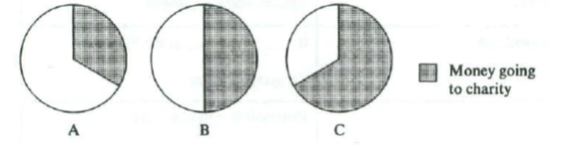
    12. What proportion of the sponsorship money goes to charity?

     A
     B
     C

    13. Each walker’s sponsorship money goes to one
     A student
     B teacher
     C school

    14. When you start the trek you must be
     A interested in getting fit
     B already quite fit
     C already very fit

    15. As you walk you will carry
     A all of your belongings
     B some of your belongings
     C none of your belongings

    16. The Semira Region has a long tradition of
     A making carpets
     B weaving blankets
     C carving wood

    Questions 17-20
    Complete the form below. Write ONE WORD ONLY.

    ITINERARY

    Day 1Arrive in Kishba
    Day 2Rest day
    Day 3Spend all day in a (17)………………..
    Day 4Visit a school
    Day 5Rest day
    Day 6See a (18)……………………with old carvings
    Day 7Rest day
    Day 8Swim in a (19)……………………..
    Day 9Visit a (20)………………..
    Day 10Depart from Kishba

    (17)                (18) 
    (19)               (20) 

    Part 3: Questions 21 and 22
    Complete the notes below. Write NO MORE THAN TWO WORDS OR A NUMBER.

    OCEAN RESEARCH
    The Robotic Float Project
    • Float is shaped like a (21) 
    • Scientists from (22)  have worked on the projects so far

    Questions 23-25
    Complete the diagram below. Write ONE WORD OR A NUMBER.

    (23) 
    (24) 
    (25) 

    Questions 26-30
    In what time period can data from the float projects help with the following things?
    Write the correct letter A, B or C next to questions 26-30.

    26. understanding of El Nino 
    27. understanding of climate change 
    28. naval rescues 
    29. sustainable fishing practices 
    30. crop selection 

    A At present
    B In the near future
    C In the long term future

    Part 4: Questions 31-34
    Choose the correct letter A, B or C.

    Hotels and Tourist Industry
    31. According to the speaker, how might a guest feel when staying in a luxury hotel?
     A impressed with the facilities
     B depressed by the experience
     C concerned at the high costs

    32. According to recent research, luxury hotels overlook the need to
     A provide for the demands of important guests
     B create a comfortable environment
     C offer an individual and personal welcome

    33. The company focused their research on
     A a wide variety of hotels
     B large, luxury hotel chains
     C exotic holiday hotels

    34. What is the impact of the outside environment on a hotel guest?
     A It has a considerable effect
     B It has a very limited effect
     C It has no effect whatsoever

    Questions 35-40
    Complete the notes below. Write ONE WORD ONLY.

    A company providing luxury serviced apartments aims to:
    • cater specifically for (35)  travellers
    • provide a stylish (36)  for guests to use
    • set a trend throughout the (37)  which becomes permanent

    Traditional holiday hotels attract people by:
    • offering the chance to (38)  their ordinary routine life
    • making sure that they are cared for in all respects – like a (39) 
    • leaving small treats in their rooms – e.g. cosmetics or (40) 

  • IELTS Listening Practice Test – Exercise 8

    Part 1: Questions 1-6
    Complete the form below. Write NO MORE THAN THREE WORDS OR A NUMBER.

    HOMESTAY APPLICATION
    Surname: Yuichini
    First name: (1) 
    Sex: female Nationality: Japanese
    Passport number: (2) 
    Age: 28 years
    Present address: Room 21C, Willow College
    Length of homestay: approx. (3) 
    Couse enrolled in: (4) 
    Family preferences: no (5)  and no objection to
    (6)
     

    Questions 7-10
    Answer the questions below. Write NO MORE THAN TWO WORDS.

    7. What does the student particularly like to eat? 
    8. What sport does the student play? 
    9. What mode of transport does the student prefer? 
    10. When will the student find out her homestay address? 

    Part 2: Questions 11-14
    Choose the correct letter A, B or C.

    11. What kind of tour is Sally leading?
     A a bus tour
     B a train tour
     C a walking tour

    12. The original buildings on the site were
     A houses
     B industrial buildings
     C shops

    13. The local residents wanted to use the site for
     A leisure
     B apartment blocks
     C a sports centre

    14. The Tower is at the centre of the
     A nature reserve
     B formal gardens
     C Bicentennial Park

    Questions 15-17
    Label the plan below. Write NO MORE THAN TWO WORDS.

    (15) 
    (16) 
    (17) 

    Questions 18-20
    Complete the table below. Write NO MORE THAN TWO WORDS.

    AreaFacilityActivity
    The MangrovesBoardwalk(18)…………………..
    Frog PondOutdoor classroom(19)………………………
    The Waterbird Refuge(20)………………………Bird watching

    (18) 
    (19) 
    (20) 

    Part 3: Questions 21 and 22
    Complete the sentences below. Write NO MORE THAN ONE WORD AND/OR A NUMBER for each answer.

    The presentation will last 15 minutes.
    There will be (21)  minutes for questions.
    The presentation will not be (22) 

    Questions 23-26

    What do the students decide about each topic for the geography presentation?
    A They will definitely include this topic.
    B They might include this topic.
    C They will not include this topic.

    Write the correct letter, A, B or C, next to questions 23-26.

    23. Geographical Location 
    24. Economy 
    25. Overview of Education System 
    26. Role of English Language 

    Questions 27-30
    Complete the table below. Write NO MORE THAN TWO WORDS.

    Information/ visual aidWhere from?
    Overhead projectorThe (27)………………
    Map of West AfricaThe (28)……………….
    Map of the islandsA tourist brochure
    Literacy figuresThe (29)………………….
    (30)…………………….on school placesAs above

    (27)                 (28) 
    (29)                (30) 

    Part 4: Questions 31-33
    Choose the correct letter A, B or C.

    Monosodium Glutamate (MSG)
    31. The speaker says the main topic of the lecture is
     A the history of monosodium glutamate
     B the way monosodium glutamate works
     C where monosodium glutamate is used

    32. In 1908, scientists in Japan
     A made monosodium glutamate
     B began using kombu
     C identified glutamate

    33. What change occurred in the manufacture of glutamate in 1956?
     A It began to be manufactured on a large scale
     B The Japanese began extracting it from natural sources
     C It became much more expensive to produce

    Questions 34-40
    Complete the notes below. Write NO MORE THAN TWO WORDS.

    Monosodium Glutamate (MSG)

    • MSG contains
    o Glutamate (78.2%)
    o Sodium (12.2%)
    (34)  (9.6%)
    • Glutamate is found in foods that contain protein such as (35)  and
    (36) 

    • MSG is used in foods in many different parts of the world.
    • In 1908 Kikunae Ikeda discovered a (37) 
    • Our ability to detect glutamate makes sense because it is so (38)  naturally.
    • John Prescott suggests that:
    o Sweetness tells us that a food contains carbohydrates.
    (39)  tells us that a food contains toxins.
    o Saltiness tells us that a food contains (40) 

  • IELTS Listening Practice Test – Exercise 7

    Part 1: Questions 1 and 2
    Choose the correct letter A, B or C.

    1. In the lobby of the library George saw
     A a group playing music
     B a display of instruments
     C a video about the festival

    2. George wants to sit at the back so they can
     A see well
     B hear clearly
     C pay less

    Summer music festival booking form

    Name: Goerge O’Neill

    Address: (3)………………..Westsea

    Postcode: (4)…………….

    Telephone: (5)……………….

    DateEventPrice per ticketNo. of tickets
    5 JuneInstrumental Group – Guitarinni£ 7.502
    17 JuneSinger (price includes (6)……………..in the garden£ 62
    22 June(7)……………………Anna Ventura£ 71
    23 JuneSpanish dance and guitar concert(8) £…………….(9)…………………

    NB: Children/ students/ senior citizens have (10)………………..discount on all tickets

    Questions 3-10
    Complete the form below. Write NO MORE THAN TWO WORDS OR A NUMBER.

    (3)                 (4)  
    (5)                 (6)  
    (7)                 (8)  
    (9)               (10) 

    Part 2: Questions 11-15
    Complete the sentences below. Write NO MORE THAN TWO WORDS OR A NUMBER.

    THE DINOSAUR MUSEUM
    11. The museum closes at  p.m. on Mondays.
    12. The museum is not open on 
    13. School groups are met by tour guides in the 
    14. The whole visit takes 90 minutes, including  minutes for the guided tour.
    15. There are  behind the museum where students can have lunch.

    Questions 16-18
    Choose THREE letter A-G.

    Which THREE things can students have with them in the museum?
     A food
     B water
     C cameras
     D books
     E bags
     F pens
     G worksheets

    Questions 19 and 20
    Choose TWO letters A-E.

    Which TWO activities can students do after the tour at present?
     A build model dinosaurs
     B watch films
     C draw dinosaurs
     D find dinosaur eggs
     E play computer games

    Part 3: Questions 21-24
    Choose the correct letter A, B or C.

    Field Trip Proposal

    21. The tutor thinks that Sandra’s proposal
     A should be re-ordered in some parts
     B needs a contents page
     C ought to include more information

    22. The proposal would be easier to follow if Sandra
     A inserted subheadings
     B used more paragraphs
     C shortened her sentences

    23. What was the problem with the formatting on Sandra’s proposal?
     A Separate points were not clearly identified
     B The headings were not always clear
     C Page numbering was not used in an appropriate way

    24. Sandra became interested in visiting the Navajo National Park through
     A articles she read
     B movies she saw as a child
     C photographs she found on the internet

    Questions 25-27
    Choose THREE letters A-G

    Which THREE topics does Sandra agree to include in the proposal?
     A climate change
     B field trip activities
     C geographical features
     D impact of tourism
     E myths and legends
     F plant and animal life G social history

    Questions 28-30
    Complete the sentences below. Write ONE WORD OR A NUMBER.

    28. The tribal park covers  hectares.
    29. Sandra suggests that they share the  for transport.
    30. She says they could also explore the local 

    Part 4: Questions 31-40
    Complete the notes below. Write ONE WORD ONLY.

    GEOGRAPHY
    Studying geography helps us to understand:
    • The effects of different processes on the (31)  of the Earth
    • The dynamic between (32)  and population

    Two main branches of study:
    • Physical features
    • Human lifestyles and their (33) 

    Specific study areas:
    • Biophysical, topographic, political, social, economic, historical and (34)  geography and also cartography

    Key point:
    • Geography helps us to understand our surroundings and the associated
    (35) 
    What do the geographers do?
    • Find data e.g. conduct censuses, collect information in the form of (36)  using computer and satellite technology
    • Analyse data – identify (37)  e.g. cause and effect
    • Publish findings in the form of:
     
    Maps

    Can show physical features of large and small areas
    But a two-dimensional map will always have some (38) 

    Aerial photos

    Can show vegetation problems (39)  density, ocean, floor etc.
     

    Landsat pictures sent to receiving stations
    • Used for monitoring (40)  conditions etc.

  • IELTS Listening Practice Test – Exercise 6

    Part 1: Questions 1-3
    Complete the form below. Write NO MORE THAN THREE WORDS OR A NUMBER.

    BORGHEIMER LANGUAGE COURSES INFORMATION

    Course Level – 3/ lower intermediate

    Customer’s name: (1) 
    Maximum class size: (2) 
    Hours of study per day (weekdays): (3) 
    Most expensive accommodation: (4) 
    First Berlin course begins: (5) 

    Questions 6 and 7
    Choose TWO letters A-E.

    Which TWO things does he need to buy for the course?

     A computer
     B computer disks
     C dictionary
     D translation exercises
     E textbooks

    Questions 8-10
    Complete the sentences below. Write NO MORE THAN THREE WORDS AND/ OR A NUMBER for each answer.

    8. Without the student discount, the course costs  Euros.

    9. Payment can be made by credit card or by 

    10. To get a free course you need to find  other people.

    Part 2: Questions 11-15
    Complete the sentences below. Write NO MORE THAN THREE WORDS AND/ OR A NUMBER for each answer.

    11. Ministers and officials put the  of the agriculture business first.

    12. Hormones make cattle  thus making meat production more profitable.

    13. The use of hormones was banned over  ago in Europe.

    14. The USA and Canada asked the WTO to declare the ban 

    15. A Danish study shows that hormones are over more dangerous than was previously thought.

    Questions 16-20
    Complete the summary below. Write NO MORE THAN THREE WORDS AND/ OR A NUMBER for each answer.

    Lack of testing

    The government has not been testing beef which is (16)  much to the anger of Mr. Verral. About (17)  of the beef which British people eat comes from abroad, some of it from Brazil, a country which on paper does not allow the use of (18)  However, when some EU inspectors visited a Brazilian farm, they found a (19)  of the banned substance. This is not the first food scandal we have had in this country. Several months ago, a well-known chocolate company found out its sweets were contaminated with (20)  of salmonella.

    Part 3: Questions 21-25
    Complete the summary below. Write NO MORE THAN THREE WORDS AND/ OR A NUMBER for each answer.

    High achievers

    Although it is thought that people who bring work home every night would be top achievers, they tend to peak early and then go into (21)  High achievers work hard, but within (22)  It is also important to choose (23)  you enjoy. Top achievers spend over (24)  of their working hours doing work they prefer. They want (25)  not just external rewards.

    Questions 26-30
    Choose the correct letter A, B or C.

    26. Top achievers take risks
     A without worrying about the consequences
     B only if they are assured of success
     C even if they face possible failure

    27. Very often perfectionists
     A turn out to be top achievers
     B don’t get many results
     C are not hard working

    28. When top achievers make mistakes
     A they ignore the fact
     B they get angry with themselves
     C they learn from the experience

    29. Top achievers tend to be people who
     A work well with others
     B prefer to work alone
     C complicate matters

    30. Loners
     A want to do everything themselves
     B are free of the compulsion to be perfect
     C take no notice of rivals

    Part 4: Questions 31-34
    Choose the correct letter A, B or C.

    31. Exposure to bright light
     A stopped production of melatonin in patients
     B increased the production of melatonin in many patients
     C caused people to crave sweet things

    32. Melatonin’s role in SAD is
     A not considered that important
     B now fully understood
     C not fully understood

    33. Subsyndromal SAD
     A is more common than SAD
     B has approximately the same number of sufferers as SAD
     C is far less common than SAD

    34. You would expect the typical SAD sufferer to be
     A a 45 year old man
     B a 16 year old girl
     C a 25 year old women

    Questions 35-40
    Complete the sentences below. Write NO MORE THAN TWO WORDS for each answer.

    35. Depression probably has a  as it seems to run in the family.

    36. Many SAD sufferers have a  craving.

    37. Serotonin has a  effect on the brain.

    38. The serotonin system of the brain cannot regulate itself well during 

    39. Some neurotransmitters may be  in certain cases.

    40. Many SAD patients put on fat in late autumn, just as 

  • IELTS Reading Practice Test – Exercise 5

    Striking Back at Lightning with Lasers

    Seldom is the weather more dramatic than when thunderstorms strike. Their electrical fury inflicts death or serious injury on around 500 people each year in the United States alone. As the clouds roll in, a leisurely round of golf can become a terrifying dice with death – out in the open, a lone golfer may be a lightning bolt’s most inviting target. And there is damage to property too. Lightning damage costs American power companies more than $100 million a year.

    But researchers in the United States and Japan are planning to hit back. Already in laboratory trials they have tested strategies for neutralising the power of thunderstorms, and this winter they will brave real storms, equipped with an armoury of lasers that they will be pointing towards the heavens to discharge thunderclouds before lightning can strike.

    The idea of forcing storm clouds to discharge their lightning on command is not new. In the early 1960s, researchers tried firing rockets trailing wires into thunderclouds to set up an easy discharge path for the huge electric charges that these clouds generate. The technique survives to this day at a test site in Florida run by the University of Florida, with support from the Electrical Power Research Institute (EPRI), based in California. EPRI, which is funded by power companies, is looking at ways to protect the United States’ power grid from lightning strikes. ‘We can cause the lightning to strike where we want it to using rockets,’ says Ralph Bernstein, manager of lightning projects at EPRI. The rocket site is providing precise measurements of lightning voltages and allowing engineers to check how electrical equipment bears up.

    Bad behaviour
    But while rockets are fine for research, they cannot provide the protection from lightning strikes that everyone is looking for. The rockets cost around $1,200 each, can only be fired at a limited frequency and their failure rate is about 40 per cent. And even when they do trigger lightning, things still do not always go according to plan. ‘Lightning is not perfectly well behaved,’ says Bernstein. ‘Occasionally, it will take a branch and go someplace it wasn’t supposed to go.’

    And anyway, who would want to fire streams of rockets in a populated area? ‘What goes up must come down,’ points out Jean-Claude Diels of the University of New Mexico. Diels is leading a project, which is backed by EPRI, to try to use lasers to discharge lightning safely – and safety is a basic requirement since no one wants to put themselves or their expensive equipment at risk. With around $500,000 invested so far, a promising system is just emerging from the laboratory.

    The idea began some 20 years ago, when high-powered lasers were revealing their ability to extract electrons out of atoms and create ions. If a laser could generate a line of ionisation in the air all the way up to a storm cloud, this conducting path could be used to guide lightning to Earth, before the electric field becomes strong enough to break down the air in an uncontrollable surge. To stop the laser itself being struck, it would not be pointed straight at the clouds. Instead it would be directed at a mirror, and from there into the sky. The mirror would be protected by placing lightning conductors close by. Ideally, the cloud-zapper (gun) would be cheap enough to be installed around all key power installations, and portable enough to be taken to international sporting events to beam up at brewing storm clouds.

    A stumbling block
    However, there is still a big stumbling block. The laser is no nifty portable: it’s a monster that takes up a whole room. Diels is trying to cut down the size and says that a laser around the size of a small table is in the offing. He plans to test this more manageable system on live thunderclouds next summer.

    Bernstein says that Diels’s system is attracting lots of interest from the power companies. But they have not yet come up with the $5 million that EPRI says will be needed to develop a commercial system, by making the lasers yet smaller and cheaper. ‘I cannot say I have money yet, but I’m working on it,’ says Bernstein. He reckons that the forthcoming field tests will be the turning point – and he’s hoping for good news. Bernstein predicts ‘an avalanche of interest and support’ if all goes well. He expects to see cloud-zappers eventually costing $50,000 to $100,000 each.

    Other scientists could also benefit. With a lightning ‘switch’ at their fingertips, materials scientists could find out what happens when mighty currents meet matter. Diels also hopes to see the birth of ‘interactive meteorology’ – not just forecasting the weather but controlling it. ‘If we could discharge clouds, we might affect the weather,’ he says.

    And perhaps, says Diels, we’ll be able to confront some other meteorological menaces. ‘We think we could prevent hail by inducing lightning,’ he says. Thunder, the shock wave that comes from a lightning flash, is thought to be the trigger for the torrential rain that is typical of storms. A laser thunder factory could shake the moisture out of clouds, perhaps preventing the formation of the giant hailstones that threaten crops. With luck, as the storm clouds gather this winter, laser-toting researchers could, for the first time, strike back.

    Questions 1-3
    Choose the correct letter, A, B, C or D. Write the correct letter in boxes 1-3 on your answer sheet.

    1 The main topic discussed in the text is
    A the damage caused to US golf courses and golf players by lightning strikes.
    B the effect of lightning on power supplies in the US and in Japan.
    C a variety of methods used in trying to control lightning strikes.
    D a laser technique used in trying to control lightning strikes.

    2 According to the text, every year lightning
    A does considerable damage to buildings during thunderstorms.
    B kills or injures mainly golfers in the United States.
    C kills or injures around 500 people throughout the world.
    D damages more than 100 American power companies.

    3 Researchers at the University of Florida and at the University of New Mexico
    A receive funds from the same source
    B are using the same techniques
    C are employed by commercial companies
    D are in opposition to each other

    Questions 4-6
    Complete the sentences below. Write NO MORE THAN TWO WORDS.

    4 EPRI receives financial support from………………
    5 The advantage of the technique being developed by Diels is that it can be used ……………..
    6 The main difficulty associated with using the laser equipment is related to its……………..

    Questions 7-10
    Complete the summary using the list of words, A-I, below.
    Write the correct letter, A-I, in boxes 7-10 on your answer sheet.

    In this method, a laser is used to create a line of ionisation by removing electrons from (7) ………………. This laser is then directed at (8) ………………….. in order to control electrical charges, a method which is less dangerous than using (9) ………………….. As a protection for the lasers, the beams are aimed firstly at (10) …………………..

    A cloud-zappers                     B atoms                     C storm clouds

    D mirrors                                E technique                F ions

    G rockets                                H conductors             I thunder

    Questions 11-13
    Do the following statements agree with the information given in Reading Passage 1?
    In boxes 11-13 on your answer sheet write:

    YES                            if the statement agrees with the claims of the writer
    NO                              if the statement contradicts the claims of the writer
    NOT GIVEN           if it is impossible to say what the writer thinks about this

    11 Power companies have given Diels enough money to develop his laser.
    12 Obtaining money to improve the lasers will depend on tests in real storms.
    13 Weather forecasters are intensely interested in Diels’s system.

    The Nature of Genius

    There has always been an interest in geniuses and prodigies. The word ‘genius’, from the Latin gens (= family) and the term ‘genius’, meaning ‘begetter’, comes from the early Roman cult of a divinity as the head of the family. In its earliest form, genius was concerned with the ability of the head of the family, the paterfamilias, to perpetuate himself. Gradually, genius came to represent a person’s characteristics and thence an individual’s highest attributes derived from his ‘genius’ or guiding spirit. Today, people still look to stars or genes, astrology or genetics, in the hope of finding the source of exceptional abilities or personal characteristics.

    The concept of genius and of gifts has become part of our folk culture, and attitudes are ambivalent towards them. We envy the gifted and mistrust them. In the mythology of giftedness, it is popularly believed that if people are talented in one area, they must be defective in another, that intellectuals are impractical, that prodigies burn too brightly too soon and burn out, that gifted people are eccentric, that they are physical weaklings, that there’s a thin line between genius and madness, that genius runs in families, that the gifted are so clever they don’t need special help, that giftedness is the same as having a high IQ, that some races are more intelligent or musical or mathematical than others, that genius goes unrecognised and unrewarded, that adversity makes men wise or that people with gifts have a responsibility to use them. Language has been enriched with such terms as ‘highbrow’, ‘egghead’, ‘blue-stocking’, ‘wiseacre’, ‘know-all’, ‘boffin’ and, for many, ‘intellectual’ is a term of denigration.

    The nineteenth century saw considerable interest in the nature of genius, and produced not a few studies of famous prodigies. Perhaps for us today, two of the most significant aspects of most of these studies of genius are the frequency with which early encouragement and teaching by parents and tutors had beneficial effects on the intellectual, artistic or musical development of the children but caused great difficulties of adjustment later in their lives, and the frequency with which abilities went unrecognised by teachers and schools. However, the difficulty with the evidence produced by these studies, fascinating as they are in collecting together anecdotes and apparent similarities and exceptions, is that they are not what we would today call norm-referenced. In other words, when, for instance, information is collated about early illnesses, methods of upbringing, schooling, etc., we must also take into account information from other historical sources about how common or exceptional these were at the time. For instance, infant mortality was high and life expectancy much shorter than today, home tutoring was common in the families of the nobility and wealthy, bullying and corporal punishment were common at the best independent schools and, for the most part, the cases studied were members of the privileged classes. It was only with the growth of paediatrics and psychology in the twentieth century that studies could be carried out on a more objective, if still not always very scientific, basis.

    Geniuses, however they are defined, are but the peaks which stand out through the mist of history and are visible to the particular observer from his or her particular vantage point. Change the observers and the vantage points, clear away some of the mist, and a different lot of peaks appear. Genius is a term we apply to those whom we recognise for their outstanding achievements and who stand near the end of the continuum of human abilities which reaches back through the mundane and mediocre to the incapable. There is still much truth in Dr. Samuel Johnson’s observation, ‘The true genius is a mind of large general powers, accidentally determined to some particular direction’. We may disagree with the ‘general’, for we doubt if all musicians of genius could have become scientists of genius or vice versa, but there is no doubting the accidental determination which nurtured or triggered their gifts into those channels into which they have poured their powers so successfully. Along the continuum of abilities are hundreds of thousands of gifted men and women, boys and girls.

    What we appreciate, enjoy or marvel at in the works of genius or the achievements of prodigies are the manifestations of skills or abilities which are similar to, but so much superior to, our own. But that their minds are not different from our own is demonstrated by the fact that the hard-won discoveries of scientists like Kepler or Einstein become the commonplace knowledge of schoolchildren and the once outrageous shapes and colours of an artist like Paul Klee so soon appear on the fabrics we wear. This does not minimise the supremacy of their achievements, which outstrip our own as the sub-four-minute milers outstrip our jogging.

    To think of geniuses and the gifted as having uniquely different brains is only reasonable if we accept that each human brain is uniquely different. The purpose of instruction is to make us even more different from one another, and in the process of being educated we can learn from the achievements of those more gifted than ourselves. But before we try to emulate geniuses or encourage our children to do so we should note that some of the things we learn from them may prove unpalatable. We may envy their achievements and fame, but we should also recognise the price they may have paid in terms of perseverance, single-mindedness, dedication, restrictions on their personal lives, the demands upon their energies and time, and how often they had to display great courage to preserve their integrity or to make their way to the top.

    Genius and giftedness are relative descriptive terms of no real substance. We may, at best, give them some precision by defining them and placing them in a context but, whatever we do, we should never delude ourselves into believing that gifted children or geniuses are different from the rest of humanity, save in the degree to which they have developed the performance of their abilities.

    Questions 14-18
    Choose FIVE letters, A—K. Write the correct letters in boxes 14-18 on your answer sheet.
    NB Your answers maybe given in any order.
    Below are listed some popular beliefs about genius and giftedness.

    Which FIVE of these beliefs are reported by the writer of the text?

    A Truly gifted people are talented in all areas.
    B The talents of geniuses are soon exhausted.
    C Gifted people should use their gifts.
    D A genius appears once in every generation.
    E Genius can be easily destroyed by discouragement.
    F Genius is inherited.
    G Gifted people are very hard to live with.
    H People never appreciate true genius.
    I Geniuses are natural leaders.
    J Gifted people develop their greatness through difficulties.
    K Genius will always reveal itself.

    Questions 19-26
    Do the following statements agree with the information given in Reading Passage 2? In boxes 19-26 on your answer sheet, write:

    TRUE                                  if the statement agrees with the information
    FALSE                                if the statement contradicts the information
    NOT GIVEN                     if there is no information on this

    19 Nineteenth-century studies of the nature of genius failed to take into account the uniqueness of the person’s upbringing.
    20 Nineteenth-century studies of genius lacked both objectivity and a proper scientific approach.
    21 A true genius has general powers capable of excellence in any area
    22 The skills of ordinary individuals are in essence the same as the skills of prodigies.
    23 The ease with which truly great ideas are accepted and taken for granted fails to lessen their significance.
    24 Giftedness and genius deserve proper scientific research into their true nature so that all talent may be retained for the human race.
    25 Geniuses often pay a high price to achieve greatness.
    26 To be a genius is worth the high personal cost.

    How Does the Biological Clock Tick?

    A Our life span is restricted. Everyone accepts this as ‘biologically’ obvious. ‘Nothing lives forever!’ However, in this statement we think of artificially produced, technical objects, products which are subjected to natural wear and tear during use. This leads to the result that at some time or other the object stops working and is unusable (‘death’ in the biological sense). But are the wear and tear and loss of function of technical objects and the death of living organisms really similar or comparable?

    B Our ‘dead’ products are ‘static’, closed systems. It is always the basic material which constitutes the object and which, in the natural course of things, is worn down and becomes ‘older*. Ageing in this case must occur according to the laws of physical chemistry and of thermodynamics. Although the same law holds for a living organism, the result of this law is not inexorable in the same way. At least as long as a biological system has the ability to renew itself it could actually become older without ageing; an organism is an open, dynamic system through which new material continuously flows. Destruction of old material and formation of new material are thus in permanent dynamic equilibrium. The material of which the organism is formed changes continuously. Thus our bodies continuously exchange old substance for new, just like a spring which more or less maintains its form and movement, but in which the water molecules are always different.

    C Thus ageing and death should not be seen as inevitable, particularly as the organism possesses many mechanisms for repair. It is not, in principle, necessary for a biological system to age and die. Nevertheless, a restricted life span, ageing, and then death are basic characteristics of life. The reason for this is easy to recognise: in nature, the existent organisms either adapt or are regularly replaced by new types. Because of changes in the genetic material (mutations) these have new characteristics and in the course of their individual lives they are tested for optimal or better adaptation to the environmental conditions. Immortality would disturb this system – it needs room for new and better life. This is the basic problem of evolution.

    D Every organism has a life span which is highly characteristic. There are striking differences in life span between different species, but within one species the parameter is relatively constant. For example, the average duration of human life has hardly changed in thousands of years. Although more and more people attain an advanced age as a result of developments in medical care and better nutrition, the characteristic upper limit for most remains 80 years. A further argument against the simple wear and tear theory is the observation that the time within which organisms age lies between a few days (even a few hours for unicellular organisms) and several thousand years, as with mammoth trees.

    E If a life span is a genetically determined biological characteristic, it is logically necessary to propose the existence of an internal clock, which in some way measures and controls the ageing process and which finally determines death as the last step in a fixed programme. Like the life span, the metabolic rate has for different organisms a fixed mathematical relationship to the body mass. In comparison to the life span this relationship is ‘inverted’: the larger the organism the lower its metabolic rate. Again this relationship is valid not only for birds, but also, similarly on average within the systematic unit, for all other organisms (plants, animals, unicellular organisms).

    F Animals which behave ‘frugally’ with energy become particularly old, for example, crocodiles and tortoises. Parrots and birds of prey are often held chained up. Thus they are not able to ‘experience life’ and so they attain a high life span in captivity. Animals which save energy by hibernation or lethargy (e.g. bats or hedgehogs) live much longer than those which are always active. The metabolic rate of mice can be reduced by a very low consumption of food (hunger diet). They then may live twice as long as their well fed comrades. Women become distinctly (about 10 per cent) older than men. If you examine the metabolic rates of the two sexes you establish that the higher male metabolic rate roughly accounts for the lower male life span. That means that they live life ‘energetically’ – more intensively, but not for as long.

    G It follows from the above that sparing use of energy reserves should tend to extend life. Extreme high performance sports may lead to optimal cardiovascular performance, but they quite certainly do not prolong life. Relaxation lowers metabolic rate, as does adequate sleep and in general an equable and balanced personality. Each of us can develop his or her own ‘energy saving programme’ with a little self-observation, critical self-control and, above all, logical consistency. Experience will show that to live in this way not only increases the life span but is also very healthy. This final aspect should not be forgotten.

    Questions 27-32
    Reading Passage 3 has seven paragraphs, A—G. Choose the correct heading for paragraphs B—G from the list of headings below. Write the correct number, i—x, in boxes 27-32 on your answer sheet.

    List of Headings

    i The biological clock
    ii Why dying is beneficial
    iii The ageing process of men and women
    iv Prolonging your life
    v Limitations of life span
    vi Modes of development of different species
    vii A stable life span despite improvements
    viii Energy consumption
    ix Fundamental differences in ageing of objects and organisms
    x Repair of genetic material

    Example: Paragraph A                v

    27 Paragraph B
    28 Paragraph C
    29 Paragraph D
    30 Paragraph E
    31 Paragraph F
    32 Paragraph G

    Questions 33-36
    Complete the notes below. Choose NO MORE THAN TWO WORDS from the passage for each answer.

    • Objects age in accordance with principles of (33) ………………….. and of (34) ……………………………..
    • Through mutations, organisms can (35) …………………. better to the environment
    • (36) ………………… would pose a serious problem for the theory of evolution

    Questions 37-40
    Do the following statements agree with the views of the writer in Reading Passage 3?
    In boxes 37-40 on your answer sheet, write:

    YES                           if the statement agrees with the views of the writer
    NO                             if the statement contradicts the views of the writer
    NOT GIVEN          if it is impossible to say what the writer thinks about this

    37 The wear and tear theory applies to both artificial objects and biological systems.
    38 In principle, it is possible for a biological system to become older without ageing.
    39 Within seven years, about 90 per cent of a human body is replaced as new.
    40 Conserving energy may help to extend a human’s life.
  • IELTS Reading Practice Test – Exercise 4

    Land of the Rising Sun

    A Japan has a significantly better record in terms of average mathematical attainment than England and Wales. Large sample international comparisons of pupils’ attainments since the 1960s have established that not only did Japanese pupils at age 13 have better scores of average attainment, but there was also a larger proportion of ‘low’ attainers in England, where, incidentally, the variation in attainment scores was much greater. The percentage of Gross National Product spent on education is reasonably similar in the two countries, so how is this higher and more consistent attainment in maths achieved?

    B Lower secondary schools in Japan cover three school years, from the seventh grade (age 13) to the ninth grade (age 15). Virtually all pupils at this stage attend state schools: only 3 per cent are in the private sector. Schools are usually modern in design, set well back from the road and spacious inside. Classrooms are large and pupils sit at single desks in rows. Lessons last for a standardised 50 minutes and are always followed by a 10-minute break, which gives the pupils a chance to let off steam. Teachers begin with a formal address and mutual bowing, and then concentrate on whole-class teaching.

    Classes are large – usually about 40 – and are unstreamed. Pupils stay in the same class for all lessons throughout the school and develop considerable class identity and loyalty. Pupils attend the school in their own neighbourhood, which in theory removes ranking by school. In practice in Tokyo, because of the relative concentration of schools, there is some competition to get into the ‘better’ school in a particular area.

    C Traditional ways of teaching form the basis of the lesson and the remarkably quiet classes take their own notes of the points made and the examples demonstrated. Everyone has their own copy of the textbook supplied by the central education authority, Monbusho, as part of the concept of free compulsory education up to the age of 15. These textbooks are, on the whole, small, presumably inexpensive to produce, but well set out and logically developed. (One teacher was particularly keen to introduce colour and pictures into maths textbooks: he felt this would make them more accessible to pupils brought up in a cartoon culture.) Besides approving textbooks, Monbusho also decides the highly centralised national curriculum and how it is to be delivered.

    D Lessons all follow the same pattern. At the beginning, the pupils put solutions to the homework on the board, then the teachers comment, correct or elaborate as necessary. Pupils mark their own homework: this is an important principle in Japanese schooling as it enables pupils to see where and why they made a mistake, so that these can be avoided in future. No one minds mistakes or ignorance as long as you are prepared to learn from them.

    After the homework has been discussed, the teacher explains the topic of the lesson, slowly and with a lot of repetition and elaboration. Examples are demonstrated on the board; questions from the textbook are worked through first with the class, and then the class is set questions from the textbook to do individually. Only rarely are supplementary worksheets distributed in a maths class. The impression is that the logical nature of the textbooks and their comprehensive coverage of different types of examples, combined with the relative homogeneity of the class, renders work sheets unnecessary. At this point, the teacher would circulate and make sure that all the pupils were coping well.

    E It is remarkable that large, mixed-ability classes could be kept together for maths throughout all their compulsory schooling from 6 to 15. Teachers say that they give individual help at the end of a lesson or after school, setting extra work if necessary. In observed lessons, any strugglers would be assisted by the teacher or quietly seek help from their neighbour. Carefully fostered class identity makes pupils keen to help each other – anyway, it is in their interests since the class progresses together.

    This scarcely seems adequate help to enable slow learners to keep up. However, the Japanese attitude towards education runs along the lines of ‘if you work hard enough, you can do almost anything’. Parents are kept closely informed of their children’s progress and will play a part in helping their children to keep up with class, sending them to ‘Juku’ (private evening tuition) if extra help is needed and encouraging them to work harder. It seems to work, at least for 95 per cent of the school population.

    F So what are the major contributing factors in the success of maths teaching?

    Clearly, attitudes are important. Education is valued greatly in Japanese culture; maths is recognised as an important compulsory subject throughout schooling; and the emphasis is on hard work coupled with a focus on accuracy. Other relevant points relate to the supportive attitude of a class towards slower pupils, the lack of competition within a class, and the positive emphasis on learning for oneself and improving one’s own standard. And the view of repetitively boring lessons and learning the facts by heart, which is sometimes quoted in relation to Japanese classes, may be unfair and unjustified. No poor maths lessons were observed. They were mainly good and one or two were inspirational.

    Questions 1-5
    Reading Passage 1 has six sections, A—F. Choose the correct heading for sections B—F from the list of headings below.

    List of Headings

    i The influence of Monbusho
    ii Helping less successful students
    iii The success of compulsory education
    iv Research findings concerning achievements in maths
    v The typical format of a maths lesson
    vi Comparative expenditure on maths education
    vii Background to middle-years education in Japan
    viii The key to Japanese successes in maths education
    ix The role of homework correction

    Example Answer:        Section A                      iv

    1 Section
    B 2 Section
    C 3 Section
    D 4 Section
    E 5 Section F

    Questions 6-9
    DO the following statements agree with the claims of the writer in Reading Passage 1?

    YES                      if the statement agrees with the claims of the writer
    NO                        if the statement contradicts the claims of the writer
    NOT GIVEN     if it is impossible to say what the writer thinks about this

    6 There is a wider range of achievement amongst English pupils studying maths than amongst their Japanese counterparts.
    7 The percentage of Gross National Product spent on education generally reflects the level of attainment in mathematics.
    8 Private schools in Japan are more modern and spacious than state-run lower secondary schools.
    9 Teachers mark homework in Japanese schools.

    Questions 10-13
    Choose the correct letter, A, B, C or D. Write the correct letter in boxes 10-13 on your answer sheet.

    10 Maths textbooks in Japanese schools are
    A cheap for pupils to buy.
    B well organised and adapted to the needs of the pupils.
    C written to be used in conjunction with TV programmes.
    D not very popular with many Japanese teachers.

    11 When a new maths topic is introduced,
    A students answer questions on the board.
    B students rely entirely on the textbook.
    C it is carefully and patiently explained to the students.
    D it is usual for students to use extra worksheets.

    12 How do schools deal with students who experience difficulties?
    A They are given appropriate supplementary tuition.
    B They are encouraged to copy from other pupils.
    C They are forced to explain their slow progress.
    D They are placed in a mixed-ability class.

    13 Why do Japanese students tend to achieve relatively high rates of success in maths?
    A It is a compulsory subject in Japan.
    B They are used to working without help from others.
    C Much effort is made and correct answers are emphasised.
    D There is a strong emphasis on repetitive learning

    Biological Control of Pests

    The continuous and reckless use of synthetic chemicals for the control of pests which pose a threat to agricultural crops and human health is proving to be counter-productive. Apart from engendering widespread ecological disorders, pesticides have contributed to the emergence of a new breed of chemical-resistant, highly lethal superbugs.

    According to a recent study by the Food and Agriculture Organisation (FAO), more than 300 species of agricultural pests have developed resistance to a wide range of potent chemicals. Not to be left behind are the disease-spreading pests, about 100 species of which have become immune to a variety of insecticides now in use.

    One glaring disadvantage of pesticides’ application is that, while destroying harmful pests, they also wipe out many useful non-targeted organisms, which keep the growth of the pest population in check. This results in what agroecologists call the ‘treadmill syndrome’. Because of their tremendous breeding potential and genetic diversity, many pests are known to withstand synthetic chemicals and bear offspring with a built-in resistance to pesticides.

    The havoc that the ‘treadmill syndrome’ can bring about is well illustrated by what happened to cotton farmers in Central America. In the early 1940s, basking in the glory of chemical- based intensive agriculture, the farmers avidly took to pesticides as a sure measure to boost crop yield. The insecticide was applied eight times a year in the mid-1940s, rising to 28 in a season in the mid-1950s, following the sudden proliferation of three new varieties of chemical- resistant pests.

    By the mid-1960s, the situation took an alarming turn with the outbreak of four more new pests, necessitating pesticide spraying to such an extent that 50% of the financial outlay on cotton production was accounted for by pesticides. In the early 1970s, the spraying frequently reached 70 times a season as the farmers were pushed to the wall by the invasion of genetically stronger insect species.

    Most of the pesticides in the market today remain inadequately tested for properties that cause cancer and mutations as well as for other adverse effects on health, says a study by United States environmental agencies. The United States National Resource Defense Council has found that DDT was the most popular of a long list of dangerous chemicals in use.

    In the face of the escalating perils from indiscriminate applications of pesticides, a more effective and ecologically sound strategy of biological control, involving the selective use of natural enemies of the pest population, is fast gaining popularity – though, as yet, it is a new field with limited potential. The advantage of biological control in contrast to other methods is that it provides a relatively low-cost, perpetual control system with a minimum of detrimental side-effects. When handled by experts, bio-control is safe, non-polluting and self-dispersing.

    The Commonwealth Institute of Biological Control (CIBC) in Bangalore, with its global network of research laboratories and field stations, is one of the most active, non-commercial research agencies engaged in pest control by setting natural predators against parasites. CIBC also serves as a clearing-house for the export and import of biological agents for pest control world-wide.

    CIBC successfully used a seed-feeding weevil, native to Mexico, to control the obnoxious parthenium weed, known to exert devious influence on agriculture and human health in both India and Australia. Similarly the Hyderabad-based Regional Research Laboratory (RRL), supported by CIBC, is now trying out an Argentinian weevil for the eradication of water hyacinth, another dangerous weed, which has become a nuisance in many parts of the world. According to Mrs Kaiser Jamil of RRL, ‘The Argentinian weevil does not attack any other plant and a pair of adult bugs could destroy the weed in 4-5 days.’ CIBC is also perfecting the technique for breeding parasites that prey on ‘disapene scale’ insects – notorious defoliants of fruit trees in the US and India.

    How effectively biological control can be pressed into service is proved by the following examples. In the late 1960s, when Sri Lanka’s flourishing coconut groves were plagued by leaf-mining hispides, a larval parasite imported from Singapore brought the pest under control. A natural predator indigenous to India, Neodumetia sangawani, was found useful in controlling the Rhodes grass-scale insect that was devouring forage grass in many parts of the US. By using Neochetina bruci, a beetle native to Brazil, scientists at Kerala Agricultural University freed a 12- kilometre- long canal from the clutches of the weed Salvinia molesta, popularly called ‘African Payal’ in Kerala. About 30,000 hectares of rice fields in Kerala are infested by this weed.

    Questions 14-17
    Choose the correct letter, A, B, C, or D. Write the correct letter in boxes 14-17 on your answer sheet.

    14 The use of pesticides has contributed to
    A a change in the way ecologies are classified by agroecologists.
    B an imbalance in many ecologies around the world.
    C the prevention of ecological disasters in some parts of the world.
    D an increase in the range of ecologies which can be usefully farmed.

    15 The Food and Agriculture Organisation has counted more than 300 agricultural pests which
    A are no longer responding to most pesticides in use
    B can be easily controlled through the use of pesticides.
    C continue to spread disease in a wide range of crops.
    D may be used as part of bio-control’s replacement of pesticides.

    16 Cotton farmers in Central America began to use pesticides
    A because of an intensive government advertising campaign.
    B in response to the appearance of new varieties of pest.
    C as a result of changes in the seasons and the climate.
    D to ensure more cotton was harvested from each crop.

    17 By the mid-1960s, cotton farmers in Central America found that pesticides
    A were wiping out 50% of the pests plaguing the crops.
    B were destroying 50% of the crops they were meant to protect.
    C were causing a 50% increase in the number of new pests reported.
    D were costing 50% of the total amount they spent on their crops.

    Questions 18-21
    Do the following statements agree with the claims of the writer in Reading Passage 2?
    In boxes 18-21 on your answer sheet, write

    YES                         if the statement agrees with the claims of the writer
    NO                           if the statement contradicts the claims of the writer
    NOT GIVEN        if it is impossible to say what the writer thinks about this

    18 Disease-spreading pests respond more quickly to pesticides than agricultural pests do.
    19 A number of pests are now born with an innate immunity to some pesticides.
    20 Biological control entails using synthetic chemicals to try and change the genetic make-up of the pests’ offspring.
    21 Bio-control is free from danger under certain circumstances.

    Questions 22-26
    Complete each sentence with the correct ending, A—I, below.

    22 Disapene scale insects feed on
    23 Neodumetia sangawani ate
    24 Leaf-mining hispides blighted
    25 An Argentinian weevil may be successful in wiping out
    26 Salvinia molesta plagues

    A forage grass              B rice fields              C coconut trees                 D fruit trees

    E water hyacinth          F parthenium weed          G Brazilian beetles

    H grass-scale insects      I larval parasites

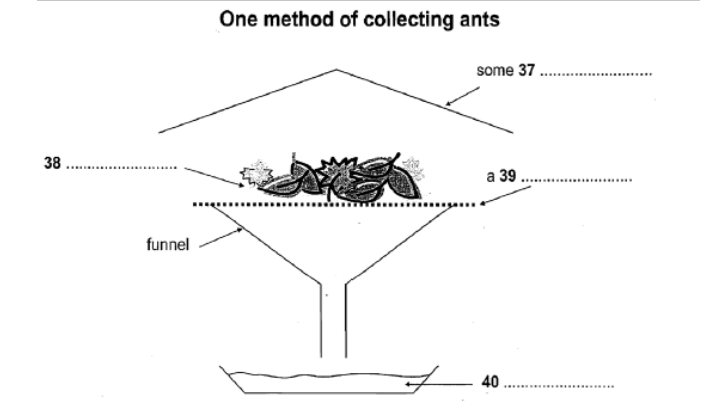
    Collecting Ant Specimens

    Collecting ants can be as simple as picking up stray ones and placing them in a glass jar, or as complicated as completing an exhaustive survey of all species present in an area and estimating their relative abundances. The exact method used will depend on the final purpose of the collections. For taxonomy, or classification, long series, from a single nest, which contain all castes (workers, including majors and minors, and, if present, queens and males) are desirable, to allow the determination of variation within species. For ecological studies, the most important factor is collecting identifiable samples of as many of the different species present as possible. Unfortunately, these methods are not always compatible. The taxonomist sometimes overlooks whole species in favour of those groups currently under study, while the ecologist often collects only a limited number of specimens of each species, thus reducing their value for taxonomic investigations.

    To collect as wide a range of species as possible, several methods must be used. These include hand collecting, using baits to attract the ants, ground litter sampling, and the use of pitfall traps. Hand collecting consists of searching for ants everywhere they are likely to occur. This includes on the ground, under rocks, logs or other objects on the ground, in rotten wood on the ground or on trees, in vegetation, on tree trunks and under bark. When possible, collections should be made from nests or foraging columns and at least 20 to 25 individuals collected. This will ensure that all individuals are of the same species, and so increase their value for detailed studies. Since some species are largely nocturnal, collecting should not be confined to daytime. Specimens are collected using an aspirator (often called a pooter), forceps, a fine, moistened paint brush, or fingers, if the ants are known not to sting. Individual insects are placed in plastic or glass tubes (1.5-3-0 ml capacity for small ants, 5-8 ml for larger ants) containing 75% to 95% ethanol. Plastic tubes with secure tops are better than glass because they are lighter, and do not break as easily if mishandled.

    Baits can be used to attract and concentrate foragers. This often increases the number of individuals collected and attracts species that are otherwise elusive. Sugars and meats or oils will attract different species and a range should be utilised. These baits can be placed either on the ground or on the trunks of trees or large shrubs. When placed on the ground, baits should be situated on small paper cards or other flat, light-coloured surfaces, or in test-tubes or vials. This makes it easier to spot ants and to capture them before they can escape into the surrounding leaf litter.

    Many ants are small and forage primarily in the layer of leaves and other debris on the ground. Collecting these species by hand can be difficult. One of the most successful ways to collect them is to gather the leaf litter in which they are foraging and extract the ants from it. This is most commonly done by placing leaf litter on a screen over a large funnel, often under some heat. As the leaf litter dries from above, ants (and other animals) move downward and eventually fall out the bottom and are collected in alcohol placed below the funnel. This method works especially well in rain forests and marshy areas. A method of improving the catch when using a funnel is to sift the leaf litter through a coarse screen before placing it above the funnel. This will concentrate the litter and remove larger leaves and twigs. It will also allow more litter to be sampled when using a limited number of funnels.

    The pitfall trap is another commonly used tool for collecting ants. A pitfall trap can be any small container placed in the ground with the top level with the surrounding surface and filled with a preservative. Ants are collected when they fall into the trap while foraging. The diameter of the traps can vary from about 18 mm to 10 cm and the number used can vary from a few to several hundred. The size of the traps used is influenced largely by personal preference (although larger sizes are generally better), while the number will be determined by the study being undertaken. The preservative used is usually ethylene glycol or propylene glycol, as alcohol will evaporate quickly and the traps will dry out. One advantage of pitfall traps is that they can be used to collect over a period of time with minimal maintenance and intervention. One disadvantage is that some species are not collected as they either avoid the traps or do not commonly encounter them while foraging.

    Questions 27-30
    Do the following statements agree with the information given in Reading Passage 3?
    In boxes 27-30 on your answer sheet, write

    TRUE                     if the statement agrees with the information
    FALSE                   if the statement contradicts the information
    NOT GIVEN       if there is no information on this

    27 Taxonomic research involves comparing members of one group of ants.
    28 New species of ant are frequently identified by taxonomists.
    29 Range is the key criterion for ecological collections.
    30 A single collection of ants can generally be used for both taxonomic and ecological purposes.

    Questions 31-36
    Classify the following statements as referring to
    A hand collecting
    B using bait
    C sampling ground litter
    D using a pitfall trap

    Write the correct letter, A, B, C or D, in boxes 31-36 on your answer sheet.

    31 It is preferable to take specimens from groups of ants.
    32 It is particularly effective for wet habitats.
    33 It is a good method for species which are hard to find.
    34 Little time and effort is required.
    35 Separate containers are used for individual specimens.
    36 Non-alcoholic preservative should be used.

    Questions 37-40
    Label the diagram below. Choose NO MORE THAN TWO WORDS from the passage for each answer.

  • IELTS Reading Practice Test – Exercise 3

    William Henry Perkin

    William Henry Perkin was born on March 12, 1838, in London, England. As a boy, Perkin’s curiosity prompted early interests in the arts, sciences, photography, and engineering. But it was a chance stumbling upon a run-down, yet functional, laboratory in his late grandfather’s home that solidified the young man’s enthusiasm for chemistry.

    As a student at the City of London School, Perkin became immersed in the study of chemistry. His talent and devotion to the subject were perceived by his teacher, Thomas Hall, who encouraged him to attend a series of lectures given by the eminent scientist Michael Faraday at the Royal Institution. Those speeches fired the young chemist’s enthusiasm further, and he later went on to attend the Royal College of Chemistry, which he succeeded in entering in 1853, at the age of 15.

    At the time of Perkin’s enrolment, the Royal College of Chemistry was headed by the noted German chemist August Wilhelm Hofmann. Perkin’s scientific gifts soon caught Hofmann’s attention and, within two years, he became Hofmann’s youngest assistant. Not long after that, Perkin made the scientific breakthrough that would bring him both fame and fortune.

    At the time, quinine was the only viable medical treatment for malaria. The drug is derived from the bark of the cinchona tree, native to South America, and by 1856 demand for the drug was surpassing the available supply. Thus, when Hofmann made some passing comments about the desirability of a synthetic substitute for quinine, it was unsurprising that his star pupil was moved to take up the challenge.

    During his vacation in 1856, Perkin spent his time in the laboratory on the top floor of his family’s house. He was attempting to manufacture quinine from aniline, an inexpensive and readily available coal tar waste product. Despite his best efforts, however, he did not end up with quinine. Instead, he produced a mysterious dark sludge. Luckily, Perkin’s scientific training and nature prompted him to investigate the substance further. Incorporating potassium dichromate and alcohol into the aniline at various stages of the experimental process, he finally produced a deep purple solution. And, proving the truth of the famous scientist Louis Pasteur’s words ‘chance favours only the prepared mind’, Perkin saw the potential of his unexpected find.

    Historically, textile dyes were made from such natural sources as plants and animal excretions. Some of these, such as the glandular mucus of snails, were difficult to obtain and outrageously expensive. Indeed, the purple colour extracted from a snail was once so costly that in society at the time only the rich could afford it. Further, natural dyes tended to be muddy in hue and fade quickly. It was against this backdrop that Perkin’s discovery was made.

    Perkin quickly grasped that his purple solution could be used to colour fabric, thus making it the world’s first synthetic dye. Realising the importance of this breakthrough, he lost no time in patenting it. But perhaps the most fascinating of all Perkin’s reactions to his find was his nearly instant recognition that the new dye had commercial possibilities.

    Perkin originally named his dye Tyrian Purple, but it later became commonly known as mauve (from the French for the plant used to make the colour violet). He asked advice of Scottish dye works owner Robert Pullar, who assured him that manufacturing the dye would be well worth it if the colour remained fast (i.e. would not fade) and the cost was relatively low. So, over the fierce objections of his mentor Hofmann, he left college to give birth to the modern chemical industry.

    With the help of his father and brother, Perkin set up a factory not far from London. Utilising the cheap and plentiful coal tar that was an almost unlimited byproduct of London’s gas street lighting, the dye works began producing the world’s first synthetically dyed material in 1857. The company received a commercial boost from the Empress Eugenie of France, when she decided the new colour flattered her. Very soon, mauve was the necessary shade for all the fashionable ladies in that country.

    Not to be outdone, England’s Queen Victoria also appeared in public wearing a mauve gown, thus making it all the rage in England as well. The dye was bold and fast, and the public clamoured for more. Perkin went back to the drawing board.

    Although Perkin’s fame was achieved and fortune assured by his first discovery, the chemist continued his research. Among other dyes he developed and introduced were aniline red (1859) and aniline black (1863) and, in the late 1860s, Perkin’s green. It is important to note that Perkin’s synthetic dye discoveries had outcomes far beyond the merely decorative. The dyes also became vital to medical research in many ways. For instance, they were used to stain previously invisible microbes and bacteria, allowing researchers to identify such bacilli as tuberculosis, cholera, and anthrax. Artificial dyes continue to play a crucial role today. And, in what would have been particularly pleasing to Perkin, their current use is in the search for a vaccine against malaria.

    Questions 1-7
    Do the following statements agree with the information given in Reading Passage 1? In boxes 1-7 on your answer sheet, write:

    TRUE                          if the statement agrees with the information
    FALSE                        if the statement contradicts the information
    NOT GIVEN             if there is no information on this more than once.

    1 Michael Faraday was the first person to recognize Perkin’s ability as a student of chemistry.
    2 Michael Faraday suggested Perkin should enroll in the Royal College of Chemistry.
    3 Perkin employed August Wilhelm Hofmann as his assistant.
    4 Perkin was still young when he made the discovery that made him rich and famous.
    5 The trees from which quinine is derived grow only in South America.
    6 Perkin hoped to manufacture a drug from a coal tar waste product.
    7 Perkin was inspired by the discoveries of the famous scientist Louis Pasteur.

    Questions 8-13
    Answer the questions below. Choose NO MORE THAN TWO WORDS from the passage for each answer

    Write your answers in boxes 8-13 on your answer sheet.

    8 Before Perkin’s discovery, with what group in society was the colour purple associated?
    9 What potential did Perkin immediately understand that his new dye had?
    10 What was the name finally used to refer to the first color Perkin invented?
    11 What was the name of the person Perkin consulted before setting up his own dye works?
    12 In what country did Perkins newly invented colour first become fashionable?
    13 According to the passage, which disease is now being targeted by researchers using synthetic dyes?

    Is There Anybody Out There?

    A The primary reason for the search is basic curiosity – the same curiosity about the natural world that drives all pure science. We want to know whether we are alone in the Universe. We want to know whether life evolves naturally if given the right conditions, or whether there is something very special about the Earth to have fostered the variety of life forms that we see around us on the planet. The simple detection of a radio signal will be sufficient to answer this most basic of all questions. In this sense, SETI is another cog in the machinery of pure science which is continually pushing out the horizon of our knowledge. However, there are other reasons for being interested in whether life exists elsewhere. For example, we have had civilisation on Earth for perhaps only a few thousand years, and the threats of nuclear war and pollution over the last few decades have told us that our survival may be tenuous. Will we last another two thousand years or will we wipe ourselves out? Since the lifetime of a planet like ours is several billion years, we can expect that, if other civilisations do survive in our galaxy, their ages will range from zero to several billion years. Thus any other civilisation that we hear from is likely to be far older, on average, than ourselves. The mere existence of such a civilisation will tell us that long-term survival is possible, and gives us some cause for optimism. It is even possible that the older civilisation may pass on the benefits of their experience in dealing with threats to survival such as nuclear war and global pollution, and other threats that we haven’t yet discovered.

    B In discussing whether we are alone, most SETI scientists adopt two ground rules. First, UFOs (Unidentified Flying Objects] are generally ignored since most scientists don’t consider the evidence for them to be strong enough to bear serious consideration (although it is also important to keep an open mind in case any really convincing evidence emerges in the future). Second, we make a very conservative assumption that we are looking for a life form that is pretty well like us, since if it differs radically from us we may well not recognise it as a life form, quite apart from whether we are able to communicate with it. In other words, the life form we are looking for may well have two green heads and seven fingers, but it will nevertheless resemble us in that it should communicate with its fellows, be interested in the Universe, live on a planet orbiting a star like our Sun, and perhaps most restrictively, have a chemistry, like us, based on carbon and water.

    C Even when we make these assumptions, our understanding of other life forms is still severely limited. We do not even know, for example, how many stars have planets, and we certainly do not know how likely it is that life will arise naturally, given the right conditions. However, when we look at the 100 billion stars in our galaxy (the Milky Way), and 100 billion galaxies in the observable Universe, it seems inconceivable that at least one of these planets does not have a life form on it; in fact, the best educated guess we can make, using the little that we do know about the conditions for carbon-based life, leads us to estimate that perhaps one in 100,000 stars might have a life-bearing planet orbiting it. That means that our nearest neighbours are perhaps 100 light years away, which is almost next door in astronomical terms.

    D An alien civilisation could choose many different ways of sending information across the galaxy, but many of these either require too much energy, or else are severely attenuated while traversing the vast distances across the galaxy. It turns out that, for a given amount of transmitted power, radio waves in the frequency range 1000 to 3000 MHz travel the greatest distance, and so all searches to date have concentrated on looking for radio waves in this frequency range. So far there have been a number of searches by various groups around the world, including Australian searches using the radio telescope at Parkes, New South Wales. Until now there have not been any detections from the few hundred stars which have been searched. The scale of the searches has been increased dramatically since 1992, when the US Congress voted NASA $10 million per year for ten years to conduct a thorough search for extra-terrestrial life. Much of the money in this project is being spent on developing the special hardware needed to search many frequencies at once. The project has two parts. One part is a targeted search using the world’s largest radio telescopes, the American-operated telescope in Arecibo, Puerto Rico and the French telescope in Nancy in France. This part of the project is searching the nearest 1000 likely stars with high sensitivity for signals in the frequency range 1000 to 3000 MHz. The other part of the project is an undirected search which is monitoring all of space with a lower sensitivity, using the smaller antennas of NASA’s Deep Space Network.

    E There is considerable debate over how we should react if we detect a signal from an alien civilisation. Everybody agrees that we should not reply immediately. Quite apart from the impracticality of sending a reply over such large distances at short notice, it raises a host of ethical questions that would have to be addressed by the global community before any reply could be sent. Would the human race face the culture shock if faced with a superior and much older civilisation? Luckily, there is no urgency about this. The stars being searched are hundreds of light years away, so it takes hundreds of years for their signal to reach us, and a further few hundred years for our reply to reach them. It’s not important, then, if there’s a delay of a few years, or decades, while the human race debates the question of whether to reply, and perhaps carefully drafts a reply.

    Questions 14—17
    Reading Passage 2 has five paragraphs, A-E. Choose the correct heading for paragraphs B-E from the headings below.
    Write the correct number: i-vii, in boxes 14—17 on your answer sheet.

    List of Headings
    i. Seeking the transmission of radio signals from planets
    ii. Appropriate responses to signals from other civilizations
    iii. Vast distances to Earth’s closest neighbors
    iv. Assumptions underlying the search for extra-terrestrial intelligence
    v. Reasons for the search for extra-terrestrial intelligence
    vi. Knowledge of extra-terrestrial life forms
    vii. Likelihood of life on other planets

    Example Answer
    Paragraph A v

    14. Paragraph B
    15. Paragraph C
    16. Paragraph D
    17. Paragraph E

    Questions 18-20
    Answer the Questions Below. Choose NO MORE THAN TWO WORDS from the passage for each answer
    Write your answers in boxes 18-20 on your answer sheet.

    18. What is the life expectancy of Earth?
    19. What kind of signals from other intelligent civilizations are SETI scientists searching for?
    20. How many stars are the world’s most powerful radio telescopes searching?

    Questions 21-26
    Do the following statements agree with the views of the writer in Reading Passage 2?
    In boxes 21-26 on your answer sheet, write

    TRUE                              if the statement agrees with the information
    FALSE                            if the statement contradicts the information
    NOT GIVEN                 if there is no information on this more than once.

    21. Alien civilizations may be able to help the human race to overcome serious problems.
    22. SETI scientists are trying to find a life form that resembles humans in many ways.
    23. The Americans and Australians have co-operated on joint research projects.
    24. So far SETI scientists have picked up radio signals from several stars.
    25. The NASA project attracted criticism from some members of Congress.
    26. If a signal from outer space is received, it will be important to respond promptly.

    The History of the Tortoise

    If you go back far enough, everything lived in the sea. At various points in evolutionary history, enterprising individuals within many different animal groups moved out onto the land, sometimes even to the most parched deserts, taking their own private seawater with them in blood and cellular fluids. In addition to the reptiles, birds, mammals and insects which we see all around us, other groups that have succeeded out of water include scorpions, snails, crustaceans such as woodlice and land crabs, millipedes and centipedes, spiders and various worms. And we mustn’t forget the plants, without whose prior invasion of the land none of the other migrations could have happened.

    Moving from water to land involved a major redesign of every aspect of life, including breathing and reproduction. Nevertheless, a good number of thoroughgoing land animals later turned around, abandoned their hard-earned terrestrial re-tooling, and returned to the water again. Seals have only gone part way back. They show us what the intermediates might have been like, on the way to extreme cases such as whales and dugongs. Whales (including the small whales we call dolphins) and dugongs, with their close cousins the manatees, ceased to be land creatures altogether and reverted to the full marine habits of their remote ancestors. They don’t even come ashore to breed. They do, however, still breathe air, having never developed anything equivalent to the gills of their earlier marine incarnation. Turtles went back to the sea a very long time ago and, like all vertebrate returnees to the water, they breathe air. However, they are, in one respect, less fully given back to the water than whales or dugongs, for turtles still lay their eggs on beaches.

    There is evidence that all modem turtles are descended from a terrestrial ancestor which lived before most of the dinosaurs. There are two key fossils called Proganochelys quenstedti and Palaeochersis talampayensis dating from early dinosaur times, which appear to be close to the ancestry of all modem turtles and tortoises. You might wonder how we can tell whether fossil animals lived on land or in water, especially if only fragments are found. Sometimes it’s obvious. Ichthyosaurs were reptilian contemporaries of the dinosaurs, with fins and streamlined bodies. The fossils look like dolphins and they surely lived like dolphins, in the water. With turtles it is a little less obvious. One way to tell is by measuring the bones of their forelimbs.

    Walter Joyce and Jacques Gauthier, at Yale University, obtained three measurements in these particular bones of 71 species of living turtles and tortoises. They used a kind of triangular graph paper to plot the three measurements against one another. All the land tortoise species formed a tight cluster of points in the upper part of the triangle; all the water turtles cluster in the lower part of the triangular graph. There was no overlap, except when they added some species that spend time both in water and on land. Sure enough, these amphibious species show up on the triangular graph approximately half way between the ‘wet cluster’ of sea turtles and the ‘dry cluster’ of land tortoises. The next step was to determine where the fossils fell. The bones of P. quenstedti and P. talampayensis leave us in no doubt. Their points on the graph are right in the thick of the dry cluster. Both these fossils were dry-land tortoises. They come from the era before our turtles returned to the water.

    You might think, therefore, that modem land tortoises have probably stayed on land ever since those early terrestrial times, as most mammals did after a few of them went back to the sea. But apparently not. If you draw out the family tree of all modem turtles and tortoises, nearly all the branches are aquatic. Today’s land tortoises constitute a single branch, deeply nested among branches consisting of aquatic turtles. This suggests that modem land tortoises have not stayed on land continuously since the time of P. quenstedti and P. talampayensis. Rather, their ancestors were among those who went back to the water, and they then re- emerged back onto the land in (relatively) more recent times.

    Tortoises therefore represent a remarkable double return. In common with all mammals, reptiles and birds, their remote ancestors were marine fish and before that various more or less worm-like creatures stretching back, still in the sea, to the primeval bacteria. Later ancestors lived on land and stayed there for a very large number of generations. Later ancestors still evolved back into the water and became sea turtles. And finally they returned yet again to the land as tortoises, some of which now live in the driest of deserts.

    Questions 27-30
    Answer the questions below. Choose NO MORE THAN TWO WORDS from the passage for each answer

    27. What had to transfer from sea to land before any animals could migrate?
    28. Which TWO processes are mentioned as those in which animals had to make big changes as they moved onto land?
    29. Which physical feature. possessed by their ancestors, do whales lack?
    30. Which animals might ichthyosaurs have resembled?

    Questions 31-33
    Do the following statements agree with the information given in Reading Passage 3?
    In boxes 31-33 on your answer sheet, write

    TRUE                          if the statement agrees with the information
    FALSE                        if the statement contradicts the information
    NOT GIVEN             if there is no information on this more than once.

    31 Turtles were among the first group of animals to migrate back to the sea.
    32 It is always difficult to determine where an animal lived when its fossilized remains are incomplete.
    33 The habitat of ichthyosaurs can be determined by the appearance of their fossilized remains.

    Questions 34-39
    Complete the flow-chart below. Choose NO MORE THAN TWO WORDS AND/OR A NUMBER from the passage. Write your answers in boxes 34-39 on your answer sheet.

    Method of determining where the ancestors of turtles and tortoises come from

    Step 1: 71 species of living turtles and tortoises were examined and a total of (34) …………….were taken from the bones of their forelimbs.
    Step 2: The data was recorded on a (35) ………………. (necessary for comparing the information).
    Outcome: Land tortoises were represented by a dense (36) ……………… of points towards the top. Sea turtles were grouped together in the bottom part.
    Step 3: The same data was collected from some living (37) ……………… species and added to the other results. Outcome: The points for these species turned out to be positioned about (38) ……………… up the triangle between the land tortoises and the sea turtles.
    Step 4: Bones of R quenstedti and P talampayensis were examined in a similar way and the results added.
    Outcome: The position of the points indicated that both these ancient creatures were (39)………………….

    Question 40
    Choose the correct letter A, B, C or D. Write the correct letter in box 40 on your answer sheet.

    According to the writer, the most significant thing about tortoises is that

    A they are able to adapt to life in extremely dry environments.
    B their original life form was a kind of primeval bacteria,
    C they have so much in common with sea turtles.
    D they have made the transition from sea to land more than once.

  • IELTS Reading Practice Test – Exercise 2

    Reading Passage One

    A Hearing impairment or other auditory function deficit in young children can have a major impact on their development of speech and communication, resulting in a detrimental effect on their ability to learn at school. This is likely to have major consequences for the individual and the population as a whole. The New Zealand Ministry of Health has found from research carried out over two decades that 6-10% of children in that country are affected by hearing loss.

    B A preliminary study in New Zealand has shown that classroom noise presents a major concern for teachers and pupils. Modern teaching practices, the organisation of desks in the classroom, poor classroom acoustics, and mechanical means of ventilation such as air-conditioning units all contribute to the number of children unable to comprehend the teacher’s voice. Education researchers Nelson and Soli have also suggested that recent trends in learning often involve collaborative interaction of multiple minds and tools as much as individual possession of information. This all amounts to heightened activity and noise levels, which have the potential to be particularly serious for children experiencing auditory function deficit. Noise in classrooms can only exacerbate their difficulty in comprehending and processing verbal communication with other children and instructions from the teacher.

    C Children with auditory function deficit are potentially failing to learn to their maximum potential because of noise levels generated in classrooms. The effects of noise on the ability of children to learn effectively in typical classroom environments are now the subject of increasing concern. The International Institute of Noise Control Engineering (l-INCE), on the advice of the World Health Organization, has established an international working party, which includes New Zealand, to evaluate noise and reverberation control for school rooms.

    D While the detrimental effects of noise in classroom situations are not limited to children experiencing disability, those with a disability that affects their processing of speech and verbal communication could be extremely vulnerable. The auditory function deficits in question include hearing impairment, autistic spectrum disorders (ASD) and attention deficit disorders (ADD/ADHD).

    E Autism is considered a neurological and genetic life-long disorder that causes discrepancies in the way information is processed. This disorder is characterised by interlinking problems with social imagination, social communication and social interaction. According to Janzen, this affects the ability to understand and relate in typical ways to people, understand events and objects in the environment, and understand or respond to sensory stimuli. Autism does not allow learning or thinking in the same ways as in children who are developing normally.

    Autistic spectrum disorders often result in major difficulties in comprehending verbal information and speech processing. Those experiencing these disorders often find sounds such as crowd noise and the noise generated by machinery painful and distressing. This is difficult to scientifically quantify as such extra-sensory stimuli vary greatly from one autistic individual to another. But a child who finds any type of noise in their classroom or learning space intrusive is likely to be adversely affected in their ability to process information.

    F The attention deficit disorders are indicative of neurological and genetic disorders and are characterised by difficulties with sustaining attention, effort and persistence, organisation skills and disinhibition. Children experiencing these disorders find it difficult to screen out unimportant information, and focus on everything in the environment rather than attending to a single activity. Background noise in the classroom becomes a major distraction, which can affect their ability to concentrate.

    G Children experiencing an auditory function deficit can often find speech and communication very difficult to isolate and process when set against high levels of background noise. These levels come from outside activities that penetrate the classroom structure, from teaching activities, and other noise generated inside, which can be exacerbated by room reverberation. Strategies are needed to obtain the optimum classroom construction and perhaps a change in classroom culture and methods of teaching. In particular, the effects of noisy classrooms and activities on those experiencing disabilities in the form of auditory function deficit need thorough investigation. It is probable that many undiagnosed children exist in the education system with ‘invisible’ disabilities. Their needs are less likely to be met than those of children with known disabilities.

    H The New Zealand Government has developed a New Zealand Disability Strategy and has embarked on a wide-ranging consultation process. The strategy recognises that people experiencing disability face significant barriers in achieving a full quality of life in areas such as attitude, education, employment and access to services. Objective 3 of the New Zealand Disability Strategy is to ‘Provide the Best Education for Disabled People’ by improving education so that all children, youth learners and adult learners will have equal opportunities to learn and develop within their already existing local school. For a successful education, the learning environment is vitally significant, so any effort to improve this is likely to be of great benefit to all children, but especially to those with auditory function disabilities.

    I A number of countries are already in the process of formulating their own standards for the control and reduction of classroom noise. New Zealand will probably follow their example. The literature to date on noise in school rooms appears to focus on the effects on schoolchildren in general, their teachers and the hearing impaired. Only limited attention appears to have been given to those students experiencing the other disabilities involving auditory function deficit. It is imperative that the needs of these children are taken into account in the setting of appropriate international standards to be promulgated in future.

    Questions 1-6
    Reading Passage 1 has nine sections, A-l. Which section contains the following information?
    Write the correct letter, A-l, in boxes 1-6 on your answer sheet.

    1 an account of a national policy initiative
    2 a description of a global team effort
    3 a hypothesis as to one reason behind the growth in classroom noise
    4 a demand for suitable worldwide regulations
    5 a list of medical conditions which place some children more at risk from noise than others
    6 the estimated proportion of children in New Zealand with auditory problems

    Questions 7-10
    Answer the questions below. Choose NO MORE THAN TWO WORDS AND/OR A NUMBER from the passage.

    7 For what period of time has hearing loss in schoolchildren been studied in New Zealand?
    8 In addition to machinery noise, what other type of noise can upset children with autism?
    9 What term is used to describe the hearing problems of schoolchildren which have not been diagnosed?
    10 What part of the New Zealand Disability Strategy aims to give schoolchildren equal opportunity?

    Questions 11 and 12
    Choose TWO letters, A-F. Write the correct letters in boxes 11 and 12 on your answer sheet.

    The list below includes factors contributing to classroom noise.
    Which TWO are mentioned by the writer of the passage?

    A current teaching methods
    B
     echoing corridors
    C cooling systems
    D large class sizes
    E loud-voiced teachers
    F playground games

    Question 13
    Choose the correct letter, A, B, C or D. Write the correct letter in box 13 on your answer sheet.

    What is the writer’s overall purpose in writing this article?
    A to compare different methods of dealing with auditory problems
    B to provide solutions for overly noisy learning environments
    C to increase awareness of the situation of children with auditory problems
    D to promote New Zealand as a model for other countries to follow

    Cambridge IELTS Test 1 to 17

    Venus in Transit

    A On 8 June 2004, more than half the population of the world were treated to a rare astronomical event. For over six hours, the planet Venus steadily inched its way over the surface of the Sun. This ‘transit’ of Venus was the first since 6 December 1882. On that occasion, the American astronomer Professor Simon Newcomb led a party to South Africa to observe the event. They were based at a girls’ school, where – it is alleged – the combined forces of three schoolmistresses outperformed the professionals with the accuracy of their observations.

    B For centuries, transits of Venus have drawn explorers and astronomers alike to the four corners of the globe. And you can put it all down to the extraordinary polymath Edmond Halley. In November 1677, Halley observed a transit of the innermost planet, Mercury, from the desolate island of St Helena in the South Pacific. He realised that, from different latitudes, the passage of the planet across the Sun’s disc would appear to differ. By timing the transit from two widely-separated locations, teams of astronomers could calculate the parallax angle – the apparent difference in position of an astronomical body due to a difference in the observer’s position. Calculating this angle would allow astronomers to measure what was then the ultimate goal: the distance of the Earth from the Sun. This distance is known as the ‘astronomical unit’ or AU.

    C Halley was aware that the AU was one of the most fundamental of all astronomical measurements. Johannes Kepler, in the early 17th century, had shown that the distances of the planets from the Sun governed their orbital speeds, which were easily measurable. But no-one had found a way to calculate accurate distances to the planets from the Earth. The goal was to measure the AU; then, knowing the orbital speeds of all the other planets round the Sun, the scale of the Solar System would fall into place. However, Halley realised that Mercury was so far away that its parallax angle would be very difficult to determine. As Venus was closer to the Earth, its parallax angle would be larger, and Halley worked out that by using Venus it would be possible to measure the Sun’s distance to 1 part in 500. But there was a problem: transits of Venus, unlike those of Mercury, are rare, occurring in pairs roughly eight years apart every hundred or so years. Nevertheless, he accurately predicted that Venus would cross the face of the Sun in both 1761 and 1769 – though he didn’t survive to see either.

    D Inspired by Halley’s suggestion of a way to pin down the scale of the Solar System, teams of British and French astronomers set out on expeditions to places as diverse as India and Siberia. But things weren’t helped by Britain and France being at war. The person who deserves most sympathy is the French astronomer Guillaume Le Gentil. He was thwarted by the fact that the British were besieging his observation site at Pondicherry in India. Fleeing on a French warship crossing the Indian Ocean, Le Gentil saw a wonderful transit – but the ship’s pitching and rolling ruled out any attempt at making accurate observations. Undaunted, he remained south of the equator, keeping himself busy by studying the islands of Mauritius and Madagascar before setting off to observe the next transit in the Philippines. Ironically after travelling nearly 50,000 kilometres, his view was clouded out at the last moment, a very dispiriting experience.

    E While the early transit timings were as precise as instruments would allow, the measurements were dogged by the ‘black drop’ effect. When Venus begins to cross the Sun’s disc, it looks smeared not circular – which makes it difficult to establish timings. This is due to diffraction of light. The second problem is that Venus exhibits a halo of light when it is seen just outside the Sun’s disc. While this showed astronomers that Venus was surrounded by a thick layer of gases refracting sunlight around it, both effects made it impossible to obtain accurate timings.

    F But astronomers laboured hard to analyse the results of these expeditions to observe Venus transits. Johann Franz Encke, Director of the Berlin Observatory, finally determined a value for the AU based on all these parallax measurements: 153,340,000 km. Reasonably accurate for the time, that is quite close to today’s value of 149,597,870 km, determined by radar, which has now superseded transits and all other methods in accuracy. The AU is a cosmic measuring rod, and the basis of how we scale the Universe today. The parallax principle can be extended to measure the distances to the stars. If we look at a star in January – when Earth is at one point in its orbit – it will seem to be in a different position from where it appears six months later. Knowing the width of Earth’s orbit, the parallax shift lets astronomers calculate the distance.

    G June 2004’s transit of Venus was thus more of an astronomical spectacle than a scientifically important event. But such transits have paved the way for what might prove to be one of the most vital breakthroughs in the cosmos – detecting Earth-sized planets orbiting other stars.

    Questions 14-17
    Reading Passage 2 has seven paragraphs, A-G. Which paragraph contains the following information?

    14 examples of different ways in which the parallax principle has been applied
    15 a description of an event which prevented a transit observation
    16 a statement about potential future discoveries leading on from transit observations
    17 a description of physical states connected with Venus which early astronomical instruments failed to overcome

    Questions 18-21
    Look at the following statements (Questions 18-21) and the list of people below. Match each statement with the correct person, A, B, C or D. Write the correct letter, A, B, C or D, in boxes 18-21 on your answer sheet.

    18 He calculated the distance of the Sun from the Earth based on observations of Venus with a fair degree of accuracy.
    19 He understood that the distance of the Sun from the Earth could be worked out by comparing observations of a transit.
    20 He realised that the time taken by a planet to go round the Sun depends on its distance from the Sun.
    21 He witnessed a Venus transit but was unable to make any calculations.

    List of People

    A Edmond Halley
    B Johannes Kepler
    C Guillaume Le Gentil
    D Johann Franz Encke

    Questions 22-26
    Do the following statements agree with the information given in Reading Passage 2? In boxes 22-26 on your answer sheet, write

    TRUE                                if the statement agrees with the information
    FALSE                              if the statement contradicts the information
    NOT GIVEN                   if there is no information on this

    22 Halley observed one transit of the planet Venus.
    23 Le Gentil managed to observe a second Venus transit.
    24 The shape of Venus appears distorted when it starts to pass in front of the Sun.
    25 Early astronomers suspected that the atmosphere on Venus was toxic.
    26 The parallax principle allows astronomers to work out how far away distant stars are from the Earth.

    A Neuroscientist Reveals How To Think Differently

    In the last decade a revolution has occurred in the way that scientists think about the brain. We now know that the decisions humans make can be traced to the firing patterns of neurons in specific parts of the brain. These discoveries have led to the field known as neuroeconomics, which studies the brain’s secrets to success in an economic environment that demands innovation and being able to do things differently from competitors. A brain that can do this is an iconoclastic one. Briefly, an iconoclast is a person who does something that others say can’t be done.

    This definition implies that iconoclasts are different from other people, but more precisely, it is their brains that are different in three distinct ways: perception, fear response, and social intelligence. Each of these three functions utilizes a different circuit in the brain. Naysayers might suggest that the brain is irrelevant, that thinking in an original, even revolutionary, way is more a matter of personality than brain function. But the field of neuroeconomics was born out of the realization that the physical workings of the brain place limitations on the way we make decisions. By understanding these constraints, we begin to understand why some people march to a different drumbeat.

    The first thing to realize is that the brain suffers from limited resources. It has a fixed energy budget, about the same as a 40 watt light bulb, so it has evolved to work as efficiently as possible. This is where most people are impeded from being an iconoclast. For example, when confronted with information streaming from the eyes, the brain will interpret this information in the quickest way possible. Thus it will draw on both past experience and any other source of information, such as what other people say, to make sense of what it is seeing. This happens all the time. The brain takes shortcuts that work so well we are hardly ever aware of them. We think our perceptions of the world are real, but they are only biological and electrical rumblings. Perception is not simply a product of what your eyes or ears transmit to your brain. More than the physical reality of photons or sound waves, perception is a product of the brain.

    Perception is central to iconoclasm. Iconoclasts see things differently to other people. Their brains do not fall into efficiency pitfalls as much as the average person’s brain. Iconoclasts, either because they were born that way or through learning, have found ways to work around the perceptual shortcuts that plague most people. Perception is not something that is hardwired into the brain. It is a learned process, which is both a curse and an opportunity for change. The brain faces the fundamental problem of interpreting physical stimuli from the senses. Everything the brain sees, hears, or touches has multiple interpretations. The one that is ultimately chosen is simply the brain’s best theory. In technical terms, these conjectures have their basis in the statistical likelihood of one interpretation over another and are heavily influenced by past experience and, importantly for potential iconoclasts, what other people say.

    The best way to see things differently to other people is to bombard the brain with things it has never encountered before. Novelty releases the perceptual process from the chains of past experience and forces the brain to make new judgments. Successful iconoclasts have an extraordinary willingness to be exposed to what is fresh and different. Observation of iconoclasts shows that they embrace novelty while most people avoid things that are different.

    The problem with novelty, however, is that it tends to trigger the brain’s fear system. Fear is a major impediment to thinking like an iconoclast and stops the average person in his tracks. There are many types of fear, but the two that inhibit iconoclastic thinking and people generally find difficult to deal with are fear of uncertainty and fear of public ridicule. These may seem like trivial phobias. But fear of public speaking, which everyone must do from time to time, afflicts one-third of the population. This makes it too common to be considered a mental disorder. It is simply a common variant of human nature, one which iconoclasts do not let inhibit their reactions.

    Finally, to be successful iconoclasts, individuals must sell their ideas to other people. This is where social intelligence comes in. Social intelligence is the ability to understand and manage people in a business setting. In the last decade there has been an explosion of knowledge about the social brain and how the brain works when groups coordinate decision making. Neuroscience has revealed which brain circuits are responsible for functions like understanding what other people think, empathy, fairness, and social identity. These brain regions play key roles in whether people convince others of their ideas. Perception is important in social cognition too. The perception of someone’s enthusiasm, or reputation, can make or break a deal. Understanding how perception becomes intertwined with social decision making shows why successful iconoclasts are so rare.

    Iconoclasts create new opportunities in every area from artistic expression to technology to business. They supply creativity and innovation not easily accomplished by committees. Rules aren’t important to them. Iconoclasts face alienation and failure, but can also be a major asset to any organization. It is crucial for success in any field to understand how the iconoclastic mind works.

    Questions 27-31
    Choose the correct letter, A, B, C or D.

    27 Neuroeconomics is a field of study which seeks to
    A cause a change in how scientists understand brain chemistry.
    B understand how good decisions are made in the brain.
    C understand how the brain is linked to achievement in competitive fields.
    D trace the specific firing patterns of neurons in different areas of the brain.

    28 According to the writer, iconoclasts are distinctive because
    A they create unusual brain circuits
    B their brains function differently
    C their personalities are distinctive
    D they make decisions easily

    29 According to the writer, the brain works efficiently because
    A it uses the eyes quickly
    B it interprets data logically
    C it generates its own energy
    D it relies on previous events

    30 The writer says that perception is
    A a combination of photons and sound waves
    B a reliable product of what your senses transmit
    C a result of brain processes
    D a process we are usually conscious of

    31 According to the writer, an iconoclastic thinker
    A centralises perceptual thinking in one part of the brain
    B avoids cognitive traps
    C has a brain that is hardwired for learning
    D has more opportunities than the average person

    Questions 32-37
    Do the following statements agree with the claims of the writer in Reading Passage 3?
    In boxes 32-37 on your answer sheet, write

    YES                            if the statement agrees with the claims of the writer
    NO                              if the statement contradicts the claims of the writer
    NOT GIVEN           if it is impossible to say what the writer thinks about this

    32 Exposure to different events forces the brain to think differently.
    33 Iconoclasts are unusually receptive to new experiences.
    34 Most people are too shy to try different things.
    35 If you think in an iconoclastic way, you can easily overcome fear.
    36 When concern about embarrassment matters less, other fears become irrelevant.
    37 Fear of public speaking is a psychological illness.

    Questions 38-40
    Complete each sentence with the correct ending, A-E, below.

    38 Thinking like a successful iconoclast is demanding because it
    39 The concept of the social brain is useful to iconoclasts because it
    40 Iconoclasts are generally an asset because their way of thinking

    A requires both perceptual and social intelligence skills.
    B focuses on how groups decide on an action.
    C works in many fields, both artistic and scientific.
    D leaves one open to criticism and rejection.
    E involves understanding how organisations manage people.

  • IELTS Reading Practice Test – Exercise 1

    ATTITUDES TO LANGUAGE

    It is not easy to be systematic and objective about language study. Popular linguistic debate regularly deteriorates into invective and polemic. Language belongs to everyone, so most people feel they have a right to hold an opinion about it. And when opinions differ, emotions can run high. Arguments can start as easily over minor points of usage as over major policies of linguistic education.

    Language, moreover, is a very public behaviour, so it is easy for different usages to be noted and criticised. No part of society or social behaviour is exempt: linguistic factors influence how we judge personality, intelligence, social status, educational standards, job aptitude, and many other areas of identity and social survival. As a result, it is easy to hurt, and to be hurt, when language use is unfeelingly attacked.

    In its most general sense, prescriptivism is the view that one variety of language has an inherently higher value than others, and that this ought to be imposed on the whole of the speech community. The view is propounded especially in relation to grammar and vocabulary, and frequently with reference to pronunciation. The variety which is favoured, in this account, is usually a version of the ‘standard’ written language, especially as encountered in literature, or in the formal spoken language which most closely reflects this style. Adherents to this variety are said to speak or write ‘correctly’; deviations from it are said to be ‘incorrect!

    All the main languages have been studied prescriptively, especially in the 18th century approach to the writing of grammars and dictionaries. The aims of these early grammarians were threefold: (a) they wanted to codify the principles of their languages, to show that there was a system beneath the apparent chaos of usage, (b) they wanted a means of settling disputes over usage, and (c) they wanted to point out what they felt to be common errors, in order to ‘improve’ the language. The authoritarian nature of the approach is best characterised by its reliance on ‘rules’ of grammar. Some usages are ‘prescribed,’ to be learnt and followed accurately; others are ‘proscribed,’ to be avoided. In this early period, there were no half-measures: usage was either right or wrong, and it was the task of the grammarian not simply to record alternatives, but to pronounce judgement upon them.

    These attitudes are still with us, and they motivate a widespread concern that linguistic standards should be maintained. Nevertheless, there is an alternative point of view that is concerned less with standards than with the facts of linguistic usage. This approach is summarised in the statement that it is the task of the grammarian to describe, not prescribe to record the facts of linguistic diversity, and not to attempt the impossible tasks of evaluating language variation or halting language change. In the second half of the 18th century, we already find advocates of this view, such as Joseph Priestley, whose Rudiments of English Grammar (1761) insists that ‘the custom of speaking is the original and only just standard of any language! Linguistic issues, it is argued, cannot be solved by logic and legislation. And this view has become the tenet of the modern linguistic approach to grammatical analysis.

    In our own time, the opposition between ‘descriptivists’ and ‘prescriptivists’ has often become extreme, with both sides painting unreal pictures of the other. Descriptive grammarians have been presented as people who do not care about standards, because of the way they see all forms of usage as equally valid. Prescriptive grammarians have been presented as blind adherents to a historical tradition. The opposition has even been presented in quasi-political terms – of radical liberalism vs elitist conservatism.

    Questions 1-8
    Do the following statements agree with the claims of the writer in Reading Passage 1?
    In boxes 1-8 in your answer sheet, write:

    YES                                if the statement agrees with the claims of the writer
    NO                                  if the statement contradicts the claims of the writer
    NOT GIVEN               if it is impossible to say what the writer thinks about this

    1 There are understandable reasons why arguments occur about language.
    2 People feel more strongly about language education than about small differences in language usage.
    3 Our assessment of a person’s intelligence is affected by the way he or she uses language.
    4 Prescriptive grammar books cost a lot of money to buy in the 18th century.
    5 Prescriptivism still exists today.
    6 According to descriptivists it is pointless to try to stop language change.
    7 Descriptivism only appeared after the 18th century.
    8 Both descriptivists and prescriptivists have been misrepresented.

    Questions 9-12
    Complete the summary using the list of words, A-l, below.

    The language debate

    According to (9) …………. there is only one correct form of language. Linguists who take this approach to language place great importance on grammatical (10) ……………………. Conversely, the view of (11) ………….., such as Joseph Priestley, is that grammar should be based on (12) ………………….

    A descriptivists                     
    B
     language expert                   
    C
     popular speech                           
    D
     formal language
    E evaluation                         
    F
     rules                                         
    G
     modern linguists                       
    H
     prescriptivists
    I change

    Question 13
    Choose the correct letter A. B, C or D.

    What is the writer’s purpose in Reading Passage?

    A to argue in favour of a particular approach to writing dictionaries and grammar books
    B to present a historical account of differing views of language
    C to describe the differences between spoken and written language
    D to show how a certain view of language has been discredited

    TIDAL POWER

    A Operating on the same principle as wind turbines, the power in sea turbines comes from tidal currents which turn blades similar to ships’ propellers, but, unlike wind, the tides are predictable and the power input is constant. The technology raises the prospect of Britain becoming self-sufficient in renewable energy and drastically reducing its carbon dioxide emissions. If tide, wind and wave power are all developed, Britain would be able to close gas, coal and nuclear power plants and export renewable power to other parts of Europe. Unlike wind power, which Britain originally developed and then abandoned for 20 years allowing the Dutch to make it a major industry, undersea turbines could become a big export earner to island nations such as Japan and New Zealand.

    B Tidal sites have already been identified that will produce one sixth or more of the UK’s power – and at prices competitive with modern gas turbines and undercutting those of the already ailing nuclear industry. One site alone, the Pentland Firth, between Orkney and mainland Scotland, could produce 10% of the country’s electricity with banks of turbines under the sea, and another at Alderney in the Channel Islands three times the 1,200 megawatts of Britain’s largest and newest nuclear plant, Sizewell B, in Suffolk. Other sites identified include the Bristol Channel and the west coast of Scotland, particularly the channel between Campbeltown and Northern Ireland.

    C Work on designs for the new turbine blades and sites are well advanced at the University of Southampton’s sustainable energy research group. The first station is expected to be installed off Lynmouth in Devon shortly to test the technology in a venture jointly funded by the department of Trade and Industry and the European Union. AbuBakr Bahaj, in charge of the Southampton research, said: The prospects for energy from tidal currents are far better than from wind because the flows of water are predictable and constant. The technology for dealing with the hostile saline environment under the sea has been developed in the North Sea oil industry and much is already known about turbine blade design, because of wind power and ship propellers. There are a few technical difficulties, but I believe in the next five to ten years we will be installing commercial marine turbine farms.’ Southampton has been awarded £215,000 over three years to develop the turbines and is working with Marine Current Turbines, a subsidiary of IT power, on the Lynmouth project. EU research has now identified 106 potential sites for tidal power, 80% round the coasts of Britain. The best sites are between islands or around heavily indented coasts where there are strong tidal currents.

    D A marine turbine blade needs to be only one third of the size of a wind generator to produce three times as much power. The blades will be about 20 metres in diameter, so around 30 metres of water is required. Unlike wind power, there are unlikely to be environmental objections. Fish and other creatures are thought unlikely to be at risk from the relatively slow-turning blades. Each turbine will be mounted on a tower which will connect to the national power supply grid via underwater cables. The towers will stick out of the water and be lit, to warn shipping, and also be designed to be lifted out of the water for maintenance and to clean seaweed from the blades.

    E Dr Bahaj has done most work on the Alderney site, where there are powerful currents. The single undersea turbine farm would produce far more power than needed for the Channel Islands and most would be fed into the French Grid and be re-imported into Britain via the cable under the Channel.

    F One technical difficulty is cavitation, where low pressure behind a turning blade causes air bubbles. These can cause vibration and damage the blades of the turbines. Dr Bahaj said: ‘We have to test a number of blade types to avoid this happening or at least make sure it does not damage the turbines or reduce performance. Another slight concern is submerged debris floating into the blades. So far we do not know how much of a problem it might be. We will have to make the turbines robust because the sea is a hostile environment, but all the signs that we can do it are good.’

    Questions 14-17
    Reading Passage 2 has six paragraphs, A-F. Which paragraph contains the following information?
    NB You may use any letter more than once.

    14 the location of the first test site
    15 a way of bringing the power produced on one site back into Britain
    16 a reference to a previous attempt by Britain to find an alternative source of energy
    17 mention of the possibility of applying technology from another industry

    Questions 18-22
    Choose FIVE Letters A-J

    Which FIVE of the following claims about tidal power are made by the writer?

    A It is a more reliable source of energy than wind power.
    B It would replace all other forms of energy in Britain.
    C Its introduction has come as a result of public pressure.
    D It would cut down on air pollution.
    E It could contribute to the closure of many existing power stations ln Britain.
    F It could be a means of increasing national income.
    G It could face a lot of resistance from other fuel industries.
    H It could be sold more cheaply than any other type of fuel.
    I It could compensate for the shortage of inland sites for energy production.
    J It is best produced in the vicinity of coastlines with particular features.

    Questions 23-26
    Label the diagram below. Choose NO MORE THAN TWO WORDS from the passage for each answer.

    An Undersea Turbine

    INFORMATION THEORY – THE BID IDEA

    A In April 2002 an event took place which demonstrated one of the many applications of information theory. The space probe, Voyager I, launched in 1977, had sent back spectacular images of Jupiter and Saturn and then soared out of the Solar System on a one-way mission to the stars. After 25 years of exposure to the freezing temperatures of deep space, the probe was beginning to show its age. Sensors and circuits were on the brink of failing and NASA experts realised that they had to do something or lose contact with their probe forever. The solution was to get a message to Voyager I to instruct it to use spares to change the failing parts. With the probe 12 billion kilometres from Earth, this was not an easy task. By means of a radio dish belonging to NASA’s Deep Space Network, the message was sent out into the depths of space. Even travelling at the speed of light, it took over 11 hours to reach its target, far beyond the orbit of Pluto. Yet, incredibly, the little probe managed to hear the faint call from its home planet, and successfully made the switchover.

    B It was the longest-distance repair job in history, and a triumph for the NASA engineers. But it also highlighted the astonishing power of the techniques developed by American communications engineer Claude Shannon, who had died just a year earlier. Born in 1916 in Petoskey, Michigan, Shannon showed an early talent for maths and for building gadgets, and made breakthroughs in the foundations of computer technology when still a student. While at Bell Laboratories, Shannon developed information theory, but shunned the resulting acclaim. In the 1940s, he single-handedly created an entire science of communication which has since inveigled its way into a host of applications, from DVDs to satellite communications to bar codes – any area, in short, where data has to be conveyed rapidly yet accurately.

    C This all seems light years away from the down-to-earth uses Shannon originally had for his work, which began when he was a 22-year-old graduate engineering student at the prestigious Massachusetts Institute of Technology in 1939. He set out with an apparently simple aim: to pin down the precise meaning of the concept of ‘information’. The most basic form of information, Shannon argued, is whether something is true or false – which can be captured in the binary unit, or ‘bit’, of the form 1 or 0. Having identified this fundamental unit, Shannon set about defining otherwise vague ideas about information and how to transmit it from place to place. In the process he discovered something surprising: it is always possible to guarantee information will get through random interference – ‘noise’ – intact.

    D Noise usually means unwanted sounds which interfere with genuine information. Information theory generalises this idea via theorems that capture the effects of noise with mathematical precision. In particular, Shannon showed that noise sets a limit on the rate at which information can pass along communication channels while remaining error-free. This rate depends on the relative strengths of the signal and noise travelling down the communication channel, and on its capacity (its ‘bandwidth’). The resulting limit, given in units of bits per second, is the absolute maximum rate of error-free communication given signal strength and noise level. The trick, Shannon showed, is to find ways of packaging up – ‘coding’ – information to cope with the ravages of noise, while staying within the information-carrying capacity – ‘bandwidth’ – of the communication system being used.

    E Over the years scientists have devised many such coding methods, and they have proved crucial in many technological feats. The Voyager spacecraft transmitted data using codes which added one extra bit for every single bit of information; the result was an error rate of just one bit in 10,000 – and stunningly clear pictures of the planets. Other codes have become part of everyday life – such as the Universal Product Code, or bar code, which uses a simple error-detecting system that ensures supermarket check-out lasers can read the price even on, say, a crumpled bag of crisps. As recently as 1993, engineers made a major breakthrough by discovering so-called turbo codes – which come very close to Shannon’s ultimate limit for the maximum rate that data can be transmitted reliably, and now play a key role in the mobile videophone revolution.

    F Shannon also laid the foundations of more efficient ways of storing information, by stripping out superfluous (‘redundant’) bits from data which contributed little real information. As mobile phone text messages like ‘I CN C U’ show, it is often possible to leave out a lot of data without losing much meaning. As with error correction, however, there’s a limit beyond which messages become too ambiguous. Shannon showed how to calculate this limit, opening the way to the design of compression methods that cram maximum information into the minimum space.

    Questions 27-32
    Reading Passage 3 has six paragraphs, A-F. Which paragraph contains the following information?

    27 an explanation of the factors affecting the transmission of information
    28 an example of how unnecessary information can be omitted
    29 a reference to Shannon`s attitude to fame
    30 details of a machine capable of interpreting incomplete information
    31 a detailed account of an incident involving information theory
    32 a reference to what Shannon initially intended to achieve in his research

    Questions 33-37
    Complete the notes below. Choose NO MORE THAN TWO WORDS from the passage for each answer

    The Voyager l Space Probe

    The probe transmitted pictures of both (33) ……………….,and ……………. , then left the (34) ……………. The freezing temperatures were found to have a negative effect on parts of the space probe. Scientists feared that both the (35)……………….. and ………………… were about to stop working. The only hope was to tell the probe to replace them with (36)…………………….. – but distance made communication with the probe difficult. A (37)………………….. was used to transmit the message at the speed of light. The message was picked up by the probe and the switchover took place.

    Questions 38-40
    Do the following statements agree with the information given in Reading Passage 3? In boxes 38-40 on your answer sheet write

    TRUE                      if the statement agrees with the information
    FALSE                    if the statement contradicts the information
    NOT GIVEN         if there is no information on this

    38. The concept of describing something as true or false was the starting point for Shannon in his attempts to send messages over distances.
    39. The amount of information that can be sent in a given time period is determined with reference to the signal strength and noise level.
    40. Products have now been developed which can convey more information than Shannon had anticipated as possible.