Month: May 2024

  • IELTS Reading Practice Test – Exercise 380

    Section 1
    Read the text below and answer questions 1-5.

    Maps Showing Walks Starting From Bingham Town Hall

    A The walk described in this leaflet takes you to one of the many places in the district where bricks were made for hundreds of years, until it was closed in the late 19th century. This brickworks is now the largest and best-known nature reserve in the area. Please note that the ground is very uneven, and under- sixes should not be taken on this walk.

    B This walk will take you to the top of Burley Hill, along a nice easy path that people of all ages will be able to manage. From the summit you can see for a great distance to the north and west, across a landscape that includes half a dozen lakes and the entrance to Butter Caves. Bear in mind, though, that mist often comes in from the sea and covers the hilltop.

    C This route leads you through the village of Cottesloe, which was created in the 1930s and is famous for its strange-looking houses and ceramics factory, which is still the largest employer in the area. An artificial lake was originally created beside the village, and has since been filled in and turned into an adventure playground. After you leave Cottesloe, you have a choice of routes to return to the starting point, so either continue via Thurley Park, or if it’s raining, take the shorter direct route.

    D This walk is ideal in fine weather, as it takes you to the shore of a lake, at a spot convenient for swimming. Children will want to enjoy themselves in the adventure playground nearby. From there you continue to Starling Cottage, which draws people from around the world to visit the home, from 1920 to 1927, of the poet Barbara Cottam.

    E If you want an easy, undemanding walk over flat ground, this walk will suit you perfectly. It passes the entrance to the famous Butter Caves visitor attraction, so you can combine a visit there with the walk, or just take shelter if it starts raining! On the final stage of the walk you pass through Wimpole, the village where Richard Merton, the architect of a number of local buildings, lived for much of his life.

    Questions 1-5
    The text has five paragraphs, A-E. Which paragraph mentions the following? Write the correct letter, A-E, in boxes 1-5 on your answer sheet. NB You may use any letter more than once.

    1. the chance to go into caves
    2. the chance to spend time beside a lake
    3. some unusual architecture
    4. unsuitability for young children
    5. the length of the walk depending on the weather

    Read the text below and answer Questions 6-14.

    The Maplehampton Scarecrow Competition – A Great Success!

    There was once a time when farmers all over the country put scarecrows in fields of growing crops. A traditional scarecrow was a model – usually life-size – of a man or woman dressed in old clothes, and their purpose was to frighten the birds away; though how successful they were is a matter of opinion!

    Maplehampton’s scarecrow competition took place on September 12th. Local farmers supplied everything needed to make a scarecrow – like pieces of wood to form a frame, and straw to stuff the scarecrow. The scarecrows were dressed in old clothes which the competitors brought with them.

    The festival was held in the village hall, instead of outdoors as planned, due to the unusually high temperature. There were two classes, one for adults and one for children, all of them working in small teams. Over 20 teams took part, each creating one scarecrow. They were encouraged by an audience of around 50, and had ideas and guidance from local artist Tracey Sanzo.

    The scarecrows were judged by a team of people from the village. The winning children’s team made a scarecrow that looked like a giant bird – which would surely keep every real bird away! The winning adult team’s scarecrow was dressed as an alien from another planet, and its face was painted to make it look very frightening – at least to human beings!

    After the judging, many of the participants and the spectators had a picnic which they had brought. Some of the scarecrows then went home to their creators’ gardens. Alice Cameron, a local farmer, liked one of the scarecrows so much, she bought it to stand on her balcony: she said she didn’t need it to scare birds away from her crops, as only bird-scarers that made a noise were effective. She just wanted to be able to see it! The event raised over £300 for village funds.

    Questions 6-14
    Do the following statements agree with the information given in the text? In boxes 6-14 on your answer sheet, write

    TRUE                  if the statement agrees with the information
    FALSE                if the statement contradicts the information
    NOT GIVEN     if there is no information on this

    6. Traditionally, most scarecrows were the same size as a human being.
    7. The competition in September was the first one in Maplehampton.
    8. The farmers who provided materials could take part in the competition.
    9. Old clothes were supplied to the people who made the scarecrows.
    10. The venue for the competition was changed because of the weather.
    11. Competitors could get advice on making their scarecrows.
    12. In the judges’ opinion, the scarecrow dressed as an alien was better than the giant bird.
    13. The competition organisers supplied a picnic for the competitors and spectators.
    14. Alice Cameron bought a scarecrow to frighten birds away from her crops.

    Section 2
    Read the text below and answer Questions 15-22.

    Qualities That Make A Great Barista

    Truly great baristas take the time to develop the key skills that will enable them to deliver the highest possible quality of coffee-based beverage and service. As a barista, you must make a concerted effort to listen to your clientele and make sure the drinks you produce are correct in all respects. This is particularly important when you consider the sheer range and complexity of modern coffee drinks, which may start from a single (or double) shot of espresso but can include many additional elements. If you become distracted by the conversation that is going on nearby, you may ultimately miss the mark from a service perspective.

    One thing that separates a great from a good barista is that the former is constantly busy and has a strong work ethic. You will often catch a great barista rinsing out the filter in their machines, for example, as this erodes the build-up of burnt coffee oil that can begin to impact on the quality and taste of each espresso shot. Similarly, do not be surprised to hear the sound of the coffee grinder at work. This highlights the keen attention to detail that distinguishes skilled baristas, as they have the desire and the awareness to make every drink with completely fresh ground coffee. This type of attentiveness helps baristas to get the most from the coffee that they use, as many of the delicate aromas found in espresso are lost when exposed to the open air.

    Timing is everything when it comes to producing the perfect cup of coffee. A great barista knows precisely when to finish the extraction of espresso, at the point when the balance of flavour has reached its optimum levels. They also understand how important this is; those who act too soon are left with a drink without flavour while those who delay the finish risk burning the beverage and tainting it with a bitter after-taste.

    When it comes to customer service, there is so much more to a coffee shop experience than drinking perfectly roasted blends. The atmosphere and the ambience also play a central role, and the interaction that the customer has with their barista sets the tone for an enjoyable experience. Great baristas ask their customers how their day is going or what they’re going to do later; they read local newspapers and keep up with issues that really matter, all of which make a real difference in a competitive marketplace.

    Questions 15-22
    Complete the notes below. Choose ONE WORD ONLY from the text for each answer.

    Notes on being a great barista

    Serving the customer
    • Be sure you make drinks that are (15)………………….for the customer
    • Ignore any (16)………………….around you

    Using the equipment
    • Clean the machine (17)……………….regularly
    • Grinding
    – always use ground coffee that is (18)………………
    – remember that air causes the smell to fade

    Making the coffee
    • Know when to stop making the espresso
    – too early reduces the (19)……………….
    – too late makes the coffee (20)……………………

    Giving good customer service
    • Talk to your customers
    – ask about the customers’ (21)…………………….
    – know something about the important (22)………………….in the area

    Read the text below and answer Questions 23-27.

    Running A Meeting

    Prior to the meeting, think about the seating and arrange it in an appropriate way. A circle can work well for informal meetings, but sometimes the furniture cannot be re-arranged or rows are more suitable. Consider the participants and decide what is best. Before people arrive, it’s a good idea to designate someone to stand at the entrance and greet everyone.

    If the meeting is small, start by requesting everyone to introduce themselves and to give a bit of relevant information in addition to their name. This may be what they do or why they are there. For all meetings, you need to introduce the chairperson, i.e., yourself, and any other outside speakers you have invited.

    Next, make sure everyone can see the agenda or has a copy of it. Briefly run through the items then take one point at a time, and make sure the group doesn’t stray from that point until it has been dealt with. Encourage participation at all times so that attendees can contribute but don’t let everyone talk at the same time. Try to keep discussions positive, but don’t ignore conflicts – find a solution for them and make sure they are resolved before they grow.

    Summarise points regularly and make clear action points. Write these down and don’t forget to note who’s doing what, and by when. Encourage everyone to feel able to volunteer for tasks and roles. It can help if the more experienced members of the group offer to share skills and knowledge, but don’t let the same people take on all the work as this can lead to tension within the group.

    At the end, remember to thank everyone for turning up and contributing. It can be nice to follow the meeting with a social activity like sharing a meal or going to a cafe.

    Questions 23-27
    Complete the flow chart below. Choose NO MORE THAN TWO WORDS from the text on page 66 for each answer.

    Tips for running a meeting
    Arrange seats according to the type of meeting and participants
    In small meetings, ask people for some (23)…………………..as they introduce themselves
    Make sure the (24)……………….is available to everyone
    Involve people in the discussion and solve any (25)……………………quickly if they arise
    Note action points and who is responsible for them
    Avoid (26)…………………..by involving a range of people in tasks
    Thank people for coming, and possibly have some kind of (27)…………………..afterwards

    Section 3
    Read the text below and answer questions 28-40.

    Feathers As Decoration In European History

    A Today, we do not generally associate feathers with the military in Europe, yet history shows that in fact feathers have played an intriguing role in European military clothing. The Bersaglieri of the Italian Army, for example, still wear a bunch of long black feathers in their hats hanging down to one side, while British fusiliers have a clipped feather plume whose colour varies according to their regiment. The Royalists in the English Civil War adorned their headgear with ostrich feathers. ‘Historically, feathers were an incredibly expressive accessory for men,1 observes Cambridge historian, Professor Ulinka Rublack. ‘Nobody has really looked at why this was the case. That’s a story that! want to tell.’

    Rublack is beginning to study the use of featherwork in early modern fashion as part of a joint project between the Universities of Cambridge, Basel and Bern. To the outsider, its preoccupations (her co-researchers are studying gold, glass and veils) might seem surprising. Yet such materials sustained significant economies and expertise.

    B Rublack has spotted that something unusual started to happen with feathers during the 16th century. In 1500, they were barely worn at all in Europe; 100 years later they had become an indispensable accessory for the fashionable European man. In prosperous trading centres, the citizens started wearing hats bedecked with feathers from cranes and swallows. Headgear was specially manufactured so that feathers could be inserted more easily. By 1573, Plantin’s Flemish-French dictionary was even obliged to offer words to describe people who chose not to wear them, recommending such terms as: ‘the featherless’ and ‘unfeathered’.

    Featherworking became big business. From Prague and Nuremberg to Paris and Madrid, people started to make a living from decorating feathers for clothing. Impressive efforts went into dyeing them. A 1548 recipe recommends using ashes, lead monoxide and river water to create a ‘very beautiful’ black, for example.

    C Why this happened will become clearer as Rublack’s project develops. One crucial driver, however, was exploration – the discovery of new lands, especially in South America. Compared with many of the other species that early European colonists encountered, exotic birds could be captured, transported and kept with relative ease. Europe experienced a sudden ‘bird-craze’, as exotic birds became a relatively common sight in the continent’s largest markets.

    Given the link with new territories and conquest, ruling elites wore feathers partly to express their power and reach. But there were also more complex reasons. In 1599, for example, Duke Frederick of Wurttemberg held a display at his court at which he personally appeared wearing a costume covered in exotic feathers and representing the Americas. This was not just a symbol of power, but of cultural connectedness, Rublack suggests: The message seems to be that he was embracing the global in a duchy that was quite insular and territorial.’

    D Nor were feathers worn by the powerful alone. In 1530, a legislative assembly at Augsburg imposed restrictions on peasants and traders adopting what it clearly felt should be an elite fashion. The measure did not last, perhaps because health manuals of the era recommended feathers could keep the wearer safe from ‘bad’ air – cold, miasma, damp or excessive heat – all of which were regarded as hazardous. During the 1550s, Eleanor of Toledo had hats made from peacock feathers to keep her dry in the rain. Gradually, feathers came to indicate that the wearer was healthy and civilised. Artists and musicians took to wearing them as a mark of subtlety and style.

    E As with most fads, this enthusiasm eventually wore off. By the mid-17th century, feathers were out of style, with one striking exception. Within the armies of Europe feathers remained an essential part of military costume. Rublack thinks that there may have been several reasons for this strange contradiction. ‘It’s associated with the notion of graceful warfaring,’ she says. This was a period when there were no standing armies and it was hard to draft soldiers. One solution was to aestheticise the military, to make it seem graceful and powerful.’ Feathers became associated with the idea of an art of warfare. They were also already a part of military garb among many native American peoples and in the Ottoman empire. Rublack believes that just as some of these cultures considered the feathers of certain birds to be highly significant, and sometimes sacred, European soldiers saw the feathers as imparting noble passions, bravery and courage.

    F In time, her research may therefore reveal a tension about the ongoing use of feathers in this unlikely context. But, as she also notes, she is perhaps the first historian to have spotted the curious emotional resonance of feathers in military fashion at all. All this shows a sea-change in methodologies: historians now chart the ways in which our identities are shaped through deep connections with ‘stuff’ – the material objects that are parts of our lives.

    Questions 28-33
    The text on has six sections, A-F. Choose the correct heading for each section from the list of headings below.
    Write the correct number, i-viii, in boxes 28-33 on your answer sheet.

    List of Headings
    i The link between feathers and a wider international awareness
    ii An unsuitable decoration for military purposes
    iii A significant rise in the popularity of feathers
    iv Growing disapproval of the trapping of birds for their feathers
    v A new approach to researching the past
    vi Feathers as protection and as a symbol of sophistication
    vii An interesting relationship between the wearing of feathers and gender
    viii A reason for the continued use of feathers by soldiers

    28. Section A
    29. Section B
    30. Section C
    31. Section D
    32. Section E
    33. Section F

    Questions 34-36
    Choose the correct letter, A, B, C or D.

    34. In Section B, what information is given about the use of feathers in the 16th century?
    A Some were not real feathers, but imitations.
    B They were sometimes coloured artificially.
    C Birds were specially bred for their feathers.
    D There was some disapproval of their use for decoration.

    35. Rublack suggests the feather costume worn by Duke Frederick in 1599 represented
    A a lack of sensitivity to American traditions.
    B a rejection of the beliefs held by those around him.
    C a positive attitude towards the culture of the Americas.
    D a wish to follow a fashion of the time.

    36. According to Rublack, one reason why feathers survived in European military costume was because
    A birds were seen as having religious significance.
    B feathers suggested certain qualities about military activities.
    C the power of feathers was feared by other cultures.
    D soldiers came to associate particular birds with warlike qualities.

    Questions 37-40
    Complete each sentence with the correct ending, A-G, below.

    37. Hats decorated with long black feathers
    38. Feathers from cranes and swallows
    39. Feathers from exotic birds
    40. Peacock feathers

    A lost popularity in the 16th century.
    B were used as protection from bad weather.
    C are worn today by some soldiers.
    D could only be worn by men of noble birth.
    E were used to create an outfit worn by a person of high status.
    F were once awarded for military achievements.
    G became popular decorations for urban dwellers in the 16th century

  • IELTS Reading Practice Test – Exercise 379

    Section 1
    Read the text below and answer questions 1-7.

    How to choose your builder

    Building a new home is a significant investment, and it’s essential to find the right builder for the job. Before you look for a builder, it’s important to develop a comprehensive budget and have clear plans. Once you have a design in mind, it is time to start narrowing down your builder shortlist, and this starts with assessing how qualified each builder is. In Australia, this means checking that the builder holds a residential building licence. Most states have their own building authority who you can contact to check a builder’s licence.

    You can also check if the builder is a member of an industry association such as the Housing Industry Association (HIA), and whether they have won any industry awards. For instance, the HIA runs a state and national awards programme, with a category that recognises the level of customer service that a builder delivers.

    Most experts agree that display homes {homes constructed by the builder that are open to the public) offer a great opportunity to study their work up close. Display homes are usually offered by major project builders who work on a large scale and can deliver good quality and value. You can also talk to the salesperson and find out about the home design and what is and isn’t included in the sale price. And it may be possible to talk to other customers you meet there and ask their opinion of the workmanship in the display home.

    Finally, avoid signing any business contract before you have read and understood it thoroughly. Ask your builder to use a standard building contract that has been designed to comply with the Domestic Building Contracts Act, and to be fair to both client and builder. You have five business days within which you may withdraw from the contract after signing it.

    Questions 1-7
    Do the following statements agree with the information given in the text? In boxes 1-7 on your answer sheet, write

    TRUE                  if the statement agrees with the information
    FALSE                if the statement contradicts the information
    NOT GIVEN     if there is no information on this

    1. After selecting a builder, you should decide on the design of your new house.
    2. In Australia, you can make sure that a builder has the appropriate licence.
    3. The best builders usually belong to the Housing Industry Association.
    4. The HIA gives an award to builders whose standards of customer service are very high.
    5. Builders who work on smaller projects are more likely to have display homes.
    6. It is advisable to have a contract which is in accordance with the Domestic Building Contracts Act.
    7. A contract is legally binding from the time it has been signed.

    Read the text below and answer Questions 8-14.

    Island adventure activities

    A Rib riding
    Conquer stormy seas on a high-speed ride in an RIB (Rigid Inflatable Boat). These powerful boats cut through choppy waters with ease. You’ll need to hold on tight as the boat bounces across the wake of awesome cruise liners in one of the world’s busiest shipping lanes.

    B Horse riding
    Experience the thrill of riding on horseback along peaceful country lanes and secluded bridleways with the help of expert guides. Even a novice can quickly take the reins and feel the thrill of riding one of nature’s most magnificent beasts.

    C Kayaking
    Test your kayak nerves paddling around a deserted military fort built on a rocky outcrop out at sea, then explore the island’s busy harbours before gliding back to dry land where a hot shower and a cup of tea await.

    D Cycling
    Test your endurance on the famous Round the Island Cycle Route. Grit your teeth and tackle the brutal hills in the south of the island, or for something less challenging, discover our car-free cycle tracks on former railway lines.

    E Segway riding
    Have you got what it takes to master a Segway? In theory, these quirky electric machines are simple to control, with users leaning forwards to go faster and back to slow down. In reality, you’ll need some practice before you can master the skill and glide around the island.

    F Tree climbing
    A climb into the canopy of a 25-metre oak tree is an amazing experience. Supported by a rope and harness, you can stand on branches no bigger than your wrist, and swing out between the boughs, or simply take the opportunity to lie in a tree-top hammock and absorb the stunning bird’s eye views.

    G Coasteering
    Tackle the spectacular coast in the north of the island. Scrabble over the rocks around cliff edges as the waves crash around you, dive through submerged caves and emerge onto a beach once used by smugglers. This is a thrilling experience, but not an adventure to attempt alone.

    H Mountain boarding
    First developed as an off-season alternative to winter sports and now a sport in its own right, mountain boarding has the speed of snowboarding but with a harder landing when you fall. After a bit of practice and a few bruises, you’ll learn to control the ride and can join the few people who can call themselves mountain boarders.

    Questions 8-14
    Look at the eight advertisements for adventure sports on an island. For which adventure sport are the following statements true? Write the correct letter, A-H, in boxes 8-14 on your answer sheet. NB You may use any letter more than once.

    8. You will be provided with safety equipment.
    9. You may get some minor injuries doing this activity.
    10. You can see a disused, isolated building.
    11. You can relax and look down from above in an unusual location.
    12. You will take an exciting trip in rough water close to big ships.
    13. You can choose easy options or more difficult ones.
    14. You may find this more difficult than you expect.

    Section 2
    Read the text below and answer Questions 15-20.

    Barrington Music Service: Business and Development Manager

    Barrington Music Service organises a wide range of music activities for children and young people resident in and around Barrington. It provides singing and specialist instrumental lessons in schools, and it owns a collection of instruments for use in schools, some of which are available for hire by the parents of children having lessons. The Service also arranges a number of music-related events, including festivals bringing together choirs and soloists from schools in both Barrington and other areas. The Music Service provides administrative and financial support for the Barrington Youth Orchestra, which takes part in workshops with professional artists and gives performances.

    Barrington Music Service is seeking to recruit a Business and Development Manager to manage the administrative function and build on the success of the Service. We are looking for an individual with a passion for delivering the best possible music provision for the benefit of our children and young people.

    As the Business and Development Manager, you will be responsible for managing the administrative and financial systems of the Music Service, ensuring it does not exceed its budget, which is currently around £1m a year. You will take the lead on marketing the Service and ensuring the generation of new income. The Music Service is involved in several partnerships with schools and with music and community organisations in the district, and you will be expected to increase the number and scope of these, as well as take the lead in fundraising. The Service recently embarked on a programme to broaden what is taught in school music lessons, to include instruments and musical styles from around the world, and you will be required to further develop this emphasis on diversity. You will need to improve systems for ensuring that the records of the Service’s activities are accurate, and maintain a database of all music teachers, students, and instruments belonging to the Service.

    The person appointed will have experience of a supervisory role and the skills to motivate members of a team. You will have an understanding of accounting, at a non-specialist level, and of standard financial procedures. High-level IT skills and excellent verbal and written communication skills are essential. Although experience in music education is not crucial, good knowledge of the field, or of other areas of arts management, would be an advantage.

    Questions 15-20
    Complete the notes below.

    Barrington Music Service
    Activities
    • organises music lessons
    • enables the hire of instruments
    • events such as (15)……………….for local and visiting schools
    • supports Barrington Youth Orchestra

    Post of Business and Development Manager
    Person appointed will
    • manage the administration of the Service
    • be responsible for keeping to the (16)……………….
    • build (17)……………….with other organisations
    • be proactive in fundraising
    • increase the focus on (18)………………..in school music lessons (e.g., international styles)
    • make sure records and a (19)………………..is kept up-to-date

    Person appointed must have
    • ability to supervise and motivate others
    • basic knowledge of (20)…………………
    • other relevant skills

    Read the text below and answer questions 21-27.

    Health and safety in small businesses

    The rate of accidents at work is almost 75% higher in small businesses than in larger companies. One possible reason is that many managers of small businesses have an inadequate knowledge of health and safety issues. Many managers of small businesses claim their situation is made worse by bureaucracy, arguing that the huge number of regulations — not just on health and safety but also on tax, the minimum wage, and much, much more – makes their work difficult.

    Many managers are simply not aware of their responsibilities. They are too busy running their companies to read manuals, employ consultants or go to seminars. Moreover, the average business person doesn’t know where and how to get information. The Federation of Small Businesses argues that the special nature of small businesses should be recognised by health and safety inspectors, with an emphasis on education and how to comply with the law, rather than simply on enforcement. For instance, inspectors could make employers aware of what they really need to know, rather than swamping them with mountains of leaflets which may not be relevant.

    Improvements are being made, however. The Health and Safety Executive has issued a free guide to the most important health and safety laws for employers. All employers must have their own health and safety policy statement and, for businesses with more than five employees, this must be in writing. It should be specific to the business and clear about the arrangements for and organisation of health and safety at work.

    It should state a strategy, detail how it will be implemented and by whom, and say when it will be reviewed and updated. It is advisable to involve employees in this process, as they have direct experience. Assessing and identifying risks is the starting point. But to comply with the law, businesses must train their employees about health and safety, and provide information to others who need to know, such as the contractors working for them. These are often smaller companies that carry out most of the dangerous work. Helping them to get into good safety habits makes it easier for them to tender for work from big companies. Other advice from the Health and Safety Executive for small businesses tackles specific issues, such as helping small companies to deal with work-related stress.

    Questions 21-27
    Complete the sentences below.

    21. One cause of health and safety problems in small businesses is that managers do not have enough relevant……………..
    22. Managers complain they have too many………………..to deal with.
    23. Managers may not fully understand their……………….
    24. Businesses sometimes feel that inspectors give them far too many………………..
    25. Businesses above a certain size must produce a written………………..of their health and safety policy.
    26. A company’s health and safety policy is relevant to both its employees and its…………………
    27. The Health and Safety Executive can advise small businesses on problems of……………….among their employees.

    Section 3
    Read the passage below and answer questions 28-40.

    Jobs in ancient Egypt

    In order to be engaged in the higher professions in ancient Egypt, a person had to be literate and so first had to become a scribe. The apprenticeship for this job lasted many years and was tough and challenging. It principally involved memorizing hieroglyphic symbols and practicing handwritten lettering. Scribes noted the everyday activities in ancient Egypt and wrote about everything from grain stocks to tax records. Therefore, most of our information on this rich culture comes from their records. Most scribes were men from privileged backgrounds. The occupation of scribe was among the most sought-after in ancient Egypt. Craftspeople endeavored to get their sons into the school for scribes, but they were rarely successful.

    As in many civilizations, the lower classes provided the means for those above them to live comfortable lives. You needed to work if you wanted to eat, but there was no shortage of jobs at any time in Egypt’s history. The commonplace items taken for granted today, such as a brush or bowl, had to be made by hand; laundry had to be washed by hand, clothing sewn, and sandals made from papyrus and palm leaves. In order to make these and have paper to write on, papyrus plants had to be harvested, processed, and distributed and all these jobs needed workers. There were rewards and sometimes difficulties. The reed cutter, for example, who harvested papyrus plants along the Nile, had to bear in mind that he worked in an area that was also home to wildlife that, at times, could prove fatal.

    At the bottom rung of all these jobs were the people who served as the basis for the entire economy; the farmers. Farmers usually did not own the land they worked. They were given food, implements, and living quarters as payment for their labor. Although there were many more glamorous jobs than farming, farmers were the backbone of the Egyptian economy and sustained everyone else.

    The details of lower-class jobs are known from medical reports on the treatment of injuries, letters, and documents written on various professions, literary works, tomb inscriptions, and artistic representations. This evidence presents a comprehensive view of daily work in ancient Egypt – how the jobs were done, and sometimes how people felt about the work. In general, the Egyptians seem to have felt pride in their work no matter what their occupation. Everyone had something to contribute to the community, and no skills seem to have been considered non-essential. The potter who produced cups and bowls was as important to the community as the scribe, and the amulet-maker as vital as the pharmacist.

    Part of making a living, regardless of one’s special skills, was taking part in the king’s monumental building projects. Although it is commonly believed that the great monuments and temples of Egypt were achieved through slave labor, there is absolutely no evidence to support this. The pyramids and other monuments were built by Egyptian laborers who either donated their time as community service or were paid for their labor, and Egyptians from every occupation could be called on to do this.

    Stone had to first be quarried and this required workers to split the blocks from the rock cliffs. It was done by inserting wooden wedges in the rock which would swell and cause the stone to break from the face. The often huge blocks were then pushed onto sleds, devices better suited than wheeled vehicles to moving weighty objects over shifting sand. They were then rolled to a different location where they could be cut and shaped. This job was done by skilled stonemasons working with copper chisels and wooden mallets. As the chisels could get blunt, a specialist in sharpening would take the tool, sharpen it, and bring it back. This would have been constant daily work as the masons could wear down their tools on a single block.

    The blocks were then moved into position by unskilled laborers. These people were mostly farmers who could do nothing with their land during the months when the Nile River overflowed its banks. Egyptologists Bob Brier and Hoyt Hobbs explain: ‘For two months annually, workmen gathered by the tens of thousands from all over the country to transport the blocks a permanent crew had quarried during the rest of the year. Overseers organized the men into teams to transport the stones on the sleds.’ Once the pyramid was complete, the inner chambers needed to be decorated by scribes who painted elaborate images on the walls. Interior work on tombs and temples also required sculptors who could expertly cut away the stone around certain figures or scenes that had been painted.

    While these artists were highly skilled, everyone – no matter what their job for the rest of the year – was expected to contribute to communal projects. This practice was in keeping with the value of ma’at (harmony and balance) which was central to Egyptian culture. One was expected to care for others as much as oneself and contributing to the common good was an expression of this. There is no doubt there were many people who did not love their job every day, but the Egyptian government was aware of how hard the people worked and so staged a number of festivals throughout the year to show gratitude and give them days off to relax.

    Questions 28-32
    Choose the correct letter, A, B, C or D.

    28. What does the writer say about scribes in ancient Egypt?
    A Their working days were very long.
    B The topics they wrote about were very varied.
    C Many of them were once ordinary working people.
    D Few of them realised the true value of their occupation.

    29. What is the writer doing in the second paragraph?
    A explaining why jobs were plentiful in ancient Egypt
    B pointing out how honest workers were in ancient Egypt
    C comparing manual and professional work in ancient Egypt
    D noting the range of duties an individual worker had in ancient Egypt

    30. What is the writer doing in the fifth paragraph?
    A explaining a problem
    B describing a change
    C rejecting a popular view
    D criticising a past activity

    31. The writer refers to the value of ma’at in order to explain
    A how the work of artists reflected beliefs in ancient Egypt.
    B how ancient Egyptians viewed their role in society.
    C why the opinions of certain people were valued in ancient Egypt.
    D why ancient Egyptians expressed their views so readily.

    32. Which word best describes the attitude of the Egyptian government toward its workers?
    A strict
    B patient
    C negligent
    D appreciative

    Questions 33-36
    Look at the following statements (Questions 33-36) and the list of jobs below. Match each statement with the correct job, A-G.

    33. was unable to work at certain times
    34. divided workers into groups
    35. faced daily hazards
    36. underwent a long period of training

    List of Jobs
    A scribe
    B reed cutter
    C farmer
    D potter
    E stonemason
    F overseer
    G sculptor

    Questions 37-40
    Complete the summary below. Choose NO MORE THAN TWO WORDS from the text for each answer.

    The king’s building projects

    Labourers who worked on the king’s buildings were local people who chose to participate in (37)……………………or who received payment.

    The work involved breaking up stone cliffs using wooden wedges. The large pieces of stone were then transported to another site on sleds, which moved easily over the (38)…………………Here, the blocks could be cut and shaped using tools made of (39)…………………..and wood. Some of these had to be sharpened regularly.

    Eventually, the stone was moved into place to create a building. The job of moving the stone was often done by (40)…………………..or other unskilled workers.

  • IELTS Reading Practice Test – Exercise 378

    Section 1
    Read the text below and answer questions 1-6.

    Helping pupils to choose optional subjects when they’re aged 14-15: what some pupils say

    A Krishnan
    I’m studying Spanish, because it’s important to learn foreign languages – and I’m very pleased when I can watch a video in class and understand it. Mr Peckham really pushes us, and offers us extra assignments, to help us improve. That’s good for me, because otherwise I’d be quite lazy.

    B Lucy
    History is my favourite subject, and it’s fascinating to see how what we learn about the past is relevant to what’s going on in the world now. It’s made me understand much more about politics, for instance. My plan is to study history at university, and maybe go into the diplomatic service, so I can apply a knowledge of history.

    C Mark
    Thursdays are my favourite days, because that’s when we have computing. It’s the high spot of the week for me – I love learning how to program. I began when I was about eight, so when I started doing it at school, I didn’t think I’d have any problem with it, but I was quite wrong! When I leave school, I’m going into my family retail business, so sadly I can’t see myself becoming a programmer.

    D Violeta
    My parents both work in leisure and tourism, and they’ve always talked about their work a lot at home. I find it fascinating. I’m studying it at school, and the teacher is very knowledgeable, though I think we spend too much time listening to her: I’d like to meet more people working in the sector, and learn from their experience.

    E Walid
    I’ve always been keen on art, so I chose it as an optional subject, though I was afraid the lessons might be a bit dull. I needn’t have worried, though – our teacher gets us to do lots of fun things, so there’s no risk of getting bored. At the end of the year the class puts on an exhibition for the school, and I’m looking forward to showing some of my work to other people.

    Questions 1-6
    Look at the five comments about lessons, A-E. For which comments are the following statements true?
    Write the correct letter, A-E, in boxes 1-6. NB You may use any letter more than once.

    1. This pupil is interested in the subject despite the way it is taught.
    2. This pupil is hoping to have a career that makes use of the subject.
    3. This pupil finds the subject harder than they expected.
    4. This pupil finds the lessons very entertaining.
    5. This pupil appreciates the benefit of doing challenging work.
    6. This pupil has realised the connection between two things.

    Read the text below and answer questions 7-14.

    It’s Almost Time For The Next Ripton Festival!

    As usual, the festival will be held in the last weekend of June, this year on Saturday to Monday, 27-29 June. Ever since last year’s festival, the committee has been hard at work to make this year’s the best ever! The theme is Ripton through the ages. Scenes will be acted out showing how the town has developed since it was first established. But there’s also plenty that’s up-to-date, from the latest music to local crafts.

    The Craft Fair is a regular part of the festival. Come and meet professional artists, designers and craftsmen and women, who will display their jewellery, paintings, ceramics, and much more. They’ll also take orders, so if you want one of them to make something especially for you, just ask! You’ll get it within a month of the festival ending.
    The Saturday barbecue will start at 2 pm and continue until 10 pm, with a bouncy castle for kids. The barbecue will be held in Palmer’s Field, or in the town hall if there’s rain. Book your tickets now, as they always sell out very quickly! Entry for under 16s is free all day; adults can come for free until 6 pm and pay £5 after that. There’ll be live music throughout, with local amateur bands in the afternoon and professional musicians in the evening.

    On Sunday we’re delighted to introduce an afternoon of boat races, arranged by the Ripton Rowing Club. The spectator area by the bridge has plenty of room to stand and cheer the boats home, in addition to a number of benches. The winners of the races will be presented with trophies by the mayor of Ripton. All money raised by the festival will go to support the sports clubs in Ripton.

    Questions 7-14
    Do the following statements agree with the information given in the text? In boxes 7-14 on your answer sheet, write

    TRUE                 if the statement agrees with the information
    FALSE               if the statement contradicts the information
    NOT GIVEN    if there is no information on this

    7. The festival is held every year.
    8. This year’s festival focuses on the town’s history.
    9. Goods displayed in the craft fair are unlike ones found in shops.
    10. The barbecue will be cancelled if it rains.
    11. Adults can attend the barbecue at any time without charge.
    12. Amateur musicians will perform during the whole of the barbecue.
    13. Seating is available for watching the boat races.
    14. People attending the festival will be asked to donate some money.

    Section 2
    Read the text below and answer Questions 15-20.

    Reducing injuries on the farm

    Farms tend to be full of activity. There are always jobs to be done and some tasks require physical manual work. While it is good for people to be active, there are risk factors associated with this, and efforts need to be made to reduce them.

    The first risk relates to the carrying of an excessive load or weight. This places undue demands on the spine and can cause permanent damage. Examples of tasks that involve this risk are moving 50-kilogramme fertiliser bags from one site to another or carrying heavy buckets of animal feed around fields. According to the UK Health and Safety Executive, activities such as these ‘should be avoided at all times’. Their documentation states that other methods should be considered, such as breaking down the load into smaller containers prior to movement or transporting the materials using a tractor or other vehicle. The risk posed by excessive force is made worse if the person lifting is also bending over as this increases pressure on the discs in the back.

    If a load is bulky or hard to grasp, such as a lively or agitated animal, it will be more difficult to hold while lifting and carrying. The holder may adopt an awkward posture, which is tiring and increases the risk of injury. Sometimes a load has to be held away from the body because there is a large obstacle in the area and the person lifting needs to be able to see where their feet are going. This results in increased stress on the back; holding a load at arm’s length imposes about five times the stress of a close-to-the-body position. In such cases, handling aids should be purchased that can take the weight off the load and minimise the potential for injury.

    Another risk that relates to awkward posture is repetitive bending when carrying out a task. An example might be repairing a gate that has collapsed onto the ground. This type of activity increases the stress on the lower back because the back muscles have to support the weight of the upper body. The farmer should think about whether the job can be performed on a workbench, reducing the need for prolonged awkward posture.

    Questions 15-20
    Complete the table below. Choose ONE WORD ONLY from the text.

    Risks And How To Avoid Them
    Risk factorExamples of farm activitiesRisk reduction measures to consider
    Heavy load– lifting sacks of (15)……………..
    – carrying foods for animals
    – divide into containers that weigh less
    – use a vehicle such as a tractor
    Awkward posture– lifting a restless (16)…………..
    – moving something around a big (17)……………..
    buy particular (18)……………to help with support
    A lot of (19)…………….while workingfixing a fallen (20)………………use a workbench instead

    Read the text below and answer Questions 21-27.

    Good Customer Service In Retail

    Without customers, your retail business would not exist. It stands to reason, therefore, that how you treat your customers has a direct impact on your profit margins. Some customers just want to browse and not be bothered by sales staff. Try to be sensitive to how much help a customer wants; be proactive in offering help without being annoying. Suggest a product that naturally accompanies what the customer is considering or point out products for which there are special offers, but don’t pressure a customer into buying an item they don’t want.

    Build up a comprehensive knowledge of all the products in your shop, including the pros and cons of products that are alike but that have been produced under a range of brand names. If you have run out of a particular item, make sure you know when the next orders are coming in. Negativity can put customers off instantly. If a customer asks a question to which the answer is no’, do not just leave it at that – follow it with a positive, for example; ‘we’re expecting more of that product in on Tuesday’.

    Meanwhile, if you see a product in the wrong place on a shelf, don’t ignore it — put it back where it belongs. This attention to presentation keeps the shop tidy, giving the right impression to your customers. Likewise, if you notice a fault with a product, remove it and replace it with another.

    When necessary, be discreet. For example, if the customer’s credit card is declined at the till, keep your voice down and enquire about an alternative payment method quietly so that the customer doesn’t feel humiliated. If they experience uncomfortable emotions in your shop, it’s unlikely that they’ll come back.
    Finally, good manners are probably the most important aspect of dealing with customers. Treat each person with respect at all times, even when you are faced with rudeness. Being discourteous yourself will only add more fuel to the fire.

    Build a reputation for polite, helpful staff and you’ll find that customers not only keep giving you their custom, but also tell their friends about you.

    Questions 21-27
    Complete the sentences below. Choose NO MORE THAN TWO WORDS from the text for each answer.

    21. A ………………..approach to selling is fine as long as you do not irritate the customer.
    22. Recommend additional products and……………….without being too forceful.
    23. Know how to compare similar products which have different……………….
    24. Avoid………………….by always saying more than ‘no’.
    25. Keep an eye on the…………………of goods on the shelves.
    26. If a customer has problems paying with their……………….handle the problem with care.
    27. Any…………………..from a customer should not affect how you treat them.

    Section 3
    Read the text below and answer questions 28-40.

    Plastic Is No Longer Fantastic

    A In 2017, Carlos Ferrando, a Spanish engineer-turned-entrepreneur, saw a piece of art in a museum that profoundly affected him, ‘What Lies Under’, a photographic composition by Indonesian digital artist Ferdi Rizkiyanto, shows a child crouching by the edge of the ocean and ‘lifting up’ a wave, to reveal a cluster of assorted plastic waste, from polyethylene bags to water bottles. The artwork, designed to raise public awareness, left Ferrando angry – and fuelled with entrepreneurial ideas.

    B Ferrando runs a Spanish-based design company, Closca, that produces an ingenious foldable bicycle helmet. But he has now also designed a stylish glass water bottle with a stretchy silicone strap and magnetic closure mechanism that means it can be attached to almost anything, from a bike to a bag to a pushchair handle. The product comes with an app that tells people where they can fill their bottles with water for free.

    C The intention is to persuade people to stop buying water in plastic bottles, thus saving consumers money and reducing the plastic waste piling up in our oceans. ‘Bottled water is now a $100 billion business, and 81 per cent of the bottles are not recycled. It’s a complete waste – water is only 1.5 per cent of the price of the bottle!’ Ferrando cries. Indeed, environmentalists estimate that by 2050 there will be more plastic in our oceans than fish and that’s mainly down to such bottles. ‘We are trying to create a sense that being environmentally sophisticated is a status symbol,’ he adds. ‘We want people to clip their bottles onto what they are wearing, to show that they are recycling – and to look cool.’

    D Ferrando’s story is fascinating because it seems like an indicator of something unexpected. Three decades ago, conspicuous consumption – the purchase of luxuries, such as handbags, shoes, cars, etc. on a lavish scale – heightened people’s social status. Indeed, the closing decades of the 20th century were a time when it seemed that anything could be turned into a commodity. Hence the fact that water became a consumer item, sold in plastic bottles, instead of just emerging, for free, from a tap.

    E Today, though, conspicuous extravagance no longer seems desirable among consumers. Now, recycling is fashionable – as is cycling rather than driving. Plastic water bottles have become so common that they do not command status; instead, what many millennials – young people born in the late 20th century – prefer to post on social media are ‘real’ (refillable) bottles or even the once widespread Thermos bottles, Some teenagers currently think that these stainless-steel vacuum-insulated water bottles that are coming back onto the market are ultra ‘cool’; never mind the fact that they feel oddly out-of-date to anyone over the age of 40 or that teenagers in the 1970s would have avoided ever being seen with one.

    F it is uncertain whether Closca will succeed in its goal. Although its foldable bike helmet is available in some outlets in New York, including the Museum of Modern Art, it can be very hard for any design entrepreneur to really take off in the global mass market, though not as hard as it might have been in the past. If an entrepreneur had wanted to fund a smart invention a few decades ago, he or she would have had to either raise a bank loan, borrow money from a family member or use a credit card. Things have moved on slightly since then.

    G Entrepreneurs are still using the last two options, but some are also tapping into the ever-growing pot of money that is becoming available in the management world for ‘corporate social responsibility’ (CSR) investments. And then there are other options for those who wish to raise money straight away. Ferrando posted details about his water-bottle venture on a large, recognised platform for funding creative projects. He appealed for people to donate $30,000 of seed money – the money he needed to get his project going – and promised to give a bottle to anyone who provided more than $39 in ‘donations’. If he received the funds, he stated that the company would produce bottles in grey and white; if $60,000 was raised, a multicoloured one would be made. Using this approach, none of the donors has a stake in his idea, nor does he have any debt. Instead, it is almost a pre-sale of the product, in a manner that tests demand in advance and creates a potential crowd of enthusiasts. This old-fashioned community funding with a digital twist is supporting a growing array of projects ranging from films to card games, videos, watches and so on. And, at last count, Closca had raised some $52,838 from 803 backers. Maybe, 20 years from now, it will be the plastic bottle that seems peculiarly old-fashioned.

    Questions 28-34
    The text has seven paragraphs, A-G. Choose the correct heading for each paragraph from the list of headings below. Write the correct number, i-viii, in boxes 28-34 on your answer sheet.

    List of Headings
    i A time when opportunities were limited
    ii The reasons why Ferrando’s product is needed
    iii A no-risk solution
    iv Two inventions and some physical details
    v The contrasting views of different generations
    vi A disturbing experience
    vii The problems with replacing a consumer item
    viii Looking back at why water was bottled

    28. Paragraph A
    29. Paragraph B
    30. Paragraph C
    31. Paragraph D
    32. Paragraph E
    33. Paragraph F
    34. Paragraph G

    Questions 35-37
    Choose the correct letter, A, B, C or D.

    35. What does Ferrando say about his glass water bottle?
    A it matches his bicycle helmet,
    B it is cheaper than a plastic bottle.
    C He has designed it to suit all ages.
    D He wants people to be proud to show it.

    36. What does the writer find fascinating about Ferrando’s story?
    A the youthfulness of his ideas
    B the old-fashioned nature of his products
    C the choice it is creating for consumers
    D the change it is revealing in people’s attitudes

    37. What does the writer suggest about Closca’s bike helmet?
    A It has both functional and artistic value.
    B Its main appeal is to older people.
    C It has had extraordinary success worldwide.
    D It is a more exciting invention than the glass bottle.

    Questions 38-40
    Complete the summary below. Choose ONE WORD ONLY from the text for each answer.

    Funding a smart invention

    Thirty years ago, the methods used by creators to fund their projects involved getting money from the bank or from someone in the (38)…………………….Banks today are still a useful source of finance, but investments may also be sought from ‘corporate social responsibility’ projects. In order to get immediate funding, the method Ferrando took was to use a well-known (39)…………………to advertise his product and request financial support. People who gave a certain figure or over were offered a free gift. In addition, Ferrando advised his donors that his company would create bottles in two colours, followed by a (40)………………bottle once they had received a more significant amount. In this way, Ferrando avoided debt and found out how many people might want his products before manufacturing them.

  • IELTS Reading Practice Test – Exercise 377

    Roman tunnels

    The Persians, who lived in present-day Iran, were one of the first civilizations to build tunnels that provided a reliable supply of water to human settlements in dry areas. In the early first millennium BCE, they introduced the qanat method of tunnel construction, which consisted of placing posts over a hill in a straight line, to ensure that the tunnel kept to its route, and then digging vertical shafts down into the ground at regular intervals. Underground, workers removed the earth from between the ends of the shafts, creating a tunnel. The excavated soil was taken up to the surface using the shafts, which also provided ventilation during the work. Once the tunnel was completed, it allowed water to flow from the top of a hillside down towards a canal, which supplied water for human use. Remarkably, some qanats built by the Persians 2,700 years ago are still in use today.

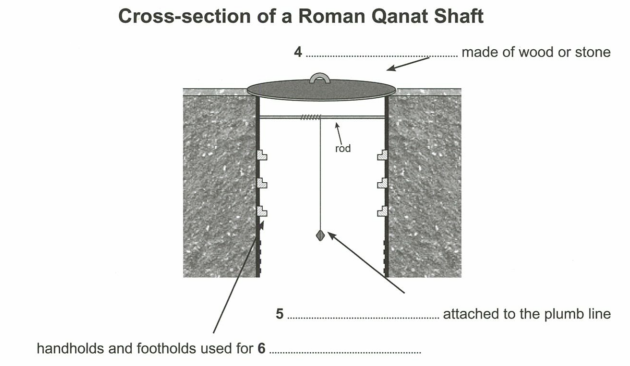
    They later passed on their knowledge to the Romans, who also used the qanat method to construct water-supply tunnels for agriculture. Roman qanat tunnels were constructed with vertical shafts dug at intervals of between 30 and 60 meters. The shafts were equipped with handholds and footholds to help those climbing in and out of them and were covered with a wooden or stone lid. To ensure that the shafts were vertical, Romans hung a plumb line from a rod placed across the top of each shaft and made sure that the weight at the end of it hung in the center of the shaft. Plumb lines were also used to measure the depth of the shaft and to determine the slope of the tunnel. The 5.6-kilometer-long Claudius tunnel, built in 41 CE to drain the Fucine Lake in central Italy, had shafts that were up to 122 meters deep, took 11 years to build and involved approximately 30,000 workers.

    By the 6th century BCE, a second method of tunnel construction appeared called the counter-excavation method, in which the tunnel was constructed from both ends. It was used to cut through high mountains when the qanat method was not a practical alternative. This method required greater planning and advanced knowledge of surveying, mathematics and geometry as both ends of a tunnel had to meet correctly at the center of the mountain. Adjustments to the direction of the tunnel also had to be made whenever builders encountered geological problems or when it deviated from its set path. They constantly checked the tunnel’s advancing direction, for example, by looking back at the light that penetrated through the tunnel mouth, and made corrections whenever necessary. Large deviations could happen, and they could result in one end of the tunnel not being usable. An inscription written on the side of a 428-meter tunnel, built by the Romans as part of the Saldae aqueduct system in modern-day Algeria, describes how the two teams of builders missed each other in the mountain and how the later construction of a lateral link between both corridors corrected the initial error.

    The Romans dug tunnels for their roads using the counter-excavation method, whenever they encountered obstacles such as hills or mountains that were too high for roads to pass over. An example is the 37-meter-long, 6-meter-high, Furlo Pass Tunnel built in Italy in 69-79 CE. Remarkably, a modern road still uses this tunnel today. Tunnels were also built for mineral extraction. Miners would locate a mineral vein and then pursue it with shafts and tunnels underground. Traces of such tunnels used to mine gold can still be found at the Dolaucothi mines in Wales. When the sole purpose of a tunnel was mineral extraction, construction required less planning, as the tunnel route was determined by the mineral vein.

    Roman tunnel projects were carefully planned and carried out. The length of time it took to construct a tunnel depended on the method being used and the type of rock being excavated. The qanat construction method was usually faster than the counter-excavation method as it was more straightforward. This was because the mountain could be excavated not only from the tunnel mouths but also from shafts. The type of rock could also influence construction times. When the rock was hard, the Romans employed a technique called fire quenching which consisted of heating the rock with fire, and then suddenly cooling it with cold water so that it would crack. Progress through hard rock could be very slow, and it was not uncommon for tunnels to take years, if not decades, to be built. Construction marks left on a Roman tunnel in Bologna show that the rate of advance through solid rock was 30 centimeters per day. In contrast, the rate of advance of the Claudius tunnel can be calculated at 1.4 meters per day. Most tunnels had inscriptions showing the names of patrons who ordered construction and sometimes the name of the architect. For example, the 1.4-kilometer Cevlik tunnel in Turkey, built to divert the floodwater threatening the harbor of the ancient city of Seleuceia Pieria, had inscriptions on the entrance, still visible today, that also indicate that the tunnel was started in 69 CE and was completed in 81 CE.

    Questions 1-6
    Label the diagram below. Choose ONE WORD ONLY from the passage for each answer.

    Questions 7-10
    Do the following statements agree with the information given in Reading Passage? In boxes 7-10 on your answer sheet, write

    TRUE                     if the statement agrees with the information
    FALSE                   if the statement contradicts the information
    NOT GIVEN       if there is no information on this

    7. The counter-excavation method completely replaced the qanat method in the 6th century BCE.
    8. Only experienced builders were employed to construct a tunnel using the counter-excavation method.
    9. The information about a problem that occurred during the construction of the Saldae aqueduct system was found in an ancient book.
    10. The mistake made by the builders of the Saldae aqueduct system was that the two parts of the tunnel failed to meet.

    Questions 11-13
    Answer the questions below. Choose NO MORE THAN TWO WORDS from the passage for each answer. Write your answers in boxes 11-13 on your answer sheet.

    11. What type of mineral were the Dolaucothi mines in Wales built to extract?
    12. In addition to the patron, whose name might be carved onto a tunnel?
    13. What part of Seleuceia Pieria was the Qevlik tunnel built to protect?

    Changes in reading habits

    Look around on your next plane trip. The iPad is the new pacifier for babies and toddlers. Younger school-aged children read stories on smartphones; older kids don’t read at all, but hunch over video games. Parents and other passengers read on tablets or skim a flotilla of email and news feeds. Unbeknown to most of us, an invisible, game-changing transformation links everyone in this picture: the neuronal circuit that underlies the brain’s ability to read is subtly, rapidly changing and this has implications for everyone from the pre-reading toddler to the expert adult.

    As work in neurosciences indicates, the acquisition of literacy necessitated a new circuit in our species’ brain more than 6,000 years ago. That circuit evolved from a very simple mechanism for decoding basic information, like the number of goats in one’s herd, to the present, highly elaborated reading brain. My research depicts how the present reading brain enables the development of some of our most important intellectual and affective processes: internalized knowledge, analogical reasoning, and inference; perspective-taking and empathy; critical analysis and the generation of insight. Research surfacing in many parts of the world now cautions that each of these essential ‘deep reading’ processes may be under threat as we move into digital- based modes of reading.

    This is not a simple, binary issue of print versus digital reading and technological innovation. As MIT scholar Sherry Turkle has written, we do not err as a society when we innovate but when we ignore what we disrupt or diminish while innovating. In this hinge moment between print and digital cultures, society needs to confront what is diminishing in the expert reading circuit, what our children and older students are not developing, and what we can do about it.

    We know from research that the reading circuit is not given to human beings through a genetic blueprint like vision or language; it needs an environment to develop. Further, it will adapt to that environment’s requirements – from different writing systems to the characteristics of whatever medium is used. If the dominant medium advantages processes that are fast, multi-task oriented and well-suited for large volumes of information, like the current digital medium, so will the reading circuit. As UCLA psychologist Patricia Greenfield writes, the result is that less attention and time will be allocated to slower, time-demanding deep reading processes.

    Increasing reports from educators and from researchers in psychology and the humanities bear this out. English literature scholar and teacher Mark Edmundson describes how many college students actively avoid the classic literature of the 19th and 20th centuries in favour of something simpler as they no longer have the patience to read longer, denser, more difficult texts. We should be less concerned with students’ ‘cognitive impatience’, however, than by what may underlie it: the potential inability of large numbers of students to read with a level of critical analysis sufficient to comprehend the complexity of thought and argument found in more demanding texts.

    Multiple studies show that digital screen use may be causing a variety of troubling downstream effects on reading comprehension in older high school and college students. In Stavanger, Norway, psychologist Anne Mangen and her colleagues studied how high school students comprehend the same material in different mediums. Mangen’s group asked subjects questions about a short story whose plot had universal student appeal; half of the students read the story on a tablet, the other half in paperback. Results indicated that students who read on print were superior in their comprehension to screen-reading peers, particularly in their ability to sequence detail and reconstruct the plot in chronological order.

    Ziming Liu from San Jose State University has conducted a series of studies which indicate that the ‘new norm’ in reading is skimming, involving word-spotting and browsing through the text. Many readers now use a pattern when reading in which they sample the first line and then word- spot through the rest of the text. When the reading brain skims like this, it reduces time allocated to deep reading processes. In other words, we don’t have time to grasp complexity, to understand another’s feelings, to perceive beauty, and to create thoughts of the reader’s own.

    The possibility that critical analysis, empathy and other deep reading processes could become the unintended ‘collateral damage’ of our digital culture is not a straightforward binary issue about print versus digital reading. It is about how we all have begun to read on various mediums and how that changes not only what we read, but also the purposes for which we read. Nor is it only about the young. The subtle atrophy of critical analysis and empathy affects us all equally. It affects our ability to navigate a constant bombardment of information. It incentivizes a retreat to the most familiar stores of unchecked information, which require and receive no analysis, leaving us susceptible to false information and irrational ideas.

    There’s an old rule in neuroscience that does not alter with age: use it or lose it. It is a very hopeful principle when applied to critical thought in the reading brain because it implies choice. The story of the changing reading brain is hardly finished. We possess both the science and the technology to identify and redress the changes in how we read before they become entrenched. If we work to understand exactly what we will lose, alongside the extraordinary new capacities that the digital world has brought us, there is as much reason for excitement as caution.

    Questions 14-17
    Choose the correct letter, A, B, C or D.

    14. What is the writer’s main point in the first paragraph?
    A Our use of technology is having a hidden effect on us.
    B Technology can be used to help youngsters to read.
    C Travellers should be encouraged to use technology on planes.
    D Playing games is a more popular use of technology than reading.

    15. What main point does Sherry Turkle make about innovation?
    A Technological innovation has led to a reduction in print reading.
    B We should pay attention to what might be lost when innovation occurs.
    C We should encourage more young people to become involved in innovation.
    D There is a difference between developing products and developing ideas.

    16. What point is the writer making in the fourth paragraph?
    A Humans have an inborn ability to read and write.
    B Reading can be done using many different mediums.
    C Writing systems make unexpected demands on the brain.
    D Some brain circuits adjust to whatever is required of them.

    17. According to Mark Edmundson, the attitude of college students
    A has changed the way he teaches.
    B has influenced what they select to read.
    C does not worry him as much as it does others.
    D does not match the views of the general public.

    Questions 18-22
    Complete the summary using the list of words, A-H, below. Write the correct letter, A-H, in boxes 18-22 on your answer sheet.

    Studies on digital screen use

    There have been many studies on digital screen use, showing some (18) ………………… trends. Psychologist Anne Mangen gave high-school students a short story to read, half using digital and half using print mediums. Her team then used a question-and-answer technique to find out how (19) ………………… each group’s understanding of the plot was. The findings showed a clear pattern in the responses, with those who read screens finding the order of information (20) ………………….. to recall. Studies by Ziming Liu show that students are tending to read (21) …………………. words and phrases in a text to save time. This approach, she says, gives the reader a superficial understanding of the (22) …………….content of material, leaving no time for thought.

    A fast
    B isolated
    C emotional
    D worrying
    E many
    F hard
    G combined
    H thorough

    Questions 23-26
    Do the following statements agree with the views of the writer in Reading Passage? In boxes 23-26 on your answer sheet, write

    YES                     if the statement agrees with the views of the writer
    NO                      if the statement contradicts the views of the writer
    NOT GIVEN    if it is impossible to say what the writer thinks about this

    23. The medium we use to read can affect our choice of reading content.
    24. Some age groups are more likely to lose their complex reading skills than others.
    25. False information has become more widespread in today’s digital era.
    26. We still have opportunities to rectify the problems that technology is presenting.

    Attitudes towards Artificial Intelligence

    A Artificial intelligence (AI) can already predict the future. Police forces are using it to map when and where crime is likely to occur. Doctors can use it to predict when a patient is most likely to have a heart attack or stroke. Researchers are even trying to give AI imagination so it can plan for unexpected consequences. Many decisions in our lives require a good forecast, and AI is almost always better at forecasting than we are. Yet for all these technological advances, we still seem to deeply lack confidence in AI predictions. Recent cases show that people don’t like relying on AI and prefer to trust human experts, even if these experts are wrong. If we want AI to really benefit people, we need to find a way to get people to trust it. To do that, we need to understand why people are so reluctant to trust AI in the first place.

    B Take the case of Watson for Oncology, one of technology giant IBM’s supercomputer programs. Their attempt to promote this program to cancer doctors was a PR disaster. The AI promised to deliver top-quality recommendations on the treatment of 12 cancers that accounted for 80% of the world’s cases. But when doctors first interacted with Watson, they found themselves in a rather difficult situation. On the one hand, if Watson provided guidance about a treatment that coincided with their own opinions, physicians did not see much point in Watson’s recommendations. The supercomputer was simply telling them what they already knew, and these recommendations did not change the actual treatment. On the other hand, if Watson generated a recommendation that contradicted the experts’ opinion, doctors would typically conclude that Watson wasn’t competent. And the machine wouldn’t be able to explain why its treatment was plausible because its machine-learning algorithms were simply too complex to be fully understood by humans. Consequently, this has caused even more suspicion and disbelief, leading many doctors to ignore the seemingly outlandish AI recommendations and stick to their own expertise.

    C This is just one example of people’s lack of confidence in AI and their reluctance to accept what AI has to offer. Trust in other people is often based on our understanding of how others think and having experience of their reliability. This helps create a psychological feeling of safety. AI, on the other hand, is still fairly new and unfamiliar to most people. Even if it can be technically explained (and that’s not always the case), AI’s decision-making process is usually too difficult for most people to comprehend. And interacting with something we don’t understand can cause anxiety and give us a sense that we’re losing control. Many people are also simply not familiar with many instances of AI actually working, because it often happens in the background. Instead, they are acutely aware of instances where AI goes wrong. Embarrassing AI failures receive a disproportionate amount of media attention, emphasising the message that we cannot rely on technology. Machine learning is not foolproof, in part because the humans who design it aren’t.

    D Feelings about AI run deep. In a recent experiment, people from a range of backgrounds were given various sci-fi films about AI to watch and then asked questions about automation in everyday life. It was found that, regardless of whether the film they watched depicted AI in a positive or negative light, simply watching a cinematic vision of our technological future polarised the participants’ attitudes. Optimists became more extreme in their enthusiasm for AI and sceptics became even more guarded. This suggests people use relevant evidence about AI in a biased manner to support their existing attitudes, a deep-rooted human tendency known as “confirmation bias”. As AI is represented more and more in media and entertainment, it could lead to a society split between those who benefit from AI and those who reject it. More pertinently, refusing to accept the advantages offered by AI could place a large group of people at a serious disadvantage.

    E Fortunately, we already have some ideas about how to improve trust in AI. Simply having previous experience with AI can significantly improve people’s opinions about the technology, as was found in the study mentioned above. Evidence also suggests the more you use other technologies such as the internet, the more you trust them. Another solution may be to reveal more about the algorithms which AI uses and the purposes they serve. Several high-profile social media companies and online marketplaces already release transparency reports about government requests and surveillance disclosures. A similar practice for AI could help people have a better understanding of the way algorithmic decisions are made.

    F Research suggests that allowing people some control over AI decision-making could also improve trust and enable AI to learn from human experience. For example, one study showed that when people were allowed the freedom to slightly modify an algorithm, they felt more satisfied with its decisions, more likely to believe it was superior and more likely to use it in the future. We don’t need to understand the intricate inner workings of AI systems, but if people are given a degree of responsibility for how they are implemented, they will be more willing to accept AI into their lives.

    Questions 27-32
    Reading Passage 3 has six sections, A-F. Choose the correct heading for each section from the list of headings below. Write the correct number, i-viii, in boxes 27-32 on your answer sheet.

    List of Headings
    i An increasing divergence of attitudes towards Al
    ii Reasons why we have more faith in human judgement than in Al
    iii The superiority of Al projections over those made by humans
    iv The process by which Al can help us make good decisions
    v The advantages of involving users in Al processes
    vi Widespread distrust of an Al innovation
    vii Encouraging openness about how Al functions
    viii A surprisingly successful Al application

    27. Section A
    28. Section B
    29. Section C
    30. Section D
    31. Section E
    32. Section F

    Questions 33-35
    Choose the correct letter, A, B, C or D.

    33. What is the writer doing in Section A?
    A providing a solution to a concern
    B justifying an opinion about an issue
    C highlighting the existence of a problem
    D explaining the reasons for a phenomenon

    34. According to Section C, why might some people be reluctant to accept Al?
    A They are afraid it will replace humans in decision-making jobs.
    B Its complexity makes them feel that they are at a disadvantage.
    C They would rather wait for the technology to be tested over a period of time.
    D Misunderstandings about how it works make it seem more challenging than it is.

    35. What does the writer say about the media in Section C of the text?
    A It leads the public to be mistrustful of Al.
    B It devotes an excessive amount of attention to Al.
    C Its reports of incidents involving Al are often inaccurate.
    D It gives the impression that Al failures are due to designer error.

    Questions 36-40
    Do the following statements agree with the claims of the writer in Reading Passage? In boxes 36-40 on your answer sheet, write

    YES                        if the statement agrees with the claims of the writer
    NO                         if the statement contradicts the claims of the writer
    NOT GIVEN      if it is impossible to say what the writer thinks about this

    36. Subjective depictions of Al in sci-fi films make people change their opinions about automation.
    37. Portrayals of Al in media and entertainment are likely to become more positive.
    38. Rejection of the possibilities of Al may have a negative effect on many people’s lives.
    39. Familiarity with Al has very little impact on people’s attitudes to the technology.
    40. Al applications which users are able to modify are more likely to gain consumer approval.

  • IELTS Reading Practice Test – Exercise 376

    Roman shipbuilding and navigation

    Shipbuilding today is based on science and ships are built using computers and sophisticated tools. Shipbuilding in ancient Rome, however, was more of an art relying on estimation, inherited techniques and personal experience. The Romans were not traditionally sailors but mostly land- based people, who learned to build ships from the people that they conquered, namely the Greeks and the Egyptians.

    There are a few surviving written documents that give descriptions and representations of ancient Roman ships, including the sails and rigging. Excavated vessels also provide some clues about ancient shipbuilding techniques. Studies of these have taught us that ancient Roman shipbuilders built the outer hull first, then proceeded with the frame and the rest of the ship. Planks used to build the outer hull were initially sewn together. Starting from the 6th century BCE, they were fixed using a method called mortise and tenon, whereby one plank locked into another without the need for stitching. Then in the first centuries of the current era, Mediterranean shipbuilders shifted to another shipbuilding method, still in use today, which consisted of building the frame first and then proceeding with the hull and the other components of the ship. This method was more systematic and dramatically shortened ship construction times. The ancient Romans built large merchant ships and warships whose size and technology were unequalled until the 16th century CE.

    Warships were built to be lightweight and very speedy. They had to be able to sail near the coast, which is why they had no ballast or excess load and were built with a long, narrow hull. They did not sink when damaged and often would lie crippled on the sea’s surface following naval battles. They had a bronze battering ram, which was used to pierce the timber hulls or break the oars of enemy vessels. Warships used both wind (sails) and human power (oarsmen) and were therefore very fast. Eventually, Rome’s navy became the largest and most powerful in the Mediterranean, and the Romans had control over what they therefore called Mare Nostrum meaning ‘our sea’.

    There were many kinds of warship. The ‘trireme’ was the dominant warship from the 7th to 4th century BCE. It had rowers in the top, middle and lower levels, and approximately 50 rowers in each bank. The rowers at the bottom had the most uncomfortable position as they were under the other rowers and were exposed to the water entering through the oar-holes. It is worth noting that contrary to popular perception, rowers were not slaves but mostly Roman citizens enrolled in the military. The trireme was superseded by larger ships with even more rowers.

    Merchant ships were built to transport lots of cargo over long distances and at a reasonable cost. They had a wider hull, double planking and a solid interior for added stability. Unlike warships, their V-shaped hull was deep underwater, meaning that they could not sail too close to the coast. They usually had two huge side rudders located off the stern and controlled by a small tiller bar connected to a system of cables. They had from one to three masts with large square sails and a small triangular sail at the bow. Just like warships, merchant ships used oarsmen, but coordinating the hundreds of rowers in both types of ship was not an easy task. In order to assist them, music would be played on an instrument, and oars would then keep time with this.

    The cargo on merchant ships included raw materials (e.g. iron bars, copper, marble and granite), and agricultural products (e.g. grain from Egypt’s Nile valley). During the Empire, Rome was a huge city by ancient standards of about one million inhabitants. Goods from all over the world would come to the city through the port of Pozzuoli situated west of the bay of Naples in Italy and through the gigantic port of Ostia situated at the mouth of the Tiber River. Large merchant ships would approach the destination port and, just like today, be intercepted by a number of towboats that would drag them to the quay.

    The time of travel along the many sailing routes could vary widely. Navigation in ancient Rome did not rely on sophisticated instruments such as compasses but on experience, local knowledge and observation of natural phenomena. In conditions of good visibility, seamen in the Mediterranean often had the mainland or islands in sight, which greatly facilitated navigation. They sailed by noting their position relative to a succession of recognisable landmarks. When weather conditions were not good or where land was no longer visible, Roman mariners estimated directions from the pole star or, with less accuracy, from the Sun at noon. They also estimated directions relative to the wind and swell. Overall, shipping in ancient Roman times resembled shipping today with large vessels regularly crossing the seas and bringing supplies from their Empire.

    Questions 1-5
    Do the following statements agree with the information given in Reading Passage? In boxes 1-5 on your answer sheet, write

    TRUE                    if the statement agrees with the information
    FALSE                  if the statement contradicts the information
    NOT GIVEN       if there is no information on this

    1. The Romans’ shipbuilding skills were passed on to the Greeks and the Egyptians.
    2. Skilled craftsmen were needed for the mortise and tenon method of fixing planks.
    3. The later practice used by Mediterranean shipbuilders involved building the hull before the frame.
    4. The Romans called the Mediterranean Sea Mare Nostrum because they dominated its use.
    5. Most rowers on ships were people from the Roman army.

    Questions 6-13
    Complete the summary below. Choose ONE WORD ONLY from the passage for each answer. Write your answers in boxes 6-13 on your answer sheet.

    Warships and merchant ships

    Warships were designed so that they were (6) ……………….. and moved quickly. They often remained afloat after battles and were able to sail close to land as they lacked any additional weight. A battering ram made of (7) ………………….. was included in the design for attacking and damaging the timber and oars of enemy ships. Warships, such as the ‘trireme’, had rowers on three different (8) ………………… Unlike warships, merchant ships had a broad (9) ………………….. that lay far below the surface of the sea. Merchant ships were steered through the water with the help of large rudders and a tiller bar. They had both square and (10) …………………… sails. On merchant ships and warships, (11) ……………….was used to ensure rowers moved their oars in and out of the water at the same time. Quantities of agricultural goods such as (12) ……………….. were transported by merchant ships to two main ports in Italy. The ships were pulled to the shore by (13) ………………….When the weather was clear and they could see islands or land, sailors used landmarks that they knew to help them navigate their route.

    Climate change reveals ancient artefacts in Norway’s glaciers

    A Well above the treeline in Norway’s highest mountains, ancient fields of ice are shrinking as Earth’s climate warms. As the ice has vanished, it has been giving up the treasures it has preserved in cold storage for the last 6,000 years – items such as ancient arrows and skis from Viking Age traders. And those artefacts have provided archaeologists with some surprising insights into how ancient Norwegians made their livings.

    B Organic materials like textiles and hides are relatively rare finds at archaeological sites. This is because unless they’re protected from the microorganisms that cause decay, they tend not to last long. Extreme cold is one reliable way to keep artefacts relatively fresh for a few thousand years, but once thawed out, these materials experience degradation relatively swiftly. With climate change shrinking ice cover around the world, glacial archaeologists need to race the clock to find newly revealed artefacts, preserve them, and study them. If something fragile dries and is windblown it might very soon be lost to science, or an arrow might be exposed and then covered again by the next snow and remain well-preserved. The unpredictability means that glacial archaeologists have to be systematic in their approach to fieldwork.

    C Over a nine-year period, a team of archaeologists, which included Lars Pilo of Oppland County Council, Norway, and James Barrett of the McDonald Institute for Archaeological Research, surveyed patches of ice in Oppland, an area of south-central Norway that is home to some of the country’s highest mountains. Reindeer once congregated on these icy patches in the later summer months to escape biting insects, and from the late Stone Age**, hunters followed. In addition, trade routes threaded through the mountain passes of Oppland, linking settlements in Norway to the rest of Europe. The slow but steady movement of glaciers tends to destroy anything at their bases, so the team focused on stationary patches of ice, mostly above 1,400 metres. That ice is found amid fields of frost-weathered boulders, fallen rocks, and exposed bedrock that for nine months of the year is buried beneath snow. ‘Fieldwork is hard work – hiking with all our equipment, often camping on permafrost – but very rewarding. You’re rescuing the archaeology, bringing the melting ice to wider attention, discovering a unique environmental history and really connecting with the natural environment,’ says Barrett.

    D At the edges of the contracting ice patches, archaeologists found more than 2,000 artefacts, which formed a material record that ran from 4,000 BCE to the beginnings of the Renaissance in the 14th century. Many of the artefacts are associated with hunting. Hunters would have easily misplaced arrows and they often discarded broken bows rather than take them all the way home. Other items could have been used by hunters traversing the high mountain passes of Oppland: all-purpose items like tools, skis, and horse tack.

    E Barrett’s team radiocarbon-dated 153 of the artefacts and compared those dates to the timing of major environmental changes in the region – such as periods of cooling or warming – and major social and economic shifts – such as the growth of farming settlements and the spread of international trade networks leading up to the Viking Age. They found that some periods had produced lots of artefacts, which indicates that people had been pretty active in the mountains during those times. But there were few or no signs of activity during other periods.

    F What was surprising, according to Barrett, was the timing of these periods. Oppland’s mountains present daunting terrain and in periods of extreme cold, glaciers could block the higher mountain passes and make travel in the upper reaches of the mountains extremely difficult. Archaeologists assumed people would stick to lower elevations during a time like the Late Antique Little Ice Age, a short period of deeper-than-usual cold from about 536-600 CE. But it turned out that hunters kept regularly venturing into the mountains even when the climate turned cold, based on the amount of stuff they had apparently dropped there. ‘Remarkably, though, the finds from the ice may have continued through this period, perhaps suggesting that the importance of mountain hunting increased to supplement failing agricultural harvests in times of low temperatures,’ says Barrett. A colder turn in the Scandinavian climate would likely have meant widespread crop failures, so more people would have depended on hunting to make up for those losses.

    G Many of the artefacts Barrett’s team recovered date from the beginning of the Viking Age, the 700s through to the 900s CE. Trade networks connecting Scandinavia with Europe and the Middle East were expanding around this time. Although we usually think of ships when we think of Scandinavian expansion, these recent discoveries show that plenty of goods travelled on overland routes, like the mountain passes of Oppland. And growing Norwegian towns, along with export markets, would have created a booming demand for hides to fight off the cold, as well as antlers to make useful things like combs. Business must have been good for hunters.

    H Norway’s mountains are probably still hiding a lot of history – and prehistory – in remote ice patches. When Barrett’s team looked at the dates for their sample of 153 artefacts, they noticed a gap with almost no artefacts from about 3,800 to 2,200 BCE. In fact, archaeological finds from that period are rare all over Norway. The researchers say that could be because many of those artefacts have already disintegrated or are still frozen in the ice. That means archaeologists could be extracting some of those artefacts from retreating ice in years to come.

    Questions 14-19
    Reading Passage 2 has eight sections, A-H. Which section contains the following information? Write the correct letter, A-H, in boxes 14-19 on your answer sheet.

    14. an explanation for weapons being left behind in the mountains
    15. a reference to the physical difficulties involved in an archaeological expedition
    16. an explanation of why less food may have been available
    17. a reference to the possibility of future archaeological discoveries
    18. examples of items that would have been traded
    19. a reference to the pressure archaeologists are under to work quickly

    Questions 20-22
    Complete the summary below. Choose ONE WORD ONLY from the passage for each answer. Write your answers in boxes 20-22 on your answer sheet.

    Interesting finds at an archaeological site

    Organic materials such as animal skins and textiles are not discovered very often at archaeological sites. They have little protection against (20) ………………….. , which means that they decay relatively quickly. But this is not always the case. If temperatures are low enough, fragile artefacts can be preserved for thousands of years. A team of archaeologists have been working in the mountains in Oppland in Norway to recover artefacts revealed by shrinking ice cover. In the past, there were trade routes through these mountains and (21) ……………….. gathered there in the summer months to avoid being attacked by (22) ………………. on lower ground. The people who used these mountains left things behind and it is those objects that are of interest to archaeologists.

    Questions 23 and 24
    Choose TWO letters, A-E. Write the correct letters in boxes 23 and 24 on your answer sheet.

    Which TWO of the following statements does the writer make about the discoveries of Barrett’s team?
    A Artefacts found in the higher mountain passes were limited to skiing equipment.
    B Hunters went into the mountains even during periods of extreme cold.
    C The number of artefacts from certain time periods was relatively low.
    D Radiocarbon dating of artefacts produced some unreliable results.
    E More artefacts were found in Oppland than at any other mountain site.

    Questions 25 and 26
    Choose TWO letters, A-E. Write the correct letters in boxes 25 and 26 on your answer sheet.

    Which TWO of the following statements does the writer make about the Viking Age?
    A Hunters at this time benefited from an increased demand for goods.
    B The beginning of the period saw the greatest growth in the wealth of Vikings.
    C Vikings did not rely on ships alone to transport goods.
    D Norwegian towns at this time attracted traders from around the world.
    E Vikings were primarily interested in their trading links with the Middle East.

    Plant ‘thermometer’ triggers springtime growth by measuring night-time heat

    A An international team of scientists led by the University of Cambridge has discovered that the ‘thermometer’ molecule in plants enables them to develop according to seasonal temperature changes. Researchers have revealed that molecules called phytochromes – used by plants to detect light during the day – actually change their function in darkness to become cellular temperature gauges that measure the heat of the night. The new findings, published in the journal Science, show that phytochromes control genetic switches in response to temperature as well as light to dictate plant development.

    B At night, these molecules change states, and the pace at which they change is ‘directly proportional to temperature’, say scientists, who compare phytochromes to mercury in a thermometer. The warmer it is, the faster the molecular change – stimulating plant growth.

    C Farmers and gardeners have known for hundreds of years how responsive plants are to temperature: warm winters cause many trees and flowers to bud early, something humans have long used to predict weather and harvest times for the coming year. The latest research pinpoints for the first time a molecular mechanism in plants that reacts to temperature – often triggering the buds of spring we long to see at the end of winter.

    D With weather and temperatures set to become ever more unpredictable due to climate change, researchers say the discovery that this light-sensing molecule also functions as the internal thermometer in plant cells could help us breed tougher crops. ‘It is estimated that agricultural yields will need to double by 2050, but climate change is a major threat to achieving this. Key crops such as wheat and rice are sensitive to high temperatures. Thermal stress reduces crop yields by around 10% for every one degree increase in temperature,’ says lead researcher Dr Philip Wigge from Cambridge’s Sainsbury Laboratory. ‘Discovering the molecules that allow plants to sense temperature has the potential to accelerate the breeding of crops resilient to thermal stress and climate change.’

    E In their active state, phytochrome molecules bind themselves to DNA to restrict plant growth. During the day, sunlight activates the molecules, slowing down growth. If a plant finds itself in shade, phytochromes are quickly inactivated – enabling it to grow faster to find sunlight again. This is how plants compete to escape each other’s shade. ‘Light-driven changes to phytochrome activity occur very fast, in less than a second,’ says Wigge. At night, however, it’s a different story. Instead of a rapid deactivation following sundown, the molecules gradually change from their active to inactive state. This is called ‘dark reversion’. ‘Just as mercury rises in a thermometer, the rate at which phytochromes revert to their inactive state during the night is a direct measure of temperature,’ says Wigge.

    F ‘The lower the temperature, the slower the rate at which phytochromes revert to inactivity, so the molecules spend more time in their active, growth-suppressing state. This is why plants are slower to grow in winter. Warm temperatures accelerate dark reversion, so that phytochromes rapidly reach an inactive state and detach themselves from the plant’s DNA – allowing genes to be expressed and plant growth to resume.’ Wigge believes phytochrome thermo-sensing evolved at a later stage, and co-opted the biological network already used for light-based growth during the downtime of night.

    G Some plants mainly use day length as an indicator of the season. Other species, such as daffodils, have considerable temperature sensitivity, and can flower months in advance during a warm winter. In fact, the discovery of the dual role of phytochromes provides the science behind a well-known rhyme long used to predict the coming season: oak before ash we’ll have a splash, ash before oak we’re in for a soak. Wigge explains: ‘Oak trees rely much more on temperature, likely using phytochromes as thermometers to dictate development, whereas ash trees rely on measuring day length to determine their seasonal timing. A warmer spring, and consequently a higher likeliness of a hot summer, will result in oak leafing before ash. A cold spring will see the opposite. As the British know only too well, a colder summer is likely to be a rain-soaked one.’

    H The new findings are the culmination of twelve years of research involving scientists from Germany, Argentina and the US, as well as the Cambridge team. The work was done in a model system, using a mustard plant called Arabidopsis, but Wigge says the phytochrome genes necessary for temperature sensing are found in crop plants as well. ‘Recent advances in plant genetics now mean that scientists are able to rapidly identify the genes controlling these processes in crop plants, and even alter their activity using precise molecular “scalpels”,’ adds Wigge. ‘Cambridge is uniquely well-positioned to do this kind of research as we have outstanding collaborators nearby who work on more applied aspects of plant biology, and can help us transfer this new knowledge into the field.’

    Questions 27 – 32
    Do the following statements agree with the information given in Reading Passage? In boxes 27-32 on your answer sheet, write

    TRUE                     if the statement agrees with the information
    FALSE                   if the statement contradicts the information
    NOT GIVEN       if there is no information on this

    27. The Cambridge scientists’ discovery of the ‘thermometer molecule’ caused surprise among other scientists.
    28. The target for agricultural production by 2050 could be missed.
    29. Wheat and rice suffer from a rise in temperatures.
    30. It may be possible to develop crops that require less water.
    31. Plants grow faster in sunlight than in shade.
    32. Phytochromes change their state at the same speed day and night.

    Questions 33-37
    Reading Passage 3 has eight sections, A-H. Which section contains the following information? Write the correct letter, A-H, in boxes 33-37 on your answer sheet.

    33. mention of specialists who can make use of the research findings
    34. a reference to a potential benefit of the research findings
    35. scientific support for a traditional saying
    36. a reference to people traditionally making plans based on plant behaviour
    37. a reference to where the research has been reported

    Questions 38-40
    Complete the sentences below. Choose NO MORE THAN TWO WORDS from the passage for each answer.
    Write your answers in boxes 38-40 on your answer sheet.

    38. Daffodils are likely to flower early in response to …………………… weather.
    39. If ash trees come into leaf before oak trees, the weather in …………………. will probably be wet.
    40. The research was carried out using a particular species of ……………………..

  • IELTS Reading Practice Test – Exercise 375

    The White Horse of Uffington

    The cutting of huge figures or ‘geoglyphs’ into the earth of English hillsides has taken place for more than 3,000 years. There are 56 hill figures scattered around England, with the vast majority on the chalk downlands of the country’s southern counties. The figures include giants, horses, crosses and regimental badges. Although the majority of these geoglyphs date within the last 300 years or so, there are one or two that are much older.

    The most famous of these figures is perhaps also the most mysterious – the Uffington White Horse in Oxfordshire. The White Horse has recently been re-dated and shown to be even older than its previously assigned ancient pre-Roman Iron Age date. More controversial is the date of the enigmatic Long Man of Wilmington in Sussex. While many historians are convinced the figure is prehistoric, others believe that it was the work of an artistic monk from a nearby priory and was created between the 11th and 15th centuries.

    The method of cutting these huge figures was simply to remove the overlying grass to reveal the gleaming white chalk below. However, the grass would soon grow over the geoglyph again unless it was regularly cleaned or scoured by a fairly large team of people. One reason that the vast majority of hill figures have disappeared is that when the traditions associated with the figures faded, people no longer bothered or remembered to clear away the grass to expose the chalk outline. Furthermore, over hundreds of years the outlines would sometimes change due to people not always cutting in exactly the same place, thus creating a different shape to the original geoglyph. The fact that any ancient hill figures survive at all in England today is testament to the strength and continuity of local customs and beliefs which, in one case at least, must stretch back over millennia.

    The Uffington White Horse is a unique, stylised representation of a horse consisting of a long, sleek back, thin disjointed legs, a streaming tail, and a bird-like beaked head. The elegant creature almost melts into the landscape. The horse is situated 2.5 km from Uffington village on a steep slope close to the Late Bronze Age* (c. 7th century BCE) hillfort of Uffington Castle and below the Ridgeway, a long-distance Neolithic** track.

    The Uffington Horse is also surrounded by Bronze Age burial mounds. It is not far from the Bronze Age cemetery of Lambourn Seven Barrows, which consists of more than 30 well-preserved burial mounds. The carving has been placed in such a way as to make it extremely difficult to see from close quarters, and like many geoglyphs is best appreciated from the air. Nevertheless, there are certain areas of the Vale of the White Horse, the valley containing and named after the enigmatic creature, from which an adequate impression may be gained. Indeed on a clear day the carving can be seen from up to 30 km away.

    The earliest evidence of a horse at Uffington is from the 1070s CE when ‘White Horse Hill’ is mentioned in documents from the nearby Abbey of Abingdon, and the first reference to the horse itself is soon after, in 1190 CE. However, the carving is believed to date back much further than that. Due to the similarity of the Uffington White Horse to the stylised depictions of horses on 1st century BCE coins, it had been thought that the creature must also date to that period.

    However, in 1995 Optically Stimulated Luminescence (OSL) testing was carried out by the Oxford Archaeological Unit on soil from two of the lower layers of the horse’s body, and from another cut near the base. The result was a date for the horse’s construction somewhere between 1400 and 600 BCE – in other words, it had a Late Bronze Age or Early Iron Age origin.

    The latter end of this date range would tie the carving of the horse in with occupation of the nearby Uffington hillfort, indicating that it may represent a tribal emblem marking the land of the inhabitants of the hillfort. Alternatively, the carving may have been carried out during a Bronze or Iron Age ritual. Some researchers see the horse as representing the Celtic*** horse goddess Epona, who was worshipped as a protector of horses, and for her associations with fertility. However, the cult of Epona was not imported from Gaul (France) until around the first century CE. This date is at least six centuries after the Uffington Horse was probably carved. Nevertheless, the horse had great ritual and economic significance during the Bronze and Iron Ages, as attested by its depictions on jewellery and other metal objects. It is possible that the carving represents a goddess in native mythology, such as Rhiannon, described in later Welsh mythology as a beautiful woman dressed in gold and riding a white horse.

    The fact that geoglyphs can disappear easily, along with their associated rituals and meaning, indicates that they were never intended to be anything more than temporary gestures. But this does not lessen their importance. These giant carvings are a fascinating glimpse into the minds of their creators and how they viewed the landscape in which they lived.

    Questions 1-8
    Do the following statements agree with the information given in Reading Passage? In boxes 1-8 on your answer sheet, write

    TRUE                  if the statement agrees with the information
    FALSE                if the statement contradicts the information
    NOT GIVEN     if there is no information on this

    1. Most geoglyphs in England are located in a particular area of the country.
    2. There are more geoglyphs in the shape of a horse than any other creature.
    3. A recent dating of the Uffington White Horse indicates that people were mistaken about its age.
    4. Historians have come to an agreement about the origins of the Long Man of Wilmington.
    5. Geoglyphs were created by people placing white chalk on the hillside.
    6. Many geoglyphs in England are no longer visible.
    7. The shape of some geoglyphs has been altered over time.
    8. The fame of the Uffington White Horse is due to its size.

    Questions 9-13
    Complete the notes below. Choose ONE WORD ONLY from the passage for each answer. Write your answers in boxes 9-13 on your answer sheet.

    The Uffington White Horse
    The location of the Uffington White Horse:
    • a distance of 2.5 km from Uffington village
    • near an ancient road known as the (9) ………………..
    • close to an ancient cemetery that has a number of burial mounds

    Dating the Uffington White Horse:
    • first reference to White Horse Hill appears in (10) ………………….. from the 1070s
    • horses shown on coins from the period 100 BCE – 1 BCE are similar in appearance
    • according to analysis of the surrounding (11) ………………….. the Horse is Late Bronze Age / Early Iron Age

    Possible reasons for creation of the Uffington White Horse:
    • an emblem to indicate land ownership
    • formed part of an ancient ritual
    • was a representation of goddess Epona – associated with protection of horses and (12) ………………..
    • was a representation of a Welsh goddess called (13) …………………

    I contain multitudes

    Microbes, most of them bacteria, have populated this planet since long before animal life developed and they will outlive us. Invisible to the naked eye, they are ubiquitous. They inhabit the soil, air, rocks and water and are present within every form of life, from seaweed and coral to dogs and humans. And, as Yong explains in his utterly absorbing and hugely important book, we mess with them at our peril.

    Every species has its own colony of microbes, called a ‘microbiome’, and these microbes vary not only between species but also between individuals and within different parts of each individual. What is amazing is that while the number of human cells in the average person is about 30 trillion, the number of microbial ones is higher – about 39 trillion. At best, Yong informs us, we are only 50 per cent human. Indeed, some scientists even suggest we should think of each species and its microbes as a single unit, dubbed a ‘holobiont’.

    In each human there are microbes that live only in the stomach, the mouth or the armpit and by and large they do so peacefully. So ‘bad’ microbes are just microbes out of context. Microbes that sit contentedly in the human gut (where there are more microbes than there are stars in the galaxy) can become deadly if they find their way into the bloodstream. These communities are constantly changing too. The right hand shares just one sixth of its microbes with the left hand. And, of course, we are surrounded by microbes. Every time we eat, we swallow a million microbes in each gram of food; we are continually swapping microbes with other humans, pets and the world at large.

    It’s a fascinating topic and Yong, a young British science journalist, is an extraordinarily adept guide. Writing with lightness and panache, he has a knack of explaining complex science in terms that are both easy to understand and totally enthralling. Yong is on a mission. Leading us gently by the hand, he takes us into the world of microbes – a bizarre, alien planet – in a bid to persuade us to love them as much as he does. By the end, we do.

    For most of human history we had no idea that microbes existed. The first man to see these extraordinarily potent creatures was a Dutch lens-maker called Antony van Leeuwenhoek in the 1670s. Using microscopes of his own design that could magnify up to 270 times, he examined a drop of water from a nearby lake and found it teeming with tiny creatures he called ‘animalcules’. It wasn’t until nearly two hundred years later that the research of French biologist Louis Pasteur indicated that some microbes caused disease. It was Pasteur’s ‘germ theory’ that gave bacteria the poor image that endures today.

    Yong’s book is in many ways a plea for microbial tolerance, pointing out that while fewer than one hundred species of bacteria bring disease, many thousands more play a vital role in maintaining our health. The book also acknowledges that our attitude towards bacteria is not a simple one. We tend to see the dangers posed by bacteria, yet at the same time we are sold yoghurts and drinks that supposedly nurture ‘friendly’ bacteria. In reality, says Yong, bacteria should not be viewed as either friends or foes, villains or heroes. Instead we should realise we have a symbiotic relationship, that can be mutually beneficial or mutually destructive.

    What then do these millions of organisms do? The answer is pretty much everything. New research is now unravelling the ways in which bacteria aid digestion, regulate our immune systems, eliminate toxins, produce vitamins, affect our behaviour and even combat obesity. ‘They actually help us become who we are,’ says Yong. But we are facing a growing problem. Our obsession with hygiene, our overuse of antibiotics and our unhealthy, low-fibre diets are disrupting the bacterial balance and may be responsible for soaring rates of allergies and immune problems, such as inflammatory bowel disease (IBD).

    The most recent research actually turns accepted norms upside down. For example, there are studies indicating that the excessive use of household detergents and antibacterial products actually destroys the microbes that normally keep the more dangerous germs at bay. Other studies show that keeping a dog as a pet gives children early exposure to a diverse range of bacteria, which may help protect them against allergies later.

    The readers of Yong’s book must be prepared for a decidedly unglamorous world. Among the less appealing case studies is one about a fungus that is wiping out entire populations of frogs and that can be halted by a rare microbial bacterium. Another is about squid that carry luminescent bacteria that protect them against predators. However, if you can overcome your distaste for some of the investigations, the reasons for Yong’s enthusiasm become clear. The microbial world is a place of wonder. Already, in an attempt to stop mosquitoes spreading dengue fever – a disease that infects 400 million people a year – mosquitoes are being loaded with a bacterium to block the disease. In the future, our ability to manipulate microbes means we could construct buildings with useful microbes built into their walls to fight off infections. Just imagine a neonatal hospital ward coated in a specially mixed cocktail of microbes so that babies get the best start in life.

    Questions 14-16
    Choose the correct letter, A, B, C or D.

    14. What point does the writer make about microbes in the first paragraph?
    A They adapt quickly to their environment.
    B The risk they pose has been exaggerated.
    C They are more plentiful in animal life than plant life.
    D They will continue to exist for longer than the human race.

    15. In the second paragraph, the writer is impressed by the fact that
    A each species tends to have vastly different microbes.
    B some parts of the body contain relatively few microbes.
    C the average individual has more microbial cells than human ones.
    D scientists have limited understanding of how microbial cells behave.

    16. What is the writer doing in the fifth paragraph?
    A explaining how a discovery was made
    B comparing scientists’ theories about microbes
    C describing confusion among scientists
    D giving details of how microbes cause disease

    Questions 17-20
    Complete the summary using the list of words, A-H, below. Write the correct letter, A-H, in boxes 17-20 on your answer sheet.

    We should be more tolerant of microbes

    Yong’s book argues that we should be more tolerant of microbes. Many have a beneficial effect, and only a relatively small number lead to (17) ……………….. And although it is misleading to think of microbes as ‘friendly’, we should also stop thinking of them as the enemy. In fact, we should accept that our relationship with microbes is one based on (18) ……………… New research shows that microbes have numerous benefits for humans. Amongst other things, they aid digestion, remove poisons, produce vitamins and may even help reduce obesity. However, there is a growing problem. Our poor (19) ………………, our overuse of antibiotics, and our excessive focus on (20) ……………………. are upsetting the bacterial balance and may be contributing to the huge increase in allergies and immune system problems.

    A solution
    B partnership
    C destruction
    D exaggeration
    E cleanliness
    F regulations
    G illness
    H nutrition

    Questions 21-26
    Do the following statements agree with the claims of the writer in Reading Passage? In boxes 21-26 on your answer sheet, write

    YES                      if the statement agrees with the claims of the writer
    NO                       if the statement contradicts the claims of the writer
    NOT GIVEN    if it is impossible to say what the writer thinks about this

    21. It is possible that using antibacterial products in the home fails to have the desired effect.
    22. It is a good idea to ensure that children come into contact with as few bacteria as possible.
    23. Yong’s book contains more case studies than are necessary.
    24. The case study about bacteria that prevent squid from being attacked may have limited appeal.
    25. Efforts to control dengue fever have been surprisingly successful.
    26. Microbes that reduce the risk of infection have already been put inside the walls of some hospital wards.

    How to make wise decisions

    Across cultures, wisdom has been considered one of the most revered human qualities. Although the truly wise may seem few and far between, empirical research examining wisdom suggests that it isn’t an exceptional trait possessed by a small handful of bearded philosophers after all – in fact, the latest studies suggest that most of us have the ability to make wise decisions, given the right context.

    ‘It appears that experiential, situational, and cultural factors are even more powerful in shaping wisdom than previously imagined,’ says Associate Professor Igor Grossmann of the University of Waterloo in Ontario, Canada. ‘Recent empirical findings from cognitive, developmental, social, and personality psychology cumulatively suggest that people’s ability to reason wisely varies dramatically across experiential and situational contexts. Understanding the role of such contextual factors offers unique insights into understanding wisdom in daily life, as well as how it can be enhanced and taught.’

    It seems that it’s not so much that some people simply possess wisdom and others lack it, but that our ability to reason wisely depends on a variety of external factors. ‘It is impossible to characterize thought processes attributed to wisdom without considering the role of contextual factors,’ explains Grossmann. ‘In other words, wisdom is not solely an “inner quality” but rather unfolds as a function of situations people happen to be in. Some situations are more likely to promote wisdom than others.’

    Coming up with a definition of wisdom is challenging, but Grossmann and his colleagues have identified four key characteristics as part of a framework of wise reasoning. One is intellectual humility or recognition of the limits of our own knowledge, and another is appreciation of perspectives wider than the issue at hand. Sensitivity to the possibility of change in social relations is also key, along with compromise or integration of different attitudes and beliefs.

    Grossmann and his colleagues have also found that one of the most reliable ways to support wisdom in our own day-to-day decisions is to look at scenarios from a third-party perspective, as though giving advice to a friend. Research suggests that when adopting a first-person viewpoint we focus on ‘the focal features of the environment’ and when we adopt a third-person, ‘observer’ viewpoint we reason more broadly and focus more on interpersonal and moral ideals such as justice and impartiality. Looking at problems from this more expansive viewpoint appears to foster cognitive processes related to wise decisions.

    What are we to do, then, when confronted with situations like a disagreement with a spouse or negotiating a contract at work, that require us to take a personal stake? Grossmann argues that even when we aren’t able to change the situation, we can still evaluate these experiences from different perspectives.

    For example, in one experiment that took place during the peak of a recent economic recession, graduating college seniors were asked to reflect on their job prospects. The students were instructed to imagine their career either ‘as if you were a distant observer’ or ‘before your own eyes as if you were right there’. Participants in the group assigned to the ‘distant observer’ role displayed more wisdom-related reasoning (intellectual humility and recognition of change) than did participants in the control group.

    In another study, couples in long-term romantic relationships were instructed to visualize an unresolved relationship conflict either through the eyes of an outsider or from their own perspective. Participants then discussed the incident with their partner for 10 minutes, after which they wrote down their thoughts about it. Couples in the ‘other’s eyes’ condition were significantly more likely to rely on wise reasoning – recognizing others’ perspectives and searching for a compromise – compared to the couples in the egocentric condition.

    ‘Ego-decentering promotes greater focus on others and enables a bigger picture, conceptual view of the experience, affording recognition of intellectual humility and change,’ says Grossmann.

    We might associate wisdom with intelligence or particular personality traits, but research shows only a small positive relationship between wise thinking and crystallized intelligence and the personality traits of openness and agreeableness. ‘It is remarkable how much people can vary in their wisdom from one situation to the next, and how much stronger such contextual effects are for understanding the relationship between wise judgment and its social and affective outcomes as compared to the generalized “traits”,’ Grossmann explains. ‘That is, knowing how wisely a person behaves in a given situation is more informative for understanding their emotions or likelihood to forgive [or] retaliate as compared to knowing whether the person may be wise “in general”.’

    Questions 27-30
    Choose the correct letter, A, B, C or D.

    27. What point does the writer make in the first paragraph?
    A Wisdom appears to be unique to the human race.
    B A basic assumption about wisdom may be wrong.
    C Concepts of wisdom may depend on the society we belong to.
    D There is still much to be discovered about the nature of wisdom.

    28. What does Igor Grossmann suggest about the ability to make wise decisions?
    A It can vary greatly from one person to another.
    B Earlier research into it was based on unreliable data.
    C The importance of certain influences on it was underestimated.
    D Various branches of psychology define it according to their own criteria.

    29. According to the third paragraph, Grossmann claims that the level of wisdom an individual shows
    A can be greater than they think it is.
    B will be different in different circumstances.
    C may be determined by particular aspects of their personality.
    D should develop over time as a result of their life experiences.

    30. What is described in the fifth paragraph?
    A a difficulty encountered when attempting to reason wisely
    B an example of the type of person who is likely to reason wisely
    C a controversial view about the benefits of reasoning wisely
    D a recommended strategy that can help people to reason wisely

    Questions 31-35
    Complete the summary using the list of words, A-J, below. Write the correct letter, A-J, in boxes 31-35 on your answer sheet.

    The characteristics of wise reasoning

    Igor Grossmann and colleagues have established four characteristics which enable us to make wise decisions. It is important to have a certain degree of (31) …………………. regarding the extent of our knowledge, and to take into account (32) ………………….. which may not be the same as our own. We should also be able to take a broad (33) …………………… of any situation. Another key characteristic is being aware of the likelihood of alterations in the way that people relate to each other. Grossmann also believes that it is better to regard scenarios with (34) ………………….. By avoiding the first-person perspective, we focus more on (35) …………………… and on other moral ideals, which in turn leads to wiser decision-making.

    A opinions
    B confidence
    C view
    D modesty
    E problems
    F objectivity
    G fairness
    H experiences
    I range
    J reasons

    Questions 36-40
    Do the following statements agree with the information given in Reading Passage? In boxes 36-40 on your answer sheet, write

    TRUE                    if the statement agrees with the information
    FALSE                  if the statement contradicts the information
    NOT GIVEN       if there is no information on this

    36. Students participating in the job prospects experiment could choose one of two perspectives to take.
    37. Participants in the couples experiment were aware that they were taking part in a study about wise reasoning.
    38. In the couples experiments, the length of the couples’ relationships had an impact on the results.
    39. In both experiments, the participants who looked at the situation from a more detached viewpoint tended to make wiser decisions.
    40. Grossmann believes that a person’s wisdom is determined by their intelligence to only a very limited extent.

  • IELTS Reading Practice Test – Exercise 374

    Why we need to protect polar bears

    Polar bears are being increasingly threatened by the effects of climate change, but their disappearance could have far-reaching consequences. They are uniquely adapted to the extreme conditions of the Arctic Circle, where temperatures can reach -40°C. One reason for this is that they have up to 11 centimetres of fat underneath their skin. Humans with comparative levels of adipose tissue would be considered obese and would be likely to suffer from diabetes and heart disease. Yet the polar bear experiences no such consequences.

    A 2014 study by Shi Ping Liu and colleagues sheds light on this mystery. They compared the genetic structure of polar bears with that of their closest relatives from a warmer climate, the brown bears. This allowed them to determine the genes that have allowed polar bears to survive in one of the toughest environments on Earth. Liu and his colleagues found the polar bears had a gene known as APoB, which reduces levels of low-density lipoproteins (LDLs) – a form of ‘bad’ cholesterol. In humans, mutations of this gene are associated with increased risk of heart disease. Polar bears may therefore be an important study model to understand heart disease in humans.

    The genome of the polar bear may also provide the solution for another condition, one that particularly affects our older generation: osteoporosis. This is a disease where bones show reduced density, usually caused by insufficient exercise, reduced calcium intake or food starvation. Bone tissue is constantly being remodelled, meaning that bone is added or removed, depending on nutrient availability and the stress that the bone is under. Female polar bears, however, undergo extreme conditions during every pregnancy. Once autumn comes around, these females will dig maternity dens in the snow and will remain there throughout the winter, both before and after the birth of their cubs. This process results in about six months of fasting, where the female bears have to keep themselves and their cubs alive, depleting their own calcium and calorie reserves. Despite this, their bones remain strong and dense.

    Physiologists Alanda Lennox and Allen Goodship found an explanation for this paradox in 2008. They discovered that pregnant bears were able to increase the density of their bones before they started to build their dens. In addition, six months later, when they finally emerged from the den with their cubs, there was no evidence of significant loss of bone density. Hibernating brown bears do not have this capacity and must therefore resort to major bone reformation in the following spring. If the mechanism of bone remodelling in polar bears can be understood, many bedridden humans, and even astronauts, could potentially benefit.

    The medical benefits of the polar bear for humanity certainly have their importance in our conservation efforts, but these should not be the only factors taken into consideration. We tend to want to protect animals we think are intelligent and possess emotions, such as elephants and primates. Bears, on the other hand, seem to be perceived as stupid and in many cases violent. And yet anecdotal evidence from the field challenges those assumptions, suggesting for example that polar bears have good problem-solving abilities. A male bear called GoGo in Tennoji Zoo, Osaka, has even been observed making use of a tool to manipulate his environment. The bear used a tree branch on multiple occasions to dislodge a piece of meat hung out of his reach. Problem-solving ability has also been witnessed in wild polar bears, although not as obviously as with GoGo. A calculated move by a male bear involved running and jumping onto barrels in an attempt to get to a photographer standing on a platform four metres high.

    In other studies, such as one by Alison Ames in 2008, polar bears showed deliberate and focussed manipulation. For example, Ames observed bears putting objects in piles and then knocking them over in what appeared to be a game. The study demonstrates that bears are capable of agile and thought-out behaviours. These examples suggest bears have greater creativity and problem-solving abilities than previously thought.

    As for emotions, while the evidence is once again anecdotal, many bears have been seen to hit out at ice and snow – seemingly out of frustration – when they have just missed out on a kill. Moreover, polar bears can form unusual relationships with other species, including playing with the dogs used to pull sleds in the Arctic. Remarkably, one hand-raised polar bear called Agee has formed a close relationship with her owner Mark Dumas to the point where they even swim together. This is even more astonishing since polar bears are known to actively hunt humans in the wild.

    If climate change were to lead to their extinction, this would mean not only the loss of potential breakthroughs in human medicine, but more importantly, the disappearance of an intelligent, majestic animal.

    Questions 1-7
    Do the following statements agree with the information given in Reading Passage? In boxes 1-7 on your answer sheet, write

    TRUE                       if the statement agrees with the information
    FALSE                    if the statement contradicts the information
    NOT GIVEN        if there is no information on this

    1. Polar bears suffer from various health problems due to the build-up of fat under their skin.
    2. The study done by Liu and his colleagues compared different groups of polar bears.
    3. Liu and colleagues were the first researchers to compare polar bears and brown bears genetically.
    4. Polar bears are able to control their levels of ‘bad’ cholesterol by genetic means.
    5. Female polar bears are able to survive for about six months without food.
    6. It was found that the bones of female polar bears were very weak when they came out of their dens in spring.
    7. The polar bear’s mechanism for increasing bone density could also be used by people one day.

    Questions 8-13
    Complete the table below. Choose ONE WORD ONLY from the passage for each answer. Write your answers in boxes 8-13 on your answer sheet.

    Reasons why polar bears should be protected
    People think of bears as unintelligent and (8) ……………………

    However, this may not be correct. For example:
    • In Tennoji Zoo, a bear has been seen using a branch as a (9) …………………… This allowed him to knock down some (10) ……………………
    • A wild polar bear worked out a method of reaching a platform where a (11) …………… was located.
    • Polar bears have displayed behaviour such as conscious manipulation of objects and activity similar to a (12) ……………………….

    Bears may also display emotions. For example:
    • They may make movements suggesting (13) ……………… if disappointed when hunting.

    The Step Pyramid of Djoser

    A The pyramids are the most famous monuments of ancient Egypt and still hold enormous interest for people in the present day. These grand, impressive tributes to the memory of the Egyptian kings have become linked with the country even though other cultures, such as the Chinese and Mayan, also built pyramids. The evolution of the pyramid form has been written and argued about for centuries. However, there is no question that, as far as Egypt is concerned, it began with one monument to one king designed by one brilliant architect: the Step Pyramid of Djoser at Saqqara.

    B Djoser was the first king of the Third Dynasty of Egypt and the first to build in stone. Prior to Djoser’s reign, tombs were rectangular monuments made of dried clay brick, which covered underground passages where the deceased person was buried. For reasons which remain unclear, Djoser’s main official, whose name was Imhotep, conceived of building a taller, more impressive tomb for his king by stacking stone slabs on top of one another, progressively making them smaller, to form the shape now known as the Step Pyramid. Djoser is thought to have reigned for 19 years, but some historians and scholars attribute a much longer time for his rule, owing to the number and size of the monuments he built.

    C The Step Pyramid has been thoroughly examined and investigated over the last century, and it is now known that the building process went through many different stages. Historian Marc Van de Mieroop comments on this, writing ‘Much experimentation was involved, which is especially clear in the construction of the pyramid in the center of the complex. It had several plans … before it became the first Step Pyramid in history, piling six levels on top of one another … The weight of the enormous mass was a challenge for the builders, who placed the stones at an inward incline in order to prevent the monument breaking up.’

    D When finally completed, the Step Pyramid rose 62 meters high and was the tallest structure of its time. The complex in which it was built was the size of a city in ancient Egypt and included a temple, courtyards, shrines, and living quarters for the priests. It covered a region of 16 hectares and was surrounded by a wall 10.5 meters high. The wall had 13 false doors cut into it with only one true entrance cut into the south-east corner; the entire wall was then ringed by a trench 750 meters long and 40 meters wide. The false doors and the trench were incorporated into the complex to discourage unwanted visitors. If someone wished to enter, he or she would have needed to know in advance how to find the location of the true opening in the wall. Djoser was so proud of his accomplishment that he broke the tradition of having only his own name on the monument and had Imhotep’s name carved on it as well.

    E The burial chamber of the tomb, where the king’s body was laid to rest, was dug beneath the base of the pyramid, surrounded by a vast maze of long tunnels that had rooms off them to discourage robbers. One of the most mysterious discoveries found inside the pyramid was a large number of stone vessels. Over 40,000 of these vessels, of various forms and shapes, were discovered in storerooms off the pyramid’s underground passages. They are inscribed with the names of rulers from the First and Second Dynasties of Egypt and made from different kinds of stone. There is no agreement among scholars and archaeologists on why the vessels were placed in the tomb of Djoser or what they were supposed to represent. The archaeologist Jean-Philippe Lauer, who excavated most of the pyramid and complex, believes they were originally stored and then given a ‘proper burial’ by Djoser in his pyramid to honor his predecessors. There are other historians, however, who claim the vessels were dumped into the shafts as yet another attempt to prevent grave robbers from getting to the king’s burial chamber.

    F Unfortunately, all of the precautions and intricate design of the underground network did not prevent ancient robbers from finding a way in. Djoser’s grave goods, and even his body, were stolen at some point in the past and all archaeologists found were a small number of his valuables overlooked by the thieves. There was enough left throughout the pyramid and its complex, however, to astonish and amaze the archaeologists who excavated it.

    G Egyptologist Miroslav Verner writes, ‘Few monuments hold a place in human history as significant as that of the Step Pyramid in Saqqara. It can be said without exaggeration that this pyramid complex constitutes a milestone in the evolution of monumental stone architecture in Egypt and in the world as a whole.’ The Step Pyramid was a revolutionary advance in architecture and became the archetype which all the other great pyramid builders of Egypt would follow.

    Questions 14-20
    Reading Passage 2 has seven paragraphs, A-G. Choose the correct heading for each paragraph from the list of headings below. Write the correct number, i-ix, in boxes 14-20 on your answer sheet.

    List of Headings
    i The areas and artefacts within the pyramid itself
    ii A difficult task for those involved
    iii A king who saved his people
    iv A single certainty among other less definite facts
    v An overview of the external buildings and areas
    vi A pyramid design that others copied
    vii An idea for changing the design of burial structures
    viii An incredible experience despite the few remains ix The answers to some unexpected questions

    14. Paragraph A
    15. Paragraph B
    16. Paragraph C
    17. Paragraph D
    18. Paragraph E
    19. Paragraph F
    20. Paragraph G

    Questions 21-24
    Complete the notes below. Choose ONE WORD ONLY from the passage for each answer. Write your answers in boxes 21-24 on your answer sheet.

    The Step Pyramid of Djoser

    The complex that includes the Step Pyramid and its surroundings is considered to be as big as an Egyptian (21) ……………… of the past. The area outside the pyramid included accommodation that was occupied by (22) …………………, long with many other buildings and features. A wall ran around the outside of the complex and a number of false entrances were built into this. In addition, a long (23) …………….. encircled the wall. As a result, any visitors who had not been invited were cleverly prevented from entering the pyramid grounds unless they knew the (24) ………………….. of the real entrance.

    Questions 25-26
    Choose TWO letters, A-E. Write the correct letters in boxes 25 and 26 on your answer sheet.

    Which TWO of the following points does the writer make about King Djoser?
    A Initially he had to be persuaded to build in stone rather than clay.
    B There is disagreement concerning the length of his reign.
    C He failed to appreciate Imhotep’s part in the design of the Step Pyramid.
    D A few of his possessions were still in his tomb when archaeologists found it.
    E He criticised the design and construction of other pyramids in Egypt.

    The future of work

    According to a leading business consultancy, 3-14% of the global workforce will need to switch to a different occupation within the next 10-15 years, and all workers will need to adapt as their occupations evolve alongside increasingly capable machines. Automation – or ‘embodied artificial intelligence’ (AI) – is one aspect of the disruptive effects of technology on the labour market. ‘Disembodied AI’, like the algorithms running in our smartphones, is another.

    Dr Stella Pachidi from Cambridge Judge Business School believes that some of the most fundamental changes are happening as a result of the ‘algorithmication’ of jobs that are dependent on data rather than on production – the so-called knowledge economy. Algorithms are capable of learning from data to undertake tasks that previously needed human judgement, such as reading legal contracts, analysing medical scans and gathering market intelligence.

    ‘In many cases, they can outperform humans,’ says Pachidi. ‘Organisations are attracted to using algorithms because they want to make choices based on what they consider is “perfect information”, as well as to reduce costs and enhance productivity.’

    ‘But these enhancements are not without consequences,’ says Pachidi. ‘If routine cognitive tasks are taken over by AI, how do professions develop their future experts?’ she asks. ‘One way of learning about a job is “legitimate peripheral participation” – a novice stands next to experts and learns by observation. If this isn’t happening, then you need to find new ways to learn.’

    Another issue is the extent to which the technology influences or even controls the workforce. For over two years, Pachidi monitored a telecommunications company. ‘The way telecoms salespeople work is through personal and frequent contact with clients, using the benefit of experience to assess a situation and reach a decision. However, the company had started using a[n] … algorithm that defined when account managers should contact certain customers about which kinds of campaigns and what to offer them.’

    The algorithm – usually built by external designers – often becomes the keeper of knowledge, she explains. In cases like this, Pachidi believes, a short-sighted view begins to creep into working practices whereby workers learn through the ‘algorithm’s eyes’ and become dependent on its instructions. Alternative explorations – where experimentation and human instinct lead to progress and new ideas – are effectively discouraged.

    Pachidi and colleagues even observed people developing strategies to make the algorithm work to their own advantage. ‘We are seeing cases where workers feed the algorithm with false data to reach their targets,’ she reports.

    It’s scenarios like these that many researchers are working to avoid. Their objective is to make AI technologies more trustworthy and transparent, so that organisations and individuals understand how AI decisions are made. In the meantime, says Pachidi, ‘We need to make sure we fully understand the dilemmas that this new world raises regarding expertise, occupational boundaries and control.’

    Economist Professor Hamish Low believes that the future of work will involve major transitions across the whole life course for everyone: ‘The traditional trajectory of full-time education followed by full-time work followed by a pensioned retirement is a thing of the past,’ says Low. Instead, he envisages a multistage employment life: one where retraining happens across the life course, and where multiple jobs and no job happen by choice at different stages.

    On the subject of job losses, Low believes the predictions are founded on a fallacy: ‘It assumes that the number of jobs is fixed. If in 30 years, half of 100 jobs are being carried out by robots, that doesn’t mean we are left with just 50 jobs for humans. The number of jobs will increase: we would expect there to be 150 jobs.’

    Dr Ewan McGaughey, at Cambridge’s Centre for Business Research and King’s College London, agrees that ‘apocalyptic’ views about the future of work are misguided. ‘It’s the laws that restrict the supply of capital to the job market, not the advent of new technologies that causes unemployment.’

    His recently published research answers the question of whether automation, AI and robotics will mean a ‘jobless future’ by looking at the causes of unemployment. ‘History is clear that change can mean redundancies. But social policies can tackle this through retraining and redeployment.’

    He adds: ‘If there is going to be change to jobs as a result of AI and robotics then I’d like to see governments seizing the opportunity to improve policy to enforce good job security. We can “reprogramme” the law to prepare for a fairer future of work and leisure.’ McGaughey’s findings are a call to arms to leaders of organisations, governments and banks to pre-empt the coming changes with bold new policies that guarantee full employment, fair incomes and a thriving economic democracy.

    ‘The promises of these new technologies are astounding. They deliver humankind the capacity to live in a way that nobody could have once imagined,’ he adds. ‘Just as the industrial revolution brought people past subsistence agriculture, and the corporate revolution enabled mass production, a third revolution has been pronounced. But it will not only be one of technology. The next revolution will be social.’

    Questions 27-30
    Choose the correct letter, A, B, C or D.

    27. The first paragraph tells us about
    A the kinds of jobs that will be most affected by the growth of Al.
    B the extent to which Al will alter the nature of the work that people do.
    C the proportion of the world’s labour force who will have jobs in Al in the future.
    D the difference between ways that embodied and disembodied Al will impact on workers.

    28. According to the second paragraph, what is Stella Pachidi’s view of the ‘knowledge economy’?
    A It is having an influence on the number of jobs available.
    B It is changing people’s attitudes towards their occupations.
    C It is the main reason why the production sector is declining.
    D It is a key factor driving current developments in the workplace.

    29. What did Pachidi observe at the telecommunications company?
    A staff disagreeing with the recommendations of Al
    B staff feeling resentful about the intrusion of Al in their work
    C staff making sure that Al produces the results that they want
    D staff allowing Al to carry out tasks they ought to do themselves

    30. In his recently published research, Ewan McGaughey
    A challenges the idea that redundancy is a negative thing.
    B shows the profound effect of mass unemployment on society.
    C highlights some differences between past and future job losses.
    D illustrates how changes in the job market can be successfully handled.

    Questions 31-34
    Complete the summary using the list of words, A-G, below. Write the correct letter, A-G, in boxes 31-34 on your answer sheet.

    The ‘algorithmication’ of jobs

    Stella Pachidi of Cambridge Judge Business School has been focusing on the ‘algorithmication’ of jobs which rely not on production but on (31) …………………..While monitoring a telecommunications company, Pachidi observed a growing (32) ……………………. on the recommendations made by Al, as workers begin to learn through the ‘algorithm’s eyes’. Meanwhile, staff are deterred from experimenting and using their own (33) ………………. and are therefore prevented from achieving innovation. To avoid the kind of situations which Pachidi observed, researchers are trying to make Al’s decision-making process easier to comprehend, and to increase users’ (34) …………………. with regard to the technology.

    A pressure
    B satisfaction
    C intuition
    D promotion
    E reliance
    F confidence
    G information

    Questions 35-40
    Look at the following statements (Questions 35-40) and the list of people below. Match each statement with the correct person, A, B or C. Write the correct letter, A, B or C, in boxes 35-40 on your answer sheet. NB You may use any letter more than once.

    35. Greater levels of automation will not result in lower employment.
    36. There are several reasons why Al is appealing to businesses.
    37. Al’s potential to transform people’s lives has parallels with major cultural shifts which occurred in previous eras.
    38. It is important to be aware of the range of problems that Al causes.
    39. People are going to follow a less conventional career path than in the past.
    40. Authorities should take measures to ensure that there will be adequately paid work for everyone.

    List of people
    A Stella Pachidi
    B Hamish Low
    C Ewan McGaughey

  • IELTS Reading Practice Test – Exercise 373

    Section 1
    Read the text below and answer questions 1-7.

    Outdoor Activities For All The Family

    A Perry Forest – Our walks cater for all ages and all degrees of fitness, and are suitable for children as well as adults. Every Saturday and Sunday throughout the year our experts lead several walks. So whether you want a short stroll on level ground or a more challenging walk to the top of Shepherds Hill we have something for you.

    B Pugsley Beach Nature Reserve – The reserve has plenty of wildlife whatever the time of year with its numerous species of birds and plants that grow hardly anywhere else but the autumn is when hundreds of grey seals arrive on the beach to have their young. The covered viewing area offers spectacular close up views of all this and hot drinks and snacks are available to help you keep warm.

    C Marston Hill – If you ever wonder what wildlife trusts do for the environment come to Marston Hall where our rangers will show you how they manage wildlife habitats from providing feeding boxes for squirrels to creating ponds for frogs and many other creatures. They’ll also take you on a short walk through the ancient pine forest in search of animal tracks ang signs.

    D Craven Discovery Centre – Here at the discovery centre youngsters are introduced to the animals in our petting zoo where they can stroke or feed the sheep, rabbits, ponies and other residents. Then they’re taken on a walk through the wood. Meanwhile the adults can take part in our of our woodland activities such as learning basic woodworking skills.

    E Shelford Family Wild Outing – Go birdwatching or catch insects as daylight fades then have a gentle job along the River Wale by moonlight and end by toasting marshmallows on a campfire. It’s all part of a Family Wild Outing in Shelford organised by the local wildlife trust. Ideal for both adults and children.

    F Garston Park – Come to Garston Park when the sun has set and explore the solar system. Ideal for children and their parents who are interested in astronomy. Our experts will help you to find your way among the stars and then we gather in the visitor centre for refreshments. Please note that events are cancelled if the weather is cloudy.

    Questions 1-7
    The text above has 6 advertisements A-F. Which advertisement mentions the following?

    1. running in the evening
    2. seeing newborn animals
    3. parents and children doing different activities at the same time
    4. choosing from alternative routes
    5. learning about how other people help animals
    6. an event occurring only at a centre time of the year
    7. identifying where animals have been

    Read the text below and answer questions 8-14.

    Hinchingbrooke School Sixth Form

    Hinchingbrooke School consists of the lower school for students aged 11 to 16 and the sixth form for ages 16 to 18+. In the sixth form we provide a strong programme of guidance for students whether they are planning on going to university into training or straight into the workplace. We have a high rate of success with applications to universities including growing success in recent years for medical school applicants.

    While the majority of sixth form students enter from the lower school, recent significant expansion of the sixth form is largely the result of an increase in applicants from other schools in the area. We pride ourselves on giving these external students a particularly warm welcome. We welcome your interest in joining our sixth form and look forward to offering you a place if you satisfy our minimum entry requirements.

    If you are an internal student please apply through the MyChoice16 application system. This is also where external students need to view course information. If you are an external student whose current school does use this application for online applications please see our website for an application form to the school. We hold an annual open evening in the autumn term when you can come and view our facilities and ask any questions you may have.

    Care, guidance and support in the sixth form at Hinchingbrooke is something of which we are very proud of and each of our students is treated as an individual. You will be assigned a professional sixth form tutor who will provide you with support and guidance and will responsible for helping you make sensible choices about your future career path.

    You will meet with your tutor at a fixed time every fortnight to discuss progress and any concerns you or your subject teachers may have about your effort and achievement. You will also set targets for yourself in agreement with your tutor and subject teachers and your progress towards achieving these targets will be monitored in your tutor meetings.

    Questions 8-14
    Do the following statements agree with the information given in the text? Write

    TRUE                     if the statement agrees with the information
    FALSE                   if the statement contradicts the information
    NOT GIVEN        if there is no such information

    8. Some sixth form students intend to start work immediately after leaving school.
    9. An increasing number of students are accepted at medical school.
    10. Most sixth form students come from other schools.
    11. External applicants have an interview before they can be accepted.
    12. Applications to the sixth form can only be made through MyChoice16 website.
    13. External applicants can talk to current students at the open evening.
    14. Students meet their tutor whenever one of them requests a meeting.

    Section 2
    Read the text below and answer questions 15-21.

    Tree Cutters At Work

    Today the tree cutting team consists of myself, Gary and Mikael. We are going to cut down a tall tree that is inside the boundary of a busy timer yard. It’s Saturday not a working day for the yard and it is far easier to remove a tree when no one else is around. As supervisor I first pop into our office to sort out the paperwork for the day which includes the risk assessments. Then I look at the most up to date weather forecast as wind and rain make our job much more difficult. Luckily we have picked a good day.

    Next we load up the equipment – things like petrol driven chainsaws of varying sizes, helmets and waterproofs, spades, rakes and other tools etc. must all go on the truck before the three of us set off. On arrival at the site we have a quick discussion on the procedure for the day. After that one of – today it’s Gary – goes up the tree to quickly select his anchor point. This is the position from which he will cut down the tree. It must be high enough to enable access throughout the tree’s branches but also have sufficient strength to support the climber. The first few big branches can be cut from the tree in large pieces and dropped into the yard so we make good progress during the morning and start our wood pile there.
    Having removed the more accessible branches we have lunch and then set up a simple system to reach the smaller upper branches. This involves placing a pulley in the tree and using thick rope to drag the branches down. When they are cut these will fall further away outside the boundary of the yard. On the other side of the perimeter fence is a wide grass verge and then a footpath where I set up a number of signs to alert the public to our activities. Working alongside a road requires vigilance so I monitor the movements of pedestrians and as Gary starts work I watch what he is doing so it can ensure safety. Once the branches are on the ground I throw them back over the fence to Mikael who cuts them up and feeds the machine that dices them into very small pieces called woo chippings.

    Questions 15-21
    Complete the flowchart below. Choose ONE WORD ONLY from the passage.

    Cutting down a big tree
    – The site supervisor checks the paperwork and the latest information on the weather first.
    – Chainsaws, clothing and all (15) ……………. are then loaded onto the lorry
    – The team talk briefly at the site about the overall (16) ……………… before the work begins
    – The climber’s anchor point must have the necessary height and (17) ……………. for the job
    – The first branches are cut and placed in a pile in the yard
    – A pulley and some (18) ………………. assist in the removal of the top branches
    – At this point signs are placed on the (19) ……………….
    – For safety the actions of both the tree cutter and (20) ………………. must be regularly checked
    – A special machine creates (21) ………………… out of some of the wood

    Read the text below and answer questions 22-27.

    Plumbing Skills

    In a residential building such as a block of flats, underfloor jobs that involve plumbing mechanical and electrical systems are common. They may need to take place in a narrow space that is often only about 35 cm deep. In addition the floors are typically covered with a wood product, engineered to resemble solid wood that has very strict criteria as far as drilling and cutting are concerned. The plumber cannot just go in and cut holes and lay pipes. He must first think about what he is doing read and understand the cutting chart that accompanies each of his tools and visualise how his work will impact on other tradespeople before proceeding.

    Commercial plumbers working on office buildings, hotels, restaurants etc. have the same issues and coordination problems as residential plumbers but often have to install equipment that is more sophisticated. This is because it forms part of integrated systems where mechanical work and plumbing work are combined. The equipment will have specific installation instructions so it is critical that the plumber has the cognitive ability to understand these. In addition often the structures are complex, and the floors and walls must be X-rayed prior to drilling to order to avoid hitting key elements such as reinforcing steel.

    Service plumbers go in where others have been and often face situations where they must troubleshoot various possible causes of a plumbing problem. In order to do this effectively they must have complete knowledge of say a customer’s shower until they are servicing even if they did not install it. They must have the ability to translate the symptoms they can see such as leaks and blockages into the actual problem and then take the appropriate action to rectify the issue in a fast and cost effective way. Often service plumbers encounter residential or commercial customers who are either facing great inconvenience or have had their operations severely disrupted because of a plumbing issue. Successful service plumbers not only need good mechanical skills but they typically need very good people skills to provide necessary support.

    Questions 22-27
    Complete the table below. Choose NO MORE THAN TWO WORDS from the passage.

    The Work Of Plumbers
    Type of plumberWork related issuesSkills/ actions needed
    Residential– working underfloor in a (22)……………..area
    – dealing with a wood product
    – plan carefully
    – always use the appropriate (23)……………..for each tool
    – consider how different (24)…………….will be affected
    Commercial– working with advanced equipment designed for integrated systems– fully comprehend instructions
    – take images of structures to locate important materials like (25)………………..
    Service– diagnosing problems and their causes
    – fully understanding something someone else installed e.g. a shower unit
    – providing quick (26)…………….solutions
    – deals well with people who have a lot of (27)……………….or disruption as a result of their problems

    Section 3
    Read the text below and answer questions 28-40.

    Why It Is Important To Save Species Like The Dormouse

    More than 100 years after they were last recorded by naturalists in the Wensleydale valley in northern England rare dormice have returned to a secret woodland location there. Twenty breeding pairs of rare hazel dormice were recently reintroduced as part of a national scheme to reverse the decline of one of Britain’s most threatened mammals. This reintroduction led by the People’s Trust for Endangered Species (PTES) and supported by a coalition of conservation groups is the 22nd in the last 23 years. Dormice depend on well managed woodlands and healthy connected hedgerows for their survival. But changes in land use since the 1940s have been so dramatic that the dormice that remain have limited living space and are increasingly isolated.

    Ahead of the release the PTES found a site of dense good quality woodland while the captive bred dormice waited in quarantine. After examination by vets the dormice were placed in their soft release accommodation in pairs. This consisted of secure wooden boxes fitted to trees and surrounded by a meter square cage. For 10 days the dormice were checked and given food daily then a small opening was made allowing them the freedom to explore while retaining the security of the cage. Everything was removed in October when the animals started preparing to go into hibernation for the winter.

    ‘The hope is that we have a free living population in the wood but we won’t know how they have fared until next year’ said Ian White of the PTES. Unsuitable habitat, captive bred animals and incorrect management could all ruin the chances of success of such schemes. However a distinctive factor of this release White explained is the intention of linking up with another released dormouse population 3 miles away by managing the land between. The goal is to create a wider landscape for dormice and that will make the population more robust.

    Woodlands were traditionally managed through regularly cutting back certain trees to ground level to stimulate growth and provide firewood or timber for local residents. This system was known as coppicing, and as an added bonus it happened to provide varied food and plenty of light for dormice. But the practice has been largely lost with much remaining woodland sliced up by roads railways and fields. England also had more than 50% of its hedgerows dug up between 1946 and 1993 as small fields were combined to make larger ones and farmland was sold for building projects. All this has had an adverse effect on dormouse populations.

    ‘It’s very important that we reintroduce the dormouse because they are a good species to get people involved with conservation,’ said White. ‘They are a fascinating species that is rare but you can still see. They promote good woodland management and what’s good for dormice is good for a large range of species.’

    Helen Meech the director of Rewilding Britain, an organisation campaigning to restore lost species and habitats to the British countryside said that such reintroductions would increase people’s familiarity with living with more wild animals once again. People’s everyday wildlife experience is becoming limited to seeing grey squirrels and pigeons she explained. ‘We are increasingly disconnected from nature. In 30 to 40 years’ time we might get to the point where we can start to think about bringing back wolves, bison or moose but let’s start with species that will have a lighter impact for now.’

    Over centuries, Britain has lost many key species that are critical for healthy ecosystems. Here are some of the species conservationists have reintroduced or are proposing to reintroduce.

    The lynx is believed to have disappeared from Britain about 1000 year ago. Experts say it would help control the fast growing population of red deer allowing forests to regenerate and support greater biodiversity. The preference of the lynx a shy animal to stay in its woodland habitat would make a threat to livestock of humans unlikely.

    After an absence of 400 years beavers are back in Britain. The Devon Beaver project cites improvements in biodiversity and water after the reintroduction of a pair near Okehampton in 2011. Scotland’s first reintroduction in Knapdale forest in 2009 was hailed an outstanding success but an unlicensed free living population in the river Tay has caused problems.

    Lost to Britain in the 1700s the wolf is the most controversial species proposed for reintroduction given its potential to kill agricultural livestock. But they are critical to the restoration of ecosystems that have been overgrazed by deer. Despite their fearsome reputation they present a low risk to people. Because of the space a wolf population would need the Scottish Highlands would be an obvious place for their reintroduction and could generate millions of pounds in tourism.

    The sea eagle also known as the white tailed eagle was driven to extinction in Britain earlier this century. A reintroduction programme has seen it return to the Inner Hebrides island of Mull. Proposals to bring it back to the east of England failed following concerns from landowners about the threat to livestock. Successful schemes in Europe have offered compensation for this.

    Then there is the wild boar which disappeared in the 13th century because of hunting. They increase biodiversity and create space for trees and plants to grow but can cause damage to crops and gardens. The species has been quietly re-establishing itself in the woodlands of Britain for several decades.

    Questions 28-31
    Complete the summary below. Choose ONE WORD ONLY from the passage.

    The procedure for the dormouse reintroduction in Wensleydale

    It was necessary to do some preparation before the 40 dormice could be released in Wensleydale. First members of PTES has to choose a suitable wooded area for them. Then (28) …………… gave them a thorough check. The team divided the animals into (29) …………… before introducing them to their temporary tree homes. These were boxes which were enclosed by cages. Initially the dormice could not get out but the team brought (30) ……………….. on a regular basis.

    Once the dormice got used to their new environment a gap was cut in the netting so they could go out and return when they wanted. Then before the animals were ready to start their annual (31) ……………. in the autumn, the team took their temporary homes away; they intended to return and review the success of the project next year.

    Questions 32-36
    Choose the correct letter A, B, C or D.

    32. Ian White says that one aim of releasing 40 dormice in Wensleydale is to
    A allow the public to observe the animals in the future
    B test whether the area is sufficient for a large group
    C experiment with new methods of caring for them
    D get the group to mix with others that live nearby

    33. Coppicing is mentioned in the fourth paragraph as an example of
    A how changes in their natural habitat have affected dormouse numbers
    B what was often in woodland in the past to help dormice survive
    C the relative importance of woodland and hedges in the countryside
    D the particular types of trees that grow best in the English climate

    34. Why does Ian White support the widespread reintroduction of dormice?
    A they are animals that can easily be bred in captivity
    B the steps taken to help them will also benefit many other animals
    C the public will be more likely to go for walks in woods and fields
    D they are animals that should particularly attract younger children

    35. What does Helen Meech hope that the dormice project will lead to?
    A an increase in the populations of the most common species
    B a public who are used to sharing their environment with wildlife
    C a general awareness of the need to reintroduce larger animals soon
    D a willingness to spend time improving natural landscapes in the UK

    36. What is suggested about wolves returning to the UK?
    A the best solution would be to keep them in a secure wildlife park
    B they would definitely need to be kept far away from humans
    C there is only one area of the UK which would accept them
    D their presence could revive some damaged environments

    Questions 37-40
    Look at the following statements and the list of animals below. Match each statement with the correct animal A-E.

    37. This species has already begun to settle in the UK without human assistance.
    38. This species would be particularly suitable for reintroduction as it is unlikely to try to come into contact with people.
    39. It is possible that reintroducing this species could bring considerable financial benefits to one area.
    40. Some countries which have already reintroduced this species have systems to repay farmers if it kills any of their animals.

    List of Animals
    A The lynx
    B The beaver
    C The wolf
    D The sea eagle
    E The wild boar

  • IELTS Reading Practice Test – Exercise 372

    Section 1
    Read the text below and answer questions 1-6.

    Local countryside walks

    A Grove Mill – Take either the yellow path or the blue path – both eventually come out at the Old Water Mill and are at about the same level of difficulty. There is a shallow stream which runs alongside the yellow path. Dogs enjoy a swim here if it’s hot and there are trees to help you cool while you want.

    B Blackhill Trail – Follow the marker posts carefully as you make your way through some dense forest. If you take a wrong turn as walkers often do your walk could end up being a lot longer than you expected. The sun may be shining but there is plenty of damp undergrowth so wear a tough pair of hiking boots if you don’t want your feet to get wet. It isn’t advisable to take small dogs on this trail.

    C Fern Way – The route is winding but fairly flat and doesn’t require any special footwear or equipment. It is accessed by a gate with a strong bolt to keep sheep and cows in the field. The path is lined on both sides by firs and some majestic redwoods that date back to the nineteenth century. There are benches along the way where you can rest and admire the beauty of the area.

    D Bay Red Valley – Be prepared to go up and down a bit on this route. The first section is uphill then the path flattens out but not for long so you need to be fairly fit. The exercise is worth it though as there are some spectacular views across the valley. There is a viewing platform, from which you may be lucky enough to see one of the herds of deer that roam the area.

    E Brownwater Trail – A circular path will take you past tree and plant species from around the world that are cared for by a dedicated team of volunteers. If you bring your dog keep it on a lead as the smaller shrubs can be easily destroyed. The path itself is open and unprotected so be sure to wear a hat or you could get sunburnt.

    Questions 1-6
    Look at the five descriptions of walks A-E below. For which walk are the following statements true?

    1. There is very little shade.
    2. There are some steep sections.
    3. There is a choice of route on this walk.
    4. There is a special site for watching wildlife.
    5. Dogs must not be allowed to run freely
    6. You can sit down in several places.

    Read the text below and answer questions 7-14.

    Poppi Properties

    Review by Sally Hanugoldi
    I have had a terrible experience with Poppi Properties and as an ex-tenant I advise you to go elsewhere if you want to rent or buy a property – as I have now done. When I initially viewed my Poppi Properties flat I was accompanied by Lillee Eggerton one of the two staff who run the company. The flat was located close to the office where I have been working for the past year so I went there before the working day had begun. I knew immediately that it was the right property for me because of the convenient location and a few days later I paid the deposit and the first two months’ rent. The flat was on the 12th floor which I admit was a surprise to me as I thought it was lower when I first read about it but Lillee was very encouraging and I felt confident that I was making the right choice. At this point she was professional and kind but once I had moved into the property I discovered that she was far less approachable that she had been during the viewing period and whenever I tried to contact her she was unavailable.

    At the start of my tenancy a number of issues were unsatisfactory in the property. For example as a new tenant you have a right to expect your flat to be clean. In fact carpets should be professionally cleaned but mine had not even been hoovered. I had hoped that this problem would be addressed quickly but nothing happened and so I did the job myself. Similarly, the oven worked when I switched it on, but it was black inside and smelt horrible. The company did nothing so in the end I just avoided using the oven while I lived there. Several times I asked to speak to the landlord directly but was told this was not possible. No one should have to put up with these problems particularly when Poppi Properties charges such high rents.

    Questions 7-14
    Do the following statements agree with the information given in the text above? Write

    TRUE                        if the statement agrees with the information
    FALSE                      if the statement contradicts the information
    NOT GIVEN           if there is no such information

    7. Sally Hanugoldi is still renting a property with Poppi Properties.
    8. Sally Hanugoldi was the first person to view the flat.
    9. Sally made a quick decision to rent the property.
    10. The flat was on a lower level than Sally changed over time.
    11. Lillee’s behaviour towards Sally changed over time.
    12. The flat that Sally rented from Poppi Properties was unfurnished.
    13. Sally employed someone to clean her carpets.
    14. The landlord raised Sally’s rent while she was living in the flat.

    Section 2
    Read the text below and answer questions 15-21.

    Procedure for making a complaint at work

    If you have a problem or complaint at work you might want to take this up with your employer. This is called raising a grievance.

    Often the best way to sort out a problem is to request an informal meeting with your immediate manager to explain your concerns. You may find it is possible to sort the problem out in this way without having to take any further action. However if you do not feel your problem has been solved you may decided to raise a formal grievance. In this case you should first try to find out your company’s grievance procedure you should be able to find details of this in your Company Handbook, HR or Personnel manual or on your company’ HR internal site.

    The next step will probably be to write to your employer. Explain your problem and if you can think of a possible solution for resolving it give details of this. When you have written your letter check that you have written the date and retain a copy so that you have a record of what you wrote. Your employer should arrange an initial meeting at a reasonable time and place to discuss your grievance. You are entitled to ask either a colleague from work or a trade union representative to go to the meeting with you. After the meeting your employer should write to you telling you what they have decided to do about your grievance.

    If you don’t agree with your employer’s decision you have the right to appeal against it this must be done in writing. A further meeting should then be called which should be led by a more senior manager if possible. If you are still not satisfied with the decision made at this meeting you may consider whether one way to solve the problem might be through mediation. This be done inside the company or by an external agent. Alternatively you can make an employment tribunal claim. You must do this no more then three months after the time when the event you are complaining about happened. If your application is received after this time limit the tribunal will not usually accept it.

    Questions 15-21
    Complete the flowchart below. Choose ONE WORD AND/OR A NUMBER from the text for each answer.

    Raising a grievance at work

    – Ask to see your immediate manager on an (15) ………….. basis
    – If not satisfied find details of your company’s grievance procedure. This may be in a handbook (16) ……………. or on an internet site
    – Write to your employer with details of your complaint. You may also suggest a (17) …………….. Make sure there is a date on your letter and keep a copy.
    – Your employer should hold a meeting. You have the right to be accompanied by a (18) ……………… or a trade union representative.
    – Your employer should then inform you of the decision in writing. If you are not happy with the decision, you can appeal in writing.
    – Your employer should then arrange a further meeting. Where possible this should be led by a manager who is (19) ………………. to the previous one
    – If you are still not happy with the decision you can
    – think about the possibility of (20) ………………..
    – make an employment tribunal claim. This must be done within (21) ……………… of the date of the event.

    Read the text below and answer questions 22-27.

    Driving a taxi or private hire vehicle

    Taxis are an important part of any town of city’s transport system. Taxis have a licence plate and roof sign that states they are taxi. As a taxi driver you might be booked in advance, wait on a taxi rank or pick up passengers while on the move. You could combine normal pick up jobs with prearranged contracts such as regular trips for schoolchildren or those unable to drive. You might also make longer distance trips such as taking people to airports. The other type of passenger transport is a private hire vehicle. As a private hire driver, you can only collect passengers who have pre booked through your operator. You cannot be flagged down in the street.

    When working in a taxi or private hire vehicle you would:
    • Take job details over the radio from the operator at the office or by an in-car computer
    • Help to load and unload passengers’ luggage
    • Assist passengers with any physical conditions that make it difficult for them to get in and out of the vehicle
    • Take payments
    • Keep the vehicle clean and roadworthy
    • Keep accounts and records if self employed

    Working conditions and skills
    You would spend most of your time on the road sometimes in heavy traffic and you would be constantly on the move. The job allows you to choose your hours but you will find more work in the evenings. You would work between 40 and 60 hours a week if full time. In the UK, 17% of taxi drivers are employed full time, 17% are employed part time and 66% are self employed. As well as being a skilled driver you need to be good at communicating with people and helping customers. You must be tactful when dealing with problems and have good time management and numeracy skills.

    Requirements
    You will need a special licence from your local authority to be a taxi driver or private care hire driver. For this you usually need to be over 21 years old to have a clean current driving licence and to have been driving for at least 12 months. You may also need to pass a test of knowledge about the local geography. If you are using your own vehicle it will also need a special licence.

    Questions 22-27
    Complete the sentences below. Choose ONE WORD ONLY from the text for the answer.

    22. Private hire drivers only take passengers by arrangement with an ……………..
    23. A driver’s job may involve helping those with …………………… problems.
    24. Working hours for drivers may vary but the greatest demand is in the ……………..
    25. The majority of drivers are ……………….
    26. A driver needs to be familiar with the ……………………. of the area.
    27. It may be useful if a driver has evidence of some …………………….. ability.

    Section 3
    Read the text below and answers questions 28-40.

    Forced rhubarb

    Rhubarb has large fan shaped leaves and long, green edible stalks which are commonly cooked with sugar to make pies and other desserts. One type of rhubarb is grown in the dark to produce longer, rosier stalks and this is called forced rhubarb.

    A In the north of England, a cold winter is good news for some and not just snowmen and woolly hat makers. According to Yorkshire farmer David Westwood, this year’s forced rhubarb is the best for years. Westwood, a softly spoken Yorkshiremen should know. He’s been growing and selling rhubarb for 62 years since he started picking on the farm aged 11. His son Jonathan works on the farm too, making him the sixth generation of the Westwoods to grow the pink stems of petioles as they are otherwise known.

    B We meet at his farm a few miles from the city of Wakefield which with the cities of Bradford and Leeds form the three points of the Rhubarb Triangle, the heart of the British rhubarb industry. ‘It doesn’t grow as well anywhere else,’ insists Westwood. He has a number of theories as to why this is. The loam soil on a clay base is perfect for the roots or crowns which rhubarb grows from. In Victorian times – the mid to late 1800s – when rhubarb’s popularity was at its peak the local coal mines provided cheap fuel for heating the sheds a crucial part of the forcing process which involves depriving the plants of light as they develop. At the same time the effluence from the industry enriched the soil for farmers. On top of that according to Westwood the high levels of pollution in the air would have been ideal for the rhubarb as rhubarb loves soot.

    C Westwood’s farm produces both the greenish outdoor rhubarb the kind that grows well in gardens all over the country and the startingly pink forced rhubarb. It’s this that is the cream of the crop the upper class of the rhubarb family. Forced rhubarb is the one that’s most likely to convert rhubarb haters who’ve been traumatised by harshly flavoured school pies made from green overgrown outdoor stems. The slender magenta spears, with a sherbet-tangy flavour and delicate texture are a far cry from that coarse bitter stuff. It’s also a rare local fruit (although technically a vegetable) at a time when imports dominate and a welcome splash of color in the drab winter months. No wonder chefs and food writers have fallen in love with forced rhubarb al over again. It’s enjoying a remarkable renaissance for only 20 years ago it was in such decline that Westwood one of the last 12 growers left from a peak of 2000, was considering abandoning it.

    D There are certainly simpler ways to grow food. First the plant roots or crowns are grown outside for more than two years. Then at the start of their third winter they are left in the ground until it is cold enough to break the crown’s dormancy. This is one of the factors that gives British rhubarb the edge over imports from the Netherlands which arrive in the country a scene stealing couple of weeks before the Yorkshire crop. To bring them to market that early the Dutch crowns are fed with gibberellic acid to replace the hormones naturally generated by a period of cold weather. Westwood is relaxed on the subject of the imported rhubarb remarking only. “It’s good looking all right but the flavor’s nowhere near.” Back in Yorkshire sometime around the middle of November the crowns are dug up transferred to shed with earthen floors and watered in. The light is blocked out completely and the heating is turned on. In the warm and dark the shoots appear so quickly that the buds can be heard gently popping. Withing 3 weeks or so the first round of picking or pulling as it’s known can begin.

    E In Westwood’s 1920s rhubarb sheds it is pitch black. I slip and slide on the narrow troughs that serve as paths between the beds of rhubarb crowns. It’s a relief when a team of pullers arrive all local men some of whom have been working for Westwood for 40 years. Each carries a sturdy candle and their pale flickering light reveals a sea of yellow leaves stretching 40 meters to the far wall. The men walk the beds plucking the satiny stems expertly choosing only the ones that have reached the length of an arm. Then cradling the fuchsia pink bundles in their arms they move on to the next patch. It’s an extraordinary sight in this age of mechanised, computerised agriculture. ‘The pulling’s done much the same way as it always has been’ Westwood says. ‘Electric light spoils the color.’ A labour intensive process it goes some way to explain the admittedly eye-watering price of the best forced rhubarb that and the heating now from oil or propane rather than coal.

    F So how was this arcane cold dark heat process in use since Victorian times discovered? Westwood’s story is appealingly earthy. A gardener threw an old crown onto the horse stable muck pile the manure was hot, and plant was soon covered. The stable boy must have been puzzled by the startling pink spears that came pushing through the dirt a week or two later but happily he had the good sense to gather them. Where there’s muck there’s money – and good eating indeed.

    Questions 28-33
    The text above has six paragraph A-F. Choose the correct heading for each paragraph from the list of headings below.

    List of headings
    i The extra time is worth it
    ii The preferred rhubarb for consumers
    iii Yorkshire’s declining air quality
    iv Observing the selection process
    v Suggesting a possible beginning
    vi A long standing family business
    vii The best region for forces rhubarb

    28. Paragraph A
    29. Paragraph B
    30. Paragraph C
    31. Paragraph D
    32. Paragraph E
    33. Paragraph F

    Questions 34-36
    Choose the correct letter A, B, C or D.

    34. What aspect of forced rhubarb does the writer praise in paragraph C?
    A its suitability for pies
    B the smoothness of its stems
    C its superiority over other types of rhubarb
    D the number of places it can be successfully grown

    35. Why does the writer think forced rhubarb has become more popular among cooking experts?
    A it is cheap and easy to grow
    B it is attractive and pleasant to eat
    C local farmers are producing more of it
    D imported varieties are in limited supply

    36. In the final paragraph the writer suggests that forced rhubarb was first produced
    A by accident
    B as animal feed
    C through trail and error
    D while growing something else

    Questions 37-40
    Complete the summary below. Choose ONE WORD ONLY from the passage.

    Growing forced rhubarb

    During November rhubarb crowns are removed from the soil and replanted in dark sheds that have plenty of heating. These conditions encourage such fast growth that the buds make a (37) ………………… sound as the pink stalks appear.

    The growing period lasts around three weeks. After that the rhubarb can be picked by a group of people known as (38) ………………… They use a (39) …………………. to inspect the stems and to make sure they are as long as a human (40) …………………

  • IELTS Reading Practice Test – Exercise 371

    Section 1
    Read the text below and answer questions 1-5.

    Want to rent a property

    A Aynho Properties – With over 50 years’ of experience we offer a comprehensive sales and lettings service. Our firm has been based in Shipton Street since its foundation and so we have a thorough knowledge of the surrounding neighborhood. Our staff make every effort to match clients’ needs to an appropriate property whether you are looking to rent an apartment a bungalow or a house.

    B Danesdale Agency – As soon as you walk in our door we will make every effort to find the right flat for you to rent. Everything we do is based on good practice – you supply written references and pay the rent on time and in return we will visit the property every four months to ensure it is maintained and that any necessary repairs are done.

    C Jakesford Properties – As a family run business with over 20 years’ experience in the property market we pride ourselves on treating every client with kindness and consideration. The landlords on our books have been selected with great care so that you can be sure they will look after your interests. Thousands of customers from all over the world have written to us to express their appreciation for the services we have offered them.

    D Kasama Letting – Our highly experienced team works hard to provide peace of mind for both tenants and landlords. James Kettering our customer liaison officer is always at the end of the phone to answer any queries you may have. We also have an administration officer who deals with contracts rents and personal queries.

    E Leftfield Letting – While the main objective of some letting agents is to get as much money as possible for their properties we aim to secure a fair deal for tenants and a trouble free service for landlords. We use modern marketing techniques that include price comparisons for similar properties with other agencies in the area so that you can make a fully informed decision.

    Questions 1-5
    Look at the five descriptions of rental property agencies A-F below. For which agency are the following statements true?

    1. The agency expects customers to provide letters of recommendation.
    2. The agency provides certain information on properties held by its competitors.
    3. The agency began business in its present location.
    4. Employees have specific roles at the agency.
    5. The agency carefully chooses the property owners that it works with.

    Read the text below and answer questions 6-14.

    Cycle Lights

    You must have approved front and rear lights that are lit, clean and working properly when cycling between sunset and sunrise. It’s no defence to say that it was past sunset but not yet dark. The legal lighting obligations for cyclists are determined by sunset and sunrise times – not the hours of darkness which starts 30 minutes after the former end 30 minutes before the latter and dictate when motorists must switch from sidelights to headlights.

    Cycling UK’s guide to cycling regulations explains the Road Vehicles Lighting Regulations in detail but in summary you need a white light at the front and a red light at the rear visible from the front and rear respectively and fixed to your bike. A light obscured by a saddlebag isn’t legal and neither is a torch on your head though there’s nothing to stop you using a head-torch as an additional light.

    The regulations also now allow flashing lights provided they flash between 60 and 240 times per minute. The legal requirements for reflectors include a red rear reflector and four amber pedal reflectors one at the front and rear of each pedal. Common sense might suggest that a reflective heel stripe or ankle band could replace an amber pedal reflector but unfortunately thee do not meet the legal requirements. This is an annoying problem for riders who use bikes where the feel are attached to the pedals and cannot slip. These pedals are not designed with enough space to accommodate reflectors and make this an area of legislation in need to change.

    Unlike with other vehicles lights are not a legal requirement for cyclists when there is seriously reduced visibility during the daytime although we would not recommend cycling through dense fog without lighting up.

    Questions 6-14
    Do the following statements agree with the information given in the passage above. Write

    TRUE                         if the statement agrees with the information
    FALSE                       if the statement contradicts the information
    NOT GIVEN            if there is no information on this

    6. It is illegal to cycle after sunset without bike lights.
    7. Front and rear lights can be attached to the rider.
    8. A torch worn on a cyclists’ head must be white.
    9. There are some legal restrictions on flashing lights.
    10. Reflectors are most commonly available in packs of four.
    11. Reflective heel strips are allowed instead of pedal reflectors.
    12. The law concerning the design of pedals is unsatisfactory.
    13. Cycling during the daytime is safer than cycling at night.
    14. It is against the law to cycle in daytime fog without lights.

    Section 2
    Read the text below and answer questions 15-20.

    Maintaining a safe environment for employees working on computers

    Workstation Furniture
    The work desk or work surface should be big enough to allow the user to arrange the screen, keyboard and documents etc. in a flexible way. It should be stable and positioned so that it’s comfortable when an employee uses a document holder but also big enough to let the user work comfortably and to alter their position.

    The working environment
    You need to assess noise levels. The equipment should not be so noisy that it distracts the user. If you cannot use quieter equipment consider soundproofing or moving the equipment. You could use partitions between noisy equipment and the rest of the workstation as an alternative.

    Lighting is also an important consideration. Surrounding windows must have curtains or blinds which users can adjust to prevent reflected glare. If needed provide users with lighting appropriate to their tasks and particular workstation. Users should have control over their lighting to prevent reflected glare.

    Temperature wise the equipment should not give out so much heat that the user becomes uncomfortable so monitor this. It’s also important that you maintain ventilation and you control humidity so that it is at a level which keeps the user comfortable.

    Task design and rest breaks
    Good design of the task can be as important as the right choice of furniture and equipment. Whenever possible you should design jobs so that employees have a mix of activities and some control over which tasks they perform and when. You should match staffing levels to workload so that individuals are neither overworked nor underworked and give employees some say in the way is carried out and the planning that goes into it.

    An employee’s need for rest breaks will vary depending on the type of work they are doing and how intensely they are working. As a general rule however short, frequent breaks are better than longer, less frequent ones. A 5-10 minutes break after 50-60 minutes work is better than 15-20 minute break after two hours. The employee should at times have a choice over when to take breaks and they should be encouraged to do non-work activities during their break ideally away from the workstation.

    Questions 15-20
    Complete the notes below. Choose ONE WORD ONLY from the text for each answer.

    Furniture
    Desk size should facilitate
    • The flexible arrangement of computer items
    • The easy use of a holder of documents
    • Change in the user’s (15)……………………

    Environment
    Employers should
    • Move, soundproof, or separate noisy equipment using (16)…………………
    • Reduce glare from nearby (17)……………….e.g. using adjustable blinds
    • Provide suitable lighting
    • Ensure a comfortable temperature
    o Check (18)…………….from equipment
    o Check air flow and quality in working area

    Tasks and breaks
    Employees should have
    • A variety of tasks to choose from
    • A fair workload
    • An input into task achievement and (19)……………..
    • Regular short breaks at times of their own (20)……………..
    • Breaks not located at their workstation

    Read the text below and answer questions 21-27.

    Using portable ladders

    Employers need to oversee all ladders that are owned by their company. Detailed visual inspections should be carried out on a regular basis, and they should have an up to date record of these. Before starting a job employers are also responsible for ensuring any ladder is the right length to meet the needs of the task reaching out from the very top of a ladder is highly dangerous. Once you get a ladder you as a user of the ladder should conduct a pre use check each working day. Conducting pre use checks should have been part of your training and should be done in accordance with the manufacturer’s guidelines. When doing a check it is important to focus on the steps and make sure they are not loose as this could cause an accident. Similarly a cracked joint in the ladder could cause it to fail.

    Almost all falls from ladders happen because the ladder moves unexpectedly. The key factor in preventing falls from ladders is to ensure your ladder is stable whilst being used. First make sure that you choose level ground on which to set up you ladder. There are specially designed tools you can use to ensure this – don’t just use a piece of wood. Second check the ground surface is dirt free and solid so the feet can grip and the ladder doesn’t sink.

    Before you go up your ladder look at the surrounding environment. Make sure the ladder cannot be struck by vehicles. If necessary safeguard the area by placing red and white cones around it. Ensure it will not be pushed over by other hazards such as opening doors. Doors and windows may need to be secured where possible. Finally think about the hazards to the general pubic and make sure they cannot walk underneath it or get too near to it. A danger sign at the base is often the best way of doing this.

    To secure the ladder tie it to a suitable point such as a window or railing making sure both sides are attached. Where this is not practical secure it to the wall near the base of the ladder with ties; avoid using blocks to wedge the ladder in place as they can easily move.

    Questions 21-27
    Complete the sentences below. Choose ONE WORD ONLY from the text.

    Safe ladder use
    21. Employers should keep a ……………….. of ladder safety inspections.
    22. Employers should check the ……………….. of a ladder is suitable for the job.
    23. The …………………. and joints of the ladder need particularly close inspection.
    24. Make sure the ………………… of the ladder are resting on a clean, hard surface.
    25. Protect the ladder from vehicles by using ………………..
    26. Use a …………………… to keep people away from the ladder.
    27. Keep the ladder in place using ties rather than ………………

    Section 3
    Read the text below and answer questions 28-40.

    The story of the Fosbury Flop

    A On October 20, 1968 a 21 year old university student from the USA called Dick Fosbury completely transformed the sport of high jumping with a gold medal and Olympic record jump of 2.24 mts at the Mexico City games. Forbury accomplished this fabulous feat by sailing over crossbar head first and backward. As colorfully described that day by the Los Angeles Times, “Fosbury goes over the bar like a guy being pushed out of a 30 storey window.’

    B At first when asked about how this unorthodox manoeuvre originated, Fosbury would joke with sportswriters, informing some that because of this university background in physics and engineering he had initially designed the Flop on paper and telling others that he had accidentally discovered this technique when he once tripped and fell backward on his take off. However in later interviews Fosbury revealed that the technique actually unfolded over many years and involved countless trials and errors. “It was simply a natural technique that evolved.” He said, “I never thought about how to change it and I am sure my coach was going crazy because it kept evolving. I didn’t know anyone else in the world would be able to use it.”

    C Fosbury explained that when he first learned to high jump at the age of 10 or 11, he tried jumping with the scissors style. He said, “ I used that style until I went into high school where my coach explained that I was never going to get anywhere with that technique. He started me with the belly roll technique. However I was really lousy with that style. I expressed my frustration to coach and he said that if I really wanted I could still use the scissors.”

    So in his next competition, Fosbury went back to the scissors style. He explained, “As the bar was raised each time, I began to lift my hips up and my shoulders went back in reaction to that. At the end of the competition I had improved my best by 15 cm to 1 m 78 and even placed third. The next two years in high school with my curved approach I began to lead with my shoulder and eventually was going over head first like today’s Floppers.”

    D In this way, the Flop evolved, not from design, but from a trial and error process which combined repeated effort with the biomechanics of Fosbury’s gangling 1 m 93 physique. Sports Illustrated writer Richard Hoffer wrote, ”It was on-site engineering his body and mind working together making reflexive adjustment with only one goal getting over the bar. Hoffer explained that although Fosbury’s arms and legs seemed to be all over the place, those movements that served to get him a centimeter higher were retained, while the others were gradually eliminated as the technique evolved.

    E What did Fosbury think of the seeming awkwardness of his Flop? “I believe that the Flop was a natural style,” he said, “And I was just the first to find it. I can say that because the Canadian jumper Debbie Brill was a few years younger than I was and also developed the same technique only a few years after me and without ever having seen me.”

    A striking coincidence? Yes indeed. But perhaps not as striking as the fact that a high school student called Bruce Quande was photographed on May 24, 1963 flopping backward over the crossbar. This was the same month that Fosbury recalls having flopped for the first time in the competition when he was at high school.

    F But completing the Flop successfully was only half the battle the return to earth still had to be negotiated. Few would even consider such an experiment knowing they had have to land on their necks. When Fosbury was jumping in high school he had to land in pits which were filled with wood chips, sawdust or sand. On one occasion Fosbury hit his head on the wooden border or the pit. Another time he landed totally out of the pit, flat on his back knocking the wind out of him. The next year Fosbury’s high school became the first in the region to install foam rubber in its high jump pit thereby cushioning the jumper’s fall and encouraging the use of the potentially dangerous Flop. The Fosbury Flop and cushioned landing areas thus appear to have co-evolved.

    G Fosbury explains how he came to name the Flop. “I am very proud that I received the naming rights. But the term by which the style is known did not appear overnight. To tell the truth the first time was that I was interviewed and asked ‘What do you call this?’ I used my engineering analytical side and I referred to it as a back lay out.’ It was not interesting and the journalist didn’t even write it down. I noted this. The next time that I was interviewed that’s when I said: ‘Well at home in my town they call it the Fosbury Flop’ – and everyone wrote it down. I was the first time to call it that but it came from a caption on a newspaper photo that said: “Fosbury flops over bar.’ The context was that our town was on a river, very popular for fishing an hour from the Pacific Ocean. And when you land a fish on the bank it’s flopping. That’s the action and so it’s a good description by a journalist and I remembered it.”

    Questions 28-32
    The text above has seven sections A-G. Which section mentions the following?

    28. A suggestion that Fosbury should change his way of jumping.
    29. A reference to an opportunity offered to Fosbury that made him feel honored.
    30. A reference to the fact that Fosbury was a very influential high jumper.
    31. Conflicting explanations given by Fosbury for the way the idea for the Fosbury Flop began.
    32. A reference to a time when Fosbury was dissatisfied with his athletic performance.

    Questions 33-36
    Choose the correct letter A, B, C or D.

    33. When interviewed about his development of the Fosbury Flop, Dick Fosbury
    A always insisted that he had carefully designed it on scientific principles
    B said he wanted to develop a technique by an injury he suffered while making a jump
    C claimed it was inspired by an injury he suffered while making a jump
    D stated that it had been done gradually without any overall pain

    34. Fosbury achieved a sudden improvement in the height he could jump when he
    A started to adapt the scissors technique
    B became much more determined to win competitions
    C decided to abandon the scissors technique
    D found a new way of using the belly roll style

    35. When describing the way that Fosbury’s jump evolved, Richard Hoffer stressed that
    A Fosbury’s height slowed down his progress
    B the process was more controlled that it appeared
    C Forbury was not really aware of his own technique
    D the process included specialist input from engineers

    36. Fosbury defended his idea that his style of jumping was natural by pointing out that
    A it was achievable by younger jumpers
    B it was copied successfully by other athletes
    C it was achievable without any special training
    D it was independently discovered by other athletes

    Questions 37-40
    Complete the summary below. Choose NO MORE THAN TWO WORDS from the passage.

    How the Fosbury Flop got its name

    When first interviewed, Fosbury called his jumping style a (37) ………………… but he realised that this had not made an impression on the (38) ………………. .In his next interview, he used a name taken from the description given to a newspaper photo – and this was the name that everyone noted. He says the name was appropriate because his town is near a (39) ………………….. and a (40) …………… does a similar type of flopping movement when brought to land.