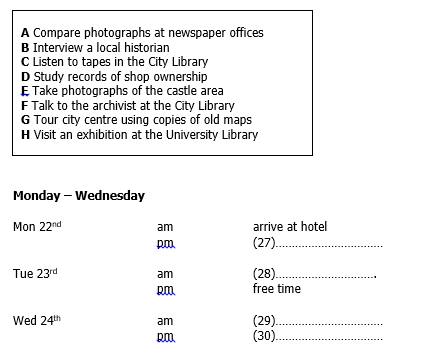
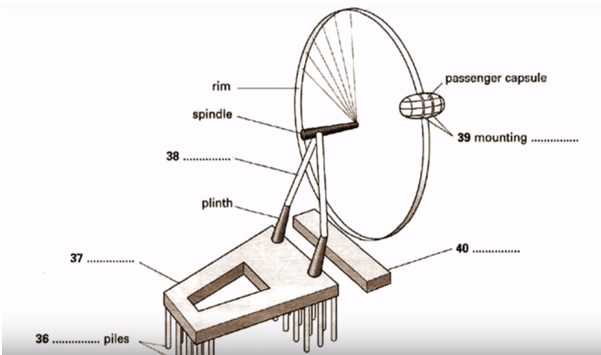
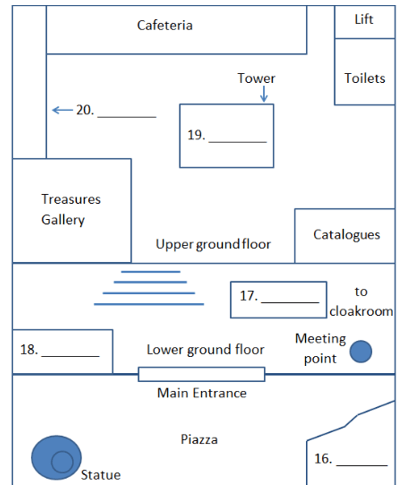
Part 1: Questions 1-5 Complete the table below. Write NO MORE THAN THREE WORDS AND/ OR A NUMBER for each answer.
Main programme Day 1
Time
Place
Activity
9 am
(1)………………………
Welcome talk by Director of Studies
9.30 am
Talk by the (2)……………..
10am
Break
(3)………………..am
Classroom 4
(4)………………….
12.30 am
(5)…………………..
Lunch
(1)(2) (3)(4) (5)
Questions 6-10 Label the places on the map below.
(6) (7) (8) (9) (10)
Part 2: Questions 11-20
Complete the notes below. Write NO MORE THAN TWO WORDS AND/ OR A NUMBER for each answer.
(11)(12) (13)(14) (15)(16) (17)(18) (19)(20)
Part 3: Questions 21-28 Complete the notes below. Write NO MORE THAN TWO WORDS AND/ OR A NUMBER for each answer.
Name: John Evans Degree: French with (21) Duration of studies: 4 years NOTE: (22) months spent in Bruges, Belgium Previous employment 1 Job: translator for restoration projects Organization: (23) Duties: liaising between building owners and (24) Duration of job: (25) months Previous employment 2 Job: translator and translation (26) Organization: BCFC Duties: translation, coordinating translations in other (27) Duration of job: (28) months
Questions 29 and 30 Choose the correct letter A, B or C.
29. John hoped to train as a teacher because A he hated working in the bank B he wants to return from Paris C he has always wanted to
30. John says living in France improved his A French B cultural awareness C French and cultural awareness
Part 4: Question 31 Which picture shows the instrument described?
A. B. C.
Questions 32-35 Complete the notes below. Write NO MORE THAN TWO WORDS for each answer.
Part
Material
Original or new?
Blowpipe
(32)…………………..
New
Air bag
Leather
(33)……………………
Main pipe
(34)…………………..
Original
Reed
Reed
(35)……………………
(32) (33) (34) (35)
Questions 36-40 Choose the correct letter A, B or C.
36. The Kentish pipe can be played A in one way only B in two ways C in several ways
37. The air bag allows the player to play A without pauses B for a very long time C in many different styles
38. Music originally written for Kentish pipe A is very traditional B is very fast C no longer exists
39. Geoffrey will play 17th century music A written by his colleagues B found by his colleagues C adapted by his colleagues
40. He will also play A classic rock tunes B a range of modern music C some familiar classical pieces
Part 1: Questions 1 and 2 Complete the notes below. Write NO MORE THAN THREE WORDS AND/ OR A NUMBER for each answer.
Report on abandoned vehicle Name of caller: Mrs Shefford
Address: 41, (1) Barrowdale WH45JP Telephone: (2) Vehicle location: in (3) near main road Type of vehicle: (4) Make: Catala Model: (5) Present color of vehicle: (6) Vehicle number: S 322 GEC General condition: poor – one (7) , cracked windscreen Length of time at site: (8) Land belongs to: (9) Last owner: no information available Other notes: vehicle does not belong to a (10) resident
Part 2: Questions 11-17 Complete the sentences below. Write NO MORE THAN TWO WORDS AND/ OR A NUMBER for each answer.
The story of John Manjiro 11. Manjiro started work as a when he was still a young boy.
12. He spent on a deserted island before he was rescued.
13. He became friends with William Whitefield who was a ship’s
14. The cost of Manjiro’s in America was covered by the Whitefield family.
15. Manjiro eventually returned to Japan, where he carried out important work as a teacher and
16. Fairhaven and Tosashimizu are now officially
17. Every two years, the John Manjiro is held in Fairhaven.
Questions 18-20 Label the map below. Write the correct letter A-I next to questions 18-20.
18. Whitefield family house 19. Old Oxford school 20. School of Navigation
Part 3: Questions 21-23 Choose the correct letter A, B or C.
21. What is the main thing Julia feels she has gained from her experience in retail? A better understanding of customer attitudes B improved ability to predict fashion trends C more skill in setting priorities in her work
22. Why is Julia interested in doing the postgraduate course? A it will enable her to develop new types of technology B it will allow her to specialize in a design area of her choice C it will provide managerial training focusing on her needs
23. What would Julia like to do after she has completed the postgraduate course? A work overseas B start her own business C stay in an academic environment
Questions 24-27 What does each university facility have?
Choose your answers from the box and write correct letter A-G next to questions 24-27.
A laboratories B rooms for individual study C inter-disciplinary focus D introductory course E purpose built premises F cafeteria G emphasis on creative use
24. Library 25. Computer centre 26. Photomedia 27. Time based media
Questions 28-30 Complete the summary below. Write NO MORE THAN TWO WORDS for each answer.
MA in fashion design: Assessment
Assessment includes three (28) which take place at the end of the stages of the degree. Final assessment is based on a project and includes the students’ (29) in the form of a written report and the (30) to which representatives of fashion companies are invited.
Part 4: Questions 31-40 Complete the notes below. Write NO MORE THAN THREE WORDS for each answer.
Laughter
The nature of laughter • Laughter is a (31) process – involves movement and sound • It is controlled by our (32)
Reasons for laughter • Only 10% of laughter is caused by jokes or funny stories • May have begun as sign of (33) after a dangerous situation • Nowadays may help to develop (34) within a group • Connected to (35) (e.g. use of humor by politicians or bosses) • May be related to male/ female differences (e.g. women laugh more at male speakers) • May be used in a (36) way to keep someone out of a group
Benefits of laughter • Safe method for the (37) of emotions such as anger and sadness • Provides good aerobic exercise • Leads to drop in levels of stress-related (38) • Improved the (39) • Can stop (40) and improve sleep
Part 1: Questions 1-3 Choose the correct letter A-D.
1. How much is the beginner’s course? A $190 B $320 C $330 D $430
2. What does the club insurance cover? A injury to yourself B injury to your equipment C damage to people’s property D loss of personal belongings
3. How do the girls want to travel? A public transport B private bus C car D bicycle
Questions 4-7 Complete the notes below. Write NO MORE THAN THREE WORDS for each answer.
Telephone Memo Name: Maria Gentle Address: C10 Mr and Mrs (4) (5) Newcastle Fax no.: 0249 (6) Type of card: (7)
Questions 8 and 9 Circle TWO letters from A-G.
8. Which TWO of the following items must people take with them? A sandals B old clothes C pullover D shirt with long sleeves E soft drinks F hat G sunglasses
9. Which TWO accommodation options mentioned are near the paragliding school? A camping B youth hostel C family D backpackers E caravan park F bed and breakfast G cheap hotel
Question 10 Write NO MORE THE THREE WORDS for the answer.
10. Which weekend do the girls decide to go?
Part 2: Questions 11-13 Complete the notes below. Write NO MORE THAN THREE WORDS for each answer.
Trip to Mungo National Park Organiser: Alan Moore Purpose of the trip: (11) Recorded years of Aboriginal life: (12) Main feature of park is the: (13)
Questions 14 and 15 Choose the correct letter A-C.
14. What took Alan by surprise? A the amount of rain B the main feature of the park C evidence of Aboriginal life
15. How did Alan feel about having to wait in the park becaue of rain? A he reluctantly accepted it B he war irritated by the rain C it made no difference to his enjoyment
Questions 16-18 Circle THREE letters A-F.
What does Alan say about those who helped him? A there were no other campers nearby B they willingly helped in the search C they kept our spirits up D they provided some dry clothes E the park ranger was unable to get through F the helicopter pilot led the search very well
Questions 19 and 20 Circle TWO letters A-F.
What does Alan say about the discoveries on the wall? A he took photos of them B they could be clearly seen C some were large D they were unique E they proved to be ancient
Part 3: Questions 21-25 Complete the table below. Write NO MORE THAN THREE WORDS for each answer.
BEN
SALLY
Day of arrival
Sunday
(21)…………………
Subject
Architecture
(22)…………………
Number of textbooks
(23)…………………
(24)…………………
Day of first lecture
Tuesday
(25)…………………
(21)(22) (23)(24) (25)
Questions 26-30 Write NO MORE THAN THREE WORDS for each answer.
26. What is Sally’s study strategy in lectures?
27. What is Ben’s study strategy for reading?
28. What is the subject of Ben’s first lecture?
29. What is the title of Ben’s first tutorial paper?
30. What is the subject of Sally’s first tutorial paper?
Part 4: Questions 31-35 Complete the table below. Write NO MORE THAN THREE WORDS for each answer.
Type of course
Name and duration
Entry requirements
Certificate
Certificate in Psychology – 6 months
None
Undergraduate diploma
Diploma in Psychology – (31)……………..
(32)…………………
First degree
(33)………………… – 3 years
Undergraduate admission to university
Masters degree
Mater of Psychology – 18 months
(34)………………………
Graduate diploma
(35)………………… – 12 months
Appropriate honors degree
(31) (32) (33) (34) (35)
Questions 36-40 Complete the table below. Write the appropriate letters A-G next to questions 36-40.
Course
Type of job
Certificate
(36)…………………………
Undergraduate diploma
(37)…………………………
First degree
(38)…………………………
Masters degree
(39)…………………………
Clinical diploma
(40)…………………………
Type of job A a job requiring an unspecified degree B working with people who are ill C managing a factory D a research psychologist E a housewife with time on her hands F a part time student G a career in an insurance office
Part 1: Questions 1-5 Complete the notes below. Write NO MORE THAN THREE WORDS AND/OR A NUMBER for each answer.
KT Furniture customer order form
Customer details Caller’s name: Sue Brown Company name: (1) Address: (2) Trading estate, 210 new hampton road south down Contact number: (3) (mobile) Delivery option: 1 or 2 (no (4) ) Method of payment: credit card, Type: (5)
Questions 6-10 Complete the table below. Write NO MORE THAN TWO WORDS AND/OR A NUMBER for each answer.
Item
Code
Color
Quantity
Office chairs
ASP 23
(6)………………………
5
(7)………………..
(8)………………..
2
Leather sofa
DFD 33
(9)…………………..
1
(10)……………….
TX 22
silver
1
(6) (7) (8) (9) (10)
Part 2: Questions 11-17 Complete the sentences below. Write NO MORE THAN TWO WORDS for each answer.
Marathon – tips for spectators 11. To enjoy the day, make sure you it first. 12. Travel within the city centre. 13. Wear on the day. 14. Check the the night before the marathon 15. Let the give drinks to runners. 16. Ray on one side of the road to avoid 17. Don’t arrange to meet runners near the
Questions 18-20 What does she speaker say about the following forms of transport?
Write the correct letter, A, B, C, or E next to questions 18-20
A will take more passengers than usual B will suit people who want to see the start of the race C waiting times will be longer than usual D will have fewer staff than usual E some work schedules will change
18. taxis
19. trams
20. buses
Part 3: Questions 21-26 Choose the correct letter, A, B or C.
21. What does Ahmed say about last week’s seminar? A He wasn’t aide to get there on time. B He didn’t know all the modems. C He couldn’t understand everything.
22. What does the tutor say about Ahmed’s preparation for the seminar? A He was better prepared than some students. B He completed some useful work. C He read some useful articles.
23. What does Ahmed say about his participation in the seminar? A He tended to speak to his neighbour only. B He spoke when other students were talking. C He felt embarrassed when students looked at him
24. What does Ahmed worry about most in seminars? A speaking at the right time B taking enough notes C staying focused
25. What does Ahmed say about his role in the group? A He hasn’t thought about it. B He’d like to change C He feels he is acting a part.
26. At the next seminar, Ahmed, tutor suggests that he should A give other modems more help with their work. B observe the behaviour of other students. C ask other students for their views.
Questions 27 and 28 Choose TWO letters A-E.
Which TWO strategies does the tutor suggest for the next seminar?
A speak more frequently B behave in a confident manner C sit next to someone helpful D listen to what other people say E think of questions to ask
Questions 29 and 30 Choose TWO letters A-E.
Which TWO suggestions does the tutor make about taking note?
A plan them before the seminar B note down key words that people say C note points to say late D include self-analysis E rewrite them after the seminar
Part 4: Questions 31-40 Complete the notes below. Write NO MORE THAN TWO WORDS for each answer.
DESERT PLANTS
Background • Deserts found in what is known as a (31) (or dry area) • Annual rainfall, if any, amounts to (32) • Soil contains a lot of salt and (33)
General adaptations of desert plants • They can (34) and store water • They have features that reduce water loss.
Examples of adaptations • Saguaro Cactus: stores water in its (35) • Barrel Cactus: can (36) or shrink according to weather • Old Man Cactus: has (37) that reflect the sun • Prickly Pear Cactus: has (38) to keep away animals • Desert Spoon: leaves are (39) to reduce water loss • Aloe Plant: leaf surface acts like a (40) covering and keeps water inside
Part 1: Questions 1-7 Complete the form below. Write NO MORE THAN TWO WORDS OR A NUMBER for each answer.
Go-travel booking form
Name: (1) Source of enquiry: saw ad in (2) magazine Holiday reference: (3) Number of people: (4) Preferred departure dates: (5) Number of nights: (6) Type of insurance: (7)
Questions 8-10 Choose THREE letters A-H.
Which THREE options does the woman want to book?
A arts demonstration B dance show C museums trip D bus tour at night E picnic lunches F river trip G room with balcony H trip to mountains
(8) (9) (10)
Part 2: Questions 11-17 Complete the notes below. Write NO MORE THAN THREE WORDS AND/ OR A NUMBER for each answer.
Run-well charity Background to Run-Well charity • Set up in (11) • Aim: raise money for the (12)
Race details • Teams to supply own (13) • Teams should (14) together • Important to bring enough (15) • Race will finish in the (16) • Prizes given by the (17)
Questions 18-20 Choose THREE letters A-H.
Which THREE ways of raising money for the charity are recommended?
A badges B bread and cake stall C swimming event D concert E door to door collecting F picnic G postcards H quiz I second hand sale
(18) (19) (20)
Part 3: Questions 21-26 Write the correct letter A, B or C next to questions 21-26.
What do the students decide about each topic for Joe’s presentation? A Joe will definitely include this topic B Joe might include this topic C Joe will not include this topic
21. cultural aspects of naming people 22. similarities across languages in naming practices 23. meanings of first names 24. place names describing geographic features 25 influence of immigration on place names 26. origins of names of countries
Questions 27-30 Complete the summary below. Write NO MORE THAN TWO WORDS for each answer.
Researchers showed a group of students many common nouns, brand names and (27) Students found it easier to identify brand names when they were shown in (28) Researchers think that (29) is important in making brand names special within the brain. Brand names create a number of (30) within the brain.
Part 4: Questions 31-40 Complete the notes below. Write NO MORE THAN TWO WORDS for each answer.
Gas balloons Uses: • Instead of (31) in the US civil war • To make (32) • To (33) for research • As part of studies of (34)
Hot air balloons Create less (35) than gas balloons
Airships Early examples had no (36) for crew
To be efficient needed a (37)
Development of large airships stopped because of: • Success of (38) • Series of (39)
Part 1: Questions 1-10 Complete the form below. Write NO MORE THAN TWO WORDS OR A NUMBER.
Short stay accommodation
Family name: Mackinlay
First name: (1) Country of origin: (2) Date of arrival: (3) Number of tenants: (4) Length of stay: 2 weeks Purpose of visit: (5) Type of accommodation: (6) Number of bedrooms: 1 or 2 Car parking: off street and (7) General area: near the beach Other requirements: near (8) Name of town: (9) Client’s email: smac13@hotmail.com Price range: up to (10) $ a week
Part 2: Questions 11-14 Choose the correct letter A, B or C.
11. Refreshments will be served A at the front counter B in the lobby C at the back of the hall
12. Nick Noble advertise A on the radio B on a billboard C in the newspaper
13. The original number of founding members was about A 12 B 20 C 200
14. The club provides activities primarily for reasonably fit A males up to 75 B females with young children C males and females of any age
Questions 15-20 Complete the table below. Write NO MORE THAN ONE WORD AND/ OR A NUMBER for each answer.
Activity
Days
Duration
Contact person
(15)…………..
Tuesday and Saturday
About 3-5 hours
Coordinator
(16)……………….
Thursday and Sunday
Up to 3 hours
(17)………………
Wanderers
Sunday
(18)…………………
Leader
(19)…………..weekends
Saturday and Sunday
All weekend
(20)……………….
(15)(16) (17)(18) (19)(20)
Part 3: Questions 21-26 Complete the notes below. Write NO MORE THAN TWO WORDS for each answer.
Globalization and educational change • New Code (21) • Aims-analysis of educational problems arising from globalization • Chance to research and (22) progress of educational change • Investigate influence of culture and (23) on education • Argue advantages and disadvantages of reorganization of public education in own country with regard to globalization • Consider the (24) of globalization on diversity of national curricula across richer and poorer countries • Assignment 1 – power point presentation (ungraded) + (25) (30%) • Assignment 2 – take part in (26) (20%) + essay (50%)
Questions 27-30 Complete the table below. Write NO MORE THAN TWO WORDS AND/ OR A NUMBER for each answer.
Author
Title
Date
(27)……………….
Comparative education
2007
Elliot
Educational issues of the new millennium
(28)………………..
(29)…………………
Education and globalization
2009
York
Globalization and (30)……………………….
2010
(27)(28) (29)(30)
Part 4: Questions 31-37 Complete the summary below. Write NO MORE THAN TWO WORDS for each answer.
Everyday the human body is fighting off (31) by destructive pathogens. A person in good health has natural protection in the form of an immune system which works best against familiar microorganisms which may have been encountered during a previous (32) or passed on by the mother before or after birth.
Vaccination is a way to cause (33) immunisation by introducing a small amout of pathogen into the body – just enough for the body’s (34) to react by making antibodies. Passive immunization can be used as a way of treating someone who is already sick. Proteins from animal (35) are introduced into the patient to give him the necessary antibodies to fight the disease.
Dr. Edward Jenner observed that people who had suffered and recovered from a serious disease called smallpox did not get it again. He also noted that victims of milder disease, cowpox which they caught from (36) were immune to smallpox. He carried out a successful (37) by deliberately giving a child cowpox in order to make him immune to smallpox.
Questions 38-40 Complete the diagram below. Choose your answers from the box below and write the letters A-F next to questions 38-40.
Part 1: Questions 1-5 Complete the notes below. Write NO MORE THAN TWO WORDS.
Tauber Insurance Company
Insurance type: vehicle
Policy#: (1) Make and model: Masda Marvel Engine size: (2) Name: Lisa Marie Haethcote Date of birth: (3) 1955 Password: (4) Change valuation? Yes Reduce value to: (5) $
Questions 6-10 Complete the notes below. Write NO MORE THAN TWO WORDS.
Notes to be added to policy: Add new driver: • Name: Samuel Michaels • Age: 28 • Relationship to main driver: (6) Reason: • (7) Client/ new driver to provide: • Verified (8) of driver’s licence • Clean driving (9) Start date: • (10) cover for 2 weeks from today • Full cover when paperwork approved
Part 2: Questions 11-16 Complete the sentences below. Write NO MORE THAN TWO WORDS for each answer.
11. You can become more confident by using
12. More confidence results in better
13. A good strategy to build confidence is to get rid of negative memories of mistakes and failures and instead concentrate on
14. Frequent of positive imagery is necessary for success.
15. Mental positivity is not enough-you also have to act in a confident manner-so is important too.
16. Setting and achieving goals results in brain activity that brings about an experience of
Questions 17-20 Complete the flow chart below. Write NO MORE THAN TWO WORDS for each answer.
(17)(18) (19) (20)
Part 3: Questions 21-23 Choose the correct letter A, B or C.
21. Julia and Bob’s science project is due A next week B next month C next year
22. All the materials they use must be A recycled B inexpensive C available in the lab
23. A Cartesian diver was called a devil by some people because A they saw it was black B they believed in the supernatural C they wanted the inventor to be famous
Questions 24 and 25 Choose TWO letters A-E.
Julia and Bob find some of the items they need A in Bob’s pencil case and the recycling bin B in the cafeteria and the Resource Centre C in the shop and Julia’s locker D in Bob’s bag and his pocket E in Tara’s packet and on the floor
Questions 26-30 Complete the notes below. Write NO MORE THAN TWO WORDS for each answer.
Assembly Step 1: fold (26) in half Step 2: use (27) to secure the ends Step 3: attach (28) to diver Step 4: fill bottle with water and replace (29) Step 5: demonstrate by squeezing and releasing bottle. Compression causes diver to sink because diver becomes (30)
Part 4: Questions 31-35 Answer the questions below. Write NO MORE THAN THREE WORDS AND/ OR A NUMBER for each answer.
31. When did Mt. Pinatubo erupt for the first time?
32. When was the earthquake measuring 7.8 recorded?
33. When did the experts begin to study Mt. Pinatubo?
34. What fell on the local villages on 2nd April?
35. What does a ‘level 5’ alert mean?
Questions 36-40 Complete the sentences below. Write NO MORE THAN THREE WORDS AND/ OR A NUMBER for each answer.
Several large earthquakes were triggered by the eruption of Pinatubo on 15th June 1991 because of the (36) of the summit. The caldera thus created considerably reduced the height of the mountain. At the same time (37) was passing by and the rain associated with it mixed with the cinders in the air to form a substance called tephra which fell on the (38) of homes causing them to collapse, crushing hundreds of people.
During the eruption large amounts of Sulphur dioxide gas were emitted, which combined with (39) to make sulphuric acid which was responsible for a great deal of ozone depletion above Antarctica. The overall effect of the cloud from this great eruption was the lowering of (40)
Part 1: Questions 1-5 Complete the notes below. Write NO MORE THAN ONE WORD OR A NUMBER.
Library application form Surname: Price
First name: Angela Mary Address: apartment 3, 86 (1) street, Pimlico Post code: (2) Telephone: 8763 5142 (home) (3) (work) Driver’s licence number: (4) Date of birth: Day: 24 Month: (5) Year: 1981
Questions 6-8 Circle THREE letters A-F.
What type of books does Angela like? A sport B travel C classics D history E cooking F nature
Questions 9 and 10 Write NO MORE THAN THREE WORDS for each answer.
9. How much does it cost to join the library? 10. When will Angela’s card be ready?
Part 2: Questions 11 and 12 Choose the correct letter A, B or C.
11. What is one of the new advantages in the dining facilities? A more students B more variety C more service
12. What was one problem with the dining options last year? A students did not have enough to eat B students has to pay too much money C students had to eat whatever was served
Questions 13 and 14 Write NO MORE THAN THREE WORDS for each answer.
13. and pasta are an example of food 14. American food consists of
Questions 15-18 Choose the correct letter A, B or C.
15. Why does the school say the food will be better? A they hired real chefs B The food is more expensive C they will make more kinds
16. When will the dining facilities open and close? A 6 am and 12 pm B 6 am and 12 am C 12 pm and 6 pm D 12 pm and 6 am
17. What can students do if they are hungry in the afternoon? A go out and buy food on the street B wait till dinner time C go to the student store for snacks
18. What must you do to eat in the dining facilities if you are not a student? A purchase a dining facility card B purchase meals at the door C purchase meals from other students
Questions 19 and 20 Select TWO answers.
Which of the following are rules of the dining facilities? A do not waste food B you may bring friends in to eat C bring your own plates and trays D clean your own plates and trays E don’t litter
Part 3: Questions 21-25 Complete the table below. Write NO MORE THAN THREE WORDS for each answer.
Forms of dog training
Examples
Obedience training
– Sit – (21)………………….
Spoken commands
– (22)………………………..
Guard training
– Patrolling – (23)……………….
Attack training
– Knocking someone down – (24)…………………..
Search training
– (25)…………………….
(21)(22) (23)(24) (25)
Questions 26-30 Write the appropriate letter A-C next to questions 26-30
According to the speaker for which dogs are the following kinds of training most useful? A small dogs B intelligent dogs C large dogs
26. physical training 27. search training 28. attack training 29. barking 30. biting
Part 4: Questions 31-36 Complete the table below. Write NO MORE THAN TWO WORDS AND/ OR A NUMBER for each answer.
Facility
Location
Hours
Items provided
Dining hall
1st floor
(31)……………….
Food
Gym and recreational hall
(32)……………
10 am to 10 pm
Treadmills, weight set (33)……………
Kitchen
(34)………………….
(35)………………..
(36)……………..microwave oven, store
(31) (32) (33) (34) (35) (36)
Questions 37-40 Complete the sentences below. Write NO MORE THAN THREE WORDS AND/ OR A NUMBER for each answer.
37. List three activities that Saturday Morning Outings have included in the past
38. There are spaces available for the volleyball team.
39. The first rule of the building: must be kept to a minimum after 11 pm. The second rule of the building: All visitors must sign in at the front of the building.
40. The third rule of the building: are not permitted in the building.
Part 1: Questions 1-6 Choose the correct letter A, B or C.
1. The Family Welcome event in the art gallery begins at A 10 am B 10.30 am C 2 pm
2. The film that is now shown in the Family Welcome event is about A sculpture B painting C ceramics
3. When do most of the free concerts take place? A in the morning B at lunchtime C in the evening
4. Where will the 4 pm concert of Latin American music take place? A in a museum B in a theatre C in a library
5. The boat race begins at A summer pool B Charlesworth bridge C Oxford marina
6. One of the boat race teams A won a regional competition earlier this year B has represented the region in a national competition C has won several regional competitions
Questions 7-10 Complete the sentences below. Write ONE WORD ONLY for each answer.
Paxton Nature Reserve 7. Paxton is a good for seeing rare all year around. 8. This is a particularly good time for seeing certain unusual 9. Visitors will be able to learn about and then collect some. 10. Part of the has been made suitable for swimming.
Part 2: Questions 11-15 Choose the correct letter A, B or C.
Changes in Barford over the last 50 years
11. In Shona’s opinion why do fewer people use buses in Barford these days? A the buses are old and uncomfortable B fares have gone up too much C there are not so many bus routes
12. What change in the road network is known to have benefitted the town most? A the construction of a bypass B the development of cycle paths C the banning of cars from certain streets
13. What is the problem affecting shopping in the town centre? A lack of parking spaces B lack of major retailers C lack of restaurants and cafes
14. What does Shona say about medical facilities in Barford? A there is no hospital B new medical practices are planned C the number of dentists is too low
15. The largest number of people are employed in A manufacturing B services C education
Questions 16-20 What is planned for each of the following facilities?
Choose FIVE answers from the box and write the correct letter A-G next to questions 16-20
Plans A it will move to a new location B it will have its opening hours extended C it will be refurbished D it will be used for a different purpose E it will have its opening hours reduced F it will have new management G it will be expanded
Facilities 16. railway station car park 17. cinema 18. indoor market 19. library 20. nature reserve
Part 3: Questions 21-26 Complete the table below. Write ONE WORD ONLY for each answer.
Subject of drawing
Change to be made
A (21)……………..surrounded by trees
Add Malcolm and a (22)…………………noticing him
People who are (23)……………….outside the forest
Add Malcolm sitting on a tree trunk and (24)…………..
Ice shakes on (25)………………covered with ice
Add a (26)……………..for each person
(21)(22) (23)(24) (25)(26)
Questions 27-30 Who is going to write each of the following parts of the report?
Write the correct letter A-D next to questions 27-30.
A Helen only B Jeremy only C both Helen and Jeremy D neither Helen nor Jeremy
Parts of the report 27. how they planned the project
28. how they had ideas for their stories
29. an interpretation of their stories
30. comments on the illustrations
Part 4: Questions 31-40 Complete the notes below. Write ONE WORD ONLY for each answer.
Ethnography in Business Ethnography: research which explores human cultures It can be used in business: • To investigate customer needs and (31) • To help companies develop new designs
Examples of ethnographic research in business
Kitchen equipment • Researchers found that cooks could not easily see the (32) in measuring cups
Cell phone • In Uganda, customers paid to use the cell phones of entrepreneurs. • These customers wanted to check the (33) used.
Computer companies • There was a need to develop (34) to improve communication between system administrators and colleagues.
Hospitals • Nurses needed to access information about (35) in different parts of the hospital
Airlines • Respondents recorded information about their (36) while travelling.
Principles of ethnographic research in business • The researched does not start off with a hypothesis • Participants may be selected by criteria such as age, (37) or product used • The participants must feel (38) about taking part in the research. • There is usually direct (39) of the participants • The interview is guided by the participant • A lot of time is needed for the (40) of the data. • Researchers look for a meaningful pattern in the data.
A The compiling of dictionaries has been historically the provenance of studious professorial types – usually bespectacled – who love to pore over weighty tomes and make pronouncements on the finer nuances of meaning. They were probably good at crosswords and definitely knew a lot of words, but the image was always rather dry and dusty. The latest technology, and simple technology at that, is revolutionising the content of dictionaries and the way they are put together.
B For the first time, dictionary publishers are incorporating real, spoken English into their data. It gives lexicographers (people who write dictionaries) access to a more vibrant, up-to-date vernacular language which has never really been studied before. In one project, 150 volunteers each agreed to discreetly tie a Walkman recorder to their waist and leave it running for anything up to two weeks. Every conversation they had was recorded. When the data was collected, the length of tapes was 35 times the depth of the Atlantic Ocean. Teams of audio typists transcribed the tapes to produce a computerised database of ten million words.
C This has been the basis – along with an existing written corpus – for the Language Activator dictionary, described by lexicographer Professor Randolph Quirk as “the book the world has been waiting for”. It shows advanced foreign learners of English how the language is really used. In the dictionary, key words such as “eat” are followed by related phrases such as “wolf down” or “be a picky eater”, allowing the student to choose the appropriate phrase.
D “This kind of research would be impossible without computers,” said Delia Summers, a director of dictionaries. “It has transformed the way lexicographers work. If you look at the word “like”, you may intuitively think that the first and most frequent meaning is the verb, as in “I like swimming”. It is not. It is the preposition, as in: “she walked like a duck”. Just because a word or phrase is used doesn’t mean it ends up in a dictionary. The sifting out process is as vital as ever. But the database does allow lexicographers to search for a word and find out how frequently it is used – something that could only be guessed at intuitively before.
E Researchers have found that written English works in a very different way to spoken English. The phrase “say what you like” literally means “feel free to say anything you want”, but in reality it is used, evidence shows, by someone to prevent the other person voicing disagreement. The phrase “it’s a question of crops up on the database over and over again. It has nothing to do with enquiry, but it’s one of the most frequent English phrases which has never been in a language learner’s dictionary before: it is now.
F The Spoken Corpus computer shows how inventive and humorous people are when they are using language by twisting familiar phrases for effect. It also reveals the power of the pauses and noises we use to play for time, convey emotion, doubt and irony.
G For the moment, those benefiting most from the Spoken Corpus are foreign learners. “Computers allow lexicographers to search quickly through more examples of real English,” said Professor Geoffrey Leech of Lancaster University. “They allow dictionaries to be more accurate and give a feel for how language is being used.” The Spoken Corpus is part of the larger British National Corpus, an initiative carried out by several groups involved in the production of language learning materials: publishers, universities and the British Library.
Questions 1-6 Reading Passage 1 has seven paragraphs (A-G). Choose the most suitable heading for each paragraph from the list of headings below. Write the appropriate numbers (i-xi) in boxes 1-6 on your answer sheet. Paragraph C has been done for you as an example. NB There are more headings than paragraphs so you will not use all of them. You may use any heading more than once.
List of Headings i. Grammar is corrected ii. New method of research iii. Technology learns from dictionaries iv. Non-verbal content v. The first study of spoken language vi. Traditional lexicographical methods vii Written English tells the truth viii New phrases enter dictionary ix A cooperative research project x Accurate word frequency counts xi Alternative expressions provided
1 Paragraph A 2 Paragraph B 3 Paragraph D 4 Paragraph E 5 Paragraph F 6 Paragraph G
Questions 7-11 The diagram below illustrates the information provided in paragraphs B-F of Reading Passage 1 Complete the labels on the diagram with an appropriate word or words. Use NO MORE THAN THREE WORDS for each space.
Question 12 Choose the appropriate letter A-D and write it in box 12 on your answer sheet
12 Why was this article written? A To give an example of a current dictionary B To announce a new approach to dictionary writing C To show how dictionaries have progressed over the years D To compare the content of different dictionaries
Moles happy as homes go underground
A The first anybody knew about Dutchman Frank Siegmund and his family was when workmen tramping through a field found a narrow steel chimney protruding through the grass. Closer inspection revealed a chink of sky-light window among the thistles, and when amazed investigators moved down the side of the hill they came across a pine door complete with leaded diamond glass and a brass knocker set into an underground building. The Siegmunds had managed to live undetected for six years outside the border town of Breda, in Holland. They are the latest in a clutch of individualistic homemakers who have burrowed underground in search of tranquility.
B Most, falling foul of strict building regulations, have been forced to dismantle their individualistic homes and return to more conventional lifestyles. But subterranean suburbia, Dutch-style, is about to become respectable and chic. Seven luxury homes cosseted away inside a high earth-covered noise embankment next to the main Tilburg city road recently went on the market for $296,500 each. The foundations had yet to be dug, but customers queued up to buy the unusual part-submerged houses, whose back wall consists of a grassy mound and whose front is a long glass gallery.
C The Dutch are not the only would-be moles. Growing numbers of Europeans are burrowing below ground to create houses, offices, discos and shopping malls. It is already proving a way of life in extreme climates; in winter months in Montreal, Canada, for instance, citizens can escape the cold in an underground complex complete with shops and even health clinics. In Tokyo builders are planning a massive underground city to be begun in the next decade, and underground shopping malls are already common in Japan, where 90 percent of the population is squeezed into 20 percent of the land space.
D Building big commercial buildings underground can be a way to avoid disfiguring or threatening a beautiful or environmentally sensitive landscape. Indeed many of the buildings which consume most land -such as cinemas, supermarkets, theatres, warehouses or libraries -have no need to be on the surface since they do not need windows.
E There are big advantages, too, when it comes to private homes. A development of 194 houses which would take up 14 hectares of land above ground would occupy 2.7 hectares below it, while the number of roads would be halved. Under several metres of earth, noise is minimal and insulation is excellent. “We get 40 to 50 enquiries a week”, says Peter Carpenter, secretary of the British Earth Sheltering Association, which builds similar homes in Britain. “People see this as a way of building for the future.” An underground dweller himself, Carpenter has never paid a heating bill, thanks to solar panels and natural insulation.
F In Europe the obstacle has been conservative local authorities and developers who prefer to ensure quick sales with conventional mass produced housing. But the Dutch development was greeted with undisguised relief by South Limburg planners because of Holland’s chronic shortage of land. It was the Tilburg architect Jo Hurkmans who hit on the idea of making use of noise embankments on main roads. His twofloored, four-bedroomed, two-bathroomed detached homes are now taking shape. “They are not so much below the earth as in it,” he says. “All the light will come through the glass front, which runs from the second floor ceiling to the ground. Areas which do not need much natural lighting are at the back. The living accommodation is to the front so nobody notices that the back is dark.”
G In the US, where energy-efficient homes became popular after the oil crisis of 1973, 10,000 underground houses have been built. A terrace of five homes, Britain’s first subterranean development, is under way in Nottinghamshire. Italy’s outstanding example of subterranean architecture is the Olivetti residential centre in Ivrea. Commissioned by Roberto Olivetti in 1969, it comprises 82 one-bedroomed apartments and 12 maisonettes and forms a house/ hotel for Olivetti employees. It is built into a hill and little can be seen from outside except a glass facade. Patnzia Vallecchi, a resident since 1992, says it is little different from living in a conventional apartment.
H Not everyone adapts so well, and in Japan scientists at the Shimizu Corporation have developed “space creation” systems which mix light, sounds, breezes and scents to stimulate people who spend long periods below ground. Underground offices in Japan are being equipped with “virtual” windows and mirrors, while underground departments in the University of Minnesota have periscopes to reflect views and light.
I But Frank Siegmund and his family love their hobbit lifestyle. Their home evolved when he dug a cool room for his bakery business in a hill he had created. During a heatwave they took to sleeping there. “We felt at peace and so close to nature,” he says. “Gradually I began adding to the rooms. It sounds strange but we are so close to the earth we draw strength from its vibrations. Our children love it; not every child can boast of being watched through their playroom windows by rabbits.
Questions 13-20 Reading Passage 2 has nine paragraphs (A-I). Choose the most suitable heading for each paragraph from the list of headings below. Write the appropriate numbers (i-xii) in boxes 13 20 on your answer sheet. Paragraph A has been done for you as an example. NB There are more headings than paragraphs so you will not use all of them.
List of Headings i. A designer describes his houses ii. Most people prefer conventional housing iii. Simulating a natural environment iv. How an underground family home developed v. Demands on space and energy are reduced vi. The plans for future homes vii. Worldwide examples of underground living accommodation viii. Some buildings do not require natural light ix. Developing underground services around the world x. Underground living improves health xi. Homes sold before completion xii. An underground home is discovered
13 Paragraph B 14 Paragraph C 15 Paragraph D 16 Paragraph E 17 Paragraph F 18 Paragraph G 19 Paragraph H 20 Paragraph I
Questions 21-26 Complete the sentences below after reading the passage. Use NO MORE THAN THREE WORDS for each answer. Write your answers in boxes 21-26 on your answer sheet.
21 Many developers prefer mass-produced houses because they … 22 The Dutch development was welcomed by … 23 Hurkmans’ houses are built into … 24 The Ivrea centre was developed for … 25 Japanese scientists are helping people … underground life. 26 Frank Siegmund’s first underground room was used for …
A Workaholic Economy
FOR THE first century or so of the industrial revolution, increased productivity led to decreases in working hours. Employees who had been putting in 12-hour days, six days a week, found their time on the job shrinking to 10 hours daily, then, finally, to eight hours, five days a week. Only a generation ago social planners worried about what people would do with all this new-found free time. In the US, at least, it seems they need not have bothered.
Although the output per hour of work has more than doubled since 1945, leisure seems reserved largely for the unemployed and underemployed. Those who work full-time spend as much time on the job as they did at the end of World War II. In fact, working hours have increased noticeably since 1970 — perhaps because real wages have stagnated since that year. Bookstores now abound with manuals describing how to manage time and cope with stress.
There are several reasons for lost leisure. Since 1979, companies have responded to improvements in the business climate by having employees work overtime rather than by hiring extra personnel, says economist Juliet B. Schor of Harvard University. Indeed, the current economic recovery has gained a certain amount of notoriety for its “jobless” nature: increased production has been almost entirely decoupled from employment. Some firms are even downsizing as their profits climb. “All things being equal, we’d be better off spreading around the work,’ observes labour economist Ronald G. Ehrenberg of Cornell University.
Yet a host of factors pushes employers to hire fewer workers for more hours and, at the same time, compels workers to spend more time on the job. Most of those incentives involve what Ehrenberg calls the structure of compensation: quirks in the way salaries and benefits are organised that make it more profitable to ask 40 employees to labour an extra hour each than to hire one more worker to do the same 40-hour job.
Professional and managerial employees supply the most obvious lesson along these lines. Once people are on salary, their cost to a firm is the same whether they spend 35 hours a week in the office or 70. Diminishing returns may eventually set in as overworked employees lose efficiency or leave for more arable pastures. But in the short run, the employer’s incentive is clear.
Even hourly employees receive benefits – such as pension contributions and medical insurance – that are not tied to the number of hours they work. Therefore, it is more profitable for employers to work their existing employees harder.
For all that employees complain about long hours, they, too, have reasons not to trade money for leisure. “People who work reduced hours pay a huge penalty in career terms,” Schor maintains. It’s taken as a negative signal about their commitment to the firm.’ [Lotte] Bailyn [of Massachusetts Institute of Technology] adds that many corporate managers find it difficult to measure the contribution of their underlings to a firm’s well-being, so they use the number of hours worked as a proxy for output. “Employees know this,” she says, and they adjust their behavior accordingly.
“Although the image of the good worker is the one whose life belongs to the company,” Bailyn says, “it doesn’t fit the facts.’ She cites both quantitative and qualitative studies that show increased productivity for part-time workers: they make better use of the time they have, and they are less likely to succumb to fatigue in stressful jobs. Companies that employ more workers for less time also gain from the resulting redundancy, she asserts. “The extra people can cover the contingencies that you know are going to happen, such as when crises take people away from the workplace.’ Positive experiences with reduced hours have begun to change the more-is-better culture at some companies, Schor reports.
Larger firms, in particular, appear to be more willing to experiment with flexible working arrangements…
It may take even more than changes in the financial and cultural structures of employment for workers successfully to trade increased productivity and money for leisure time, Schor contends. She says the U.S. market for goods has become skewed by the assumption of full-time, two-career households. Automobile makers no longer manufacture cheap models, and developers do not build the tiny bungalows that served the first postwar generation of home buyers. Not even the humblest household object is made without a microprocessor. As Schor notes, the situation is a curious inversion of the “appropriate technology” vision that designers have had for developing countries: U.S. goods are appropriate only for high incomes and long hours.
Questions 27-32 Do the following statements agree with the views of the writer in Reading Passage 3? In boxes 27-32 write
YES if the statement agrees with the views of the writer NO if the statement contradicts the views of the writer NOT GIVEN if it is impossible to say what the writer thinks about this
27 Today, employees are facing a reduction in working hours. 28 Social planners have been consulted about US employment figures. 29 Salaries have not risen significantly since the 1970s. 30 The economic recovery created more jobs. 31 Bailyn’s research shows that part-time employees work more efficiently. 32 Increased leisure time would benefit two-career households.
Questions 33 and 34 Choose the appropriate letters A-D and write them in boxes 33 and 34 on your answer sheet.
33 Bailyn argues that it is better for a company to employ more workers because A it is easy to make excess staff redundant. B crises occur if you are under-staffed. C people are available to substitute for absent staff. D they can project a positive image at work.
34 Schor thinks it will be difficult for workers in the US to reduce their working hours because A they would not be able to afford cars or homes. B employers are offering high incomes for long hours. C the future is dependent on technological advances. D they do not wish to return to the humble post-war era.
Questions 35-38 The writer mentions a number of factors that have resulted, in employees working longer hours. Which FOUR of the following factors are mentioned? Write your answers (A-H) in boxes 35-38 on your answer sheet.
List of Factors A Books are available to help employees cope with stress. B Extra work is offered to existing employees. C Increased production has led to joblessness. D Benefits and hours spent on the job are not linked. E Overworked employees require longer to do their work. F Longer hours indicate greater commitment to the firm. G Managers estimate staff productivity in terms of hours worked. H Employees value a career more than a family.
Questions 39 and 40 Complete the sentences below with words from the reading passage. Write NO MORE THAN ONE WORD.
39. Returns from overburdened employees decreases with time because they lose…….. 40. Employees give more work to their existing employees because for them it is……….