Author: theieltsbridge

  • IELTS Reading Practice Test – Exercise 10

    Making Time for Science

    Chronobiology might sound a little futuristic – like something from a science fiction novel, perhaps – but it’s actually a field of study that concerns one of the oldest processes life on this planet has ever known: short-term rhythms of time and their effect on flora and fauna.

    This can take many forms. Marine life, for example, is influenced by tidal patterns. Animals tend to be active or inactive depending on the position of the sun or moon. Numerous creatures, humans included, are largely diurnal – that is, they like to come out during the hours of sunlight. Nocturnal animals, such as bats and possums, prefer to forage by night. A third group are known as crepuscular: they thrive in the low- light of dawn and dusk and remain inactive at other hours.

    When it comes to humans, chronobiologists are interested in what is known as the circadian rhythm. This is the complete cycle our bodies are naturally geared to undergo within the passage of a twenty-four hour day. Aside from sleeping at night and waking during the day, each cycle involves many other factors such as changes in blood pressure and body temperature. Not everyone has an identical circadian rhythm. ‘Night people’, for example, often describe how they find it very hard to operate during the morning, but become alert and focused by evening. This is a benign variation within circadian rhythms known as a chronotype.

    Scientists have limited abilities to create durable modifications of chronobiological demands. Recent therapeutic developments for humans such as artificial light machines and melatonin administration can reset our circadian rhythms, for example, but our bodies can tell the difference and health suffers when we breach these natural rhythms for extended periods of time. Plants appear no more malleable in this respect; studies demonstrate that vegetables grown in season and ripened on the tree are far higher in essential nutrients than those grown in greenhouses and ripened by laser.

    Knowledge of chronobiological patterns can have many pragmatic implications for our day-to-day lives. While contemporary living can sometimes appear to subjugate biology – after all, who needs circadian rhythms when we have caffeine pills, energy drinks, shift work and cities that never sleep? – keeping in synch with our body clock is important.

    The average urban resident, for example, rouses at the eye-blearing time of 6.04 a.m., which researchers believe to be far too early. One study found that even rising at 7.00 a.m. has deleterious effects on health unless exercise is performed for 30 minutes afterward. The optimum moment has been whittled down to 7.22 a.m.; muscle aches, headaches and moodiness were reported to be lowest by participants in the study who awoke then.

    Once you’re up and ready to go, what then? If you’re trying to shed some extra pounds, dieticians are adamant: never skip breakfast. This disorients your circadian rhythm and puts your body in starvation mode. The recommended course of action is to follow an intense workout with a carbohydrate-rich breakfast; the other way round and weight loss results are not as pronounced.

    Morning is also great for breaking out the vitamins. Supplement absorption by the body is not temporal-dependent, but naturopath Pam Stone notes that the extra boost at breakfast helps us get energised for the day ahead. For improved absorption, Stone suggests pairing supplements with a food in which they are soluble and steering clear of caffeinated beverages. Finally, Stone warns to take care with storage; high potency is best for absorption, and warmth and humidity are known to deplete the potency of a supplement.

    After-dinner espressos are becoming more of a tradition – we have the Italians to thank for that – but to prepare for a good night’s sleep we are better off putting the brakes on caffeine consumption as early as 3 p.m. With a seven hour half-life, a cup of coffee containing 90 mg of caffeine taken at this hour could still leave 45 mg of caffeine in your nervous system at ten o’clock that evening. It is essential that, by the time you are ready to sleep, your body is rid of all traces.

    Evenings are important for winding down before sleep; however, dietician Geraldine Georgeou warns that an after-five carbohydrate-fast is more cultural myth than chronobiological demand. This will deprive your body of vital energy needs. Overloading your gut could lead to indigestion, though. Our digestive tracts do not shut down for the night entirely, but their work slows to a crawl as our bodies prepare for sleep. Consuming a modest snack should be entirely sufficient.

    Questions 1-7
    Do the following statements agree with the information given in Reading Passage 1? In boxes 1-7 on your answer sheet, write

    TRUE                    if the statement agrees with the information
    FALSE                  if the statement contradicts the information
    NOT GIVEN       if there is no information on this

    1 Chronobiology is the study of how living things have evolved over time.
    2 The rise and fall of sea levels affects how sea creatures behave.
    3 Most animals are active during the daytime.
    4 Circadian rhythms identify how we do different things on different days.
    5 A ‘night person’ can still have a healthy circadian rhythm.
    6 New therapies can permanently change circadian rhythms without causing harm.
    7 Naturally-produced vegetables have more nutritional value.

    Questions 8-13
    Choose the correct letter, A, B, C or D.
    Write the correct letter in boxes 8-13 on your answer sheet.

    8 What did researchers identify as the ideal time to wake up in the morning?
    A 6.04
    B 7.00
    C 7.22
    D 7.30

    9 In order to lose weight, we should
    A avoid eating breakfast
    B eat a low carbohydrate breakfast
    C exercise before breakfast
    D exercise after breakfast

    10 Which is NOT mentioned as a way to improve supplement absorption?
    A avoiding drinks containing caffeine while taking supplements
    B taking supplements at breakfast
    C taking supplements with foods that can dissolve them
    D storing supplements in a cool, dry environment

    11 The best time to stop drinking coffee is
    A mid-afternoon
    B 10 p.m.
    C only when feeling anxious
    D after dinner

    12 In the evening, we should
    A stay away from carbohydrates
    B stop exercising
    C eat as much as possible
    D eat a light meal

    13 Which of the following phrases best describes the main aim of Reading Passage 1?
    A to suggest healthier ways of eating, sleeping and exercising
    B to describe how modern life has made chronobiology largely irrelevant
    C to introduce chronobiology and describe some practical applications
    D to plan a daily schedule that can alter our natural chronobiological rhythms

    The Triune Brain

    The first of our three brains to evolve is what scientists call the reptilian cortex. This brain sustains the elementary activities of animal survival such as respiration, adequate rest and a beating heart. We are not required to consciously “think” about these activities. The reptilian cortex also houses the “startle centre”, a mechanism that facilitates swift reactions to unexpected occurrences in our surroundings. That panicked lurch you experience when a door slams shut somewhere in the house, or the heightened awareness you feel when a twig cracks in a nearby bush while out on an evening stroll are both examples of the reptilian cortex at work. When it comes to our interaction with others, the reptilian brain offers up only the most basic impulses: aggression, mating, and territorial defence. There is no great difference, in this sense, between a crocodile defending its spot along the river and a turf war between two urban gangs.

    Although the lizard may stake a claim to its habitat, it exerts total indifference toward the well-being of its young. Listen to the anguished squeal of a dolphin separated from its pod or witness the sight of elephants mourning their dead, however, and it is clear that a new development is at play. Scientists have identified this as the limbic cortex. Unique to mammals, the limbic cortex impels creatures to nurture their offspring by delivering feelings of tenderness and warmth to the parent when children are nearby. These same sensations also cause mammals to develop various types of social relations and kinship networks. When we are with others of “our kind” – be it at soccer practice, church, school or a nightclub – we experience positive sensations of togetherness, solidarity and comfort. If we spend too long away from these networks, then loneliness sets in and encourages us to seek companionship.

    Only human capabilities extend far beyond the scope of these two cortexes. Humans eat, sleep and play, but we also speak, plot, rationalise and debate finer points of morality. Our unique abilities are the result of an expansive third brain – the neocortex – which engages with logic, reason and ideas. The power of the neocortex comes from its ability to think beyond the present, concrete moment. While other mammals are mainly restricted to impulsive actions (although some, such as apes, can learn and remember simple lessons), humans can think about the “big picture”. We can string together simple lessons (for example, an apple drops downwards from a tree; hurting others causes unhappiness) to develop complex theories of physical or social phenomena (such as the laws of gravity and a concern for human rights).

    The neocortex is also responsible for the process by which we decide on and commit to particular courses of action. Strung together over time, these choices can accumulate into feats of progress unknown to other animals. Anticipating a better grade on the following morning’s exam, a student can ignore the limbic urge to socialise and go to sleep early instead. Over three years, this ongoing sacrifice translates into a first class degree and a scholarship to graduate school; over a lifetime, it can mean ground¬breaking contributions to human knowledge and development. The ability to sacrifice our drive for immediate satisfaction in order to benefit later is a product of the neocortex.

    Understanding the triune brain can help us appreciate the different natures of brain damage and psychological disorders. The most devastating form of brain damage, for example, is a condition in which someone is understood to be brain dead. In this state a person appears merely unconscious – sleeping, perhaps – but this is illusory. Here, the reptilian brain is functioning on autopilot despite the permanent loss of other cortexes.

    Disturbances to the limbic cortex are registered in a different manner. Pups with limbic damage can move around and feed themselves well enough but do not register the presence of their littermates. Scientists have observed how, after a limbic lobotomy ,“one impaired monkey stepped on his outraged peers as if treading on a log or a rock”. In our own species, limbic damage is closely related to sociopathic behaviour. Sociopaths in possession of fully-functioning neocortexes are often shrewd and emotionally intelligent people but lack any ability to relate to, empathise with or express concern for others.

    One of the neurological wonders of history occurred when a railway worker named Phineas Gage survived an incident during which a metal rod skewered his skull, taking a considerable amount of his neocortex with it. Though Gage continued to live and work as before, his fellow employees observed a shift in the equilibrium of his personality. Gage’s animal propensities were now sharply pronounced while his intellectual abilities suffered; garrulous or obscene jokes replaced his once quick wit. New findings suggest, however, that Gage managed to soften these abrupt changes over time and rediscover an appropriate social manner. This would indicate that reparative therapy has the potential to help patients with advanced brain trauma to gain an improved quality of life.

    Questions 14-22
    Classify the following as typical of
    A the reptilian cortex
    B the limbic cortex
    C the neocortex

    Write the correct letter, A, B or C, in boxes 14-22 on your answer sheet.

    14 giving up short-term happiness for future gains
    15 maintaining the bodily functions necessary for life
    16 experiencing the pain of losing another
    17 forming communities and social groups
    18 making a decision and carrying it out
    19 guarding areas of land
    20 developing explanations for things
    21 looking after one’s young
    22 responding quickly to sudden movement and noise

    Questions 23-26
    Complete the sentences below. Write NO MORE THAN TWO WORDS from the passage for each answer. Write your answers in boxes 23-26 on your answer sheet.

    23 A person with only a functioning reptilian cortex is known as…………………
    24 …………………………in humans is associated with limbic disruption.
    25 An industrial accident caused Phineas Gage to lose part of his……………………….
    26 After his accident, co-workers noticed an imbalance between Gage’s…………………………….and higher-order thinking.

    HELIUM’S FUTURE UP IN THE AIR

    A In recent years we have all been exposed to dire media reports concerning the impending demise of global coal and oil reserves, but the depletion of another key non-renewable resource continues without receiving much press at all. Helium – an inert, odourless, monatomic element known to lay people as the substance that makes balloons float and voices squeak when inhaled – could be gone from this planet within a generation.

    B Helium itself is not rare; there is actually a plentiful supply of it in the cosmos. In fact, 24 per cent of our galaxy’s elemental mass consists of helium, which makes it the second most abundant element in our universe. Because of its lightness, however, most helium vanished from our own planet many years ago. Consequently, only a miniscule proportion – 0.00052%, to be exact – remains in earth’s atmosphere. Helium is the by¬product of millennia of radioactive decay from the elements thorium and uranium. The helium is mostly trapped in subterranean natural gas bunkers and commercially extracted through a method known as fractional distillation.

    C The loss of helium on Earth would affect society greatly. Defying the perception of it as a novelty substance for parties and gimmicks, the element actually has many vital applications in society. Probably the most well known commercial usage is in airships and blimps (non-flammable helium replaced hydrogen as the lifting gas du jour after the Hindenburg catastrophe in 1932, during which an airship burst into flames and crashed to the ground killing some passengers and crew). But helium is also instrumental in deep-sea diving, where it is blended with nitrogen to mitigate the dangers of inhaling ordinary air under high pressure; as a cleaning agent for rocket engines; and, in its most prevalent use, as a coolant for superconducting magnets in hospital MRI (magnetic resonance imaging) scanners.

    D The possibility of losing helium forever poses the threat of a real crisis because its unique qualities are extraordinarily difficult, if not impossible to duplicate (certainly, no biosynthetic ersatz product is close to approaching the point of feasibility for helium, even as similar developments continue apace for oil and coal). Helium is even cheerfully derided as a “loner” element since it does not adhere to other molecules like its cousin, hydrogen. According to Dr. Lee Sobotka, helium is the “most noble of gases, meaning it’s very stable and non-reactive for the most part … it has a closed electronic configuration, a very tightly bound atom. It is this coveting of its own electrons that prevents combination with other elements’. Another important attribute is helium’s unique boiling point, which is lower than that for any other element. The worsening global shortage could render millions of dollars of high-value, life-saving equipment totally useless. The dwindling supplies have already resulted in the postponement of research and development projects in physics laboratories and manufacturing plants around the world. There is an enormous supply and demand imbalance partly brought about by the expansion of high-tech manufacturing in Asia.

    E The source of the problem is the Helium Privatisation Act (HPA), an American law passed in 1996 that requires the U.S. National Helium Reserve to liquidate its helium assets by 2015 regardless of the market price. Although intended to settle the original cost of the reserve by a U.S. Congress ignorant of its ramifications, the result of this fire sale is that global helium prices are so artificially deflated that few can be bothered recycling the substance or using it judiciously. Deflated values also mean that natural gas extractors see no reason to capture helium. Much is lost in the process of extraction. As Sobotka notes: “[t]he government had the good vision to store helium, and the question now is: Will the corporations have the vision to capture it when extracting natural gas, and consumers the wisdom to recycle? This takes long-term vision because present market forces are not sufficient to compel prudent practice”. For Nobel-prize laureate Robert Richardson, the U.S. government must be prevailed upon to repeal its privatisation policy as the country supplies over 80 per cent of global helium, mostly from the National Helium Reserve. For Richardson, a twenty- to fifty-fold increase in prices would provide incentives to recycle.

    F A number of steps need to be taken in order to avert a costly predicament in the coming decades. Firstly, all existing supplies of helium ought to be conserved and released only by permit, with medical uses receiving precedence over other commercial or recreational demands. Secondly, conservation should be obligatory and enforced by a regulatory agency. At the moment some users, such as hospitals, tend to recycle diligently while others, such as NASA, squander massive amounts of helium. Lastly, research into alternatives to helium must begin in earnest.

    Questions 27-31
    Reading Passage 3 has six paragraphs, A-F.

    Which paragraph contains the following information?

    27 a use for helium which makes an activity safer
    28 the possibility of creating an alternative to helium
    29 a term which describes the process of how helium is taken out of the ground
    30 a reason why users of helium do not make efforts to conserve it
    31 a contrast between helium’s chemical properties and how non-scientists think about it

    Questions 32-35
    Do the following statements agree with the claims of the writer in Reading Passage 3? In boxes 32-35 on your answer sheet, write

    YES                              if the statement agrees with the claims of the writer
    NO                                if the statement contradicts the claims of the writer
    NOT GIVEN              if it is impossible to say what the writer thinks about this

    32 Helium chooses to be on its own.
    33 Helium is a very cold substance.
    34 High-tech industries in Asia use more helium than laboratories and manufacturers in other parts of the world.
    35 The US Congress understood the possible consequences of the HPA.

    Questions 36-40
    Complete the summary below. Choose NO MORE THAN TWO WORDS from the passage for each answer.

    Sobotka argues that big business and users of helium need to help look after helium stocks because (36)………………… will not be encouraged through buying and selling alone. Richardson believes that the (37)………………………….needs to be withdrawn, as the U.S. provides most of the world’s helium. He argues that higher costs would mean people have (38)…………………………. to use the resource many times over.

    People should need a (39)……………………………… to access helium that we still have. Furthermore, a (40)………………………….. should ensure that helium is used carefully.

  • IELTS Reading Practice Test – Exercise 9

    ANT INTELLIGENCE

    When we think of intelligent members of the animal kingdom, the creatures that spring immediately to mind are apes and monkeys. But in fact the social lives of some members of the insect kingdom are sufficiently complex to suggest more than a hint of intelligence. Among these, the world of the ant has come in for considerable scrutiny lately, and the idea that ants demonstrate sparks of cognition has certainly not been rejected by those involved in these investigations.

    Ants store food, repel attackers and use chemical signals to contact one another in case of attack. Such chemical communication can be compared to the human use of visual and auditory channels (as in religious chants, advertising images and jingles, political slogans and martial music) to arouse and propagate moods and attitudes. The biologist Lewis Thomas wrote Ants are so much like human beings as to be an embarrassment. They farm fungi, raise aphids as livestock, launch armies to war, use chemical sprays to alarm and confuse enemies, capture slaves, engage in child labour, exchange information ceaselessly. They do everything but watch television.

    However, in ants there is no cultural transmission – everything must be encoded in the genes – whereas in humans the opposite is true. Only basic instincts are carried in the genes of a newborn baby, other skills being learned from others in the community as the child grows up. It may seem that this cultural continuity gives us a huge advantage over ants. They have never mastered fire nor progressed. Their fungus farming and aphid herding crafts are sophisticated when compared to the agricultural skills of humans five thousand-years ago but have been totally overtaken by modem human agribusiness.

    Or have they? The farming methods of ants are at least sustainable. They do not ruin environments or use enormous amounts of energy. Moreover, recent evidence suggests that the crop farming of ants may be more sophisticated and adaptable than was thought.

    Ants were farmers fifty million years before humans were. Ants can’t digest the cellulose in leaves – but some fungi can. The ants therefore cultivate these fungi in their nests, bringing them leaves to feed on, and then use them as a source of food. Farmer ants secrete antibiotics to control other fungi that might act as ‘weeds’, and spread waste to fertilise the crop.

    It was once thought that the fungus that ants cultivate was a single type that they had propagated, essentially unchanged from the distant past. Not so. Ulrich Mueller of Maryland and his colleagues genetically screened 862 different types of fungi taken from ants’ nests. These turned out to be highly diverse: it seems that ants are continually domesticating new species. Even more impressively, DNA analysis of the fungi suggests that the ants improve or modify the fungi by regularly swapping and sharing strains with neigh boring ant colonies.

    Whereas prehistoric man had no exposure to urban lifestyles – the forcing house, of intelligence – the evidence suggests that ants have lived in urban settings for close on a hundred million years, developing and maintaining underground cities of specialised chambers and tunnels.

    When we survey Mexico City, Tokyo, Los Angeles, we are amazed at what has been accomplished by humans. Yet Hoelldobler and Wilson’s magnificent work for ant lovers, the Ants, describes a supercolony of the ant Formica yessensis on the Ishikari Coast of Hokkaido. This ‘megalopolis’ was reported to be composed of 360 million workers and a million queens living in 4,500 interconnected nests across a territory of 2.7 square kilometers.

    Such enduring and intricately meshed levels of technical achievement outstrip by far anything achieved by our distant ancestors. We hail as masterpieces the cave paintings in southern France and elsewhere, dating back some 20,000 years. Ant societies existed in something like their present form more than seventy million years ago. Beside this, prehistoric man looks technologically primitive. Is this then some kind of intelligence, albeit of a different kind?

    Research conducted at Oxford, Sussex and Zurich Universities has shown that when; desert ants return from a foraging trip, they navigate by integrating bearings and distances, which they continuously update their heads. They combine the evidence of visual landmarks with a mental library of local directions, all within a framework which is consulted and updated. So ants can learn too.

    And in a twelve-year programme of work, Ryabko and Reznikova have found evidence that ants can transmit very complex messages. Scouts who had located food in a maze returned to mobilise their foraging teams. They engaged in contact sessions, at the end of which the scout was removed in order to observe what her team might do. Often the foragers proceeded to the exact spot in the maze where the food had been Elaborate precautions were taken to prevent the foraging team using odour clues. Discussion now centers on whether the route through the maze is communicated as a ‘left- right sequence of turns or as a ‘compass bearing and distance’ message.

    During the course of this exhaustive study, Reznikova has grown so attached to her laboratory ants that she feels she knows them as individuals – even without the paint spots used to mark them. It’s no surprise that Edward Wilson, in his essay, ‘In the company of ants’, advises readers who ask what to do with the ants in their kitchen to: ‘Watch where you step. Be careful of little lives.’

    Questions 1-6
    Do the following statements agree with the information given in Reading Passage 1? In boxes 1-6 on your answer sheet, write:

    TRUE                     if the statement agrees with the information
    FALSE                   if the statement contradicts the information
    NOT GIVEN        if there is no information on this

    1 Ants use the same channels of communication as humans do.
    2 City life is one factor that encourages the development of intelligence.
    3 Ants can build large cities more quickly than humans do.
    4 Some ants can find their way by making calculations based on distance and position.
    5 In one experiment, foraging teams were able to use their sense of smell to find food.
    6 The essay. ‘In the company of ants’ explores ant communication.

    Questions 7-13
    Complete the summary using the list of words, A-O, below. Write the correct letter, A-O, in boxes 7-13 on your answer sheet.

    Ants as farmers
    Ants have sophisticated methods of farming, including herding livestock and growing crops, which are in many ways similar to those used in human agriculture. The ants cultivate a large number of different species of edible fungi which convert (7)………………… into a form which they can digest. They use their own natural (8)………………… as weed-killers and also use unwanted materials as (9)…………………… Genetic analysis shows they constantly upgrade these fungi by developing new species and by (10)………………… species with neighboring ant colonies. In fact, the farming methods of ants could be said to be more advanced than human agribusiness, since they use (11)………………… methods, they do not affect the (12)……………… and do not waste (13)……………………

    A aphidsB agriculturalC celluloseD exchanging
    E energyF fertilizersG foodH fungi
    I growingJ interbreedingK naturalL other species
    M secretionsN sustainableO environment
    POPULATION MOVEMENT AND GENETICS

    A Study of the origins and distribution of human populations used to be based on archaeological and fossil evidence. A number of techniques developed since the 1950s, however, have placed the study of these subjects on a sounder and more objective footing. The best information on early population movements is now being obtained from the ‘archaeology of the living body’, the clues to be found in genetic material.

    B Recent work on the problem of when people first entered the Americas is an example of the value of these new techniques. North-east Asia and Siberia have long been accepted as the launching ground for the first human colonisers of the New World*. But was there one major wave of migration across the Bering Strait into the Americas, or several? And when did this event, or events, take place? In recent years, new clues have come from research into genetics, including the distribution of genetic markers in modern Native Americans.

    C An important project, led by the biological anthropologist Robert Williams, focused on the variants (called Gm allotypes) of one particular protein – immunoglobin G — found in the fluid portion of human blood. All proteins ‘drift’, or produce variants, over the generations, and members of an interbreeding human population will share a set of such variants. Thus, by comparing the Gm allotypes of two different populations (e.g. two Indian tribes), one can establish their genetic ‘distance’, which itself can be calibrated to give an indication of the length of time since these populations last interbred.

    D Williams and his colleagues sampled the blood of over 5,000 American Indians in western North America during a twenty- year period. They found that their Gm allotypes could be divided into two groups, one of which also corresponded to the genetic typing of Central and South American Indians. Other tests showed that the Inuit (or Eskimo) and Aleut formed a third group. From this evidence it was deduced that there had been three major waves of migration across the Bering Strait. The first, Paleo-lndian, wave more than 15,000 years ago was ancestral to all Central and South American Indians. The second wave, about 14,000-12,000 years ago, brought Na-Dene hunters, ancestors of the Navajo and Apache (who only migrated south from Canada about 600 or 700 years ago). The third wave, perhaps 10,000 or 9,000 years ago, saw the migration from North-east Asia of groups ancestral to the modern Eskimo and Aleut.

    E How far does other research support these conclusions? Geneticist Douglas Wallace has studied mitochondrial DNA in blood samples from three widely separated Native American groups: Pima- Papago Indians in Arizona, Maya Indians on the Yucatdn peninsula, Mexico, and Ticuna Indians in the Upper Amazon region of Brazil. As would have been predicted by Robert Williams’s work, all three groups appear to be descended from the same ancestral (Paleo-lndian) population.

    F There are two other kinds of research that have thrown some light on the origins of the Native American population; they involve the study of teeth and of languages. The biological anthropologist Christy Turner is an expert in the analysis of changing physical characteristics in human teeth. He argues that tooth crowns and roots have a high genetic component, minimally affected by environmental and other factors. Studies carried out by Turner of many thousands of New and Old World specimens, both ancient and modern, suggest that the majority of prehistoric Americans are linked to Northern Asian populations by crown and root traits such as incisor6 shoveling (a scooping out on one or both surfaces of the tooth), single-rooted upper first premolars6 and triple-rooted lower first molars.

    According to Turner, this ties in with the idea of a single Paleo-lndian migration out of North Asia, which he sets at before 14,000 years ago by calibrating rates of dental micro-evolution. Tooth analyses also suggest that there were two later migrations of Na-Denes and Eskimo- Aleut.

    G The linguist Joseph Greenberg has, since the 1950s, argued that all Native American languages belong to a single ‘Amerind’ family, except for Na-Dene and Eskimo-Aleut – a view that gives credence to the idea of three main migrations. Greenberg is in a minority among fellow linguists, most of whom favour the notion of a great many waves of migration to account for the more than 1,000 languages spoken at one time by American Indians. But there is no doubt that the new genetic and dental evidence provides strong backing for Greenberg’s view. Dates given for the migrations should nevertheless be treated with caution, except where supported by hard archaeological evidence.

    Questions 14-19
    Reading Passage 2 has seven sections, A-G. Choose the correct headings for sections A-F from the list of headings below. Write the correct number, i-x, in boxes 14-19 on your answer sheet.

    List of Headings

    i The results of the research into blood-variants
    ii Dental evidence
    iii Greenberg’s analysis of the dental and linguistic evidence
    iv Developments in the methods used to study early population movements
    v Indian migration from Canada to the U.S.A.
    vi Further genetic evidence relating to the three-wave theory
    vii Long-standing questions about prehistoric migration to America
    viii Conflicting views of the three-wave theory, based on non-genetic Evidence
    ix Questions about the causes of prehistoric migration to America
    x How analysis of blood-variants measures the closeness of the relationship between different populations

    14 Passage A
    15 Passage B
    16 Passage C
    17 Passage D
    18 Passage E
    19 Passage F

    Example Section G                viii

    Questions 20 and 21
    The discussion of Williams’s research indicates the periods at which early people are thought to have migrated along certain routes. There are six routes, A-F, marked on the map below.

    Complete the form below. Write the correct letter A-F in boxes 20 and 21 on your answer sheet.

    RoutePeriod (number of years ago)
    (20)…………………..15,000 or more
    (21)…………………..600 to 700

    Questions 22-25
    Reading Passage 2 refers to the three-wave theory of early migration to the Americas. It also suggests in which of these three waves the ancestors of various groups of modern native Americans first reached the continent.

    Classify the groups named in the table below as originating from
    A the first wave
    B the second wave
    C the third wave

    Write the correct letter A, B or C in boxes on your answer sheet.

    Name of GroupWave Number
    Inuit(22)………………………….
    Apache(23)………………………….
    Pima-Papago(24)………………………….
    Ticuna(25)………………………….

    Question 26

    Choose the correct letter A, B, C or D. Write the correct letter in box 26 on your answer sheet.

    26. Christy Turner’s research involved the examination of

    A teeth from both prehistoric and modern Americans and Asians

    B thousands of people who live in either the New of the Old World

    C dental specimens from the majority of prehistoric Americans

    D the eating habits of American and Asian populations

    READING PASSAGE 3

    Forests are one of the main elements of our natural heritage. The decline of Europe’s forests over the last decade and a half has led to an increasing awareness and understanding of the serious imbalances which threaten them. European countries are becoming increasingly concerned by major threats to European forests, threats which know no frontiers other than those of geography or climate: air pollution, soil deterioration, the increasing number of forest fires and sometimes even the mismanagement of our woodland and forest heritage. There has been a growing awareness of the need for countries to get together to co-ordinate their policies. In December 1990, Strasbourg hosted the first Ministerial Conference on the protection of Europe’s forests. The conference brought together 31 countries from both Western and Eastern Europe. The topics discussed included the coordinated study of the destruction of forests, as well as how to combat forest fires and the extension of European research programs on the forest ecosystem. The preparatory work for the conference had been undertaken at two meetings of experts. Their initial task was to decide which of the many forest problems of concern to Europe involved the largest number of countries and might be the subject of joint action. Those confined to particular geographical areas, such as countries bordering the Mediterranean or the Nordic countries therefore had to be discarded. However, this does not mean that in future they will be ignored.

    As a whole, European countries see forests as performing a triple function: biological, economic and recreational. The first is to act as a ‘green lung’ for our planet; by means of photosynthesis, forests produce oxygen through the transformation of solar energy, thus fulfilling what for humans is the essential role of an immense, non-polluting power plant. At the same time, forests provide raw materials for human activities through their constantly renewed production of wood. Finally, they offer those condemned to spend five days a week in an urban environment an unrivalled area of freedom to unwind and take part in a range of leisure activities, such as hunting, riding and hiking. The economic importance of forests has been understood since the dawn of man – wood was the first fuel. The other aspects have been recognised only for a few centuries but they are becoming more and more important. Hence, there is a real concern throughout Europe about the damage to the forest environment which threatens these three basic roles.

    The myth of the ‘natural’ forest has survived, yet there are effectively no remaining ‘primary’ forests in Europe. All European forests are artificial, having been adapted and exploited by man for thousands of years. This means that a forest policy is vital, that it must transcend national frontiers and generations of people, and that it must allow for the inevitable changes that take place in the forests, in needs, and hence in policy. The Strasbourg conference was one of the first events on such a scale to reach this conclusion. A general declaration was made that ‘a central place in any ecologically coherent forest policy must be given to continuity over time and to the possible effects of unforeseen events, to ensure that the full potential of these forests is maintained.

    That general declaration was accompanied by six detailed resolutions to assist national policy-making. The first proposes the extension and systematisation of surveillance sites to monitor forest decline. Forest decline is still poorly understood but leads to the loss of a high proportion of a tree’s needles or leaves. The entire continent and the majority of species are now affected: between 30% and 50% of the tree population. The condition appears to result from the cumulative effect of a number of factors, with atmospheric pollutants the principal culprits. Compounds of nitrogen and sulphur dioxide should be particularly closely watched. However, their effects are probably accentuated by climatic factors, such as drought and hard winters, or soil imbalances such as soil acidification, which damages the roots. The second resolution concentrates on the need to preserve the genetic diversity of European forests. The aim is to reverse the decline in the number of tree species or at least to preserve the ‘genetic material’ of all of them. Although forest fires do not affect all of Europe to the same extent, the amount of damage caused the experts to propose as the third resolution that the Strasbourg conference consider the establishment of a European databank on the subject. All information used in the development of national preventative policies would become generally available. The subject of the fourth resolution discussed by the ministers was mountain forests. In Europe, it is undoubtedly the mountain ecosystem which has changed most rapidly and is most at risk. A thinly scattered permanent population and development of leisure activities, particularly skiing, have resulted in significant long-term changes to the local ecosystems. Proposed developments include a preferential research program on mountain forests. The fifth resolution relaunched the European research network on the physiology of trees, called Eurosilva. Eurosilva should support joint European research on tree diseases and their physiological and biochemical aspects. Each country concerned could increase the number of scholarships and other financial support for doctoral theses and research projects in this area. Finally, the conference established the framework for a European research network on forest ecosystems. This would also involve harmonising activities in individual countries as well as identifying a number of priority research topics relating to the protection of forests. The Strasbourg conference’s main concern was to provide for the future. This was the initial motivation, one now shared by all 31 participants representing 31 European countries. Their final text commits them to on-going discussion between government representatives with responsibility for forests.

    Questions 27-33
    Do the following statements agree with the information given in Reading Passage 3? In boxes 27-33 on your answer sheet, write

    TRUE                        if the statement agrees with the information
    FALSE                      if the statement contradicts the information
    NOT GIVEN           if there is no information on this

    27 Forest problems of Mediterranean countries are to be discussed at the next meeting of experts.
    28 Problems in Nordic countries were excluded because they are outside the European Economic Community.
    29 Forests are a renewable source of raw material.
    30 The biological functions of forests were recognised only in the twentieth century.
    31 Natural forests still exist in parts of Europe.
    32 Forest policy should be limited by national boundaries.
    33 The Strasbourg conference decided that a forest policy must allow for the possibility of change.

    Questions 34-39
    Look at the following statements issued by the conference.
    Which SIX of the following statements. A-J, refer to the resolutions that were issued?

    Match the statements with the appropriate resolutions (Questions 34-39).

    A All kinds of species of trees should be preserved.
    B Fragile mountain forests should be given priority in research programs.
    C The surviving natural forests of Europe do not need priority treatment.
    D Research is to be better co-ordinate throughout Europe.
    E Information on forest fires should be collected and shared.
    F Loss Of leaves from trees should be more extensively and carefully monitored.
    G Resources should be allocated to research into tree diseases.
    H Skiing should be encouraged in thinly populated areas.
    I Soil imbalances such as acidification should be treated with compounds of nitrogen and sulphur.
    J Information is to be systematically gathered on any decline in the condition of forests.

    34 Resolution 1
    35 Resolution 2
    36 Resolution 3
    37 Resolution 4
    38 Resolution 5
    39 Resolution 6

    Question 40
    Choose the correct letter, A. B, C or D. Write the correct letter in box 40 on your answer sheet

    40 What is the best title for Reading Passage 3?
    A The biological, economic and recreational role of forests
    B Plans to protect the forests of Europe
    C The priority of European research into ecosystems
    D Proposals for a world-wide policy on forest management

  • IELTS Reading Practice Test – Exercise 8

    Pulling Strings to Build Pyramids

    The pyramids of Egypt were built more than three thousand years ago, and no one knows how. The conventional picture is that tens of thousands of slaves dragged stones on sledges. But there is no evidence to back this up. Now a Californian software consultant called Maureen Clemmons has suggested that kites might have been involved. While perusing a book on the monuments of Egypt, she noticed a hieroglyph that showed a row of men standing in odd postures. They were holding what looked like ropes that led, via some kind of mechanical system, to a giant bird in the sky. She wondered if perhaps the bird was actually a giant kite, and the men were using it to lift a heavy object.

    Intrigued, Clemmons contacted Morteza Gharib, aeronautics professor at the California Institute of Technology. He was fascinated by the idea. ‘Coming from Iran, I have a keen interest in Middle Eastern science/ he says. He too was puzzled by the picture that had sparked Clemmons’s interest. The object in the sky apparently had wings far too short and wide for a bird. ‘The possibility certainly existed that it was a kite,’ he says. And since he needed a summer project for his student Emilio Graff, investigating the possibility of using kites as heavy lifters seemed like a good idea.

    Gharib and Graff set themselves the task of raising a 4.5-metre stone column from horizontal to vertical, using no source of energy except the wind. Their initial calculations and scale-model wind-tunnel experiments convinced them they wouldn’t need a strong wind to lift the 33.5-tonne column. Even a modest force, if sustained over a long time, would do. The key was to use a pulley system that would magnify the applied force. So they rigged up a tent-shaped scaffold directly above the tip of the horizontal column, with pulleys suspended from the scaffold’s apex. The idea was that as one end of the column rose, the base would roll across the ground on a trolley.

    Earlier this year, the team put Clemmons’s unlikely theory to the test, using a 40-square- metre rectangular nylon sail. The kite lifted the column clean off the ground. ‘We were absolutely stunned,’ Gharib says. The instant the sail opened into the wind, a huge force was generated and the column was raised to the vertical in a mere 40 seconds.’

    The wind was blowing at a gentle 16 to 20 kilometres an hour, little more than half what they thought would be needed. What they had failed to reckon with was what happened when the kite was opened. There was a huge initial force – five times larger than the steady state force,’ Gharib says. This jerk meant that kites could lift huge weights, Gharib realised. Even a 300-tonne column could have been lifted to the vertical with 40 or so men and four or five sails. So Clemmons was right: the pyramid, builders could have used kites to lift massive stones into place. Whether they actually did is another matter,’ Gharib says.

    There are no pictures showing the construction of the pyramids, so there is no way to tell what really happened. The evidence for using kites to move large stones is no better or worse than the evidence for the brute force method,’ Gharib says.

    Indeed, the experiments have left many specialists unconvinced. The evidence for kite-lifting is non-existent,’ says Willeke Wendrich, an associate professor of Egyptology at the University of California, Los Angeles. Others feel there is more of a case for the theory. Harnessing the wind would not have been a problem for accomplished sailors like the Egyptians. And they are known to have used wooden pulleys, which could have been made strong enough to bear the weight of massive blocks of stone. In addition, there is some physical evidence that the ancient Egyptians were interested in flight. A wooden artefact found on the step pyramid at Saqqara looks uncannily like a modem glider. Although it dates from several hundred years after the building of the pyramids, its sophistication suggests that the Egyptians might have been developing ideas of flight for a long time. And other ancient civilisations certainly knew about kites; as early as 1250 BC, the Chinese were using them to deliver messages and dump flaming debris on their foes.

    The experiments might even have practical uses nowadays. There are plenty of places around the globe where people have no access to heavy machinery, but do know how to deal with wind, sailing and basic mechanical principles. Gharib has already been contacted by a civil engineer in Nicaragua, who wants to put up buildings with adobe roofs supported by concrete arches on a site that heavy equipment can’t reach. His idea is to build the arcnes horizontally, then lift them into place using kites. We’ve given him some design hints,’ says Gharib. We’re just waiting for him to report back.’ So whether they were actually used to build the pyramids or not, it seems that kites may make sensible construction tools in the 21st century AD.

    Questions 1-7
    Do the following statement with the information given in Reading Passage 1? In boxes 1-7 on your answer sheet, write

    TRUE                        if the statement agrees with the information
    FALSE                      if the statement contradicts the information
    NOT GIVEN           if there is no information on this

    1 It is generally believed that large numbers of people were needed to build the pyramids.
    2 Clemmons found a strange hieroglyph on the wall of an Egyptian monument.
    3 Gharib had previously done experiments on bird flight.
    4 Gharib and Graff tested their theory before applying it.
    5 The success of the actual experiment was due to the high speed of the wind.
    6 They found that, as the kite flew higher, the wind force got stronger.
    7 The team decided that it was possible to use kites to raise very heavy stones.

    Questions 8-13
    Complete the summary below. Choose NO MORE THAN TWO WORDS from the passage for each answer.

    Addition evidence for theory of kite lifting

    The Egyptians had (8)………………, which could lift large pieces of (9)……………….., and they knew how to use the energy of the wind from their skill as (10)………………. The discovery on one pyramid of an object which resembled a (11)…………….. suggests they may have experimented with (12) …………… In addition, over two thousand years ago kites used in china as weapons, as well as for sending (13)………………

    Endless Harvest

    More than two hundred years ago, Russian explorers and fur hunters landed on the Aleutian Islands, a volcanic archipelago in the North Pacific, and learned of a land mass that lay farther to the north. The islands’ native inhabitants called this land mass Aleyska, the ‘Great Land’; today, we know it as Alaska.

    The forty-ninth state to join the United States of America (in 1959), Alaska is fully one-fifth the size of the mainland 48 states combined. It shares, with Canada, the second longest river system in North America and has over half the coastline of the United States. The rivers feed into the Bering Sea and Gulf of Alaska – cold, nutrient-rich waters which support tens of millions of seabirds, and over 400 species of fish, shellfish, crustaceans, and molluscs. Taking advantage of this rich bounty, Alaska’s commercial fisheries have developed into some of the largest in the world.

    According to the Alaska Department of Fish and Game (ADF&G), Alaska’s commercial fisheries landed hundreds of thousands of tonnes of shellfish and herring, and well over a million tonnes of groundfish (cod, sole, perch and pollock) in 2000. The true cultural heart and soul of Alaska’s fisheries, however, is salmon. ‘Salmon,’ notes writer Susan Ewing in The Great Alaska Nature Factbook, ‘pump through Alaska like blood through a heart, bringing rhythmic, circulating nourishment to land, animals and people.’ The ‘predictable abundance of salmon allowed some native cultures to flourish,’ and ‘dying spawners feed bears, eagles, other animals, and ultimately the soil itself.’ All five species of Pacific salmon – chinook, or king; chum, or dog; coho, or silver; sockeye, or red; and pink, or humpback – spawn in Alaskan waters, and 90% of all Pacific salmon commercially caught in North America are produced there. Indeed, if Alaska was an independent nation, it would be tire largest producer of wild salmon in the world. During 2000, commercial catches of Pacific salmon in Alaska exceeded 320,000 tonnes, with an ex-vessel value of over $260 million.

    Catches have not always been so healthy. Between 1940 and 1959, overfishing led to crashes in salmon populations so severe that in 1953 Alaska was declared a federal disaster area. With the onset of statehood, however, the State of Alaska took over management of its own fisheries, guided by a state constitution which mandates that Alaska’s natural resources be managed on a sustainable basis. At that time, statewide harvests totalled around 25 million salmon. Over the next few decades average catches steadily increased as a result of this policy of sustainable management, until, during the 1990s, annual harvests were well in excess of 100 million, several occasions over 200 million fish.

    The primary reason for such increases is what is known as ‘In-Season Abundance-Based Management’. There are biologists throughout the state constantly monitoring adult fish as they show up to spawn. The biologists sit in streamside counting towers, study sonar, watch from aeroplanes, and talk to fishermen. The salmon season in Alaska is not pre-set. The fishermen know the approximate time of year when they will be allowed to fish, but on any given day, one or more field biologists in a particular area can put a halt to fishing. Even sport fishing can be brought to a halt. It is this management mechanism that has allowed Alaska salmon stocks — and, accordingly, Alaska salmon fisheries — to prosper, even as salmon populations in the rest of the United States are increasingly considered threatened or even endangered.

    In 1999, the Marine Stewardship Council (MSC) commissioned a review of the Alaska salmon fishery. The Council, which was founded in 1996, certifies fisheries that meet high environmental standards, enabling them to use a label that recognises their environmental responsibility. The MSC has established a set of criteria by which commercial fisheries can be judged. Recognising the potential benefits of being identified as environmentally responsible, fisheries approach the Council requesting to undergo the certification process. The MSC then appoints a certification committee, composed of a panel of fisheries experts, which gathers information and opinions from fishermen, biologists, government officials, industry representatives, non-governmental organisations and others.

    Some observers thought the Alaska salmon fisheries would not have any chance of certification when, in the months leading up to MSC’s final decision, salmon runs throughout western Alaska completely collapsed. In the Yukon and Kuskokwim rivers, chinook and chum runs were probably the poorest since statehood; subsistence communities throughout the region, who normally have priority over commercial fishing, were devastated.

    The crisis was completely unexpected, but researchers believe it had nothing to do with impacts of fisheries. Rather, they contend, it was almost certainly the result of climatic shifts, prompted in part by cumulative effects of the el nino/la nina phenomenon on Pacific Ocean temperatures, culminating in a harsh winter in which huge numbers of salmon eggs were frozen. It could have meant the end as far as the certification process was concerned. However, the state reacted quickly, closing down all fisheries, even those necessary for subsistence purposes.

    In September 2000, MSC announced that the Alaska salmon fisheries qualified for certification. Seven companies producing Alaska salmon were immediately granted permission to display the MSC logo on their products. Certification is for an initial period of five years, with an annual review to ensure that the fishery is continuing to meet the required standards.

    Questions 14-20
    Do the following statements agree with the information given in Reading Passage 2? In boxes 14-20 on your answer sheet, write

    TRUE                         if the statement agrees with the information
    FALSE                       if the statement contradicts the information
    NOT GIVEN            if there is no information on this

    14 The inhabitants of the Aleutian islands renamed their islands Aleyska
    15 Alaska’s fisheries are owned by some of the world’s largest companies.
    16 Life in Alaska is dependent on salmon.
    17 Ninety per cent of all Pacific salmon caught are sockeye or pink salmon.
    18 More than 320,000 tonnes of salmon were caught in Alaska in 2000.
    19 Between 1940 and 1959, there was a sharp decrease in Alaska’s salmon population.
    20 During the 1990s, the average number of salmon caught each year was 100 million.

    Questions 21-26
    Complete each sentence with the correct ending, A-K. below. Write the correct letter, A-K in boxes 21-26 on your answer sheet.

    21 In Alaska, biologists keep a check on adult fish
    22 Biologists have the authority
    23 In-Season Abundance-Based Management has allowed the Alaska salmon fisheries
    24 The Marine Stewardship Council (MSC) was established
    25 As a result of the collapse of the salmon runs in 1999, the state decided
    26 In September 2000, the MSC allowed seven Alaska salmon companies

    A to recognise fisheries that care for the environment.
    B to be successful.
    C to stop fish from spawning
    D to set up environmental protection laws.
    E to stop people fishing for sport.
    F to label their products using the MSC logo.
    G to ensure that fish numbers are sufficient to permit fishing.
    H to assist the subsistence communities in the region.
    I to freeze a huge number of salmon eggs.
    J to deny certification to the Alaska fisheries.
    K to close down all-fisheries.

    Effects of Noise

    In general, it is plausible to suppose that we should prefer peace and quiet to noise. And yet most of us have had the experience of having to adjust to sleeping in the mountains or the countryside because it was initially ‘too quiet’, an experience that suggests that humans are capable of adapting to a wide range of noise levels. Research supports this view. For example, Glass and Singer (1972) exposed people to short bursts of very loud noise and then measured their ability to work out problems and their physiological reactions to the noise. The noise was quite disruptive at first, but after about four minutes the subjects were doing just as well on their tasks as control subjects who were not exposed to noise. Their physiological arousal also declined quickly to the same levels as those of the control subjects.

    But there are limits to adaptation and loud noise becomes more troublesome if the person is required to concentrate on more than one task. For example, high noise levels interfered with the performance of subjects who were required to monitor three dials at a time, a task not unlike that of an aeroplane pilot or an air-traffic controller (Broadbent, 1957). Similarly, noise did not affect a subject’s ability to track a moving line with a steering wheel, but it did interfere with the subject’s ability to repeat numbers while tracking (Finkelman and Glass, 1970).

    Probably the most significant finding from research on noise is that its predictability is more important than how loud it is. We are much more able to ‘tune out’ chronic background noise, even if it is quite loud, than to work under circumstances with unexpected intrusions of noise. In the Glass and Singer study, in which subjects were exposed to bursts of noise as they worked on a task, some subjects heard loud bursts and others heard soft bursts. For some subjects, the bursts were spaced exactly one minute apart (predictable noise); others heard the same amount of noise overall, but the bursts occurred at random intervals (unpredictable noise). Subjects reported finding the predictable and unpredictable noise equally annoying, and all subjects performed at about the same level during the noise portion of the experiment. But the different noise conditions had quite different after-effects when the subjects were required to proofread written material under conditions of no noise. As shown in Table 1 the unpredictable noise produced more errors in the later proofreading task than predictable noise; and soft, unpredictable noise actually produced slightly more errors on this task than the loud, predictable noise.

    Apparently, unpredictable noise produces more fatigue than predictable noise, but it takes a while for this fatigue to take its toll on performance.

    Predictability is not the only variable that reduces or eliminates the negative effects of noise. Another is control. If the individual knows that he or she can control the noise, this seems to eliminate both its negative effects at the time and its after-effects. This is true even if the individual never actually exercises his or her option to turn the noise off (Glass and Singer, 1972). Just the knowledge that one has control is sufficient.

    The studies discussed so far exposed people to noise for only short periods and only transient effects were studied. But the major worry about noisy environments is that living day after day with chronic noise may produce serious, lasting effects. One study, suggesting that this worry is a realistic one, compared elementary school pupils who attended schools near Los Angeles’s busiest airport with students who attended schools in quiet neighbourhoods (Cohen et al., 1980). It was found that children from the noisy schools had higher blood pressure and were more easily distracted than those who attended the quiet schools. Moreover, there was no evidence of adaptability to the noise. In fact, the longer the children had attended the noisy schools, the more distractible they became. The effects also seem to be long lasting. A follow-up study showed that children who were moved to less noisy classrooms still showed greater distractibility one year later than students who had always been in the quiet schools (Cohen et al, 1981). It should be noted that the two groups of children had been carefully matched by the investigators so that they were comparable in age, ethnicity, race, and social class.

    Questions 27-29
    Choose the correct letter, A, B, C or D. Write the correct letter in boxes 27-29 on your answer sheet

    27 The writer suggests that people may have difficulty sleeping in the mountains because
    A humans do not prefer peace and quiet to noise.
    B they may be exposed to short bursts of very strange sounds.
    C humans prefer to hear a certain amount of noise while they sleep.
    D they may have adapted to a higher noise level in the city.

    28 In noise experiments, Glass and Singer found that
    A problem-solving is much easier under quiet conditions.
    B physiological arousal prevents the ability to work.
    C bursts of noise do not seriously disrupt problem-solving in the long term.
    D the physiological arousal of control subjects declined quickly.

    29 Researchers discovered that high noise levels are not likely to interfere with the
    A successful performance of a single task.
    B tasks of pilots or air traffic controllers.
    C ability to repeal numbers while tracking moving lines.
    D ability to monitor three dials at once.

    Questions 30-34
    Complete the summary using the list of words and phrases, A-J. below. Write the correct letter A-J in boxes 30-34 on your answer sheet. NB You may use any letter more than once.

    Glass and Singer (1972) showed that situations in which there is intense noise have less effect on performance than circumstances in which (30)……………………….. noise occurs. Subjects were divided into groups to perform a task. Some heard loud bursts of noise, others sort. For some subjects, the noise was predictable, while for others its occurrence was random. All groups were exposed to (31)……………………. noise. The predictable noise group (32)……………………. the unpredictable noise group on this task. In the second part of the experiment, the four groups were given a proofreading task to complete under conditions of no noise. They were required to check written material for errors. The group which had been exposed to unpredictable noise (33)……………… the group which had been exposed to predictable noise. The group which had been exposed to loud predictable noise performed better than those who” had heard soft, unpredictable bursts. The results suggest that (34)………………………… noise produces fatigue but that this manifests itself later.

    A no control over
    B unexpected
    C intense
    D the same amount of
    E performed better than
    F performed at about the same level as
    G no
    H showed more irritation than
    I made more mistakes than
    J different types of

    Questions 35-40
    Look at the following statements (Questions 35-40) and the list of researchers below. Match each statement with the correct researcher(s), A-E. Write the correct letter A-E, in boxes 35-40 on your answer sheet.

    NB You may use any letter more than once.

    35. Subjects exposed to noise find it difficult at first to concentrate on problem-solving tasks.
    36. Long-term exposure to noise can produce changes in behavior which can still be observed a year later.
    37. The problems associated with exposure to noise do not arise if the subject knows they can make it stop.
    38. Exposure to high-pitched noise results in more errors than exposure to low-pitched noise
    39. Subjects find it difficult to perform three tasks at the same time when exposed to noise
    40. Noise affects a subject’s capacity to repeat numbers while carrying out another task.

    List of Researchers

    A Glass and Singer
    B Broadbent
    C Finke man and Glass
    D Cohen et al.
    E None of the above

  • IELTS Reading Practice Test – Exercise 7

    A CHRONICLE OF TIMEKEEPING

    A According to archaeological evidence, at least 5,000 years ago, and long before the advent of the Roman Empire, the Babylonians began to measure time, introducing calendars to co-ordinate communal activities, to plan the shipment of goods and, in particular, to regulate planting and harvesting. They based their calendars on three natural cycles: the solar day, marked by the successive periods of light and darkness as the earth rotates on its axis; the lunar month, following the phases of the moon as it orbits the earth; and the solar year, defined by the changing seasons that accompany our planet’s revolution around the sun.

    B Before the invention of artificial light, the moon had greater social impact. And, for those living near the equator in particular, its waxing and waning was more conspicuous than the passing of the seasons. Hence, the calendars that were developed at the lower latitudes were influenced more by the lunar cycle than by the solar year. In more northern climes, however, where seasonal agriculture was practised, the solar year became more crucial. As the Roman Empire expanded northward, it organised its activity chart for the most part around the solar year.

    C Centuries before the Roman Empire, the Egyptians had formulated a municipal calendar having 12 months of 30 days, with five days added to approximate the solar year. Each period of ten days was marked by the appearance of special groups of stars called decans. At the rise of the star Sirius just before sunrise, which occurred around the all-important annual flooding of the Nile, 12 decans could be seen spanning the heavens. The cosmic significance the Egyptians placed in the 12 decans led them to develop a system in which each interval of darkness (and later, each interval of daylight) was divided into a dozen equal parts. These periods became known as temporal hours because their duration varied according to the changing length of days and nights with the passing of the seasons. Summer hours were long, winter ones short; only at the spring and autumn equinoxes were the hours of daylight and darkness equal. Temporal hours, which were first adopted by the Greeks and then the Romans, who disseminated them through Europe, remained in use for more than 2,500 years.

    D In order to track temporal hours during the day, inventors created sundials, which indicate time by the length or direction of the sun’s shadow. The sundial’s counterpart, the water clock, was designed to measure temporal hours at night. One of the first water clocks was a basin with a small hole near the bottom through which the water dripped out. The falling water level denoted the passing hour as it dipped below hour lines inscribed on the inner surface. Although these devices performed satisfactorily around the Mediterranean, they could not always be depended on in the cloudy and often freezing weather of northern Europe.

    E The advent of the mechanical clock meant that although it could be adjusted to maintain temporal hours, it was naturally suited to keeping equal ones. With these, however, arose the question of when to begin counting, and so, in the early 14th century, a number of systems evolved. The schemes that divided the day into 24 equal parts varied according to the start of the count: Italian hours began at sunset, Babylonian hours at sunrise, astronomical hours at midday and ‘great clock’ hours, used for some large public clocks in Germany, at midnight. Eventually these were superseded by ‘small clock’, or French, hours, which split the day into two 12-hour periods commencing at midnight.

    F The earliest recorded weight-driven mechanical clock was built in 1283 in Bedfordshire in England. The revolutionary aspect of this new timekeeper was neither the descending weight that provided its motive force nor the gear wheels (which had been around for at least 1,300 years) that transferred the power; it was the part called the escapement. In the early 1400s came the invention of the coiled spring or fusee which maintained constant force to the gear wheels of the timekeeper despite the changing tension of its mainspring. By the 16th century, a pendulum clock had been devised, but the pendulum swung in a large arc and thus was not very efficient.

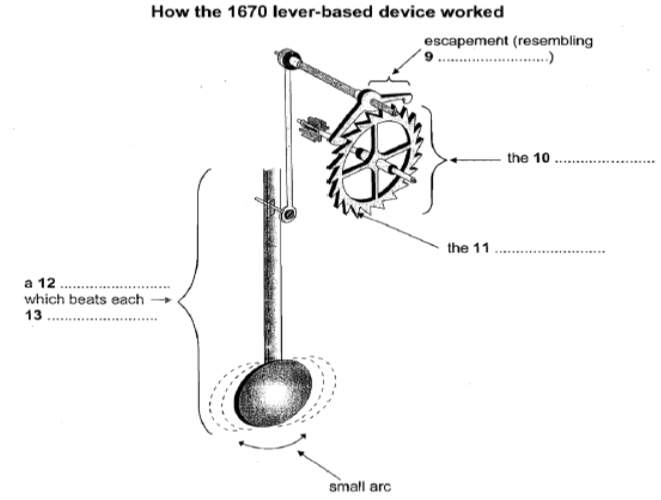
    G To address this, a variation on the original escapement was invented in 1670, in England. It was called the anchor escapement, which was a lever-based device shaped like a ship’s anchor. The motion of a pendulum rocks this device so that it catches and then releases each tooth of the escape wheel, in turn allowing it to turn a precise amount. Unlike the original form used in early pendulum clocks, the anchor escapement permitted the pendulum to travel in a very small arc. Moreover, this invention allowed the use of a long pendulum which could beat once a second and thus led to the development of a new floor standing case design, which became known as the grandfather clock.

    H Today, highly accurate timekeeping instruments set the beat for most electronic devices. Nearly all computers contain a quartz-crystal clock to regulate their operation. Moreover, not only do time signals beamed down from Global Positioning System satellites calibrate the functions of precision navigation equipment, they do so as well for mobile phones, instant stock-trading systems and nationwide power-distribution grids. So integral have these time-based technologies become to day-to-day existence that our dependency on them is recognised only when they fail to work.

    Questions 1-4
    Reading Passage 1 has eight paragraphs, A-H. Which paragraph contains the following information? Write the correct letter, A-H, in boxes 1- 4 on your answer sheet.

    1 a description of an early timekeeping invention affected by cold temperatures
    2 an explanation of the importance of geography in the development of the calendar in farming communities
    3 a description of the origins of the pendulum clock
    4 details of the simultaneous efforts of different societies to calculate time using uniform hours

    Questions 5-8
    Look at the following events (Questions 5-8) and the list of nationalities below. Match each event with the correct nationality, A-F. Write the correct letter, A-F, in boxes 5-8 on your answer sheet.

    5 They devised a civil calendar in which the months were equal in length.
    6 They divided the day into two equal halves.
    7 They developed a new cabinet shape for a type of timekeeper.
    8 They created a calendar to organise public events and work schedules.

    A Babylonians
    B Egyptians
    C Greeks
    D English
    E Germans
    F French

    Questions 9-13
    Label the diagram below. Write NO MORE THAN TWO WORDS from the passage.

    AIR TRAFFIC CONTROL IN THE USA

    A An accident that occurred in the skies over the Grand Canyon in 1956 resulted in the establishment of the Federal Aviation Administration (FAA) to regulate and oversee the operation of aircraft in the skies over the United States, which were becoming quite congested. The resulting structure of air traffic control has greatly increased the safety of flight in the United States, and similar air traffic control procedures are also in place over much of the rest of the world.

    B Rudimentary air traffic control (АТС) existed well before the Grand Canyon disaster. As early as the 1920s, the earliest air traffic controllers manually guided aircraft in the vicinity of the airports, using lights and flags, while beacons and flashing lights were placed along cross-country routes to establish the earliest airways. However, this purely visual system was useless in bad weather, and, by the 1930s, radio communication was coming into use for АТС. The first region to have something approximating today’s АТС was New York City, with other major metropolitan areas following soon after.

    C In the 1940s, АТС centres could and did take advantage of the newly developed radar and improved radio communication brought about by the Second World War, but the system remained rudimentary. It was only after the creation of the FAA that full-scale regulation of America’s airspace took place, and this was fortuitous, for the advent of the jet engine suddenly resulted in a large number of very fast planes, reducing pilots’ margin of error and practically demanding some set of rules to keep everyone well separated and operating safely in the air.

    D Many people think that АТС consists of a row of controllers sitting in front of their radar screens at the nation’s airports, telling arriving and departing traffic what to do. This is a very incomplete part of the picture. The FAA realised that the airspace over the United States would at any time have many different kinds of planes, flying for many different purposes, in a variety of weather conditions, and the same kind of structure was needed to accommodate all of them.

    E To meet this challenge, the following elements were put into effect. First, АТС extends over virtually the entire United States. In general, from 365m above the ground and higher, the entire country is blanketed by controlled airspace. In certain areas, mainly near airports, controlled airspace extends down to 215m above the ground, and, in the immediate vicinity of an airport, all the way down to the surface. Controlled airspace is that airspace in which FAA regulations apply. Elsewhere, in uncontrolled airspace, pilots are bound by fewer regulations. In this way, the recreational pilot who simply wishes to go flying for a while without all the restrictions imposed by the FAA has only to stay in uncontrolled airspace, below 365m, while the pilot who does want the protection afforded by АТС can easily enter the controlled airspace.

    F The FAA then recognised two types of operating environments. In good meteorological conditions, flying would be permitted under Visual Flight Rules (VFR), which suggests a strong reliance on visual cues to maintain an acceptable level of safety. Poor visibility necessitated a set of Instrumental Flight Rules (IFR), under which the pilot relied on altitude and navigational information provided by the plane’s instrument panel to fly safely. On a clear day, a pilot in controlled airspace can choose a VFR or IFR flight plan, and the FAA regulations were devised in a way which accommodates both VFR and IFR operations in the same airspace. However, a pilot can only choose to fly IFR if they possess an instrument rating which is above and beyond the basic pilot’s license that must also be held.

    G Controlled airspace is divided into several different types, designated by letters of the alphabet. Uncontrolled airspace is designated Class F, while controlled airspace below 5,490m above sea level and not in the vicinity of an airport is Class E. All airspace above 5,490m is designated Class A. The reason for the division of Class E and Class A airspace stems from the type of planes operating in them. Generally, Class E airspace is where one finds general aviation aircraft (few of which can climb above 5,490m anyway), and commercial turboprop aircraft. Above 5,490m is the realm of the heavy jets, since jet engines operate more efficiently at higher altitudes. The difference between Class E and A airspace is that in Class A, all operations are IFR, and pilots must be instrument-rated, that is, skilled and licensed in aircraft instrumentation. This is because АТС control of the entire space is essential. Three other types of airspace, Classes D, С and B, govern the vicinity of airports. These correspond roughly to small municipal, medium-sized metropolitan and major metropolitan airports respectively, and encompass an increasingly rigorous set of regulations. For example, all a VFR pilot has to do to enter Class С airspace is establish two-way radio contact with АТС. No explicit permission from АТС to enter is needed, although the pilot must continue to obey all regulations governing VFR flight. To enter Class В airspace, such as on approach to a major metropolitan airport, an explicit АТС clearance is required. The private pilot who cruises without permission into this airspace risks losing their license.

    Questions 14-19
    Reading passage 2 has seven paragraphs A-G. Choose the correct heading for paragraphs A and C-G from the list below. Write the correct number i-x in boxes 14-19 on your answer sheet.

    List of Headings

    i Disobeying FAA Regulations
    ii Aviation disaster prompts action
    iii Two coincidental developments
    iv Setting Altitude Zones
    v An oversimplified view
    vi Controlling pilots’ licence
    vii Defining airspace categories
    viii Setting rules to weather conditions
    ix Taking of Safety
    x First step towards ATC

    Example – Paragraph B                 x
    14 Paragraph A
    15 Paragraph C
    16 Paragraph D
    17 Paragraph E
    18 Paragraph F
    19 Paragraph G

    Questions 20-26
    Do the following statements agree with the given information of the reading passage? In boxes 20-26 on your answer sheet, write:

    TRUE                          if the statement agrees with the information
    FALSE                        if the statement contradicts the information
    NOT GIVEN             if there is no information on this

    20 The FAA was created as a result of the introduction of the jet engine.
    21 Air traffic control started after the Grand Canyon crash in 1956.
    22 Beacons and flashing lights are still used by the ATC today.
    23 Some improvements were made in radio communication during World War II.
    24 Class F airspace is airspace which is below 365m and not near airports.
    25 All aircraft in class E airspace must use IFR.
    26 A pilot entering class C airspace is flying over an average-sized city.

    TELEPATHY

    Since the 1970s, parapsychologists at leading universities and research institutes around the world have risked the derision of sceptical colleagues by putting the various claims for telepathy to the test in dozens of rigorous scientific studies. The results and their implications are dividing even the researchers who uncovered them.

    Some researchers say the results constitute compelling evidence that telepathy is genuine. Other parapsychologists believe the field is on the brink of collapse, having tried to produce definitive scientific proof and failed. Sceptics and advocates alike do concur on one issue, however: that the most impressive evidence so far has come from the so-called ‘ganzfeld’ experiments, a German term that means ‘whole field’. Reports of telepathic experiences had by people during meditation led parapsychologists to suspect that telepathy might involve ‘signals’ passing between people that were so faint that they were usually swamped by normal brain activity. In this case, such signals might be more easily detected by those experiencing meditation-like tranquility in a relaxing ‘whole field’ of light, sound and warmth.

    The ganzfeld experiment tries to recreate these conditions with participants sitting in soft reclining chairs in a sealed room, listening to relaxing sounds while their eyes are covered with special filters letting in only soft pink light. In early ganzfeld experiments, the telepathy test involved identification of a picture chosen from a random selection of four taken from a large image bank. The idea was that a person acting as a ‘sender’ would attempt to beam the image over to the ‘receiver’ relaxing in the sealed room. Once the session was over, this person was asked to identify which of the four images had been used. Random guessing would give a hit-rate of 25 per cent; if telepathy is real, however, the hit-rate would be higher. In 1982, the results from the first ganzfeld studies were analysed by one of its pioneers, the American parapsychologist Charles Honorton. They pointed to typical hit-rates of better than 30 per cent – a small effect, but one which statistical tests suggested could not be put down to chance.

    The implication was that the ganzfeld method had revealed real evidence for telepathy. But there was a crucial flaw in this argument – one routinely overlooked in more conventional areas of science. Just because chance had been ruled out as an explanation did not prove telepathy must exist; there were many other ways of getting positive results. These ranged from ‘sensory leakage’ – where clues about the pictures accidentally reach the receiver – to outright fraud. In response, the researchers issued a review of all the ganzfeld studies done up to 1985 to show that 80 per cent had found statistically significant evidence. However, they also agreed that there were still too many problems in the experiments which could lead to positive results, and they drew up a list demanding new standards for future research.

    After this, many researchers switched to autoganzfeld tests – an automated variant of the technique which used computers to perform many of the key tasks such as the random selection of images. By minimising human involvement, the idea was to minimise the risk of flawed results. In 1987, results from hundreds of autoganzfeld tests were studied by Honorton in a ‘meta-analysis’, a statistical technique for finding the overall results from a set of studies. Though less compelling than before, the outcome was still impressive.

    Yet some parapsychologists remain disturbed by the lack of consistency between individual ganzfeld studies. Defenders of telepathy point out that demanding impressive evidence from every study ignores one basic statistical fact: it takes large samples to detect small effects. If, as current results suggest, telepathy produces hit-rates only marginally above the 25 per cent expected by chance, it’s unlikely to be detected by a typical ganzfeld study involving around 40 people: the group is just not big enough. Only when many studies are combined in a meta-analysis will the faint signal of telepathy really become apparent. And that is what researchers do seem to be finding.

    What they are certainly not finding, however, is any change in attitude of mainstream scientists: most still totally reject the very idea of telepathy. The problem stems at least in part from the lack of any plausible mechanism for telepathy.

    Various theories have been put forward, many focusing on esoteric ideas from theoretical physics. They include ‘quantum entanglement’, in which events affecting one group of atoms instantly affect another group, no matter how far apart they may be. While physicists have demonstrated entanglement with specially prepared atoms, no-one knows if it also exists between atoms making up human minds. Answering such questions would transform parapsychology. This has prompted some researchers to argue that the future lies not in collecting more evidence for telepathy, but in probing possible mechanisms. Some work has begun already, with researchers trying to identify people who are particularly successful in autoganzfeld trials. Early results show that creative and artistic people do much better than average: in one study at the University of Edinburgh, musicians achieved a hit-rate of 56 per cent. Perhaps more tests like these will eventually give the researchers the evidence they are seeking and strengthen the case for the existence of telepathy.

    Questions 27-30
    Complete each sentence with the correct ending, A —G, below. Write the correct letter, A—G, in boxes 27-30 on your answer sheet.

    27 Researchers with differing attitudes towards telepathy agree on
    28 Reports of experiences during meditation indicated
    29 Attitudes to parapsychology would alter drastically with
    30 Recent autoganzfeld trials suggest that success rates will improve with

    A the discovery of a mechanism for telepathy.
    B the need to create a suitable environment for telepathy.
    C their claims of a high success rate.
    D a solution to the problem posed by random guessing.
    E the significance of the ganzfeld experiments.
    F a more careful selection of subjects.
    G a need to keep altering conditions.

    Questions 31-40
    Complete the table below. Choose NO MORE THAN THREE WORDS from the passage for each answer.
    Write your answers in boxes 31-40 on your answer sheet.

    TELEPATHY EXPERIMENTS
    Name/ DateDescriptionResultFlas
    Ganzfeld studies 1982involved a person acting as a (31)……………….who picked out one (32)……………. from a random selection of four and a (33)………………. who then tried to identify ithit rates were higher than with random guessingpositive results could be produced by factors such as (34)…………. or (35)…………..
    Autoganzfeld studies 1987(36)…………….were used for key tasks to limit the amount of (37)…………. in carrying out the teststhe results were then subjected to a (38)………….the (39)………….. between different test results were put down to the fact that sample groups were not (40)…………. (as with most ganzfled studies)
  • IELTS Reading Practice Test – Exercise 6

    Sheet Glass Manufacture: the Float Process

    Glass, which has been made since the time of the Mesopotamians and Egyptians, is little more than a mixture of sand, soda ash and lime. When heated to about 1500 degrees Celsius (°C) this becomes a molten mass that hardens when slowly cooled. The first successful method for making clear, flat glass involved spinning. This method was very effective as the glass had not touched any surfaces between being soft and becoming hard, so it stayed perfectly unblemished, with a ‘fire finish’. However, the process took a long time and was labour intensive.

    evertheless, demand for flat glass was very high and glassmakers across the world were looking for a method of making it continuously. The first continuous ribbon process involved squeezing molten glass through two hot rollers, similar to an old mangle. This allowed glass of virtually any thickness to be made non-stop, but the rollers would leave both sides of the glass marked, and these would then need to be ground and polished. This part of the process rubbed away around 20 per cent of the glass, and the machines were very expensive.

    The float process for making flat glass was invented by Alistair Pilkington. This process allows the manufacture of clear, tinted and coated glass for buildings, and clear and tinted glass for vehicles. Pilkington had been experimenting with improving the melting process, and in 1952 he had the idea of using a bed of molten metal to form the flat glass, eliminating altogether the need for rollers within the float bath. The metal had to melt at a temperature less than the hardening point of glass (about 600°C), but could net boil at a temperature below the temperature of the molten glass (about 1500°C). The best metal for the job was tin.

    The rest of the concept relied on gravity, which guaranteed that the surface of the molten metal was perfectly flat and horizontal. Consequently, when pouring molten glass onto the molten tin, the underside of the glass would also be perfectly flat. If the glass were kept hot enough, it would flow over the molten tin until the top surface was also flat, horizontal and perfectly parallel to the bottom surface. Once the glass cooled to 604°C or less it was too hard to mark and could be transported out of the cooling zone by rollers. The glass settled to a thickness of six millimetres because of surface tension interactions between the glass and the tin. By fortunate coincidence, 60 per cent of the flat glass market at that time was for six- millimetre glass.

    Pilkington built a pilot plant in 1953 and by 1955 he had convinced his company to build a full-scale plant. However, it took 14 months of non-stop production, costing the company £100,000 a month, before the plant produced any usable glass. Furthermore, once they succeeded in making marketable flat glass, the machine was turned off for a service to prepare it for years of continuous production. When it started up again it took another four months to get the process right again. They finally succeeded in 1959 and there are now float plants all over the world, with each able to produce around 1000 tons of glass every day, non-stop for around 15 years.

    Float plants today make glass of near optical quality. Several processes – melting, refining, homogenising – take place simultaneously in the 2000 tonnes of molten glass in the furnace. They occur in separate zones in a complex glass flow driven by high temperatures. It adds up to a continuous melting process, lasting as long as 50 hours, that delivers glass smoothly and continuously to the float bath, and from there to a coating zone and finally a heat treatment zone, where stresses formed during cooling are relieved.

    The principle of float glass is unchanged since the 1950s. However, the product has changed dramatically, from a single thickness of 6.8 mm to a range from sub-millimetre to 25 mm, from a ribbon frequently marred by inclusions and bubbles to almost optical perfection. To ensure the highest quality, inspection takes place at every stage. Occasionally, a bubble is not removed during refining, a sand grain refuses to melt, a tremor in the tin puts ripples into the glass ribbon. Automated on-line inspection does two things. Firstly, it reveals process faults upstream that can be corrected. Inspection technology allows more than 100 million measurements a second to be made across the ribbon, locating flaws the unaided eye would be unable to see. Secondly, it enables computers downstream to steer cutters around flaws.

    Float glass is sold by the square metre, and at the final stage computers translate customer requirements into patterns of cuts designed to minimise waste.

    Questions 1-8
    Complete the table and diagram below. Choose NO MORE THAN TWO WORDS from the passage for each answer.
    Write your answers in boxes 1-8 on your answer sheet.

    Questions 9-13
    Do the following statements agree with the information given in Reading Passage 1? In boxes 9-13 on your answer sheet, write:

    TRUE                          if the statement agrees with the information
    FALSE                        if the statement contradicts the information
    NOT GIVEN             if there is no information on this

    9 The metal used in the float process had to have specific properties.
    10 Pilkington invested some of his own money in his float plant.
    11 Pilkington’s first full-scale plant was an instant commercial success.
    12 The process invented by Pilkington has now been improved.
    13 Computers are better than humans at detecting faults in glass.

    The Little Ice Age

    A This book will provide a detailed examination of the Little Ice Age and other climatic shifts, but, before I embark on that, let me provide a historical context. We tend to think of climate – as opposed to weather – as something unchanging, yet humanity has been at the mercy of climate change for its entire existence, with at least eight glacial episodes in the past 730,000 years. Our ancestors adapted to the universal but irregular global warming since the end of the last great Ice Age, around 10,000 years ago, with dazzling opportunism. They developed strategies for surviving harsh drought cycles, decades of heavy rainfall or unaccustomed cold; adopted agriculture and stock-raising, which revolutionised human life; and founded the world’s first pre-industrial civilisations in Egypt, Mesopotamia and the Americas. But the price of sudden climate change, in famine, disease and suffering, was often high.

    B The Little Ice Age lasted from roughly 1300 until the middle of the nineteenth century. Only two centuries ago, Europe experienced a cycle of bitterly cold winters; mountain glaciers in the Swiss Alps were the lowest in recorded memory, and pack ice surrounded Iceland for much of the year. The climatic events of the Little Ice Age did more than help shape the modern world. They are the deeply important context for the current unprecedented global warming. The Little Ice Age was far from a deep freeze, however; rather an irregular seesaw of rapid climatic shifts, few lasting more than a quarter-century, driven by complex and still little understood interactions between the atmosphere and the ocean. The seesaw brought cycles of intensely cold winters and easterly winds, then switched abruptly to years of heavy spring and early summer rains, mild winters, and frequent Atlantic storms, or to periods of droughts, light northeasterly winds, and summer heat waves.

    C Reconstructing the climate changes of the past is extremely difficult, because systematic weather observations began only a few centuries ago, in Europe and North America. Records from India and tropical Africa are even more recent.

    For the time before records began, we have only ‘proxy records’ reconstructed largely from tree rings and ice cores, supplemented by a few incomplete written accounts. We now have hundreds of tree-ring records from throughout the northern hemisphere, and many from south of the equator, too, amplified with a growing body of temperature data from ice cores drilled in Antarctica, Greenland, the Peruvian Andes, and other locations. We are close to a knowledge of annual summer and winter temperature variations over much of the northern hemisphere going back 600 years.

    D This book is a narrative history of climatic shifts during the past ten centuries, and some of the ways in which people in Europe adapted to them. Part One describes the Medieval Warm Period, roughly 900 to 1200. During these three centuries, Norse voyagers from Northern Europe explored northern seas, settled Greenland, and visited North America. It was not a time of uniform warmth, for then, as always since the Great Ice Age, there were constant shifts in rainfall and temperature. Mean European temperatures were about the same as today, perhaps slightly cooler.

    E It is known that the Little Ice Age cooling began in Greenland and the Arctic in about 1200. As the Arctic ice pack spread southward, Norse voyages to the west were rerouted into the open Atlantic, then ended altogether. Storminess increased in the North Atlantic and North Sea. Colder, much wetter weather descended on Europe between 1315 and 1319, when thousands perished in a continent-wide famine. By 1400, the weather had become decidedly more unpredictable and stormier, with sudden shifts and lower temperatures that culminated in the cold decades of the late sixteenth century. Fish were a vital commodity in growing towns and cities, where food supplies were a constant concern. Dried cod and herring were already the staples of the European fish trade, but changes in water temperatures forced fishing fleets to work further offshore. The Basques, Dutch, and English developed the first offshore fishing boats adapted to a colder and stormier Atlantic. A gradual agricultural revolution in northern Europe stemmed from concerns over food supplies at a time of rising populations. The revolution involved intensive commercial farming and the growing of animal fodder on land not previously used for crops. The increased productivity from farmland made some countries self-sufficient in grain and livestock and offered effective protection against famine.

    F Global temperatures began to rise slowly after 1850, with the beginning of the Modern Warm Period. There was a vast migration from Europe by land-hungry farmers and others, to which the famine caused by the Irish potato blight contributed, to North America, Australia, New Zealand, and southern Africa. Millions of hectares of forest and woodland fell before the newcomers’ axes between 1850 and 1890, as intensive European farming methods expanded across the world. The unprecedented land clearance released vast quantities of carbon dioxide into the atmosphere, triggering for the first time humanly caused global warming. Temperatures climbed more rapidly in the twentieth century as the use of fossil fuels proliferated and greenhouse gas levels continued to soar. The rise has been even steeper since the early 1980s. The Little Ice Age has given way to a new climatic regime, marked by prolonged and steady warming. At the same time, extreme weather events like Category 5 hurricanes are becoming more frequent.

    Questions 14-17
    Reading Passage 2 has six paragraphs, A—F. Choose the correct heading for paragraphs B and D—F from the list of headings below. Write the correct number, i—ix, in boxes 14-17 on your answer sheet.

    List of Headings

    i Predicting climatic changes
    ii The relevance of the Little Ice Age today
    iii How cities contribute to climate change
    iv Human impact on the climate
    v How past climatic conditions can be determined
    vi A growing need for weather records
    vii A study covering a thousand years
    viii People have always responded to climate change
    ix Enough food at last

    Example Answer           Paragraph A                viii
    14. Paragraph B
    Example Answer           Paragraph C                 v
    15 Paragraph D
    16 Paragraph E
    17 Paragraph F

    Questions 18-22
    Complete the summary using the list of words, A—I, below. Write the correct letter, A—I, in boxes 18-22 on your answer sheet.

    Weather during the Little Ice Age
    Documentation of past weather condition is limited: our main sources of knowledge of conditions in the distant past are (18)………………. and (19)………………… . We can deduce that the Little Ice Age was a time of (20)…………… , rather than of consistent freezing. Within it there were some periods of very cold winters, others of (21)…………. and heavy rain, and yet others that saw (22)…………. with no rain at all.

    A climatic shifts                    B ice cores                      C tree rings

    D glaciers                             E interactions                  F weather observations

    G heat waves                       H storms                         I written accounts

    Questions 23-26
    Classify the following events as occurring during the

    A Medieval Warm Period
    B Little Ice Age
    C Modem Warm Period

    Write the correct letter, A, B or C, in boxes 23-26 on your answer sheet.

    23 Many Europeans started farming abroad.
    24 The cutting down of trees began to affect the climate.
    25 Europeans discovered other lands.
    26 Changes took place in fishing patterns.

    The meaning and power of smell

    A A survey conducted by Anthony Synott at Montreal’s Concordia University asked participants to comment on how important smell was to them in their lives. It became apparent that smell can evoke strong emotional responses. A scent associated with a good experience can bring a rush of joy, while a foul odour or one associated with a bad memory may make us grimace with disgust. Respondents to the survey noted that many of their olfactory likes and dislikes were based on emotional associations. Such associations can be powerful enough so that odours that we would generally label unpleasant become agreeable, and those that we would generally consider fragrant become disagreeable for particular individuals. The perception of smell, therefore, consists not only of the sensation of the odours themselves, but of the experiences and emotions associated with them.

    B Odours are also essential cues in social bonding. One respondent to the survey believed that there is no true emotional bonding without touching and smelling a loved one. In fact, infants recognise the odours of their mothers soon after birth and adults can often identify their children or spouses by scent. In one well-known test, women and men were able to distinguish by smell alone clothing worn by their marriage partners from similar clothing worn by other people. Most of the subjects would probably never have given much thought to odour as a cue for identifying family members before being involved in the test, but as the experiment revealed, even when not consciously considered, smells register.

    C In spite of its importance to our emotional and sensory lives, smell is probably the most undervalued sense in many cultures. The reason often given for the low regard in which smell is held is that, in comparison with its importance among animals, the human sense of smell is feeble and undeveloped. While it is true that the olfactory powers of humans are nothing like as fine as those possessed by certain animals, they are still remarkably acute. Our noses are able to recognise thousands of smells, and to perceive odours which are present only in extremely small quantities.

    D Smell, however, is a highly elusive phenomenon. Odours, unlike colours, for instance, cannot be named in many languages because the specific vocabulary simply doesn’t exist. ‘It smells like . . .,’ we have to say when describing an odour, struggling to express our olfactory experience. Nor can odours be recorded: there is no effective way to either capture or store them over time. In the realm of olfaction, we must make do with descriptions and recollections. This has implications for olfactory research.

    E Most of the research on smell undertaken to date has been of a physical scientific nature. Significant advances have been made in the understanding of the biological and chemical nature of olfaction, but many fundamental questions have yet to be answered. Researchers have still to decide whether smell is one sense or two – one responding to odours proper and the other registering odourless chemicals in the air. Other unanswered questions are whether the nose is the only part of the body affected by odours, and how smells can be measured objectively given the nonphysical components. Questions like these mean that interest in the psychology of smell is inevitably set to play an increasingly important role for researchers.

    F However, smell is not simply a biological and psychological phenomenon. Smell is cultural, hence it is a social and historical phenomenon. Odours are invested with cultural values: smells that are considered to be offensive in some cultures may be perfectly acceptable in others. Therefore, our sense of smell is a means of, and model for, interacting with the world. Different smells can provide us with intimate and emotionally charged experiences and the value that we attach to these experiences is interiorised by the members of society in a deeply personal way. Importantly, our commonly held feelings about smells can help distinguish us from other cultures. The study of the cultural history of smell is, therefore, in a very real sense, an investigation into the essence of human culture.

    Questions 27-32
    Reading Passage 3 has six paragraphs, A—F. Choose the correct heading for each paragraph from the list of headings below.

    Write the correct number, i—viii, in boxes 27-32 on your answer sheet.

    List of Headings

    i The difficulties of talking about smells
    ii The role of smell in personal relationships
    iii Future studies into smell
    iv The relationship between the brain and the nose
    v The interpretation of smells as a factor in defining groups
    vi Why our sense of smell is not appreciated
    vii Smell is our superior sense
    viii The relationship between smell and feelings

    27 Paragraph A
    28 Paragraph B
    29 Paragraph C
    30 Paragraph D
    31 Paragraph E
    32 Paragraph F

    Questions 33-36
    Choose the correct letter, A, B, C or D. Write the correct letter in boxes 33-36 on your answer sheet.

    33 According to the introduction, we become aware of the importance of smell when
    A we discover a new smell
    B we experience a powerful smell
    C our ability to smell is damaged
    D we are surrounded by odours

    34 The experiment described in paragraph B
    A shows how we make use of smell without realising it
    B demonstrates that family members have a similar smell
    C proves that a sense of smell is learnt
    D compares the sense of smell in males and females

    35 What is the writer doing in paragraph C?
    A supporting other research
    B making a proposal
    C rejecting a common belief
    D describing limitations

    36 What does the writer suggest about the study of smell in the atmosphere in paragraph E?
    A The measurement of smell is becoming more accurate
    B Researchers believe smell is a purely physical reaction
    C Most smells are inoffensive
    D Smell is yet to be defined

    Questions 37-40
    Complete the sentences below. Choose ONE WORD ONLY from the passage for each answer.

    37 Tests have shown that odours can help people recognise the………………..belonging to their husbands and wives.
    38 Certain linguistic groups may have difficulty describing smell because they lack the appropriate……………
    39 The sense of smell may involve response to…………………which do not smell, in addition to obvious odours.
    40 Odours regarded as unpleasant in certain……………………….are not regarded as unpleasant in others.

  • IELTS Listening Practice Test – Exercise 20

    Part 1: Question 1
    Choose the correct letter A, B or C.

    1. Mr. Jones moved to Los Angeles
     A two weeks ago
     B three weeks ago
     C two days ago

    Question 2
    Answer the question with NO MORE THAN TWO WORDS.

    2. When does Mr. Jones have to go to his office? 

    Question 3
    Choose the correct letter A, B or C.

    3. Mr. Jones for a(n)
     A insurance company
     B medical company
     C real estate company

    Questions 4 and 5
    Complete the following sentences with ONE WORD OR A NUMBER.

    Mr. Jones’ appointment with the doctor is at (4)  am on
    (5)
     

    Question 6-8
    Write NO MORE THAN THREE WORDS for each answer.

    List any THREE medical tests that the insurance company requires Mr. Jones to have
    (6) 
    (7) 
    (8) 

    Questions 9 and 10
    Answer the following questions. Write ONE WORD OR A NUMBER for each answer.

    9 What is Mr. Jones’ home telephone number including the area code? 
    10 What is secretary’s first name? 

    Part 2: Questions 11-13
    Complete the following sentences with NO MORE THAN THREE WORDS for each answer.

    11. Mr. Smith manages group tours to Australia, New Zealand and the 
    12. Morning Sun Travel did some  and developed their new tour.
    13. From the Five Seasons Hotel Sydney, one can clearly see a harbor, a bridge and 

    Question 14
    Choose the correct letter A, B or C.

    14. Mr. Smith says that to get used to the time difference it is best to
     A have a rest
     B visit a harbor
     C go outside

    Question 15
    Complete the following sentence WITH ONE WORD only.

    15. A wombat looks like a  with two short legs.

    Question 16
    Choose the correct letter A, B or C.

    16. After the visit to the Sydney Olympic Site the tour group will return to downtown Sydney by
     A bus
     B boat
     C seaplane

    Question 17
    Answer the question with ONE WORD OR A NUMBER only.

    17. How high will the seaplane fly over Bondi Beach? 

    Questions 18 and 19
    Complete the sentence below with ONE WORD only.

    Mr. Smith says that in addition to Italian and Chinese food, in Australian cities one can find
    (18)  and (19)  cuisine.

    Question 20
    Answer the question with ONE WORD only.

    20. After Sydney, what is the destination on the tour itinerary? 

    Part 3: Questions 21-23
    Choose THREE letters from A-E.

    Why is Ann late preparing her talk?
     A her mother is ill
     B the doctor says Ann should do all the cooking and cleaning for her mother
     C Ann and her mother cannot pay for extra help
     D the neighbours are all too busy to help her mother
     E she spends too much time playing computer games

    Questions 24 and 25
    Complete the following sentences with NO MORE THAN TWO WORDS for each answer.

    When studying (24)  in high school, Bill read about an experiment on how wearing a uniform can change people’s (25) 

    Questions 26 and 27
    Choose the correct letter A, B or C.

    26. Bill thinks that the professor is from
     A University of America
     B University of California
     C University of Los Angeles

    27. The police took the students to a
     A school
     B prison
     C police station

    Questions 28 and 29
    Choose TWO letters from A-E.

    Why does Bill say the arrested students did not know the other students?
     A they had not been introduced
     B they went to different schools
     C to prevent them realizing they were there for the experiment they had signed up for
     D the other students were in uniform
     E the professor did not want them to know each other

    Question 30
    Complete the following sentence with NO MORE THAN TWO WORDS.

    30. Bill says the ‘prisons’ started having 

    Part 4: Questions 31 and 32
    Choose TWO letter from A-E.

    The lecturer will talk about
     A the media
     B the internet
     C types of message
     D Yahoo
     E advertising

    Questions 34 and 33
    Write NO MORE THAN THREE WORDS for each answer.

    The speaker says effective advertising depends on the right (33)  and the
    (34) 

    Question 35
    Choose the correct letter A, B or C.

    35. Advertisers always want to change people’s
     A buying habits
     B life
     C working habits

    Questions 36-40
    Complete the sentences with NO MORE THAN THREE WORDS for each answer.

    People usually buy (36)  because they recognize the name of the manufacture. The speaker says that Shell has purchased a (37)  and marketed a beer they called (38)  San Fran Video Store handed out cards with a (39)  and a (40)  Of the store locations of them.

  • IELTS Listening Practice Test – Exercise 19

    Part 1: Questions 1-10
    Complete the notes below. Write NO MORE THAN TWO WORDS OR A NUMBER for each answer.

    Health club customer research
    Name: Selina Thompson

    Occupation: (1) 
    Age group: (2) 
    Type of membership: (3) 
    Length of membership: (4)  years
    Why joined: recommended by a (5) 
    Visits to club per month: Eight (on average)
    Facility used most: (6) 
    Facility not used (if any): tennis courts (because reluctant to (7)  )
    Suggestions for improvements: have more (8) 
    Install (9)  in the gym
    Open (10)  later at weekends

    Part 2: Questions 11-16
    Complete the flow chart below. Choose SIX answers from the box and write the correct letter A-G next to questions 11-16.

    A air
    B ash
    C earth
    D grass
    E sticks
    F stones
    G water

    Making a steam pit
    • Dig a pit
    • Arrange a row of (11)  over the pit
    • Place (12)  on top
    • Light the wood and let it burn out
    • Remove (13) 
    • Insert a stick
    • Cover the pit with (14) 
    • Place wrapped food on top and cover it with (15) 
    • Remove the stick and put (16)  into the hole

    Questions 17-18
    Choose TWO letters, A-E.

    Which TWO characteristics apply to the bamboo oven?

     A It’s suitable for windy weather.
     B The fire is lit below the bottom end of the bamboo.
     C The bamboo is cut into equal lengths.
     D The oven hangs from a stick.
     E It cooks food by steaming it.

    Questions 19-20
    Choose TWO letters, A-E.

    Which TWO pieces of advice does the speaker give about eating wild fungi?

     A Cooking doesn’t make poisonous fungi edible.
     B Edible wild fungi can be eaten without cooking.
     C Wild fungi are highly nutritious.
     D Some edible fungi look very similar to poisonous varieties.
     E Fungi which cannot be identified should only be eaten in small quantities.

    Part 3: Questions 21-25
    Choose the correct letter, A, B or C.

    Research project on attitudes towards study

    21. Phoebe’s main reason for choosing her topic was that
     A her classmates had been very interested in it.
     B it would help prepare her for her first teaching post.
     C she had been inspired by a particular book.

    22. Phoebe’s main research question related to
     A the effect of teacher discipline.
     B the variety of learning activities.
     C levels of pupil confidence.

    23. Phoebe was most surprised by her finding that
     A gender did not influence behaviour significantly.
     B girls were more negative about school than boys.
     C boys were more talkative than girls in class.

    24. Regarding teaching, Phoebe says she has learned that
     A teachers should be flexible in their lesson planning.
     B brighter children learn from supporting weaker ones.
     C children vary from each other in unpredictable ways.

    25. Tony is particularly impressed by Phoebe’s ability to
     A recognise the limitations of such small-scale research.
     B reflect on her own research experience in an interesting way.
     C design her research in such a way as to minimise difficulties.

    Questions 26-30
    What did Phoebe find difficult about the different research techniques she used?

    Choose FIVE answers from the box and write the correct letter A-G, next to questions 26-30.

    Difficulties
    A Obtaining permission
    B Deciding on a suitable focus
    C Concentrating while gathering data
    D Working collaboratively
    E Processing data she had gathered
    F Finding a suitable time to conduct the research
    G Getting hold of suitable equipment

    Research techniques
    26. Observing lessons 
    27. Interviewing teachers 
    28. Interviewing pupils 
    29. Using questionnaires 
    30. Taking photographs 

    Part 4: Questions 31-40
    Complete the sentences below. Write NO MORE THAN TWO WORDS for each answer.

    Saving the juniper plant

    Background

    31. Juniper was one of the first plants to colonise Britain after the last 
    32. Its smoke is virtually  so juniper wood was used as fuel in illegal activities.
    33. Oils from the plant were used to prevent  spreading.
    34. Nowadays, its berries are widely used to  food and drink

    Ecology

    35. Juniper plants also support several species of insects and 

    Problems

    36. In current juniper populations, ratios of the  are poor.
    37. Many of the bushes in each group are of the same age so  of whole populations is rapid.

    Solutions

    38. Plantlife is trialling novel techniques across  areas of England.
    39. One measure is to introduce  for seedlings.
    40. A further step is to plant  from healthy bushes.

  • IELTS Listening Practice Test – Exercise 18

    Part 1: Questions 1-8
    Complete the table below using NO MORE THAN THREE WORDS AND/OR A NUMBER for each answer.

    People interested in sharing the flat

    NameJobDescriptionSpecial Requirements
    Phil Parrott(1)……………teacher– (2)……………….
    -Too health-conscious?
    (3)…………….because of equipment
    David (4)……………Lawyer– Older
    – Quiet
    – (5)…………….
    To pay less for gas and electricity
    Leo Norris(6)………………….– Funny
    – Lazy
    – Not (7)…………or…………
    – Outdoor type
    Somewhere to keep his (8)………………..

    (1)                  (2) 
    (3)                 (4) 
    (5)                 (6) 
    (7)                 (8) 

    Questions 9 and 10
    Complete the notes below. Write NO MORE THAN THREE WORDS AND/ OR A NUMBER for each answer.

    Leo’s phone number (mobile) (9)  
    Leo would like to move in on (10) 

    Part 2: Questions 11-14
    Choose the correct letter A, B or C.

    11. Refreshments will be served
     A at the front counter
     B in the lobby
     C at the back of the hall

    12. Nick Noble advertised
     A on the radio
     B on a billboard
     C in the newspaper

    13. The original number of founding members was about
     A 12
     B 20
     C 200

    14. The club provides activities primarily for reasonable fit
     A males up to 75
     B females with young children
     C males and females of any age

    Questions 15-20
    Complete the table below. Write NO MORE THAN ONE WORD AND/ OR A NUMBER for each answer.

    ActivityDay(s)DurationContact Person
    (15)……………….Tuesday and SaturdayAbout 3-5 hoursCoordinator
    (16)………………….Thursday and SundayUp to 3 hours(17)………………..
    WanderersSunday(18)……………Leader
    (19)…………….weekendsSaturday and SundayAll weekend(20)………………..

    (15)                   (16)  
    (17)                   (18)  
    (19)                   (20) 

    Part 3: Questions 21-26
    Choose the correct letter A, B or C.

    21. What is the main topic of assignment?
     A the historical development of television
     B the development of new media
     C the cultural future of television

    22. According to Emilie which new technology will become the biggest competition for television?
     A iPods
     B mobile phones
     C video games

    23. According to the tutor the average length of a television become
     A 45 minutes
     B 4 to 5 minutes
     C 10 minutes

    24. What part of the library is going to be closed for one week?
     A the sociology section
     B the media studies section
     C the journals section

    25. Which body do they decide to complain to?
     A Premises committee
     B Students’ Union
     C the library

    26. What will the reprographics office do?
     A send emails to your tutor
     B send your dissertation to you
     C send your dissertation to your tutor

    Questions 27-30
    Answer the questions below. Write NO MORE THAN THREE WORDS AND/ OR A NUMBER for each answer.

    27. What does the tutor compare homemade videos with? 
    28. What is the title of Mrs Jone’s lecture? 
    29. Where is the lecture? 
    30. When is the final date for the assignment? 

    Part 4: Questions 31-37
    Complete the sentences below. Write NO MORE THAN THREE WORDS for each answer.

    31. Samuel Wells  before Scholastic House opened in 1903.
    32. There were  original students.
    33. Scholastic House became  in 1963.
    34. One of these students became a prominent 
    35. Scholastic House experienced difficulties during 
    36. The college has a tradition of learning and 
    37. Since 1972, controversial  have been discussed.

    Questions 38-40
    Choose the correct letter A, B or C.

    38. The college discusses controversial issues because it
     A informs the debate
     B reduces tension
     C encourages argument

    39. The principal believes that
     A science is less advanced than medicine
     B philosophy is more useful than science
     C science is ahead of philosophy

    40. The principal urges the students to
     A accept what they are told
     B ask questions at all times
     C think only about their studies

  • IELTS Listening Practice Test – Exercise 17

    Part 1: Questions 1-4
    Choose the correct letter A, B or C.

    1. A TFN is a number used
     A exclusively for tax administration
     B exclusively by individual tax payers
     C for managing several government services

    2. Without a TFN, the applicant would be
     A taxed at a higher rate
     B unable to work
     C liable for medicare contributions

    3. What kind of visa does the applicant have?
     A a visa granting indefinite stay
     B a visa with work rights
     C a student visa

    4. A TFN is issued
     A if you change your name
     B only once in a lifetime
     C when you claim a government benefit

    Questions 5-10
    Complete the form below. Write NO MORE THAN TWO WORDS AND/ OR A NUMBER for each answer.

    Passport:(5)……………..
    NationalitySpanish
    Postal Address1339 (6)……………………Hollywell 1517
    Contact DetailsPhone: 09-55775076
    Preferred Contact PersonMartha (7)…………………..(landlady)
    Family NameFarina
    First Given Name(8)……………………….Maria
    Any Other NamesMary = (9)………………….
    Date of Brith(10)…………./……………../…………………(dd/mm/yy)
    GenderFemale
    Name of SpouseNA

    (5)                    (6)   
    (7)                   (8)    
    (9)                  (10)  

    Part 2: Questions 11-16
    Complete the notes below. Write NO MORE THAN TWO WORDS for each answer.

    Keeping kids safe on Internet

    • Internet for children-scary but educational
    • ‘Online Family Norris’ blocks (11)  and social sites
    • But still important to watch children and (12)  them
    • Keep computer in family room where you can see it
    • Children should never use their own name nor give out (13) 
    • Online friends stay online
    • No personal email address for youngsters
    • Teach teenagers that (14)  on the Internet always stay there – and may ruin job prospects
    • Watch out for (15) 
    • Teenagers use internet: to socialize or do (16) 
    • Young kids: find help with school subjects

    Questions 17-20
    Complete the table below. Write NO MORE THAN TWO WORDS for each answer.

    WebsiteContentActivityAge Group
    www.mathtutor.comMathematicsPractice and (17)………………….All levels
    www.spellcity.comSpelling(18)………………………Primary school
    www.bee.co/typingTyping(19)……………………….All levels
    www.coolresource.com(20)………………….Extra practiceMiddle school

    (17)                  (18) 
    (19)                 (20) 

    Part 3: Questions 21-23
    Choose the correct letter A, B or C.

    21. Ted and Cleo’s research results will be presented as a
     A poster
     B survey
     C graph

    22. They will select foreign students
     A from the language school
     B from the business school
     C randomly on campus

    23. The foreign students will have to
     A collate the answers
     B rank the answers
     C know a lot about the answers.

    Questions 24-28
    Complete the notes below. Write NO MORE THAN THREE WORDS for each answer.

    Reasons for studying abroad
    Study abroad
    • Is the best way to learn a language
    • Provides a (24) 
    • Allows you to experience another culture first hand
    • Helps you (25) 
    • Give you opportunity to make new friends
    • Helps you (26) 
    • Enables you to (27) 
    • Increase the value of your degree
    • Improves (28) 

    • Expands your world view

    Questions 29 and 30
    Label the diagram below. Choose your answers from the box and write the letters A-H next to questions 29-30.

    (29) 
    (30) 

    Part 4: Questions 31-36
    Complete the table below. Write NO MORE THAN TWO WORDS AND OR A NUMBER for each answer.

    Charles William Peale

    SlidePaintingDateNotes
    1Pitt as a Roman Senator(31)……………….Elaborate , symbolical portrait of British parliamentarian
    2George Washington1772(32)……………….of many Washington portraits
    3The Peale Family1773Family portrait – shows exuberance & (33)…………………
    4The (34)………….1795‘trompe l’oeil’ style – double portraits of sons – Raphaelle & Titian
    5Rachel Weeping1772Wife and dead (35)……………..
    6James(36)……………….Brother James – in darkness but face illuminated

    (31) 
    (32) 
    (33) 
    (34) 
    (35) 
    (36) 

    Questions 37-40
    Complete the summary below. Write NO MORE THAN ONE WORD for each answer.

    Primarily, Peale was a painter but he was also a politician, scientist and (37)  with many successful patents. He worked with Thomas Jefferson on the polygraph which was a desk that could be used for copying a (38)  He wrote academic papers on different subjects and tried to make movies, spectacles and a velocipede (a kind of (39)  ) Peale was also a naturalist and taxidermist and he helped unearth the skeleton of mastodon which was the best (40)  in his museum.

  • IELTS Listening Practice Test – Exercise 16

    Section 1: Questions 1-5
    Complete the table below using NO MORE THAN TWO WORDS AND/OR A NUMBER for each answer.

    Name of libraryLocationOpening timesOther information
    Bailey LibraryParkville campus8.30 am to (1)………….pm weekdaysPopular with students
    Brown LibraryNear Stratton Street and (2)……………..7 am to 2 am dailyOpen to (3)…………students only
    RMIT LibraryLevel 5, building 8, (4)………………Swan Street10 am – 12 midnight Monday to Friday
    10 am – (5)………………..pm Saturdays and Sundays
    Good internet facilites

    (1)                   (2) 
    (3)                  (4) 
    (5) 

    Questions 6-10
    Complete the flow chart below. Write NO MORE THAN ONE WORD for each answer.
    Process of booking a computer
    • Step 1: log in to (6)  using your student number and
    (7)
     
    • Step 2: choose the resource type you would like to use
    • Step 3: select (8)  of computer
    • Step 4: select date of booking using (9)  options
    • Step 5: complete your booking. Your name should appear on the booking
    (10)
     

    Section 2: Questions 11-14
    Choose TWO answers for each question.

    11. Doors Open
     A is an annual event
     B lasts for one week
     C is a free event
     D happens in spring
     E is more than 100 years old

    12. The Observatory
     A is situated in Edinburgh
     B was built 20 years ago
     C regularly participates in the Doors Open event
     D is 120 years old
     E is open to visitors every day of the year

    13. Planetarium Shows
     A take place twice a day
     B are more popular on Saturday
     C run on Saturday and Sunday
     D run four times a day
     E finish at half past ten

    14. All tickets
     A must be booked in advance
     B are already sold out
     C are on sale at the information point
     D must be booked online
     E are available for from midday

    Questions 15-20
    Complete the sentences using NO MORE THAN TWO WORDS for each answer.

    15. The tour of the telescope dome includes access to the  of the building
    16. Tour participants are advised to have suitable 
    17. Visitors to the Crawford Collection can see items from the astronomical  on display
    18. The children’s craft workshops take place in the 
    19. During the craft workshops children can construct a model of a 
    20. Children also have the opportunity to colour a 

    Section 3: Questions 21-23
    Choose THREE letters A-G.

    Which THREE examples of space junk are mentioned by the speaker?

    (21) 
    (22) 
    (23) 

    A cans
    B cooling tanks
    C metal plates
    D metal screws
    E paint
    F satellites
    G whole rackets

    Questions 24-26
    Which country is responsible for depositing the following percentages of space junk?

    (24)  28% 
    (25)  29% 
    (26)  37% 

    A China
    B Europe
    C India
    D Russia
    E United States

    Questions 27-30
    Complete the table below. Choose the answers from the options and write the appropriate letter A-I next to questions 27-30.
    Space Junk – Satellites

    Name of SatelliteCountry of originNotes
    UARSUnited States– Size and weight of (27)……………..
    – Was in space for two decades
    SkylabUnited States– Ended up in (28)……………..
    – Weight of (29)………………
    MirRussia– Larger than UARS
    – Ended up in (30)………………….

    (27) 
    (28) 
    (29) 
    (30) 

    A a grown up gorilla
    B a double decker bus
    C the desert
    D Eastern Australia
    E the 1980s
    F 2001
    G 100 tonnes
    H the South Pacific

    Section 4: Questions 31-35
    Complete the table below. Use NO MORE THAN TWO WORDS for each answer.

    Supermarket Layout

    Name of areaLocation of areaPurpose of area
    Decompression zone (sometimes called the (31)………………zone)Situated immediately inside the entrance and is generally free of (32)……………………..To encourage the customer to (33)………………to the supermarket
    (34)………………………zoneSituated on the right side near the front doorTo encourage customers to relax before they start shopping
    Power aisleThe central route through the supermarketTo display (35)……………..

    (31)                     (32) 
    (33)                    (34) 
    (35) 

    Questions 36-40
    Which items do the following sentences apply to?

    Write correct letter A, B, C, D or E next to questions 36-40.

    A fruit and vegetables
    B bread and milk
    C cheap tinned foods
    D flowers
    E sunglasses

    36. They are referred to as distress goods 
    37. They are always located at the front of the supermarket 
    38. They are referred to as destination goods 
    39. They are normally located below eye level 
    40. They are often located at the check-out