Category: IELTS Reading

  • IELTS Reading Practice Test – Exercise 366

    The development of the London underground railway

    In the first half of the 1800s, London’s population grew at an astonishing rate, and the central area became increasingly congested. In addition, the expansion of the overground railway network resulted in more and more passengers arriving in the capital. However, in 1846, a Royal Commission decided that the railways should not be allowed to enter the City, the capital’s historic and business centre. The result was that the overground railway stations formed a ring around the City. The area within consisted of poorly built, overcrowded slums and the streets were full of horse-drawn traffic. Crossing the City became a nightmare. It could take an hour and a half to travel 8 km by horse-drawn carriage or bus. Numerous schemes were proposed to resolve these problems, but few succeeded.

    Amongst the most vocal advocates for a solution t0 London’s traffic problems was Charles Pearson, who worked as a solicitor for the City of London. He saw both social and economic advantages in building an underground railway that would link the overground railway stations together and clear London slums at the same time. His idea was to relocate the poor workers who lived in the inner-city slums to newly constructed suburbs, and to provide cheap rail travel for them to get to work. Pearson’s ideas gained support amongst some businessmen and in 1851 he submitted a plan to Parliament. It was rejected, but coincided with a proposal from another group for an underground connecting line, which Parliament passed.

    The two groups merged and established the Metropolitan Railway Company in August 1854. The company’s plan was to construct an underground railway line from the Great Western Railway’s (GWR) station at Paddington to the edge of the City at Farringdon Street – a distance of almost 5 km. The organisation had difficulty in raising the funding for such a radical and expensive scheme, not least because of the critical articles printed by the press. Objectors argued that the tunnels would collapse under the weight of traffic overhead, buildings would be shaken and passengers would be poisoned by the emissions from the train engines. However, Pearson and his partners persisted.

    The GWR, aware that the new line would finally enable them to run trains into the heart of the City, invested almost £250,000 in the scheme. Eventually, over a five-year period, £1m was raised. The chosen route ran beneath existing main roads to minimise the expense of demolishing buildings. Originally scheduled to be completed in 21 months, the construction of the underground line took three years. It was built just below street level using a technique known as ‘cut and cover’. A trench about ten metres wide and six metres deep was dug, and the sides temporarily held up with timber beams. Brick walls were then constructed, and finally a brick arch was added to create a tunnel. A two-metre-deep layer of soil was laid on top of the tunnel and the road above rebuilt.

    The Metropolitan line, which opened on 10 January 1863, was the world’s first underground railway. On its first day, almost 40,000 passengers were carried between Paddington and Farringdon, the journey taking about 18 minutes. By the end of the Metropolitan’s first year of operation, 9.5 million journeys had been made. Even as the Metropolitan began operation, the first extensions to the line wen being authorised; these were built over the next five years, reaching Moorgate in the east of London and Hammersmith in the west. The original plan was to pull the trains with steam locomotives, using firebricks in the boilers to provide steam, but these engines were never introduced. Instead, the line used specially designed locomotives that were fitted with water tanks in which steam could be condensed. However, smoke and fumes remained a problem, even though ventilation shafts were added to the tunnels.

    Despite the extension of the underground railway, by the 1880s, congestion on London’s streets had become worse. The problem was partly that the exiting underground lines formed a circuit around the centre of London and extended *o tie suburbs, but did not cross the capital’s centre. The ‘cut and cover’ method of construction; not an option in this part of the capital. The only alternative was to tunnel deep underground. Although the technology to create these tunnels existed, steam locomotives could not be used in such a confined space. It wasn’t until the development of a reliable electric motor, and a means of transferring power from the generator to a moving train, that the world’s first deep-level electric railway, the City & South London, became possible. The line opened in 1890, and ran from the City to Stockwell, south of the River Thames. The trains were made up of three carriages and driven by electric engines. The carriages were narrow and had tiny windows just below the roof because it was thought that passengers would not want to look out at the tunnel walls. The line was not without its problems, mainly caused by an unreliable power supply. Although the City & South London Railway was a great technical achievement, it did not make a profit. Then, in 1900, the Central London Railway, known as the ‘Tuppenny Tube’, began operation using new electric locomotives. It was very popular and soon afterwards new railways and extensions were added to the growing tube network. By 1907, the heart of today’s Underground system was in place.

    Questions 1-6
    Complete the notes below. Choose ONE WORD ONLY from the passage for each answer.

    The London underground railway
    The problem
    • The (1) ………………… of London increased rapidly between 1800 and 1850
    • The streets were full of horse-drawn vehicles

    The proposed solution
    • Charles Pearson, a solicitor, suggested building an underground railway
    • Building the railway would make it possible to move people to better housing in the (2) ……………….
    • A number of (3) …………………. agreed with Pearson’s idea
    • The company initially had problems getting the (4) …………………. needed for the project
    • Negative articles about the project appeared in the 5

    The construction
    • The chosen route did not require many buildings to be pulled down
    • The ‘cut and cover’ method was used to construct the tunnels
    • With the completion of the brick arch, the tunnel was covered with (6) ………………….

    Questions 7-13
    Do the following statements agree with the information given in Reading Passage? In boxes 7-13 on your answer sheet, write

    TRUE if the statement agrees with the information
    FALSE if the statement contradicts the information
    NOT GIVEN if there is no information on this

    7. Other countries had built underground railways before the Metropolitan line opened.
    8. More people than predicted travelled on the Metropolitan line on ‘he first day.
    9. The use of ventilation shafts failed to prevent pollution in the tunnels.
    10. A different approach from the ‘cut and cover’ technique was required in London’s central area.
    11. The windows on City & South London trains were at eye level.
    12. The City & South London Railway was a financial success.
    13. Trains on the ‘Tuppenny Tube’ nearly always ran on time.

    Stadiums: past, present and future

    A Stadiums are among the oldest forms of urban architecture: vast stadiums where the public could watch sporting events were at the centre of western city life as far back as the ancient Greek and Roman Empires, well before the construction of the great medieval cathedrals and the grand 19th- and 20th-century railway stations which dominated urban skylines in later eras. Today, however, stadiums are regarded with growing scepticism. Construction costs can soar above £1 billion, and stadiums finished for major events such as the Olympic Games or the FIFA World Cup have notably fallen into disuse and disrepair. But this need not be the case. History shows that stadiums can drive urban development and adapt to the culture of every age. Even today, architects and planners are finding new ways to adapt the mono-functional sports arenas which became emblematic of modernisation during the 20th century.

    B The amphitheatre of Arles in southwest France, with a capacity of 25,000 spectators, is perhaps the best example of just how versatile stadiums can be. Built by the Romans in 90 AD, it became a fortress with four towers after the fifth century, and was then transformed into a village containing more than 200 houses. With the growing interest in conservation during the 19th century, it was converted back into an arena for the staging of bullfights, thereby returning the structure to its original use as a venue for public spectacles. Another example is the imposing arena of Verona in northern Italy, with space for 30,000 spectators, which was built 60 years before the Arles amphitheatre and 40 years before Rome’s famous Colosseum. It has endured the centuries and is currently considered one of the world’s prime sites for opera, thanks to its outstanding acoustics.

    C The area in the centre of the Italian town of Lucca, known as the Piazza dell’ Anfiteatro, is yet another impressive example of an amphitheatre becoming absorbed into the fabric of the city. The site evolved in a similar way to Arles and was progressively filled with buildings from the Middle Ages until the 19th century, variously used as houses, a salt depot and a prison. But rather than reverting to an arena, it became a market square, designed by Romanticist architect Lorenzo Nottolini. Today, the ruins of the amphitheatre remain embedded in the various shops and residences surrounding the public square.

    D There are many similarities between modern stadiums and the ancient amphitheatres intended for games. But some of the flexibility was lost at the beginning of the 20th century, as stadiums were developed using new products such as steel and reinforced concrete, and made use of bright lights for night-time matches. Many such stadiums are situated in suburban areas, designed for sporting use only and surrounded by parking lots. These factors mean that they may not be as accessible to the general public, require more energy to run and contribute to urban heat.

    E But many of today’s most innovative architects see scope for the stadium to help improve the city. Among the current strategies, two seem to be having particular success: the stadium as an urban hub, and as a power plant.
    There’s a growing trend for stadiums to be equipped with public spaces and services that serve a function beyond sport, such as hotels, retail outlets, conference centres, restaurants and bars, children’s playgrounds and green space. Creating mixed-use developments such as this reinforces compactness and multi-functionality, making more efficient use of land and helping to regenerate urban spaces. This opens the space up to families and a wider cross-section of society, instead of catering only to sportspeople and supporters. There have been many examples of this in the UK: the mixed-use facilities at Wembley and Old Trafford have become a blueprint for many other stadiums in the world.

    F The phenomenon of stadiums as power stations has arisen from the idea that energy problems can be overcome by integrating interconnected buildings by means of a smart grid, which is an electricity supply network that uses digital communications technology to detect and react to local changes in usage, without significant energy losses. Stadiums are ideal for these purposes, because their canopies have a large surface area for fitting photovoltaic panels and rise high enough (more than 4) metres) to make use of micro wind turbines. Freiburg Mage Solar Stadium in Germany is the first of a new wave of stadiums as power plants, which also includes the Amsterdam Arena and the Kaohsiung Stadium. The latter, inaugurated in 2009, has 8,844 photovoltaic panels producing up to 1.14 GWh of electricity annually. This reduces the annual output of carbon dioxide by 660 tons and supplies up to 80 percent of the surrounding area when the stadium is not in use. This is proof that a stadium can serve its city, and have a decidedly positive impact in terms of reduction of CO2 emissions.

    G Sporting arenas have always been central to the life and culture of cities. In every era, the stadium has acquired new value and uses: from military fortress to residential village, public space to theatre and most recently a field for experimentation in advanced engineering. The stadium of today now brings together multiple functions, thus helping cities to create a sustainable future.

    Questions 14-17
    Reading Passage has seven sections, A-G. Which section contains the following information? Write the correct letter, A-G, in boxes 14-17 on your answer sheet. NB You may use any letter more than once.

    14. a mention of negative attitudes towards stadium building projects
    15. figures demonstrating the environmental benefits of a certain stadium
    16. examples of the wide range of facilities available at some new stadiums
    17. reference to the disadvantages of the stadiums built during a certain era

    Questions 18-22
    Complete the summary below. Choose ONE WORD ONLY from the passage for each answer. Write your answers in boxes 18-22 on your answer sheet.

    Roman amphitheatres
    The Roman stadiums o’1 Europe have proved very versatile. The amphitheatre of Arles, for example, was converted first into a (18) …………………. , then into a residential area and finally into an arena where spectators could watch (19) …………………… Meanwhile, the arena in Verona, one of the oldest Roman amphitheatres, is famous today as a venue where (20) ………………. is performed. The site of Lucca’s amphitheatre has also been used for many purposes over the centuries, including the storage of (21) ………………….. It is now a market square with (22) …………………….. and homes incorporated into the remains of the Roman amphitheatre.

    Questions 23 and 24
    Choose TWO letters, A-E. Write the correct letters in boxes 23 and 24 on your answer sheet.

    When comparing twentieth-century stadiums to ancient amphitheatres in Section D, which TWO negative features does the writer mention?
    A They are less imaginatively designed.
    B They are less spacious.
    C They are in less convenient locations.
    D They are less versatile.
    E They are made of less durable materials.

    Questions 25 and 26
    Choose TWO letters, A-E. Write the correct letters in boxes 25 and 26 on your answer sheet.

    Which TWO advantages of modern stadium design does the writer mention?
    A offering improved amenities for the enjoyment of sports events
    B bringing community life back into the city environment
    C facilitating research into solar and wind energy solutions
    D enabling local residents to reduce their consumption of electricity
    E providing a suitable site for the installation of renewable power generators

    To catch a king

    Charles Spencer’s latest book, To Catch a King, tells us the story of the hunt for King Charles II in the six weeks after his resounding defeat at the Battle of Worcester in September 1651. And what a story it is. After his father was executed by the Parliamentarians in 1649, the young Charles II sacrificed one of the very principles his father had died for and did a deal with the Scots, thereby accepting Presbyterianism as the national religion in return for being crowned King of Scots. His arrival in Edinburgh prompted the English Parliamentary army to invade Scotland in a pre-emptive strike. This was followed by a Scottish invasion of England. The two sides finally faced one another at Worcester in the west of England in 1651. After being comprehensively defeated on the meadows outside the city by the Parliamentarian army, the 21-year-old king found himself the subject of a national manhunt, with a huge sum offered for his capture. Over the following six weeks he managed, through a series of heart-poundingly close escapes, to evade the Parliamentarians before seeking refuge in France. For the next nine years, the penniless and defeated Charles wandered around Europe with only a small group of loyal supporters.

    Years later, after his restoration as king, the 50-year-old Charles II requested a meeting with the writer and diarist Samuel Pepys. His intention when asking Pepys to commit his story to paper was to ensure that this most extraordinary episode was never forgotten. Over two three-hour sittings, the king related to him in great detail his personal recollections of the six weeks he had spent as a fugitive. As the king and secretary settled down (a scene that is surely a gift for a future scriptwriter), Charles commenced his story: ‘After the battle was so absolutely lost as to be beyond hope of recovery, I began to think of the best way of saving myself.’

    One of the joys of Spencer’s book, a result not least of its use of Charles II’s own narrative as well as those of his supporters, is just how close the reader gets to the action. The day-by-day retelling of the fugitives’ doings provides delicious details: the cutting of the king’s long hair with agricultural shears, the use of walnut leaves to dye his pale skin, and the day Charles spent lying on a branch of the great oak tree in Boscobel Wood as the Parliamentary soldiers scoured the forest floor below. Spencer draws out both the humour – such as the preposterous refusal of Charles’s friend Henry Wilmot to adopt disguise on the grounds that it was beneath his dignity – and the emotional tension when the secret of king’s presence was cautiously revealed to his supporters.

    Charles’s adventures after losing the Battle of Worcester hide the uncomfortable truth that whilst almost everyone in England had been appalled by the execution of his father, they had not welcomed the arrival of his son with the Scots army, but had instead firmly bolted their doors. This was partly because he rode at the head of what looked like a foreign invasion force and partly because, after almost a decade of civil war, people were desperate to avoid it beginning again. This makes it all the more interesting that Charles II himself loved the story so much ever after. As well as retelling it to anyone who would listen, causing eye-rolling among courtiers, he set in train a series of initiatives to memorialise it. There was to be a new order of chivalry, the Knights of the Royal Oak. A series of enormous oil paintings depicting the episode were produced, including a two-metre-wide canvas of Boscobel Wood and a set of six similarly enormous paintings of the king on the run. In 1660, Charles II commissioned the artist John Michael Wright to paint a flying squadron of cherubs carrying an oak tree to the heavens on the ceiling of his bedchamber. It is hard to imagine many other kings marking the lowest point in their life so enthusiastically, or indeed pulling off such an escape in the first place.

    Charles Spencer is the perfect person to pass the story on to a new generation. His pacey, readable prose steers deftly clear of modern idioms and elegantly brings to life the details of the great tale. He has even-handed sympathy for both the fugitive king and the fierce republican regime that hunted him, and he succeeds in his desire to explore far more of the background of the story than previous books on the subject have done. Indeed, the opening third of the book is about how Charles II found himself at Worcester in the first place, which for some will be reason alone to read To Catch a King.

    The tantalising question left, in the end, is that of what it all meant. Would Charles II have been a different king had these six weeks never happened? The days and nights spent in hiding must have affected him in some way. Did the need to assume disguises, to survive on wit and charm alone, to use trickery and subterfuge to escape from tight corners help form him? This is the one area where the book doesn’t quite hit the mark. Instead its depiction of Charles II in his final years as an ineffective, pleasure-loving monarch doesn’t do justice to the man (neither is it accurate), or to the complexity of his character. But this one niggle aside, To Catch a King is an excellent read, and those who come to it knowing little of the famous tale will find they have a treat in store.

    Questions 27-31
    Complete the summary using the list of phrases, A-J, below. Write the correct letter, A-J, in boxes 27-31 on your answer sheet.

    The story behind the hunt for Charles II

    Charles II’s father was executed by the Parliamentarian forces in 1649. Charles II then formed a (27) …………………. with the Scots, and in order to become King of Scots, he abandoned an important (28) …………………… that was held by his father and had contributed to his father’s death. The opposing sides then met outside Worcester in 1651. The battle led to a (29) ……………….. for the Parliamentarians and Charles had to flee for his life. A (30) …………………. was offered for Charles’s capture, but after six weeks spent in hiding, he eventually managed to reach the (31) ……………………. of continental Europe.

    A military innovation
    B large reward
    C widespread conspiracy
    D relative safety
    E new government
    F decisive victory
    G political debate
    H strategic alliance
    I popular solution
    J religious conviction

    Questions 32-35
    Do the following statements agree with the claims of the writer in Reading Passage? In boxes 32-35 on your answer sheet, write

    YES if the statement agrees with the claims of the writer
    NO if the statement contradicts the claims of the writer
    NOT GIVEN if it is impossible to say what the writer thinks about this

    32. Charles chose Pepys for the task because he considered him to be trustworthy.
    33. Charles’s personal recollection of the escape lacked sufficient detail.
    34. Charles indicated to Pepys that he had planned his escape before the battle.
    35. The inclusion of Charles’s account is a positive aspect of the book.

    Questions 36-40
    Choose the correct letter, A, B, C or D.

    36. What is the reviewer’s main purpose in the first paragraph?
    A to describe what happened during the Battle of Worcester
    B to give an account of the circumstances leading to Charles II’s escape
    C to provide details of the Parliamentarians’ political views
    D to compare Charles Il’s beliefs with those of his father

    37. Why does the reviewer include examples of the fugitives’ behaviour in the third paragraph?
    A to explain how close Charles II came to losing his life
    B to suggest that Charles II’s supporters were badly prepared
    C to illustrate how the events of the six weeks are brought to life
    D to argue that certain aspects are not as well known as they should be

    38. What point does the reviewer make about Charles II in the fourth paragraph?
    A He chose to celebrate what was essentially a defeat.
    B He misunderstood the motives of his opponents.
    C He aimed to restore people’s faith in the monarchy.
    D He was driven by a desire to be popular.

    39. What does the reviewer say about Charles Spencer in the fifth paragraph?
    A His decision to write the book comes as a surprise.
    B He takes an unbiased approach to the subject matter.
    C His descriptions of events would be better if they included more detail.
    D He chooses language that is suitable for a twenty-first-century audience.

    40. When the reviewer says the book ‘doesn’t quite hit the mark’, she is making the point that
    A it overlooks the impact of events on ordinary people.
    B it lacks an analysis of prevalent views on monarchy.
    C it omits any references to the deceit practised by Charles II during his time in hiding.
    D it fails to address whether Charles II’s experiences had a lasting influence on him.
  • IELTS Reading Practice Test – Exercise 365

    Section 1
    Read the text below and answer questions 1-7.

    The best ice cream makers

    Have you ever considered making ice cream at home but thought it would be too complicated? Here is a selection of machines that could change your mind

    A Magimix Gelato Expert
    If you’re an ice cream fanatic, it doesn’t get better than this. It’s quick, taking as little as 20 minutes, and consistent in its results, while the three automated programmes are very easy to use and it has an unusually generous two-litre capacity. On the other hand, we found it noisier than many, and the ice cream is softer than we might have liked.

    B Shake n Make Ice Cream Maker
    If you want to make some basic soft ice cream, this is a fun little gadget that gets decent results. You add a little ice and salt to the base, then your ingredients to the stainless-steel tub, pop the lid on and give it a good shake for at least three minutes. Provided you measure everything exactly and shake back and forth consistently, it’s surprisingly efficient.

    C Sage Smart Scoop
    This is a seriously smart machine. Our favourite feature is the built-in sensor that works out whether the consistency of your ice cream or frozen yoghurt is right for you (from the 12 hardness settings) so that it can stop mixing when it’s ready, alerting you with a fun tune. As you’d expect from the considerable price tag, there’s a built-in freezer and it feels beautifully engineered.

    D Lakeland Digital Ice Cream Maker
    You simply pop on the lid and pour in the ingredients, then set the timer using the nice, clear digital display. Some customers reportedly struggled to disassemble it in order to wash the bowl and paddle, but we didn’t have that problem. We’re also giving it extra points for the recipe book, which has some really tasty ideas.

    E Judge Ice Cream Maker
    We had a few criticisms, perhaps not surprisingly when you consider this is one of the cheapest models in our selection – notably the fact that the paddle isn’t as robust as the ones in other models. We’d have liked more recipes, too. But, for a budget machine, this is a bargain.

    F KitchenAid Artisan Ice Cream Maker
    If you own a KitchenAid food mixer, this attachment (one of 15 that fits this machine) is a good way to start ice cream making. You simply freeze the bowl before use and attach it to the mixer (a quick and easy job) and pour in your favourite fresh ingredients, with some recipes taking just 20 minutes.

    Questions 1-7
    Look at the six advertisements for ice cream makers, A-F. For which ice cream maker are the following statements true?

    1. Users of this machine will need to put some physical effort into making ice cream.
    2. Users of this machine can decide how soft they want their ice cream to be.
    3. This ice cream maker can be fixed onto an existing kitchen appliance.
    4. It is possible to make a larger amount of ice cream at one time than in most other machines.
    5. This machine has features that make it worth the high price.
    6. People might find it difficult to take this machine apart.
    7. This machine makes an enjoyable sound when the ice cream is prepared.

    Read the text below and answer Questions 8-14.

    Photography weekend course on the coast of Cornwall

    Our three-night photography weekend is designed to appeal to all levels. Participants will be able to enjoy some of the fantastic locations on this beautiful coastline, with its ever-changing light, while staying in a comfortable hotel and enjoying some typical dishes of this south-western region of Britain.

    Price includes: Personal daily tuition, discussions, welcome reception, and dinner, bed and breakfast for three nights in a twin or double room.

    Price does not include: Insurance and photographic equipment plus transport to photographic venues. Participants are required to arrange this. Car share during the weekend is a popular option.

    Course information
    • Our courses are relaxed but comprehensive, and the content is largely dictated by those attending. Included within the sessions are editing workshops at the hotel and photo shoots down by the sea. Visits further away are also undertaken to experiment with different landscapes.
    • Arrival by mid-afternoon on the first day will allow you to check into the hotel and enjoy some Cornish refreshments before heading out into the fresh air for our first shoot together at sunset. Dinner and a good night’s sleep and you’ll be ready to start at sunrise the next day. In the evenings you will have a chance to unwind at the hotel, share your thoughts on the day and spend time looking at images and sharing editing techniques.
    • Maximum numbers: Four photographers per course.
    • The following equipment is essential: A digital SLR or bridge camera with its instruction manual, batteries and charger; memory cards; comfortable walking footwear with good grip; warm outdoor clothing and waterproofs.
    • Recommended equipment: A tripod, filters, a laptop with editing software and charger.

    Questions 8-14
    Do the following statements agree with the information given in the text? In boxes 8-14 on your answer sheet, write

    TRUE                            if the statement agrees with the information
    FALSE                          if the statement contradicts the information
    NOT GIVEN               if there is no information on this

    8. The course is aimed at people who are already skilled photographers.
    9. Three meals a day are included in the course fee.
    10. The only way to reach the hotel is by car.
    11. The topics covered on the course depend mainly on the wishes of the participants.
    12. Participants are expected to get up early on their first morning to take photographs.
    13. The tutor will show participants examples of her work after dinner.
    14. Participants should be prepared for bad weather.

    Section 2
    Read the text below and answer Questions 15-21.

    Respiratory Protective Equipment – advice for factory employees

    You need to wear Respiratory Protective Equipment (RPE) when you’re doing work where you could breathe in hazardous substances in the air such as dust, vapour or gas. Common health effects from breathing hazardous substances include sore eyes and headaches. Make sure you are using the right RPE for the task. For example, negative pressure respirators should not be used in low oxygen environments.

    Some types of RPE must have a tight seal around the facial area to be effective. Your employer will arrange a yearly facial fit test to ensure that you are given RPE that fits properly. This checks that the seal between the respirator and the facial area is secure, by releasing a substance that you can smell or taste if the RPE is not working properly. RPE will only provide effective protection if you are clean shaven. Facial hair growth makes it almost impossible to get a good seal so, if you have a beard, you should talk to your employer about other forms of RPE that do not rely on a tight facial fit. Jewellery and long hair can also compromise an effective fit.

    Using your RPE
    You should complete a visual check of your RPE for signs of damage before you use it. If you are using RPE that requires a tight fit, you must check it fits properly before entering a hazardous area.

    Cleaning your RPE
    Wash and dry your RPE after using it. Use a mild detergent, as harsh products such as solvents can cause damage. Use a brush and warm water and rinse with clean water. This will remove excess detergent that can cause skin irritation. Dry your RPE on a solid wooden rack or suspend from a clothes line.

    Maintaining your RPE
    Inspect your RPE after each use and during cleaning. Make sure you check the straps for breaks, tears, fraying edges and deterioration of elasticity. Check the inhalation and exhalation valves are working and not damaged.

    Storing your RPE
    Improper storage can cause distortion to your RPE. Store your RPE in a clean, dry plQGe, QWay from dust, oil and sunlight. RPE should be stored so that it doesn’t get crushed.

    Questions 15-21
    Complete the sentences below. Choose ONE WORD from the text for each answer.

    15. Some respirators are unsuitable for use in areas with limited levels of ………………
    16. Facial fit tests should be conducted on a …………………. basis.
    17. For workers who have a ……………………., an alternative to tight-fitting RPE may be required.
    18. Workers should avoid cleaning their RPE with ……………….
    19. RPE can either be hung up or placed on a timber …………….. in order to dry it.
    20. It is important to ensure that the RPE ……………. are not ripped and can still stretch.
    21. RPE should not be exposed to direct ………………. when it is being stored.

    Read the text below and answer Questions 22-27.

    Working with cows in a dairy Guidelines for employers

    Slips and trips
    Slips and trips are one of the most common accidents when working in farm dairies. They often happen when working with cows in a dairy during milking, and during maintenance and cleaning.

    The following three hazards make it more likely that employees will slip or trip:
    1. Surfaces which are wet or dirty
    • Have a system for cleaning up milk, oil, cleaning fluid and grain spills as soon as it happen, and make sure it is followed.
    • Install non-slip mats in wet work areas and make sure that footwear is slip-resistant.

    2. Obstacles such as pipes or cables in the farm dairy
    • Reduce tripping accidents by hanging hoses and pipes along walls out of people’s way and remove unused fittings, like bolt fasteners in floors.
    • Move obstacles from walkways and entrances where possible. Tripping hazards which cannot be removed should be clearly indicated with yellow tape. If there are obstacles overhead, these should be wrapped in padding to avoid risk of injury.

    3. Steps which are too high or not deep enough, or steps in poorly lit areas
    • Build steps properly and use non-slip surfaces.
    • Handrails should also be fitted.
    • The provision of good lighting can also help to reduce the risk of injury.

    Lifting and carrying
    The following tasks pose risks to dairy workers:
    • lifting buckets of grain, water and milk
    • lifting calves.

    Managing the hazards
    • Balance the load by using two buckets, one in each hand.
    • Where possible, use trolleys and other mechanical aids to replace manual tasks.

    Milking by hand
    Specific tasks in milking which cause injury are:
    • bending in an awkward position
    • putting on and removing milking equipment from cows.

    Managing the hazards
    • Think about designing or changing the milking area so workers can change the height they are working at to suit them. Ensure that all equipment needed is close by to avoid workers having to overreach or adopt a bending position.
    • Alternate between jobs to reduce repetitious manual handling tasks, including a rotation between putting on and removing milking equipment.

    Questions 22-27
    Complete the table below. Choose ONE WORD from the text for each answer.

    HazardManaging the hazard
    Slips and trips
    Slippery floor surfaces Remove solid spills such as grain immediately. Ensure all items of (22) …………. have good grip. 
    Hoses and pipes Ensure they are fitted to walls where possible. Highlight obstructions with brightly coloured tape. 
    Overhead obstaclesEnsure they are covered with (23) …………..
    Unsuitable stepsProvide good lighting and install (24) …………
    Lifting and carrying
    Transporting containers and calves Spread the weight evenly between both hands. Try to avoid moving containers by hand, and use equipment such as (25) ………… instead. 
    Milking by hand
    Repetitive handling of milking equipment Keep everything accessible so that employees don’t need to bend or (26) ……………. Introduce a system of (27) ………… to increase variety. 

    Section 3
    Read the text below and answer Questions 28-40.

    Questions 28-34
    The text has seven sections, A-G. Choose the correct heading for each section from the list of headings below. Write the correct number, i-viii, in boxes 28-34 on your answer sheet.

    List of Headings
    i How chance contributes to conditions being right
    ii Concern about the changing environment
    iii The process of photographing animals at night is getting easier
    iv How human developments are affecting wildlife
    v Photographing objects that can’t be seen in detail
    vi A season that may seem unsuitable for photographers
    vii No longer too expensive
    viii A less ambitious approach

    28. Section A
    29. Section B
    30. Section C
    31. Section D
    32. Section E
    33. Section F
    34. Section G

    Night photography in autumn

    A November in the northern hemisphere is not the most inspiring of months for the photographer. The days shorten appreciably as winter approaches and the last autumn leaves are blown free by high winds and frequent rain. Nature seems dormant, as many birds have long since flown to warmer climates, fungi break through the earth, and many animal species sleep until spring’s warm awakening.

    It would seem a good time also to put the camera to bed and forget about photography until the first snowfall. Well, not quite. With the days being shorter and daylight less bright, November is an excellent month to turn your attention to what can be found in the long darkness from dusk to dawn. In the nocturnal hours a vast number of life forms still thrive, and provide a completely different set of subjects to those the daylight hours present.

    B As the most noticeable object in the night sky, the moon is an obvious subject when making your initial attempts at night photography. The timing of an evening moonrise is important to know because, not only does it vary according to the time of year, but the moon always appears largest at this point, when it is closest to the horizon. To capture the moon at its brilliant best, you need a bit of luck too: a time when its brightest phase – a full moon – coincides with the ideal weather forecast of a cloudless night sky. The moon is not a direct light source such as the sun or the stars; instead it is reflecting the light of the sun hitting its surface. On such a night, a full moon will reflect only about ten percent of the sunlight, but that is still enough to illuminate buildings, trees, bridges and other landscape features.

    C With today’s cameras, far greater detail can be rendered. Whole constellations consisting of thousands of points of starlight filling the frame and even galaxies such as our own Milky Way can be captured. This is a type of night photography for which few of us had suitable equipment a decade ago, but now it has become accessible to all photographers, thanks to the much improved, affordable technology.

    However, photographers choosing to shoot the moon may be less concerned by this, as they tend to prefer to use telephoto lenses to magnify the size of the moon, particularly when it is low in the sky and can be shown in relation to a landmark or recognisable structure within the frame.

    D Of course, the nocturnal world offers other subjects closer to the ground, some that are even familiar to us by day. As cities and towns spread further into our green spaces, some wild animals move further afield to escape our intrusions, while others adapt to their new urbanised surroundings.

    In European cities, sightings of foxes at night are increasingly common, as they thrive thanks to the cover of darkness and a ready supply of residents’ waste bins, which they use as feeding stations. Deer and wild boar are larger mammals that have also adapted to the urban fringes in recent years, emerging from the cover of parks and nearby forests to forage into residential gardens by night.

    E Such is the proliferation of urban wildlife that some photographers now specialise in documenting the nocturnal animals that have developed a taste for city nightlife. The improvement in camera technology that has made night sky images more accessible has also extended the creative repertoire of the wildlife photographer. It is now possible to photograph some wild species at night, or soon after dusk, without having to always resort to the use of specialist equipment. More exciting still is how the techniques of astro-photography and the wildlife camera-trap have combined in recent years, to produce images of nocturnal animals against a background of a star-studded night sky. This marriage of two photographic genres has created an innovative style of night photography.

    F If that all sounds a bit too complex and time-consuming, with too many variables to spoil the hoped-for result, then consider using the fading light of the night sky in the brief time after dusk in a more opportunistic manner. Dusk is the part of the nocturnal phase when the light of the sun is still visible, though the sun itself has disappeared completely. During the earliest phase of dusk there is enough ambient light remaining to enable features in our surroundings to be seen without the aid of artificial light sources such as floodlights or street lamps.

    G While many of us shoot sunsets, the period of dusk also provides an opportunity to use the ambient light low in the sky as a backdrop to photographing foreground subjects in varying stages of illumination, or even as shadowy outlines against the fading sky. The variety of possible subjects includes ships at sea, flocks of low-flying birds, trees, windmills, skyscrapers and high bridges. These are all well known by day, but against a night sky at dusk they lack colour, so any compositional strength is determined by the graphic appeal of their distinct and recognisable shapes.

    Questions 35-40
    Complete the sentences below. Choose ONE WORD ONLY from the text for each answer.

    35. November is a time when ………………. grow.
    36. The apparent size of the moon depends on its position in relation to the ………………
    37. Sunlight is reflected by the …………………. of the moon.
    38. When the night sky is clear, many objects in the …………………… e.g., buildings, are visible.
    39. With modern cameras, it is possible to photograph not only constellations but also ………………
    40. Deer and wild boar may search for food in …………………. in towns.

  • IELTS Reading Practice Test – Exercise 364

    Section 1
    Read the text below and answer questions 1-7.

    Manly Beaches

    Next time you visit Manly, 30 minutes by ferry from the centre of Australia’s biggest city, Sydney, try some of these less famous beaches

    A Fairy Bower
    Located in a marine protection area, the water is perfect for paddling, snorkelling or even scuba diving. There is a small gift shop for unusual souvenirs, and a kiosk that rents stand-up paddleboards. Buses do not stop nearby so a walk is necessary.

    B North Steyne
    This popular beach is a little further from the ferry than the main beach and it always feels less crowded. North Steyne has professional lifeguards on duty, but the surf can be hazardous so check conditions if swimming with young ones. If you want to try surfing for the first time, Manly Surf School operates out of the surf club located on the beach. Please note that boards are reserved for students and are not available for rent.

    C Delwood
    Delwood’s secluded cove is a scenic walk from the ferry along the harbour walkway. There are no shops, so bring a picnic and have a peaceful swim off the rocks. You’ll probably have the beach to yourself.

    D Little Manly
    This popular harbour beach has a net that encloses the swimming area. It is a good option for families as the protected area makes it easy to keep an eye on kids playing in the water. There is also a large playground, a public barbecue that anyone can use and toilet facilities, which make this a great spot for a family day out.

    E East Esplanade
    Located next to Manly Wharf, East Esplanade is a popular spot all day. There is no beach closer to the ferry or buses than this one. Kayakers meet for a paddle here as the sun rises, and daytrippers sit on the sand during the day. People get together on the grass after work, and bring drinks, snacks and music to watch the sun go down.

    F Shelly Beach
    This is the best spot if you don’t like big waves. Rent a beach chair or head straight to the Boathouse Cafe, the perfect place for breakfast or lunch. Please note that Shelly Beach gets overly crowded at times, so avoid it on a sunny weekend afternoon.

    Questions 1-7
    Look at the six beach descriptions, A-F. For which beaches are the following statements true?

    1. You can buy food at this beach.
    2. You can learn to do a sport at this beach.
    3. This beach can be uncomfortably busy.
    4. Adults can supervise their children without much difficulty at this beach.
    5. This beach is nearest to public transport.
    6. People are employed to supervise swimmers at this beach.
    7. You can hire sports equipment at this beach.

    Read the text below and answer Questions 8-14.

    Sydney Water: advice for customers paying a bill

    About your bill
    Sydney Water services over five million people in greater Sydney, and if you own a property, you’ll get a bill from us. Generally, this is just for your water and wastewater services, but there could be other charges. We send most bills quarterly, after we’ve read the meter. If your property has no meter, we send the bill at the start of each quarter.

    When do we send the bill?
    If you’d like monthly bills, simply ask us to read your meter monthly. It costs $32.52 a quarter to be billed this way and this additional fee will appear on the first bill each quarter. To arrange it, just call us on 13 20 92.

    What if you can’t pay the bill?
    We understand that it might be hard to pay your bill. If you’re having difficulties, we have a range of options to help. If you receive a pension, we may give you a reduction on your bill, but you must own and live in your home to qualify for this.

    How can you get your billing history?
    • Register for eBill. When you register for Sydney Water’s online billing facility, eBill, you’ll be able to see your past bills at any time. Once you’re registered, you’ll stop getting paper bills and start getting electronic ones.
    • Still want paper bills? Simply cancel your registration after you have saved the electronic bills you need. Then you’ll go back to paper bills, but you won’t have access to the online bills after you cancel.
    • Contact us. Simply contact us and we’ll give you a statement that shows the amounts we charged you and the payments we received on your last five bills.
    • Need more history? If you need information that’s older than your last five bills, you need to pay $28.04 for a ‘billing record search statement’.

    How do you stop a charge on a bill?
    We’ll stop a fixed charge on your bill if a licensed plumber cuts off your water or wastewater service. Your plumber must apply for this disconnection and follow Sydney Water’s standard procedures.

    Questions 8-14
    Do the following statements agree with the information given in the text? In boxes 8-14 on your answer sheet, write

    TRUE                        if the statement agrees with the information
    FALSE                      if the statement contradicts the information
    NOT GIVEN           if there is no information on this

    8. All property owners receive Sydney Water bills.
    9. Customers who don’t have a water meter must pay an extra charge.
    10. Customers who choose to receive a bill every month pay extra.
    11. Pensioners who live in rented accommodation might get a discount.
    12. Customers registered for eBill receive both paper and electronic bills.
    13. Customers who request information from the period before their last five bills must pay a fee.
    14. A fixed charge can be avoided when the water supply is disconnected by a licensed plumber.

    Section 2
    Read the text below and answer Questions 15-20.

    Company car parking policy

    DG Contracts recognises that many people working in the organisation require a vehicle for business purposes and aims to provide parking facilities for as many individuals as possible. However, car parking provision is limited. DG Contracts therefore actively encourages staff to reduce their carbon footprint by using public transport, walking or cycling, or by organising ways of sharing the use of cars.

    The car parking policy aims to allocate parking on a fair and equitable basis with spaces being given first to those employees who claim above a certain mileage of travel for business purposes. Individuals who are allocated a parking space will be issued with a parking permit and a number which corresponds to a car parking space. If there are any non-allocated car parking spaces, these can be utilised by employees on a first-come, first-served basis. In some cases, designated parking areas are required for company vehicles, which must be parked securely at night. However, employees may park in these areas in the daytime.

    If any individual leaves the company prior to the expiry of their parking permit, this will be handed on to the member of staff who acts as their replacement, assuming that this person requires it. If any individual who has been issued a parking permit takes maternity leave or is signed off work for a lengthy period, their parking permit will be reallocated to the staff member appointed as cover for this individual during their absence.

    Employees who park their cars in a DG company car park do so at their own risk and must follow the rules laid down in the parking policy. If you have any complaints concerning any aspect of car parking at DG company car parks, please address them to the HR Manager.

    Questions 15-20
    Complete the sentences below. Choose ONE WORD ONLY from the text for each answer.

    15. Parking is limited, so the use of alternative methods of transport and the …………….. of cars is encouraged.
    16. Staff with the highest ………………… are given parking spaces first.
    17. Some parking spaces are reserved for company vehicles during the …………………. but may be used by staff at other times.
    18. If an employee leaves the company permanently, their parking space will normally be given to their ………
    19. If an employee takes extended leave, their parking space will be given to the person who provides …………. for the absent employee.
    20. All …………… about car parking should be sent to the HR Manager.

    Read the text below and answer Questions 21-27.

    Ensuring safety in the office

    It’s fairly obvious that safety and health hazards can exist on worksites filled with heavy machinery and equipment. However, a surprising number of hazards can also be present in the office.

    The most common types of injuries are slips, trips and falls. Boxes, files and other items piled in walkways can create a tripping hazard. Be certain that all materials are safely stored in their proper location to prevent build-up of clutter. Further, in addition to posing an electrical hazard, stretching wires across walkways creates a tripping hazard, so ensure they are properly secured and covered.

    Standing on rolling office chairs is a significant fall hazard. Workers who need to reach something at an elevated height should use a stepladder, which must be fully opened and placed on level ground.

    Workers can collide when making turns in the hallways and around blind corners. This can be prevented by installing mirrors in these places so workers can see who is coming. Floors may also present a hazard. Marble or tile can become very slippery, particularly when wet. The use of carpets can help to reduce falls and can be especially helpful at main doors, where workers are likely to be coming in with wet shoes.

    Another type of injury comes from workers being struck by an object. Filing cabinets may be in danger of tipping over if drawers are left open, and filing cabinets and desks may also create a tripping hazard if they are not properly closed. High piles of materials and equipment can cause major injuries if they are knocked over. Heavy objects should always be stored close to the ground, and the load capacity of shelves should never be exceeded.

    Because office workers spend most of their day seated at a desk, they are prone to strains and other injuries related to posture and repetitive movement. Desks, seating, monitor stands, etc. should all be adjustable in order to accommodate the widest possible range of employees. Typing from hard copy can lead to neck strain if a worker is forced to look down repeatedly to the desk at the document being copied and back to the computer screen. This can be prevented by providing holders, which help to prevent muscle imbalance by positioning the document at the same level as the screen. Another cause of neck injuries is incorrect placement of the computer mouse – this should always be kept beside the keyboard, and at the same level.

    Questions 21-27
    Complete the notes below. Choose ONE WORD ONLY from the text for each answer.

    Making sure offices are safe

    To prevent slips, trips, falls and collisions, ensure that
    • boxes, files, etc. are correctly stored
    • items such as (21) ………… do not create a tripping hazard
    • workers do not use (22) ……………. to reach high object
    • (23) ……………. are fixed at corners
    • floors are covered by (24) …………….. especially at entrances

    To prevent injuries caused by objects, ensure that
    • (25) …………….. in office furniture are kept closed
    • objects which are heavy are kept near the floor

    To prevent injuries due to posture and repetitive movement ensure that
    • office furniture is (26) ……………..
    • (27) ……………… are provided for documents
    • the mouse is placed next to the computer keyboard

    Section 3
    Read the text below and answer questions 28-40.

    Roman Roads

    A The long straight roads built by the Romans have in many cases become just as famous in history as their greatest emperors and generals. Building upon more ancient routes and creating a huge number of new ones Roman engineers were fearless in their plans to join one point to another in as straight line as possible whatever the difficulties in geography and the costs in manpower. Consequently roads required bridges tunnels, viaducts and many other architectural and engineering features to create a series of breathtaking but highly useful monuments which spread from Europe to eastern parts of the Roman Empire.

    B The Romans did not invent roads, but as in so many other areas, they took an idea which went back as far as the Bronze Age and extended that concept daring to squeeze from it the fullest possible potential. The first and most famous great Roman road was the Via Appia or Appian Way. Constructed from 312 BCE and covering 196 kilometers it linked Rome to ancient Capua in Italy in as straight a line as possible and was appropriately known to the Romans as the Regina Viarum or ‘Queen of Roads’. Much like a modern highway it bypassed small towns along the way and it largely ignored geographical obstacles. The road would later be extended to 569 kilometers in length.

    C The network of public Roman roads covered over 120,000 kilometers. Besides permitting the rapid deployment of troops and more importantly the wheeled vehicles which supplied them with food and equipment, Roman roads allowed for an increase in trade and cultural exchange. Roads were also one of the ways Rome could demonstrate its authority. For this reason, many roads began and ended in a triumphal arch, and the imperial prestige associated with a road project was demonstrated in the fact that roads were very often named after the officials who funded them; for example, the Via Appia takes its name from the Roman magistrate Appius Claudius Caecus.

    D To achieve the objective of constructing the shortest routes possible between two points, all manner of engineering difficulties had to be overcome. Once extensive surveying had been carried out, to ensure the proposed route was actually straight and to determine what various engineering methods were needed, marshes had to be drained, forests cut through, creeks diverted, bedrock channelled, mountainsides cut into rivers crossed with bridges, valleys traversed with viaducts and tunnels built through mountains. When all that was done, roads had to be levelled, reinforced with support walls or terracing and then, of course, maintained which they were for over 800 years.

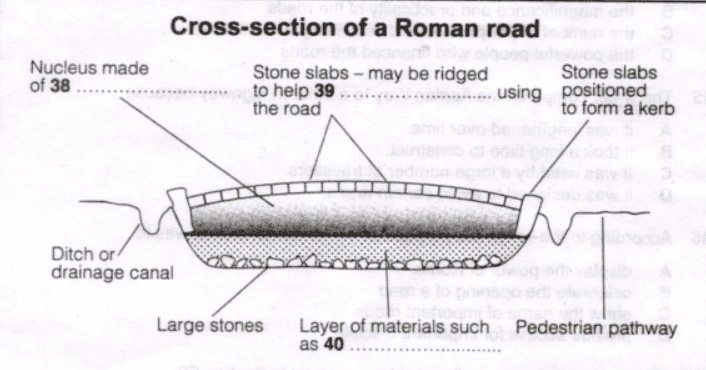
    E Major roads were around a standard 4.2 metres wide, which was enough space for two vehicles to pass each other. First a trench was dug in the earth, and a layer of large stones was used to form the foundation. This was followed by a substantial deposit of smaller broken materials – often crushed brick was used for this purpose, and on top of this, a layer of fine gravel was added. This upper section of the road was referred to as the nucleus and was then surfaced with blocks or slabs. Mountain roads might also have ridges running across the surface of the slabs, to give animals better grip, and have ruts cut into the stone to guide wheeled vehicles.

    Roads were purposely inclined slightly from the centre down to the kerb to allow rainwater to run off along the sides. Many also had parallel ditches that collected the runoff and formed a drainage canal on each side of the road. A path of packed gravel for pedestrians typically ran along each side of the road, varying in width from 1 to 3 metres. Separating the path from the road were the kerb stones, which were regular upright slabs. Busier stretches of main roads had areas where vehicles could pull over, and some of these had services for travellers and their animals. Milestones were also set up at regular intervals along the road and these often recorded who was responsible for the upkeep of that stretch of the road and what repairs had been made.

    F Lasting symbols of the imagination of Roman engineers are the many arched bridges and viaducts still standing today that helped achieve the engineers’ straight-line goal. The Romans built to last, and the piers of bridges which crossed rivers, for example, were often built with a resistant prow-shape and used massive durable blocks of stone, while the upper parts might be built of stone blocks strengthened with iron clamps. Perhaps the most impressive bridge was at Narni; 180 metres long, 8 metres wide and as high as 33 metres, it had 4 massive semicircular arches, one of which, stretching 32.1 metres, ranks as one of the longest block-arch spans in the ancient world. Recently hit by earthquakes, it is now having to undergo restoration work to repair the effects.

    Such was the engineering and surveying skill of the Romans that many of their roads have provided the basis for hundreds of today’s routes across Europe and the Middle East. Many roads in Italy still use the original Roman name for certain stretches, and some bridges, such as at Tre Ponti in Venice, still carry road traffic today.

    Questions 28-33
    The text has six sections, A-F. Which section mentions the following?

    28. the various functions of Roman roads
    29. reference to some current remains of Roman road building
    30. a description of preparations for building a road
    31. the period in history when road building began
    32. the consequence of damage caused by a natural disaster
    33. the total distance once crossed by Roman roads

    Questions 34-37
    Choose the correct letter, A, B, C or D.

    34. Which aspect of Roman road building does the writer mention in Section A?
    A the strength and permanence of the roads
    B the magnificence and practicality of the roads
    C the number of people involved in building
    D the powerful people who financed the roads

    35. The writer compares the Appian Way to a modern highway because
    A it was lengthened over time.
    B it took a long time to construct.
    C It was used by a large number of travellers.
    D it was designed to avoid certain areas.

    36. According to the writer, the purpose of the triumphal arches was to
    A display the power of Rome.
    B celebrate the opening of a road.
    C show the name of important roads.
    D provide access for important officials.

    37. What common use of a milestone is mentioned in Section E?
    A indicating to travellers the total length of the road
    B highlighting areas of the road that needed repair
    C noting details regarding the maintenance of the road
    D marking rest places along the road for travellers and their animals

    Questions 38-40
    Label the diagram below. Choose NO MORE THAN TWO WORDS from the text for each answer.

  • IELTS Reading Practice Test – Exercise 363

    Section 1
    Read the text below and answer questions 1-8.

    Choosing the best sleeping bag

    When choosing a sleeping bag, check what seasons it’s for, as well as how heavy it is if you’re backpacking. Also think about the filling. Natural duck down is very warm, has a longer lifespan and is easier to pack up, while synthetic materials are easier to clean, and they dry quicker and are cheaper.

    A Vango Fuse -12
    This all-year-round sleeping bag combines natural duck down and a new synthetic fibre. The result is a bag that’s warm and weighs 1.5kg. There’s a water-resistant finish to protect it from moisture.

    B Outwell Campion Lux Double Sleeping Bag
    This double sleeping bag – which is suitable for all seasons except winter – is soft and cosy, and there’s a handy pocket for essentials, located inside near the top. It also folds up remarkably small, given its size.

    C Nordisk Oscar +10
    At just 350g, this sleeping bag is remarkably light, and as it’s synthetic, it’s very easy to maintain. The pack size is just 13x20cm, which makes it ideal for backpacking. It will work perfectly for summer trekking.

    D The Big Sleep 250GSM Single Cowl Sleeping
    If you want a no-frills, budget sleeping bag that will last more than one summer, opt for this. It’s soft, comfy and simple to wash. Give yourself a bit of time to fit it back in the bag, though. Use it for spring, summer and autumn.

    E Jack Wolfskin Smoozip +3
    We like the extra insulation in this sleeping bag around the areas that tend to feel the cold (head, chest and feet). And the hood is cosy enough to use as a pillow.

    F Vango Starwalker Dragon
    This innovative, high-quality kids’ sleeping bag enables you to undo some zips and turn it into a fun, animal-themed coat. Once your youngster is ready for bed, simply zip the bottom back on and zip up the shoulders. Suitable for between 8 and 20 degrees Celsius.

    G Outwell Conqueror
    This sleeping bag has an integrated down duvet and lots of space. What’s more, it packs up compactly and is easy to get back in the bag. It’s light but too big for a rucksack.

    Questions 1-8
    Look at the seven reviews of sleeping bags, A-G, above. For which sleeping bag are the following statements true? Write the correct letter, A-G, in boxes 1-8 on your answer sheet.

    1. This sleeping bag is not very easy to pack up.
    2. People can use this sleeping bag in any season.
    3. This sleeping bag has been designed to ensure certain parts of the body are warm.
    4. This sleeping bag contains a useful storage area.
    5. People who do not want to spend much on a sleeping bag will find this one suits their needs.
    6. This sleeping bag can also keep the user warm during the daytime.
    7. People who wish to avoid carrying heavy weights should try this sleeping bag.
    8. This sleeping bag contains two different types of material.

    Read the text below and answer Questions 9-14.

    The Spread the Word Life Writing Prize

    We are delighted to announce The Spread the Word Life Writing Prize in association with Goldsmiths Writers’ Centre.

    Competition Rules

    Entries should be original works of life writing of no more than 5,000 words. The word count will be checked and entries longer than 5,000 words will be disqualified. There is no minimum word count.

    For the purposes of the Prize, Life Writing is defined as non-fiction and should be based on a significant portion from the author’s own experience. Traditional biographies, where the piece is only about the experience of someone else, are excluded.

    Writers only submit one entry each. Multiple entries by the same author will result in only the first entry being considered for the Prize and any additional entries disqualified. Writers who have previously won or been highly commended in the Life Writing Prize are excluded from entering; otherwise, previous entrants may submit.

    Entries must be the original, previously unpublished work of the entrant. Graphic novel-style entries, where drawings or photographs accompany text, are welcome. Entries can be self-contained pieces of life writing, or the first 5,000 words of a longer piece of work.

    The Life Writing Prize is open to writers aged over 18 and resident in the UK who are emerging writers, which means they have not previously published in print a full-length work. We define a full-length work as, for example, a complete work of fiction or non-fiction over 30,000 words.

    Entries that are simultaneously submitted elsewhere are welcome – but please let us know as soon as possible if a piece is to be published elsewhere or has won another prize so we can disqualify it from the Life Writing Prize.

    The winner will receive £1,500, publication on Spread the Word’s website, two years’ membership of the Royal Society of Literature, and a development meeting with an editor and an agent. Two highly commended entries will receive £500 and two mentoring sessions, a development meeting with an editor and an agent, and be published on the Spread the Word website.

    Questions 9-14
    Do the following statements agree with the information given in the text? In boxes 9-14 on your answer sheet, write

    TRUE                         if the statement agrees with the information
    FALSE                       if the statement contradicts the information
    NOT GIVEN            if there is no information on this

    9. Writers can submit an entry of fewer than 5,000 words for the Life Writing Prize.
    10. Writers can choose to write about the life of a person they know.
    11. People who have entered an earlier Life Writing competition without achieving any success may enter again.
    12. Writers who are between 19 and 25 years old and in full-time education have won the prize in previous years.
    13. Only one prize is awarded at the end of the Life Writing competition.
    14. Previous winners of the Life Writing Prize have gone on to become successful published writers.

    Section 2
    Read the text below and answer Questions 15-21.

    Encouraging employees to be healthy: a guide for employers

    Benefits
    Putting effort into employee wellness can reduce absenteeism and encourage better teamwork in the workplace, as well as increased productivity. Once you’ve devised a program, continue to assess the outcomes and regularly survey your team to gather feedback.

    Focus on general prevention
    Consider offering flu vaccinations on site and look at offering employees incentives on health insurance. Some companies arrange for someone who specialises in health issues, such as a doctor, to visit the workplace and speak to employees.

    Encourage a healthier diet
    Most of us know that eating healthily can help prevent future diseases, but many are not aware that unhealthy eating is linked to a 66 percent increased risk of loss of productivity. It may be necessary to consciously develop a healthy food and drink workplace policy, including a healthy catering policy. A simple thing to do is substitute soda in any on-site vending machines with water or juice. Also investigate the nutritional value of food supplied for team meetings and work events. Consider putting a bowl of fruit out in the staff room and urge everyone to help themselves for free. You can encourage employees to bring in healthy lunches from home by making sure that there is a fridge in the break room.

    Encourage more exercise
    Encouraging employees to exercise needn’t be expensive as there are plenty of low-cost methods available. These might include: installing racks for bikes in your staff car park; encouraging employees to take part in fun runs and charity events; suggesting ‘walking meetings’ where people discuss business as they get fresh air and exercise; and putting in showers to assist those who ride or run to the workplace. Some companies negotiate group rates for their employees at a nearby gym.

    Improve mental health
    Recent reports have shown that ignoring mental health costs Australian companies at least $11 billion a year. We all have a responsibility to look out for one another. Some ways you can do this in the workplace include: running employee surveys to get valuable information on morale in the workplace; training managers on mental health strategies; offering rebates so employees are compensated for counselling if required; and refusing to accept any bullying and unprofessional behaviour in your workplace.

    Questions 15-21
    Complete the notes below. Choose ONE WORD ONLY from the text for each answer.

    Encouraging employee health

    Benefits
    • improved efficiency
    • less (15)…………

    Preventing problems
    • invite guests e.g. a doctor to give information
    • provide vaccinations

    Diets
    • make healthier options available to replace (16)…………..
    • have healthy food at meetings
    • offer (17)…………..at no cost
    • provide a (18)……………..for staff use

    Exercise
    • provide somewhere for employees to leave their (19)…………..
    • provide (20)……………for workers who exercise

    Mental health
    • give managers appropriate training
    • find out how employees feel at work by using (21)…………
    • do not tolerate bullying or other inappropriate behaviour

    Read the text below and answer Questions 22-27.

    Marama Beach Hotel and Bistro: guidelines for working in the kitchen

    The health and well-being of customers and staff is our first priority, and we expect all staff to take every step possible to maintain food safety and work in a hygienic manner.

    Hygiene
    • Long hair must be tied back and no rings may be worn if touching food.
    • The regulation chefs’ shirts and trousers are to be freshly laundered before starting a new shift, along with aprons if they are worn.
    • Cross-contamination between raw and cooked food must be avoided. To this end, staff must use a clean board each time they cut different types of food.
    • Staff should not touch money and then food without washing their hands in between.
    • In the case of illness or a skin problem, the staff member should inform the manager. Cuts on hands and arms must be properly wrapped or bandaged.

    Safety rules
    • All injuries must be reported to management immediately.
    • Safety guards must not be altered in any way, and staff must always wear protective clothing and gloves when working with sharp, hot, cold or corrosive items or materials.
    • Loose clothing or jewellery must not be worn.
    • Defective appliances must be turned off and not used – staff must not try to fix them themselves.
    • Heavy boxes should be lifted carefully with bent knees and a straight back, holding the box close to the body.
    • Work areas should be clean and free of hazards.
    • Spills on the floor must be dealt with immediately.
    • Flammable liquids must be stored away from flames.
    • If storing containers of chemicals in the kitchen, they must have clear labels, so as to avoid any confusion about the contents.

    Breaks
    Staff have 20 minutes of paid break time per 3 hours of work, during which time they may not leave the premises. Every staff member who works a shift exceeding 5 hours is entitled to a 30-minute unpaid break and free meals. However, please be aware that the kitchen may not always be able to provide this service, especially in peak times. Beverages kept in the storeroom may not be consumed by staff, but filtered water is provided free of charge in the staff room.

    Questions 22-27
    Complete the sentences below. Choose ONE WORD ONLY from the text for each answer.

    22. Chefs’ uniforms and ………………… must be washed for every shift.
    23. Kitchen staff need to change the ……………… when they start chopping another kind of food.
    24. All staff must make sure their hands are clean after handling ……………
    25. Workers in the kitchen should not attempt to repair …………..
    26. ……………. are required to identify any chemicals kept in the kitchen.
    27. It is forbidden for kitchen staff to have drinks from the ……………

    Section 3
    Read the text below and answer Questions 28-40.

    A home-sewing revival: the return of Clothkits

    In the 1970s, Clothkits revolutionised home sewing. Later, a woman from Sussex, England, revived the nostalgic brand and brought it up to date

    A ‘I can’t remember many of the clothes I wore before I was six, but I have a vivid memory of a certain skirt whose patterns I can still trace in my mind. It was wraparound, with a belt that threaded through itself, decorated with cats in two shades of green. I wore it with a knitted red jersey my mum bought in a jumble sale, and brown sandals with flowers cut into the toes. It was 1979, and I was not yet five. I forgot about that skirt for a long time, but when a girlfriend mentioned the name Clothkits while we were chatting, it was as if a door suddenly opened on a moment in the past that resonated with vivid significance for me.’ The brand, founded in 1968, had by the late 1980s mostly vanished from people’s lives, but by a combination of determination and luck Kay Mawer brought it back.

    B Clothkits was created by the designer Anne Kennedy, who came up with the ingenious idea of printing a pattern straight on to coloured fabric so that a paper pattern was not needed. It was accompanied by instructions that almost anyone could follow on how to cut the pieces out and sew them together. ‘I was rebelling against the formulaic lines of textile design at that time,’ Kennedy says. ‘My interest was in folk art and clothes that were simple to make as I had lots of unfinished sewing disasters in my cupboard.’ Clothkits has always embodied the spirit of the late 1960s and 1970s. Its initial design was a dress in a geometric stripe in orange, pink, turquoise and purple. It cost 25 shillings (£1.25), and after it was featured in the Observer newspaper, Kennedy received more than £2,000 worth of orders. She ran the company from Lewes in Sussex, where at its peak it employed more than 400 people, selling to 44 countries worldwide. Sew-your-own kits formed the core of the business, supplemented by knitwear. Kennedy’s children demonstrated the patterns by wearing them in photographs.

    C Kennedy sold the company in the late 1980s. There had been a few administrative problems with postal strikes and a new computer system, which back then took up an entire room, ‘but the times were changing as well,’ she says. ‘More women were going out to work and sewing less for their children.’ She sold the company to one of her suppliers, who then sold it on to Freeman’s, which ran Clothkits alongside its own brand for a while, using Kennedy’s impressive database, but its ethos are big, corporate company did not sit well alongside the alternative and artistic of Clothkits. In 1991, Clothkits was made dormant, and there the story may have ended, were it not for Mawer’s fascination with discovering what happened Clothkits.

    D Mawer’s mother bought her a sewing machine when she was ten and taught her basic pattern-cutting and garment construction, encouraging her to experiment with colour and design by trial and error. The first garment Mawer made was a pair of trousers, which she made by tracing around an existing pair of trousers. In her late twenties, she spent five years working on digital and sculptural installations. ‘It was an amazing, mind-expanding experience, but I knew it was unlikely I could make a living as a practising artist. I was definitely looking for a way that I could work in a creative industry with a commercial edge.’ The experience inspired Mawer to return to education, studying for a degree in fine art at the University of Chichester. Her passion for vintage fabric, which her mother had encouraged her to start collecting, led her back to Clothkits, and from there to a journey into the heart of Freeman’s. Negotiations with the company took 18 months, but in October 2007 Clothkits was hers.

    E The ethos of Clothkits remains the same, and Mawer is proud that her fabric is printed either in London or the north of England, and that packaging is kept to an absolute minimum. ‘I wanted to feel that everyone involved in the brand, from design to production, was part of a process I could witness. I couldn’t see the point of manufacturing on the other side of the world, as that’s not what Clothkits has ever been about.’ The revival of Clothkits has also, of course, coincided with a growing sense of dissatisfaction at our disposable society, and the resulting resurgence of interest in skills such as sewing and knitting. ‘Making your own clothes gives you a greater appreciation of the craftsmanship in the construction of a garment,’ Mawer says. ‘When you know the process involved in making a skirt, you treasure it in a way you wouldn’t if you’d bought it from a mass- producing manufacturer.’

    Questions 28-31
    The text has five paragraphs, A-E. Which paragraph mentions the following?

    28. mention of Mawer’s desire to oversee all the stages of her business
    29. reference to changing employment patterns among the general population
    30. the date when Clothkits was originally established as a product
    31. the benefits of sewing a garment and then wearing it

    Questions 32-35
    Choose the correct letter, A, B, C or D.

    32. In Paragraph A, the writer says that Kay Mawer was reminded about Clothkits by
    A a shop she visited.
    B a purchase she made.
    C an outfit someone was wearing.
    D a conversation with someone she knew.

    33. What does the reader learn about Clothkits in the 1960s and 1970s?
    A Its designs represented the attitudes of the time.
    B Its products were only affordable for the wealthy.
    C Its creator tried many times to launch her company.
    D Its management was spread across numerous countries.

    34. Why did Clothkits close in 1991?
    A There were unexpected staffing problems.
    B The funding for sewing activities was inadequate.
    C Freeman’s was an unsuitable partner.
    D Records on Kennedy’s database were lost.

    35. What point does the writer make in Paragraph E?
    A Clothkits will reach more markets than in the past.
    B Clothkits will need bigger premises than in the past.
    C People are more concerned about throwing away items than in the past.
    D People do less sewing now than in the past.

    Questions 36-40
    Complete the summary below. Choose ONE WORD ONLY from the text for each answer.

    The early days of Clothkits

    Clothkits was started by a designer named Anne Kennedy. Her clothing company specialised in selling (36) …………. with a pattern printed on it. This came with (37) …………….. which meant that buyers were able to make their own garments.

    The very first garment Anne Kennedy made was a multi-coloured striped dress with a (38) …………….. pattern. A (39) ………………… article led to many orders for this from around the world. As the company grew, she increased her workforce, and also sold (40) …………… as part of her business. She exhibited her designs using her children as models.

  • IELTS Reading Practice Test – Exercise 362

    Section 1
    Read the text below and answer questions 1-7.

    What to do if your clothes have been lost or damaged by a dry cleaner

    Dry cleaners are legally required to take reasonable care of anything left with them. You can claim compensation if your belongings are damaged or lost while in their care.

    Even if the dry cleaning company has a sign saying they aren’t responsible for items left with them, this isn’t necessarily true. They can’t opt out of this responsibility just by putting up a sign.

    As soon as you realise there’s a problem, contact them and explain the situation. They might offer you compensation straight away. If they don’t, you should ask them to either cover the cost of repairing the item or to pay for a replacement (if it can’t be repaired).

    If they have to pay the cost of replacing a damaged or lost item, the maximum they’re obliged to offer you is the value of the item when it was left with them, not what it would cost to replace as new. You’ll probably be asked to provide evidence of how much it originally cost – for example, a receipt. The dry cleaner can then offer you a reduced amount depending on the condition of the item – you’ll have to negotiate the cost with them.

    If the dry cleaner is part of a national chain, you could get in touch with the customer services department of their head office and make the complaint to them directly.

    If the dry cleaner refuses to compensate you or they offer you too little, try the following steps:
    • If the dry cleaner is a member of a trade association such as the UK Fashion and Textile Association, you can pass your complaint to them and they may be able to help you.
    • You could get an independent organization to look at your issue and produce a report, but this could be expensive (often around £100).

    If you’ve tried the options above and are still unhappy with the outcome, you could take your case to court. There’s a time limit for going to court – from when you took the item to the dry cleaner, you have up to six years.

    Questions 1-7
    Do the following statements agree with the information given in the text? In boxes 1-7 on your answer sheet, write

    TRUE                              if the statement agrees with the information
    FALSE                            if the statement contradicts the information
    NOT GIVEN                 if there is no information on this

    1. Dry cleaners are generally responsible for items left with them, even if there’s a sign saying the opposite.
    2. If the dry cleaner loses an item belonging to you, they should give you enough money to buy a completely new one.
    3. If you have the receipt for a damaged item, the company should refund the amount you originally paid for it.
    4. It may be possible to get support for your complaint from a dry cleaners’ trade association.
    5. If you’re offered too little compensation, you can request a free report from an independent organisation.
    6. Most people who take a case about a dry-cleaning company to court are satisfied with the outcome.
    7. If an item was lost or damaged nine months ago, you can still take the dry cleaner to court.

    Read the text below and answer Questions 8-14.

    Groups for readers and writers

    A Teenvision
    This is a reading group for teens aged 12-16 which meets on the last Thursday of the month. We are a friendly group, with everybody keen to talk about what we’ve enjoyed reading recently and make suggestions on what we should read next. We are massive fans of action, fantasy and adventure but we try to include a mix of genres in our choices.

    B Creative writing workshops
    Would you like to share your writing with others and hear their constructive suggestions for how to improve it? Have you got a book inside you but need the inspiration to get started? Build your confidence to begin formulating ideas for storylines and characters at our regular workshops. Open to all – beginners and established writers.

    C Books for now
    We meet on the second and fourth Mondays of each month in members’ homes. The group is open to men and women who enjoy discussing the themes and issues found in science fiction novels. Our books are usually those written from the 1960s onwards and include feminist science fiction, cyberpunk and scientific romance.

    D Readers’ book group
    This is an open group for parents at the library, and toddlers are welcome to come along and play in the children’s library while the meeting is taking place. The group reads mainly fiction of different genres. Books are supplied by the library. Anyone is welcome – have a look at our website to see what the book is for the next meeting.

    E The book club
    Every month members of this group read a fabulous business book which is then discussed when we meet. At our meetings you’ll have the chance to network with other members – all like-minded businesswomen – in a relaxed environment. There will be lots of ideas to discuss, as well as refreshments and lots of fun!

    F Poetry writing group
    A writing group for young poets aged between 12 and 18 at the library. You will explore how to power up your imagination, and your poems will be displayed in the library and online. The group meets fortnightly on Saturdays from 12 p.m. to 2 p.m. The group is currently full but anyone interested is welcome to join the membership waiting list.

    Questions 8-14
    The text 18 has six paragraphs, A-F. Which paragraph mentions the following? Write the correct letter, A-F, in boxes 8-14 on your answer sheet. NB You may use any letter more than once.

    8. Members of this group share ideas for the books they would like to read.
    9. It isn’t possible for any new members to join this group at present.
    10. You can get feedback on your own work from other members of this group.
    11. This group focuses on stories belonging to just one genre.
    12. Work produced by members of this group will be available to the public.
    13. This group doesn’t read or write either poetry or fiction.
    14. This group would suit someone who thinks they could write a book.

    Section 2
    Read the text below and answer questions 15-22

    Mechanical Lifting Equipment

    If some simple precautions are taken, lifting equipment that is essential for construction and engineering projects can be used safely. Forklift trucks, lifting trolleys, mobile and fixed cranes and all their parts are classed as lifting equipment.

    All equipment used for lifting or moving heavy loads should be properly constructed. For example, equipment bearing a CE mark has been constructed to international standards. In addition, equipment that meets these standards will have documented instructions for tests that should be adhered to prior to using the equipment. Certain types of machinery, such as cranes, must be inspected by a qualified engineer on a six-monthly basis.

    For operations that use cranes, a formal lift plan must be prepared. Lift plans are a type of risk assessment, whereby the possible dangers of the operation are carefully calculated, and control measures are identified and put in place. Before any lift proceeds, the plan should be talked over with the lifting crew during what is often referred to as a Tool Box Talk’ (TBT). This is an important opportunity for them to ask questions about their role in the operation.

    When heavy loads are being moved around, there are some practical things that should be done to prevent accidents. Firstly, if a load needs to be moved where workers or members of the public are present, the area must have barriers or other means to ensure no one is allowed to walk under the load while it is moving. Secondly, someone called a banksman should always be used when moving heavy loads by crane. As a crane driver often cannot see the load, especially during touch-down, this person tells him or her which way to move it.

    It is very unusual for machinery such as cranes to fail. However, it is all too easy to ignore the importance of the secondary equipment. This refers to those items that are attached between the mechanical lifting machine and the load that is being lifted. Chains, slings, shackles and rigging are all examples of secondary lifting equipment, and it is perhaps surprising to note that most injuries occur due to faults or weaknesses in these items. It is essential that a six-monthly visual inspection is carried out to ensure there are no signs of wear or damage to the slings and shackles.

    Questions 15-22
    Complete the notes below. Choose NO MORE THAN TWO WORDS for each answer from the passage.

    Lifting equipment
    • must be manufactured well e.g have a (15) ………………. on it
    • may need to undergo (16) …………………
    • may need a regular check by an (17) ………………

    Lift plans
    • relevant to cranes
    • used to establish and carry out (18) …………… for any risks
    • a (19) ………………. can be consulted during a ‘Tool Box Talk’

    Preventing accidents with heavy loads
    • use objects such as (20) ………………. to make sure the load does not pass over anyone’s head
    • appoint (21) ………………. to give verbal directions to the crane driver

    Secondary lifting equipment (chains, slings, etc.)
    • more likely to cause (22) …………….

    Read the text below and answer Questions 23-27.

    Dealing with customer complaints

    When a customer complains, it is usually for a good reason. Here are some strategies that will help you handle a customer complaint in a smooth and professional manner.

    When a customer presents you with a complaint, keep in mind that the issue is not personal. Aiming to win the confrontation accomplishes nothing. He or she has usually made a purchase that did not meet their expectations – a product, service, or maybe a combination of the two. A worker who remains in control of their emotions deals from a position of strength.

    Let the customer say what they need to. Respond with phrases such as, ‘Hmm’, ‘I see’, and Tell me more’. Then be quiet. As the customer expresses their annoyance yet sees you are not reacting, he or she will begin to relax. The customer needs to do this before being able to hear your solution.

    When the customer has calmed down and feels you have heard his or her side, start asking questions. Be careful not to give scripted replies but use this as an opportunity to start a genuine conversation, building a relationship of trust with your customer. To help you understand the situation, get as many details as possible.

    Take charge of the situation and let the customer know what you are going to do to solve the problem. One thing to keep in mind is that you should know what you can and cannot do within the policy of the business you work for. The cost could be minimal – maybe a simple upgrade on the customer’s next purchase or a small gift certificate. A simple gesture like this could result in a word-of-mouth recommendation to others, while making a promise you cannot commit to will only set you back.

    Questions 23-27
    Complete the table below. Choose ONE WORD ONLY for the answer from the passage.

    Strategies for dealing with customer complaints
    StrategyYour approachThe customer…..
    Stay calmremember it is not a direct attack on youdo not try to (23) ……….. the argumentusually had (24) ……… that were not fulfilled
    Listen welluse short phrases in replycannot recognise a (25)………… until calm
    Get the factsask questions and begin a proper conversationwill start to trust you
    Suggest actionbe sure of your company’s (26) ……… on complaintsmay well make a verbal (27) …………… in future

    Section 3
    Read the text below and answer Questions 28-40.

    Questions 28-33
    The text has six sections, A-F. Choose the correct heading for each section from the list of headings below. Write the correct number, l-viii, in boxes 28-33 on your answer sheet.

    List of Headings
    i An enterprise arising from success in other countries
    ii The hope that storks will inspire a range of emotions and actions
    iii Support from some organisations but not from others
    iv Finding new types of habitat
    v Opposition from the general public
    vi A sign of hope in difficult times
    vii Creatures which represent both joy and opposition
    viii Storks causing delight and the revival of public events

    28. Section A
    29. Section B
    30. Section C
    31. Section D
    32. Section E
    33. Section F

    White storks back in Britain after hundreds of years

    These beautiful birds could be about to become a feature of the British landscape again

    A The last definitive record of a pair of white storks successfully breeding in Britain was in 1416, from a nest on St Giles Cathedral in Edinburgh. No one knows why storks disappeared from our shores. They often featured on the menus of medieval banquets so we might, quite simply, have consumed them all. But there could be a more ominous reason. Storks are migrants arriving after the end of winter, nesting on rooftops and happily associating with humans, and because of this they have long been a symbol of hope and new life. Yet their association with rebirth also meant they became a symbol of rebellion. Shortly after the restoration of King Charles II in 1660, while storks were rare but surviving, parliament debated putting greater effort into destroying them entirely for fear they might inspire republicanism. Today, fortunately, that notion has disappeared and the stork retains its association with new life, appearing on cards given to celebrate the arrival of a new child, as a bird carrying a baby in a sling held in its beak.

    B So, after such a long absence, there was great excitement when in April of this year a pair of white storks built an untidy nest of sticks in the top branches of a huge oak in the middle of our rewilding project at Knepp Estate in West Sussex. Drone footage, taken before the pair started sitting on them, showed three large eggs. The fact that they were infertile and did not hatch was not too disappointing. The pair are only four years old, and storks can live to over thirty, with their first attempts to breed often failing. Prospects for next year are encouraging. These young storks are part of a project to return the species to Britain, inspired by reintroductions in European countries that more than reached their target. Imported from Poland, they have spent the best part of three years in a six-acre pen with a group of other juveniles and several injured, non-flying adults, also from Poland. Other birds have already shown strong loyalty to the site. Two years ago, a young bird from Knepp flew across the Channel to France and, this summer, returned to its companions.

    C In the face of reports of unrelenting ecological loss (the UN estimates a million species are on the brink of extinction globally), the white stork’s return is refreshing news. As tens of thousands of people demonstrate about the growing climate crisis and eco-anxiety besets us, these glimpses of restoration are important. Featuring the storks in BBC television’s Springwatch in June, the ecologist Chris Packham described the project as ‘imaginative, intelligent, progressive and practical’.

    D And yet its path to restoration in the UK has not been smooth. Support from conservation bodies has been surprisingly difficult to obtain; some were hard- pressed with their own initiatives, while others were simply reluctant to stick their necks out. In addition, the committee of the Sussex Wildlife Trust raised doubts about the stork ever having been a British bird. They also had concerns that English-bred birds would migrate across the Channel, and feared that their messy nests and closeness to humans would cause a hazard – rubbish falling down people’s chimneys.

    So how has the reintroduction project managed to get going? What makes it in some ways special is that it has had to rely on private individuals actually building the introduction pens themselves and feeding the birds at their own expense. The expertise of tiny yet determined conservation charities such as the Roy Dennis Wildlife Foundation – responsible for the successful reintroductions of ospreys and white-tailed eagles to Britain – has been very welcome. And the support of Cotswold Wildlife Park, which quarantined the original Polish birds and continues to manage and cover the costs of the captive-breeding programme using its own well- trained staff and excellent facilities, has proved invaluable.

    E Across Europe, as stork populations have suffered from the draining of wetlands and disappearance of insect-rich pastures and meadows, their loss has been felt deeply. A few years ago, a tearful old woman in a village in Belarus showed me the nest on her roof, empty of storks for the first time in living memory. Where storks have been reintroduced, they are greeted with great happiness and some historical stork festivals have been restored. The Spanish erect poles for nests along their motorways, and in Alsace householders install cartwheels for storks to build nests on their roofs. During a cold snap in Bulgaria last March, villagers even gave white storks access to their homes.

    F A driving motivation behind the project in the UK is the aspiration that the storks’ return will spark feelings of empathy and affection from townspeople who see their nests on rooftops. They might also encourage the public to feel worried about the wider area where they fly off to feed on earthworms, grasshoppers and frogs. White storks could be that charismatic species that connects urban communities directly with landscape restoration. Certainly, people once loved them here. The name of our local village, Storrington, was originally ‘Estorcheton’ or ‘home of the storks’. The public response has been overwhelming, with crowds coming to see white storks flying free in England for the first time in hundreds of years, and private landowners queueing up to offer more introduction sites. The flight of the white stork over Britain is the triumph of practical action over bureaucracy, self-interest and negativity.

    Questions 34-37
    Complete the summary below. Choose ONE WORD ONLY from the text for each answer.

    Project to reintroduce white storks at Knepp Estate

    Last spring, two white storks were observed nesting at Knepp Estate, putting (34) …………….. together high up in a large oak tree. The female laid three eggs, which unfortunately proved to be (35) …………… However, this
    was not surprising for such young storks. Naturalists believe they are likely to breed successfully in the future.

    These two storks were bred in (36) ……………. and, after arriving in the UK, were kept for several years together with a few fully mature storks and some fellow juveniles before being released at Knepp. It appears that other storks are developing a sense of (37) ………………… to their new home. One left Knepp for a year, only to fly back to be with the group again.

    Questions 38—40
    Choose the correct letter, A, B, C or D.

    38. In Section A, we learn that in the past people thought white storks
    A represented the deep snow and cold days of winter.
    B had the power to ensure that babies were born safely.
    C were a speciality that only the very rich were allowed to eat.
    D might be used to encourage people to get rid of the monarchy.

    39. The Sussex Wildlife Trust committee was unwilling to support the storks because
    A it thought there might not be any safe breeding places locally.
    B it worried whether they would survive in Britain long enough.
    C it was unsure that they were actually a native species.
    D it had too many other worthy projects to support.

    40. What has been one effect of stork reintroductions in Europe?
    A A variety of measures have been taken to create nesting sites.
    B Changes have been made to the routes of some major roads.
    C Special shelters have been made to protect the birds in bad weather.
    D Some people have strengthened their roofs to support the birds’ weight.

  • IELTS Reading Practice Test – Exercise 361

    Green roofs

    A Rooftops covered with grass, vegetable gardens and lush foliage are now a common sight in many cities around the world. More and more private companies and city authorities are investing in green roofs, drawn to their wide-ranging benefits. Among the benefits are saving on energy costs, mitigating the risk of floods, making habitats for urban wildlife, tackling air pollution and even growing food. These increasingly radical urban designs can help cities adapt to the monumental problems they face, such as access to resources and a lack of green space due to development. But the involvement of city authorities, businesses and other institutions is crucial to ensuring their success – as is research investigating different options to suit the variety of rooftop spaces found in cities. The UK is relatively new to developing green roofs, and local governments and institutions are playing a major role in spreading the practice. London is home to much of the UK’s green roof market, mainly due to forward-thinking policies such as the London Plan, which has paved the way to more than doubling the area of green roofs in the capital.

    B Ongoing research is showcasing how green roofs in cities can integrate with ‘living walls’: environmentally friendly walls which are partially or completely covered with greenery, including a growing medium, such as soil or water. Research also indicates that green roofs can be integrated with drainage systems on the ground, such as street trees, so that the water is managed better and the built environment is made more sustainable. There is also evidence to demonstrate the social value of green roofs. Doctors are increasingly prescribing time spent gardening outdoors for patients dealing with anxiety and depression. And research has found that access to even the most basic green spaces can provide a better quality of life for dementia sufferers and help people avoid obesity.

    C In North America, green roofs have become mainstream, with a wide array of expansive, accessible and food-producing roofs installed in buildings. Again, city leaders and authorities have helped push the movement forward — only recently, San Francisco, USA, created a policy requiring new buildings to have green roofs. Toronto, Canada, has policies dating from the 1990s, encouraging the development of urban farms on rooftops. These countries also benefit from having newer buildings than in many parts of the world, which makes it easier to install green roofs. Being able to keep enough water at roof height and distribute it right across the rooftop is crucial to maintaining the plants on any green roof – especially on ‘edible roofs’ where fruit and vegetables are farmed. And it’s much easier to do this in newer buildings, which can typically hold greater weight, than to retro-fit old ones. Having a stronger roof also makes it easier to grow a greater variety of plants, since the soil can be deeper.

    D For green roofs to become the norm for new developments, there needs to be support from public authorities and private investors. Those responsible for maintaining buildings may have to acquire new skills, such as landscaping, and in some cases, volunteers may be needed to help out. Other considerations include installing drainage paths, meeting health and safety requirements and perhaps allowing access for the public, as well as planning restrictions and disruption from regular activities in and around the buildings during installation. To convince investors and developers that installing green roofs is worthwhile, economic arguments are still the most important. The term ‘natural capital’ has been developed to explain the economic value of nature; for example, measuring the money saved by installing natural solutions to protect against flood damage, adapt to climate change or help people lead healthier and happier lives.

    E As the expertise about green roofs grows, official standards have been developed to ensure that they are designed, constructed and maintained properly, and function well. Improvements in the science and technology underpinning green roof development have also led to new variations in the concept. For example, ‘blue roofs’ enable buildings to hold water over longer periods of time, rather than draining it away quickly – crucial in times of heavier rainfall. There are also combinations of green roofs with solar panels, and ‘brown roofs’ which are wilder in nature and maximise biodiversity. If the trend continues, it could create new jobs and a more vibrant and sustainable local food economy – alongside many other benefits. There are still barriers to overcome, but the evidence so far indicates that green roofs have the potential to transform cities and help them function sustainably long into the future. The success stories need to be studied and replicated elsewhere, to make green, blue, brown and food-producing roofs the norm in cities around the world.

    Questions 1-5
    Reading Passage has five paragraphs, A-E. Which paragraph contains the following information? Write the correct letter, A-E, in boxes 1-5 on your answer sheet. NB You may use any letter more than once.

    1. mention of several challenges to be overcome before a green roof can be installed
    2. reference to a city where green roofs have been promoted for many years
    3. a belief that existing green roofs should be used as a model for new ones
    4. examples of how green roofs can work in combination with other green urban initiatives
    5. the need to make a persuasive argument for the financial benefits of green roofs

    Questions 6-9
    Complete the summary below. Choose ONE WORD ONLY from the passage for each answer. Write your answers in boxes 6-9 on your answer sheet.

    Advantages of green roofs

    City rooftops covered with greenery have many advantages. These include lessening the likelihood that floods will occur, reducing how much money is spent on (6)………………… and creating environments that are suitable for wildlife. In many cases, they can also be used for producing (7)…………………. There are also social benefits of green roofs. For example, the medical profession recommends (8)…………………as an activity to help people cope with mental health issues. Studies have also shown that the availability of green spaces can prevent physical problems such as (9)……………….

    Questions 10 and 11
    Choose TWO letters, A-E. Write the correct letters in boxes 10 and 11 on your answer sheet.

    Which TWO advantages of using newer buildings for green roofs are mentioned in Paragraph C of the passage?
    A a longer growing season for edible produce
    B more economical use of water
    C greater water-storage capacity
    D ability to cultivate more plant types
    E a large surface area for growing plants

    Questions 12 and 13
    Choose TWO letters, A-E. Write the correct letters in boxes 12 and 13 on your answer sheet.

    Which TWO aims of new variations on the concept of green roofs are mentioned in Paragraph E of the passage?
    A to provide habitats for a wide range of species
    B to grow plants successfully even in the wettest climates
    C to regulate the temperature of the immediate environment
    D to generate power from a sustainable source
    E to collect water to supply other buildings

    Tie growth mindset

    Over the past century, a powerful idea has taken root in the educational landscape. The concept of intelligence as something innate has been supplanted by the idea that intelligence is not fixed, and that, with the right training, we can be the authors of our own cognitive capabilities. Psychologist Alfred Binet, the developer of the first intelligence tests, was one of many 19th-century scientists who held that earlier view and sought to quantify cognitive ability. Then, in the early 20th century, progressive thinkers revolted against the notion that inherent ability is destiny. Instead, educators such as John Dewey argued that every child’s intelligence could be developed, given the right environment.

    ‘Growth mindset theory’ is a relatively new – and extremely popular – version of this idea. In many schools today you will see hallways covered in motivational posters and hear speeches on the mindset of great sporting heroes who simply believed their way to the top. A major focus of the growth mindset in schools is coaxing students away from seeing failure as an indication of their ability, and towards seeing it as a chance to improve that ability. As educationalist Jeff Howard noted several decades ago: ‘Smart is not something that you just are, smart is something that you can get.’

    The idea of the growth mindset is based on the work of psychologist Carol Dweck in California in the 1990s. In one key experiment, Dweck divided a group of 10- to 12-year-olds into two groups. All were told that they had achieved a high score on a test but the first group were praised for their intelligence in achieving this, while the others were praised for their effort. The second group – those who had been instilled with a ‘growth mindset’ – were subsequently far more likely to put effort into future tasks. Meanwhile, the former took on only those tasks that would not risk their sense of worth. This group had inferred that success or failure is due to innate ability, and this ‘fixed mindset’ had led them to fear of failure and lack of effort. Praising ability actually made the students perform worse, while praising effort emphasised that change was possible.

    One of the greatest impediments to successfully implementing a growth mindset, however, is the education system itself: in many parts of the world, the school climate is obsessed with performance in the form of constant testing, analysing and ranking of students – a key characteristic of the fixed mindset. Nor is it unusual for schools to create a certain cognitive dissonance, when they applaud the benefits of a growth mindset but then hand out fixed target grades in lessons based on performance.

    Aside from the implementation problem, the original growth mindset research has also received harsh criticism. The statistician Andrew Gelman claims that ‘their research designs have enough degrees of freedom that they could take their data to support just about any theory at all’. Professor of Psychology Timothy Bates, who has been trying to replicate Dweck’s work, is finding that the results are repeatedly null. He notes that: ‘People with a growth mindset don’t cope any better with failure … Kids with the growth mindset aren’t getting better grades, either before or after our intervention study.’

    Much of this criticism is not lost on Dweck, and she deserves great credit for responding to it and adapting her work accordingly. In fact, she argues that her work has been misunderstood and misapplied in a range of ways. She has also expressed concerns that her theories are being misappropriated in schools by being conflated with the self-esteem movement: ‘For me the growth mindset is a tool for learning and improvement. It’s not just a vehicle for making children feel good.’

    But there is another factor at work here. The failure to translate the growth mindset into the classroom might reflect a misunderstanding of the nature of teaching and learning itself. Growth mindset supporters David Yeager and Gregory Walton claim that interventions should be delivered in a subtle way to maximise their effectiveness. They say that if adolescents perceive a teacher’s intervention as conveying that they are in need of help, this could undo its intended effects.

    A lot of what drives students is their innate beliefs and how they perceive themselves. There is a strong correlation between self-perception and achievement, but there is evidence to suggest that the actual effect of achievement on self-perception is stronger than the other way round. To stand up in a classroom and successfully deliver a good speech is a genuine achievement, and that is likely to be more powerfully motivating than vague notions of ‘motivation’ itself.

    Recent evidence would suggest that growth mindset interventions are not the elixir of student learning that its proponents claim it to be. The growth mindset appears to be a viable construct in the lab, which, when administered in the classroom via targeted interventions, doesn’t seem to work. It is hard to dispute that having faith in the capacity to change is a good attribute for students. Paradoxically, however, that aspiration is not well served by direct interventions that try to instil it. Motivational posters and talks are often a waste of time, and might well give students a deluded notion of what success actually means. Teaching concrete skills such as how to write an effective introduction to an essay then praising students’ effort in getting there is probably a far better way of improving confidence than telling them how unique they are, or indeed how capable they are of changing their own brains. Perhaps growth mindset works best as a philosophy and not an intervention.

    Questions 14-16
    Choose the correct letter, A, B, C or D.

    14. What can we learn from the first paragraph?
    A where the notion of innate intelligence first began
    B when ideas about the nature of intelligence began to shift
    C how scientists have responded to changing views of intelligence
    D why thinkers turned away from the idea of intelligence being fixed

    15. The second paragraph describes how schools encourage students to
    A identify their personal ambitions.
    B help each other to realise their goals.
    C have confidence in their potential to succeed.
    D concentrate on where their particular strengths lie.

    16. In the third paragraph, the writer suggests that students with a fixed mindset
    A tend to be less competitive.
    B generally have a low sense of self-esteem.
    C will only work hard if they are given constant encouragement.
    D are afraid to push themselves beyond what they see as their limitations.

    Questions 17-22
    Look at the following statements (Questions 17-22) and the list of people below. Match each statement with the correct person or people, A-E. Write the correct letter, A-E, in boxes 17-22 on your answer sheet. NB You may use any letter more than once.

    17. The methodology behind the growth mindset studies was not strict enough.
    18. The idea of the growth mindset has been incorrectly interpreted.
    19. Intellectual ability is an unchangeable feature of each individual.
    20. The growth mindset should be promoted without students being aware of it.
    21. The growth mindset is not simply about boosting students’ morale.
    22. Research shows that the growth mindset has no effect on academic achievement.

    List of People
    A Alfred Binet
    B Carol Dweck
    C Andrew Gelman
    D Timothy Bates
    E David Yeager and Gregory Walton

    Questions 23-26
    Do the following statements agree with the views of the writer in reading passage? In boxes 23-26 on your answer sheet, write

    YES                                  if the statement agrees with the views of the writer
    NO                                    if the statement contradicts the views of the writer
    NOT GIVEN                 if it is impossible to say what the writer thinks about this

    23. Dweck has handled criticisms of her work in an admirable way.
    24. Students’ self-perception is a more effective driver of self-confidence than actual achievement is.
    25. Recent evidence about growth mindset interventions has attracted unfair coverage in the media.
    26. Deliberate attempts to encourage students to strive for high achievement may have a negative effect.

    Alfred Wegener: science, exploration and the theory of continental drift

    Introduction
    This is a book about the life and scientific work of Alfred Wegener, whose reputation today rests with his theory of continental displacements, better known as ‘continental drift’. Wegener proposed this theory in 1912 and developed it extensively for nearly 20 years. His book on the subject, The Origin of Continents and Oceans, went through four editions and was the focus of an international controversy in his lifetime and for some years after his death.

    Wegener’s basic idea was that many mysteries about the Earth’s history could be solved if one supposed that the continents moved laterally, rather than supposing that they remained fixed in place. Wegener showed in great detail how such continental movements were plausible and how they worked, using evidence from a large number of sciences including geology, geophysics, paleontology, and climatology. Wegener’s idea – that the continents move – is at the heart of the theory that guides Earth sciences today: namely plate tectonics. Plate tectonics is in many respects quite different from Wegener’s proposal, in the same way that modern evolutionary theory is very different from the ideas Charles Darwin proposed in the 1850s about biological evolution. Yet plate tectonics is a descendant of Alfred Wegener’s theory of continental drift, in quite the same way that modern evolutionary theory is a descendant of Darwin’s theory of natural selection.

    When I started writing about Wegener’s life and work, one of the most intriguing things about him for me was that, although he came up with a theory on continental drift, he was not a geologist. He trained as an astronomer and pursued a career in atmospheric physics. When he proposed the theory of continental displacements in 1912, he was a lecturer in physics and astronomy at the University of Marburg, in southern Germany. However, he was not an ‘unknown’. In 1906 he had set a world record (with his brother Kurt) for time aloft in a hot-air balloon: 52 hours. Between 1906 and 1908 he had taken part in a highly publicized and extremely dangerous expedition to the coast of northeast Greenland. He had also made a name for himself amongst a small circle of meteorologists and atmospheric physicists in Germany as the author of a textbook, Thermodynamics of the Atmosphere (1911), and of a number of interesting scientific papers.

    As important as Wegener’s work on continental drift has turned out to be, it was largely a sideline to his interest in atmospheric physics, geophysics, and paleoclimatology , and thus I have been at great pains to put Wegener’s work on continental drift in the larger context of his other scientific work, and in the even larger context of atmospheric sciences in his lifetime. This is a ‘continental drift book’ only to the extent that Wegener was interested in that topic and later became famous for it. My treatment of his other scientific work is no less detailed, though I certainly have devoted more attention to the reception of his ideas on continental displacement, as they were much more controversial than his other work.

    Readers interested in the specific detail of Wegener’s career will see that he often stopped pursuing a given line of investigation (sometimes for years on end), only to pick it up later. I have tried to provide guideposts to his rapidly shifting interests by characterizing different phases of his life as careers in different sciences, which is reflected in the titles of the chapters. Thus, the index should be a sufficient guide for those interested in a particular aspect of Wegener’s life but perhaps not all of it. My own feeling, however, is that the parts do not make as much sense on their own as do all of his activities taken together. In this respect I urge readers to try to experience Wegener’s life as he lived it, with all the interruptions, changes of mind, and renewed efforts this entailed.

    Wegener left behind a few published works but, as was standard practice, these reported the results of his work – not the journey he took to reach that point. Only a few hundred of the many thousands of letters he wrote and received in his lifetime have survived and he didn’t keep notebooks or diaries that recorded his life and activities. He was not active (with a few exceptions) in scientific societies, and did not seek to find influence or advance his ideas through professional contacts and politics, spending most of his time at home in his study reading and writing, or in the field collecting observations.

    Some famous scientists, such as Newton, Darwin, and Einstein, left mountains of written material behind, hundreds of notebooks and letters numbering in the tens of thousands. Others, like Michael Faraday, left extensive journals of their thoughts and speculations, parallel to their scientific notebooks. The more such material a scientist leaves behind, the better chance a biographer has of forming an accurate picture of how a scientist’s ideas took shape and evolved.

    I am firmly of the opinion that most of us, Wegener included, are not in any real sense the authors of our own lives. We plan, think, and act, often with apparent freedom, but most of the time our lives ‘happen to us’, and we only retrospectively turn this happenstance into a coherent narrative of fulfilled intentions. This book, therefore, is a story both of the life and scientific work that Alfred Wegener planned and intended and of the life and scientific work that actually ‘happened to him’. These are, as I think you will soon see, not always the same thing.

    Questions 27-30
    Do the following statements agree with the claims of the writer in reading passage? In boxes 27-30 on your answer sheet, write

    YES                               if the statement agrees with the claims of the writer
    NO                                 if the statement contradicts the claims of the writer
    NOT GIVEN              if it is impossible to say what the writer thinks about this

    27. Wegener’s ideas about continental drift were widely disputed while he was alive.
    28. The idea that the continents remained fixed in place was defended in a number of respected scientific publications.
    29. Wegener relied on a limited range of scientific fields to support his theory of continental drift.
    30. The similarities between Wegener’s theory of continental drift and modern-day plate tectonics are enormous.

    Questions 31-36
    Complete the summary using the list of phrases, A-J, below. Write the correct letter, A-J, in boxes 31-36 on your answer sheet.

    Wegener’s life and work

    One of the remarkable things about Wegener from a (31)…………………is that although he proposed a theory of continental drift, he was not a geologist. His (32)……………….. were limited to atmospheric physics. However, at the time he proposed his theory of continental drift in 1912, he was already a person of (33)……………….Six years previously, there had been his (34)……………………….of 52 hours in a hot-air balloon, followed by his well-publicised but (35)…………………….of Greenland’s coast. With the publication of his textbook on thermodynamics, he had also come to the attention of a (36)……………………of German scientists.

    A modest fame
    B vast range
    C record-breaking achievement
    D research methods
    E select group
    F professional interests
    G scientific debate
    H hazardous exploration
    I biographer’s perspective
    J narrow investigation

    Questions 37-40
    Choose the correct letter, A, B, C or D.

    37. What is Mott T Greene doing in the fifth paragraph?
    A describing what motivated him to write the book
    B explaining why it is desirable to read the whole book
    C suggesting why Wegener pursued so many different careers
    D indicating what aspects of Wegener’s life interested him most

    38. What is said about Wegener in the sixth paragraph?
    A He was not a particularly ambitious person.
    B He kept a record of all his scientific observations.
    C He did not adopt many of the scientific practices of the time.
    D He enjoyed discussing new discoveries with other scientists.

    39. What does Greene say about some other famous scientists?
    A Their published works had a greater impact than Wegener’s did.
    B They had fewer doubts about their scientific ideas than Wegener did.
    C Their scientific ideas were more controversial than Wegener’s.
    D They are easier subjects to write about than Wegener.

    40. What is Greene’s main point in the final paragraph?
    A It is not enough in life to have good intentions.
    B People need to plan carefully if they want to succeed.
    C People have little control over many aspects of their lives.
    D It is important that people ensure they have the freedom to act.

  • IELTS Reading Practice Test – Exercise 360

    Materials to take us beyond concrete

    Concrete is everywhere, but it’s bad for the planet, generating large amounts of carbon dioxide – alternatives are being developed

    A Concrete is the second most used substance in the global economy, after water – and one of the world’s biggest single sources of greenhouse gas emissions. The chemical process by which cement, the key ingredient of concrete, is created results in large quantities of carbon dioxide. The UN estimates that there will be 9.8 billion people living on the planet by mid-century. They will need somewhere to live. If concrete is the only answer to the construction of new cities, then carbon emissions will soar, aggravating global warming. And so scientists have started innovating with other materials, in a scramble for alternatives to a universal commodity that has underpinned our modem life for many years.

    B The problem with replacing concrete is that it is so very good at what it does.Chris Cheeseman, an engineering professor at Imperial College London, says the key thing to consider is the extent to which concrete is used around the world, and is likely to continue to be used. ‘Concrete is not a high-carbon product. Cement is high carbon, but concrete is not. But it is the scale on which it is used that makes it high carbon. The sheer scale of manufacture is so huge, that is the issue.’

    C Not only are the ingredients of concrete relatively cheap and found in abundance in most places around the globe, the stuff itself has marvellous properties: Portland cement, the vital component of concrete, is mouldable and pourable, but quickly sets hard. Cheeseman also notes another advantage: concrete and steel have similar thermal expansion properties, so steel can be used to reinforce concrete, making it far stronger and more flexible as a building material than it could be on its own. According to Cheeseman, all these factors together make concrete hard to beat. ‘Concrete is amazing stuff. Making anything with similar properties is going to be very difficult.’

    D A possible alternative to concrete is wood. Making buildings from wood may seem like a rather medieval idea, but climate change is driving architects to turn to treated timber as a possible resource. Recent years have seen the emergence of tall buildings constructed almost entirely from timber. Vancouver, Vienna and Brumunddal in Norway are all home to constructed tall, wooden buildings.

    E Using wood to construct buildings, however, is not straightforward. Wood expands as it absorbs moisture from the air and is susceptible to pests, not to mention fire. But treating wood and combining it with other materials can improve its properties. Cross-laminated timber is engineered wood. An adhesive is used to stick layers of solid-sawn timber together, crosswise, to form building blocks. This material is light but has the strength of concrete and steel. Construction experts say that wooden buildings can be constructed at a greater speed than ones of concrete and steel and the process, it seems, is quieter.

    F Stora Enso is Europe’s biggest supplier of cross-laminated timber, and its vice-president Markus Mannstrom reports that the company is seeing increasing demand globally for building in wood, with climate change concerns the key driver. Finland, with its large forests, where Stora Enso is based, has been leading the way, but the company is seeing a rise in demand for its timber products across the world, including in Asia. Of course, using timber in a building also locks away the carbon that it absorbed as it grew. But even treated wood has its limitations and only when a wider range of construction projects has been proven in practice will it be possible to see wood as a real alternative to concrete in constructing tall buildings.

    G Fly ash and slag from iron ore are possible alternatives to cement in a concrete mix. Fly ash, a byproduct of coal-burning power plants, can be incorporated into concrete mixes to make up as much as 15 to 30% of the cement, without harming the strength or durability of the resulting mix. Iron-ore slag, a byproduct of the iron-ore smelting process, can be used in a similar way. Their incorporation into concrete mixes has the potential to reduce greenhouse gas emissions. But Anna Surgenor, of the UK’s Green Building Council, notes that although these waste products can save carbon in the concrete mix, their use is not always straightforward. ‘It’s possible to replace the cement content in concrete with waste products to lower the overall carbon impact. But there are several calculations that need to be considered across the entire life cycle of the building – these include factoring in where these materials are being shipped from. If they are transported over long distances, using fossil fuels, the use of alternative materials might not make sense from an overall carbon reduction perspective.’

    H While these technologies are all promising ideas, they are either unproven or based on materials that are not abundant. In their overview of innovation in the concrete industry, Felix Preston and Johanna Lehne of the UK’s Royal Institute of International Affairs reached the conclusion that, ‘Some novel cements have been discussed for more than a decade within the research community, without breaking through. At present, these alternatives are rarely as cost-effective as conventional cement, and they face raw-material shortages and resistance from customers.’

    Questions 1-4
    Reading Passage 1 has eight sections, A-H. Which section contains the following information? Write the correct letter, A-H, in boxes 1-4 on your answer sheet.

    1. an explanation of the industrial processes that create potential raw materials for concrete
    2. a reference to the various locations where high-rise wooden buildings can be found
    3. an indication of how widely available the raw materials of concrete are
    4. the belief that more high-rise wooden buildings are needed before wood can be regarded as a viable construction material

    Questions 5-8
    Complete the summary below. Choose ONE WORD ONLY from the passage for each answer. Write your answers in boxes 5-8 on your answer sheet.

    Making buildings with wood

    Wood is a traditional building material, but current environmental concerns are encouraging (5)………………..to use wood in modern construction projects. Using wood, however, has its challenges. For example, as (6)……………….. in the atmosphere enters wood, it increases in size. In addition, wood is prone to pests and the risk of fire is greater. However, wood can be turned into a better construction material if it is treated and combined with other materials. In one process, (7)………………of solid wood are glued together to create building blocks. These blocks are lighter than concrete and steel but equal them in strength. Experts say that wooden buildings are an improvement on those made of concrete and steel in terms of the (8)…………………..with which they can be constructed and how much noise is generated by the process.

    Questions 9-13
    Look at the following statements (Questions 9-13) and the list of people below. Match each statement with the correct person, A, B, C or D. Write the correct letter, A, B, C or D, in boxes 9-13 on your answer sheet. NB You may use any letter more than once.

    9. The environmental advantage of cement alternatives may not be as great as initially assumed.
    10. It would be hard to create a construction alternative to concrete that offers so many comparable benefits.
    11. Worries about the environment have led to increased interest in wood as a construction material.
    12. Expense has been a factor in the negative response to the development of new cements.
    13. The environmental damage caused by concrete is due to it being produced in large quantities.

    List of People
    A Chris Cheeseman
    B Markus Mannstrom
    C Anna Surgenor
    D Felix Preston and Johanna Lehne

    The steam car

    A When primitive automobiles first began to appear in the 1800s, their engines were based on steam power. Steam had already enjoyed a long and successful career in the railways, so it was only natural that the technology evolved into a miniaturized version which was separate from the trains. But these early cars inherited steam’s weaknesses along with its strengths. The boilers had to be lit by hand, and they required about twenty minutes to build up pressure before they could be driven. Furthermore, their water reservoirs only lasted for about thirty miles before needing replenishment. Despite such shortcomings, these newly designed self-propelled carriages offered quick transportation, and by the early 1900s it was not uncommon to see such machines shuttling wealthy citizens around town.

    B But the glory days of steam cars were few. A new technology called the Internal Combustion Engine soon appeared, which offered the ability to drive down the road just moments after starting up. At first, these noisy gasoline cars were unpopular because they were more complicated to operate and they had difficult hand-crank starters, which were known to break arms when the engines backfired. But in 1912 General Motors introduced the electric starter, and over the following few years steam power was gradually phased out.

    C Even as the market was declining, four brothers made one last effort to rekindle the technology. Between 1906 and 1909, while still attending high school, Abner Doble and his three brothers built their first steam car in their parents’ basement. It comprised parts taken from a wrecked early steam car but reconfigured to drive an engine of their own design. Though it did not run well, the Doble brothers went on to build a second and third prototype in the following years. Though the Doble boys’ third prototype, nicknamed the Model B, still lacked the convenience of an internal combustion engine, it drew the attention of automobile trade magazines due to its numerous improvements over previous steam cars. . The Model B proved to be superior to gasoline automobiles in many ways. Its high-pressure steam drove the engine pistons in virtual silence, in contrast to clattering gas engines which emitted the aroma of burned hydrocarbons. Perhaps most impressively, the Model B was amazingly swift. It could accelerate from zero to sixty miles per hour in just fifteen seconds, a feat described as ‘remarkable acceleration’ by Automobile magazine in 1914.

    D The following year Abner Doble drove the Model B from Massachusetts to Detroit in order to seek investment in his automobile design, which he used to open the General Engineering Company. He and his brothers immediately began working on the Model C, which was intended to expand upon the innovations of the Model B. The brothers added features such as a key-based ignition in the cabin, eliminating the need for the operator to manually ignite the boiler. With these enhancements, the Dobles’ new car company promised a steam vehicle which would provide all of the convenience of a gasoline car, but with much greater speed, much simpler driving controls, and a virtually silent powerplant. By the following April, the General Engineering Company had received 5,390 deposits for Doble Detroits, which were scheduled for delivery in early 1918.

    E Later that year Abner Doble delivered unhappy news to those eagerly awaiting the delivery of their modem new cars. Those buyers who received the handful of completed cars complained that the vehicles were sluggish and erratic, sometimes going in reverse when they should go forward. The new engine design, though innovative, was still plagued with serious glitches.

    F The brothers made one final attempt to produce a viable steam automobile. In early 1924, the Doble brothers shipped a Model E to New York City to be road-tested by the Automobile Club of America. After sitting overnight in freezing temperatures, the car was pushed out into the road and left to sit for over an hour in the frosty morning air. At the turn of the key, the boiler lit and reached its operating pressure inside of forty seconds. As they drove the test vehicle further, they found that its evenly distributed weight lent it surprisingly good handling, even though it was so heavy. As the new Doble steamer was further developed and tested, its maximum speed was pushed to over a hundred miles per hour, and it achieved about fifteen miles per gallon of kerosene with negligible emissions.

    G Sadly, the Dobles’ brilliant steam car never was a financial success. Priced at around $18,000 in 1924, it was popular only among the very wealthy. Plus, it is said that no two Model Es were quite the same, because Abner Doble tinkered endlessly with the design. By the time the company folded in 1931, fewer than fifty of the amazing Model E steam cars had been produced. For his whole career, until his death in 1961, Abner Doble remained adamant that steam-powered automobiles were at least equal to gasoline cars, if not superior. Given the evidence, he may have been right. Many of the Model E Dobles which have survived are still in good working condition, some having been driven over half a million miles with only normal maintenance. Astonishingly, an unmodified Doble Model E runs clean enough to pass the emissions laws in California today, and they are pretty strict. It is true that the technology poses some difficult problems, but you cannot help but wonder how efficient a steam car might be with the benefit of modem materials and computers. Under the current pressure to improve automotive performance and reduce emissions, it is not unthinkable that the steam car may rise again.

    Questions 14-20
    Reading Passage 2 has seven paragraphs, A-G. Choose the correct heading for each paragraph from the list of headings below. Write the correct number, i-viii, in boxes 14-20 on your answer sheet.

    List of Headings
    i A period in cold conditions before the technology is assessed
    ii Marketing issues lead to failure
    iii Good and bad aspects of steam technology are passed on
    iv A possible solution to the issues of today
    v Further improvements lead to commercial orders
    vi Positive publicity at last for this quiet, clean, fast vehicle
    vii A disappointing outcome for customers
    viii A better option than the steam car arises

    14. Paragraph A
    15. Paragraph B
    16. Paragraph C
    17. Paragraph D
    18. Paragraph E
    19. Paragraph F
    20. Paragraph G

    Questions 21-23
    Choose the correct letter, A, B, C or D.

    21. What point does the writer make about the steam car in Paragraph B?
    A Its success was short-lived.
    B Not enough cars were made.
    C Car companies found them hard to sell.
    D People found them hard to drive.

    22. When building their first steam car, the Doble brothers
    A constructed all the parts themselves.
    B made written notes at each stage of the construction.
    C needed several attempts to achieve a competitive model.
    D sought the advice of experienced people in the car industry.

    23. In order to produce the Model C, the Doble brothers
    A moved production to a different city.
    B raised financial capital.
    C employed an additional worker.
    D abandoned their earlier designs.

    Questions 24-26
    Complete the summary below. Choose ONE WORD AND/ OR A NUMBER from the passage for each answer.
    Write your answers in boxes 24-26 on your answer sheet.

    The Model E

    The Model E was road-tested in 1924 by the Automobile Club of America. They found it easy to drive, despite its weight, and it impressed the spectators. A later version of the Model E raised its (24)……………….. while keeping its emissions extremely low. The steam car was too expensive for many people and its design was constantly being altered. Under (25)……………..cars were produced before the company went out of business. However, even today, there are Model Es on the road in the US. They are straightforward to maintain, and they satisfy California’s (26)……………….emissions laws. Perhaps today’s technology and materials would help us revive the steam car.

    The case for mixed-ability classes

    Picture this scene. It’s an English literature lesson in a UK school, and the teacher has just read an extract from Shakespeare’s Romeo and Juliet with a class of 15-year-olds. He’s given some of the students copies of No Fear Shakespeare, a kid-friendly translation of the original. For three students, even these literacy demands are beyond them. Another girl simply can’t focus and he gives her pens and paper to draw with. The teacher can ask the No Fear group to identify the key characters and maybe provide a tentative plot summary. He can ask most of the class about character development, and five of them might be able to support their statements with textual evidence. Now two curious students are wondering whether Shakespeare advocates living a life of moderation or one of passionate engagement.

    As a teacher myself, I’d think my lesson would be going rather well if the discussion went as described above. But wouldn’t this kind of class work better if there weren’t such a huge gap between the top and the bottom? If we put all the kids who needed literacy support into one class, and all the students who want to discuss the virtue of moderation into another?

    The practice of ‘streaming’, or ‘tracking’, involves separating students into classes depending on their diagnosed levels of attainment. At a macro level, it requires the establishment of academically selective schools for the brightest students, and comprehensive schools for the rest. Within schools, it means selecting students into a ‘stream’ of general ability, or ‘sets’ of subject- specific ability. The practice is intuitively appealing to almost every stakeholder.

    I have heard the mixed-ability model attacked by way of analogy: a group hike. The fittest in the group take the lead and set a brisk pace, only to have to stop and wait every 20 minutes. This is frustrating, and their enthusiasm wanes. Meanwhile, the slowest ones are not only embarrassed but physically struggling to keep up. What’s worse, they never get a long enough break. They honestly just want to quit. Hiking, they feel, is not for them.

    Mixed-ability classes bore students, frustrate parents and bum out teachers. The brightest ones will never summit Mount Qomolangma, and the stragglers won’t enjoy the lovely stroll in the park they are perhaps more suited to. Individuals suffer at the demands of the collective, mediocrity prevails. So: is learning like hiking?

    The current pedagogical paradigm is arguably that of constructivism, which emerged out of the work of psychologist Lev Vygotsky. In the 1930s, Vygotsky emphasised the importance of targeting a student’s specific ‘zone of proximal development’ (ZPD). This is the gap between what they can achieve only with support – teachers, textbooks, worked examples, parents and so on – and what they can achieve independently. The purpose of teaching is to provide and then gradually remove this ‘scaffolding’ until they are autonomous. If we accept this model, it follows that streaming students with similar ZPDs would be an efficient and effective solution. And that forcing everyone on the same hike – regardless of aptitude – would be madness.

    Despite all this, there is limited empirical evidence to suggest that streaming results in better outcomes for students. Professor John Hattie, director of the Melbourne Education Research Institute, notes that ‘tracking has minimal effects on learning outcomes’. What is more, streaming appears to significantly – and negatively – affect those students assigned to the lowest sets. These students tend to have much higher representation of low socioeconomic class. Less significant is the small benefit for those lucky clever students in the higher sets. The overall result is that the smart stay smart and the dumb get dumber, further entrenching the social divide.

    In the latest update of Hattie’s influential meta-analysis of factors influencing student achievement, one of the most significant factors is the teachers’ estimate of achievement. Streaming students by diagnosed achievement automatically limits what the teacher feels the student is capable of. Meanwhile, in a mixed environment, teachers’ estimates need to be more diverse and flexible.

    While streaming might seem to help teachers effectively target a student’s ZPD, it can underestimate the importance of peer-to-peer learning. A crucial aspect of constructivist theory is the role of the MKO – ‘more- knowledgeable other’ – in knowledge construction. While teachers are traditionally the MKOs in classrooms, the value of knowledgeable student peers must not go unrecognised either.

    I find it amazing to watch students get over an idea to their peers in ways that I would never think of. They operate with different language tools and different social tools from teachers and, having just learnt it themselves, they possess similar cognitive structures to their struggling classmates. There is also something exciting about passing on skills and knowledge that you yourself have just mastered – a certain pride and zeal, a certain freshness to the interaction between ‘teacher’ and ‘learner’ that is often lost by the expert for whom the steps are obvious and the joy of discovery forgotten.

    Having a variety of different abilities in a collaborative learning environment provides valuable resources for helping students meet their learning needs, not to mention improving their communication and social skills. And today, more than ever, we need the many to flourish – not suffer at the expense of a few bright stars. Once a year, I go on a hike with my class, a mixed bunch of students. It is challenging. The fittest students realise they need to encourage the reluctant. There are lookouts who report back, and extra items to carry for others. We make it – together.

    Questions 27-30
    Choose the correct letter, A, B, C or D.

    27. The writer describes the Romeo and Juliet lesson in order to demonstrate
    A how few students are interested in literature.
    B how a teacher handles a range of learning needs.
    C how unsuitable Shakespeare is for most teenagers.
    D how weaker students can disrupt their classmates’ learning.

    28. What does the writer say about streaming in the third paragraph?
    A It has a very broad appeal.
    B It favours cleverer students.
    C It is relatively simple to implement.
    D It works better in some schools than others.

    29. What idea is suggested by the reference to Mount Qomolangma in the fifth paragraph?
    A students following unsuitable paths
    B students attempting interesting tasks
    C students not achieving their full potential
    D students not being aware of their limitations

    30. What does the word ‘scaffolding’ in the sixth paragraph refer to?
    A the factors which prevent a student from learning effectively
    B the environment where most of a student’s learning takes place
    C the assistance given to a student in their initial stages of learning
    D the setting of appropriate learning targets for a student’s aptitude

    Questions 31-35
    Complete the summary using the list of phrases, A-I, below. Write the correct letter, A-l, in boxes 31-35 on your answer sheet.

    Is streaming effective?

    According to Professor John Hattie of the Melbourne Education Research Institute, there is very little indication that streaming leads to (31)…………………..He points out that, in schools which use streaming, the most significant impact is on those students placed in the (32)…………………, especially where a large proportion of them have (33)……………………Meanwhile, for the (34)…………………, there appears to be only minimal advantage. A further issue is that teachers tend to have (35)………………….of students in streamed groups.

    A wrong classes
    B lower expectations
    C average learners
    D bottom sets
    E brightest pupils
    F disadvantaged backgrounds
    G weaker students
    H higher achievements
    I positive impressions

    Questions 36-40
    Do the following statements agree with the views of the writer in reading passage? In boxes 36-40 on your answer sheet, write

    YES                                if the statement agrees with the views of the writer
    NO                                  if the statement contradicts the views of the writer
    NOT GIVEN               if it is impossible to say what the writer thinks about this

    36. The Vygotsky model of education supports the concept of a mixed-ability class.
    37. Some teachers are uncertain about allowing students to take on MKO roles in the classroom.
    38. It can be rewarding to teach knowledge which you have only recently acquired.
    39. The priority should be to ensure that the highest-achieving students attain their goals.
    40. Taking part in collaborative outdoor activities with teachers and classmates can improve student outcomes in the classroom.

  • IELTS Reading Practice Test – Exercise 359

    Stonehenge

    For centuries, historians and archaeologists have puzzled over the many mysteries of Stonehenge, a prehistoric monument that took an estimated 1,500 years to erect. Located on Salisbury Plain in southern England, it is comprised of roughly 100 massive upright stones placed in a circular layout.

    Archaeologists believe England’s most iconic prehistoric ruin was built in several stages, with the earliest constructed 5,000 or more years ago. First, Neolithic Britons used primitive tools, which may have been fashioned out of deer antlers, to dig a massive circular ditch and bank, or henge. Deep pits dating back to that era and located within the circle may have once held a ring of timber posts, according to some scholars.

    Several hundred years later, it is thought, Stonehenge’s builders hoisted an estimated 80 bluestones, 43 of which remain today, into standing positions and placed them in either a horseshoe or circular formation. These stones have been traced all the way to the Preseli Hills in Wales, some 300 kilometres from Stonehenge. How, then, did prehistoric builders without sophisticated tools or engineering haul these boulders, which weigh up to four tons, over such a great distance?

    According to one long-standing theory among archaeologists, Stonehenge’s builders fashioned sledges and rollers out of tree trunks to lug the bluestones from the Preseli Hills. They then transferred the boulders onto rafts and floated them first along the Welsh coast and then up the River Avon toward Salisbury Plain; alternatively, they may have towed each stone with a fleet of vessels. More recent archaeological hypotheses have them transporting the bluestones with supersized wicker baskets on a combination of ball bearings and long grooved planks, hauled by oxen.

    As early as the 1970s, geologists have been adding their voices to the debate over how Stonehenge came into being. Challenging the classic image of industrious builders pushing, carting, rolling or hauling giant stones from faraway Wales, some scientists have suggested that it was glaciers, not humans, that carried the bluestones to Salisbury Plain. Most archaeologists have remained sceptical about this theory, however, wondering how the forces of nature could possibly have delivered the exact number of stones needed to complete the circle.

    The third phase of construction took place around 2000 BCE. At this point, sandstone slabs – known as ‘sarsens’ – were arranged into an outer crescent or ring; some were assembled into the iconic three-pieced structures called trilithons that stand tall in the centre of Stonehenge. Some 50 of these stones are now visible on the site, which may once have contained many more. Radiocarbon dating has revealed that work continued at Stonehenge until roughly 1600 BCE, with the bluestones in particular being repositioned multiple times.

    But who were the builders of Stonehenge? In the 17th century, archaeologist John Aubrey made the claim that Stonehenge was the work of druids, who had important religious, judicial and political roles in Celtic society. This theory was widely popularized by the antiquarian William Stukeley, who had unearthed primitive graves at the site. Even today, people who identify as modern druids continue to gather at Stonehenge for the summer solstice. However, in the mid-20th century, radiocarbon dating demonstrated that Stonehenge stood more than 1,000 years before the Celts inhabited the region.

    Many modern historians and archaeologists now agree that several distinct tribes of people contributed to Stonehenge, each undertaking a different phase of its construction. Bones, tools and other artefacts found on the site seem to support this hypothesis. The first stage was achieved by Neolithic agrarians who were likely to have been indigenous to the British Isles. Later, it is believed, groups with advanced tools and a more communal way of life left their mark on the site. Some believe that they were immigrants from the European continent, while others maintain that they were probably native Britons, descended from the original builders.

    If the facts surrounding the architects and construction of Stonehenge remain shadowy at best, the purpose of the striking monument is even more of a mystery. While there is consensus among the majority of modern scholars that Stonehenge once served the function of burial ground, they have yet to determine what other purposes it had.

    In the 1960s, the astronomer Gerald Hawkins suggested that the cluster of megalithic stones operated as a form of calendar, with different points corresponding to astrological phenomena such as solstices, equinoxes and eclipses occurring at different times of the year. While his theory has received a considerable amount of attention over the decades, critics maintain that Stonehenge’s builders probably lacked the knowledge necessary to predict such events or that England’s dense cloud cover would have obscured their view of the skies.

    More recently, signs of illness and injury in the human remains unearthed at Stonehenge led a group of British archaeologists to speculate that it was considered a place of healing, perhaps because bluestones were thought to have curative powers.

    Questions 1-8
    Complete the notes below. Choose NO MORE THAN TWO WORDS from the passage for each answer. Write your answers in boxes 1-8 on your answer sheet.

    Stonehenge

    Construction
    Stage 1:
    • the ditch and henge were dug, possibly using tools made from (1)………………..
    • (2)………………may have been arranged in deep pits inside the circle

    Stage 2:
    • bluestones from the Preseli Hills were placed in standing position
    • theories about the transportation of the bluestones:
    o archaeological:
    -builders used (3)……………to make sledges and rollers
    – (4)……………….pulled them on giant baskets
    o geological:
    – they were brought from Wales by (5)……………

    Stage 3:
    • sandstone slabs were arranged into an outer crescent or ring

    Builders
    • a theory arose in the 17th century that its builders were Celtic (6)…………..

    Purpose
    • many experts agree it has been used as a (7)…………………site
    • in the 1960s, it was suggested that it worked as a kind of (8)………………..

    Questions 9-13
    Do the following statements agree with the information given in reading passage? In boxes 9-13 on your answer sheet, write

    TRUE                          if the statement agrees with the information
    FALSE                        if the statement contradicts the information
    NOT GIVEN            if there is no information on this

    9. During the third phase of construction, sandstone slabs were placed in both the outer areas and the middle of the Stonehenge site.
    10. There is scientific proof that the bluestones stood in the same spot until approximately 1600 BCE.
    11. John Aubrey’s claim about Stonehenge was supported by 20th-century findings.
    12. Objects discovered at Stonehenge seem to indicate that it was constructed by a number of different groups of people.
    13. Criticism of Gerald Hawkins’ theory about Stonehenge has come mainly from other astronomers.

    Living with artificial intelligence

    Powerful artificial intelligence (Al) needs to be reliably aligned with human values, but does this mean Al will eventually have to police those values?

    This has been the decade of Al, with one astonishing feat after another. A chess-playing Al that can defeat not only all human chess players, but also all previous human-programmed chess machines, after learning the game in just four hours? That’s yesterday’s news, what’s next? True, these prodigious accomplishments are all in so- called narrow Al, where machines perform highly specialised tasks. But many experts believe this restriction is very temporary. By mid-century, we may have artificial general intelligence (AGI) – machines that can achieve human-level performance on the full range of tasks that we ourselves can tackle.

    If so, there’s little reason to think it will stop there. Machines will be free of many of the physical constraints on human intelligence. Our brains run at slow biochemical processing speeds on the power of a light bulb, and their size is restricted by the dimensions of the human birth canal. It is remarkable what they accomplish, given these handicaps. But they may be as far from the physical limits of thought as our eyes are from the incredibly powerful Webb Space Telescope.

    Once machines are better than us at designing even smarter machines, progress towards these limits could accelerate. What would this mean for us? Could we ensure a safe and worthwhile coexistence with such machines? On the plus side, Al is already useful and profitable for many things, and super Al might be expected to be super useful, and super profitable. But the more powerful Al becomes, the more important it will be to specify its goals with great care. Folklore is full of tales of people who ask for the wrong thing, with disastrous consequences – King Midas, for example, might have wished that everything he touched turned to gold, but didn’t really intend this to apply to his breakfast.

    So we need to create powerful Al machines that are ‘human-friendly’ – that have goals reliably aligned with our own values. One thing that makes this task difficult is that we are far from reliably human-friendly ourselves. We do many terrible things to each other and to many other creatures with whom we share the planet. If superintendent machines don’t do a lot better than us, we’ll be in deep trouble. We’ll have powerful new intelligence amplifying the dark sides of our own fallible natures.

    For safety’s sake, then, we want the machines to be ethically as well as cognitively superhuman. We want them to aim for the moral high ground, not for the troughs in which many of us spend some of our time. Luckily they’ll be smart enough for the job. If there are routes to the moral high ground, they’ll be better than us at finding them, and steering us in the right direction.

    However, there are two big problems with this utopian vision. One is how we get the machines started on the journey, the other is what it would mean to reach this destination. The ‘getting started’ problem is that we need to tell the machines what they’re looking for with sufficient clarity that we can be confident they will find it – whatever ‘it’ actually turns out to be. This won’t be easy, given that we are tribal creatures and conflicted about the ideals ourselves. We often ignore the suffering of strangers, and even contribute to it, at least indirectly. How then, do we point machines in the direction of something better?

    As for the ‘destination’ problem, we might, by putting ourselves in the hands of these moral guides and gatekeepers, be sacrificing our own autonomy – an important part of what makes us human. Machines who are better than us at sticking to the moral high ground may be expected to discourage some of the lapses we presently take for granted. We might lose our freedom to discriminate in favour of our own communities, for example. Loss of freedom to behave badly isn’t always a bad thing, of course: denying ourselves the freedom to put children to work in factories, or to smoke in restaurants are signs of progress. But are we ready for ethical silicon police limiting our options? They might be so good at doing it that we won’t notice them; but few of us are likely to welcome such a future.

    These issues might seem far-fetched, but they are to some extent already here. Al already has some input into how resources are used in our National Health Service (NHS) here in the UK, for example. If it was given a greater role, it might do so much more efficiently than humans can manage, and act in the interests of taxpayers and those who use the health system. However, we’d be depriving some humans (e.g. senior doctors) of the control they presently enjoy. Since we’d want to ensure that people are treated equally and that policies are fair, the goals of Al would need to be specified correctly.

    We have a new powerful technology to deal with – itself, literally, a new way of thinking. For our own safety, we need to point these new thinkers in the right direction, and get them to act well for us. It is not yet clear whether this is possible, but if it is, it will require a cooperative spirit, and a willingness to set aside self-interest. Both general intelligence and moral reasoning are often thought to be uniquely human capacities. But safety seems to require that we think of them as a package: if we are to give general intelligence to machines, we’ll need to give them moral authority, too. And where exactly would that leave human beings? All the more reason to think about the destination now, and to be careful about what we wish for.

    Questions 14-19
    Choose the correct letter, A, B, C or D.

    14. What point does the writer make about Al in the first paragraph?
    A It is difficult to predict how quickly Al will progress.
    B Much can be learned about the use of Al in chess machines.
    C The future is unlikely to see limitations on the capabilities of Al.
    D Experts disagree on which specialised tasks Al will be able to perform.

    15. What is the writer doing in the second paragraph?
    A explaining why machines will be able to outperform humans
    B describing the characteristics that humans and machines share
    C giving information about the development of machine intelligence
    D indicating which aspects of humans are the most advanced

    16. Why does the writer mention the story of King Midas?
    A to compare different visions of progress
    B to illustrate that poorly defined objectives can go wrong
    C to emphasise the need for cooperation
    D to point out the financial advantages of a course of action

    17. What challenge does the writer refer to in the fourth paragraph?
    A encouraging humans to behave in a more principled way
    B deciding which values we want Al to share with us
    C creating a better world for all creatures on the planet
    D ensuring Al is more human-friendly than we are ourselves

    18. What does the writer suggest about the future of Al in the fifth paragraph?
    A The safety of machines will become a key issue.
    B It is hard to know what impact machines will have on the world.
    C Machines will be superior to humans in certain respects.
    D Many humans will oppose machines having a wider role.

    19. Which of the following best summarises the writer’s argument in the sixth paragraph?
    A More intelligent machines will result in greater abuses of power.
    B Machine learning will share very few features with human learning.
    C There are a limited number of people with the knowledge to program machines.
    D Human shortcomings will make creating the machines we need more difficult.

    Questions 20-23
    Do the following statements agree with the information given in reading passage? In boxes 20-23 on your answer sheet, write

    YES                            if the statement agrees with the information
    NO                              if the statement contradicts the information
    NOT GIVEN           if there is no information on this

    20. Machines with the ability to make moral decisions may prevent us from promoting the interests of our communities.
    21. Silicon police would need to exist in large numbers in order to be effective.
    22. Many people are comfortable with the prospect of their independence being restricted by machines.
    23. If we want to ensure that machines act in our best interests, we all need to work together.

    Questions 24-26
    Complete the summary using the list of phrases, A-F, below. Write the correct letter, A-F, in boxes 24-26 on your answer sheet.

    Using AI in the UK health system

    Al currently has a limited role in the way (24)………………..are allocated in the health service. The positive aspect of Al having a bigger role is that it would be more efficient and lead to patient benefits. However, such a change would result, for example, in certain (25)………………. not having their current level of (26)………………… It is therefore important that Al goals are appropriate so that discriminatory practices could be avoided.

    A medical practitioners
    B specialised tasks
    C available resources
    D reduced illness
    E professional authority
    F technology experts

    An ideal city

    Leonardo da Vinci’s ideal city was centuries ahead of its time

    T he word ‘genius’ is universally associated with the name of Leonardo da Vinci. A true Renaissance man, he embodied scientific spirit, artistic talent and humanist sensibilities. Five hundred years have passed since Leonardo died in his home at Chateau du Clos Luce, outside Tours, France. Yet far from fading into insignificance, his thinking has carried down the centuries and still surprises today.

    The Renaissance marked the transition from the 15th century to modernity and took place after the spread of the plague in the 14th century, which caused a global crisis resulting in some 200 million deaths across Europe and Asia. Today, the world is on the cusp of a climate crisis, which is predicted to cause widespread displacement, extinctions and death, if left unaddressed. Then, as now, radical solutions were called for to revolutionise the way people lived and safeguard humanity against catastrophe.

    Around 1486 – after a pestilence that killed half the population in Milan, Italy – Leonardo turned his thoughts to urban planning problems. Following a typical Renaissance trend, he began to work on an ‘ideal city’ project, which – due to its excessive costs – would remain unfulfilled. Yet given that unsustainable urban models are a key cause of global climate change today, it’s only natural to wonder how Leonardo might have changed the shape of modem cities.

    Although the Renaissance is renowned as an era of incredible progress in art and architecture, it is rarely noted that the 15th century also marked the birth of urbanism as a true academic discipline. The rigour and method behind the conscious conception of a city had been largely missing in Western thought until the moment when prominent Renaissance men pushed forward large-scale urban projects in Italy, such as the reconfiguration of the town of Pienza and the expansion of the city of Ferrara. These works surely inspired Leonardo’s decision to rethink the design of medieval cities, with their winding and overcrowded streets and with houses piled against one another.

    It is not easy to identify a coordinated vision of Leonardo’s ideal city because of his disordered way of working with notes and sketches. But from the largest collection of Leonardo’s papers ever assembled, a series of innovative thoughts can be reconstructed regarding the foundation of a new city along the Ticino River, which runs from Switzerland into Italy and is 248 kilometres long. He designed the city for the easy transport of goods and clean urban spaces, and he wanted a comfortable and spacious city, with well-ordered streets and architecture. He recommended ‘high, strong walls’, with ‘towers and battlements of all necessary and pleasant beauty’.

    His plans for a modem and ‘rational’ city were consistent with Renaissance ideals. But, in keeping with his personality, Leonardo included several innovations in his urban design. Leonardo wanted the city to be built on several levels, linked with vertical outdoor staircases. This design can be seen in some of today’s high-rise buildings but was unconventional at the time. Indeed, this idea of taking full advantage of the interior spaces wasn’t implemented until the 1920s and 1930s, with the birth of the Modernist movement.

    While in the upper layers of the city, people could walk undisturbed between elegant palaces and streets, the lower layer was the place for services, trade, transport and industry. But the true originality of Leonardo’s vision was its fusion of architecture and engineering. Leonardo designed extensive hydraulic plants to create artificial canals throughout the city. The canals, regulated by clocks and basins, were supposed to make it easier for boats to navigate inland. Leonardo also thought that the width of the streets ought to match the average height of the adjacent houses: a rule still followed in many contemporary cities across Italy, to allow access to sun and reduce the risk of damage from earthquakes.

    Although some of these features existed in Roman cities, before Leonardo’s drawings there had never been a multi-level, compact modem city which was thoroughly technically conceived. Indeed, it wasn’t until the 19th century that some of his ideas were applied. For example, the subdivision of the city by function – with services and infrastructures located in the lower levels and wide and well-ventilated boulevards and walkways above for residents – is an idea that can be found in Georges-Eugene Haussmann’s renovation of Paris under Emperor Napoleon III between 1853 and 1870.

    Today, Leonardo’s ideas are not simply valid, they actually suggest a way forward for urban planning. Many scholars think that the compact city, built upwards instead of outwards, integrated with nature (especially water systems), with efficient transport infrastructure, could help modem cities become more efficient and sustainable. This is yet another reason why Leonardo was aligned so closely with modem urban planning and centuries ahead of his time.

    Questions 27-33
    Do the following statements agree with the information given in reading passage? In boxes 27-33 on your answer sheet, write

    TRUE                           if the statement agrees with the information
    FALSE                         if the statement contradicts the information
    NOT GIVEN             if there is no information on this

    27. People first referred to Leonardo da Vinci as a genius 500 years ago.
    28. The current climate crisis is predicted to cause more deaths than the plague.
    29. Some of the challenges we face today can be compared to those of earlier times.
    30. Leonardo da Vinci’s ‘ideal city’ was constructed in the 15th century.
    31. Poor town planning is a major contributor to climate change.
    32. In Renaissance times, local people fought against the changes to Pienza and Ferrara.
    33. Leonardo da Vinci kept a neat, organised record of his designs.

    Questions 34-40
    Complete the summary below. Choose ONE WORD ONLY from the passage for each answer.

    Leonardo da Vinci’s ideal city

    A collection of Leonardo da Vinci’s paperwork reveals his design of a new city beside the Ticino River. This was to provide better (34)…………………for trade and a less polluted environment. Although Leonardo da Vinci’s city shared many of the ideals of his time, some of his innovations were considered unconventional in their design. They included features that can be seen in some tower blocks today, such as (35)………………..on the exterior of a building. Leonardo da Vinci wasn’t only an architect. His expertise in (36)……………….was evident in his plans for artificial canals within his ideal city. He also believed that the height of houses should relate to the width of streets in case earthquakes occurred. The design of many cities in Italy today follows this (37)……………..

    While some cities from (38)…………………times have aspects that can also be found in Leonardo’s designs, his ideas weren’t put into practice until long after his death. (39)………………….is one example of a city that was redesigned in the 19th century in the way that Leonardo had envisaged. His ideas are also relevant to today’s world, where building (40)…………………no longer seems to be the best approach.

  • IELTS Reading Practice Test – Exercise 358

    Urban farming

    In Paris, urban farmers are trying a soil-free approach to agriculture that uses less space and fewer resources. Could it help cities face the threats to our food supplies?

    On top of a striking new exhibition hall in southern Paris, the world’s largest urban rooftop farm has started to bear fruit. Strawberries that are small, intensely flavoured and resplendently red sprout abundantly from large plastic tubes. Peer inside and you see the tubes are completely hollow, the roots of dozens of strawberry plants dangling down inside them. From identical vertical tubes nearby burst row upon row of lettuces; near those are aromatic herbs, such as basil, sage and peppermint. Opposite, in narrow, horizontal trays packed not with soil but with coconut fibre, grow cherry tomatoes, shiny aubergines and brightly coloured chards.

    Pascal Hardy, an engineer and sustainable development consultant, began experimenting with vertical farming and aeroponic growing towers – as the soil-free plastic tubes are known – on his Paris apartment block roof five years ago. The urban rooftop space above the exhibition hall is somewhat bigger: 14,000 square metres and almost exactly the size of a couple of football pitches. Already, the team of young urban farmers who tend it have picked, in one day, 3,000 lettuces and 150 punnets of strawberries. When the remaining two thirds of the vast open area are in production, 20 staff will harvest up to 1,000 kg of perhaps 35 different varieties of fruit and vegetables, every day. ‘We’re not ever, obviously, going to feed the whole city this way,’ cautions Hardy. ‘In the urban environment you’re working with very significant practical constraints, clearly, on what you can do and where. But if enough unused space can be developed like this, there’s no reason why you shouldn’t eventually target maybe between 5% and 10% of consumption.’

    Perhaps most significantly, however, this is a real-life showcase for the work of Hardy’s flourishing urban agriculture consultancy, Agripolis, which is currently fielding enquiries from around the world to design, build and equip a new breed of soil-free inner-city farm. ‘The method’s advantages are many,’ he says. ‘First, I don’t much like the fact that most of the fruit and vegetables we eat have been treated with something like 17 different pesticides, or that the intensive farming techniques that produced them are such huge generators of greenhouse
    gases. I don’t much like the fact, either, that they’ve travelled an average of 2,000 refrigerated kilometres to my plate, that their quality is so poor, because the varieties are selected for their capacity to withstand such substantial journeys, or that 80% of the price I pay goes to wholesalers and transport companies, not the producers.’

    Produce grown using this soil-free method, on the other hand – which relies solely on a small quantity of water, enriched with organic nutrients, pumped around a closed circuit of pipes, towers and trays – is ‘produced up here, and sold locally, just down there. It barely travels at all,’ Hardy says. ‘You can select crop varieties for their flavour, not their resistance to the transport and storage chain, and you can pick them when they’re really at their best, and not before.’ No soil is exhausted, and the water that gently showers the plants’ roots every 12 minutes is recycled, so the method uses 90% less water than a classic intensive farm for the same yield.

    Urban farming is not, of course, a new phenomenon. Inner-city agriculture is booming from Shanghai to Detroit and Tokyo to Bangkok. Strawberries are being grown in disused shipping containers, mushrooms in underground carparks. Aeroponic farming, he says, is ‘virtuous’. The equipment weighs little, can be installed on almost any flat surface and is cheap to buy: roughly €100 to €150 per square metre. It is cheap to run, too, consuming a tiny fraction of the electricity used by some techniques.

    Produce grown this way typically sells at prices that, while generally higher than those of classic intensive agriculture, are lower than soil-based organic growers. There are limits to what farmers can grow this way, of course, and much of the produce is suited to the summer months. ‘Root vegetables we cannot do, at least not yet,’ he says. ‘Radishes are OK, but carrots, potatoes, that kind of thing – the roots are simply too long. Fruit trees are obviously not an option. And beans tend to take up a lot of space for not much return.’ Nevertheless, urban farming of the kind being practised in Paris is one part of a bigger and fast-changing picture that is bringing food production closer to our lives.

    Questions 1-3
    Complete the sentences below. Choose NO MORE THAN TWO WORDS AND/ OR A NUMBER from the passage for each answer.

    Urban farming so Paris

    1. Vertical tubes are used to grow strawberries……………….and herbs.
    2. There will eventually be a daily harvest of as much as………………….in weight of fruit and vegetables.
    3. It may be possible that the farm’s produce will account for as much as 10% of the city’s…………….overall.

    Questions 4-7
    Complete the table below. Choose ONE WORD ONLY from the passage for each answer.

    Intensive farming versus aeroponic urban farming
    GrowthSelectionSale
     Intensive farming wide range of (4)……….usedtechniques pollute airquality not goodvarieties of fruit and vegetables chosen that can survive long (5)…………(6)…………….receive very little of overall income
    Aeroponic urban farmingno soil usednutrients added to water which is recycledproduce chosen because of its (7)…………..

    Questions 8-13
    Do the following statements agree with the information given in the passage? In boxes 8-13 of your answer sheet write

    TRUE                             if the statement agrees with the information
    FALSE                           if the statement contradicts the information
    NOT GIVEN               if there is no information on this

    8. Urban farming can take place above or below ground.
    9. Some of the equipment used in aeroponic farming can be made by hand.
    10. Urban farming relies more on electricity than some other types of farming.
    11. Fruit and vegetables grown on an aeroponic urban farm are cheaper than traditionally grown organic produce.
    12. Most produce can be grown on an aeroponic urban farm at any time of the year.
    13. Beans take longer to grow on an urban farm than other vegetables.

    Forest management in Pennsylvania, USA

    How managing low-quality wood (also known as low-use wood) for bioenergy can encourage sustainable forest management

    A A tree’s ‘value’ depends on several factors including its species, size, form, condition, quality, function, and accessibility, and depends on the management goals for a given forest. The same tree can be valued very differently by each person who looks at it. A large, straight black cherry tree has high value as timber to be cut into logs or made into furniture, but for a landowner more interested in wildlife habitat, the real value of that stem (or trunk) may be the food it provides to animals. Likewise, if the tree suffers from black knot disease, its value for timber decreases, but to a woodworker interested in making bowls, it brings an opportunity for a unique and beautiful piece of art.

    B In the past, Pennsylvania landowners were solely interested in the value of their trees as high-quality timber. The norm was to remove the stems of highest quality and leave behind poorly formed trees that were not as well suited to the site where they grew. This practice, called ‘high-grading’, has left a legacy of low-use wood’ in the forests. Some people even call these ‘junk trees’, and they are abundant in Pennsylvania. These trees have lower economic value for traditional timber markets, compete for growth with higher-value trees, shade out desirable regeneration and decrease the health of a stand leaving it more vulnerable to poor weather and disease. Management that specifically targets low-use wood can help landowners manage these forest health issues, and wood energy markets help promote this.

    C Wood energy markets can accept less expensive wood material of lower quality than would be suitable for traditional timber markets. Most wood used for energy in Pennsylvania is used to produce heat or electricity through combustion. Many schools and hospitals use wood boiler systems to heat and power their facilities, many homes are primarily heated with wood, and some coal plants incorporate wood into their coal streams to produce electricity. Wood can also be gasified for electrical generation and can even be made into liquid fuels like ethanol and gasoline for lorries and cars. All these products are made primarily from low-use wood. Several tree- and plant-cutting approaches, which could greatly improve the long-term quality of a forest, focus strongly or solely on the use of wood for those markets.

    D One such approach is called a Timber Stand Improvement (TSI) Cut. In a TSI Cut, really poor-quality tree and plant material is cut down to allow more space, light, and other resources to the highest-valued stems that remain. Removing invasive plants might be another primary goal of a TSI Cut. The stems that are left behind might then grow in size and develop more foliage and larger crowns or tops that produce more coverage for wildlife; they have a better chance to regenerate in a less crowded environment. TSI Cuts can be tailored to one farmer’s specific management goals for his or her land.

    E Another approach that might yield a high amount of low-use wood is a Salvage Cut. With the many pests and pathogens visiting forests including hemlock wooly adelgid, Asian longhorned beetle, emerald ash borer, and gypsy moth, to name just a few, it is important to remember that those working in the forests can help ease these issues through cutting procedures. These types of cut reduce the number of sick trees and seek to manage the future spread of a pest problem. They leave vigorous trees that have stayed healthy enough to survive the outbreak.

    F A Shelterwood Cut, which only takes place in a mature forest that has already been thinned several times, involves removing all the mature trees when other seedlings have become established. This then allows the forester to decide which tree species are regenerated. It leaves a young forest where all trees are at a similar point in their growth. It can also be used to develop a two-tier forest so that there are two harvests and the money that comes in is spread out over a decade or more.

    G Thinnings and dense and dead wood removal for fire prevention also center on the production of low-use wood. However, it is important to remember that some retention of what many would classify as low-use wood is very important. The tops of trees that have been cut down should be left on the site so that their nutrients cycle back into the soil. In addition, trees with many cavities are extremely important habitats for insect predators like woodpeckers, bats and small mammals. They help control problem insects and increase the health and resilience of the forest. It is also important to remember that not all small trees are low-use. For example, many species like hawthorn provide food for wildlife. Finally, rare species of trees in a forest should also stay behind as they add to its structural diversity.

    Questions 14-18
    Reading Passage 2 has seven paragraphs, A-G. Which paragraph contains the following information?
    Write the correct letter, A-G, in boxes 14—18 on your answer sheet. NB You may use any letter more than once.

    14. bad outcomes for a forest when people focus only on its financial reward
    15. reference to the aspects of any tree that contribute to its worth
    16. mention of the potential use of wood to help run vehicles
    17. examples of insects that attack trees
    18. an alternative name for trees that produce low-use wood

    Questions 19-21
    Look at the following purposes (Questions 19-21) and the list of timber cuts below. Match each purpose with the correct timber cut, A, B or C. Write the correct letter, A, B or C, in boxes 19-21 on your answer sheet. NB You may use any letter more than once.

    19. to remove trees that are diseased
    20. to generate income across a number of years
    21. to create a forest whose trees are close in age

    List of Timber Cuts
    A a TSI Cut
    B a Salvage Cut
    C a Shelterwood Cut

    Questions 22-26
    Complete the sentences below. Choose ONE WORD ONLY from the passage for each answer.

    22. Some dead wood is removed to avoid the possibility of………………
    23. The………………from the tops of cut trees can help improve soil quality.
    24. Some damaged trees should be left, as their………………provide habitats for a range of creatures.
    25. Some trees that are small, such as…………………are a source of food for animals and insects.
    26. Any trees that are……………….should be left to grow, as they add to the variety of species in the forest.

    Conquering Earth’s space junk problem

    Satellites, rocket shards and collision debris are creating major traffic risks in orbit around the planet. Researchers are working to reduce these threats

    A Last year, commercial companies, military and civil departments and amateurs sent more than 400 satellites into orbit, over four times the yearly average in the previous decade. Numbers could rise even more sharply if leading space companies follow through on plans to deploy hundreds to thousands of large constellations of satellites to space in the next few years.

    All that traffic can lead to disaster. Ten years ago, a US commercial Iridium satellite smashed into an inactive Russian communications satellite called Cosmos-2251, creating thousands of new pieces of space shrapnel that now threaten other satellites in low Earth orbit – the zone stretching up to 2,000 kilometres in altitude. Altogether, there are roughly 20,000 human-made objects in orbit, from working satellites to small rocket pieces. And satellite operators can’t steer away from every potential crash, because each move consumes time and fuel that could otherwise be used for the spacecraft’s main job.

    B Concern about space junk goes back to the beginning of the satellite era, but the number of objects in orbit is rising so rapidly that researchers are investigating new ways of attacking the problem. Several teams are trying to improve methods for assessing what is in orbit, so that satellite operators can work more efficiently in ever-more-crowded space. Some researchers are now starting to compile a massive data set that includes the best possible information on where everything is in orbit. Others are developing taxonomies of space debris – working on measuring properties such as the shape and size of an object, so that satellite operators know how much to worry about what’s coming their way. The alternative, many say, is unthinkable. Just a few uncontrolled space crashes could generate enough debris to set off a runaway cascade of fragments, rendering near-Earth space unusable. ‘If we go on like this, we will reach a point of no return,’ says Carolin Frueh, an astrodynamical researcher at Purdue University in West Lafayette, Indiana.

    C Even as our ability to monitor space objects increases, so too does the total number of items in orbit. That means companies, governments and other players in space are collaborating in new ways to avoid a shared threat. International groups such as the Inter-Agency Space Debris Coordination Committee have developed guidelines on space sustainability. Those include inactivating satellites at the end of their useful life by venting pressurised materials or leftover fuel that might lead to explosions. The intergovernmental groups also advise lowering satellites deep enough into the atmosphere that they will burn up or disintegrate within 25 years. But so far, only about half of all missions have abided by this 25-year goal, says Holger Krag, head of the European Space Agency’s space-debris office in Darmstadt, Germany. Operators of the planned large constellations of satellites say they will be responsible stewards in their enterprises in space, but Krag worries that problems could increase, despite their best intentions. ‘What happens to those that fail or go bankrupt?’ he asks. They are probably not going to spend money to remove their satellites from space.’

    D In theory, given the vastness of space, satellite operators should have plenty of room for all these missions to fly safely without ever nearing another object. So some scientists are tackling the problem of space junk by trying to find out where all the debris is to a high degree of precision. That would alleviate the need for many of the unnecessary manoeuvres that are carried out to avoid potential collisions. ‘If you knew precisely where everything was, you would almost never have a problem,’ says Marlon Sorge, a space-debris specialist at the Aerospace Corporation in El Segundo, California.

    E The field is called space traffic management, because it’s similar to managing traffic on the roads or in the air. Think about a busy day at an airport, says Moriba Jah, an astrodynamicist at the University of Texas at Austin: planes line up in the sky, landing and taking off close to one another in a carefully choreographed routine. Air-traffic controllers know the location of the planes down to one metre in accuracy. The same can’t be said for space debris. Not all objects in orbit are known, and even those included in databases are not tracked consistently.

    F An additional problem is that there is no authoritative catalogue that accurately lists the orbits of all known space debris. Jah illustrates this with a web-based database that he has developed. It draws on several sources, such as catalogues maintained by the US and Russian governments, to visualise where objects are in space. When he types in an identifier for a particular space object, the database draws a purple line to designate its orbit. Only this doesn’t quite work for a number of objects, such as a Russian rocket body designated in the database as object number 32280. When Jah enters that number, the database draws two purple lines: the US and Russian sources contain two completely different orbits for the same object. Jah says that it is almost impossible to tell which is correct, unless a third source of information made it possible to cross-correlate. Jah describes himself as a space environmentalist: ‘I want to make space a place that is safe to operate, that is free and useful for generations to come.’ Until that happens, he argues, the space community will continue devolving into a tragedy in which all spaceflight operators are polluting a common resource.

    Questions 27-31
    Reading Passage has six sections, A-F. Which section contains the following information?

    27. a reference to the cooperation that takes place to try and minimise risk
    28. an explanation of a person’s aims
    29. a description of a major collision that occurred in space
    30. a comparison between tracking objects in space and the efficiency of a transportation system
    31. a reference to efforts to classify space junk

    Questions 32-35
    Complete the summary below. Choose ONE WORD ONLY from the passage for each answer. Write your answers in boxes 32-35 on your answer sheet.

    The Inter-Agency Space Debris Coordination Committee

    The committee gives advice on how the (32)……………………of space can be achieved. The committee advises that when satellites are no longer active, any unused (33)……………….or pressurised material that could cause
    (34)…………………………should be removed.

    Although operators of large satellite constellations accept that they have obligations as stewards of space, Holger Krag points out that the operators that become (35)……………………are unlikely to prioritise removing their satellites from space.

    Questions 36-40
    Look at the following statements (Questions 36-40) and the list of people below. Match each statement with the correct person, A, B, C or D. Write the correct letter, A, B, C or D, in boxes 36-40 on your answer sheet. NB You may use any letter more than once.

    36. Knowing the exact location of space junk would help prevent any possible danger.
    37. Space should be available to everyone and should be preserved for the future.
    38. A recommendation regarding satellites is widely ignored.
    39. There is conflicting information about where some satellites are in space.
    40. There is a risk we will not be able to undo the damage that occurs in space.

    List of People
    A Carolin Frueh
    B Holger Krag
    C Marlon Sorge
    D Moriba Jah

  • IELTS Reading Practice Test – Exercise 279

    Read Section 3 and answer Questions 29–40

    CALISTHENICS

    The world’s oldest form of resistance training

    (A) From the very first caveman to scale a tree or hang from a cliff face, to the mighty armies of the Greco-Roman empires and the gymnasiums of modern American high schools, calisthenics has endured and thrived because of its simplicity and utility. Unlike strength training which involves weights, machines or resistance bands, calisthenics uses only the body’s own weight for physical development.

    (B) Calisthenics enters the historical record at around 480 B.C., with Herodotus’ account of the Battle of Thermopolylae. Herodotus reported that, prior to the battle, the god-king Xerxes sent a scout party to spy on his Spartan enemies. The scouts informed Xerxes that the Spartans, under the leadership of King Leonidas, were practicing some kind of bizarre, synchronised movements akin to a tribal dance. Xerxes was greatly amused. His own army was comprised of over 120,000 men, while the Spartans had just
    300. Leonidas was informed that he must retreat or face annihilation. The Spartans did not retreat, however, and in the ensuing battle they managed to hold Xerxes’ enormous army at bay for some time until reinforcements arrived. It turns out their tribal dance was not a superstitious ritual but a form of calisthenics by which they were building awe-inspiring physical strength and endurance.

    (C) The Greeks took calisthenics seriously not only as a form of military discipline and strength, but also as an artistic expression of movement and an aesthetically ideal physique. Indeed, the term calisthenics itself is derived from the Greek words for beauty and strength. We know from historical records and images from pottery, mosaics and sculptures of the period that the ancient Olympians took calisthenics training seriously.
    They were greatly admired – and still are, today – for their combination of athleticism and physical beauty. You may have heard a friend whimsically sigh and mention that someone ‘has the body of a Greek god’. This expression has travelled through centuries
    and continents, and the source of this envy and admiration is the calisthenics method.

    (D) Calisthenics experienced its second golden age in the 1800s. This century saw the birth of gymnastics, an organised sport that uses a range of bars, rings, vaulting horses and balancing beams to display physical prowess. This period is also when the phenomena of strongmen developed. These were people of astounding physical strength and development who forged nomadic careers by demonstrating outlandish feats of strength to stunned populations. Most of these men trained using hand balancing and horizontal bars, as modern weight machines had not yet been invented.

    (E) In the 1950s, Angelo Siciliano – who went by the stage name Charles Atlas – was crowned “The World’s Most Perfectly Developed Man”. Atlas’s own approach stemmed from traditional calisthenics, and through a series of mail order comic books he taught these methods to hundreds of thousands of children and young adults through the 1960s and 1970s. But Atlas was the last of a dying breed. The tides were turning, fitness methods were drifting away from calisthenics, and no widely-regarded proponent of the method would ever succeed him.   

    (F) In the 1960s and 1970s calisthenics and the goal of functional strength combined with physical beauty was replaced by an emphasis on huge muscles at any cost. This became the sport of body building. Although body building’s pioneers were drawn from the calisthenics tradition, the sole goal soon became an increase in muscle size. Body building icons, people such as Arnold Schwarzenegger and Sergio Oliva, were called mass monsters because of their imposing physiques. Physical development of this nature was only attainable through the use of anabolic steroids, synthetic hormones which boosted muscle development while harming overall health. These body builders also relied on free weights and machines, which allowed them to target and bloat the size of individual muscles rather than develop a naturally proportioned body.
    Calisthenics, with its emphasis on physical beauty and a balance in proportions, had little to offer the mass monsters.

    (G) In this “bigger is better” climate, calisthenics was relegated to groups perceived to be vulnerable, such as women, people recuperating from injuries and school students.
    Although some of the strongest and most physically developed human beings ever to have lived acquired their abilities through the use of sophisticated calisthenics, a great deal of this knowledge was discarded and the method was reduced to nothing more than an easily accessible and readily available activity. Those who mastered the rudimentary skills of calisthenics could expect to graduate to weight training rather than advanced calisthenics.

    (H) In recent years, however, fitness trends have been shifting back toward the use of calisthenics. Bodybuilding approaches that promote excessive muscle development frequently lead to joint pain, injuries, unbalanced physiques and weak cardiovascular health. As a result, many of the newest and most popular gyms and programmes emphasize calisthenics-based methods instead. Modern practices often combine elements from a number of related traditions such as yoga, Pilates, kettle-ball training, gymnastics and traditional Greco-Roman calisthenics. Many people are keen to recover the original Greek vision of physical beauty and strength and harmony of the mind-body connection.

    Questions 29-35

    The text has eight paragraphs, AH.

    Which paragraph contains the following information?
    Write the correct letter, AH, in boxes, 2935 on your answer sheet.

    29. The origin of the word ‘calisthenics’. 

    30. The last popular supporter of calisthenics. 

    31. The first use of calisthenics as a training method. 

    32. A multidisciplinary approach to all-round health and strength. 

    33. Reasons for the survival of calisthenics throughout the ages. 

    34. The use of a medical substance to increase muscle mass and strength. 

    35. A reference to travelling showmen who displayed their strength for audiences. 

    QUESTIONS 36–40

    Complete the summary below.

    Choose NO MORE THAN TWO WORDS from the text for each answer.

    Write your answers in boxes 3640 on your answer sheet.

    During the sixties and seventies, attaining huge muscles became more important than (36)  or having an attractive-looking body. The first people to take up this new sport of body building had a background in calisthenics but the most famous practitioners became known as (37)  on account of the impressive size of their muscles. Drugs and mechanical devices were used to develop individual muscles to a monstrous size. Calisthenics then became the domain of ‘weaker’ people: females, children and those recovering from (38) . Much of the advanced knowledge about calisthenics was lost and the method was subsequently downgraded to the status of a simple, user-friendly activity. Once a person became skilled at this, he would progress to (39) . Currently a revival of calisthenics is under way as extreme muscle building can harm the body leaving it sore, out of balance, and in poor (40) .