Category: IELTS Reading

  • IELTS Reading Practice Test – Exercise 184

    Working in the movies

    When people ask French translator Virginie Verdier what she does for a living, it must be tempting to say enigmatically: ‘Oh me? I’m in the movies’. It’s strictly true, but her starring role is behind the scenes. As translating goes, it doesn’t get more entertaining or glamorous than subtitling films. If you’re very lucky, you get to work on the new blockbuster films before they’re in the cinema, and if you’re just plain lucky, you get to work on the blockbuster movies that are going to video or DVD.

    The process starts when you get the original script and a tape. ‘We would start with translating and adapting the film script. The next step is what we call ‘timing’, which means synchronising the subtitles to the dialogue and pictures.’ This task requires discipline. You play the film, listen to the voice and the subtitles are up on your screen ready to be timed. You insert your subtitle when you hear the corresponding dialogue and delete .it when the dialogue finishes. The video tape carries a time code which runs in hours, minutes, seconds and frames. Think of it as a clock. The subtitling unit has an insert key to capture the time code where you want the subtitle to appear. When you press the delete key, it captures the time code where you want the subtitle to disappear. So each subtitle would Subtitling is an exacting part of the translation profession. Melanie Leyshon talks to Virginie Verdier of London translation company VSI about the glamour and the grind. Virginie is quick to point out that this is as exacting as any translating job. You work hard. It’s not all entertainment as you are doing the translating. You need all the skills of a good translator and those of a top-notch editor. You have to be precise and, of course, much more concise than in traditional translation work.

    ‘have an ‘in’ point and an ‘out’ point which represent the exact time when the subtitle comes in and goes out. This process is then followed by a manual review, subtitle by subtitle, and time- codes are adjusted to improve synchronisation and respect shot changes. This process involves playing the film literally frame by frame as it is essential the subtitles respect the visual rhythm of the film.’

    Different subtitlers use different techniques. ‘I would go through the film and do the whole translation and then go right back from the beginning and start the timing process. But you could do it in different stages, translate let’s say 20 minutes of the film, then time this section and translate the next 20 minutes, and so on. It’s just a different method.’

    For multi-lingual projects, the timing is done first to create what is called a ‘spotting list’, a subtitle template, which is in effect a list of English subtitles pre-timed and edited for translation purposes. This is then translated and the timing is adapted to the target language with the help of the translator for quality control.

    ‘Like any translation work, you can’t hurry subtitling,’ says Virginie. ‘If subtitles are translated and timed in a rush, the quality will be affected and it will show.’ Mistakes usually occur when the translator does not master the source language and misunderstands the original dialogue. ‘Our work also involves checking and reworking subtitles when the translation is not up to standard. However, the reason for redoing subtitles is not just because of poor quality translation. We may need to adapt subtitles to a new version of the film: the time code may be different. The film may have been edited or the subtitles may have been created for the cinema rather than video. If subtitles were done for cinema on 35mm, we would need to reformat the timing for video, as subtitles could be out of synch or too fast. If the translation is good, we would obviously respect the work of the original translator.’

    On a more practical level, there are general subtitling rules to follow, says Virginie. ‘Subtitles should appear at the bottom of the screen and usually in the centre.’ She says that different countries use different standards and rules. In Scandinavian countries and Holland, for example, subtitles are traditionally left justified. Characters usually appear in white with a thin black border for easy reading against a white or light background. We can also use different colours for each speaker when subtitling for the hearing impaired. Subtitles should have a maximum of two lines and the maximum number of characters on each line should be between 32 and 39. Our company standard is 37 (different companies and countries have different standards).’

    Translators often have a favourite genre, whether it’s war films, musicals, comedies (one of the most difficult because of the subtleties and nuances of comedy in different countries), drama or corporate programmes. Each requires a certain tone and style. ‘VSI employs American subtitlers, which is incredibly useful as many of the films we subtitle are American,’ says Virginie. ‘For an English person, it would not be so easy to understand the meaning behind typically American expressions, and vice-versa.’

    Questions 1-5
    Complete the flow chart below. Use NO MORE THAN THREE WORDS from the passage for each answer.

    THE SUBTITLING PROCESS

    Stage 1: Translate and adapt the script

    Stage 2: (1)…………………….-matching the subtitles to what said Involves recording time codes by using the (2)……………….keys.

    Stage 3: (3)……………………….– in order to make the (4)……………………..better

    Multi – lingual project

    Stage 4: Produce something known as a (5)……………………..and translate that

    Questions 6-9
    Do the following statements agree with the information given in Reading Passage 1? In boxes 6-9 on your answer sheet write

    TRUE if the statement agrees with the information
    FALSE if the statement contradicts the information
    NOT GIVEN If there is no information on this

    6. For translators, all subtitling work on films is desirable.
    7. Subtitling work involves a requirement that does not apply to other translation work.
    8. Some subtitling techniques work better than others.
    9. Few people are completely successful at subtitling comedies.

    Questions 10-13
    Complete the sentences below with words from Reading Passage I. Use NO MORE THAN THREE WORDS for each answer.

    Poor subtitling can be a result of the subtitler not being excellent at (10)……………………

    To create subtitles for a video version of a film, it may be necessary to (11)…………………….

    Subtitles usually have a (12)……………………….around them.

    Speakers can be distinguished from each other for the benefit of (13)…………………..

    Complementary and alternative medicine

    Is complementary medicine hocus-pocus or does it warrant large-scale scientific investigation? should science range beyond conventional medicine and conduct research on alternative medicine and the supposed growing links between mind and body? This will be hotly debated at the British Association for the Advancement of Science.

    One Briton in five uses complementary medicine, and according to the most recent Mintel survey, one in ten uses herbalism or homoeopathy. Around £130 million is spent on oils, potions and pills every year in Britain, and the complementary and alternative medicine industry is estimated to be worth £1.6 billion. With the help of Professor Edzard Ernst, Laing chair of complementary medicine at The Peninsula Medical School, Universities of Exeter and Plymouth, we asked scientists their views on complementary and alternative medicine. Seventy-five scientists, in fields ranging from molecular biology to neuroscience, replied.

    Surprisingly, our sample of scientists was twice as likely as the public to use some form of complementary medicine, at around four in 10 compared with two in 10 of the general population. Three quarters of scientific users believed they were effective. Acupuncture, chiropractic and osteopathy were the most commonly used complementary treatments among scientists and more than 55 per cent believed these were more effective than a placebo and should be available to all on the National Health Service.

    Scientists appear to place more trust in the more established areas of complementary and alternative medicine, such as acupuncture, chiropractic and osteopathy, for which there are professional bodies and recognised training, than therapies such as aromatherapy and spiritual healing. ‘Osteopathy is now a registered profession requiring a certified four-year degree before you can advertise and practise,’ said one neuroscientist who used the therapy. Nearly two thirds of the scientists who replied to our survey believed that aromatherapy and homoeopathy were no better than placebos, with almost a half thinking the same of herbalism and spiritual thinking. Some of the comments we received were scathing, even though one in ten of our respondents had used homeopathy. ‘Aromatherapy and homoeopathy are scientifically nonsensical,’ said one molecular biologist from the University of Bristol. Dr Romke Bron, a molecular biologist at the Medical Research Council Centre at King’s College London, added: ‘Homoeopathy is a big scam and I am convinced that if someone sneaked into a homoeopathic pharmacy and swapped labels, nobody would notice anything.’

    Two centuries after homeopathy was introduced, it still lacks a watertight demonstration that it works. Scientists are happy that the resulting solutions and sugar baffled by how they can do anything.

    Both complementary and conventional medicine should be used in routine health care, according to followers of the ‘integrated health approach’, who want to treat an individual ‘as a whole’. But the scientists who responded to our survey s expressed serious concerns about this approach, with more than half believing that integrated medicine was an attempt to bypass rigorous scientific testing. Dr Bron said: ‘There is an awful lot of bad science going on in alternative medicine and the general public has a hard time to distinguish between scientific myth and fact. It is absolutely paramount to maintain rigorous quality control in health care. Although the majority of alternative health workers mean well, there are just too many frauds out there preying on vulnerable people.’

    One molecular biologist from the University of Warwick admitted that ‘by doing this poll I have realised how shamefully little I understand about alternative therapy. Not enough scientific research has been performed. There is enough anecdotal evidence to suggest that at least some of the alternative therapies are effective for some people, suggesting this is an area ripe for research.’

    When asked if complementary and alternative medicine should get more research funding, scientists believed the top three (acupuncture, chiropractic and osteopathy) should get money, as should herbalism. It seems that therapies based on physical manipulation or a known action – like the active ingredients in a herb on a receptor in the body – are the ones that the scientific community has faith in. Less than a quarter thought that therapies such as aromatherapy, homoeopathy and spiritual healing should get any funding.

    Scientists believed that the ‘feelgood’ counselling effect of complementary medicine and the time taken to listen to patients’ problems was what worked, rather than any medicinal effect. In contrast, the average visit to the doctor lasts only eight minutes, says the British Medical Association. Dr Stephen Nurrish, a molecular biologist at University College London, said: ‘Much of the benefit people get from complementary medicine is the time to talk to someone and be listened to sympathetically, something that is now lacking from medicine in general.’

    But an anonymous neuroscientist at King’s College London had a more withering view of this benefit: ‘On the validity of complementary and alternative medicines, no one would dispute that ‘feeling good’ is good for your health, but why discriminate between museum-trip therapy, patting-a-dog therapy and aromatherapy? Is it because only the latter has a cadre of professional ‘practitioners’?’

    There are other hardline scientists who argue that there should be no such thing as complementary and alternative medicine. As Professor David Moore, director of the Medical Research Council’s Institute for Hearing Research, said: ‘Either a treatment works or it doesn’t. The only way to determine if it works is to test it against appropriate controls (that is, scientifically).’

    Questions 14-19
    Look at the following views (Questions 14—19) and the list of people below them. Match each view with the person expressing it in the passage. NB You may use any letter more than once.

    14. Complementary medicine provides something that conventional medicine no longer does.
    15. It is hard for people to know whether they are being told the truth or nor.
    16. Certain kinds of complementary and alternative medicine are taken seriously because of the number of people making money from them.
    17. Nothing can be considered a form of medicine unless it has been proved effective.
    18. It seems likely that some forms of alternative medicine do work.
    19. One particular kind of alternative medicine is a deliberate attempt to cheat the public.

    List of People

    A Dr Romke Bron
    B a molecular biologist from the University of Warwick
    C Dr Stephen Nurrish
    D a neuroscientist at King’s College London
    E Professor David Moore

    Questions 20-22
    Complete each sentence with the correct ending A-F from the box below.

    20. The British Association for the Advancement of Science will be discussing the issue of
    21. A recent survey conducted by a certain organisation addressed the issue of
    22. The survey in which the writer of the article was involved gave information on

    A what makes people use complementary rather than conventional medicine.’
    B how many scientists themselves use complementary and alternative medicine.
    C whether alternative medicine should be investigated scientifically.
    D research into the use of complementary and conventional medicine together.
    E how many people use various kinds of complementary medicine.
    F the extent to which attitudes to alternative medicine are changing

    Questions 23-26
    Classify the following information as being given about

    A acupuncture
    B aromatherapy
    C herbalism
    D homoeopathy

    23. scientists believe that it is ineffective but harmless.
    24. Scientists felt that it could he added to the group of therapies that deserved to be provided with resources for further investigation.
    25. Scientists felt that it deserved to be taken seriously because of the organised way in which it has developed.
    26. A number of scientists had used it, but harsh criticism was expressed about it

    The cloud messenger

    A Luke Howard had been speaking for nearly an hour, during which time his audience had found itself in a state of gradually mounting excitement. By the time that he reached the concluding words of his address, the Plough Court laboratory was in an uproar. Everyone in the audience had recognized the importance of what they had just heard, and all were in a mood to have it confirmed aloud by their friends and neighbours in the room. Over the course of the past hour, they had been introduced not only to new explanations of the formation and lifespan of clouds, but also to a poetic new terminology: ‘Cirrus’, ‘Stratus’, ‘Cumulus’, ‘Nimbus’, and the other names, too, the names of intermediate compounds and modified forms, whose differences were based on altitude, air temperature and the shaping powers of upward radiation. There was much that needed to be taken on board.

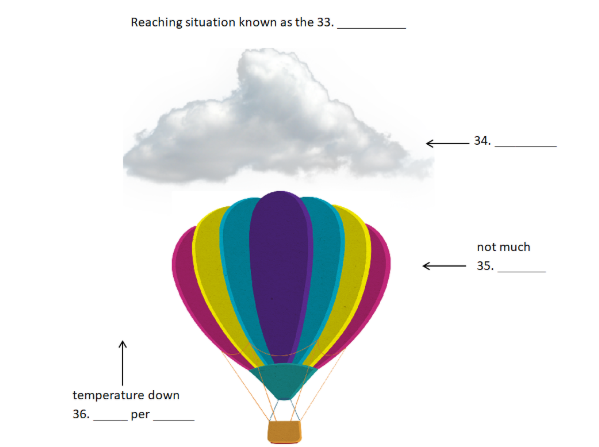
    B Clouds, as everyone in the room would already have known, were staging posts m the rise and fall of water as it made its way on endless compensating journeys between the earth and the fruitful sky. Yet the nature of the means of their exact construction remained a mystery to most observers who, on the whole, were still in thrall to the vesicular or ‘bubble’ theory that had dominated meteorological thinking for the better part of a century. The earlier speculations, in all their strangeness, had mostly been forgotten or were treated as historical curiosities to be glanced at, derided and then abandoned. Howard, however, was adamant that clouds were formed from actual solid drops of water and ice, condensed from their vaporous forms by the fall in temperature which they encountered as they ascended through the rapidly cooling lower atmosphere. Balloon pioneers during the 1780s had continued just how cold it could get up in the realm of the clouds: the temperature fell some 6.5″C for every thousand metres they ascended. By the rime the middle of a major cumulus cloud had been reached, the temperature would have dropped to below freezing, while the oxygen concentration of the air would be starting to thin quire dangerously. That was what the balloonists meant by ‘dizzy heights’.

    C Howard was not, of course, the first to insist that clouds were best understood as entities with physical properties of their own, obeying the same essential laws which governed the rest of the natural world (with one or two interesting anomalies: water, after all, is a very strange material). It had long been accepted by many of the more scientifically minded that clouds, despite their distance and their seeming intangibility, should be studied and apprehended like any other objects in creation.

    D There was more, however, and better. Luke Howard also claimed that there was a fixed and constant number of basic cloud types, and this number was not (as the audience might have anticipated) in the hundreds or the thousands, like the teeming clouds themselves, with each as individual as a thumbprint. Had this been the case, it would render them both unclassifiable and unaccountable; just so many stains upon the sky. Howard’s claim, on the contrary, was that there were just three basic families of cloud, into which every one of the thousands of ambiguous forms could be categorized with certainty. The clouds obeyed a system and, once recognized in outline, their basic forms would be ‘as distinguishable from each other as a tree from a hill, or the latter from a lake’, for each displayed the simplest possible visual characteristics.

    E The names which Howard devised tor them were designed to convey a descriptive sense of each cloud type’s outward characteristics (a practice derived from the usual procedures of natural history classification), and were taken from the Latin, for ease of adoption by the learned of different nations’: Cirrus (from the Latin for fibre or hair), Cumulus (from the Latin for heap or pile) and Stratus (from the Latin for layer or sheet). Clouds were thus divided into tendrils, heaps and layers: the three formations at the heart of their design. Howard then went on to name four other cloud types, all of which were either modifications or aggregates of the three major families of formation. Clouds continually unite, pass into one another and disperse, but always in recognizable stages. The rain cloud Nimbus, for example (from the Latin for cloud), was, according to Howard, a rainy combination of all three types, although Nimbus was reclassified as nimbostratus by meteorologists in 1932, by which time the science of rain had developed beyond all recognition.

    F The modification of clouds was a major new idea, and what struck the audience most vividly about it was its elegant and powerful fittingness. All of what they had just heard seemed so clear and so self-evident. Some must have wondered how it was that no one – not even in antiquity – had named or graded the clouds before, or if they had, why their efforts had left no trace in the language. How could it he that the task had been waiting for Howard, who had succeeded in wringing a kind of exactitude from out of the vaporous clouds? Their forms, though shapeless and unresolved, had at last, it seemed, been securely grasped. Howard had given a set of names to a radical fluidity and impermanence that seemed every bit as magical, to that first audience, as the Eskimo’s fabled vocabulary of snow.

    Questions 27-32
    Reading Passage 3 has six paragraphs A-F. Choose the correct heading for each paragraph from the list of headings below.

    List of Headings
    i An easily understood system
    ii Doubts dismissed
    iii Not a totally unconventional view
    iv Theories compared
    v A momentous occasion
    vi A controversial use of terminology
    vii Initial confusion
    viii Previous beliefs replaced
    ix More straightforward than expected
    x An obvious thing to do

    27. Paragraph A
    28. Paragraph B
    29. Paragraph C
    30. Paragraph D
    31. Paragraph E
    32. Paragraph F

    Questions 33-36
    Label the diagram below. Choose NO MORE THAN THREE WORDS AND/OR A NUMBER from the passage for each answer.
    Questions 37-40
    Reading Passage 3 has six paragraphs labelled A-F. Which paragraph contains the following information? NB You may use any letter more than once.

    37. an example of a modification made to work done by Howard
    38. a comparison between Howard’s work and another classification system.
    39. a reference to the fact that Howard presented a very large amount of information
    40. an assumption that the audience asked themselves a question

  • IELTS Reading Practice Test – Exercise 183

    Groucho Marx Arthur Sheekman

    In a show-business career that spanned over seventy years, Groucho Marx successfully conquered every entertainment medium, becoming a star of the vaudeville stage, Broadway, motion pictures, radio and television. But, as the author of seven books, a play, two film screenplays and over one hundred magazine articles and essays, Groucho quietly conquered another medium, one in which he was as proud to work as any of the others. His writing is often overlooked in studies of his career, perhaps due to the quantity and variety of his other work.

    Throughout his literary career, Groucho was dogged by the incorrect and unfair assumption by many critics and even by his biographer that he used a ghost writer. Most Hollywood celebrities who wrote books had professional writers do the actual work. The fact that Groucho publicly stated on many occasions that he abhorred ghost writers is clouded by his relationship with Arthur Sheekman. Friends for many years, Groucho and Sheekman had an unusual literary relationship. They worked in collaboration and each offered the other editorial help. For a brief time in the early 1940s, Groucho fronted for Sheekman, who was having trouble selling his work. By thus lending his name to another writer’s work, Groucho subjected all of his literary endeavors to suspicion from critics who simply refused to believe that an entertainer could write.

    That some of Sheekman’s magazine pieces got into print under Groucho’s byline becomes apparent from reading the unedited correspondence between the two of them. The letters indicate that Groucho’s essays from this period fall into three categories: first, pieces written by Groucho with no input from Sheekman at all. In a July I, 1940, letter to Sheekman, Groucho asked, ‘Did you see that little piece wrote for Reader’s Digest? On March 17. 1941, he wrote, ‘My drool is coming out in next week’s Issue of This Week so cancel your subscription now.’ Clearly Sheekman could not have had anything to do with a piece that he was told to look for.

    The second and probably largest category of Groucho’s essays of this period consists of those written by Groucho and sent to Sheekman for editorial assistance. On July 20, 1940, Groucho wrote: Tm enclosing a copy of the piece I wrote. Probably another page or so is needed to complete it, but our starting date [for filming Go West ] came and I just haven’t had time to finish it. Let me know what you think of it and be honest because any other kind of opinion would be of no value to me. I won’t attempt to influence you by telling you the reactions I’ve already had, so for the love of God tell me the truth.’ Shortly thereafter, on October 10, Groucho wrote: ‘1 received your suggestions on my piece – I’m glad you liked It, If you did – you’re probably right about the beginning. I’ll do it over again.’ By the time Groucho wrote to Sheekman on July 25. 1942, it appears that some sort of financial arrangement had been made regarding Sheekman’s suggestions. On that date Groucho also wrote: Tm writing an unfunny piece on insomnia and I’ll send it in a week or so, I hope, for you to read – I’d like your opinion, proofread — correcting all the glaring illiteracies and, otherwise, do a fine polishing job.’

    The remainder of Groucho’s essays from this period comprise the third category, Sheekman compositions with varying degrees of input from Groucho. The level of Groucho’s contributions to the articles in the third category ranges from actually suggesting the topic and drawing up an outline to simply rewriting a few paragraphs for the purpose of injecting his own style into the piece. In a July 10, 1940, letter Groucho wrote: ‘I think you ought to try another political piece – a campaign thing – for This Week or some other magazine. This will be an extremely hot topic for the next few months and I think you should take advantage of it. If you’ll write to me, I’ll try to jot down a few items that you could complain about.’ Presumably, the chain of events would continue with Sheekman sending an essay to Groucho for his approval and whatever rewrites were needed. On May 29, 1940, Groucho wrote, ‘Received your piece and looked it over.’ In these letters to Sheekman, Groucho always referred to a piece as either ‘my piece’ or ‘your piece’. The letter continued, ‘I thought the piece was good … and I’ll send it to Bye and see if he can sell it… I’ll just rewrite a couple of paragraphs in your piece – not that I can improve them, but perhaps they’ll sound a little more like me.’ Groucho was concerned enough about this arrangement to take the care to at least make the piece somewhat his own.

    Groucho really had no need for this entire enterprise. He gave the money to Sheekman and had no trouble getting his own work published. The principal reason for him submitting Sheekman’s work to magazines as his own was that it made Sheekman’s material easily marketable based on Groucho’s celebrity. Sheekman couldn’t have been altogether happy with the arrangement, but the reality was that he was periodically unemployed and the use of Groucho’s name brought in occasional paychecks. So it is not quite fair to call Sheekman Groucho’s ghost writer. A more apt description of their literary relationship at this time is that Groucho occasionally fronted for Sheekman and offered him the services of his literary agent, while each offered the other editorial advice. The reasons for some of their collaborative efforts not being credited as such remain unexplained, but Groucho was never shy about crediting his collaborators, and in every other case he did so.

    Questions 1-4
    Do the following statements reflect the claims of the writer of Reading Passage 1? In boxes 1 – 4 on your answer sheet ante

    YES if the statement agrees with the views of the writer
    NO if the statement contradicts the views of the writer
    NOT GIVEN if it is impossible to say what the writer thinks about this

    1. Groucho’s work as a writer was sometimes better than his work in other media.
    2. Groucho’s relationship with Sheekman cast doubt on his own abilities as a writer.
    3. Money was occasionally a source of disagreement between Groucho and Sheekman.
    4. Groucho occasionally regretted his involvement with Sheekman.

    Questions 5-8
    Complete the notes below. Choose NO MORE THAN THREE WORDS from the passage for each answer.

    Category 1Category 2Category 3
    Sheekman had (5)…………………Sheekmand provided (6)…………………mostly (7)…………………
    Groucho added (8)……………….

    Questions 9-13
    Write the correct letter A-G in boxes 9-13 on your answer sheet.

    9. Groucho referred to his own inadequacy with regard to use of language.
    10. Groucho explained his reason for amending an essay.
    11. Groucho agreed that part of an essay needed revising.
    12. Groucho drew Sheekman’s attention to an essay soon to be published.
    13. Groucho suggested that an essay should adopt a negative point of view.

    List of Letters Sent by Groucho to Sheekman

    A July 1, 1940
    B March 17, 1941
    C July 20, 1940
    D October 10, 1940
    E July 25, 1942
    F July 10, 1940
    G May 29, 1940

    An Earth – Shaking Discovery

    In 1963, a paper appeared in the journal Nature that radically changed the way we view this planet and its resources. Tts authors, Fred Vine and Drummond Matthews, did for the Earth sciences what Crick and Watson did for biology and Einstein did for physics, and new areas of scientific development are still emerging as a result.

    Yet both men are largely forgotten and unrecognised. What Vine and Matthews did was to provide proof that continents really do drift across the surface of the globe. This understanding profoundly affects the way we use the planet today – it directs the way we prospect for resources such as oil and minerals: it has enabled us to predict most volcanic eruptions and to understand patterns of earthquakes. Incredibly perhaps, an understanding of the mobile dynamic nature of the Earth is helping an understanding of long-term global climate changes. Despite the significance of their work, neither man received great honour or fame.

    The idea of continental drift was first proposed in a serious way by the German meteorologist Allred Wegener in 1915. People had noticed the neat jigsaw-like fit between South America and Africa, but Wegener found actual fossil evidence that the two continents were once joined. No one took him seriously; in fact he was ridiculed by most of the geological community. This was partly because, not being a geologist, he was perceived as an outsider. But the main reason for the hostility; according to Vine, was that Wegener was unable to come up with an explanation as to how whole continents could possibly move even an inch, let alone dance to the music of time around the globe.

    In the 1920s, the Scottish geologist Arthur Holmes hypothesised that convection currents within the Earth ‘could become sufficiently vigorous to drag the two halves of the original continent apart! In the late 1950s, an American, Harry Hess, came up with the hypothesis that new sea floor is constantly being generated at the mid­-ocean ridges by hot material rising in a convection current. But neither man could find evidence to prove it. It was no more than just a hunch that it had to be right, and a hunch is not enough for science.

    Vine had been fascinated by the apparent fit of the continents since the age of 14, and as a graduate student at Cambridge was assigned a project analysing one of the new magnetic surveys of the ocean floor. He found what he describes as parallel zebra swipes of normal and reversed magnetism’ around the mid-ocean ridge. Most significantly; these stripes were symmetrical either side of the ridge crests. There had to be a reason for this. The young Vine and his supervisor Matthews proposed that the magnetic stripes were caused by new ocean floor being formed as molten rock rose at the mid-ocean ridges and spread each side of the ridge.

    As the molten rock solidified, it became weakly magnetised parallel to the Earth’s magnetic field. U was just becoming recognised in the early 1960s that the Earths magnetic field flips every so often, so magnetic north becomes a magnetic south pole and vice versa. These flips in magnetic field were being recorded in the new sea floor. It was like a giant tape recording of the ocean floor’s history. As new sea floor was made, it pushed the last lot aside, widening the ocean and in turn pushing the continents either side further apart. In other words, they had discovered the mechanism driving drifting continents that was missing from Wegener’s work. The science of the Earth was never the same again.

    By the end of the 1960s, confirmation of global sea floor spreading led to plate tectonics – the view of the outside of the Earth comprising just a few rigid plates which are shunted about by growing sea floor. There was a realisation that mountains are formed when two plates collide, and that most volcanoes and earthquakes occur on the edges of these plates. All this was accepted as fact by all but a few diehard dinosaurs in the geological world.

    It is now in the impact of shifting continents on the global environment that Vine feels the most exciting and significant research lies: ‘The distribution of continents and the opening and closing of ocean gates between continents has had a profound effect on climates and has caused flips from Ice­house Earth to Green-house Earth.’ The recognition that the Earth’s hydrosphere, atmosphere and biosphere are all intimately linked with the drifting continents and the goings- on deep within the Earth has spawned the term ‘Earth Systems Science’. It is a great oak tree of science that has grown from the acorn of truth supplied by Vine and Matthews. The holistic approach of earth systems science is very much welcomed by Vine: Tm rather pleased that this has come together.’ He feels that the future for understanding the planet lies in an integrated approach to the sciences, rather than the isolated stance the geologists took throughout the 20th century: There was an incredible polarisation of science and I was caught between the boundaries. It was anathema to me – the whole of environmental science should be integrated.’

    Questions 14-17
    Complete each sentence with the correct ending A-G from the box below.

    14. The work done by Vine and Matthews has had implications concerning
    15. Wegener attempted to provide an explanation of
    16. Wegener’s conclusions were greeted as
    17. The theories presented by both Holmes and Hess concerned

    A matters that had not received much attention for some time.
    B something which could not possibly be true.
    C something misunderstood at first but later seen as a breakthrough.
    D matters beyond simply the movement of continents.
    E something that had already been observed.
    F something arrived at by intuition that could not be demonstrated.
    G matters requiring different research techniques

    Questions 18-22
    Label the diagram below.

    THE DISCOVERIES OF VINE AND MATTHEWS

    Questions 23-26
    Answer the questions below using NO MORE THAN THREE WORDS for each answer.

    23. What is the name of the theory concerning the structure of the Earth that developed from the demonstration of sea floor spreading?
    24. According to Vine, what has the movement of continents had a big influence on?
    25. What branch of science has emerged as a result of the work done by Vine and Matthews?
    26. Which word does Vine use to describe the way in which he believes study of the Earth should be conducted?

    Think Happy

    A What would Sir Isaac Newton have made of it? There he was, painted in oils, gazing down at one of the strangest meetings that the Royal Society, Britain’s most august scientific body, has ever held. If Newton had flashed a huge grin, it would have been completely appropriate, for beneath him last week a two- day conference was unfolding on a booming new field of science: investigating what makes people happy. Distinguished professors strode up to the podium, including one eminent neurologist armed with videos of women giggling at comedy films; another was a social scientist brandishing statistics on national cheerfulness. Hundreds of other researchers sat scribbling notes on how to produce more smiles.

    B The decision by the Royal Society to pick ‘the science of wellbeing’ from hundreds of applications for conferences on other topics is no laughing matter. It means that the investigation of what makes people happy is being taken very seriously indeed. ‘Many philosophies and religions have studied this subject, but scientifically it has been ignored,’ said Dr Nick Baylis, a Cambridge University psychologist and one of the conference organisers. ‘For the Royal Society to give us its countenance is vital, because that states that what we are doing deserves to be acknowledged and Investigated by the best scientific minds.’

    C At first sight, the mission of Baylis – and the growing number of other scientists working on happiness research – appears fanciful. They want to deploy scientifically rigorous methods to determine why some people are lastingly happy while others tend to misery. Then they envisage spreading the secret of happiness across the globe and, in short, increasing the sum of human happiness. ‘If someone is happy, they are more popular and also healthier, they live longer and are more productive at work. So it is very much worth having’ he says.

    D Baylis, the only ‘positive psychology’ lecturer in Britain, knows that the aims of happiness research might sound woolly, so he is at pains to distance himself from the brigades of non- academic self-help gurus. He refers to ‘life satisfaction’ and ‘wellbeing’ and emphasises that his work, and that of others at the conference, is grounded in solid research. So what have the scientists discovered – has a theory of happiness been defined yet?

    E According to Professor Martin Sellgman, probably the world’s leading figure in this field, happiness could be but a train ride – and a couple of questionnaires – away. It was Seligman, a psychologist from Pennsylvania University, who kick-started the happiness science movement with a speech he made as President of the American Psychological Association (APA). Why, asked Seligman, shocking delegates at an APA conference, does science only investigate suffering? Why not look into what steps increase happiness, even for those who are not depressed, rather than simply seek to assuage pain? For a less well- known scientist, the speech could have spelt the end of a career, but instead Seligman landed funding of almost £18m to follow his hunch. He has been in regular contact with hundreds of other researchers and practising psychologists around the world, all the while conducting polls and devising strategies for increasing happiness.

    F His findings have led him to believe that there are three main types of happiness. First, there is ‘the pleasant life’ – the kind of happiness we usually gain from sensual pleasures such as eating and drinking or watching a good film. Seligman blames Hollywood and the advertising industry for encouraging the rest of us, wrongly as he sees it, to believe that lasting happiness is to be found that way. Second, ị there is ‘the good life’, which comes from enjoying something we are good or talented at. The key to this, Seligman believes, lies in identifying our strengths and then taking part in an activity that uses them. Third, there is ‘the meaningful life’. The most lasting happiness, Seligman says, comes from finding something you believe in and then putting your strengths at its service. People who are good at communicating with others might thus find long-lasting happiness through becoming involved in politics or voluntary work, while a rock star wanting to save the world might find it in organising a charity concert.

    G Achieving ‘the good life’ and ‘the meaningful life’ is the secret of lasting happiness, Seligman says. For anybody unsure of how to proceed, he has an intriguing idea. To embark on the road to happiness, he suggests that you need a pen, some paper and, depending on your location, a railway ticket. First, identify a person to whom you feel a deep debt of gratitude but have never thanked properly. Next, write a 300-word essay outlining how important the help was and how much you appreciate it. Then tell them you need to visit, without saying what for, turn up at their house and read them the essay. The result: tears, hugs and deeper, longer-lasting happiness, apparently, than would come from any amount of champagne.

    H Sceptics may insist that science will always remain a clumsy way of investigating and propagating happiness and say that such things are better handled by artists, writers and musicians – if they can be handled at all. And not everybody at the conference was positive about the emerging science. Lewis Wolpert, professor of biology as applied to medicine at University College London, who has written a bestseller about his battle with depression, said: ‘If you were really totally happy, I’d be very suspicious. I think you wouldn’t do anything, you’d just sort of sit there in a treacle of happiness. There’s a whole world out there, and unless you have a bit of discomfort, you’ll never actually do anything.’

    Question 27-30
    Complete the sentences below with words taken from Reading Passage 3. Use NO MORE THAN THREE WORDS for each answer.

    At the conference, research into happiness was referred to as the (27)…………………

    Baylis and others intend to use (28)………………………to find out what makes people happy or unhappy.

    Baylis gives classes on the subject of (29)………………………

    Baylis says he should not be categorised among the (30)……………………..who do not have academic credentials.

    Questions 31-36
    Complete the summary below using words from the box. Write your answers in boxes 31-36 on your answer sheet.

    Seligman’s categories of happiness Seligman’s first type of happiness involves the enjoyment of pleasures such as (31)……………………….He believes that people should not be under the (32)…………………….that such things lead to happiness that is not just temporary. His second type is related to (33)…………………….Identification of this should lead to (34)…………………….and the result is ‘the good life’. His third type involves having a strong (35)……………………..and doing something about it for the benefit…of others. This, according to Seligman, leads to happiness that has some (36)……………………

    abilityeffortincentiveperseverancecelebration
    egoillusionpermanenceconceptencouragement
    leadershipsupportconfidenceentertainmenttheory
    convictionexaggerationparticipationthrill

    Questions 37-40
    Reading Passage 3 has eight: paragraphs labelled A-H Which paragraph contains the following information?

    37. a view that complete happiness may not be a desirable goal
    38. a reference to the potential wider outcomes of conducting research into happiness
    39. an implication of the fact that the conference was held at all
    40. a statement concerning the possible outcome of expressing a certain view in public


  • IELTS Reading Practice Test – Exercise 182

    From SunnyD and Pizza to Bread and Water

    A Another bad week in a bad month for the food and drink industry. Sunny Delight, formerly the UK’s third largest selling drink, is to be taken off the shelves by Asda after plummeting sales, the supermarket said at the weekend. Yesterday, it was the turn of Northern Foods, makers of biscuits, pies, pizzas and ready meals, to admit that the trend to healthier food was causing it problems. The company’s chief executive, Pat O’Driscoll, issued its second profits warning in two months as its biscuit sales slumped by 12% year on year in January and February, and pastry sates by 11%. Shares fell 17% to a five-year low of £1.08p.

    B The National Consumer Council’s food expert, Sue Dibb, said the news showed companies would have to change to survive. “It looks as though we’ve reached the tipping point on food. Our research showed that two thirds of consumers have made changes to what they eat in the last year. Supermarkets are getting competitive about health. Companies are having to wake up or lose their customers.” Foods analyst Clive Black, of Shore Capital, said that a “sea change” in eating habits was behind the industry’s problems. “Anyone who hasn’t realised over recent years that fruit and veg are good and doughnuts and cream cakes are bad must have been living on the moon,” he said. “But over the past year or so, the penny really seems to have dropped.”

    C Like other supermarket groups, Asda said it had seen a marked change in buying patterns in the past year. “Customers want more natural and authentic products,” Jon Bett, the trading manager for chilled drinks, said. “The market for carbonated drinks has declined 7 to 8% in the last year, while the juice market has doubled and water sales have grown phenomenally.” The trend had been driven by media coverage and the “Jamie Oliver effect”, he added.

    D The decline of Sunny Delight is matched by the fall of other soft drinks – two weeks ago, Britvic admitted a “severe decline” in sales of its carbonated drinks, which include Tango, 7UP and Pepsi – although the fate of the SunnyD brand has attracted particular schadenfreude. Sunny Delight burst on to the market in 1998 and reached the league table of top brands in 1999 by selling itself as a healthy drink, although its original recipe was only 5% juice with plenty of sugar and water as well as vegetable oil, thickeners, added vitamins, flavourings, and colourings.

    E The health watchdog the Food Commission accused then owners Procter and Gamble of a con for selling it from fridge cabinets. In 1999, paediatrician Duncan Cameron reported a new and alarming condition in the medical journals: Sunny Delight Syndrome. A girl of five had turned bright yellow after drinking five litres a day. She was overdosing on beta-carotene, the additive used to give the drink its orange colour, and the pigment was being deposited in her skin. The marketing dream turned to a nightmare: by coincidence television adverts at the time showed two white snowmen raiding the fridge for SunnyD and turning bright orange. Its collapse was as dramatic as its rise to fame, and Gerber Foods Soft Drinks, which bought distribution rights to the brand in 2005, has been unable to reverse its fortunes despite efforts to reduce the sugar content, change the recipe, and introduce new variations, including a bright green apple and kiwi flavour.

    F Kath Dalmeny, the Food Commission’s senior policy adviser, greeted the news of SunnyD’s delisting with satisfaction. “There is no appetite any more for products that claim to be healthy but have no real nutritional value. Sunny Delight didn’t live up to its claims and parents have seen through that kind of marketing.” Gerber Funds Suit Drinks said SunnyD was suffering from an inherited and unjustified image problem. The marketing director, Rob Spencer, told The Grocer magazine: “In Asda, two thirds of our sales come from no added sugar versions, which are up by 1% year on year.”

    G But market research figures from the company AC Nielsen show that the pressure on Sunny Delight and Northern Foods is part of a wider trend. Sales of pizzas and frozen foods fell by 9.2% last year. Most products seen as unhealthy declined – confectionery by 3.1%/bagged snacks by 1.2%, and carbonated soft drinks by 1.7% – while those seen as healthy boomed. Drinking yoghurts were up 51%, juices 15.6%, and water 9.4%. Ethical investment analysts EIRIS recently listed leading food manufacturers according to the percentage of turnover derived from products which fall into the unhealthy category. It said Unilever, Kraft Foods, PepsiCo, Coca-Cola, McDonald’s, and Cadbury Schweppes had the highest risk of suffering a backlash.

    Questions 1-4
    The text has 7 paragraphs (A – G).

    Which paragraph contains each of the following pieces of information?

    1. Most consumers have changed their eating habits over the last year.
    2. The suggestion that parents are more aware of how advertisers try to sell products
    3. The ingredients of a once-popular drink
    4. A description of an advertisement

    Questions 5-8
    Complete the following sentences using NO MORE THAN TWO WORDS from the text for each gap.

    Shops are becoming more (5)…………………..about stocking healthy food and drink products.

    Sunny Delight was originally marketed as a (6)…………………….

    Gerber Foods Soft Drinks has the (7)………………………..for Sunny Delight.

    The most dramatic change in consumption has been for (8)……………………..

    Questions 9-13
    Do the following statements agree with the information given in Reading Passage 1? In boxes 9 -13 on your answer sheet, write

    TRUE if the statement agrees with the information
    FALSE if the statement contradicts the information
    NOT GIVEN If there is no information on this

    9. Most of the foods produced by Northern Foods are healthy.
    10. Duncan Cameron is a doctor.
    11. Rob Spencer works for Asda.
    12. Sales of Coca-Cola are declining in Britain.
    13. Fast food companies are looking to developing countries to increase their profits.

    No Growing Pains for Daniel Radcliffe

    A You know those tales of lost youth that spring from actors who are too successful too soon? You will probably not hear any about Daniel Radcliffe, who conjures up his alter ego Harry Potter for the fourth boy-wizard film saga, “Harry Potter and the Goblet of Fire”, opening Nov. 18 (after its premiere Saturday in New York City). “If childhood is being surrounded by people who you love being around and being incredibly happy, then I absolutely have had that,” he says. “It’s been a bizarre childhood. It’s been strange, but it’s been great.”

    B Radcliffe, now an articulate 16-year-old, has not been arrested, has not warred with his parents over his millions now tucked away, or thrown hissy fits on the set. What in the name of Macaulay Culkin is going on? “They all know exactly what they’re worth,” “Goblet” director Mike Newell says of Radcliffe and co-stars Emma Watson and Rupert Grint, “but they have not become impossible.” Radcliffe became a global icon as a 10-year-old when he won a worldwide casting call to breathe life into the hero from J. K. Rowling’s best-selling fantasy books. Despite endless adoration, he seems to be avoiding that notorious fraternity of thespian lads who turn rotten.

    C In a one-to-one conversation at a London hotel, the 5-foot-7 Radcliffe, without those H. P. spectacles, emerges as very much a boy, but with a showman’s polish that no abracadabra could evoke when he first wielded a magic wand. He makes small talk before the first question is popped and, later, in a press conference, works the room like a professional comedian. He has never been stung by a bad review or an unflattering portrait. That is because he has never read any of his press. His parents, Alan Radcliffe and Marcia Gresham, have provided a magic carpet ride into puberty by protecting him from both the adulation and the evisceration.

    D Radcliffe remains blissfully ignorant of his riches as well – reported to be next in line behind fellow young Brits Charlotte Church and Prince Harry. “To be honest, I don’t actually know how much at this point,” Radcliffe says. “I don’t, really. In a way, I think that’s right. It’s not something that affects the way I think about things.” Radcliffe’s Groucho-eyebrow-draped blue eyes lock in without trepidation. Although he gives relatively few interviews, he does not flinch at potentially awkward questions, either. He is the land of millionaire action-figure boy-next-door with whom you’d like to take your teen daughter out for a soda. Radcliffe wears a green striped dress shirt, and his only accessory is his publicist and long-time family friend Vanessa Davies.

    E Except for premieres, Radcliffe’s family employs no bodyguards, according to the actor. At school, the hubbub over his presence dies down after a few weeks. Fan interest “never got too aggressive”, he says. “I know there are people who are slightly obsessed, but it doesn’t really worry me too much. As long as it stays at the pitch it is now. Occasionally you meet someone slightly worrying, but I never really feel in danger.” The security issue that absorbs him at the moment is longevity as an actor. For the first time since he began the “Harry Potter” installments, Radcliffe is set to work on another feature, “December Boys”, a coming-of-age tale in which he plays an orphan. It begins shooting in Australia in December.

    F Taking a cue from one of his idols, Gary Oldman, who plays Harry’s godfather Sirius Black in the Potter movies, Radcliffe wants to forge various on-screen personas. “If I was to complete the series without having done anything else during that time, it would be harder to be seen as anything else,” he says. “It’s just showing people I can do other things.” At the moment, Radcliffe is preparing for the fifth Potter edition, “Harry Potter and the Order of the Phoenix”. It requires him to take tutoring at the Leavesden Studios in Hertfordshire. Although he has aged out of many of the restrictions of England’s child labour laws, he is determined to stick to his old schedule. Each film typically takes 11 months to finish.

    G “It would be too intense if I did that much school and that much filming at the same time,” he says. “Both my performance and schoolwork would suffer.” Radcliffe is prepared to work the same routine if called upon to do No. 6, “Harry Potter and the Half-Blood Prince”. (Rowling is at work on a seventh.) “Ultimately it comes down to whether I feel like doing it,” he says. “If it’s a great script, a great director and it will challenge me, there’s no reason for me not to do it. I’ve read the sixth book. It’s such an amazing part for me if I was to do it. That would definitely be something that would challenge me. However, it’s a long way away.”

    H No. 5 puts Radcliffe through his paces in a hormonally charged setting. Newell says he crafted it first as a thriller, pitting the budding sorcery prodigy against Lord Voldemort (Ralph Fiennes), who has not appeared since he killed Harry’s parents 13 years earlier. Although he is a poor swimmer, Radcliffe immersed himself in an extended underwater scene. “He won’t turn into a stuntman, but he’s a responsible boy,” producer David Heyman says. Radcliffe seems to enjoy the spotlight more than his co-stars, piping in with glib comments as Grint, 17, stumbled through the afternoon news conference.

    I All the while, Radcliffe’s parents sat in the back row, watching with thin smiles and arms folded. “I might be arrogant and big-headed, but they kept me really grounded, and I can’t thank them enough for that,” Radcliffe says. He is still just a teenager, more an on-screen dragon slayer than ladykiller. Radcliffe spoke frankly about his less-than-magical ways with girls, saying their expectations of him as Harry dissolves into a “grimmer reality”. He knows the Potter experience will long outlive his awkwardness. After all, millions of moviegoers have fallen under his spell. “This has given me a feeling of confidence,” says Radcliffe, “which I might not have had otherwise.”

    Questions 14-17
    The text has 9 paragraphs (A -I).

    Which paragraph does each of the following headings best fit?

    14. Security
    15. Underwater scene
    16. Balancing filming and studies
    17. Not a bad star

    Questions 18-22
    According to the text, FIVE of the following statements are true.

    Write the corresponding letters in answer boxes 18-22 in any order.

    A The first showing of Harry potter and goblet of fire was in New York
    B Daniel Radcliffe started acting when he was ten years old
    C Daniel Radcliffe does not talk to reporters often
    D Daniel Radcliffe is treated specially at school
    E When filming Daniel Radcliffe is tutored at the film studio
    F Daniel Radcliffe gets on with the Harry Potter director
    G Daniel Radcliffe seems to be better at dealing with reporters than Rupert Grint
    H Daniel Radcliffe’s parents were unhappy with the press conference

    Questions 23-26
    According to the information given in the text, choose the correct answer or answers from the choices given.

    23. The writer says that Daniel Radcliffe
    A looks taller without his glasses
    B behaves very professionally
    C does not read reviews of his acting

    24. Daniel Radcliffe says that he
    A has less money than Prince Harry
    B does not know how much money he has made
    C does not care how much money he has made

    25. Daniel Radcliffe wants to play roles other than Harry Potter because
    A his idol Gary Oldman did that
    B his idol Gary Oldman suggested it
    C he does not want people to think he can only play Harry Potter

    26. Daniel Radcliffe says that he has not been successful with girls because
    A he is still a teenager
    B they expect him to be like Harry Potter
    C his parents won’t let him go dating

    The Fame Machine

    Fascination is universal for what Aaron Spelling, a prolific producer of American soap operas, once called “rich people having problems that money can’t solve”. The fascinated in star-struck Britain have no equal. The country has a profusion of titles devoted to chronicling even the smallest doings of celebrities. Britons buy almost half as many celebrity magazines as Americans do, despite having a population that is only one fifth the size. Celebrity news often makes the front page of British tabloid newspapers, providing a formidable distribution channel for stories about celebrities. New figures from the Audit Bureau of Circulations show that the ten best-selling celebrity publications and ten most popular tabloids have a combined circulation of 23 million.

    Satisfying this voracious demand has turned what was once a shoddy, amateurish business into an entertainment industry in its own right. Its business model has two distinguishing features. First, celebrity has become the product – rather than just a device for marketing films or music. The “talent” (if that is the word) owes its standing chiefly to the celebrity machine and not to any particular gift. It, therefore, depends on the attentions of the press to make money. Second, celebrities, agents, photographers, and picture desks have found that the most efficient way to create an endless supply of celebrity news is to work together. A business that used to be based on intrusion has discovered a preference for collaboration.

    It is also expanding abroad. In the past few weeks, Northern & Shell has launched an American edition of OK!, a celebrity magazine that already has Australian, Chinese, and Middle Eastern editions. EMAP recently launched Closer in France and already published a South African edition of Heat, a best-seller in Britain. Celebrity hounds who cut their teeth in Britain’s competitive market are in demand abroad. The National Enquirer, a hard-nosed American scandal sheet famed for pushing back the boundaries of taste – and of free speech – was relaunched earlier in the year by a team led by Paul Field, formerly of The Sun, and stuffed with alumni of British tabloids and magazines.

    Celebrity magazines were not a British invention. Hello!, which is still widely read but which has been waning of late, originated in Spain, where Hola! provided a hint of glamour to women under Franco’s drab reign. Before that, magazines grew up around the film industry in America. Some reported what the studios wanted them to say; others, such as Confidential – which became the biggest-selling magazine in America in the 1950s – aimed to dish the dirt on the stars. In Britain, celebrity news has been used to sell newspapers for more than a century. The News of the World, which gleefully reported aristocratic scandals in the 19th century, first appeared in the same year as Dickens’s “A Christmas Carol”.

    Modern Britain has given the gossip a new sophistication. Part of the secret has been to separate celebrity revenue streams. Julian Henry of Henry’s House, an agency for celebrities, distinguishes between a celebrity’s craft (such as singing, stripping, or kicking footballs) and their celebrity rating, which has a trajectory of its own, and often has an inverse relationship to the talent a famous person has, or once had. This second stream can often be more valuable than the first, and Britain’s celebrity industry has become adept at creating and selling it.

    Take Peter Andre and Katie Price, who are to marry later this month. The pop singer and the model better known as Jordan, met when their careers were flagging, on a reality TV show – that essential new cog in the celebrity machine. They have sold rights to the wedding, built around a Cinderella theme, as an exclusive to OK! for a small fortune (a price, the gossip press says, that has irked Victoria Beckham, whose marriage to her footballer husband was covered by a million-pound contract). In the past, such sums have been reserved for authentic stars such as Michael Douglas and Catherine Zeta-Jones. The deal included more than wedding snaps: over a year of the couple’s life – from prenuptial nerves to the first birthday of the expected offspring – was bundled together and sold as a commodity. Ms. Price, who once said the only book she had read was the story of the Yorkshire Ripper, has now signed a three-book deal with Random House.

    Paul Ashford of Northern & Shell, the company that owns OK!, calls this stuff “relationship journalism”, and it is pretty easy to spot. The process has become so effective that the three celebrities who insiders say shift most copies of OK! have all been manufactured in this way. With celebrity stories able to have such a powerful effect on sales, it is unsurprising that their manufacture is not left to chance. Modern celebrity in Britain is also more egalitarian. Tittle-tattle about dukes and duchesses is worth less than stories on ordinary folk, partly because ordinary folk make for more colourful copy. The News of the World boosted circulation by 250,000 when it put the Beckhams on its cover last year after David Beckham was alleged to have had a love affair. Such cases show how celebrities’ willing participation can come back to haunt them if they transgress. This is less common than you might think: many of the celebrity pictures that look like plain intrusion into private lives are staged.

    This is partly thanks to the profit motive. Many celebrities don’t see why they should give away their image when they could make money from it. Darren Lyons runs a photography agency called Big Pictures that specialises in shooting celebrities through long lenses as if for a paparazzi picture. The profits from the picture sales are then split between the subject, the agency, and the photographer. “We’re almost known as the friendly paparazzi,” grins Mr. Lyons from the high-backed, red leather judicial chair in his office, a lion-skin rug spread across the floor. Collaboration allows celebrities to retain some control over choosing the pictures that appear.

    Questions 27-30
    For each question, only ONE of the choices is correct.

    27. British people buy
    A as many celebrity magazines as Americans do.
    B more celebrity magazines per head of population than Americans.
    C a grand total of 23 million celebrity magazines each year.

    28. The National Enquirer is
    A a tasteful magazine.
    B now owned by British people.
    C now employing many British journalists.

    29. The News of the World
    A is an American newspaper.
    B has been published for over a hundred years.
    C published extracts from “A Christmas Carol”.

    30. Darren Lyons
    A works with celebrities.
    B is disliked by many celebrities.
    C doesn’t co-operate with newspapers and magazines.

    Questions 31-35
    Complete the following sentences using NO MORE THAN THREE WORDS from the text for each gap.

    Britain’s celebrity industry is good at (31)………………………a celebrity rating.

    Peter Andre and Katie Price’s wedding will have a (32)………………………..

    According to some, the three stars that can increase sales of OK! most all participate in (33)…………………..

    (34)………………………make more interesting subjects for stories.

    If celebrities co-operate with agencies and photographers, they (35)…………………….with regard to which photographs of them are published.

    Questions 36-40
    Do the following statements agree with the information given in Reading Passage 3? In boxes 36 – 40 on your answer sheet, write

    TRUE if the statement agrees with the information
    FALSE if the statement contradicts the information
    NOT GIVEN If there is no information on this

    36. Aaron Spelling has produced many American soap operas.
    37. The “talent” (paragraph 2) refers to the celebrity.
    38. Confidential was first published in the 1950s.
    39. At Henry’s House, the celebrity’s ability is linked to their celebrity rating.
    40. Peter Andre and Katie Price were becoming more successful when they met.

  • IELTS Reading Practice Test – Exercise 181

    From Hand to Mouth

    A Once again, southern Africa is facing a severe food crisis. It is a chronic problem – and shouldn’t be. At the Trinity hospital in Malawi’s southern Nsanje district, three-year-old Mboyi is lying listless, his face against the wall. His belly is badly bloated and skin is peeling off his legs. His mother explains that the family has not been able to harvest anything this year, due to poor rains. Mothers in the area are already bringing malnourished children to hospitals in alarming numbers. Yet, it will be another six months before the next harvest.

    B Aid agencies are sounding the alarm, hoping that help will come before emaciated children’s haunting images, such as those recently seen in Niger, appear on western television screens. The UN’s World Food Programme (WFP) says that close to 12 million people across southern Africa will need food aid before the next harvest. The agency is short of more than $150 million to feed them over the next six months. Malawi and Zimbabwe are by far the hungriest, but Mozambique, Zambia, Lesotho, and Swaziland are also affected. The drought may be southern Africa’s worst in a decade. The crucial rains of January, when newly planted crops need water, did not come on time. Nor, in some places, did seeds and fertiliser. Maize, the staple food, is scarce in some areas; prices in markets have shot up beyond the means of the hungriest.

    C Though the problem is particularly severe this year, it recurs across southern Africa. Food is produced mainly by subsistence farmers on small plots with no irrigation, their fate tied to rain falling in the right amount at the right time. Bad roads and unreliable transport make it expensive to move food and seeds. Without proper marketing channels, small farmers cannot sell whatever surplus they may have outside their neighbourhoods. This leaves southern Mozambicans hungry, even when crops are plentiful up north. Maize is ill-suited to the climate, needing too much water. In Malawi, there are too many people for the land. Partly due to bad farming, yields are low. And the region has the world’s highest rate of AIDS.

    D Many small farmers struggle to make ends meet even in good years, so one bad season can be disastrous. And in Swaziland and Mozambique, they are facing their fourth dry year in a row. Unable to grow enough to feed themselves or borrow their way out of hard times, farmers end up losing the few assets they have. In Malawi, those without anything left often resort to cutting and selling firewood, further eroding the soil and making their plots still less productive, or else fishing already depleted waters. Others venture into crocodile-infested rivers to dig out water-lily tubers for food.

    E Bad government policy sometimes makes things worse. In Zimbabwe, once the region’s breadbasket, land grabs have crippled commercial agriculture and irrigation systems. Hyperinflation and lack of foreign exchange make it hard to buy seeds and fertiliser, while fuel shortages stymie crop transport. A recent operation to “clean up” cities by bulldozing supposedly illegal dwellings has left another 700,000 people destitute, adding to the ranks of the hungry. The government has so far refused to endorse the UN’s proposed emergency programme to help those affected. Other governments are less bloody-minded. Malawi, the worst-hit country, with 5 million people (nearly half its population) needing food handouts, wants help. In July, President Bingu wa Mutharika asked his compatriots to give to a “feed the nation” fund: so far, $565,000 has been collected. In August, the UN appealed for $88 million. The World Bank will give $30 million.

    F Harnessing what the region already has would go a long way to offsetting its chronic hunger. In southern Malawi, rivers regularly flood – and are badly managed. By contrast, a big sugar plantation in Nchalo, its sprinklers spitting out arcs of water, is a green oasis. On a smaller but no less hopeful scale, the nearby Chitsukwa irrigation scheme cost only about $20,000 and provided canals and enough low-tech pumps to water 18 hectares (45 acres), which sustain 176 farmers. Along the canal, women with babies on their backs labour on what look like portable stairmasters, pumping water into their fields: the maize is flourishing. Now armed with better knowledge, farmers are aiming at three crops a year, instead of the precarious single one to which they were accustomed. A few kilometres down the road, the land is hopelessly dry and barren.

    G Uladi Mussa, Malawi s minister for agriculture and food security, insists that expanding small-scale irrigation is a top priority. The potential is there, he explains, but Malawi lacks the know-how and money to do it on its own. Zambia and Mozambique have both welcomed exiled white Zimbabwean farmers, whose skills are already boosting local agriculture. Meanwhile, chronic hunger is threatening southern Africa’s future generations. Close to half of Malawi’s under-five-year-olds are stunted. Schools unable to feed their pupils report drops in attendance, as children are too weak to walk or are forced to help their parents find food. For them, the damage will remain long after the rains have come.

    Questions 1-4
    The text has 7 paragraphs (A – G).

    Which paragraph contains each of the following pieces of information?

    1. The main reasons why there is a lack of food in southern Africa year after year
    2. How small development schemes can help to solve the problem
    3. The things that some desperate farmers do to feed themselves and their families
    4. The size and cost of the problem in southern Africa

    Questions 5-8
    Complete the following sentences using NO MORE THAN THREE WORDS from the text for each gap.

    The January rains are described as ‘crucial’ because (5)………………………need the water.

    Maize is an unsuitable crop in much of southern Africa because it requires (6)…………………….

    In Zimbabwe, much agricultural produce cannot be moved because of (7)…………………..

    (8)…………………………..can be used instead of irrigation canals to water crops.

    Questions 9-13
    Do the statements on the next page agree with the information given in Reading Passage 1? In boxes 9 -13 on your answer sheet, write

    TRUE if the statement agrees with the information
    FALSE if the statement contradicts the information
    NOT GIVEN If there is no information on this

    9. Some farmers didn’t get seeds to plant this season.
    10. Poor infrastructure means that parts of Mozambique are without food while other parts have plenty.
    11. Southern Africa does not have many of the resources it needs to help solve its food problem.
    12. Zimbabwe’s government policies have actually helped neighbouring countries in one way.
    13. About half of Malawi’s children aged under 5 are malnourished.

    Looking for Life on the Ocean Wave

    A Put one buccaneering entrepreneur-cum-bioscientist on a luxury yacht. Using some mighty fine nets, let him trawl the world’s oceans for the smallest creatures. Catalogue the genetic diversity of this, the most abundant form of life in the largest habitat on Earth. Then hijack the molecular machinery of these microbes to make clean energy, new drugs or boost the ability of the Earth’s lungs to “breathe” more carbon dioxide, and so limit global warming.

    B This may sound like the outline for a sci-fi potboiler, but it sums up the remarkable efforts of Craig Venter, the maverick American scientist. Seven wars ago. Venter announced at the White House that he had identified all the genes – the genome – in the DNA of a human being. It was the culmination of a bitter race with an international consortium of government labs, and his bull-in-a-china-shop approach earned him the epithet “the boy of science”.

    C It did not deter him, and while many of the critics in the scientific establishment who vilified him disappeared from view. Venter went on to become the first person to read his own genome and is also undertaking an extraordinary effort to create a synthetic genome for an artificial organism. Today, however, he is bobbing in the middle of the Sea of Cortez, mixing business with pleasure in a project to read marine DNA codes as he sails along the west coast of the Americas. His 29-metre sloop, Sorcerer II, is a floating laboratory. Rather than use the traditional method of studying microorganisms by growing them in the lab, which only works with one species in every 100, Venter is obtaining the genetic codes of anything and everything present in sea water. The result is a radical new view of life in the oceans, the modem answer to Charles Darwin’s I 9th-century voyage on the HMS Beagle. “We are starting to view the world in a gene-centred fashion,” Venter says. “Our goal is to try to sort out evolution, working back from the genes to what organisms are there.” He calls his approach “metagenomics”.

    D Microbes make up the vast majority of life on the planet and account for up to 90 per cent of the biological mass in the sea. They are the central processors of matter and energy in ecosystems. They are responsible for the creation and maintenance of the air we breathe. They are also, perhaps, our biggest hope of slowing global warming. Our oceans are the biggest “sink” of carbon, thanks in part to organisms that absorb carbon from the atmosphere to build their skeletons and shells, like “lungs”. Remarkably, the vast majority of these organisms are unknown. “It is important to understand their role and function to ensure the survival of the planet and human life,” says Venter, who is founder and chairman of the J. Craig Venter Institute in Rockville, Maryland.

    E The Sorcerer II expedition began with a pilot project in 2003 in the Sargasso Sea near Bermuda in which more than a million new genes were discovered in what was thought to be the marine equivalent of a desert. For the next two years, Venter flew back and forth to join the crew as it sampled the waters from Halifax, Nova Scotia, to the Eastern Tropical Pacific. ‘I did all the major ocean passages.” he said. One in particular, through the Panama Canal, up to Cocos Island and down to the Galapagos, “was a transforming event, phenomenal” as he combined genomics with writing an autobiography and diving with sharks, all under the gaze of a Discovery Channel TV crew.

    F Using phenomenal computing power to reconstruct and analyse microbial DNA, with a single stage of the calculations taking more than a million hours of supercomputer time, a flood of discoveries has come from the latest phase of the expedition. Venter announced in a trio of papers in PloS Biology a few days ago that his team had returned to port with 400 newly discovered microbes and six million new genes. Each gene contains the instructions used to make the proteins that build and operate living thing’-, and Waiter’s bounty doubles the number known to science. His company, Synthetic Genomics, wants to harness this genetic information to use the microbes to turn carbon dioxide into propane and other fuels, short-circuiting the traditional geological process where ancient creatures are compressed into coal and oil over the aeons. Another target is hydrogen production, the ultimate clean fuel.

    G When it comes to climate change, the expedition has thrown up another key insight. Some parts of the ocean have more carbon-hungry organisms than others, and it used to he thought that populations reflected local nutrient levels. Venter has found that t his may not be the case. The culprit could be bacterial viruses phages – which keep microbe levels low in some seas. “If we can understand this relationship more, and find out how to inhibit the viruses, or make the bacteria resistant, we would have a lot more organisms capturing carbon dioxide,” says Venter.

    H The biggest impact of his project has been on basic science, overturning many established ideas about the tree of life. It used to be thought that the protein pigment in our own eyes that enables us to detect light was rare. But Venter’s gene trawl reveals that all surface marine organisms make proteorhodopsins that detect coloured light. “They turn out to be one of the most abundant and important, gene families on the planet,” he said. Blue and green variants are found in different environments – blue light preferred in the open ocean such as the indigo Sargasso Sea and green light along coasts. Venter believes these proteins help microbes to use energy from the sun, as plants do, but without photosynthesis. Instead, they use this “light-harvesting” machinery to pump charged atoms in the equivalent of solar batteries.

    I The team discovered many new proteins that protect microbes from UV rays and some that are involved in repairing the damage caused by UV. They were also surprised to discover that many kinds of protein that were thought to be specific to one kingdom of life were more widespread. This is only the start. “It’s clear,” says Venter, “that we’ve only begun to scratch the surface of understanding the microbial world.”

    Questions 14-17
    The text has 9 paragraphs (A-I).

    Which paragraph does each of the following headings best fit?

    14. How to save the world?
    15. Research contradicts conventional ideas
    16. Genome race winner
    17. The importance of microbes

    Questions 18-22
    According to the text, FIVE of the following statements are true.

    Write the corresponding letters in answer boxes 18 to 22 in any order.

    A Craig Venter is an unconventional scientist
    B Venter has no scientific qualifications
    C Carbon is used to make shells for sea creatures
    D The Sargasso Sea has long been thought of as not rich in life
    E The genes Venter has discovered are interesting but scientifically useless
    F Venter wants to make bacteria resistant to viruses
    G Microbes may use sunlight as energy but without photosynthesis
    H Bacteria can protect microbes from too much sunlight

    Questions 23-26
    According to the information given in Reading Passage 2, choose the correct answer or answers from the choices given.

    23. Craig Venter
    A is the only person to have read his own generic code
    B owns a floating laboratory
    C disagrees with Darwin’s theory of evolution

    24. Craig Venter’s pilot project
    A took place in the Sargasso Sea
    B ended at the Galapagos islands
    C gave him the idea of writing his autobiography

    25. Synthetic Genomics, owned by Venter, hopes to
    A make fuel from carbon dioxide
    B produce hydrogen
    C discover more species of microbe

    26 Before Venter’s study, it was thought that
    A nutrients level depended on the number of organisms that eat carbon
    B certain viruses keep microbe levels under control
    C bacteria might be responsible for climate change

    Do You Look Your Age?

    It can be hard to guess someone’s exact age. A range of factors may leave marks on our appearance: how much sleep We’ve had – even the way we dress and our view of ourselves. The good news is that just as these factors can add years on to your appearance, it follows that they can also take years off. We don’t always have control over some of those social factors that can make us look younger, but there are other steps we can take to try to stop the ravages of age.

    SOCIAL FACTORS
    Last month, the University of Southern Denmark published a report, The Influence of Environmental Factors on Facial Ageing, which showed that how we live can affect how old we look. In it, 1,826 twins were photographed and then ten female nurses aged between 25-46 years were asked to guess how old the “models” were. The results were intriguing. They showed that belonging to a high social class can make us look up to four years younger, and many other lifestyle factors were shown to affect the way we look. Having children was found to make men look a full year younger, though it had no effect on women, and having four or more children cancelled out the benefit.

    Depression and sun exposure were the biggest factors in making you look old before your time. Depression added up to three and a half years to a woman’s perceived age (and 2.4 years for men). Sun exposure piled on at least an extra year. Smoking put on six months for a woman and a year for a man. Meanwhile, having a high BMI (body mass index) was found to take a whole year off for both men and women. “If you are not depressed, not a smoker and not too skinny, you are basically doing well,” says Professor Kaare Christensen (married, three children, non-smoker), one of the report’s authors. Professor Christensen’s report concluded that it was more dangerous for our health to look a year older, than to actually be a year older.

    NUTRITION
    This is possibly the biggest change we can make fairly easily. There are four main factors that prematurely age us: smoking, too much alcohol, lack of fresh fruit and vegetables, and insufficient protein intake. You can immediately tell a smoker. It’s not just the lines around the mouth and eyes, but smoking is dehydrating to the body. Every time you inhale on a cigarette, you’re taking toxins into the body which have to be diffused and detoxified by the liver and kidneys, and they’re dependent on plenty of fresh water to carry toxins away. Most smokers don’t drink anywhere near enough water.

    The really big, quick fix, though, is eating more fresh fruit and vegetables. You can see if someone doesn’t eat enough, or any, fresh fruit and veg in a minute. The skin lacks a freshness and translucency. This is because the skin is the last organ to benefit from the nutrients you eat – the likes of the brain, heart, and lungs all get first share. If someone’s diet is lacking in fruit and veg, the skin will become dehydrated. This is a sign that sufficient nutrients aren’t being delivered, so from an anti-ageing point of view, it’s important to have live, fresh food and raw food is vital. If you have to cook, steaming will retain at least some of the vitamins and minerals.

    The other really important thing, and one we tend to miss out on in our diet-obsessed culture, is adequate intake of essential fatty acids (EFAs), from oily fish, nuts, and seeds. EFAs are vital for prolonging life expectancy because every cell in the body has a phospholipid bilayer that protects it, but they also give the skin a dewy, “bouncy”, youthful feel. One of the worst things you can do in terms of looking old is to go on a low-fat diet. Stress is another big one for adding years. We can help support the adrenal and thyroid glands, which take a hammering when we’re stressed, by eating plenty of fresh vitamin C and magnesium for the adrenal glands; and iodine, selenium, zinc, and B vitamins to support the thyroid.

    EXERCISE
    We’ve come to think of exercise as a pure slimming pursuit and women tend to be rather scared of lifting weights, but building lean tissue through weight-bearing exercise is key to keeping the years at bay. Exercise can help reduce the effects of ageing by slowing down the decline of type II muscle fibres. Generally, type I muscle fibres deal with aerobic activities and type II with anaerobic ones. The type II responds to resistance work to improve muscle tone. With ageing, there’s a reduction in frequency, duration, and intensity of habitual activity: we generally move less. So, these type II fibres deteriorate because they simply don’t get enough stimuli.

    SKIN CARE
    Almost every skin cream promises to make you look younger. It’s a promise many are seduced by, but many end up disappointed. The problem is not that products don’t work, but starting too late, and then not spending enough money. A lot of people skip good skin care until they think they need it, and by then it’s actually too late. In women, the skin around the eyes is the first to go, in men it’s the hands. A good routine should start early because maintenance is much easier than repair.

    Your skin also becomes more transparent as you get older, so you need to adapt your make-up and hair colour accordingly. Foundation should be lighter than you’d imagine, and sheerer, and if you want to cover grey, don’t be tempted to go for a too-dark hair colour or block colour – highlights are kind. Don’t forget to apply moisturiser around the back of the neck: It’s the only bit of skin attached to a bone, so it’s important that you look after it to avoid sagging.

    Questions 27-30
    For each question, only ONE of the choices is correct.

    27. According to surveys, which of the following social factors makes a person look older?
    A Having more than four children
    B Having a high BMI
    C Spending a long time in the sun

    28. Which of the following nutritional factors makes a person look older?
    A Eating lots of fruit and vegetables
    B Not eating enough protein
    C Eating lots of meat

    29. How can exercise help make a person look younger?
    A By making them feel happier
    B It helps keep type II muscle fibres in better condition.
    C It increases oxygen flow.

    30. What is the main problem with skincare products?
    A People don’t use them early enough.
    B People spend too much money on them.
    C Most skincare products don’t work.

    Questions 31-35
    Complete the following sentences using NO MORE THAN THREE WORDS from the text for each gap.

    The Danish survey used photographs of (31)………………….

    The greatest difference people can make relatively easily is with (32)…………………

    The human body uses the (33)……………………to get rid of toxins.

    A (34)……………………….diet makes people look much older.

    People should use (35)………………………..on the back of the neck.

    Questions 36-40
    Do the following statements agree with the information given in Reading Passage 3? In boxes 36 – 40 on your answer sheet, write

    TRUE if the statement agrees with the information
    FALSE if the statement contradicts the information
    NOT GIVEN If there is no information on this

    36. A person’s social class can affect how old they look.
    37. Having children makes men and women look younger.
    38. Smokers need to drink more water than non-smokers.
    39. Some people don’t get enough fatty acids because they are slimming.
    40. Most skin creams contain vitamins that are good for the skin


  • IELTS Reading Practice Test – Exercise 180

    Fix it with Flavour

    A Gabriele Dionisi, a ’38-year-old Italian computer wizard living in London, is a true individualist when it comes to food. He has been known to live for days on dry toast and mashed potato. He’s also very fond of tinned mackerel with biscuits, washed down with, say, an apple-and-tomato milkshake. For some unfathomable reason, he sometimes has problems with his guts. Then he makes himself a hot cup of camomile tea with honey and half a spoonful of chilli flakes. “It’s an old Italian recipe,” he says. “Ms- grandmother taught me to make it. It’s very good for the digestion.”

    B Spices such as chilli have been used for medicinal purposes in Europe for centuries. Medieval herbalists believed that spices could be used to treat a range of pains, diseases, and ailments. Sometimes they got it right; sometimes they were way off the end of the spice rack. For example, they used to pound up cloves to extract the oil, which was used to treat toothache. Sensible move: modern scientists know that cloves contain eugenol, a chemical which is an effective local anaesthetic. Cloves also contain salicylic acid, the basis of aspirin.

    C Ginger was held to be good for stomach upsets, and it is now known to have anti-nausea properties. It is also believed to have a painkilling effect, which is being studied at the University of Arizona. Unfortunately, those muddled medieval medics also believed that ginger was a cure for the Black Death – it isn’t – and that eating borage would give you courage, just because the words rhymed.

    D Doctors in India have long used spices as medicines. They understood that spices could be used as remedies. Their motto was: Let food be thy medicine. The Indian chef’s favourite medical spice is turmeric, the yellow ingredient used in almost all Indian cookery. Turmeric is an antiseptic and disinfectant, and it is used widely not so much for its taste but for its antibacterial properties.

    E Turmeric is used in Indian homes as a first-aid treatment. For example, if you had a small cut on your finger, you’d run it under the tap and then dust the wound with turmeric. It is also supposed to be a cure for arthritis, and scientists are now researching its potential ability to suppress the growth of cancer cells.

    F In 2002, staff at the oncology department of Leicester University noticed that of 500 patients with colon cancer, only two were Asian, despite the fact that 20 per cent of the population in Leicester is Asian. The scientists believed this was due to their spicy diet. And, in America, researchers at the Columbia University College of Physicians and Surgeons are investigating Zyflamend, a herbal treatment for arthritis, which contains turmeric and ginger. Zyflamend has shown an ability to reduce prostate cancer cell proliferation by as much as 78% and induce cancer cell death.

    G Studies at the Indian Institute of Science, in Bangalore, suggest that curcumin, the chemical that gives turmeric its yellow colour, might also help to treat malaria. Mice were infected with the malaria parasite Plasmodium berghei and given five daily doses orally. After 20 days, a third of the treated mice were alive, whereas the untreated animals all died by day 13.

    H If you want to know what chillies do to the body, cut open a fresh chilli and hold it on the back of your hand for 15 or 20 minutes. It will make the hand red and sore. It you eat it in excess, it can give you gastric problems. However, in small doses, chilli can aid digestion. Chilli contains vitamins A and E and is a good source of potassium, beta carotene, and folic acid. Also, chilli contains twice as much vitamin C as an orange, and it really can help to protect the body from colds and flu. One chilli contains 100mg of vitamin C more than the daily recommended amount, and capsaicin, the chemical in chillies that gives them heat, is also a natural decongestant.

    I The pleasure of chillies comes from the pain of eating them. Literally, the burning sensation in the mouth triggers the release of endorphins, an opiate-like painkilling chemical, in the brain. This makes you feel good; so good, in fact, that it is possible to become a chilli junkie. In the light of this, perhaps the late Signora Dionisi should have taught her favourite grandson how lo make something oilier than chilli camomile tea.

    Questions 1-4
    The text has 9 paragraphs (A -I).

    Which paragraph contains each of the following pieces of information?

    1. The reason that turmeric is yellow
    2. How turmeric is used by Indians
    3. A medieval cure for stomach aches
    4. The method Gabriele Dionisi uses to solve stomach aches

    Questions 5-8
    Complete the following sentences using NO MORE THAN TWO WORDS from the text for each gap.

    The article refers to medieval herbalists as (5)………………………because they didn’t always use herbs properly.

    The article provides no support for the suggestion that turmeric can help to deal with (6)…………………..though this is being investigated.

    A single chilli provides more (7)………………………than a person needs in a day.

    Eating chillies creates a feeling of (8)………………………..thanks to the release of endorphins.

    Questions 9-13
    Do the following statements agree with the information given in Reading Passage 1? In boxes 9 -13 on your answer sheet, write

    TRUE if the statement agrees with the information
    FALSE if the statement contradicts the information
    NOT GIVEN If there is no information on this

    9. Cloves are used to make aspirin.
    10. Turmeric is not used in Indian cooking because of its taste.
    11. Zyflamend can kill cancer cells.
    12. Chillies help prevent colds because they contain capsaicin.
    13. Signora Dionisi taught her favourite grandson many traditional Italian recipes.

    Clicks, Bricks, and Bargains

    A It’s a new phenomenon called “Cyber Monday”. On November 28, millions of Americans returned to work after the Thanksgiving holiday and fired up their office computers to take advantage of high-speed Internet links and continue the arduous task of hunting for Christmas presents. Visits to some retail websites more than doubled, and Visa reported that online spending by its cardholders grew by 26% compared with the same day a year ago. Despite concerns about a fall in consumer confidence putting the brake on store sales, online purchases are soaring in most countries, Something else is happening, too. Increasingly, the websites run by conventional retailers – once considered dinosaurs of the bricks-and-mortar age – are growing the fastest. Indeed, on Thanksgiving Day itself, the number of visitors to Wal-Mart’s website exceeded those visiting Amazon – the first time that has ever happened, says Hitwise, which monitors Internet usage.

    B Online sales in America (excluding travel) are expected to grow to more than $19 billion in the crucial two months running up to Christmas – 24% more than the same period last year – according to comScore Networks, a research firm. Online sales of toys, computer games, clothing, and jewellery are all more than 30% higher. In many countries, the websites run by eBay and Amazon get the most visitors. Both are considered “pure Internet plays”, since they have no physical shops. Their business models have changed markedly, and they now resemble online versions of vast department stores, where thousands of big and small third-party merchants also offer their wares. During Thanksgiving in 2004, Amazon for the first time sold more consumer electronics than it sold books.

    C Amazon was the company that proved online retailing could be a huge business – and it still leads the pack. Things are changing quickly. The online rise of mighty Wal-Mart, the world’s biggest retailer, is being closely followed by its chief supermarket rival, Target, which now operates the fourth most popular retail website in America. In Britain, Argos, a catalogue merchant, is the third most popular retail site, followed by Tesco, the country’s biggest supermarket chain. Europeans are surfing the web in record numbers and almost half now visit retail websites, especially those of traditional merchants. According to Nielsen//NetRatings, the leading retail websites in Europe include Germany’s Tchibo, a diversified chain; OTTO, a German mail-order specialist; and Fnac, a French high-street favourite.

    D Far from wrecking retailers’ businesses, the web plays to their strengths. Shopping comparison sites, including America’s Shopzilla and Ciao in Europe, are among the fastest growing destinations on the web. These sites allow users to compare products, read reviews – and most important of all – see who is offering the lowest prices. They make money from advertising or charging retailers when users click on a link to the retailers’ website. With huge economies of scale, it is hardly surprising that giants such as Wal-Mart often emerge as the vendor offering the cheapest prices. Besides attracting an online purchase, shopping comparison searches can also be used by ordinary retailers as a relatively cheap way to advertise and attract consumers to their physical stores.

    E The traditional retailers are finding many other advantages in expanding their stores online. One is that in cyberspace, even the biggest super-centre is unconstrained by planning laws or dogged by protests, as Wal-Mart often is when it tries to expand offline. Both Wal-Mart and Target also use the web to test the market for certain \ products before they send them to their stores. Conventional shopkeepers might be late coming to the Internet, but they now realise that they can offer more to their customers online, and that the technology required to do so is relatively easy to use, says Michael Silverstein of the Boston Consulting Group. “Retailers are starting to recognise that their most profitable customers … find the convenience of an online offering complementary to an in-store experience,” he says. As examples of successful exponents of this in America, Mr. Silverstein points to Neiman Marcus, which has taken a lead in online top-end fashion, Victoria’s Secret in lingerie, and Circuit City in consumer electronics.

    F Circuit City was a pioneer of the “pick-up in-store” option, which is proving increasingly popular with Internet shoppers. Around half the customers buying goods online from Circuit City collect their purchases at a shop. For this holiday season, the company is offering what it calls a “24/24 Pick-up Guarantee”: if goods ordered online or over the telephone are not available for collection at a local store within 24 minutes of purchase, the customer can claim a $24 gift voucher. Apart from instant consumer gratification, why would someone want the convenience of buying online only to trek to a store to take delivery? There are, it appears, many reasons. Some people want to examine items before they accept them; some want to save on delivery costs; others want to avoid hanging around for the delivery man to call. For many, the chief reason is that they trust a big retailing brand with a local store – not least because they will know where goods can be returned if there is a problem. With more than 3,700 stores in America alone, this hands Wal-Mart another big advantage. It is developing services that link the web with its stores, such as e-mailing digital pictures and picking up the prints.

    G Does this mean retailing giants will come to dominate the web just as they do the high street? Some might carve out large chunks of cyberspace. Tesco, for instance, has a huge 30% share of the British grocery market. Online it is even more popular: Nielsen//NetRatings says almost 70% of online shoppers plan to buy groceries this Christmas from tesco.com. Even the big traditional retailers still face competition online. For instance, Wal-Mart may have more than five times the annual sales of Target, but Target’s website is growing faster and, according to some analysts, the average value of an online sale at Target is roughly three times more than one made online at Wal-Mart. This is one reason why Wal-Mart is now offering more upmarket goods on its website, including diamond rings. So, should Amazon have stuck to books? Jeff Bezos, its founder and chief executive, does not think so and likes to plug his site, with its growing army of other traders, as offering “earth’s biggest selection”. Nevertheless, he is spreading his bets. These days, Amazon also sells its e-commerce experience, helping to run the websites of big, traditional retailers such as Target and Britain’s Marks & Spencer.

    Questions 14-17
    The text has 7 paragraphs (A – G).

    Which paragraph does each of the following headings best fit?

    14. Compare prices on the Net
    15. Buy online, collect at the store
    16. Street and web domination
    17. In the footsteps of Amazon

    Questions 18-22
    According to the text, FIVE of the following statements are true.

    Write the corresponding letters in answer boxes 18 to 22 in any order.

    A websites operated by traditional retailers are the fastest growing ones
    B online sales grew by over $19 billion last year
    C Amazon is the biggest online retailer
    D Shopzila allows people to compare prices in different stores
    E Michael Silverstein says the best customers like to mix online and traditional shopping
    F Circuit city was one of the first businesses of its kind
    G Tesco has the biggest share of Britain’s retail market
    H Target sells less than Wal-Mart

    Questions 23-24
    According to the information given in the text, choose the correct answer or answers from the choices given.

    23. “Cyber Monday” is
    A the busiest day for online shopping in America.
    B when Americans begin shopping for Christmas.
    C the first time visits to the Wal-Mart website exceeded visits to the Amazon website.

    24. eBay and Amazon are considered to be “pure Internet plays” because
    A you cannot visit their shops.
    B they are like big stores.
    C third-party agents can sell things there.

    Questions 25-26

    According to the information given in the text, choose the correct answer or answers from the choices given.

    25. Problems that traditional retailers have when expanding include
    A the busiest day for online shopping in America
    B when Americans begin shopping for Christmas
    C the first time visits to the Wal-Mart website exceeded visits to the Amazon website

    26. People buy online then go to the store to collect their purchases because they
    A you cannot visit their shops
    B they are like big stores
    D third party agents can sell things there

    Can You Charm Your Way into Oxbridge?

    It s Oxbridge season again, and thousands of applicants are anxiously waiting to be called to interview. Independent schools will be putting the final polish on candidates who may well have already had a year’s intensive preparation. Candidates, if they are lucky, might get a five-minute mock interview with one of their teachers. At the Cotswold School, in Bourton-on-the-Water, a Gloucestershire comprehensive, it’s a different story. Here, the eight Oxbridge candidates, all boys, are being given intensive social grooming courtesy of Rachel Holland, a former independent-school maths teacher and housemistress, who has clipped along in her high heels and smart, pink linen two-piece to give them a morning’s tuition in the lost arts of sitting, standing, walking, making small talk, dressing well, and handing round canapés. It might sound the sort of thing that would have sceptical teenagers lolling in their chairs and rolling their eyes skywards, but Rachel Holland is warm, engaging, funny, and direct. People, she tells the boys bluntly, always judge others within a few seconds of meeting them, which is why first impressions are so vital.

    Step by step she takes the group through a good “meet and greet” how to smile, make eye contact, and give a firm handshake. Lolling in chairs is a no-no, she says, even when you’re waiting outside an interview room. “And don’t sit with your legs really far apart, either.” How do you enter an interview room? Rachel Holland demonstrates, miming closing the door quietly behind her, smiling warmly, walking confidently across the carper, and shaking each interviewer’s hand as she says her name. Then the boys do it, over and over again “head up, don’t rush it, turn and sit down, but remember, don’t sit down until you’re invited to. Imagine your interviewers have had a bad day. You need to brighten it up for them. You need to announce to them that you’re here. What you’re saying when you come in like this is: ‘Here I am, I’m so-and-so, and I’m really pleased to see you. Pay attention to me. I want my place, and you should give it to me!’”

    Rachel Holland set up Rachel Holland Associates to teach social skills after realising the popularity of the workshops she devised for the pupils of Millfield, the school where she was working. Her courses range from a three-hour workshop on basic manners for 7- to 10-year-olds, to a one-term course for school leavers on etiquette and life skills, which covers all aspens of modern life including how to walk in high heels, accept a compliment, write a thank-yon letter, and know when not to use a mobile phone, “livery child, no matter what their background, needs to he given social skills,” she says. ’Everyone needs to know how to he polite and well mannered.”

    Once upon a time teaching these things was considered a parents’ job, but today’s parents, she says, are often as confused as their offspring. “They ask me, ‘What should my child wear to interview?’ Then I get lots of questions about eating. Young people say ‘If there’s lots of cutlery, what should I do?’ They find the idea of, say, eating, a meal with a future employer very intimidating. I think social skills need to be taught as a proper subject in schools, not an add-on, although it helps that I’m coming in from outside and am not their maths or physics teacher.” So far, she has taken her new company into four independent schools and has now come to the Cotswold School to try out her skills in the state sector by working with this small Oxbridge group, and running a larger workshop for 11-year-olds.

    The headmistress, Ann Holland, came across her work through a family connection – Rachel Holland is her husband’s niece and thought: “If they’re doing this, why shouldn’t my children have some of it, too?” Neither she, nor the boys, think for a minute that knowing how to hand round canapés is the key to getting into Oxbridge. Nevertheless, the effect of the workshop is astonishing. Over the course of the morning, the candidates are transformed from amiable, lounging schoolboys into young men with palpable presence who both charm and command your attention. Holland, watching the action, straightens her back in her chair. “This is really, really practical stuff. I only wish someone had told me all this when I was young.”

    The boys, who come from a wide span of social backgrounds, soak up the non-stop stream of tips, ask lots of questions, and haw fun swaggering up and down to music, trying to inject more confidence and authority into the way they walk. However, they find learning how to make small talk in twos, and then threes, a tricky business. “It’s hard work,” agrees Rachel Holland. “You’ve got to store some questions in your head. You’ve got to fake it. You’ve got to look relaxed and confident. And remember the most important thing smile!” After a break, she turns to clothes. The boys are told to buy the best quality they can afford, to know their measurements – a tape measure is whipped out, and they are all measured for sleeve length and neck sice – and “always to try and buy a suit with vents at the back. It allows you to move. It really makes a difference.” They are told when people wear evening dress, what “smart casual” consists of, and how “come as you are” invitations tend not to mean what they say.

    “When would you wear a morning suit?” Rachel Holland asks them. “In the morning?” they volunteer, hopefully. Aspects of the workshop, like knowing when to wear a top hat, are clearly not relevant to their young lives, but they like being told what’s what and. during a break, wax enthusiastic. Alex Green, 17, who is applying to read geography at Cambridge, says the morning has boosted his confidence. “I feel more assured of myself. I feel I know how to control myself in an interview. The little things about things like posture are really helpful.” “It’s really like acting. It’s gelling your image across,” says Alex Bexon, 17, another geographer, who is applying to Oxford.

    Questions 27-30
    For each question, only ONE of the choices is correct.

    27. Rachel Holland’s advice does not include how to
    A pass exams
    B eat correctly.
    C talk about non-academic subjects.

    28. Rachel Holland believes parents don’t teach many things to their children because they
    A have so little time.
    B don’t know how to do such things.
    C haven’t been well educated.

    29. Making small talk well involves
    A remembering what people say.
    B walking correctly.
    C asking questions.

    30. Alex Green says he feels
    A more confident.
    B healthier.
    C more energetic.

    Questions 31-35
    Complete the following sentences using NO MORE THAN THREE WORDS from the text for each gap.

    Rachel Holland used to teach (31)…………………..

    The boys are taught to say their names as they (32)…………………

    One of Rachel’s courses involves teaching (33)…………………..to younger children.

    Cotswold School is a (34)…………………..school.

    Rachel teaches the boys how to put more (35)…………………….into their walking.

    Questions 36-40
    Do the following statements agree with the information given in Reading Passage 3? In boxes 36 — 40 on your answer sheet, write

    TRUE if the statement agrees with the information
    FALSE if the statement contradicts the information
    NOT GIVEN If there is no information on this

    36. All of the Oxbridge candidates at Cotswold School are receiving coaching from Rachel Holland.
    37. Some of Rachel’s courses include tips on writing.
    38. Rachel thinks her job would be more difficult if she was teaching the boys.
    39. The skills Rachel teaches are the key to getting an Oxbridge place.
    40. The boys are not interested in things that are not relevant to them.

  • IELTS Reading Practice Test – Exercise 179

    Coming of Age

    A Three striking facts highlight the dramatic shift in recent years in the relative economic balance of “first-world” and “third-world” economies. Last year, according to our estimates, emerging economies produced slightly more than half of world output measured at purchasing-power parity. Second, they also accounted for more than half of the increase in global GDP in current-dollar terms. And third, perhaps most striking of all, the 32 biggest emerging economies grew in both 2004 and 2005. Every previous year during the past three decades saw at least one country in recession – if not a deep crisis. Some economies will inevitably stumble over the coming years, but, thanks to sounder policies, most can look forward to rapid long-term growth. The young emerging economies have grown up in more ways than one.

    B Such happenings are part of the biggest shift in economic strength since the emergence of the United States more than a century ago. As developing countries and the former Soviet block have embraced market-friendly economic reforms and opened their borders to trade and investment, more countries are industrialising than ever before – and more quickly. During their industrial revolutions, America and Britain took 50 years to double their real incomes per head; today China is achieving that in a single decade. In an open world, it is much easier to catch up by adopting advanced countries’ technology than it is to be an economic leader that has to invent new technologies in order to keep growing. The shift in economic power towards emerging economies is therefore likely to continue. This is returning the world to the sort of state that endured throughout most of its history. People forget that, until the late 19th century, China and India were the world’s two biggest economies and today’s “emerging economies” accounted for the bulk of world production.

    C Many bosses, workers, and politicians in the rich world fear that the success of these newcomers will be at their own expense. However, rich countries will gain more than they lose from the enrichment of others. Fears that the third world will steal rich-world output and jobs are based on the old fallacy that an increase in one country’s output must be at the expense of another’s. But more exports give developing countries more money to spend on imports – mainly from developed economies. Faster growth in poor countries is therefore more likely to increase the output of their richer counterparts than to reduce it. The emerging economies are helping to lift world GDP growth at the very time when the rich world’s ageing populations would otherwise cause growth to slow.

    D Although stronger growth in emerging economies will make developed count lies as a whole better off, not everybody will be a winner. Globalisation is causing the biggest shift in relative prices (of labour, capital, commodities, and goods) for a century, and this in turn is causing a significant redistribution of income. Low-skilled workers in developed economies are losing out relative to skilled workers. And owners of capital are-grabbing a bigger slice of the cake relative to workers as a whole.

    E As a result of China, India, and the former Soviet Union embracing market capitalism, the global labour force has doubled in size. To the extent that this has made labour more abundant, and capital relatively scarcer, it has put downward pressure on wages relative to the return on capital. Throughout the rich world, profits have surged to record levels as a share of national income, while the workers’ slice has fallen. Hence, Western workers as a whole do not appear to have shared fully in the fruits of globalisation; many low-skilled ones may even be worse off. However, this is only part of the story. Workers’ wages may be squeezed, but as consumers they benefit from lower prices. As shareholders and future pensioners, they stand to gain from a more efficient use of global capital. Competition from emerging economies should also help to spur rich-world productivity growth and thus average incomes,

    F To the extent that rich economies as a whole gain from the new wealth of emerging ones, governments have more scope to compensate losers. Governments have another vital role to play, too. The intensifying competition from emerging economies makes flexible labour and product markets even more imperative, so as to speed up the shift from old industries to new ones. That is why Europe and Japan cannot afford to drag their heels over reform or leave workers ill-equipped to take up tomorrow’s jobs. Developed countries that are quick to abandon declining industries and move upmarket into new industries and services will fare best as the emerging economies come of age. Those that resist change can look forward to years of relative decline. Those that embrace it can best share in the emerging economies’ astonishing new wealth.

    Questions 1-4
    The text has 6 paragraphs (A – F).

    Which paragraph contains each of the following pieces of information?

    1. Advice for developed countries
    2. The reason that it is faster to develop nowadays
    3. The fact that in the 30 years before 2004, not all large developing economies grew
    4. The fact that domination of the global economy by Western countries is unusual in global history

    Questions 5-8
    Complete the following sentences using NO MORE THAN THREE WORDS from the text for each gap.

    Developing economies can catch up with developed ones faster because they don’t have to (5)………………..

    Growth in developing countries helps developed economies because of spending (6)………………..

    Capital is being used more efficiently because it is (7)………………….

    Economic (8)…………………..is required in many developed economies.

    Questions 9-13
    Do the following statements agree with the information given in Reading Passage 1? In boxes 9 – 13 on your answer sheet, write

    TRUE if the statement agrees with the information
    FALSE if the statement contradicts the information
    NOT GIVEN If there is no information on this

    9. Large developing economies should not have any problems in the future.
    10. If one country increases production, another country will have to reduce its production.
    11. Globalisation is causing greater differences in income.
    12. Low-skilled workers in developed economies are earning less.
    13. Japan is not spending enough on education.

    British Universities Seek Quantity and Quality

    A Pity the poor British professor. Once upon a time in the halcyon 1960s, his students were a privileged few, an academic elite drawn from the top four per cent of the population. New university arrivals were literate and numerate; crimes against grammar were the exception rather than the rule. According to a new comprehensive survey of British university faculty and staff, all that has changed. “They [incoming students] don’t know how to write essays they just assemble bits from the Internet,” commented a disgruntled Oxford tutor. Even the cream of candidates do not necessarily know how to use an apostrophe,” added another.

    B The decline in student competence parallels a dramatic increase in British university and college enrolment over the past decade, spurred in recent years by Prime Minister Tony Blair’s push to get half of all young Britons a university degree. As professors and business owners alike decry the quality of university students and graduates, more than a few observers are questioning the wisdom of packing ivory towers with the masses. Students themselves may begin to question whether higher education is overvalued, with tuition rales set to rise steeply next fall.

    C British universities and colleges are teeming with almost 2.5 million young adults, a 12- fold increase of 1960s numbers, and up almost fifty per cent over the past decade alone. A report published last month for the Association of Graduate Recruiters found that almost half of the top 200 employers of university graduates were unhappy with the calibre of candidates. The recent survey, conducted by Oxford University and Universities & Colleges Admissions Service (UCAS), listed a catalogue of complaints about freshmen which had led in some cases to year long courses being deferred by a year.

    D “You are getting students going to higher education now who wouldn’t have done so 20 years ago, and in some ways that’s a good thing, as it widens opportunity,” says Geoff Hayward, lecturer at Oxford University’s educational studies department. There were, he adds, “genuine concerns about young people and their capacity to benefit from higher education”. Part of the problem, Mr. Hayward says, lies in the way teenagers are taught in school, prepped assiduously for exams at the expense of broader understanding. Despite the students’ academic failings, the Oxford/UCAS survey did find they were more tech-savvy and better at oral communication than their predecessors.

    E Nevertheless, concerns about the state of Britain’s university system are deepening this year as its funding faces one of its biggest shake-ups in decades. Following the lead of America, Australia, and New Zealand among others, universities will introduce a new annual £3,000 ($6,000) tuition fee for students next year – nearly triple the current fee. The charge, brought in by the government to drum up cash for a perennially under-funded sector, is expected to saddle graduates with debts of at least £12,000 ($24,000), according to the National Union of Students (NUS), making some think twice about whether to study. Already, official figures show the number of university applicants fell this year for the first time in six years, by 3.4 per cent.

    F “We’ve said all along that this policy will deter prospective students from going to university,” says Julian Nicholds, NUS vice president for education. “About 13,000 fewer prospective students have applied this year, and that is only attributable to the threat of debt in the future.” For the government, the fall in applicants is slightly awkward. Tony Blair’s Labour administration has committed itself to boosting the number of young people in higher education to fifty per cent by 2010. That might prove tricky if teenagers – and their parents – are deterred by the burgeoning cost of study.

    G Alison Wolf, an expert at King’s College London and author of a book called “Does Education Matter,” concedes that the added fees might make students think twice but says the price increase won’t turn them away. “When a degree has become as important as ours, all the evidence is that fees will not have an impact because it’s still economically worthwhile to get a degree,” says Ms. Wolf. Estimates suggest graduates will still earn as much as £400,000 ($800,000) more over a lifetime than non- graduates: A little debt will be worth it in the long run, she says.

    H Bill Rammell, higher education minister, says Blair’s target of fifty per cent enrolment is “an economic and social necessity”. He also points out that by 2012, an estimated 6.8 million graduate jobs will have been created, requiring increasing numbers of university- educated workers. “It is therefore crucial that we are able to produce sufficient numbers of highly skilled, employable graduates to fill those posts,” says Mr. Rammell. “Most industrialised countries have targets to expand university numbers.”

    I However, Wolf says the government’s fifty per cent target is “nuts”. “There is no evidence that it is important for economic growth,” she contends. “Switzerland is the richest country in Europe and has one of the lowest numbers of graduates.” A market based society, she says, is capable of working out what kind of workers it needs without government-mandated quotas, which may end up encouraging people to go to university who might do better pursuing vocational endeavours. “It would make more sense for society if lots of people didn’t go to university for the wrong reasons,” she says, “but as long as employers continue to use degrees as a filter device for screening candidates, demand for degrees will remain high.”

    Questions 14-17
    The text has 9 paragraphs (A -I).

    Which paragraph does each of the following headings best fit?

    14. Higher fees
    15. Many employers unhappy
    16. Government’s push for numbers
    17. Paying is worth it.

    Questions 18-22
    According to the text, FIVE of the following statements are true.

    A higher education is overvalued
    B certain students have had to postpone taking courses
    C students nowadays are better at using technology
    D the number of university applications has declined this year
    E the government wants 50% of young people in higher education
    F Alison Wolf agrees with Julian Nichols
    G Bill Rammell agrees with Tony Blair
    H Switzerland is following Britain’s example

    Questions 23-26
    According to the information given in the text, choose the correct answer or answers from the choices given.

    23. University students nowadays are criticised for their lack of
    A mathematical ability
    B essay writing ability
    C criminal behavior

    24. Geoff Hayward is concerned about
    A the quality of students
    B the ability of students to communicate properly
    C there being too much focus on examinations at shcools

    25. Bill Rammell points out that
    A Britain does not have enough graduates
    B there are 6.8 million graduates in Britain
    C other countries want to increase the number of graduates

    26. Wolf believes
    A Switzerland is better than Britain
    B market forces should determine how many people go to university
    C employers use degrees to shorten lists of applicants

    Are You Experienced?

    How we spend our money is changing. In the new “experience economy”, we pay to do things, not have things. Trevor Beattie, the advertising supremo, has earned millions by devising original and controversial publicity campaigns. His agency assembled the arresting FCUK logo for French Connection. However, he doesn’t believe in amassing expensive emblems of success, instead lavishing his fortune on such ephemeral things as flights in a MiG jet, or flying his mum on Concorde. He says that buying a Porsche is the saddest thing in the history of money.

    Beattie is not alone in prizing memories above materialism. For a truly special birthday party, a Ferrari in a ribbon will no longer cut it. What the super-rich really want is their own private . Rolling Stones concert (cost: £2 million) or a trip into space (£100,000, courtesy of Virgin Galactic). Even the rest of us don’t particularly want stuff any more: we’d rather enjoy a day at the races, a massage, a ride in a hot-air balloon, or a weekend cookery course run by a Michelin-starred chef. These are all symptomatic of the growing “experience economy”, which has evolved out of a culture of mass affluence. With our basic needs satisfied – the disposable income of Britons is double what it was in 1980 – we are becoming increasingly choosy about how we spend our money.

    Rather than upgrading our car or television, we’ll spend the cash in coffee shops, hotels, restaurants, sports clubs, and theme parks. We’ll splash out on European city breaks or walking the Inca Trail. Experiences, in other words, the amount that British people spend on retail goods as a proportion of consumer spending has gone down in the past ten years. That money has migrated to restaurants, leisure and budget travel, as well as mobile phone calls.

    Even that most acquisitional of pursuits, shopping, has had to wake up to the experience economy. Shopping malls such as Bluewater have acknowledged the arrival of the experience economy by restyling themselves as destinations for a family day out. You can browse, dine, and take in a film; the shopping is optional. Companies such as Marks & Spencer recognise the trend, which is why they’ve started putting coffee shops and bookshops in their stores. The experience of shopping is just as important to us as what we end up taking home.

    The “experience economy” was first predicted in a 1998 article in the Harvard Business Review by James Gilmore, an American business consultant who advocates, among other things, sleep deprivation as an idea booster. The idea was later expanded into The Experience Economy: Work is Theatre & Every Business a Stage. Written with B. Joseph Pine, the book posits that we are in the middle of a profound economic shift. Just as we moved from a goods to a service economy, now we are shifting from a service to an experience economy.

    Accordingly, to stand out in the marketplace, companies need to offer not just goods and services but experiences. Companies are no longer mere suppliers but stagers of events designed to be experienced. The newest retail stores prove the point: the flagship Toys “R” Us’ shop in Times Square in New York is no “pile ’em high, sell ’em cheap” emporium. Visitors are immersed in the Toys “R” Us experience as soon as they encounter the Ferris wheel at the front door. Other attractions include two floors designed as a Barbie house, and an animatronic dinosaur. Shoppers are called guests.

    The idea is to foster an emotional attachment between company and consumer, and hope that “guests” will want to acquire a memento that reminds them of the warm fuzzy feelings they had during the experience. The hippest companies of the moment – Starbucks, Apple and, on a smaller scale, the drinks company Innocent – are all admired within the business industry for their ability to connect emotionally with their consumers and for proving that people will pay a premium to buy into their world. An Innocent fruit smoothie, for example, costs about £2, much more than a non-branded smoothie. Magazine reviews of the Apple iPod, which always criticise its battery life and exorbitant price tag, are inevitably forgiving because of the iPod’s iconic design and an enduring affection for the company’s perceived ability to do things differently. Visitors to Apple’s six British stores are encouraged to use an “online concierge” to help them to plan their trip, showing that progressive companies have bought in fully to the hospitality concept.

    The conveyor belt of business publishing also attests to the increasing importance of the customer experience. Pine and Gilmore’s groundbreaking offering was followed by such tomes as Priceless: Turning Ordinary Products into Extraordinary Experiences (which became required reading at IBM, Estee Lauder and Pizza Hut) and Making Meaning: How Successful Businesses Deliver Meaningful Customer Experiences. They all preach the same gospel: that, contrary to what companies think, not all consumers are focused on bagging the cheapest product. The buying experience is critical (which is why we have not all switched to Internet shopping or no-frills airlines).

    The most notable aspect of the experience economy is how much we are prepared to pay for a purely non-material experience, such as a day in a spa or a trip to Prague. A collision of social trends is responsible. This era is unique in the coming together of various trends such as globalism, multiculturalism, and a demographic shift in terms of longevity. There are more leisure activities around today than twenty years ago. We are aware of these other activities and cultures, and we now have the money to experience them. Now that we are living longer, we have more time to try different things.

    Questions 27-30
    For each question, only ONE of the choices is correct.

    27. Trevor Beattie is least likely to
    A think of a good way of advertising something.
    B fly in a military plane.
    C buy a nice, fast car.

    28. An “experience economy” has grown in Britain because
    A most people have enough things.
    B people like new ideas.
    C buying things has become too expensive.

    29. Shopping malls such as Bluewater
    A are changing the way they present themselves.
    B have been slow to recognise changes in consumer behaviour.
    C are unhappy with the idea of an “experience economy”.

    30. Retailers focusing more on “experiences” still aim to make sales through
    A better marketing techniques.
    B calling customers “guests”.
    C selling customers things that remind them of their experiences.

    Questions 31-35
    Complete the following sentences using NO MORE THAN TWO WORDS from the text for each gap.

    James Gilmore thinks that people become more creative when subjected to (31)……………..

    Starbucks is a company that has managed to develop an (32)…………………..with its customers.

    Pine and Gilmore’s books suggest that not all consumers focus on buying the (33)…………………

    Internet shopping lacks the (34)…………………….

    People have time for more experiences partly because they are (35)…………………

    Questions 36-40
    Do the following statements agree with the information given in Reading Passage 3? In boxes 36 – 40 on your answer sheet, write:

    TRUE if the statement agrees with the information
    FALSE if the statement contradicts the information
    NOT GIVEN If there is no information on this

    36. In Britain, the total amount of money spent on buying things has gone down in the last ten years.
    37. Some shopping malls have a cinema to enhance people’s shopping experience.
    38. iPods are often criticised for being too expensive.
    39. Apple is considered to be a creative company.
    40. Companies believe there is a clear limit to how much people will pay for “experience.

  • IELTS Reading Practice Test – Exercise 178

    Climate Change: Instant Expert

    A Climate change is with us. A decade ago, it was conjecture. Now the future is unfolding before our eyes. Canada’s Inuit see it in disappearing Arctic ice and permafrost. The shantytown dwellers of Latin America and Southern Asia see it in lethal storms and floods. Europeans see it in disappearing glaciers, forest fires and fatal heat waves. Scientists see it in tree rings, ancient coral and bubbles trapped in ice cores. These reveal that the world has not been as warm as it is now for a millennium or more. The three warmest years on record have all occurred since 1998; 19 of the warmest 20 since 1980. And Earth has probably never warmed as fast as in the past 30 years–a period when natural influences on global temperatures, such as solar cycles and volcanoes should have cooled us down.

    B Climatologists reporting for the UN Intergovernmental Panel on Climate Change (IPCC) say we are seeing global warming caused by human activities. People are causing the change by burning nature’s vast stores of coal, oil and natural gas. This releases billions of tonnes of carbon dioxide (CO2) every year, although the changes may actually have started with the dawn of agriculture, say some scientists. The physics of the “greenhouse effect” has been a matter of scientific fact for a century. CO2 is a greenhouse gas that traps the Sun’s radiation within the troposphere, the lower atmosphere. It has accumulated along with other manmade greenhouse gases, such as methane and chlorofluorocarbons (CFCs). Some studies suggest that cosmic rays may also be involved in warming.

    C If current trends continue, we will raise atmospheric CO2concentrations to double pre-industrial levels during this century. That will probably be enough to raise global temperatures by around 2℃ to 5℃. Some warming is certain, but the degree will be determined by cycles involving melting ice, the oceans, water vapour, clouds and changes to vegetation. Warming is bringing other unpredictable changes. Melting glaciers and precipitation are causing some rivers to overflow, while evaporation is emptying others. Diseases are spreading. Some crops grow faster while others see yields slashed by disease and drought. Clashes over dwindling water resources may cause conflicts in many regions.

    D As natural ecosystems – such as coral reefs – are disrupted, biodiversity is reduced. Most species cannot migrate fast enough to keep up, though others are already evolving in response to warming. Thermal expansion of the oceans, combined with melting ice on land, is also raising sea levels. In this century, human activity could trigger an irreversible melting of the Greenland ice sheet. This would condemn the world to a rise in sea level of six metres – enough to flood land occupied by billions of people.

    E The global warming would be more pronounced if it were not for sulphur particles and other pollutants that shade us, and because forests and oceans absorb around half of the CO2 we produce. But the accumulation rate of atmospheric CO2 has doubled since 2001, suggesting that nature’s ability to absorb the gas could now be stretched to the limit. Recent research suggests that natural CO2 “sinks”, like peat bogs and forests, are actually starting to release CO2.

    F At the Earth Summit in 1992, the world agreed to prevent “dangerous” climate change. The first step was the 1997 Kyoto Protocol, which came into force during 2005. It will bring modest emission reductions from industrialised countries. Many observers say deeper cuts are needed and developing nations, which have large and growing populations, will one day have to join in. Some, including the US Bush administration, say the scientific uncertainty over the pace of climate change is grounds for delaying action. The US and Australia have reneged on Kyoto. Most scientists believe we are under-estimating the dangers.

    G In any case, according to the IPCC, the world needs to quickly improve the efficiency of its energy usage and develop renewable non-carbon fuels like: wind, solar, tidal, wave and perhaps nuclear power. It also means developing new methods of converting this clean energy into motive power, like hydrogen fuel cells for cars. Other less conventional solutions include ideas to stave off warming by “mega-engineering” the planet with giant mirrors to deflect the Sun’s rays, seeding the oceans with iron to generate algal blooms, or burying greenhouse gases below the sea. The bottom line is that we will need to cut CO2 emissions by 70% to 80% simply to stabilise atmospheric CO2 concentrations–and thus temperatures. The quicker we do that, the less unbearably hot our future world will be.

    Questions 1-4
    The text has 7 paragraphs (A-G).

    Which paragraph contains each of the following pieces of information?

    1. The effects of global warming on animals.
    2. The ways in which ordinary people can see the global climate is changing.
    3. The science behind global warming.
    4. Possible solutions to global warming.

    Questions 5-8
    Complete the following sentences using NO MORE THAN THREE WORDS from the text.

    Wars could be fought over reduced (5)…………………….

    Certain pollutants actually protect us from (6)…………………….

    (7)…………………………..countries were not required to make cuts in emissions under the Kyoto Protocol.

    Algal blooms feed on (8)………………….

    Questions 9-13
    Do the following statements agree with the information given in Reading Passage 1?

    TRUE if the statement agrees with the information
    FALSE if the statement contradicts the information
    NOT GIVEN If there is no information on this

    9. Volcanoes can influence the global climate.
    10. Billions of people live near the sea.
    11. Peat bogs never release CO2.
    12. Improving energy efficiency can be done quickly.
    13. Burying greenhouse gases under the sea is not possible.

    Britain’s canals – the solution to overcrowded roads?

    A It’s hard to imagine that only a decade or so ago many of the nation’s canals were little more than the last resting place for abandoned shopping trolleys. There’s still work to be done, but their transformation has been remarkable. Projects such as Castlefield in Manchester and Brindley Place in Birmingham have transformed city-centre canals from stagnant reminders of a fading industrial past to the epitome of urban cool. However, 21st-century priorities dictate that the rehabilitation of this 18th-century motorway system cannot stop there. Canals and navigable rivers form a major transport network, in need of only piecemeal investment, and with the spare capacity to take away the need for hundreds of thousands of lorry journeys. In the second half of the 18th century, canals drove the industrial revolution. Today, authorities want them to drive congestion off the roads. Last month, for example, the European Commission proposed a seven-year plan to shift large amounts of freight from roads to inland waterways.

    B Europe’s enthusiasm comes as no surprise. Freight traffic is expected to grow by a third in the next decade. The cost of pollution and congestion is set to swallow one per cent of Europe’s entire GDP by 2010. “With a fleet of 11000 vessels and a capacity equalling 10000 trains or 440000 trucks, inland waterways can make transport in Europe more efficient, reliable and environmental friendly,” says Jacques Barrot, vice-president of the European Commission in charge of transport. “Europe cannot afford to leave that potential untapped.”

    C Mainland Europe has never, in fairness, left it completely untapped. The canals of the low countries and the rivers of central and eastern Europe buzzed with the sound of freight barges long after British industry had thrown in its lot with railways and roads. Attempts to revive freight on British canals have been hampered by the fact that their heyday lasted barely 60 years, and they were first considered obsolete 150 years ago. For much of the intervening period, many have simply been left to rot. “Our network was in decline for a long time compared to much of Europe,” says Eugene Baston of British Waterways. “Whereas other countries developed road and rail transport but carried on using their waterways as well, our canals were neglected. In fact many European countries actually enlarged their canals 100 years ago.”

    D That decline in Britain has been reversed, first by leisure seekers and more recently by industry. Boaters, anglers, walkers and cyclists now benefit from around 4000 miles of navigable waterways and the paths and trails that run alongside them. Waterside living is fashionable, and city-centre canals have been a focus for urban renewal, And, despite our obsession with road transport, environmental considerations are forcing government and business to mm the clock back 200 years and–at least in a minor way–get our waterways working again.

    E In fact, industrial goods such as coal, steel, aggregates and petroleum have never completely disappeared from large rivers and designated commercial waterways. Barges on the river Severn have recently started carrying the equivalent of 34000 lorry loads of aggregates each year, the first freight traffic on the river for a decade. British Waterways, which owns about half of the country’s navigable inland waterways, carded the equivalent of 64000 25-ton lorry loads of freight in 2004. The organisation says these figures are certain to increase as new schemes start, and environmentalists hope they will. Carrying freight by water uses about a quarter of the energy of an equivalent road journey. In comparison to lorries, barges produce low emissions, low noise and are visually unobtrusive. “We think that anything that can take freight off the roads needs to be fully explored,” says Tony Bosworth, transport campaigner for Friends of the Earth. “Canals can do that. They can help cut the pollution that causes climate change.”

    F There is a limit to what canals can carry. The slow pace of water travel does not fit well with the limited shelf-life of fresh produce. If supermarkets won’t trust their cherry tomatoes to water, they might trust the waste paper and plastic that protects them. Many of the proposals to utilise Britain’s waterways are based around waste management and recycling schemes. For example, a pilot scheme in Hackney, east London, has seen municipal waste collected by truck and transferred to barge for transportation to a reprocessing plant. In the future, the scheme could remove 300000 dustcart miles from the borough’s streets every year. Current arrangements could be just the tip of the iceberg.

    G Planning permission has been given for a Powerday recycling plant at Willesden Junction, a site that sits on the intersection of road, rail and canal networks. “The plant will have the capacity to handle a million and a half tons of waste every year, but the amount carried by road will be capped at 500000 tons,” says Ed Fox of British Waterways London. “If they want to grow the business, they will have to work with us.” Fox says getting freight back on the canals has been “a nice idea” for 50 years, but until recently little more than an idea. “The Powerday project, on the other hand, is proof of what really can be done.”

    H Though details have yet to be decided, British Waterways believes the most appropriate way to transport some of the building materials destined for London’s giant Olympic construction project is by the network of waterways that links the Thames and east London. The Olympic Delivery Authority says: “It’s being looked at and the final solution could well involve some transportation by water. What exactly we do will be based on a range of factors, but one of those will be sustainability.” Their gentle pace will always make canals a niche player in a busy world, but after 200 years of neglect, the tide is starting to turn.

    Questions 14-17
    The text has 8 paragraphs (A-H).

    Which paragraph does each of the following headings best fit?

    14. Olympic transport
    15. The decline of British canals
    16. Modern leisure uses
    17. Energy efficient

    Questions 18-22
    According to the text, FIVE of the following statements are true.

    Choose the corresponding letters in answer boxes 18-22.

    A canals were important in the industrial revolution in britain
    B the use of canals in Europe is expected to grow by a third over the next ten years
    C Britain was the only European country to let its canal decline
    D Canals in Britain have become a focus for city centre renewal
    E barges are less polluting that lorries
    F in London most waste is transported on canals
    G the amount of waste that can be taken to the Powerday plant by road is limited
    H canals will not become a major form of transport in the world

    Questions 23-26

    23. Canals will require
    A relatively little investment.
    B considerable investment.
    C investment equal to 1% of Europe’s transport budget.

    24. The European canal network
    A transported most of Europe’s goods for 60 years.
    B was built mostly about 150 years ago.
    C has actually been expanded in some countries over the last hundred years.

    25. Suitable products for transportation by canal include
    A fresh fruit and vegetables.
    B fuel
    C cereal

    26. How much waste can Powerday recycling plant treat in one year?
    A 1.5 million tons
    B 500 tons
    C 15 million tons

    Are You Being Served?

    The world’s factory, it turns out, has a sizeable canteen attached, not to mention an office block and shopping mall. Last month’s official revision of China’s gross domestic product revealed an economy worth 16 trillion yuan ($1.9 trillion) in 2004, 17% more than previously thought. Some $265 billion of the increase – 93% of it – was ascribed to the services sector. As a result, services’ share of the economy has jumped by nine percentage points, to 41%, compared with 46% for manufacturing and 13% for primary industries (mainly agriculture and mining).

    Where has all this extra activity come from? The bulk of it is obvious to any traveller in China. As people grow wealthier, they want more restaurants and bars, clothes stores, car dealerships, bookshops, private hospitals, English language classes and beauty salons. In many of these businesses, however, turnover and profits have not previously been captured by a statistical system geared to measuring factory production. The small, often private, companies that dominate these areas have also often been at pains to escape notice – and therefore taxes.

    Li Deshui, commissioner of China’s National Bureau of Statistics, confirms that most of the newly unearthed GDP comes from three categories. The first is wholesale, retail and catering; the second, transport, storage, post and telecommunications. While postal and telecoms services are still state-controlled and thus readily measured, more than a million small tracking and removal companies are not. The third activity is real estate, booming particularly in the coastal cities and increasingly inland too, leading to an influx of private money – not least from overseas speculators. Property development has, in turn, boosted demand for architects, decorators, do-it-yourself stores and other building services.

    There is more to China’s services boom than dishing up stir-fries, shipping boxes and fitting out apartments. Recent years have seen a surge in media and technology services, including the internet; in financial services such as leasing; and in education and leisure. In a small way, for example, China is starting to rival India as an outsourcing hub: less for call-centres that require excellent English than for such tasks as preparing reports and patent filings. In October Microsoft took a stake in a Chinese software firm in Dalian, a city in north-east China with a thriving outsourcing industry preparing tax returns and software for companies from Japan and South Korea.

    China’s rapid economic growth is fuelling demand for accountants, lawyers, bankers and all manner of consultants, as Chinese companies expand and restructure. Specialists in marketing, advertising and public relations advise on the relatively new area of marketing products and developing brands. The new wealth has other consequences, too. China now has nearly a million security guards. It can offer its new rich everything from cosmetic surgeons to pet salons.

    Meanwhile, a huge new market is opening up for private education–fuelled by the combination of a poor public system, the preoccupation of middle-class parents with giving their (often) only child the best chances, and demand from business. Chinese families spend more on education than on anything except housing – the market for courses, books and materials more than doubled from 2002 levels, to $90 billion in 2005. Richer households have also caused a tourism boom, which is still chiefly domestic, though more mainlanders are venturing overseas as visa restrictions are lifted. The World Travel & Tourism Council predicts that China’s annual tourism market will more than triple to $300 billion within a decade.

    China’s services sector, on this basis, is well-developed and roughly as large as those of Japan and South Korea were at a similar stage of development, notes the HSBC bank. In reality, it is bigger still, since the GDP revision cannot capture activities such as kerbside lending and tax-dodging cash transactions in property or entertainment–all of which Dong Tao, chief Asia economist at CSFB, another bank, reckons add another $220 billion to the economy. Even so, the 41% of GDP claimed by services in China remains below the 60-75% typical in developed countries. It is smaller even than India’s 52%.

    One reason for this is a bias towards manufacturing–“China’s ‘real-men-make-stuff’ attitude,” as Gordon Orr of McKinsey’s Shanghai office puts it. This has led to a plethora of ill-thought-through regulations for services, made worse by China’s continuing suspicion of private business, which is mostly concentrated in the services sector. The lack of a national trucking licence, for example, means hauliers must get approval from each province to move goods across the country and unload them on to different trucks at each border–delaying delivery and increasing spoilage and pilfering. In retailing, local governments often maintain inefficient supply chains, in part to protect local jobs. David Wei, head of B&Q in China, says his 48 do-it-yourself stores on the mainland are served by 1800 suppliers, compared with 600 suppliers in Britain for more than 300 stores.

    Worse, though China took an early decision to invite foreign direct investment into manufacturing, it has been reluctant to open up services. Diana Farrell, director of the McKinsey Global Institute, the consultancy’s think-tank, argues that allowing more foreign investment in services could bring not just capital and technology but a competitive dynamic. The presence of Carrefour and Wal-Mart has led to domestic copycats, creating innovation and productivity growth.

    Questions 27-30
    For each question, only ONE of the choices is correct.

    27. “The world’s factory” refers to
    A the total mount of goods produced in the world.
    B China.
    C the United States.

    28. It is not easy to measure the finances of
    A large state-owned companies.
    B foreign companies.
    C numerous small companies.

    29. Real estate has helped increase the size of the service economy because
    A real estate is a service industry.
    B it involves a lot of investment from abroad.
    C developing real estate requires services.

    30. The largest portion of household spending in China goes towards
    A education.
    B accommodation.
    C travel.

    Questions 31-35
    Complete the following sentences using NO MORE THAN THREE WORDS from the text.

    China is not really a rival to India in the role of an (31)……………………..

    Most tourism in China is (32)……………………..

    Many transactions in the real estate and leisure industries are in cash and that leads to (33)………………….

    Most private business in China is (34)………………………in the service sector.

    China has brought far less (35)……………………….into services, slowing development of that sector.

    Questions 36-40
    Do the following statements agree with the information given in Reading Passage 3?

    TRUE if the statement agrees with the information
    FALSE if the statement contradicts the information
    NOT GIVEN If there is no information on this

    36. Officially, the largest sector in China is the service sector.
    37. Some of the newly-discovered GDP comes from the education sector.
    38. Dalian is a successful outsourcing center for Japan and Korea.
    39. As visa restrictions are lowered, Chinese people are expected to spend more than$300 billion on tourism.
    40. China’s services sector is about the same size as Japan’s and South Korea’s.

  • IELTS Reading Practice Test – Exercise 177

    Fordlandia

    Natural latex, or rubber, comes from the sap of rubber trees. Native to the Amazon region of South America, they had long been a Brazilian monopoly, and the boom in wild rubber had made many remote jungle towns rich, until thousands of seeds of the tree were smuggled out by an entrepreneurial Brit, Henry Wickham. These were used to start plantations throughout British East-Asia, where the trees, facing none of their natural insect or fungal enemies, thrived. Thus, the Brazilian rubber boom crashed, leaving control of the world’s supplies with the plantation owners in Malaysia (where to this day, most of the world’s natural rubber is still produced).

    But in the late 1920s, the automobile tycoon, Henry Ford, had a vision. He believed in vertical integration—that is, a supply chain of car parts and products united through his ownership. With his factories producing hundreds of thousands of cars, each of them needing rubber tyres, Ford wanted his own source of rubber and resented dealing with the British plantation interests. He therefore decided to buy a huge tract of Amazonian rainforest, where he would transplant his American workers and lifestyle, in order to make the largest rubber plantation on the planet. It would be called Fordlandia — ambitious, grandiose, and doomed from the beginning.

    The first mistake was to hire a rather untrustworthy Brazilian to scout for the best location in the Amazon, This man recommended a damp, rocky, and infertile series of hillsides near the Tapajos river, a tributary of the wide and mighty Amazon. In 1928, Ford blindly acquired a 10,000-square-kilometre concession and immediately ordered an immense amount of infrastructure to be built—at huge cost. To this end, earth-moving equipment arrived, tractors, stump-pullers, trains, prefabricated living quarters, and food-making equipment. The surface jungle was cleared, scores of Ford’s employees were relocated, and out of this wilderness sprang an instant slice of America, complete with a modern hospital, library, hotels, ice cream makers, and row upon row of prefabricated houses positioned along nicely paved streets.

    The second big mistake was that, incredibly, Ford never thought to consult trained horticulturists. He naively assumed that his own company engineers, who had proven their worth in the production of cars, would prove equally adept at this agricultural endeavour. Thus, they planted the rubber trees thickly together, believing that they would nourish in their home environment. However, in the Amazonian jungle, wild rubber trees are actually few and far between — a defence against the prodigious insect life which chews, drills, sucks, and bites. In such environments, monocultural farming approaches are dubious at best. Ford’s young rubber trees had no sooner appeared from the ground than they were attacked by caterpillars, ants, red spiders, and most significantly, South American leaf blight, which, to this day, limits the number of rubber plantations in this, the tree’s native land.

    The next problem was based on cultural differences. The newly planted fields needed hundreds of local workers, who, although well paid, were expected to follow Ford’s patronising vision of a healthy lifestyle. Instead of the local custom of working before and after the roastingly hot middle of the day, Ford’s workers were forced to do the standard company 9-to-5 shift. Similarly, they had to eat American food and take part in weekend activities considered sufficiently wholesome, such as poetry reading and square-dancing. Alcohol was strictly forbidden at work, in the housing estates, or within Fordlandia’s sphere of influence. After a year denied their local customs, the disgruntled workers had had enough, and a riot followed, leaving the hapless American staff scurrying into the jungle to escape injury. It was all finally quelled with the arrival of the Brazilian army.

    After three years, and no significant quantity of rubber to show for it all, Ford did what he should have done from the beginning—hired a trained horticulturist, who ultimately concluded that, in whatever manner the rubber trees were planted, the land was not appropriate for their cultivation. With such humiliating news, anyone less stubborn would have given up, yet Ford purchased another tract of land some fifty miles downstream of the Tapajos river—flatter, drier, better drained, and more suitable for machinery — and started all over again. This time, Ford imported blight-resistant Malaysian rubber trees, and much more horticultural expertise. Still, 10 years later, in 1942, the operation could only produce a paltry 750 tons of latex rubber. Ford’s factories were hoping for almost 40,000.

    The final nail in the coffin was the development of synthetic rubber, and in 1945, it was time to admit defeat, although it was not Ford who did so. By that time he was old and ill and had relinquished control of his company to his grandson, Henry Ford II, who closed down the entire rubber operation. The holdings were sold back to the Brazilian government for a pittance, leaving a loss of over $20 million (which would be over 10 times that much in today’s terms) — a complete and utter financial disaster.

    Questions 1-4
    Do the following statements agree with the information given in Reading Passage One?

    TRUE if the statement agrees with the information
    FALSE if the statement contradicts the information
    NOT GIVEN If there is no information on this

    1. Henry Wickham destroyed the Brazilian rubber boom.
    2. Rubber trees are well suited to Malaysia.
    3. The Tapajos river is very wide.
    4. Fordlandia may have succeeded.

    Questions 5-10
    Complete the table. Choose NO MORE THAN TWO WORDS from the passage for each answer.

    Fordlandia’s problemsResult of these
    Onefirst piece of land not (5)………………….for rubber treesno (6)……………of rubber produced
    Two(7)…………………were unfamiliar with farmingan unwise (8)………………approach
    Threenot following (9)…………………..a (10)…………………

    Questions 11-13
    Complete the sentences. Choose NO MORE THAN TWO WORDS from the passage for each answer.

    The natural enemy of rubber trees is (11)……………………..

    Plantations definitely need the skills of (12)……………………..

    Fordlandia closed down upon the invention of (13)………………………..

    Shakespeare: The Authorship Question

    If one were asked to name the greatest writer in the English language, few would hesitate in answering, ‘William Shakespeare’. Although he dabbled in poetry, his central claim to fame is his plays, almost 40 of them. Extensively studied, constantly performed, adapted, and reinterpreted into modern contexts, Shakespeare’s plays remain as popular as ever. But did he write them, that is the question?

    The immediate reaction is to wonder why anyone would even ask this. Although there is little documentary evidence of Shakespeare’s life, what does exist unequivocally identifies him as the author of the plays. His name appears on title pages of a few publications, printing orders, and theatrical documents, and is mentioned by contemporary commentators and a fellow playwright, both publicly and in private memoirs, in every case in a way that is consistent with Shakespeare being the author. Consequently, for hundreds of years, no one held any doubts whatsoever on the matter.

    There it would have remained, had Shakespeare’s post-humous reputation not reached such lofty heights. With the widespread acceptance of his dramatic genius, apparent inconsistencies were perceived. Chief among these was how such literature could originate from, as viewed by some, a humble ill-educated country bumpkin and bawdy stage entrepreneur, about whom so little was known. Details of Shakespeare’s schooling and upbringing in the small market town of Stratford-Upon-Avon are non-existent, but among his surviving children there is no evidence of strong education or even basic literacy skills. No original written texts have ever been found, and Shakespeare’s six surviving signatures are all unsteady, showing inconsistent style and spelling.

    Most tellingly for some are the circumstances of Shakespeare’s death. Firstly, there is his will, a commonplace and unpoetic document, making no mention whatsoever of the considerable body of papers, reference books, and miscellaneous plays, poetry, and writings that one would expect a playwright of Shakespeare’s stature to possess. Apparently he was unconcerned about the rights to both his own plays (many of which remained unpublished at that time) and his own literary heritage. The second fact is that, upon his death, there were no eulogies, mourning notices, or testimonies from those who knew him. All this seems very perplexing for a playwright and poet who, whilst not necessarily considered the most polished, professional, or learned by his peers, had nevertheless achieved considerable wealth, respect, and fame, even in his own lifetime.

    Such thoughts first became public in the mid-19th century — and have never really slopped, developing the grand title, ‘The Shakespeare authorship question”, and dividing those interested into two sides: the Stratfordians: those who support Shakespeare as the author, and the anti-Stratfordians: those who do not. For the latter body, the only way to overcome the documentary evidence in support of Shakespeare’s authorship is to assume a conspiracy existed among a select group of people, perhaps including Shakespeare himself, in order to protect the real author’s identity. So who was he (and in those times, it goes without saying that it could not be a ‘she’)?

    The anti-Stratfordians search for a university-educated, upper-class candidate — someone who would inevitably have had knowledge of aristocratic manners and mores, and familiarity with the proceedings and politics of the royal court, all of which so often appear in the plays themselves. The reason for the conspiracy is that producing such works, full with themes of royal revenge and murder, intrigue and assassination, mob rule and rebellion, could render a nobleman liable to the dangerous charge of subversion. Some have also argued that, at that time, it was considered socially unacceptable for the upper-class to publish creative literature for monetary gain, being instead confined to circulating their writings among their peers, or seeing them performed among courtly audiences.

    There are four leading contenders. Sir Francis Bacon was the first nominated, and certainly had the best intellectual credentials, being well-versed in law, philosophy, essay writing, and science. However, since the 1920s, Edward de Vere, an aristocratic earl who patronised and sponsored actors and the arts, has become the leading contender. Only slightly less favoured is a fellow playwright, Christopher Marlowe. Born into the same social class as Shakespeare, he at least went to university, although his early death in a tavern brawl presents difficulties — unless one assumes his demise was fabricated to allow him to continue writing under Shakespeare’s name. Finally, there is William Stanley, another aristocratic earl. Contemporary accounts attest to the fact that he wrote plays for the common people, and throughout his life he displayed interest and support for the theatre.

    And the evidence? Mere historical and literary conjecture, vague similarities in writing styles, and loose coincidences between the lives and travels of these contenders when compared to the scenes and settings of many of the plays in question. In other words, nothing solid at all. The case is so flimsy that reputable scholars barely discuss it, and rightly so. Although capable of attracting public interest and selling books, unless some real evidence emerges, I would say that the authorship question is not questionable at all.

    Questions 14-17
    Do the following statements agree with the information given in Reading Passage Two?

    TRUE if the statement agrees with the information
    FALSE if the statement contradicts the information
    NOT GIVEN If there is no information on this

    14. Shakespeare’s name appears on many documents.
    15. He was considered a genius even in his lifetime.
    16. He was well-educated.
    17. When he died, not all the plays had been published.

    Questions 18-21
    Complete the sentences. Choose ONE WORD from the passage for each answer.

    We have six examples of Shakespeare’s (18)………………………

    He used ordinary language in his (19)…………………….

    The lack of public grieving upon his death is (20)………………………

    Those who believe Shakespeare was not the author are called (21)………………….

    Questions 22-24
    Complete the flowchart. Choose NO MORE THAN THREE WORDS from the passage for each answer.

    Questions 25-26
    Choose the correct letter, A, B, C, or D.

    25. Which sentence was mentioned in the reading passage?
    A Sir Francis Bacon was the smartest of the candidates.
    B Edward de Vere was in the same social class as Shakespeare.
    C Christopher Marlowe is the prime candidate.
    D William Stanley wrote plays for courtly audiences.

    26. The author believes that Shakespeare
    A did not write the plays.
    B may not have written the plays.
    C probably wrote the plays.
    D certainly wrote the plays.

    The Immunisation Controversy

    A Carl Sagan once said, ‘Science loses ground to pseudo-science because the latter seems to offer more comfort.’ Yes, hard science, proven facts, and indisputable logic are often not sufficiently consoling, and thus routinely eliminated from the equation. Never, though, has this been more distressing than with the so-called ‘anti-vaccination’ movement. The end result has been the needless death of very young children, the most helpless of bystanders, and yet it seems there is no end in sight.

    B It is strange to believe that vaccination, with such a long and distinguished track record, is now under assault. Smallpox, for example, had killed over half a billion human beings throughout history but was eradicated — completely removed from the face of the Earth — via immunisation programs. Similarly, polio, rubella, whooping cough, measles, and a slew of other diseases which routinely decimated the youth are now, virtually, things of the past. The days of high infant mortality, short life spans, and nasty brutish lives are indeed long gone, and we owe it all to this crucial insight into disease prevention.

    C And this is part of the problem. With the once terrible epidemics lying outside of human memory, a growing number of people are convinced that vaccinations are no longer necessary, and that the small risk of adverse effects outweighs the benefits. One reason for this belief is that many genetic disorders related to brain impairment often emerge at around two years of age — that is, the same period in which babies receive vaccinations. If one in a hundred babies is destined to develop autism among a vaccinated group, then observable symptoms of the problem will likely appear after a vaccination shot, leading distraught parents to link one event to the other.

    D This misattribution is compounded by the Internet, which now hosts a sprawling forum of anti-vaccination lobby groups and their websites, full with unsubstantiated claims, fraudulent research, anecdotal evidence, and the passionate tirades of multitudes, firmly convinced of the correctness of their case. Authority is undermined, statistics ignored, and hard science excluded. Is it so surprising? If creationists and alternative medicine practitioners can gain respectability and widespread public and political support, so too can the pseudo-science of the anti-vaccinationists. When faced with this wave of propaganda, it would be hard for many parents, motivated by the intense desire to protect their children, not to be influenced.

    E At this point, it must be clarified that there is no credible evidence whatsoever to support the anti-vaccinationists’ claims. Over a score of peer-reviewed studies have found nothing to link the MMR (measles/mumps/rubella) vaccine to autism, or even the more subtle neurological problems, and every reason to continue with vaccinations. The so-called increase in autism so often attributed to vaccinations merely results from more accurate diagnoses. Children who in the past would have been labeled as ‘retarded’ or ‘slow’ are now identified as having one of the three main grades of autism (which is probably genetically determined). Yet this argument falls on deaf ears, and the counter-claimants have succeeded in reducing vaccination rates among certain communities to the extent that outbreaks of preventable childhood illnesses (such as polio, meningitis, and measles) are occurring.

    F The MMR controversy is a sad case. In 1998, a high-profile paper linked this vaccine to autism. It was later shown that the author was receiving funds from various groups engaged in a lawsuit against vaccine manufacturers, and that the study was both ethically and methodologically faulty. Data had been manipulated, and results misreported. Similar studies found no link whatsoever, and in 2004, the medical journal which hosted the original article formally retracted its conclusion. Yet vaccination rates in the UK. had dropped to 80% in the subsequent years. In late 1999, a measles outbreak occurred in North Dublin (which had vaccination rates as low as 60%), resulting in 100 hospitalisations and three deaths.

    G One of the key arguments of the anti-vaccinationists is that they have the right to choose their medication. These people attack what they see as the impersonal, intrusive, and uncaring edifice of modern medical science. However, the success of immunisation programs depends on a sufficiently high number of the population being immune, which forces the disease to die out through lack of carriers. If there are enough susceptible individuals to provide a chain of disease transmission, safety is compromised for all, and this is why free choice should not be an issue, particularly when the hard evidence presents an overwhelming case. Personally, I would have thought that when children started dying from preventable diseases, the anti-vaccinationists’ case would die also.

    H But there are other agendas at play. Anti-vaccinationists can posture as moral crusaders, dismissing those who support immunisation as being in the payment of big pharmaceutical companies, whom they see as dishonest and immoral. Talk show hosts, women’s magazines, paid ‘experts’, lawyers, and media celebrities, all benefit from creating controversy when none existed, while alternative medicine practitioners and snake-oil salesmen all oppose vaccination, believing that their own slew of pills, potions, and unproven expensive treatments do the job better. Against all this, how can rational science prevail?

    Questions 27-33
    Reading Passage Three has seven paragraphs, A-H. Choose the correct heading for Paragraphs B-H from the list of headings.

    List of Headings
    i Easy publicity
    ii Increasing outbreaks of disease
    iii Some real reasons
    iv All or nothing
    v Autism on the rise
    vi Past successes
    vii A sad consequence
    viii An unfortunate coincidence
    ix A simple explanation
    x Some dubious evidence

    Example Answer Paragraph A vii

    27. Paragraph B
    28. Paragraph C
    29. Paragraph D
    30. Paragraph E
    31. Paragraph F
    32. Paragraph G
    33. Paragraph H

    Questions 34-36
    Choose THREE answers from the list and write the correct letter, A-G, next to the questions.

    For which THREE reasons, A-G, do anti-vaccinationists oppose vaccinations?

    A believing they cause problems
    B wanting to save money
    C wanting freedom of choice
    D not believing drug manufacturers
    E the pain of vaccinations
    F the influence of creationists
    G preferring alternative medicine

    Questions 37-40
    Choose the correct letter, A, B, C, or D.

    37. Autism is
    A sometimes caused by vaccinations.
    B a very subtle neurological disorder.
    C most likely inherited.
    D increasing.

    38. The 1998 paper was
    A the cause of falling vaccination rates.
    B defended by the medical journal.
    C verified by other studies.
    D funded by patients.

    39. Vaccinations
    A have removed most smallpox from the world.
    B are supported by solid evidence.
    C are defended on some websites.
    D are no longer necessary.

    40. Alternative medicine practitioners
    A believe vaccinations are generally good.
    B can be impersonal and uncaring.
    C are often supported by politicians.
    D are often quite cheap.

  • IELTS Reading Practice Test – Exercise 176

    Family Names

    Any specific study of words and language almost invariably has an obscure name, and that includes the study of people’s names themselves. This science is called anthroponomastics (anthropos being man, and onoma being name) but do not expect that word to be useful in your life. Yet all people possess names, and most possess several. With respect to the apparently random family name, if one traces back far enough in time, there is inevitably a formative logic that warrants some reflection. After all, that is the name people will carry their whole lives (name changes aside), and pass on to their descendants.

    Considering early Britain, populations at that time lived in small farming hamlets, where they generally stayed their whole lives, and people had one name only. Being the only person named ‘John’ in the village allowed that single name to sufficiently distinguish that person from all others. If another John did exist, one could simply add some description to the name: ‘John the carpenter’ versus ‘John near the hill’, and a third could be ‘John, Peter’s son’. Such additions were mostly short-lived and not passed down to descendants. But of course, life was not destined to remain that simple.

    With townships increasing in population, people becoming more mobile, and invading armies flowing to and fro, complications set in. In England, the process of adopting family names (or ‘surnames’ or ‘second names’) did not happen suddenly, but if one had to pick a fixed date, 1379 would be a good start. This was when the government introduced a poll tax, the administration of which required a list of the names of every adult in the kingdom. Suddenly, there were too many Johns to deal with. To resolve this issue, the later Additions Statute (1413) insisted that all names also come with the bearers’ occupation and place of residence. With such increasing bureaucracy, fixed and heritable family names would eventually become a necessity.

    There were many methods by which these names were decided. The most obvious was to use that place of residence, although this method did come with the obvious problem that all residents of, say, Wickham, could not take the family name ‘Wickham’ without causing obvious confusion. Still, jumping to Italy, this did not prevent Leonardo da Vinci (from Vinci) becoming the town’s most famous export. Moving back to England, family names could also derive from personal beliefs (resulting in Mope, Christian, Godley, and others) or physical attributes, giving us Armstrong, Short, Brown, and others. Such names are often disguised by their original Gaelic derivation. Guilfoyle means ‘follower of (Saint) Paul’; Kennedy means ‘ugly head’.

    Quite common also was to be named from the trade or profession carried out, resulting in names such as Smith, Butcher, and Carpenter. Many of these refer to professions long made redundant, such as Fletcher (arrow maker), Cooper (barrel maker), or Heyward (fence maintainer). Also common was to be named from geographic features, often ones near where the name-bearer lived. And so there is Hill, Bush, Underwood (‘under the wood’), Eastlake, Bridges, and many others. Finally, names often showed the relationships among families, where ‘son of Peter’ became ‘Peter’s son’, in turn becoming ‘Peterson’. Similarly, there is Johnson, Harrison, and Robertson. In Scots, ‘Mac’ was used, giving MacDonald, MacPherson, and others.

    With the mixing of populations from different countries (especially in America), the original foreign names often suffered. This was either due to mispronunciation, which saw names such as Pfoersching become Pershing, or deliberate modifications to accommodate English pronunciation and spelling. Thus, Krankheit became Cronkite, and Wistinghausen became Westinghouse. Yet even the most English of family names is often historically knocked around a fair bit in terms of spelling and pronunciation before settling into its final form. Old English spellings, for example, were often lost in favour of phonetic intelligibility, making the determination of exact meaning difficult. .

    All this study of family names might lead one to believe that using them is universal. Far from it, and the technical word for a single name only is a mononym. Parts of Africa, India, Central Asia, and Indonesia, as well as many indigenous or aboriginal groups use single names only. In the developed world, such names are usually stage names, reserved for celebrities, artists, singers, or film stars. The entertainment industry in Japan is replete with examples: Mana, Ayaka, and Ichiro, while Korea, China, and Hong Kong, have followed suit. Moving to the West, some will invent names (Bono, Sting, Prince), or just use family names (Liberace, Morrisey), or their first names (Shakira, Cher). Contrasting this, the musician Bjork uses a mononym in accordance with her own culture. As with all Icelanders, she has no family name.

    A final point of interest is that in European and Western cultures, the family name is usually given after the first name (in both speaking and writing) — hence the terms ‘first’ and ‘last’ name. Contrasting this, in Asian cultures it is the other way round, reflecting the greater emphasis placed on family relationships. Since many of these cultures have vertical writing, what to the West is a ‘last name’ is in the East, an ‘upper name’.

    Questions 1-4
    Answer the questions. Choose NO MORE THAN TWO WORDS from the passage for each answer.

    1. What aspect of family names should make us think more about them?
    2. Originally, what was needed to distinguish two same first names?
    3. What legislation began the process of using family names?
    4. What made family names, in time, necessary?

    Questions 5-9
    Write the correct letter, A—F, next to the questions.

    What system was used for the formation of the following names?

    A Personal belief
    B Place of residence
    C Mistake
    D Mononym
    E Profession
    F Geographic feature

    5. Bono
    6. da Vinci
    7. Pershing
    8. Heyward
    9. Guilfoyle

    Questions 10-13
    Complete the sentences. Choose NO MORE THAN TWO WORDS from the passage for each answer.

    ‘Mac’ in Scottish means (10)……………………..

    In order to be easier to write, foreign names often had (11)…………………….

    Spelling changes in names can make it hard to know their (12)………………..

    The term ‘upper name’ is used because of Asia’s (13)………………….

    Sampling Bias

    Our primitive ancestors left many paintings on the walls inside caves. Additionally, inside and near these places there is evidence of fire pits, and refuse and burial sites. However, one could equally imagine this same evidence of daily life on exposed cliffs or hillsides, on trees or animals skins, and beside rivers and coastlines. Such evidence, if it existed, would have long been washed, eroded, or rotted away. Thus, prehistoric people are characterised as ‘cavemen’, presumed to have a predilection for dwelling in these places only because that is where most evidence is taken. This ‘caveman effect’ is an example of what is known as ‘sampling bias’ — one of the biggest problems when conducting any form of statistical data gathering.

    Surveys, for example, are popular because they are easy to administer and relatively cost-effective, particularly if conducted remotely through technical means, such as telephone, mail, email, or the Internet. Surveys also lend themselves to obtaining particularly large numbers of respondents, which, in theory, allows a greater chance of sampling all the variations of the target population. They can also be standardised with fixed questions and responses (such as ‘tick the box’ or ‘closed-ended’ questions). This allows easy collation, analysis, and presentation of results, all with the air of precision that mathematics brings. Such surveys, however, have proven notoriously unreliable because of the difficulty in obtaining representative samples. In other words, the sampling is biased, or skewed in favour of certain outcomes.

    Let us look at some examples. If one calls people on cellphones, it immediately excludes those who favour landlines, and thus the sample of respondents may be those who are more technically-conversant, skewing data based on, say, technical issues (‘How often do you use the Internet?’). If one rings domestic homes during the daytime, most of those who work during the day will be excluded. Those that answer will more likely be the unemployed, disabled, elderly, and retired, skewing data based on, say, work-related issues (‘How important is work in your life?’). No matter how large the sampling size is, sampling bias can immediately invalidate the results.

    One of the more subtle of sampling biases is known as self-selection. No matter how rigorously the respondents are chosen to be random and characteristic of the target population, those who choose to respond will be different to those who do not. Generally, respondents who are willing to invest time in giving answers obviously want to say something, whereas those who choose not to answer probably do not. Thus, any survey in which many respondents do not answer, do not give clear answers, or only give cursory or unthinking answers, is immediately invalidated, since opinionated perspectives are disproportionately represented.

    The latter is such an immediate and obvious problem that it has given rise to techniques to maximise the possibility of garnering responses. One of the more effective is to give the respondents advanced warning (often through the mail), highlighting the time, the nature of the survey, and the mode of delivery, as well as expressing appreciation for the assistance. The interviewers themselves must be sufficiently trained in correct question-asking techniques, and, with cranks, salespeople, and scam-artists abounding, interviewers must provide introductions about themselves, their company, and the nature of the interview, fully and with evident sincerity, in order to gain the trust of those they are talking to.

    Even with this, sampling bias can easily arise due to the number of variables in place, since it only takes one to skew the data. If taking samples from a specific location — say, a street corner—then it may be that this location is in the business district, excluding ordinary workers from the sample. It may be that it is near a restaurant district, excluding those who cook more often for themselves. If there is a health club nearby, the majority of respondents may be much healthier than the average of the population. If it is on a university campus, designed to poll university students, is it near the engineering or the arts faculty? The part-time or full-time schools? Are they rich or poor? Male or female? What about race, colour, gender, religion, socio-economic background, and first language? The list goes on and on.

    One method to deal with this is to make sure all targeted groups are represented, if only a little, and make mathematical extrapolations to correct the bias. For this to work, the degree of underrepresentation needs to be quantified exactly, and one needs to assume the under-represented respondents are indeed typical of their kind. If, for example, one aims to find the opinion of the population regarding the outcome of an election, but could only, for whatever reasons, interview one woman for every four men, the responses of the women could be multiplied by four, and thus, one can assume (guardedly and with many provisos), that the sampling bias from gender has been corrected. But that does assume all the other variables which introduce bias have been excluded — often a very problematic assumption to make.

    Questions 14-18
    Do the following statements agree with the information given in Reading Passage Two?

    TRUE if the statement agrees with the information
    FALSE if the statement contradicts the information
    NOT GIVEN If there is no information on this

    14. Cavemen were often very good artists.
    15. Surveys can be done cheaply by telephone.
    16. Surveys can usually give reliable information.
    17. The elderly and disabled people are often at home during the day.
    18. Larger survey samples can reduce sampling bias.

    Questions 19-24
    Complete the flowchart. Choose NO MORE THAN TWO WORDS from the passage for each answer.

    Questions 25-26
    Choose the correct letter, A, B, C, or D.

    25. The number of sampling variables
    A is usually not so large.
    B can result in important input being lost.
    C means many locations need to be used.
    D can result in lists being necessary.

    26. Mathematical extrapolation
    A can yield confident results.
    B requires responses from both men and women.
    C needs exact ratios.
    D needs many respondents.

    The Biggest Impact

    A In 1980 a team of researchers were analysing soil samples at what was then known as the KT boundary. The K is misleading, as it actually refers to the cretaceous era, while the T refers to the tertiary era. What made geologists originally place a division in that distant time, some 65 million years ago, was the mass extinction which then occurred, seeing over two thirds of all land and sea life disappear, including the dinosaurs — or more strictly, all non-birdlike dinosaurs (since birds are now considered dinosaurs’ descendants). Whilst this was not the biggest extinction of all, it is definitely the most famous. But what caused it?

    B The researchers discovered that sedimentary layers at the KT boundary contained a concentration of iridium many times higher than what normally occurs — up to 120 times. Most iridium disappeared when the Earth was molten, sinking into its metallic core. However, this element is abundant in asteroids and comets, which led to an intriguing hypothesis — that an asteroid or comet had struck the Earth, causing the mass extinction. The object would have vaporised almost immediately upon impact, throwing its iridium-rich contents into the atmosphere, from where it eventually settled across the entire planet. The problem was, an asteroid large enough to do this would have left traces of its impact in the Earth’s crust, and at that time there were no known signs. Or were there?

    C In actual feet, in the 1960s, a contractor named Baltosser working for a Mexican state-owned oil company had looked at a gravity map of the Yucatán Peninsula, near the Gulf of Mexico. He noticed a large arc-shape, showing a symmetry that was impossible to naturally occur. Company policy forbade him from releasing his findings, and so the secret lay until 1978, when two geophysicists, Camargo and Penfield, working for the same company, discovered it again. In the search for possible oil-drilling sites, they had been examining magnetic surveys in the Gulf of Mexico, which revealed an underwater arc. The two arcs, sea-based and land-based, matched perfectly, showing a circle 180 kilometers wide, centred on the coastal village of Chicxulub, and so it became known as the Chicxulub Crater.

    D In 1981, Camargo and Penfield released their findings, but the world was not listening. It took over ten years, and much more evidence (rock samples, drilling cores, and dating of the seabed rocks to the magic figure of 65 million years), before scientists began to accept the findings, although widespread skepticism existed, and still remains, to some extent, today. It is occasionally argued that the impact was not the sole reason for the mass extinction, or that there were other contemporaneous impacts, or that extensive volcanism or climate and sea-level change were the real causes. It was perhaps this that led, in 2010, to an international panel of over 40 scientists being convened in order to specifically address the evidence. They concluded that an asteroid impact, as evidenced by the Chicxulub Crater, was indeed the cause of the mass extinction.

    E Trying to picture that event, the most powerful ever in the Earth’s history, strains the imagination. It begins with a 10-15 kilometer wide rock appearing from nowhere, almost instantaneously vaporising, and releasing over two million times the energy of an atomic bomb. The most immediate effect is a cloud of super-heated dust, ash, and steam expanding outwards, igniting fires, and broiling everything in its path. A split second later follows a series of shock waves, traveling across the surface of the globe, triggering earthquakes and volcanic eruptions. Next there is a ‘mega-tsunami’, thousands of meters high, ripping coastlines apart and stirring up the oceans. Then, in the next few weeks, the huge amounts of carbon dioxide from the vaporisation of carbonate rock heats the Earth, but with the atmosphere choked with dust for years, sunlight is blocked, killing off plants, ultimately plunging the Earth into winter and the entire biosphere into absolute chaos.

    F The surprising fact is not that so many creatures became extinct, but that so many survived! With global disruption to plant communities, the herbivorous dinosaurs died quickly, and their predators soon followed. Sea-based life suffered disastrously, and all giant marine reptiles disappeared, yet the ancestors of the crocodile survived. It is theorised that, like modern crocodiles, they were semi-aquatic and thus were able to shelter in the water from fires and blast damage, and yet could scavenge on land amongst the abundance of dead animals for years afterwards. Similarly, insects, worms, and molluscs could all feed on dead plant and animal matter, allowing those that fed on these creatures to survive. Consequently, insectivores, scavengers, or those with omnivorous eating habits, including mammals and smaller bird-like reptiles, were preserved.

    G Thus, the dinosaurs as we know them, after 135 million years as the dominant land animal, were all but gone. This allowed mammals, then only small burrowing cat-like creatures (attributes which had also helped ensure their survival throughout the disaster), to emerge from the undergrowth, diversity, and eventually rule the land. In an ironic consequence, that class of animal ultimately led to species Homo sapiens, or human beings. So, were it not for that disastrous extinction 65 million years ago, we would not be here today.

    Questions 27-32
    Reading Passage Three has seven paragraphs, A-G.

    List of Heading
    i The situation in the sea
    ii The first piece of evidence
    iii A fortunate consequence
    iv Preservation strategies
    v Company procedures
    vi The mystery of the border
    vii A first-hand view
    viii An unexpected element
    ix A final decision
    x Heated debate

    Example Answer Paragraph A vi

    27. Paragraph B
    28. Paragraph C
    29. Paragraph D
    30. Paragraph E
    31. Paragraph F
    32. Paragraph G

    Questions 33-37
    Complete the summary of the first half of the passage. Choose NO MORE THAN TWO WORDS from the passage for each answer.

    Baltosser, a contractor, was the first to identify the (33)……………….., but could not reveal this information because of (34)……………….Years later, the discovery of (35)………………………at the KT boundary added further evidence, after which Camargo and Penfield finally showed the world Baltosser’s discovery. Nevertheless, they had to overcome (36)………………………….until an international commission confirmed this event as the real reason for the (37)…………………………which followed.

    Questions 38-40
    Choose the correct letter, A, B, C, or D.

    38. After the asteroid struck the Earth:
    A the shock wave was followed by the object’s vaporisation.
    B the Earth warmed before going cold.
    C the tsunami caused earthquakes and volcanic eruptions.
    D the eruptions plunged the atmosphere into chaos.

    39. In the aftermath of the asteroid strike
    A all the dinosaurs died.
    B all reptiles died.
    C the dead animals were important.
    D the water allowed shelter for mammals.

    40. Mammals of that time survived because they
    A consumed dead animals and plant
    B were large and strong.
    C lived in the shadows of trees.
    D were a special class of animals.

  • IELTS Reading Practice Test – Exercise 175

    If You Can Get Used To The Tastes

    There is a formal word for it: entomophagy. It means the consumption of insects by us, human beings. Okay, we are not insectivores (eaters of insects), although, it must be admitted, our primate cousins regularly feast on insects. Sure, but those relatives live in trees, and swing from branches, and we don’t. Okay, you say, snails, those slimy garden pests, are relished as a gourmet food, most famously by the French, who are otherwise not interested in garden life. But, I counter, snails are not insects. They are mollusks, and I’d like to think that makes a difference.

    What I’m talking about is eating true insects, those with six legs, three body parts, hard exoskeleton, and two antennae. We can extend this definition to our eight-legged arachnids (spiders and scorpions), as well. These are creatures people just don’t eat. At least, that was what I thought, until I met a personally as well as ecologically-friendly young man, Peter Ferguson, who advocates insects as the ultimate in culinary delight. Why? Peter explains, ‘For a start, there are many insects, about 10 million species, and a huge biomass of high quality calories, and we just ignore them. In a world having trouble feeding itself, that doesn’t make sense.’n

    Ignore them we do, at least in Western culture, where we have long had much better alternatives. Animal husbandry has characterised our societies, giving us pork, poultry, and cattle, upon which we regularly feast. Yet other cultures don’t have it so lucky, in Africa, in Asia, and among aboriginal or ethnic groups in Oceania, insects have an equally long history as an important dietary supplement, from butterflies and moths, to bees and wasps, cockroaches and ants, beetle grubs or larvae, caterpillars and worms, scorpions (a delicacy in southern China) and tarantulas. Even the Christian Bible states that John the Baptist lived on locusts and wild honey, locusts being grasshoppers in their swarming stage. These same insects, incidentally, are commonly eaten in Thailand, where a visit to a market there will reveal multitudes, deep-fried in glistening piles for the delectation of passing shoppers.

    Consider the African mopane worm, for example. To begin with, the name is a misnomer. The creature is actually a large colourful caterpillar, which, in the fullness of time, turns into a rather dull-looking moth, although most never reach that stage. The hairy yellow- striped creatures are eagerly sought after, hand-picked from trees in the wild, pinched by the tail-end to squeeze out the slimy green intestinal tract, after which they are most often sun-dried or smoked, thereafter ready for consumption. Tins of mopane worms in brine, or in tomato or chili sauce are common in supermarkets. They can be eaten straight from the can. fried into crunchy snacks, or added as an ingredient to conventional dishes. The harvest and sale of wild mopane worms is now a multi-million dollar industry, feeding millions of people, mostly indigenous Africans.

    Peter is enthusiastically telling me why he does it. ‘Insects have protein, and all the vitamins, minerals, and fat you could want.’ When I remain skeptical, Peter holds up a fried grasshopper. ‘This has lots of calcium’. Then comes the (you guessed it) termite paste, a black smear with the look, smell, and consistency, of an industrial solvent. ‘Iron. Very rich.’ Then comes the grublike larvae of some form of moth. ‘Essential trace elements such as zinc and copper.’ Anything else? ‘Insects don’t produce greenhouse gases, and don’t need antibiotics.’ Peter even cites my mopane worm example. ‘Three kilograms of mopane leaves will feed a kilogram of worms—-a 30% payback. With cattle, it’s less than 10%. Insects are cheap to buy, cheap to breed, and easy to manage.’

    One can’t argue with that. The phenomenal rate at which insects breed is well known, and more than makes up for their small size. A female cricket might be a fraction of the weight of a huge beef cow, but lays up to 1,500 eggs a month, converted into food at 20 times the rate of beef, whilst using only a fraction of the space and water. The ecological argument for entomophagy is undeniable, although there are significant concerns about internal parasites, and the accumulation of pesticides and toxins inside many wild insects. Allergic reactions have also been reported. Cooking insects well is recommended, and their consumption should, of course, be avoided, after intensive pesticide use or commercial spraying of local agricultural lands.

    But what about the taste? Here, Peter hesitates. He finally comes out with a suspicious, ‘You get used to it.’ When I nod skeptically, he comes out with a far more confident, ‘Actually, you’re eating insects already, all the time.’ Yes, apparently, insects find their way into the human food chain, whether we like it or not. For example, most of those who eat rice (as I do) are inadvertently eating not just a few rice weevil larvae, and probably benefited by this, given the additional vitamins these larvae supply. Whole insects, insect parts, insect detritus, larvae, and excrement, appear in all our food, but in such small quantities that they are basically unnoticed and insignificant. Peter smiles. ‘In that sense, we’re already insectivores. We’ve just got to take the next logical step.’

    Questions 1-4
    Do the following statements agree with the information given in Reading Passage One?

    TRUE if the statement agrees with the information
    FALSE if the statement contradicts the information
    NOT GIVEN If there is no information on this

    1. The French are well known for eating insects.
    2. Peter Ferguson is a nature-friendly person.
    3. Insect eating by people is a modern phenomenon.
    4. Some insects are used for religious purposes.

    Questions 5-10
    Complete the table. Choose NO MORE THAN TWO WORDS from the passage for each answer.

    InsectOne factAnother fact
    Grasshoperscontains (5)…………………popular in (6)……………….
    Mopane wormsprimarily eaten by (7)…………….eat (8)………………
    Scorpionsare popular in (9)………………are a type of (10)……………….

    Questions 11-13
    Choose the correct letter, A, B, C, or D.

    11. Mopane worms
    A are appropriately named.
    B usually reach their moth form.
    C are extensively raised for profit.
    D are usually treated before being eaten.

    12. Insects
    A multiply quickly.
    B are best eaten raw.
    C are mostly safe to eat.
    D produce small amounts of greenhouse gas.

    13. The author
    A likes snails.
    B probably eats mopane worms.
    C believes insects can taste good.
    D probably eats rice weevil larvae.

    AC or DC: The War of Currents

    Electricity can be delivered in either alternating current (AC), or direct current (DC), and in the late 1880s in America, with electricity delivery in its infancy, it initially seemed clear which system was superior. Thomas Edison, a home-grown American inventor, heavily favoured DC from the start. Yet the limitations of his system would become increasingly obvious, as would the advantages of AC, and despite Edison’s best efforts, his crusade would ultimately be lost.

    In 1879, Edison’s team at Menlo Park had improved the electric light bulb, but Edison needed an efficient electricity distribution system to capitalise on this. Thus, in 1880, he founded the Edison Illuminating Company and constructed a generating station providing 110 volts of direct current. Yet such a system has drawbacks. Due to the low voltage, there Hows correspondingly higher current, meaning that the electrical resistance of the transmission wires significantly reduces the voltage as it travels further afield. Whatever thickness of wire is used, there is a natural limitation in the distance over which the electricity can be economically transmitted.

    There are, however, benefits to using DC. It can allow storage batteries to be directly connected to the electricity grid, giving extra power to meet sudden short-term peaks of demand, or backup during breakdown of supply. Furthermore, during Edison’s time, there were no practical AC motors, only DC ones. Also, most of the load consisted of incandescent light bulbs, which ran well on DC. Perhaps most importantly, Edison had the patents (legal rights) to many associated DC devices which he and his team had invented, such as meters, telegraphic devices, and household machinery. Thus, the widespread adoption of DC across America would see him gain considerably from patent royalties.

    Still, all such inventions were somewhat useless when DC electricity could only be delivered to customers within a few kilometers of the generating source. To overcome this problem, the best answer is to transform, or step-up, the voltage to very high levels for transmission, and then transform it down to safe levels for customer use. This also allows thinner and less expensive wires, but there is no low-cost technology to transform voltage — unless one uses AC, and it was the brilliant physicist and prolific inventor, Nikola Tesla, who had extensively researched this system.

    Tesla, a penniless immigrant from Serbia, worked for a year at Edison’s Menlo lab. He had actually proposed the AC system to Edison, but Edison, an empirical experimenter with little formal education, dismissed it as impractical. Tesla, with the mathematical training and formal theoretical knowledge, was able to understand AC’s potential, even inventing an AC polyphase electric induction motor. Tesla soon felt he was not being given due credit or enough financial compensation from Edison, and a direct confrontation led to him immediately resigning, after which he was reduced to working as a labourer for a few years to make ends meet.

    But Tesla was not the first to advocate AC. The system was being trialed in many European countries, with considerable success. One of the converts to the cause was a university-trained electrical engineer named George Westinghouse, and he was willing to invest in the idea. He formed a company and purchased the patents to AC-based transformer technology from its European inventors, as well those to Tesla’s AC polyphase electric motor, among others. This eventually led to him hiring Tesla himself to help commercialise AC, and promote it as a better system. A bitter feud, known as the ‘War of Currents’ was set to begin.

    Edison first strike was to claim that high-voltage systems were too dangerous to use. Certainly they were dangerous, but Westinghouse countered that such risks could be minimised and were considerably outweighed by the benefits. Edison’s next strike was to use his influence on various American state governments to limit power transmission to low voltages, effectively eliminating AC from the competition. When this failed, Edison was prepared to conduct public electrocutions of animals by AC — even on a rogue elephant no longer wanted by its circus owners. In the battle of public opinion, this was even filmed.

    The next logical step was to show AC’s deadliness on human beings themselves. Edison, realising that he was losing the war, again used his influence on government, this time to promote the use of AC for the execution of prisoners. Thus, in 1890, the first ‘electric chair’ was constructed in anticipation of an impending death sentence. Westinghouse countered by hiring the best lawyers of the day to defend the prisoner in question, as well as to prevent the system of execution. Although he failed in both respects, the results were unexpected. Despite a botched execution and the horror of the spectators, the electric chair would remain, but AC would not be stigmatised as the killer Edison’s had hoped.

    Meanwhile, AC’s range and efficiency saw Westinghouse being given high prestige engineering projects, such as the Ames Hydro-electric Generating Plant (1891), and another one on Niagara Falls, culminating in the greatest public relations victory in 1893: the contract to illuminate the Columbian Exposition in Chicago. Here, Tesla and Westinghouse showed the wonders of AC power with various electrical exhibits, such as fluorescent lamps and Tesla’s AC motors, to an awestruck audience and widespread press attention. After that, the war was effectively won, and AC would take over almost completely.

    Questions 14-17
    Complete the table. Choose NO MORE THAN TWO WORDS from the passage for each answer.

    DIRECT CURRENT
    AdvantagesDisadvantages
    Supply can be supplemented with (14)……………..wire resistance lowers the (15)………………
    Could power (16)………………..motors (only sort available then)supply distance is limited
    Gave Edison incomewires used are thick and (17)………………

    Questions 18-20
    Choose THREE answers from the list and write the correct letter, A-F, next to the questions.

    Which THREE strategies, A-F, did Edison use to discredit AC current?

    A hired lawyers
    B pressured politicians
    C invented many DC devices
    D used movie cameras
    E scared people
    F invented the electric chair

    Questions 21-26
    Answer the questions. Choose the correct letter, A, B, or C.

    A Edison and Tesla
    B Edison and Westinghouse
    C Tesla and Westinghouse

    Who

    21. favoured AC?
    22, started a company?
    23. had a face-to-face fight?
    24. invented many devices?
    25. owned many patents?
    26. was well educated?

    The International Space Station

    Just before sunrise, on a clear night, look up, and you may be able to see it travelling steadily across the dark starry sky. It will take about four minutes to pass — too fast to be a planet, too slow to be a shooting star. What is it, then? It is the International Space Station (ISS), on one of its 15 orbits per day. The sun’s light has lit it up while you still remain in night’s darkness, but don’t discount that white dot as something inconsequential. About $100 billion has been spent on it so far, and it will need much more money by the time it ceases operation, sometime after 2025.

    This enormous cost could not, of course, be paid by one nation. The ISS was necessarily a joint effort by no less than five different space agencies: America’s NASA, Russia’s RKA, Canada’s CSA, Japan’s JAXA, and the European equivalent, ESA. Similarly, with the difficulty in ferrying payloads into this environment, a project of the scale of the ISS could not be a ready-made station (such as the earliest varieties). The ISS was built module by module, each flown into space and then intricately connected—eventually becoming in appearance an awkward conglomeration, yet when viewed with our planet Earth in the background, a grand and inspiring monument to humankind’s ingenuity.

    Such a construction would immediately break to pieces under the influence of any gravity — but, of course, being in orbit, this force is not felt. The station is constantly freefalling under Earth’s gravitational pull, yet never hitting the planet due to the station’s lateral velocity. This will, however, not continue forever. With its low-earth trajectory, there is an aerodynamic drag from the faint atmosphere through which the station continually ploughs. This results in a small yet steady and perceptible loss of speed, and consequent orbital decay. Contributing to this loss are, surprisingly, tidal forces. Being so large and loosely connected, the parts of the ISS further from the Earth flex more than the parts closer, using up energy.

    The largest component of the ISS is the Truss Structure, a non-pressurised ten-segment spine, upon which are connected the station’s extensive solar arrays at one end, and thermal radiators towards the centre. Perpendicular to this are the pressurised modules. The station actually began with one of these: Zarya, first launched in 1998. Only two weeks later, Unity was directly attached to this, its most notable feature being the protruding Cupola — a large seven-windowed viewing room, absolutely essential for the psychological wellbeing of the crew. It took almost two more years before Zvezda was attached to Zarya’s opposite end. Later, the Truss Structure was fixed to the Unity Module, followed by the Harmony Module beyond that.

    The station’s interior is no less complicated, and with a six-member crew staying onboard for up to six months, the life-support systems are crucial. Being in the airless and deadly vacuum of space, it goes without saying that atmospheric control — that is, maintaining a stable Earth-like atmosphere — is the most important element. This has, in fact, always presented the greatest challenge in spacecraft design. In 1967, the Apollo 1 craft experimented with pure oxygen, to its regret. Although this allowed a lower air pressure (better from an engineering standpoint), it more easily fuels combustion. A random spark started a fire which raced through the craft, killing all three crew members, after which the experiment has never been tried again.

    The ISS’s main source of oxygen is the ‘ Elektron’ system, which uses an electric current to break apart water molecules. The oxygen produced is vented into the pressurised modules, while the other by-product, hydrogen, is vented into space. This system generates enough supplies for a six-member crew, although it has proven notoriously unreliable, so much that the emergency backups have been regularly required: bottled oxygen (ferried up by unmanned supply craft), a solid-fuel oxygen generator, and a chemical one, in the Zvezda and Zarya Modules, respectively. Their output is circulated with strong (and noisy) fans, without which the air around immobile astronauts would stagnate. A bubble of their own exhaled carbon dioxide would form, leaving them oxygen-deprived and struggling to breathe.

    This indicates that life on the ISS is no pleasure cruise. The close and cramped quarters, the awkward and uncomfortable facilities, the strict eating, hygiene, and two-hour-per-day exercise protocols, the dizziness and fatigue induced in that weightless environment, and the long workday of maintenance and scientific experiments, all create a difficult life. It is this, and the human isolation, that can particularly strain relationships and aggravate tensions. And if this was not enough, there is a direct physical risk from solar radiation due to the periodic flares that erupt from the sun’s surface. As one returning crew member said, “It’s an interesting place for a visit, but you wouldn’t want to live there.”

    Questions 27-31
    Answer the questions. Choose NO MORE THAN TWO WORDS from the passage for each answer.

    27. What does the ISS physically look like from Earth?
    28. What does the ISS physically look like from space?
    29. What forced the five space agencies to work together on the ISS?
    30. What were the original space stations like?
    31. What stops the ISS from striking the Earth?

    Questions 32-37
    Label the diagram with specific terms. Choose NO MORE THAN TWO WORDS from the passage for each answer.

    Questions 38-40
    Complete the table by giving cause of each effect or incident. Choose NO MORE THAN TWO WORDS from the passage for each cause.

    Effect/ incidentOne causeAnother cause
    ISS slowing downaerodynamic drag(38)………………
    Apollo 1 fire(39)………………….random spark
    ISS crew-member stressdifficult life(40)………………..