Month: April 2024

  • IELTS Listening Practice Test – Exercise 105

    Part 1: Questions 1-10
    Complete the form below. Write ONE WORD OR A NUMBER.

    COOKERY CLASSES
    Cookery ClassesFocusOther Information
    The food studiohow to (1)………………and cook with seasonal products– small classes
    – also offers (2)………..classes
    – clients who return get a (3)…………discount
    Bond’s cookery schoolfood that is (4)………………– includes recipes to strengthen your (5)…………..
    – they have a free (6)……………every Thursday
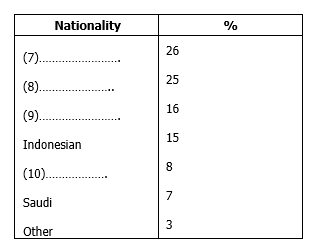
    The (7)…………….Centremainly (8)…………….food– located near the (9)…………..
    – a special course in skills with a (10)………………is sometimes available

    (1)                     (2)   
    (3)                    (4)   
    (5)                    (6)   
    (7)                    (8)   
    (9)                   (10) 

    Part 2: Questions 11-13
    Choose the correct letter A, B or C.

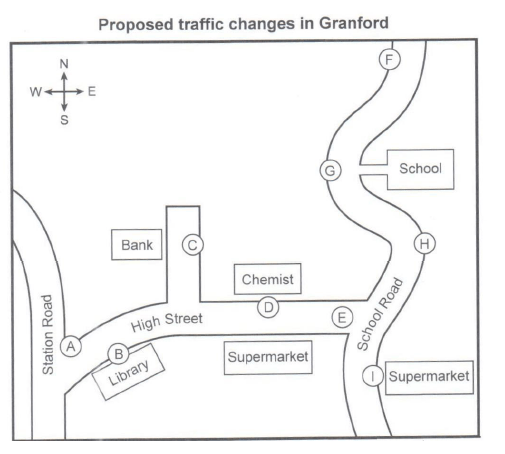
    Traffic Changes in Granford
    11. Why are changes needed to traffic systems in Granford?
     A The number of traffic accidents has risen.
     B The amount of traffic on the roads has increased.
     C The types of vehicles on the roads have changed.

    12. In a survey, local residents particularly complained about
     A dangerous driving by parents.
     B pollution from trucks and lorries.
     C inconvenience from parked cars.

    13. According to the speaker, one problem with the new regulations will be
     A raising money to pay for them.
     B finding a way to make people follow them.
     C getting the support of the police.

    Questions 14-20
    Label the map below. Write the correct letter A-I next to questions 14-20.

    14. New traffic lights 
    15. Pedestrian crossing 
    16. Parking allowed 
    17. New ‘no parking’ sign 
    18. New disabled parking spaces 
    19. Widened pavement 
    20. Lorry loading/ unloading restrictions 

    Part 3: Questions 21-25
    Choose the correct letter A, B or C.

    21. Why is Jack interested in investigating seed germination?
     A He may do a module on a related topic later on
     B He wants to have a career in plant science
     C He is thinking of choosing this topic for his dissertation

    22. Jack and Emma agree the main advantage of their present experiment is that it can be
     A described very easily
     B carried out inside the laboratory
     C completed in the time available

    23. What do they decide to check with their tutor?
     A whether their aim is appropriate
     B whether anyone else has chosen this topic
     C whether the assignment contributes to their final grade

    24. They agree that Grave’s book on seed germination is disappointing because
     A it fails to cover recent advances in seed science
     B the content is irrelevant for them
     C its focus is very theoretical

    25. What does Jack say about the article on seed germination by Lee Hall?
     A the diagrams of plant development are useful
     B the analysis of seed germination statistics is thorough
     C the findings on seed germination after fires are surprising

    Questions 26-30
    Complete the flow chart below. Choose FIVE answers from the box and write the correct letter A-H next to questions 26-30.

    A. containerB. soilC. weightD. condition
    E. heightF. colourG. typesH. depths
    Stages in the experiment
    Select seeds of different (26)………………….and sizes
    Measure and record the (27)………………and size of each one
    Decide on the (28)……………….to be used
    Use a different (29)………………..for each seed and label it
    After about 3 weeks record the plant’s (30)……………
    Investigate the findings

    (26)                  (27) 
    (28)                  (29) 
    (30) 

    Part 4: Questions 31-40.
    Complete the notes below. Write ONE WORD ONLY for each answer.

    Effects of urban environment on animals
    Introduction
    Recent urban developments represent massive environmental changes. It was previously thought that only a few animals were suitable for city life e.g.
    • The (31)  Because of its general adaptability
    • The pigeon – because walls of city buildings are similar to (32) 
    In fact, many urban animals are adapting with unusual (33) 

    Recent research
    • Emilie Snell-Rood studied urbanized mammal specimens from museums in Minnesota
    o She found the size of their (34)  had increased
    o She suggests this may be due to the need to locate new sources of
    (35)
      and to deal with new dangers
    • Catarina Miranda focused on the (36)  of urban and rural blackbirds.
    o She found urban birds were often braver but were afraid of situations that were
    (37)
     
    • Jonathan Atwell studies how animals respond to urban environments
    o He found that some animals respond to (38)  by producing lower levels of hormones.
    • Sarah Partan’s team found urban squirrels use their (39)  to help them communicate

    Long- term possibilities

    Species of animals may develop which are unique to cities. However, some changes may not be (40) 

  • IELTS Listening Practice Test – Exercise 104

    Part 1: Questions 1-4
    Complete the form below. Write NO MORE THAN THREE WORDS AND/ OR A NUMBER for each answer.

    Model – Ford Fiesta

    Registration: 3R1 (1) 
    Current mileage: (2)  miles
    Estimated yearly mileage: 6,000 a year
    Overnight parking: (3) 
    Cover: third party (4) 
    No claim bonus: 6 years

    Questions 5-7
    Choose THREE letters A-G.

    Which additional cover does Liam want?

     A legal
     B 14 day cover courtesy car
     C driver injury
     D protected no claim bonus
     E breakdown
     F lost car key
     G windscreen

    Questions 8-10
    Complete the form below. Write NO MORE THAN THREE WORDS AND/ OR A NUMBER for each answer.

    Name: Liam Byrd
    Address: 35 Bottiville Crescent, Birmingham
    Postcode: (8) 
    Date of birth: 11/11/1969
    Telephone: 0121 677 9887
    Payment by: (9) 
    Card number: **** 1551
    Security number: ***
    How did the customer hear about Hartline? (10) 

    Part 2: Questions 11-14
    Complete the sentences below. Write NO MORE THAN THREE WORDS AND/ OR A NUMBER for each answer.

    11. Every year more than  people try to climb Mont Blanc.
    12. Approximately  reach the top every day in the summer months.
    13. In July 2007 there were 30 fatalities, chiefly due to 
    14. One danger is  caused by other climbers.

    Questions 15-17
    Choose the correct letter A, B or C.

    15. How did Katherine do her most recent climb?
     A in a group
     B with a guide
     C on her own

    16. Why did Katherine find her first climb on Mont Blanc difficult?
     A because of poor weather conditions
     B because of the time she was climbing
     C because the route was crowded

    17. What did Katherine do on her second climb that made it easier?
     A she spent a few days in Charnonix beforehand
     B she did the climb over two days
     C she climbed smaller peaks for training

    Questions 18-20
    Choose THREE letters A-F.

    What has experience taught Katherine about climbing Mont Blanc?

     A be in good physical condition
     B have the right climbing equipment
     C wear several layers of clothing
     D protect yourself from the sun
     E climb with others
     F acclimatize yourself to the altitude first

    Part 3: Questions 21-23
    Write NO MORE THAN THREE WORDS for each answer.

    21. When do Elaine and Adam decide to meet for revision? 

    22. What item does Adam think will help them work independently on revision? 

    23. How does Elaine suggest they spend their revision time between meetings? 

    Questions 24-28
    Complete the sentences below. Write NO MORE THAN THREE WORDS for each answer.

    24. It’s best to avoid notes 

    25. Relate  to key theories and arguments.

    26. Using diagrams can help keep a lot of information 

    27. Bullet points can enable you to highlight 

    28. Keep a record of your sources, such as the 

    Questions 29 and 30
    Choose the correct letter A, B or C.

    29. In future revision sessions Adam suggests using past papers
     A to try to predict future exam questions
     B to test each other
     C to discuss the questions

    30. Elaine suggests
     A adding essay practice to the timetable
     B doing essays under exam conditions
     C asking a tutor to mark their essays

    Part 4: Questions 31-33
    Choose the correct letter A, B or C.

    31. According to the text, shared space
     A is very popular in the Netherlands
     B reduces the number of cars in an area
     C improves the dynamic between drivers and pedestrians

    32. Shared space design results in
     A fewer road signs
     B stronger boundaries between pedestrians and motorists
     C increased local employment

    33. Supporters of shared space argue that it
     A leads to new businesses opening
     B makes people happier to shop in the area
     C encourages wildlife

    Questions 34-37
    Match the groups A-D with their concerns about shared space 34-37.

    A Motorists
    B Blind people
    C Cyclists
    D Supporters of shared space

    34. Insufficient experience amongst planners 
    35. A lack of important signage 
    36. Intimidation by motorists 
    37. The loss of familiar street furniture 

    Questions 38 and 39
    Choose TWO letters A-D.

    People will be able to answer the questions

     A on the internet
     B at the local library
     C at the proposed site
     D at home

    Question 40
    Choose the correct letter A, B or C.

    40. Questions must be designed so that they
     A do not reflect the views of the campaign group
     B do not require an understanding of shared space
     C are easy to answer.

  • IELTS Listening Practice Test – Exercise 103

    Part 1: Questions 1-10
    Complete the notes below. Write NO MORE THAN TWO WORDS for each answer.

    Job Inquiry
    Type of job required: part-time

    Position availableDetails
    (1)……………………..Duty: to provide (2)………….service
    Working hours: (3)…………
    Requirement: receive (4)…………..without pay
    Day off: one day a week (request in advance)
    (5)…………………….Requirements: clean and valid license, 6 years experience
    Working hours: (6)…………..
    Duty: to take employees to and from work
    – to collect the (7)……………..
    – to pick up the children
    Day off: (8)……………
    Cashier in a (9)…………….Working hours: 17.30 – 22.30
    Duty: to sell and dispense tickets
    – to provide refreshments
    – to make (10)……….
    Day off: Mondays

    (1)                    (2)   
    (3)                    (4)  
    (5)                    (6)  
    (7)                    (8)  
    (9)                   (10) 

    Part 2: Questions 11-14
    Choose the correct letter A, B or C.

    11. The host families will
     A earn a big money
     B receive no pay
     C receive stable pay

    12. What is the guest expected to overcome when suffering from culture shock?
     A loneliness
     B difficulty to make friends
     C language barriers

    13. What can the guests do if they want to become familiar with host families?
     A talk about personal interests
     B clean their rooms
     C cook together

    14. What is likely to happen to the guests in the long run?
     A they will enhance cultural understanding
     B they will gain overseas experience
     C they will know more people from different countries

    Questions 15-20
    Complete the notes below. Write NO MORE THAN TWO WORDS for each answer.

    How to apply for a homestay

    • Visit the website and contact the advisor
    • Keep in touch with the (15) 
    • Provide two photos one for the host family and other for (16) 
    • Send in some documents to confirm your (17) 
    • Receive (18)  within 7 working days
    • Have an (19)  in London
    • Pay the extra fee for a fast track service
    • Receive a written (20) 

    Part 3: Questions 21-26
    Choose the correct letter A, B or C.

    21. What kind of research method does the professor recommend?
     A interview
     B observation
     C questionnaire

    22. What is the project based on?
     A a study they did before in Australia
     B a similar angle someone has done before
     C an Australian study

    23. What does the professor advise Douglas to do about the formation of the focus groups?
     A strengthen the group in size
     B reduce the number of children in each group
     C build more than 3 groups

    24. To do the project best, the professor suggests the students
     A interview various people or sectors.
     B not be too ambitious.
     C work hard enough.

    25. To gather data, the professor asks Jane
     A to replace other people’s advice.
     B to simplify the textbook.
     C to practice using the date table.

    26. The reason why Douglas hasn’t read enough reference books is that
     A he doesn’t have enough time.
     B he thinks there are too many books to read.
     C he hasn’t spent time in the library.

    Questions 27-30
    What do the students decide about the following parts of the project?

    Write the correct letter A, B or C next to questions 27-30

    A Jane will do
    B Douglas will do
    C They will do together

    27. final report 
    28. sheet preparation 
    29. letter 
    30. transcript 

    Part 4: Questions 31-36
    Complete the notes below. Write ONE WORD ONLY for each answer.

    GRAPHICAL SYMBOL
    ‘Graphical symbol’
    • includes the logographs in Egyptian hieroglyphic writing and ancient Chinese pictograms
    • found in Africa, the Americas, and Oceania
    • still has something to do with (31)  use today

    Ancient graphic writing systems
    • Researchers obtain a wide range of (32)  about past civilisations.
    – Rosetta Stone was found in 1799 when members of Napoleon’s expedition got to Egypt.
    – Frenchman Jean-François Champollion determined the phonetic values of the symbols in 1822.
    • In those symbols, (33)  are used to depict various meanings.

    Camera obscura
    • (34)  helps people understand history better.
    • Some charities will (35)  many endangered species.
    • A camera was tied to one (36)  of a bird.

    Questions 37-40
    Complete the sentences below. Write ONE WORD ONLY for each answer.

    37 More  will be included in the future with the development of photography.
    38 Companies would like to invest a lot to advertise in 
    39 Designing appealing  is used as a way of effective branding.
    40 Graphic writing systems are of great importance in the subject of 

  • IELTS Listening Practice Test – Exercise 102

    Part 1: Questions 1-3
    Complete the table below. Write NO MORE THAN THREE WORDS AND/ OR A NUMBER for each answer.

    AnimalBrought byReason
    (1)…………………………Settlersfor food
    FoxSettlers(2)………………….
    Cane toad(3)………………..to kill beetles

    (1) 
    (2) 
    (3) 

    Questions 4 and 5
    Complete the flowchart below. Write NO MORE THAN TWO WORDS AND/ OR A NUMBER for each answer.

    BEETLES’ EFFECT ON SUGAR CANE

    Step 1: Beetle lay eggs

    Step 2: Eggs become rugs

    Step 3: Grubs eat the (4)…………

    Step 4: Sugar cane (5)…………

    (4) 
    (5) 

    Questions 6-10
    Choose the correct letter A, B or C.

    6. The cane toad originated in
     A Central America
     B Hawaii
     C Australia

    7. In Australia, the toads
     A grew extremely large
     B multiplied in number
     C ate the cane beetles

    8. The farmers’ plan failed because
     A there were too many beetles
     B their own research was faulty
     C they believed the reports they read

    9. The sugar cane industry
     A thrives today
     B has died out in some areas
     C survives alongside the beetle

    10. The second lesson to be learned from this story is that
     A the environment is constantly at risk
     B first hand research is not always necessary
     C caution is necessary when dealing with nature

    Part 2: Questions 11-20
    Complete the time table below. Write NO MORE THAN THREE WORDS AND/ OR A NUMBER for each answer.

    PARK ARTS CENTRE
    DatesTimesEventNotes
    18 – 24 Feb(11)……………..and……………..Folk music concertcan get a (12)…………….in shop
    1 – 8 Marsee the (13)……………..Annual (14)……………..groups from (15)………………
    (16)………………..8 pmFilm: (17)……………..talk by the (18)…………….
    2 Aprilto be confirmed(19)………………it will be (20)……………….

    (11)                         (12) 
    (13)                        (14) 
    (15)                         (16) 
    (17)                         (18) 
    (19)                        (20) 

    Part 3: Questions 21-25

    What opinion is expressed about each dissertation?

    Choose your answers from the list below and write the letters A-I next to questions 21-25.

    A it has an inadequate index
    B it contains unusual illustrations
    C it is too detailed in places
    D it presents clear arguments
    E it contains diagrams which are not clear
    F it omits important historical facts
    G it is poorly translated
    H it contains useful background information
    I it is not suitable for new students

    21. Twentieth Century Architecture 

    22. Modern Construction 

    23. Steel, Glass and Concrete 

    24. The Space We Make 

    25. Change and Tradition 

    Questions 26-30
    Complete the flow chart below. Write NO MORE THAN THREE WORDS for each answer.

    BEN’S PROGRAMME

    Step 1: Look at drawings of (26)…………….

    Step 2: Get images of (27)…………….from internet

    Step 3: Find books about (28)………………of the period

    Step 4: Show (29)………………….to Dr. Forbes

    Step 5: Ask Dr. Gray for more (30)…………

    (26)                  (27) 
    (28)                  (29) 
    (30) 

    Part 4: Questions 31-40
    Complete the sentences below. Write NO MORE THAN TWO WORDS for each answer.

    31. Rival cameras were claimed to  less than the Cinematographe.
    32. In Russia, on one occasion, the Cinematographe was suspected of being a 
    33. Early filming in Russia led to the creation of a new approach to 
    34. One problem for historians is not knowing whether early equipment  as it was claimed.
    35. Marey encountered difficulties achieving the  of strips of photographic paper.
    36. The  of the comic strip influenced the way films were planned.
    37. Documentaries used  shots before fiction films did.
    38. The popularity of  films led to increased numbers of shots.
    39. When filming  the screen might be divided.
    40. As films became more complex  became an important part of film-making.

  • IELTS Listening Practice Test – Exercise 101

    Part 1: Questions 1-6
    Complete the notes below. Write NO MORE THAN THREE WORDS AND/ OR A NUMBER for each answer.

    School Excursion
    Day: Wednesday

    Destination: (1) 
    Weather: (2) 
    Arrival time: (3) 

    Activities planned
    See: (4) 
    Eat: catered lunch
    Attend: (5) 
    Return time: (6) 

    Questions 7-10
    Complete the table below. Write ONE WORD only for each answer.

    (7)                        (8)  
    (9)                       (10) 

    Part 2: Questions 11-15
    Choose the correct letter A, B or C.

    11. The company deals mostly with
     A big cities
     B nature holidays
     C Nepal

    12. The overseas consultants deal with
     A Asia
     B North America
     C Europe

    13. For deserts and gorges, customers should come in the
     A morning
     B afternoon
     C night

    14. Trips to regional locations are good because
     A the buses are comfortable
     B there is shortage of suitcases
     C they can be seen quickly

    15. SleekLine buses are particularly known for their
     A service
     B size
     C comfort

    Questions 16-20
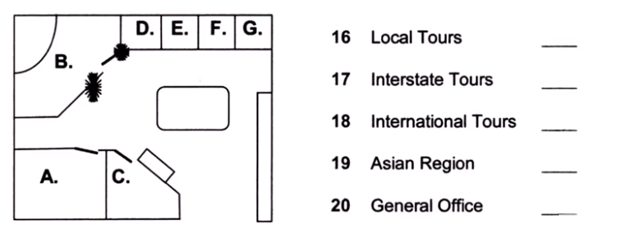
    Identify the rooms in the office plan. Write the correct letter A-G next to questions 16-20.

    (16)                    (17) 
    (18)                   (19) 
    (20) 

    Part 3: Questions 21-24
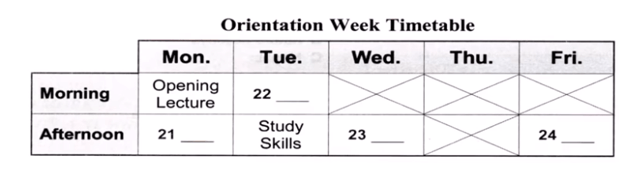
    Complete the timetable. Write the correct letter A-H for each answer.

    (21)                    (22) 
    (23)                    (24) 

    A BBQ
    B Careers lecture
    C Computer lab visit
    D Dance
    E Library tour
    F Student union induction
    G University tour
    H Legal rights lecture

    Questions 25-30
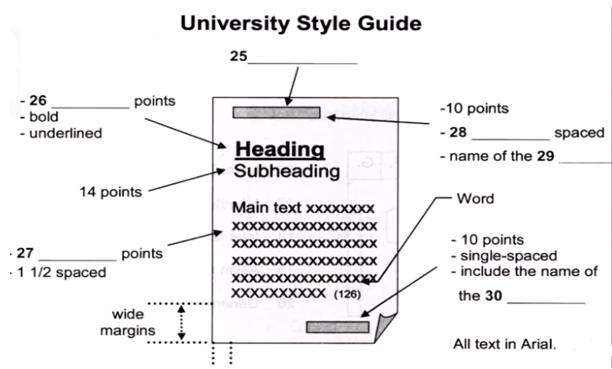
    Complete the labels. Write ONE WORD AND/ OR A NUMBER for each answer.

    (25)                        (26) 
    (27)                        (28) 
    (29)                        (30) 

    Part 4: Questions 31-34
    Complete the sentences. Write NO MORE THAN TWO WORDS for each answer.

    31. Behavior in parks is controlled by 
    32. Insect numbers are reduced by having 
    33. A wilderness park does not have any 
    34. Observing trees and lying in the grass are examples of 

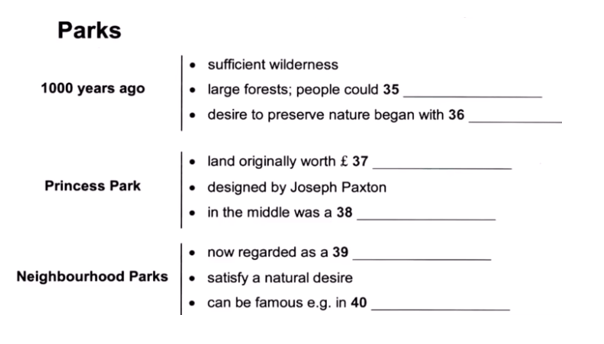
    Questions 35-40
    Complete the notes. Write NO MORE THAN TWO WORDS AND/ OR A NUMBER for each answer.

    (35)                    (36) 
    (37)                    (38) 
    (39)                    (40) 

  • IELTS Reading Practice Test – Exercise 120

    Disorders: An Overview

    Autistic Spectrum Disorder

    Children with Autistic Spectrum Disorder have difficulty understanding what other people are saying, need help to play with other children, enjoy routines and find unfamiliar situations difficult. People with Autistic Spectrum Disorder can be good at creative activities like art, music and poetry. They can concentrate on one thing for a long time no they can become very good at something that they like doing.

    ADHD – Attention Deficit

    Hyperactivity Disorder

    People with ADHD have three types of problems. Overactive behaviour (hyperactivity), impulsive behaviour and difficulty pitying attention. Children with ADHD are not just very active but have a wide range of problem behaviours which can make them very difficult to care for and control. Those who have ADHD often find it difficult to fit in at school. They may also have problems getting on with other children. Some children have significant problems with concentration and attention, but are not necessarily overactive or impulsive. These children are sometimes described as having Attention Deficit Disorder (ADD) rather than ADHD. ADD can easily be missed because the child is quiet and dreamy rather than disruptive. ADHD is not related to intelligence. Children with all levels of ability can have ADHD.

    Stress

    Stress can be defined as the way you feel when you’re under abnormal pressure. All sorts of situations can cause stress. The most common, however, involve work, money matters and relationships with partners, children or other family members. Stress may be caused either by major upheavals and life events such as divorce, unemployment, moving house and bereavement, or by a series of minor irritations such as feeling undervalued at work or dealing with difficult children.

    Some stress can be positive and research has suggested that a moderate level of stress makes us perform better. It also makes us more alert and can help us in challenging situations such as job interviews or public speaking. Stressful situations can also be exhilarating and some people actually thrive on the excitement that comes with dangerous sports or other ‘high-risk’ activities.

    Schizophrenia

    Schizophrenia is a diagnosis given to some people who have severely disrupted beliefs and experiences. During an episode of schizophrenia, a person’s experience and interpretation of the outside world is disrupted – they may lose touch with reality, see or hear things that are not there and act in unusual ways in response to these ‘hallucinations’. An episode of schizophrenia can last for several weeks and can be very frightening. The causes are unknown but episodes of schizophrenia appear to be associated with changes in some brain chemicals. Stressful experiences and some recreational drugs tire sometimes thought to trigger an episode.

    Depression

    Depression describes a range of moods, from the low spirits that we all experience, to a severe problem that interferes with everyday life. The latter type, sometimes referred to as “clinical depression”, is defined its “a persistent exaggeration of the everyday feelings that accompany sadness”. If you have severe depression you may experience low mood, loss of interest and pleasure as well as feelings of worthlessness and guilt. You may also experience tearfulness, poor concentration, reduced energy, reduced or increased appetite, changes in weight, sleep problems and anxiety. You may even feel that life is not worth living, and plan or attempt suicide.
    Obsessive Compulsive

    Disorder in Adults

    Imagine you are getting up in the morning. You know you will need to go to the bathroom, but the thought of accidentally touching the doorknob is frightening. There may be dangerous bacteria on it. Of course you cleaned the entire bathroom yesterday, including the usual series of spraying disinfectant, washing and rinsing. As usual it took a couple of hours to do it the right way. Even then you weren’t sure whether you had missed an area, so you had to re-wash the floor. Naturally the doorknob was sprayed and rubbed three times with a bactericidal spray. Now the thought that you could have missed a spot on the door knob makes you very nervous.

    This description might give you some sense of the tormented and anxious world that people with Obsessive Compulsive Disorder (OCD) live in. It is a world filled with dangers from outside and from within. Often elaborate rituals and thoughts are used to ward off feared events, but no amount of mental or physical activity seems adequate, so doubt and anxiety are often present.

    People who do not have OCD may perform behaviours in a ritualistic way, repeating, checking, or washing things out of habit or concern. Generally this is done without much, if any, worry. What distinguishes OCD as a psychiatric disorder is that the experience of obsessions, and the performance of rituals, reaches such an intensity or frequency that it causes significant psychological distress and interferes in a significant way with psycho-social functioning. The guideline of at least one hour spent on symptoms per day is often used as a measure of ‘significant interference’. However, among patients who try to avoid situations that bring on anxiety and compulsions, the actual symptoms may not consume an hour. Yet their situations would dearly constitute interfering with functioning. Consider, for instance, a welfare mother who throws out more than $100 of groceries a week because of contamination fears. Although this behaviour has a major effect on her functioning, it might not consume one hour per day.

    Patients with OCD describe their experience as having thoughts (obsessions) that they associate with some danger. The sufferer generally recognises that it is his or her own thoughts, rather than something imposed by someone else (as in some paranoid schizophrenic patients). However, the disturbing thoughts cannot be dismissed, and simply nag at the sufferer. Something must then be done to relieve the danger and mitigate the fear. This leads to actions and thoughts that are intended to neutralise the danger. These are the compulsions. Because these behaviours seem to give the otherwise ‘helplessly anxious’ person something to combat the danger, they are temporarily reassuring. However, since the ‘danger’ is typically irrational or imaginary, it simply returns, thereby triggering another cycle of the briefly reassuring compulsions. From the standpoint of classic conditioning, this pattern of painful obsession followed by temporarily reassuring compulsion eventually produces an intensely ingrained habit. It is rare to see obsessions without compulsions.

    The two most common obsessions are fears of contamination and fear of harming oneself or others, while the two most common compulsions are checking and cleaning.

    Questions 1-5
    Look at the statements (Questions 1 – 5) and the list of disorders (A – G) below. Match each statement with the correct disorder A – G.

    NB There are more disorders than descriptions, so you will not use them all.

    1 can be positive in small doses but is generally associated with pressure
    2 feeling that there is danger constantly present
    3 has experiences that may or may not be part of the ‘real’ world
    4 active to the point of losing concentration and becoming disruptive
    5 good at art but not at communicating

    Types of Disorders
    A Stress
    B Autistic Spectrum Disorder
    C Attention Deficit Disorder
    D Schizophrenia
    E Attention Deficit Hyperactivity Disorder
    F Depression
    G Obsessive Compulsive Disorder

    Questions 6-9
    Complete the table below. Write NO MORE THAN THREE WORDS from the passage for each answer.

    DisorderPersonality trait exhibited by sufferer
    Autism Spectrum Disordermay excel in activities of a (6)……………..nature
    Attention Deficit Disordermay appear (7)…………………..
    Schizophreniamay respond to experiencing episodes of the disease by behaving in very (8)……………….
    Depressionmy experience feelings of futility that lead to thoughts of (9)……………….
    Obsessive Compulsive Disordermay frequently experience feelings of doubt and anxiety

    Questions 10-13
    Choose the correct letter, A, B, C or D.

    10. Which disorder could cause visible physical changes?
    A Autistic Spectrum Disorder
    B Stress
    C Schizophrenia
    D Depression

    11. Episodes of which disorder may last for a limited period of time?
    A ADHD
    B Autistic Spectrum Disorder
    C schizophrenia
    D depression

    12. Which disorder can be triggered by the death of a loved one?
    A Autistic Spectrum Disorder
    B ADHD
    C Stress
    D OCD

    13. What characterises sufferers of OCD?
    A the fear of going outside
    B the performance of rituals
    C the desire to hurt others
    D the feeling that they are helpless to ease their distress

    The Developing World

    A THE DEVELOPING WORLD – the economically underdeveloped countries of Asia. Africa. Oceania and Latin America – is considered as an entity with common characteristics, such as poverty, high birth rates, and economic dependence on the advanced countries. Until recently, the developing world was known as ‘the third world’. The French demographer Alfred Sauvy coined the expression (in French) in 1952 by analogy with the ‘third estate’ – the commoners of France before and during the French Revolution – as opposed to priests and nobles, comprising the First and second estates respectively. ‘Like the third estate’, wrote Sauvy, ‘the third world is nothing, and it wants to be something’. The term therefore implies that the third world is exploited, much as the third estate was exploited and that, like the third estate, its destiny is a revolutionary one. It conveys as well a second idea, also discussed by Sauvy – that of nonalignment, for the developing world belongs neither to the industrialised capitalist world nor to the industrialised former communist bloc. The expression ‘third world’ was used at the 1955 conference of Afro-Asian countries held in Bandung. Indonesia. In 1956 a group of social scientists associated with Sauvy’s National Institute of Demographic Studies, in Paris, published a book called ‘Le Tiers-Monde’. Three years later, the French economist Francois Perroux launched a new journal, on problems of underdevelopment, with the same title. By the end of the 1950s the term was frequently employed in the French media to refer to the underdeveloped countries of Asia. Africa, Oceania and Latin America. Present day politicians and social commentators, however, now use the term ‘developing world’ in a politically correct effort to dispel the negative connotations of ‘third world’.

    B Countries in the developing world have a number of common traits: distorted and highly dependent economies devoted to producing primary products for the developed world; traditional, rural social structures; high population growth and widespread poverty. Nevertheless, the developing world is sharply differentiated, for it includes countries on various levels of economic development. And despite the poverty of the countryside and the urban shanty towns, the ruling elites of most third world countries are wealthy.

    C This combination of conditions in Asia, Africa, Oceania and Latin America is linked to the absorption of the developing world into the international capitalist economy, by way of conquest or indirect domination. The main economic consequence of Western domination was the creation, for the first time in history, of a world market. By setting up sub-economies linked to the West throughout the developing world, and by introducing other modern institutions, industrial capitalism disrupted traditional economies and, indeed, societies. This disruption led to underdevelopment.

    D Because the economies of underdeveloped countries have been geared to the needs of industrialised countries, they often comprise only a few modem economic activities, such as mining or the cultivation of plantation crops. Control over these activities has often remained in the hands of large foreign firms. The prices of developing world products are usually determined by large buyers in the economically dominant countries of the West, and trade with the West provides almost all the developing world’s income. Throughout the colonial period, outright exploitation severely limited the accumulation of capital within the foreign dominated countries. Even after decolonisation (in the 1950s, 1960s, and 1970s), the economies of the developing world grew slowly, or not at all, owing largely to the deterioration of the ‘terms of trade’ – the relationship between the cost of the goods a nation must import from abroad and its income from the exports it sends to foreign countries. Terms of trade are said to deteriorate when the cost of imports rises faster than income from exports. Since buyers in the industrialised countries determined the prices of most products involved in international trade, the worsening position of the developing world was scarcely surprising. Only the oil-producing countries – after 1973 – succeeded in escaping the effects of Western domination of the world economy.

    E No study of the developing world could hope to assess its future prospects without taking into account population growth. While the mortality rate from poverty-related diseases continues to cause international concern, the birth rate continues to rise at unprecedented levels. This population explosion in the developing world will surely prevent any substantial improvements in living standards, as well as threaten people in stagnant economies with worsening poverty and starvation levels.

    Questions 14–18
    Reading Passage 2 has five paragraphs, A – E. Choose the most suitable heading for each paragraph from the list of headings below.

    List of Headings
    i The great divide between rich and poor.
    ii The status and destiny of the developing’ world follows a European precedent.
    iii Economic progress in the developing world slowed down In political unrest.
    iv More people, less food.
    v Western countries refuse to acknowledge their history of colonisation.
    vi Open trade is the main reason these countries become impoverished.
    vii Rivalry in the developing world between capitalist and former communist bloc countries.
    viii Prices and conditions set by outsiders

    14 Paragraph A
    15 Paragraph B
    16 Paragraph C
    17 Paragraph D
    18 Paragraph E

    Questions 19-22
    Do the following statements agree with the information given in Reading Passage 2?

    In spaces 19-22 below, write

    YES                                        if the statement agrees with the views of the writer
    NO                                          if the statement contradicts the views of the writer
    NOT GIVEN                       if it is impossible to say what the writer thinks about this

    19 Agriculture still plays a role in the economy of developing countries.
    20 The population of the developing world increases at such a fast rate because they constantly need to renew the labour force.
    21 Countries that spend more on imports than they can from exports can experience problems.
    22 Like the developing world, oil-rich countries are also victims of dominance by Western powers.

    Questions 23–26
    Complete each sentence with the correct ending A – F below.

    Write the correct letter A – F in spaces 23 – 26 below.

    23 Countries in the developing world
    24 The term ‘the third world’ implies
    25 One factor that is prevalent in the developing world is
    26 One consequence of the terms of trade was

    A economic dependence on developed countries.
    B that decolonisation took a long time to achieve.
    C dictate the needs of industrialised countries.
    D share common characteristics.
    E that many economies stagnated.
    F a society that wants something it does not have.

    Biometrics

    A The term “biometrics’ is derived from the Greek words bio (life) and metric (to measure). It refers to technologies for measuring and analysing a person’s physiological or behavioural characteristics, such as fingerprints, irises, voice patterns, facial patterns and hand measurements, for identification and verification purposes. One of the earliest known examples of biometrics in practice was a form of fingerprinting used in China in the 14th century. Chinese merchants stamped children’s palm prints and footprints on paper with ink to distinguish the young children from one another. This method of biometrics is still being practised today.

    B Until the late 1800s, identification largely relied upon ‘photographic memory.’ In the 1890s, an anthropologist and police desk clerk in Paris named Alphonse Bertillon sought to fix the problem of identifying convicted criminals and turned biometrics into a distinct field of study. He developed a method of multiple body measurements which was named after him – Bertillonage. Bertillon based his system on the claim that measurement of adult bones does not change after the age of 20. He also introduced a cataloguing system, which enabled the filing and checking of records quite quickly. His system was used by police authorities throughout the world, until 1903, when two identical measurements were obtained for two different persons at Fort Leavenworth prison. The prison switched to fingerprinting the following day and the rest of the world soon followed abandoning Bertillonage forever. After the failure of Bertillonage, the police started using fingerprinting, which was developed by Richard Edward Henry of Scotland Yard, essentially reverting to the same methods used by the Chinese for years.

    C In the past three decades biometrics has moved from a single method (fingerprinting) to more than ten different methods. Hundreds of companies are involved with this development and continue to improve their methods as the technology available to them advances. As the industry grows, however, so does the public concern over privacy issues. Laws and regulations continue to be drafted and standards are beginning to be developed. While no other biometric has yet reached the wide range of use of fingerprinting, some are beginning to be used in both legal and business areas.

    D Identification and verification have long been in practice by presenting a personal document, such as a licence, ID card or a passport. It may also require personal information such as passwords or PINs. For security reasons, often two, or all three, of these systems are combined but as times progress, we are in constant need for more secure and accurate measures. Authentication by biometric verification is becoming increasingly common in corporate and public security systems, consumer electronics and point of-sale applications. In addition to security, the driving force behind biometric verification has been convenience. Already, many European countries are introducing a biometric passport which will carry a paper-thin computer chip to store the facial image and at least one additional biometric identifier. This will help to counter fraudulent efforts to obtain duplicate passports and will verify the identity of the holder against the document.

    E Identification and verification are mainly used today in the fight against crime with the methods of fingerprint and DNA analysis. It is also used in security for granting access rights by voice pattern recognition. Additionally, it is used for personal comfort by identifying a person and changing personal settings accordingly, as in setting car seats by facial recognition. Starting in early 2000, the use of biometrics in schools has become widespread, particularly in the UK and USA. A number of justifications are given for such practices, including combatting truancy, and replacing library cards or meal cards with fingerprinting systems. Opponents of school biometrics have raised privacy concerns against the creation of databases that would progressively include the entire population.

    F Biometric devices consist of a reader or scanning device, software that converts the gathered information into digital form, and a database that stores the biometric data for comparison with previous records. When converting the biometric input, the software identifies specific points of data as match points. The match points are processed using an algorithm into a value that can be compared with biometric data in the database. There are two types of biometrics: behavioural and physical. Behavioural biometrics are generally used for verification while physical biometrics can be used for either identification or verification.

    G Iris-pattern and retina-pattern authentication methods are already employed in some bank automatic teller machines. Voice waveform recognition, a method of verification that has been used for many years with tape recordings in telephone wiretaps, is now being used for access to proprietary databanks in research facilities. Facial-recognition technology has been used by law enforcement to pick out individuals in large crowds with considerable reliability. Hand geometry is being used in industry to provide physical access to buildings. Earlobe geometry has been used to disprove the identity of individuals who claim to be someone they are not (identity theft). Signature comparison is not as reliable, all by itself, as other biometric verification methods but offers an extra layer of verification when used in conjunction with one or more other methods. No matter what biometric methodology is used, the identification verification process remains the same. A record of a person’s unique characteristic is captured and kept in a database. Later on, when identification verification is required, a new record is captured and compared with the previous record in the database. If the data in the new record matches that in the database record, the person’s identity is confirmed.

    H As technology advances, and time goes on, more and more private companies and public utilities will use biometrics for safe, accurate identification. However, these advances will raise many concerns throughout society, where many may not be educated on the methods. Some believe this technology can cause physical harm to an individual using it, or that instruments used are unsanitary. For example, there are concerns that retina scanners might not always be clean. There are also concerns as to whether our personal information taken through biometric methods can be misused, tampered with, or sold, eg. by criminals stealing, rearranging or copying the biometric data Also, the data obtained using biometrics can be used in unauthorised ways without the individual’s consent. Much still remains to be seen in the effectiveness of biometric verification before we can identify it as the safest system for identification.

    Questions 27-31
    Reading Passage 3 has eight paragraphs, A – H. Which paragraph contains the following information?

    27 possible health hazards associated with the use of biometrics
    28 convicted criminals were not the first to be identified by the use of biometrics
    29 the application of mathematics in assessing biometric data
    30 despite its limitations, biometries has become a commercial field of activity
    31 some biometric methods are useful only in conjunction with others

    Questions 32-34
    Complete the sentences below. Choose NO MORE THAN TWO WORDS from the passage for each answer.

    Members of the public are becoming increasingly worried about the (32)……………………………that may accompany the use of biometrics.

    Biometries can be used to improve the (33)………………………………of drivers and passengers.

    Regardless of the technology used, it has one common purpose: to find somebody’s (34)………………………….and store it on computer.

    Questions 35-40
    Compute the summary with the list of words A – L below. Write the correct letter A – L in spaces 35 – 40 below.

    BIOMETRICS
    As long ago as the 14th century, the Chinese made use of biometrics in order to tell young children apart, but it was only in the 1890s when it was first used by the authorities as a means of (35)……………………… in criminal cases. The system developed by the Frenchman Bertillon – that of measuring adult bones – was flawed, however, and so police adopted (36)………………………….. as a more reliable way of identifying suspects. Governments, companies and even schools employ biometric technology to ensure, for example, that people do not enter a country illegally, gain access to certain buildings, or assume someone else’s (37)………………………………..Apart from security, another important (38)……………………………….behind biometric verification has been (39)……………………………..The use of biometrics, however, has its critics, who say that the data collected could be used for different purposes without our (40)……………………………………

    A identification
    B security
    C convenience
    D scanning
    E fingerprinting
    F identity
    G violation
    H measuring
    I justification
    J approval
    K factor
    L apprehension

  • IELTS Reading Practice Test – Exercise 119

    What is it that draws us to these creatures?

    “This inhuman place makes human monsters,” wrote Stephen King in his novel The Shining. Many academics agree that monsters lurk in the deepest recesses, they prowl through our ancestral minds appearing in the half-light, under the bed – or at the bottom of the sea.

    “They don’t really exist, but they play a huge role in our mindscapes, in our dreams, stories, nightmares, myths and so on,” says Matthias Classen, assistant professor of literature and media at Aarhus University in Denmark, who studies monsters in literature. “Monsters say something about human psychology, not the world.”

    One Norse legend talks of the Kraken, a deep sea creature that was the curse of fishermen. If sailors found a place with many fish, most likely it was the monster that was driving them to the surface. If it saw the ship it would pluck the hapless sailors from the boat and drag them to a watery grave.

    This terrifying legend occupied the mind and pen of the poet Alfred Lord Tennyson too. In his short 1830 poem The Kraken he wrote: “Below the thunders of the upper deep, / Far far beneath in the abysmal sea, / His ancient, dreamless, uninvaded sleep / The Kraken sleepeth.”

    The deeper we travel into the ocean, the deeper we delve into our own psyche. And when we can go no further – there lurks the Kraken.

    Most likely the Kraken is based on a real creature – the giant squid. The huge mollusc takes pride of place as the personification of the terrors of the deep sea. Sailors would have encountered it at the surface, dying, and probably thrashing about. It would have made a weird sight, “about the most alien thing you can imagine,” says Edith Widder, CEO at the Ocean Research and Conservation Association.

    “It has eight lashing arms and two slashing tentacles growing straight out of its head and it’s got serrated suckers that can latch on to the slimiest of prey and it’s got a parrot beak that can rip flesh. It’s got an eye the size of your head, it’s got a jet propulsion system and three hearts that pump blue blood.”

    The giant squid continued to dominate stories of sea monsters with the famous 1870 novel, Twenty Thousand Leagues Under the Sea, by Jules Verne. Verne’s submarine fantasy is a classic story of puny man against a gigantic squid.

    The monster needed no embellishment – this creature was scary enough, and Verne incorporated as much fact as possible into the story, says Emily Alder from Edinburgh Napier University. “Twenty Thousand Leagues Under the Sea and another contemporaneous book, Victor Hugo’s Toilers of the Sea, both tried to represent the giant squid as they might have been actual zoological animals, much more taking the squid as a biological creature than a mythical creature.” It was a given that the squid was vicious and would readily attack humans given the chance.

    That myth wasn’t busted until 2012, when Edith Widder and her colleagues were the first people to successfully film giant squid under water and see first-hand the true character of the monster of the deep. They realised previous attempts to film squid had failed because the bright lights and noisy thrusters on submersibles had frightened them away.

    By quietening down the engines and using bioluminescence to attract it, they managed to see this most extraordinary animal in its natural habitat. It serenely glided into view, its body rippled with metallic colours of bronze and silver. Its huge, intelligent eye watched the submarine warily as it delicately picked at the bait with its beak. It was balletic and mesmeric. It could not have been further from the gnashing, human-destroying creature of myth and literature. In reality this is a gentle giant that is easily scared and pecks at its food.

    Another giant squid lies peacefully in the Natural History Museum in London, in the Spirit Room, where it is preserved in a huge glass case. In 2004 it was caught in a fishing net off the Falkland Islands and died at the surface. The crew immediately froze its body and it was sent to be preserved in the museum by the Curator of Molluscs, Jon Ablett. It is called Archie, an affectionate short version of its Latin name Architeuthis dux. It is the longest preserved specimen of a giant squid in the world.

    “It really has brought science to life for many people,” says Ablett. “Sometimes I feel a bit overshadowed by Archie, most of my work is on slugs and snails but unfortunately most people don’t want to talk about that!”

    And so today we can watch Archie’s graceful relative on film and stare Archie herself (she is a female) eye-to-eye in a museum. But have we finally slain the monster of the deep? Now we know there is nothing to be afraid of, can the Kraken finally be laid to rest? Probably not says Classen. “We humans are afraid of the strangest things. They don’t need to be realistic. There’s no indication that enlightenment and scientific progress has banished the monsters from the shadows of our imaginations. We will continue to be afraid of very strange things, including probably sea monsters.”

    Indeed we are. The Kraken made a fearsome appearance in the blockbuster series Pirates of the Caribbean. It forced Captain Jack Sparrow to face his demons in a terrifying face-to-face encounter. Pirates needed the monstrous Kraken, nothing else would do. Or, as the German film director Werner Herzog put it, “What would an ocean be without a monster lurking in the dark? It would be like sleep without dreams.”

    Questions 1-7
    Do the following statements agree with the information given in Reading Passage 1?

    TRUE                          if the statement is true
    FALSE                        if the statement is false
    NOT GIVEN             if the information is not given in the passage

    1 Matthias Classen is unsure about the possibility of monster’s existence.
    2 Kraken is probably based on an imaginary animal.
    3 Previous attempts on filming the squid had failed due to the fact that the creature was scared.
    4 Giant squid was caught alive in 2004 and brought to the museum.
    5 Jon Ablett admits that he likes Archie.
    6 According to Classen, people can be scared both by imaginary and real monsters.
    7 Werner Herzog suggests that Kraken is essential to the ocean.

    Questions 8-12
    Choose the correct letter, A, B, C or D.

    8. Who wrote a novel about a giant squid?
    A Emily Alder
    B Stephen King
    C Alfred Lord Tennyson
    D Jules Verne

    9. What, of the featuring body parts, mollusc DOESN’T have?
    A two tentacles
    B serrated suckers
    C beak
    D smooth suckers

    10. Which of the following applies to the bookish Kraken?
    A notorious
    B scary
    C weird
    D harmless

    11. Where can we see a giant squid?
    A at the museum
    B at a seaside
    C on TV
    D in supermarkets

    12. The main purpose of the text is to:
    A help us to understand more about both mythical and biological creatures of the deep
    B illustrate the difference between Kraken and squid
    C shed the light on the mythical creatures of the ocean
    D compare Kraken to its real relative

    Questions 13-16
    Complete the sentences below. Write NO MORE THAN THREE WORDS from the passage for each answer.

    Write your answers in boxes 13–16 on your answer sheet.

    According to the Victor Hugo’s novel, the squid would (13)………………………….if he had such opportunity.

    The real squid appeared to be (14)……………………………..

    Archie must be the (15)……………………………….of its kind on Earth.

    We are able to encounter the Kraken’s (16)……………………………….in a movie franchise.

    How did science fiction writer HG Wells predict its invention three decades before the first detonations?

    A Imagine you’re the greatest fantasy writer of your age. One day you dream up the idea of a bomb of infinite power. You call it the “atomic bomb”. HG Wells first imagined a uranium-based hand grenade that “would continue to explode indefinitely” in his 1914 novel The World Set Free. He even thought it would be dropped from planes. What he couldn’t predict was how a strange conjunction of his friends and acquaintances – notably Winston Churchill, who’d read all Wells’s novels twice, and the physicist Leo Szilard – would turn the idea from fantasy to reality, leaving them deeply tormented by the scale of destructive power that it unleashed.

    B The story of the atom bomb starts in the Edwardian age, when scientists such as Ernest Rutherford were grappling with a new way of conceiving the physical world. The idea was that solid elements might be made up of tiny particles in atoms. “When it became apparent that the Rutherford atom had a dense nucleus, there was a sense that it was like a coiled spring,” says Andrew Nahum, curator of the Science Museum’s Churchill’s Scientists exhibition. Wells was fascinated with the new discoveries. He had a track record of predicting technological innovations. Winston Churchill credited Wells for coming up with the idea of using aeroplanes and tanks in combat ahead of World War One.

    C The two men met and discussed ideas over the decades, especially as Churchill, a highly popular writer himself, spent the interwar years out of political power, contemplating the rising instability of Europe. Churchill grasped the danger of technology running ahead of human maturity, penning a 1924 article in the Pall Mall Gazette called “Shall we all commit suicide?”. In the article, Churchill wrote: “Might a bomb no bigger than an orange be found to possess a secret power to destroy a whole block of buildings – nay to concentrate the force of a thousand tons of cordite and blast a township at a stroke?” This idea of the orange-sized bomb is credited by Graham Farmelo, author of Churchill’s Bomb, directly to the imagery of The World Set Free.

    D By 1932 British scientists had succeeded in splitting the atom for the first time by artificial means, although some believed it couldn’t produce huge amounts of energy. But the same year the Hungarian emigre physicist Leo Szilard read The World Set Free. Szilard believed that the splitting of the atom could produce vast energy. He later wrote that Wells showed him “what the liberation of atomic energy on a large scale would mean”. Szilard suddenly came up with the answer in September 1933 – the chain reaction – while watching the traffic lights turn green in Russell Square in London. He wrote: “It suddenly occurred to me that if we could find an element which is split by neutrons and which would emit two neutrons when it absorbed one neutron, such an element, if assembled in sufficiently large mass, could sustain a nuclear chain reaction.”

    E In that eureka moment, Szilard also felt great fear – of how a bustling city like London and all its inhabitants could be destroyed in an instant as he reflected in his memoir published in 1968:
    “Knowing what it would mean – and I knew because I had read HG Wells – I did not want this patent to become public.” The Nazis were on the rise and Szilard was deeply anxious about who else might be working on the chain reaction theory and an atomic Bomb. Wells’s novel Things To Come, turned into a 1936 film, The Shape of Things to Come, accurately predicted aerial bombardment and an imminent devastating world war. In 1939 Szilard drafted the letter Albert Einstein sent to President Roosevelt warning America that Germany was stockpiling uranium. The Manhattan Project was born.

    F Szilard and several British scientists worked on it with the US military’s massive financial backing. Britons and Americans worked alongside each other in “silos” – each team unaware of how their work fitted together. They ended up moving on from the original enriched uranium “gun” method, which had been conceived in Britain, to create a plutonium implosion weapon instead. Szilard campaigned for a demonstration bomb test in front of the Japanese ambassador to give them a chance to surrender. He was horrified that it was instead dropped on a city. In 1945 Churchill was beaten in the general election and in another shock, the US government passed the 1946 McMahon Act, shutting Britain out of access to the atomic technology it had helped create. William Penney, one of the returning Los Alamos physicists, led the team charged by Prime Minister Clement Atlee with somehow putting together their individual pieces of the puzzle to create a British bomb on a fraction of the American budget.

    G “It was a huge intellectual feat,” Andrew Nahum observes. “Essentially they reworked the calculations that they’d been doing in Los Alamos. They had the services of Klaus Fuchs, who [later] turned out to be an atom spy passing information to the Soviet Union, but he also had a phenomenal memory.” Another British physicist, Patrick Blackett, who discussed the Bomb after the war with a German scientist in captivity, observed that there were no real secrets. According to Nahum he said: “It’s a bit like making an omelette. Not everyone can make a good one. “When Churchill was re-elected in 1951 he “found an almost complete weapon ready to test and was puzzled and fascinated by how Atlee had buried the costs in the budget”, says Nahum. “He was very conflicted about whether to go ahead with the test and wrote about whether we should have ‘the art and not the article’. Meaning should it be enough to have the capability… [rather] than to have a dangerous weapon in the armoury.”

    H Churchill was convinced to go ahead with the test, but the much more powerful hydrogen bomb developed three years later worried him greatly. HG Wells died in 1946. He had been working on a film sequel to The Shape of Things To Come that was to include his concerns about the now-realised atomic bomb he’d first imagined. But it was never made. Towards the end of his life, says Nahum, Wells’s friendship with Churchill “cooled a little”. “Wells considered Churchill as an enlightened but tarnished member of the ruling classes.” And Churchill had little time for Wells’ increasingly fanciful socialist utopian ideas.

    I Wells believed technocrats and scientists would ultimately run a peaceful new world order like in The Shape of Things To Come, even if global war destroyed the world as we knew it first. Churchill, a former soldier, believed in the lessons of history and saw diplomacy as the only way to keep mankind from self-destruction in the atomic age. Wells’ scientist acquaintance Leo Szilard stayed in America and campaigned for civilian control of atomic energy, equally pessimistic about Wells’ idea of a bold new scientist-led world order. If anything Szilard was tormented by the power he had helped unleash. In 1950, he predicted a cobalt bomb that would destroy all life on the planet. In Britain, the legacy of the Bomb was a remarkable period of elite scientific innovation as the many scientists who had worked on weaponry or radar returned to their civilian labs. They gave us the first commercial jet airliner, the Comet, near-supersonic aircraft and rockets, highly engineered computers, and the Jodrell Bank giant moveable radio telescope.

    J The latter had nearly ended the career of its champion, physicist Bernard Lovell, with its huge costs, until the 1957 launch of Sputnik, when it emerged that Jodrell Bank had the only device in the West that could track it. Nahum says Lovell reflected that “during the war the question was never what will something cost. The question was only can you do it and how soon can we have it? And that was the spirit he took into his peacetime science.” Austerity and the tiny size of the British market, compared with America, were to scupper those dreams. But though the Bomb created a new terror, for a few years at least, Britain saw a vision of a benign atomic future, too and believed it could be the shape of things to come.

    Questions 17-25
    Reading Passage 2 has ten paragraphs, A–J. Which paragraph contains the following information?

    17 Scientific success
    18 Worsening relations
    19 The dawn of the new project
    20 Churchill’s confusion
    21 Different perspectives
    22 Horrifying prediction
    23 Leaving Britain behind the project
    24 Long-term discussion
    25 New idea

    Questions 26-27
    Choose the correct letter, A, B, C or D.

    26. How can you describe the relations between Churchill and Wells throughout the years?

    A passionate → friendly → adverse
    B curious → friendly
    C respectful → friendly → inhospitable
    D friendly → respectful → hostile

    27. What is the type of this text?
    A science-fiction story
    B article from the magazine
    C historical text
    D Wells autobiography

    The growth of intelligence

    No one doubts that intelligence develops as children grow older. Yet the concept of intelligence has proved both quite difficult to define in unambiguous terms and unexpectedly controversial in some respects. Although, at one level, there seem to be almost as many definitions of intelligence as people who have tried to define it, there is broad agreement on two key features. That is, intelligence involves the capacity not only to learn from experience but also to adapt to one’s environment. However, we cannot leave the concept there. Before turning to what is known about the development of intelligence, it is necessary to consider whether we are considering the growth of one or many skills. That question has been tackled in rather different ways by psychometricians and by developmentalists.

    The former group has examined the issue by determining how children’s abilities on a wide range of tasks intercorrelate, or go together. Statistical techniques have been used to find out whether the patterns are best explained by one broad underlying capacity, general intelligence, or by a set of multiple, relatively separate, special skills in domains such as verbal and visuospatial ability. While it cannot be claimed that everyone agrees on what the results mean, most people now accept that for practical purposes it is reasonable to suppose that both are involved. In brief, the evidence in favour of some kind of general intellectual capacity is that people who are superior (or inferior) on one type of task tend also to be superior (or inferior) on others. Moreover, general measures of intelligence tend to have considerable powers to predict a person’s performance on a wide range of tasks requiring special skills. Nevertheless, it is plain that it is not at all uncommon for individuals to be very good at some sorts of task and yet quite poor at some others.

    Furthermore the influences that affect verbal skills are not quite the same as those that affect other skills.

    This approach to investigating intelligence is based on the nature of the task involved, but studies of age-related changes show that this is not the only, or necessarily the most important, approach. For instance, some decades ago, Horn and Cattell argued for a differentiation between what they termed ‘fluid’ and ‘crystallised’ intelligence. Fluid abilities are best assessed by tests that require mental manipulation of abstract symbols. Crystallised abilities, by contrast, reflect knowledge of the environment in which we live and past experience of similar tasks; they may be assessed by tests of comprehension and information.

    It seems that fluid abilities peak in early adult life, whereas crystallised abilities increase up to advanced old age.

    Developmental studies also show that the interconnections between different skills vary with age. Thus in the first year of life an interest in perceptual patterns is a major contributor to cognitive abilities, whereas verbal abilities are more important later on. These findings seemed to suggest a substantial lack of continuity between infancy and middle childhood. However, it is important to realise that the apparent discontinuity will vary according to which of the cognitive skills were assessed in infancy. It has been found that tests of coping with novelty do predict later intelligence. These findings reinforce the view that young children’s intellectual performance needs to be assessed from their interest in and curiosity about the environment, and the extent to which this is applied to new situations, as well as by standardised intelligence testing.

    These psychometric approaches have focused on children’s increase in cognitive skills as they grow older. Piaget brought about a revolution in the approach to cognitive development through his arguments (backed up by observations) that the focus should be on the thinking processes involved rather than on levels of cognitive achievement. These ideas of Piaget gave rise to an immense body of research and it would be true to say that subsequent thinking has been heavily dependent on his genius in opening up new ways of thinking about cognitive development. Nevertheless, most of his concepts have had to be so radically revised, or rejected, that his theory no longer provides an appropriate basis for thinking about cognitive development. To appreciate why that is so, we need to focus on some rather different elements of Piaget’s theorising.

    The first element, which has stood the test of time, is his view that the child is an active agent of learning and of the importance of this activity in cognitive development. Numerous studies have shown how infants actively scan their environment; how they prefer patterned to non-patterned objects, how they choose novel over familiar stimuli, and how they explore their environment as if to see how it works. Children’s questions and comments vividly illustrate the ways in which they are constantly constructing schemes of what they know and trying out their ideas of how to fit new knowledge into those schemes or deciding that the schemes need modification. Moreover, a variety of studies have shown that active experiences have a greater effect on learning than comparable passive experiences. However, a second element concerns the notion that development proceeds through a series of separate stages that have to be gone through step-by-step, in a set order, each of which is characterised by a particular cognitive structure. That has turned out to be a rather misleading way of thinking about cognitive development, although it is not wholly wrong.

    Questions 28-31
    Choose the correct letter, A, B, C or D.

    28. Most researchers accept that one feature of intelligence is the ability to
    A change our behaviour according to our situation.
    B react to others’ behaviour patterns.
    C experiment with environmental features.
    D cope with unexpected setbacks.

    29. What have psychometricians used statistics for?
    A to find out if cooperative tasks are a useful tool in measuring certain skills
    B to explore whether several abilities are involved in the development of intelligence
    C to demonstrate that mathematical models can predict test results for different skills
    D to discover whether common sense is fundamental to developing children’s abilities

    30. Why are Horn and Cattell mentioned?
    A They disagreed about the interpretation of different intelligence tests.
    B Their research concerned both linguistic and mathematical abilities.
    C They were the first to prove that intelligence can be measured by testing a range of special skills.
    D Their work was an example of research into how people’s cognitive skills vary with age.

    31. What was innovative about Piaget’s research?
    A He refused to accept that children developed according to a set pattern.
    B He emphasised the way children thought more than how well they did in tests.
    C He used visually appealing materials instead of traditional intelligence tests.
    D He studied children of all ages and levels of intelligence.

    Questions 32-37
    Do the following statements agree with the views of the writer in Reading Passage 3?

    In boxes 32-37 on your answer sheet, write

    YES                            if the statement agrees with the views of the writer
    NO                              if the statement contradicts the views of the writer
    NOT GIVEN           if it is impossible to say what the writer thinks about this

    32 A surprising number of academics have come to the same conclusion about what the term intelligence means.
    33 A general test of intelligence is unlikely to indicate the level of performance in every type of task.
    34 The elderly perform less well on comprehension tests than young adults.
    35 We must take into account which skills are tested when comparing intelligence at different ages.
    36 Piaget’s work influenced theoretical studies more than practical research.
    37 Piaget’s emphasis on active learning has been discredited by later researchers.

    Questions 38-40
    Complete the summary using the list of words, A-l, below.

    Write the correct letter, A-l, in boxes 38-40 on your answer sheet.

    A adult
    B practical
    C verbal
    D spatial
    E inquisitive
    F uncertain
    G academic
    H plentiful
    I unfamiliar

    Researchers investigating the development of intelligence have shown that (38)…………………………. skills become more significant with age. One good predictor of (39)…………………………intelligence is the degree to which small children are (40)…………………………….about their surroundings and how much interest they show on finding themselves in an unfamiliar setting.
  • IELTS Reading Practice Test – Exercise 118

    The Development of Travel under the Ocean

    For millennia, humans have been intrigued by what lies beneath the sea and although submarine travel was attempted from time to time, it did not become commonplace until the middle of last century. Several clever and innovative people had experimented with designs for submersible boats before then, but there was much loss of life and little success.

    There had long been use of a primitive diving bell for explorative purposes, but it was as a war machine that the submarine came into its own. The first development in the history of American submarines was a small submersible with a hand-cranked screw-like oar and a crew of one. It was built before the American Revolutionary War (1775—1783) but was adapted for use against the British during this war. Although its pilot twice failed to fasten explosive devices to British ships before losing control of his vessel, he escaped harm.

    In 1800, an American inventor, Robert Fulton, designed an underwater machine that he called the Nautilus. This version brought in features that can still be found in some modern submarines, notably adjustable diving planes for better underwater manoeuvring, dual systems of propulsion, and a compressed air system that allowed it to stay down for about four hours without surfacing.

    Development of submersible vessels lagged a long way behind the continued progress in the design of surface ships until the American Civil War (1861-1865) when both sides tried out various designs. One of those, called the Hunley — named after its financier rather than its inventor, sank twice during training missions with 11 crew members losing their lives including Hunley himself. Notwithstanding these failures, it was commissioned again in 1864 to attack a ship in Charleston Harbor. A torpedo was used to strike and scuttle the ship – a first in naval history, but the submarine never reappeared, and once again the whole crew perished. Its potential had been recognised, but there still remained the challenge of operating safely under the water.

    The US Navy could appreciate the strategic benefits of having submarines in its fleet and held a competition to encourage design and construction of these underwater craft. The inventor, John Holland, won the competition and it was his sixth prototype, the Holland, that the navy bought and added to its fleet in 1900. This submarine was quite different from previous designs. It was propelled by a gasoline engine that turned a propeller while the vessel was on the surface. When it submerged, the engine ran a generator to charge batteries to operate an electric motor. The improved propulsion methods were, unfortunately, highly dangerous. Not only is gasoline flammable and unstable, using it in the restricted environment of a submarine posed quite a hazard for the crewmen. There was another problem, too: the batteries were not only heavy, cumbersome and inefficient, but they were also extremely volatile.

    During the same period as Holland’s efforts were being trialled, a German scientist by the name of Rudolf Diesel created an engine which used a fuel less explosive than gasoline and which could consequently be stored safely. Another advantage was that there was no necessity for an electric spark to ignite the fuel. These safety improvements combined with better fuel economy allowed Diesel engines to power a submarine for longer on the surface; however, batteries were still needed to supply energy for underwater operation.

    Although diesel-powered submarines were successful and used by the US Navy for almost 50 years, the search for a single power source carried on. It wasn’t long before the concept of nuclear power was realised in Germany and taken up by an American physicist, Ross Gunn, who could envisage its potential in submersibles. A research team was put together to adapt the concept of nuclear power for use in submarines. In effect, modem nuclear submarines have on board a small nuclear power plant which produces a great amount of energy. This is used to heat water and create steam which drives a huge turbine which turns the propeller.

    There have been many adaptations and technological improvements made to submarines over the years, but the shape is basically the same. Obviously, it is a totally enclosed craft, cigar-shaped with narrowed ends. The outer hull is the largest part of the boat and forms the body. The inner hull is designed to resist the considerable water pressure and insulates the crew from the cold. This is where the crew works, eats and sleeps. It also contains the engine room and the apparatus that makes clean air and clean water. Between the hulls are the ballast tanks for controlling buoyancy. There is a tall fin-shaped sail that comes up out of the hull. Inside the sail is the conning tower and extending from this, to the fore, there is a periscope (through which the captain can see the sea and sky when the submarine is near the surface of the water). Sonar is used for navigation deep below the surface. The other projection from the conning tower is the radio antenna.

    Underwater, there are two controls for steering the submarine. The rudder (like a tail fin) controls side-to-side movement, and diving planes influence rise and descent. There are two sets of diving planes: the forward sail planes and the stem planes, which are located at the back with the rudder and propeller.

    Advancing technology will undoubtedly result in different shapes and modes of operation, and it is quite possible that, in the future, submarines will be manned by robots or computer technology that communicates information to land bases via satellite.

    Questions 1-6
    Answer the questions below. Choose NO MORE THAN THREE WORDS from the text for each answer.

    1. What kind of underwater device was used to investigate the ocean before submersible boats were invented?

    2. What was the crewman of the first American-built submarine trying to do before his mission failed?

    3. What gave the Nautilus the ability to remain submerged for a long time?

    4. When was a submarine first used successfully to sink an enemy boat?

    5. What new type of propulsion did the Holland use on top of the water?

    6. For what reason was Diesel’s fuel considered safer than Holland’s?

    Questions 7—13
    Label the diagram below. Choose NO MORE THAN TWO WORDS from the text for each answer.

    Vitamins – To supplement or not?

    Mineral, vitamin, and antioxidant health supplements make up a multi-billion-dollar industry in the United States alone, but do they really work? Evidence suggests supplementation is clearly indicated in special circumstances, but can actually be harmful in others. For the general population, however, supplements have negligible or no impact on the prevention of common cancers, cardiovascular diseases, cognitive decline, mortality, or any other major indicators of health. In pursuit of a longer, happier and healthier life, there are certainly better investments for most people than a tube of vitamin supplements.

    Particular sub-groups of the population can gain a proven benefit from supplementation. Folic acid has long been indicated as a prenatal supplement due to its assistance in foetal cell division and corresponding ability to prevent neural tube birth defects. Since Canada and the United States decided to require white flour to be fortified with folic acid, spinal birth defects have plummeted by 75%, and rates of neuroblastoma (a ravaging form of infant cancer) are now 50% lower. In countries without such fortification, or for women on low-carbohydrate diets, a prenatal multivitamin could make the crucial difference. The United States Department of Health and Human Services has concluded that the elderly may also benefit from extra vitamin D; calcium can help prevent bone fractures; and zinc and antioxidants can maintain vision while deflecting macular degeneration in people who would otherwise be likely to develop this affliction.

    There is mounting evidence, however, for many people to steer clear of multivitamins. The National Institutes of Health has noted a “disturbing evidence of risk” in tobacco users: beta-carotene, a common ingredient in multivitamins, was found over a six-year study to significantly contribute to higher lung cancer and mortality rates in smokers. Meanwhile, excessive vitamin A (a supplement often taken to boost the immune system) has been proven to increase women’s risk of a hip fracture, and vitamin E, thought to improve cardiovascular health, was contraindicated in a study that demonstrated higher rates of congestive heart failure among such vitamin users. Antioxidant supplementation has no purpose nor does it achieve anything, according to the Food and Nutrition Board of the National Academy of Sciences, and the Medical Letter Group has gone further in suggesting they may interfere with treatment and promote some cancers. Antioxidants are generally regarded as counteracting the destructive effect of free radicals in the body, but according to the Medical Letter’s theory, free radicals may also serve the purpose of sending a powerful signal to the body’s immune system to fix the damage. By taking supplements, we risk undermining that message and upsetting the balance of antioxidants and free radicals in the body. The supplements counteract the free radicals, the immune system is not placed on alert, and the disease could sneak through the gates.

    One problem with supplementation by tablet is the poor record on digestibility. These tablets are often stocked with metal-based minerals that are essentially miniature rocks, and our bodies are unable to digest them. Even the vitamin elements of these pills that are theoretically digestible are often unable to be effectively extracted by our bodies when they arrive in such a condensed form. In Salt Lake City, for example, over 150 gallons of vitamin and mineral pills are retrieved from the sewer filters each month. According to the physician’s desk reference, only about 10% – 20% of multivitamins are absorbed by the body. The National Advisory Board is even more damning, suggesting that every 100mg of tablet corresponds to about 8.3mg of blood concentration, although noting that this can still potentially perform a helpful role in some cases. In effect, for every $100 you spend on vitamin supplements, over $90 of that is quite literally flushed down the toilet.

    A final argument against multivitamins is the notion that they can lead people – consciously or not – to the conclusion that supplementation fills in the gaps of an unhealthy diet and mops up afterwards, leaving their bodies none the wiser that instead of preparing a breakfast of fresh fruit and muesli, they popped a tiny capsule with coffee and a chocolate bar. In a seven-year study, however, the Heart Protection study did not find any positive outcome whatsoever from multivitamins and concluded that while vitamins in the diet are important, multivitamin tablets are safe but completely useless. There is evidently no shortcut around the task of buying, preparing, and consuming fresh fruit and vegetables every day. Boosting, supplementing, and fortifying products alter people’s very perception of what healthy food is; instead of heading for the fresh produce aisle in the supermarket, they are likely to seek out sugary, processed foods with a handful of extra B vitamins as a healthy choice. We cannot supplement our way out of a bad diet.

    Questions 14-16
    Choose, the correct letter, A. B, C, or D.

    14. The writer does not recommend multivitamin supplementation for____
    A pregnant women.
    B young children.
    C anyone prone to eye problems.
    D old people.

    15. According to the writer, vitamin E has been shown to____
    A lead to heart problems.
    B be good for heart health.
    C support the immune system.
    D have no effect.

    16. The Medical letter Group believes antioxidant supplementation___
    A is ineffective in attacking free radicals.
    B alerts the immune system to the presence of free radicals.
    C attacks both free radicals and the immune system.
    D prevents the immune system from responding to free radicals.

    Questions 17-21
    Do the following statements agree with the information given in Reading Passage 2?

    In boxes 17-21 on your answer sheet, write

    YES                               if the statement agrees with the views of the writer
    NO                                 if the statement contradicts the views of the writer
    NOT GIVEN              if it is impossible to say what the writer thinks about this

    17 Some multivitamin tablets have indigestible ingredients.
    18 Some individual vitamins are better absorbed than others in a tablet form.
    19 Our bodies cannot distinguish food-based from supplement-based vitamins.
    20 Multivitamins can lead to poorer overall eating habits in a person’s life.
    21 People typically know that fortified processed foods are not good for them.

    Questions 22-26
    Classify the following groups of people according to whether they believe

    Write the correct letter A, B or C, in boxes 22-26 on your answer sheet.

    A the supplementation may have a positive effect
    B the supplementation may have a negative effect
    C supplementation has no effect

    22 The United States Department of Health and Human Services
    23 The National Institutes of Health
    24 The Food and Nutrition Board of the National Academy of Sciences
    25 The National Advisory Board
    26 The Heart Protection Group

    The Birth of Suburbia

    A. There is no single pivotal moment that could be separated out from any other as the conception of the suburban lifestyle; from the early 1800s, various types of suburban development have sprung up and evolved in their own localised ways, from the streetcar suburbs of New York to the dormitory towns outside of London. It is William Levitt, however, who is generally regarded as the father of modem suburbia. During World War II, Levitt served in the United States Navy where he developed expertise in the mass construction of military housing, a process that he streamlined using uniform and interchangeable parts. In 1947, the budding developer used this utilitarian knowledge to begin work with his father and architect brother constructing a planned community on Long Island, New York. With an emphasis on speed, efficiency, and cost-effective production, the Levitts were soon able to produce over 30 units a day.

    B. William Levitt correctly predicted the demand for affordable, private, quiet, and comfortable homes from returning GIs after World War II and with the baby boom starting to kick in. All the original lots sold out in a matter of days, and by 1951, nearly 18,000 homes in the area had been constructed by the Levitt fit Sons Company. Levittown quickly became the prototype of mass- produced housing, spurring the construction of similar projects in Pennsylvania, New Jersey, and even Puerto Rico, followed by a new industry, and soon a new way of life and a new ideal for the American family.

    C. One of the major criticisms of suburbia is that it can lead to isolation and social dislocation. With properties spread out over great swathes of land, sealed off from one another by bushes, fences and trees, the emphasis of suburban life is placed squarely on privacy rather than community. In the densely populated urban settlements that predated suburbs (and that are still the predominant way of life for some people), activities such as childcare and household chores as well as sources of emotional and moral support were widely socialised. This insured that any one family would be able to draw on a pool of social resources from their neighbours, building cohabitants and family on nearby streets. Suburbia breaks these networks down into individual and nuclear family units resulting in an increase in anti-social behaviour even amongst the wealthy. Teens from wealthy suburban families, for example, are more likely to smoke, drink alcohol, and use drugs than their poorer urban peers, and are also more likely to experience depression and anxiety.

    D. Another major problem with the suburban lifestyle is its damaging ecological impact. The comparison of leafy, quiet, and low-density suburbs with life in the concrete towers of sooty, congested urban conurbations is actually quite misleading; as it turns out, if you want to be kind to the natural environment, the key is to stay away from it. Suburbia fails the environmental friendliness test on a number of counts. Firstly, due to their low population density, suburbs consume natural land at a much higher rate than high-density row housing or apartment buildings. Secondly, they encourage the use of personal motor vehicles, often at a rate of one per family member, at the expense of public transport. It is also much less efficient to provide electricity and water to individual suburban houses instead of individual units in an apartment building. In his comparison of urban and suburban pollution, Edward L. Glaeser concluded that we need to “build more sky towers – especially in California”. Virtually everywhere, he found cities to be cleaner than suburbs. And the difference in carbon dioxide emissions between high-density cities and their suburbs (for example, in New York) was the highest. Urban residents of New York can claim on average to produce nearly 15,000 pounds of carbon dioxide less than their suburban peers.

    E. Another negative aspect of suburban life is its stifling conformity and monotony of social experience. It was not just the nuts and bolts and the concrete foundations of suburban houses that got replicated street upon street, block upon block, and suburb upon suburb; it was everything from the shops and cultural life to people’s hopes, dreams, and aspirations. Suburbia gave birth to the “strip mall”, a retail establishment that is typically composed of a collection of national or global chain stores, all stocked with a centrally dictated, homogenous array of products. The isolation and lack of interaction in suburbs has also encouraged the popularity of television, a passively receptive medium for the viewer that, in the early days at least, offered an extremely limited scope of cultural exposure compared with the wealth of experiences available in the inner city. Meanwhile, much of the inner-city “public sphere” has been lost with suburban flight. The public sphere is the area of social life in which people come together to freely discuss and identify social problems. In the city, this has traditionally occurred around newsstands, in coffee houses, salons, theatres, meeting halls, and so on. Suburbia has not found a way to replace this special type of social experience, however. Social meeting points in the suburbs tend to be based exclusively around specific interests such as sports or cultural clubs, with no broad forms of daily social interaction.

    F. These points do not suggest the idea of suburbia itself is flawed, but that it has not been executed in a way that takes into account the full spectrum of human needs and desires. This likely reflects the hasty, thrown-together nature of early suburban development. With the baby boom rippling across Western countries and demand for family-friendly housing skyrocketing, developers and city planners were unable to develop sophisticated models. Now, however, we should take time to consider what has gone wrong and how we can reconfigure the suburb. How can we imbue suburban life with the lost sphere of public discussion and debate? How can people maintain their sought after privacy without sacrificing a sense of community? How can we use new technologies to make suburbs environmentally friendly? These are questions for which the developers of tomorrow will have to find answers, lest the dream of suburbia become the nightmare of disturbia.

    Questions 27-31
    Reading Passage 3 has six paragraphs, A-F. Which paragraph contains the following information?

    27 A reason to construct taller buildings
    28 Where people might discuss issues of societal concern in urban locations
    29 The founder of what is broadly understood as contemporary ‘suburbs’
    30 Examples of problems suffered by the youth that suburban lifestyle can make worse
    31 A model for suburban development in the latter half of the 20th century

    Questions 32-38
    Do the following statements agree with the information given in Reading Passage 3?

    In boxes 32-38 on your answer sheet, write

    YES                                 if the statement agrees with the views of the writer
    NO                                   if the statement contradicts the views of the writer
    NOT GIVEN                if it is impossible to say what the writer thinks about this

    32 A good principle for ecological preservation is to avoid human interference.
    33 In some countries, suburbs are more environmentally friendly than in the USA.
    34 Suburban development fosters the use of both public and private forms of transport
    35 People cannot relate to each other in suburbs because their lives are too different.
    36 There is not much variety amongst the goods at a strip mall.
    37 Television has not tended to offer the same diversity as urban cultural outlets.
    38 There are numerous of ways of communication and interaction between people living in the suburbs.

    Questions 39-40
    Choose TWO letters, A-E.

    Write your answers in boxes 39-40 on your answer sheet.

    Which TWO of the following does the author conclude?

    A The very concept of a healthy suburban lifestyle is problematic.
    B The speed of suburban growth has contributed to its imperfections.
    C By thinking about human and ecological needs, suburbs can become better places to live.
    D Developers will have to think about ways of living that do not require suburbs.

    E Suburbs have their downsides, but they are the best way for parents to raise children.

  • IELTS Reading Practice Test – Exercise 117

    Nushu – A Secret Language

    A. It is sometimes said that men and women communicate in different languages. For hundreds of years in the Jiangyong County of Hunan Province, China, this was quite literally the case. Sometime between 400 and 1,000 years ago, women defied the patriarchal norms of the time that forbade them to read or write and conceived of Nu shu — literally, ‘ women’s language ’ — a secretive script and language of their own. Through building informal networks of ‘sworn sisters’ who committed themselves to teaching the language only to other women, and by using it artistically in ways that could be passed off as artwork (such as writing characters on a decorative fan), Nushu was able to grow and spread without attracting too much suspicion.

    B. Nushu has many orthographical distinctions from the standard Chinese script. Whereas standard Chinese has large, bold strokes that look as if they might have been shaped with a thick permanent marker pen, Nushu characters are thin, slanted and have a slightly ‘scratchy’ appearance that bears more similarity to calligraphy. Whereas standard Chinese is logographic, with characters that represent words and meanings, Nushu is completely phonetic — each character represents a sound; the meaning must be acquired from the context of what is being said. Users of Nushu developed coded meanings for various words and phrases, but it is likely that only a tiny fraction of these will ever be known. Many secrets of Nushu have gone to the grave.

    C. Nushu was developed as a way to allow women to communicate with one another in confidence. To some extent, this demand came from a desire for privacy, and Nushu allowed women a forum for personal written communication in a society that was dominated by a male-orientated social culture. There was also a practical element to the rise of Nushu, however: until the mid 20th century, women were rarely encouraged to become literate in the standard Chinese script. Nushu provided a practical and easy-to-learn alternative. Women who were separated from their families and friends by marriage could, therefore, send ‘letters’ to each other. Unlike traditional correspondence, however, Nushu characters were painted or embroidered onto everyday items like fans, pillowcases, and handkerchiefs and embodied in ‘artwork’ in order to avoid making men suspicious.

    D. After the Chinese Revolution, more women were encouraged to become literate in the standard Chinese script, and much of the need for a special form of women’s communication was dampened. When the Red Guard discovered the script in the 1960s, they thought it to be a code used for espionage. Upon learning that it was a secret women’s language, they were suspicious and fearful. Numerous letters, weavings, embroideries, and other artefacts were destroyed, and women were forbidden to practise Nushu customs. As a consequence, the generational chains of linguistic transmission were broken up, and the language ceased being passed down through sworn sisters. There is no longer anyone alive who has learnt Nushu in this traditional manner; Yang Huanyi, the last proficient user of the language, died on September 20, 2004, in her late 90s.

    E. In recent years, however, popular and scholarly interest in Nushu has blossomed. The Ford Foundation granted US$209,000 to build a Nushu Museum that houses artefacts such as audio recordings, manuscripts, and articles, some of which date back over 100 years. The investment from Hong Kong SAR is also being used to build infrastructure at potential tourist sites in Hunan, and some schools in the area have begun instruction in the language. Incidentally, the use of Nushu is also a theme in Lisa See’s historical novel. Snow Flower and the Secret Fan, which has since been adapted for film.

    Questions 1-5
    Reading Passage 1 has five sections, A-E. Choose the correct heading for each section from the list of headings below.

    1 Section A
    2 Section B
    3 Section C
    4 Section D
    5 Section E

    List of headings
    i Financial costs
    ii Decline and disuse
    iii Birth and development
    iv Political uses of Nushu
    v The social role of Nushu
    vi Last of the Nushu speakers
    vii Characteristics of written Nushu
    viii Revival and contemporary interest

    Questions 6-7
    Choose TWO letters, A-E. Write your answers in boxes 6-7 on your answer sheet.

    Why was there a need for Nushu? Which TWO reasons are given in the text?

    A It provided new artistic opportunities for female artisans.
    B It was a way for uneducated women to read and write.
    C Not enough women were taking an interest in literature.
    D It was a way for women to correspond without men knowing.
    E It helped women believe in themselves and their abilities.

    Questions 8-13
    Do the following statements agree with the information given in Reading Passage 1? In boxes 8-13 on your answer sheet, write

    TRUE                               if the statement is true
    FALSE                             if the statement is false
    NOT GIVEN                  if the information is not given in the passage

    8 The post-Revolution government did not want women to read or write in any language.
    9 At first, the Red Guard thought Nushu might be a tool for spies.
    10 Women could be punished with the death penalty for using Nushu.
    11 The customary way of learning Nushu has died out
    12 There is a lot of money to be made out of public interest in Nushu.
    13 Nushu is now being openly taught.

    Venus Flytrap

    A. From indigenous myths to John Wyndham’s Day of the Triffids and the off-Broadway musical Little Shop of Horrors, the idea of cerebral, carnivorous flora has spooked audiences and readers for centuries. While shrubs and shoots have yet to uproot themselves or show any interest in human beings, however, for some of earth’s smaller inhabitants – arachnids and insects – the risk of being trapped and ingested by a plant can be a threat to their daily existence. Easily, the most famous of these predators is the Venus Flytrap, one of only two types of ‘snap traps’ in the world. Though rarely found growing wild, the Flytrap has captured popular imagination and can be purchased in florists and plant retailers around the world.

    B. Part of the Venus Flytrap’s mysterious aura begins with the tide itself. While it is fairly clear that the second half of the epithet has been given for its insect-trapping ability, the origin of ‘Venus’ is somewhat more ambiguous. According to the International Carnivorous Plant Society, the plant was first studied in the 17th and 18th centuries, when puritanical mores ruled Western societies and obsession was rife with forbidden human impulses and urges, women were often portrayed in these times as seductresses and temptresses, and botanists are believed to have seen a parallel between the behaviour of the plant in luring and devouring insects and the imagined behaviour of women in luring and ‘trapping’ witless men. The plant was thus named after the pagan goddess of love and money – Venus.

    C. The Venus Flytrap is a small plant with six to seven leaves growing out of a bulb-like stem. At the end of each leaf is a trap, which is an opened pod with cilia around the edges like stiff eyelashes. The pod is lined with anthocyanin pigments and sweet-smelling sap to attract flies and other insects. When they fly in, trigger hairs inside the pod sense the intruder’s movement, and the pod snaps shut. The trigger mechanism is so sophisticated that the plant can differentiate between living creatures and non-edible debris by requiring two trigger hairs to be touched within twenty seconds of each other, or one hair to be touched in quick succession. The plant has no nervous system, and researchers can only hypothesise as to how the rapid shutting movement works. This uncertainty adds to the Venus Flytrap’s allure.

    D. The pod shuts quickly but does not seal entirely at first; scientists have found that tins mechanism allows miniscule insects to escape, as they will not be a source of useful nourishment for the plant. If the creature is large enough, however, the plant’s flaps will eventually meet to form an airtight compress, and at this point, the digestive process begins. A Venus Flytrap’s digestive system is remarkably similar to how a human stomach works. For somewhere between five and twelve days, the trap secretes acidic digestive juices that dissolve the soft tissue and cell membranes of the insect. These juices also kill any bacteria that have entered with the food, ensuring the plant maintains its hygiene so that it does not begin to rot. Enzymes in the acid help with the digestion of DNA, amino acids, and cell molecules so that every fleshy part of the animal can be consumed. Once the plant has reabsorbed the digestive fluid – this time with the added nourishment, the trap reopens and the exoskeleton blows away in the wind.

    E. Although transplanted to other locations around the world, the Venus Flytrap is only found natively in an area around Wilmington, North Carolina in the United States. It thrives in bogs, marshes, and wetlands and grows in wet sand and peaty soils. Because these environments are so depleted in nitrogen, they asphyxiate other flora, but the Flytrap overcomes this nutritional poverty by sourcing protein from its insect prey. One of the plant’s curious features is resilience to flame. It is speculated that the Flytrap evolved this to endure through periodic blazes and to act as a means of survival that its competition lacks.

    F. While the Venus Flytrap will not become extinct any time soon (an estimated 3-6 million plants are presently in cultivation), its natural existence is uncertain. In the last survey, only 35,800 Flytraps were found remaining in the wild, and some prominent conservationists have suggested the plant be given the status of ‘vulnerable’. Since this research is considerably dated, having taken place in 1992, the present number is considerably lower. The draining and destruction of natural wetlands where the Flytrap lives is considered to be the biggest threat to its existence, as well as people removing the plants from their natural habitat. Punitive measures have been introduced to prevent people from doing this. Ironically, while cultural depictions of perennial killers may persist, the bigger threat is not what meat-eating plants might do to us but what we may do to them.

    Questions 14-19
    Reading Passage 2 has six paragraphs, A-F. Which paragraph contains the following information?

    Write the correct letter, A-F, in boxes 14-19 on your answer sheet.

    14 An overview of how the Flytrap eats its prey
    15 A comparison between human and plant behaviour
    16 A measure designed to preserve Flytraps in their native environment
    17 An example of a cultural and artistic portrayal of meat-eating plants
    18 A characteristic of the Venus Flytrap that is exceptional in the botanical world
    19 A reference to an aspect of the Venus Flytrap’s biology that is not fully understood

    Questions 20-22
    Complete the sentences below with words taken from Reading Passage 2. Use NO MORE THAN TWO WORDS for each answer.

    If they are too small to provide (20)…………………………………., the closing pod allows insects to get out.

    Only the (21)………………………………is left after the Flytrap has finished digesting an insect.

    Many plants cannot survive in bogs and wetlands owing to the lack of (22)……………………………

    Questions 23-26
    Do the following statements agree with the information given in Reading Passage 2? In boxes 23—26 on your answer sheet write

    TRUE                             if the statement is true
    FALSE                           if the statement is false
    NOT GIVEN                if the information is not given in the passage

    23 The Venus Flytrap can withstand some exposure to fire.
    24 Many botanists would like the Venus Flytrap to be officially recognised as an endangered plant species.
    25 Only 35,800 Venus Flytraps now survive in their natural habitats.
    26 Human interference is a major factor in the decline of wild Venus Flytraps.

    Growth Model

    Shortly after World War II, ‘development’ as we now understand it was set in motion. Western governments and donors poured money into new agencies that set about trying to stimulate the economies of underdeveloped countries. Because of this emphasis, it is now widely regarded as the Growth Model. Although we might expect poverty reduction to be the central objective, planners at this stage were primarily concerned with industrial development. It was hoped that the benefits of this would trickle down to poor people through raising incomes and providing employment opportunities, thereby indirectly lifting them above the ascribed poverty threshold of a dollar a day. The weaknesses of these assumptions were revealed, however, when poverty rates and economic growth were found to rise simultaneously in many countries.

    During the 1970s, a new trend took over – trickle-up development. Instead of focusing on macro-economic policy and large-scale industrial projects, planners shifted attention to the core living requirements of individuals and communities. This became known as the Basic Needs Approach to development. It was hoped that through the provision of services such as community sanitation and literacy programmes, poverty could be eliminated from below. Economic growth was desirable but superfluous – Basic Needs redefined poverty from involving a lack of money to lacking the capability to attain full human potential. The trouble with Basic Needs programmes, however, was their expensive, resource-intensive nature that entailed continuous management and funding

    Since the 1980s, development planners have moved towards the Sustainable Livelihoods Approach, which emphasises good livelihoods (materially and socially) that, most importantly, are independent and sustainable. ‘Sustainable’ in this sense means that people are able to recover from the shocks and stresses of daily life, absolving agencies of the need to persistently monitor their lives. This approach emphasises a view of poverty that comes not from the rich but from the impoverished themselves, who are considered to be most suitably positioned to determine the poverty indicators that contribute to the multiple facets of their own deprivation. Although the Sustainable Livelihoods Approach has been criticised for lacking an environmental platform strong enough to respond to climate change, and for disassociating aspects of power and societal status from being a contestable part of development, it is currently the preferred model for development projects.

    Though there is some linearity to the trajectory of development practice, with paradigms shifting in and out of fashion, vigorous scholarly debate persists around all approaches. The Growth Model, for example, is still defended by many theorists, particularly economists. Those who believe in the Growth Model insist that nothing trumps economic development as a tool for poverty alleviation for the developing countries (although there is often less enthusiasm for its applicability to the postindustrial West). Many countries that have focused explicitly on growth have managed to make considerable inroads into reducing poverty, even in the absence of a development programme; Japan and Germany followed this route after World War II, as has China from the 1970s. On the other hand, some countries with massive inflows of funding for aid-based ‘development projects’ – particularly those in sub-Saharan Africa – have struggled to progress with meeting poverty reduction targets.

    There is a good reason to be sceptical about the Growth Model, however, as is evidenced by the numerous societies that have partly imploded as a consequence of prioritising economic growth above the work of human development. The experiences of many eastern European countries with health and employment crises in the early 1990s are particularly traumatic examples of this. ‘The Growth Model also suffers from an undemocratic, and ‘technocratic’, if not autocratic, method underdeveloped countries frequently make policy decisions based on consultation with Western economists and institutions on how to generate growth. This dissolves the autonomy of communities to make their own decisions about what matters to them, and what kind of society they would like to build. The move to the Sustainable livelihoods Approach is a positive move in tills regard, because by operating on a principle that decisions should be made by those who are affected by them, it introduces a role for localised decision-making.

    It will be difficult, if not impossible, for any country in the near future to ignore economic growth as a development indicator while continuing to meet development targets. It is important, however, that we move away from seeing this type of growth as the prime objective for development. Development is ultimately about people, and human development must be placed at the forefront; economic growth is simply one tool out of many that can help us along the way. We also need to recognise that foreign advisers, whatever qualifications and knowledge they may possess, can sometimes be a hindrance; local autonomy must be respected for real development to occur. The Growth Model may have failed, but this does not render economic growth irrelevant. The Sustainable Livelihoods Approach offers helpful and realistic alternatives. But it is folly to commit ourselves to a strictly defined, systematic programme – less constrictive mindsets will help us break the development fashion cycle.

    Questions 27-33
    Complete the table below. Choose NO MORE THAN TWO WORDS from the passage for each answer.

    Growth modelBasic needs approachSustainable livelihoods approach
    (27)………………was the main goaltypified by small scale aid such as health and (28)……………. projectstries to encourage ways of living that are most self sufficient
    Poverty described as living on less than a dollar a daypoverty seen as an inability to reach (29)……………poor people identify their own (30)…………….
    It was discovered that poverty could increase in step with (31)……………………projects costly and (32)……………… requiring ongoing involvementthe problem of (33)…………………not adequately addressed; ignores issues of social dominance and authority

    Questions 34-38
    Do the following statements agree with the claims of the writer in Reading Passage 3?

    In boxes 34-38 on your answer sheet, write

    YES                                  if the statement agrees with the views of the writer
    NO                                    if the statement contradicts the views of the writer
    NOT GIVEN                 if it is impossible to say what the writer thinks about this

    34 The most favoured method of development is the Sustainable Livelihoods Approach.
    35 While institutions often follow development trends, academic disputes are more timeless.
    36 The Growth Model is more popular with Third World scholars than Western scholars.
    37 It is not possible to reduce poverty without an explicit development policy.
    38 The Growth Model takes some authority away from local forms of organisation.

    Questions 39-40
    Choose TWO letters, A—E.

    Which TWO of the following statements form part of the author’s conclusion?

    A Economic growth is the primary development goal, but there are other factors to consider.
    B It is preferable not to think about development in rigid, structured terms.
    C Development projects are likely to fail in the absence of highly educated experts.
    D The Sustainable Livelihoods Approach is more effective than the Growth Model.
    E Economic growth should only be considered as a means for development, not an end point.

  • IELTS Reading Practice Test – Exercise 116

    Bioluminescence

    A. In the pitch-black waters of the ocean’s aphotic zone – depths from 1,000m to the sea floor – Rood eyesight does not count for very much on its own. Caves, in addition, frequently present a similar problem: the complete absence of natural light at any time of the day. This has not stopped some organisms from turning these inhospitable environments into their homes, and in the process many have created their own forms of light by developing one of the stunning visual marvels of the biological universe – bioluminescence.

    B. Many people will encounter bioluminescence at some point in their life, typically in some form of glowworm, which is found on most continents. North and South America are home to the “firefly”, a glowing beetle which is known as a glow-worm during its larvae stage. Flightless glowing beetles and worms are also found in Europe, Asia, Australia, and New Zealand. Less common flies, centipedes, molluscs, and snails have bioluminescent qualities as well, as do some mushrooms. The most dramatic examples of bioluminescence. However, are found deep below the ocean’s surface, where no sunlight can penetrate at all. Here, anglerfish, cookie-cutter sharks, flashlight fish, lantern fish, gulper eels, viperfish, and many other species have developed bioluminescence in unique and creative ways to facilitate their lives.

    C. The natural uses of bioluminescence vary widely, and organisms have learnt to be very creative with its use. Fireflies employ bioluminescence primarily for reproductive means – their flashing patterns advertise a firefly’s readiness to breed. Some fish use it as a handy spotlight to help them locate prey. Others use it as a lure; the anglerfish, for example, dangles a luminescent flare that draws in gullible, smaller fishes which get snapped up by the anglerfish in an automated reflex. Sometimes, bioluminescence is used to resist predators. Vampire squids eject a thick cloud of glowing liquid from the tip of its arms when threatened, which can be disorientating. Other species use a single, bright flash to temporarily blind their attacker, with an effect similar to that of an oncoming car which has not dipped its headlights.

    D. Humans have captured and utilized bioluminescence by developing, over the last decade, a technology known as Bioluminescence Imaging (BLI). BU involves the extraction of a DNA protein from a bioluminescent organism, and then the integration of this protein into a laboratory animal through trans- geneticism. Researchers have been able to use luminized pathogens and cancer cell lines to track the respective spread of infections and cancers. Through BLI, cancers and infections can be observed without intervening in a way that affects their independent development. In other words, while an ultra-sensitive camera and bioluminescent proteins add a visual element, they do not disrupt or mutate the natural processes. As a result, when testing drugs and treatments, researchers are permitted a single perspective of a therapy’s progression.

    E. Once scientists learn how to engineer bioluminescence and keep it stable in large quantities, a number of other human uses for it will become available. Glowing trees have been proposed as replacements for electric lighting along busy roads, for example, which would reduce our dependence on non-renewable energy sources. The same technology used in Christmas trees for the family home would also eliminate the fire danger from electrical fairy lights. It may also be possible for crops and plants to luminesce when they require watering, and for meat and dairy products to “tell us” when they have become contaminated by bacteria. In a similar way, forensic investigators could detect bacterial species on corpses through bioluminescence. Finally, there is the element of pure novelty. Children’s toys and stickers are often made with glow-in-the dark qualities, and a biological form would allow rabbits, mice, fish, and other pets to glow as well.

    Questions 1-5
    Reading Passage 1 has five sections, A-E. Choose the correct headings for sections A-E from the list of headings below.

    List of Headings
    i Mushrooms that glow in the dark
    ii Bright creatures on land and in the sea
    iii Evolution’s solution
    iv Cave-dwelling organisms
    v Future opportunities in biological engineering
    vi Nature’s gift to medicine
    vii Bioluminescence in humans
    viii Purposes of bioluminescence in the wild
    ix Luminescent pets

    1 Section A
    2 Section B
    3 Section C
    4 Section D
    5 Section E

    Questions 6-9
    Choose FOUR letters. A—G. Write the correct letters in boxes 6-9 on your answer sheet.

    Which FOUR uses are listed for bioluminescence in nature?

    A ways of attracting food
    B tracing the spread of diseases
    C mating signals
    D growing trees for street lighting
    E drug trials
    F defensive tactics
    G a torch to identify food

    Questions 10-13
    Complete the sentences below. Choose NO MORE THAN TWO WORDS from the passage for each answer.

    The luminescent fluid that a vampire squid emits has a (10)…………………………….effect on its predator.

    In order to use bioluminescence in a trans-genetic environment, (11)…………………………….must first be removed from a bioluminescent creature.

    One advantage of BLI is that it could allow researchers to see how a treatment is working without altering or disturbing (12)………………………………….

    In the future, (13)……………………………..may be able to use bioluminescence to identify evidence on dead bodies.

    CHANGES IN MALE BODY IMAGE

    A. The pressures on women to look slender, youthful, and attractive have been extensively documented, but changing expectations for women’s bodies have varied widely. From voluptuous and curvy in the days of Marilyn Monroe to slender and androgynous when Twiggy hit the London scene in the mid-1960s, and then on to the towering Amazonian models of the 1980s and the “heroin chic” and size-zero obsession of today, it is not just clothes that go in and out of fashion for women. The prevailing notion of the perfect body for men, however, has remained remarkably static: broad shoulders, a big chest and arms, and rippling, visible abdominal muscles and powerful legs have long been the staple ingredients of a desirable male physique.

    B. A growing body of evidence suggests this is changing, however. Rootsteins, a mannequin design company in Britain, has released its newest male model – the homme nouveau – with a cinched-in 27-inch waist. “To put that into perspective,” says one female fashion reporter, “I had a 27-inch waist when I was thirteen _ and I was really skinny.” The company suggests that the homme nouveau “redresses the prevailing ‘beefcake’ figure by carving out a far more streamlined, sinuous silhouette to match the edgier attitude of a new generation”.

    C. Elsewhere in the fashion industry, the label American Apparel is releasing a line of trousers in sizes no larger than a 30-inch waist, which squeezes out most of the younger male market who have an average waistline over five inches larger. Slender young men are naturally starting to dominate the catwalks and magazine pages as well: “No one wanted the big guys,” model David Gandy has said, describing how his muscled physique was losing him jobs. “It was all the skinny, androgynous look. People would look at me very, very strangely when I went to castings.”

    D. Achieving such a physique can be unattainable for those without the natural genetic make-up. “I don’t know that anyone would consider my body archetypal or as an exemplar to work towards,” notes model Davo McConville. “You couldn’t aim for this; it’s defined by a vacuum of flesh, by what it’s not.” Nevertheless, statistics suggest it is not just an obsession of models, celebrities, and the media – more and more ordinary men are prepared to go to great lengths for a slender body. One indication is the growing number of men who are discovering surgical reconstruction. Male breast-reduction has become especially popular, in 2009, the year-on-year growth rate for this procedure rose to 44 per cent in the United Kingdom. Liposuction also remains popular in the market for male body reconstructive surgery, with 35,000 such procedures being performed on men every year.

    E. Additionally, more men now have eating disorders than ever before. These are characterized by normal eating habits, typically either the consumption of insufficient or excessive amounts of food. Eating disorders are detrimental to the physical and mental condition of people who suffer from them, and the desire to achieve unrealistic physiques has been implicated as a cause. In 1990, only 10% of people suffering from anorexia or bulimia were believed to be male, but this figure has climbed steadily to around one quarter today. Around two in five binge eaters are men. Women still make up the majority of those afflicted by eating disorders, but the perception of it being a “girly” problem has contributed to men being less likely to pursue treatment. In 2008, male eating disorders were thrust into the spotlight when former British Deputy Prime Minister, John Prescott, admitted to habitually gorging on junk food and then inducing himself to vomit while in office. “I never admitted to this out of the shame and embarrassment,” he said. “I found it difficult as a man like me to admit that I suffered from bulimia.”

    F. In some respects, the slim male silhouette seems to be complementing, rather than displacing, the G. I. Joe physique. Men’s Health, one of the only titles to weather the floundering magazine market with sales increasing to a quarter of a million per issue, has a staple diet of bulky men on the cover who entice readers with the promise of big, powerful muscles. Advertising executives and fashion editors suggest that in times of recession and political uncertainty, the more robust male body image once again becomes desirable. Academic research supports this claim, indicating that more “feminine” features are desirable for men in comfortable and secure societies, while “masculine” physical traits are more attractive where survival comes back to the individual. A University of Aberdeen study, conducted using 4,500 women from over 30 countries, found a pronounced correlation between levels of public healthcare and the amount of effeminacy women preferred in their men. In Sweden, the country considered to have the best healthcare, 68 per cent of women preferred the men who were shown with feminine facial features. In Brazil, the country with the worst healthcare in the study, only 45 per cent of women were so inclined. “The results suggest that as healthcare improves, more masculine men fall out of favour,” the researchers concluded.

    G. Ultimately, columnist Polly Vernon has written, we are left with two polarized ideals of masculine beauty. One is the sleek, slender silhouette that exudes cutting-edge style and a wealthy, comfortable lifestyle. The other is the “strong, muscular, austerity-resistant” form that suggests a man can look after himself with his own bare hands. These ideals co-exist by pulling men in different directions and encouraging them to believe they must always be chasing physical perfection, while simultaneously destabilizing any firm notions of what physical perfection requires.

    H. As a result, attaining the ideal body becomes an ever more futile and time-consuming task. Vernon concludes that this means less time for the more important things in life, and both sexes should resist the compulsive obsession with beauty.

    Questions 14-20
    Reading Passage 2 has eight paragraphs, A-H. Which paragraph contains the following information?
    NB You may use any letter more than once.

    14 an opinion on whether body image changes have positive or negative effects
    15 a historical comparison of gendered body images
    16 a humiliating confession of overeating by a public figure
    17 a cosmetic operation that has become increasingly popular
    18 a health condition afflicting increasing numbers of men
    19 the effect of changing body ideals on a male model
    20 an explanation of how living standards affect the desirability of male physiques

    Questions 21-26
    Do the following statements agree with the information given in Reading Passage 2?

    YES                             if the statement agrees with the views of the writer
    NO                              if the statement contradicts the views of the writer
    NOT GIVEN           if it is impossible to say what the writer thinks about this

    21 A thin body is achievable for men regardless of their genes.
    22 Male liposuction is more popular than male breast-reduction.
    23 Rating disorders harm the mind and body.
    24 Women seek help for eating disorders more often than men.
    25 Men’s Health has suffered from a downturn in magazine sales.
    26 As public healthcare improves, men become more feminine.

    EATS, SHOOTS AND LEAVES A Book Review

    The title of Fats, Shoots and Leaves refers to a famously misplaced comma in a wildlife manual that ended up suggesting a panda rather violently “eats, shoots and leaves” instead of eating shoots and leaves. The author of this book, journalist Lynne Truss, is something akin to a militant linguist, dedicating this “zero tolerance” manifesto on grammar to the striking Bolshevik printers of St. Petersburg who, in demanding the same remuneration for punctuation as they received for letters, ended up setting in motion the first Russian Revolution.

    Some of the book involves humorous attacks on erroneous punctuation. There is the confused Shakespearian thespian who inadvertently turns a frantic plea: “Go, get him surgeons!” into the cheerful encouragement of “Go get him, surgeons!” Street and shop signs have a ubiquitous presence. A bakery declares “FRESH DONUT’S SOLD HERE” and a florist curiously announces that “Pansy’s here!” (Is she?). The shameless title of a Hollywood film Two Weeks Notice is reeled in for criticism – “Would they similarly call it One Weeks Notice?’’, Truss enquires – and sometimes, as in the case of signs promoting “ANTIQUE’S” and “Potatoe’s” – one questions whether we are bearing witness to new depths of grammar ignorance, or a postmodern caricature of atrocious punctuation.

    Eats, Shoots and Leaves is not just a piece of comedy and ridicule, however, and Truss has plenty to offer on the question of proper grammar usage. If you have ever wondered whether it is acceptable to simply use an “em dash”1 in place of a comma – the verdict from Truss is that you can. “The dash is less formal than the semicolon, which makes it more attractive,” she suggests. “It enhances conversational tone; and … it is capable of quite subtle effects.” The author concludes, with characteristic wry condescension, that the em dash’s popularity largely rests on people knowing it is almost impossible to use incorrectly. Truss is a personal champion of the semicolon, a historically contentious punctuation mark elsewhere maligned by novelist Kurt Vonnegut Jr., as a “transvestite hermaphrodite representing absolutely nothing”. Coming to the semicolon’s defence, Truss suggests that while it can certainly be Overused, she refers to the dying words of one 20th century writer: “I should have used fewer semicolons, the semicolon can perform the role of a kind of Special Policeman in the event of comma fights.”

    Truss has come under criticism on two broad points. The first argument criticises the legitimacy of her authority as a punctuation autocrat. Louis Menand, writing in the New Yorker, details Eats, Shoots and Leaves’ numerous grammatical and punctuation sins: a comma-free non-restrictive clause; a superfluous ellipsis; a misplaced apostrophe; a misused parenthesis; two misused semicolons; an erroneous hyphen in the word “abuzz”, and so on. In fact, as Menand notes, half the semicolons in the Truss book are spuriously deployed because they stem from the author’s open flouting of the rule that semicolons must only connect two independent clauses. “Why would a person not just vague about the rules but disinclined to follow them bother to produce a guide to punctuation?” Menand inquires. Ultimately, he holds Truss accused of producing a book that pleases those who “just need to vent” and concludes that Eats, Shoots and Leaves is actually a tirade against the decline of language and print that disguises itself, thinly and poorly, as some kind of a style manual.

    Linguist David Chrystal has criticised what he describes as a “linguistic purism” coursing through Truss’ book. Linguistic purism is the notion that one variety of language is somehow more pure than others, with this sense of purity often based on an idealised historical point in the language’s development, but sometimes simply in reference to an abstract ideal. In The Fight for English: How Language Pundits Ate, Shot and Left, Chrystal – a former colleague of Truss – condemns the no-holds-barred approach to punctuation and grammar. “Zero tolerance does not allow for flexibility,” he argues. “It is prescriptivism taken to extremes. It suggests that language is in a state where all the rules are established with 100 per cent certainty. The suggestion is false. We do not know what all the rules of punctuation are. And no rule of punctuation is followed by all of the people all of the time.”

    Other detractors of Truss’ “prescriptivism” are careful to disassociate needless purism from robust and sensible criticism, an oppositional stance they call descriptivism. “Don’t ever imagine,” Geoffrey K. Pullum on the Language Log emphasises, “that I think all honest attempts at using English are just as good as any others. Bad writing needs to be fixed. But let’s make sure we fix the right things.” In other words, we do not require a dogmatic approach to clean up misused language. Charles Gaulke concurs, noting that his opposition to “prescriptivism” does not require contending with the existence of standards themselves, but questioning whether our standards should determine what works, or whether what works should determine our standards.

    Ultimately, it is unlikely the purists and pedagogues will ever make absolute peace with those who see language as a fluid, creative process within which everyone has a role to play. Both sides can learn to live in a sort of contentious harmony, however. Creativity typically involves extending, adapting and critiquing the status quo, and revising and reviving old traditions while constructing new ones. Rules must exist in order for this process to take place, if only for them to be broken. On the flip side, rules have an important role to play in guiding our language into forms that can be accessed by people across all manner of differences, so it is vital to acknowledge the extent to which they can be democratic, rather than merely autocratic in function. Nevertheless, all the regulations in the world cannot stem the natural spring of language, which bursts through rivets and snakes around the dams that linguistic authorities may try to put in place. We should celebrate rather than curse these inevitable tensions.

    Questions 27-32
    Look as the following statements (Questions 27-32) and the list of people below. Match each statement with the correct person A-E. NB You may use any letter more than once.

    27 Mistakes should be corrected on the basis of common sense.
    28 No one has legitimacy as an ultimate authority on punctuation use.
    29 Eats, Shoots and Leaves is not the type of book it claims to be.
    30 The idea that some forms of language can be better than others is wrong.
    31 The semicolon has no real purpose.
    32 We can ask whether rules are helpful without undermining the need for rules.

    List of people
    A Kurt Vonnegut Jr
    B Louis Menand
    C David Chrystal
    D Geoffrey K. Pullum
    E Charles Gaulke

    Questions 33-37
    Complete the summary below. Choose NO MORE THAN THREE WORDS from the passage for each answer.

    Eats, Shoots and Leaves is a book on punctuation by journalist Lynne Truss, who could be described as a (33)………………………..She dedicates the book to the Bolshevik printers who started the (34)…………………………..by protesting for better pay conditions. The book is partly a humorous criticism of incorrect punctuation. Some of the examples are so bad it is possible that they are actually a (35)……………………………….Truss also guides the reader on correct punctuation usage. She likes them dash because it is not as (36)……………………….as the semicolon, for example, but remains a (37)………………………………of the latter due to its ability to discipline areas of text that are crowded with commas.

    Questions 38-40
    Choose THREE letters, A—G. Write the correct letters in boxes 38-40 on your answer sheet.

    Which THREE of the following statements form part of the author’s conclusion?

    A Rules prevent the creation of new things.
    B A centralised point of control can effectively guide the flow of language.
    C Both the descriptivists and prescriptivists have important roles to play in language evolution.
    D Disputes over matters of language rules need not be condemned.
    E Prescriptivists and descriptivists are both wrong.
    F Rules help everyone use language and do not merely prescribe usage.
    G An essential part of creativity is the rejection of that which has come before.