Month: April 2024

  • IELTS Reading Practice Test – Exercise 85

    Trees in trouble

    A Big trees are incredibly important ecologically. For a start, they sustain countless other species. They provide shelter for many animals, and their trunks and branches can become gardens, hung with green ferns, orchids and bromeliads, coated with mosses and draped with vines. With their tall canopies* basking in the sun, they capture vast amounts of energy. This allows them to produce massive crops of fruit, flowers and foliage that sustain much of the animal life in the forest.

    B Only a small number of tree species have the genetic capacity to grow really big. The mightiest are native to North America, but big trees grow all over the globe, from the tropics to the boreal forests of the high latitudes. To achieve giant stature, a tree needs three things: the right place to establish its seedling, good growing conditions and lots of time with low adult mortality*. Disrupt any of these, and you can lose your biggest trees.

    C In some parts of the world, populations of big trees are dwindling because their seedlings cannot survive or grow. In southern India, for instance, an aggressive non-native shrub, Lantana camara, is invading the floor of many forests. Lantana grows so thickly that young trees often fail to take root. With no young trees to replace them, it is only a matter of time before most of the big trees disappear. Across much of northern Australia, gamba grass from Africa is overrunning native savannah woodlands. The grass grows up to four metres tall and burns fiercely, creating super-hot fires that cause catastrophic tree mortality.

    D Without the right growing conditions trees cannot get really big, and there is some evidence to suggest tree growth could slow in a warmer world, particularly in environments that are already warm. Having worked for decades at La Selva Biological Station in Puerto Viejo de Sarapiqui, Costa Rica, David and Deborah Clark and colleagues have shown that tree growth there declines markedly in warmer years. “During the day, their photosynthesis* shuts down when it gets too warm, and at night they consume more energy because their metabolic rate increases, much as a reptile’s would when it gets warmer,” explains David Clark. With less energy produced in warmer years and more being consumed just to survive, there is even less energy available for growth.

    E The Clarks’ hypothesis, if correct, means tropical forests would shrink over time. The largest, oldest trees would progressively die off and tend not to be replaced. According to the Clarks, this might trigger a destabilisation of the climate; as older trees die, forests would release some of their stored carbon into the atmosphere, prompting a vicious cycle of further warming, forest shrinkage and carbon emissions.

    F Big trees face threats from elsewhere. The most serious is increasing mortality, especially of mature trees. Across much of the planet, forests of slow-growing ancient trees have been cleared for human use. In western North America, most have been replaced by monocultures of fast-growing conifers. Siberia’s forests are being logged at an incredible rate. Logging in tropical forests is selective but the timber cutters usually prioritise the biggest and oldest trees. In the Amazon, my colleagues and I found the mortality rate for the biggest trees had tripled in small patches of rainforest surrounded by pasture land. This happens for two reasons. First, as they grow taller, big trees become thicker and less flexible: when winds blow across the surrounding cleared land, there is nothing to stop their acceleration. When they hit the trees, the impact can snap them in half. Second, rainforest fragments dry out when surrounded by dry, hot pastures and the resulting drought can have devastating consequences: one four-year study has shown that death rates will double for smaller trees but will increase 4.5 times for bigger trees.

    G Particular enemies to large trees are insects and disease. Across vast areas of western North America, increasingly mild winters are causing massive outbreaks of bark beetle. These tiny creatures can kill entire forests as they tunnel their way through the inside of trees. In both North America and Europe, fungus-causing diseases such as Dutch elm disease have killed off millions of stately trees that once gave beauty to forests and cities. As a result of human activity, such enemies reach even the remotest corners of the world, threatening to make the ancient giants a thing of the past.

    Questions 1-7
    Reading Passage 1 has seven paragraphs, A-G. Choose the correct heading for each paragraph from the list of headings below. Write the correct number, i-x, in boxes 1-7 on your answer sheet.

    List of Headings
    i How deforestation harms isolated trees
    ii How other plants can cause harm
    iii Which big trees support the most diverse species
    iv Impact of big tree loss on the wider environment
    v Measures to prevent further decline in big tree populations
    vi How wildlife benefits from big trees
    vii Risk from pests and infection
    viii Ways in which industry uses big tree products
    ix How higher temperatures slow the rate of tree growth
    x Factors that enable trees to grow to significant heights

    1. Paragraph A
    2. Paragraph B
    3. Paragraph C
    4. Paragraph D
    5. Paragraph E
    6. Paragraph F
    7. Paragraph G

    Questions 8-13
    Complete the sentences below. Choose NO MORE THAN TWO WORDS from the passage for each answer.

    8 The biggest trees in the world can be found in……………………….
    9 Some trees in northern Australia die because of…………………………made worse by gamba grass.
    10 The Clarks believe that the release of………………………….from dead trees could lead to the death of more trees.
    11 Strong…………………………………are capable of damaging tall trees in the Amazon.
    12 …………………………………..has a worse impact on tall trees than smaller ones.
    13 In western Northern America, a species of……………………………….has destroyed many trees.

    Whale Strandings

    When the last stranded whale of a group eventually dies, the story does not end there. A team of researchers begins to investigate, collecting skin samples for instance, recording anything that could help them answer the crucial question: why? Theories abound, some more convincing than others. In recent years, navy sonar has been accused of causing certain whales to strand. It is known that noise pollution from offshore industry, shipping and sonar can impair underwater communication, but can it really drive whales onto our beaches?

    In 1998, researchers at the Pelagos Cetacean Research Institute, a Greek non-profit scientific group, linked whale strandings with low- frequency sonar tests being carried out by the North Atlantic Treaty Organisation (NATO). They recorded the stranding of 12 Cuvier’s beaked whales over 38.2 kilometres of coastline. NATO later admitted it had been testing new sonar technology in the same area at the time as the strandings had occurred. ‘Mass’ whale strandings involve four or more animals. Typically they all wash ashore together, but in mass atypical strandings (such as the one in Greece), the whales don’t strand as a group; they are scattered over a larger area.

    For humans, hearing a sudden loud noise might prove frightening, but it does not induce mass fatality. For whales, on the other hand, there is a theory on how sonar can kill. The noise can surprise the animal, causing it to swim too quickly to the surface. The result is decompression sickness, a hazard human divers know all too well. If a diver ascends too quickly from a high-pressure underwater environment to a lower-pressure one, gases dissolved in blood and tissue expand and form bubbles. The bubbles block the flow of blood to vital organs, and can ultimately lead to death.

    Plausible as this seems, it is still a theory and based on our more comprehensive knowledge of land-based animals. For this reason, some scientists are wary. Whale expert Karen Evans is one such scientist. Another is Rosemary Gales, a leading expert on whale strandings. She says sonar technology cannot always be blamed for mass strandings. “It’s a case-by-case situation. Whales have been stranding for a very long time – pre-sonar.” And when 80% of all Australian whale strandings occur around Tasmania, Gales and her team must continue in the search for answers.

    When animals beach next to each other at the same time, the most common cause has nothing to do with humans at all. “They’re highly social creatures,” says Gales. “When they mass strand – it’s complete panic and chaos. If one of the group strands and sounds the alarm, others will try to swim to its aid, and become stuck themselves.”

    Activities such as sonar testing can hint at when a stranding may occur, but if conservationists are to reduce the number of strandings, or improve rescue operations, they need information on where strandings are likely to occur as well. With this in mind, Ralph James, physicist at the University of Western Australia in Perth, thinks he may have discovered why whales turn up only on some beaches. In 1986 he went to Augusta, Western Australia, where more than 100 false killer whales had beached. “I found out from chatting to the locals that whales had been stranding there for decades. So I asked myself, what is it about this beach?” From this question that James pondered over 20 years ago, grew the university’s Whale Stranding Analysis Project.

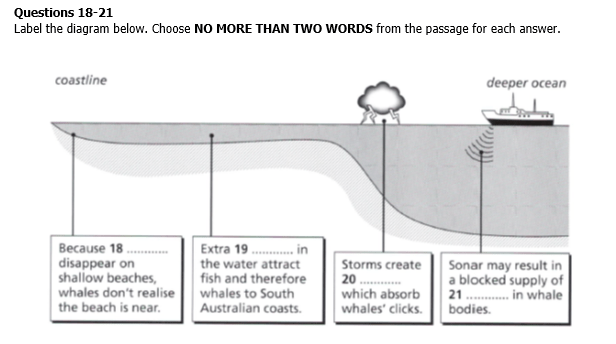
    Data has since revealed that all mass strandings around Australia occur on gently sloping sandy beaches, some with inclines of less than 0.5%. For whale species that depend on an echolocation system to navigate, this kind of beach spells disaster. Usually, as they swim, they make clicking noises, and the resulting sound waves are reflected in an echo and travel back to them. However, these just fade out on shallow beaches, so the whale doesn’t hear an echo and it crashes onto the shore.

    But that is not all. Physics, it appears, can help with the when as well as the where. The ocean is full of bubbles. Larger ones rise quickly to the surface and disappear, whilst smaller ones – called microbubbles – can last for days. It is these that absorb whale ‘clicks! “Rough weather generates more bubbles than usual,” James adds. So, during and after a storm, echolocating whales are essentially swimming blind.

    Last year was a bad one for strandings in Australia. Can we predict if this – or any other year – will be any better? Some scientists believe we can. They have found trends which could be used to forecast ‘bad years’ for strandings in the future. In 2005, a survey by Klaus Vanselow and Klaus Ricklefs of sperm whale strandings in the North Sea even found a correlation between these and the sunspot cycle, and suggested that changes in the Earth’s magnetic field might be involved. But others are sceptical. “Their study was interesting … but the analyses they used were flawed on a number of levels,” says Evans. In the same year, she co-authored a study on Australian strandings that uncovered a completely different trend. “We analysed data from 1920 to 2002 … and observed a clear periodicity in the number of whales stranded each year that coincides with a major climatic cycle.” To put it more simply, she says, in the years when strong westerly and southerly winds bring cool water rich in nutrients closer to the Australia coast, there is an increase in the number of fish. The whales follow.

    So what causes mass strandings? “It’s probably many different components,” says James. And he is probably right. But the point is we now know what many of those components are.

    Questions 14-17
    Choose NO MORE THAN TWO WORDS from the passage for each answer.

    14. What do researchers often take from the bodies of whales?
    15. What do some industries and shipping create that is harmful to whales?
    16. In which geographical region do most whale strandings in Australia happen?
    17. Which kind of whale was the subject of a study in the North Sea?
    Questions 22-26
    Do the following statements agree with the information given in Reading Passage 2? In boxes 22-26 on your answer sheet, write

    TRUE                            if the statement agrees with the information
    FALSE                          if the statement contradicts the information
    NOT GIVEN               if there is no information on this

    22. The aim of the research by the Pelagos Institute in 1998 was to prove that navy sonar was responsible for whale strandings.
    23. The whales stranded in Greece were found at different points along the coast.
    24. Rosemary Gales has questioned the research techniques used by the Greek scientists.
    25. According to Gales, whales are likely to try to help another whale in trouble.
    26. There is now agreement amongst scientists that changes in the Earth’s magnetic fields contribute to whale strandings.

    Science in Space

    A premier, world-class laboratory in low Earth orbit. That was how the National Aeronautics and Space Administration agency (NASA) sold the International Space Station (ISS) to the US Congress in 2001.Today no one can doubt the agency’s technological ambition. The most complex engineering project ever attempted has created an enormous set of interlinked modules that orbits the planet at more than 27,000 kilometres per hour. It might be travelling fast but, say critics, as a lab it is going nowhere. So far, it has gone through $150 billion.

    So where should its future priorities lie? This question was addressed at the recent 1st annual ISS research and development conference in Colorado. Among the presenters was Satoshi Iwase of Aichi Medical University in Japan who has spent several years developing an experiment that could help solve one of the key problems that humans will face in space: keeping our bodies healthy in weightlessness. One thing that physiologists have learned is that without gravity our bodies begin to lose strength, leaving astronauts with weakened bones, muscles and cardiovascular systems. To counter these effects on a long-duration mission to, say, Mars, astronauts will almost certainly need to create their own artificial gravity. This is where Iwase comes in. He leads a team designing a centrifuge for humans. In their preliminary design, an astronaut is strapped into the seat of a machine that resembles an exercise bike. Pedalling provides a workout for the astronaut’s muscles and cardiovascular system, but it also causes the seat to rotate vertically around a central axis so the rider experiences artificial gravity while exercising.

    The centrifuge project highlights the station’s potential as a research lab. Similar machines have flown in space aboard NASA’s shuttles, but they couldn’t be tested for long enough to prove whether they were effective. It’s been calculated that to properly assess a centrifuge’s impact on human physiology, astronauts would have to ride it for 30 minutes a day for at least two months. The only way to test this is in weightlessness, and the only time we have to do that is on the space station,’ says Laurence Young, a space medicine expert at the Massachusetts Institute of Technology.

    There are certainly plenty of ideas for other experiments: but many projects have yet to fly. Even if the centrifuge project gets the green light, it will have to wait another five years before the station’s crew can take a spin. Lengthy delays like this are one of the key challenges for NASA, according to an April 201 I report from the US National Academy of Sciences. Its authors said they were ‘deeply concerned’ about the state of NASA’s science research, and made a number of recommendations. Besides suggesting that the agency reduces the time between approving experiments and sending them into space, it also recommended setting clearer research priorities.

    NASA has already begun to take action, hiring management consultants ProOrbis to develop a plan to cut through the bureaucracy. And Congress also directed NASA to hire an independent organisation, the Centre for the Advancement of Science in Space (CASIS), to help manage the station’s US lab facilities. One of CASIS’s roles is to convince public and private investors that science on the station is worth the spend because judged solely by the number of papers published, the ISS certainly seems poor value: research on the station has generated about 3,100 papers since 1998.The Hubble Space Telescope, meanwhile, has produced more than I 1,300 papers in just over 20 years, yet it cost less than one-tenth of the price of the space station.

    Yet Mark Uhran, assistant associate administrator for the ISS, refutes the criticism that the station hasn’t done any useful research. He points to progress made on a salmonella vaccine, for example. To get the ISS research back on track, CASIS has examined more than 100 previous microgravity experiments to identify promising research themes. From this, it has opted to focus on life science and medical research, and recently called for proposals for experiments on muscle wasting, osteoporosis and the immune system. The organisation also maintains that the ISS should be used to develop products with commercial application and to test those that are either close to or already on the market. Investment from outside organisations is vital, says Uhran, and a balance between academic and commercial research will help attract this.

    The station needs to attract cutting-edge research, yet many scientists seem to have little idea what goes on aboard it.Jeanne DiFrancesco at ProOrbis conducted more than 200 interviews with people from organisations with potential interests in low gravity studies. Some were aware of the ISS but they didn’t know what’s going on up there, she says. ‘Others know there’s science, but they don’t know what kind.’

    According to Alan Stern, planetary scientist, the biggest public relations boost for the ISS may come from the privately funded space flight industry. Companies like SpaceX could help NASA and its partners when it comes to resupplying the ISS, as it suggests it can reduce launch costs by two-thirds. Virgin Atlantic’s Space Ship Two or ZeroUnfinity’s high- altitude balloon could also boost the space station’s fortunes. They might not come close to the ISS’s orbit, yet Stern believes they will revolutionise the way we, the public, see space. Soon everyone will be dreaming of interplanetary travel again, he predicts. More importantly, scientists are already queuing for seats on these low-gravity space-flight services so they can collect data during a few minutes of weightlessness. This demand for low-cost space flight could eventually lead to a service running on a more frequent basis, giving researchers the chance to test their ideas before submitting a proposal for experiments on the ISS. Getting flight experience should help them win a slot on the station, says Stern.

    Questions 27-30
    Choose the correct letter, A, B, C or D

    27. What does the writer state about the ISS in the first paragraph?
    A Its manufacture has remained within the proposed budget.
    B It is a great example of technological achievement.
    C There are doubts about the speed it has attained.
    D NASA should have described its purpose more accurately.

    28. What are we told about Satoshi Iwase’s experimental machine?
    A It is based on conventional exercise equipment.
    B It was originally commissioned by NASA.
    C It is designed only to work in low-gravity environments.
    D It has benefits that Iwase did not anticipate.

    29. The writer refers to the Hubble Space Telescope in order to
    A show why investment in space technology has decreased.
    B highlight the need to promote the ISS in a positive way.
    C explain which kind of projects are more likely to receive funding.
    D justify the time required for a space project to produce results.

    30. In the sixth paragraph, we are told that CASIS has
    A rejected certain applications for experiments on the ISS.
    B expressed concern about testing products used for profit.
    C questioned the benefits of some of the projects currently on the ISS.
    D invited researchers to suggest certain health-based projects.

    Questions 31-35
    Look at the following opinions (Questions 31-35) and the list of people below. Match each opinion with the correct person, A, B, C or D. Write the correct letter, A, B, C or D, in boxes 31-35 on your answer sheet.
    NB You may use any letter more than once.

    31. The ISS should be available for business-related ventures.
    32. There is general ignorance about what kinds of projects are possible on the ISS.
    33. The process of getting accepted projects onto the ISS should be speeded up.
    34. Some achievements of the ISS are underrated.
    35. To properly assess new space technology, there has to be an absence of gravity.

    List of people
    A Laurence Young
    B Authors of the US National Academy of Sciences report
    C Mark Uhran
    D Jeanne DiFrancesco

    Questions 36-39
    Complete the summary using the lists of words, A-H, below.
    Write the correct letter, A-H, in boxes 36-39 on your answer sheet.

    The influence of commercial space flight on the ISS
    According to Alan Stern, private space companies could affect the future of the ISS. He believes they could change its image; firstly because sending food and equipment there would be more (36)…………………………….if a commercial craft were used, and secondly, because commercial flights might make the whole idea of space exploration seem (37)……………………………….to ordinary people. Another point is that as the demand for space flights increases, there is a chance of them becoming more (38)…………………………………. And by working on a commercial flight first, scientists would be more (39)……………………….. if an ISS position came up.

    A safe
    B competitive
    C flexible
    D real
    E rapid
    F regular
    G suitable
    H economical

    Question 40
    Choose the correct letter, A, B. C or D. Write the correct letter in box 40 on your answer sheet.

    40. The writer’s purpose in writing this article is to
    A promote the advantages of space flight in general.
    B illustrate how the ISS could become more effective.
    C criticise the ISS for its narrow-minded attitude.
    D contrast useful and worthless space projects.

  • IELTS Reading Practice Test – Exercise 84

    South pole adventurer

    FOR a few weeks in January 1912, Antarctica was full of explorers. Norwegian Roald Amundsen had reached the South Pole on 14 December and was speeding back to the coast. On 17 January, Robert Scott and the men of the British Antarctic expedition had arrived at the pole to find they had been beaten to it. Just then, a third man arrived; Japanese explorer Nobu Shirase. However, his part in one of the greatest adventure stories of the 20th century is hardly known outside his own country, even by fellow explorers. Yet as Scott was nearing the pole and with the rest of the world still unaware of Amundsen’s triumph, Shirase and his team sailed into Antarctica’s Bay of Whales in the smallest ship ever to try its luck in these dangerous waters.

    Since boyhood Shirase had dreamed of becoming a polar explorer. Like Amundsen, he initially set his sights on the North Pole. But after the American Robert Peary claimed to have reached it in 1909, both men hastily altered their plans. Instead they would aim for the last big prize: the South Pole. In January 1910, Shirase put his plans before Japanese government officials, promising to raise the flag at the South Pole within three years. For many of them, the question wasn’t could he do it but why would it be worth doing? 15 years earlier the International Geographical Congress had said that as the last unknown continent the Antarctic offered the chance to add to knowledge in almost every branch of science. So, like the British, Shirase presented his expedition as a search for knowledge: he would bring back fossils, make meteorological measurements and explore unknown parts of the continent.

    The response from the government was cool, however, and Shirase struggled to raise funds. Fortunately, a few months later, Japan’s former prime minister Shigenobu □kuma came to Shirase’s rescue. With □kuma’s backing, Shirase got together just enough money to buy and equip a small ship. He eventually acquired a scientist, too, called Terutaro Takeda. At the end of November 1910, his ship the Kainan Maru finally left Tokyo with 27 men and 28 Siberian dogs on board. Before leaving, Shirase confidently outlined his plans to the media. He would sail to New Zealand, then reach Antarctica in February, during the southern summer, and then proceed to the pole the following spring. This was not to be, however. Bad weather delayed the expedition and they didn’t reach New Zealand until 8 February; Amundsen and Scott had already been in Antarctica for a month, preparing for winter. In New Zealand local reporters were astonished: the ship was half the size of Amundsen’s ship. True, it was reinforced with iron plate and extra wood, but the ship had only the feeblest engine to help force its way through ice. Few doubted Shirase’s courage, but most reckoned the expedition to be ill- prepared as the Japanese had only lightweight sledges for transport across the ice, made of bamboo and wood.

    But Shirase’s biggest challenge was time. Antarctica is only accessible by sea for a few weeks in summer and expeditions usually aimed to arrive in January or February. ‘Even with their determination and daring, our Japanese friends are running it rather fine,’ wrote local reporters. Nevertheless, on 11 February the Kainan Maru left New Zealand and sailed straight into the worst weather the captain had ever seen. Then, on 6 March, they approached the coastline of Antarctica’s Ross Sea, looking for a place to land. The ice began to close in, threatening to trap them for the winter, an experience no one was likely to survive. With a remarkable piece of seamanship, the captain steered the ship out of the ice and turned north. They would have to wait out the winter in a warmer climate.

    A year later than planned, Shirase and six men finally reached Antarctica. Catching up with Scott or Amundsen was out of the question and he had said he would stick to science this time. Yet Shirase still felt the pull of the pole and eventually decided he would head southward to experience the thrills and hardships of polar exploration he had always dreamed of. With provisions for 20 days, he and four men would see how far they could get.

    Shirase set off on 20 January 1912 with Takeda and two dog handlers, leaving two men at the edge of the ice shelf to make meteorological measurements. For a week they struggled through one blizzard after another, holing up in their tents during the worst of the weather. The temperature fell to -25°C, and frostbite claimed some of the dogs. On 26 January, Shirase estimated there were enough provisions to continue for two more days. Two days later, he announced it was time to turn back. Takeda calculated they had reached 80° 5 south and had travelled 250 kilometres. The men hoisted the Japanese flag.

    On 3 February, all the men were heading home. The ship reached Tokyo in June 1912 – and Shirase was greeted like a hero despite the fact that he never reached the pole. Nor did he contribute much to science – but then nor did Amundsen, whose only interest was in being first to the pole. Yet Shirase’s expedition was heroic. They travelled beyond 80° south, one of only four teams to have gone so far south at the time. Furthermore, they did it all without the advantages of the other teams and with no previous experience.

    Questions 1-8
    Do the following statements agree with the information given in Reading Passage 1 ?
    In boxes 1-8 on your answer sheet, write

    TRUE                         if the statement agrees with the information
    FALSE                       if the statement contradicts the information
    NOT GIVEN            if there is no information on this

    1. Shirase’s trip to the South Pole is well-known to other explorers.
    2. Since Shirase arrived in Antarctica, smaller ships have also made the journey.
    3. Shirase’s original ambition was to travel to the North Pole.
    4. Some Japanese officials thought Shirase’s intention to travel to the South Pole was pointless.
    5. The British team announced their decision to carry out scientific research in Antarctica before Shirase.
    6. Shirase found it easy to raise the money he needed for his trip to the South Pole.
    7. A previous prime minister of Japan persuaded a scientist to go with Shirase.
    8. The weather that slowed down Shirase’s progress to New Zealand was unusually bad for the season.

    Questions 9-13
    Choose the correct letter; A, B, C or D.

    9. When reporters in New Zealand met Shirase, they were
    A. concerned about the quality of his equipment.
    B. impressed with the design of his ship.
    C. certain he was unaware of the dangers ahead.
    D. surprised by the bravery he demonstrated.

    10. What are we told about the captain of the Kainan Maru in the fifth paragraph?
    A. He had given Shirase some poor advice.
    B. His skill at sailing saved the boat and crew.
    C. He refused to listen to the warnings of others.
    D. He was originally confident they could reach Antarctica.

    11. After Shirase finally reached Antarctica he realised that
    A. he was unsure of the direction he should follow.
    B. he would have to give up on fulfilling his personal ambition.
    C. he might not have enough food to get to the South Pole.
    D. he still wanted to compete in the race against the other teams.

    12. What is the writer doing in the seventh paragraph?
    A. criticising a decision concerning scientific research.
    B. explaining why a particular mistake had occurred.
    C. describing the conditions that the expedition faced.
    D. rejecting the idea that Shirase was poorly prepared.

    13. What is the writer’s main point in the final paragraph?
    A. Considering the problems Shirase had to deal with, his achievement was incredible.
    B. In Japan, the reaction to Shirase’s adventure in Antarctica came as a surprise to him.
    C. It was obvious that Amundsen would receive more attention as an explorer than Shirase.
    D. Shirase had achieved more on the Antarctic expedition than even he had expected.

    The rise of agribots

    The next time you stand at the supermarket checkout, spare a thought for the farmers who helped fill your shopping basket as life is hard for them right now. This, in turn, inevitably means bigger grocery bills for consumers, and greater hardship for the millions in countries where food shortages are a matter of life and death. Worse, studies suggest that the world will need twice as much food by 2050. Yet while farmers must squeeze more out of the land, they must also address the necessity of reducing their impact on the soil, waterways and atmosphere. All this means rethinking how agriculture is practiced, and taking automation to a whole new level. On the new model farms of the future, precision will be key. Why dose a whole field with chemicals if you can spray only where they are needed? Each plant could get exactly the right amount of everything, no more or less, an approach that could slash chemical use and improve yields in one move. But this is easier said than done; the largest farms in Europe and the U.S. can cover thousands of acres. That’s why automation is key to precision farming. Specifically, say agricultural engineers, precision farming needs robot farmers.

    One day, we might see fields with ‘agribots’ (agricultural robots) that can identify individual seedlings and encourage them along with drops of fertilizer. Other machines would distinguish problem weeds from crops and eliminate them with shots from high-power lasers or a microdot of pesticide. These machines will also be able to identify and harvest all kinds of vegetables. More than a century of mechanization has already turned farming into an industrial-scale activity in much of the world, with farms that grow cereals being the most heavily automated.

    But a variety of other crops, including oranges and tomatoes destined to become processed foods, are also picked mechanically, albeit to a slightly lesser extent. Yet the next wave of autonomous farm machinery is already at work. You probably haven’t even noticed, for these robots are disguised as tractors. Many are self-steering, use GPS to cross a field, and can even ‘talk’ to their implements – a plough or sprayer, for example. And the implements can talk back, telling the tractor that it’s going too fast or needs to move to the left. This kind of communication is also being developed in other farm vehicles. A new system allows a combine harvester, say, to send a call over to a tractor- trailer so the driver can unload the grain as and when necessary.

    However, when fully autonomous systems take to the field, they’ll look nothing like tractors. With their enormous size and weight, today’s farm machines have significant downsides: they compact the soil, reducing porosity and killing beneficial life, meaning crops don’t grow so well. Simon Blackmore, who researches agricultural technology at Harper Adams University College in England believes that fleets of lightweight autonomous robots have the potential to solve this problem and that replacing brute force with precision is key. ‘A seed only needs one cubic centimeter of soil to grow. If we cultivate just that we only put tiny amounts of energy in and the plants still grow nicely.’ There is another reason why automation may be the way forward according to Eldert van Henten, a robotics researcher at Wageningen University in the Netherlands. ‘While the population is growing and needs to be fed, a rapidly shrinking number of people are willing to work in agriculture,’ he points out. Other researchers such as Linda Calvin, an economist at the U.S. Department of Agriculture, and Philip Martin at the University of California, Davis, have studied trends in mechanization to predict how US farms might fare. Calvin and Martin have observed how rising employment costs have led to the adoption of labour-saving farm technology in the past, citing the raisin industry as an example. In 2000, a bumper harvest crashed prices and, with profits squeezed, farmers looked for a solution. With labour one of their biggest costs – 42 percent of production expenses on U.S. farms, on average – they started using a mechanical harvester adapted from a machine used by wine makers. By 2007, almost half of California’s raisins were mechanically harvested and a labour force once numbering 50,000 had shrunk to 30,000.

    As well as having an impact on the job market, the widespread adoption of agribots might bring changes at the supermarket. Lewis Holloway, who studies agriculture at the University of Hull, UK, says that robotic milking is likely to influence the genetics of dairy herds as farmers opt for ‘robot-friendly’ cows, with udder shape, and even attitudes, suited to automated milking. Similarly, he says, it’s conceivable that agribots could influence what fruit or vegetable varieties get to the shops, since farmers may prefer to grow those with, say, leaf shapes that are easier for their robots to discriminate from weeds. Almost inevitably, these machines will eventually alter the landscape, too. The real tipping point for robot agriculture will come when farms are being designed with agribots in mind, says Salah Sukkarieh, a robotics researcher at the Australian Center for Field Robotics, Sydney. This could mean a return to smaller fields, with crops planted in grids rather than rows and fruit trees pruned into two-dimensional shapes to make harvesting easier. This alien terrain tended by robots is still a while away, he says ‘but it will happen.’

    Questions 14-17
    Do the following statements agree with the claims of the writer in Reading Passage 2? In boxes 14-17 on your answer sheet, write

    YES                           if the statement agrees with the claims of the writer
    NO                             if the statement contradicts the claims of the writer
    NOT GIVEN          if it is impossible to say what the writer thinks about this

    14. Governments should do more to ensure that food is generally affordable.
    15. Farmers need to reduce the harm they do to the environment.
    16. In the future, farmers are likely to increase their dependency on chemicals.
    17. Farms in Europe and the US may find it hard to adapt to precision farming.

    Questions 18-21
    Complete the sentences below. Choose ONE WORD ONLY from the passage for each answer.

    18. In the future, agribots will provide………………………….to young plants.
    19. Some machines will use chemicals or……………………………..to get rid of unwanted plants.
    20. It is the production of………………………………which currently uses most machinery on farms.
    21. ……………………………….between machines such as tractors is making farming more efficient.

    Questions 22-26
    Look at the following researchers (Questions 22-26) and the list of statements below. Match each researcher with the correct statement, A-H.

    22. Simon Blackmore
    23. Eldert van Henten
    24. Linda Calvin and Philip Martin
    25. Lewis Holloway
    26. Salah Sukkarieh

    List of Findings
    A. The use of automation might impact on the development of particular animal and plant species.
    B. We need to consider the effect on employment that increased automation will have.
    C. We need machines of the future to be exact, not more powerful.
    D. As farming becomes more automated the appearance of farmland will change.
    E. New machinery may require more investment than certain farmers can afford.
    F. There is a shortage of employees in the farming industry.
    G. There are limits to the environmental benefits of automation.
    H. Economic factors are often the driving force behind the development of machinery.

    Homer’s Literary Legacy

    A Until the last tick of history’s clock, cultural transmission meant oral transmission and poetry, passed from mouth to ear, was the principal medium of moving information across space and from one generation to the next. Oral poetry was not simply a way of telling lovely or important stories, or of flexing the imagination. It was, argues the classicist Eric Havelock, a “massive repository of useful knowledge, a sort of encyclopedia of ethics, politics, history and technology which the effective citizen was required to learn as the core of his educational equipment”. The great oral works transmitted a shared cultural heritage, held in common not on bookshelves, but in brains. In India, an entire class of priests was charged with memorizing the Vedas with perfect fidelity. In pre-lslamic Arabia, people known as Rawis were often attached to poets as official memorizers.The Buddha’s teachings were passed down in an unbroken chain of oral tradition for four centuries until they were committed to writing in Sri Lanka in the first century B.C.

    B The most famous of the Western tradition’s oral works, and the first to have been systematically studied, were Homer’s Odyssey and Iliad. These two poems – possibly the first to have been written down in the Greek alphabet – had long been held up as literary archetypes. However, even as they were celebrated as the models to which all literature should aspire, Homer’s masterworks had also long been the source of scholarly unease. The earliest modern critics sensed that they were somehow qualitatively different from everything that came after – even a little strange. For one thing, both poems were oddly repetitive in the way they referred to characters. Odysseus was always “clever Odysseus”. Dawn was always “rosy-fingered”. Why would someone write that? Sometimes the epithets seemed completely off-key. Why call the murderer of Agamemnon “blameless Aegisthos”? Why refer to “swift-footed Achilles” even when he was sitting down? Or to “laughing Aphrodite” even when she was in tears? In terms of both structure and theme, the Odyssey and Iliad were also oddly formulaic, to the point of predictability. The same narrative units – gathering armies, heroic shields, challenges between rivals – pop up again and again, only with different characters and different circumstances. In the context of such finely spun, deliberate masterpieces, these quirks* seemed hard to explain.

    C At the heart of the unease about these earliest works of literature were two fundamental questions: first, how could Greek literature have been born ex nihilo* with two masterpieces? Surely a few less perfect stories must have come before, and yet these two were among the first on record. And second, who exactly was their author? Or was it authors? There were no historical records of Homer, and no trustworthy biography of the man exists beyond a few self-referential hints embedded in the texts themselves.

    D Jean-Jacques Rousseau was one of the first modern critics to suggest that Homer might not have been an author in the contemporary sense of a single person who sat down and wrote a story and then published it for others to read. In his 1781 Essay on the Origin of Languages, the Swiss philosopher suggested that the Odyssey and Iliad might have been “written only in men’s memories. Somewhat later they were laboriously collected in writing”- though that was about as far as his enquiry into the matter went.

    E In 1795, the German philologist Friedrich August Wolf argued for the first time that not only were Homer’s works not written down by Homer, but they weren’t even by Homer. They were, rather, a loose collection of songs transmitted by generations of Greek bards*, and only redacted* in their present form at some later date. In 1920, an eighteen-year-old scholar named Milman Parry took up the question of Homeric authorship as his Master’s thesis at the University of California, Berkeley. He suggested that the reason Homer’s epics seemed unlike other literature was because they were unlike other literature. Parry had discovered what Wood and Wolf had missed: the evidence that the poems had been transmitted orally was right there in the text itself. All those stylistic quirks, including the formulaic and recurring plot elements and the bizarrely repetitive epithets -“clever Odysseus”and “gray-eyed Athena”- that had always perplexed readers were actually like thumbprints left by a potter: material evidence of how the poems had been crafted. They were mnemonic* aids that helped the bard(s) fit the meter and pattern of the line, and remember the essence of the poems.

    F The greatest author of antiquity was actually, Parry argued, just “one of a long tradition of oral poets that… composed wholly without the aid of writing”. Parry realised that if you were setting out to create memorable poems, the Odyssey and the Iliad were exactly the kind of poems you’d create. It’s said that cliches* are the worst sin a writer can commit, but to an oral bard, they were essential. The very reason that cliches so easily seep into our speech and writing – their insidious memorability – is exactly why they played such an important role in oral storytelling.The principles that the oral bards discovered as they sharpened their stories through telling and retelling were the same mnemonic principles that psychologists rediscovered when they began conducting their first scientific experiments on memory around the turn of the twentieth century. Words that rhyme are much more memorable than words that don’t, and concrete nouns are easier to remember than abstract ones. Finding patterns and structure in information is how our brains extract meaning from the world, and putting words to music and rhyme is a way of adding extra levels of pattern and structure to language.

    Questions 27-32
    Reading Passage 3 has six paragraphs, A-F.

    Which paragraph contains the following information?

    27. the claim that the Odyssey and Iliad were not poems in their original form.
    28. a theory involving the reinterpretation of the term ‘author’
    29. references to the fact that little is known about Homer’s life
    30. a comparison between the construction of Homer’s poems and another art form
    31. examples of the kinds of people employed to recall language
    32. doubts regarding Homer’s apparently inappropriate descriptions

    Questions 33 and 34
    Choose TWO letters, A-E.

    Which TWO of these points are made by the writer of the text about the Odyssey and the Iliad?
    A. They are sometimes historically inaccurate.
    B. It is uncertain which century they were written in.
    C. Their content is very similar.
    D. Later writers referred to them as ideal examples of writing.
    E. There are stylistic differences between them.

    Questions 35 and 36
    Choose TWO letters, A-E.

    Which TWO of the following theories does the writer of the text refer to?
    A. Homer wrote his work during a period of captivity.
    B. Neither the Odyssey nor the Iliad were written by Homer.
    C. Homer created the Odyssey and Iliad without writing them down.
    D. Homer may have suffered from a failing memory in later life.
    E. The oral and written versions of Homer’s work may not be identical.

    Questions 37-40
    Complete the summary below. Choose ONE WORD ONLY from the passage for each answer.

    The importance of the spoken word and how words are remembered
    Spoken poetry was once the means by which each (37)……………………………….. of a particular culture or community could pass on its knowledge. Indeed, it has been suggested that it was the duty of a (38)………………………… to know poetry so they would be informed about subjects such as politics and history.

    Psychologists now know that when people are trying to remember information, they may find it difficult to remember words that express (39)……………………………… ideas. It is easier to remember words which sound similar or go together with (40)………………………………

  • IELTS Reading Practice Test – Exercise 83

    South pole adventurer

    FOR a few weeks in January 1912, Antarctica was full of explorers. Norwegian Roald Amundsen had reached the South Pole on 14 December and was speeding back to the coast. On 17 January, Robert Scott and the men of the British Antarctic expedition had arrived at the pole to find they had been beaten to it. Just then, a third man arrived; Japanese explorer Nobu Shirase. However, his part in one of the greatest adventure stories of the 20th century is hardly known outside his own country, even by fellow explorers. Yet as Scott was nearing the pole and with the rest of the world still unaware of Amundsen’s triumph, Shirase and his team sailed into Antarctica’s Bay of Whales in the smallest ship ever to try its luck in these dangerous waters.

    Since boyhood Shirase had dreamed of becoming a polar explorer. Like Amundsen, he initially set his sights on the North Pole. But after the American Robert Peary claimed to have reached it in 1909, both men hastily altered their plans. Instead they would aim for the last big prize: the South Pole. In January 1910, Shirase put his plans before Japanese government officials, promising to raise the flag at the South Pole within three years. For many of them, the question wasn’t could he do it but why would it be worth doing? 15 years earlier the International Geographical Congress had said that as the last unknown continent the Antarctic offered the chance to add to knowledge in almost every branch of science. So, like the British, Shirase presented his expedition as a search for knowledge: he would bring back fossils, make meteorological measurements and explore unknown parts of the continent.

    The response from the government was cool, however, and Shirase struggled to raise funds. Fortunately, a few months later, Japan’s former prime minister Shigenobu □kuma came to Shirase’s rescue. With □kuma’s backing, Shirase got together just enough money to buy and equip a small ship. He eventually acquired a scientist, too, called Terutaro Takeda. At the end of November 1910, his ship the Kainan Maru finally left Tokyo with 27 men and 28 Siberian dogs on board. Before leaving, Shirase confidently outlined his plans to the media. He would sail to New Zealand, then reach Antarctica in February, during the southern summer, and then proceed to the pole the following spring. This was not to be, however. Bad weather delayed the expedition and they didn’t reach New Zealand until 8 February; Amundsen and Scott had already been in Antarctica for a month, preparing for winter. In New Zealand local reporters were astonished: the ship was half the size of Amundsen’s ship. True, it was reinforced with iron plate and extra wood, but the ship had only the feeblest engine to help force its way through ice. Few doubted Shirase’s courage, but most reckoned the expedition to be ill- prepared as the Japanese had only lightweight sledges for transport across the ice, made of bamboo and wood.

    But Shirase’s biggest challenge was time. Antarctica is only accessible by sea for a few weeks in summer and expeditions usually aimed to arrive in January or February. ‘Even with their determination and daring, our Japanese friends are running it rather fine,’ wrote local reporters. Nevertheless, on 11 February the Kainan Maru left New Zealand and sailed straight into the worst weather the captain had ever seen. Then, on 6 March, they approached the coastline of Antarctica’s Ross Sea, looking for a place to land. The ice began to close in, threatening to trap them for the winter, an experience no one was likely to survive. With a remarkable piece of seamanship, the captain steered the ship out of the ice and turned north. They would have to wait out the winter in a warmer climate.

    A year later than planned, Shirase and six men finally reached Antarctica. Catching up with Scott or Amundsen was out of the question and he had said he would stick to science this time. Yet Shirase still felt the pull of the pole and eventually decided he would head southward to experience the thrills and hardships of polar exploration he had always dreamed of. With provisions for 20 days, he and four men would see how far they could get.

    Shirase set off on 20 January 1912 with Takeda and two dog handlers, leaving two men at the edge of the ice shelf to make meteorological measurements. For a week they struggled through one blizzard after another, holing up in their tents during the worst of the weather. The temperature fell to -25°C, and frostbite claimed some of the dogs. On 26 January, Shirase estimated there were enough provisions to continue for two more days. Two days later, he announced it was time to turn back. Takeda calculated they had reached 80° 5 south and had travelled 250 kilometres. The men hoisted the Japanese flag.

    On 3 February, all the men were heading home. The ship reached Tokyo in June 1912 – and Shirase was greeted like a hero despite the fact that he never reached the pole. Nor did he contribute much to science – but then nor did Amundsen, whose only interest was in being first to the pole. Yet Shirase’s expedition was heroic. They travelled beyond 80° south, one of only four teams to have gone so far south at the time. Furthermore, they did it all without the advantages of the other teams and with no previous experience.

    Questions 1-8
    Do the following statements agree with the information given in Reading Passage 1 ?
    In boxes 1-8 on your answer sheet, write

    TRUE                         if the statement agrees with the information
    FALSE                       if the statement contradicts the information
    NOT GIVEN            if there is no information on this

    1. Shirase’s trip to the South Pole is well-known to other explorers.
    2. Since Shirase arrived in Antarctica, smaller ships have also made the journey.
    3. Shirase’s original ambition was to travel to the North Pole.
    4. Some Japanese officials thought Shirase’s intention to travel to the South Pole was pointless.
    5. The British team announced their decision to carry out scientific research in Antarctica before Shirase.
    6. Shirase found it easy to raise the money he needed for his trip to the South Pole.
    7. A previous prime minister of Japan persuaded a scientist to go with Shirase.
    8. The weather that slowed down Shirase’s progress to New Zealand was unusually bad for the season.

    Questions 9-13
    Choose the correct letter; A, B, C or D.

    9. When reporters in New Zealand met Shirase, they were
    A. concerned about the quality of his equipment.
    B. impressed with the design of his ship.
    C. certain he was unaware of the dangers ahead.
    D. surprised by the bravery he demonstrated.

    10. What are we told about the captain of the Kainan Maru in the fifth paragraph?
    A. He had given Shirase some poor advice.
    B. His skill at sailing saved the boat and crew.
    C. He refused to listen to the warnings of others.
    D. He was originally confident they could reach Antarctica.

    11. After Shirase finally reached Antarctica he realised that
    A. he was unsure of the direction he should follow.
    B. he would have to give up on fulfilling his personal ambition.
    C. he might not have enough food to get to the South Pole.
    D. he still wanted to compete in the race against the other teams.

    12. What is the writer doing in the seventh paragraph?
    A. criticising a decision concerning scientific research.
    B. explaining why a particular mistake had occurred.
    C. describing the conditions that the expedition faced.
    D. rejecting the idea that Shirase was poorly prepared.

    13. What is the writer’s main point in the final paragraph?
    A. Considering the problems Shirase had to deal with, his achievement was incredible.
    B. In Japan, the reaction to Shirase’s adventure in Antarctica came as a surprise to him.
    C. It was obvious that Amundsen would receive more attention as an explorer than Shirase.
    D. Shirase had achieved more on the Antarctic expedition than even he had expected.

    The rise of agribots

    The next time you stand at the supermarket checkout, spare a thought for the farmers who helped fill your shopping basket as life is hard for them right now. This, in turn, inevitably means bigger grocery bills for consumers, and greater hardship for the millions in countries where food shortages are a matter of life and death. Worse, studies suggest that the world will need twice as much food by 2050. Yet while farmers must squeeze more out of the land, they must also address the necessity of reducing their impact on the soil, waterways and atmosphere. All this means rethinking how agriculture is practiced, and taking automation to a whole new level. On the new model farms of the future, precision will be key. Why dose a whole field with chemicals if you can spray only where they are needed? Each plant could get exactly the right amount of everything, no more or less, an approach that could slash chemical use and improve yields in one move. But this is easier said than done; the largest farms in Europe and the U.S. can cover thousands of acres. That’s why automation is key to precision farming. Specifically, say agricultural engineers, precision farming needs robot farmers.

    One day, we might see fields with ‘agribots’ (agricultural robots) that can identify individual seedlings and encourage them along with drops of fertilizer. Other machines would distinguish problem weeds from crops and eliminate them with shots from high-power lasers or a microdot of pesticide. These machines will also be able to identify and harvest all kinds of vegetables. More than a century of mechanization has already turned farming into an industrial-scale activity in much of the world, with farms that grow cereals being the most heavily automated.

    But a variety of other crops, including oranges and tomatoes destined to become processed foods, are also picked mechanically, albeit to a slightly lesser extent. Yet the next wave of autonomous farm machinery is already at work. You probably haven’t even noticed, for these robots are disguised as tractors. Many are self-steering, use GPS to cross a field, and can even ‘talk’ to their implements – a plough or sprayer, for example. And the implements can talk back, telling the tractor that it’s going too fast or needs to move to the left. This kind of communication is also being developed in other farm vehicles. A new system allows a combine harvester, say, to send a call over to a tractor- trailer so the driver can unload the grain as and when necessary.

    However, when fully autonomous systems take to the field, they’ll look nothing like tractors. With their enormous size and weight, today’s farm machines have significant downsides: they compact the soil, reducing porosity and killing beneficial life, meaning crops don’t grow so well. Simon Blackmore, who researches agricultural technology at Harper Adams University College in England believes that fleets of lightweight autonomous robots have the potential to solve this problem and that replacing brute force with precision is key. ‘A seed only needs one cubic centimeter of soil to grow. If we cultivate just that we only put tiny amounts of energy in and the plants still grow nicely.’ There is another reason why automation may be the way forward according to Eldert van Henten, a robotics researcher at Wageningen University in the Netherlands. ‘While the population is growing and needs to be fed, a rapidly shrinking number of people are willing to work in agriculture,’ he points out. Other researchers such as Linda Calvin, an economist at the U.S. Department of Agriculture, and Philip Martin at the University of California, Davis, have studied trends in mechanization to predict how US farms might fare. Calvin and Martin have observed how rising employment costs have led to the adoption of labour-saving farm technology in the past, citing the raisin industry as an example. In 2000, a bumper harvest crashed prices and, with profits squeezed, farmers looked for a solution. With labour one of their biggest costs – 42 percent of production expenses on U.S. farms, on average – they started using a mechanical harvester adapted from a machine used by wine makers. By 2007, almost half of California’s raisins were mechanically harvested and a labour force once numbering 50,000 had shrunk to 30,000.

    As well as having an impact on the job market, the widespread adoption of agribots might bring changes at the supermarket. Lewis Holloway, who studies agriculture at the University of Hull, UK, says that robotic milking is likely to influence the genetics of dairy herds as farmers opt for ‘robot-friendly’ cows, with udder shape, and even attitudes, suited to automated milking. Similarly, he says, it’s conceivable that agribots could influence what fruit or vegetable varieties get to the shops, since farmers may prefer to grow those with, say, leaf shapes that are easier for their robots to discriminate from weeds. Almost inevitably, these machines will eventually alter the landscape, too. The real tipping point for robot agriculture will come when farms are being designed with agribots in mind, says Salah Sukkarieh, a robotics researcher at the Australian Center for Field Robotics, Sydney. This could mean a return to smaller fields, with crops planted in grids rather than rows and fruit trees pruned into two-dimensional shapes to make harvesting easier. This alien terrain tended by robots is still a while away, he says ‘but it will happen.’

    Questions 14-17
    Do the following statements agree with the claims of the writer in Reading Passage 2? In boxes 14-17 on your answer sheet, write

    YES                           if the statement agrees with the claims of the writer
    NO                             if the statement contradicts the claims of the writer
    NOT GIVEN          if it is impossible to say what the writer thinks about this

    14. Governments should do more to ensure that food is generally affordable.
    15. Farmers need to reduce the harm they do to the environment.
    16. In the future, farmers are likely to increase their dependency on chemicals.
    17. Farms in Europe and the US may find it hard to adapt to precision farming.

    Questions 18-21
    Complete the sentences below. Choose ONE WORD ONLY from the passage for each answer.

    18. In the future, agribots will provide………………………….to young plants.
    19. Some machines will use chemicals or……………………………..to get rid of unwanted plants.
    20. It is the production of………………………………which currently uses most machinery on farms.
    21. ……………………………….between machines such as tractors is making farming more efficient.

    Questions 22-26
    Look at the following researchers (Questions 22-26) and the list of statements below. Match each researcher with the correct statement, A-H.

    22. Simon Blackmore
    23. Eldert van Henten
    24. Linda Calvin and Philip Martin
    25. Lewis Holloway
    26. Salah Sukkarieh

    List of Findings
    A. The use of automation might impact on the development of particular animal and plant species.
    B. We need to consider the effect on employment that increased automation will have.
    C. We need machines of the future to be exact, not more powerful.
    D. As farming becomes more automated the appearance of farmland will change.
    E. New machinery may require more investment than certain farmers can afford.
    F. There is a shortage of employees in the farming industry.
    G. There are limits to the environmental benefits of automation.
    H. Economic factors are often the driving force behind the development of machinery.

    Homer’s Literary Legacy

    A Until the last tick of history’s clock, cultural transmission meant oral transmission and poetry, passed from mouth to ear, was the principal medium of moving information across space and from one generation to the next. Oral poetry was not simply a way of telling lovely or important stories, or of flexing the imagination. It was, argues the classicist Eric Havelock, a “massive repository of useful knowledge, a sort of encyclopedia of ethics, politics, history and technology which the effective citizen was required to learn as the core of his educational equipment”. The great oral works transmitted a shared cultural heritage, held in common not on bookshelves, but in brains. In India, an entire class of priests was charged with memorizing the Vedas with perfect fidelity. In pre-lslamic Arabia, people known as Rawis were often attached to poets as official memorizers.The Buddha’s teachings were passed down in an unbroken chain of oral tradition for four centuries until they were committed to writing in Sri Lanka in the first century B.C.

    B The most famous of the Western tradition’s oral works, and the first to have been systematically studied, were Homer’s Odyssey and Iliad. These two poems – possibly the first to have been written down in the Greek alphabet – had long been held up as literary archetypes. However, even as they were celebrated as the models to which all literature should aspire, Homer’s masterworks had also long been the source of scholarly unease. The earliest modern critics sensed that they were somehow qualitatively different from everything that came after – even a little strange. For one thing, both poems were oddly repetitive in the way they referred to characters. Odysseus was always “clever Odysseus”. Dawn was always “rosy-fingered”. Why would someone write that? Sometimes the epithets seemed completely off-key. Why call the murderer of Agamemnon “blameless Aegisthos”? Why refer to “swift-footed Achilles” even when he was sitting down? Or to “laughing Aphrodite” even when she was in tears? In terms of both structure and theme, the Odyssey and Iliad were also oddly formulaic, to the point of predictability. The same narrative units – gathering armies, heroic shields, challenges between rivals – pop up again and again, only with different characters and different circumstances. In the context of such finely spun, deliberate masterpieces, these quirks* seemed hard to explain.

    C At the heart of the unease about these earliest works of literature were two fundamental questions: first, how could Greek literature have been born ex nihilo* with two masterpieces? Surely a few less perfect stories must have come before, and yet these two were among the first on record. And second, who exactly was their author? Or was it authors? There were no historical records of Homer, and no trustworthy biography of the man exists beyond a few self-referential hints embedded in the texts themselves.

    D Jean-Jacques Rousseau was one of the first modern critics to suggest that Homer might not have been an author in the contemporary sense of a single person who sat down and wrote a story and then published it for others to read. In his 1781 Essay on the Origin of Languages, the Swiss philosopher suggested that the Odyssey and Iliad might have been “written only in men’s memories. Somewhat later they were laboriously collected in writing”- though that was about as far as his enquiry into the matter went.

    E In 1795, the German philologist Friedrich August Wolf argued for the first time that not only were Homer’s works not written down by Homer, but they weren’t even by Homer. They were, rather, a loose collection of songs transmitted by generations of Greek bards*, and only redacted* in their present form at some later date. In 1920, an eighteen-year-old scholar named Milman Parry took up the question of Homeric authorship as his Master’s thesis at the University of California, Berkeley. He suggested that the reason Homer’s epics seemed unlike other literature was because they were unlike other literature. Parry had discovered what Wood and Wolf had missed: the evidence that the poems had been transmitted orally was right there in the text itself. All those stylistic quirks, including the formulaic and recurring plot elements and the bizarrely repetitive epithets -“clever Odysseus”and “gray-eyed Athena”- that had always perplexed readers were actually like thumbprints left by a potter: material evidence of how the poems had been crafted. They were mnemonic* aids that helped the bard(s) fit the meter and pattern of the line, and remember the essence of the poems.

    F The greatest author of antiquity was actually, Parry argued, just “one of a long tradition of oral poets that… composed wholly without the aid of writing”. Parry realised that if you were setting out to create memorable poems, the Odyssey and the Iliad were exactly the kind of poems you’d create. It’s said that cliches* are the worst sin a writer can commit, but to an oral bard, they were essential. The very reason that cliches so easily seep into our speech and writing – their insidious memorability – is exactly why they played such an important role in oral storytelling.The principles that the oral bards discovered as they sharpened their stories through telling and retelling were the same mnemonic principles that psychologists rediscovered when they began conducting their first scientific experiments on memory around the turn of the twentieth century. Words that rhyme are much more memorable than words that don’t, and concrete nouns are easier to remember than abstract ones. Finding patterns and structure in information is how our brains extract meaning from the world, and putting words to music and rhyme is a way of adding extra levels of pattern and structure to language.

    Questions 27-32
    Reading Passage 3 has six paragraphs, A-F.

    Which paragraph contains the following information?

    27. the claim that the Odyssey and Iliad were not poems in their original form.
    28. a theory involving the reinterpretation of the term ‘author’
    29. references to the fact that little is known about Homer’s life
    30. a comparison between the construction of Homer’s poems and another art form
    31. examples of the kinds of people employed to recall language
    32. doubts regarding Homer’s apparently inappropriate descriptions

    Questions 33 and 34
    Choose TWO letters, A-E.

    Which TWO of these points are made by the writer of the text about the Odyssey and the Iliad?
    A. They are sometimes historically inaccurate.
    B. It is uncertain which century they were written in.
    C. Their content is very similar.
    D. Later writers referred to them as ideal examples of writing.
    E. There are stylistic differences between them.

    Questions 35 and 36
    Choose TWO letters, A-E.

    Which TWO of the following theories does the writer of the text refer to?
    A. Homer wrote his work during a period of captivity.
    B. Neither the Odyssey nor the Iliad were written by Homer.
    C. Homer created the Odyssey and Iliad without writing them down.
    D. Homer may have suffered from a failing memory in later life.
    E. The oral and written versions of Homer’s work may not be identical.

    Questions 37-40
    Complete the summary below. Choose ONE WORD ONLY from the passage for each answer.

    The importance of the spoken word and how words are remembered
    Spoken poetry was once the means by which each (37)……………………………….. of a particular culture or community could pass on its knowledge. Indeed, it has been suggested that it was the duty of a (38)………………………… to know poetry so they would be informed about subjects such as politics and history.

    Psychologists now know that when people are trying to remember information, they may find it difficult to remember words that express (39)……………………………… ideas. It is easier to remember words which sound similar or go together with (40)………………………………

  • IELTS Reading Practice Test – Exercise 82

    The Flavour Of Pleasure

    No matter how much we talk about tasting our favorite flavors, relishing them really depends on a combined input from our senses that we experience through mouth, tongue and nose. The taste, texture, and feel of food are what we tend to focus on, but most important are the slight puffs of air as we chew our food – what scientists call ‘retronasal smell’.

    Certainly, our mouths and tongues have taste buds, which are receptors for the five basic flavors: sweet, salty, sour, bitter, and umami, or what is more commonly referred to as savory. But our tongues are inaccurate instruments as far as flavor is concerned. They evolved to recognise only a few basic tastes in order to quickly identify toxins, which in nature are often quite bitter or acidly sour.

    All the complexity, nuance, and pleasure of flavor come from the sense of smell operating in the back of the nose. It is there that a kind of alchemy occurs when we breathe up and out the passing whiffs of our chewed food. Unlike a hound’s skull with its extra long nose, which evolved specifically to detect external smells, our noses have evolved to detect internal scents. Primates specialise in savoring the many millions of flavor combinations that they can create for their mouths.

    Taste without retronasal smell is not much help in recognising flavor. Smell has been the most poorly understood of our senses, and only recently has neuroscience, led by Yale University’s Gordon Shepherd, begun to shed light on its workings. Shepherd has come up with the term ‘neurogastronomy’ to link the disciplines of food science, neurology, psychology, and anthropology with the savory elements of eating, one of the most enjoyed of human experiences.

    In many ways, he is discovering that smell is rather like face recognition. The visual system detects patterns of light and dark and, building on experience, the brain creates a spatial map. It uses this to interpret the interrelationship of the patterns and draw conclusions that allow us to identify people and places. In the same way, we use patterns and ratios to detect both new and familiar flavors. As we eat, specialised receptors in the back of the nose detect the air molecules in our meals. From signals sent by the receptors, the brain understands smells as complex spatial patterns. Using these, as well as input from the other senses, it constructs the idea of specific flavors.

    This ability to appreciate specific aromas turns out to be central to the pleasure we get from food, much as our ability to recognise individuals is central to the pleasures of social life. The process is so embedded in our brains that our sense of smell is critical to our enjoyment of life at large. Recent studies show that people who lose the ability to smell become socially insecure, and their overall level of happiness plummets.

    Working out the role of smell in flavor interests food scientists, psychologists, and cooks alike. The relatively new discipline of molecular gastronomy, especially, relies on understanding the mechanics of aroma to manipulate flavor for maximum impact. In this discipline, chefs use their knowledge of the chemical changes that take place during cooking to produce eating pleasures that go beyond the ‘ordinary’.

    However, whereas molecular gastronomy is concerned primarily with the food or ‘smell’ molecules, neurogastronomy is more focused on the receptor molecules and the brain’s spatial images for smell. Smell stimuli form what Shepherd terms ‘odor objects’, stored as memories, and these have a direct link with our emotions. The brain creates images of unfamiliar smells by relating them to other more familiar smells. Go back in history and this was part of our survival repertoire; like most animals, we drew on our sense of smell, when visual information was scarce, to single out prey.

    Thus the brain’s flavor-recognition system is a highly complex perceptual mechanism that puts all five senses to work in various combinations. Visual and sound cues contribute, such as crunching, as does touch, including the texture and feel of food on our lips and in our mouths. Then there are the taste receptors, and finally, the smell, activated when we inhale. The engagement of our emotions can be readily illustrated when we picture some of the wide- ranging facial expressions that are elicited by various foods – many of them hard-wired into our brains at birth. Consider the response to the sharpness of a lemon and compare that with the face that is welcoming the smooth wonder of chocolate.

    The flavor-sensing system, ever receptive to new combinations, helps to keep our brains active and flexible. It also has the power to shape our desires and ultimately our bodies. On the horizon we have the positive application of neurogastronomy: manipulating flavor to curb our appetites.

    Questions 1-5
    Complete the notes below. Write NO MORE THAN TWO WORDS from the passage.

    1. According to scientists, the term………………………….characterises the most critical factor in appreciating flavour.
    2. ‘Savoury’ is a better-known word for………………………
    3. The tongue was originally developed to recognise the unpleasant taste of……………………..
    4. Human nasal cavities recognize……………………………much better than external ones.
    5. Gordon Shepherd uses the word ‘neurogastronomy’ to draw together a number of…………………………related to the enjoyment of eating.

    Questions 6-9

    Complete the notes below. Write NO MORE THAN TWO WORDS from the passage.

    Face recognitionpatterns of dark and light are used to put together a (6)………………the brain identifies facesfacial recognition is key to our enjoyment of (7)……………..
    Smellreceptors recognize the (8)…………….in foodthe brain identifies certain (9)…………………smell is key to our enjoyment of food

    Questions 10-13
    Answer the questions below. Choose NO MORE THAN ONE WORD from the text for each answer.

    10. In what form does the brain store ‘odor objects’?
    11. When seeing was difficult, what did we use our sense of smell to find?
    12. Which food item illustrates how flavour and positive emotion are linked?
    13. What could be controlled in the future through flavour manipulation?

    Dawn Of The Robots

    A At first sight it looked like a typical suburban road accident. A Land Rover approached a Chevy Tahoe estate car that had stopped at a kerb; the Land Rover pulled out and tried to pass the Tahoe just as it started off again. There was a crack of fenders and the sound of paintwork being scraped, the kind of minor mishap that occurs on roads thousands of times every day. Normally drivers get out, gesticulate, exchange insurance details and then drive off. But not on this occasion. No one got out of the cars for the simple reason that they had no humans inside them; the Tahoe and Land Rover were being controlled by computers competing in November’s DARPA (the U.S. Defence Advanced Research Projects Agency) Urban Challenge.

    B The idea that machines could perform to such standards is startling. Driving is a complex task that takes humans a long time to perfect. Yet here, each car had its on-board computer loaded with a digital map and route plans, and was instructed to negotiate busy roads; differentiate between pedestrians and stationary objects; determine whether other vehicles were parked or moving off; and handle various parking manoeuvres, which robots turn out to be unexpectedly adept at. Even more striking was the fact that the collision between the robot Land Rover, built by researchers at the Massachusetts Institute of Technology, and the Tahoe, fitted out by Cornell University Artificial Intelligence (AI) experts, was the only scrape in the entire competition. Yet only three years earlier, at DARPA’s previous driverless car race, every robot competitor – directed to navigate across a stretch of open desert – either crashed or seized up before getting near the finishing line.

    C It is a remarkable transition that has clear implications for the car of the future. More importantly, it demonstrates how robotics sciences and Artificial Intelligence have progressed in the past few years – a point stressed by Bill Gates, the Microsoft boss who is a convert to these causes. ‘The robotics industry is developing in much the same way the computer business did 30 years ago,’ he argues. As he points out, electronics companies make toys that mimic pets and children with increasing sophistication. ‘I can envision a future in which robotic devices will become a nearly ubiquitous part of our day-to-day lives,’ says Gates. ‘We may be on the verge of a new era, when the PC will get up off the desktop and allow us to see, hear, touch and manipulate objects in places where we are not physically present.’

    D What is the potential for robots and computers in the near future? The fact is we still have a way to go before real robots catch up with their science fiction counterparts/ Gates says. So what are the stumbling blocks? One key difficulty is getting robots to know their place. This has nothing to do with class or etiquette, but concerns the simple issue of positioning. Humans orient themselves with other objects in a room very easily. Robots find the task almost impossible. ‘Even something as simple as telling the difference between an open door and a window can be tricky for a robot,’ says Gates. This has, until recently, reduced robots to fairly static and cumbersome roles.

    E For a long time, researchers tried to get round the problem by attempting to re-create the visual processing that goes on in the human cortex. However, that challenge has proved to be singularly exacting and complex. So scientists have turned to simpler alternatives: ‘We have become far more pragmatic in our work,’ says Nello Cristianini, Professor of Artificial Intelligence at the University of Bristol in England and associate editor of the Journal of Artificial Intelligence Research. ‘We are no longer trying to re-create human functions. Instead, we are looking for simpler solutions with basic electronic sensors, for example.’ This approach is exemplified by vacuuming robots such as the Electrolux Trilobite. The Trilobite scuttles around homes emitting ultrasound signals to create maps of rooms, which are remembered for future cleaning. Technology like this is now changing the face of robotics, says philosopher Ron Chrisley, director of the Centre for Research in Cognitive Science at the University of Sussex in England.

    F Last year, a new Hong Kong restaurant, Robot Kitchen, opened with a couple of sensor-laden humanoid machines directing customers to their seats. Each possesses a touch-screen on which orders can be keyed in. The robot then returns with the correct dishes. In Japan, University of Tokyo researchers recently unveiled a kitchen ‘android’ that could wash dishes, pour tea and make a few limited meals. The ultimate aim is to provide robot home helpers for the sick and the elderly, a key concern in a country like Japan where 22 per cent of the population is 65 or older. Over US$1 billion a year is spent on research into robots that will be able to care for the elderly. ‘Robots first learn basic competence – how to move around a house without bumping into things. Then we can think about teaching them how to interact with humans,’ Chrisley said. Machines such as these take researchers into the field of socialised robotics: how to make robots act in a way that does not scare or offend individuals. ‘We need to study how robots should approach people, how they should appear. That is going to be a key area for future research,’ adds Chrisley.

    Questions 14-19
    The text on the following pages has six paragraphs, A-F. Choose the correct heading for each paragraph from the list of headings (i-ix) below.

    List of headings
    i Tackling the issue using a different approach
    ii A significant improvement on last time
    iii How robots can save human lives
    iv Examples of robots at work
    v Not what it seemed to be
    vi Why timescales are impossible to predict
    vii The reason why robots rarely move
    viii Following the pattern of an earlier development
    ix The ethical issues of robotics

    14 Paragraph A
    15 Paragraph B
    16 Paragraph C
    17 Paragraph D
    18 Paragraph E
    19 Paragraph F

    Questions 20-23
    Look at the following statements (Questions 20-23) and the list of people below.
    Match each statement with the correct person, A, B or C.
    NB You may use any letter more than once.

    A Bill Gates
    B Nello Cristianini
    C Ron Chrisley

    20. An important concern for scientists is to ensure that robots do not seem frightening.
    21. We have stopped trying to enable robots to perceive objects as humans do.
    22. It will take considerable time for modern robots to match the ones we have created in films and books.
    23. We need to enable robots to move freely before we think about trying to communicate with them.

    Questions 24-26
    Complete the notes below. Write NO MORE THAN THREE WORDS from the passage.

    Robot features
    DARPA race cars: (24)…………………………provides maps and plans for route
    Electrolux trilobite: builds an image of a room by sending out (25)………………………..
    Robot kitchen humanoids: have a (26)……………………………..to take orders

    It’s Your Choice – Or Is It Really?

    We are constantly required to process a wide range of information to make decisions. Sometimes, these decisions are trivial, such as what marmalade to buy. At other times, the stakes are higher, such as deciding which symptoms to report to the doctor. However, the fact that we are accustomed to processing large amounts of information does not mean that we are better at it (Chabris & Simons, 2009). Our sensory and cognitive systems have systematic ways of failing of which we are often, perhaps blissfully, unaware.

    Imagine that you are taking a walk in your local city park when a tourist approaches you asking for directions. During the conversation, two men carrying a door pass between the two of you. If the person asking for directions had changed places with one of the people carrying the door, would you notice? Research suggests that you might not. Harvard psychologists Simons and Levi (1998) conducted a field study using this exact set-up and found that the change in identity went unnoticed by 7 (46.6%) of the 15 participants. This phenomenon has been termed ‘change blindness’and refers to the difficulty that observers have in noticing changes to visual scenes (e.g. the person swap), when the changes are accompanied by some other visual disturbance (e.g. the passing of the door).

    Over the past decade, the change blindness phenomenon has been replicated many times. Especially noteworthy is an experiment by Davies and Hine (2007) who studied whether change blindness affects eyewitness identification. Specifically, participants were presented with a video enactment of a burglary. In the video, a man entered a house, walking through the different rooms and putting valuables into a knapsack. However, the identity of the burglar changed after the first half of the film while the initial burglar was out of sight. Out of the 80 participants, 49 (61%) did not notice the change of the burglar’s identity, suggesting that change blindness may have serious implications for criminal proceedings.

    To most of us, it seems bizarre that people could miss such obvious changes while they are paying active attention. However, to catch those changes, attention must be targeted to the changing feature. In the study described above, participants were likely not to have been expecting the change to happen, and so their attention may have been focused on the valuables the burglar was stealing, rather than the burglar.

    Drawing from change blindness research, scientists have come to the conclusion that we perceive the world in much less detail than previously thought (Johansson, Hall, & Sikstrom, 2008). Rather than monitoring all of the visual details that surround us, we seem to focus our attention only on those features that are currently meaningful or important, ignoring those that are irrelevant to our current needs and goals.Thus at any given time, our representation of the world surrounding us is crude and incomplete, making it possible for changes or manipulations to go undetected (Chabris & Simons, 2010).

    Given the difficulty people have in noticing changes to visual stimuli, one may wonder what would happen if these changes concerned the decisions people make. To examine choice blindness, Hall and colleagues (2010) invited supermarket customers to sample two different kinds of jams and teas. After participants had tasted or smelled both samples, they indicated which one they preferred. Subsequently, they were purportedly given another sample of their preferred choice. On half of the trials, however, these were samples of the non-chosen jam or tea. As expected, only about one-third of the participants detected this manipulation. Based on these findings, Hall and colleagues proposed that choice blindness is a phenomenon that occurs not only for choices involving visual material, but also for choices involving gustatory and olfactory information.

    Recently, the phenomenon has also been replicated for choices involving auditory stimuli (Sauerland, Sagana, & Otgaar, 2012). Specifically, participants had to listen to three pairs of voices and decide for each pair which voice they found more sympathetic or more criminal. The voice was then presented again; however, the outcome was manipulated for the second voice pair and participants were presented with the non-chosen voice. Replicating the findings by Hall and colleagues, only 29% of the participants detected this change.

    Merckelbach, Jelicic, and Pieters (2011) investigated choice blindness for intensity ratings of one’s own psychological symptoms. Their participants had to rate the frequency with which they experienced 90 common symptoms (e.g. anxiety, lack of concentration, stress, headaches etc.) on a 5-point scale. Prior to a follow-up interview, the researchers inflated ratings for two symptoms by two points. For example, when participants had rated their feelings of shyness, as 2 (i.e. occasionally), it was changed to 4 (i.e. all the time). This time, more than half (57%) of the 28 participants were blind to the symptom rating escalation and accepted it as their own symptom intensity rating.This demonstrates that blindness is not limited to recent preference selections, but can also occur for intensity and frequency.

    Together, these studies suggest that choice blindness can occur in a wide variety of situations and can have serious implications for medical and judicial outcomes. Future research is needed to determine how, in those situations, choice blindness can be avoided.

    Questions 27-31
    Do the following statements agree with the claims of the writer in the text?

    YES                           if the statement agrees with the claims of the writer
    NO                             if the statement contradicts the claims of the writer
    NOT GIVEN          if it is impossible to say what the writer thinks about this

    27. Doctors make decisions according to the symptoms that a patient describes.
    28. Our ability to deal with a lot of input material has improved over time.
    29. We tend to know when we have made an error of judgement.
    30. A legal trial could be significantly affected by change blindness.
    31. Scientists have concluded that we try to take in as much detail as possible from our surroundings.

    Questions 32-36

    Complete the table below. Choose NO MORE THAN TWO WORDS from the text for each answer.

    Experiments In Change Blindness
    ResearchesPurpose of experimentSituation for participantsFocus of participants’ attentionPercentage unaware of identity change
    Simons & Levi, 1998to illustrate change blindness caused by a (32)……………such as an objectgiving (33)…………to a strangerthe movement of (34)……………46.6%
    Davies & Hine, 2007to assess the impact of change blindness on (35)……………..by eyewitnesseswatching a burglarythe collection of (36)………….61%

    Questions 37 and 38
    Choose TWO letters, A-E.

    Which TWO statements are true for both the supermarket and voice experiments?

    A. The researchers focused on non-visual material.
    B. The participants were asked to explain their preferences.
    C. Some of the choices made by participants were altered.
    D. The participants were influenced by each other’s choices.
    E. Percentage results were surprisingly low.

    Questions 39 and 40
    Choose TWO letters, A-E

    Which TWO statements are true for the psychology experiment conducted by Merckelbach, Jelicic, and Pieters?

    A. The participants had to select their two most common symptoms.
    B. The participants gave each symptom a 1-5 rating.
    C. Shyness proved to be the most highly rated symptom.
    D. The participants changed their minds about some of their ratings.
    E. The researchers focused on the strength and regularity of symptoms.

  • IELTS Reading Practice Test – Exercise 81

    The Dover Bronze Age Boat

    It was 1992. In England, workmen were building a new road through the heart of Dover, to connect the ancient port and the Channel Tunnel, which, when it opened just two years later, was to be the first land link between Britain and Europe for over 10,000 years. A small team from the Canterbury Archaeological Trust (CAT) worked alongside the workmen, recording new discoveries brought to light by the machines.

    At the base of a deep shaft six metres below the modem streets a wooden structure was revealed. Cleaning away the waterlogged site overlying the timbers, archaeologists realised its true nature. They had found a prehistoric boat, preserved by the type of sediment in which it was buried. It was then named the Dover Bronze-Age Boat.

    About nine metres of the boat’s length was recovered; one end lay beyond the excavation and had to be left. What survived consisted essentially of four intricately carved oak planks: two on the bottom, joined along a central seam by a complicated system of wedges and timbers, and two at the side, curved and stitched to the others. The seams had been made watertight by pads of moss, fixed by wedges and yew stitches.

    The timbers that closed the recovered end of the boat had been removed in antiquity when it was abandoned, but much about its original shape could be deduced. There was also evidence for missing upper side planks. The boat was not a wreck, but had been deliberately discarded, dismantled and broken. Perhaps it had been ‘ritually killed’ at the end of its life, like other Bronze-Age objects.

    With hindsight, it was significant that the boat was found and studied by mainstream archaeologists who naturally focused on its cultural context. At the time, ancient boats were often considered only from a narrower technological perspective, but news about the Dover boat reached a broad audience. In 2002, on the tenth anniversary of the discovery, the Dover Bronze-Age Boat Trust hosted a conference, where this meeting of different traditions became apparent. Alongside technical papers about the boat, other speakers explored its social and economic contexts, and the religious perceptions of boats in Bronze-Age societies. Many speakers came from overseas, and debate about cultural connections was renewed.

    Within seven years of excavation, the Dover boat had been conserved and displayed, but it was apparent that there were issues that could not be resolved simply by studying the old wood. Experimental archaeology seemed to be the solution: a boat reconstruction, half-scale or full-sized, would permit assessment of the different hypotheses regarding its build and the missing end. The possibility of returning to Dover to search for the boat’s unexcavated northern end was explored, but practical and financial difficulties were insurmountable – and there was no guarantee that the timbers had survived the previous decade in the changed environment.

    Detailed proposals to reconstruct the boat were drawn up in 2004. Archaeological evidence was beginning to suggest a Bronze-Age community straddling the Channel, brought together by the sea, rather than separated by it. In a region today divided by languages and borders, archaeologists had a duty to inform the general public about their common cultural heritage.

    The boat project began in England but it was conceived from the start as a European collaboration. Reconstruction was only part of a scheme that would include a major exhibition and an extensive educational and outreach programme. Discussions began early in 2005 with archaeological bodies, universities and heritage organisations either side of the Channel. There was much enthusiasm and support, and an official launch of the project was held at an international seminar in France in 2007. Financial support was confirmed in 2008 and the project then named BOAT 1550BC got under way in June 2011.

    A small team began to make the boat at the start of 2012 on the Roman Lawn outside Dover museum. A full-scale reconstruction of a mid-section had been made in 1996, primarily to see how Bronze- Age replica tools performed. In 2012, however, the hull shape was at the centre of the work, so modem power tools were used to carve the oak planks, before turning to prehistoric tools for finishing. It was decided to make the replica half-scale for reasons of cost and time, and synthetic materials were used for the stitching, owing to doubts about the seeding and tight timetable.

    Meanwhile, the exhibition was being prepared ready for opening in July 2012 at the Castle Museum in Boulogne-sur-Mer. Entitled ‘Beyond the Horizon: Societies of the Channel & North Sea 3,500 years ago’, it brought together for the first time a remarkable collection of Bronze-Age objects, including many new discoveries for commercial archaeology and some of the great treasure of the past. The reconstructed boat, as a symbol of the maritime connections that bound together the communities either side of the Channel, was the centerpiece.

    Questions 1-5

    Complete the flow chart below. Write NO MORE THAN ONE WORD from the passage.

    Key Events
    1992 – the boat was discovered during the construction of a (1)………………..
    2002 – an international (2)………………was held to gather information
    2004 – (3)……………….for the reconstruction was reproduced
    2007 – the (4)……………..of boat 1550BC took place
    2012 – the Bronze Age (5)………………..featured the boat and other projects

    Questions 6-9
    Do the following statements agree with the information given in the text?
    In boxes 6-9 on your answer sheet, write

    TRUE                      if the statement agrees with the information
    FALSE                    if the statement contradicts the information
    NOT GIVEN        if there is no information on this

    6. Archaeologists realised that the boat had been damaged on purpose.
    7. Initially, only the technological aspects of the boat were examined.
    8. Archaeologists went back to the site to try and find the missing northern end of the boat.
    9. Evidence found in 2004 suggested that the Bronze-Age Boat had been used for trade.

    Questions 10-13
    Answer the questions below. Write NO MORE THAN THREE WORD OR A NUMBER from the passage.

    10. How far under the ground was the boat found?
    11. What natural material had been secured to the boat to prevent water entering?
    12. What aspect of the boat was the focus of the 2012 reconstruction?
    13. Which two factors influenced the decision not to make a full scale reconstruction of the boat?

    The Changing Role Of Airports

    A In recent times developing commercial revenues has become more challenging for airports due to a combination of factors, such as increased competition from Internet shopping, restrictions on certain sales, such as tobacco, and new security procedures that have had an impact on the dwell time of passengers. Moreover, the global economic downturn has caused a reduction in passenger numbers while those that are travelling generally have less money to spend. This has meant that the share of revenue from non-aeronautical revenues actually peaked at 54% at the turn of the century and has subsequently declined slightly. Meanwhile, the pressures to control the level of aeronautical revenues are as strong as ever due to the poor financial health of many airlines and the rapid rise of the low-cost carrier sector.

    B Some of the more obvious solutions to growing commercial revenues, such as extending the merchandising space or expanding the variety of shopping opportunities, have already been tried to their limit at many airports. A more radical solution is to find new sources of commercial revenue within the terminal, and this has been explored by many airports over the last decade or so. As a result, many terminals are now much more than just shopping malls and offer an array of entertainment, leisure, and beauty and wellness facilities. At this stage of facilities provision, the airport also has the possibility of taking on the role of the final destination rather than merely a facilitator of access.

    C At the same time, airports have been developing and expanding the range of services that they provide specifically for the business traveller in the terminal. This includes offering business centres that supply support services, meeting or conference rooms and other space for special events. Within this context, Jarach (2001) discusses how dedicated meetings facilities located within the terminal and managed directly by the airport operator may be regarded as an expansion of the concept of airline lounges or as a way to reconvert abandoned or underused areas of terminal buildings. Previously it was primarily airport hotels and other facilities offered in the surrounding area of the airport that had the potential to take on this role and become active as a business space (McNeill, 2009).

    D When an airport location can be promoted as a business venue, this may increase the overall appeal of the airport and help it become more competitive in both attracting and retaining airlines and their passengers. In particular, the presence of meeting facilities could become one of the determining factors taken into consideration when business people are choosing airlines and where they change their planes. This enhanced attractiveness itself may help to improve the airport operator’s financial position and future prospects, but clearly this will be dependent on the competitive advantage that the airport is able to achieve in comparison with other venues.

    E In 2011, an online airport survey was conducted and some of the areas investigated included the provision and use of meeting facilities at airports and the perceived role and importance of these facilities in generating income and raising passenger numbers. In total, there were responses from staff at 1 54 airports and 68% of these answered ‘yes’ to the question: Does your airport own and have meetings facilities available for hire? The existence of meeting facilities therefore seems high at airports. In addition, 28% of respondents that did not have meeting facilities stated that they were likely to invest in them during the next five years. The survey also asked to what extent respondents agreed or disagreed with a number of statements about the meeting facilities at their airport. 49% of respondents agreed that they have put more investment into them during recent years; 41% agreed that they would invest more in the immediate future. These are fairly high proportions considering the recent economic climate.

    F The survey also asked airports with meeting facilities to estimate what proportion of users are from the local area, i.e. within a 90-minute drive from the airport, or from abroad. Their findings show that meeting facilities provided by the majority of respondents tend to serve local versus non-local or foreign needs. 63% of respondents estimated that over 60% of users are from the local area. Only 3% estimated that over 80% of users are from abroad. It is therefore not surprising that the facilities are of limited importance when it comes to increasing use of flights at the airport: 16% of respondents estimated that none of the users of their meeting facilities use flights when travelling to or from them, while 56% estimated that 20% or fewer of the users of their facilities use flights.

    G The survey asked respondents with meeting facilities to estimate how much revenue their airport earned from its meeting facilities during the last financial year. Average revenue per airport was just $1 2,959. Meeting facilities are effectively a non-aeronautical source of airport revenue. Only 1% of respondents generated more than 20% non-aeronautical revenue from their meetings facilities; none generated more than 40%. Given the focus on local demand, it is not surprising that less than a third of respondents agreed that their meeting facilities support business and tourism development in their home region or country.

    H The findings of this study suggest that few airports provide meetings facilities as a serious commercial venture. It may be that, as owners of large property, space is available for meeting facilities at airports and could play an important role in serving the needs of the airport, its partners, and stakeholders such as government and the local community. Thus, while the local orientation means that competition with other airports is likely to be minimal, competition with local providers of meetings facilities is likely to be much greater.

    Questions 14-18
    The text has eight paragraphs, A-H.
    Which paragraph contains the following information?
    Write the correct letter, A-H, in boxes 14-18 on your answer sheet. N.B. You may use any letter more than once.

    14 evidence that a significant number of airports provide meeting facilities
    15 a statement regarding the fact that no further developments are possible in some areas of airport trade
    16 reference to the low level of income that meeting facilities produce for airports
    17 mention of the impact of budget airlines on airport income
    18 examples of airport premises that might be used for business purposes

    Questions 19-22
    Complete the sentences below. Choose NO MORE THAN TWO WORDS from the text for each answer. Write your answers in boxes 19-22 on your answer sheet.

    19 The length of time passengers spend shopping at airports has been affected by updated……………………
    20 Airports with a wide range of recreational facilities can become a……………………………for people rather than a means to travel.
    21 Both passengers and……………………………may feel encouraged to use and develop a sense of loyalty towards airports that market their business services.
    22 Airports that supply meeting facilities may need to develop a…………………………..over other venues.

    Questions 23-26
    Complete the summary below. Choose NO MORE THAN TWO WORDS from the text for each answer.

    Survey findings
    Despite financial constraints due to the (23)…………………………………. , a significant percentage of airports provide and wish to further support business meeting facilities. Also, just under 30% of the airports surveyed plan to provide these facilities within (24)…………………………………. However, the main users of the facilities are (25)……………………….. and as many as 16% of respondents to the survey stated that their users did not take any (26)…………………………………… at the airport.

    Is Photography Art?

    This may seem a pointless question today. Surrounded as we are by thousands of photographs, most of us take for granted that, in addition to supplying information and seducing customers, camera images also serve as decoration, afford spiritual enrichment, and provide significant insights into the passing scene. But in the decades following the discovery of photography, this question reflected the search for ways to fit the mechanical medium into the traditional schemes of artistic expression.

    The much-publicized pronouncement by painter Paul Delaroche that the daguerreotype* signalled the end of painting is perplexing because this clever artist also forecast the usefulness of the medium for graphic artists in a letter written in 1839. Nevertheless, it is symptomatic of the swing between the outright rejection and qualified acceptance of the medium that was fairly typical of the artistic establishment. Discussion of the role of photography in art was especially spirited in France, where the internal policies of the time had created a large pool of artists, but it was also taken up by important voices in England. In both countries, public interest in this topic was a reflection of the belief that national stature and achievement in the arts were related.

    From the maze of conflicting statements and heated articles on the subject, three main positions about the potential of camera art emerged. The simplest, entertained by many painters and a section of the public, was that photographs should not be considered ‘art’ because they were made with a mechanical device and by physical and chemical phenomena instead of by human hand and spirit; to some, camera images seemed to have more in common with fabric produced by machinery in a mill than with handmade creations fired by inspiration. The second widely held view, shared by painters, some photographers, and some critics, was that photographs would be useful to art but should not be considered equal in creativeness to drawing and painting. Lastly, by assuming that the process was comparable to other techniques such as etching and lithography, a fair number of individuals realized that camera images were or could be as significant as handmade works of art and that they might have a positive influence on the arts and on culture in general.

    Artists reacted to photography in various ways. Many portrait painters – miniaturists in particular – who realized that photography represented the ‘handwriting on the wall’ became involved with daguerreotyping or paper photography in an effort to save their careers; some incorporated it with painting, while others renounced painting altogether. Still other painters, the most prominent among them the French painter, Jean- Auguste-Dominique Ingres, began almost immediately to use photography to make a record of their own output and also to provide themselves with source material for poses and backgrounds, vigorously denying at the same time its influence on their vision or its claims as art.

    The view that photographs might be worthwhile to artists was enunciated in considerable detail by Lacan and Francis Wey. 1‘he latter, an art and literary critic, who eventually recognised that camera images could be inspired as well as informative, suggested that they would lead to greater naturalness in the graphic depiction of anatomy, clothing, likeness, expression, and landscape. By studying photographs, true artists, he claimed, would be relieved of menial tasks and become free to devote themselves to the more important spiritual aspects of their work.

    Wey left unstated what the incompetent artist might do as an alternative, but according to the influential French critic and poet Charles Baudelaire, writing in response to an exhibition of photography in 1859, lazy and untalented painters would become photographers. Fired by a belief in art as an imaginative embodiment of cultivated ideas and dreams, Baudelaire regarded photography as ‘a very humble servant of art and science’; a medium largely unable to transcend ‘external reality’. For this critic, photography was linked with ‘the great industrial madness’ of the time, which in his eyes exercised disastrous consequences on the spiritual qualities of life and art.

    Eugene Delacroix was the most prominent of the French artists who welcomed photography as help-mate but recognized its limitations. Regretting that ‘such a wonderful invention’ had arrived so late in his lifetime, he still took lessons in daguerreotyping, and both commissioned and collected photographs. Delacroix’s enthusiasm for the medium can be sensed in a journal entry noting that if photographs were used as they should be, an artist might ‘raise himself to heights that we do not yet know’.

    The question of whether the photograph was document or art aroused interest in England also. The most important statement on this matter was an unsigned article that concluded that while photography had a role to play, it should not be ‘constrained’ into ‘competition’ with art; a more stringent viewpoint led critic Philip Gilbert Hamerton to dismiss camera images as ‘narrow in range, emphatic in assertion, telling one truth for ten falsehoods’.

    These writers reflected the opposition of a section of the cultural elite in England and France to the ‘cheapening of art’ which the growing acceptance and purchase of camera pictures by the middle class represented. Technology made photographic images a common sight in the shop windows of Regent Street and Piccadilly in London and the commercial boulevards of Paris. In London, for example, there were at the time some commercial establishments where portraits, landscapes, and photographic reproductions of works of art could be bought. This appeal to the middle class convinced the elite that photographs would foster a desire for realism instead of idealism, even though some critics recognized that the work of individual photographers might display an uplifting style and substance that was consistent with the defining characteristics of art.

    Questions 27-30
    Choose the correct letter A, B, C or D.

    27. What is the writer’s main point in the first paragraph?
    A. Photography is used for many different purposes
    B. Photographers and artists have the same principal aims
    C. Photography has not always been a readily accepted art form
    D. Photographers today are more creative than those of the past

    28. What public view about artists was shared by the French and the English?
    A. that only artists could reflect a culture’s true values
    B. that only artists were qualified to judge photography
    C. that artists could lose work as a result of photography
    D. that artistic success raised a country’s international profile

    29. What does the writer mean in line 59 by ‘the handwriting on the wall’?
    A. an example of poor talent
    B. a message that cannot be trusted
    C. an advertisement for something new
    D. a signal that something bad will happen

    30. What was the result of the widespread availability of photographs to the middle classes?
    A. the most educated worried about its impact on public taste
    B. it helped artists appreciate the merits of photography
    C. improvements were made in photographic methods
    D. it led to a reduction in price of photographs

    Questions 31-34
    Completed the summary of paragraph 3 using the list of words A-G below.

    A inventive
    B similar
    C beneficial
    D next
    E mixed
    F justified
    G inferior

    Camera art
    In the early days of photography, opinions on its future were (31)………………………………, but three clear views emerged. A large number of artists and ordinary people saw photographs as (32)…………………………………..to paintings because of the way they were produced. Another popular view was that photographs could have a role to play in the art world, despite the photographer being less (33)………………………………….Finally, a smaller number of people suspected that the impact of photography on art and society could be (34)……………………..

    Questions 35-40
    Look at the following statements and the list of people, A-E, below. Match each statement with the correct person.
    Write the correct letter, A-E, in boxes 35-40 on your answer sheet.

    35 He claimed that photography would make paintings more realistic.
    36 He highlighted the limitations and deceptions of the camera.
    37 He documented his production of artwork by photographing his works.
    38 He noted the potential for photography to enrich artistic talent.
    39 He based some of the scenes in his paintings on photographs.
    40 He felt photography was part of the trend towards greater mechanisation.

    A Jean-Auguste-Dominique Ingres
    B Francis Wey
    C Charles Baudelaire
    D Eugene Delacroix
    E Philip Gilbert Hamerton

  • IELTS Reading Practice Test – Exercise 80

    The Story of Silk

    Silk is a fine, smooth material produced from the cocoons – soft protective shells – that are made by mulberry silkworms (insect larvae). Legend has it that it was Lei Tzu, wife of the Yellow Emperor, ruler of China in about 3000 BC, who discovered silkworms. One account of the story goes that as she was taking a walk in her husband’s gardens, she discovered that silkworms were responsible for the destruction of several mulberry trees. She collected a number of cocoons and sat down to have a rest. It just so happened that while she was sipping some tea, one of the cocoons that she had collected landed in the hot tea and started to unravel into a fine thread. Lei Tzu found that she could wind this thread around her fingers. Subsequently, she persuaded her husband to allow her to rear silkworms on a grove of mulberry trees. She also devised a special reel to draw the fibres from the cocoon into a single thread so that they would be strong enough to be woven into fabric. While it is unknown just how much of this is true, it is certainly known that silk cultivation has existed in China for several millennia.

    Originally, silkworm farming was solely restricted to women, and it was they who were responsible for the growing, harvesting and weaving. Silk quickly grew into a symbol of status, and originally, only royalty were entitled to have clothes made of silk. The rules were gradually relaxed over the years until finally during the Qing Dynasty (1644-1911 AD), even peasants, the lowest caste, were also entitled to wear silk. Sometime during the Han Dynasty (206 BC-220 AD), silk was so prized that it was also used as a unit of currency. Government officials were paid their salary in silk, and fanners paid their taxes in grain and silk. Silk was also used as diplomatic gifts by the emperor. Fishing lines, bowstrings, musical instruments and paper were all made using silk. The earliest indication of silk paper being used was discovered in the tomb of a noble who is estimated to have died around 168 AD.

    Demand for this exotic fabric eventually created the lucrative trade route now known as the Silk Road, taking silk westward and bringing gold, silver and wool to the East. It was named the Silk Road after its most precious commodity, which was considered to be worth more than gold. The Silk Road stretched over 6,000 kilomet res from Eastern China to the Mediterranean Sea, following the Great Wall of China, climbing the Pamir mountain range, crossing modern-day Afghanistan and going on to the Middle East, with a major trading market in Damascus. From there, the merchandise was shipped across the Mediterranean Sea. Few merchants travelled the entire route; goods were handled mostly by a series of middlemen.

    With the mulberry silkworm being native to China, the country was the world’s sole producer of silk for many hundreds of years. The secret of silk-making eventually reached the rest of the world via the Byzantine Empire, which ruled over the Mediterranean region of southern Europe, North Africa and the Middle East during the period 330-1453 AD. According to another legend, monks working for the Byzantine emperor Justinian smuggled silkworm eggs to Constantinople (Istanbul in modern-day Turkey) in 550 AD, concealed inside hollow bamboo walking canes. The Byzantines were as secretive as the Chinese, however, and for many centuries the weaving and trading of silk fabric was a strict imperial monopoly. Then in the seventh century, the Arabs conquered Persia, capturing their magnificent silks in the process. Silk production thus spread through Africa, Sicily and Spain as the Arabs swept through these lands. Andalusia in southern Spain was Europe’s main silk- producing centre in the tenth century. By the thirteenth century, however, Italy had become Europe’s leader in silk production and export. Venetian merchants traded extensively in silk and encouraged silk growers to settle in Italy. Even now, silk processed in the province of Como in northern Italy enjoys an esteemed reputation.

    The nineteenth century and industrialisation saw the downfall of the European silk industry. Cheaper Japanese silk, trade in which was greatly facilitated by the opening of the Suez Canal, was one of the many factors driving the trend. Then in the twentieth century, new manmade fibres, such as nylon, started to be used in what had traditionally been silk products, such as stockings and parachutes. The two world wars, which interrupted the supply of raw material from Japan, also stifled the European silk industry. After the Second World War, Japan’s silk production was restored, with improved production and quality of raw silk. Japan was to remain the world’s biggest producer of raw silk, and practically the only major exporter of raw silk, until the 1970s. However, in more recent decades, China has gradually recaptured its position as the world’s biggest producer and exporter of raw silk and silk yarn. Today, around 125,000 metric tons of silk are produced in the world, and almost two thirds of that production takes place in China.

    Questions 1-9
    Complete the notes below. Choose ONE WORD ONLY from the passage for each answer.
    Write your answers in boxes 1-9 on your answer sheet.

    THE STORY OF SILK
    Early silk production in China
    • Around 3000 BC, according to legend:
    • silkworm cocoon fell into emperor’s wife’s (1)……………………..
    • emperor’s wife invented a (2)…………………………to pull out silk fibres
    • Only (3)……………………………..were allowed to produce silk
    • Only (4)……………………………..were allowed to wear silk
    • Silk used as a form of (5)…………………………….
    • e.g. farmers’ taxes consisted partly of silk
    • Silk used for many purposes
    • e.g. evidence found of (6)………………………………made from silk around 168 AD

    Silk reaches rest of world
    • Merchants use Silk Road to take silk westward and bring back (7)…………………………………and precious metals
    • 550 AD: (8)……………………………………hide silkworm eggs in canes and take them to Constantinople
    • Silk production spreads across Middle East and Europe
    • 20th century: (9)……………………………..and other manmade fibres cause decline in silk production

    Questions 10-13
    Do the following statements agree with the information in Reading Passage 1?
    In boxes 10-13 on your answer sheet, write

    TRUE                       if the statement agrees with the information
    FALSE                     if the statement contradicts the information
    NOT GIVEN          if there is no information on this

    10 Gold was the most valuable material transported along the Silk Road.
    11 Most tradesmen only went along certain sections of the Silk Road.
    12 The Byzantines spread the practice of silk production across the West.
    13 Silk yarn makes up the majority of silk currently exported from China.

    Great Migrations

    Animal migration, however it is defined, is far more than just the movement of animals. It can loosely be described as travel that takes place at regular intervals – often in an annual cycle – that may involve many members of a species, and is rewarded only after a long journey. It suggests inherited instinct. The biologist Hugh Dingle has identified five characteristics that apply, in varying degrees and combinations, to all migrations. They are prolonged movements that carry animals outside familiar habitats; they tend to be linear, not zigzaggy; they involve special behaviours concerning preparation (such as overfeeding) and arrival; they demand special allocations of energy. And one more: migrating animals maintain an intense attentiveness to the greater mission, which keeps them undistracted by temptations and undeterred by challenges that would turn other animals aside.

    An arctic tern, on its 20,000 km flight from the extreme south of South America to the Arctic circle, will take no notice of a nice smelly herring offered from a bird-watcher’s boat along the way. While local gulls will dive voraciously for such handouts, the tern flies on. Why? The arctic tern resists distraction because it is driven at that moment by an instinctive sense of something we humans find admirable: larger purpose. In other words, it is determined to reach its destination. The bird senses that it can eat, rest and mate later. Right now it is totally focused on the journey; its undivided intent is arrival.

    Reaching some gravelly coastline in the Arctic, upon which other arctic terns have converged, will serve its larger purpose as shaped by evolution: finding a place, a time, and a set of circumstances in which it can successfully hatch and rear offspring.

    But migration is a complex issue, and biologists define it differently, depending in part on what sorts of animals they study. Joe! Berger, of the University of Montana, who works on the American pronghorn and other large terrestrial mammals, prefers what he calls a simple, practical definition suited to his beasts: ‘movements from a seasonal home area away to another home area and back again’. Generally the reason for such seasonal back-and-forth movement is to seek resources that aren’t available within a single area year-round.

    But daily vertical movements by zooplankton in the ocean – upward by night to seek food, downward by day to escape predators – can also be considered migration. So can the movement of aphids when, having depleted the young leaves on one food plant, their offspring then fly onward to a different host plant, with no one aphid ever returning to where it started.

    Dingle is an evolutionary biologist who studies insects. His definition is more intricate than Berger’s, citing those five features that distinguish migration from other forms of movement. They allow for the fact that, for example, aphids will become sensitive to blue light (from the sky) when it’s time for takeoff on their big journey, and sensitive to yellow light (reflected from tender young leaves) when it’s appropriate to land. Birds will fatten themselves with heavy feeding in advance of a long migrational flight. The value of his definition, Dingle argues, is that it focuses attention on what the phenomenon of wildebeest migration shares with the phenomenon of the aphids, and therefore helps guide researchers towards understanding how evolution has produced them all.

    Human behaviour, however, is having a detrimental impact on animal migration. The pronghorn, which resembles an antelope, though they are unrelated, is the fastest land mammal of the New World. One population, which spends the summer in the mountainous Grand Teton National Park of the western USA, follows a narrow route from its summer range in the mountains, across a river, and down onto the plains. Here they wait out the frozen months, feeding mainly on sagebrush blown clear of snow. These pronghorn are notable for the invariance of their migration route and the severity of its constriction at three bottlenecks. If they can’t pass through each of the three during their spring migration, they can’t reach their bounty of summer grazing; if they can’t pass through again in autumn, escaping south onto those windblown plains, they are likely to die trying to overwinter in the deep snow. Pronghorn, dependent on distance vision and speed to keep safe from predators, traverse high, open shoulders of land, where they can see and run. At one of the bottlenecks, forested hills rise to form a V, leaving a corridor of open ground only about 150 metres wide, filled with private homes. Increasing development is leading toward a crisis for the pronghorn, threatening to choke off their passageway.

    Conservation scientists, along with some biologists and land managers within the USA’s National Park Service and other agencies, are now working to preserve migrational behaviours, not just species and habitats. A National Forest has recognised the path of the pronghorn, much of which passes across its land, as a protected migration corridor. But neither the Forest Service nor the Park Service can control what happens on private land at a bottleneck. And with certain other migrating species, the challenge is complicated further – by vastly greater distances traversed, more jurisdictions, more borders, more dangers along the way. We will require wisdom and resoluteness to ensure that migrating species can continue their journeying a while longer.

    Questions 14-18
    Do the following statements agree with the information given in Reading Passage 2?
    In boxes 14-18 on your answer sheet, write

    TRUE                          if the statement agrees with the information
    FALSE                        if the statement contradicts the information
    NOT GIVEN            if there is no information on this

    14 Local gulls and migrating arctic terns behave in the same way when offered food.
    15 Experts’ definitions of migration tend to vary according to their area of study.
    16 Very few experts agree that the movement of aphids can be considered migration.
    17 Aphids’ journeys are affected by changes in the light that they perceive.
    18 Dingle’s aim is to distinguish between the migratory behaviours of different species

    Questions 19-22
    Complete each sentence with the correct ending, A-G, below.
    Write the correct letter, A-G, in boxes 19-22 on your answer sheet.

    19 According to Dingle, migratory routes are likely to
    20 To prepare for migration, animals are likely to
    21 During migration, animals are unlikely to
    22 Arctic terns illustrate migrating animals’ ability to

    A be discouraged by difficulties
    B travel on open land where they can look out for predators
    C eat more than they need for immediate purposes
    D be repeated daily
    E ignore distractions
    F be governed by the availability of water
    G follow a straight line

    Questions 23-26
    Complete the summary below. Choose ONE WORD ONLY from the passage for each answer.
    Write your answers in boxes 23-26 on your answer sheet.

    The migration of pronghorns
    Pronghorns rely on their eyesight and (23)………………………………….to avoid predators. One particular population’s summer habitat is a national park, and their winter home is on the (24)………………………………., where they go to avoid the danger presented by the snow at that time of year. However, their route between these two areas contains three (25)………………………………..One problem is the construction of new homes in a narrow (26)…………………………..of land on the pronghorns’ route.

    Preface to ‘How the other half thinks: Adventures in mathematical reasoning’

    A Occasionally, in some difficult musical compositions, there are beautiful, but easy parts – parts so simple a beginner could play them. So it is with mathematics as well. There are some discoveries in advanced mathematics that do not depend on specialized knowledge, not even on algebra, geometry, or trigonometry. Instead they may involve, at most, a little arithmetic, such as ‘the sum of two odd numbers is even’, and common sense. Each of the eight chapters in this book illustrates this phenomenon. Anyone can understand every step in the reasoning.

    The thinking in each chapter uses at most only elementary arithmetic, and sometimes not even that. Thus all readers will have the chance to participate in a mathematical experience, to appreciate the beauty of mathematics, and to become familiar with its logical, yet intuitive, style of thinking.

    B One of my purposes in writing this book is to give readers who haven’t had the opportunity to see and enjoy real mathematics the chance to appreciate the mathematical way of thinking. I want to reveal not only some of the fascinating discoveries, but, more importantly, the reasoning behind them.

    In that respect, this book differs from most books on mathematics written for the general public. Some present the lives of colorful mathematicians. Others describe important applications of mathematics. Yet others go into mathematical procedures, but assume that the reader is adept in using algebra.

    C I hope this book will help bridge that notorious gap that separates the two cultures: the humanities and the sciences, or should I say the right brain (intuitive) and the left brain (analytical, numerical). As the chapters will illustrate, mathematics is not restricted to the analytical and numerical; intuition plays a significant role. The alleged gap can be narrowed or completely overcome by anyone, in part because each of us is far from using the full capacity of either side of the brain. To illustrate our human potential, I cite a structural engineer who is an artist, an electrical engineer who is an opera singer, an opera singer who published mathematical research, and a mathematician who publishes short stories.

    D Other scientists have written books to explain their fields to non-scientists, but have necessarily had to omit the mathematics, although it provides the foundation of their theories. The reader must remain a tantalized spectator rather than an involved participant, since the appropriate language for describing the details in much of science is mathematics, whether the subject is expanding universe, subatomic particles, or chromosomes. Though the broad outline of a scientific theory can be sketched intuitively, when a part of the physical universe is finally understood, its description often looks like a page in a mathematics text.

    E Still, the non-mathematical reader can go far in understanding mathematical reasoning. This book presents the details that illustrate the mathematical style of thinking, which involves sustained, step-by-step analysis, experiments, and insights. You will turn these pages much more slowly than when reading a novel or a newspaper. It may help to have a pencil and paper ready to check claims and carry out experiments.

    F As I wrote, I kept in mind two types of readers: those who enjoyed mathematics until they were turned off by an unpleasant episode, usually around fifth grade, and mathematics aficionados, who will find much that is new throughout the book.

    This book also serves readers who simply want to sharpen their analytical skills. Many careers, such as law and medicine, require extended, precise analysis. Each chapter offers practice in following a sustained and closely argued line of thought. That mathematics can develop this skill is shown by these two testimonials:

    G A physician wrote, The discipline of analytical thought processes [in mathematics] prepared me extremely well for medical school. In medicine one is faced with a problem which must be thoroughly analyzed before a solution can be found. The process is similar to doing mathematics.’

    A lawyer made the same point, ‘Although I had no background in law – not even one political science course – I did well at one of the best law schools. I attribute much of my success there to having learned, through the study of mathematics, and, in particular, theorems, how to analyze complicated principles. Lawyers who have studied mathematics can master the legal principles in a way that most others cannot.’

    I hope you will share my delight in watching as simple, even naive, questions lead to remarkable solutions and purely theoretical discoveries find unanticipated applications.

    Questions 27-34
    Reading Passage 3 has seven sections, A-G. Which section contains the following information?
    Write the correct letter, A-G, in boxes 27-34 on your answer sheet. NB You may use any letter more than once.

    27 a reference to books that assume a lack of mathematical knowledge
    28 the way in which this is not a typical book about mathematics
    29 personal examples of being helped by mathematics
    30 examples of people who each had abilities that seemed incompatible
    31 mention of different focuses of books about mathematics
    32 a contrast between reading this book and reading other kinds of publication
    33 a claim that the whole of the book is accessible to everybody
    34 a reference to different categories of intended readers of this book

    Questions 35-40
    Complete the sentences below. Choose ONE WORD ONLY from the passage for each answer.
    Write your answers in boxes 35-40 on your answer sheet.

    35 Some areas of both music and mathematics are suitable for someone who is a………………………………
    36 It is sometimes possible to understand advanced mathematics using no more than a limited knowledge of………………………
    37 The writer intends to show that mathematics requires……………………………..thinking, as well as analytical skills.
    38 Some books written by…………………………have had to leave out the mathematics that is central to their theories.
    39 The writer advises non-mathematical readers to perform……………………………….while reading the book.
    40 A lawyer found that studying……………………………..helped even more than other areas of mathematics in the study of law.

  • IELTS Reading Practice Test – Exercise 79

    Raising the Mary Rose

    On 19 July 1545, English and French fleets were engaged in a sea battle off the coast of southern England in the area of water called the Solent, between Portsmouth and the Isle of Wight. Among the English vessels was a warship by the name of Mary Rose. Built in Portsmouth some 35 years earlier, she had had a long and successful fighting career, and was a favourite of King Henry VIII. Accounts of what happened to the ship vary: while witnesses agree that she was not hit by the French, some maintain that she was outdated, overladen and sailing too low in the water, others that she was mishandled by undisciplined crew. What is undisputed, however, is that the Mary Rose sank into the Solent that day, taking at least 500 men with her. After the battle, attempts were made to recover the ship, but these failed.

    The Mary Rose came to rest on the seabed, lying on her starboard (right) side at an angle of approximately 60 degrees. The hull (the body of the ship) acted as a trap for the sand and mud carried by Solent currents. As a result, the starboard side filled rapidly, leaving the exposed port (left) side to be eroded by marine organisms and mechanical degradation. Because of the way the ship sank, nearly all of the starboard half survived intact. During the seventeenth and eighteenth centuries, the entire site became covered with a layer of hard grey clay, which minimised further erosion.

    Then, on 16 June 1836, some fishermen in the Solent found that their equipment was caught on an underwater obstruction, which turned out to be the Mary Rose. Diver John Deane happened to be exploring another sunken ship nearby, and the fishermen approached him, asking him to free their gear. Deane dived down, and found the equipment caught on a timber protruding slightly from the seabed. Exploring further, he uncovered several other timbers and a bronze gun. Deane continued diving on the site intermittently until 1840, recovering several more guns, two bows, various timbers, part of a pump and various other small finds.

    The Mary Rose then faded into obscurity for another hundred years. But in 1965, military historian and amateur diver Alexander McKee, in conjunction with the British Sub-Aqua Club, initiated a project called ‘Solent Ships’. While on paper this was a plan to examine a number of known wrecks in the Solent, what McKee really hoped for was to find the Mary Rose. Ordinary search techniques proved unsatisfactory, so McKee entered into collaboration with Harold E. Edgerton, professor of electrical engineering at the Massachusetts Institute of Technology. In 1967, Edgerton’s side-scan sonar systems revealed a large, unusually shaped object, which McKee believed was the Mary Rose.

    Further excavations revealed stray pieces of timber and an iron gun. But the climax to the operation came when, on 5 May 1971, part of the ship’s frame was uncovered. McKee and his team now knew for certain that they had found the wreck, but were as yet unaware that it also housed a treasure trove of beautifully preserved artefacts. Interest in the project grew, and in 1979, The Mary Rose Trust was formed, with Prince Charles as its President and Dr Margaret Rule its Archaeological Director. The decision whether or not to salvage the wreck was not an easy one, although an excavation in 1978 had shown that it might be possible to raise the hull. While the original aim was to raise the hull if at all feasible, the operation was not given the go-ahead until January 1982, when all the necessary information was available.

    An important factor in trying to salvage the Mary Rose was that the remaining hull was an open shell. This led to an important decision being taken: namely to carry out the lifting operation in three very distinct stages. The hull was attached to a lifting frame via a network of bolts and lifting wires. The problem of the hull being sucked back downwards into the mud was overcome by using 12 hydraulic jacks. These raised it a few centimetres over a period of several days, as the lifting frame rose slowly up its four legs. It was only when the hull was hanging freely from the lifting frame, clear of the seabed and the suction effect of the surrounding mud, that the salvage operation progressed to the second stage. In this stage, the lifting frame was fixed to a hook attached to a crane, and the hull was lifted completely clear of the seabed and transferred underwater into the lifting cradle. This required precise positioning to locate the legs into the ‘stabbing guides’ of the lifting cradle. The lifting cradle was designed to fit the hull using archaeological survey drawings, and was fitted with air bags to provide additional cushioning for the hull’s delicate timber framework. The third and final stage was to lift the entire structure into the air, by which time the hull was also supported from below. Finally, on 11 October 1982, millions of people around the world held their breath as the timber skeleton of the Mary Rose was lifted clear of the water, ready to be returned home to Portsmouth.

    Questions 1-4
    Do the following statements agree with the information given in Reading Passage 1?
    In boxes 1-4 on your answer sheet, write

    TRUE                              if the statement agrees with the information
    FALSE                            if the statement contradicts the information
    NOT GIVEN                if there is no information on this

    1 There is some doubt about what caused the Mary Rose to sink.
    2 The Mary Rose was the only ship to sink in the battle of 19 July 1545.
    3 Most of one side of the Mary Rose lay undamaged under the sea.
    4 Alexander McKee knew that the wreck would contain many valuable historical objects.

    Questions 5-8
    Look at the following statements (Questions 5-8) and the list of dates below.
    Match each statement with the correct date, A-G.
    Write the correct letter, A-G, in boxes 5-8 on your answer sheet.

    5 A search for the Mary Rose was launched.
    6 One person’s exploration of the Mary Rose site stopped.
    7 It was agreed that the hull of the Mary Rose should be raised.
    8 The site of the Mary Rose was found by chance.

    List of dates
    A 1836
    B 1840
    C 1965
    D 1967
    E 1971
    F 1979
    G 1982

    What destroyed the civilization of Easter Island?

    A Easter Island, or Rapu Nui as it is known locally, is home to several hundred ancient human statues – the moai. After this remote Pacific island was settled by the Polynesians, it remained isolated for centuries. All the energy and resources that went into the moai – some of which are ten metres tall and weigh over 7,000 kilos – came from the island itself. Yet when Dutch explorers landed in 1722, they met a Stone Age culture. The moai were carved with stone tools, then transported for many kilometres, without the use of animals or wheels, to massive stone platforms. The identity of the moai builders was in doubt until well into the twentieth century. Thor Heyerdahl, the Norwegian ethnographer and adventurer, thought the statues had been created by pre-Inca peoples from Peru. Bestselling Swiss author Erich von Daniken believed they were built by stranded extraterrestrials. Modern science – linguistic, archaeological and genetic evidence – has definitively proved the moai builders were Polynesians, but not how they moved their creations. Local folklore maintains that the statues walked, while researchers have tended to assume the ancestors dragged the statues somehow, using ropes and logs.

    B When the Europeans arrived, Rapa Nui was grassland, with only a few scrawny trees. In the 1970s and 1980s, though, researchers found pollen preserved in lake sediments, which proved the island had been covered in lush palm forests for thousands of years. Only after the Polynesians arrived did those forests disappear. US scientist Jared Diamond believes that the Rapanui people – descendants of Polynesian settlers – wrecked their own environment. They had unfortunately settled on an extremely fragile island – dry, cool, and too remote to be properly fertilised by windblown volcanic ash. When the islanders cleared the forests for firewood and farming, the forests didn’t grow back. As trees became scarce and they could no longer construct wooden canoes for fishing, they ate birds. Soil erosion decreased their crop yields. Before Europeans arrived, the Rapanui had descended into civil war and cannibalism, he maintains. The collapse of their isolated civilisation, Diamond writes, is a ‘worst-case scenario for what may lie ahead of us in our own future’.

    C The moai, he thinks, accelerated the self-destruction. Diamond interprets them as power displays by rival chieftains who, trapped on a remote little island, lacked other ways of asserting their dominance. They competed by building ever bigger figures. Diamond thinks they laid the moai on wooden sledges, hauled over log rails, but that required both a lot of wood and a lot of people. To feed the people, even more land had to be cleared. When the wood was gone and civil war began, the islanders began toppling the moai. By the nineteenth century none were standing.

    D Archaeologists Terry Hunt of the University of Hawaii and Carl Lipo of California State University agree that Easter Island lost its lush forests and that it was an ‘ecological catastrophe’ – but they believe the islanders themselves weren’t to blame. And the moai certainly weren’t. Archaeological excavations indicate that the Rapanui went to heroic efforts to protect the resources of their wind-lashed, infertile fields. They built thousands of circular stone windbreaks and gardened inside them, and used broken volcanic rocks to keep the soil moist. In short, Hunt and Lipo argue, the prehistoric Rapanui were pioneers of sustainable farming.

    E Hunt and Lipo contend that moai-building was an activity that helped keep the peace between islanders. They also believe that moving the moai required few people and no wood, because they were walked upright. On that issue, Hunt and Lipo say, archaeological evidence backs up Rapanui folklore. Recent experiments indicate that as few as 18 people could, with three strong ropes and a bit of practice, easily manoeuvre a 1,000 kg moai replica a few hundred metres. The figures’ fat bellies tilted them forward, and a D-shaped base allowed handlers to roll and rock them side to side.

    F Moreover, Hunt and Lipo are convinced that the settlers were not wholly responsible for the loss of the island’s trees. Archaeological finds of nuts from the extinct Easter Island palm show tiny grooves, made by the teeth of Polynesian rats. The rats arrived along with the settlers, and in just a few years, Hunt and Lipo calculate, they would have overrun the island. They would have prevented the reseeding of the slow-growing palm trees and thereby doomed Rapa Nui’s forest, even without the settlers’ campaign of deforestation. No doubt the rats ate birds’ eggs too. Hunt and Lipo also see no evidence that Rapanui civilisation collapsed when the palm forest did. They think its population grew rapidly and then remained more or less stable until the arrival of the Europeans, who introduced deadly diseases to which islanders had no immunity. Then in the nineteenth century slave traders decimated the population, which shrivelled to 111 people by 1877.

    G Hunt and Lipo’s vision, therefore, is one of an island populated by peaceful and ingenious moai builders and careful stewards of the land, rather than by reckless destroyers ruining their own environment and society. ‘Rather than a case of abject failure, Rapu Nui is an unlikely story of success’, they claim. Whichever is the case, there are surely some valuable lessons which the world at large can learn from the story of Rapa Nui.

    Questions 14-20
    Reading Passage 2 has seven paragraphs, A-G.
    Choose the correct heading for each paragraph from the list of headings below.
    Write the correct number, i-ix, in boxes 14-20 on your answer sheet.

    List of Headings
    i Evidence of innovative environment management practices
    ii An undisputed answer to a question about the moai
    iii The future of the moai statues
    iv A theory which supports a local belief
    v The future of Easter Island
    vi Two opposing views about the Rapanui people
    vii Destruction outside the inhabitants’ control
    viii How the statues made a situation worse
    ix Diminishing food resources

    14 Paragraph A
    15 Paragraph B
    16 Paragraph C
    17 Paragraph D
    18 Paragraph E
    19 Paragraph F
    20 Paragraph G

    Questions 21-24
    Complete the summary below. Choose ONE WORD ONLY from the passage for each answer.
    Write your answers in boxes 21-24 on your answer sheet.

    Jared Diamond’s View
    Diamond believes that the Polynesian settlers on Rapa Nui destroyed its forests, cutting down its trees for fuel and clearing land for (21)…………………………………Twentieth-century discoveries of pollen prove that Rapu Nui had once been covered in palm forests, which had turned into grassland by the time the Europeans arrived on the island. When the islanders were no longer able to build the (22)…………………………………….they needed to go fishing, they began using the island’s (23)……………………………………..as a food source, according to Diamond. Diamond also claims that the moai were built to show the power of the island’s chieftains, and that the methods of transporting the statues needed not only a great number of people, but also a great deal of (24)…………………………..

    Questions 25 and 26
    Choose TWO letters, A-E.

    Write the correct letters in boxes 25 and 26 on your answer sheet.

    On what points do Hunt and Lipo disagree with Diamond?

    A the period when the moai were created
    B how the moai were transported
    C the impact of the moai on Rapanui society
    D how the moai were carved
    E the origins of the people who made the moai

    Neuroaesthetics

    An emerging discipline called neuroaesthetics is seeking to bring scientific objectivity to the study of art, and has already given us a better understanding of many masterpieces. The blurred imagery of Impressionist paintings seems to stimulate the brain’s amygdala, for instance. Since the amygdala plays a crucial role in our feelings, that finding might explain why many people find these pieces so moving.

    Could the same approach also shed light on abstract twentieth-century pieces, from Mondrian’s geometrical blocks of colour, to Pollock’s seemingly haphazard arrangements of splashed paint on canvas? Sceptics believe that people claim to like such works simply because they are famous. We certainly do have an inclination to follow the crowd. When asked to make simple perceptual decisions such as matching a shape to its rotated image, for example, people often choose a definitively wrong answer if they see others doing the same. It is easy to imagine that this mentality would have even more impact on a fuzzy concept like art appreciation, where there is no right or wrong answer.

    Angelina Hawley-Dolan, of Boston College, Massachusetts, responded to this debate by asking volunteers to view pairs of paintings – either the creations of famous abstract artists or the doodles of infants, chimps and elephants. They then had to judge which they preferred. A third of the paintings were given no captions, while many were labelled incorrectly – volunteers might think they were viewing a chimp’s messy brushstrokes when they were actually seeing an acclaimed masterpiece. In each set of trials, volunteers generally preferred the work of renowned artists, even when they believed it was by an animal or a child. It seems that the viewer can sense the artist’s vision in paintings, even if they can’t explain why.

    Robert Pepperell, an artist based at Cardiff University, creates ambiguous works that are neither entirely abstract nor clearly representational. In one study, Pepperell and his collaborators asked volunteers to decide how ‘powerful’ they considered an artwork to be, and whether they saw anything familiar in the piece. The longer they took to answer these questions, the more highly they rated the piece under scrutiny, and the greater their neural activity. It would seem that the brain sees these images as puzzles, and the harder it is to decipher the meaning, the more rewarding is the moment of recognition.

    And what about artists such as Mondrian, whose paintings consist exclusively of horizontal and vertical lines encasing blocks of colour? Mondrian’s works are deceptively simple, but eye-tracking studies confirm that they are meticulously composed, and that simply rotating a piece radically changes the way we view it. With the originals, volunteers’ eyes tended to stay longer on certain places in the image, but with the altered versions they would flit across a piece more rapidly. As a result, the volunteers considered the altered versions less pleasurable when they later rated the work.

    In a similar study, Oshin Vartanian of Toronto University asked volunteers to compare original paintings with ones which he had altered by moving objects around within the frame. He found that almost everyone preferred the original, whether it was a Van Gogh still life or an abstract by Miro. Vartanian also found that changing the composition of the paintings reduced activation in those brain areas linked with meaning and interpretation.

    In another experiment, Alex Forsythe of the University of Liverpool analysed the visual intricacy of different pieces of art, and her results suggest that many artists use a key level of detail to please the brain. Too little and the work is boring, but too much results in a kind of ‘perceptual overload’, according to Forsythe. What’s more, appealing pieces both abstract and representational, show signs of ‘fractals’ – repeated motifs recurring in different scales. Fractals are common throughout nature, for example in the shapes of mountain peaks or the branches of trees. It is possible that our visual system, which evolved in the great outdoors, finds it easier to process such patterns.

    It is also intriguing that the brain appears to process movement when we see a handwritten letter, as if we are replaying the writer’s moment of creation. This has led some to wonder whether Pollock’s works feel so dynamic because the brain reconstructs the energetic actions the artist used as he painted. This may be down to our brain’s ‘mirror neurons’, which are known to mimic others’ actions. The hypothesis will need to be thoroughly tested, however. It might even be the case that we could use neuroaesthetic studies to understand the longevity of some pieces of artwork. While the fashions of the time might shape what is currently popular, works that are best adapted to our visual system may be the most likely to linger once the trends of previous generations have been forgotten.

    It’s still early days for the field of neuroaesthetics – and these studies are probably only a taste of what is to come. It would, however, be foolish to reduce art appreciation to a set of scientific laws. We shouldn’t underestimate the importance of the style of a particular artist, their place in history and the artistic environment of their time. Abstract art offers both a challenge and the freedom to play with different interpretations. In some ways, it’s not so different to science, where we are constantly looking for systems and decoding meaning so that we can view and appreciate the world in a new way.

    Questions 27-30
    Choose the correct letter, A, B, C or D.
    Write the correct letter in boxes 27-30 on your answer sheet.

    27 In the second paragraph, the writer refers to a shape-matching test in order to illustrate
    A the subjective nature of art appreciation
    B the reliance of modern art on abstract forms
    C our tendency to be influenced by the opinions of others
    D a common problem encountered when processing visual data

    28 Angelina Hawley-Dolan’s findings indicate that people
    A mostly favour works of art which they know well
    B hold fixed ideas about what makes a good work of art
    C are often misled by their initial expectations of a work of art
    D have the ability to perceive the intention behind works of art

    29 Results of studies involving Robert Pepperell’s pieces suggest that people
    A can appreciate a painting without fully understanding it
    B find it satisfying to work out what a painting represents
    C vary widely in the time they spend looking at paintings
    D generally prefer representational art to abstract art

    30 What do the experiments described in the fifth paragraph suggest about the paintings of Mondrian?
    A They are more carefully put together than they appear
    B They can be interpreted in a number of different ways
    C They challenge our assumptions about shape and colour
    D They are easier to appreciate than many other abstract works

    Questions 31-33
    Complete the summary using the list of words, A-H, below.
    Write the correct letters, A-H, in boxes 31-33 on your answer sheet.

    Art and the Brain
    The discipline of neuroaesthetics aims to bring scientific objectivity to the study of art. Neurological studies of the brain, for example, demonstrate the impact which Impressionist paintings have on our (31)…………………………………Alex Forsythe of the University of Liverpool believes many artists give their works the precise degree of (32)……………………………………. which most appeals to the viewer’s brain. She also observes that pleasing works of art often contain certain repeated (33)………………………………….which occur frequently in the natural world.

    A interpretation
    B complexity
    C emotions
    D movements
    E skill
    F layout
    G concern
    H images

    Questions 34-39
    Do the following statements agree with the views of the writer in Reading Passage 3?

    YES                            if the statement agrees with the views of the writer
    NO                              if the statement contradicts the views of the writer
    NOT GIVEN           if there is no information on this

    34 Forsythe’s findings contradicted previous beliefs on the function of ‘fractals’ in art.
    35 Certain ideas regarding the link between ‘mirror neurons’ and art appreciation require further verification.
    36 People’s taste in paintings depends entirely on the current artistic trends of the period.
    37 Scientists should seek to define the precise rules which govern people’s reactions to works of art.
    38 Art appreciation should always involve taking into consideration the cultural context in which an artist worked.
    39 It is easier to find meaning in the field of science than in that of art.

    Question 40
    Choose the correct letter, A, B, C or D. Write the correct letter in box 40 on your answer sheet.

    40 What would be the most appropriate subtitle for the article?
    A Some scientific insights into how the brain responds to abstract art
    B Recent studies focusing on the neural activity of abstract artists
    C A comparison of the neurological bases of abstract and representational art
    D How brain research has altered public opinion about abstract art

  • IELTS Reading Practice Test – Exercise 78

    Crop-Growing Skyscrapers

    By the year 2050, nearly 80% of the Earth’s population will live in urban centres. Applying the most conservative estimates to current demographic trends, the human population will increase by about three billion people by then. An estimated 109 hectares of new land (about 20% larger than Brazil) will be needed to grow enough food to feed them, if traditional farming methods continue as they are practised today. At present, throughout the world, over 80% of the land that is suitable for raising crops is in use. Historically, some 15% of that has been laid waste by poor management practices. What can be done to ensure enough food for the world’s population to live on?

    The concept of indoor farming is not new, since hothouse production of tomatoes and other produce has been in vogue for some time. What is new is the urgent need to scale up this technology to accommodate another three billion people. Many believe an entirely new approach to indoor farming is required, employing cutting-edge technologies. One such proposal is for the ‘Vertical Farm’. The concept is of multi-storey buildings in which food crops are grown in environmentally controlled conditions. Situated in the heart of urban centres, they would drastically reduce the amount of transportation required to bring food to consumers. Vertical farms would need to be efficient, cheap to construct and safe to operate. If successfully implemented, proponents claim, vertical farms offer the promise of urban renewal, sustainable production of a safe and varied food supply (through year-round production of all crops), and the eventual repair of ecosystems that have been sacrificed for horizontal farming.

    It took humans 10,000 years to learn how to grow most of the crops we now take for granted. Along the way, we despoiled most of the land we worked, often turning verdant, natural ecozones into semi-arid deserts. Within that same time frame, we evolved into an urban species, in which 60% of the human population now lives vertically in cities. This means that, for the majority, we humans have shelter from the elements, yet we subject our food- bearing plants to the rigours of the great outdoors and can do no more than hope for a good weather year. However, more often than not now, due to a rapidly changing climate, that is not what happens. Massive floods, long droughts, hurricanes and severe monsoons take their toll each year, destroying millions of tons of valuable crops.

    The supporters of vertical farming claim many potential advantages for the system. For instance, crops would be produced all year round, as they would be kept in artificially controlled, optimum growing conditions. There would be no weather-related crop failures due to droughts, floods or pests. All the food could be grown organically, eliminating the need for herbicides, pesticides and fertilisers. The system would greatly reduce the incidence of many infectious diseases that are acquired at the agricultural interface. Although the system would consume energy, it would return energy to the grid via methane generation from composting nonedible parts of plants. It would also dramatically reduce fossil fuel use, by cutting out the need for tractors, ploughs and shipping.

    A major drawback of vertical farming, however, is that the plants would require artificial light. Without it, those plants nearest the windows would be exposed to more sunlight and grow more quickly, reducing the efficiency of the system. Single-storey greenhouses have the benefit of natural overhead light: even so, many still need artificial lighting. A multi-storey facility with no natural overhead light would require far more. Generating enough light could be prohibitively expensive, unless cheap, renewable energy is available, and this appears to be rather a future aspiration than a likelihood for the near future.

    One variation on vertical farming that has been developed is to grow plants in stacked trays that move on rails. Moving the trays allows the plants to get enough sunlight. This system is already in operation, and works well within a single-storey greenhouse with light reaching it from above: it is not certain, however, that it can be made to work without that overhead natural light.

    Vertical farming is an attempt to address the undoubted problems that we face in producing enough food for a growing population. At the moment, though, more needs to be done to reduce the detrimental impact it would have on the environment, particularly as regards the use of energy. While it is possible that much of our food will be grown in skyscrapers in future, most experts currently believe it is far more likely that we will simply use the space available on urban rooftops.

    Questions 1-7
    Complete the sentences below. Choose NO MORE THAN TWO WORDS from the passage for each answer.
    Write your answers in boxes 1-7 on your answer sheet.

    Indoor farming
    1 Some food plants, including……………………………………, are already grown indoors.
    2 Vertical farms would be located in………………………………….., meaning that there would be less need to take them long distances to customers.
    3 Vertical farms could use methane from plants and animals to produce………………………..
    4 The consumption of…………………………….would be cut because agricultural vehicles would be unnecessary.
    5 The fact that vertical farms would need……………………………..light is a disadvantage.
    6 One form of vertical farming involves planting in……………………………which are not fixed.
    7 The most probable development is that food will be grown on…………………………….in towns and cities.

    Questions 8-13
    Do the following statements agree with the information given in Reading Passage 1?
    In boxes 8-13 on your answer sheet, write

    TRUE                        if the statement agrees with the information
    FALSE                      if the statement contradicts the information
    NOT GIVEN           if there is no information on this

    8 Methods for predicting the Earth’s population have recently changed.
    9 Human beings are responsible for some of the destruction to food-producing land.
    10 The crops produced in vertical farms will depend on the season.
    11 Some damage to food crops is caused by climate change.
    12 Fertilisers will be needed for certain crops in vertical farms.
    13 Vertical farming will make plants less likely to be affected by infectious diseases

    The Falkirk Wheel

    The Falkirk Wheel in Scotland is the world’s first and only rotating boat lift. Opened in 2002, it is central to the ambitious £84.5m Millennium Link project to restore navigability across Scotland by reconnecting the historic waterways of the Forth & Clyde and Union Canals.

    The major challenge of the project lay in the fact that the Forth & Clyde Canal is situated 35 metres below the level of the Union Canal. Historically, the two canals had been joined near the town of Falkirk by a sequence of 11 locks – enclosed sections of canal in which the water level could be raised or lowered – that stepped down across a distance of 1.5 km. This had been dismantled in 1933, thereby breaking the link. When the project was launched in 1994, the British Waterways authority were keen to create a dramatic twenty-first- century landmark which would not only be a fitting commemoration of the Millennium, but also a lasting symbol of the economic regeneration of the region.

    Numerous ideas were submitted for the project, including concepts ranging from rolling eggs to tilting tanks, from giant see-saws to overhead monorails. The eventual winner was a plan for the huge rotating steel boat lift which was to become The Falkirk Wheel. The unique shape of the structure is claimed to have been inspired by various sources, both manmade and natural, most notably a Celtic double headed axe, but also the vast turning propeller of a ship, the ribcage of a whale or the spine of a fish.

    The various parts of The Falkirk Wheel were all constructed and assembled, like one giant toy building set, at Butterley Engineering’s Steelworks in Derbyshire, some 400 km from Falkirk. A team there carefully assembled the 1,200 tonnes of steel, painstakingly fitting the pieces together to an accuracy of just 10 mm to ensure a perfect final fit. In the summer of 2001, the structure was then dismantled and transported on 35 lorries to Falkirk, before all being bolted back together again on the ground, and finally lifted into position in five large sections by crane. The Wheel would need to withstand immense and constantly changing stresses as it rotated, so to make the structure more robust, the steel sections were bolted rather than welded together. Over 45,000 bolt holes were matched with their bolts, and each bolt was hand-tightened.

    The Wheel consists of two sets of opposing axe-shaped arms, attached about 25 metres apart to a fixed central spine. Two diametrically opposed water-filled ‘gondolas’, each with a capacity of 360,000 litres, are fitted between the ends of the arms. These gondolas always weigh the same, whether or not they are carrying boats. This is because, according to Archimedes’ principle of displacement, floating objects displace their own weight in water. So when a boat enters a gondola, the amount of water leaving the gondola weighs exactly the same as the boat. This keeps the Wheel balanced and so, despite its enormous mass, it rotates through 180° in five and a half minutes while using very little power. It takes just 1.5 kilowatt-hours (5.4 MJ) of energy to rotate the Wheel – roughly the same as boiling eight small domestic kettles of water.

    Boats needing to be lifted up enter the canal basin at the level of the Forth & Clyde Canal and then enter the lower gondola of the Wheel. Two hydraulic steel gates are raised, so as to seal the gondola off from the water in the canal basin. The water between the gates is then pumped out. A hydraulic clamp, which prevents the arms of the Wheel moving while the gondola is docked, is removed, allowing the Wheel to turn. In the central machine room an array often hydraulic motors then begins to rotate the central axle. The axle connects to the outer arms of the Wheel, which begin to rotate at a speed of 1/8 of a revolution per minute. As the wheel rotates, the gondolas are kept in the upright position by a simple gearing system. Two eight-metre-wide cogs orbit a fixed inner cog of the same width, connected by two smaller cogs travelling in the opposite direction to the outer cogs – so ensuring that the gondolas always remain level. When the gondola reaches the top, the boat passes straight onto the aqueduct situated 24 metres above the canal basin.

    The remaining 11 metres of lift needed to reach the Union Canal is achieved by means of a pair of locks. The Wheel could not be constructed to elevate boats over the full 35-metre difference between the two canals, owing to the presence of the historically important Antonine Wall, which was built by the Romans in the second century AD. Boats travel under this wall via a tunnel, then through the locks, and finally on to the Union Canal.

    Questions 14-19
    Do the following statements agree with the information given in Reading Passage 2?
    In boxes 14-19 on your answer sheet, write

    TRUE                           if the statement agrees with the information
    FALSE                         if the statement contradicts the information
    NOT GIVEN              if there is no information on this

    14 The Falkirk Wheel has linked the Forth & Clyde Canal with the Union Canal for the first time in their history.
    15 There was some opposition to the design of the Falkirk Wheel at first.
    16 The Falkirk Wheel was initially put together at the location where its components were manufactured.
    17 The Falkirk Wheel is the only boat lift in the world which has steel sections bolted together by hand.
    18 The weight of the gondolas varies according to the size of boat being carried.
    19 The construction of the Falkirk Wheel site took into account the presence of a nearby ancient monument.

    Reducing The Effects Of Climate Change

    A Such is our dependence on fossil fuels, and such is the volume of carbon dioxide already released into the atmosphere, that many experts agree that significant global warming is now inevitable. They believe that the best we can do is keep it at a reasonable level, and at present the only serious option for doing this is cutting back on our carbon emissions. But while a few countries are making major strides in this regard, the majority are having great difficulty even stemming the rate of increase, let alone reversing it. Consequently, an increasing number of scientists are beginning to explore the alternative of geo-engineering – a term which generally refers to the intentional large-scale manipulation of the environment. According to its proponents, geo-engineering is the equivalent of a backup generator: if Plan A – reducing our dependency on fossil fuels – fails, we require a Plan B, employing grand schemes to slow down or reverse the process of global warming.

    B Geo-engineering has been shown to work, at least on a small localised scale. For decades, May Day parades in Moscow have taken place under clear blue skies, aircraft having deposited dry ice, silver iodide and cement powder to disperse clouds. Many of the schemes now suggested look to do the opposite, and reduce the amount of sunlight reaching the planet. The most eye-catching idea of all is suggested by Professor Roger Angel of the University of Arizona. His scheme would employ up to 16 trillion minute spacecraft, each weighing about one gram, to form a transparent, sunlight-refracting sunshade in an orbit 1.5 million km above the Earth. This could, argues Angel, reduce the amount of light reaching the Earth by two per cent.

    C The majority of geo-engineering projects so far carried out – which include planting forests in deserts and depositing iron in the ocean to stimulate the growth of algae – have focused on achieving a general cooling of the Earth. But some look specifically at reversing the melting at the poles, particularly the Arctic. The reasoning is that if you replenish the ice sheets and frozen waters of the high latitudes, more light will be reflected back into space, so reducing the warming of the oceans and atmosphere.

    D The concept of releasing aerosol sprays into the stratosphere above the Arctic has been proposed by several scientists. This would involve using sulphur or hydrogen sulphide aerosols so that sulphur dioxide would form clouds, which would, in turn, lead to a global dimming. The idea is modelled on historic volcanic explosions, such as that of Mount Pinatubo in the Philippines in 1991, which led to a short-term cooling of global temperatures by 0.5°C. Scientists have also scrutinised whether it’s possible to preserve the ice sheets of Greenland with reinforced high-tension cables, preventing icebergs from moving into the sea. Meanwhile in the Russian Arctic, geo-engineering plans include the planting of millions of birch trees. Whereas the regions native evergreen pines shade the snow and absorb radiation, birches would shed their leaves in winter, thus enabling radiation to be reflected by the snow. Re-routing Russian rivers to increase cold water flow to ice-forming areas could also be used to slow down warming, say some climate scientists.

    E But will such schemes ever be implemented? Generally speaking, those who are most cautious about geo-engineering are the scientists involved in the research. Angel says that his plan is ‘no substitute for developing renewable energy: the only permanent solution’. And Dr Phil Rasch of the US-based Pacific Northwest National Laboratory is equally guarded about the role of geoengineering: ‘I think all of us agree that if we were to end geo-engineering on a given day, then the planet would return to its pre-engineered condition very rapidly, and probably within ten to twenty years. That’s certainly something to worry about.’

    F The US National Center for Atmospheric Research has already suggested that the proposal to inject sulphur into the atmosphere might affect rainfall patterns across the tropics and the Southern Ocean. ‘Geo-engineering plans to inject stratospheric aerosols or to seed clouds would act to cool the planet, and act to increase the extent of sea ice,’ says Rasch. ‘But all the models suggest some impact on the distribution of precipitation.’

    G ‘A further risk with geo-engineering projects is that you can “overshoot”,’ says Dr Dan Lunt, from the University of Bristol’s School of Geophysical Sciences, who has studied the likely impacts of the sunshade and aerosol schemes on the climate. ‘You may bring global temperatures back to pre-industrial levels, but the risk is that the poles will still be warmer than they should be and the tropics will be cooler than before industrialisation.’ To avoid such a scenario, Lunt says Angel’s project would have to operate at half strength; all of which reinforces his view that the best option is to avoid the need for geo-engineering altogether.

    H “The main reason why geo-engineering is supported by many in the scientific community is that most researchers have little faith in the ability of politicians to agree – and then bring in – the necessary carbon cuts. Even leading conservation organisations see the value of investigating the potential of geo-engineering. According to Dr Martin Sommerkorn, climate change advisor for the World Wildlife Fund’s International Arctic Programme, ‘Human-induced climate change has brought humanity to a position where we shouldn’t exclude thinking thoroughly about this topic and its possibilities.’

    Questions 27-29
    Reading Passage 3 has eight paragraphs A-H. Which paragraph contains the following information?
    Write the correct letter, A-H, in boxes 27-29 on your answer sheet.

    27 mention of a geo-engineering project based on an earlier natural phenomenon
    28 an example of a successful use of geo-engineering
    29 a common definition of geo-engineering

    Questions 30-36

    Complete the table below. Choose ONE WORD from the passage for each answer.

    GEO ENGINEERING PROJECTS
    ProcedureAim
    Put a large number of tiny spacecraft into orbit far above Earthto create a (30)…………….that would reduce the amount of light reaching Earth
    Place (31)………………….in the seato encourage (32)………………..to form
    Release aerosol sprays into the stratosphereto create (33)…………………that would reduce the amount of light reaching Earth
    Fix strong (34)………………….to Greenland ice sheetsto prevent icebergs moving into the sea
    Plant trees in Russian Arctic that would lose their leaves in winterto allow the (35)…………………..to reflect radiation
    Change the direction of (36)………………..to bring more cold water into ice forming areas

    Questions 37-40
    Look at the following statements (Questions 37-40) and the list of scientists below. Match each statement with the correct scientist, A-D. Write the correct letter, A-D, in boxes 37-40 on your answer sheet.

    37 The effects of geo-engineering may not be long-lasting.
    38 Geo-engineering is a topic worth exploring.
    39 It may be necessary to limit the effectiveness of geo-engineering projects.
    40 Research into non-fossil-based fuels cannot be replaced

    List of Scientists

    A Roger Angel
    B Phil Rasch
    C Dan Lunt
    D Martin Sommerkorn

  • IELTS Reading Practice Test – Exercise 77

    Research using twins

    To biomedical researchers all over the world, twins offer a precious opportunity to untangle the influence of genes and the environment – of nature and nurture. Because identical twins come from a single fertilized egg that splits into two, they share virtually the same genetic code. Any differences between them – one twin having younger looking skin, for example – must be due to environmental factors such as less time spent in the sun.

    Alternatively, by comparing the experiences of identical twins with those of fraternal twins, who come from separate eggs and share on average half their DNA, researchers can quantify the extent to which our genes affect our lives. If identical twins are more similar to each other with respect to an ailment than fraternal twins are, then vulnerability to the disease must be rooted at least in part in heredity.

    These two lines of research – studying the differences between identical twins to pinpoint the influence of environment, and comparing identical twins with fraternal ones to measure the role of inheritance – have been crucial to understanding the interplay of nature and nurture in determining our personalities, behavior, and vulnerability to disease.

    The idea of using twins to measure the influence of heredity dates back to 1875, when the English scientist Francis Galton first suggested the approach (and coined the phrase ‘nature and nurture’). But twin studies took a surprising twist in the 1980s, with the arrival of studies into identical twins who had been separated at birth and reunited as adults. Over two decades 137 sets of twins eventually visited Thomas Bouchard’s lab in what became known as the Minnesota Study of -‘Twins Reared Apart. Numerous tests were carried out on the twins, and they were each asked more than 15,000 questions.

    Bouchard and his colleagues used this mountain of data to identify how far twins were affected by their genetic makeup. The key to their approach was a statistical concept called heritability. In broad terms, the heritability of a trait measures the extent to which differences among members of a population can be explained by differences in their genetics. And wherever Bouchard and other scientists looked, it seemed, they found the invisible hand of genetic influence helping to shape our lives.

    Lately, however, twin studies have helped lead scientists to a radical new conclusion: that nature and nurture are not the only elemental forces at work. According to a recent field called epigenetics, there is a third factor also in play, one that in some cases serves as a bridge between the environment and our genes, and in others operates on its own to shape who we are.

    Epigenetic processes are chemical reactions tied to neither nature nor nurture but representing what researchers have called a ‘third component’. These reactions influence how our genetic code is expressed: how each gene is strengthened or weakened, even turned on or off, to build our bones, brains and all the other parts of our bodies.
    If you think of our DNA as an immense piano keyboard and our genes as the keys – each key symbolizing a segment of DNA responsible for a particular note, or trait, and all the keys combining to make us who we are – then epigenetic processes determine when and how each key can be struck, changing the tune being played.

    One way the study of epigenetics is revolutionizing our understanding of biology is by revealing a mechanism by which the environment directly impacts on genes. Studies of animals, for example, have shown that when a rat experiences stress during pregnancy, it can cause epigenetic changes in a fetus that lead to behavioral problems as the rodent grows up. Other epigenetic processes appear to occur randomly, while others are normal, such as those that guide embryonic cells as they become heart, brain, or liver cells, for example.

    Geneticist Danielle Reed has worked with many twins over the years and thought deeply about what twin studies have taught us. ‘It’s very clear when you look at twins that much of what they share is hardwired,’ she says. ‘Many things about them are absolutely the same and unalterable. But it’s also clear, when you get to know them, that other things about them are different. Epigenetics is the origin of a lot of those differences, in my view.’

    Reed credits Thomas Bouchard’s work for today’s surge in twin studies. ‘He was the trailblazer,’ she says. ‘We forget that 50 years ago things like heart disease were thought to be caused entirely by lifestyle. Schizophrenia was thought to be due to poor mothering. Twin studies have allowed us to be more reflective about what people are actually born with and what’s caused by experience.’

    Having said that, Reed adds, the latest work in epigenetics promises to take our understanding even further. ‘What I like to say is that nature writes some things in pencil and some things in pen,’ she says. Things written in pen you can’t change. That’s DNA. But things written in pencil you can. That’s epigenetics. Now that we’re actually able to look at the DNA and see where the pencil writings are, it’s sort of a whole new world.’

    Questions 1-4
    Do the following statements agree with the information given in Reading Passage 1?
    In boxes 1-4 on your answer sheet, write

    TRUE                            if the statement agrees with the information
    FALSE                          if the statement contradicts the information
    NOT GIVEN              if there is no information on this

    1 There may be genetic causes for the differences in how young the skin of identical twins looks.
    2 Twins are at greater risk of developing certain illnesses than non-twins.
    3 Bouchard advertised in newspapers for twins who had been separated at birth.
    4 Epigenetic processes are different from both genetic and environmental processes.

    Questions 5-9
    Look at the following statements (Questions 5-9) and the list of researchers below. Match each statement with the correct researcher, A, B or C. Write the correct letter, A, B or C, in boxes 5-9 on your answer sheet.
    NB You may use any letter more than once.

    List of Researchers
    A Francis Galton
    B Thomas Bouchard
    C Danielle Reed

    5 invented a term used to distinguish two factors affecting human characteristics
    6 expressed the view that the study of epigenetics will increase our knowledge
    7 developed a mathematical method of measuring genetic influences
    8 pioneered research into genetics using twins
    9 carried out research into twins who had lived apart

    Questions 10-13
    Complete the summary using the list of words, A-F, below.
    Write the correct letter, A-F, in boxes 10-13 on your answer sheet.

    Epigenetic processes
    In epigenetic processes, (10)…………………………..influence the activity of our genes, for example in creating our internal (11)………………………….The study of epigenetic processes is uncovering a way in which our genes can be affected by our (12)………………………………One example is that if a pregnant rat suffers stress, the new-born rat may later show problems in its (13)………………………….

    A. Nurture
    B. Organs
    C. Code
    D. Chemicals
    E. Environment
    F. Behaviour

    An introduction to film sound

    Though we might think of film as an essentially visual experience, we really cannot afford to underestimate the importance of film sound. A meaningful sound track is often as complicated as the image on the screen, and is ultimately just as much the responsibility of the director. The entire sound track consists of three essential ingredients: the human voice, sound effects and music. These three tracks must be mixed and balanced so as to produce the necessary emphases which in turn create desired effects. Topics which essentially refer to the three previously mentioned tracks are discussed below. They include dialogue, synchronous and asynchronous sound effects, and music.

    Let us start with dialogue. As is the case with stage drama, dialogue serves to tell the story and expresses feelings and motivations of characters as well. Often with film characterization the audience perceives little or no difference between the character and the actor. Thus, for example, the actor Humphrey Bogart is the character Sam Spade; film personality and life personality seem to merge. Perhaps this is because the very texture of a performer’s voice supplies an element of character.

    When voice textures fit the performer’s physiognomy and gestures, a whole and very realistic persona emerges. The viewer sees not an actor working at his craft, but another human being struggling with life. It is interesting to note that how dialogue is used and the very amount of dialogue used varies widely among films. For example, in the highly successful science-fiction film 2001, little dialogue was evident, and most of it was banal and of little intrinsic interest. In this way the film-maker was able to portray what Thomas Sobochack and Vivian Sobochack call, in An Introduction to Film, the ‘inadequacy of human responses when compared with the magnificent technology created by man and the visual beauties of the universe’.

    The comedy Bringing Up Baby, on the other hand, presents practically non-stop dialogue delivered at breakneck speed. This use of dialogue underscores not only the dizzy quality of the character played by Katherine Hepburn, but also the absurdity of the film itself and thus its humor. The audience is bounced from gag to gag and conversation to conversation; there is no time for audience reflection. The audience is caught up in a whirlwind of activity in simply managing to follow the plot. This film presents pure escapism – largely due to its frenetic dialogue.

    Synchronous sound effects are those sounds which are synchronized or matched with what is viewed. For example, if the film portrays a character playing the piano, the sounds of the piano are projected. Synchronous sounds contribute to the realism of film and also help to create a particular atmosphere. For example, the ‘click’ of a door being opened may simply serve to convince the audience that the image portrayed is real, and the audience may only subconsciously note the expected sound. However, if the ‘click’ of an opening door is part of an ominous action such as a burglary, the sound mixer may call attention to the ‘click’ with an increase in volume; this helps to engage the audience in a moment of suspense.

    Asynchronous sound effects, on the other hand, are not matched with a visible source of the sound on screen. Such sounds are included so as to provide an appropriate emotional nuance, and they may also add to the realism of the film. For example, a film-maker might opt to include the background sound of an ambulance’s siren while the foreground sound and image portrays an arguing couple. The asynchronous ambulance siren underscores the psychic injury incurred in the argument; at the same time the noise of the siren adds to the realism of the film by acknowledging the film’s city setting.

    We are probably all familiar with background music in films, which has become so ubiquitous as to be noticeable in its absence. We are aware that it is used to add emotion and rhythm. Usually not meant to be noticeable, it often provides a tone or an emotional attitude toward the story and/or the characters depicted. In addition, background music often foreshadows a change in mood. For example, dissonant music may be used in film to indicate an approaching (but not yet visible) menace or disaster.

    Background music may aid viewer understanding by linking scenes. For example, a particular musical theme associated with an individual character or situation may be repeated at various points in a film in order to remind the audience of salient motives or ideas.

    Film sound comprises conventions and innovations. We have come to expect an acceleration of music during car chases and creaky doors in horror films. Yet, it is important to note as well that sound is often brilliantly conceived. The effects of sound are often largely subtle and often are noted by only our subconscious minds. We need to foster an awareness of film sound as well as film space so as to truly appreciate an art form that sprang to life during the twentieth century – the modern film.

    Questions 14-18
    Choose the correct letter, A, B, C or D.
    Write the correct letter in boxes 14-18 on your answer sheet.

    14 In the first paragraph, the writer makes a point that
    A the director should plan the sound track at an early stage in filming.
    B it would be wrong to overlook the contribution of sound to the artistry of films.
    C the music industry can have a beneficial influence on sound in film.
    D it is important for those working on the sound in a film to have sole responsibility for it.

    15 One reason that the writer refers to Humphrey Bogart is to exemplify
    A the importance of the actor and the character appearing to have similar personalities.
    B the audience’s wish that actors are visually appropriate for their roles.
    C the value of the actor having had similar feelings to the character.
    D the audience’s preference for dialogue to be as authentic as possible.

    16 In the third paragraph, the writer suggests that
    A audiences are likely to be critical of film dialogue that does not reflect their own experience.
    B film dialogue that appears to be dull may have a specific purpose.
    C filmmakers vary considerably in the skill with which they handle dialogue.
    D the most successful films are those with dialogue of a high quality.

    17 What does the writer suggest about Bringing Up Baby
    A The plot suffers from the filmmaker’s wish to focus on humorous dialogue.
    B The dialogue helps to make it one of the best comedy films ever produced.
    C There is a mismatch between the speed of the dialogue and the speed of actions.
    D The nature of the dialogue emphasises key elements of the film.

    18 The writer refers to the ‘click’ of a door to make the point that realistic sounds
    A are often used to give the audience a false impression of events in the film.
    B may be interpreted in different ways by different members of the audience.
    C may be modified in order to manipulate the audience’s response to the film.
    D tend to be more significant in films presenting realistic situations.

    Questions 19-23
    Do the following statements agree with the information given in Reading Passage 2?

    TRUE                           if the statement agrees with the information
    FALSE                         if the statement contradicts the information
    NOT GIVEN              if there is no information on this

    19 Audiences are likely to be surprised if a film lacks background music.
    20 Background music may anticipate a development in a film.
    21 Background music has more effect on some people than on others.
    22 Background music may help the audience to make certain connections within the film.
    23 Audiences tend to be aware of how the background music is affecting them.

    Questions 24-26
    Complete each sentence with the correct ending, A-E, below.

    24 The audience’s response to different parts of a film can be controlled
    25 The feelings and motivations of characters become clear
    26 A character seems to be a real person rather than an actor

    A. when the audience listens to the dialogue
    B. if the film reflects the audience’s own concerns
    C. if voice, sound and music are combined appropriately
    D. when the director is aware of how the audience will respond
    E. when the actor’s appearance, voice and moves are consistent with each other

    This Marvelous Invention

    A Of all mankind’s manifold creations, language must take pride of place. Other inventions – the wheel, agriculture, sliced bread – may have transformed our material existence, but the advent of language is what made us human. Compared to language, all other inventions pale in significance, since everything we have ever achieved depends on language and originates from it. Without language, we could never have embarked on our ascent to unparalleled power over all other animals, and even over nature itself.

    B But language is foremost not just because it came first. In its own right it is a tool of extraordinary sophistication, yet based on an idea of ingenious simplicity: ‘this marvellous invention of composing out of twenty-five or thirty sounds that infinite variety of expressions which, whilst having in themselves no likeness to what is in our mind, allow us to disclose to others its whole secret, and to make known to those who cannot penetrate it all that we imagine, and all the various stirrings of our soul’. This was how, in 1660, the renowned French grammarians of the Port-Royal abbey near Versailles distilled the essence of language, and no one since has celebrated more eloquently the magnitude of its achievement. Even so, there is just one flaw in all these hymns of praise, for the homage to languages unique accomplishment conceals a simple yet critical incongruity. Language is mankinds greatest invention – except, of course, that it was never invented. This apparent paradox is at the core of our fascination with language, and it holds many of its secrets.

    C Language often seems so skillfully drafted that one can hardly imagine it as anything other than the perfected handiwork of a master craftsman. How else could this instrument make so much out of barely three dozen measly morsels of sound? In themselves, these configurations of mouth – p,f,b,v,t,d,k,g,s,h,a,e and so on – amount to nothing more than a few haphazard spits and splutters, random noises with no meaning, no ability to express, no power to explain. But run them through the cogs and wheels of the language machine, let it arrange them in some very special orders, and there is nothing that these meaningless streams of air cannot do: from sighing the interminable boredom of existence to unravelling the fundamental order of the universe.

    D The most extraordinary thing about language, however, is that one doesn’t have to be a genius to set its wheels in motion. The language machine allows just about everybody – from pre-modern foragers in the subtropical savannah, to post-modern philosophers in the suburban sprawl – to tie these meaningless sounds together into an infinite variety of subtle senses, and all apparently without the slightest exertion. Yet it is precisely this deceptive ease which makes language a victim of its own success, since in everyday life its triumphs are usually taken for granted. The wheels of language run so smoothly that one rarely bothers to stop and think about all the resourcefulness and expertise that must have gone into making it tick. Language conceals art.

    E Often, it is only the estrangement of foreign tongues, with their many exotic and outlandish features, that brings home the wonder of languages design. One of the showiest stunts that some languages can pull off is an ability to build up words of breath-breaking length, and thus express in one word what English takes a whole sentence to say. The Turkish word fehirliliftiremediklerimizdensiniz, to take one example, means nothing less than ‘you are one of those whom we can’t turn into a town-dweller’. (In case you were wondering, this monstrosity really is one word, not merely many different words squashed together – most of its components cannot even stand up on their own.)

    F And if that sounds like some one-off freak, then consider Sumerian, the language spoken on the banks of the Euphrates some 5,000 years ago by the people who invented writing and thus enabled the documentation of history. A Sumerian word like munintuma’a (‘when he had made it suitable for her’) might seem rather trim compared to the Turkish colossus above. What is so impressive about it, however, is not its lengthiness but rather the reverse – the thrifty compactness of its construction. The word is made up of different slots, each corresponding to a particular portion of meaning. This sleek design allows single sounds to convey useful information, and in fact even the absence of a sound has been enlisted to express something specific. If you were to ask which bit in the Sumerian word corresponds to the pronoun ‘it’ in the English translation ‘when he had made it suitable for her’, then the answer would have to be nothing. Mind you, a very particular kind of nothing: the nothing that stands in the empty slot in the middle. The technology is so fine-tuned then that even a non-sound, when carefully placed in a particular position, has been invested with a specific function. Who could possibly have come up with such a nifty contraption?

    Questions 27-32
    Reading Passage 3 has six paragraphs, A-F.
    Choose the correct heading for paragraphs A-F from the list of headings below.
    Write the correct number, i-vii, in boxes 27-32 on your answer sheet.

    List of Headings
    i Differences between languages highlight their impressiveness
    ii The way in which a few sounds are organised to convey a huge range of meaning
    iii Why the sounds used in different languages are not identical
    iv Apparently incompatible characteristics of language
    v Even silence can be meaningful
    vi Why language is the most important invention of all
    vii The universal ability to use language

    27 Paragraph A
    28 Paragraph B
    29 Paragraph C
    30 Paragraph D
    31 Paragraph E
    32 Paragraph F

    Questions 33-36
    Complete the summary using the list of words, A-G, below.
    Write the correct letter, A-G, in boxes 33-36 on your answer sheet.

    The importance of language
    The wheel is one invention that has had a major impact on (33)…………………………….aspects of life, but no impact has been as (34)……………………………………as that of language. Language is very (35)…………………………………., yet composed of just a small number of sounds. Language appears to be (36)……………………………….to use. However its sophistication is often overlooked.

    A. Difficult
    B. Complex
    C. Original
    D. Admired
    E. Material
    F. Easy
    G. Fundamental

    Questions 37-40
    Do the following statements agree with the views of the writer in Reading Passage 3? In boxes 37-40 on your answer sheet, write

    YES                         if the statement agrees with the views of the writer
    NO                           if the statement contradicts the views of the writer
    NOT GIVEN        if it is impossible to say what the writer thinks about this

    37 Human beings might have achieved their present position without language.
    38 The Port-Royal grammarians did justice to the nature of language.
    39 A complex idea can be explained more clearly in a sentence than in a single word.
    40 The Sumerians were responsible for starting the recording of events.

  • IELTS Reading Practice Test – Exercise 76

    Tea Times

    A The chances are that you have already drunk a cup or glass of tea today. Perhaps, you are sipping one as you read this. Tea, now an everyday beverage in many parts of the world, has over the centuries been an important part of the rituals of hospitality both in the home and in wider society.

    B Tea originated in China, and in Eastern Asia tea making and drinking ceremonies have been popular for centuries. Tea was first shipped to North Western Europe by English and Dutch maritime traders in the sixteenth century. At about the same time, a land route from the Far East, via Moscow, to Europe was opened up. Tea also figured in America’s bid for independence from British rule – the Boston Tea Party.

    C As, over the last four hundred years, tea-leaves became available throughout much of Asia and Europe, the ways in which tea was drunk changed. The Chinese considered the quality of the leaves and the ways in which they were cured all important. People in other cultures added new ingredients besides tea-leaves and hot water. They drank tea with milk, sugar, spices like cinnamon and cardamom, and herbs such as mint or sage. The variations are endless. For example, in Western Sudan on the edge of the Sahara Desert, sesame oil is added to milky tea on cold mornings. In England tea, unlike coffee, acquired a reputation as a therapeutic drink that promoted health. Indeed, in European and Arab countries as well as in Persia and Russia, tea was praised for its restorative and health giving properties. One Dutch physician, Cornelius Blankaart, advised that to maintain health a minimum of eight to ten cups a day should be drunk, and that up to 50 to 100 daily cups could be consumed with safety.

    D While European coffee houses were frequented by men discussing politics and closing business deals, respectable middle-class women stayed at home and held tea parties. When the price of tea fell in the nineteenth century poor people took up the drink with enthusiasm. Different grades and blends of tea were sold to suit every pocket.

    E Throughout the world today, few religious groups object to tea drinking. In Islamic cultures, where drinking of alcohol is forbidden, tea and coffee consumption is an important part of social life. However, Seventh-Day Adventists, recognising the beverage as a drug containing the stimulant caffeine, frown upon the drinking of tea.

    F Nomadic Bedouin are well known for traditions of hospitality in the desert. According to Middle Eastern tradition, guests are served both tea and coffee from pots kept ready on the fires of guest tents where men of the family and male visitors gather. Cups of ‘bitter’ cardamom coffee and glasses of sugared tea should be constantly refilled by the host.

    G For over a thousand years, Arab traders have been bringing Islamic culture, including tea drinking, to northern and western Africa. Techniques of tea preparation and the ceremony involved have been adapted. In West African countries, such as Senegal and The Gambia, it is fashionable for young men to gather in small groups to brew Chinese ‘gunpowder’ tea. The tea is boiled with large amounts of sugar for a long time.

    H Tea drinking in India remains an important part of daily life. There, tea made entirely with milk is popular. ‘Chai’ is made by boiling milk and adding tea, sugar and some spices. This form of tea making has crossed the Indian Ocean and is also popular in East Africa, where tea is considered best when it is either very milky or made with water only. Curiously, this ‘milk or water’ formula has been carried over to the preparation of instant coffee, which is served in cafes as either black, or sprinkled on a cup of hot milk

    I In Britain, coffee drinking, particularly in the informal atmosphere of coffee shops, is currently in vogue. Yet, the convention of afternoon tea lingers. At conferences, it remains common practice to serve coffee in the morning and tea in the afternoon. Contemporary China, too, remains true to its long tradition. Delegates at conferences and seminars are served tea in cups with lids to keep the infusion hot. The cups are topped up throughout the proceedings. There are as yet no signs of coffee at such occasions.

    Questions 1-8
    Reading Passage 1 has nine paragraphs A-I. From the list of headings below choose the most suitable heading for each paragraph. Write the appropriate numbers i-xiii in boxes 1-8 on your answer sheet.

    List of Headings
    i Diverse drinking methods
    ii Limited objections to drinking tea
    iii Today’s continuing tradition – in Britain and China
    iv Tea – a beverage of hospitality
    v An important addition – tea with milk
    vi Tea and alcohol
    vii The everyday beverage in all parts of the world
    viii Tea on the move
    ix African tea
    x The fall in the cost of tea
    xi The value of tea
    xii Tea-drinking in Africa
    xiii Hospitality among the Bedouin

    Example Paragraph F                    Answer xiii

    1 Paragraph A
    2 Paragraph B
    3 Paragraph C
    4 Paragraph D
    5 Paragraph E
    6 Paragraph G
    7 Paragraph H
    8 Paragraph I

    Questions 9-13
    Complete the sentences below with words taken from Reading Passage 1. Use NO MORE THAN THREE WORDS for each answer.

    9 For centuries, both at home and in society, tea has had an important role in………………………….
    10 Falling tea prices in the nineteenth century meant that people could choose the…………………….of the tea they could afford.
    11 Because it………………………………Seventh-Day Adventists do not approve of the drinking of tea.
    12 In the desert, one group that is well known for its traditions of hospitality is the………………………….
    13 In India,……………………………., as well as tea, are added to boiling milk to make ‘chai’.

    Caveat Scriptor

    Let the would-be writer beware! Anyone foolhardy enough to embark on a career as a writer—whether it be an academic treatise, a novel, or even an article – should first read this!

    People think that writing as a profession is glamorous; that it is just about sitting down and churning out words on a page, or more likely these days on a computer screen. If only it were! So what exactly does writing a book entail? Being a writer is about managing a galaxy of contradictory feelings: elation, despair, hope, frustration, satisfaction and depression—and not all separately! Of course, it also involves carrying out detailed research: first to establish whether there is a market for the planned publication, and second what should be the content of the book. Sometimes, however, instinct takes the place of market research and the contents are dictated not by plans and exhaustive research, but by experience and knowledge.

    Once the publication has been embarked upon, there is a long period of turmoil as the text takes shape. A first draft is rarely the final text of the book. Nearly all books are the result of countless hours of altering and re-ordering chunks of text and deleting the superfluous bits. While some people might think that with new technology the checking and editing process is sped up, the experienced writer would hardly agree. Unfortunately, advanced technology now allows the writer the luxury of countless editings; a temptation many writers find hard to resist. So a passage, endlessly re-worked may end up nothing remotely like the original, and completely out of place when compared with the rest of the text.

    After the trauma of self-editing and looking for howlers, it is time to show the text to other people, friends perhaps, for appraisal. At this stage, it is not wise to send it off to a literary agent or direct to publishers, as it may need further fine-tuning of which the author is unaware. Once an agent has been approached and has rejected a draft publication, it is difficult to go and ask for the re-vamped text to be considered again. It also helps, at this stage, to offer a synopsis of the book, if it is a novel, or an outline if it is a textbook. This acts as a guide for the author, and a general reference for friends and later for agents.

    Although it is tempting to send the draft to every possible agent at one time, it is probably unwise. Some agents may reject the publication out of hand, but others may proffer some invaluable advice, for example about content or the direction to be taken. Information such as this may be of use in finally being given a contract by an agent or publisher.

    The lucky few taken on by publishers or agents, then have their books subjected to a number of readers, whose job it is to vet a book: deciding whether it is worth publishing and whether the text as it stands is acceptable or not. After a book has finally been accepted by a publisher, one of the greatest difficulties for the writer lies in taking on board the publisher’s alterations to the text. Whilst the overall story and thrust of the book may be acceptable, it will probably have to conform to an in-house style, as regards language, spelling and punctuation. More seriously, the integrity of the text may be challenged, and this may require radical re-drafting which is usually unpalatable to the author. A book’s creation period is complex and unnerving, but the publisher’s reworkings and text amputations can also be a tortuous process.

    For many writers, the most painful period comes when the text has been accepted, and the writer is waiting for it to be put together for the printer. By this stage, it is not uncommon for the writer to be thoroughly sick of the text.

    Abandon writing? Nonsense. Once smitten, it is not easy to escape the compulsion to create and write, despite the roller-coaster ride of contradictory emotions.

    Questions 14-21
    Complete the summary below using words from the box.

    editing processwritingbewaredictatingfirst draft
    researchglamourpublishinga literary agentsummary
    alterationsups and downsprofessionroller-coasterpublisher
    readerschallenges

    People often associate writing with (14)………………………………But being a writer involves managing conflicting emotions as well as (15)…………………………….and instinct. Advanced technology, contrary to what might be thought, does not make the (16)……………………………………..faster. When a writer has a draft of the text ready, it is a good idea to have a (17)………………………………..for friends and agents to look at. If an author is accepted by a publisher, the draft of the book is given to (18)……………………………………for vetting. (19)…………………………………are then often made, which are not easy for the writer to agree. However, (20)…………………………………is compelling, even though there are (21)………………………

    Questions 22 and 23
    Choose the correct letter A, B, C or D.

    22 In the planning stages of a book,
    A instinct can replace market research
    B market research can replace instinct
    C market research is essential
    D instinct frequently replaces market research

    23 The problem with the use of advanced technology in editing is that
    A it becomes different from the original
    B it is unfortunate
    C it is a luxury
    D many writers cannot resist changing the text again and again

    Questions 24-27
    Complete the sentences below with words taken from Reading Passage 2. Use NO MORE THAN THREE WORDS for each answer.

    24 Once a text is finished, the writer needs to get the……………………………..of other people.
    25 Some agents may reject the draft of a book, while others may offer………………………………
    26 Apart from the need for a draft to conform to an in-house style, a publisher’s changes to a text may include………………….
    27 The publisher’s alterations to a book are difficult for a writer, as is the……………………………as the book grows.

    Pronunciation And Phsyiognomy

    Imagine the scene: you are sitting on the tube and on gets someone you instinctively feel is American. To make sure you ask them the time, and are right, but how did you know?

    When we say someone ‘looks American’, we take into consideration dress, mannerism and physical appearance. However, since the Americans do not constitute one single race, what exactly is meant by ‘look’? In fact, one salient feature is a pronounced widening around the jaw – a well-documented phenomenon.

    Writer Arthur Koestler once remarked that friends of his, whom he had met thirty years after they emigrated to the United States, had acquired an ‘American physiognomy’, i.e. a broadened jaw, an appearance which is also prevalent in the indigenous population. An anthropologist friend of his attributed this to the increased use of the jaw musculature in American enunciation. This ‘change of countenance’ in immigrants had already been observed by the historian M. Fishberg in 1910.

    To paraphrase the philosopher Emerson, certain national, social and religious groups, such as ageing actors, long-term convicts and celibate priests, to give just a few examples, develop a distinguishing ‘look’, which is not easily defined, but readily recognised. Their way of life affects their facial expression and physical features, giving the mistaken impression that these traits are of hereditary or ‘racial’ origin. All the factors mentioned above contribute, as well as heredity. But the question of appearance being affected by pronunciation – as in the case of American immigrant including those from other English speaking countries over the course of many years – is of great interest, and calls for further study into the science of voice production. This can only benefit those working in the field of speech therapy, elocution and the pronunciation of foreign languages, and help the student from a purely physiological point of view. Naturally, the numerous psychological and socio-linguistic factors that inhibit most adult learners of foreign languages from acquiring ‘good’ pronunciation constitute a completely different and no less important issue that require separate investigation.

    The pronunciation of the various forms of English around the world today is affected by the voice being ‘placed’ in different parts of the mouth. We use our speech organs in certain ways to produce specific sounds, and these muscles have to practise to learn new phonemes. Non-Americans should look in the mirror while repeating ‘I really never heard of poor reward for valour’ with full use of the USA retroflex /r/ phoneme, and note what happens to their jawbones after three or four repetitions. Imagine the effect of these movements on the jaw muscles after twenty years! This phoneme is one of the most noticeable features of US English and one that non-Americans always exaggerate when mimicking the accent. Likewise, standard British RP is often parodied, and its whine of superiority mocked to the point of turning the end of one’s nose up as much as possible. Not only does this enhance the ‘performance’, but also begs the question of whether this look is the origin of the expression ‘stuck up’?

    Once on a Birmingham bus, a friend pointed to a fellow passenger and said, ‘That man’s Brummie accent is written all over his face.’ This was from someone who would not normally make crass generalisations. The interesting thing would be to establish whether thin lips and a tense, prominent chin are a result of the way Midlands English is spoken, or its cause, or a mixture of both. Similarly, in the case of Liverpool one could ask whether the distinctive ‘Scouse accent was a reason for, or the frequency of high cheekbones in the local population.

    When one learns another accent, as in the theatre for example, voice coaches often resort to images to help their students acquire the distinctive sound of the target pronunciation. With ‘Scouse’, the mental aid employed is pushing your cheekbones up in a smile as high as they will go and you have got a very slack mouth full of cotton wool. The sound seems to spring off the sides of your face—outwards and upwards. For a Belfast accent, one has to tighten the sides of the jaws until there is maximum tension, and speak opening the lips as little as possible. This gives rise to the well-known ‘Ulster jaw’ phenomenon. Learning Australian involves imagining the ordeals of the first westerners transported to the other side of the world. When exposed to the merciless glare and unremitting heat of the southern sun, we instinctively screw up our eyes and grimace for protection.

    Has this contributed to an Australian ‘look’, and affected the way ‘Aussies’ speak English, or vice versa? It is a curious chicken and egg conundrum, but perhaps the answer is ultimately irrelevant. Of course other factors affect the way people look and sound, and it would certainly be inaccurate to suggest that all those who speak one form of a language or dialect have a set physiognomy because of their pronunciation patterns. But a large enough number do, and that alone is worth investigating. What is important, however, is establishing pronunciation as one of the factors that determine physiognomy, and gaining a deeper insight into the origins and nature of the sounds of speech. And of course, one wonders what ‘look’ one’s own group has!

    Questions 28-30
    Look at the following people (Questions 28-30) and the list of statements below.
    Match each person with the correct statement.

    28 Koestler
    29 Fishberg
    30 Emerson

    A Americans use their jaw more to enunciate
    B immigrants acquire physiognomical features common among the indigenous population
    C facial expression and physical features are hereditary
    D lifestyle affects physiognomy
    E Americans have a broadened jaw
    F His friend’s appearance had changed since they moved to the United States.
    G the change of countenance was unremarkable

    Questions 31-36
    Do the following statements reflect the claims of the writer in Reading Passage 3?
    In boxes 31-36 on your answer sheet write

    YES                            if the statement agrees with the information in the passage
    NO                              if the statement contradicts the information in the passage
    NOT GIVEN           if there is no information about the statement in the passage

    31 Further study into the science of voice production will cost considerable sums of money.
    32 The psychological and socio-linguistic factors that make it difficult for adult learners of foreign languages to gain ‘good’ pronunciation are not as important as other factors.
    33 Speech organs are muscles.
    34 New phonemes are difficult to learn.
    35 People often make fun of standard British RP.
    36 Facial features contribute to the incomprehensibility of Midlands English.

    Questions 37-40
    Complete each of the following statements (Questions 37-40) with the best ending A-I from the box below. Write the appropriate letters A-I in boxes 37-40 on your answer sheet.

    37 Voice coaches
    38 The Scouse accent
    39 Whether the way we look affects the way we speak or the other way round
    40 It is important to prove that pronunciation

    A can be achieved by using mental aid
    B is irrelevant
    C is worth investing
    D use images to assist students with the desired pronunciation
    E is a chicken and egg conundrum
    F get the target
    G can affect appearance
    H is not as easy as a Belfast one
    I makes you smileShow Answers