Month: April 2024

  • IELTS Reading Practice Test – Exercise 55

    Reading Passage 1

    Adults and children are frequently confronted with statements about the alarming rate of loss of tropical rainforests. For example, one graphic illustration to which children might readily relate is the estimate that rainforests are being destroyed at a rate equivalent to one thousand football fields every forty minutes – about the duration of a normal classroom period. In the face of the frequent and often vivid media coverage, it is likely that children will have formed ideas about rainforests – what and where they are, why they are important, what endangers them – independent of any formal tuition. It is also possible that some of these ideas will be mistaken.

    Many studies have shown that children harbour misconceptions about ‘pure’, curriculum science. These misconceptions do not remain isolated but become incorporated into a multifaceted, but organised, conceptual framework, making it and the component ideas, some of which are erroneous, more robust but also accessible to modification. These ideas may be developed by children absorbing ideas through the popular media. Sometimes this information may be erroneous. It seems schools may not be providing an opportunity for children to re-express their ideas and so have them tested and refined by teachers and their peers.

    Despite the extensive coverage in the popular media of the destruction of rainforests, little formal information is available about children’s ideas in this area. The aim of the present study is to start to provide such information, to help teachers design their educational strategies to build upon correct ideas and to displace misconceptions and to plan programmes in environmental studies in their schools.

    The study surveys children’s scientific knowledge and attitudes to rainforests. Secondary school children were asked to complete a questionnaire containing five open-form questions. The most frequent responses to the first question were descriptions which are self-evident from the term ‘rainforest’. Some children described them as damp, wet or hot. The second question concerned the geographical location of rainforests. The commonest responses were continents or countries: Africa (given by 43% of children), South America (30%), Brazil (25%). Some children also gave more general locations, such as being near the Equator.

    Responses to question three concerned the importance of rainforests. The dominant idea, raised by 64% of the pupils, was that rainforests provide animals with habitats. Fewer students responded that rainforests provide plant habitats, and even fewer mentioned the indigenous populations of rainforests. More girls (70%) than boys (60%) raised the idea of rainforest as animal habitats.

    Similarly, but at a lower level, more girls (13%) than boys (5%) said that rainforests provided human habitats. These observations are generally consistent with our previous studies of pupils’ views about the use and conservation of rainforests, in which girls were shown to be more sympathetic to animals and expressed views which seem to place an intrinsic value on non-human animal life.

    The fourth question concerned the causes of the destruction of rainforests. Perhaps encouragingly, more than half of the pupils (59%) identified that it is human activities which are destroying rainforests, some personalising the responsibility by the use of terms such as ‘we are’. About 18% of the pupils referred specifically to logging activity.

    One misconception, expressed by some 10% of the pupils, was that acid rain is responsible for rainforest destruction; a similar proportion said that pollution is destroying rainforests. Here, children are confusing rainforest destruction with damage to the forests of Western Europe by these factors. While two fifths of the students provided the information that the rainforests provide oxygen, in some cases this response also embraced the misconception that rainforest destruction would reduce atmospheric oxygen, making the atmosphere incompatible with human life on Earth.

    In answer to the final question about the importance of rainforest conservation, the majority of children simply said that we need rainforests to survive. Only a few of the pupils (6%) mentioned that rainforest destruction may contribute to global warming. This is surprising considering the high level of media coverage on this issue. Some children expressed the idea that the conservation of rainforests is not important.

    The results of this study suggest that certain ideas predominate in the thinking of children about rainforests. Pupils’ responses indicate some misconceptions in basic scientific knowledge of rainforests’ ecosystems such as their ideas about rainforests as habitats for animals, plants and humans and the relationship between climatic change and destruction of rainforests.

    Pupils did not volunteer ideas that suggested that they appreciated the complexity of causes of rainforest destruction. In other words, they gave no indication of an appreciation of either the range of ways in which rainforests are important or the complex social, economic and political factors which drive the activities which are destroying the rainforests. One encouragement is that the results of similar studies about other environmental issues suggest that older children seem to acquire the ability to appreciate, value and evaluate conflicting views. Environmental education offers an arena in which these skills can be developed, which is essential for these children as future decision – makers.

    Questions 1-8

    Do the following statements agree with the information given in Reading Passage 1.

    In boxes 1-8 on your answer sheet, write

    TRUE                       if the statement is true according to the passage
    FALSE                     if the statement is false according to the passage
    NOT GIVEN         if the information is not given in the passage

    1 The plight of the rainforests has largely been ignored by the media.
    2 Children only accept opinions on rainforests that they encounter in their classrooms.
    3 It has been suggested that children hold mistaken views about the ‘pure’ science that they study at school.
    4 The fact that children’s ideas about science form part of a larger framework of ideas means that it is easier to change them.
    5 The study involved asking children a number of yes/no questions such as ‘Are there any rainforests in Africa?’
    6 Girls are more likely than boys to hold mistaken views about the rainforests’ destruction.
    7 The study reported here follows on from a series of studies that have looked at children’s understanding of rainforests.
    8 A second study has been planned to investigate primary school children’s ideas about rainforests.

    Questions 9-13

    The box below gives a list of responses A–P to the questionnaire discussed in Reading Passage 1.
    Answer the following questions by choosing the correct responses A–P.
    Write your answers in boxes 9–13 on your answer sheet.

    List of Responses
    A There is a complicated combination of reasons for the loss of the rainforests.
    B The rainforests are being destroyed by the same things that are destroying the forests of Western Europe.
    C Rainforests are located near the Equator.
    D Brazil is home to the rainforests.
    E Without rainforests some animals would have nowhere to live.
    F Rainforests are important habitats for a lot of plants.
    G People are responsible for the loss of the rainforests.
    H The rainforests are a source of oxygen.
    I Rainforests are of consequence for a number of different reasons.
    J As the rainforests are destroyed, the world gets warmer.
    K Without rainforests there would not be enough oxygen in the air.
    L There are people for whom the rainforests are home.
    M Rainforests are found in Africa.
    N Rainforests are not really important to human life.
    O The destruction of the rainforests is the direct result of logging activity.
    P Humans depend on the rainforests for their continuing existence.

    9 What was the children’s most frequent response when asked where the rainforests were?
    10 What was the most common response to the question about the importance of the rainforests?
    11 What did most children give as the reason for the loss of the rainforests?
    12 Why did most children think it important for the rainforests to be protected?
    13 Which of the responses is cited as unexpectedly uncommon, given the amount of time spent on the issue by the newspapers and television?

    Question 14
    Choose the best answer A, B, C, D or E.

    14 Which of the following is the most suitable title for Reading Passage 1?
    A The development of a programme in environmental studies within a science curriculum
    B Children’s ideas about the rainforests and the implications for course design
    C The extent to which children have been misled by the media concerning the rainforests.
    D How to collect, collate and describe the ideas of secondary school children.
    E The importance of the rainforests and the reasons for their destruction.

    What Do Whales Feel?

    Some of the senses that we and other terrestrial mammals take for granted are either reduced or absent in cetaceans or fail to function well in water. For example, it appears from their brain structure that toothed species are unable to smell. Baleen species, on the other hand, appear to have some related brain structures but it is not known whether these are functional. It has been speculated that, as the blowholes evolved and migrated to the top of the head, the neural pathways serving sense of smell may have been nearly all sacrificed. Similarly, although at least some cetaceans have taste buds, the nerves serving these have degenerated or are rudimentary.

    The sense of touch has sometimes been described as weak too, but this view is probably mistaken. Trainers of captive dolphins and small whales often remark on their animals’ responsiveness to being touched or rubbed, and both captive and freeranging cetacean individuals of all species (particularly adults and calves, or members of the same subgroup) appear to make frequent contact. This contact may help to maintain order within a group, and stroking or touching are part of the courtship ritual in most species. The area around the blowhole is also particularly sensitive and captive animals often object strongly to being touched there.

    The sense of vision is developed to different degrees in different species. Baleen species studied at close quarters underwater – specifically a grey whale calf in captivity for a year, and free-ranging right whales and humpback whales studied and filmed off Argentina and Hawaii – have obviously tracked objects with vision underwater, and they can apparently see moderately well both in water and in air. However, the position of the eyes so restricts the field of vision in baleen whales that they probably do not have stereoscopic vision.

    On the other hand, the position of the eyes in most dolphins and porpoises suggests that they have stereoscopic vision forward and downward. Eye position in freshwater dolphins, which often swim on their side or upside down while feeding, suggests that what vision they have is stereoscopic forward and upward. By comparison, the bottlenose dolphin has extremely keen vision in water. Judging from the way it watches and tracks airborne flying fish, it can apparently see fairly well through the air–water interface as well. And although preliminary experimental evidence suggests that their in-air vision is poor, the accuracy with which dolphins leap high to take small fish out of a trainer’s hand provides anecdotal evidence to the contrary.

    Such variation can no doubt be explained with reference to the habitats in which individual species have developed. For example, vision is obviously more useful to species inhabiting clear open waters than to those living in turbid rivers and flooded plains. The South American boutu and Chinese beiji, for instance, appear to have very limited vision, and the Indian susus are blind, their eyes reduced to slits that probably allow them to sense only the direction and intensity of light.

    Although the senses of taste and smell appear to have deteriorated, and vision in water appears to be uncertain, such weaknesses are more than compensated for by cetaceans’ well-developed acoustic sense. Most species are highly vocal, although they vary in the range of sounds they produce, and many forage for food using echolocation. Large baleen whales primarily use the lower frequencies and are often limited in their repertoire. Notable exceptions are the nearly song-like choruses of bowhead whales in summer and the complex, haunting utterances of the humpback whales. Toothed species in general employ more of the frequency spectrum, and produce a wider variety of sounds, than baleen species (though the sperm whale apparently produces a monotonous series of high-energy clicks and little else). Some of the more complicated sounds are clearly communicative, although what role they may play in the social life and ‘culture’ of cetaceans has been more the subject of wild speculation than of solid science.

    Questions 15-21
    Complete the table below. Choose NO MORE THAN THREE WORDS from Reading Passage 2 for each answer. Write your answers in boxes 15–21 on your answer sheet.

    SenseSpeciesAbilityComments
    Tastesome typespoornerves linked to their (15)…………………..are underdeveloped
    Vision(16)…………….yesprobably do not have stereoscopic vision
    Visiondolphins, porpoisesyesprobably have stereoscopic vision (17)…………………and………………….
    Vision(18)………………….yesprobably have stereoscopic vision forward and upward
    Visionbottlenose dolphinyesexceptional in (19)…………………and good in air water interface
    Visionboutu and beijipoorhave limited vision
    VisionIndian susnoprobably only sense direction and intensity of light
    Hearingmost large baleenyesusually are (20)…………………repertoire limited
    Hearing(21)………………whales and …………… whalesyessong like
    Hearingtoothedyesuse more of frequency spectrum; have wider repertoire

    Questions 22-26

    Answer the questions below using NO MORE THAN THREE WORDS from the passage for each answer.

    Write your answers in boxes 22–26 on your answer sheet.

    22 Which of the senses is described here as being involved in mating?
    23 Which species swims upside down while eating?
    24 What can bottlenose dolphins follow from under the water?
    25 Which type of habitat is related to good visual ability?
    26 Which of the senses is best developed in cetaceans?

    Visual Symbols And The Blind

    Part 1
    From a number of recent studies, it has become clear that blind people can appreciate the use of outlines and perspectives to describe the arrangement of objects and other surfaces in space. But pictures are more than literal representations. This fact was drawn to my attention dramatically when a blind woman in one of my investigations decided on her own initiative to draw a wheel as it was spinning. To show this motion, she traced a curve inside the circle (Fig. 1). I was taken aback. Lines of motion, such as the one she used, are a very recent invention in the history of illustration. Indeed, as art scholar David Kunzle notes, Wilhelm Busch, a trend-setting nineteenth-century cartoonist, used virtually no motion lines in his popular figures until about 1877.

    When I asked several other blind study subjects to draw a spinning wheel, one particularly clever rendition appeared repeatedly: several subjects showed the wheel’s spokes as curved lines. When asked about these curves, they all described them as metaphorical ways of suggesting motion. Majority rule would argue that this device somehow indicated motion very well. But was it a better indicator than, say, broken or wavy lines – or any other kind of line, for that matter? The answer was not clear. So I decided to test whether various lines of motion were apt ways of showing movement or if they were merely idiosyncratic marks. Moreover, I wanted to discover whether there were differences in how the blind and the sighted interpreted lines of motion.

    To search out these answers, I created raised-line drawings of five different wheels, depicting spokes with lines that curved, bent, waved, dashed and extended beyond the perimeter of the wheel. I then asked eighteen blind volunteers to feel the wheels and assign one of the following motions to each wheel: wobbling, spinning fast, spinning steadily, jerking or braking. My control group consisted of eighteen sighted undergraduates from the University of Toronto.

    All but one of the blind subjects assigned distinctive motions to each wheel. Most guessed that the curved spokes indicated that the wheel was spinning steadily; the wavy spokes, they thought, suggested that the wheel was wobbling; and the bent spokes were taken as a sign that the wheel was jerking. Subjects assumed that spokes extending beyond the wheel’s perimeter signified that the wheel had its brakes on and that dashed spokes indicated the wheel was spinning quickly.

    In addition, the favoured description for the sighted was the favoured description for the blind in every instance. What is more, the consensus among the sighted was barely higher than that among the blind. Because motion devices are unfamiliar to the blind, the task I gave them involved some problem solving. Evidently, however, the blind not only figured out meanings for each line of motion, but as a group they generally came up with the same meaning at least as frequently as did sighted subjects.

    Part 2
    We have found that the blind understand other kinds of visual metaphors as well. One blind woman drew a picture of a child inside a heart – choosing that symbol, she said, to show that love surrounded the child. With Chang Hong Liu, a doctoral student from China, I have begun exploring how well blind people understand the symbolism behind shapes such as hearts that do not directly represent their meaning.

    We gave a list of twenty pairs of words to sighted subjects and asked them to pick from each pair the term that best related to a circle and the term that best related to a square. For example, we asked: What goes with soft? A circle or a square? Which shape goes with hard?

    All our subjects deemed the circle soft and the square hard. A full 94% ascribed happy to the circle, instead of sad. But other pairs revealed less agreement: 79% matched fast to slow and weak to strong, respectively. And only 51% linked deep to circle and shallow to square. (See Fig. 2.) When we tested four totally blind volunteers using the same list, we found that their choices closely resembled those made by the sighted subjects. One man, who had been blind since birth, scored extremely well. He made only one match differing from the consensus, assigning ‘far’ to square and ‘near’ to circle. In fact, only a small majority of sighted subjects – 53% – had paired far and near to the opposite partners. Thus, we concluded that the blind interpret abstract shapes as sighted people do.

    Questions 27-29

    Choose the correct letter, A, B, C or D. Write your answers in boxes 27–29 on your answer sheet.

    27 In the first paragraph the writer makes the point that blind people
    A may be interested in studying art.
    B can draw outlines of different objects and surfaces.
    C can recognise conventions such as perspective.
    D can draw accurately.

    28 The writer was surprised because the blind woman
    A drew a circle on her own initiative.
    B did not understand what a wheel looked like.
    C included a symbol representing movement.
    D was the first person to use lines of motion.

    29 From the experiment described in Part 1, the writer found that the blind subjects
    A had good understanding of symbols representing movement.
    B could control the movement of wheels very accurately.
    C worked together well as a group in solving problems.
    D got better results than the sighted undergraduates.

    Questions 30-32

    Look at the following diagrams (Questions 30–32), and the list of types of movement below.
    Match each diagram to the type of movement A–E generally assigned to it in the experiment.
    Choose the correct letter A–E and write them in boxes 30–32 on your answer sheet.
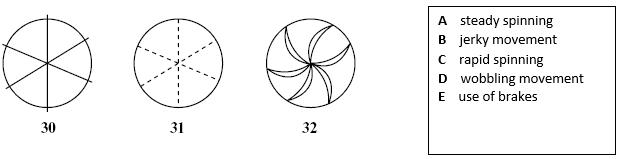
    Questions 33-39
    Complete the summary below using words from the box. Write your answers in boxes 33–39 on your answer sheet.
    NB You may use any word more than once.

    In the experiment described in Part 2, a set of word (33) ……………….. was used to investigate whether blind and sighted people perceived the symbolism in abstract (34) ……………….. in the same way. Subjects were asked which word fitted best with a circle and which with a square. From the (35) ……………….. volunteers, everyone thought a circle fitted ‘soft’ while a square fitted ‘hard’. However, only 51% of the (36) ……………….. volunteers assigned a circle to (37) ………………… When the test was later repeated with (38) ……………….. volunteers, it was found that they made (39) ……………….. choices.

    associationsblinddeephardhundred
    identicalpairsshapessightedsimilar
    shallowsoftwords

    Question 40
    Choose the correct letter, A, B, C or D. Write your answer in box 40 on your answer sheet.

    Which of the following statements best summarises the writer’s general conclusion?
    A The blind represent some aspects of reality differently from sighted people.
    B The blind comprehend visual metaphors in similar ways to sighted people.
    C The blind may create unusual and effective symbols to represent reality.
    D The blind may be successful artists if given the right training.

  • IELTS Reading Practice Test – Exercise 54

    Wildfires

    A Wildfires are usually the product of human negligence. Humans start about 90% of wild fires and lightning causes the other 10%. Regular causes for wildfires include arson, camping fires, throwing away cigarettes, burning rubbish, and playing with fireworks or matches. Once begun, wildfires can spread at a rate of up to 23 kph and, as a fire spreads over a landscape, it could undertake a life of its own – doing different things to keep itself going, even creating other blazes by throwing cinders miles away.

    Three components are necessary to start a fire: oxygen, fuel and heat. These three make up “the fire triangle” and fire fighters frequently talk about this when they are attempting to put out blazes. The theory is that if the fire fighters can remove one of the triangle pillars, they can take control of and eventually put out the fire.

    B The speed at which wildfires spread depends on the fuel around them. Fuel is any living or dead material that will burn. Types of fuel include anything from trees, underbrush and grassland to houses. The quantity of inflammable material around a fire is known as “the fuel load” and is determined by the amount of available fuel per unit area, usually tons per acre. How dry the fuel is can also influence how fires behave. When the fuel is very dry, it burns much more quickly and forms fires that are much harder to control.

    Basic fuel characteristics affecting a fire are size and shape, arrangement and moisture, but with wildfires, where fuel usually consists of the same type of material, the main factor influencing ignition time is the ratio of the fuel’s total surface area to its volume. Because the surface area of a twig is not much bigger than its volume, it ignites rapidly. However, a tree’s surface area is much smaller than its volume, so it requires more time to heat up before ignition.

    C Three weather variables that affect wildfires are temperature, wind and moisture. Temperature directly influences the sparking of wildfires, as heat is one of the three pillars of the fire triangle. Sticks, trees and underbrush on the ground receive heat from the sun, which heats and dries these potential fuels. Higher temperatures allow fuels to ignite and burn more quickly and add to the speed of a wildfire’s spread. Consequently, wildfires tend to rage in the afternoon, during the hottest temperatures.

    The biggest influence on a wildfire is probably wind and this is also the most unpredictable variable. Winds provide fires with extra oxygen, more dry fuel, and wind also makes wildfires spread more quickly. Fires also create winds of their own that can be up to ten times faster than the ambient wind. Winds can even spread embers that can generate additional fires, an event known as spotting. Winds also change the course of fires, and gusts can take flames into trees, starting a “crown fire”. Humidity and precipitation provide moisture that can slow fires down and reduce their intensity, as it is hard for fuel to ignite if it has high moisture levels. Higher levels of humidity mean fewer wildfires.

    D Topography can also hugely influence wildfire behaviour. In contrast to fuel and weather, topography hardly changes over time and can help or hamper the spread of a wildfire. The principal topographical factor relating to wildfires is slope. As a rule, fires move uphill much faster than downhill and the steeper the slope, the quicker fires move. This is because fires move in the same direction of the ambient wind, which generally blows uphill. Moreover, the fire can preheat fuel further uphill as smoke and heat rise in that direction. On the other hand, when the fire reaches the top of a hill, it has to struggle to come back down.

    E Each year thousands of fire fighters risk their lives in their jobs. Elite fire fighters come in two categories: Hotshots and Smokejumpers. Operating in 20 man units, the key task of hotshots is to construct firebreaks around fires. A firebreak is a strip of land with all potential fuel removed. As their name suggests, smokejumpers jump out of aircraft to reach smaller fires situated in inaccessible regions. They attempt to contain these smaller fires before they turn into bigger ones.

    As well as constructing firebreaks and putting water and fire retardant on fires, fire fighters also use “backfires”. Backfires are created by fire fighters and burn towards the main fire incinerating any potential fuel in its path. Fire fighters on the ground also receive extensive support from the air with tankers dropping thousands of gallons of water and retardant. Dropped from planes and helicopters, retardant is a red chemical containing phosphate fertilizer, which slows and cools fires.

    Questions 1-4
    Reading Passage 1 has 5 paragraphs (A – E). From the list of headings below choose the most suitable headings for paragraphs B – E. Write the appropriate number (i – viii) in boxes 1 – 4 on your answer sheet.
    NB There are more headings than paragraphs, so you will not use them all.

    Example Paragraph A            iii

    List of headings

    i Climate Conditions
    ii Solutions from the Air
    iii Fire Starters
    iv Battling the Blaze
    v The Lie of the Land
    vi Rain – The Natural Saviour
    vii Fuelling the Flames
    viii Fires and Trees

    1 Paragraph B
    2 Paragraph C
    3 Paragraph D
    4 Paragraph E

    Questions 5-9
    Using NO MORE THAN THREE WORDS from Reading Passage 2, answer the following questions.
    Write your answers in boxes 5 – 9 on your answer sheet.

    6 What is measured in tons per acre?
    7 When do wildfires burn at their fiercest?
    8 What can travel in the wind to create fires at some distance from the initial fire?
    9 Name a method using an additional fire that fire fighters use to control wild fires.

    Questions 10-13
    Complete each of the following statements (Questions 10 – 13) with words taken from Reading Passage 1.
    Write NO MORE THAN THREE WORDS for each answer.

    10 The most important factor in how quickly a wildfire catches fire is the surface to volume………………….
    11 The most significant weather factor to affect wildfires’ actions is………………………
    12 Fires on the tops of trees are known as…………………………
    13 Wildfires usually travel much faster……………………….because of the typical direction of prevailing winds.

    Problems with Water

    Nearly half the world’s population will experience critical water shortages by 2025, according to the United Nations (UN). Wars over access to water are a rising possibility in this century and the main conflicts in Africa during the next 25 years could be over this most precious of commodities, as countries fight for access to scarce resources. “Potential water wars are likely in areas where rivers and lakes are shared by more than one country,” says Mark Evans a UN worker. Evans predicts that “population growth and economic development will lead to nearly one in two people in Africa living in countries facing water scarcity or what is known as ‘water stress’ within 25 years.” Water scarcity is defined as less than 1,000 cubic metres of water available per person per year, while water stress means less than 1,500 cubic metres of water is available per person per year. The report says that by 2025, 12 more African countries will join the 13 that already suffer from water stress or water scarcity. What makes the water issue even more urgent is that demand for water will grow increasingly fast as larger areas are placed under crops and economic development. Evans adds that “the strong possibility that the world is experiencing climate change also adds to this urgency.”

    How to deal with water shortages is in the forefront of the battle between environmental activists on the one hand and governments and construction firms on the other. At the recent World Summit on Sustainable Development in Johannesburg activists continued their campaign to halt dam construction, while many governments were outraged about a vocal minority thwarting their plans.

    One of the UN’s eight millennium development goals is to halve the proportion of people without “sustainable” access to safe drinking water by 2015. How to ensure this happens was one of the big issues of the summit. Much of the text on this was already agreed, but one of the unresolved issues in the implementation plan was whether the goal on water would be extended to cover sanitation. The risks posed by water-borne diseases in the absence of sanitation facilities means the two goals are closely related. Only US negotiators have been resisting the extension of goals to include sanitation due to the financial commitment this would entail. However, Evans says the US is about to agree to this extension. This agreement could give the UN a chance to show that in one key area the world development agenda was advanced in Johannesburg.

    But the UN has said Johannesburg was not about words alone, but implementation. A number of projects and funding initiatives were unveiled at the summit. But implementation is always harder, as South Africa has experienced in its water programme. Graham Bennetts, a water official in the South African government explains: “Since the 1994 elections government has provided easy access to water to 7 million people, but extending this to a further 7 million and ensuring this progress is sustainable is one of South Africa’s foremost implementation challenges.” In South Africa, access to water is defined as 25 litres a person daily, within a distance of 200m from where they live. “Although South Africa’s feat far exceeds the UN millennium goal on water supply, severe constraints on local government capacity make a more rapid expansion difficult,” says Bennetts.

    For some of those who have only recently been given ready access to water, their gains are under threat as the number of cut-offs by municipalities for non-payment rise, says Liane Greef of the Environmental Monitoring Group. Greef is programme manager for Water Justice in southern Africa. Those who have their water supply cut off also automatically forfeit their right to 6000 free litres of water for a family a month under South Africa’s “water for all” policy. In the face of continued increases in unemployment, payment for water and other utilities has the potential to fast undo government’s high profile feats in delivery since 1994.

    It is also the way of ensuring sufficient water supply and its management that will increasingly become a political battleground in South Africa. Water Affairs director-general Mike Muller says South Africa is near the end of its dam-building programme. However, there are big projects proposed elsewhere in southern Africa that could possibly be halted by activists who could bring pressure on funding agencies such as the World Bank. Greef says her group will campaign during the summit against the proposed Skuifraam Dam, which would be built near Franschhoek to supply additional water to Cape Town.

    Rather than rely on new dam construction, the city should ensure that water is used wisely at all times rather than only in dry spells, Greef says. Another battleground for her group is over the privatisation of water supply, she says. Water supply, she insists, is best handled in the public interest by accountable government.

    There is increasing hope from advances in technology to deal with water shortages. It is agricultural production which takes up about 90% of water consumed for human purposes, says the UN. To lower agricultural demand for water the Sri Lanka-based International Water Management Institute is researching ways of obtaining “more crop per drop” through the development of drought resistant crops, as well as through better water management techniques. One of the institute’s research sites is the Limpopo River basin. According to the institute’s director-general, Frank Rijsbereman, rice growers in China use a quarter of the water a ton of produce to those in South Africa. The institute hopes the “green revolution” in crop productivity will soon be matched by the “blue revolution” in improving water utilisation in agriculture.

    Questions 14-21
    Match the views (14-21) with the people listed below.

    14 Water needs to be utilised more prudently by some people.
    15 South Africa has almost completed its plans for building dams.
    16 Local government has excluded some South African households from getting free water for not meeting their bills.
    17 The World Summit in Johannesburg will soon have its aims on hygiene agreed among all participants.
    18 Faster development of water supply in South Africa is limited by the facilities of community administrations.
    19 Water use is more efficient than in South Africa in some foreign food production.
    20 Government should be answerable for water delivery and not private companies.
    21 The water question’s importance has been increased due to the risk of global weather temperature rises.

    MM      Mike Muller
    FR        Frank Rijsbereman
    ME       Mark Evans
    LG        Liane Greef
    GB       Graham Bennetts

    Questions 22-27
    Read the passage about problems with water again and look at the statements below.
    In boxes 22 – 27 on your answer sheet write:

    TRUE                 if the statement is true
    FALSE               if the statement is false
    NOT GIVEN    if the information is not given in the passage

    22 Some African countries are currently at war over water resources.
    23 A recent report says by 2025 that 25 African countries will suffer from water scarcity alone.
    24 Vocal environment activists were arrested at the World Summit.
    25 Questions at the World Summit over including water sanitation have not yet been agreed.
    26 The World Summit had many good ideas but had little contribution on how to put the ideas into practice.
    27 Plants are being introduced that can flourish with little water.

    The History of Papermaking in the United Kingdom

    The first reference to a paper mill in the United Kingdom was in a book printed by Wynken de Worde in about 1495. This mill belonged to a certain John Tate and was near Hertford. Other early mills included one at Dartford, owned by Sir John Speilman, who was granted special privileges for the collection of rags by Queen Elizabeth and one built in Buckinghamshire before the end of the sixteenth century. During the first half of the seventeenth century, mills were established near Edinburgh, at Cannock Chase in Staffordshire, and several in Buckinghamshire, Oxfordshire and Surrey. The Bank of England has been issuing bank notes since 1694, with simple watermarks in them since at least 1697. Henri de Portal was awarded the contract in December 1724 for producing the Bank of England watermarked bank-note paper at Bere Mill in Hampshire. Portals have retained this contract ever since but production is no longer at Bere Mill.

    There were two major developments at about the middle of the eighteenth century in the paper industry in the UK. The first was the introduction of the rag engine or hollander, invented in Holland sometime before 1670, which replaced the stamping mills, which had previously been used, for the disintegration of the rags and beating of the pulp. The second was in the design and construction of the mould used for forming the sheet. Early moulds had straight wires sewn down on to the wooden foundation, this produced an irregular surface showing the characteristic “laid” marks, and, when printed on, the ink did not give clear, sharp lines. Baskerville, a Birmingham printer, wanted a smoother paper. James Whatman the Elder developed a woven wire fabric, thus leading to his production of the first woven paper in 1757.

    Increasing demands for more paper during the late eighteenth and early nineteenth centuries led to shortages of the rags needed to produce the paper. Part of the problem was that no satisfactory method of bleaching pulp had yet been devised, and so only white rags could be used to produce white paper. Chlorine bleaching was being used by the end of the eighteenth century, but excessive use produced papers that were of poor quality and deteriorated quickly. By 1800 up to 24 million pounds of rags were being used annually, to produce 10,000 tons of paper in England and Wales, and 1000 tons in Scotland, the home market being supplemented by imports, mainly from the continent. Experiments in using other materials, such as sawdust, rye straw, cabbage stumps and spruce wood had been conducted in 1765 by Jacob Christian Schaffer. Similarly, Matthias Koops carried out many experiments on straw and other materials at the Neckinger Mill, Bermondsey around 1800, but it was not until the middle of the nineteenth century that pulp produced using straw or wood was utilised in the production of paper.

    By 1800 there were 430 (564 in 1821) paper mills in England and Wales (mostly single vat mills), under 50 (74 in 1823) in Scotland and 60 in Ireland, but all the production was by hand and the output was low. The first attempt at a paper machine to mechanise the process was patented in 1799 by Frenchman Nicholas Louis Robert, but it was not a success. However, the drawings were brought to England by John Gamble in 1801 and passed on to the brothers Henry and Sealy Fourdrinier, who financed the engineer Henry Donkin to build the machine. The first successful machine was installed at Frogmore, Hertfordshire, in 1803. The paper was pressed onto an endless wire cloth, transferred to a continuous felt blanket and then pressed again. Finally it was cut off the reel into sheets and loft dried in the same way as hand made paper. In 1809 John Dickinson patented a machine that that used a wire cloth covered cylinder revolving in a pulp suspension, the water being removed through the centre of the cylinder and the layer of pulp removed from the surface by a felt covered roller (later replaced by a continuous felt passing round a roller). This machine was the forerunner of the present day cylinder mould or vat machine, used mainly for the production of boards. Both these machines produced paper as a wet sheet, which require drying after removal from the machine, but in 1821 T B Crompton patented a method of drying the paper continuously, using a woven fabric to hold the sheet against steam heated drying cylinders. After it had been pressed, the paper was cut into sheets by a cutter fixed at the end of the last cylinder.

    By the middle of the nineteenth century the pattern for the mechanised production of paper had been set. Subsequent developments concentrated on increasing the size and production of the machines. Similarly, developments in alternative pulps to rags, mainly wood and esparto grass, enabled production increases. Conversely, despite the increase in paper production, there was a decrease, by 1884, in the number of paper mills in England and Wales to 250 and in Ireland to 14 (Scotland increased to 60), production being concentrated into fewer, larger units. Geographical changes also took place as many of the early mills were small and had been situated in rural areas. The change was to larger mills in, or near, urban areas closer to suppliers of the raw materials (esparto mills were generally situated near a port as the raw material was brought in by ship) and the paper markets.

    Questions 28-34
    Do the following statements agree with the views of the writer of the reading passage on The History of Papermaking in the U.K.? In Boxes 28 – 34 write:

    YES                                  if the statement agrees with the writer
    NO                                    if the statement doesn’t agree with the writer
    NOT GIVEN                 if it is impossible to say what the writer thinks about this

    28 The printing of paper money in the UK has always been done by the same company.
    29 Early paper making in Europe was at its peak in Holland in the 18th century.
    30 18th Century developments in moulds led to the improvement of a flatter, more even paper.
    31 Chlorine bleaching proved the answer to the need for more white paper in the 18th and 19th centuries.
    32 The first mechanised process that had any success still used elements of the hand made paper-making process.
    33 Modern paper making machines are still based on John Dickinson’s 1809 patent.
    34 The development of bigger mills near larger towns was so that mill owners could take advantage of potential larger workforces.

    Questions 35-40
    Match the events (35 – 40) with the dates (A – G) listed below. Write the appropriate letters in boxes 35 – 40 on your answer sheet.

    35 Invention of the rag engine.
    36 A new method for drying paper patented.
    37 First successful machine for making paper put into production.
    38 Manufacture of the first woven paper.
    39 Watermarks first used for paper money.
    40 The first machine for making paper patented.

    Dates
    A 1803
    B 1757
    C 1821
    D 1697
    E 1799
    F 1670
    G 1694

  • IELTS Reading Practice Test – Exercise 53

    Cod In Trouble

    A In 1992, the devastating collapse of the cod stocks off the East coast of Newfoundland forced the Canadian government to take drastic measures and close the fishery. Over 40,000 people lost their jobs, communities are still struggling to recover and the marine ecosystem is still in a state of collapse. The disintegration of this vital fishery sounded a warning bell to governments around the world who were shocked that a relatively sophisticated, scientifically based fisheries management program, not unlike their own, could have gone so wrong. The Canadian government ignored warnings that their fleets were employing destructive fishing practices and refused to significantly reduce quotas citing the loss of jobs as too great a concern.

    B In the 1950s Canadian and US east coast waters provided an annual 100,000 tons in cod catches rising to 800,000 by 1970. This over fishing led to a catch of only 300,000 tons by 1975. Canada and the US reacted by passing legislation to extend their national jurisdictions over marine living resources out to 200 nautical miles and catches naturally declined to 139,000 tons in 1980. However the Canadian fishing industry took over and restarted the over fishing and catches rose again until, from 1985, it was the Canadians who were landing more than 250,000 tons of northern cod annually. This exploitation ravaged the stocks and by 1990 the catch was so low (29,000 tons) that in 1992 (12%000 tons) Canada had to ban all fishing in east coast waters. In a fishery that had for over a century yielded a quarter-million ton catches, there remained a biomass of less than 1700 tons and the fisheries department also predicted that, even with an immediate recovery, stocks need at least 15 years before they would be healthy enough to withstand previous levels of fishing.

    C The devastating fishing came from massive investment poured into constructing huge “draggers”. Draggers haul enormous nets held open by a combination of huge steel plates and heavy chains and rollers that plough the ocean bottom. They drag up anything in the way, inflicting immense damage, destroying critical habitat and contributing to the destabilization of the northern cod ecosystem. The draggers targeted huge aggregations of cod while they were spawning, a time when the fish population is highly vulnerable to capture. Excessive trawling on spawning stocks became highly disruptive to the spawning process and ecosystem. In addition, the trawling activity resulted in a physical dispersion of eggs leading to a higher fertilization failure. Physical and chemical damage to larvae caused by the trawling action also reduced their chances of survival. These draggers are now banned forever from Canadian waters.

    D Canadian media often cite excessive fishing by overseas fleets, primarily driven by the capitalist ethic, as the primary cause of the fishing out of the north Atlantic cod stocks. Many nations took fish off the coast of Newfoundland and all used deep-sea trawlers, and many often blatantly exceeded established catch quotas and treaty agreements. There can be little doubt that non North American fishing was a contributing factor in the cod stock collapse, and that the capitalist dynamics that were at work in Canada were all too similar for the foreign vessels and companies. But all of the blame cannot be put there, no matter how easy it is to do, as it does not account for the management of the resources.

    E Who was to blame? As the exploitation of the Newfoundland fishery was so predominantly guided by the government, we can argue that a fishery is not a private area, as the fisher lacks management rights normally associated with property and common property. The state had appropriated the property, and made all of the management decisions. Fishermen get told who can fish, what they can fish, and essentially, what to do with the fish once it is caught. In this regard then, when a resource such as the Newfoundland fishery collapses, it is more a tragedy of government negligence than a tragedy of the general public.

    F Following the ‘92 ban on northern cod fishing and most other species, an estimated 30 thousand people that had already lost their jobs after the 1992 Northern Cod moratorium took effect, were joined by an additional 12,000 fishermen and plant workers. With more than forty thousand people out of jobs, Newfoundland became an economic disaster area, as processing plants shut down, and vessels from the smallest dory to the monster draggers were made idle or sold overseas at bargain prices. Several hundred Newfoundland communities were devastated.

    G Europeans need only look across the North Atlantic to see what could be in store for their cod fishery. In Canada they were too busy with making plans, setting expansive goals, and then allocating fish, and lots of it, instead of making sound business plans to match fishing with the limited availability of the resource. Cod populations in European waters are now so depleted that scientists have recently warned that “all fisheries in this area that target cod should be closed.” The Canadian calamity demonstrates that we now have the technological capability to find and annihilate every commercial fish stock, in any ocean and do irreparable damage to entire ecosystems in the process. In Canada’s case, a two billion dollar recovery bill may only be a part of the total long-term costs. The costs to individuals and desperate communities now deprived of meaningful and sustainable employment is staggering.

    Questions 1-6
    Reading Passage 1 has 7 paragraphs (A – G). From the list of headings below choose the most suitable headings for paragraphs B – G.

    Example Paragraph A        iv

    List of headings
    i Factory Closures
    ii The Human Cost
    iii The Tragedy of State Mismanagement
    iv A Warning to the World
    v European Techniques
    vi Destructive Trawling Technology
    vii Lessons to be Learned
    viii The Demise of the Northern Cod
    ix Canadian Fishing Limits
    x The Breaking of Agreements
    xi Foreign Over-fishing

    1 Paragraph B
    2 Paragraph C
    3 Paragraph D
    4 Paragraph E
    5 Paragraph F
    6 Paragraph G

    Questions 7-10
    Choose the appropriate letters A – D and write them in boxes 7 – 10 on your answer sheet.

    7 The Canadian government didn’t want to reduce cod catches pre 1992 because they were worried about
    A possible rising unemployment
    B the ecological effects
    C the marine ecosystem
    D drastic measures

    8 Which graph most accurately describes Canadian cod catches from 1950 to 1992?

    9 According to Reading Passage 1, which of the following is now true about the Newfoundland fisheries?
    A Catches of 1700 tons a year only are permitted.
    B Normal fishing could start again in 2007.
    C No cod fishing is allowed but some other species can be caught.
    D Fishing with draggers will be allowed again in 2007.

    10 Who does the writer blame for the collapse of the Newfoundland cod fishery?
    A The Canadian fishing industry
    B The foreign fishing industry
    C The Canadian government
    D The US fishing industry

    Questions 11-14
    Do the following statements agree with the views of the writer of the reading passage on Cod in Trouble?
    In Boxes 11 – 14 write:

    YES                              if the statement agrees with the writer
    NO                                if the statement doesn’t agree with the writer
    NOT GIVEN             if it is impossible to say what the writer thinks about this

    11 Disruption of cod breeding was a major factor in the Newfoundland cod disaster.
    12 Foreign trawlers frequently broke the catch allowances.
    13 There was often conflict between the foreign fishermen and the Canadian authorities.
    14 Europe does not face the seriousness of the Canadian disaster.

    The Rise of Antibiotic-Resistant Infections

    A When penicillin became widely available during the Second World War, it was a medical miracle, rapidly vanquishing the biggest wartime killer – infected wounds. Discovered initially by a French medical student, Ernest Duchesne, in 1896, and then rediscovered by Scottish physician Alexander Fleming in 1928, Penicillium crippled many types of disease-causing bacteria. But just four years after drug companies began mass-producing penicillin in 1943, microbes began appearing that could resist it.

    B “There was complacency in the 1980s. The perception was that we had licked the bacterial infection problem. Drug companies weren’t working on new agents. They were concentrating on other areas, such as viral infections,” says Michael Blum, M.D., medical officer in the Food and Drug Administration’s division of anti-infective drug products. “In the meantime, resistance increased to a number of commonly used antibiotics, possibly related to overuse. In the 1990s, we’ve come to a point for certain infections that we don’t have agents available.”

    C The increased prevalence of antibiotic resistance is an outcome of evolution. Any population of organisms, bacteria included, naturally includes variants with unusual traits – in this case, the ability to withstand an antibiotic’s attack on a microbe. When a person takes an antibiotic, the drug kills the defenceless bacteria, leaving behind – or “selecting,” in biological terms – those that can resist it. These renegade bacteria then multiply, increasing their numbers a million fold in a day, becoming the predominant microorganism. “Whenever antibiotics are used, there is selective pressure for resistance to occur. More and more organisms develop resistance to more and more drugs,” says Joe Cranston, Ph.D., director of the department of drug policy and standards at the American Medical Association in Chicago.

    D Disease-causing microbes thwart antibiotics by interfering with their mechanism of action. For example, penicillin kills bacteria by attaching to their cell walls, then destroying a key part of the wall. The wall falls apart, and the bacterium dies. Resistant microbes, however, either alter their cell walls so penicillin can’t bind or produce enzymes that dismantle the antibiotic. Antibiotic resistance results from gene action. Bacteria acquire genes conferring resistance in different ways. Bacterial DNA may mutate spontaneously. Drug-resistant tuberculosis arises this way. Another way is called transformation where one bacterium may take up DNA from another bacterium. Most frightening, however, is resistance acquired from a small circle of DNA called a plasmid, which can flit from one type of bacterium to another. A single plasmid can provide a slew of different resistances.

    E Many of us have come to take antibiotics for granted. A child develops a sore throat or an ear infection, and soon a bottle of pink medicine makes everything better. Linda McCaig, a scientist at the CDC, comments that “many consumers have an expectation that when they’re ill, antibiotics are the answer. Most of the time the illness is viral, and antibiotics are not the answer. This large burden of antibiotics is certainly selecting resistant bacteria.” McCaig and Peter Killeen, a fellow scientist at the CDC, tracked antibiotic use in treating common illnesses. The report cites nearly 6 million antibiotic prescriptions for sinusitis alone in 1985, and nearly 13 million in 1992. Ironically, advances in modern medicine have made more people predisposed to infection. McCaig notes that “there are a number of immunocompromised patients who wouldn’t have survived in earlier times. Radical procedures produce patients who are in difficult shape in the hospital, and there is routine use of antibiotics to prevent infection in these patients.”

    F There are measures we can take to slow the inevitable resistance. Barbara Murray, M.D., of the University of Texas Medical School at Houston writes that “simple improvements in public health measures can go a long way towards preventing infection”. Such approaches include more frequent hand washing by health-care workers, quick identification and isolation of patients with drug-resistant infections, and improving sewage systems and water purity.

    Drug manufacturers are also once again becoming interested in developing new antibiotics. The FDA is doing all it can to speed development and availability of new antibiotic drugs. “We can’t identify new agents – that’s the job of the pharmaceutical industry. But once they have identified a promising new drug, what we can do is to meet with the company very early and help design the development plan and clinical trials,” says Blum. In addition, drugs in development can be used for patients with multi-drug-resistant infections on an emergency compassionate use basis for people with AIDS or cancer, for example.” Blum adds. Appropriate prescribing is important. This means that physicians use a narrow spectrum antibiotics – those that target only a few bacterial types – whenever possible, so that resistances can be restricted. “There has been a shift to using costlier, broader spectrum agents. This prescribing trend heightens the resistance problem because more diverse bacteria are being exposed to antibiotics,” writes Killeen. So, while awaiting the next wonder drug, we must appreciate, and use correctly, the ones that we already have.

    Another problem with antibiotic use is that patients often stop taking the drug too soon, because symptoms improve. However, this merely encourages resistant microbes to proliferate. The infection returns a few weeks later, and this time a different drug must be used to treat it. The conclusion: resistance can be slowed if patients take medications correctly.

    Questions 15-21
    Match the views (15 – 21) with the people listed below.
    Write the appropriate letters in boxes 15 – 21 on your answer sheet.

    15 Antibiotics are sometimes used to only prevent infections.
    16 Choosing the correct antibiotic for particular infections is important.
    17 Today there are some bacterial infections for which we have no effective antibiotic.
    18 Untested drugs can be used on terminal patients as a last resort.
    19 Resistance develops every time an antibiotic is used.
    20 Merely washing hands can have a positive effect.
    21 Antibiotics are often impotently used against viruses.

    PK        Peter Killeen
    JC         Joe Cranston
    LM       Linda McCaig
    MB       Michael Blum
    BM      Barbara Murray

    Questions 22-27
    Reading Passage 2 has 6 paragraphs (A – F). Which paragraphs concentrate on the following information? Write the appropriate letters (A – F) in boxes 22 – 27 on your answer sheet.

    22 How antibiotic resistance happens.
    23 The survival of the fittest bacteria.
    24 Factors to consider in solving the antibiotic-resistant bacteria problem.
    25 The impact of the discovery of the first antibiotic.
    26 The misuse and overuse of antibiotics.
    27 The cessation of research into combating bacterial infections.

    Hydroelectric Power

    Hydroelectric power is America’s leading renewable energy resource. Of all the renewable power sources, it’s the most reliable, efficient, and economical. Water is needed to run a hydroelectric generating unit. It’s held in a reservoir or lake behind a dam, and the force of the water being released from the reservoir through the dam spins the blades of a turbine. The turbine is connected to the generator that produces electricity. After passing through the turbine, the water re-enters the river on the downstream side of the dam.

    Hydroelectric plants convert the kinetic energy within falling water into electricity. The energy in moving water is produced in the sun, and consequently is continually being renewed. The energy in sunlight evaporates water from the seas and deposits it on land as rain. Land elevation differences result in rainfall runoff, and permit some of the original solar energy to be harnessed as hydroelectric power. Hydroelectric power is at present the earth’s chief renewable electricity source, generating 6% of global energy and about 15% of worldwide electricity. Hydroelectric power in Canada is plentiful and provides 60% of their electrical requirements. Usually regarded as an inexpensive and clean source of electricity, most big hydroelectric projects being planned today are facing a great deal of hostility from environmental groups and local people.

    The earliest recorded use of water power was a clock, constructed around 250 BC. Since then, people have used falling water to supply power for grain and saw mills, as well as a host of other uses. The earliest use of flowing water to generate electricity was a waterwheel on the Fox River in Wisconsin in 1882.

    The first hydroelectric power plants were much more dependable and efficient than the plants of the day that were fired by fossil fuels. This led to a rise in number of small to medium sized hydroelectric generating plants located wherever there was an adequate supply of falling water and a need for electricity. As demand for electricity soared in the middle years of the 20th century, and the effectiveness of coal and oil power plants improved, small hydro plants became less popular. The majority of new hydroelectric developments were focused on giant megaprojects.

    Hydroelectric plants harness energy by passing flowing water through a turbine. The water turbine rotation is delivered to a generator, which generates electricity. The quantity of electricity that can be produced at a hydroelectric plant relies upon two variables. These variables are (1) the vertical distance that the water falls, called the “head”, and (2) the flow rate, calculated as volume over time. The amount of electricity that is produced is thus proportional to the head product and the flow rate.

    So, hydroelectric power stations can normally be separated into two kinds. The most widespread are “high head” plants and usually employ a dam to stock up water at an increased height. They also store water at times of rain and discharge it during dry times. This results in reliable and consistent electricity generation, capable of meeting demand since flow can be rapidly altered. At times of excess electrical system capacity, usually available at night, these plants can also pump water from one reservoir to another at a greater height. When there is peak electrical demand, the higher reservoir releases water through the turbines to the lower reservoir.

    “Low head” hydroelectric plants usually exploit heads of just a few meters or less. These types of power station use a weir or low dam to channel water, or no dam at all and merely use the river flow. Unfortunately their electricity production capacity fluctuates with seasonal water flow in a river.

    Until only recently people believed almost universally that hydroelectric power was an environmentally safe and clean means of generating electricity. Hydroelectric stations do not release any of the usual atmospheric pollutants emitted by power plants fuelled by fossil fuels so they do not add to global warming or acid rain. Nevertheless, recent studies of the larger reservoirs formed behind dams have implied that decomposing, flooded vegetation could give off greenhouse gases equal to those from other electricity sources.

    The clearest result of hydroelectric dams is the flooding of huge areas of land. The reservoirs built can be exceptionally big and they have often flooded the lands of indigenous peoples and destroyed their way of life. Numerous rare ecosystems are also endangered by hydroelectric power plant development.

    Damming rivers may also change the quantity and quality of water in the rivers below the dams, as well as stopping fish migrating upstream to spawn. In addition, silt, usually taken downstream to the lower parts of a river, is caught by a dam and so the river downstream loses the silt that should fertilize the river’s flood plains during high water periods.

    Theoretical global hydroelectric power is approximately four times larger than the amount that has been taken advantage of today. Most of the residual hydro potential left in the world can be found in African and Asian developing countries. Exploiting this resource would involve an investment of billions of dollars, since hydroelectric plants normally have very high building costs. Low head hydro capacity facilities on small scales will probably increase in the future as low head turbine research, and the standardization of turbine production, reduce the costs of low head hydro-electric power production. New systems of control and improvements in turbines could lead in the future to more electricity created from present facilities. In addition, in the 1950’s and 60’s when oil and coal prices were very low, lots of smaller hydroelectric plants were closed down. Future increases in the prices of fuel could lead to these places being renovated.

    Questions 28-32
    Read the passage about Hydroelectric Power again and look at the statements below.
    In boxes 28 – 32 on your answer sheet write:

    TRUE                          if the statement is true
    FALSE                        if the statement is false
    NOT GIVEN            if the information is not given in the passage

    28 Canada uses the most hydroelectric power in the world today.
    29 An early use of hydroelectric power was in the timber industry.
    30 The first hydroelectric power stations were more effective than those using competing energy sources.
    31 People have been drowned by the flooding of their traditional territory when reservoirs are created.
    32 Nowadays, agriculture below hydroelectric dams is not affected by the change in water flow.

    Questions 33-36
    Complete each of the following statements (Questions 33 – 36) with words taken from Reading Passage 3.
    Write NO MORE THAN THREE WORDS for each answer.

    33 The origin of hydroelectric power is the…………………………produced when water obeys the laws of gravity.
    34 How far water drops to the turbines in a power station is known as…………………………….
    35 A drawback to low head hydroelectric power stations is that they depend on………………….
    36 Derelict hydroelectric power stations could be……………………….in the future.

    Questions 37-40
    Using NO MORE THAN THREE WORDS from Reading Passage 3, answer the following questions.

    37 What proportion of the world’s electricity supply is provided by hydroelectric power?
    38 How is the flow rate of a hydroelectric power station quantified?
    39 When do high head power plants use surplus electricity to transfer water to a second reservoir?
    40 What underwater action can lead to the production of pollution similar to that produced by fossil fuel power stations?

  • IELTS Reading Practice Test – Exercise 52

    Cleaning up The Thames

    The River Thames, which was biologically “dead” as recently as the 1960s, is now the cleanest metropolitan river in the world, according to the Thames Water Company. The company says that thanks to major investment in better sewage treatment in London and the Thames Valley, the river that flows through the United Kingdom capital and the Thames Estuary into the North Sea is cleaner now than it has been for 130 years. The Fisheries Department, who are responsible for monitoring fish levels in the River Thames, has reported that the river has again become the home to 115 species of fish including sea bass, flounder, salmon, smelt, and shad. Recently, a porpoise was spotted cavorting in the river near central London.

    But things were not always so rosy. In the 1950s, sewer outflows and industrial effluent had killed the river. It was starved of oxygen and could no longer support aquatic life. Until the early 1970s, if you fell into the Thames you would have had to be rushed to hospital to get your stomach pumped. A clean-up operation began in the 1960s. Several Parliamentary Committees and Royal Commissions were set up, and, over time, legislation has been introduced that put the onus on polluters – effluent- producing premises and businesses – to dispose of waste responsibly. In 1964 the Greater London Council (GLC) began work on greatly enlarged sewage works, which were completed in 1974.

    The Thames clean up is not over though. It is still going on, and it involves many disparate arms of government and a wide range of non-government stakeholder groups, all representing a necessary aspect of the task. In London’s case, the urban and non-urban London boroughs that flank the river’s course each has its own reasons for keeping “their” river nice. And if their own reasons do not hold out a sufficiently attractive carrot, the government also wields a compelling stick. The 2000 Local Government Act requires each local borough to “prepare a community strategy for promoting or improving the economic, social and environmental well-being of their area.” And if your area includes a stretch of river, that means a sustainable river development strategy.

    Further legislation aimed at improving and sustaining the river’s viability has been proposed. There is now legislation that protects the River Thames, either specifically or as part of a general environmental clause, in the Local Government Act, the London Acts, and the law that created the post of the mayor of London. And these are only the tip of an iceberg that includes industrial, public health and environmental protection regulations. The result is a wide range of bodies officially charged, in one way or another, with maintaining the Thames as a public amenity. For example, Transport for London – the agency responsible for transport in the capital – plays a role in regulating river use and river users. They now are responsible for controlling the effluents and rubbish coming from craft using the Thames. This is done by officers on official vessels regularly inspectiing craft and doing spot checks. Another example is how Thames Water (TW) has now been charged to reduce the amount of litter that finds its way into the tidal river and its tributaries.

    TW’s environment and quality manager, Dr. Peter Spillett, said: “This project will build on our investment which has dramatically improved the water quality of the river. London should not be spoiled by litter which belongs in the bin not the river.” Thousands of tons of rubbish end up in the river each year, from badly stored waste, people throwing litter off boats, and rubbish in the street being blown or washed into the river. Once litter hits the water it becomes too heavy to be blown away again and therefore the rivers act as a sink in the system. While the Port of London already collects up to 3,000 tons of solid waste from the tideway every year, Thames Water now plans to introduce a new device to capture more rubbish floating down the river. It consists of a huge cage that sits in the flow of water and gathers the passing rubbish. Moored just offshore in front of the Royal Naval College at Greenwich, south-east London, the device is expected to capture up to 20 tons of floating litter each year. If washed out to sea, this rubbish can kill marine mammals, fish and birds. This machine, known as the Rubbish Muncher, is hoped to be the first of many, as the TW is now looking for sponsors to pay for more cages elsewhere along the Thames. Monitoring of the cleanliness of the River Thames in the past was the responsibility of a welter of agencies – British Waterways, Port of London Authority, the Environment Agency, the Health and Safety Commission, Thames Water – as well as academic departments and national and local environment groups. If something was not right, someone was bound to call foul and hold somebody to account, whether it was the local authority, an individual polluter or any of the many public and private sector bodies that bore a share of the responsibility for maintaining the River Thames as a public amenity. Although they will all still have their part to play, there is now a central department in the Environment Agency, which has the remit of monitoring the Thames. This centralisation of accountability will, it is hoped, lead to more efficient control and enforcement.

    Questions 1 – 6
    Some of the actions taken to clean up the River Thames are listed below.
    The writer gives these actions as examples of things that have been done by various agencies connected with the River Thames. Match each action with the agency responsible for doing it.

    Actions to clean up the river Thames

    A Operating the Rubbish Muncher
    B Creating Community Strategies
    C Monitoring the Cleanliness of the River Thames
    D Monitoring Fish Levels
    E Collecting Solid Waste from the Tideway
    F Creating Enlarged Sewage Works
    G Controlling the River Thames’ Traffic

    Example: The fisheries department                  Answer D

    1 The Environment Agency
    2 Transport for London
    3 The Greater London Council
    4 Thames Water
    5 Port of London
    6 Local Boroughs

    Questions 7-14
    Do the following statements agree with passage on Cleaning up the Thames? In Boxes 7 – 14 write:

    YES                          if the statement agrees with the writer
    NO                            if the statement doesn’t agree with the writer
    NOT GIVEN         if it is impossible to say what the writer thinks about this

    7 The Thames is now cleaner than it was in 1900.
    8 Swimming in the Thames now poses no health hazards.
    9 It is now mainly the responsibility of those who pollute the Thames to clean their waste up.
    10 All local London boroughs are now partly responsible for keeping the Thames clean.
    11 Transport for London now employs a type of River Police to enforce control of their regulations.
    12 Rubbish Munchers are now situated at various locations on the Thames.
    13 Previously no one department had overall responsibility or control for monitoring the cleanliness of the Thames.
    14 British Waterways will no longer have any part in keeping the Thames clean.

    Reading Passage Two

    If it weren’t for nicotine, people wouldn’t smoke tobacco. Why? Because of the more than 4000 chemicals in tobacco smoke, nicotine is the primary one that acts on the brain, altering people’s moods, appetites and alertness in ways they find pleasant and beneficial. Unfortunately, as it is widely known, nicotine has a dark side: it is highly addictive. Once smokers become hooked on it, they must get their fix of it regularly, sometimes several dozen times a day. Cigarette smoke contains 43 known carcinogens, which means that long-term smoking can amount to a death sentence. In the US alone, 420,000 Americans die every year from tobacco-related illnesses.

    Breaking nicotine addiction is not easy. Each year, nearly 35 million people make a concerted effort to quit smoking. Sadly, less than 7 percent succeed in abstaining for more than a year; most start smoking again within days. So what is nicotine and how does it insinuate itself into the smoker’s brain and very being?

    The nicotine found in tobacco is a potent drug and smokers, and even some scientists, say it offers certain benefits. One is enhance performance. One study found that non-smokers given doses of nicotine typed about 5 percent faster than they did without it. To greater or lesser degrees, users also say nicotine helps them to maintain concentration, reduce anxiety, relieve pain, and even dampen their appetites (thus helping in weight control). Unfortunately, nicotine can also produce deleterious effects beyond addiction. At high doses, as are achieved from tobacco products, it can cause high blood pressure, distress in the respiratory and gastrointestinal systems and an increase in susceptibility to seizures and hypothermia.

    First isolated as a compound in 1828, in its pure form nicotine is a clear liquid that turns brown when burned and smells like tobacco when exposed to air. It is found in several species of plants, including tobacco and, perhaps surprisingly, in tomatoes, potatoes, and eggplant (though in extremely low quantities that are pharmacologically insignificant for humans).

    As simple as it looks, the cigarette is highly engineered nicotine delivery device. For instance, when tobacco researchers found that much of the nicotine in a cigarette wasn’t released when burned but rather remained chemically bound within the tobacco leaf, they began adding substances such as ammonia to cigarette tobacco to release more nicotine. Ammonia helps keep nicotine in its basic form, which is more readily vaporised by the intense heat of the burning cigarette than the acidic form. Most cigarettes for sale in the US today contain 10 milligrams or more of nicotine. By inhaling smoke from a lighted cigarette, the average smoker takes 1 or 2 milligrams of vaporised nicotine per cigarette. Today we know that only a miniscule amount of nicotine is needed to fuel addiction. Research shows that manufacturers would have to cut nicotine levels in a typical cigarette by 95% to forestall its power to addict. When a smoker puffs on a lighted cigarette, smoke, including vaporised nicotine, is drawn into the mouth. The skin and lining of the mouth immediately absorb some nicotine, but the remainder flows straight down into the lungs, where it easily diffuses into the blood vessels lining the lung walls. The blood vessels carry the nicotine to the heart, which then pumps it directly to the brain. While most of the effects a smoker seeks occur in the brain, the heart takes a hit as well. Studies have shown that a smoker’s first cigarette of the day can increase his or her heart rate by 10 to 20 beats a minute. Scientists have found that a smoked substance reaches the brain more quickly than one swallowed, snorted (such as cocaine powder) or even injected. Indeed, a nicotine molecule inhaled in smoke will reach the brain within 10 seconds. The nicotine travels through blood vessels, which branch out into capillaries within the brain. Capillaries normally carry nutrients but they readily accommodate nicotine molecules as well. Once inside the brain, nicotine, like most addictive drugs, triggers the release of chemicals associated with euphoria and pleasure.

    Just as it moves rapidly from the lungs into the bloodstream, nicotine also easily diffuses through capillary walls. It then migrates to the spaces surrounding neurones – ganglion cells that transmit nerve impulses throughout the nervous system. These impulses are the basis for our thoughts, feelings, and moods. To transmit nerve impulses to its neighbour, a neurone releases chemical messengers known as neurotransmitters. Like nicotine molecules, the neurotransmitters drift into the so-called synaptic space between neurones, ready to latch onto the receiving neurone and thus deliver a chemical “message” that triggers an electrical impulse.

    The neurotransmitters bind onto receptors on the surface of the recipient neurone. This opens channels in the cell surface through which enter ions, or charged atoms, of sodium. This generates a current across the membrane of the receiving cell, which completes delivery of the “message”. An accomplished mimic, nicotine competes with the neurotransmitters to bind to the receptors. It wins and, like the vanquished chemical, opens ion channels that let sodium ions into the cell. But there’s a lot more nicotine around than the original transmitter, so a much larger current spreads across the membrane. This bigger current causes increased electrical impulses to travel along certain neurones. With repeated smoking, the neurones adapt to this increased electrical activity, and the smoker becomes dependent on the nicotine.

    Questions 15-21
    Do the following statements agree with the views of the writer of Reading Passage 2? In Boxes 15 – 21 write:

    YES                         if the statement agrees with the writer
    NO                           if the statement doesn’t agree with the writer
    NOT GIVEN        if it is impossible to say what the writer thinks about this

    15 Although nicotine is probably the well-known chemical in cigarettes, it is not necessarily the one that changes the psyche of the smoker when cigarettes are smoked.
    16 In spite of the difficulties, according to the text more than thirty-five million people a year give up smoking.
    17 It has been shown that nicotine in cigarettes can improve people’s abilities to perform some actions more quickly.
    18 Added ammonia in cigarettes allows smokers to inhale more nicotine.
    19 Snorted substances reach the brain faster than injected substances.
    20 Nicotine dilates the blood vessels that carry it around the body.
    21 Nicotine molecules allow greater electrical charges to pass between neurones.

    Questions 22-26
    Using NO MORE THAN THREE WORDS OR A NUMBER from Reading Passage 2, answer the following questions.
    Write your answers in boxes 22 – 26 on your answer sheet.

    22 What is the natural colour of nicotine?
    23 By how much would cigarette companies have to cut the nicotine content in cigarettes to prevent them from being addictive?
    24 Name ONE of 2 things that first take nicotine into a smoker’s body?
    25 According to the passage, by how many beats a minute can a cigarette raise a smoker’s heart rate?
    26 What type of cell in the human body encloses neurones?

    Question 27
    From the list below choose the most suitable title for Reading Passage 2.
    A How to Quit Smoking
    B The Dangers of Smoking
    C Cell Biology
    D Why Smoking is Addictive
    E Nicotine is a Poison

    Deer Farming in Australia

    A Deer are not indigenous to Australia. They were introduced into the country during the nineteenth century under the acclimatization programs governing the introduction of exotic species of animals and birds into Australia. Six species of deer were released at various locations. The animals dispersed and established wild populations at various locations across Australia, mostly depending upon their points of release into the wild. These animals formed the basis for the deer industry in Australia today.

    Commercial deer farming in Australia commenced in Victoria in 1971 with the authorized capture of rusa deer from the Royal National Park, NSW. Until 1985, only four species of deer, two from temperate climates (red, fallow) and two tropical species (rusa, chital) were confined for commercial farming. Late in 1985, pressure from industry to increase herd numbers saw the development of import protocols. This resulted in the introduction of large numbers of red deer hybrids from New Zealand and North American elk directly from Canada. The national farmed deer herd is now distributed throughout all states although most are in New South Wales and Victoria.

    B The number of animals processed annually has continued to increase, despite the downward trend in venison prices since 1997. Of concern is the apparent increase in the number of female animals processed and the number of whole herds committed for processing. With more than 40,000 animals processed in 1998/99 and 60,000 in 1999/2000, there is justified concern that future years may see a dramatic drop in production. At least 85% of all venison produced in Australia is exported, principally to Europe. At least 90% of all velvet antler produced is exported in an unprocessed state to Asia.

    Schemes to promote Australian deer products continue to have a positive effect on sales that in turn have a positive effect on prices paid to growers. The industry appears to be showing limited signs that it is emerging from a state of depression caused by both internal and external factors that include: (i) the Asian currency downturn; (ii) the industry’s lack of competitive advantage in influential markets (particularly in respect to New Zealand competition), and; (iii) within industry processing and marketing competition for limited product volumes of venison.

    C From the formation of the Australian Deer Breeders Federation in 1979, the industry representative body has evolved through the Deer Farmers Federation of Australia to the Deer Industry Association of Australia Ltd (DIAA), which was registered in 1995. The industry has established two product development and marketing companies, the Australian Deer Horn and Co-Products Pty Ltd (ADH) and the Deer Industry Projects and Development Pty Ltd, which trades as the Deer Industry Company (DIC). ADH collects and markets Australian deer horn and co-products on behalf of Australian deer farmers. It promotes the harvest of velvet antler according to the strict quality assurance program promoted by the industry. The company also plans and co-ordinates regular velvet accreditation courses for Australian deer farmers.

    D Estimates suggest that until the early 1990s the rate of the annual increase in the number of farmed deer was up to 25%, but after 1993 this rate of increase fell to probably less than 10%. The main reasons for the decline in the deer herd growth rate at such a critical time for the market were: (i) severe drought conditions up to 1998 affecting eastern Australia during 1993-96 and (ii) the consequent slaughter of large numbers of breeding females, at very low prices. These factors combined to decrease confidence within the industry. Lack of confidence saw a drop in new investment within the industry and a lack of willingness of established farmers to expand their herds. With the development of strong overseas markets for venison and velvet and the prospect of better seasons ahead in 1996, the trends described were seen to have been significantly reversed. However, the relatively small size of the Australian herd was seen to impose undesirable restraints on the rate at which herd numbers could be expanded to meet the demands for products.

    Supply difficulties were exacerbated when the supply of products, particularly venison, was maintained by the slaughter of young breeding females. The net result was depletion of the industry’s female breeding herds.

    E Industry programs are funded by statutory levies on sales of animals for venison, velvet antler sales and the sale of live animals into export markets. The industry has a 1996 – 2000 five year plan including animal nutrition, pasture quality, carcass quality, antler harvesting, promotional material and technical bulletins. All projects have generated a significant volume of information, which compliments similar work undertaken in New Zealand and other deer farming countries.

    Major projects funded by levy funds include the Venison Market Project from 1992 to 1996. This initiative resulted in a dramatic increase in international demand for Australian venison and an increase in the domestic consumption of venison. In an effort to maintain existing venison markets in the short term and to increase them in the long term, in 1997 the industry’s top priority became the increase in size and production capacity of the national herd.

    Questions 28-32
    The reading passage on Deer Farming in Australia has 5 paragraphs (A – E).
    From the list of headings below choose the most suitable headings for paragraphs A – E.
    Write the appropriate number (i – viii) in boxes 28 – 32 on your answer sheet. NB There are more headings than paragraphs, so you will not use them all.

    List of headings
    i Industry Structures
    ii Disease Affects Production
    iii Trends in Production
    iv Government Assistance
    v How Deer Came to Australia
    vi Research and Development
    vii Asian Competition
    viii Industry Development

    28 Paragraph A
    29 Paragraph B
    30 Paragraph C
    31 Paragraph D
    32 Paragraph E

    Questions 33-37
    Read the passage about Deer Farming in Australia again and look at the statements below.
    In boxes 33 – 37 on your answer sheet write:

    TRUE                     if the statement is true
    FALSE                   if the statement is false
    NOT GIVEN        if the information is not given in Reading Passage 3

    33 Until 1985 only 2 species of the originally released Australian deer were not used for farming.
    34 Since 1985 many imported deer have been interbred with the established herds.
    35 The drop in deer numbers since 1997 led to an increase in the price of venison.
    36 Only a small amount of Australian venison production is consumed domestically.
    37 Current economic conditions in Asian countries have had positive effect on the Australian deer industry.

    Questions 38 – 40
    Complete each of the following statements (Questions 38 – 40) with words taken from Reading Passage 3. Write NO MORE THAN THREE WORDS for each answer.

    Write your answers in boxes 38 – 40 on your answer sheet.
    38 A stringent……………………….allows the Australian deer industry to maintain their excellence of product.
    39 Herd stock expansion was made difficult by the killing of…………………………to continue product supply.
    40 Foreign and home markets for Australian venison increased due to the……………………

  • IELTS Reading Practice Test – Exercise 51

    The Creativity Myth

    A It is a myth that creative people are born with their talents: gifts from God or nature. Creative genius is, in fact, latent within many of us, without our realising. But how far do we need to travel to find the path to creativity? For many people, a long way. In our everyday lives, we have to perform many acts out of habit to survive, like opening the door, shaving, getting dressed, walking to work, and so on. If this were not the case, we would, in all probability, become mentally unhinged. So strongly ingrained are our habits, though this varies from person to person, that sometimes, when a conscious effort is made to be creative, automatic response takes over. We may try, for example, to walk to work following a different route, but end up on our usual path. By then it is too late to go back and change our minds. Another day, perhaps. The same applies to all other areas of our lives. When we are solving problems, for example, we may seek different answers, but, often as not, find ourselves walking along the same well-trodden paths.

    B So, for many people, their actions and behaviour are set in immovable blocks, their minds clogged with the cholesterol of habitual actions, preventing them from operating freely, and thereby stifling creation. Unfortunately, mankind’s very struggle for survival has become a tyranny – the obsessive desire to give order to the world is a case in point. Witness people’s attitude to time, social customs and the panoply of rules and regulations by which the human mind is now circumscribed.

    C The groundwork for keeping creative ability in check begins at school. School, later university and then work, teach us to regulate our lives, imposing a continuous process of restrictions which is increasing exponentially with the advancement of technology. Is it surprising then that creative ability appears to be so rare? It is trapped in the prison that we have erected. Yet, even here in this hostile environment, the foundations for creativity are being laid; because setting off on the creative path is also partly about using rules and regulations. Such limitations are needed so that once they are learnt, they can be broken.

    D The truly creative mind is often seen as totally free and unfettered. But a better image is of a mind, which can be free when it wants, and one that recognises that rules and regulations are parameters, or barriers, to be raised and dropped again at will. An example of how the human mind can be trained to be creative might help here. People’s minds are just like tense muscles that need to be freed up and the potential unlocked. One strategy is to erect artificial barriers or hurdles in solving a problem. As a form of stimulation, the participants in the task can be forbidden to use particular solutions or to follow certain lines of thought to solve a problem. In this way they are obliged to explore unfamiliar territory, which may lead to some startling discoveries. Unfortunately, the difficulty in this exercise, and with creation itself, is convincing people that creation is possible, shrouded as it is in so much myth and legend. There is also an element of fear involved, however subliminal, as deviating from the safety of one’s own thought patterns is very much akin to madness. But, open Pandora’s box, and a whole new world unfolds before your very eyes.

    E Lifting barriers into place also plays a major part in helping the mind to control ideas rather than letting them collide at random. Parameters act as containers for ideas, and thus help the mind to fix on them. When the mind is thinking laterally, and two ideas from different areas of the brain come or are brought together, they form a new idea, just like atoms floating around and then forming a molecule. Once the idea has been formed, it needs to be contained or it will fly away, so fleeting is its passage. The mind needs to hold it in place for a time so that it can recognise it or call on it again. And then the parameters can act as channels along which the ideas can flow, developing and expanding. When the mind has brought the idea to fruition by thinking it through to its final conclusion, the parameters can be brought down and the idea allowed to float off and come in contact with other ideas.

    Questions 1-5
    Reading Passage 1 has five paragraphs, A-E.
    Which paragraph contains the following information?
    Write the correct letter A-E in boxes 1-5 on your answer sheet. NB You may use any letter more than once.

    1 the way parameters in the mind help people to be creative
    2 the need to learn rules in order to break them
    3 how habits restrict us and limit creativity
    4 how to train the mind to be creative
    5 how the mind is trapped by the desire for order

    Questions 6-10
    Choose the correct letter, A, B, C or D.

    6 According to the writer, creative people
    A are usually born with their talents
    B are born with their talents
    C are not born with their talents
    D are geniuses

    7 According to the writer, creativity is
    A a gift from God or nature
    B an automatic response
    C difficult for many people to achieve
    D a well-trodden path

    8 According to the writer
    A the human race’s fight to live is becoming a tyranny
    B the human brain is blocked with cholesterol
    C the human race is now circumscribed by talents
    D the human race’s fight to survive stifles creative ability

    9 Advancing technology
    A holds creativity in check
    B improves creativity
    C enhances creativity
    D is a tyranny

    10 According to the author, creativity
    A is common
    B is increasingly common
    C is becoming rarer and rarer
    D is a rare commodity

    Questions 11-14
    Do the following statements reflect the claims of the writer?
    In boxes 11-14 on your answer sheet write

    YES                              if the statement agrees with the information in the passage
    NO                                if the statement contradicts the information in the passage
    NOT GIVEN             if there is no information about the statement in the passage

    11 Rules and regulations are examples of parameters.
    12 The truly creative mind is associated with the need for free speech and a totally free society.
    13 One problem with creativity is that people think it is impossible.
    14 The act of creation is linked to madness.

    Locked Doors Open Access

    The word, ‘security’, has both positive and negative connotations. Most of us would say that we crave security for all its positive virtues, both physical and psychological – its evocation of the safety of home, of undying love, or of freedom from need. More negatively, the word nowadays conjures up images of that huge industry which has developed to protect individuals and property from invasion by ‘outsiders’, ostensibly malicious and intent on theft or wilful damage.

    Increasingly, because they are situated in urban areas of escalating crime, those buildings which used to allow free access to employees and other users (buildings such as offices, schools, colleges or hospitals) now do not. Entry areas which in another age were called ‘Reception’ are now manned by security staff. Receptionists, whose task it was to receive visitors and to make them welcome before passing them on to the person they had come to see, have been replaced by those whose task it is to bar entry to the unauthorized, the unwanted or the plain unappealing.

    Inside, these buildings are divided into ‘secure zones’ which often have all the trappings of combination locks and burglar alarms. These devices bar entry to the uninitiated, hinder circulation, and create parameters of time and space for user access. Within the spaces created by these zones, individual rooms are themselves under lock and key, which is a particular problem when it means that working space becomes compartmentalized.

    To combat the consequent difficulty of access to people at a physical level, we have now developed technological access. Computers sit on every desk and are linked to one another, and in many cases to an external universe of other computers, so that messages can be passed to and fro. Here too security plays a part, since we must not be allowed access to messages destined for others. And so the password was invented. Now correspondence between individuals goes from desk to desk and cannot be accessed by colleagues. Library catalogues can be searched from one’s desk. Papers can be delivered to, and received from, other people at the press of a button.

    And yet it seems that, just as work is isolating individuals more and more, organizations are recognizing the advantages of ‘team-work’; perhaps in order to encourage employees to talk to one another again. Yet, how can groups work in teams if the possibilities for communication are reduced? How can they work together if e-mail provides a convenient electronic shield behind which the blurring of public and private can be exploited by the less scrupulous? If voice-mail walls up messages behind a password? If I can’t leave a message on my colleague’s desk because his office is locked?

    Team-work conceals the fact that another kind of security, ‘job security’, is almost always not on offer. Just as organizations now recognize three kinds of physical resources: those they buy, those they lease long-term and those they rent short-term – so it is with their human resources. Some employees have permanent contracts, some have short-term contracts, and some are regarded simply as casual labour.

    Telecommunication systems offer us the direct line, which means that individuals can be contacted without the caller having to talk to anyone else. Voice-mail and the answer-phone mean that individuals can communicate without ever actually talking to one another. If we are unfortunate enough to contact organizations with sophisticated touch-tone systems, we can buy things and pay for them without ever speaking to a human being.

    To combat this closing in on ourselves we have the Internet, which opens out communication channels more widely than anyone could possibly want or need. An individual’s electronic presence on the Internet is known as a ‘Home Page’ – suggesting the safety and security of an electronic hearth. An elaborate system of 3-dimensional graphics distinguishes this very 2-dimensional medium of ‘web sites’. The nomenclature itself creates the illusion of a geographical entity, that the person sitting before the computer is travelling, when in fact the ‘site’ is coming to him. ‘Addresses’ of one kind or another move to the individual, rather than the individual moving between them, now that location is no longer geographical.

    An example of this is the mobile phone. I am now not available either at home or at work, but wherever I take my mobile phone. Yet, even now, we cannot escape the security of wanting to ‘locate’ the person at the other end. It is no coincidence that almost everyone we see answering or initiating a mobile phone-call in public begins by saying where he or she is.

    Questions 15-18
    Choose the correct letter A, B, C or D.

    15 According to the author, one thing we long for is
    A the safety of the home
    B security
    C open access
    D positive virtues

    16 Access to many buildings
    A is unauthorized
    B is becoming more difficult
    C is a cause of crime in many urban areas
    D used to be called ‘Reception’

    17 Buildings used to permit access to any users
    A but now they do not
    B and still do now
    C especially offices and schools
    D especially in urban areas

    18 Secure zones
    A do not allow access to the user
    B compartmentalise the user
    C are often like traps
    D are not accessible to everybody

    Questions 19-24
    Complete the summary below using words from the box.

    The problem of physical access to buildings has now been (19)………………………………by technology. Messages are (20)………………………………with passwords not allowing (21)…………………………to read someone else’s messages. But, while individuals are becoming increasingly (22)……………………………..socially by the way they do their job, at the same time more value is being put on (23)………………………………….However, e-mail and voice-mail have led to a (24)…………………………………opportunities for person-to-person communication.

    reducing ofcomputerdecrease inprotected
    team-workcombatsimilardeveloped
    no different fromother peoplesolvedcut-off
    overcameisolatingphysical

    Questions 25-27
    Complete the sentences below with words taken from Reading Passage 2. Use NO MORE THAN THREE WORDS for each answer.

    25 The writer does not like……………………………….
    26 An individual’s Home Page indicates their………………………………on the Internet.
    27 Devices like mobile phones mean that location is…………………………..

    Reading Passage 3

    A Between the Inishowen peninsula, north west of Derry, and the Glens of Antrim, in the east beyond the Sperrin Mountains, is found some of Western Europe’s most captivating and alluring landscape.

    B The Roe Valley Park, some 15 miles east of Derry is a prime example. The Park, like so many Celtic places, is steeped in history and legend. As the Roe trickles down through heather bogs in the Sperrin Mountains to the South, it is a river by the time it cuts through what was once called the ‘garden of the soul’ – in Celtic ‘Gortenanima’.

    C The castle of O’Cahan once stood here and a number of houses which made up the town of Limavady. The town takes its name from the legend of a dog leaping into the river Roe carrying a message, or perhaps chasing a stag. This is a wonderful place, where the water traces its way through rock and woodland; at times, lingering in brooding pools of dark cool water under the shade of summer trees, and, at others, forming weirs and leads for water mills now long gone.

    D The Roe, like all rivers, is witness to history and change. To Mullagh Hill, on the west bank of the River Roe just outside the present day town of Limavady, St Columba came in 575 AD for the Convention of Drumceatt. The world is probably unaware that it knows something of Limavady; but the town is, in fact, renowned for Jane Ross’s song Danny Boy, written to a tune once played by a tramp in the street. Limavady town itself and many of the surrounding villages have Celtic roots but no one knows for sure just how old the original settlement of Limavady is.

    E Some 30 miles along the coast road from Limavady, one comes upon the forlorn, but imposing ruin of Dunluce Castle, which stands on a soft basalt outcrop, in defiance of the turbulent Atlantic lashing it on all sides. The jagged-toothed ruins sit proud on their rock top commanding the coastline to east and west. The only connection to the mainland is by a narrow bridge. Until the kitchen court fell into the sea in 1639 killing several servants, the castle was fully inhabited. In the next hundred years so, the structure gradually fell into its present dramatic state of disrepair, stripped of its roofs by wind and weather and robbed by man of its carved stonework. Ruined and forlorn its aspect may be yet, in the haunting Celtic twilight of the long summer evenings, it is redolent of another age, another dream.

    F A mile or so to the east of the castle lies Port na Spaniagh, where the Neapolitan Galleas, Girona, from the Spanish Armada went down one dark October night in 1588 on its way to Scotland. Of the 1500-odd men on board, nine survived.

    G Even further to the east, is the Giant’s Causeway stunning coastline with strangely symmetrical columns of dark basalt – a beautiful geological wonder. Someone once said of the Causeway that it was worth seeing, but not worth going to see. That was in the days of horses and carriages, when travelling was difficult. But it is certainly well worth a visit. The last lingering moments of the twilight hours are the best time to savour the full power of the coastline’s magic; the time when the place comes into its own. The tourists are gone and if you are very lucky you will be alone. A fine circular walk will take you down to the Grand Causeway, past amphitheatres of stone columns and formations. It is not frightening, but there is a power in the place – tangible, yet inexplicable. The blackness of some nights conjure up feelings of eeriness and unease. The visitor realises his place in the scheme of the magnificent spectacle. Once experienced, it is impossible to forget the grandeur of the landscape.

    H Beyond the Causeway, connecting the mainland with an outcrop of rock jutting out of the turbulent Atlantic, is the Carrick-a-Rede Rope Bridge. When first constructed, the bridge was a simple rope handrail with widely spaced slats which was used mainly by salmon fishermen needing to travel from the island to the mainland. In time, the single handrail was replaced with a more sturdy caged bridge however, it is still not a crossing for the faint-hearted. The Bridge swings above a chasm of rushing, foaming water that seems to drag the unwary down, and away. Many visitors who make the walk one way are unable to return resulting in them being taken off the island by boat.

    Questions 28-32
    Look at the following list of places (Questions 28-32) from paragraphs A-E of reading passage 3 and their locations on the map. Match each place with its location on the map.

    28 The Sperrin Mountains
    29 Dunluce Castle
    30 Inishowen
    31 The Glens of Antrim

    Questions 33-38
    Do the following statements reflect the claims of the writer in Reading Passage 3?

    YES                          if the statement agrees with the information in the passage
    NO                            if the statement contradicts the information in the passage
    NOT GIVEN         if there is no information about the statement in the passage

    33 After 1639 the castle of Dunluce was not completely uninhabited.
    34 For the author, Dunluce Castle evokes another period of history.
    35 There were more than 1500 men on the Girona when it went down.
    36 The writer believes that the Giant’s Causeway is worth going to visit.
    37 The author recommends twilight as the best time to visit the Giant’s Causeway.
    38 The more sturdy cage added to the Carrick-a-Rede Rope Bridge has helped to increase the number of visitors to the area.

    Questions 39 and 40
    Choose the correct letter, A, B, C or D.

    39 The writer feels that the Giant’s Causeway is
    A an unsettling place
    B a relaxing place
    C a boring place
    D an exciting place

    40 Which of the following would be a good title for the passage?
    A The Roe Valley Park
    B The Giant’s Causeway
    C Going East to West
    D A leap into history

  • IELTS Reading Practice Test – Exercise 50

    The Coral Reefs Of Agatti Island

    A Agatti is one of the Lakshadweep Islands off the southwest coast of India. These islands are surrounded by lagoons and coral reefs which are in turn surrounded by the open ocean. Coral reefs, which are formed from the skeletons of minute sea creatures, give shelter to a variety of plants and animals, and therefore have the potential to provide a stream of diverse benefits to the inhabitants of Agatti Island.

    B In the first place, the reefs provide food and other products for consumption by the islanders themselves. Foods include different types of fish, octopus and molluscs, and in the case of poorer families these constitute as much as 90% of the protein they consume. Reef resources are also used for medicinal purposes. For example, the money cowrie, a shell known locally as Vallakavadi, is commonly made into a paste and used as a home remedy to treat cysts in the eye.

    C In addition, the reef contributes to income generation. According to a recent survey, 20% of the households on Agatti report lagoon fishing, or shingle, mollusc, octopus and cowrie collection as their main occupation (Hoon et al, 2002). For poor households, the direct contribution of the reef to their financial resources is significant: 12% of poor households are completely dependent on the reef for their household income, while 59% of poor households rely on the reef for 70% of their household income, and the remaining 29% for 50% of their household income.

    D Bartering of reef resources also commonly takes place, both between islanders and between islands. For example, Agatti Island is known for its abundance of octopus, and this is often used to obtain products from nearby Androth Island. Locally, reef products may be given by islanders in return for favours, such as help in constructing a house or net mending, or for other products such as rice, coconuts or fish.

    E The investment required to exploit the reefs is minimal. It involves simple, locally available tools and equipment, some of which can be used without a boat, such as the fishing practice known as Kat moodsal. This is carried out in the shallow eastern lagoon of Agatti by children and adults, close to shore at low tide, throughout the year. A small cast net, a leaf bag, and plastic slippers are all that are required, and the activity can yield 10–12 small fish (approximately 1 kg) for household consumption. Cast nets are not expensive, and all the households in Agatti own at least one. Even the boats, which operate in the lagoon and near-shore reef, are constructed locally and have low running costs. They are either small, non-mechanised, traditional wooden rowing boats, known as Thonis, or rafts, known as Tharappam.

    F During more than 400 years of occupation and survival, the Agatti islanders have developed an intimate knowledge of the reefs. They have knowledge of numerous different types of fish and where they can be found according to the tide or lunar cycle. They have also developed a local naming system or folk taxonomy, naming fish according to their shape. Sometimes the same species is given different names depending on its size and age. For example, a full grown Emperor fish is called Metti and a juvenile is called Killokam. The abundance of each species at different fishing grounds is also well known. Along with this knowledge of reef resources, the islanders have developed a wide range of skills and techniques for exploiting them. A multitude of different fishing techniques are still used by the islanders, each targeting different areas of the reef and particular species.

    G The reef plays an important role in the social lives of the islanders too, being an integral part of traditions and rituals. Most of the island’s folklore revolves around the reef and sea. There is hardly any tale or song which does not mention the traditional sailing crafts, known as Odams, the journeys of enterprising ‘heroes’, the adventures of sea fishing and encounters with sea creatures. Songs that women sing recollect women looking for returning Odams, and requesting the waves to be gentler and the breeze just right for the sails. There are stories of the benevolent sea ghost baluvam, whose coming to shore is considered a harbinger of prosperity for that year, bringing more coconuts, more fish and general well-being.

    H The reef is regarded by the islanders as common property, and all the islanders are entitled to use the lagoon and reef resources. In the past, fishing groups would obtain permission from the Amin (island head person) and go fishing in the grounds allotted by him. On their return, the Amin would be given a share of the catch, normally one of the best or biggest fish. This practice no longer exists, but there is still a code of conduct or etiquette for exploiting the reef, and common respect for this is an effective way of avoiding conflict or disputes.

    I Exploitation of such vast and diverse resources as the reefs and lagoon surrounding the island has encouraged collaborative efforts, mainly for purposes of safety, but also as a necessity in the operation of many fishing techniques. For example, an indigenous gear and operation known as Bala fadal involves 25–30 men. Reef gleaning for cowrie collection by groups of 6–10 women is also a common activity, and even today, although its economic significance is marginal, it continues as a recreational activity.

    Questions 1-9

    Reading Passage 1 has nine paragraphs A–I.
    Choose the correct heading for each paragraph from the list of headings below.

    List of Headings
    i Island legends
    ii Resources for exchange
    iii Competition for fishing rights
    iv The low cost of equipment
    v Agatti’s favourable location
    vi Rising income levels
    vii The social nature of reef occupations
    viii Resources for islanders’ own use
    ix High levels of expertise
    x Alternative sources of employment
    xi Resources for earning money
    xii Social rights and obligations

    1) Paragraph A
    2) Paragraph B
    3) Paragraph C
    4) Paragraph D
    5) Paragraph E
    6) Paragraph F
    7) Paragraph G
    8) Paragraph H
    9) Paragraph I

    Questions 10-13

    Choose the correct letter, A, B, C or D.

    10) What proportion of poor households get all their income from reef products?
    A 12%
    B 20%
    C 29%
    D 59%

    11 Kat moodsal fishing
    A is a seasonal activity.
    B is a commercial activity.
    C requires little investment.
    D requires use of a rowing boat.

    12 Which characteristic of present-day islanders do the writers describe?
    A physical strength
    B fishing expertise
    C courage
    D imagination

    13 What do the writers say about the system for using the reef on Agatti?
    A Fish catches are shared equally.
    B The reef owner issues permits.
    C There are frequent disputes.
    D There is open access.

    Urban Planning In Singapore

    British merchants established a trading post in Singapore in the early nineteenth century, and for more than a century trading interests dominated. However, in 1965 the newly independent island state was cut off from its hinterland, and so it set about pursuing a survival strategy. The good international communications it already enjoyed provided a useful base, but it was decided that if Singapore was to secure its economic future, it must develop its industry. To this end, new institutional structures were needed to facilitate, develop, and control foreign investment. One of the most important of these was the Economic Development Board (EDB), an arm of government that developed strategies for attracting investment. Thus from the outset, the Singaporean government was involved in city promotion.

    Towards the end of the twentieth century, the government realised that, due to limits on both the size of the country’s workforce and its land area, its labour-intensive industries were becoming increasingly uncompetitive. So an economic committee was established which concluded that Singapore should focus on developing as a service centre, and seek to attract company headquarters to serve South East Asia, and develop tourism, banking, and offshore activities. The land required for this service-sector orientation had been acquired in the early 1970s, when the government realised that it lacked the banking infrastructure for a modern economy. So a new banking and corporate district, known as the ‘Golden Shoe’, was planned, incorporating the historic commercial area. This district now houses all the major companies and various government financial agencies.

    Singapore’s current economic strategy is closely linked to land use and development planning. Although it is already a major city, the current development plan seeks to ensure Singapore’s continued economic growth through restructuring, to ensure that the facilities needed by future business are planned now. These include transport and telecommunication infrastructure, land, and environmental quality. A major concern is to avoid congestion in the central area, and so the latest plan deviates from previous plans by having a strong decentralisation policy. The plan makes provision for four major regional centres, each serving 800,000 people, but this does not mean that the existing central business district will not also grow. A major extension planned around Marina Bay draws on examples of other ‘world cities’, especially those with waterside central areas such as Sydney and San Francisco. The project involves major land reclamation of 667 hectares in total. Part of this has already been developed as a conference and exhibition zone, and the rest will be used for other facilities. However the need for vitality has been recognised and a mixed zoning approach has been adopted, to include housing and entertainment.

    One of the new features of the current plan is a broader conception of what contributes to economic success. It encompasses high quality residential provision, a good environment, leisure facilities and exciting city life. Thus there is more provision for low-density housing, often in waterfront communities linked to beaches and recreational facilities. However, the lower housing densities will put considerable pressure on the very limited land available for development, and this creates problems for another of the plan’s aims, which is to stress environmental quality. More and more of the remaining open area will be developed, and the only natural landscape surviving will be a small zone in the centre of the island which serves as a water catchment area. Environmental policy is therefore very much concerned with making the built environment more green by introducing more plants – what is referred to as the ‘beautification’ of Singapore. The plan focuses on green zones defining the boundaries of settlements, and running along transport corridors. The incidental green provision within housing areas is also given considerable attention.

    Much of the environmental provision, for example golf courses, recreation areas, and beaches, is linked to the prime objective of attracting business. The plan places much emphasis on good leisure provision and the need to exploit Singapore’s island setting. One way of doing this is through further land reclamation, to create a whole new island devoted to leisure and luxury housing which will stretch from the central area to the airport. A current concern also appears to be how to use the planning system to create opportunities for greater spontaneity: planners have recently given much attention to the concept of the 24-hour city and the cafe society. For example, a promotion has taken place along the Singapore river to create a cafe zone. This has included the realisation, rather late in the day, of the value of retaining older buildings, and the creation of a continuous riverside promenade. Since the relaxation in 1996 of strict guidelines on outdoor eating areas, this has become an extremely popular area in the evenings. Also, in 1998 the Urban Redevelopment Authority created a new entertainment area in the centre of the city which they are promoting as ‘the city’s one-stop, dynamic entertainment scene’.

    In conclusion, the economic development of Singapore has been very consciously centrally planned, and the latest strategy is very clearly oriented to establishing Singapore as a leading ‘world city’. It is well placed to succeed, for a variety of reasons. It can draw upon its historic roots as a world trading centre; it has invested heavily in telecommunications and air transport infrastructure; it is well located in relation to other Asian economies; it has developed a safe and clean environment; and it has utilised the international language of English.

    Questions 14-19
    Complete the summary below using words from the box.

    decentralizationagriculturetourismhygiene
    hospitalsfuelindustryservice
    tradeloansderegulationrecycling
    labourtransportentertainmentbeautification

    Singapore

    When Singapore became an independent, self-sufficient state it decided to build up its (14) ……………….., and government organisations were created to support this policy. However, this initial plan met with limited success due to a shortage of (15) ……………….. and land. It was therefore decided to develop the (16) ……………….. sector of the economy instead.

    Singapore is now a leading city, but planners are working to ensure that its economy continues to grow. In contrast to previous policies, there is emphasis on (17) ………………… In addition, land will be recovered to extend the financial district, and provide (18) ……………….. as well as housing. The government also plans to improve the quality of Singapore’s environment, but due to the shortage of natural landscapes it will concentrate instead on what it calls (19) …………………

    Questions 20-26

    Do the following statements agree with the information given in Reading Passage 2.

    In boxes 1-6 on your answer sheet, write

    TRUE                         if the statement is true according to the passage
    FALSE                       if the statement is false according to the passage
    NOT GIVEN           if the information is not given in the passage

    20) After 1965, the Singaporean government switched the focus of the island’s economy.
    21) The creation of Singapore’s financial centre was delayed while a suitable site was found.
    22) Singapore’s four regional centres will eventually be the same size as its central business district.
    23) Planners have modelled new urban developments on other coastal cities.
    24) Plants and trees are amongst the current priorities for Singapore’s city planners.
    25) The government has enacted new laws to protect Singapore’s old buildings.
    26) Singapore will find it difficult to compete with leading cities in other parts of the world.

    Reading Passage 3

    A Spice plants, such as coriander, cardamom or ginger, contain compounds which, when added to food, give it a distinctive flavour. Spices have been used for centuries in the preparation of both meat dishes for consumption and meat dishes for long-term storage. However, an initial analysis of traditional meat-based recipes indicated that spices are not used equally in different countries and regions, so we set about investigating global patterns of spice use.

    B We hypothesized initially that the benefit of spices might lie in their anti-microbial properties. Those compounds in spice plants which give them their distinctive flavours probably first evolved to fight enemies such as plant-eating insects, fungi, and bacteria. Many of the organisms which afflict spice plants attack humans too, in particular the bacteria and fungi that live on and in dead plant and animal matter. So if spices kill these organisms, or inhibit their production of toxins, spice use in food might reduce our own chances of contracting food poisoning.

    C The results of our investigation supported this hypothesis. In common with other researchers, we found that all spices for which we could locate appropriate information have some antibacterial effects: half inhibit more than 75% of bacteria, and four (garlic, onion, allspice and oregano) inhibit 100% of those bacteria tested. In addition, many spices are powerful fungicides.

    D Studies also show that when combined, spices exhibit even greater anti-bacterial properties than when each is used alone. This is interesting because the food recipes we used in our sample specify an average of four different spices. Some spices are so frequently combined that the blends have acquired special names, such as ‘chili powder’ (typically a mixture of red pepper, onion, paprika, garlic, cumin and oregano) and ‘oriental five spice’ (pepper, cinnamon, anise, fennel and cloves). One intriguing example is the French ‘quatre epices’ (pepper, cloves, ginger and nutmeg) which is often used in making sausages. Sausages are a rich medium for bacterial growth, and have frequently been implicated as the source of death from the botulism toxin, so the value of the anti-bacterial compounds in spices used for sausage preparation is obvious.

    E A second hypothesis we made was that spice use would be heaviest in areas where foods spoil most quickly. Studies indicate that rates of bacterial growth increase dramatically with air temperature. Meat dishes that are prepared in advance and stored at room temperatures for more than a few hours, especially in tropical climates, typically show massive increases in bacterial counts. Of course temperatures within houses, particularly in areas where food is prepared and stored, may differ from those of the outside air, but usually it is even hotter in the kitchen.

    F Our survey of recipes from around the world confirmed this hypothesis: we found that countries with higher than average temperatures used more spices. Indeed, in hot countries nearly every meat-based recipe calls for at least one spice, and most include many spices, whereas in cooler ones, substantial proportions of dishes are prepared without spices, or with just a few. In other words, there is a significant positive correlation between mean temperature and the average quantity of spices used in cooking.

    G But if the main function of spices is to make food safer to eat, how did our ancestors know which ones to use in the first place? It seems likely that people who happened to add spice plants to meat during preparation, especially in hot climates, would have been less likely to suffer from food poisoning than those who did not. Spice users may also have been able to store foods for longer before they spoiled, enabling them to tolerate longer periods of scarcity. Observation and imitation of the eating habits of these healthier individuals by others could spread spice use rapidly through a society. Also, families that used appropriate spices would rear a greater number of more healthy offspring, to whom spice-use traditions had been demonstrated, and who possessed appropriate taste receptors.

    H Another question which arises is why did people develop a taste for spicy foods? One possibility involves learned taste aversions. It is known that when people eat something that makes them ill, they tend to avoid that taste subsequently. The adaptive value of such learning is obvious. Adding a spice to a food that caused sickness might alter its taste enough to make it palatable again (i.e. it tastes like a different food), as well as kill the micro-organisms that caused the illness, thus rendering it safe for consumption. By this process, food aversions would more often be associated with unspiced (and therefore unsafe) foods, and food likings would be associated with spicy foods, especially in places where foods spoil rapidly. Over time people would have developed a natural preference for spicy food.

    I Of course, spice use is not the only way to avoid food poisoning. Cooking, and completely consuming wild game immediately after slaughter reduces opportunities for the growth of micro-organisms. However, this is practical only where fresh meat is abundant year-round. In areas where fresh meat is not consistently available, preservation may be accomplished by thoroughly cooking, salting, smoking, drying, and spicing meats. Indeed, salt has been used worldwide for centuries to preserve food. We suggest that all these practices have been adopted for essentially the same reason: to minimize the effects of harmful, food-borne organisms.

    Questions 27-33

    Reading Passage 3 has nine paragraphs, labelled A–I.

    Which paragraphs contain the following information?

    27) an example of a food which particularly benefits from the addition of spices.
    28) a range of methods for making food safer to eat.
    29) a comparison between countries with different climate types.
    30) an explanation of how people first learned to select appropriate spices.
    31) a method of enhancing the effectiveness of individual spices.
    32) the relative effectiveness of certain spices against harmful organisms.
    33) the possible origins of a dislike for unspiced foods.

    Questions 34-39

    Answer the questions below with words taken from Reading Passage 3.

    Use NO MORE THAN TWO WORDS for each answer.

    34) According to the writers, what might be the use of spices in cooking help people to avoid?
    35) What proportion of bacteria in food do four of the spices tested destroy?
    36) Which food often contains a spice known as ‘quatre epices’?
    37) Which types of country use the fewest number of spices in cooking?
    38) What might food aversions often be associated with?
    39) Apart from spices, which substance is used in all countries to preserve food?

    Question 40

    Choose the correct letter, A, B, C, or D.
    40) Which is the best title for Reading Passage 3?
    A The function of spices in food preparation
    B A history of food preservation techniques
    C Traditional recipes from around the world
    D An analysis of the chemical properties of spice plants

  • IELTS Reading Practice Test – Exercise 49

    Diabetes

    Here are some facts that you probably didn’t know about diabetes. It is the world’s fastest growing disease. It is Australia’s 6th leading cause of death. Over 1 million Australians have it though 50% of those are as yet unaware. Every 10 minutes someone is diagnosed with diabetes. So much for the facts but what exactly is diabetes?

    Diabetes is the name given to a group of different conditions in which there is too much glucose in the blood. Here’s what happens: the body needs glucose as its main source of fuel or energy. The body makes glucose from foods containing carbohydrate such as vegetables containing carbohydrate (like potatoes or corn) and cereal foods (like bread, pasta and rice) as well as fruit and milk. Glucose is carried around the body in the blood and the glucose level is called glycaemia. Glycaemia (blood sugar levels) in humans and animals must be neither too high nor too low, but just right. The glucose running around in the blood stream now has to get out of the blood and into the body tissues. This is where insulin enters the story. Insulin is a hormone made by the pancreas, a gland sitting just below the stomach. Insulin opens the doors that let glucose go from the blood to the body cells where energy is made. This process is called glucose metabolism. In diabetes, the pancreas either cannot make insulin or the insulin it does make is not enough and cannot work properly. Without insulin doing its job, the glucose channels are shut. Glucose builds up in the blood leading to high blood glucose levels, which causes the health problems linked to diabetes.

    People refer to the disease as diabetes but there are actually two distinctive types of the disease. Type 1 diabetes is a condition characterized by high blood glucose levels caused by a total lack of insulin. It occurs when the body’s immune system attacks the insulin-producing beta cells in the pancreas and destroys them. The pancreas then produces little or no insulin. Type 1 diabetes develops most often in young people but can appear in adults. Type 2 diabetes is the most common form of diabetes. In type 2 diabetes, either the body does not produce enough insulin or the cells ignore the insulin. Insulin is necessary for the body to be able to use sugar. Sugar is the basic fuel for the cells in the body, and insulin takes the sugar from the blood into the cells.

    The diagnosis of diabetes often depends on what type the patient is suffering from. In Type 1 diabetes, symptoms are usually sudden and sometimes even life threatening – hyperglycaemia (high blood sugar levels) can lead to comas – and therefore it is mostly diagnosed quite quickly. In Type 2 diabetes, many people have no symptoms at all, while other signs can go unnoticed, being seen as part of ‘getting older’.

    Therefore, by the time symptoms are noticed, the blood glucose level for many people can be very high. Common symptoms include: being more thirsty than usual, passing more urine, feeling lethargic, always feeling hungry, having cuts that heal slowly, itching, skin infections, bad breath, blurred vision, unexplained weight change, mood swings, headaches, feeling dizzy and leg cramps.

    At present there is no cure for diabetes, but there is a huge amount of research looking for a cure and to provide superior management techniques and products until a cure is found. Whether it’s Type 1 or Type 2 diabetes, the aim of any diabetes treatment is to get your blood glucose levels as close to the non-diabetic range as often as possible. For people with Type 1 diabetes, this will mean insulin injections every day plus leading a healthy lifestyle. For people with Type 2 diabetes, healthy eating and regular physical activity may be all that is required at first:

    Sometimes tablets and/or insulin may be needed later on. Ideally blood glucose levels are kept as close to the non-diabetic range as possible so frequent self-testing is a good idea. This will help prevent the short-term effects of very low or very high blood glucose levels as well as the possible long-term problems. If someone is dependent on insulin, it has to be injected into the body. Insulin cannot be taken as a pill. The insulin would be broken down during digestion just like the protein in food. Insulin must be injected into the fat under your skin for it to get into your blood. Diabetes can cause serious complications for patients. When glucose builds up in the blood instead of going into cells, it can cause problems. Short term problems are similar to the symptoms but long term high blood sugar levels can lead to heart attacks, strokes, kidney failure, amputations and blindness. Having your blood pressure and cholesterol outside recommended ranges can also lead to problems like heart attack and stroke and in fact 2 out of 3 people with diabetes eventually die of these complications. Young adults age 18 – 44 who get type 2 diabetes are 14 times more likely to suffer a heart attack, and are up to 30 times more likely to have a stroke than their peers without diabetes. Young women account for almost all the increase in heart attack risk, while young men are twice as likely to suffer a stroke as young women. This means that huge numbers of people are going to get heart disease, heart attacks and strokes years, sometimes even decades, before they should.

    Questions 1 – 7
    Do the following statements reflect the views of the writer in Reading Passage 1?
    In boxes 1 – 7 on your answer sheet write:

    YES                                   if the statement agrees with the information
    NO                                     if the statement contradicts the statement
    NOT GIVEN                  if there is no information on this in the passage

    1 Carbohydrate foods are the body’s source of glucose.
    2 Diabetics cannot produce insulin.
    3 Some patients develop diabetes due to faults in their own immune systems
    4 Hyperglycaemia leads to type 1 diabetes being diagnosed quite quickly.
    5 Artificial insulin is the most effective treatment for those patients requiring insulin.
    6 Frequent check ups at the doctor can drastically reduce the chances of suffering from problems related to diabetes.
    7 The majority of diabetics develop heart problems or suffer strokes.

    Questions 8-11
    Complete the following statements with the best ending from the box below.
    Write the appropriate letters A – H in boxes 8 – 11 on your answer sheet.

    8 Bizarre as it may seem, many people with diabetes…
    9 Insulin is a hormone that allows glucose to be absorbed by…
    10 Non severe type 2 diabetes can be solely treated by…
    11 Increases in diabetes related heart problems are mainly seen in…

    A a healthy lifestyleB never suffer any ill effectsC womenD people also suffering strokes
    E body cellsF the pancreasG do not realise the factH injections

    Questions 12-14
    According to the text which of the following are symptoms of diabetes?
    Choose THREE letters (A – G) and write them in boxes 12 – 14 on your answer sheet.

    A hot flushes
    B muscle pains
    C nausea
    D losing consciousness
    E tiredness
    F bleeding gums
    G dilation of the eyes

    Contaminating The Arctic

    Our perception of the Arctic region is that its distance from industrial centers keeps it pristine and clear from the impact of pollution. However, through a process known as transboundary pollution, the Arctic is the recipient of contaminants whose sources are thousands of miles away. Large quantities of pollutants pour into our atmosphere, as well as our lakes, rivers, and oceans on a daily basis. In the last 20 years, scientists have detected an increasing variety of toxic contaminants in the North, including pesticides from agriculture, chemicals and heavy metals from industry, and even radioactive fall-out from Chernobyl. These are substances that have invaded ecosystems virtually worldwide, but they are especially worrisome in the Arctic.

    Originally, Arctic contamination was largely blamed on chemical leaks, and these leaks were thought to be “small and localized.” The consensus now is that pollutants from around the world are being carried north by rivers, ocean currents, and atmospheric circulation. Due to extreme conditions in the Arctic, including reduced sunlight, extensive ice cover and cold temperatures, contaminants break down much more slowly than in warmer climates. Contaminants can also become highly concentrated due to their significantly lengthened life span in the Arctic.

    Problems of spring run-off into coastal waters during the growth period of marine life are of critical concern. Spring algae blooms easily, absorbing the concentrated contaminants released by spring melting. These algae are in turn eaten by zooplankton and a wide variety of marine life. The accumulation of these contaminants increases with each step of the food chain or web and can potentially affect northerners who eat marine mammals near the top of the food chain. Pollutants respect no borders; transboundary pollution is the movement of contaminants across political borders, whether by air, rivers, or ocean currents. The eight circumpolar nations, led by the Finnish Initiative of 1989, established the Arctic Environmental Protection Strategy (AEPS) in which participants have agreed to develop an Arctic Monitoring and Assessment Program (AMAP). AMAP establishes an international scientific network to monitor the current condition of the Arctic with respect to specific contaminants. This monitoring program is extremely important because it will give a scientific basis for understanding the scope of the problem.

    In the 1950’s, pilots traveling on weather reconnaissance flights in the Canadian high Arctic reported seeing bands of haze in the springtime in the Arctic region. It was during this time that the term “Arctic haze” was first used, referring to this smog of unknown origin. But it was not until 1972, that Dr. Glenn Shaw of the Geophysical Institute at the University of Alaska first put forth ideas of the nature and long-range origin of Arctic haze. The idea that the source was long range was very difficult for many to support. Each winter, cold, dense air settles over the Arctic. In the darkness, the Arctic seems to become more and more polluted by a buildup of mid-latitude emissions from fossil fuel combustion, smelting and other industrial processes. By late winter, the Arctic is covered by a layer of this haze the size of the continent of Africa. When the spring light arrives in the Arctic, there is a smog-like haze, which makes the region, at times, looks like pollution over such cities as Los Angeles.

    This polluted air is a well-known and well-characterized feature of the late winter Arctic environment. In the North American Arctic, episodes of brown or black snow have been traced to continental storm tracks that deliver gaseous and particulate-associated contaminants from Asian deserts and agricultural areas. It is now known that the contaminants originate largely from Europe and Asia.

    Arctic haze has been studied most extensively in Point Barrow, Alaska, across the Canadian Arctic and in Svalbard (Norway). Evidence from ice cores drilled from the ice sheet of Greenland indicates that these haze particles were not always present in the Arctic, but began to appear only in the last century. The Arctic haze particles appear to be similar to smog particles observed in industrial areas farther south, consisting mostly of sulfates mixed with particles of carbon. It is believed the particles are formed when gaseous sulfur dioxide produced by burning sulfur-bearing coal is irradiated by sunlight and oxidized to sulfate, a process catalyzed by trace elements in the air. These sulfate particles or droplets of sulfuric acid quickly capture the carbon particles, which are also floating in the air. Pure sulfate particles or droplets are colourless, so it is believed the darkness of the haze is caused by the mixed-in carbon particles.

    The impact of the haze on Arctic ecosystems, as well as the global environment, has not been adequately researched. The pollutants have only been studied in their aerosol form over the Arctic. However, little is known about what eventually happens to them. It is known that they are removed somehow. There is a good degree of likelihood that the contaminants end up in the ocean, likely into the North Atlantic, the Norwegian Sea and possibly the Bering Sea — all three very important fisheries.

    Currently, the major issue among researchers is to understand the impact of Arctic haze on global climate change. The contaminants absorb sunlight and, in turn, heat up the atmosphere. The global impact of this is currently unknown but the implications are quite powerful.

    Questions 15-21
    Read passage 2and look at the statements below. In boxes 15 – 21 on your answer sheet write:

    TRUE                        if the statement is true
    FALSE                      if the statement is false
    NOT GIVEN           if the information is not given in the passage

    15 Industry in the Arctic has increased over the last 20 years.
    16 Arctic conditions mean that the break down of pollutants is much accelerated
    17 Pollution absorbed by arctic algae can eventually affect humans.
    18 The AEPS has set up scientific stations in the Arctic to monitor pollution.
    19 Arctic pollution can sometimes resemble US urban pollution.
    20 Evidence that this smog has only occurred in the 20th Century has been found in the ice on the polar ice cap.
    21 Research has shown that aerosol arctic pollutants remain the air indefinitely.

    Questions 22-27
    Complete the summary relating to Arctic Haze below.
    Choose your answers from the box below the summary and write them in boxes 22 – 27 on your answer sheet.
    NB There are more words than spaces, so you will not use them at all.

    Theories that the origins of spring, arctic haze, first seen over the ice cap in the 1950s, came from far away were at first not (22)………………………… This haze is a smog formed in the dark, arctic winter by pollution delivered to the Arctic by storms (23)……………………………in Europe and Asia. It is known to be a recent phenomenon as proof from (24)………………………….shows it only starting to occur in the 20th Century. The smog consists of sulphates and carbon, the latter creating the (25)…………………………….of the haze. Due to lack of research, the final destination of the pollution is unknown but it probably ends up in the (26)………………………………. and therefore into the food chain. Scientists are presently more worried about the (27)…………………………effect it has on climate change.

    burningterribleice coresvalidcertain
    originatingseadestroyingtheoriesunknown
    agriculturedecidedbird lifedissipatingaccepted
    gasesdarknessairdensity
    The Story Of Coffee

    A Coffee was first discovered in Eastern Africa in an area we know today as Ethiopia. A popular legend refers to a goat herder by the name of Kaldi, who observed his goats acting unusually friskily after eating berries from a bush. Curious about this phenomenon, Kaldi tried eating the berries himself. He found that these berries gave him renewed energy.

    B The news of this energy laden fruit quickly moved throughout the region. Coffee berries were transported from Ethiopia to the Arabian Peninsula, and were first cultivated in what today is the country of Yemen. Coffee remained a secret in Arabia before spreading to Turkey and then to the European continent by means of Venetian trade merchants.

    C Coffee was first eaten as a food though later people in Arabia would make a drink out of boiling the beans for its narcotic effects and medicinal value. Coffee for a time was known as Arabian wine to Muslims who were banned from alcohol by Islam. It was not until after coffee had been eaten as a food product, a wine and a medicine that it was discovered, probably by complete accident in Turkey, that by roasting the beans a delicious drink could be made. The roasted beans were first crushed, and then boiled in water, creating a crude version of the beverage we enjoy today. The first coffee houses were opened in Europe in the 17th Century and in 1675, the Viennese established the habit of refining the brew by filtering out the grounds, sweetening it, and adding a dash of milk.

    D If you were to explore the planet for coffee, you would find about 60 species of coffee plants growing wild in Africa, Malaysia, and other regions. But only about ten of them are actually cultivated. Of these ten, two species are responsible for almost all the coffee produced in the world: Coffea Arabica and Coffea Canephora (usually known as Robusta). Because of ecological differences existing among the various coffee producing countries, both types have undergone many mutations and now exist in many sub species.

    E Although wild plants can reach 10 – 12 metres in height, the plantation one reaches a height of around four metres. This makes the harvest and flowering easier, and cultivation more economical. The flowers are white and sweet-scented like the Spanish jasmine. Flowers give way to a red, darkish berry. At first sight, the fruit is like a big cherry both in size and in colour. The berry is coated with a thin, red film (epicarp) containing a white, sugary mucilaginous flesh (mesocarp). Inside the pulp there are the seeds in the form of two beans coupled at their flat surface. Beans are in turn coated with a kind of resistant, golden yellow parchment, (called endocarp). When peeled, the real bean appears with another very thin silvery film. The bean is bluish green verging on bronze, and is at the most 11 millimetres long and 8 millimetres wide.

    F Coffee plants need special conditions to give a satisfactory crop. The climate needs to be hot-wet or hot temperate, between the Tropic of Cancer and the Tropic of Capricorn, with frequent rains and temperatures varying from 15 to 25 Degrees C. The soil should be deep, hard, permeable, well irrigated, with well-drained subsoil. The best lands are the hilly ones or from just-tilled woods. The perfect altitude is between 600 and 1200 metres, though some varieties thrive at 2000-2200 metres. Cultivation aimed at protecting the plants at every stage of growth is needed. Sowing should be in sheltered nurseries from which, after about six months, the seedlings should be moved to plantations in the rainy season where they are usually alternated with other plants to shield them from wind and excessive sunlight. Only when the plant is five years old can it be counted upon to give a regular yield. This is between 400 grams and two kilos of arabica beans for each plant, and 600 grams and two kilos for robusta beans.

    G Harvesting time depends on the geographic situation and it can vary greatly therefore according to the various producing countries. First the ripe beans are picked from the branches. Pickers can selectively pick approximately 250 to 300 pounds of coffee cherry a day. At the end of the day, the pickers bring their heavy burlap bags to pulping mills where the cherry coffee can be pulped (or wet milled). The pulped beans then rest, covered in pure rainwater to ferment overnight. The next day the wet beans are hand-distributed upon the drying floor to be sun dried. This drying process takes from one to two weeks depending on the amount of sunny days available. To make sure they dry evenly, the beans need to be raked many times during this drying time. Two weeks later the sun dried beans, now called parchment, are scooped up, bagged and taken to be milled. Huge milling machines then remove the parchment and silver skin, which renders a green bean suitable for roasting. The green beans are roasted according to the customers’ specifications and, after cooling, the beans are then packaged and mailed to customers.

    Questions 28-33
    The reading passage on The Story of Coffee has 7 paragraphs A – G.
    From the list of headings below choose the most suitable headings for paragraphs B – G.

    List of headings
    i Growing Coffee
    ii Problems with Manufacture
    iii Processing the Bean
    iv First Contact
    v Arabian Coffee
    vi Coffee Varieties
    vii Modern Coffee
    viii The Spread of Coffee
    ix Consuming Coffee
    x Climates for Coffee
    xi The Coffee Plant

    Example: Paragraph A              iv

    28 Paragraph B
    29 Paragraph C
    30 Paragraph D
    31 Paragraph E
    32 Paragraph F
    33 Paragraph G

    Questions 34-36
    Complete the labels on the diagram of a coffee bean below.
    Choose your answers from the text and write them in boxes 34 – 36 on your answer sheet.

    Questions 37-40
    Using the information in the passage, complete the flow chart below. Write your answers in boxes 37 – 40 on your answer sheet. Use NO MORE THAN THREE WORDS from the passage for each answer.

    THE COFFEE PRODUCTION PROCESS
    The coffee (e.g.)………………………is picked by hand and delivered to mills. Answer: Cherry
    The coffee cherry is pulped or (37)…………………….
    The pulped beans are left (38)…………………..to ferment in pure water.
    The wet beans are sun dried for 1 or 2 weeks to make parchment – they are (39)……………….often to ensure an even drying experience
    The parchment is then bagged and taken to be milled to make the green beans
    The green beans are then roasted to (40)…………………..
    The roasted beans are cooled
  • IELTS Reading Practice Test – Exercise 48

    The Big Cats At The Sharjah Breeding Centre

    It is one of the few places where you will be able to spot them all at the same time… the Arabian wolf, an African cheetah, an Arabian leopard, an oryx, a gazelle. These are just some of the animals, which, on the brink of extinction, are now getting a new lease of life thanks to the exemplary work being done at the Breeding Centre for Endangered Arabian Wildlife in Sharjah.

    Sharjah is one of the seven emirates that make up the United Arab Emirates. The Breeding Centre’s expertise and facilities have made it a prime destination for illegally imported animals confiscated by UAE and Sharjah authorities. In the last four years, more than 900 mammals and reptiles and 969 birds have arrived at the centre, including 25 North African cheetahs, Houbara bustard and falcons, lions, a baby Nile crocodile and a Burmese python that was left in a rental car at the airport.

    The 25 cheetahs were all imported illegally into the UAE and were intercepted at the UAE harbour and airport entry points. They nearly all arrived malnourished, dehydrated and highly stressed after long voyages stuffed into boxes, crates and suitcases. Now they are bright and full of energy. The Centre’s efforts have also been rewarded when the first cheetah mating took place at the end of 2002. Playing matchmaker with these beautiful creatures is no easy task – successful breeding requires considerable patience and intimate knowledge of each animal’s personality, and it is the result of intensive and expert management of each animal within the group as well as of the group as a whole.

    Because this group was still young and inexperienced in courtship matters, the keepers had to make the introductions only after careful planning and management, much like the lead role in a Jane Austen novel. The female cheetahs were initially intimidated by the presence of the male; however, as they advance to oestrus, the roles are reversed and the male cheetah becomes too wary to approach during the female’s most receptive phase of the cycle. It is the responsibility of the keeper therefore to monitor each individual and to be able to respond to any indication from the cheetahs that the time is right for introducing a pair. The close bond that invariably develops between the keeper and the cheetahs enables the keeper to spot even the most subtle signs from the animals in their care. The trust between keeper and animal has also allowed the opportunity to study cellular changes in the sexual organs of the females during the hormonal cycles that occur prior to reproduction.

    The Breeding Centre’s cheetahs are also participants in the European breeding programme, which aims to ensure that the genetic diversity of this endangered species is maintained and expanded by breeding as many founder animals as possible to introduce new bloodlines into the captive population. In this way, the group held at the centre plays a very important role in the future health of the international captive population, as they are potentially all new founders. Also very important for the Sharjah Breeding Centre is the leopard-breeding programme.

    The Arabian leopard, Panthera pardus nimr, is critically endangered around the world and particularly in the Arabian peninsula, where it was once found throughout the coastal mountain ranges. Activities like hunting, trapping and habitat destruction has reduced their range to a few isolated and fragmented populations in Oman, Yemen and Saudi Arabia.

    In the 1980s, a captive breeding programme was established near Muscat with the capture of three leopards in southwestern Oman. The breeding programme in the UAE was initiated by the Arabian Leopard Trust and started with the arrival of two mature specimens: a male Arabian leopard from Yemen and a female on breeding loan from Oman in 1995. The arrival of these two animals led to the construction of the Breeding Centre in which the leopard has played the role of flagship species.

    Today there are twelve leopards at the Breeding centre, eight of which have been born at the centre since the first cub in 1998. Once more, the secret to the centre’s success is the close relationship between animal and keeper. The leopard is usually shy and secretive with people around, but here they react positively to the presence of their keepers, approaching the fence so they can be talked to or scratched behind an ear.

    The bond is particularly important during breeding season, when keepers decide to introduce pairs to each other. Male leopards are known to have killed their partners on introduction, so it is essential for the keeper to understand the leopards’ behaviour to decide when it is safe to do so. The trust is also important if keepers need to enter dens to check on and monitor the cub’s growth. Leopard females have been known to kill their cubs if the dens have been disturbed, but the centre’s leopards are quite comfortable with the staff handling the new generation of cubs.

    Questions 1-8
    Use the information in the text to match the statements (1 – 8) with the animals (A – D). Write the appropriate letter (A – D) in boxes 1 – 8 on your answer sheet. Write:
    A if the statement refers to cheetahs at the Breeding Centre.
    B if the statement refers to leopards at the Breeding Centre.
    C if the statement refers to both cheetahs and leopards at the Breeding Centre.
    D If the statement refers to neither cheetahs nor leopards at the Breeding Centre.

    Example
    These animals are endangered          C

    1 These animals were smuggled into the UAE.
    2 At first these animals did not adapt to life at the Sharjah Breeding Centre
    3 These animals are regarded as the most important animal at the Centre.
    4 Half of these animals were born at the Breeding centre.
    5 These animals can be dangerous to one another.
    6 The role of the keeper is vital in the breeding programme of these animals.
    7 The first of these animals at the Breeding Centre were relatively young.
    8 It is normally difficult for humans to approach these animals.

    Questions 9-13
    Complete the summary below. Choose your answers from the box below the summary and write them in boxes 9- 12 on your answer sheet. NB There are more words than spaces, so you will not use them at all.

    SUMMARY
    The Sharjah Breeding Centre now has a variety of animals including birds, mammals and (9)………………………. As its name suggests, the Centre is primarily involved in breeding and (10)……………………….. the numbers of the species housed there whilst still maintaining the (11)……………………… of bloodlines in order to retain genetic health. In spite of problems involving the complex (12)……………………………… of the animals, a fair amount of (13)…………………………. has been achieved with North African cheetahs and Arabian leopards.

    reptilesvarietybehaviorsuccesscreating
    expandingdifficultydiversityactionhabitat
    seasonfishchangeworkingprogramme
    Insomnia – The Enemy Of Sleep

    A It is not unusual to have sleep troubles from time to time. But, if you feel you do not get enough sleep or satisfying sleep, you may have insomnia, a sleep disorder. People with insomnia have one or more of the following: difficulty falling asleep, waking up often during the night and having trouble going back to sleep, waking up too early in the morning and unrefreshing sleep. Insomnia is not defined by the number of hours you sleep every night. The amount of sleep a person needs varies. While most people need between 7 and 8 hours of sleep a night, some people do well with less, and some need more.

    B Insomnia occurs most frequently in people over age 60, in people with a history of depression, and in women, especially after menopause. Severe emotional trauma can also cause insomnia with divorced, widowed and separated people being the most likely to suffer from this sleep disorder. Stress, anxiety, illness and other sleep disorders such as restless legs syndrome are the most common causes of insomnia. An irregular work schedule, jet lag or brain damage from a stroke or Alzeimer’s disease can also cause insomnia as well as excessive use of alcohol or illicit drugs. It can also accompany a variety of mental illnesses.

    C The mechanism that induces sleep is not known. When it becomes dark, the pineal gland in the brain secretes a hormone called melatonin, which is thought to induce sleep. Exactly why sleep is necessary for good health and efficient mental functioning is unknown. We do know that sleep consists of two very different states: rapid eye movement (REM) sleep and non-REM sleep. In REM sleep, dreams occur, the eyes move under the closed lids and there is an increase in oxygen consumption, blood flow and neural activity. REM sleep occurs four or five times during a night. Beginning periods last about ten to fifteen minutes but the periods get longer as the night goes on. The periods of REM sleep alternate with longer periods of non-REM sleep, when body functions slow. Non-REM sleep has four stages. During the deepest stages (3 and 4) it is hard to rouse a sleeper. As the night goes on, the periods of non-REM sleep become progressively lighter. Sleep in stages 1 and 2 are felt to be restorative as during this time the body repairs itself utilising a hormone called somatostatin. Lack of stage 4 sleep is believed to be important in chronically painful conditions such as fibromyalgia.

    D Healthcare providers diagnose insomnia in several ways. One way is to categorize insomnia by how often it occurs. Another way is to identify the insomnia by what is causing the sleep deprivation. The two main types of insomnia have been described as Primary Insomnia and Secondary Insomnia. Primary Insomnia is a chronic condition with little apparent association with stress or a medical problem. The most common form of primary insomnia is psychophysiological insomnia. Secondary insomnia is caused by symptoms that accompany a medical condition such as anxiety, depression or pain.

    E Improving one’s sleep hygiene helps improve insomnia in all patients. Relaxing during the hour before you go to sleep and creating a comfortable environment suited for sleep can be helpful. Older people who wake up earlier than normal or have trouble falling asleep may need less sleep than they used to. Changing one’s sleep pattern, either by going to bed later or waking up earlier, can be effective in dealing with insomnia in older people. Therapy also depends on the cause and severity of the insomnia. Transient and intermittent insomnia may not require any direct action since these conditions last only a few days at a time. However, if insomnia interferes with a person’s daily activities, something should be done. Usually the best method of dealing with insomnia is by attacking the underlying cause. For example, people who are depressed often have insomnia and looking at this problem may eliminate it.

    F Not getting enough sleep can make you less productive, irritable and unable to concentrate. Lack of sleep can make it seem as if you “got up out of the wrong side of the bed.” Early morning headaches and waking up feeling as if you never went to sleep can result in frustration. Stress can cause insomnia but insomnia also increases stress. Insomnia can make driving unsafe as well. Insomnia can result in missed work, which can cause you to become less productive and miss promotions. It can leave you feeling as if you just can’t get enough done. Insomnia can also mask serious mental disorders. People with insomnia may think that not getting enough sleep is their only problem, but the insomnia may actually be one symptom of a larger disorder, such as depression. Studies show that people with insomnia are four times more likely to be depressed than people with a healthy sleeping pattern. In addition, lack of sleep can tax the heart and lead to serious conditions like heart disease. All of these are important problems that can affect every part of your life.

    G Establishing certain set routines can help insomniacs get better sleep. Examples of these routines include: going to bed and getting up at the same time every day, avoiding napping, avoiding caffeine, nicotine, alcohol and eating heavily late in the day, exercising regularly and making your bedroom comfortable in terms of the bed, noise and temperature. Insomniacs should also only use their bedroom for sleep so that their bodies associate the room with sleep. Finally, if you can’t get to sleep, don’t toss and turn all night. Get up and read or do something that is not overly stimulating until you feel really sleepy again.

    Questions 14-19
    The reading passage on Insomnia has 7 paragraphs (A – G). From the list of headings below choose the most suitable headings for paragraphs B – G. Write the appropriate number (i – xi) in boxes 14 – 19 on your answer sheet.
    NB There are more headings than paragraphs, so you will not use them all.

    Example: Paragraph A             iv

    List of headings
    i. The Role of Sleep
    ii. Insomnia Medication
    iii. Habits to Promote a Good Night’s Sleep
    iv. What is Insomnia
    v. Complications for Insomniacs
    vi. Government Action
    vii. Available Treatment for Insomnia
    viii. The Causes of Insomnia
    ix. Therapy Solutions
    x. Types of Insomnia
    xi. Current Research

    14 Paragraph B
    15 Paragraph C
    16 Paragraph D
    17 Paragraph E
    18 Paragraph F
    19 Paragraph G

    Questions 20-27
    Do the following statements agree with the views of the writer of the reading passage on Insomnia?
    In Boxes 20 – 27 write:

    YES                             if the statement agrees with the writer
    NO                               if the statement doesn’t agree with the writer
    NOT GIVEN            if it is impossible to say what the writer thinks about this

    20 Someone who only gets four hours of sleep a night must be suffering from insomnia.
    21 Travelling can cause insomnia.
    22 REM sleep is felt to be the most important for the body’s rest.
    23 Secondary insomnia is far more common than primary insomnia.
    24 Sufferers of insomnia can attend specialist sleep clinics.
    25 Many people suffering from insomnia don’t realise that they suffer from it.
    26 There is no actual correlation linking insomnia and depression.
    27 Sleeping during the day can make insomnia worse.

    Alternative Farming Methods In Oregon

    Onion growers in eastern Oregon are adopting a system that saves water and keeps topsoil in place, while producing the highest quality “super colossal” onions. Pear growers in southern Oregon have reduced their use of some of the most toxic pesticides by up to two-thirds, and are still producing top-quality pears. Range managers throughout the state have controlled the poisonous weed tansy ragwort with insect predators and saved the Oregon livestock industry up to $4.8 million a year.

    These are some of the results Oregon growers have achieved in collaboration with Oregon State University (OSU) researchers as they test new farming methods including integrated pest management (IPM). Nationwide, however, IPM has not delivered results comparable to those in Oregon. A recent U.S General Accounting Office (GAO) report indicates that while integrated pest management can result in dramatically reduced pesticide use, the federal government has been lacking in effectively promoting that goal and implementing IPM. Farmers also blame the government for not making the new options of pest management attractive. “Wholesale changes in the way that farmers control the pests on their farms is an expensive business.” Tony Brown, of the National Farmers Association says. “If the farmers are given tax breaks to offset the expenditure, then they would willingly accept the new practices.” The report goes on to note that even though the use of the riskiest pesticides has declined nationwide, they still make up more than 40 percent of all pesticides used today; and national pesticide use has risen by 40 million kilograms since 1992. “Our food supply remains the safest and highest quality on Earth but we continue to overdose our farmland with powerful and toxic pesticides and to under-use the safe and effective alternatives,” charged Patrick Leahy, who commissioned the report. Green action groups disagree about the safety issue. “There is no way that habitual consumption of foodstuffs grown using toxic chemicals of the nature found on today’s farms can be healthy for consumers,” noted Bill Bowler, spokesman for Green Action, one of many lobbyists interested in this issue.

    The GAO report singles out Oregon’s apple and pear producers who have used the new IPM techniques with growing success. Although Oregon is clearly ahead of the nation, scientists at OSU are taking the Government Accounting Office criticisms seriously. “We must continue to develop effective alternative practices that will reduce environmental hazards and produce high quality products,” said Paul Jepson, a professor of entomology at OSU and new director of OSU’s Integrated Plant Protection Centre (IPPC). The IPPC brings together scientists from OSU’s Agricultural Experiment Station, OSU Extension service, the U.S. Department of Agriculture and Oregon farmers to help develop agricultural systems that will save water and soil, and reduce pesticides. In response to the GAO report, the Centre is putting even more emphasis on integrating research and farming practices to improve Oregon agriculture environmentally and economically.

    “The GAO report criticizes agencies for not clearly communicating the goals of IPM,” said Jepson. “Our challenge is to greatly improve the communication to and from growers, to learn what works and what doesn’t. The work coming from OSU researchers must be adopted in the field and not simply languish in scientific journals.”

    In Oregon, growers and scientists are working together to instigate new practices. For example, a few years ago scientists at OSU’s Malheur Experiment Station began testing a new drip irrigation system to replace old ditches that wasted water and washed soil and fertilizer into streams. The new system cut water and fertilizer use by half, kept topsoil in place and protected water quality. In addition, the new system produced crops of very large onions, rated “super colossal” and highly valued by the restaurant industry and food processors. Art Pimms, one of the researchers at Malheur comments: “Growers are finding that when they adopt more environmentally benign practices, they can have excellent results. The new practices benefit the environment and give the growers their success.”

    OSU researchers in Malheur next tested straw mulch and found that it successfully held soil in place and kept the ground moist with less irrigation. In addition, and unexpectedly, the scientists found that the mulched soil created a home for beneficial beetles and spiders that prey on onion thrips – a notorious pest in commercial onion fields – a discovery that could reduce the need for pesticides. “I would never have believed that we could replace the artificial pest controls that we had before and still keep our good results,” commented Steve Black, a commercial onion farmer in Oregon, “but instead we have actually surpassed expectations.”

    OSU researchers throughout the state have been working to reduce dependence on broad- spectrum chemical sprays that are toxic to many kind of organisms, including humans. “Consumers are rightly putting more and more pressure on the industry to change its reliance on chemical pesticides, but they still want a picture-perfect product,” said Rick Hilton, entomologist at OSU’s Southern Oregon Research and Extension Centre, where researchers help pear growers reduce the need for highly toxic pesticides. Picture perfect pears are an important product in Oregon and traditionally they have required lots of chemicals. In recent years, the industry has faced stiff competition from overseas producers, so any new methods that growers adopt must make sense economically as well as environmentally. Hilton is testing a growth regulator that interferes with the molting of codling moth larvae. Another study used pheromone dispensers to disrupt codling moth mating. These and other methods of integrated pest management have allowed pear growers to reduce their use of organophosphates by two-thirds and reduce all other synthetic pesticides by even more and still produce top-quality pears. These and other studies around the state are part of the effort of the IPPC to find alternative farming practices that benefit both the economy and the environment.

    Questions 28-35
    Match the views (28 – 35) with the people listed below.

    28 There is a double advantage to the new techniques.
    29 Expectations of end users of agricultural products affect the products.
    30 The work on developing these alternative techniques is not finished.
    31 Eating food that has had chemicals used in its production is dangerous to our health.
    32 Changing current farming methods is not a cheap process.
    33 Results have exceeded anticipations.
    34 The research done should be translated into practical projects.
    35 The U.S. produces the best food in the world.

    TB Tony BrownPL Patrick LeahyBB Bill BowlerPJ Paul Jepson
    AP Art PimmsSB Steve BlackRH Rick Hilton

    Questions 36-40
    Read the passage about alternative farming methods in Oregon again and look at the statements below.
    In boxes 36 – 40 on your answer sheet write:

    TRUE                             if the statement is true
    FALSE                           if the statement is false
    NOT GIVEN                if the information is not given in the advertisement

    36 Integrated Pest Management has generally been regarded as a success in the US.
    37 Oregon farmers of apples and pears have been promoted as successful examples of Integrated Pest Management.
    38 The IPPC uses scientists from different organisations.
    39 Straw mulch experiments produced unplanned benefits.
    40 The apple industry is now facing a lot of competition from abroad.

  • IELTS Reading Practice Test – Exercise 47

    Ocean Acidification

    A few years ago, biologist, Victoria Fabry, saw the future of the world’s oceans in ajar. She was aboard a research ship in the North Pacific, carrying out experiments on a species of pteropod – small molluscs with shells up to a centimetre long, which swim in a way that resembles butterfly flight, propelled by small flaps. Something strange was happening in Fabry’s jars. ‘The pteropods were still swimming, but their shells were visibly dissolving,’ says Fabry. She realised that the animals’ respiration had increased the carbon dioxide (CO2) in the jars, which had been sealed for 48 hours, changing the water’s chemistry to a point where the calcium carbonate in the pteropods’ shells had started to dissolve. What Fabry had stumbled on was a hint of ‘the other CO2 problem’.

    It has taken several decades for climate change to be recognised as a serious threat. But another result of our fossil-fuel habit – ocean acidification – has only begun to be researched in the last few years. Its impact could be momentous, says Joanie Kleypas of the National Centre for Atmospheric Research in Boulder, Colorado.

    CO2 forms carbonic acid when it dissolves in water, and the oceans are soaking up more and more of it. Recent studies show that the seas have absorbed about a third of all the fossil-fuel carbon released into the atmosphere since the beginning of the industrial revolution in the mid-eighteenth century, and they will soak up much more over the next century. Yet until quite recently many people dismissed the idea that humanity could alter the acidity of the oceans, which cover 71% of the planet’s surface to an average depth of about four kilometres. The ocean’s natural buffering capacity was assumed to be capable of preventing any changes in acidity even with a massive increase in CO2 levels.

    And it is – but only if the increase happens slowly, over hundreds of thousands of years. Over this timescale, the release of carbonates from rocks on land and from ocean sediments can neutralise the dissolved CO2, just like dropping chalk in an acid. Levels of CO2 are now rising so fast that they are overwhelming the oceans’ buffering capacity.

    In 2003 Ken Caldeira of the Carnegie Institution in Stanford, and Michael Wickett at the Lawrence Livermore National Laboratory, calculated that the absorption of fossil CO2 could make the oceans more acidic over the next few centuries than they have been for 300 million years, with the possible exception of rare catastrophic events. The potential seriousness of the effect was underlined in 2005 by the work of James Zachos of the University of California and his colleagues, who studied one of those rare catastrophic events. They showed that the mass extinction of huge numbers of deep-sea creatures around 55 million years ago was caused by ocean acidification after the release of around 4500 gigatonnes of carbon. It took over 100,000 years for the oceans to return to their normal state.

    Around the same time as the Zachos paper, the UK’s Royal Society published the first comprehensive report on ocean acidification. It makes grim reading, concluding that ocean acidification is inevitable without drastic cuts in emissions. Marine ecosystems, especially coral reefs, are likely to be affected, with fishing and tourism based around reefs losing billions of dollars each year. Yet the report also stressed that there is huge uncertainty about the effects on marine life.

    The sea creatures most likely to be affected are those that make their shells or skeletons from calcium carbonate, including tiny plankton and huge corals. Their shells and skeletons do not dissolve only because the upper layers of the oceans are supersaturated with calcium carbonate. Acidification reduces carbonate ion concentrations, making it harder for organisms to build their shells or skeletons. When the water drops below the saturation point, these structures will start to dissolve. Calcium carbonate comes in two different forms, aragonite and calcite, aragonite being more soluble. So organisms with aragonite structures, such as corals, will be hardest hit.

    So far the picture looks relentlessly gloomy, but could there actually be some positive results from adding so much CO2 to the seas? One intriguing finding, says Ulf Riebesell of the Leibniz Institute of Marine Sciences in Kiel, Germany, concerns gases that influence climate. A few experiments suggest that in more acidic conditions, microbes will produce more volatile organic compounds such as dimethyl sulphide, some of which escapes to the atmosphere and causes clouds to develop. More clouds would mean cooler conditions, which could potentially slow global warming.

    Calculating the effect of ocean acidification on people and economies is virtually impossible, but it could be enormous. Take the impact on tropical corals, assuming that warming and other pressures such as pollution do not decimate them first. Reefs protect the shorelines of many countries. Acidification could start eating away at reefs just when they are needed more than ever because of rising sea levels.

    ‘No serious scientist believes the oceans will be devoid of life,’ says Caldeira. ‘Wherever there is light and nutrients something will live. A likely outcome will be a radical simplification of the ecosystem.’ Taking this and other scientists’ views into account, it seems clear that acidification will mean the loss of many species, so our children will not see the amazingly beautiful things that we can. It is important to tell them to go and see the corals now before it is too late.

    Questions 1-7
    Answer the questions below. Choose NO MORE THAN THREE WORDS AND/OR A NUMBER from the passage for each answer.

    1 What does the pteropod use to move itself through the water?
    2 Which part of the pteropods was being damaged by increased acidification?
    3 What proportion of the carbon released over the last 200 years has been taken in by the oceans?
    4 Where do carbonates enter the oceans from?
    5 How long did the oceans need to recover after the destruction of marine life by acidification 55 million years ago?
    6 Which businesses will suffer if reefs are damaged?
    7 What type of creatures make their skeletons out of aragonite?

    Questions 8-12
    Complete the flow chart below. Write NO MORE THAN TWO WORDS from the passage.

    A POSSIBLE BENEFIT FROM INCREASED CO2 LEVELS IN THE SEA
    Increased ocean acidification
    Large quantities of organic compounds made by (8)…………………..
    Transfer to (9)……………………..
    (10)……………………..are formed
    (11)………………………..temperatures
    Reduction in rate of (12)…………………..

    Question 13
    Choose the correct letter; A, B, C or D. Write the correct letter in box 13 on your answer sheet.

    13 Which of the following best summarises the writer’s view in the passage?
    A We will have to wait and see if acidification has serious effects.
    B It is clear that acidification will cause huge damage to marine life.
    C It is likely that increased CO2 will change marine ecosystems considerably.
    D The theory that increased CO2 could have positive results is believable.

    A New Fair Trade Organisation

    Trade has, so far, proved ineffective in solving the major problems faced by most nations. However, the answer to the injustices of the existing trade regime is not no trade, but fair trade.

    The existing regime forbids poor nations from following the path taken by the rich. With the exceptions of Switzerland, Belgium and the Netherlands, all the nations that have become independently wealthy did so with the help of a mechanism economists call ‘infant industry protection’: defending new sectors from foreign competition until they are big enough to compete on equal terms. The textile industry in Britain, for example, on which the Industrial Revolution was built in the nineteenth century, was nurtured and promoted by means of tariffs (or trade taxes) and the outright prohibition of competing goods. Between 1864 and 1913, the US was the most heavily protected nation on earth. Only when these countries had established technological and commercial superiority did they suddenly discover the virtues of unimpeded competition.

    For nations to develop in direct competition with countries with established industries is like learning to swim in a fast-flowing river: you are likely to be swept away and drowned long before you acquire the necessary expertise. Your competitors have experience, legal rights and established marketing networks on their side; your infant industries have none of these. It is all but impossible, in other words, for poor nations to extract money from the rich unless they can safeguard some key parts of their economies.

    Clearly, nations that are currently poor should be permitted to defend certain industries from foreign competition with the help of tariff barriers and subsidies. Rich nations, on the other hand, should be permitted neither to subsidise their industries nor to impose tariffs on imports. Nations should be forced gradually to lift their protections as they develop. So, the first function of what we might call the Fair Trade Organisation (FTO) would be to lay down the rules governing the protections and privileges permitted at different stages of development.

    A fair-trade system should, or so we should hope, slowly push the world towards genuine free trade, which is likely to be the most equitable means of governing nations’ relationships with each other. This system could provide a potent means by which the world could begin to move towards the economic equality that is an essential precondition for political equality. It would not, however, directly address some of the other critical problems that the people of poor nations confront – such as inadequate working conditions, environmental devastation and the inordinate power of the multinational corporations.

    Many campaigners in the rich world have suggested that the best way to raise standards is to discriminate, through tariffs or other measures, against imports from countries where workers or the environment are mistreated. This approach has also been advocated by trades unions seeking to protect members’ jobs from foreigners. Unsurprisingly, it is deeply resented by the very people it is supposed to help: the workers of the poor world.

    If our purpose is to regulate international trade, then it surely makes sense to address the behaviour, not of nation states, but of the multinational corporations operating between them. So a second function of the FTO could be to set the standards to which those corporations must conform. A corporation would not be permitted to trade between nations unless it could demonstrate that, at every stage of manufacture and distribution, its own operations and those of its suppliers met the necessary standards.

    If, for example, a food-processing corporation based in Europe wished to import cocoa from an African country, it would need to demonstrate that the plantation owners it bought from were not using banned pesticides, expanding into protected forests or failing to conform to whatever other standards the FTO set. The company’s performance would be assessed, at its own expense, by monitors accredited to the organisation.

    One other precondition of justice is that producers and consumers should carry their own costs, rather than dumping them on other people. The monitors deployed by the FTO could determine whether or not companies are paying a fair price for the resources they use. Companies would, among other costs, have to buy enough of a nation’s carbon quota to cover the fossil fuel they consume.

    One of the many beneficial impacts of such full-cost accounting would be that everything that could be processed in the country of origin would be. No multinational company would export logs, coffee beans or cotton, as it requires far more (costly) energy to transport these bulky resources from one place to another than would be involved in exporting the finished products – furniture, instant coffee and T-shirts (all currently manufactured on the other side of the world). Those nations which are currently locked into the export of raw materials would become the most favoured locations for manufacturing.

    Under this scheme, export growth comes to measure something quite different. At present it represents a mixture of gains and losses, which are misleadingly compounded into a single figure. The loss of natural resources is ‘added’ to the genuine addition of value provided by the application of labour. The FTO system would effectively separate these measures. The extraction and export of natural resources would in most cases be accounted as a loss. The application of human labour would be measured as a gain. Nations would be able to see immediately whether they were being enriched or impoverished through trade. To introduce these measures in the face of the resistance of the world’s most powerful governments and companies would require severe and unusual methods. But the goal of universal fair trade would permit the global economic levelling without which there can be no justice.

    Questions 14-19
    Choose the correct letter; A, B, C or D. Write the correct letter in boxes 14 – 19 on your answer sheet.

    14 The writer refers to textile production in Britain in order to
    A point out how differently industries were financed in the past.
    B show how unnecessary tariff barriers are for countries today.
    C help the reader understand how infant industry protection works.
    D compare European trade development with that of the United States.

    15 What is the writer’s main point in the third paragraph?
    A Businesses will succeed if they learn from established companies.
    B Detailed market research is often neglected in developing countries.
    C You have to be prepared to adapt your products quickly to follow fashion.
    D New industries in poor countries will probably fail without protection.

    16 According to the writer, a fair trade system could have the effect of
    A improving safety in the majority of workplaces around the world.
    B preventing the continued destruction of endangered wildlife habitats.
    C encouraging states to work together in a more even-handed way.
    D making politicians agree to more representative systems of government.

    17 What point is the writer making in the sixth paragraph?
    A The trades unions’ aim is to help foreign workers gain better conditions.
    B The trades unions are concerned about the effects of imports on local jobs.
    C Workers in poor countries are grateful for the trades unions’ support.
    D Campaigners are right to suggest imposing tariffs against bad treatment.

    18 According to the writer, what is one of the benefits of full-cost accounting?
    A Factories would be set up and jobs created in the country of origin.
    B Multinational companies would consume fewer natural resources.
    C The export of finished products around the world would decrease.
    D Countries would be able to keep their resources for the domestic market.

    19 What conclusion does the writer come to about the FTO system?
    A It would help to combat injustice in its many different forms.
    B It would be difficult to introduce but would be worth the effort.
    C States all over the world would earn more through trade as a result of it.
    D Multinationals would accept it because it measures exports more precisely.

    Questions 20-26
    Complete the summary below. Choose NO MORE THAN TWO WORDS from the passage for each answer.

    A Proposal for Regulating Multinational Corporations

    The FTO would determine the (20)………………………for the multinational corporations to follow. In this way, a multinational corporation would have to prove that all aspects of the way it produced its goods and the systems for their (21)……………………………to customers was in line with FTO requirements. Similarly it would need to satisfy the FTO that the processes employed by any (22)…………………………that it used were also acceptable. As an illustration, in order to source cocoa from Africa, a corporation would have to ensure that no illegal (23)…………………………were being used by the (24)………………………….during cultivation and that they had not taken over land from (25)………………………..It would not be sufficient for multinational corporations to say that these points had been checked. Their conduct would have to be inspected by (26)……………………………..appointed by the FTO.

    The First Antigravity Machine

    It was one of the biggest science stories of the 1990s. Even now, the facts behind it remain hotly disputed. And small wonder, for if the claims made for the small disc, the focus of the controversy, are true, it may be possible to break through one of the great barriers in the scientific world and control the most potent of cosmic forces: gravity. Huge innovations in flight and space travel could arise from that.

    The first gravity-blocking system to be taken seriously by scientists appeared in a laboratory in Tampere University of Technology, Finland. A Russian scientist named Dr Evgeny Podkletnov created a disc 275mm across, made from a substance which combined copper, barium and the ‘rare Earth metal’ called yttrium, which is known to be a high-temperature superconductor (a substance that conducts electricity without resistance). When chilled with liquid nitrogen at -196° C (a high temperature compared with other superconductors), this material loses all its electrical resistance, and can levitate (lift) in a magnetic field. That may seem amazing for a ceramic-like material – and it won a Nobel Prize for the scientists, Karl Muller and Johannes Bednorz, who first demonstrated it in the 1980s. But according to Podkletnov, the disc had another far more astounding property.

    In 1992, while experimenting with rotating superconductors, Podkletnov noticed that pipe-smoke from a nearby researcher was drifting into a vertical column above the spinning disc. Intrigued by this phenomenon, he decided to devise an experiment to investigate further. A superconductive disc, surrounded by liquid nitrogen was magnetically levitated and rotated at high speed – up to 5,000 revolutions per minute (rpm) in a magnetic field. An object was suspended from a sensitive balance above the disc. It was enclosed in a glass tube to shield it from any effects of air currents. During the course of a series of tests, Podkletnov was able to observe that the object lost a variable amount of weight from less than 0.5 percent to 2 percent of its total weight. This effect was noted with a range of materials from ceramics to wood. The effect was slight, yet the implications were revolutionary: the disc appeared to be partly shielding the object from the gravitational pull of the Earth.

    This was just the start, claimed Podkletnov. While far short of the 100 percent reduction in weight needed to send astronauts into space, for example, it was infinitely greater than the amount predicted by the best theory of gravity currently in existence: Einstein’s theory of general relativity (GR), published in 1905. According to Einstein, gravity is not some kind of ‘force field’, like magnetism, which can – in principle at least – be screened out. Instead, GR views gravity as a distortion in the very fabric of space and time, that permeates the whole cosmos. As such, any claim to have shielded objects from gravity is to defy Einstein himself.

    Podkletnov’s claims were subjected to intense scrutiny when he submitted them for publication. The UK Institute of Physics had Podkletnov’s paper checked by three independent referees, but none could find a fatal flaw. His research was set to appear in the respected Journal of Physics when events took an unexpected turn. The claims were leaked to the media, sparking world-wide coverage of his apparent breakthrough. Then Podkletnov suddenly withdrew the paper from publication and refused to talk to the press.

    Rumours began to circulate of unknown backers demanding silence until the device had been fully patented. But for many scientists the strange events were all too familiar. Podkletnov was just the latest in a long line of people to have made claims about defying gravity. Most of these have come from madcap inventors, with bizarre devices – often with some kind of spinning disc. But occasionally, respectable academics have made such claims as well.

    One instance of this occurred in the late 1980s when scientists at Tohoku University, Japan, made headlines with research suggesting that apparatus, known as a gyroscope, lost 0.01 percent of its weight when spinning at up to 13,000 rpm. Oddly the effect only appeared if the gyroscope was spinning anticlockwise – raising suspicions that some mechanical peculiarity was to blame. Attempts by scientists at the University of Colorado to replicate the effect failed.

    Then Professor Giovanni Modanese, an Italian theoretical physicist, became interested. He had read an earlier paper by Podkletnov, hinting at a connection between superconductivity and gravity shielding. Modanese wondered if the magnetic fields surrounding the superconductive disc might somehow assimilate part of the gravitational field under it. He published some calculations based on his idea in 1995 – and soon discovered that taking ‘antigravity’ seriously was a career-limiting move.

    The revelations about Podkletnov’s antigravity research led to reports of major corporations setting up their own studies. In 2000, the UK defence contractor BAE Systems was said to have launched ‘Project Greenglow’ to investigate Podkletnov’s gravity shield effect. Then it emerged that the US aircraft builder Boeing was also investigating, suggesting it too had an interest in the effect. Groups in other countries were also rumoured to be carrying out studies. Yet not one of the teams has reported confirmation of the original findings. Some projects have been wound up without producing results either way. So for the time being, it seems that the dream of controlling gravity will remain precisely that.

    Questions 27-30
    Label the diagram below. Choose NO MORE THAN THREE WORDS OR A NUMBER from the passage.

    Questions 31-35
    Classify the following findings as belonging to

    A Podkletnov
    B Tohoku University
    C Modanese

    Write the correct letter, A, B or C in boxes 31-35 on your answer sheet.
    31 The experiment only works if the equipment moves in a particular direction.
    32 Varying amounts of weight are lost as a result of the test.
    33 Gravity could be absorbed by a magnetic field.
    34 Superconductive material seems to screen an object from gravity.
    35 Weight loss occurs when the equipment rotates at speeds reaching 13,000 rpm.

    Questions 36-40
    Do the following statements agree with information given in Reading Passage 3?

    TRUE                          if the statement agrees with the information
    FALSE                        if the statement contradicts the information
    NOT GIVEN            if there is no information on this.

    36 Podkletnov won a prize for his initial work on superconductive substances.
    37 A chance observation led Podkletnov to experiment with gravity blocking.
    38 Einstein challenged earlier experiments on antigravity.
    39 Modanese suffered professionally after following up Podkletnov’s findings.
    40 An aircraft company announced that it had replicated Podkletnov’s results.

  • IELTS Reading Practice Test – Exercise 46

    Jargon

    A Jargon is a loaded word. One dictionary defines it, neatly and neutrally, as ‘the technical vocabulary or idiom of a special activity or group’, but this sense is almost completely overshadowed by another: ‘obscure and often pretentious language marked by a roundabout way of expression and use of long words’. For most people, it is this second sense which is at the front of their minds when they think about jargon. Jargon is said to be a bad use of language, something to be avoided at all costs. No one ever describes it in positive terms (‘that was a delightful piece of rousing jargon’). Nor does one usually admit to using it oneself: the myth is that jargon is something only other people employ.

    B The reality, however, is that everyone uses jargon. It is an essential part of the network of occupations and pursuits that make up society. All jobs present an element of jargon, which workers learn as they develop their expertise. All hobbies require mastery of a jargon. Each society grouping has its jargon. The phenomenon turns out to be universal – and valuable. It is the jargon element which, in a job, can promote economy and precision of expression, and thus help make life easier for the workers. It is also the chief linguistic element which shows professional awareness (‘know-how’) and social togetherness (‘shop-talk’).

    C When we have learned to command it, jargon is something we readily take pleasure in, whether the subject area is motorcycles, knitting, cricket, baseball or computers. It can add pace, variety and humour to speech – as when, with an important event approaching, we might slip into NASA-speak, and talk about countdown, all systems go, and lift-off. We enjoy the mutual showing-off which stems from a fluent use of terminology, and we enjoy the in-jokes which shared linguistic experience permits. Moreover, we are jealous of this knowledge. We are quick to demean anyone who tries to be part of our group without being prepared to take on its jargon.

    D If jargon is so essential a part of our lives, why then has it had such a bad press? The most important reason stems from the way jargon can exclude as well as include. We may not be too concerned if we find ourselves faced with an impenetrable wall of jargon when the subject matter has little perceived relevance to our everyday lives, as in the case of hydrology, say, or linguistics. But when the subject matter is one where we feel implicated, and think we have a right to know, and the speaker uses words which make it hard for us to understand, then we start to complain; and if we suspect that the obfuscation is deliberate policy, we unreservedly condemn, labelling it gobbledegook and calling down public derision upon it.

    E No area is exempt, but the fields of advertising, politics and defence have been especially criticised in recent years by the various campaigns for Plain English. In these domains, the extent to which people are prepared to use jargon to hide realities is a ready source of amusement, disbelief and horror. A lie is a lie, which can be only temporarily hidden by calling it an ‘inoperative statement’ or ‘an instance of plausible deniability’. Nor can a nuclear plant explosion be suppressed for long behind such phrases as ‘energetic disassembly’, ‘abnormal evolution’ or ‘plant transient’.

    F While condemning unnecessary or obscuring jargon in others, we should not forget to look out for it in ourselves. It is so easy to ‘slip into’ jargon, without realizing that our own listeners/readers do not understand. It is also temptingly easy to slip some jargon into our expression, to ensure that others do not understand. And it is just as easy to begin using jargon which we ourselves do not understand. The motivation to do such apparently perverse things is not difficult to grasp. People like to be ‘in’, to be part of an intellectual or technical elite; and the use of jargon, whether understood or not, is a badge of membership. Jargon, also, can provide a lazy way into a group or an easy way of hiding uncertainties and inadequacies: when terminology slips plausibly from the tongue, it is not essential for the brain to keep up. Indeed some people have developed this skill to professional levels. And certainly, faced with a telling or awkward question, and the need to say something acceptable in public, slipping into jargon becomes a simple way out, and can soon become a bad habit.

    Questions 1-6
    Reading Passage 1 has six paragraphs, A – F. Choose the correct heading for each paragraph from the list of headings below. Write the correct number i – ix in boxes 1 – 6 on your answer sheet.

    List of Headings
    i The benefits of simple language
    ii A necessary tool
    iii A lasting way of concealing disasters
    iv The worst offenders
    v A deceptively attractive option
    vi Differing interpretations
    vii Publicising new words
    viii Feeling shut out
    ix Playing with words

    1 Paragraph A
    2 Paragraph B
    3 Paragraph C
    4 Paragraph D
    5 Paragraph E
    6 Paragraph F

    Questions 7-12
    Complete the summary using the list of words A-L below. Write the correct letter A- L in boxes 7 – 12 on your answer sheet.

    The Up Side of Jargon
    Jargon plays a useful part in many aspects of life including leisure. For example, when people take up pastimes they need to develop a good (7)……………………………of the relevant jargon. During discussion of these or other areas of interest, conversation can become more exciting and an element of (8)……………………….can be introduced by the use of shared jargon. Jargon is particularly helpful in the workplace. It leads to more (9)……………………….in the way colleagues communicate during work hours. Taking part in (10)……………………….during moments of relaxation can also help them to bond better. It is interesting that members of a group, whether social or professional, often demonstrate a certain (11)……………………….. towards the particular linguistic characteristics of their subject area and tend to regard new people who do not wish to learn the jargon with (12)…………………..

    A judgementB jokesC shop-talk
    D efficiencyE know-howF command
    G contemptH feelingI possessiveness
    J pleasureK fearL humour

    Question 13
    Choose the correct letter, A, B, C or D. Write the correct letter in box 13 on your answer sheet.

    13 Which of the following statements would the writer agree with?
    A Jargon thoroughly deserves the bad reputation it has gained.
    B Jargon should not be encouraged except in the workplace.
    C Jargon should not be used if the intention is to exclude others.
    D Everyday life would be very much better without jargon.

    Healthy Intentions

    A One hundred years ago, the leading causes of death in the industrial world were infectious diseases such as tuberculosis, influenza and pneumonia. Since then, the emergence of antibiotics, vaccines and public health controls has reduced the impact of infectious disease. Today, the top killers are non-infectious illnesses related essentially to lifestyle (diet, smoking and lack of exercise). The main causes of death in the United States in 1997 were heart disease, cancer and stroke. Chronic health problems, such as obesity, noninsulin-dependent diabetes and osteoporosis, which are not necessarily lethal but nonetheless debilitating, are steadily increasing. It is clear that economic and technical progress is no assurance of good health.

    B Humans are qualitatively different from other animals because we manipulate the flow of energy and resources through the ecosystem to our advantage, and consequently to the detriment of other organisms. That is why we compete so successfully with other species. But with this success come some inherent failings, particularly in terms of our health.

    C According to physician Boyd Eaton and his anthropologist colleagues, despite all our technological wizardry and intellectual advances, modern humans are seriously malnourished. The human body evolved to eat a very different diet from that which most of us consume today. Before the advent of agriculture, about ten thousand years ago, people were hunter-gatherers, the food varying with the seasons and climate and all obtained from local sources. Our ancestors rarely, if ever, ate grains or drank the milk of other animals.

    D Although ten thousand years seems a long time ago, 99.99 percent of our genetic material was already formed. Thus we are not well adapted to an agriculturally based diet of cereals and dairy products. At least 100,000 generations of people were hunter-gatherers, only 500 generations have depended on agriculture, only ten generations have lived since the onset of the industrial age and only two generations have grown up with highly processed fast foods. Physicians Randolph Nesse and George Williams write: ‘Our bodies were designed over the course of millions of years for lives spent in small groups hunting and gathering on the plains of Africa. Natural selection has not had time to revise our bodies for coping with fatty diets, automobiles, drugs, artificial lights and central heating. From this mismatch between our design and our environment arises much, perhaps most, preventable modern disease.’

    E Do we really want to eat like prehistoric humans? Surely ‘cavemen’ were not healthy? Surely their life was hard and short? Apparently not. Archaeological evidence indicates that these hunter-gatherer ancestors were robust, strong and lean with no sign of osteoporosis or arthritis – even at more advanced ages. Paleolithic humans ate a diet similar to that of wild chimpanzees and gorillas today: raw fruit, nuts, seeds, vegetation, fresh untreated water, insects and wild- game meat low in saturated fats. Much of their food was hard and bitter. Most important, like chimpanzees and gorillas, prehistoric humans ate a wide variety of plants – an estimated 100 to 300 different types in one year. Nowadays, even health-conscious, rich westerners seldom consume more than twenty to thirty different species of plants.

    F The early human diet is estimated to have included more than 100 grams of fiber a day. Today the recommended level of 30 grams is rarely achieved by most of us. Humans and lowland gorillas share similar digestive tracts – in particular, the colon – but, while gorillas derive up to 60 percent of their total energy from fiber fermentation in the colon, modern humans get only about 4 percent. When gorillas are brought into captivity and fed on lower-fiber diets containing meat and eggs, they suffer from many common human disorders: cardiovascular disease, ulcerative colitis and high cholesterol levels. Their natural diet, rich in antioxidants and fiber, apparently prevents these diseases in the wild, suggesting that such a diet may have serious implications for our own health.

    G Not all agricultural societies have taken the same road. Many traditional agriculturalists maintain the diversity of their diet by eating a variety of herbs and other plant compounds along with meat and grains. The Huasa people of northern Nigeria, for example, traditionally include up to twenty wild medicinal plants in their grain-based soups, and peoples who have become heavily reliant on animal products have found ways of countering the negative effects of such a diet. While the Masai of Africa eat meat and drink blood, milk and animal fat as their only sources of protein, they suffer less heart trouble than Westerners. One reason is that they always combine their animal products with strong, bitter antioxidant herbs. In other words, the Masai have balanced the intake of oxidising and antioxidising compounds. According to Timothy Johns, it is not the high intake of animal fat or the low intake of antioxidants, that creates so many health problems in industrial countries; it is the lack of balance between the two.

    H Eating the right foods and natural medicines requires a sensitivity to subtle changes in appetite. Do I fancy something sweet, sour, salty, stimulating or sedating? What sort of hunger is it? And after consumption, has the ‘need’ been satisfied? Such subtleties are easily overridden by artificially created superstimuli in processed foods that leave us unable to select a healthy diet. We need to listen more carefully to our bodies’ cravings and take an intentional role in maintaining our health before disease sets in.

    Questions 14-20
    Reading Passage 2 has seven paragraphs, A – G.
    Which paragraph contains the following information?
    NB You may use any letter more than once.

    14 a reference to systems for neutralizing some harmful features of modern diets
    15 a suggestion as to why mankind has prospered
    16 an example of what happens if a balanced, plant-based diet is abandoned
    17 a chronological outline of the different types of diet mankind has lived on
    18 details of which main factors now threaten human life
    19 a reference to one person’s theory about the cause of some of today’s illnesses
    20 details of the varied intake of early humans

    Questions 21 – 26
    Do the following statements agree with the claims of the writer in Reading passage 2? In boxes 21 -26 on your answer sheet, write

    YES                            if the statement agrees with the claims of the writer
    NO                              if the statement contradicts the claims of the writer
    NOT GIVEN           if it is impossible to say what the writer thinks about this

    21 An increase in material resources leads to improved physical health.
    22 Cereals were unknown to our hunter-gathering ancestors.
    23 In the future, human bodies will adapt to take account of changes in diet.
    24 Many people in developed countries have a less balanced diet than early humans.
    25 Gorillas that live in the wild avoid most infectious diseases.
    26 Food additives can prevent people from eating what their bodies need.

    Educational And Professional Opportunities For Women In New Technologies

    The principle that you don’t have to be a mechanic to drive a car can also be applied to Information and Communication Technologies (ICTs). Gone are the days when a computer user needed knowledge of a programming language. On one hand, this is good news for women. It is because women can now use computers without needing computer science qualifications that gives ICTs the potential to enhance women’s education. But, our lack of ICT skills is not praiseworthy. Feminist writers for many years have argued that if more women were engineers and scientists, we might live in a very different world. (Rothschild 1982)

    In a review of five countries, Millar and Jagger examined women’s employment in ICT occupations. They found a pattern of a low proportion of female entrants, a significant ‘leaking’ (Alper 1993) of those who enter to other areas of employment, and a ghetto of women in lower paid jobs. How did a new area of economic activity become gendered so quickly? An obvious answer could be that men have seen it as a desirable area and women have not. It is often said that new industries are both ‘gender blind’ (i.e. if you are good at your work you’ll succeed whatever your gender) and that they value ‘feminine’ communication and ‘people’ skills. But recent research does not bear this out. A study of a new high-tech ICT company (Woodfield 2000) employing highly qualified graduates showed that men were given management responsibility despite an acknowledgement by the company that they had poor management skills. And there was an unwillingness to give responsibilities to women who had these skills. It seems that jobs acquire gender quite quickly in some sectors.

    In the 1980s and 1990s, interesting studies were done into the ways in which men and women think about the world. They argued for the validation of diverse ways of thinking, rather than a hierarchy with a particular kind of male intellectual tradition at the apex. Turkle (1984; 1996) has done similar work on the ways people interact with computers. She sees computers as tools used as an extension of our identities, with significant variations in the ways that men and women use them to explore and perform their gendered identities. This subtle way of understanding our relationship with this technology, however, must go in parallel with a materialist view, which is that an underlying motivation for most ICT-based initiatives in work, education, leisure, citizenship is economic force.

    We must also differentiate between the opportunities for employment offered by ICTs, and the tools they provide for education. We must beware of the inappropriate application of ICTs to a problem that would be better addressed in another way. Research into the effectiveness of ICTs as measured by student performance in Maths, suggests that for young children there is a negative relationship between classroom computer use and Maths performance. One researcher, Angrist, from MIT found when examining ICTs in the classroom that the set-up costs were obvious and the benefits much less so (Economist 2002). It could be more effective to have more teacher involvement and lower class sizes.

    In 1963 Clark Kerr, the President of the University of California, coined the term ‘multiversity’, to suggest that universities were no longer based on a body of universal knowledge or a heterogeneous body of students. Higher education, professional education and life skills education are now being delivered by a variety of different universities, colleges and commercial companies. The distinctions between these are breaking down. Just when women are getting equal access to higher education and professional education, what constitutes higher level education and valid scholarly activity has been called into question through the creation of virtual universities. On the other hand, women are often claimed to have the most to gain from these new flexible and distributed kinds of education.

    Although online education provides new opportunities for women it is also the source of new pressures. The term ‘Second Shift’ was invented to identify the work/life balance of employed women. Women in paid employment did not substitute this for their domestic work; they struggled to carry out both obligations. Kramarae sees education in the new century as the ‘Third Shift’: ‘As lifelong learning and knowledge become ever more important, women and men find they juggle not only the demands of work and family, but also the demands of further education throughout their lives. ’ (2001)

    ICTs – the Internet in particular – are seen as providing global access to key educational resources. However, access to information is a useless resource if you don’t have the skills to evaluate and use it. Shade (2002) distinguishes between the feminisation of the Internet, where women are targeted as consumers rather than citizens or learners; and feminist uses of the Internet where women develop content that creates opportunities for women.

    Digital media may also produce inflexibility for women engaged in learning. A survey of open and distance learning students (Kirkup and Priimmer 1997; Kirkup 2001) demonstrated differences in the preferred learning styles of women and men. Women were uncomfortable with isolation and stated a desire for connection with others. Engagement in creating and maintaining networks and relationships is often cited as a reason why computer-mediated communication will be a ‘female’ technology. Unfortunately, however, empirical work challenges this. Li (2002), in a study of university students in the UK and China, found that male students used e-mail more frequently, spent more time online, and engaged in more varied activities than women students. There is now a wealth of research on the gender differences of male and female online activity, all of which demonstrate the online environment creating a gendered world operating in similar ways to the material world.

    Questions 27-34
    Look at the following people (Questions 27 – 34) and the list of reported findings below. Match each person with the correct finding, A-K. Write the correct letter A – K in boxes 27 – 34 on your answer sheet.

    27 Rothschild
    28 Alper
    29 Woodfield
    30 Turkle
    31 Angrist
    32 Shade
    33 Kirkup
    34 Li

    List of Reported Findings
    A Men and women perceive their environment differently.
    B The advantages of ICTs in schools are difficult to specify.
    C Men see ICT as an exciting new area of employment.
    D Female students find working on their own unappealing.
    E A greater female representation in scientific and technical posts would have enormous benefits.
    F Women can be seen as both passive and active users of ICTs.
    G Female students can benefit most from ICTs and distance learning.
    H In Higher Education, men use a wider range of ICT skills than women.
    I A considerable number of women give up ICT posts to work in different fields.
    J The way the two genders regard computers reflects the differences in the way they develop their sense of self.
    K Certain new employment sectors are soon colonized by workers of one sex.

    Questions 35-40
    Complete the sentences below. Choose NO MORE THAN THREE WORDS from the passage for each answer.

    35 The term ‘…………………………’ refers to a company that is equally happy to promote workers of either sex.
    36 It is clear that ICT developments in most fields are driven by…………………..
    37 The range of institutions providing high level instruction today is known as a…………………..
    38 Women who are working find it hard to get their………………………..right.
    39 The way workers of both sexes now face having to fit children, work and continued learning into their lives is called the………………….
    40 Women are thought to be suited to computer work as it involves developing………………………and………………….