Author: theieltsbridge

  • The two maps below show road access to a city hospital in 2007 and in 2010. IELTS Cambridge 13 – test 1 (Task 1)

    Question – The two maps below show road access to a city hospital in 2007 and in 2010.
    Summarise the information by selecting and reporting the main features, and make comparisons where relevant. Write atleast 150 words.
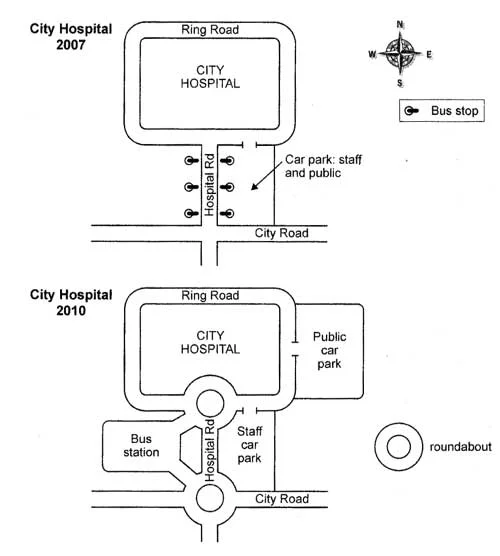
    The presented maps illustrate the evolution of road access to a city hospital in the years 2007 and 2010.

    In 2007, the primary access point was a single road extending from the northwest, with a supplementary road connecting from the south. By 2010, significant changes occurred as a new road was introduced from the west, expanding access options. Moreover, the southern road underwent extension and now interconnected with the newly constructed western road, creating a more intricate road network.

    Comparing the two periods, a clear enhancement in road infrastructure is evident. The addition of the western road in 2010 diversified access routes, potentially alleviating congestion. The extension of the southern road further contributed to improved connectivity.

    Overall, the transformation from a simpler road layout in 2007 to a more intricate and well-connected network in 2010 signifies a positive development in the accessibility of the city hospital.
  • Some people believe that it is best to accept a bad situation, such as an unsatisfactory job or shortage of money. Others argue that it is better to try and improve such situations. IELTS Cambridge 14 – Test 1 (Task 2)

    Question – Some people believe that it is best to accept a bad situation, such as an unsatisfactory job or shortage of money. Others argue that it is better to try and improve such situations.
    Discuss both these views and give your own opinion. Give reasons for your answer and include any relevant examples from your own knowledge or experience. Write at least 250 words.

    Divergent views exist regarding the necessity of either attempting to find solutions or accepting unfavourable circumstances as they arise. This essay will go through both sides of the debate and explain why I think the latter is more compelling.

    Accepting challenging circumstances in life is the best course of action, according to numerous people, for two main reasons. Firstly, people should adopt a more philosophical perspective and accept unfortunate circumstances for what they are, as they are frequently unavoidable. Differing opinions, habits, or backgrounds between the spouses in a marriage, for instance, inevitably lead to conflicts. To avoid endangering their relationship, a husband must learn to accept his wife for who she is rather than for what he wants her to be. Furthermore, attempting to handle difficult circumstances and get out of bad ones constantly can cause a great deal of stress and anxiety. People can keep a cheerful attitude and live happier lives if they can accept bad things as inevitable events in life.

    Despite this, I contend that we ought to be proactive and look for solutions to any problems we encounter. The primary benefit of taking proactive action is that it maintains our state of ongoing learning and development, which will offer us priceless chances to raise our consciousness and promote personal development. Our chances of success in both our personal and professional lives are increased as a result. Additionally, people can transform some of their destructive emotions into more constructive ones by concentrating on making bad situations better. For instance, unpleasant feelings like fear or rage can be transformed into a sense of empowerment when we solve our problems, no matter how challenging they may be. Long-term effects on mental health would result from people’s desire to just ignore their unfavourable circumstances and let the negative mental states fester.

    In summary, even though there are advantages to embracing unfavourable circumstances in life, I continue to believe that it would be preferable to concentrate on making them better for the reasons outlined above.

  • The charts below show the average percentages in typical meals of three types of nutrients, all of which may be unhealthy if eaten too much. IELTS Cambridge 14 – Test 1 (Task 1)

    Question – The charts below show the average percentages in typical meals of three types of nutrients, all of which may be unhealthy if eaten too much.
    Summarise the information by selecting and reporting the main features and make comparisons where relevant. Write atleast 150 words.

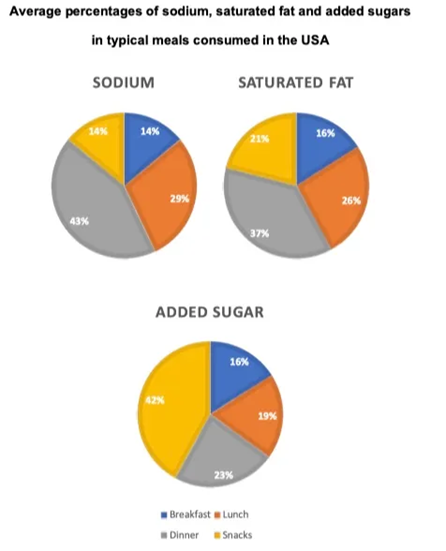
    Embark on a nutritional exploration as we delve into the intricacies of four standard meals through revealing pie charts. These charts meticulously outline the average amounts of three vital nutrient types—sodium, saturated fats, and added sugars. It’s crucial to note that an overindulgence in these nutrients can potentially lead to detrimental effects on one’s health.

    Considering all factors, it becomes apparent that dinner, among the four meals examined, boasts the highest levels of both saturated fat and sodium. In stark contrast, breakfast emerges as the frontrunner with the lowest amounts of these nutrients. However, breaking the mold, the snack takes center stage by showcasing the highest concentration of added sugar.

    A deeper dive into the charts uncovers that both lunch and dinner claim the top spots for the highest percentages of saturated fat, standing at 37% and 26% respectively. Similarly, in the sodium arena, dinner leads the pack with 43%, closely followed by lunch at 29%. Interestingly, when it comes to added sugars, lunch and dinner play catch-up with only 23% and 19% respectively.

    Turning our attention to the composition aspect, breakfast and the snack share a common ground, each containing 14% sodium. However, the snack slightly edges out breakfast in saturated fats, registering a marginally higher 21% compared to the latter’s 16%. A notable distinction surfaces in the realm of added sugars, where breakfast commands a substantial 42%, in stark contrast to the snack’s more modest 16%.

    In navigating these nutrient percentages, it becomes abundantly clear that our meal choices wield significant influence over our nutritional intake. Stay tuned for further insights into crafting a balanced and health-conscious diet!