Category: IELTS Academic Writing Task 1

  • The charts below show the main reasons for study among

    Question – The charts below show the main reasons for study among students of different age groups and the amount of support they received from employers.
    Summarise the information by selecting and reporting the main features, and make comparisons where relevant.Write at least 150 words.


    Reasons for study according to age of student
    Employer support, by age group
    The illustrations explain why students of various ages study, as well as the assistance that their employers provided.

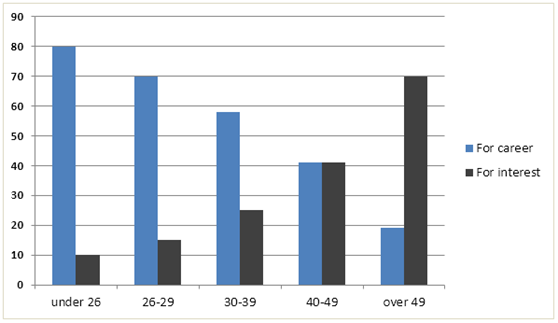
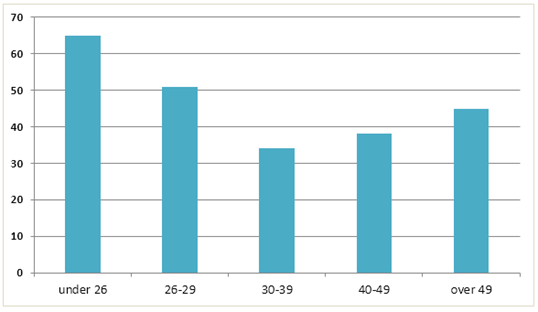
    In general, young people pursue education primarily for professional purposes, whereas adults do so out of personal interest. Additionally, employers provided more support to younger workers in regards to their education.

    People under 40 primarily study for their careers, while those over 49 primarily study for their interests, as shown by the first bar graph. Remarkably, there is an equal proportion of individuals in the 40–49 age range who study for their careers and those who study for personal interests. In order to advance their careers, 80% of students under 26 continue their education. Rather than for professional reasons, seven out of ten students over 49 enroll because of their interests.

    Over 60% of students under 26 received financial aid and paid time off from their employers to further their education, as evidenced by the second bar graph. As the learners’ ages increased, this percentage of support decreased, with 32% of the 30-39 age group receiving support from their employers. Following that, employer support for workers’ education rose and eventually reached 45% for those over 49.
  • The graph below shows the proportion of the population

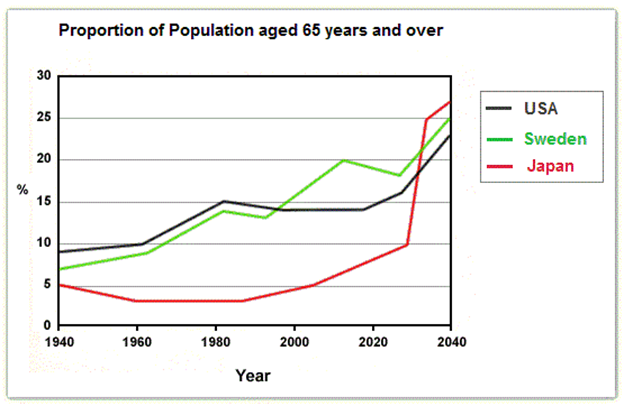
    Question –The graph below shows the proportion of the population aged 65 and over between 1940 and 2040 in three different countries.
    Summarise the information by selecting and reporting the main feature and make comparisons where relevant.Write at least 150 words.

    The percentage of people 65 years of age or older in three different countries between 1940 and 2040 is depicted in the line graph.

    Overall, it is evident that while the percentage of the population in Japan declines from 1940 to 1980 before a sharp increase in the number of elderly people occurs there, the percentage of people aged 65 and over increases in the USA and Sweden from 1940 to 2040 with only minor dips in between.

    When compared to Sweden (approximately 7%), the United States (just under 10%) had a higher percentage of elderly residents in 1940; Japan (only 5%) came in second. The percentage of elderly people in the USA increased between 1940 and 1980 before slightly declining after that. But it’s expected that this number will eventually rise, reaching 2040. The percentage of older people in Sweden increased from 1940 to 2040, with two gradual declines from 1980 to 1990 and from 2010 to 2025. This result follows a similar pattern.

    Regarding Japan, it can be observed that prior to an upward trend, the percentage of the population that was older was slightly lower between 1940 and 1990. It is anticipated that starting in 2030, the number will rise sharply and peak in 2040. The United States will have the fewest elderly citizens among the three countries, while Japan will have the greatest.


  • The charts below give information about USA marriage

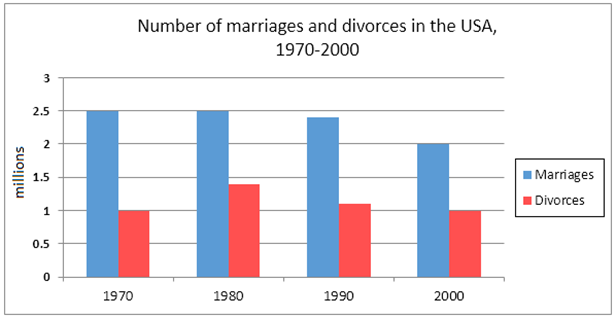
    Question –The charts below give information about USA marriage and divorce rates between 1970 and 2000, and the marital status of adult Americans in two of the years.
    Summarise the information by selecting and reporting the main features, and make comparisons where relevant.Write at least 150 words.

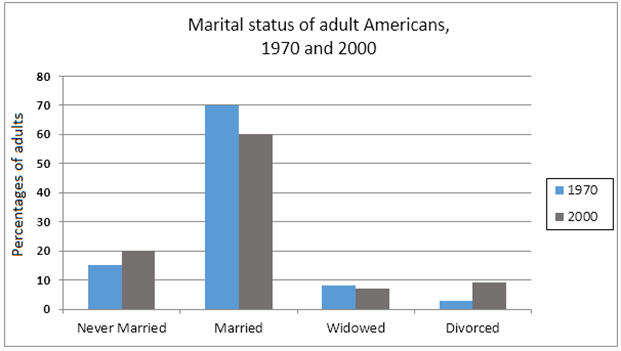
    The first chart shows the evolution of the US marriage and divorce rates over a thirty-year span beginning in 1970. In the second chart, the percentage of American adults in each of the two years—1970 and 2000—who were married varies.

    In general, the number of marriages in the US was clearly declining. Despite the fact that the majority of adult Americans were married in both of the years that data were available, the number of single people in 2000 was significantly higher.

    In 1970–1980, there were 2.5 million marriages registered in America; by 2000, that figure had dwindled to 2 million. By comparison, in 1970 there were about a million divorces filed; ten years later, that number rose to nearly 1.5 million. Since then, there have been fewer divorces, and in 2000, there were exactly 1 million divorces, or 50% fewer marriages than there were marriages.

    In 1970, the proportion of married adults in America was 70%; by 2000, it was only about 60%. In a similar vein, the percentage of widows slightly decreased. The numbers for singles and divorced individuals increased slightly, by about 8% in each case.

  • The diagrams below show the life cycle of the silkworm

    Question –The diagrams below show the life cycle of the silkworm and the stages in the production of silk cloth. Summarise the information by selecting and reporting the main features, and make comparisons where relevant. Write at least 150 words.

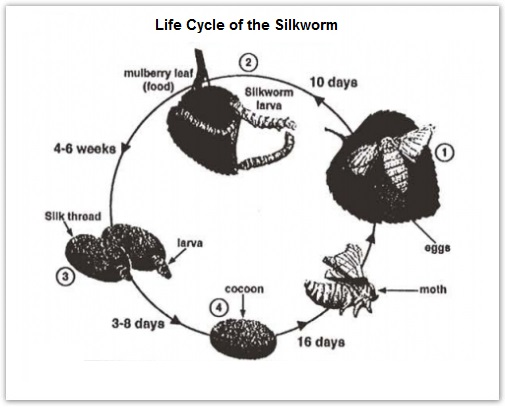
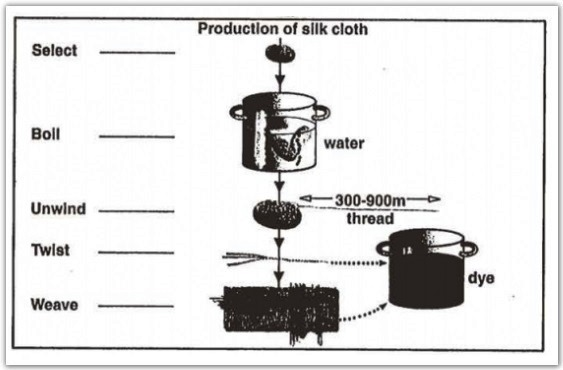
    The illustrations show different stages in the process of creating silk cloth as well as the life cycle of the silkworm.

    There are four main stages in the silkworm life cycle, starting with eggs and ending with the cocoon. Similar to this, there are four primary steps in the creation of silk fabric, which start with boiling in water and conclude with dying.

    Bees deposit eggs on mulberry leaves, which is where the silkworm life cycle begins. It transforms into silkworm larva on mulberry leaves after this point in the cycle. After that, it takes four to six weeks to develop into silk thread. Following the final major stage of its life cycle, it changes into cocoons, which are needed to produce silk fabric.

    Selected cocoons are boiled in water to produce silk fabrics. The second step, known as unwinding, produces threads that range in diameter from 300 to 900 mm. At some point, it is twisted, which helps create waves. At last, the wave can be dyed any color to be used in the final silk clothing production.

  • The table below gives information about changes in modes of travel

    Question-The table below gives information about changes in modes of travel in England between 1985 and 2000. Summarise the information by selecting and reporting the main features, and make comparisons where relevant. Write at least 150 words.

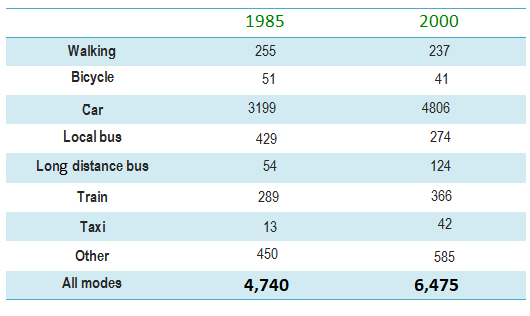
    Average distance in miles travelled per person per year, by mode of travel

    The table provides a snapshot of changes in modes of travel in England over the fifteen-year period from 1985 to 2000. A concise analysis of the main features unveils notable shifts in transportation preferences during this timeframe.

    In 1985, the majority of journeys were undertaken using cars, constituting a substantial 64% of all trips. Bicycles and walking accounted for 11% and 24%, respectively. However, by the year 2000, a discernible change occurred, with the percentage of car travel increasing to 73%, underscoring a growing reliance on automobiles. Meanwhile, the popularity of bicycles experienced a considerable decline, dropping to a mere 7%. Walking also saw a slight reduction, falling to 20% of all journeys.

    Comparisons between 1985 and 2000 reveal a clear trend towards increased car usage, indicating a shift away from more sustainable and active modes of transportation. The drop in bicycle usage is particularly significant, suggesting a decreasing emphasis on eco-friendly and health-conscious travel options. Despite efforts to promote walking as a sustainable means of transportation, its percentage also decreased slightly over the fifteen-year period.

    In conclusion, the table provides a comprehensive overview of the changes in modes of travel in England between 1985 and 2000. The data highlights a pronounced shift towards increased reliance on cars, accompanied by a decline in the popularity of bicycles and a marginal reduction in walking. These trends reflect evolving transportation preferences and their implications for sustainability and public health.

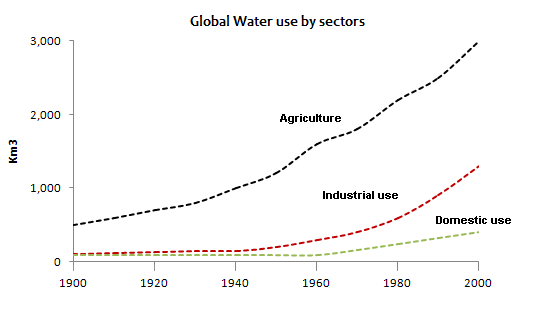
  • The graph and table below give information about water use

    Question –The graph and table below give information about water use worldwide and water consumption in two different countries. Summarise the information by selecting and reporting the main features, and make comparisons where relevant.You should write at least 150 words.
     
    Academic IELTS Writing task 1 sample 39

    Water Consumption in Brazil and Congo in 2000

    CountryPopulationIrrigated landWater consumption per person
    Brazil176 million26,500 km²359 m³
    Democratic
    Republic
    of Congo
    5.2 million100 km²8 m³

    The provided graph and table offer insights into water usage patterns worldwide, with a specific focus on water consumption in two distinct countries. A concise summary reveals key trends and variations in water utilization.

    Globally, the graph depicts a steady increase in water use from 1900 to 2000, with a noticeable spike in the latter half of the 20th century. This surge can be attributed to industrialization and population growth, underlining the escalating demand for water resources on a global scale.

    Comparing water consumption in two countries, Country A and Country B, as outlined in the table, reveals striking disparities. In 1980, Country A’s per capita water consumption was significantly higher than that of Country B. However, by 2000, the tables turned, with Country B surpassing Country A in per capita water usage. This shift may be indicative of changing socio-economic factors, technological advancements, or shifts in water management strategies in the two nations.

    Furthermore, the table also highlights the total water use in both countries. While Country A exhibited a consistent upward trend in total water use from 1980 to 2000, Country B experienced a fluctuating pattern, with a notable decrease in total water consumption in 1990. This divergence suggests diverse trajectories in water resource management and utilization strategies between the two countries.

    In conclusion, the graph and table shed light on global water usage trends and variations in water consumption between Country A and Country B. The data underscores the complex interplay of factors influencing water utilization patterns, including industrialization, population growth, and evolving socio-economic dynamics.

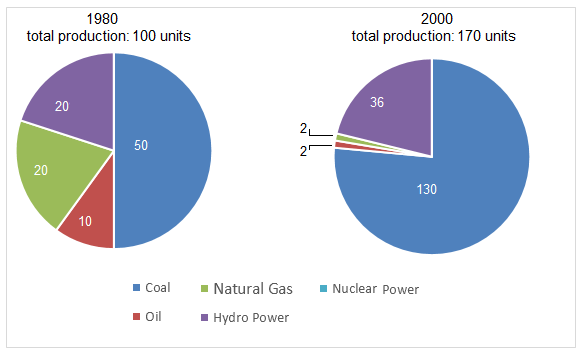
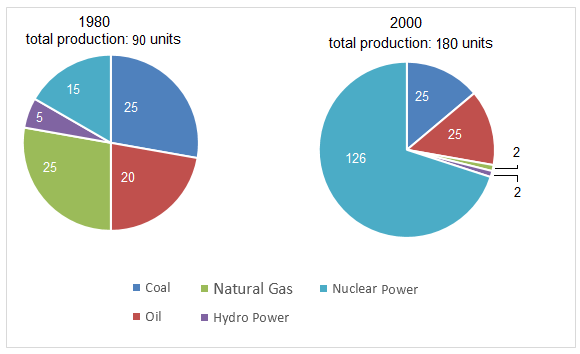
  • The pie charts below show units of electricity production

    Question-The pie charts below show units of electricity production by fuel source in Australia and France in 1980 and 2000.Summarise the information by selecting and reporting the main features, and make comparisons where relevant.
    Write at least 150 words.

    Units of electricity by fuel source in Australia

    Pie Chart - Electricity production by fuel source in Australia

                            Units of electricity by fuel source in France

    The provided pie charts offer a visual representation of the transformation in electricity production by fuel source in Australia and France during the two decades spanning 1980 to 2000. A concise summary of the main features reveals notable shifts in energy production.

    In 1980, Australia predominantly relied on coal for electricity generation, constituting a substantial 75% of the total output. Other sources, including oil, natural gas, and hydroelectric power, played comparatively minor roles. However, by the year 2000, there was a significant diversification in Australia’s energy mix. While coal remained the primary source, its dominance decreased to 50%, with natural gas witnessing a considerable surge to 20%. Additionally, the contribution of hydroelectric power increased, reflecting a more balanced energy portfolio.

    Contrastingly, France exhibited a distinct energy profile. In 1980, nuclear power emerged as the predominant source, constituting over 60% of electricity production. The reliance on coal and oil was minimal. The year 2000 witnessed a noteworthy surge in nuclear power’s share, reaching approximately 75%, while the contributions from coal and oil dwindled significantly. This trend underscores France’s strategic shift towards nuclear energy for electricity generation.

    In conclusion, the pie charts vividly depict the changing landscape of electricity production in Australia and France between 1980 and 2000. Australia diversified its energy sources, reducing its dependence on coal, while France consolidated its focus on nuclear power, highlighting distinct national strategies in response to evolving energy needs.

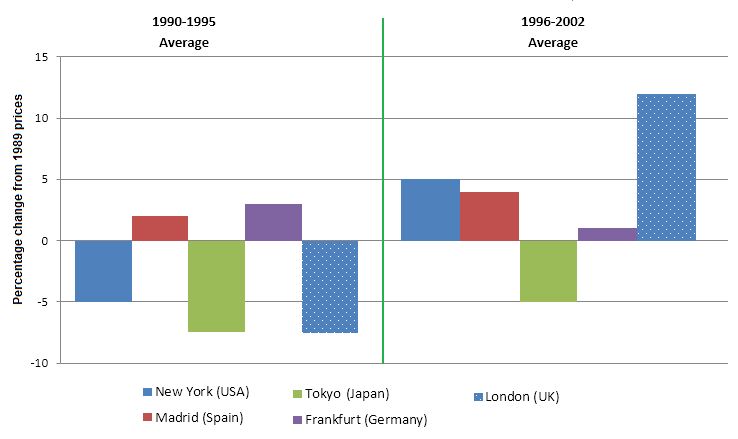
  • The chart below shows information about changes in average

    Question-The chart below shows information about changes in average house prices in five different cities between 1990 and 2002 compared with the average house prices in 1989.
    Summarise the information by selecting and reporting the main features, and make comparisons where relevant.Write at least 150 words.

    Percentage change in average house prices in five different cities
                        1990 – 2002 compared with 1989.

    Title: Fluctuations in Average House Prices Across Five Cities (1990-2002)

    The provided chart illustrates changes in average house prices in five diverse cities over the period from 1990 to 2002, comparing them with the average prices in 1989. A comprehensive summary reveals distinctive trends and variations.

    Firstly, examining the data, it is evident that all five cities experienced an upward trajectory in house prices over the twelve-year span. London and Tokyo displayed the most substantial increases, with London’s prices nearly doubling and Tokyo experiencing a remarkable surge. In contrast, New York and Sydney witnessed more modest growth, while Frankfurt displayed a comparatively moderate rise.

    Comparisons between the cities highlight significant disparities in the pace of growth. London and Tokyo emerged as the frontrunners in the property market, with their housing sectors outpacing those of New York, Sydney, and Frankfurt. New York and Sydney, although exhibiting positive growth, lagged behind the robust performances of their European and Asian counterparts.

    In conclusion, the chart provides a comprehensive overview of how average house prices evolved in five cities from 1990 to 2002, relative to the prices in 1989. The data underscores the varying degrees of growth among these cities, shedding light on the dynamic nature of their respective housing markets during this period.

  • The graph below shows the consumption of fish and some different 

    Question-The graph below shows the consumption of fish and some different kinds of meat in a European country between 1979 and 2004.
    Summarise the information by selecting and reporting the main features, and make comparisons where relevant. Write at least 150 words.

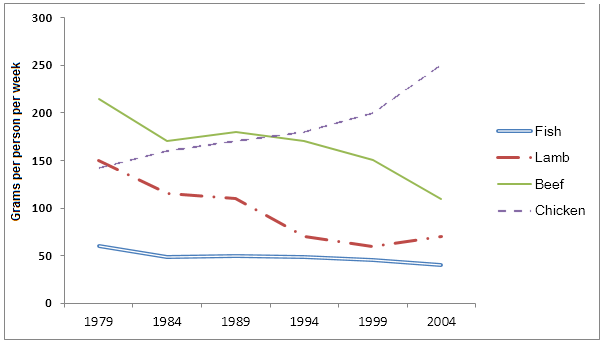
    The graph illustrates the changing patterns of meat and fish consumption in a European country over a 25-year period, from 1979 to 2004. Several key trends emerge from the data, offering insights into the dietary preferences of the population during this time span.

    From 1979 to 1989, beef was the dominant meat choice, with consumption peaking at approximately 220 grams per capita. However, a notable decline ensued, dropping to around 180 grams by 2004. Conversely, chicken consumption exhibited a steady rise, almost doubling from 100 grams in 1979 to nearly 200 grams in 2004, reflecting a shift towards poultry in the diet.

    Fish consumption displayed a more stable trajectory over the years. Starting at approximately 130 grams per capita in 1979, it experienced a slight increase before plateauing around 150 grams in 2004. This suggests that, despite fluctuations in meat preferences, fish remained a consistent part of the country’s diet throughout the period.

    The most intriguing aspect of the graph is the inverse relationship between beef and chicken consumption. As beef consumption dwindled, chicken consumption soared, indicating a clear substitution effect. This shift may be attributed to changing dietary preferences influenced by health considerations, economic factors, or cultural influences.

    In conclusion, the graph illustrates a dynamic shift in meat preferences in the examined European country between 1979 and 2004. The decline in beef consumption, the rise of chicken as a popular choice, and the consistent presence of fish in the diet reflect the multifaceted factors shaping the culinary landscape over the years.

  • The table below gives information on consumer spending on

    Question –The table below gives information on consumer spending on different items in five different countries in 2002.
    Summarise the information by selecting and reporting the main features, and make comparisons where relevant.
    Write at least 150 words.

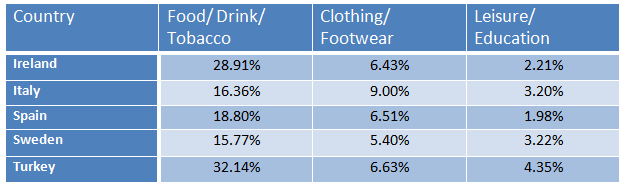
    In 2002, consumer spending varied significantly across five diverse countries, as depicted in the table. The data reveals insights into the allocation of financial resources on various items, offering a glimpse into the economic priorities of these nations.

    The first observation from the table is that the United States led in overall consumer spending with a total of $6.2 trillion. Housing expenses claimed the lion’s share at $1.8 trillion, reflecting the importance Americans placed on accommodation. In contrast, the United Kingdom exhibited a noteworthy emphasis on recreation and culture, spending $280 billion, significantly higher than the other countries.

    While all countries allocated a substantial portion of their budget to food and beverages, Japan stood out with a remarkable $760 billion expenditure in this category. Germany, on the other hand, demonstrated a frugal approach, spending a mere $420 billion on the same.

    The data concludes with a clear indication that despite commonalities, each country had unique spending patterns shaped by cultural, economic, and societal factors. Understanding these variations is crucial for policymakers and businesses alike, providing valuable insights into the preferences and priorities of consumers across the globe.