Month: April 2024

  • IELTS Reading Practice Test – Exercise 190

    AIRCONDITIONING THE EARTH

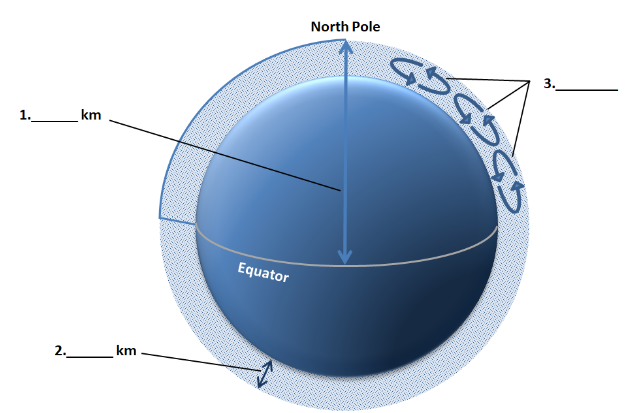
    The circulation of air in the atmosphere is activated by convection, the transference of heat resulting from the fact that warm gases or fluids rise while cold gases or fluids sink. For example, if one wall of a room is heated whilst the opposite wall is cooled, air will rise against the warm wall and flow across the ceiling to the cold wall before descending to flow back across the floor to the warm wall again. The real atmosphere, however, is like a very long room with a very low ceiling.

    The distance from equator to pole is 10,000 km, while the ‘ceiling height’ to the beginning of the stratosphere is only about 10 km. The air therefore splits up into a number of smaller loops or convection cells. Between the equator and each pole there are three such cells and within these the circulation is mainly north-south.

    Large-scale air-conditioning
    The result of this circulation is a flow of heat energy towards the poles and a levelling out of the climate so that both equatorial and polar regions are habitable. The atmosphere generally retains its state of equilibrium as every north-going air current is counterbalanced by a south-going one. In the same way depressions at lower levels in the troposphere are counterbalanced by areas of high pressure in the upper levels, and vice versa. The atmospheric transference of heat is closely associated with the movement of moisture between sea and continent and between different latitudes. Moist air can transport much greater quantities of energy than dry air.

    Because the belts of convection cells run east to west, both climate and weather vary according to latitude. Climatic zones are particularly distinguishable at sea where there are no land masses to disturb the pattern.

    Man and the winds
    For thousands of years mankind has been dependent upon the winds: they brought rain to the land and carried ships across the seas. Thus the westerly wind belts, the trade winds and the monsoon winds of the global circulation systems have been known to us for many centuries.

    As recently as the 20th century, Arab ships sailed on the south-west monsoon winds from East Africa to India and back again on the north-east monsoon winds, without need of a compass. The winds alone were sufficient. In the equatorial convergence zone (the ‘doldrums’), and in the regions around the Tropic of Cancer and Tropic of Capricorn known as the ‘horse latitudes’, sailing ships could drift for weeks unable to steer, while the ‘roaring forties’ of the South Atlantic (40-50°S) were notorious among mariners for their terrible winds.

    It was not until the development of the balloon at the end of the 18th century, however, that it became possible to study meteorological conditions at high altitudes. The balloon is still a significant research device although today it carries a radar reflector or a set of instruments and a radio transmitter, rather than the scientists themselves. Nowadays high-flying aircraft and satellites are also important aids to meteorology. Through them we have discovered the west to east jet stream. This blows at speeds of up to 500 km/h at altitudes of 9,000-10,000 m along the border between the Arctic and temperate zone convection belts.

    Weather fronts
    The circulation within the different convection cells is greater than the exchange of air between them and therefore the temperature in two cells that are close to each other can differ greatly. Consequently, the borders between the different convection cells are areas in which warm and cold air masses oppose each other, advancing and withdrawing. In the Northern Hemisphere, the dividing line between the Arctic and temperate convection zones is the polar front, and it is this which determines the weather in northern Europe and North America. This front is unstable, weaving sometimes northward, sometimes southward, of an average latitude of 60°N. Depressions become trapped within the deep concavities of this front and these subsequently move eastward along it with areas of rain and snowfall. In this way global air circulation determines not only the long-term climate but also the immediate weather.

    Questions 1-3
    Label the diagram below. Choose NO MORE THAN TWO WORDS AND/OR A NUMBER from the passage for each answer.
    Questions 4-7
    Complete the summary below using the list of words and phrases, A-L, below.

    A on land
    B polar regions
    C moisture
    D heat
    E balanced
    F at sea
    G offset
    H pole
    I equatorial regions
    J latitude
    K in the air
    L longitude

    Global air circulation spreads heat from the equator towards the (4)……………………Generally, a state of balance in the atmosphere is maintained because the north-moving air currents are continually being (5)…………………..by the south ones. Within the system of heat transfer in the atmosphere, climate is affected not only by (6)………………..but also by the amount of moisture in the air. The most accurate geographical zone for the study of climate is (7)…………………….., where there are no local wind systems.

    Questions 8-12
    Write the correct letter, A, B or C in boxes 8-12 on your answer sheet.

    Classify the following wind patterns according to whether the writer states they are

    A useful
    B problematic
    C neither useful nor problematic

    8. ‘roaring forties’
    9. south-west monsoon winds
    10. west to east jet stream
    11. ‘horse latitudes’
    12. north-east monsoon winds

    Question 13
    Answer the question below. Choose NO MORE THAN THREE WORDS AND/OR A NUMBER from the passage.

    13. Which border between convection zones determines the weather in the Northern Hemisphere?

    MONEY AS THE UNIT OF ACCOUNT

    SECTION A
    The most difficult aspect of money to understand is its function as a unit of account. In linear measurement we find the definition of a yard, or a metre, easy to accept. In former times these lengths were defined in terms of fine lines etched onto brass rods maintained in standards laboratories at constant temperatures. Money, however, is much more difficult to define because the value of anything is ultimately in the mind of the observer, and such values will change with time and circumstance.

    Sir Isaac Newton, as Master of the Royal Mint, defined the pound sterling (£) in 1717 as 113 grains of pure gold. This took Britain off silver and onto gold as defining the unit of account. The pound was 113 grains of pure gold, the shilling was 1/20 of that, and the penny 1/240 of it.

    By the end of the„19th century the gold standard had spread around most of the trading world, with the result that there was a single world money. It was called by different names in different countries, but all these supposedly different currencies were rigidly interconnected through their particular definition in terms of a quantity of gold.

    SECTION B
    In economic life the prices of different commodities and services are always changing with respect to each other. If the potato crop, for example, is ruined by frost or flood, then the price of potatoes will go up. The consequences of that particular price increase will be complex and unpredictable. Because of the high price of potatoes, prices of other things will decline, as demand for them declines. Similarly, the argument that the Middle East crisis following the Iraqi annexation of Kuwait would, because of increased oil prices, have led to sustained general inflation is, although widely accepted, entirely without foundation. With sound money (money whose purchasing power does not decline over time) a sudden price shock in any one commodity will not lead to a general price increase, but to changes in relative prices throughout the economy. As oil increases, other goods and services will drop in price, and oil substitutes will rise in price, as the consequences of the oil price increase work their unpredictable and complex way through the economy.

    The use of gold as the unit of account during the days of the gold standard meant that the price of all other commodities and services would swing up and down with reference to the price of gold, which was fixed. If gold supplies diminished, as they did when the 1850s gold rushes in California and Australia were finishing, then deflation (a general price level decrease] would set in. When new gold rushes followed in South Africa and again in Australia, in the 1880s and 1890s, the general price level increased, gently, around the world, as there was more money in circulation.

    SECTION C
    The end of the gold standard began with the introduction of the Bretton-Woods Agreement in 1946. This fixed the value of all world currencies relative to the US dollar, which in turn was fixed to a specific value of gold (US$0.35/oz). However, in 1971 the US government finally refused to exchange US dollars for gold, and other countries soon followed. Governments printed as much paper money or coinage as they wanted, and the more that was printed, the less each unit of currency was worth.

    The key problem with these government ‘fiat’ currencies is that their value is not defined; such value is subject to how much money a government cares to print. Their future value is unpredictable, depending as it does on political chance. In past economic calculations of the Australian Institute for Public Policy, incomes and expenditures were automatically converted to dollars of a particular year, using CPI deflators, which are stored in the Institute’s computers. When the Institute performs economic calculations into the future, it guesses at inflation rates and includes these guesses in its figures. The guesses are entirely based on past experience. In Australia most current calculations assume a three to four per cent inflation rate.

    SECTION D
    The great advantage of the 19th century gold standard was not just that it defined the unit of account, but that it operated throughout almost the entire world. Anthony Trollope tells us in his diaries about his Australian travels in 1872 that a pound of meat, selling in Australia for two pence, would have cost ten pence or even a shilling in the UK. It was this price difference which drove investment and effort into the development of shipboard refrigeration, and opening up of major new markets for Australian meat, at great benefit to the British public.

    Today we can determine price differences between countries by considering the exchange rate of the day. In twelve months’ time, even a month’s time, however, a totally different situation may prevail, and investments of time and money made on the basis of an opportunity at an exchange rate of the day, may actually perform poorly because of subsequent exchange rate movements.

    The great advantage of having a single stable world currency is that such currency would have very high information content. It tells people where to invest their time, energy and capital, all around the world, with much greater accuracy and predictability than would otherwise be possible.

    Questions 14-17
    Reading Passage 2 has four sections, A-D. Choose the correct heading for each section from the list of headings below.

    List of Headings
    i The effects of inflation
    ii The notion of money and its expression
    iii The rise of problematic modern currencies
    iv Stable money compared to modern ‘fiat’ currencies
    v The function of money
    vi The interrelationship of prices
    vii Stability of modern currencies

    14. SECTION A
    15. SECTION B
    16. SECTION C
    17. SECTION D

    Questions 18-22
    Look at the following causes and the list of results below. Match each cause with the appropriate result.

    18. Oil prices rise.
    19. The price of potatoes goes up.
    20. Gold was the unit of account.
    21. The amount of gold available went down.
    22. Meat in Australia was cheaper than elsewhere.

    List of Results
    A The price of goods fluctuated in relation to a fixed gold price
    B People developed techniques of transporting it to other places.
    C Oil substitutes become more expensive
    D More people went to live in Australia
    E The price of other things goes down, because fewer people could afford to buy them
    F The price of commodities remained fixed
    G There is no observable effect.
    H All prices went down, everywhere.
    I Oil substitutes drop in price

    Questions 23-27
    Classify the following characteristics as belonging to

    A money based on a gold standard
    B government ‘fiat’ monopoly currencies
    C both money based on a gold standard and ‘fiat’ currencies

    23. it has a clearly defined value
    24. its value by definition varies over time
    25. its future value is predictable
    26. its past value can be calculated
    27. it makes international investment easier

    PURPOSES OF LANGUAGE STUDY: THE AUSTRALIAN SENATE INQUIRY INTO A NATIONAL LANGUAGE POLICY

    The Report of the Inquiry by the Senate of the Australian Parliament into a national language policy in Australia proposed five purposes for studying a language other than English in Australian schools.

    POINT ONE
    The first point relates to what might be termed the more strictly utilitarian reasons for language learning: the acquisition of fluency in a language other than English for the purpose of direct communication. The communication in question may be of an informal nature, such as that which occurs during overseas travel, or between members of different groups within Australian society in a variety of social situations. In large measure, however, this language learning objective relates to the rote of languages other than English in various fields of employment, such as interpreting and translating, international trade, diplomacy and defence.

    Professor M. Halliday, a witness to the Inquiry, cautioned against placing too heavy an emphasis on utilitarian goals, stating that ‘one should not be too restricted to the practical arguments which are in a sense dishonest if you say to someone: “If you spend all this time learning a language you will immediately be able to go and find a use for it”.’

    The Committee agrees that, taken in isolation, practical arguments tend to give an incomplete picture of the value of language learning. In the early school years, for example, utilitarian objectives may well be less important than they are at tertiary level where employment considerations exert a strong influence.

    POINT TWO
    The second purpose concerns the link between a language and the cultural context from which it emerges. Many submissions stressed the value of the language learning experience as a means of understanding other cultures, and hence of developing sensitive and tolerant cross-cultural attitudes. This proposition is applied to cultures both within Australia and overseas. Thus, it is argued that language study can contribute in important ways both to harmonious community relationships within Australia, and to an understanding of the cultural values of other countries.

    It is also contended that language provides the key to major historical cultures, such as the civilisations of classical antiquity which have exerted a profound influence on the Western tradition.

    In the course of hearings, Dr David Ingram of the Australian Federation of Modern Language Teachers Associations referred to evidence which lends some empirical support to the claim that the experience of language learning fosters the development of a better understanding of other cultures. The Committee does not find the proposition difficult to accept. It believes, however, that the measure of success achieved is likely to be largely dependent on the teaching methodology adopted, and the degree of teacher commitment to the goal of cultural awareness and sensitivity.

    POINT THREE
    The third objective relates to the role of language learning is the maintenance of ethnic languages and cultures within Australia. It was argued in submissions that a central element in Australia’s policy of multiculturalism is a recognition of the value of the cultural heritages of the different groups within Australian society. Since language and culture are inextricably intertwined, the preservation of cultural heritages necessarily entails the retention of the languages associated with them. In the case of Aboriginal communities this issue takes on a special note of urgency since, in many instances, Aboriginal cultures and languages are on the verge of disappearing completely. The objective in this context, therefore, is not simply to assist in the maintenance of a cultural and linguistic heritage but to aid in preserving that heritage from extinction.

    POINT FOUR
    Prominent amongst the purposes of language learning described in submissions was the fourth point: the development of the general cognitive and linguistic capacities of students. The educational outcomes at stake here were described in a number of ways. Professor M. Halliday, for example, spoke of language learning as an educational exercise of the first importance, as a development of thinking.’ Another submission referred to the development of ‘a sharpened, more critical awareness of the nature and mechanism of language.’ Professor Clyne pointed to research conducted particularly in Canada which, he states, ‘suggests that bilinguals are superior to monolinguals in logical thought and conceptual development, verbal intelligence and divergent thinking.’

    POINT FIVE
    Finally, several submissions spoke of the role of language learning is the general development of personality. To a large extent, this objective builds upon and sums up aspects of those already covered. The possibility of direct communication with speakers of another language, for example, offers the opportunity for a broadening of personal horizons. A similar outcome may be expected from the encounter with another culture made possible through language study. Where the language concerned is the child’s mother tongue, either the language of a migrant group or an Aboriginal language, an additional factor emerges. In this context, it is argued, language study contributes significantly to the development of individual self-esteem, since the introduction of the language into the school encourages children of that language background to value it and appreciate it as an asset. As a result, their estimation of their family’s value as well as of their own worth is likely to rise.

    The Committee believes that submissions have been correct in drawing attention to these personal development issues. Naturally, the benefits of language learning in question here are less easy to quantify than those involved in the objectives previously discussed. Nonetheless, the Committee believes that, if appropriately taught, languages can play an important part in assisting young people to establish their identity, and develop their individual and social personalities.

    Questions 28-32
    Reading Passage 3 proposes five points for the Purpose of Language Study. Choose the correct heading for each of the five points from the list of headings below.

    28. Point One
    29. Point Two
    30. Point Three
    31. Point Four
    32. Point Five

    List of Headings
    i Maintenance of ethnic languages and outlines as part of Australia’s policy of multiculturalism
    ii Tolerance and acceptance of other races and cultures through language classes
    iii Successful communication with non-English speaking people both within Australia and overseas
    iv A better appreciation of the multicultural nature of Australian society
    v Developing a better understanding of other cultures
    vi Developing better cognitive and general linguistic abilities in students
    vii Assessment whether bilinguals are superior to monolinguals
    viii Developing the personality of students and sense of individual identity
    ix The prevention of Aboriginal languages disappearing

    Questions 33-37
    Do the following statements agree with the information given in Reading Passage 3? In boxes 33-37 on your answer sheet, write

    TRUE if the statement agrees with the information
    FALSE if the statement contradicts the information
    NOT GIVEN If there is no information on this

    33. Fluency skills in a language other than English are acquired for the purpose of communicating in informal settings.
    34. There is evidence which suggests that language learning does not necessarily promote a better understanding of cultures.
    35. Learning a second language produces greater tolerance, better understanding of others and acceptance of difference.
    36. Preserving a culture involves retaining the language associated with it.
    37. Learning a language facilitates a child’s communication with family members of non-English speaking backgrounds.

    Questions 38-40
    Complete the sentences below. Choose NO MORE THAN TWO WORDS for each answer.

    Understanding of other cultures whether within Australia or overseas is one of the benefits gained through (38)………………..

    Ability to study one’s background language at school seemingly raises an individual’s (39)………………….

    Provided they are competently taught, languages can help to form the (40)…………………..of individuals and develop their personalities.

  • IELTS Reading Practice Test – Exercise 189

    Nature on display in American zoos

    The first zoo in the United States opened in Philadelphia in 1874, followed by the Cincinnati Zoo the next year. By 1940 there were zoos in more than one hundred American cities. The Philadelphia Zoo was more thoroughly planned and better financed than most of the hundreds of zoos that would open later but in its landscape and its mission – to both educate and entertain it embodied ideas about how to build a zoo that stayed consistent for decades. The zoos came into existence in the late nineteenth century during the transition of the United States from a rural and agricultural nation to an industrial one.

    The population more than doubled between 1860 and 1900. As more middle class people lived in cities, they began seeking new relationships with the natural world as a place for recreation, self-improvement, and Spiritual renewal. Cities established systems of public parks, and nature tourism – already popular – became even more fashionable with the establishment of national parks. Nature was thought to be good for people of all ages and classes. Nature study was incorporated into school curricula, and natural history collecting became an increasingly popular pastime.

    At the same time, the fields of study which were previously thought of as’ natural history’ grew into separate areas such as taxonomy, experimental embryology and genetics, each with its own experts and structures. As laboratory research gained prestige in the zoology departments of American universities, the gap between professional and amateur scientific activities widened. Previously, natural history had been open to amateurs and was easily popularized, but research required access to microscopes and other equipment in laboratories, as well as advanced education.

    The new zoos set themselves apart from traveling animal shows by stating their mission as education and the advancement of science, In addition to recreation. Zoos presented zoology for the non specialist, at a time when the intellectual distance between amateur naturalists and laboratory oriented zoologists was increasing. They attracted wide audiences and quickly became a feature of every growing and forward thinking city. They were emblems of civic pride on a level of importance with art museums, natural history museums and botanical gardens.

    Most American zoos were founded and operated as part of the public parks administration. They were dependent on municipal funds, and they charged no admission fee. They tended to assemble as many different mammal and bird species as possible, along with a few reptiles, exhibiting one or two specimens of each, and they competed with each other to become the first to display a rarity, like a rhinoceros. In the constant effort to attract the public to make return visits, certain types of display came in and out of fashion; for example, dozens of zoos built special Islands for their large populations of monkeys. In the 1930s, the Works Progress Administration funded millions of dollars of construction at dozens of zoos, for the most part, the collections of animals were organized by species in a combination of enclosures according to a fairly loose classification scheme.

    Although many histories of individual zoos describe the 1940s through the 1960s as a period of stagnation, and in some cases there was neglect, new zoos continued to be set up all over the country. In the 1940s and 1950s, the first zoos designed specifically for children were built, some with the appeal of farm animals. An increasing number of zoos tried new ways of organizing their displays. In addition to the traditional approach of exhibiting like kinds together, zoo planners had a new approach of putting animals in groups according to their continent of origin and designing exhibits showing animals of particular habitats, for example, polar, desert, or forest. During the 1960s, a few zoos arranged some displays according to animal behavior; the Bronx Zoo. for instance, opened its World of Darkness exhibit of nocturnal animals. Paradoxically, at the same time as zoo displays began incorporating ideas about the ecological relationships between animals, big cats and primates continued to be displayed in bathroom like cages lined with tiles.

    By the 1970s, a new wave of reform was stirring. Popular movements for environmentalism and animal welfare called attention to endangered species and to zoos that did not provide adequate care for their animals. More projects were undertaken by research scientists and zoos began hiring full-time vets as they stepped up captive breeding programs. Many zoos that had been supported entirely by municipal budgets began recruiting private financial support and charging admission fees. In the prosperous 1980s and 1990s. zoos built realistic ‘landscape immersion’ exhibits, many of them around the theme of the tropical rainforest and. increasingly, conservation moved to the forefront of zoo agendas.

    Although zoos were popular and proliferating institutions in the United States at the turn of the twentieth century, historians have paid little attention to them. Perhaps zoos have been ignored because they were, and remain still, multi-purpose institutions, and as such they fall between the categories of analysis that historians often use. In addition, their stated goals of recreation, education, the advancement of science, and protection of endangered species have often conflicted. Zoos occupy a difficult middle ground between science and showmanship, high culture and low, remote forests and the cement cityscape, and wild animals and urban people.

    Questions 1-7
    Do the following statements agree with the information given in Reading Passage 1? In boxes 1-7 on your answer sheet, write

    TRUE if the statement agrees with the information
    FALSE if the statement contradicts the information
    NOT GIVEN If there is no information on this

    1. The concepts on which the Philadelphia zoo was based soon became unfashionable.
    2. The opening of zoos coincided with a trend for people to live in urban areas.
    3. During the period when many zoos were opened, the study of natural history became more popular in universities than other scientific subjects.
    4. Cities recognized that the new zoos were as significant an amenity as museums.
    5. Between 1940 and 1960 some older zoos had to move to new sites in order to expand.
    6. In the 1970s, new ways of funding zoos were developed.
    7. There has been serious disagreement amongst historians about the role of the first zoos.

    Questions 8-13
    Complete the notes below. Choose NO MORE THAN ONE WORD from the passage for each answer.

    • Up to 1940 – More mammals and birds exhibited than (8)………………………. (9)…………….were very popular animals in many zoos at one time.
    • 1940s and 1950s – Zoos started exhibiting animals according to their (10)………………and where they came from.
    • 1960s – Some zoos categorized animals by (11)……………………
    • 1970s – (12)………………….. were employed following protests about animal care.
    • 1980s onward – The importance of (13)………………..became greater.

    Can we prevent the poles from melting?

    A Such is our dependence on fossil fuels, and such is the volume of carbon dioxide we have already released into the atmosphere, that most climate scientists agree that significant global warming is now inevitable – the best we can hope to do is keep it at a reasonable level, and even that is going to be an uphill task. At present, the only serious option on the table for doing this is cutting back on our carbon emissions, but while a few countries are making major strides in this regard, the majority are having great difficulty even stemming the rate of increase, let alone reversing it. Consequently, an increasing number of scientists are beginning to explore the alternatives. They oil fall under the banner of geoengineering – generally defined as the intentional large-scale manipulation of the environment.

    B Geoengineering has been shown to work, at least on a small, localized scale, for decades. May Day parades in Moscow have taken place under clear blue skies, aircraft having deposited dry ice, silver iodide and cement powder to disperse clouds. Many of the schemes now suggested look to do the opposite, and reduce the amount of sunlight reaching the planet. One scheme focuses on achieving a general cooling of the Earth and involves the concept of releasing aerosol sprays into the stratosphere above the Arctic to create clouds of sulphur dioxide, which would, in turn, lead to a global dimming. The idea is modelled on historical volcanic explosions, such as that of Mount Pinatubo in the Philippines in 1991, which led to a short term cooling of global temperatures by 0.5“C. The aerosols could be delivered by artillery, highflying aircraft or balloons.

    C Instead of concentrating on global cooling, other schemes look specifically at reversing the melting at the poles. One idea is to bolster an ice cap by spraying it with water. Using pumps to carry water from below the sea ice, the spray would come out as snow or ice particles, producing thicker sea ice with a higher albedo (the ratio of sunlight reflected from a surface) to reflect summer radiation. Scientists have also scrutinized whether it is possible to block icefjords in Greenland with cables which have been reinforced, preventing icebergs from moving into the sea. Veli Albert Kallio, a Finnish scientist, says that such an idea is impractical, because the force of the ice would ultimately snap the cables and rapidly release a large quantity of frozen ice into the sea. However, Kallio believes that the sort of cables used in suspension bridges could potentially be used to divert, rather than halt, the southward movement of ice from Spitsbergen. ‘It would stop the ice moving south, and local currents would see them float northwards,’ he says.

    D A number of geoengineering ideas are currently being examined in the Russian Arctic. These include planting millions of birch trees: the thinking, according to Kallio, is that their white bark would increase the amount of reflected sunlight. The loss of their leaves in winter would also enable the snow to reflect radiation. In contrast, the native evergreen pines tend to shade the snow and absorb radiation. Using ice-breaking vessels to deliberately break up and scatter coastal sea ice in both Arctic and Antarctic waters in their respective autumns, and diverting Russian rivers to increase cold-water (low to ice-forming areas, could also be used to slow down warming, Kallio says. ‘You would need the wind to blow the right way, but in the right conditions, by letting ice float free and head north, you would enhance ice growth.’

    E But will such ideas ever be implemented? The major counterarguments to geoengineering schemes are, first, that they are a ‘cop-out’ that allow us to continue living the way we do, rather than reducing carbon emissions; and, second, even if they do work, would the side- effects outweigh the advantages? Then there’s the daunting prospect of upkeep and repair of any scheme as well as the consequences of a technical failure. ’I think all of us agree that if we were to end geoengineering on a given day, then the planet would return to its pre-engineered condition very rapidly, and probably within 10 to 20 years,’ says Dr Phil Rasch, chief scientist for climate change at the US-based Pacific Northwest National Laboratory. ‘That’s certainly something to worry about. I would consider geoengineering as a strategy to employ only while we manage the conversion to a non-fossil- fuel economy.’ ‘The risk with geoengineering projects is that you can “overshoot”,’ says Dr Dan Lunt, from the University of Bristol. ‘You may bring global temperatures back to pre-industrial levels, but the risk is that the poles will still be warmer than they should be and the tropics will be cooler than before industrialization.’

    F The main reason why geoengineering is countenanced by the mainstream scientific community is that most researchers have little faith in the ability of politicians to agree – and then bring in – the necessary carbon cuts. Even leading conservation organisations believe the subject is worth exploring. As Dr Mortin Sommerkorn, a climate change advisor says. ‘But human-induced climate change has brought humanity to a position where it is important not to exclude thinking thoroughly about this topic and its possibilities despite the potential drawbacks. If, over the coming years, the science tells us about an ever-increased climate sensitivity of the planet – and this isn’t unrealistic – then v/e may be best served by not having to start our thinking from scratch.’

    Questions 14-18
    Reading Passage 2 has six paragraphs A-F. Which paragraph contains the following information? NB You may use any letter more than once.

    14. the existence of geoengineering projects distracting from the real task of changing the way we live
    15. circumstances in which geoengineering has demonstrated success
    16. maintenance problems associated with geoengineering projects
    17. support for geoengineering being due to a lack of confidence in governments
    18. more success in fighting climate change in some parts of the world than others

    Questions 19-23
    Complete the summary below. Choose NO MORE THAN TWO WORDS from the passage for each answer.

    Geoengineering projects

    A range of geoengineering ideas has been put forward, which aim either to prevent the melting of the ice caps or to stop the general rise in global temperatures. One scheme to discourage the melting of ice and snow involves introducing (19)……………………to the Arctic because of their colour. The build-up of ice could be encouraged by dispersing ice along the coasts using special ships and changing the direction of some (20)………………………but this scheme is dependent on certain weather conditions. Another way of increasing the amount of ice involves using (21)………………………to bring water to the surface. A scheme to stop ice moving would use (22)………………….but this method is more likely to be successful in preventing the ice from travelling in one direction rather than stopping it altogether. A suggestion for cooling global temperatures is based on what has happened in the past after (23)……………………..and it involves creating clouds of gas.

    Questions 24-26
    Look at the following people and the list of opinions below. Match each person with the correct opinion A-E.

    24. Phil Rasch
    25. Dan Lunt
    26. Martin Sommerkorn

    List of opinions
    A The problems of geoengineering shouldn’t mean that ideas are not seriously considered.
    B Some geoengineering projects are more likely to succeed than others.
    C Geoengineering only offers a short-term solution.
    D A positive outcome of geoengineering may have a negative consequence elsewhere.
    E Most geoengineering projects aren’t clear in what they are aiming at

    America’s oldest art?

    Set within treacherously steep cliffs, and hidden away valleys of northeast Brazil, is some of Southeast America’s most significant and spectacular rock-art. Most of the art so far discovered from the ongoing excavations comes from the archaeologically – important National Park o’ the Serra da Capivara in the state of Piaui, and it is causing quite a controversy. The reason for the uproar? The art is being dated to around 25,000 or perhaps. According to some archaeologists, even 36,000 years ago. If correct, this is set to challenge the widely field view that the America were first colonized from the north, via the Bering Straits from eastern Siberia at around 10.000 BC. only moving down into Central and South America in the millennia thereafter.

    Prior to the designation of 130,000 hectares as a National Park, the rock-art sites were difficult to get to and often dangerous to enter. In ancient times, this inaccessibility must have heightened the importance of the sites, and indeed of the people who painted on the rocks. Wild animals and human figures dominate the art and are incorporated into often-complex scenes involving hunting, supernatural beings, fighting and dancing. The artists depicted the animals that roamed the local ancient brushwood forest. The large mammals are usually painted in groups and tend to be shown a running stance, as though trying to escape from hunting parties. Processions – lines of human and animal figures – also appear of great impotence to these ancient artists. Might such lines represent family units or groups of warriors? On a number of panels, rows of stylized figures, some numbering up to 30 individual figures, were painted using the natural undulating contours of the rock surface, so evoking the contours of the seconding landscape Other interesting, but very rare, occurrences are scenes that show small human figures holding on to and dancing around a tree, possibly involved in some tom of a ritual dance.

    Due to the favourable climatic conditions. the imagery on many panels is in a remarkable state of preservation. Despite this, however, there are serious conservation issues that affect their long term survival. The chemical and mineral quantities of the rock on which the imagery is panted is fragile and on several panels it is unstable. As well as the secretion of sodium carbonate on the rock surface, complete panel sections have, over the ancient and recent past, broken away from the main rock surface. These have then become buried and sealed into sometimes-ancient floor deposits. Perversely, this form of natural erosion and subsequent deposition has assisted archaeologists in dating several major rock-art sites. Of course, dating the art is extremely difficult oven the non-existence of plant and animal remains that might be scientifically dated. However, there am a small number of sites in the Serra da Capivara that are giving up their secrets through good systematic excavation. Thus, at Toca do Roqiomo da Pedra Furada. rock-art researcher Niéde Guidon managed to obtain a number of dates. At different levels of excavation, she located fallen painted rock fragments, which she was able to dale to at least 36,000 years ago. Along with toe painted fragments, crude stone tools were found. Also discovered wore a series of scientifically datable sites of fireplaces, or hearths, the earliest dated to 46,000 BC. arguably the oldest dates for human habitation in the America.

    However, these conclusions are net without controversy. Critics, mainly from North America, have suggested that the hearths may in fact be a natural phenomenon, the result of seasonal brushwood fires. Several North American researchers have gone further and suggested that the rock art from this site dates from no earlier than about 3,730 years age, based on the results of limited radiocarbon dating. Adding further fool to the general debate is the fact that the artists in the area of the National Hark tended not to draw over old motifs (as often occurs with rock-art), which makes it hard to work out the relative chronology of the images or styles. However, the diversity of imagery and the narrative the paintings create from each of the many sites within the National Park suggests different artists were probably making their art at efferent times, and potentially using each site over many thousands of years.

    With fierce debates thus raging over the dating, where these artists originate from is also still very much open to speculation. The traditional view ignores the early dating evidence from the South American rock-art sites. In a revised scenario, some palaeo – anthropologists are now suggesting that modern humans may’ have migrated from Africa using the strong currents of the Atlantic Ocean some 63.000 years or more ago, while others suggest a more improbable colonization coming from the Pacific Ocean. Yet, while ether hypothesis is plausible, there is still no supporting archaeological evidence between the South American coastline and the interior. Rather, it seems possible that there were a number of waves of human colonization of the Americas occurring possibly over a 60,000-100,000 year period, probably using the Bering Straits as a land bridge to cross into the Americas.

    Despite the compelling evidence from South America, it stands alone: the earliest secure human evidence yet found in the state of Oregon in North America only dates to 12,300 years BC. So this is a fierce debate that is likely to go on for many more years. However, the splendid rock art and its allied anthropology of northeast of Brazil, described here, is playing a huge and significant role in the discussion.

    Questions 27-29
    Choose the correct fetter, A, B, C or D.

    27. According to the first paragraph, the rock-art in Serra da Capivara may revolutionize accepted ideas about
    A the way primitive people lived in North America.
    B the date when the earliest people arrived in South America.
    C the origin of the people who crossed the Bering Straits.
    D the variety of cultures which developed in South America.

    28. How did the ancient artists use the form of the rock where they painted?
    A to mimic the shape of the countryside nearby
    B to emphasize the shape of different animals
    C to give added light and shade to their paintings
    D to give the impression of distance in complex works

    29. In the fourth paragraph, what does the writer say is unusual about the rock-artists of Serra da Capivara?
    A They had a very wide range of subject-matter.
    B Their work often appears to be illustrating a story.
    C They tended to use a variety of styles in one painting,
    D They rarely made new paintings on top of old ones.

    Questions 30-36
    In boxes 30-36 on your answer sheet, write

    YES if the statement agrees with the views of the writer
    NO if the statement contradicts the views of the writer
    NOT GIVEN if it is impossible to say what the writer thinks about this

    30. Archaeologists have completed their survey of the rock-art in Piaui.
    31. The location of the rock-art suggests that the artists had a significant role in their society.
    32. The paintings of animals show they were regarded as sacred by the ancient humans.
    33. Some damage to paintings is most likely due to changes in the weather of the region.
    34. The fact that some paintings wore buried is useful to archaeologists.
    35. The tools found near some paintings were probably used for hunting animals.
    36. The North American researchers have confirmed Niéde Guidons dating of the paintings.

    Questions 37-40
    Complete each sentence with the correct ending. A-F below.

    37. Materials derived from plants or animals
    38. The discussions about the ancient hearths
    39. Theories about where the first South Americans originated from
    40. The finds of archaeologists in Oregon

    A are giving rise to a great deal of debate among palaeo-anthropologists.
    B do not support the earliest dates suggested for the arrival of people in America.
    C are absent from rock-art sites In the Serra da Capivara.
    D have not been accepted by academics outside America.
    E centre on whether or not they are actually man-made.
    F reflect the advances in scientific dating methods.

  • IELTS Reading Practice Test – Exercise 188

    Communicating in Colour

    There are more than 160 known species of chameleons. The main distribution is in Africa and Madagascar, and other tropical regions, although some species are also found in parts of southern Europe and Asia. There are introduced populations in Hawaii and probably in California and Florida too.

    New species are still discovered quite frequently. Dr Andrew Marshall, a conservationist from York University, was surveying monkeys in Tanzania, when he stumbled across a twig snake in the Magombera forest which, frightened, coughed up a chameleon and fled. Though a colleague persuaded him not to touch it because of the risk from venom, Marshall suspected it might be a new species, and took a photograph to send to colleagues, who confirmed his suspicions. Kinyongia magomberae, literally “the chameleon from Magombera”, is the result, and the fact it was not easy to identify is precisely what made it unique. The most remarkable feature of chameleons is their ability to change colour, an ability rivalled only by cuttlefish and octopi in the animal kingdom. Because of this, colour is not the best thing for telling chameleons apart and different species are usually identified based on the patterning and shape of the head, and the arrangement of scales. In this case it was the bulge of scales on the chameleon’s nose.

    Chameleons are able to use colour for both communication and camouflage by switching from bright, showy colours to the exact colour of a twig within seconds. They show an extraordinary range of colours, from nearly black to bright blues, oranges, pinks and greens, even several at once. A popular misconception is that chameleons can match whatever background they are placed on, whether a chequered red and yellow shirt or a Smartie box. But each species has a characteristic set of cells containing pigment distributed over their bodies in a specific pattern, which determines the range of colours and patterns they can show. To the great disappointment of many children, placing a chameleon on a Smartie box generally results in a stressed, confused, dark grey or mottled chameleon.

    Chameleons are visual animals with excellent eyesight, and they communicate with colour. When two male dwarf chameleons encounter each other, each shows its brightest colours. They puff out their throats and present themselves side-on with their bodies flattened to appear as large as possible and to show off their colours. This enables them to assess each other from a distance. If one is clearly superior, the other quickly changes to submissive colouration, which is usually a dull combination of greys or browns. If the opponents are closely matched and both maintain their bright colours, the contest can escalate to physical fighting and jaw-locking, each trying to push each other along the branch in a contest of strength. Eventually, the loser will signal his defeat with submissive colouration.

    Females also have aggressive displays used to repel male attempts at courtship. When courting a female, males display the same bright colours that they use during contests. Most of the time, females are unreceptive and aggressively reject males by displaying a contrasting light and dark colour pattern, with their mouths open and moving their bodies rapidly from side to side. If the male continues to court a female, she often chases and bites him until he retreats. The range of colour- change during female displays, although impressive, is not as great as that shown by males.

    Many people assume that colour change evolved to enable chameleons to match a greater variety of backgrounds in their environment. If this was the case, then the ability of chameleons to change colour should be associated with the range of background colours in the chameleon’s habitat, but there is no evidence for such a pattern. For example, forest habitats might have a greater range of brown and green background colours than grasslands, so forest-dwelling species might be expected to have greater powers of colour change. Instead, the males whose display colours are the most eye-catching show the greatest colour change. Their displays are composed of colours that contrast highly with each other as well as with the background vegetation. This suggests that the species that evolved the most impressive capacities for colour change did so to enable them to intimidate rivals or attract mates rather than to facilitate camouflage.

    How do we know that chameleon display colours are eye-catching to another chameleon – or, for that matter, to a predatory bird? Getting a view from the perspective of chameleons or their bird predators requires information on the chameleon s or bird’s visual system and an understanding of how their brains might process visual information. This is because the perceived colour of an object depends as much on die brain’s wiring as on the physical properties of the object itself. Luckily, recent scientific advances have made it possible to obtain such measurements in the field, and information on visual systems of a variety of animals is becoming increasingly available.

    The spectacular diversity of colours and ornaments in nature has inspired biologists for centuries. But if we want to understand the function and evolution of animal colour patterns, we need to know how they are perceived by the animals themselves – or their predators. After all, camouflage and conspicuousness are in the eye of the beholder.

    Questions 1-4
    Answer the questions below. Choose NO MORE THAN THREE WORDS from the passage for each answer.

    1. What kind of climate do most chameleons live in?
    2. Which animal caught a chameleon that Dr. Andrew Marshall saw?
    3. What was the new species named after?
    4. Which part of the body is unique to the species Kinyongla magomberae?

    Questions 5-13
    Do the following statements agree with the information given in Reading Passage 1? In boxes 5-13 on your answer sheet, write

    TRUE if the statement agrees with the information
    FALSE if the statement contradicts the information
    NOT GIVEN If there is no information on this

    5. Few creatures can change colour as effectively as cuttlefish.
    6. Chameleons can imitate a pattern provided there are only two colours.
    7. Chameleons appear to enjoy trying out new colours.
    8. Size matters more than colour when male chameleons compete.
    9. After a fight, the defeated male hides among branches of a tree.
    10. Females use colour and movement to discourage males.
    11. The popular explanation of why chameleons change colour has been proved wrong.
    12. There are more predators of chameleons in grassland habitats than in others.
    13. Measuring animals’ visual systems necessitates removing them from their habitat.

    The Pursuit of Happiness

    A In the late 1990; psychologist Martin Seligman of the University of Pennsylvania urged colleagues to observe optimal moods with the same kind of focus with which they had for so long studied illnesses: we would never learn about the full range of human functions unless we knew as much about mental wellness as we do about mental illness. A new generation of psychologists built up a respectable body of research on positive character traits and happiness-boosting practices. At the same time, developments in neuroscience provided new clues to what makes us happy and what that looks like In the brain. Self appointed experts took advantage of the trend with guarantees to eliminate worry, stress, dejection and even boredom. This happiness movement has provoked a great deal of opposition among psychologists who observe that the preoccupation with happiness has come at the cost of sadness, an important feeling that people have tried to banish from their emotional repertoire. Allan Horwitz of Rutgers laments that young people who are naturally weepy after breakups are often urged to medicate themselves instead of working through their sadness. Wake Forest University’s Eric Wilson fumes that the obsession with happiness amounts to a ‘craven disregard” for the melancholic perspective that has given rise to the greatest works of art. “The happy man,” he writes, ‘is a hollow man.’

    B After all people are remarkably adaptable. Following a variable period of adjustment, we bounce back to our previous level of happiness, no matter what happens to us. (There are some scientifically proven exceptions, notably suffering the unexpected loss of a job or the loss of a spouse. Both events tend to permanently knock people back a step.) Our adaptability works in two directions. Because we are so adaptable, points out Professor Sonja J.yubomirsky of the University of California, we quickly get used to many of the accomplishments we strive for in life, such as lauding the big job or getting married. Soon alter we reach a milestone, we start to feel that something is missing. We begin coveting another worldly possession or eyeing a social advancement. But such an approach keeps us tethered to a treadmill where happiness is always just out of reach, one toy or one step away. It’s possible to get off the treadmill entirely by focusing on activities that are dynamic, surprising, and attention-absorbing. and thus less likely to bore us than, say, acquiring shiny new toys.

    C Moreover, happiness is not a reward tor escaping pain. Russ Harris, the author of The Happiness Trap, calls popular conceptions of happiness dangerous because they set people up for a ‘struggle against reality*. They don’t acknowledge that real life is full of disappointments, loss, and inconveniences. ”If you’re going to live a rich and meaningful life.* Harris says, “you’re going to feel a full range of emotions.” Action toward goals other than happiness makes people happy. It is not crossing the finish line that is most rewarding, it is anticipating achieving the goal. University of Wisconsin neuroscientist Richard Davidson has found that working hard toward a goal, and making progress to the point of expecting a goal to be realized, not only activates positive feelings but also suppresses negative emotions such as fear and depression.

    D We are constantly making decisions, ranging from what clothes to put on. to whom we should marry, not to mention all those flavors of ice cream. We base many of our decisions on whether we think a particular preference will increase our well-being. Intuitively, we seem convinced that the more choices we have, the better off we will ultimately be. But our world of unlimited opportunity imprisons us more than it makes us happy. In what Swarthmore psychologist Barrs- Schwartz calls “the paradox of choice.” lacing many possibilities leaves us stressed out – and less satisfied with whatever we do decide. Having too many choices keeps us wondering about all the opportunities missed.

    E Besides, not everyone can put on a happy face. Rirlxira Held, a professor of psychology at Bowdoin College, rails against “the tyranny of the positive attitude”. ‘Looking on the bright side isn’t possible for some people and Is even counterproductive,” she insists. ‘When you put pressure on people to cope in a way that doesn’t fit them, it not only doesn’t work, it makes them feel like a failure on top of already feeling bad.” The one-size-fits-all approach to managing emotional life is misguided, agrees Professor Julie Norem, author of The Positive Power of Negative Thinking. In her research, she has shown that the defensive pessimism that anxious people feel can be harnessed to help them get things done, which in turn makes them happier. A naturally pessimistic architect, for example, can set low expectations for an upcoming presentation and review all of the bad outcomes that she’s imagining, so that she can prepare carefully and increase her chances of success.

    F By contrast, an individual who is not living according to their values, will not be happy, no matter how much they achieve. Some people, however, are not sure what their values are. In that case Harris has a great question: ‘Imagine I could wave a magic wand to ensure that you would have the approval and admiration of everyone on the planet, forever. What, in that case, would you choose to do with your life?” Once this has been answered honestly, you can start taking steps toward your ideal vision of yourself. The actual answer is unimportant, as long as you’re living consciously. The state of happiness is not really a state at all. It’s an ongoing personal experiment.

    Questions 14-19
    Reading Passage 2 has six paragraphs A-F. Which paragraph mentions the following? NB You may use any letter more than once.

    14. the need for individuals to understand what really matters to them
    15. tension resulting from a wide variety of alternatives
    16. the hope of success as a means of overcoming unhappy feelings
    17. people who call themselves specialists
    18. human beings’ capacity for coping with change
    19. doing things which are interesting in themselves

    Questions 20-21
    Choose TWO letters A-E. Write the correct letters in boxes 20-21 on your answer sheet

    Which TWO of the following people argue against aiming for constant happiness?

    A Martin Seligman
    B Eric Wilson
    C Sonja Lyubomirsky
    D Russ Harris
    E Barry Schwartz

    Questions 22-23
    Choose TWO letters A-E. Write the correct letters in boxes 22-23 on your answer sheet.

    Which TWO of the following beliefs are identified as mistaken in the text?

    A inherited wealth brings less happiness than earned wealth
    B social status affects our perception of how happy we are
    C an optimistic outlook ensures success
    D unhappiness can and should be avoided
    E extremes of emotion are normal in the young

    Questions 24-26
    Complete the sentences below. Choose NO MORE THAN ONE WORD from the passage for each answer.

    In order to have a complete understanding of how people’s minds work, Martin Seligman suggested that research should examine our most positive (24)…………………….as closely as it does our psychological problems. Soon after arriving at a (25)…………………………in their lives, people become accustomed to what they have achieved and have a sense that they are lacking something. People who are (26)………………….by nature are more likely to succeed if they make thorough preparation for a presentation.

    The Deep Sea

    At a time when most think of outer space as the final frontier, we must remember that a great deal of unfinished business remains here on earth. Robots crawl on the surface of Mars, and spacecraft exit our solar system, but most of our own planet has still never been seen by human eyes. It seems ironic that we know more about impact craters on the far side of the moon than about the longest and largest mountain range on earth. It is amazing that human beings crossed a quarter of a million miles of space to visit our nearest celestial neighbor before penetrating just two miles deep into the earths own waters to explore the Midocean Ridge. And it would be hard to imagine a more significant part of our planet to investigate – a chain of volcanic mountains 42,000 miles long where most of the earth’s solid surface was born, and where vast volcanoes continue to create new submarine landscapes.

    The figure we so often see quoted 71% of the earth’s surface – understates the oceans’ importance. If you consider instead three-dimensional volumes, the land dwellers’ share of the planet shrinks even more toward insignificance: less than 1% of the total. Most of the oceans’ enormous volume, lies deep below the familiar surface. The upper sunlit layer, by one estimate, contains only 2 or 3% of the total space available to life. The other 97% of the earth’s biosphere lies deep beneath the water’s surface, where sunlight never penetrates. Until recently, it was impossible to study the deep ocean directly. By the sixteenth century, diving bells allowed people to stay underwater for a short time: they could swim to the hell to breathe air trapped underneath it rather than return all the way to the surface. Later, other devices, including pressurized or armored suits, heavy’ metal helmets, and compressed air supplied through hoses from the surface, allowed at least one diver to reach 500 feet or so. It was 1930 when a biologist named William Beebe and his engineering colleague Otis Barton sealed themselves into a new kind of diving craft, an invention that finally allowed humans to penetrate beyond the shallow sunlit layer of the sea and the history of deep-sea exploration began. Science then was largely incidental – something that happened along the way. In terms of technical ingenuity and human bravery, this part of the story is every’ bit as amazing as the history of early aviation. Yet many of these individuals, and the deep-diving vehicles that they built and tested, are not well known.

    It was not until the 1970s that deep-diving manned submersibles were able to reach the Midocean Ridge and begin making major contributions to a wide range of scientific questions. A burst of discoveries followed in short order. Several of these profoundly changed whole fields of science, and their implications are still not fully understood. For example, biologists may now be seeing – in the strange communities of microbes and animals that live around deep volcanic vents – clues to the origin of life on earth. No one even knew that these communities existed before explorers began diving to the bottom in submersible. Entering the deep, black abyss presents unique challenges for which humans must carefully prepare if the wish to survive. It is an unforgiving environment, both harsh and strangely beautiful, that few who have not experienced it first hand can fully appreciate. Even the most powerful searchlights penetrate only lens of feet. Suspended particles scatter tile light and water itself is for less transparent than air; it absorbs and scatters light. The ocean also swallows other types of electromagnetic radiation, including radio signals. That is why many deep sea vehicles dangle from tethers. Inside those tethers, copper wires or fiber optic strands transmit signals that would dissipate and the if broadcast into open water.

    Another challenge is that the temperature near the bottom in very deep water typically hovers just four degrees above freezing, and submersibles rarely have much insulation. Since water absorbs heat more quickly than air. the cold down below seems to penetrate a diving capsule for more quickly than it would penetrate, say, a control van up above, on the deck of the mother ship. And finally, the abyss clamps down with crushing pressure on anything that enters it. ‘I his force is like air pressure on land, except that water is much heavier than air. At sea level on land, we don’t even notice I atmosphere of pressure, about 15 pounds per square inch, the weight of the earths blanket of air. In the deepest part of the ocean, nearly seven miles down, its about 1,200 atmospheres. 18,000 pounds per square inch. A square-inch column of lead would crush down on your body with equal force if it were 3,600 feet tall.

    Fish that live in the deep don’t feel the pressure, because they are filled with water from their own environment. It has already been compressed by abyssal pressure as much as water can be (which is not much). A diving craft, however, is a hollow chamber, rudely displacing the water around it. That chamber must withstand the full brunt of deep sea pressure – thousands of pounds per square inch. If seawater with that much pressure behind it ever finds a way to break inside, it explodes through the hole with laser-like intensity. It was into such a terrifying environment that the first twentieth-century explorers ventured.

    Questions 27-30
    Write the correct letter. A. B. C or D, in boxes 27-30 on your answer sheet.

    27. In the first paragraph, the writer finds it surprising that …
    A we send robots to Mars rather than to the sea bed.
    B we choose to explore the least accessible side of the moon.
    C people reached the moon before they explored the deepest parts of the earth’s oceans.
    D spaceships are sent beyond our solar system instead of exploring it.

    28. The writer argues that saying 71 % of the earth’s surface is ocean is not accurate because it
    A ignores the depth of the world’s oceans.
    B is based on an estimated volume.
    C overlooks the significance of landscape features.
    D refers to the proportion of water in which life is possible.

    29. How did the diving bell help divers?
    A It allowed each diver to carry a supply of air underwater.
    B It enabled piped air to reach deep below the surface.
    C It offered access to a reservoir of air below the surface.
    D It meant that they could dive as deep as 500 feet.

    30. What point does the writer make about scientific discoveries between 1930 and 1970?
    A They were rarely the primary purpose of deep sea exploration.
    B The people who conducted experiments were not professional scientists.
    C Many people refused to believe the discoveries that were made.
    D They involved the use of technologies from other disciplines.

    Questions 31-36
    Do the following statements agree with the views of the writer in Reading Passage 3? In boxes 31-36 on your answer sheet, write

    YES if the statement agrees with the views of the writer
    NO if the statement contradicts the views of the writer
    NOT GIVEN if it is impossible to say what the writer thinks about this

    31. The Midocean Ridge is largely the same as when the continents emerged.
    32. We can make an approximate calculation of the percentage of the ocean which sunlight penetrates.
    33. Many unexpected scientific phenomena came to light when exploration of the Midocean Ridge began.
    34. The number of people exploring the abyss has risen sharply in the 21st century.
    35. One danger of the darkness is that deep sea vehicles become entangled in vegetation.
    36. The construction of submersibles offers little protection from the cold at great depths.

    Questions 37-40
    Complete the summary using the list of words A-I below.

    Deep diving craft

    A diving craft has to be (37)………………enough to cope with the enormous pressure of the abyss, which is capable of crushing almost anything. Unlike creatures that live there, which are not (38)…………………because they contain compressed water, a submersible is filled with (39)………………..If it has a weak spot in its construction, there will be a (40)………………..explosion of water into the craft.

    A ocean
    B air
    C deep
    D hollow
    E sturdy
    F atmosphere
    G energetic
    H violent
    I heavy

  • IELTS Reading Practice Test – Exercise 187

    Scientists Are Mapping the World’s Largest Volcano

    A After 36 days of battling sharks that kept biting their equipment, scientists have returned from the remote Pacific Ocean with a new way of looking at the world’s largest – and possibly most mysterious – volcano, Tamu Massif.

    B The team has begun making 3-D maps that offer the clearest look yet at the underwater mountain, which covers an area the size of New Mexico. In the coming months, the maps will be refined and the data analyzed, with the ultimate goal of figuring out how the mountain was formed.

    C It’s possible that the western edge of Tamu Massif is actually a separate mountain that formed at a different time, says William Sager, a geologist at the University of Houston who led the expedition. That would explain some differences between the western part of the mountain and the main body.

    D The team also found that the massif (as such a massive mountain is known) is highly pockmarked with craters and cliffs. Magnetic analysis provides some insight into the mountain’s genesis, suggesting that part of it formed through steady releases of lava along the intersection of three mid-ocean ridges, while part of it is harder to explain. A working theory is that a large plume of hot mantle rock may have contributed additional heat and material, a fairly novel idea.

    E Tamu Massif lies about 1,000 miles (1,600 kilometers) east of Japan. It is a rounded dome, or shield volcano, measuring 280 by 400 miles (450 by 650 kilometers). Its top lies more than a mile (about 2,000 meters) below the ocean surface and is 50 times larger than the biggest active volcano on Earth, Hawaii’s Mauna Loa. Sager published a paper in 2013 that said the main rise of Tamu Massif is most likely a single volcano, instead of a complex of multiple volcanoes that smashed together. But he couldn’t explain how something so big formed.

    F The team used sonar and magnetometers (which measure magnetic fields) to map more than a million square kilometers of the ocean floor in great detail. Sager and students teamed up with Masao Nakanishi of Japan’s Chiba University, with Sager receiving funding support from the National Geographic Society and the Schmidt Ocean Institute.

    G Since sharks are attracted to magnetic fields, the toothy fish “were all over our magnetometer, and it got pretty chomped up,” says Sager. When the team replaced the device with a spare, that unit was nearly ripped off by more sharks. The magnetic field research suggests the mountain formed relatively quickly, sometime around 145 million years ago. Part of the volcano sports magnetic “stripes,” or bands with different magnetic properties, suggesting that lava flowed out evenly from the mid-ocean ridges over time and changed in polarity each time Earth’s magnetic field reversed direction. The central part of the peak is more jumbled, so it may have formed more quickly or through a different process.

    H Sager isn’t sure what caused the magnetic anomalies yet, but suspects more complex forces were at work than simply eruptions from the ridges. It’s possible a deep plume of hot rock from the mantle also contributed to the volcano’s formation, he says. Sager hopes the analysis will also help explain about a dozen other similar features on the ocean floor, as well as add to the overall understanding of plate tectonics.

    Questions 1-8
    Reading Passage 1 has eight paragraphs, A-H. What paragraph has the following information?

    1. Possible explanation of the differences between parts of the mountain
    2. Size data
    3. A new way of looking
    4. Problem with sharks
    5. Uncertainty of the anomalies
    6. Equipment which measures magnetic fields
    7. The start of making maps
    8. A working theory

    Questions 9-12
    Complete the sentences using NO MORE THAN TWO WORDS from the passage.

    A big plume of (9)………………….rock may have contributed extra heat and material.

    Tamu Massif is a (10)…………………………..or shield volcano.

    Replacing the device with a (11)……………………didn’t help, as that unit was nearly ripped off by more sharks.

    Sager believes that the magnetic anomalies were caused by something more than (12)………………….from the ridges.

    We know the city where HIV first emerged

    It is easy to see why AIDS seemed so mysterious and frightening when US medics first encountered it 35 years ago. The condition robbed young, healthy people of their strong immune system, leaving them weak and vulnerable. And it seemed to come out of nowhere. Today we know much more how and why HIV – the virus that leads to AIDS – has become a global pandemic. Unsurprisingly, sex workers unwittingly played a part. But no less important were the roles of trade, the collapse of colonialism, and 20th Century sociopolitical reform. HIV did not really appear out of nowhere, of course. It probably began as a virus affecting monkeys and apes in west central Africa.

    From there it jumped species into humans on several occasions, perhaps because people ate infected bushmeat. Some people carry a version of HIV closely related to that seen in sooty mangabey monkeys, for instance. But HIV that came from monkeys has not become a global problem. We are more closely related to apes, like gorillas and chimpanzees, than we are to monkeys. But even when HIV has passed into human populations from these apes, it has not necessarily turned into a widespread health issue. HIV originating from apes typically belongs to a type of virus called HIV-1. One is called HIV-1 group O, and human cases are largely confined to west Africa.

    In fact, only one form of HIV has spread far and wide after jumping to humans. This version, which probably originated from chimpanzees, is called HIV-1 group M (for “major”). More than 90% of HIV infections belong in group M. Which raises an obvious question: what’s so special about HIV-1 group M? A study published in 2014 suggests a surprising answer: there might be nothing particularly special about group M. It is not especially infectious, as you might expect. Instead, it seems that this form of HIV simply took advantage of events. “Ecological rather than evolutionary factors drove its rapid spread,” says Nuno Faria at the University of Oxford in the UK. Faria and his colleagues built a family tree of HIV, by looking at a diverse array of HIV genomes collected from about 800 infected people from central Africa.

    Genomes pick up new mutations at a fairly steady rate, so by comparing two genome sequences and counting the differences they could work out when the two last shared a common ancestor. This technique is widely used, for example to establish that our common ancestor with chimpanzees lived at least 7 million years ago. “RNA viruses such as HIV evolve approximately 1 million times faster than human DNA,” says Faria. This means the HIV “molecular clock” ticks very fast indeed. It ticks so fast, Faria and his colleagues found that the HIV genomes all shared a common ancestor that existed no more than 100 years ago. The HIV-1 group M pandemic probably first began in the 1920s.

    Then the team went further. Because they knew where each of the HIV samples had been collected, they could place the origin of the pandemic in a specific city: Kinshasa, now the capital of the Democratic Republic of Congo. At this point, the researchers changed tack. They turned to historical records to work out why HIV infections in an African city in the 1920s could ultimately spark a pandemic. A likely sequence of events quickly became obvious. In the 1920s, DR Congo was a Belgian colony and Kinshasa – then known as Leopoldville – had just been made the capital. The city became a very attractive destination for young working men seeking their fortunes, and for sex workers only too willing to help them spend their earnings. The virus spread quickly through the population.

    It did not remain confined to the city. The researchers discovered that the capital of the Belgian Congo was, in the 1920s, one of the best connected cities in Africa. Taking full advantage of an extensive rail network used by hundreds of thousands of people each year, the virus spread to cities 900 miles (1500km) away in just 20 years. Everything was in place for an explosion in infection rates in the 1960s.The beginning of that decade brought another change. Belgian Congo gained its independence, and became an attractive source of employment to French speakers elsewhere in the world, including Haiti. When these young Haitians returned home a few years later they took a particular form of HIV-1 group M, called “subtype B”, to the western side of the Atlantic.

    It arrived in the US in the 1970s, just as sexual liberation and homophobic attitudes were leading to concentrations of gay men in cosmopolitan cities like New York and San Francisco. Once more, HIV took advantage of the sociopolitical situation to spread quickly through the US and Europe. “There is no reason to believe that other subtypes would not have spread as quickly as subtype B, given similar ecological circumstances,” says Faria. The story of the spread of HIV is not over yet. For instance, in 2015 there was an outbreak in the US state of Indiana, associated with drug injecting.

    The US Centers for Disease Control and Prevention has been analyzing the HIV genome sequences and data about location and time of infection, says Yonatan Grad at the Harvard School of Public Health in Boston, Massachusetts. “These data help to understand the extent of the outbreak, and will further help to understand when public health interventions have worked.” This approach can work for other pathogens. In 2014, Grad and his colleague Marc Lipsitch published an investigation into the spread of drug-resistant gonorrhoea across the US.

    “Because we had representative sequences from individuals in different cities at different times and with different sexual orientations, we could show the spread was from the west of the country to the east,” says Lipsitch. What’s more, they could confirm that the drug-resistant form of gonorrhoea appeared to have circulated predominantly in men who have sex with men. That could prompt increased screening in these at-risk populations, in an effort to reduce further spread. In other words, there is real power to studying pathogens like HIV and gonorrhoea through the prism of human society.

    Questions 13-20
    Do the following statements agree with the information given in Reading Passage 1? In boxes 13-20 on your answer sheet, write

    TRUE if the statement agrees with the information
    FALSE if the statement contradicts the information
    NOT GIVEN If there is no information on this

    13. AIDS were first encountered 35 years ago.
    14. The most important role in developing AIDS as a pandemia was played by sex workers.
    15. It is believed that HIV appeared out of nowhere.
    16. Humans are not closely related to monkey.
    17. HIV-1 group O originated in 1920s.
    18. HIV-1 group M has something special.
    19. Human DNA evolves approximately 1 million times slower than HIV.
    20. Scientists believe that HIV already existed in 1920s.

    Questions 21-28
    Complete the sentences below. Write NO MORE THAN TWO WORDS from the passage for each answer.

    Scientists can place the origin of (21)……………………in a specific city.

    Kinshasa was a very (22)…………………….for young working men and many others willing to spend their money.

    In just 20 years virus managed to (23)……………………to cities 900 miles away.

    Belgian Congo became an attractive source of employment to French speakers when it gained (24)……………..

    HIV has spread quickly through the US and Europe because of the (25)……………………

    It is said that outbreak in Indiana was associated with (26)…………………

    The same approach as for HIV can work for (27)…………………

    The form of gonorrhoea that is drug-resistant appeared to have (28)……………………..in men who have sex with men.

    Penguins’ anti-ice trick revealed

    Scientists studying penguins’ feathers have revealed how the birds stay ice free when hopping in and out of below zero waters in the Antarctic. A combination of nano-sized pores and an extra water repelling preening oil the birds secrete is thought to give Antarctic penguins’ feathers superhydrophobic properties. Researchers in the US made the discovery using Scanning Electron Microscopy (SEM) to study penguin feathers in extreme detail. Antarctic penguins live in one of Earth’s most extreme environments, facing temperatures that drop to -40C, winds with speeds of 40 metres per second and water that stays around -2.2C. But even in these sub-zero conditions, the birds manage to prevent ice from coating their feathers.

    “They are an amazing species, living in extreme conditions, and great swimmers. Basically they are living engineering marvels,” says research team member Dr Pirouz Kavehpour, professor of Mechanical and Aerospace Engineering at the University of California, Los Angeles (UCLA). Birds’ feathers are known to have hydrophobic, or non-wetting, properties. But scientists from UCLA, University of Massachusetts Amherst and SeaWorld, wanted to know what makes Antarctic penguins’ feathers extra ice repelling.

    “What we learn here is how penguins combine oil and nano-structures on the feathers to produce this effect to perfection,” explains Kavehpour. By analysing feathers from different penguin species, the researchers discovered Antarctic species the gentoo penguin (Pygoscelis papua) was more superhydrophobic compared with a species found in warmer climes – the Magellanic penguin (Spheniscus magellanicus) – whose breeding sites include Argentinian desert.

    Gentoo penguins’ feathers contained tiny pores which trapped air, making the surface hydrophobic. And they were smothered with a special preening oil, produced by a gland near the base of the tail, with which the birds cover themselves. Together, these properties mean that in the wild, droplets of water on Antarctic penguins’ superhydrophobic feathers bead up on the surface like spheres – formations that, according to the team, could provide geometry that delays ice formation, since heat cannot easily flow out of the water if the droplet only has minimal contact with the surface of the feather.

    “The shape of the droplet on the surface dictates the delay in freezing,” explains Kavehpour. The water droplets roll off the penguin’s feathers before they have time to freeze, the researchers propose. Penguins living in the Antarctic are highly evolved to cope with harsh conditions: their short outer feathers overlap to make a thick protective layer over fluffier feathers which keep them warm. Under their skin, a thick layer of fat keeps them insulated. The flightless birds spend a lot of time in the sea and are extremely agile and graceful swimmers, appearing much more awkward on land.

    Kavehpour was inspired to study Antarctic penguins’ feathers after watching the birds in a nature documentary: “I saw these birds moving in and out of water, splashing everywhere. Yet there is no single drop of frozen ice sticking to them,” he tells BBC Earth. His team now hopes its work could aid design of better man-made surfaces which minimise frost formation.

    “I would love to see biomimicking of these surfaces for important applications, for example, de-icing of aircrafts,” says Kavehpour. Currently, airlines spend a lot of time and money using chemical de-icers on aeroplanes, as ice can alter the vehicles’ aerodynamic properties and can even cause them to crash.

    Questions 29-33
    Choose the correct letter, A, B, C or D.

    29. Penguins stay ice free due to
    A A combination of nano-sized pores
    B An extra water repelling preening oil
    C A combination of nano-sized pores and an extra water repelling preening oil
    D A combination of various factors

    30. Antarctic penguins experience extreme weather conditions, including:
    A Low temperature, that can drop to -40
    B Severe wind, up to 40 metres per second
    C Below zero water temperature
    D All of the above

    31. In line 5 words engineering marvels mean:
    A That penguins are very intelligent
    B That penguins are good swimmers
    C That penguins are well prepared to living in severe conditions
    D Both B and C

    32. Penguins feather has everything, EXCEPT:
    A Hydrophobic properties
    B Extra ice repelling
    C Soft structures
    D Oil structures

    33. The gentoo penguin:
    A Is less superhydrophobic compared to the Magellanic penguin
    B Has feathers that contain tiny pores
    C Can’t swim
    D Lives in Argentinian desert

    Questions 34-40
    Complete the sentences below. Write ONLY ONE WORD from the passage for each answer.

    Formations like (34)…………………….could provide geometry that delays ice formation.

    The delay in freezing is dictated by the (35)………………….of the droplet.

    Penguins in Antarctic are highly evolved to be able to cope with (36)……………….conditions.

    Penguins are insulated by a (37)…………………….layer of fat.

    On the land, penguins appear much more (38)………………………than in the sea.

    The inspiration came to Kavehpour after watching a (39)…………………..about penguins.

    Kavehpour would like to see (40)……………………..surfaces which minimise frost formation.

  • IELTS Reading Practice Test – Exercise 186

    Keep a Watchful Eye on the Bridges

    A Most road and rail bridges are only inspected visually, if at all. Every few months, engineers have to clamber over the structure in an attempt to find problems before the bridge shows obvious signs of damage. Technologies developed at Los Alamos National Laboratory, New Mexico, and Texas A&M University may replace these surveys with microwave sensors that constantly monitor the condition of bridges.

    B “The device uses microwaves to measure the distance between the sensor and the bridge, much like radar does,” says Albert Migliori, a Los Alamos physicist “Any load on the bridge – such as traffic induces displacements, which change that distance as the bridge moves up and down.” By monitoring these movements over several minutes, the researchers can find out how the bridge resonates. Changes in its behaviour can give an early warning of damage.

    C The Interstate 40 bridge over the Rio Grande river in Albuquerque provided the researchers with a rare opportunity to text their ideas. Chuck Farrar, an engineer at Los Alamos, explains: “The New Mexico authorities decided to raze this bridge and replace it. We were able to mount instruments on it, test it under various load conditions and even inflict damage just before it was demolished.” In the 1960s and 1970s, 2500 similar bridges were built in the US. They have two steel girders supporting the load in each section. Highway experts know that this design is “fracture critical” because a failure in either girder would cause the bridge to fail.

    D After setting up the microwave dish on the ground below the bridge, the Los Alamos team installed conventional accelerometers at several points along the span to measure its motion. They then tested the bridge while traffic roared across it and while subjecting it to pounding from a “shaker”, which delivered precise punches to a specific point on the road.

    E “We then created damage that we hoped would simulate fatigue cracks that can occur in steel girders,” says Farrar. They first cut a slot about 60 centimetres long in the middle of one girder. They then extended the cut until it reached the bottom of the girder and finally they cut across the flange – the bottom of the girder’s “I” shape.

    F The initial, crude analysis of the bridge’s behaviour, based on the frequency at which the bridge resonates, did not indicate that anything was wrong until the flange was damaged. But later the data were reanalysed with algorithms that took into account changes in the mode shapes of the structure – shapes that the structure takes on when excited at a particular frequency. These more sophisticated algorithms, which were developed by Norris Stubbs at Texas A&M University, successfully identified and located the damage caused by the initial cut.

    G “When any structure vibrates, the energy is distributed throughout with some points not moving, while others vibrate strongly at various frequencies,” says Stubbs. “My algorithms use pattern recognition to detect changes in the distribution of this energy.” NASA already uses Stubbs’ method to check the behaviour of the body flap that slows space shuttles down after they land.

    H A commercial system based on the Los Alamos hardware is now available, complete with the Stubbs algorithms, from the Quatro Corporation in Albuquerque for about $100,000. Tim Darling, another Los Alamos physicist working on the microwave interferometer with Migliori, says that as the electronics become cheaper, a microwave inspection system will eventually be applied to most large bridges in the US. “In a decade I would like to see a battery or solar-powered package mounted under each bridge, scanning it every day to detect changes,” he says.

    Questions 1-4
    Choose the correct letter, A, B, C or D.

    1. How did the traditional way to prevent damage of the bridges before the invention of new monitoring system?
    A Bridges has to be tested in every movement on two points
    B Bridges has to be closely monitored by microwave devices.
    C Bridges has already been monitored by sensors.
    D Bridges has to be frequently inspected by professional workers with naked eyes.

    2. How does the new microwave monitors find out the problems of bridges?
    A by changeling the distance between the positions of devices
    B by controlling the traffic flow on the bridges
    C by monitoring the distance caused by traffic between two points
    D by displacement of the several critical parts in the bridges

    3. Why did the expert believe there is a problem for the design called “fracture critical”?
    A Engineers failed to apply the newly developed construction materials.
    B There was not enough finance to repair the bridges.
    C The supporting parts of the bridges may crack and cause the bridge to fail.
    D There was bigger traffic load conditions than the designers had anticipated.

    4. Defect was not recognized by a basic method in the beginning
    A until the mid of faces of bridges has fractures.
    B until the damage appears along and down to the flanges.
    C until the points on the road have been punched.
    D until the frequency of resonates appears disordered.

    Questions 5-8
    Filling the blanks in the diagram labels.

    5. Something circular, appear below the bridge
    6. Something small, appear along the bridge
    7. Two things under the bridge and are supporting it
    8. Something under the bridge with a “L” (or “I”) shape

    Questions 9-13
    The reading Passage has eight paragraphs, A–H. Which paragraph contains the following information?

    9. how is the pressure that they have many a great chance to test bridges
    10. a ten-year positive change for microwave device
    11. the chance they get a honorable contract
    12. explanation of the mechanism for the new microwave monitoring to work
    13. how is the damage deliberately created by the researchers

    Activities for Children

    A Twenty-five years ago, children in London walked to school and played in parks and playing fields after school and at the weekend. Today they are usually driven to school by parents anxious about safety and spend hours glued to television screens or computer games. Meanwhile, community playing fields are being sold off to property developers at an alarming rate. ‘This change in lifestyle has, sadly, meant greater restrictions on children,’ says Neil Armstrong, Professor of Health and Exercise Science at the University of Exeter. ‘If children continue to be this inactive, they’ll be storing up big problems for the future.’

    B In 1985, Professor Armstrong headed a five-year research project into children’s fitness. The results, published in 1990, were alarming. The survey, which monitored 700 11-16-year-olds, found that 48 per cent of girls and 41 per cent of boys already exceeded safe cholesterol levels set for children by the American Heart Foundation. Armstrong adds, “heart is a muscle and need exercise, or it loses its strength.” It also found that 13 per cent of boys and 10 per cent of girls were overweight. More disturbingly, the survey found that over a four-day period, half the girls and one-third of the boys did less exercise than the equivalent of a brisk 10-minute walk. High levels of cholesterol, excess body fat and inactivity are believed to increase the risk of coronary heart disease.

    C Physical education is under pressure in the UK – most schools devote little more than 100 minutes a week to it in curriculum time, which is less than many other European countries. Three European countries are giving children a head start in PE, France, Austria and Switzerland – offer at least two hours in primary and secondary schools. These findings, from the European Union of Physical Education Associations, prompted specialists in children’s physiology to call on European governments to give youngsters a daily PE programme. The survey shows that the UK ranks 13th out of the 25 countries, with Ireland bottom, averaging under an hour a week for PE. From age six to 18, British children received, on average, 106 minutes of PE a week. Professor Armstrong, who presented the findings at the meeting, noted that since the introduction of the national curriculum there had been a marked fall in the time devoted to PE in UK schools, with only a minority of pupils getting two hours a week.

    D As a former junior football international, Professor Armstrong is a passionate advocate for sport. Although the Government has poured millions into beefing up sport in the community, there is less commitment to it as part of the crammed school curriculum. This means that many children never acquire the necessary skills to thrive in team games. If they are no good at them, they lose interest and establish an inactive pattern of behaviour. When this is coupled with a poor diet, it will lead inevitably to weight gain. Seventy per cent of British children give up all sport when they leave school, compared with only 20 per cent of French teenagers. Professor Armstrong believes that there is far too great an emphasis on team games at school. “We need to look at the time devoted to PE and balance it between individual and pair activities, such as aerobics and badminton, as well as team sports.” He added that children need to have the opportunity to take part in a wide variety of individual, partner and team sports.

    E The good news, however, is that a few small companies and children’s activity groups have reacted positively and creatively to the problem. ‘Take That,’ shouts Gloria Thomas, striking a disco pose astride her mini-space hopper. ‘Take That,’ echo a flock of toddlers, adopting outrageous postures astride their space hoppers. ‘Michael Jackson,’ she shouts, and they all do a spoof fan-crazed shriek. During the wild and chaotic hopper race across the studio floor, commands like this are issued and responded to with untrammelled glee. The sight of 15 bouncing seven-year-olds who seem about to launch into orbit at every bounce brings tears to the eyes. Uncoordinated, loud, excited and emotional, children provide raw comedy.

    F Any cardiovascular exercise is a good option, and it doesn’t necessarily have to be high intensity. It can be anything that gets your heart rate up: such as walking the dog, swimming, running skipping, hiking. “Even walking through the grocery store can be exercise,” Samis-Smith said. What they don’t know is that they’re at a Fit Kids class, and that the fun is a disguise for the serious exercise plan they’re covertly being taken through. Fit Kids trains parents to run fitness classes for children. ‘Ninety per cent of children don’t like team sports,’ says company director, Gillian Gale.

    G A Prevention survey found that children whose parents keep in shape are much more likely to have healthy body weights themselves. “There’s nothing worse than telling a child what he needs to do and not doing it yourself,” says Elizabeth Ward, R.D., a Boston nutritional consultant and author of Healthy Foods, Healthy Kids. “Set a good example and get your nutritional house in order first.” In the 1930s and ’40s, kids expended 800 calories a day just walking, carrying water, and doing other chores,’ notes Fima Lifshitz, M.D., a pediatric endocrinologist in Santa Barbara. “Now, kids in obese families are expending only 200 calories a day in physical activity,” says Lifshitz, “incorporate more movement in your family’s life – park farther away from the stores at the mall, take stairs instead of the elevator, and walk to nearby friends’ houses instead of driving.”

    Questions 14-17
    The reading Passage has seven paragraphs, A–G. Which paragraph contains the following information?

    14. health and living condition of children
    15. health organization monitored physical activity
    16. comparison of exercise time between UK and other countries
    17. wrong approach for school activity

    Questions 18-21
    Do the following statements agree with the information given in Reading Passage? In boxes 18-21 on your answer sheet, write

    TRUE if the statement agrees with the information
    FALSE if the statement contradicts the information
    NOT GIVEN If there is no information on this

    18. According to American Heart Foundation, cholesterol levels of boys are higher than girls’.
    19. British children generally do less exercise than some other European countries.
    20. Skipping becomes more and more popular in schools of UK.
    21. According to Healthy Kids, the first task is for parents to encourage their children to keep the same healthy body weight.

    Questions 22-26
    Choose the correct letter, A, B, C or D.

    22. According to paragraph A, what does Professor Neil Armstrong concern about
    A Spending more time on TV affect academic level
    B Parents have less time stay with their children
    C Future health of British children
    D Increasing speed of property’s development

    23. What does Armstrong indicate in Paragraph B
    A We need to take a 10 minute walk every day.
    B We should do more activity to exercise heart.
    C Girls’ situation is better than boys.
    D Exercise can cure many disease.

    24. What is aim of First Kids’ training
    A Make profit by running several sessions
    B Only concentrate on one activity for each child.
    C To guide parents how to organize activities for children.
    D Spread the idea that team sport is better.

    25. What did Lifshitz suggest in the end of this passage
    A Create opportunities to exercise your body.
    B Taking elevator saves your time.
    C Kids should spend more than 200 calories each day.
    D We should never drive but walk.

    26. What is the main idea of this passage?
    A health of the children who are overweight is at risk in the future
    B children in UK need proper exercises
    C government mistaken approach for children
    D parents play the most important role in children’s activity

    Have teenagers always existed?

    A 600 years ago, roller coaster pioneers never would have imagined the advancements that have been made to create the roller coasters of today. The tallest and fastest roller coaster in the world is the Kingda Ka, a coaster in New Jersey that launches its passengers from zero to 128 miles per hour in 3.5 seconds (most sports cars take over four seconds to get to just 60 miles per hour). It then heaves its riders skyward at a 90-degree angle (straight up) until it reaches a height of 456 feet, over one and a half football fields, above the ground, before dropping another 418 feet (Coaster Grotto “Kingda Ka”). With that said, roller coasters are about more than just speed and height, they are about the creativity of the designers that build them, each coaster having its own unique way of producing intense thrills at a lesser risk than the average car ride. Roller coasters have evolved drastically over the years, from their primitive beginnings as Russian ice slides, to the metal monsters of today. Their combination of creativity and structural elements make them one of the purest forms of architecture.

    B At first glance, a roller coaster is something like a passenger train. It consists of a series of connected cars that move on tracks. But unlike a passenger train, a roller coaster has no engine or power source of its own. For most of the ride, the train is moved by gravity and momentum. To build up this momentum, you need to get the train to the top of the first hill or give it a powerful launch. The traditional lifting mechanism is a long length of chain running up the hill under the track. The chain is fastened in a loop, which is wound around a gear at the top of the hill and another one at the bottom of the hill. The gear at the bottom of the hill is turned by a simple motor. This turns the chain loop so that it continually moves up the hill like a long conveyer belt. The coaster cars grip onto the chain with several chain dogs, sturdy hinged hooks. When the train rolls to the bottom of the hill, the dogs catches onto the chain links. Once the chain dog is hooked, the chain simply pulls the train to the top of the hill. At the summit, the chain dog is released and the train starts its descent down the hill.

    C Roller coasters have a long, fascinating history. The direct ancestors of roller coasters were monumental ice slides – long, steep wooden-slides covered in ice, some as high as 70 feet – that were popular in Russia in the 16th and 17th centuries. Riders shot down the slope in sleds made out of wood or blocks of ice, crash-landing in a sand pile. Coaster historians diverge on the exact evolution of these ice slides into actual rolling carts. The most widespread account is that a few entrepreneurial Frenchmen imported the ice slide idea to France. The warmer climate of France tended to melt the ice, so the French started building waxed slides instead, eventually adding wheels to the sleds. In 1817, the Russes a Belleville (Russian Mountains of Belleville) became the first roller coaster where the train was attached to the track (in this case, the train axle fit into a carved groove). The French continued to expand on this idea, coming up with more complex track layouts, with multiple cars and all sorts of twists and turns.

    D In comparison to the world’s first roller coaster, there is perhaps an even greater debate over what was America’s first true coaster. Many will say that it is Pennsylvania’s own Maunch Chunk-Summit Hill and Switch Back Railroad. The Maunch Chunk-Summit Hill and Switch Back Railroad was originally America’s second railroad, and considered my many to be the greatest coaster of all time. Located in the Lehigh valley, it was originally used to transport coal from the top of Mount Pisgah to the bottom of Mount Jefferson, until Josiah White, a mining entrepreneur, had the idea of turning it into a part-time thrill ride. Because of its immediate popularity, it soon became strictly a passenger train. A steam engine would haul passengers to the top of the mountain, before letting them coast back down, with speeds rumored to reach 100 miles per hour! The reason that it was called a switch back railroad, a switch back track was located at the top – where the steam engine would let the riders coast back down. This type of track featured a dead end where the steam engine would detach its cars, allowing riders to coast down backwards. The railway went through a couple of minor track changes and name changes over the years, but managed to last from 1829 to 1937, over 100 years.

    E The coaster craze in America was just starting to build. The creation of the Switch Back Railway, by La Marcus Thompson, gave roller coasters national attention. Originally built at New York’s Coney Island in 1884, Switch Back Railways began popping up all over the country. The popularity of these rides may puzzle the modern-day thrill seeker, due to the mild ride they gave in comparison to the modern-day roller coaster. Guests would pay a nickel to wait in line up to five hours just to go down a pair of side-by-side tracks with gradual hills that vehicles coasted down at a top speed around six miles per hour. Regardless, Switchback Railways were very popular, and sparked many people, including Thompson, to design coasters that were bigger and better.

    F The 1910s and 1920s were probably the best decade that the roller coaster has ever seen. The new wave of technology, such as the “unstop wheels”, an arrangement that kept a coaster’s wheels to its tracks by resisted high gravitational forces, showed coasters a realm of possibilities that has never been seen before. In 1919, North America alone had about 1,500 roller coasters, a number that was rising rampantly. Then, the Great Depression gave a crushing blow to amusement parks all over America. As bad as it was, amusement parks had an optimistic look on the future in the late 1930s. But, in 1942 roller coasters could already feel the effects of World War Two, as they were forced into a shadow of neglect. Most, nearly all of America’s roller coasters were shut down. To this very day, the number of roller coaster in America is just a very tiny fraction of the amount of roller coasters in the 1920s.

    Questions 27-30
    Answer the questions below. Choose NO MORE THAN TWO WORDS from the passage for each answer.

    A diagram that explains the mechanism and working principles of roller coaster.

    Questions 31-36
    Complete the following summary of the paragraphs of Reading Passage, using NO MORE THAN TWO WORDS from the Reading Passage for each answer.

    The first roller coaster was perhaps originated from Russia which is wrapped up by (31)……………….which was introduced into France, and it was modified to (32)………………….because temperature there would (33)………………the ice. This time (34)…………………..were installed on the board. In America, the first roller coaster was said to appear in Pennsylvania, it was actually a railroad which was designed to send (35)…………………between two mountains. Josiah White turned it into a thrill ride, it was also called switch back track and a (36)…………………..there allowed riders to slide downward back again.

    Questions 37-40
    Do the following statements agree with the information given in Reading Passage? In boxes 37–40 on your answer sheet, write

    YES if the statement agrees with the views of the writer
    NO if the statement contradicts the views of the writer
    NOT GIVEN if it is impossible to say what the writer thinks about this

    37. The most exiting roller coaster in the world is in New Jersey.
    38. French added more innovation on Russian ice slide including both cars and tracks.
    39. Switch Back Railways began to gain popularity since its first construction in New York.
    40. The Great Depression affected amusement parks yet did not shake the significant role of US roller coasters in the world.

  • IELTS Reading Practice Test – Exercise 185

    Walking With Dinosaurs

    Peter L. Falkingham and his colleagues at Manchester University are developing techniques which look set to revolutionize our understanding of how dinosaurs and other extinct animals behaved.

    The media image of palaeontologists who study prehistoric life is often of field workers camped in the desert in the hot sun, carefully picking away at the rock surrounding a large dinosaur bone. But Peter Falkingham has done little of that for a while now. Instead, he devotes himself to his computer. Not because he has become inundated with paperwork, but because he is a new kind of palaeontologist: a computational palaeontologist.

    What few people may consider is that uncovering a skeleton, or discovering a new species, is where the research begins, not where it ends. What we really want to understand is how the extinct animals and plants behaved in their natural habitats. Drs Bill Sellers and Phil Manning from the University of Manchester use a ‘genetic algorithm’ – a kind of computer code that can change itself and ‘evolve’ – to explore how extinct animals like dinosaurs, and our own early ancestors, walked and stalked.

    The fossilized bones of a complete dinosaur skeleton can tell scientists a lot about the animal, but they do not make up the complete picture and the computer can try to fill the gap. The computer model is given a digitized skeleton, and the locations of known muscles. The model then randomly activates the muscles. This, perhaps unsurprisingly, results almost without fail in the animal falling on its face. So the computer alters the activation pattern and tries again … usually to similar effect. The modeled dinosaurs quickly ‘evolve’. If there is any improvement, the computer discards the old pattern and adopts the new one as the base for alteration. Eventually, the muscle activation pattern evolves a stable way of moving, the best possible solution is reached, and the dinosaur can walk, run, chase or graze. Assuming natural selection evolves the best possible solution too, the modeled animal should be moving in a manner similar to its now-extinct counterpart. And indeed, using the same method for living animals (humans, emu and ostriches) similar top speeds were achieved on the computer as in reality. By comparing their cyberspace results with real measurements of living species, the Manchester team of palaeontologists can be confident in the results computed showing how extinct prehistoric animals such as dinosaurs moved.

    The Manchester University team have used the computer simulations to produce a model of a giant meat-eating dinosaur. lt is called an acrocanthosaurus which literally means ‘high spined lizard’ because of the spines which run along its backbone. It is not really known why they are there but scientists have speculated they could have supported a hump that stored fat and water reserves. There are also those who believe that the spines acted as a support for a sail. Of these, one half think it was used as a display and could be flushed with blood and the other half think it was used as a temperature-regulating device. It may have been a mixture of the two. The skull seems out of proportion with its thick, heavy body because it is so narrow and the jaws are delicate and fine. The feet are also worthy of note as they look surprisingly small in contrast to the animal as a whole. It has a deep broad tail and powerful leg muscles to aid locomotion. It walked on its back legs and its front legs were much shorter with powerful claws.

    Falkingham himself is investigating fossilized tracks, or footprints, using computer simulations to help analyze how extinct animals moved. Modern-day trackers who study the habitats of wild animals can tell you what animal made a track, whether that animal was walking or running, sometimes even the sex of the animal. But a fossil track poses a more considerable challenge to interpret in the same way. A crucial consideration is knowing what the environment including the mud, or sediment, upon which the animal walked was like millions of years ago when the track was made. Experiments can answer these questions but the number of variables is staggering. To physically recreate each scenario with a box of mud is extremely time-consuming and difficult to repeat accurately. This is where computer simulation comes in.

    Falkingham uses computational techniques to model a volume of mud and control the moisture content, consistency, and other conditions to simulate the mud of prehistoric times. A footprint is then made in the digital mud by a virtual foot. This footprint can be chopped up and viewed from any angle and stress values can be extracted and calculated from inside it. By running hundreds of these simulations simultaneously on supercomputers, Falkingham can start to understand what types of footprint would be expected if an animal moved in a certain way over a given kind of ground. Looking at the variation in the virtual tracks, researchers can make sense of fossil tracks with greater confidence. The application of computational techniques in palaeontology is becoming more prevalent every year. As computer power continues to increase, the range of problems that can be tackled and questions that can be answered will only expand.

    Questions 1-6
    Do the following statements agree with the information given in Reading Passage 1? In boxes 1-6 on your answer sheet, write

    TRUE if the statement agrees with the information
    FALSE if the statement contradicts the information
    NOT GIVEN If there is no information on this

    1. In his study of prehistoric life, Peter Falkinghom rarely spends time on outdoor research.
    2. Several attempts are usually needed before the computer model of a dinosaur used by Sellers and Manning manages to stay upright.
    3. When the Sellers and Manning computer model was used for people, it showed them moving faster than they are physically able to.
    4. Some palaeontologists have expressed reservations about the conclusions reached by the Manchester team concerning the movement of dinosaurs.
    5. An experienced tracker can analyse fossil footprints as easily as those made by live animals.
    6. Research carried out into the composition of prehistoric mud has been found to be inaccurate.

    Questions 7-9
    Label the diagram below. Choose NO MORE THAN ONE WORD from the passage for each answer. Write your answers in boxes 7-9 on your answer sheet.

    Questions 10-13
    Complete the flow-chart below. Write NO MORE THAN TWO WORDS for each answer.

    Peter Falkingham’s Computer Model
    Mud is simulated with attention to its texture and thickness and how much (10)…………………it contains
    A virtual foot produces a footprint in the mud
    The footprint is dissected and examined from all angles
    Levels of (11)……………………are measured within the footprint
    Multiple simulations relate footprints to different types of (12)…………………
    More accurate interpretation of (13)………………….is possible
    The Robots Are Coming

    A Can robots advance so far that they become the ultimate threat to our existence? Some scientists say no, and dismiss the very idea of Artificial Intelligence. The human brain, they argue, is the most complicated system ever created, and any machine designed to reproduce human thought is bound to fail. Physicist Roger Penrose of Oxford University and others believe that machines are physically incapable of human thought. Colin McGinn of Rutgers University backs this up when he says that Artificial Intelligence ‘is like sheep trying to do complicated psychoanalysis. They just don’t have the conceptual equipment they need in their limited brains’.

    B Artificial Intelligence, or Al, is different from most technologies in that scientists still understand very little about how intelligence works. Physicists have a good understanding of Newtonian mechanics and the quantum theory of atoms and molecules, whereas the basic laws of intelligence remain a mystery.

    But a sizable number of mathematicians and computer scientists, who are specialists in the area, are optimistic about the possibilities.

    To them it is only a matter of time before a thinking machine walks out of the laboratory. Over the years, various problems have impeded all efforts to create robots. To attack these difficulties, researchers tried to use the ‘top- down approach’, using a computer in an attempt to program all the essential rules onto a single disc. By inserting this into a machine, it would then become self-aware and attain human-like intelligence.

    C In the 1950s and 1960s great progress was made, but the shortcomings of these prototype robots soon became clear. They were huge and took hours to navigate across a room. Meanwhile, a fruit fly, with a brain containing only a fraction of the computing power, can effortlessly navigate in three dimensions.

    Our brains, like the fruit fly’s, unconsciously recognize what we see by performing countless calculations. This unconscious awareness of patterns is exactly what computers are missing. The second problem is robots’ lack of common sense. Humans know that water is wet and that mothers are older than their daughters. But there is no mathematics that can express these truths. Children learn the intuitive laws of biology and physics by interacting with the real world. Robots know only what has been programmed into them.

    D Because of the limitations of the top-down approach to Artificial Intelligence, attempts have been made to use a ‘bottom-up’ approach instead – that is, to try to imitate evolution and the way a baby learns. Rodney Brooks was the director of MIT’s Artificial Intelligence laboratory, famous for its lumbering ‘top- down’ walking robots. He changed the course of research when he explored the unorthodox idea of tiny ‘insectoid’ robots that learned to walk by bumping into things instead of computing mathematically the precise position of their feet. Today many of the descendants of Brooks’ insectoid robots are on Mars gathering data for NASA (The National Aeronautics and Space Administration), running across the dusty landscape of the planet. For all their successes in mimicking the behavior of insects, however, robots using neural networks have performed miserably when their programmers have tried to duplicate in them the behavior of higher organisms such as mammals. MIT’s Marvin Minsky summarises the problems of Al: ‘The history of Al is sort of funny because the first real accomplishments were beautiful things, like a machine that could do well in a maths course. But then we started to try to make machines that could answer questions about simple children’s stories. There’s no machine today that can do that.’

    E There are people who believe that eventually there will be a combination between the top- down and bottom-up, which may provide the key to Artificial Intelligence. As adults, we blend the two approaches. It has been suggested that our emotions represent the quality that most distinguishes us as human, that it is impossible for machines ever to have emotions. Computer expert Hans Moravec thinks that in the future robots will be programmed with emotions such as fear to protect themselves so that they can signal to humans when their batteries are running low, for example. Emotions are vital in decision-making. People who have suffered a certain kind of brain injury lose the ability to experience emotions and become unable to make decisions. Without emotions to guide them, they debate endlessly over their options. Moravec points out that as robots become more intelligent and are able to make choices, they could likewise become paralysed with indecision. To aid them, robots of the future might need to have emotions hardwired into their brains.

    F There is no universal consensus as to whether machines can be conscious, or even, in human terms, what consciousness means. Minsky suggests the thinking process in our brain is not localised but spread out, with different centres competing with one another at any given time. Consciousness may then be viewed as a sequence of thoughts and images issuing from these different, smaller ‘minds’, each one competing for our attention. Robots might eventually attain a ‘silicon consciousness’. Robots, in fact, might one day embody an architecture for thinking and processing information that is different from ours – but also indistinguishable. If that happens, the question of whether they really ‘understand’ becomes largely irrelevant. A robot that has perfect mastery of syntax, for all practical purposes, understands what is being said.

    Questions 14-20
    Reading Passage 2 has six paragraphs A-F. Which paragraph contains the following information? NB You may use any letter more than once.

    14. An insect that proves the superiority of natural intelligence over Artificial Intelligence
    15. Robots being able to benefit from their mistakes
    16. Many researchers not being put off believing that Artificial Intelligence will eventually be developed
    17. An innovative approach that is having limited success
    18. The possibility of creating Artificial Intelligence being doubted by some academics
    19. No generally accepted agreement of what our brains do
    20. Robots not being able to extend the intelligence in the same way as humans

    Questions 21-23
    Look at the following people (Questions 21-23) and the list of statements below. Match each person with the correct statement A-E

    21. Colin McGinn
    22. Marvin Minsky
    23. Hans Moravec

    A Artificial Intelligence may require something equivalent to feelings in order to succeed.
    B Different kinds of people use different parts of the brain.
    C Tests involving fiction have defeated Artificial Intelligence so far.
    D People have intellectual capacities which do not exist in computers.
    E People have no reason to be frightened of robots

    Questions 24-26
    Complete the summary below. Choose ONE WORD ONLY from the passage for each answer.

    When will we have a thinking machine?

    Despite some advances, the early robots had certain weaknesses. They were given the information they needed on a (24)………………………..This was known as the ‘top-down’ approach and enabled them to do certain tasks but they were unable to recognise (25)……………………Nor did they have any intuition or ability to make decisions based on experience. Rodney Brooks tried a different approach. Robots similar to those invented by Brooks are to be found on (26)…………………where they are collecting information.

    Endangered Languages

    ‘Nevermind whales, save the languages’, says Peter Monaghan, graduate of the Australian National University

    Worried about the loss of rain forests and the ozone At linguistics meetings in the US, where the layer? Well, neither of those is doing any worse than endangered-language issue has of late been a large majority of the 6,000 to 7,000 languages that something of a flavour of the month, there is remain in use on Earth. One half of the survivors will growing evidence that not all approaches to the almost certainly be gone by 2050, while 40% more preservation of languages will be particularly will probably be well on their way out. In their place, helpful. Some linguists are boasting, for example, almost all humans will speak one of a handful of of more and more sophisticated means of capturing mega languages – Mandarin, English, Spanish.

    Linguists know what causes languages to disappear, but less often remarked is what happens on the way to disappearance: languages’ vocabularies, grammars and expressive potential all diminish as one language is replaced by another. ‘Say a community goes over from speaking a traditional Aboriginal language to speaking a creole*,’ says Australian Nick Evans, a leading authority on Aboriginal languages, ‘you leave behind a language where there’s very fine vocabulary for the landscape. All that is gone in a creole. You’ve just got a few words like ‘gum tree’ or whatever. As speakers become less able to express the wealth of knowledge that has filled ancestors’ lives with meaning over millennia, it’s no wonder that communities tend to become demoralised.’

    If the losses are so huge, why are relatively few linguists combating the situation? Australian linguists, at least, have achieved a great deal in terms of preserving traditional languages. Australian governments began in the 1970s to support an initiative that has resulted in good documentation of most of the 130 remaining Aboriginal languages. In England, another Australian, Peter Austin, has directed one of the world’s most active efforts to limit language loss, at the University of London. Austin heads a programme that has trained many documentary linguists in England as well as in language-loss hotspots such as West Africa and South America.

    At linguistics meetings in the US, where the endangered-language issue has of late been something of a flavour of the month, there is growing evidence that not all approaches to the preservation of languages will be particularly helpful. Some linguists are boasting, for example, of more and more sophisticated means of capturing languages: digital recording and storage, and internet and mobile phone technologies. But these are encouraging the ‘quick dash’ style of recording trip: fly in, switch on digital recorder, fly home, download to hard drive, and store gathered material for future research. That’s not quite what some endangered-language specialists have been seeking for more than 30 years. Most loud and untiring has been Michael Krauss, of the University of Alaska. He has often complained that linguists are playing with non-essentials while most of their raw data is disappearing.

    Who is to blame? That prominent linguist Noam Chomsky, say Krauss and many others. Or, more precisely, they blame those linguists who have been obsessed with his approaches. Linguists who go out into communities to study, document and describe languages, argue that theoretical linguists, who draw conclusions about how languages work, have had so much influence that linguistics has largely ignored the continuing disappearance of languages. Chomsky, from his post at the Massachusetts Institute of Technology, has been the great man of theoretical linguistics for far longer than he has been known as a political commentator. His landmark work of 1957 argues that all languages exhibit certain universal grammatical features, encoded in the human mind. American linguists, in particular, have focused largely on theoretical concerns ever since, even while doubts have mounted about Chomsky’s universals.

    Austin and Co. are in no doubt that because languages are unique, even if they do tend to have common underlying features, creating dictionaries and grammars requires prolonged and dedicated work. This requires that documentary linguists observe not only languages’ structural subtleties, but also related social, historical and political factors. Such work calls for persistent funding of field scientists who may sometimes have to venture into harsh and even hazardous places. Once there, they may face difficulties such as community suspicion. As Nick Evans says, a community who speak an endangered language may have reasons to doubt or even oppose efforts to preserve it. They may have seen support and funding for such work come and go. They may have given up using the language with their children, believing they will benefit from speaking a more widely understood one. Plenty of students continue to be drawn to the intellectual thrill of linguistics field work. That’s all the more reason to clear away barriers, contend Evans, Austin and others. The highest barrier, they agree, is that the linguistics profession’s emphasis on theory gradually wears down the enthusiasm of linguists who work in communities. Chomsky disagrees. He has recently begun to speak in support of language preservation. But his linguistic, as opposed to humanitarian, argument is, let’s say, unsentimental: the loss of a language, he states, ‘is much more of a tragedy for linguists whose interests are mostly theoretical, like me, than for linguists who focus on describing specific languages, since it means the permanent loss of the most relevant data for general theoretical work’. At the moment, few institutions award doctorates for such work, and that’s the way it should be, he reasons. In linguistics, as in every other discipline, he believes that good descriptive work requires thorough theoretical understanding and should also contribute to building new theory. But that’s precisely what documentation does, objects Evans. The process of immersion in a language, to extract, analyse and sum it up, deserves a PhD because it is ‘the most demanding intellectual task a linguist can engage in’.

    Questions 27-32
    Do the following statements agree with the views of the writer In Reading Passage 3? In boxes 27-32 on your answer sheet, write

    YES if the statement agrees with the views of the writer
    NO if the statement contradicts the views of the writer
    NOT GIVEN if it is impossible to say what the writer thinks about this

    27. By 2050 only a small number of languages will be flourishing.
    28. Australian academics’ efforts to record existing Aboriginal languages have been too limited.
    29. The use of technology in language research is proving unsatisfactory in some respects.
    30. Chomsky’s political views have overshadowed his academic work.
    31. Documentary linguistics studies require long-term financial support.
    32. Chomsky’s attitude to disappearing languages is too emotional.

    Questions 33-36
    Choose the correct letter, A, B, C or D.

    33. The writer mentions rainforests and the ozone layer
    A because he believes anxiety about environmental issues is unfounded.
    B to demonstrate that academics in different disciplines share the same problems.
    C because they exemplify what is wrong with the attitudes of some academics.
    D to make the point that the public should be equally concerned about languages.

    34. What does Nick Evans say about speakers of a creole?
    A They lose the ability to express ideas which are part of their culture.
    B Older and younger members of the community have difficulty communicating.
    C They express their ideas more clearly and concisely than most people.
    D Accessing practical information causes problems for them.

    35. What is similar about West Africa and South America, from the linguist’s point of view?
    A The English language is widely used by academics and teachers.
    B The documentary linguists who work there were trained by Australians.
    C Local languages are disappearing rapidly in both places.
    D There are now only a few undocumented languages there.

    36. Michael Krauss has frequently pointed out that
    A linguists are failing to record languages before they die out.
    B linguists have made poor use of improvements in technology.
    C linguistics has declined in popularity as an academic subject.
    D linguistics departments are underfunded in most universities.

    Questions 37-40
    Complete each sentence with the correct ending A-G below. Write the correct letter A-G in boxes 37-40 on your answer sheet.

    37. Linguists like Peter Austin believe that every language is unique
    38. Nick Evans suggests a community may resist attempts to save its language
    39. Many young researchers are interested in doing practical research
    40. Chomsky supports work in descriptive linguistics

    A even though it is in danger of disappearing.
    B provided that it has a strong basis in theory.
    C although it may share certain universal characteristics
    D because there is a practical advantage to it
    E so long as the drawbacks are clearly understood.
    F in spite of the prevalence of theoretical linguistics.
    G until they realize what is involved

  • IELTS Reading Practice Test – Exercise 184

    Working in the movies

    When people ask French translator Virginie Verdier what she does for a living, it must be tempting to say enigmatically: ‘Oh me? I’m in the movies’. It’s strictly true, but her starring role is behind the scenes. As translating goes, it doesn’t get more entertaining or glamorous than subtitling films. If you’re very lucky, you get to work on the new blockbuster films before they’re in the cinema, and if you’re just plain lucky, you get to work on the blockbuster movies that are going to video or DVD.

    The process starts when you get the original script and a tape. ‘We would start with translating and adapting the film script. The next step is what we call ‘timing’, which means synchronising the subtitles to the dialogue and pictures.’ This task requires discipline. You play the film, listen to the voice and the subtitles are up on your screen ready to be timed. You insert your subtitle when you hear the corresponding dialogue and delete .it when the dialogue finishes. The video tape carries a time code which runs in hours, minutes, seconds and frames. Think of it as a clock. The subtitling unit has an insert key to capture the time code where you want the subtitle to appear. When you press the delete key, it captures the time code where you want the subtitle to disappear. So each subtitle would Subtitling is an exacting part of the translation profession. Melanie Leyshon talks to Virginie Verdier of London translation company VSI about the glamour and the grind. Virginie is quick to point out that this is as exacting as any translating job. You work hard. It’s not all entertainment as you are doing the translating. You need all the skills of a good translator and those of a top-notch editor. You have to be precise and, of course, much more concise than in traditional translation work.

    ‘have an ‘in’ point and an ‘out’ point which represent the exact time when the subtitle comes in and goes out. This process is then followed by a manual review, subtitle by subtitle, and time- codes are adjusted to improve synchronisation and respect shot changes. This process involves playing the film literally frame by frame as it is essential the subtitles respect the visual rhythm of the film.’

    Different subtitlers use different techniques. ‘I would go through the film and do the whole translation and then go right back from the beginning and start the timing process. But you could do it in different stages, translate let’s say 20 minutes of the film, then time this section and translate the next 20 minutes, and so on. It’s just a different method.’

    For multi-lingual projects, the timing is done first to create what is called a ‘spotting list’, a subtitle template, which is in effect a list of English subtitles pre-timed and edited for translation purposes. This is then translated and the timing is adapted to the target language with the help of the translator for quality control.

    ‘Like any translation work, you can’t hurry subtitling,’ says Virginie. ‘If subtitles are translated and timed in a rush, the quality will be affected and it will show.’ Mistakes usually occur when the translator does not master the source language and misunderstands the original dialogue. ‘Our work also involves checking and reworking subtitles when the translation is not up to standard. However, the reason for redoing subtitles is not just because of poor quality translation. We may need to adapt subtitles to a new version of the film: the time code may be different. The film may have been edited or the subtitles may have been created for the cinema rather than video. If subtitles were done for cinema on 35mm, we would need to reformat the timing for video, as subtitles could be out of synch or too fast. If the translation is good, we would obviously respect the work of the original translator.’

    On a more practical level, there are general subtitling rules to follow, says Virginie. ‘Subtitles should appear at the bottom of the screen and usually in the centre.’ She says that different countries use different standards and rules. In Scandinavian countries and Holland, for example, subtitles are traditionally left justified. Characters usually appear in white with a thin black border for easy reading against a white or light background. We can also use different colours for each speaker when subtitling for the hearing impaired. Subtitles should have a maximum of two lines and the maximum number of characters on each line should be between 32 and 39. Our company standard is 37 (different companies and countries have different standards).’

    Translators often have a favourite genre, whether it’s war films, musicals, comedies (one of the most difficult because of the subtleties and nuances of comedy in different countries), drama or corporate programmes. Each requires a certain tone and style. ‘VSI employs American subtitlers, which is incredibly useful as many of the films we subtitle are American,’ says Virginie. ‘For an English person, it would not be so easy to understand the meaning behind typically American expressions, and vice-versa.’

    Questions 1-5
    Complete the flow chart below. Use NO MORE THAN THREE WORDS from the passage for each answer.

    THE SUBTITLING PROCESS

    Stage 1: Translate and adapt the script

    Stage 2: (1)…………………….-matching the subtitles to what said Involves recording time codes by using the (2)……………….keys.

    Stage 3: (3)……………………….– in order to make the (4)……………………..better

    Multi – lingual project

    Stage 4: Produce something known as a (5)……………………..and translate that

    Questions 6-9
    Do the following statements agree with the information given in Reading Passage 1? In boxes 6-9 on your answer sheet write

    TRUE if the statement agrees with the information
    FALSE if the statement contradicts the information
    NOT GIVEN If there is no information on this

    6. For translators, all subtitling work on films is desirable.
    7. Subtitling work involves a requirement that does not apply to other translation work.
    8. Some subtitling techniques work better than others.
    9. Few people are completely successful at subtitling comedies.

    Questions 10-13
    Complete the sentences below with words from Reading Passage I. Use NO MORE THAN THREE WORDS for each answer.

    Poor subtitling can be a result of the subtitler not being excellent at (10)……………………

    To create subtitles for a video version of a film, it may be necessary to (11)…………………….

    Subtitles usually have a (12)……………………….around them.

    Speakers can be distinguished from each other for the benefit of (13)…………………..

    Complementary and alternative medicine

    Is complementary medicine hocus-pocus or does it warrant large-scale scientific investigation? should science range beyond conventional medicine and conduct research on alternative medicine and the supposed growing links between mind and body? This will be hotly debated at the British Association for the Advancement of Science.

    One Briton in five uses complementary medicine, and according to the most recent Mintel survey, one in ten uses herbalism or homoeopathy. Around £130 million is spent on oils, potions and pills every year in Britain, and the complementary and alternative medicine industry is estimated to be worth £1.6 billion. With the help of Professor Edzard Ernst, Laing chair of complementary medicine at The Peninsula Medical School, Universities of Exeter and Plymouth, we asked scientists their views on complementary and alternative medicine. Seventy-five scientists, in fields ranging from molecular biology to neuroscience, replied.

    Surprisingly, our sample of scientists was twice as likely as the public to use some form of complementary medicine, at around four in 10 compared with two in 10 of the general population. Three quarters of scientific users believed they were effective. Acupuncture, chiropractic and osteopathy were the most commonly used complementary treatments among scientists and more than 55 per cent believed these were more effective than a placebo and should be available to all on the National Health Service.

    Scientists appear to place more trust in the more established areas of complementary and alternative medicine, such as acupuncture, chiropractic and osteopathy, for which there are professional bodies and recognised training, than therapies such as aromatherapy and spiritual healing. ‘Osteopathy is now a registered profession requiring a certified four-year degree before you can advertise and practise,’ said one neuroscientist who used the therapy. Nearly two thirds of the scientists who replied to our survey believed that aromatherapy and homoeopathy were no better than placebos, with almost a half thinking the same of herbalism and spiritual thinking. Some of the comments we received were scathing, even though one in ten of our respondents had used homeopathy. ‘Aromatherapy and homoeopathy are scientifically nonsensical,’ said one molecular biologist from the University of Bristol. Dr Romke Bron, a molecular biologist at the Medical Research Council Centre at King’s College London, added: ‘Homoeopathy is a big scam and I am convinced that if someone sneaked into a homoeopathic pharmacy and swapped labels, nobody would notice anything.’

    Two centuries after homeopathy was introduced, it still lacks a watertight demonstration that it works. Scientists are happy that the resulting solutions and sugar baffled by how they can do anything.

    Both complementary and conventional medicine should be used in routine health care, according to followers of the ‘integrated health approach’, who want to treat an individual ‘as a whole’. But the scientists who responded to our survey s expressed serious concerns about this approach, with more than half believing that integrated medicine was an attempt to bypass rigorous scientific testing. Dr Bron said: ‘There is an awful lot of bad science going on in alternative medicine and the general public has a hard time to distinguish between scientific myth and fact. It is absolutely paramount to maintain rigorous quality control in health care. Although the majority of alternative health workers mean well, there are just too many frauds out there preying on vulnerable people.’

    One molecular biologist from the University of Warwick admitted that ‘by doing this poll I have realised how shamefully little I understand about alternative therapy. Not enough scientific research has been performed. There is enough anecdotal evidence to suggest that at least some of the alternative therapies are effective for some people, suggesting this is an area ripe for research.’

    When asked if complementary and alternative medicine should get more research funding, scientists believed the top three (acupuncture, chiropractic and osteopathy) should get money, as should herbalism. It seems that therapies based on physical manipulation or a known action – like the active ingredients in a herb on a receptor in the body – are the ones that the scientific community has faith in. Less than a quarter thought that therapies such as aromatherapy, homoeopathy and spiritual healing should get any funding.

    Scientists believed that the ‘feelgood’ counselling effect of complementary medicine and the time taken to listen to patients’ problems was what worked, rather than any medicinal effect. In contrast, the average visit to the doctor lasts only eight minutes, says the British Medical Association. Dr Stephen Nurrish, a molecular biologist at University College London, said: ‘Much of the benefit people get from complementary medicine is the time to talk to someone and be listened to sympathetically, something that is now lacking from medicine in general.’

    But an anonymous neuroscientist at King’s College London had a more withering view of this benefit: ‘On the validity of complementary and alternative medicines, no one would dispute that ‘feeling good’ is good for your health, but why discriminate between museum-trip therapy, patting-a-dog therapy and aromatherapy? Is it because only the latter has a cadre of professional ‘practitioners’?’

    There are other hardline scientists who argue that there should be no such thing as complementary and alternative medicine. As Professor David Moore, director of the Medical Research Council’s Institute for Hearing Research, said: ‘Either a treatment works or it doesn’t. The only way to determine if it works is to test it against appropriate controls (that is, scientifically).’

    Questions 14-19
    Look at the following views (Questions 14—19) and the list of people below them. Match each view with the person expressing it in the passage. NB You may use any letter more than once.

    14. Complementary medicine provides something that conventional medicine no longer does.
    15. It is hard for people to know whether they are being told the truth or nor.
    16. Certain kinds of complementary and alternative medicine are taken seriously because of the number of people making money from them.
    17. Nothing can be considered a form of medicine unless it has been proved effective.
    18. It seems likely that some forms of alternative medicine do work.
    19. One particular kind of alternative medicine is a deliberate attempt to cheat the public.

    List of People

    A Dr Romke Bron
    B a molecular biologist from the University of Warwick
    C Dr Stephen Nurrish
    D a neuroscientist at King’s College London
    E Professor David Moore

    Questions 20-22
    Complete each sentence with the correct ending A-F from the box below.

    20. The British Association for the Advancement of Science will be discussing the issue of
    21. A recent survey conducted by a certain organisation addressed the issue of
    22. The survey in which the writer of the article was involved gave information on

    A what makes people use complementary rather than conventional medicine.’
    B how many scientists themselves use complementary and alternative medicine.
    C whether alternative medicine should be investigated scientifically.
    D research into the use of complementary and conventional medicine together.
    E how many people use various kinds of complementary medicine.
    F the extent to which attitudes to alternative medicine are changing

    Questions 23-26
    Classify the following information as being given about

    A acupuncture
    B aromatherapy
    C herbalism
    D homoeopathy

    23. scientists believe that it is ineffective but harmless.
    24. Scientists felt that it could he added to the group of therapies that deserved to be provided with resources for further investigation.
    25. Scientists felt that it deserved to be taken seriously because of the organised way in which it has developed.
    26. A number of scientists had used it, but harsh criticism was expressed about it

    The cloud messenger

    A Luke Howard had been speaking for nearly an hour, during which time his audience had found itself in a state of gradually mounting excitement. By the time that he reached the concluding words of his address, the Plough Court laboratory was in an uproar. Everyone in the audience had recognized the importance of what they had just heard, and all were in a mood to have it confirmed aloud by their friends and neighbours in the room. Over the course of the past hour, they had been introduced not only to new explanations of the formation and lifespan of clouds, but also to a poetic new terminology: ‘Cirrus’, ‘Stratus’, ‘Cumulus’, ‘Nimbus’, and the other names, too, the names of intermediate compounds and modified forms, whose differences were based on altitude, air temperature and the shaping powers of upward radiation. There was much that needed to be taken on board.

    B Clouds, as everyone in the room would already have known, were staging posts m the rise and fall of water as it made its way on endless compensating journeys between the earth and the fruitful sky. Yet the nature of the means of their exact construction remained a mystery to most observers who, on the whole, were still in thrall to the vesicular or ‘bubble’ theory that had dominated meteorological thinking for the better part of a century. The earlier speculations, in all their strangeness, had mostly been forgotten or were treated as historical curiosities to be glanced at, derided and then abandoned. Howard, however, was adamant that clouds were formed from actual solid drops of water and ice, condensed from their vaporous forms by the fall in temperature which they encountered as they ascended through the rapidly cooling lower atmosphere. Balloon pioneers during the 1780s had continued just how cold it could get up in the realm of the clouds: the temperature fell some 6.5″C for every thousand metres they ascended. By the rime the middle of a major cumulus cloud had been reached, the temperature would have dropped to below freezing, while the oxygen concentration of the air would be starting to thin quire dangerously. That was what the balloonists meant by ‘dizzy heights’.

    C Howard was not, of course, the first to insist that clouds were best understood as entities with physical properties of their own, obeying the same essential laws which governed the rest of the natural world (with one or two interesting anomalies: water, after all, is a very strange material). It had long been accepted by many of the more scientifically minded that clouds, despite their distance and their seeming intangibility, should be studied and apprehended like any other objects in creation.

    D There was more, however, and better. Luke Howard also claimed that there was a fixed and constant number of basic cloud types, and this number was not (as the audience might have anticipated) in the hundreds or the thousands, like the teeming clouds themselves, with each as individual as a thumbprint. Had this been the case, it would render them both unclassifiable and unaccountable; just so many stains upon the sky. Howard’s claim, on the contrary, was that there were just three basic families of cloud, into which every one of the thousands of ambiguous forms could be categorized with certainty. The clouds obeyed a system and, once recognized in outline, their basic forms would be ‘as distinguishable from each other as a tree from a hill, or the latter from a lake’, for each displayed the simplest possible visual characteristics.

    E The names which Howard devised tor them were designed to convey a descriptive sense of each cloud type’s outward characteristics (a practice derived from the usual procedures of natural history classification), and were taken from the Latin, for ease of adoption by the learned of different nations’: Cirrus (from the Latin for fibre or hair), Cumulus (from the Latin for heap or pile) and Stratus (from the Latin for layer or sheet). Clouds were thus divided into tendrils, heaps and layers: the three formations at the heart of their design. Howard then went on to name four other cloud types, all of which were either modifications or aggregates of the three major families of formation. Clouds continually unite, pass into one another and disperse, but always in recognizable stages. The rain cloud Nimbus, for example (from the Latin for cloud), was, according to Howard, a rainy combination of all three types, although Nimbus was reclassified as nimbostratus by meteorologists in 1932, by which time the science of rain had developed beyond all recognition.

    F The modification of clouds was a major new idea, and what struck the audience most vividly about it was its elegant and powerful fittingness. All of what they had just heard seemed so clear and so self-evident. Some must have wondered how it was that no one – not even in antiquity – had named or graded the clouds before, or if they had, why their efforts had left no trace in the language. How could it he that the task had been waiting for Howard, who had succeeded in wringing a kind of exactitude from out of the vaporous clouds? Their forms, though shapeless and unresolved, had at last, it seemed, been securely grasped. Howard had given a set of names to a radical fluidity and impermanence that seemed every bit as magical, to that first audience, as the Eskimo’s fabled vocabulary of snow.

    Questions 27-32
    Reading Passage 3 has six paragraphs A-F. Choose the correct heading for each paragraph from the list of headings below.

    List of Headings
    i An easily understood system
    ii Doubts dismissed
    iii Not a totally unconventional view
    iv Theories compared
    v A momentous occasion
    vi A controversial use of terminology
    vii Initial confusion
    viii Previous beliefs replaced
    ix More straightforward than expected
    x An obvious thing to do

    27. Paragraph A
    28. Paragraph B
    29. Paragraph C
    30. Paragraph D
    31. Paragraph E
    32. Paragraph F

    Questions 33-36
    Label the diagram below. Choose NO MORE THAN THREE WORDS AND/OR A NUMBER from the passage for each answer.

    Questions 37-40
    Reading Passage 3 has six paragraphs labelled A-F. Which paragraph contains the following information? NB You may use any letter more than once.

    37. an example of a modification made to work done by Howard
    38. a comparison between Howard’s work and another classification system.
    39. a reference to the fact that Howard presented a very large amount of information
    40. an assumption that the audience asked themselves a question

  • IELTS Reading Practice Test – Exercise 183

    Groucho Marx Arthur Sheekman

    In a show-business career that spanned over seventy years, Groucho Marx successfully conquered every entertainment medium, becoming a star of the vaudeville stage, Broadway, motion pictures, radio and television. But, as the author of seven books, a play, two film screenplays and over one hundred magazine articles and essays, Groucho quietly conquered another medium, one in which he was as proud to work as any of the others. His writing is often overlooked in studies of his career, perhaps due to the quantity and variety of his other work.

    Throughout his literary career, Groucho was dogged by the incorrect and unfair assumption by many critics and even by his biographer that he used a ghost writer. Most Hollywood celebrities who wrote books had professional writers do the actual work. The fact that Groucho publicly stated on many occasions that he abhorred ghost writers is clouded by his relationship with Arthur Sheekman. Friends for many years, Groucho and Sheekman had an unusual literary relationship. They worked in collaboration and each offered the other editorial help. For a brief time in the early 1940s, Groucho fronted for Sheekman, who was having trouble selling his work. By thus lending his name to another writer’s work, Groucho subjected all of his literary endeavors to suspicion from critics who simply refused to believe that an entertainer could write.

    That some of Sheekman’s magazine pieces got into print under Groucho’s byline becomes apparent from reading the unedited correspondence between the two of them. The letters indicate that Groucho’s essays from this period fall into three categories: first, pieces written by Groucho with no input from Sheekman at all. In a July I, 1940, letter to Sheekman, Groucho asked, ‘Did you see that little piece wrote for Reader’s Digest? On March 17. 1941, he wrote, ‘My drool is coming out in next week’s Issue of This Week so cancel your subscription now.’ Clearly Sheekman could not have had anything to do with a piece that he was told to look for.

    The second and probably largest category of Groucho’s essays of this period consists of those written by Groucho and sent to Sheekman for editorial assistance. On July 20, 1940, Groucho wrote: Tm enclosing a copy of the piece I wrote. Probably another page or so is needed to complete it, but our starting date [for filming Go West ] came and I just haven’t had time to finish it. Let me know what you think of it and be honest because any other kind of opinion would be of no value to me. I won’t attempt to influence you by telling you the reactions I’ve already had, so for the love of God tell me the truth.’ Shortly thereafter, on October 10, Groucho wrote: ‘1 received your suggestions on my piece – I’m glad you liked It, If you did – you’re probably right about the beginning. I’ll do it over again.’ By the time Groucho wrote to Sheekman on July 25. 1942, it appears that some sort of financial arrangement had been made regarding Sheekman’s suggestions. On that date Groucho also wrote: Tm writing an unfunny piece on insomnia and I’ll send it in a week or so, I hope, for you to read – I’d like your opinion, proofread — correcting all the glaring illiteracies and, otherwise, do a fine polishing job.’

    The remainder of Groucho’s essays from this period comprise the third category, Sheekman compositions with varying degrees of input from Groucho. The level of Groucho’s contributions to the articles in the third category ranges from actually suggesting the topic and drawing up an outline to simply rewriting a few paragraphs for the purpose of injecting his own style into the piece. In a July 10, 1940, letter Groucho wrote: ‘I think you ought to try another political piece – a campaign thing – for This Week or some other magazine. This will be an extremely hot topic for the next few months and I think you should take advantage of it. If you’ll write to me, I’ll try to jot down a few items that you could complain about.’ Presumably, the chain of events would continue with Sheekman sending an essay to Groucho for his approval and whatever rewrites were needed. On May 29, 1940, Groucho wrote, ‘Received your piece and looked it over.’ In these letters to Sheekman, Groucho always referred to a piece as either ‘my piece’ or ‘your piece’. The letter continued, ‘I thought the piece was good … and I’ll send it to Bye and see if he can sell it… I’ll just rewrite a couple of paragraphs in your piece – not that I can improve them, but perhaps they’ll sound a little more like me.’ Groucho was concerned enough about this arrangement to take the care to at least make the piece somewhat his own.

    Groucho really had no need for this entire enterprise. He gave the money to Sheekman and had no trouble getting his own work published. The principal reason for him submitting Sheekman’s work to magazines as his own was that it made Sheekman’s material easily marketable based on Groucho’s celebrity. Sheekman couldn’t have been altogether happy with the arrangement, but the reality was that he was periodically unemployed and the use of Groucho’s name brought in occasional paychecks. So it is not quite fair to call Sheekman Groucho’s ghost writer. A more apt description of their literary relationship at this time is that Groucho occasionally fronted for Sheekman and offered him the services of his literary agent, while each offered the other editorial advice. The reasons for some of their collaborative efforts not being credited as such remain unexplained, but Groucho was never shy about crediting his collaborators, and in every other case he did so.

    Questions 1-4
    Do the following statements reflect the claims of the writer of Reading Passage 1? In boxes 1 – 4 on your answer sheet ante

    YES if the statement agrees with the views of the writer
    NO if the statement contradicts the views of the writer
    NOT GIVEN if it is impossible to say what the writer thinks about this

    1. Groucho’s work as a writer was sometimes better than his work in other media.
    2. Groucho’s relationship with Sheekman cast doubt on his own abilities as a writer.
    3. Money was occasionally a source of disagreement between Groucho and Sheekman.
    4. Groucho occasionally regretted his involvement with Sheekman.

    Questions 5-8
    Complete the notes below. Choose NO MORE THAN THREE WORDS from the passage for each answer.

    Category 1Category 2Category 3
    Sheekman had (5)…………………Sheekmand provided (6)…………………mostly (7)…………………
    Groucho added (8)……………….

    Questions 9-13
    Write the correct letter A-G in boxes 9-13 on your answer sheet.

    9. Groucho referred to his own inadequacy with regard to use of language.
    10. Groucho explained his reason for amending an essay.
    11. Groucho agreed that part of an essay needed revising.
    12. Groucho drew Sheekman’s attention to an essay soon to be published.
    13. Groucho suggested that an essay should adopt a negative point of view.

    List of Letters Sent by Groucho to Sheekman

    A July 1, 1940
    B March 17, 1941
    C July 20, 1940
    D October 10, 1940
    E July 25, 1942
    F July 10, 1940
    G May 29, 1940

    An Earth – Shaking Discovery

    In 1963, a paper appeared in the journal Nature that radically changed the way we view this planet and its resources. Tts authors, Fred Vine and Drummond Matthews, did for the Earth sciences what Crick and Watson did for biology and Einstein did for physics, and new areas of scientific development are still emerging as a result.

    Yet both men are largely forgotten and unrecognised. What Vine and Matthews did was to provide proof that continents really do drift across the surface of the globe. This understanding profoundly affects the way we use the planet today – it directs the way we prospect for resources such as oil and minerals: it has enabled us to predict most volcanic eruptions and to understand patterns of earthquakes. Incredibly perhaps, an understanding of the mobile dynamic nature of the Earth is helping an understanding of long-term global climate changes. Despite the significance of their work, neither man received great honour or fame.

    The idea of continental drift was first proposed in a serious way by the German meteorologist Allred Wegener in 1915. People had noticed the neat jigsaw-like fit between South America and Africa, but Wegener found actual fossil evidence that the two continents were once joined. No one took him seriously; in fact he was ridiculed by most of the geological community. This was partly because, not being a geologist, he was perceived as an outsider. But the main reason for the hostility; according to Vine, was that Wegener was unable to come up with an explanation as to how whole continents could possibly move even an inch, let alone dance to the music of time around the globe.

    In the 1920s, the Scottish geologist Arthur Holmes hypothesised that convection currents within the Earth ‘could become sufficiently vigorous to drag the two halves of the original continent apart! In the late 1950s, an American, Harry Hess, came up with the hypothesis that new sea floor is constantly being generated at the mid­-ocean ridges by hot material rising in a convection current. But neither man could find evidence to prove it. It was no more than just a hunch that it had to be right, and a hunch is not enough for science.

    Vine had been fascinated by the apparent fit of the continents since the age of 14, and as a graduate student at Cambridge was assigned a project analysing one of the new magnetic surveys of the ocean floor. He found what he describes as parallel zebra swipes of normal and reversed magnetism’ around the mid-ocean ridge. Most significantly; these stripes were symmetrical either side of the ridge crests. There had to be a reason for this. The young Vine and his supervisor Matthews proposed that the magnetic stripes were caused by new ocean floor being formed as molten rock rose at the mid-ocean ridges and spread each side of the ridge.

    As the molten rock solidified, it became weakly magnetised parallel to the Earth’s magnetic field. U was just becoming recognised in the early 1960s that the Earths magnetic field flips every so often, so magnetic north becomes a magnetic south pole and vice versa. These flips in magnetic field were being recorded in the new sea floor. It was like a giant tape recording of the ocean floor’s history. As new sea floor was made, it pushed the last lot aside, widening the ocean and in turn pushing the continents either side further apart. In other words, they had discovered the mechanism driving drifting continents that was missing from Wegener’s work. The science of the Earth was never the same again.

    By the end of the 1960s, confirmation of global sea floor spreading led to plate tectonics – the view of the outside of the Earth comprising just a few rigid plates which are shunted about by growing sea floor. There was a realisation that mountains are formed when two plates collide, and that most volcanoes and earthquakes occur on the edges of these plates. All this was accepted as fact by all but a few diehard dinosaurs in the geological world.

    It is now in the impact of shifting continents on the global environment that Vine feels the most exciting and significant research lies: ‘The distribution of continents and the opening and closing of ocean gates between continents has had a profound effect on climates and has caused flips from Ice­house Earth to Green-house Earth.’ The recognition that the Earth’s hydrosphere, atmosphere and biosphere are all intimately linked with the drifting continents and the goings- on deep within the Earth has spawned the term ‘Earth Systems Science’. It is a great oak tree of science that has grown from the acorn of truth supplied by Vine and Matthews. The holistic approach of earth systems science is very much welcomed by Vine: Tm rather pleased that this has come together.’ He feels that the future for understanding the planet lies in an integrated approach to the sciences, rather than the isolated stance the geologists took throughout the 20th century: There was an incredible polarisation of science and I was caught between the boundaries. It was anathema to me – the whole of environmental science should be integrated.’

    Questions 14-17
    Complete each sentence with the correct ending A-G from the box below.

    14. The work done by Vine and Matthews has had implications concerning
    15. Wegener attempted to provide an explanation of
    16. Wegener’s conclusions were greeted as
    17. The theories presented by both Holmes and Hess concerned

    A matters that had not received much attention for some time.
    B something which could not possibly be true.
    C something misunderstood at first but later seen as a breakthrough.
    D matters beyond simply the movement of continents.
    E something that had already been observed.
    F something arrived at by intuition that could not be demonstrated.
    G matters requiring different research techniques

    Questions 18-22
    Label the diagram below.

    THE DISCOVERIES OF VINE AND MATTHEWS

    Questions 23-26
    Answer the questions below using NO MORE THAN THREE WORDS for each answer.

    23. What is the name of the theory concerning the structure of the Earth that developed from the demonstration of sea floor spreading?
    24. According to Vine, what has the movement of continents had a big influence on?
    25. What branch of science has emerged as a result of the work done by Vine and Matthews?
    26. Which word does Vine use to describe the way in which he believes study of the Earth should be conducted?

    Think Happy

    A What would Sir Isaac Newton have made of it? There he was, painted in oils, gazing down at one of the strangest meetings that the Royal Society, Britain’s most august scientific body, has ever held. If Newton had flashed a huge grin, it would have been completely appropriate, for beneath him last week a two- day conference was unfolding on a booming new field of science: investigating what makes people happy. Distinguished professors strode up to the podium, including one eminent neurologist armed with videos of women giggling at comedy films; another was a social scientist brandishing statistics on national cheerfulness. Hundreds of other researchers sat scribbling notes on how to produce more smiles.

    B The decision by the Royal Society to pick ‘the science of wellbeing’ from hundreds of applications for conferences on other topics is no laughing matter. It means that the investigation of what makes people happy is being taken very seriously indeed. ‘Many philosophies and religions have studied this subject, but scientifically it has been ignored,’ said Dr Nick Baylis, a Cambridge University psychologist and one of the conference organisers. ‘For the Royal Society to give us its countenance is vital, because that states that what we are doing deserves to be acknowledged and Investigated by the best scientific minds.’

    C At first sight, the mission of Baylis – and the growing number of other scientists working on happiness research – appears fanciful. They want to deploy scientifically rigorous methods to determine why some people are lastingly happy while others tend to misery. Then they envisage spreading the secret of happiness across the globe and, in short, increasing the sum of human happiness. ‘If someone is happy, they are more popular and also healthier, they live longer and are more productive at work. So it is very much worth having’ he says.

    D Baylis, the only ‘positive psychology’ lecturer in Britain, knows that the aims of happiness research might sound woolly, so he is at pains to distance himself from the brigades of non- academic self-help gurus. He refers to ‘life satisfaction’ and ‘wellbeing’ and emphasises that his work, and that of others at the conference, is grounded in solid research. So what have the scientists discovered – has a theory of happiness been defined yet?

    E According to Professor Martin Sellgman, probably the world’s leading figure in this field, happiness could be but a train ride – and a couple of questionnaires – away. It was Seligman, a psychologist from Pennsylvania University, who kick-started the happiness science movement with a speech he made as President of the American Psychological Association (APA). Why, asked Seligman, shocking delegates at an APA conference, does science only investigate suffering? Why not look into what steps increase happiness, even for those who are not depressed, rather than simply seek to assuage pain? For a less well- known scientist, the speech could have spelt the end of a career, but instead Seligman landed funding of almost £18m to follow his hunch. He has been in regular contact with hundreds of other researchers and practising psychologists around the world, all the while conducting polls and devising strategies for increasing happiness.

    F His findings have led him to believe that there are three main types of happiness. First, there is ‘the pleasant life’ – the kind of happiness we usually gain from sensual pleasures such as eating and drinking or watching a good film. Seligman blames Hollywood and the advertising industry for encouraging the rest of us, wrongly as he sees it, to believe that lasting happiness is to be found that way. Second, ị there is ‘the good life’, which comes from enjoying something we are good or talented at. The key to this, Seligman believes, lies in identifying our strengths and then taking part in an activity that uses them. Third, there is ‘the meaningful life’. The most lasting happiness, Seligman says, comes from finding something you believe in and then putting your strengths at its service. People who are good at communicating with others might thus find long-lasting happiness through becoming involved in politics or voluntary work, while a rock star wanting to save the world might find it in organising a charity concert.

    G Achieving ‘the good life’ and ‘the meaningful life’ is the secret of lasting happiness, Seligman says. For anybody unsure of how to proceed, he has an intriguing idea. To embark on the road to happiness, he suggests that you need a pen, some paper and, depending on your location, a railway ticket. First, identify a person to whom you feel a deep debt of gratitude but have never thanked properly. Next, write a 300-word essay outlining how important the help was and how much you appreciate it. Then tell them you need to visit, without saying what for, turn up at their house and read them the essay. The result: tears, hugs and deeper, longer-lasting happiness, apparently, than would come from any amount of champagne.

    H Sceptics may insist that science will always remain a clumsy way of investigating and propagating happiness and say that such things are better handled by artists, writers and musicians – if they can be handled at all. And not everybody at the conference was positive about the emerging science. Lewis Wolpert, professor of biology as applied to medicine at University College London, who has written a bestseller about his battle with depression, said: ‘If you were really totally happy, I’d be very suspicious. I think you wouldn’t do anything, you’d just sort of sit there in a treacle of happiness. There’s a whole world out there, and unless you have a bit of discomfort, you’ll never actually do anything.’

    Question 27-30
    Complete the sentences below with words taken from Reading Passage 3. Use NO MORE THAN THREE WORDS for each answer.

    At the conference, research into happiness was referred to as the (27)…………………

    Baylis and others intend to use (28)………………………to find out what makes people happy or unhappy.

    Baylis gives classes on the subject of (29)………………………

    Baylis says he should not be categorised among the (30)……………………..who do not have academic credentials.

    Questions 31-36
    Complete the summary below using words from the box. Write your answers in boxes 31-36 on your answer sheet.

    Seligman’s categories of happiness Seligman’s first type of happiness involves the enjoyment of pleasures such as (31)……………………….He believes that people should not be under the (32)…………………….that such things lead to happiness that is not just temporary. His second type is related to (33)…………………….Identification of this should lead to (34)…………………….and the result is ‘the good life’. His third type involves having a strong (35)……………………..and doing something about it for the benefit…of others. This, according to Seligman, leads to happiness that has some (36)……………………

    abilityeffortincentiveperseverancecelebration
    egoillusionpermanenceconceptencouragement
    leadershipsupportconfidenceentertainmenttheory
    convictionexaggerationparticipationthrill

    Questions 37-40
    Reading Passage 3 has eight: paragraphs labelled A-H Which paragraph contains the following information?

    37. a view that complete happiness may not be a desirable goal
    38. a reference to the potential wider outcomes of conducting research into happiness
    39. an implication of the fact that the conference was held at all
    40. a statement concerning the possible outcome of expressing a certain view in public


  • IELTS Reading Practice Test – Exercise 182

    From SunnyD and Pizza to Bread and Water

    A Another bad week in a bad month for the food and drink industry. Sunny Delight, formerly the UK’s third largest selling drink, is to be taken off the shelves by Asda after plummeting sales, the supermarket said at the weekend. Yesterday, it was the turn of Northern Foods, makers of biscuits, pies, pizzas and ready meals, to admit that the trend to healthier food was causing it problems. The company’s chief executive, Pat O’Driscoll, issued its second profits warning in two months as its biscuit sales slumped by 12% year on year in January and February, and pastry sates by 11%. Shares fell 17% to a five-year low of £1.08p.

    B The National Consumer Council’s food expert, Sue Dibb, said the news showed companies would have to change to survive. “It looks as though we’ve reached the tipping point on food. Our research showed that two thirds of consumers have made changes to what they eat in the last year. Supermarkets are getting competitive about health. Companies are having to wake up or lose their customers.” Foods analyst Clive Black, of Shore Capital, said that a “sea change” in eating habits was behind the industry’s problems. “Anyone who hasn’t realised over recent years that fruit and veg are good and doughnuts and cream cakes are bad must have been living on the moon,” he said. “But over the past year or so, the penny really seems to have dropped.”

    C Like other supermarket groups, Asda said it had seen a marked change in buying patterns in the past year. “Customers want more natural and authentic products,” Jon Bett, the trading manager for chilled drinks, said. “The market for carbonated drinks has declined 7 to 8% in the last year, while the juice market has doubled and water sales have grown phenomenally.” The trend had been driven by media coverage and the “Jamie Oliver effect”, he added.

    D The decline of Sunny Delight is matched by the fall of other soft drinks – two weeks ago, Britvic admitted a “severe decline” in sales of its carbonated drinks, which include Tango, 7UP and Pepsi – although the fate of the SunnyD brand has attracted particular schadenfreude. Sunny Delight burst on to the market in 1998 and reached the league table of top brands in 1999 by selling itself as a healthy drink, although its original recipe was only 5% juice with plenty of sugar and water as well as vegetable oil, thickeners, added vitamins, flavourings, and colourings.

    E The health watchdog the Food Commission accused then owners Procter and Gamble of a con for selling it from fridge cabinets. In 1999, paediatrician Duncan Cameron reported a new and alarming condition in the medical journals: Sunny Delight Syndrome. A girl of five had turned bright yellow after drinking five litres a day. She was overdosing on beta-carotene, the additive used to give the drink its orange colour, and the pigment was being deposited in her skin. The marketing dream turned to a nightmare: by coincidence television adverts at the time showed two white snowmen raiding the fridge for SunnyD and turning bright orange. Its collapse was as dramatic as its rise to fame, and Gerber Foods Soft Drinks, which bought distribution rights to the brand in 2005, has been unable to reverse its fortunes despite efforts to reduce the sugar content, change the recipe, and introduce new variations, including a bright green apple and kiwi flavour.

    F Kath Dalmeny, the Food Commission’s senior policy adviser, greeted the news of SunnyD’s delisting with satisfaction. “There is no appetite any more for products that claim to be healthy but have no real nutritional value. Sunny Delight didn’t live up to its claims and parents have seen through that kind of marketing.” Gerber Funds Suit Drinks said SunnyD was suffering from an inherited and unjustified image problem. The marketing director, Rob Spencer, told The Grocer magazine: “In Asda, two thirds of our sales come from no added sugar versions, which are up by 1% year on year.”

    G But market research figures from the company AC Nielsen show that the pressure on Sunny Delight and Northern Foods is part of a wider trend. Sales of pizzas and frozen foods fell by 9.2% last year. Most products seen as unhealthy declined – confectionery by 3.1%/bagged snacks by 1.2%, and carbonated soft drinks by 1.7% – while those seen as healthy boomed. Drinking yoghurts were up 51%, juices 15.6%, and water 9.4%. Ethical investment analysts EIRIS recently listed leading food manufacturers according to the percentage of turnover derived from products which fall into the unhealthy category. It said Unilever, Kraft Foods, PepsiCo, Coca-Cola, McDonald’s, and Cadbury Schweppes had the highest risk of suffering a backlash.

    Questions 1-4
    The text has 7 paragraphs (A – G).

    Which paragraph contains each of the following pieces of information?

    1. Most consumers have changed their eating habits over the last year.
    2. The suggestion that parents are more aware of how advertisers try to sell products
    3. The ingredients of a once-popular drink
    4. A description of an advertisement

    Questions 5-8
    Complete the following sentences using NO MORE THAN TWO WORDS from the text for each gap.

    Shops are becoming more (5)…………………..about stocking healthy food and drink products.

    Sunny Delight was originally marketed as a (6)…………………….

    Gerber Foods Soft Drinks has the (7)………………………..for Sunny Delight.

    The most dramatic change in consumption has been for (8)……………………..

    Questions 9-13
    Do the following statements agree with the information given in Reading Passage 1? In boxes 9 -13 on your answer sheet, write

    TRUE if the statement agrees with the information
    FALSE if the statement contradicts the information
    NOT GIVEN If there is no information on this

    9. Most of the foods produced by Northern Foods are healthy.
    10. Duncan Cameron is a doctor.
    11. Rob Spencer works for Asda.
    12. Sales of Coca-Cola are declining in Britain.
    13. Fast food companies are looking to developing countries to increase their profits.

    No Growing Pains for Daniel Radcliffe

    A You know those tales of lost youth that spring from actors who are too successful too soon? You will probably not hear any about Daniel Radcliffe, who conjures up his alter ego Harry Potter for the fourth boy-wizard film saga, “Harry Potter and the Goblet of Fire”, opening Nov. 18 (after its premiere Saturday in New York City). “If childhood is being surrounded by people who you love being around and being incredibly happy, then I absolutely have had that,” he says. “It’s been a bizarre childhood. It’s been strange, but it’s been great.”

    B Radcliffe, now an articulate 16-year-old, has not been arrested, has not warred with his parents over his millions now tucked away, or thrown hissy fits on the set. What in the name of Macaulay Culkin is going on? “They all know exactly what they’re worth,” “Goblet” director Mike Newell says of Radcliffe and co-stars Emma Watson and Rupert Grint, “but they have not become impossible.” Radcliffe became a global icon as a 10-year-old when he won a worldwide casting call to breathe life into the hero from J. K. Rowling’s best-selling fantasy books. Despite endless adoration, he seems to be avoiding that notorious fraternity of thespian lads who turn rotten.

    C In a one-to-one conversation at a London hotel, the 5-foot-7 Radcliffe, without those H. P. spectacles, emerges as very much a boy, but with a showman’s polish that no abracadabra could evoke when he first wielded a magic wand. He makes small talk before the first question is popped and, later, in a press conference, works the room like a professional comedian. He has never been stung by a bad review or an unflattering portrait. That is because he has never read any of his press. His parents, Alan Radcliffe and Marcia Gresham, have provided a magic carpet ride into puberty by protecting him from both the adulation and the evisceration.

    D Radcliffe remains blissfully ignorant of his riches as well – reported to be next in line behind fellow young Brits Charlotte Church and Prince Harry. “To be honest, I don’t actually know how much at this point,” Radcliffe says. “I don’t, really. In a way, I think that’s right. It’s not something that affects the way I think about things.” Radcliffe’s Groucho-eyebrow-draped blue eyes lock in without trepidation. Although he gives relatively few interviews, he does not flinch at potentially awkward questions, either. He is the land of millionaire action-figure boy-next-door with whom you’d like to take your teen daughter out for a soda. Radcliffe wears a green striped dress shirt, and his only accessory is his publicist and long-time family friend Vanessa Davies.

    E Except for premieres, Radcliffe’s family employs no bodyguards, according to the actor. At school, the hubbub over his presence dies down after a few weeks. Fan interest “never got too aggressive”, he says. “I know there are people who are slightly obsessed, but it doesn’t really worry me too much. As long as it stays at the pitch it is now. Occasionally you meet someone slightly worrying, but I never really feel in danger.” The security issue that absorbs him at the moment is longevity as an actor. For the first time since he began the “Harry Potter” installments, Radcliffe is set to work on another feature, “December Boys”, a coming-of-age tale in which he plays an orphan. It begins shooting in Australia in December.

    F Taking a cue from one of his idols, Gary Oldman, who plays Harry’s godfather Sirius Black in the Potter movies, Radcliffe wants to forge various on-screen personas. “If I was to complete the series without having done anything else during that time, it would be harder to be seen as anything else,” he says. “It’s just showing people I can do other things.” At the moment, Radcliffe is preparing for the fifth Potter edition, “Harry Potter and the Order of the Phoenix”. It requires him to take tutoring at the Leavesden Studios in Hertfordshire. Although he has aged out of many of the restrictions of England’s child labour laws, he is determined to stick to his old schedule. Each film typically takes 11 months to finish.

    G “It would be too intense if I did that much school and that much filming at the same time,” he says. “Both my performance and schoolwork would suffer.” Radcliffe is prepared to work the same routine if called upon to do No. 6, “Harry Potter and the Half-Blood Prince”. (Rowling is at work on a seventh.) “Ultimately it comes down to whether I feel like doing it,” he says. “If it’s a great script, a great director and it will challenge me, there’s no reason for me not to do it. I’ve read the sixth book. It’s such an amazing part for me if I was to do it. That would definitely be something that would challenge me. However, it’s a long way away.”

    H No. 5 puts Radcliffe through his paces in a hormonally charged setting. Newell says he crafted it first as a thriller, pitting the budding sorcery prodigy against Lord Voldemort (Ralph Fiennes), who has not appeared since he killed Harry’s parents 13 years earlier. Although he is a poor swimmer, Radcliffe immersed himself in an extended underwater scene. “He won’t turn into a stuntman, but he’s a responsible boy,” producer David Heyman says. Radcliffe seems to enjoy the spotlight more than his co-stars, piping in with glib comments as Grint, 17, stumbled through the afternoon news conference.

    I All the while, Radcliffe’s parents sat in the back row, watching with thin smiles and arms folded. “I might be arrogant and big-headed, but they kept me really grounded, and I can’t thank them enough for that,” Radcliffe says. He is still just a teenager, more an on-screen dragon slayer than ladykiller. Radcliffe spoke frankly about his less-than-magical ways with girls, saying their expectations of him as Harry dissolves into a “grimmer reality”. He knows the Potter experience will long outlive his awkwardness. After all, millions of moviegoers have fallen under his spell. “This has given me a feeling of confidence,” says Radcliffe, “which I might not have had otherwise.”

    Questions 14-17
    The text has 9 paragraphs (A -I).

    Which paragraph does each of the following headings best fit?

    14. Security
    15. Underwater scene
    16. Balancing filming and studies
    17. Not a bad star

    Questions 18-22
    According to the text, FIVE of the following statements are true.

    Write the corresponding letters in answer boxes 18-22 in any order.

    A The first showing of Harry potter and goblet of fire was in New York
    B Daniel Radcliffe started acting when he was ten years old
    C Daniel Radcliffe does not talk to reporters often
    D Daniel Radcliffe is treated specially at school
    E When filming Daniel Radcliffe is tutored at the film studio
    F Daniel Radcliffe gets on with the Harry Potter director
    G Daniel Radcliffe seems to be better at dealing with reporters than Rupert Grint
    H Daniel Radcliffe’s parents were unhappy with the press conference

    Questions 23-26
    According to the information given in the text, choose the correct answer or answers from the choices given.

    23. The writer says that Daniel Radcliffe
    A looks taller without his glasses
    B behaves very professionally
    C does not read reviews of his acting

    24. Daniel Radcliffe says that he
    A has less money than Prince Harry
    B does not know how much money he has made
    C does not care how much money he has made

    25. Daniel Radcliffe wants to play roles other than Harry Potter because
    A his idol Gary Oldman did that
    B his idol Gary Oldman suggested it
    C he does not want people to think he can only play Harry Potter

    26. Daniel Radcliffe says that he has not been successful with girls because
    A he is still a teenager
    B they expect him to be like Harry Potter
    C his parents won’t let him go dating

    The Fame Machine

    Fascination is universal for what Aaron Spelling, a prolific producer of American soap operas, once called “rich people having problems that money can’t solve”. The fascinated in star-struck Britain have no equal. The country has a profusion of titles devoted to chronicling even the smallest doings of celebrities. Britons buy almost half as many celebrity magazines as Americans do, despite having a population that is only one fifth the size. Celebrity news often makes the front page of British tabloid newspapers, providing a formidable distribution channel for stories about celebrities. New figures from the Audit Bureau of Circulations show that the ten best-selling celebrity publications and ten most popular tabloids have a combined circulation of 23 million.

    Satisfying this voracious demand has turned what was once a shoddy, amateurish business into an entertainment industry in its own right. Its business model has two distinguishing features. First, celebrity has become the product – rather than just a device for marketing films or music. The “talent” (if that is the word) owes its standing chiefly to the celebrity machine and not to any particular gift. It, therefore, depends on the attentions of the press to make money. Second, celebrities, agents, photographers, and picture desks have found that the most efficient way to create an endless supply of celebrity news is to work together. A business that used to be based on intrusion has discovered a preference for collaboration.

    It is also expanding abroad. In the past few weeks, Northern & Shell has launched an American edition of OK!, a celebrity magazine that already has Australian, Chinese, and Middle Eastern editions. EMAP recently launched Closer in France and already published a South African edition of Heat, a best-seller in Britain. Celebrity hounds who cut their teeth in Britain’s competitive market are in demand abroad. The National Enquirer, a hard-nosed American scandal sheet famed for pushing back the boundaries of taste – and of free speech – was relaunched earlier in the year by a team led by Paul Field, formerly of The Sun, and stuffed with alumni of British tabloids and magazines.

    Celebrity magazines were not a British invention. Hello!, which is still widely read but which has been waning of late, originated in Spain, where Hola! provided a hint of glamour to women under Franco’s drab reign. Before that, magazines grew up around the film industry in America. Some reported what the studios wanted them to say; others, such as Confidential – which became the biggest-selling magazine in America in the 1950s – aimed to dish the dirt on the stars. In Britain, celebrity news has been used to sell newspapers for more than a century. The News of the World, which gleefully reported aristocratic scandals in the 19th century, first appeared in the same year as Dickens’s “A Christmas Carol”.

    Modern Britain has given the gossip a new sophistication. Part of the secret has been to separate celebrity revenue streams. Julian Henry of Henry’s House, an agency for celebrities, distinguishes between a celebrity’s craft (such as singing, stripping, or kicking footballs) and their celebrity rating, which has a trajectory of its own, and often has an inverse relationship to the talent a famous person has, or once had. This second stream can often be more valuable than the first, and Britain’s celebrity industry has become adept at creating and selling it.

    Take Peter Andre and Katie Price, who are to marry later this month. The pop singer and the model better known as Jordan, met when their careers were flagging, on a reality TV show – that essential new cog in the celebrity machine. They have sold rights to the wedding, built around a Cinderella theme, as an exclusive to OK! for a small fortune (a price, the gossip press says, that has irked Victoria Beckham, whose marriage to her footballer husband was covered by a million-pound contract). In the past, such sums have been reserved for authentic stars such as Michael Douglas and Catherine Zeta-Jones. The deal included more than wedding snaps: over a year of the couple’s life – from prenuptial nerves to the first birthday of the expected offspring – was bundled together and sold as a commodity. Ms. Price, who once said the only book she had read was the story of the Yorkshire Ripper, has now signed a three-book deal with Random House.

    Paul Ashford of Northern & Shell, the company that owns OK!, calls this stuff “relationship journalism”, and it is pretty easy to spot. The process has become so effective that the three celebrities who insiders say shift most copies of OK! have all been manufactured in this way. With celebrity stories able to have such a powerful effect on sales, it is unsurprising that their manufacture is not left to chance. Modern celebrity in Britain is also more egalitarian. Tittle-tattle about dukes and duchesses is worth less than stories on ordinary folk, partly because ordinary folk make for more colourful copy. The News of the World boosted circulation by 250,000 when it put the Beckhams on its cover last year after David Beckham was alleged to have had a love affair. Such cases show how celebrities’ willing participation can come back to haunt them if they transgress. This is less common than you might think: many of the celebrity pictures that look like plain intrusion into private lives are staged.

    This is partly thanks to the profit motive. Many celebrities don’t see why they should give away their image when they could make money from it. Darren Lyons runs a photography agency called Big Pictures that specialises in shooting celebrities through long lenses as if for a paparazzi picture. The profits from the picture sales are then split between the subject, the agency, and the photographer. “We’re almost known as the friendly paparazzi,” grins Mr. Lyons from the high-backed, red leather judicial chair in his office, a lion-skin rug spread across the floor. Collaboration allows celebrities to retain some control over choosing the pictures that appear.

    Questions 27-30
    For each question, only ONE of the choices is correct.

    27. British people buy
    A as many celebrity magazines as Americans do.
    B more celebrity magazines per head of population than Americans.
    C a grand total of 23 million celebrity magazines each year.

    28. The National Enquirer is
    A a tasteful magazine.
    B now owned by British people.
    C now employing many British journalists.

    29. The News of the World
    A is an American newspaper.
    B has been published for over a hundred years.
    C published extracts from “A Christmas Carol”.

    30. Darren Lyons
    A works with celebrities.
    B is disliked by many celebrities.
    C doesn’t co-operate with newspapers and magazines.

    Questions 31-35
    Complete the following sentences using NO MORE THAN THREE WORDS from the text for each gap.

    Britain’s celebrity industry is good at (31)………………………a celebrity rating.

    Peter Andre and Katie Price’s wedding will have a (32)………………………..

    According to some, the three stars that can increase sales of OK! most all participate in (33)…………………..

    (34)………………………make more interesting subjects for stories.

    If celebrities co-operate with agencies and photographers, they (35)…………………….with regard to which photographs of them are published.

    Questions 36-40
    Do the following statements agree with the information given in Reading Passage 3? In boxes 36 – 40 on your answer sheet, write

    TRUE if the statement agrees with the information
    FALSE if the statement contradicts the information
    NOT GIVEN If there is no information on this

    36. Aaron Spelling has produced many American soap operas.
    37. The “talent” (paragraph 2) refers to the celebrity.
    38. Confidential was first published in the 1950s.
    39. At Henry’s House, the celebrity’s ability is linked to their celebrity rating.
    40. Peter Andre and Katie Price were becoming more successful when they met.

  • IELTS Reading Practice Test – Exercise 181

    From Hand to Mouth

    A Once again, southern Africa is facing a severe food crisis. It is a chronic problem – and shouldn’t be. At the Trinity hospital in Malawi’s southern Nsanje district, three-year-old Mboyi is lying listless, his face against the wall. His belly is badly bloated and skin is peeling off his legs. His mother explains that the family has not been able to harvest anything this year, due to poor rains. Mothers in the area are already bringing malnourished children to hospitals in alarming numbers. Yet, it will be another six months before the next harvest.

    B Aid agencies are sounding the alarm, hoping that help will come before emaciated children’s haunting images, such as those recently seen in Niger, appear on western television screens. The UN’s World Food Programme (WFP) says that close to 12 million people across southern Africa will need food aid before the next harvest. The agency is short of more than $150 million to feed them over the next six months. Malawi and Zimbabwe are by far the hungriest, but Mozambique, Zambia, Lesotho, and Swaziland are also affected. The drought may be southern Africa’s worst in a decade. The crucial rains of January, when newly planted crops need water, did not come on time. Nor, in some places, did seeds and fertiliser. Maize, the staple food, is scarce in some areas; prices in markets have shot up beyond the means of the hungriest.

    C Though the problem is particularly severe this year, it recurs across southern Africa. Food is produced mainly by subsistence farmers on small plots with no irrigation, their fate tied to rain falling in the right amount at the right time. Bad roads and unreliable transport make it expensive to move food and seeds. Without proper marketing channels, small farmers cannot sell whatever surplus they may have outside their neighbourhoods. This leaves southern Mozambicans hungry, even when crops are plentiful up north. Maize is ill-suited to the climate, needing too much water. In Malawi, there are too many people for the land. Partly due to bad farming, yields are low. And the region has the world’s highest rate of AIDS.

    D Many small farmers struggle to make ends meet even in good years, so one bad season can be disastrous. And in Swaziland and Mozambique, they are facing their fourth dry year in a row. Unable to grow enough to feed themselves or borrow their way out of hard times, farmers end up losing the few assets they have. In Malawi, those without anything left often resort to cutting and selling firewood, further eroding the soil and making their plots still less productive, or else fishing already depleted waters. Others venture into crocodile-infested rivers to dig out water-lily tubers for food.

    E Bad government policy sometimes makes things worse. In Zimbabwe, once the region’s breadbasket, land grabs have crippled commercial agriculture and irrigation systems. Hyperinflation and lack of foreign exchange make it hard to buy seeds and fertiliser, while fuel shortages stymie crop transport. A recent operation to “clean up” cities by bulldozing supposedly illegal dwellings has left another 700,000 people destitute, adding to the ranks of the hungry. The government has so far refused to endorse the UN’s proposed emergency programme to help those affected. Other governments are less bloody-minded. Malawi, the worst-hit country, with 5 million people (nearly half its population) needing food handouts, wants help. In July, President Bingu wa Mutharika asked his compatriots to give to a “feed the nation” fund: so far, $565,000 has been collected. In August, the UN appealed for $88 million. The World Bank will give $30 million.

    F Harnessing what the region already has would go a long way to offsetting its chronic hunger. In southern Malawi, rivers regularly flood – and are badly managed. By contrast, a big sugar plantation in Nchalo, its sprinklers spitting out arcs of water, is a green oasis. On a smaller but no less hopeful scale, the nearby Chitsukwa irrigation scheme cost only about $20,000 and provided canals and enough low-tech pumps to water 18 hectares (45 acres), which sustain 176 farmers. Along the canal, women with babies on their backs labour on what look like portable stairmasters, pumping water into their fields: the maize is flourishing. Now armed with better knowledge, farmers are aiming at three crops a year, instead of the precarious single one to which they were accustomed. A few kilometres down the road, the land is hopelessly dry and barren.

    G Uladi Mussa, Malawi s minister for agriculture and food security, insists that expanding small-scale irrigation is a top priority. The potential is there, he explains, but Malawi lacks the know-how and money to do it on its own. Zambia and Mozambique have both welcomed exiled white Zimbabwean farmers, whose skills are already boosting local agriculture. Meanwhile, chronic hunger is threatening southern Africa’s future generations. Close to half of Malawi’s under-five-year-olds are stunted. Schools unable to feed their pupils report drops in attendance, as children are too weak to walk or are forced to help their parents find food. For them, the damage will remain long after the rains have come.

    Questions 1-4
    The text has 7 paragraphs (A – G).

    Which paragraph contains each of the following pieces of information?

    1. The main reasons why there is a lack of food in southern Africa year after year
    2. How small development schemes can help to solve the problem
    3. The things that some desperate farmers do to feed themselves and their families
    4. The size and cost of the problem in southern Africa

    Questions 5-8
    Complete the following sentences using NO MORE THAN THREE WORDS from the text for each gap.

    The January rains are described as ‘crucial’ because (5)………………………need the water.

    Maize is an unsuitable crop in much of southern Africa because it requires (6)…………………….

    In Zimbabwe, much agricultural produce cannot be moved because of (7)…………………..

    (8)…………………………..can be used instead of irrigation canals to water crops.

    Questions 9-13
    Do the statements on the next page agree with the information given in Reading Passage 1? In boxes 9 -13 on your answer sheet, write

    TRUE if the statement agrees with the information
    FALSE if the statement contradicts the information
    NOT GIVEN If there is no information on this

    9. Some farmers didn’t get seeds to plant this season.
    10. Poor infrastructure means that parts of Mozambique are without food while other parts have plenty.
    11. Southern Africa does not have many of the resources it needs to help solve its food problem.
    12. Zimbabwe’s government policies have actually helped neighbouring countries in one way.
    13. About half of Malawi’s children aged under 5 are malnourished.

    Looking for Life on the Ocean Wave

    A Put one buccaneering entrepreneur-cum-bioscientist on a luxury yacht. Using some mighty fine nets, let him trawl the world’s oceans for the smallest creatures. Catalogue the genetic diversity of this, the most abundant form of life in the largest habitat on Earth. Then hijack the molecular machinery of these microbes to make clean energy, new drugs or boost the ability of the Earth’s lungs to “breathe” more carbon dioxide, and so limit global warming.

    B This may sound like the outline for a sci-fi potboiler, but it sums up the remarkable efforts of Craig Venter, the maverick American scientist. Seven wars ago. Venter announced at the White House that he had identified all the genes – the genome – in the DNA of a human being. It was the culmination of a bitter race with an international consortium of government labs, and his bull-in-a-china-shop approach earned him the epithet “the boy of science”.

    C It did not deter him, and while many of the critics in the scientific establishment who vilified him disappeared from view. Venter went on to become the first person to read his own genome and is also undertaking an extraordinary effort to create a synthetic genome for an artificial organism. Today, however, he is bobbing in the middle of the Sea of Cortez, mixing business with pleasure in a project to read marine DNA codes as he sails along the west coast of the Americas. His 29-metre sloop, Sorcerer II, is a floating laboratory. Rather than use the traditional method of studying microorganisms by growing them in the lab, which only works with one species in every 100, Venter is obtaining the genetic codes of anything and everything present in sea water. The result is a radical new view of life in the oceans, the modem answer to Charles Darwin’s I 9th-century voyage on the HMS Beagle. “We are starting to view the world in a gene-centred fashion,” Venter says. “Our goal is to try to sort out evolution, working back from the genes to what organisms are there.” He calls his approach “metagenomics”.

    D Microbes make up the vast majority of life on the planet and account for up to 90 per cent of the biological mass in the sea. They are the central processors of matter and energy in ecosystems. They are responsible for the creation and maintenance of the air we breathe. They are also, perhaps, our biggest hope of slowing global warming. Our oceans are the biggest “sink” of carbon, thanks in part to organisms that absorb carbon from the atmosphere to build their skeletons and shells, like “lungs”. Remarkably, the vast majority of these organisms are unknown. “It is important to understand their role and function to ensure the survival of the planet and human life,” says Venter, who is founder and chairman of the J. Craig Venter Institute in Rockville, Maryland.

    E The Sorcerer II expedition began with a pilot project in 2003 in the Sargasso Sea near Bermuda in which more than a million new genes were discovered in what was thought to be the marine equivalent of a desert. For the next two years, Venter flew back and forth to join the crew as it sampled the waters from Halifax, Nova Scotia, to the Eastern Tropical Pacific. ‘I did all the major ocean passages.” he said. One in particular, through the Panama Canal, up to Cocos Island and down to the Galapagos, “was a transforming event, phenomenal” as he combined genomics with writing an autobiography and diving with sharks, all under the gaze of a Discovery Channel TV crew.

    F Using phenomenal computing power to reconstruct and analyse microbial DNA, with a single stage of the calculations taking more than a million hours of supercomputer time, a flood of discoveries has come from the latest phase of the expedition. Venter announced in a trio of papers in PloS Biology a few days ago that his team had returned to port with 400 newly discovered microbes and six million new genes. Each gene contains the instructions used to make the proteins that build and operate living thing’-, and Waiter’s bounty doubles the number known to science. His company, Synthetic Genomics, wants to harness this genetic information to use the microbes to turn carbon dioxide into propane and other fuels, short-circuiting the traditional geological process where ancient creatures are compressed into coal and oil over the aeons. Another target is hydrogen production, the ultimate clean fuel.

    G When it comes to climate change, the expedition has thrown up another key insight. Some parts of the ocean have more carbon-hungry organisms than others, and it used to he thought that populations reflected local nutrient levels. Venter has found that t his may not be the case. The culprit could be bacterial viruses phages – which keep microbe levels low in some seas. “If we can understand this relationship more, and find out how to inhibit the viruses, or make the bacteria resistant, we would have a lot more organisms capturing carbon dioxide,” says Venter.

    H The biggest impact of his project has been on basic science, overturning many established ideas about the tree of life. It used to be thought that the protein pigment in our own eyes that enables us to detect light was rare. But Venter’s gene trawl reveals that all surface marine organisms make proteorhodopsins that detect coloured light. “They turn out to be one of the most abundant and important, gene families on the planet,” he said. Blue and green variants are found in different environments – blue light preferred in the open ocean such as the indigo Sargasso Sea and green light along coasts. Venter believes these proteins help microbes to use energy from the sun, as plants do, but without photosynthesis. Instead, they use this “light-harvesting” machinery to pump charged atoms in the equivalent of solar batteries.

    I The team discovered many new proteins that protect microbes from UV rays and some that are involved in repairing the damage caused by UV. They were also surprised to discover that many kinds of protein that were thought to be specific to one kingdom of life were more widespread. This is only the start. “It’s clear,” says Venter, “that we’ve only begun to scratch the surface of understanding the microbial world.”

    Questions 14-17
    The text has 9 paragraphs (A-I).

    Which paragraph does each of the following headings best fit?

    14. How to save the world?
    15. Research contradicts conventional ideas
    16. Genome race winner
    17. The importance of microbes

    Questions 18-22
    According to the text, FIVE of the following statements are true.

    Write the corresponding letters in answer boxes 18 to 22 in any order.

    A Craig Venter is an unconventional scientist
    B Venter has no scientific qualifications
    C Carbon is used to make shells for sea creatures
    D The Sargasso Sea has long been thought of as not rich in life
    E The genes Venter has discovered are interesting but scientifically useless
    F Venter wants to make bacteria resistant to viruses
    G Microbes may use sunlight as energy but without photosynthesis
    H Bacteria can protect microbes from too much sunlight

    Questions 23-26
    According to the information given in Reading Passage 2, choose the correct answer or answers from the choices given.

    23. Craig Venter
    A is the only person to have read his own generic code
    B owns a floating laboratory
    C disagrees with Darwin’s theory of evolution

    24. Craig Venter’s pilot project
    A took place in the Sargasso Sea
    B ended at the Galapagos islands
    C gave him the idea of writing his autobiography

    25. Synthetic Genomics, owned by Venter, hopes to
    A make fuel from carbon dioxide
    B produce hydrogen
    C discover more species of microbe

    26 Before Venter’s study, it was thought that
    A nutrients level depended on the number of organisms that eat carbon
    B certain viruses keep microbe levels under control
    C bacteria might be responsible for climate change

    Do You Look Your Age?

    It can be hard to guess someone’s exact age. A range of factors may leave marks on our appearance: how much sleep We’ve had – even the way we dress and our view of ourselves. The good news is that just as these factors can add years on to your appearance, it follows that they can also take years off. We don’t always have control over some of those social factors that can make us look younger, but there are other steps we can take to try to stop the ravages of age.

    SOCIAL FACTORS
    Last month, the University of Southern Denmark published a report, The Influence of Environmental Factors on Facial Ageing, which showed that how we live can affect how old we look. In it, 1,826 twins were photographed and then ten female nurses aged between 25-46 years were asked to guess how old the “models” were. The results were intriguing. They showed that belonging to a high social class can make us look up to four years younger, and many other lifestyle factors were shown to affect the way we look. Having children was found to make men look a full year younger, though it had no effect on women, and having four or more children cancelled out the benefit.

    Depression and sun exposure were the biggest factors in making you look old before your time. Depression added up to three and a half years to a woman’s perceived age (and 2.4 years for men). Sun exposure piled on at least an extra year. Smoking put on six months for a woman and a year for a man. Meanwhile, having a high BMI (body mass index) was found to take a whole year off for both men and women. “If you are not depressed, not a smoker and not too skinny, you are basically doing well,” says Professor Kaare Christensen (married, three children, non-smoker), one of the report’s authors. Professor Christensen’s report concluded that it was more dangerous for our health to look a year older, than to actually be a year older.

    NUTRITION
    This is possibly the biggest change we can make fairly easily. There are four main factors that prematurely age us: smoking, too much alcohol, lack of fresh fruit and vegetables, and insufficient protein intake. You can immediately tell a smoker. It’s not just the lines around the mouth and eyes, but smoking is dehydrating to the body. Every time you inhale on a cigarette, you’re taking toxins into the body which have to be diffused and detoxified by the liver and kidneys, and they’re dependent on plenty of fresh water to carry toxins away. Most smokers don’t drink anywhere near enough water.

    The really big, quick fix, though, is eating more fresh fruit and vegetables. You can see if someone doesn’t eat enough, or any, fresh fruit and veg in a minute. The skin lacks a freshness and translucency. This is because the skin is the last organ to benefit from the nutrients you eat – the likes of the brain, heart, and lungs all get first share. If someone’s diet is lacking in fruit and veg, the skin will become dehydrated. This is a sign that sufficient nutrients aren’t being delivered, so from an anti-ageing point of view, it’s important to have live, fresh food and raw food is vital. If you have to cook, steaming will retain at least some of the vitamins and minerals.

    The other really important thing, and one we tend to miss out on in our diet-obsessed culture, is adequate intake of essential fatty acids (EFAs), from oily fish, nuts, and seeds. EFAs are vital for prolonging life expectancy because every cell in the body has a phospholipid bilayer that protects it, but they also give the skin a dewy, “bouncy”, youthful feel. One of the worst things you can do in terms of looking old is to go on a low-fat diet. Stress is another big one for adding years. We can help support the adrenal and thyroid glands, which take a hammering when we’re stressed, by eating plenty of fresh vitamin C and magnesium for the adrenal glands; and iodine, selenium, zinc, and B vitamins to support the thyroid.

    EXERCISE
    We’ve come to think of exercise as a pure slimming pursuit and women tend to be rather scared of lifting weights, but building lean tissue through weight-bearing exercise is key to keeping the years at bay. Exercise can help reduce the effects of ageing by slowing down the decline of type II muscle fibres. Generally, type I muscle fibres deal with aerobic activities and type II with anaerobic ones. The type II responds to resistance work to improve muscle tone. With ageing, there’s a reduction in frequency, duration, and intensity of habitual activity: we generally move less. So, these type II fibres deteriorate because they simply don’t get enough stimuli.

    SKIN CARE
    Almost every skin cream promises to make you look younger. It’s a promise many are seduced by, but many end up disappointed. The problem is not that products don’t work, but starting too late, and then not spending enough money. A lot of people skip good skin care until they think they need it, and by then it’s actually too late. In women, the skin around the eyes is the first to go, in men it’s the hands. A good routine should start early because maintenance is much easier than repair.

    Your skin also becomes more transparent as you get older, so you need to adapt your make-up and hair colour accordingly. Foundation should be lighter than you’d imagine, and sheerer, and if you want to cover grey, don’t be tempted to go for a too-dark hair colour or block colour – highlights are kind. Don’t forget to apply moisturiser around the back of the neck: It’s the only bit of skin attached to a bone, so it’s important that you look after it to avoid sagging.

    Questions 27-30
    For each question, only ONE of the choices is correct.

    27. According to surveys, which of the following social factors makes a person look older?
    A Having more than four children
    B Having a high BMI
    C Spending a long time in the sun

    28. Which of the following nutritional factors makes a person look older?
    A Eating lots of fruit and vegetables
    B Not eating enough protein
    C Eating lots of meat

    29. How can exercise help make a person look younger?
    A By making them feel happier
    B It helps keep type II muscle fibres in better condition.
    C It increases oxygen flow.

    30. What is the main problem with skincare products?
    A People don’t use them early enough.
    B People spend too much money on them.
    C Most skincare products don’t work.

    Questions 31-35
    Complete the following sentences using NO MORE THAN THREE WORDS from the text for each gap.

    The Danish survey used photographs of (31)………………….

    The greatest difference people can make relatively easily is with (32)…………………

    The human body uses the (33)……………………to get rid of toxins.

    A (34)……………………….diet makes people look much older.

    People should use (35)………………………..on the back of the neck.

    Questions 36-40
    Do the following statements agree with the information given in Reading Passage 3? In boxes 36 – 40 on your answer sheet, write

    TRUE if the statement agrees with the information
    FALSE if the statement contradicts the information
    NOT GIVEN If there is no information on this

    36. A person’s social class can affect how old they look.
    37. Having children makes men and women look younger.
    38. Smokers need to drink more water than non-smokers.
    39. Some people don’t get enough fatty acids because they are slimming.
    40. Most skin creams contain vitamins that are good for the skin